ABC Family Arquivos Brasileiros de Cardiologia International Journal of Cardiovascular Sciences ABC Heart Failure & Cardiomyopathy ABC Imagem Cardiovascular
Português English
ABC Family
Português English
  • About
    • About ABC Family
    • Internal Regulation
    • Editorial Board
    • Brazilian Society of Cardiology (SBC)
  • Issues
  • SBC Guidelines
  • Content
    • Videos
    • Podcasts
    • News
  • About
    • About ABC Family
    • Internal Regulation
    • Editorial Board
    • Brazilian Society of Cardiology (SBC)
  • Issues
  • SBC Guidelines
  • Content
    • Videos
    • Podcasts
    • News

ABC Family

  • ABC Family
  • Arquivos Brasileiros de Cardiologia
  • International Journal of Cardiovascular Sciences
  • ABC Heart Failure & Cardiomyopathy
  • ABC Imagem Cardiovascular
Search in

No content found.

Journals
Ordering
Article types
Others

  1. Home
  2. Keyword: Risk Assessment
Figure 1
ABC
Editorial

Risk Stratification in Heart Failure: The Role of the MAGGIC Score in a Brazilian Population

Evandro José Cesarino et al. Marildes Luiza de Castro Larissa Espíndola Neto Regina Celia Garcia de Andrade Carolina Baraldi Araujo Restini

Heart failure (HF) represents one of the main challenges in contemporary cardiology and is the leading cause of hospitalization for cardiovascular disease in Brazil, especially among older adults. In addition to the high burden of morbidity and mortality, HF is associated with high rates of hospital readmission and a significant impact on healthcare systems. Given this scenario, early identification of patients at higher risk of adverse events has become a fundamental component of the clinical management of the disease.

Risk stratification tools play a central role in this process, assisting in prognostic estimation, therapeutic planning, and shared clinical decision-making with patients and families.

[…]

  • Heart Failure
  • Risk Assessment
  • Social Validity
  • Validation Studies as Topic
  • Validation Study
Read Full Article
Creative Commons Attribution (CC BY) Creative Commons license
15/06/2026 DOI: 10.36660/abc.20260305i Views 3
Performance of the MAGGIC Score in Individuals with Heart Failure: Validation in a Brazilian Population
ABC
Original Article

Performance of the MAGGIC Score in Individuals with Heart Failure: Validation in a Brazilian Population

Gabriela Gomes de Paula et al. Henrique Iahnke Garbin Maria Eduarda Kaminski Dayana Dias Mendonça … Gabriela Corrêa Souza Luis Eduardo Rohde Luis Beck da Silva Neto Andreia Biolo

Abstract

Background

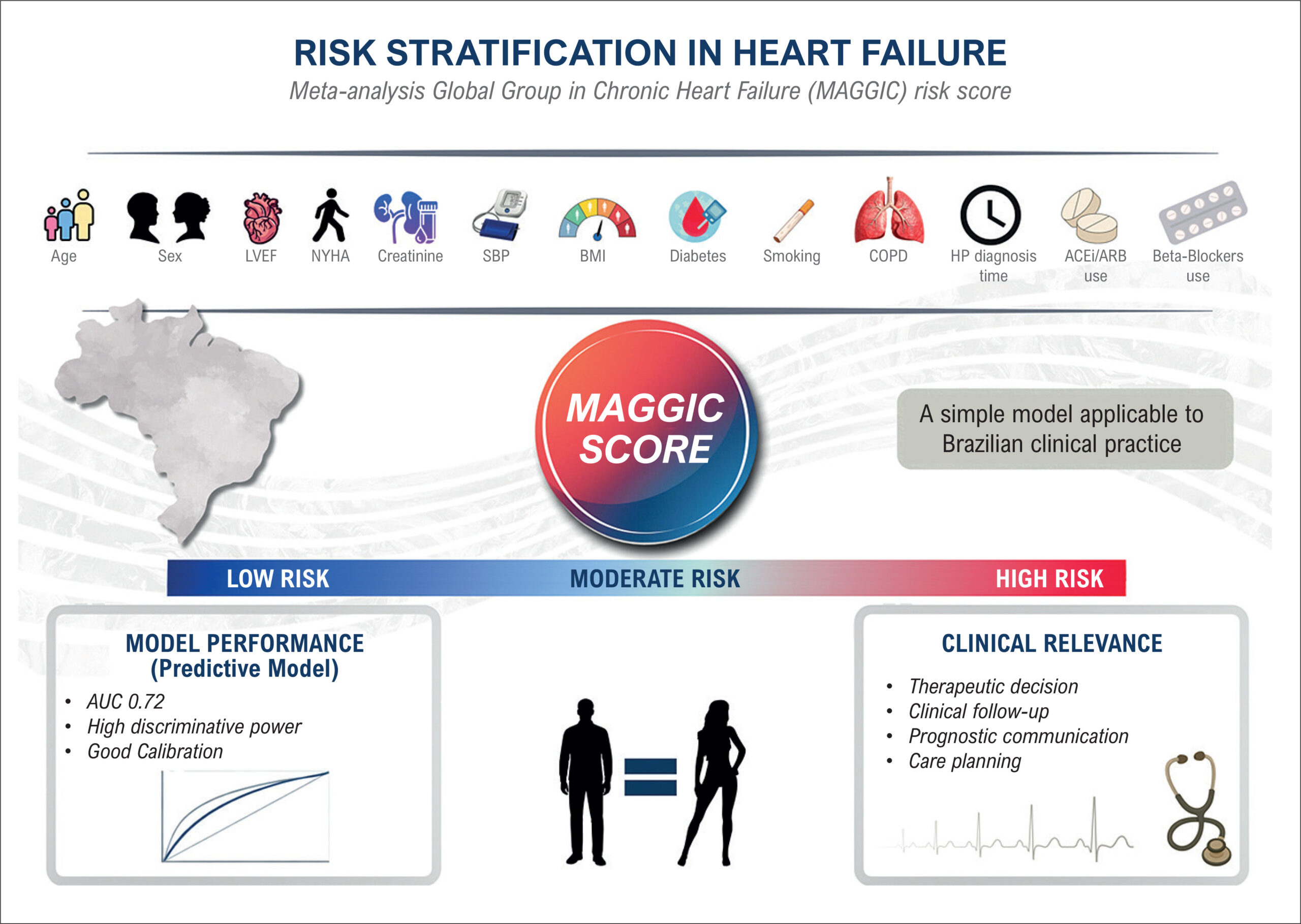
The Meta-Analysis Global Group in Chronic Heart Failure (MAGGIC) score is a risk stratification tool used to predict mortality in heart failure (HF). However, potential sex-related differences in its performance and its applicability to the Brazilian population remain uncertain.

Objectives

To evaluate sex-based differences in the performance of the MAGGIC score and to validate the score in a Brazilian HF cohort.

Methods

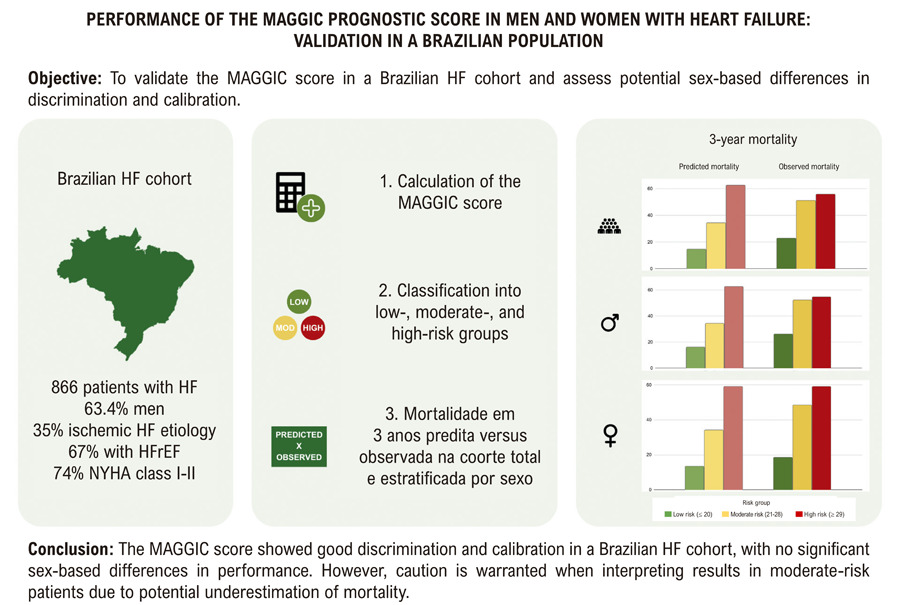
This retrospective cohort study included 866 patients followed at a HF outpatient clinic. The primary outcome was 3-year all-cause mortality. The MAGGIC score was calculated for each patient. Discrimination was assessed using the area under the receiver operating characteristic curve, and calibration was evaluated using the Hosmer-Lemeshow test. Analyses were performed for the overall cohort and stratified by sex. A p-value < 0.05 was considered statistically significant.

Results

The overall 3-year mortality rate was 33.4% (36.4% in men and 27.8% in women; p = 0.010). Predicted mortality was 20.9% (mean score 18.3 ± 7), with 22.7% for men and 19.1% for women. The score demonstrated good discrimination (area under the curve = 0.72; 95% CI: 0.686-0.754), with similar performance in men (0.704 [0.661-0.747]) and women (0.733 [0.674-0.792]). Calibration showed good agreement: overall chi-square (χ2) = 1.1 (p = 0.998), men χ2 = 0.9 (p = 0.999), and women χ2 = 1.3 (p = 0.995). Observed mortality was higher in moderate-risk groups, with no significant difference between moderate- and high-risk groups (p = 0.236).

Conclusion

The MAGGIC score showed good performance in a Brazilian HF cohort, with no significant sex-based differences, although higher observed mortality was identified among moderate-risk patients.

  • Heart Failure
  • Prognosis
  • Risk Assessment
  • Validation Study
Read Full Article
Creative Commons Attribution (CC BY) Creative Commons license
01/05/2026 DOI: 10.36660/abc.20250614i Views 1
Figure 1
ABCIC
Brief Communication

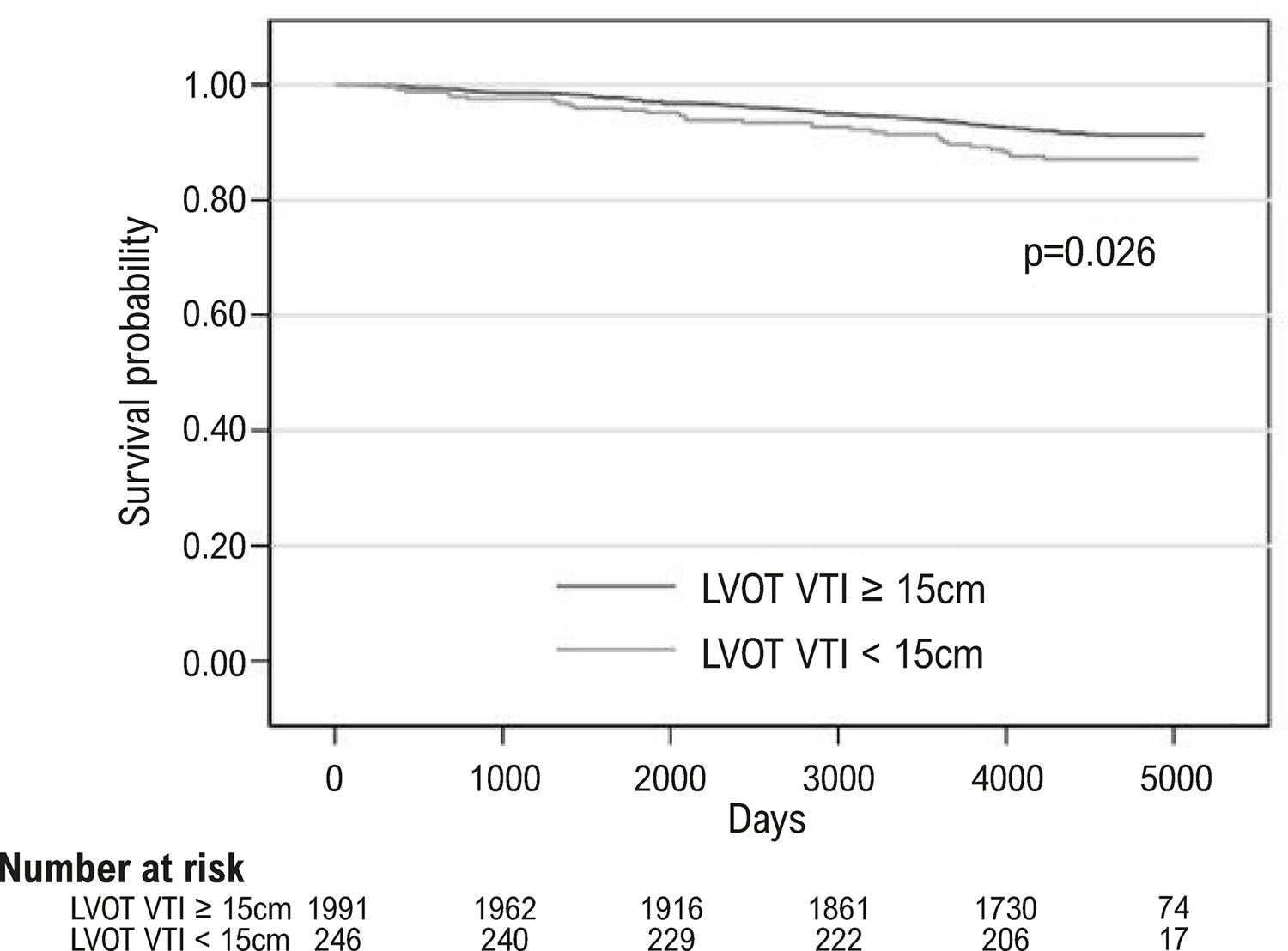
Left Ventricular Outflow Tract Velocity-Time Integral (LVOT VTI) as a Marker of Cardiac Performance: Mortality Data of the ELSA-Brasil Cohort

Mariana de Castro Lopes et al. Altair Ivory Heidemann Jr Eduardo G. Pianca Bruce B. Duncan … Murilo Foppa Angela B.S Santos

Transthoracic Echocardiography (TTE) is a well-established tool for assessing cardiac function and hemodynamics. While Left Ventricular (LV) systolic and diastolic function are commonly used metrics, Cardiac Output (CO) remains central for evaluating hemodynamic status, especially in critical care settings. TTE-derived parameters, such as Left Ventricular Outflow Tract Velocity-Time Integral (LVOT VTI) and LVOT area, when combined with body habitus and heart rate, provide noninvasive estimates of cardiac output. However, the accuracy of CO calculations may decrease when multiple covariates are included, with LVOT diameter being a major source of error. In contrast, isolated LVOT VTI may represent a simpler and more reliable surrogate of cardiac performance.

Among patients with Heart Failure with reduced Ejection Fraction (HFrEF), LVOT VTI values below 12 cm or 8 cm have been associated with worse cardiovascular outcomes, with a progressive increase in risk as VTI decreases., Similarly, in intermediate to high-risk pulmonary embolism, LVOT VTI ≤ 15 cm has been associated with higher in-hospital mortality, cardiopulmonary arrest, shock, and need for reperfusion therapy. In secondary mitral regurgitation, LVOT VTI ≤ 17 cm predicts both cardiovascular and all-cause mortality. And in ambulatory adults with stable Coronary Artery Disease (CAD), LVOT VTI ≤ 18 cm was associated with heart failure hospitalization and mortality. Despite these findings, there is limited data to evaluate the usefulness of LVOT VTI in free-dwelling adults.

[…]

  • Echocardiography
  • Healthy Volunteers
  • Mortality
  • Risk Assessment
Read Full Article
Creative Commons Attribution (CC BY) Creative Commons license
17/04/2026 DOI: 10.36660/abcimg.20260013i Views 2
ABC
Editorial

Brazilian Evidence Reinforces the Applicability of the H2FPEF and HFA-PEFF Scores in HFpEF

Pedro Silvio Farsky

Heart failure with preserved ejection fraction (HFpEF) remains a diagnostic challenge in modern cardiology. Representing approximately half of all heart failure cases, this condition presents with complex pathophysiology, often subjective diagnostic criteria, and more limited therapeutic options., In this context, the use of diagnostic scoring systems, such as H2FPEF and HFA-PEFF, has gained importance, providing clinicians with standardized and evidence-based tools to guide both diagnosis and risk stratification.,

A prospective study conducted at a Brazilian tertiary hospital provides relevant data on the applicability of these scores in our population. Conducted between March 2019 and December 2021, the study included 103 patients diagnosed with HFpEF, who were followed for approximately 2.4 years. In addition to clinical and echocardiographic characterization, all patients underwent exercise testing, and both the H2FPEF and HFA-PEFF scores were calculated. Patients were then categorized into intermediate- and high-probability groups according to the score points obtained and followed for the composite outcome of all-cause mortality and heart failure hospitalizations.

[…]

  • Diastolic Heart Failure
  • Prognosis
  • Risk Assessment
Read Full Article
Creative Commons Attribution (CC BY) Creative Commons license
29/08/2025 DOI: 10.36660/abc.20250361i Views 2
Figure 1
ABC
Original Article

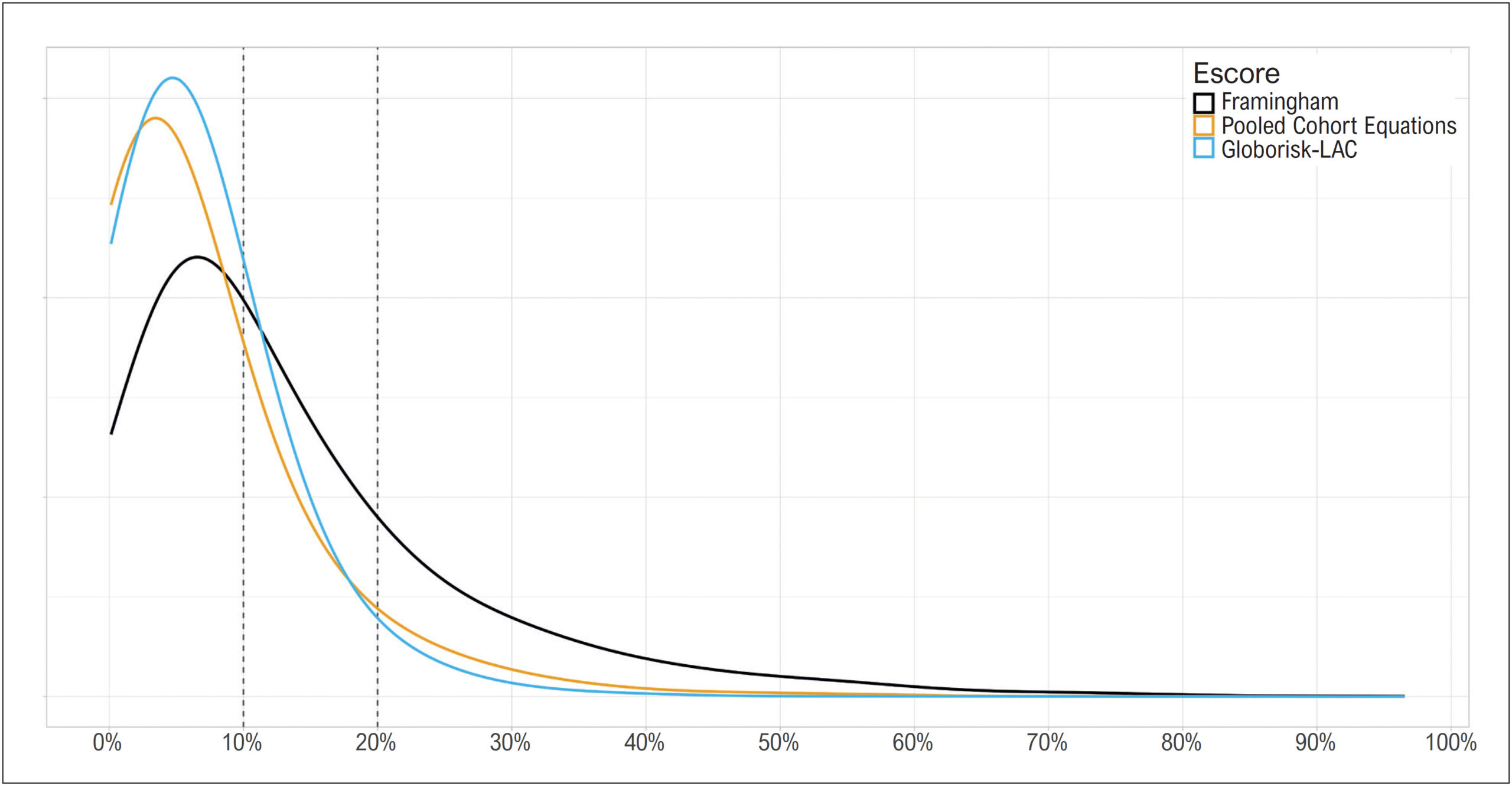
Agreement between Framingham, Pooled Cohort Equations, and Globorisk-LAC in the Estimation of Cardiovascular Risk in Brazil, 2013

Leonardo Ferreira Fontenelle et al. Thiago Dias Sarti Gabriela Callo Quinte Ana Paula Santana Coelho Almeida José Geraldo Mill

Abstract

Background

The Framingham risk score and Pooled Cohort Equations (PCE) have never been recalibrated for the Brazilian population. In contrast, the Globorisk-LAC score was recently derived using a methodology analogous to the PCE and has been recalibrated for Latin American countries.

Objectives

To describe the agreement between the Framingham, PCE, and Globorisk-LAC scores in estimating the 10-year cardiovascular risk in the Brazilian population.

Methods

This cross-sectional study used the three scores to estimate cardiovascular risk in participants aged 40 to 74 years without a history of cardiovascular disease based on data from the 2013 National Health Survey (PNS). The agreement was estimated as (i) the percentage of participants in which the risk estimated by one score was between 0.80 and 1.25 times the risk estimated by another score and (ii) based on the Gwet’s agreement coefficient (AC1) according to risk categories (low, intermediate, and high).

Results

A total of 4,416 participants were included from 8,952 participants from the PNS with a laboratory component. The median (interquartile range) of the estimated 10-year cardiovascular risk was 9.2% (5.1 to 17.8) according to the Framingham, 3.6% (1.7 to 8.2) according to the PCE, and 4.7% (2.8 to 8.1) according to the Globorisk-LAC. The risk estimated using the Framingham agreed with the Globorisk-LAC and PCE in 6.4% and 1.8% of the cases, respectively, whereas the PCE and Globorisk-LAC agreed in 34.7% of the cases. When considering the risk stratification, the respective AC1 values were 0.454, 0.489, and 0.874.

Conclusions

The three cardiovascular risk scores showed low levels of agreement with each other. The reasons for this disagreement suggests that Globorisk-LAC is a strong candidate to replace the Framingham in the Brazilian guidelines for dyslipidemia.

  • Brazil
  • Heart Disease Risk Factors
  • Risk Assessment
Read Full Article
Creative Commons Attribution (CC BY) Creative Commons license
28/07/2025 DOI: 10.36660/abc.20240405i Views 2
TIMI Risk Score for Secondary Prevention to Risk Stratify Chronic Coronary Syndrome Patients: External Validation Study
ABC
Original Article

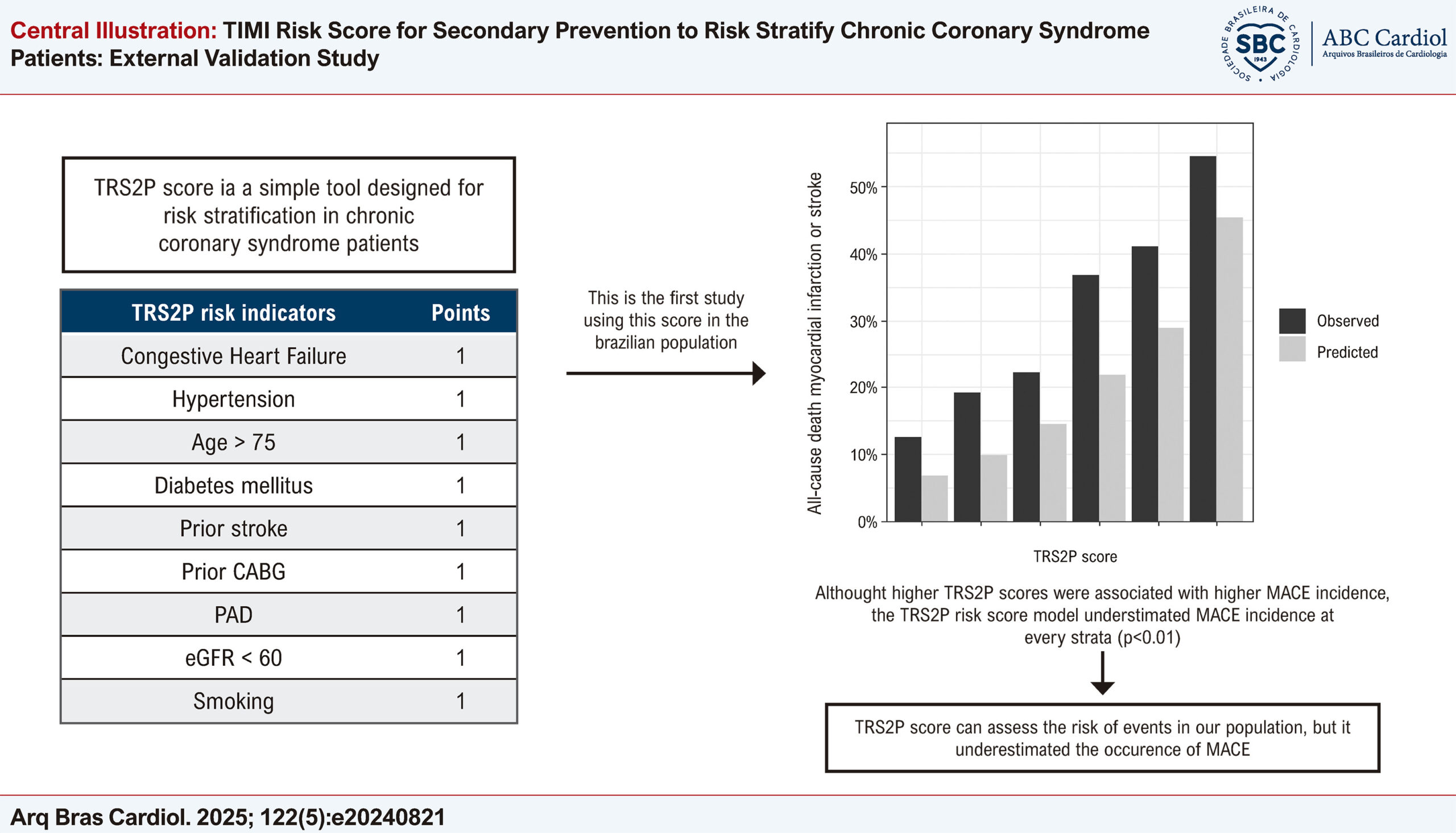
TIMI Risk Score for Secondary Prevention to Risk Stratify Chronic Coronary Syndrome Patients: External Validation Study

Henrique Trombini Pinesi et al. Eduardo Martelli Moreira Marcelo Henrique Moreira Barbosa Fabio Grunspun Pitta … Fabiana Hanna Rached Eduardo Gomes Lima Eduardo Bello Martins Carlos Vicente Serrano Jr

Abstract

Background

Risk stratification in chronic coronary syndrome (CCS) patients is challenging. TIMI Risk Score for Secondary Prevention (TRS2P) is a simple nine-point tool developed to predict cardiovascular death, myocardial infarction (MI), and ischemic stroke among post-MI patients. No studies have been conducted on it in the Brazilian population.

Objective

Validate the TRS2P score among CCS patients at a tertiary center in Brazil.

Methods

This is a registry-based study of patients with CCS, defined as having a previous revascularization procedure, previous MI, or ≥50% stenosis in at least one epicardial coronary artery. The primary outcome was the three-year incidence of MACE (death, MI or stroke). The predicted risk was as reported in the original derivation study. Calibration was assessed through a calibration plot and the Hosmer-Lemeshow test. Discrimination was evaluated through the concordance (C)-statistic. A significance level of 0.05 was adopted.

Results

The study sample consisted of 515 patients. There were 173 (34%) women, 75 (15%) aged over 75 years, 298 (58%) had diabetes, and 156 (30%) had chronic kidney disease. During follow-up, 126 MACE were documented. The estimated three-year incidence was 24% (95% confidence interval [CI] 21%-28%), whereas the predicted incidence was 15%. Although higher TRS2P scores were associated with higher MACE incidence, the TRS2P risk score model underestimated MACE incidence at every strata (p < 0.01). The C-statistic was 0.64 (95% CI 0.58-0.69).

Conclusion

The TRS2P score identifies patients with a higher risk of cardiovascular events but it underestimated MACE and presented poor discrimination in a Brazilian CCS cohort.

  • Coronary Artery Disease
  • Risk Assessment
  • Secondary Prevention
Read Full Article
Creative Commons Attribution (CC BY) Creative Commons license
26/05/2025 DOI: 10.36660/abc.20240821i Views 2
Figure 1
ABC
Research Letter

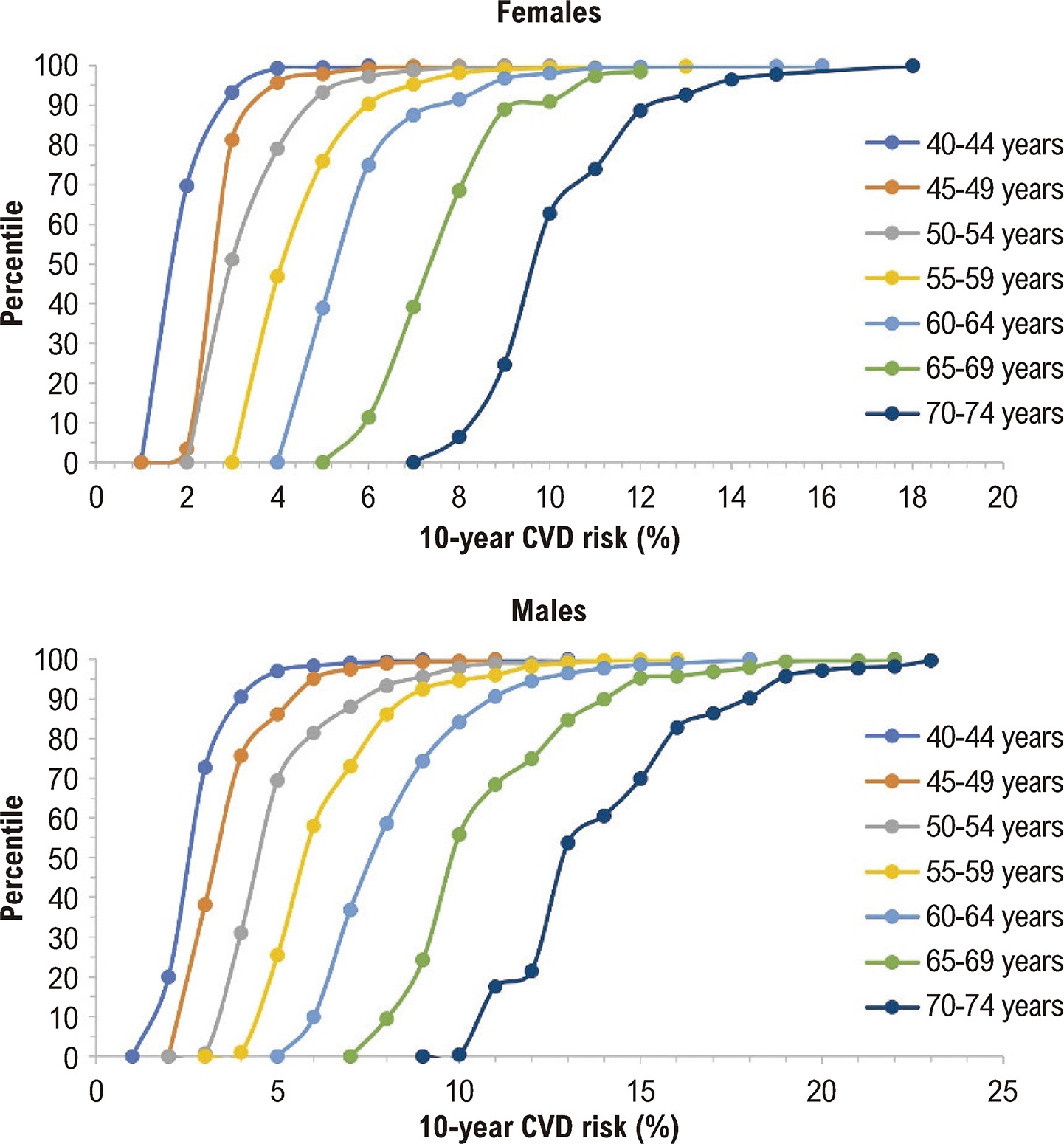
The WHO Cardiovascular Disease Risk (Non-Laboratory-Based) in a Selected Brazilian Population: Percentiles of Distribution And Agreement With Laboratory-Based Scores

Fernando Yue Cesena et al. Giuliano Generoso Itamar de S. Santos Alexandre C. Pereira … Marcio S. Bittencourt Raul D. Santos Paulo A. Lotufo Isabela M. Benseñor

Introduction

In 2019, the World Health Organization (WHO) published revised charts for estimating the 10-year risk of cardiovascular disease (CVD). Two models are proposed: one based on laboratory tests including plasma total cholesterol and presence or absence of diabetes mellitus as predictors, and another based on the body mass index (BMI). In low-resource and office settings, when cholesterol levels and information on diabetes are not available, the BMI-based score can be used.

In a previous study, we determined laboratory-based percentiles of the WHO CVD risk distribution, according to sex and age, in the Brazilian Longitudinal Study of Adult Health (ELSA-Brasil) baseline population. These percentiles were associated with the calculated risk of atherosclerotic CVD up to 75 years, regardless of the estimated 10-year risk. Expressing the risk percentile has been proposed to increase risk awareness and improve adherence to preventive measures.–

[…]

  • body mass index
  • Cardiovascular Diseases
  • Heart Disease Risk Factors
  • Risk Assessment
  • World Health Organization
Read Full Article
Creative Commons Attribution (CC BY) Creative Commons license
26/08/2024 DOI: 10.36660/abc.20240002i
ABC
Editorial

Electrocardiography in the Pre-Operative Assessment of Low-Risk Patients: Current Evidence

Francisco José de Oliveira Filho et al. Leonardo Rufino Garcia Pedro Luciano Mellucci Filho Lenize da Silva Rodrigues Matheus Bertanha

Cardiovascular diseases represent the main cause of mortality in the adult population, both in Brazil and globally. The proportional mortality from these diseases in Brazil is approximately 27%. Cardiovascular alterations become the cause of great concern for patients who will undergo surgical procedures, a time when the body is exposed to a high level of metabolic stress and, therefore, cardiovascular complications can overlap with unfavorable outcomes. Worldwide, it is estimated that annually, approximately 900,000 patients undergoing surgery develop cardiac complications directly related to the surgery. In this context, the perioperative period and, therefore, physiological changes secondary to surgical trauma are a more important risk factor for the manifestation of cardiovascular diseases.

In Brazil, between 2 and 3 million surgeries are performed per year, according to the Department of Informatics of the Unified Health System (DATASUS). The magnitude of the data reiterates the importance of carrying out detailed pre-operative preparation so that the risks related to the surgical procedure are minimized, including cardiological evaluation.

[…]

  • Cardiovascular Diseases/surgery
  • Electrocardiography/methods
  • Neoplasms//surgery
  • Perioperative Care
  • Risk Assessment
Read Full Article
Creative Commons Attribution (CC BY) Creative Commons license
04/03/2024 DOI: 10.36660/abc.20230808 Views 2
Figure 1
ABC
Original Article

Determining Percentiles of Atherosclerotic Cardiovascular Risk According to Sex and Age in a Healthy Brazilian Population

Fernando Yue Cesena et al. Nea Miwa Kashiwagi Carlos Andre Minanni Raul D. Santos

Abstract

Background

Expressing the risk of atherosclerotic cardiovascular disease (ASCVD) as percentiles of the distribution according to sex and age may provide a better perception of the risk.

Objectives

To determine percentiles of the 10-year ASCVD risk distribution according to sex and age in a sample of the Brazilian population; to characterize individuals at low 10-year risk but high risk percentile.

Methods

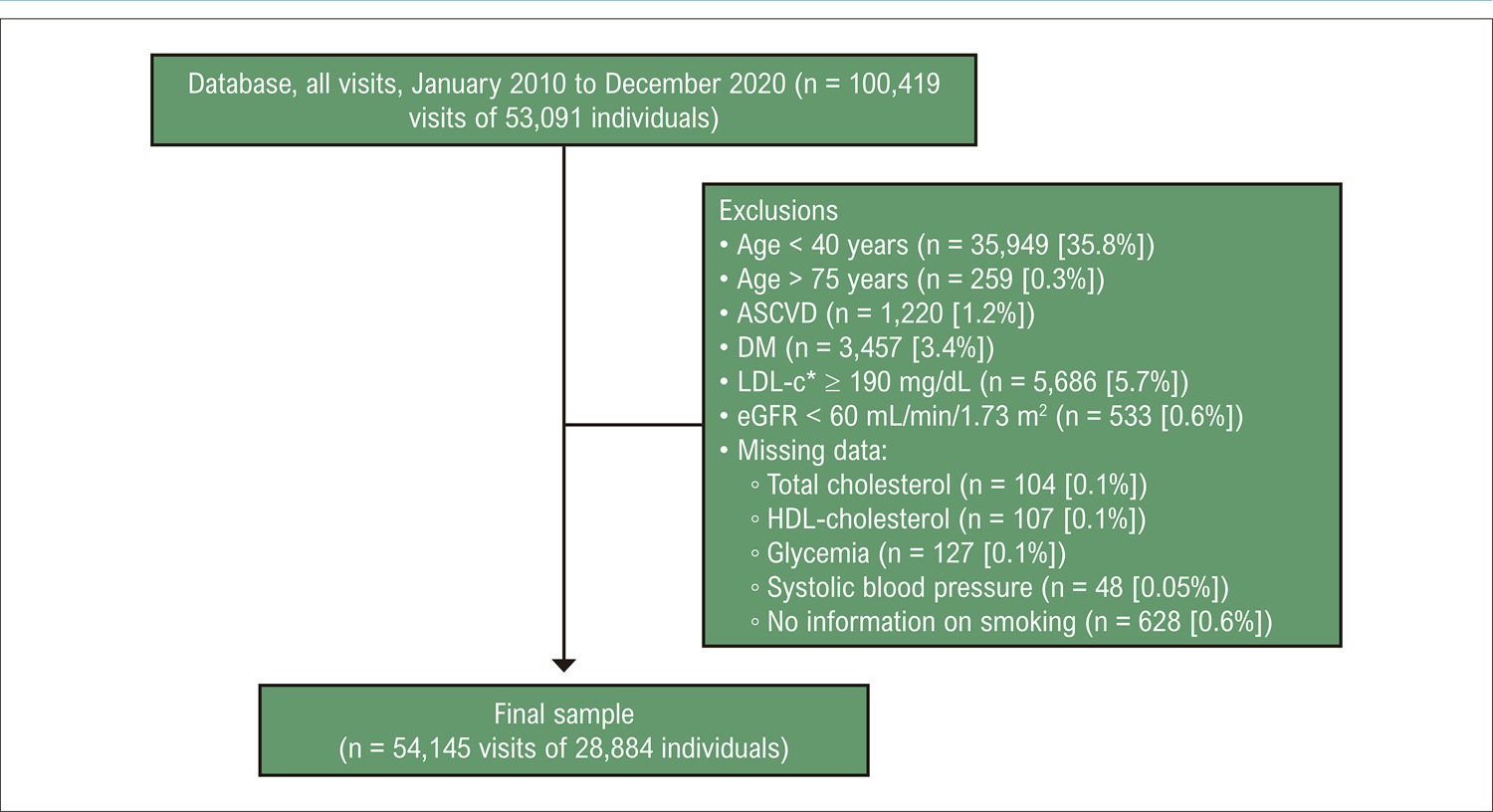
We analyzed individuals aged 40 to 75 years who underwent routine health evaluations from 2010 to 2020. Persons with known clinical ASCVD, diabetes mellitus, chronic kidney disease, or LDL-cholesterol ≥ 190 mg/dL were excluded. The 10-year ASCVD risk was calculated by the ACC/AHA pooled cohort equations. Local polynomial regression was used to determine risk percentiles. Two-sided p-values < 0.050 were considered statistically significant.

Results

Our sample comprised 54,145 visits (72% male, median age [interquartile range] 48 [43, 53] years). We constructed sex-specific graphs plotting age against ASCVD risk corresponding to the 10th, 25th, 50th, 75th, and 90th percentiles. Most males up to 47 years and females up to 59 years above the 75th percentile had a 10-year risk < 5%. Individuals at low 10-year risk and risk percentile ≥ 75th had a high prevalence of excess weight and median (interquartile range) LDL-cholesterol levels 136 (109, 158) mg/dL (males) and 126 (105, 147) mg/dL (females).

Conclusions

We established ASCVD risk percentiles according to sex and age in a large sample of the Brazilian population. This approach may increase risk awareness and help identify younger persons at low 10-year risk who may benefit from more aggressive risk factor control.

  • Cardiovascular Diseases
  • Heart Disease Risk Factors
  • Risk Assessment
Read Full Article
Creative Commons Attribution (CC BY) Creative Commons license
30/06/2023 DOI: 10.36660/abc.20220552 Views 1
ABC
Editorial

Lung Function and Inspiratory Muscle Strength in Heart Failure: Can They be Considered Potential Prognostic Markers?

Filipe Ferrari

Heart failure (HF) is a complex syndrome considered a major public health problem. Different HF subtypes are classically defined based on left ventricular ejection fraction (LVEF). Although its prognosis has improved in recent decades – explained, in part, by major therapeutic advances – HF persists with a high burden of mortality and negatively influences the quality of life., In this sense, common symptoms experienced in this disease, such as shortness of breath and exercise intolerance, contribute greatly to this sharp decline in the quality of life of individuals. Another condition, considered an important risk factor, which usually accompanies HF, is pulmonary dysfunction. The respiratory impairments observed in HF may be related to several reasons, such as an impairment of lung mechanics and gas diffusion, as well as respiratory muscle weakness – aggravating increased dyspnea, being a major limitation on physical exercise.

Spirometry is a widely used test that allows the analysis of lung function – by measuring the amount of air inhaled and exhaled to the maximum. Because chronic obstructive pulmonary disease shares similar signs and symptoms with HF, its identification in individuals with HF can be challenging; in this sense, spirometry can help confirm the diagnosis. About evaluating the potential severity of some lung diseases, the exercise test can also be useful, observing a series of parameters, such as the ratio of forced expiratory volume in 1 second/forced vital capacity (FEV1/FVC). The severity of the disease can still be classified based on FEV1 when it is below the lower limit of normal (ranging from mild when ≥70% of predicted to very severe when <35% of predicted). Although HF itself can lead to a decrease in FEV1 and FVC of about 20% of predicted, in addition to the fact that a worse FEV1 may predict higher mortality, convincing evidence examining the prognostic role of FEV1 in the HF setting still needs further investigation.

[…]

  • Exercise Tolerance
  • Heart Failure
  • Respiratory Insufficiency
  • Respiratory Muscles
  • Risk Assessment
  • Ventricular Function
Read Full Article
Creative Commons Attribution (CC BY) Creative Commons license
29/04/2022 DOI: 10.36660/abc.20211060 Views 2
ABC
Editorial

Treatment Evolution and the Impact of Pre-Surgical Predictors on Outcomes of Patients with Congenital Heart Disease

Maurice Zanini

Congenital heart disease (CHD) is the most common class among malformations. These are important malformations that can compromise the patient’s survival and quality of life. Although there is slight variation among many population-based studies, CHD occurs in approximately 1% of live births (data range from 4 to 10 per 1000 live births), with a similar prevalence worldwide. It is also the main cause of mortality from birth, and its incidence is considered high given its severity. –

Critical CHD is often lethal in the absence of treatment. Since the first repair using cardiopulmonary bypass in 1953, accurate diagnosis and effective treatment have become feasible, even in the case of more complex congenital heart lesions. Effective surgical therapies have increased life expectancy.

[…]

  • Heart Defects,Congenital/surgery
  • Pre-Operative Period
  • Retrospective Studies
  • Risk Assessment
  • Risk Factors
  • Survival
Read Full Article
Creative Commons Attribution (CC BY) Creative Commons license
07/03/2022 DOI: 10.36660/abc.20220020 Views 2
ABC
Original Article

Relationship of Lung Function and Inspiratory Strength with Exercise Capacity and Prognosis in Heart Failure

Sergio Henrique Rodolpho Ramalho et al. Alexandra Correa Gervazoni Balbuena de Lima Fabiola Maria Ferreira da Silva Fausto Stauffer Junqueira de Souza … Lawrence Patrick Cahalin Graziella França Bernardelli Cipriano Gerson Cipriano Junior

Abstract

Background

Spirometry is underused in heart failure (HF) and the extent to which each defect associates with exercise capacity and prognosis is unclear.

Objective

To determine the distinct relationship of continuous %predicted FVC (ppFVC) and FEV1/FVC with: 1) maximal inspiratory pressure (MIP), left ventricular ejection fraction (LVEF), exercise performance; and 2) prognosis for the composite of cardiovascular death, heart transplantation or left ventricular assist device implant.

Methods

A cohort of 111 HF participants (AHA stages C/D) without diagnosed pneumopathy, spirometry, manovacuometry and maximum cardiopulmonary test. The association magnitudes were verified by linear and Cox (HR; 95% CI) regressions, age/sex adjusted. A p<0.05 was considered significant.

Results

Age was 57±12 years, 60% men, 64% in NYHA III. Every 10%-point increase in FEV1/FVC [β 7% (95% CI: 3–10)] and ppFVC [4% (2-6)] associated with ventilatory reserve (VRes), however only ppFVC associated with MIP [3.8 cmH2O (0.3-7.3)], LVEF [2.1% (0.5-3.8)] and VO2peak [0.5 mL/kg/min (0.1–1.0)], accounting for age/sex. In 2.2 years (mean), 22 events occurred, and neither FEV1/FVC (HR 1.44; 95% CI: 0.97–2.13) nor ppFVC (HR 1.13; 0.89–1.43) was significantly associated with the outcome. Only in the LVEF ≤50% subgroup (n=87, 20 events), FEV1/FVC (HR 1.50; 1.01–2.23), but not ppFVC, was associated with greater risk.

Conclusions

In chronic HF, reduced ppFVC associated with lower MIP, LVEF, VRes and VO2peak, but no distinct poorer prognosis over 2.2 years of follow-up. Distinctively, FEV1/FVC was associated only with VRes, and, in participants with LVEF ≤50%, FEV1/FVC reduction proportionally worsened prognosis. Therefore, FEV1/FVC and ppFVC add supplementary information regarding HF phenotyping.
  • Exercise Tolerance
  • Respiratory Insufficiency
  • Respiratory Muscles
  • Risk Assessment
  • Ventricular Function
Read Full Article
Creative Commons Attribution (CC BY) Creative Commons license
07/02/2022 DOI: 10.36660/abc.20201130
ABC
Editorial

Predictive Models to Enhance our Knowledge: Is It Necessary?

Marcia M. Noya-Rabelo et al. Diogo Freitas Cardoso de Azevedo Olga Ferreira de Souza

Heart Failure (HF) is a condition with an adverse prognosis; 1-year mortality rates in population-based studies have been reported to be 35% to 40%. – In Brazil, BREATHE registry, large sample of hospitalized patients with decompensated heart failure from different regions, demonstrated high intrahospital mortality (12.6%). Although HF admission decreased from 2008 to 2017, it was observed increased rate of length of stay for heart failure in hospitalized patients. Accurate prognostic information may enhance our ability to predict outcomes, thus informing decisions for patients. Numerous demographics, clinical and biochemical variables have been reported to provide important prognostic value in patients with heart failure, and several predictive models have been developed. Therefore, knowledge of mortality predictors can be used to generate predictive models that can aid clinicians’ decision making by identifying patients who are at high or low risk of death.

Although most previous models are comprehensive and well-validated, there are still some limitations. First, some models were constructed in the period before the recent guideline-directed pharmacological treatment. Second, most previous models aimed to predict the short-term mortality rate. In addition, most were built using population in Western countries. As we have already known, factors that predict mortality in the community setting may differ.

[…]

  • Cardiovascular Diseases
  • China/epidemiology
  • Heart Failure
  • Hospitalization
  • Risk Assessment
Read Full Article
Creative Commons Attribution (CC BY) Creative Commons license
25/10/2021 DOI: 10.36660/abc.20210733 Views 1
Figure 1
ABC
Original Article

Value of left atrial diameter with CHA2DS2-VASc score in predicting left atrial/left atrial appendage thrombosis in non-valvular atrial fibrillation

Yu Zhang et al. Yi-Qiang Yuan

Abstract

Background

Atrial fibrillation is the most common persistent arrhythmia, and is the main factor that leads to thromboembolism.

Objective

To investigate the value of left atrial diameter combined with CHA2DS2-VASc score in predicting left atrial/left atrial appendage thrombosis in non-valvular atrial fibrillation.

Methods

This is a retrospective study. 238 patients with non-valvular atrial fibrillation were selected and divided into two groups: thrombosis and non-thrombosis. CHA2DS2-VASc score was determined. P<0.05 was considered statistically significant.

Results

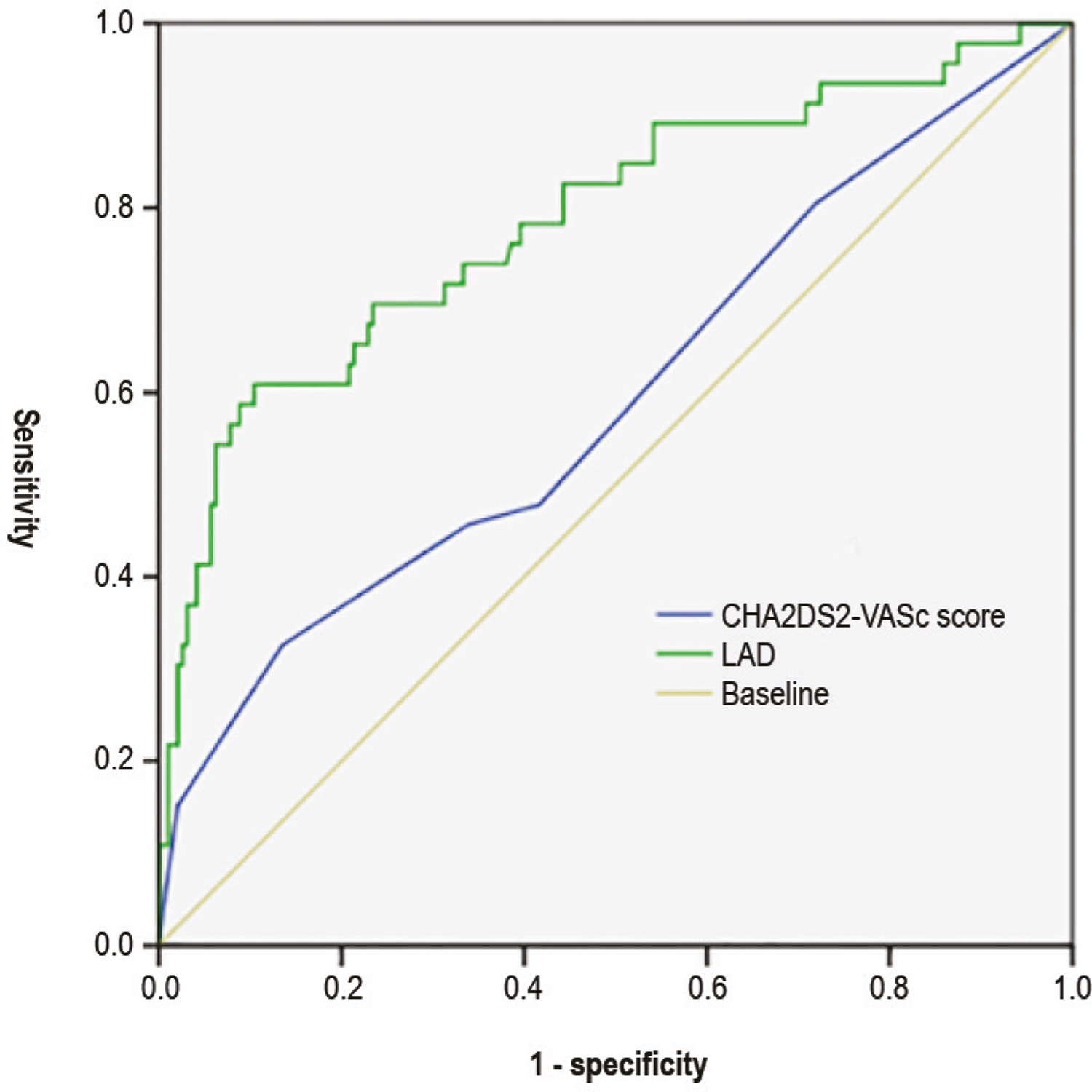
Multivariate logistic regression analysis revealed that the history of stroke/transient ischemic attack, vascular disease, CHA2DS2-VASc score, left atrial diameter (LAD), left ventricular end-diastolic dimension (LVEDD) and left ventricular ejection fraction (LVEF) were independent risk factors for left atrial/left atrial appendage thrombosis (p<0.05). Receiver operating characteristic curve analysis revealed that the area under the curve for the CHA2DS2-VASc score in predicting left atrial/left atrial appendage thrombosis was 0.593 when the CHA2DS2-VASc score was ≥3 points, and sensitivity and specificity were 86.5% and 32.6%, respectively, while the area under the curve for LAD in predicting left atrial/left atrial appendage thrombosis was 0.786 when LAD was ≥44.17 mm, and sensitivity and specificity were 89.6% and 60.9%, respectively. Among the different CHA2DS2-VASc groups, the incidence rate of left atrial/left atrial appendage thrombosis in patients with LAD ≥44.17 mm was higher than patients with LAD <44.17 mm (p<0.05).

Conclusion

CHA2DS2-VASc score and LAD are correlated with left atrial/left atrial appendage thrombosis in non-valvular atrial fibrillation. For patients with a CHA2DS2-VASc score of 0 or 1, when LAD is ≥44.17 mm, the risk for left atrial/left atrial appendage thrombosis remained high. (Arq Bras Cardiol. 2020; [online].ahead print, PP.0-0)

  • Atrial Appendage
  • Atrial Fibrillation Non Valvar
  • Heart Atria
  • Propensity Score
  • Risk Assessment
  • Stroke
Read Full Article
Creative Commons Attribution (CC BY) Creative Commons license
01/01/2021 DOI: 10.36660/abc.20190492 Views 1
Figure 1
IJCS
Original Article

Prognosis of Heart Failure with Preserved Ejection Fraction in Primary Care by the H2FPEF Score

Antonio Jose Lagoeiro Jorge et al. Maria Luiza Garcia Rosa Wolney de Andrade Martins Adson Leite … Dayse Mary da Silva Correia Maria Auxiliadora Nogueira Saad Humberto Villacorta Sergio Chermont Ronaldo Altenburg Gismondi Breno Macedo Almeida Evandro Tinoco Mesquita

Abstract

Background:

Primary care physicians have difficulty dealing with patients who have HF with preserved LVEF(HFpEF). The prognosis of HFpEF is poor, and difficult to predict on primary care.

Objective:

The aim of the study is to apply the H2FPEF score to primary care patients and verify its power to assess the risk of death or hospitalization due to cardiovascular disease.

Methods:

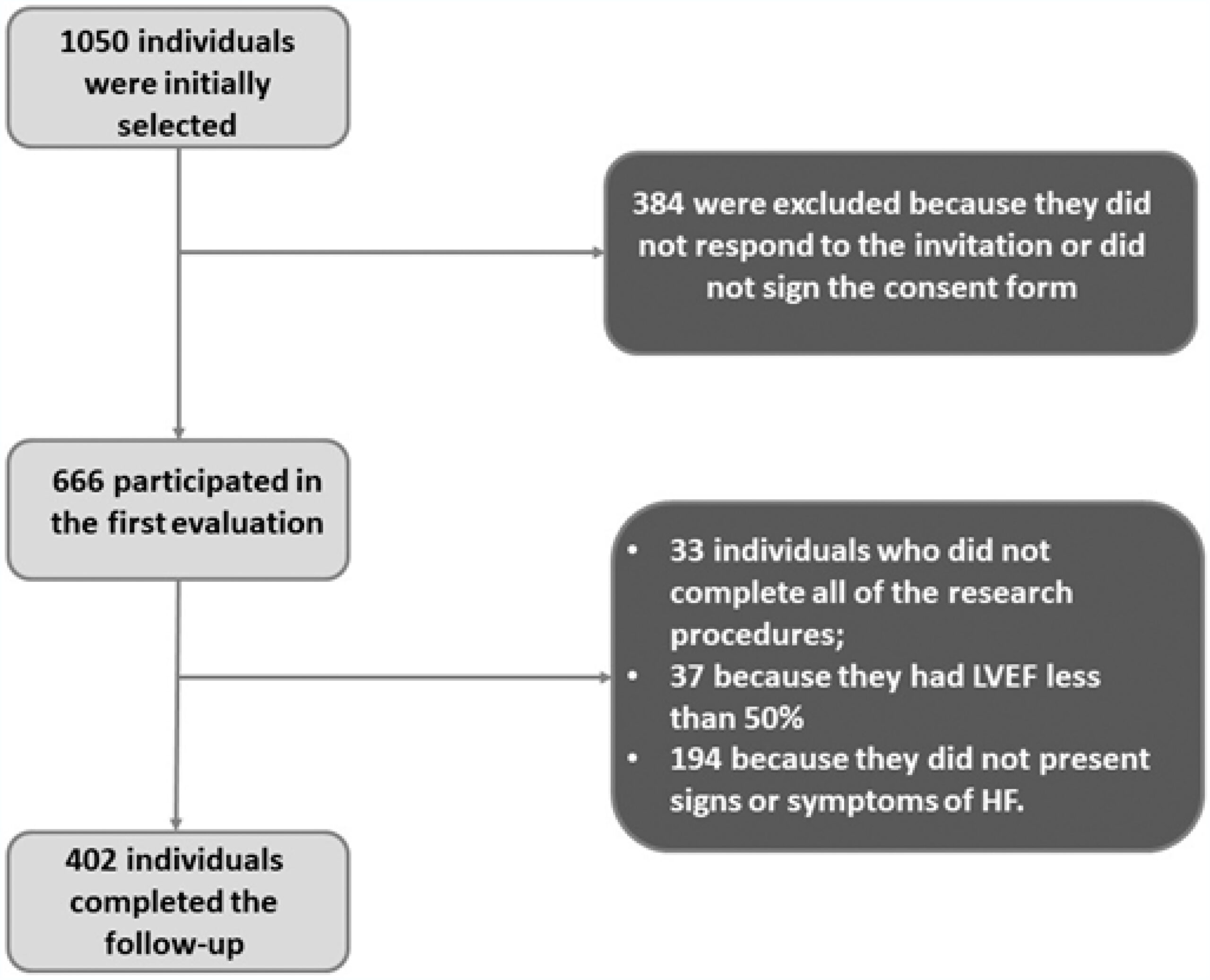
This longitudinal study included 402 individuals, with signs or symptoms of HF, aged≥45 years and, underwent an evaluation which included clinical examination, BNP and echocardiogram. The diagnosis of HFpEF was confirmed by the criteria of the European Society of Cardiology. After five years, the patients were reassessed as to the occurrence of the composite outcome, death from any cause or hospitalization for cardiovascular disease. H2FPEF used six variables: body mass index, medications for hypertension, age, pulmonary artery systolic pressure, atrial fibrillation and E/e’ ratio ranged from 0 to 9 points. The level of statistical significance was p<0.05.

Results:

HFpEF was diagnosed in 58(14.4%). Among patients with H2FPEF≥4, 30% had HFpEF and in those with a score≤4, HFpEF was present in 12%. Patients with HFpEF and H2FPEF≥4 had 53% of outcomes, whereas patients with HFpEF and a score ≤4 had a 21% of outcomes. BNP values were higher in patients with HFpEF compared to those without HFpEF(p<0.0001).

Conclusion:

H2FPEF≥4 indicated a worse prognosis in patients with HFpEF assisted in primary care. H2FPEF may be a simple and useful tool for risk stratification in patients with HFpEF at the primary care.

  • H2FPEF Score
  • Heart Failure
  • Morbidity
  • Mortality
  • Risk Assessment
  • Stroke Volume
Read Full Article
Creative Commons Attribution (CC BY) Creative Commons license
25/11/2020 DOI: 10.36660/ijcs.20200076 Views 1
Figure 1
IJCS
Original Article

Atrial Fibrillation and Use of Rivaroxaban: Performance of the Prothrombin Time / INR as a Function of Time After Blood Collection

Rita Carolina Figueiredo Duarte et al. Priscila Samara Sérgio Moreira Cláudia Natália Ferreira Estevão Lanna Figueiredo … Eduardo Sternick Francisco Rezende Silveira Luan Carlos Vieira Alves Ana Paula Lucas Mota Edna Afonso Reis Maria das Graças Carvalho Helton José dos Reis

Abstract

Background

Traditionally, the most effective therapy in the prevention of stroke in patients with atrial fibrillation (AF) has been oral anticoagulation with vitamin K inhibitors, particularly warfarin, whose disadvantages and adverse effects have led to their replacement by “direct oral anticoagulants”, as factor X inhibitor.

Objectives

This study aimed to conduct a brief approach on atrial fibrillation (AF) and use of Rivaroxaban, and to comparatively evaluate the prothrombin time / International Normalized Ratio (PT/INR) in patients with AF in use of this oral anticoagulant, depending on the time elapsed between the last administration of the drug and the time of blood sample venipuncture.

Methods

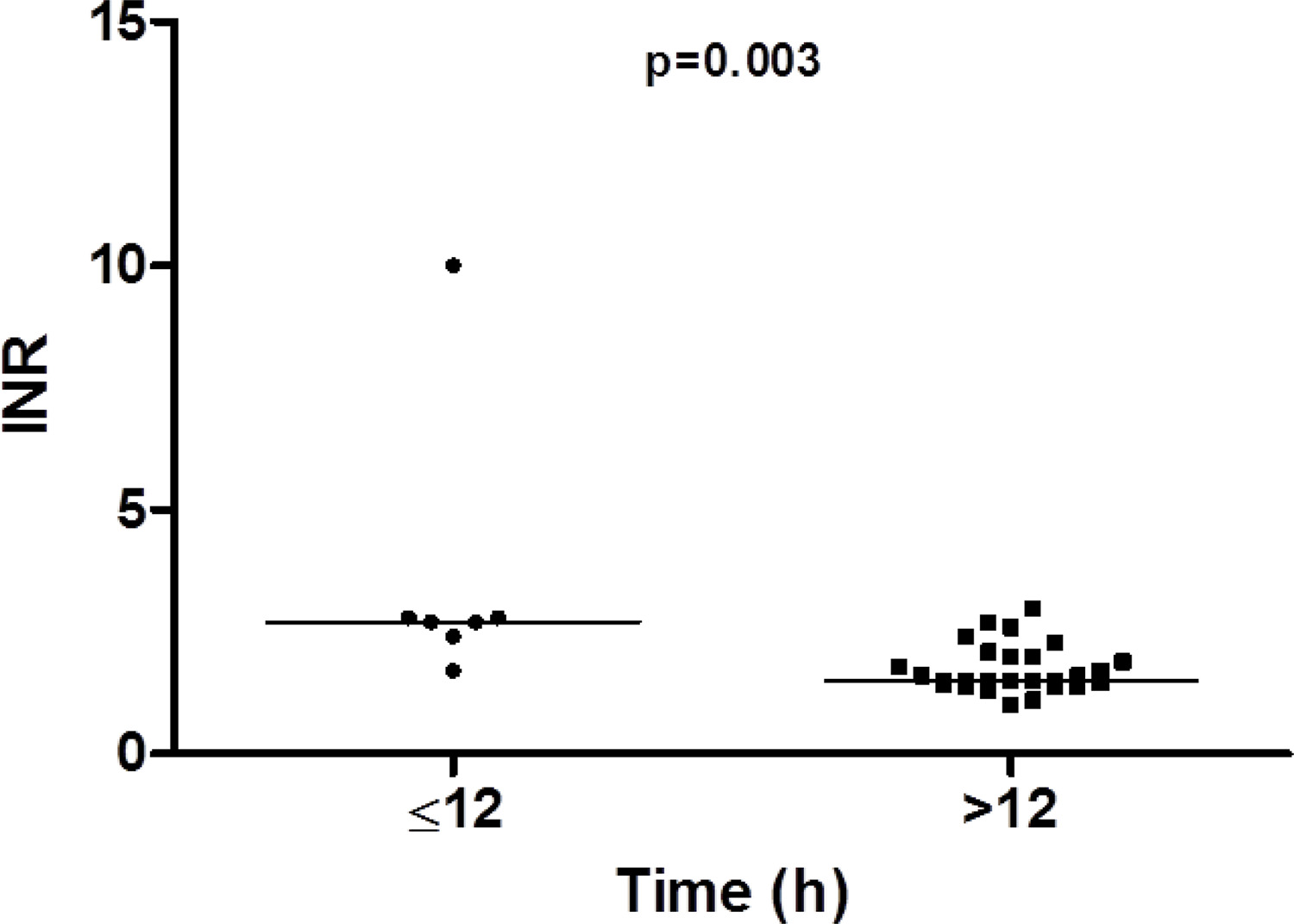
We evaluated 34 patients with AF in use of Rivaroxaban by using PT / INR, distributed into a subgroup with blood collection time ≤ 12 hours (n = 7) and > 12 hours after the last drug intake (n = 27). Mann-Whitney test was used to compare the groups and p < 0.05 was considered significant.

Results

An analysis as a function of time between the Rivaroxaban intake and blood collection, revealed that PT / INR suffers the greatest effect up to 12 hours after ingestion of the drug, dropping to levels close to normal in subsequent hours before the next dose.

Conclusion

We concluded that, in contrast to warfarin, the knowledge of the time interval between drug intake and blood collection from patients taking Rivaroxaban is essential to properly interpret a laboratory test to assess hemostasis, particularly PT and its derivatives. Int J Cardiovasc Sci. 2020; [online].ahead print, PP.0-0

  • Anticoagulants
  • Atrial Fibrillation
  • blood coagulation
  • Embolism
  • Hemorrhage/physiopathology
  • Risk Assessment
  • Rivaroxaban
  • Stroke
  • Warfarin
Read Full Article
Creative Commons Attribution (CC BY) Creative Commons license
06/11/2020 DOI: 10.36660/ijcs.20190141 Views 1
Figure 1
IJCS
Original Article

Risk Stratification in Chest Pain: Impact on the Diagnosis of Acute Coronary Syndrome

Ana Paula Paz Reis et al. Karen Brasil Ruschel Maria Antonieta P. de Moraes Karlyse Belli … Marco Lumertz Saffi Jaqueline Eilert Fagundes

Abstract

Background

The implementation of institutional protocols in the emergency department (ED) for risk stratification in patients with chest pain has been recommended.

Objective

To assess the sensitivity, specificity and predictive value of an institutional risk stratification protocol for chest pain suggestive of acute coronary syndrome (ACS).

Method

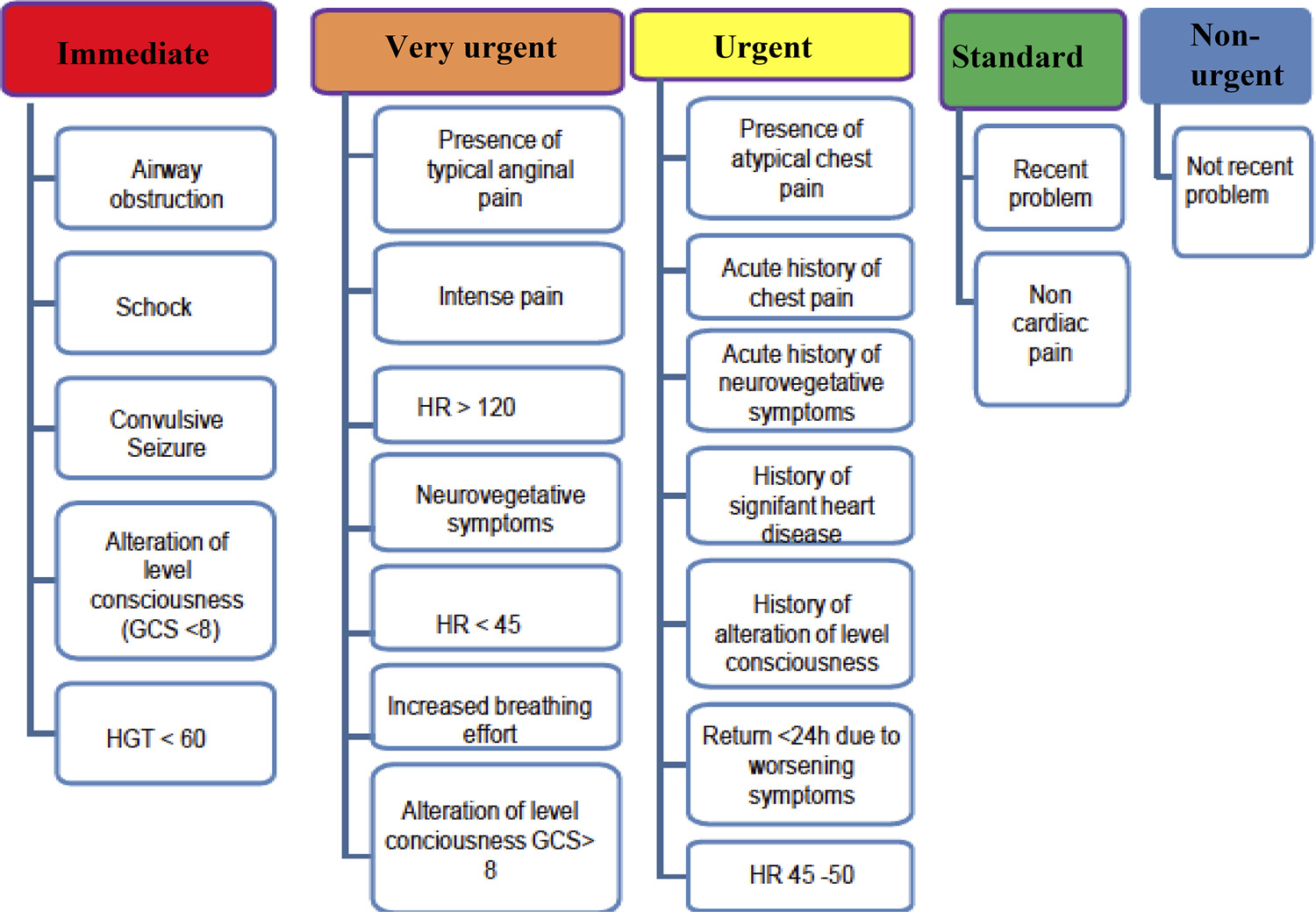
Cross-sectional study conducted based on the computerized records of patients treated with the use of a chest pain protocol adapted from the Manchester protocol. The level of risk was stratified by applying five colors representing the respective levels. Each color represents a level of severity and a maximum waiting time for receiving medical care. Red and orange were considered to be high priority, while patients with yellow, green or blue indications were considered to represent a low priority. To compare the type of diagnosis and the classification of priority for receiving care, the Pearson’s chi-square test was used, considering a significance level of p< 0.05 for all tests.

Results

The records of 1,074 patients admitted to the cardiology ED were analyzed. Men (54%), with a mean age of 60 ± 15 years, with complaints of chest pain (44%) of moderate intensity (80%) were predominant the study. Of these patients, 19% were classified as high priority, while 81% were considered to represent a low priority. ACS was confirmed in 23% of the patients, with 34% of them being classified as high priority and 66% as low priority. The sensitivity of the risk stratification protocol for chest pain was 33.7% and the specificity was 86.0%, with a positive and negative predictive value of 41.7% and 81.3%, respectively.

Conclusion

The Institutional risk stratification protocol for chest pain suggestive of ACS presented satisfactory specificity and a low degree of sensitivity. Int J Cardiovasc Sci. 2020; [online].ahead print, PP.0-0

  • Acute coronary syndrome
  • Chest Pain
  • Emergency Medical Services
  • Risk Assessment
  • Risk Factors
  • Sensitivity and Specifity
Read Full Article
Creative Commons Attribution (CC BY) Creative Commons license
28/08/2020 DOI: 10.36660/ijcs.20190178
ABC
Editorial

Short Editorial: Distinct Prognostic Competence between the Clinical and Anatomical Models in Acute Coronary Syndromes: Comparison by Type of Outcome

Roberto Coury Pedrosa

Cardiovascular events, especially acute myocardial infarction, are the main causes of death in Brazil. In some European countries (e.g., France, Portugal, Italy), the 30-day mortality rates due to infarction have declined in recent decades to as low as 3% to 5%. This reflects the organization of healthcare logistics, including pre-hospital care, unified protocols, training, central regulation, and commitment to care. In Brazil, the 30-day mortality rates vary from 3% to 5% in advanced centers and 30% in those where care does not apply the recommended guidelines. This disparity usually reflects a still deficient public healthcare system that lacks diagnostic flowcharts, institutional protocols, central regulation, or professionals who are able to interpret the diagnosis for infarction using an electrocardiogram (ECG). Unfortunately, we still find that many centers lack equipment in emergency sectors (defibrillator, intubation materials, ventilators, electrocardiographs, vasoactive drugs, cardiac monitors, temporary pacemakers, and fibrinolytic drugs) and coronary units, as well as the lack of qualified professionals to provide the best treatment.

The recognition that acute coronary syndromes (ACS) constitute a heterogeneous disease in relation to prognosis was fundamental for the correct identification of individuals at higher risk, who require more intensive intervention. It has been shown that not all patients with ACS belong to high or very high risk categories; there is a considerable percentage consisting of young patients without classic risk factors that can be adequately classified into intermediate or even low risk categories. Thus, it is important to identify those patients at higher risk who need more intensive treatment. Important clinical studies have contributed to the evolution of the approach to patients with ACS. – Currently, the emerging focus on the involvement of socioeconomic factors in cardiovascular risk has been constantly reported.

[…]

  • Acute coronary syndrome
  • Cardiovascular Diseases, mortality
  • Diagnostic Equipment
  • Myocardial Infarction
  • Organizationa and Administration
  • Percutaneous Coronary Intervention
  • Public Health
  • Risk Assessment
Read Full Article
Creative Commons Attribution (CC BY) Creative Commons license
28/08/2020 DOI: 10.36660/abc.20200758 Views 1
Figure 1
IJCS
Original Article

Correlation between Surgical Risk Scales with Respiratory Muscle Strength and Functional Independence in Patients Submitted to Coronary Artery Bypass Grafting

André Luiz Lisboa Cordeiro et al. Átila Darlan Queiroz de Brito Graziele Freitas Almeida Leilane Souza Jesus … Flávia de Araújo Oliveira Janinne Lima da Silva André Raimundo França Guimarães Roberto Moreno Barros

Abstract

Background

The European Heart Surgery Risk Assessment System (EuroSCORE) and InsCor have been used to predict complications of cardiac surgery. However, their application to predict lung function and functionality is still uncertain.

Objective

To correlate surgical risk scales with functional independence and pulmonary function in patients undergoing coronary artery bypass grafting.

Methods

This was a prospective cohort study. In the preoperative period, the two surgical scales were applied, the maximal inspiratory pressure (MIP), maximal expiratory pressure (MEP), and peak expiratory flow (PEF) were measured, and functionality was assessed using the functional independence measure (FIM). On the seventh postoperative day, the pulmonary function and functionality variables were reevaluated, compared with the preoperative values (delta) and correlated with the risk scales. Correlations of pulmonary function, functional independence and muscle strength variables with the surgical scales were made by Pearson correlation test. The significance level adopted was 5%.

Results

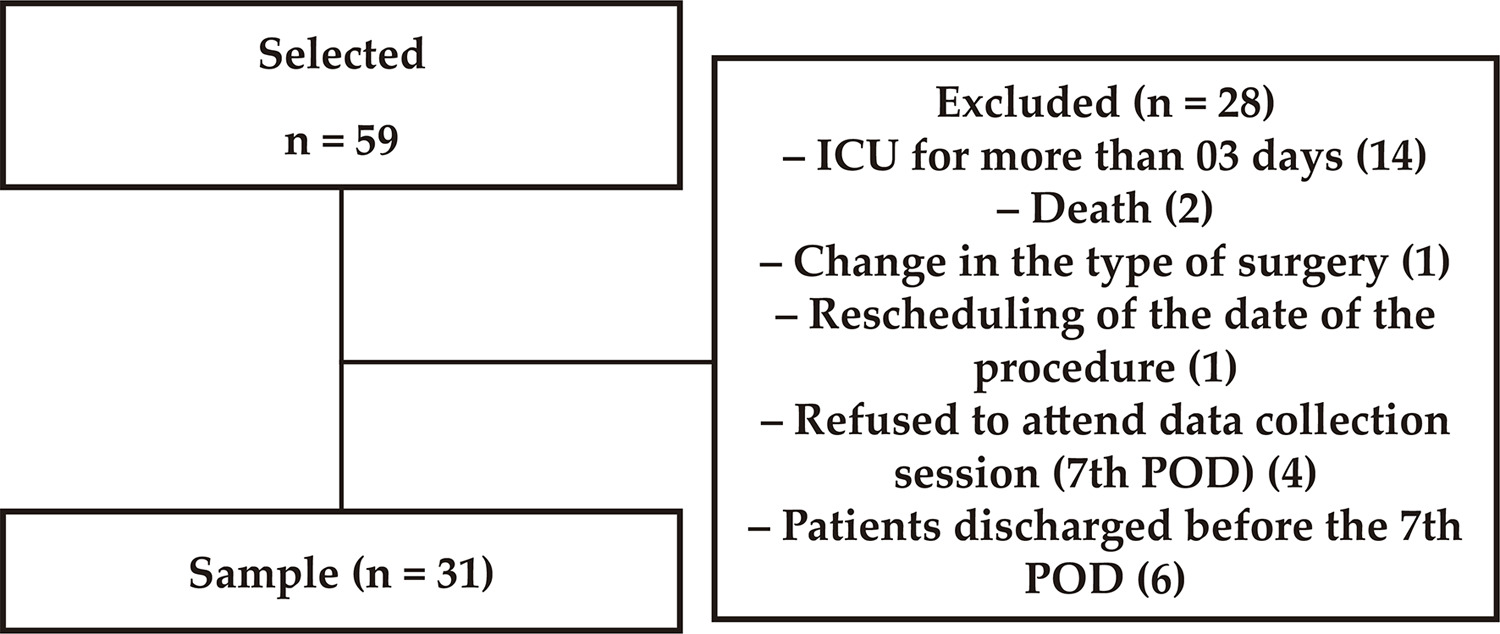
Thirty-one patients were studied; most were male (77%), with a mean age of 56±8 years. Mean EuroSCORE was 2.3±0.5 and mean InsCOR was 1.2±0.5. MIP, MEP, and PEF reduced 30% (p<0.001), 33% (p<0.001) and 10% (p=0.23), respectively. The EuroSCORE correlated with MIP (r-0.78; p = 0.02) and FIM (r-0.79; p <0.01), and the InsCor correlated with MIP (r-0.77), MEP (r-0.73) and MIF (r-0.89; p=0.02).

Conclusion

The EuroSCORE showed a strong negative correlation with MIP and FIM, while InsCor had a strong negative correlation with MIP, MEP and FIM. (Int J Cardiovasc Sci. 2020; [online].ahead print, PP.0-0)

  • Cardiovascular Diseases, mortality
  • Muscle Stremght
  • Myocardial Revascularization
  • Physical Therapy Speciality
  • Postoperative Care
  • Pre-Operative Care
  • Respiratory Pressures
  • Risk Assessment
Read Full Article
Creative Commons Attribution (CC BY) Creative Commons license
15/07/2020 DOI: 10.36660/ijcs.20190161 Views 1
Graph 1
IJCS
Original Article

Reliability between Cardiovascular Risk Assessment Tools: A Pilot Study

Rodrigo Conill Marasciulo et al. Ana Maria Nunes de Faria Stamm Guilherme Thomé Garcia Antônio Carlos Estima Marasciulo … Ariel Córdova Rosa Alexandre Augusto de Costa Remor Cristian Battistella

Abstract

Background

The prevention of cardiovascular disease (CVD) is important in clinical practice due to its high morbidity and mortality. Different guidelines have recommended the use of different cardiovascular risk assessment tools, which may have implications on therapeutic decisions.

Objective

To evaluate the agreement rate between the Framingham risk score (FRS) and the Systematic Coronary Risk Evaluation (SCORE) tool on CVD risk assessment in disease-free subjects.

Methods

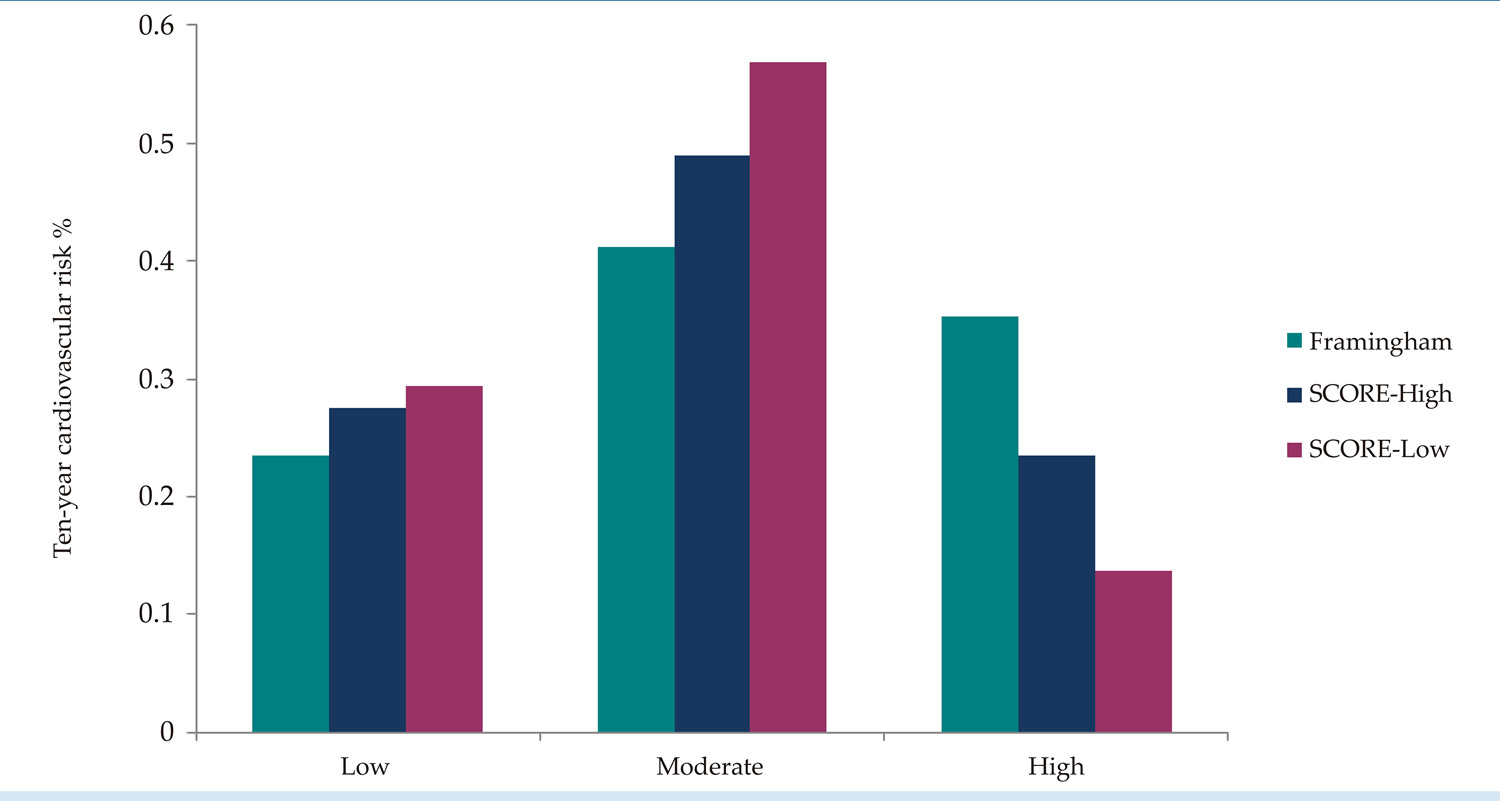
Cross-sectional study with a sample of 51 subjects treated at the outpatient clinic of a university hospital in Brazil between January 2014 and January 2015. The FRS and two versions of the European SCORE (SCORE-High and SCORE-Low) were used to assess CVD risk; patients were classified as low/moderate risk (< 20% and <5%, respectively) or high risk (≥ 20% and ≥5%, respectively). The agreement rate was evaluated using kappa statistics, a test for interrater reliability that ranges from -1 to 1, and results above 0.6 represent a high agreement rate.

Results

The FRS classified a higher proportion of subjects as high risk for CVD (35.3% [18/51] vs. 23.5% [12/51] with the SCORE-High and 13.7% [7/51] with SCORE-Low). However, there was a high agreement rate between FRS and SCORE-High (k=0.628). The agreement between FRS and SCORE-Low was poor (k=0.352).

Conclusions

There was a high agreement rate between FRS and SCORE-High in cardiovascular risk assessment in the study sample. (Int J Cardiovasc Sci. 2020; [online].ahead print, PP.0-0)

  • Cardiovascular Diseases/prevention and control
  • Cross-Sectional Studies
  • diabetes
  • Hypertension
  • Morbidity
  • Mortality
  • Risk Assessment
  • Risk Factors
Read Full Article
Creative Commons Attribution (CC BY) Creative Commons license
07/07/2020 DOI: 10.36660/ijcs.20190157 Views 1
ABC
Editorial

Why We Build Models – From Clinical Cardiology Practice to Infectious Disease Epidemics

Marcio Sommer Bittencourt

Francisco, 64 years old, comes to your office for a preventive health evaluation. He has a history of well-controlled hypertension and is otherwise well. His past medical history is unremarkable. No family history of cardiovascular disease or smoking and LDL-cholesterol (LDL-C) of 90 mg/dL. After discussing with the patient, you are unsure if this patient’s risk benefit profile would favor the use of statins. Instead of trusting your personal feelings, you decide to use the Framingham risk score (FRS) to decide if statins would be recommended. The calculated Framingham score is 8.1% and you decide not to initiate statins at this point.

One month later, Francisco returns to your office with typical angina on major exertion but has no signs of unstable disease. Once again, to avoid overconfidence on your initial impression, you decide to use the Diamond and Forrester (DF) chest pain prediction rule, which estimates the pretest probability of obstructive coronary artery disease (CAD). For a male at his age, the rule suggests a pretest probability of 94% (high probability), so you decide to request an invasive angiography in the outpatient setting.

[…]

  • Biomarkers
  • Cardiovascular Diseases
  • Coronavirus
  • COVID-19
  • Pandemics
  • Prevention and Control
  • Risk Assessment
  • Risk Factors
  • Risk reduction Behavior
Read Full Article
Creative Commons Attribution (CC BY) Creative Commons license
03/07/2020 DOI: 10.36660/abc.20200527 Views 1
Figure 1
ABC
Original Article

Analysis of Risk Scores to Predict Mortality in Patients Undergoing Cardiac Surgery for Endocarditis

Fernando Pivatto Júnior et al. Clarissa Carmona de Azevedo Bellagamba Eduardo Gatti Pianca Fernando Schmidt Fernandes … Maurício Butzke Stefano Boemler Busato Miguel Gus

Abstract

Background

Risk scores are available for use in daily clinical practice, but knowing which one to choose is still fraught with uncertainty.

Objectives

To assess the logistic EuroSCORE, EuroSCORE II, and the infective endocarditis (IE)-specific scores STS-IE, PALSUSE, AEPEI, EndoSCORE and RISK-E, as predictors of hospital mortality in patients undergoing cardiac surgery for active IE at a tertiary teaching hospital in Southern Brazil.

Methods

Retrospective cohort study including all patients aged ≥ 18 years who underwent cardiac surgery for active IE at the study facility from 2007-2016. The scores were assessed by calibration evaluation (observed/expected [O/E] mortality ratio) and discrimination (area under the ROC curve [AUC]). Comparison of AUC was performed by the DeLong test. A p < 0.05 was considered statistically significant.

Results

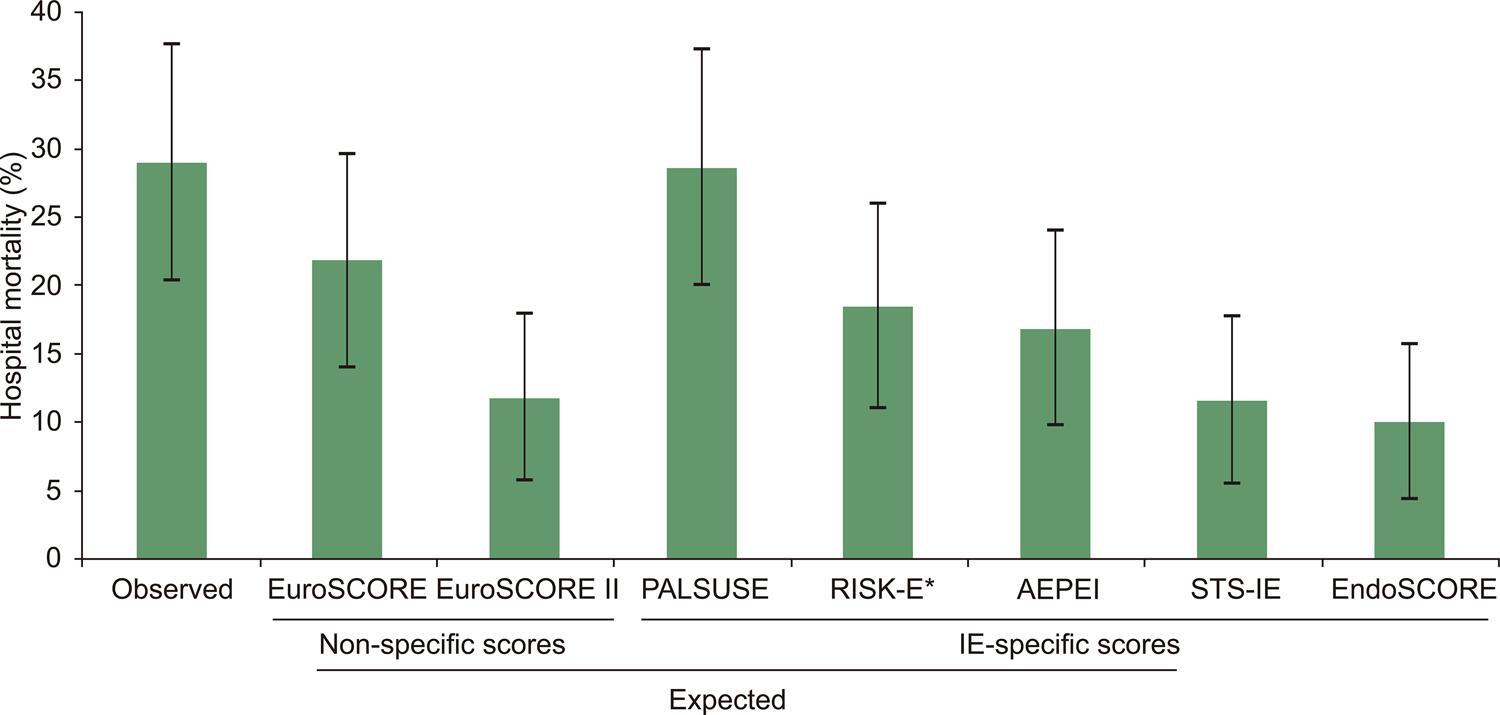
A total of 107 patients were included. Overall hospital mortality was 29.0% (95%CI: 20.4-37.6%). The best O/E mortality ratio was achieved by the PALSUSE score (1.01, 95%CI: 0.70-1.42), followed by the logistic EuroSCORE (1.3, 95%CI: 0.92-1.87). The logistic EuroSCORE had the highest discriminatory power (AUC 0.77), which was significantly superior to EuroSCORE II (p = 0.03), STS-IE (p = 0.03), PALSUSE (p = 0.03), AEPEI (p = 0.03), and RISK-E (p = 0.02).

Conclusions

Despite the availability of recent IE-specific scores, and considering the trade-off between the indexes, the logistic EuroSCORE seemed to be the best predictor of mortality risk in our cohort, taking calibration (O/E mortality ratio: 1.3) and discrimination (AUC 0.77) into account. Local validation of IE-specific scores is needed to better assess preoperative surgical risk. (Arq Bras Cardiol. 2020; 114(3):518-524)

  • Cardiovascular Surgical Procedures/mortality
  • Endocarditis/complications
  • Hospital Mortality
  • Risk Assessment
Read Full Article
Creative Commons Attribution (CC BY) Creative Commons license
06/04/2020 DOI: 10.36660/abc.20190050 Views 2
ABC
Editorial

Impact of Transcatheter Aortic Valve Implantation on Kidney Function: the “Renovalvular” Interaction in Aortic Stenosis

Antonio de Santis

The advent of renal congestion in heart failure was first described by Frédéric Justin Collet (1870-1966), a French pathologist who found the notion of passive renal congestion related to heart dysfunction, creating the revealing term “rein cardiaque” in the early 1900s. The term cardiorenal syndrome emerged from a 2004 National Heart, Lung, and Blood Institute Working GrouP conference evaluating the complex interactions between the heart and kidney. The main pathophysiological mechanisms related to this condition are increased central venous and intra-abdominal pressures; reduced cardiac output and cardiac index; neurohormonal dysregulation; oxidative stress and inflammatory mediators. Degenerative aortic stenosis (AS) represents one of the most prevalent valvular heart diseases and an important cause of heart failure, with a strong correlation with aging process. The combination of atherosclerosis, biomineralization and oxidative stress leads to calcium deposition within the valve leaflets. The “renovalvular” interaction in AS may represent a two-way path, from a pathophysiological perspective. In one way, AS may impair kidney function by arterial hypoperfusion and systemic venous congestion. On the other way, chronic kidney disease (CKD) is also an important risk factor for AS, due to the massive and aggressive calcification of the leaflets, mainly imposed by imbalances in the calcium and phosphorus homeostasis.

For patients with AS undergoing conventional surgical aortic valve replacement (AVR), there is an increase in complication rates such as major bleeding and reoperation when comparing patients with moderately reduced kidney function (estimated glomerular filtration rate [eGFR] between 30-60 ml/min/1.73 m) versus those without kidney disease. Mortality after surgical AVR also increases with worsening GFR.

[…]

  • Aortic Valve Stenosis/complications
  • Heart Failure/complications
  • Renal Insufficiency/ complications
  • Risk Assessment
  • Transcatheter Aortic Valve Replacement/trends
Read Full Article
Creative Commons Attribution (CC BY) Creative Commons license
02/12/2019 DOI: 10.36660/abc.20190753 Views 1
Figure 1
IJCS
Case Report

Sudden Cardiac Arrest in Athletes: Do not Miss Suspicious Details

Marta Luísa Braga et al. Paula Dias Mariana Vasconcelos Rui Almeida … Paulo Araújo Maria Maciel

Introduction

Sudden cardiac death (SCD) related to sports activities is an unexpected and rare event, usually occurring in young and apparently healthy athletes. The main cause of SCD in young athletes (< 35 years old) is ventricular arrhythmia (VA) associated with arrhythmogenic disorders (e.g. hypertrophic cardiomyopathy, arrhythmogenic right ventricular cardiomyopathy – ARVC, channelopathies). Some of these conditions can be suspected by routine pre-participation clinical evaluation, while others remain undetectable even after careful screening.– This paper presents the case of a professional athlete with undiagnosed ARVC, whose first manifestation was malignant VA and biventricular dysfunction.

[…]

  • Arrhythmias Cardiac
  • Arrhytmogenic Right Ventricular Dysplasia
  • Athletes
  • Cardiac arrest
  • Physical Endurance
  • Risk Assessment
  • Spots
  • Sudden Death
Read Full Article
Creative Commons Attribution (CC BY) Creative Commons license
12/08/2019 DOI: 10.5935/2359-4802.20190065 Views 1

Could not load more articles. Please try again.

How to cite this article

EndNote RIS

Electronic Document Format (Vancouver)

Cesarino EJ, Castro ML, Espíndola Neto L, Andrade RCG, Restini CBA. Risk Stratification in Heart Failure: The Role of the MAGGIC Score in a Brazilian Population. Arquivos Brasileiros de Cardiologia 2026;123(3):e20260305.

Electronic Document Format (ABNT)

Cesarino, Evandro José; Castro, Marildes Luiza de; Espíndola Neto, Larissa; Andrade, Regina Celia Garcia de; Restini, Carolina Baraldi Araujo. Risk Stratification in Heart Failure: The Role of the MAGGIC Score in a Brazilian Population. Arquivos Brasileiros de Cardiologia, v. 123, n. 3, e20260305, Jun. 2026.

Electronic Document Format (APA)

Cesarino, E. J., Castro, M. L. , Espíndola Neto, L., Andrade, R. C. G. , & Restini, C. B. A. (2026). Risk Stratification in Heart Failure: The Role of the MAGGIC Score in a Brazilian Population. Arquivos Brasileiros de Cardiologia, 123(3), e20260305.

Electronic Document Format (ISO)

Cesarino, Evandro José and Castro, Marildes Luiza de and Espíndola Neto, Larissa and Andrade, Regina Celia Garcia de and Restini, Carolina Baraldi Araujo. Risk Stratification in Heart Failure: The Role of the MAGGIC Score in a Brazilian Population. Arquivos Brasileiros de Cardiologia [online]. 2026, vol. 123, n. 3, [cited 2026-10-14], e20260305. Available from: <https://journals.cardiol.br/en/article/risk-stratification-in-heart-failure-the-role-of-the-maggic-score-in-a-brazilian-population/>. ISSN 0066-782X

EndNote RIS

Electronic Document Format (Vancouver)

Paula GG, Garbin HI, Kaminski ME, Mendonça DD, Souza GC, Rohde LE, Silva Neto LB, et al. Performance of the MAGGIC Score in Individuals with Heart Failure: Validation in a Brazilian Population. Arquivos Brasileiros de Cardiologia 2026;123(3):e20250614.

Electronic Document Format (ABNT)

Paula, Gabriela Gomes de; Garbin, Henrique Iahnke; Kaminski, Maria Eduarda; Mendonça, Dayana Dias; Souza, Gabriela Corrêa; Rohde, Luis Eduardo; Silva Neto, Luis Beck da; Biolo, Andreia. Performance of the MAGGIC Score in Individuals with Heart Failure: Validation in a Brazilian Population. Arquivos Brasileiros de Cardiologia, v. 123, n. 3, e20250614, Apr. 2026.

Electronic Document Format (APA)

Paula, G. G. , Garbin, H. I., Kaminski, M. E., Mendonça, D. D., Souza, G. C., Rohde, L. E., Silva Neto, L. B. , & Biolo, A. (2026). Performance of the MAGGIC Score in Individuals with Heart Failure: Validation in a Brazilian Population. Arquivos Brasileiros de Cardiologia, 123(3), e20250614.

Electronic Document Format (ISO)

Paula, Gabriela Gomes de and Garbin, Henrique Iahnke and Kaminski, Maria Eduarda and Mendonça, Dayana Dias and Souza, Gabriela Corrêa and Rohde, Luis Eduardo and Silva Neto, Luis Beck da and Biolo, Andreia. Performance of the MAGGIC Score in Individuals with Heart Failure: Validation in a Brazilian Population. Arquivos Brasileiros de Cardiologia [online]. 2026, vol. 123, n. 3, [cited 2026-10-14], e20250614. Available from: <https://journals.cardiol.br/en/article/performance-of-the-maggic-score-in-individuals-with-heart-failure-validation-in-a-brazilian-population/>. ISSN 0066-782X

EndNote RIS

Electronic Document Format (Vancouver)

Lopes MC, Heidemann Jr AI, Pianca EG, Duncan BB, Foppa M, Santos AB. Left Ventricular Outflow Tract Velocity-Time Integral (LVOT VTI) as a Marker of Cardiac Performance: Mortality Data of the ELSA-Brasil Cohort. ABC Imagem Cardiovascular 2026;39(1):e20260013.

Electronic Document Format (ABNT)

Lopes, Mariana de Castro; Heidemann Jr, Altair Ivory; Pianca, Eduardo G.; Duncan, Bruce B.; Foppa, Murilo; Santos, Angela B.S. Left Ventricular Outflow Tract Velocity-Time Integral (LVOT VTI) as a Marker of Cardiac Performance: Mortality Data of the ELSA-Brasil Cohort. ABC Imagem Cardiovascular, v. 39, n. 1, e20260013, Apr. 2026.

Electronic Document Format (APA)

Lopes, M. C., Heidemann Jr, A. I., Pianca, E. G., Duncan, B. B., Foppa, M., & Santos, A. B. (2026). Left Ventricular Outflow Tract Velocity-Time Integral (LVOT VTI) as a Marker of Cardiac Performance: Mortality Data of the ELSA-Brasil Cohort. ABC Imagem Cardiovascular, 39(1), e20260013.

Electronic Document Format (ISO)

Lopes, Mariana de Castro and Heidemann Jr, Altair Ivory and Pianca, Eduardo G. and Duncan, Bruce B. and Foppa, Murilo and Santos, Angela B.S. Left Ventricular Outflow Tract Velocity-Time Integral (LVOT VTI) as a Marker of Cardiac Performance: Mortality Data of the ELSA-Brasil Cohort. ABC Imagem Cardiovascular [online]. 2026, vol. 39, n. 1, [cited 2026-10-14], e20260013. Available from: <https://journals.cardiol.br/en/article/left-ventricular-outflow-tract-velocity-time-integral-lvot-vti-as-a-marker-of-cardiac-performance-mortality-data-of-the-elsa-brasil-cohort/>. ISSN 2318-8219

EndNote RIS

Electronic Document Format (Vancouver)

Farsky PS. Brazilian Evidence Reinforces the Applicability of the H2FPEF and HFA-PEFF Scores in HFpEF. Arquivos Brasileiros de Cardiologia 2025;122(6):e20250361.

Electronic Document Format (ABNT)

Farsky, Pedro Silvio. Brazilian Evidence Reinforces the Applicability of the H2FPEF and HFA-PEFF Scores in HFpEF. Arquivos Brasileiros de Cardiologia, v. 122, n. 6, e20250361, Aug. 2025.

Electronic Document Format (APA)

Farsky, P. S. (2025). Brazilian Evidence Reinforces the Applicability of the H2FPEF and HFA-PEFF Scores in HFpEF. Arquivos Brasileiros de Cardiologia, 122(6), e20250361.

Electronic Document Format (ISO)

Farsky, Pedro Silvio. Brazilian Evidence Reinforces the Applicability of the H2FPEF and HFA-PEFF Scores in HFpEF. Arquivos Brasileiros de Cardiologia [online]. 2025, vol. 122, n. 6, [cited 2026-10-14], e20250361. Available from: <https://journals.cardiol.br/en/article/brazilian-evidence-reinforces-the-applicability-of-the-h2fpef-and-hfa-peff-scores-in-hfpef/>. ISSN 0066-782X

EndNote RIS

Electronic Document Format (Vancouver)

Fontenelle LF, Sarti TD, Quinte GC, Almeida APSC, Mill JG. Agreement between Framingham, Pooled Cohort Equations, and Globorisk-LAC in the Estimation of Cardiovascular Risk in Brazil, 2013. Arquivos Brasileiros de Cardiologia 2025;122(6):e20240405.

Electronic Document Format (ABNT)

Fontenelle, Leonardo Ferreira; Sarti, Thiago Dias; Quinte, Gabriela Callo; Almeida, Ana Paula Santana Coelho; Mill, José Geraldo. Agreement between Framingham, Pooled Cohort Equations, and Globorisk-LAC in the Estimation of Cardiovascular Risk in Brazil, 2013. Arquivos Brasileiros de Cardiologia, v. 122, n. 6, e20240405, Jul. 2025.

Electronic Document Format (APA)

Fontenelle, L. F., Sarti, T. D., Quinte, G. C., Almeida, A. P. S. C., & Mill, J. G. (2025). Agreement between Framingham, Pooled Cohort Equations, and Globorisk-LAC in the Estimation of Cardiovascular Risk in Brazil, 2013. Arquivos Brasileiros de Cardiologia, 122(6), e20240405.

Electronic Document Format (ISO)

Fontenelle, Leonardo Ferreira and Sarti, Thiago Dias and Quinte, Gabriela Callo and Almeida, Ana Paula Santana Coelho and Mill, José Geraldo. Agreement between Framingham, Pooled Cohort Equations, and Globorisk-LAC in the Estimation of Cardiovascular Risk in Brazil, 2013. Arquivos Brasileiros de Cardiologia [online]. 2025, vol. 122, n. 6, [cited 2026-10-14], e20240405. Available from: <https://journals.cardiol.br/en/article/agreement-between-framingham-pooled-cohort-equations-and-globorisk-lac-in-the-estimation-of-cardiovascular-risk-in-brazil-2013/>. ISSN 0066-782X

EndNote RIS

Electronic Document Format (Vancouver)

Pinesi HT, Moreira EM, Barbosa MHM, Pitta FG, Rached FH, Lima EG, Martins EB, et al. TIMI Risk Score for Secondary Prevention to Risk Stratify Chronic Coronary Syndrome Patients: External Validation Study. Arquivos Brasileiros de Cardiologia 2025;122(5):e20240821.

Electronic Document Format (ABNT)

Pinesi, Henrique Trombini; Moreira, Eduardo Martelli; Barbosa, Marcelo Henrique Moreira; Pitta, Fabio Grunspun; Rached, Fabiana Hanna; Lima, Eduardo Gomes; Martins, Eduardo Bello; Serrano Jr, Carlos Vicente. TIMI Risk Score for Secondary Prevention to Risk Stratify Chronic Coronary Syndrome Patients: External Validation Study. Arquivos Brasileiros de Cardiologia, v. 122, n. 5, e20240821, May. 2025.

Electronic Document Format (APA)

Pinesi, H. T., Moreira, E. M., Barbosa, M. H. M., Pitta, F. G., Rached, F. H., Lima, E. G., Martins, E. B., & Serrano Jr, C. V. (2025). TIMI Risk Score for Secondary Prevention to Risk Stratify Chronic Coronary Syndrome Patients: External Validation Study. Arquivos Brasileiros de Cardiologia, 122(5), e20240821.

Electronic Document Format (ISO)

Pinesi, Henrique Trombini and Moreira, Eduardo Martelli and Barbosa, Marcelo Henrique Moreira and Pitta, Fabio Grunspun and Rached, Fabiana Hanna and Lima, Eduardo Gomes and Martins, Eduardo Bello and Serrano Jr, Carlos Vicente. TIMI Risk Score for Secondary Prevention to Risk Stratify Chronic Coronary Syndrome Patients: External Validation Study. Arquivos Brasileiros de Cardiologia [online]. 2025, vol. 122, n. 5, [cited 2026-10-14], e20240821. Available from: <https://journals.cardiol.br/en/article/timi-risk-score-for-secondary-prevention-to-risk-stratify-chronic-coronary-syndrome-patients-external-validation-study/>. ISSN 0066-782X

EndNote RIS

Electronic Document Format (Vancouver)

Cesena FY, Generoso G, Santos IS, Pereira AC, Bittencourt MS, Santos RD, Lotufo PA, et al. The WHO Cardiovascular Disease Risk (Non-Laboratory-Based) in a Selected Brazilian Population: Percentiles of Distribution And Agreement With Laboratory-Based Scores. Arquivos Brasileiros de Cardiologia 2024;121(7):e20240002.

Electronic Document Format (ABNT)

Cesena, Fernando Yue; Generoso, Giuliano; Santos, Itamar de S.; Pereira, Alexandre C.; Bittencourt, Marcio S.; Santos, Raul D.; Lotufo, Paulo A.; Benseñor, Isabela M.. The WHO Cardiovascular Disease Risk (Non-Laboratory-Based) in a Selected Brazilian Population: Percentiles of Distribution And Agreement With Laboratory-Based Scores. Arquivos Brasileiros de Cardiologia, v. 121, n. 7, e20240002, Aug. 2024.

Electronic Document Format (APA)

Cesena, F. Y., Generoso, G., Santos, I. S., Pereira, A. C., Bittencourt, M. S., Santos, R. D., Lotufo, P. A., & Benseñor, I. M. (2024). The WHO Cardiovascular Disease Risk (Non-Laboratory-Based) in a Selected Brazilian Population: Percentiles of Distribution And Agreement With Laboratory-Based Scores. Arquivos Brasileiros de Cardiologia, 121(7), e20240002.

Electronic Document Format (ISO)

Cesena, Fernando Yue and Generoso, Giuliano and Santos, Itamar de S. and Pereira, Alexandre C. and Bittencourt, Marcio S. and Santos, Raul D. and Lotufo, Paulo A. and Benseñor, Isabela M.. The WHO Cardiovascular Disease Risk (Non-Laboratory-Based) in a Selected Brazilian Population: Percentiles of Distribution And Agreement With Laboratory-Based Scores. Arquivos Brasileiros de Cardiologia [online]. 2024, vol. 121, n. 7, [cited 2026-10-14], e20240002. Available from: <https://journals.cardiol.br/en/article/the-who-cardiovascular-disease-risk-non-laboratory-based-in-a-selected-brazilian-population-percentiles-of-distribution-and-agreement-with-laboratory-based-scores/>. ISSN 0066-782X

EndNote RIS

Electronic Document Format (Vancouver)

Oliveira Filho FJ, Garcia LR, Mellucci Filho PL, Rodrigues LS, Bertanha M. Electrocardiography in the Pre-Operative Assessment of Low-Risk Patients: Current Evidence. Arquivos Brasileiros de Cardiologia 2024;121(1):e20230808.

Electronic Document Format (ABNT)

Oliveira Filho, Francisco José de; Garcia, Leonardo Rufino; Mellucci Filho, Pedro Luciano; Rodrigues, Lenize da Silva; Bertanha, Matheus. Electrocardiography in the Pre-Operative Assessment of Low-Risk Patients: Current Evidence. Arquivos Brasileiros de Cardiologia, v. 121, n. 1, e20230808, Mar. 2024.

Electronic Document Format (APA)

Oliveira Filho, F. J. , Garcia, L. R., Mellucci Filho, P. L., Rodrigues, L. S., & Bertanha, M. (2024). Electrocardiography in the Pre-Operative Assessment of Low-Risk Patients: Current Evidence. Arquivos Brasileiros de Cardiologia, 121(1), e20230808.

Electronic Document Format (ISO)

Oliveira Filho, Francisco José de and Garcia, Leonardo Rufino and Mellucci Filho, Pedro Luciano and Rodrigues, Lenize da Silva and Bertanha, Matheus. Electrocardiography in the Pre-Operative Assessment of Low-Risk Patients: Current Evidence. Arquivos Brasileiros de Cardiologia [online]. 2024, vol. 121, n. 1, [cited 2026-10-14], e20230808. Available from: <https://journals.cardiol.br/en/article/electrocardiography-in-the-pre-operative-assessment-of-low-risk-patients-current-evidence/>. ISSN 0066-782X

EndNote RIS

Electronic Document Format (Vancouver)

Cesena FY, Kashiwagi NM, Minanni CA, Santos RD. Determining Percentiles of Atherosclerotic Cardiovascular Risk According to Sex and Age in a Healthy Brazilian Population. Arquivos Brasileiros de Cardiologia 2023;120(6):e20220552.

Electronic Document Format (ABNT)

Cesena, Fernando Yue; Kashiwagi, Nea Miwa; Minanni, Carlos Andre; Santos, Raul D.. Determining Percentiles of Atherosclerotic Cardiovascular Risk According to Sex and Age in a Healthy Brazilian Population. Arquivos Brasileiros de Cardiologia, v. 120, n. 6, e20220552, Jun. 2023.

Electronic Document Format (APA)

Cesena, F. Y., Kashiwagi, N. M., Minanni, C. A., & Santos, R. D. (2023). Determining Percentiles of Atherosclerotic Cardiovascular Risk According to Sex and Age in a Healthy Brazilian Population. Arquivos Brasileiros de Cardiologia, 120(6), e20220552.

Electronic Document Format (ISO)

Cesena, Fernando Yue and Kashiwagi, Nea Miwa and Minanni, Carlos Andre and Santos, Raul D.. Determining Percentiles of Atherosclerotic Cardiovascular Risk According to Sex and Age in a Healthy Brazilian Population. Arquivos Brasileiros de Cardiologia [online]. 2023, vol. 120, n. 6, [cited 2026-10-14], e20220552. Available from: <https://journals.cardiol.br/en/article/determining-percentiles-of-atherosclerotic-cardiovascular-risk-according-to-sex-and-age-in-a-healthy-brazilian-population/>. ISSN 0066-782X

EndNote RIS

Electronic Document Format (Vancouver)

Ferrari F. Lung Function and Inspiratory Muscle Strength in Heart Failure: Can They be Considered Potential Prognostic Markers?. Arquivos Brasileiros de Cardiologia 2022;118(4):692-3.

Electronic Document Format (ABNT)

Ferrari, Filipe. Lung Function and Inspiratory Muscle Strength in Heart Failure: Can They be Considered Potential Prognostic Markers?. Arquivos Brasileiros de Cardiologia, v. 118, n. 4, p. 692-693, Apr. 2022.

Electronic Document Format (APA)

Ferrari, F. (2022). Lung Function and Inspiratory Muscle Strength in Heart Failure: Can They be Considered Potential Prognostic Markers?. Arquivos Brasileiros de Cardiologia, 118(4), 692-693.

Electronic Document Format (ISO)

Ferrari, Filipe. Lung Function and Inspiratory Muscle Strength in Heart Failure: Can They be Considered Potential Prognostic Markers?. Arquivos Brasileiros de Cardiologia [online]. 2022, vol. 118, n. 4, [cited 2026-10-14], pp. 692-693. Available from: <https://journals.cardiol.br/en/article/lung-function-and-inspiratory-muscle-strength-in-heart-failure-can-they-be-considered-potential-prognostic-markers/>. ISSN 0066-782X

EndNote RIS

Electronic Document Format (Vancouver)

Zanini M. Treatment Evolution and the Impact of Pre-Surgical Predictors on Outcomes of Patients with Congenital Heart Disease. Arquivos Brasileiros de Cardiologia 2022;118(2):420-1.

Electronic Document Format (ABNT)

Zanini, Maurice. Treatment Evolution and the Impact of Pre-Surgical Predictors on Outcomes of Patients with Congenital Heart Disease. Arquivos Brasileiros de Cardiologia, v. 118, n. 2, p. 420-421, Mar. 2022.

Electronic Document Format (APA)

Zanini, M. (2022). Treatment Evolution and the Impact of Pre-Surgical Predictors on Outcomes of Patients with Congenital Heart Disease. Arquivos Brasileiros de Cardiologia, 118(2), 420-421.

Electronic Document Format (ISO)

Zanini, Maurice. Treatment Evolution and the Impact of Pre-Surgical Predictors on Outcomes of Patients with Congenital Heart Disease. Arquivos Brasileiros de Cardiologia [online]. 2022, vol. 118, n. 2, [cited 2026-10-14], pp. 420-421. Available from: <https://journals.cardiol.br/en/article/treatment-evolution-and-the-impact-of-pre-surgical-predictors-on-outcomes-of-patients-with-congenital-heart-disease/>. ISSN 0066-782X

EndNote RIS

Electronic Document Format (Vancouver)

Ramalho SHR, Lima ACGB, Silva FMF, Souza FSJ, Cahalin LP, Cipriano GFB, Cipriano Junior G, et al. Relationship of Lung Function and Inspiratory Strength with Exercise Capacity and Prognosis in Heart Failure. Arquivos Brasileiros de Cardiologia 2022;118(4):680-91.

Electronic Document Format (ABNT)

Ramalho, Sergio Henrique Rodolpho; Lima, Alexandra Correa Gervazoni Balbuena de; Silva, Fabiola Maria Ferreira da; Souza, Fausto Stauffer Junqueira de; Cahalin, Lawrence Patrick; Cipriano, Graziella França Bernardelli; Cipriano Junior, Gerson. Relationship of Lung Function and Inspiratory Strength with Exercise Capacity and Prognosis in Heart Failure. Arquivos Brasileiros de Cardiologia, v. 118, n. 4, p. 680-691, Feb. 2022.

Electronic Document Format (APA)

Ramalho, S. H. R., Lima, A. C. G. B. , Silva, F. M. F. , Souza, F. S. J. , Cahalin, L. P., Cipriano, G. F. B., & Cipriano Junior, G. (2022). Relationship of Lung Function and Inspiratory Strength with Exercise Capacity and Prognosis in Heart Failure. Arquivos Brasileiros de Cardiologia, 118(4), 680-691.

Electronic Document Format (ISO)

Ramalho, Sergio Henrique Rodolpho and Lima, Alexandra Correa Gervazoni Balbuena de and Silva, Fabiola Maria Ferreira da and Souza, Fausto Stauffer Junqueira de and Cahalin, Lawrence Patrick and Cipriano, Graziella França Bernardelli and Cipriano Junior, Gerson. Relationship of Lung Function and Inspiratory Strength with Exercise Capacity and Prognosis in Heart Failure. Arquivos Brasileiros de Cardiologia [online]. 2022, vol. 118, n. 4, [cited 2026-10-14], pp. 680-691. Available from: <https://journals.cardiol.br/en/article/relationship-of-lung-function-and-inspiratory-strength-with-exercise-capacity-and-prognosis-in-heart-failure/>. ISSN 0066-782X

EndNote RIS

Electronic Document Format (Vancouver)

Noya-Rabelo MM, Azevedo DFC, Souza OF. Predictive Models to Enhance our Knowledge: Is It Necessary?. Arquivos Brasileiros de Cardiologia 2021;117(4):624-5.

Electronic Document Format (ABNT)

Noya-Rabelo, Marcia M.; Azevedo, Diogo Freitas Cardoso de; Souza, Olga Ferreira de. Predictive Models to Enhance our Knowledge: Is It Necessary?. Arquivos Brasileiros de Cardiologia, v. 117, n. 4, p. 624-625, Oct. 2021.

Electronic Document Format (APA)

Noya-Rabelo, M. M., Azevedo, D. F. C. , & Souza, O. F. (2021). Predictive Models to Enhance our Knowledge: Is It Necessary?. Arquivos Brasileiros de Cardiologia, 117(4), 624-625.

Electronic Document Format (ISO)

Noya-Rabelo, Marcia M. and Azevedo, Diogo Freitas Cardoso de and Souza, Olga Ferreira de. Predictive Models to Enhance our Knowledge: Is It Necessary?. Arquivos Brasileiros de Cardiologia [online]. 2021, vol. 117, n. 4, [cited 2026-10-14], pp. 624-625. Available from: <https://journals.cardiol.br/en/article/predictive-models-to-enhance-our-knowledge-is-it-necessary/>. ISSN 0066-782X

EndNote RIS

Electronic Document Format (Vancouver)

Zhang Y, Yuan Y. Value of left atrial diameter with CHA2DS2-VASc score in predicting left atrial/left atrial appendage thrombosis in non-valvular atrial fibrillation. Arquivos Brasileiros de Cardiologia 2021;116(2):325-31.

Electronic Document Format (ABNT)

Zhang, Yu; Yuan, Yi-Qiang. Value of left atrial diameter with CHA2DS2-VASc score in predicting left atrial/left atrial appendage thrombosis in non-valvular atrial fibrillation. Arquivos Brasileiros de Cardiologia, v. 116, n. 2, p. 325-331, Jan. 2021.

Electronic Document Format (APA)

Zhang, Y., & Yuan, Y. (2021). Value of left atrial diameter with CHA2DS2-VASc score in predicting left atrial/left atrial appendage thrombosis in non-valvular atrial fibrillation. Arquivos Brasileiros de Cardiologia, 116(2), 325-331.

Electronic Document Format (ISO)

Zhang, Yu and Yuan, Yi-Qiang. Value of left atrial diameter with CHA2DS2-VASc score in predicting left atrial/left atrial appendage thrombosis in non-valvular atrial fibrillation. Arquivos Brasileiros de Cardiologia [online]. 2021, vol. 116, n. 2, [cited 2026-10-14], pp. 325-331. Available from: <https://journals.cardiol.br/en/article/value-of-left-atrial-diameter-with-cha2ds2-vasc-score-in-predicting-left-atrial-left-atrial-appendage-thrombosis-in-non-valvular-atrial-fibrillation/>. ISSN 0066-782X

EndNote RIS

Electronic Document Format (Vancouver)

Jorge AJL, Rosa MLG, Martins WA, Leite A, Correia DMS, Saad MAN, Villacorta H, et al. Prognosis of Heart Failure with Preserved Ejection Fraction in Primary Care by the H2FPEF Score. International Journal of Cardiovascular Sciences 2020;33(6):666-72.

Electronic Document Format (ABNT)

Jorge, Antonio Jose Lagoeiro; Rosa, Maria Luiza Garcia; Martins, Wolney de Andrade; Leite, Adson; Correia, Dayse Mary da Silva; Saad, Maria Auxiliadora Nogueira; Villacorta, Humberto; Chermont, Sergio; Gismondi, Ronaldo Altenburg; Almeida, Breno Macedo; Mesquita, Evandro Tinoco. Prognosis of Heart Failure with Preserved Ejection Fraction in Primary Care by the H2FPEF Score. International Journal of Cardiovascular Sciences, v. 33, n. 6, p. 666-672, Nov. 2020.

Electronic Document Format (APA)

Jorge, A. J. L., Rosa, M. L. G., Martins, W. A., Leite, A., Correia, D. M. S., Saad, M. A. N., Villacorta, H., Chermont, S., Gismondi, R. A., Almeida, B. M., & Mesquita, E. T. (2020). Prognosis of Heart Failure with Preserved Ejection Fraction in Primary Care by the H2FPEF Score. International Journal of Cardiovascular Sciences, 33(6), 666-672.

Electronic Document Format (ISO)

Jorge, Antonio Jose Lagoeiro and Rosa, Maria Luiza Garcia and Martins, Wolney de Andrade and Leite, Adson and Correia, Dayse Mary da Silva and Saad, Maria Auxiliadora Nogueira and Villacorta, Humberto and Chermont, Sergio and Gismondi, Ronaldo Altenburg and Almeida, Breno Macedo and Mesquita, Evandro Tinoco. Prognosis of Heart Failure with Preserved Ejection Fraction in Primary Care by the H2FPEF Score. International Journal of Cardiovascular Sciences [online]. 2020, vol. 33, n. 6, [cited 2026-10-14], pp. 666-672. Available from: <https://journals.cardiol.br/en/article/prognosis-of-heart-failure-with-preserved-ejection-fraction-in-primary-care-by-the-h2fpef-score/>. ISSN 2359-4802

EndNote RIS

Electronic Document Format (Vancouver)

Duarte RCF, Moreira PSS, Ferreira CN, Figueiredo EL, Sternick E, Silveira FR, Alves LCV, et al. Atrial Fibrillation and Use of Rivaroxaban: Performance of the Prothrombin Time / INR as a Function of Time After Blood Collection. International Journal of Cardiovascular Sciences 2020;34(2):116-21.

Electronic Document Format (ABNT)

Duarte, Rita Carolina Figueiredo; Moreira, Priscila Samara Sérgio; Ferreira, Cláudia Natália; Figueiredo, Estevão Lanna; Sternick, Eduardo; Silveira, Francisco Rezende; Alves, Luan Carlos Vieira; Mota, Ana Paula Lucas; Reis, Edna Afonso; Carvalho, Maria das Graças; Reis, Helton José dos. Atrial Fibrillation and Use of Rivaroxaban: Performance of the Prothrombin Time / INR as a Function of Time After Blood Collection. International Journal of Cardiovascular Sciences, v. 34, n. 2, p. 116-121, Nov. 2020.

Electronic Document Format (APA)

Duarte, R. C. F., Moreira, P. S. S., Ferreira, C. N., Figueiredo, E. L., Sternick, E., Silveira, F. R., Alves, L. C. V., Mota, A. P. L., Reis, E. A., Carvalho, M. G., & Reis, H. J. (2020). Atrial Fibrillation and Use of Rivaroxaban: Performance of the Prothrombin Time / INR as a Function of Time After Blood Collection. International Journal of Cardiovascular Sciences, 34(2), 116-121.

Electronic Document Format (ISO)

Duarte, Rita Carolina Figueiredo and Moreira, Priscila Samara Sérgio and Ferreira, Cláudia Natália and Figueiredo, Estevão Lanna and Sternick, Eduardo and Silveira, Francisco Rezende and Alves, Luan Carlos Vieira and Mota, Ana Paula Lucas and Reis, Edna Afonso and Carvalho, Maria das Graças and Reis, Helton José dos. Atrial Fibrillation and Use of Rivaroxaban: Performance of the Prothrombin Time / INR as a Function of Time After Blood Collection. International Journal of Cardiovascular Sciences [online]. 2020, vol. 34, n. 2, [cited 2026-10-14], pp. 116-121. Available from: <https://journals.cardiol.br/en/article/atrial-fibrillation-and-use-of-rivaroxaban-performance-of-the-prothrombin-time-inr-as-a-function-of-time-after-blood-collection/>. ISSN 2359-4802

EndNote RIS

Electronic Document Format (Vancouver)

Reis APP, Ruschel KB, Moraes MAP, Belli K, Saffi ML, Fagundes JE. Risk Stratification in Chest Pain: Impact on the Diagnosis of Acute Coronary Syndrome. International Journal of Cardiovascular Sciences 2020;34(1):67-73.

Electronic Document Format (ABNT)

Reis, Ana Paula Paz; Ruschel, Karen Brasil; Moraes, Maria Antonieta P. de; Belli, Karlyse; Saffi, Marco Lumertz; Fagundes, Jaqueline Eilert. Risk Stratification in Chest Pain: Impact on the Diagnosis of Acute Coronary Syndrome. International Journal of Cardiovascular Sciences, v. 34, n. 1, p. 67-73, Aug. 2020.

Electronic Document Format (APA)

Reis, A. P. P., Ruschel, K. B., Moraes, M. A. P. , Belli, K., Saffi, M. L., & Fagundes, J. E. (2020). Risk Stratification in Chest Pain: Impact on the Diagnosis of Acute Coronary Syndrome. International Journal of Cardiovascular Sciences, 34(1), 67-73.

Electronic Document Format (ISO)

Reis, Ana Paula Paz and Ruschel, Karen Brasil and Moraes, Maria Antonieta P. de and Belli, Karlyse and Saffi, Marco Lumertz and Fagundes, Jaqueline Eilert. Risk Stratification in Chest Pain: Impact on the Diagnosis of Acute Coronary Syndrome. International Journal of Cardiovascular Sciences [online]. 2020, vol. 34, n. 1, [cited 2026-10-14], pp. 67-73. Available from: <https://journals.cardiol.br/en/article/risk-stratification-in-chest-pain-impact-on-the-diagnosis-of-acute-coronary-syndrome/>. ISSN 2359-4802

EndNote RIS

Electronic Document Format (Vancouver)

Pedrosa RC. Short Editorial: Distinct Prognostic Competence between the Clinical and Anatomical Models in Acute Coronary Syndromes: Comparison by Type of Outcome. Arquivos Brasileiros de Cardiologia 2020;115(2):226-8.

Electronic Document Format (ABNT)

Pedrosa, Roberto Coury. Short Editorial: Distinct Prognostic Competence between the Clinical and Anatomical Models in Acute Coronary Syndromes: Comparison by Type of Outcome. Arquivos Brasileiros de Cardiologia, v. 115, n. 2, p. 226-228, Aug. 2020.

Electronic Document Format (APA)

Pedrosa, R. C. (2020). Short Editorial: Distinct Prognostic Competence between the Clinical and Anatomical Models in Acute Coronary Syndromes: Comparison by Type of Outcome. Arquivos Brasileiros de Cardiologia, 115(2), 226-228.

Electronic Document Format (ISO)

Pedrosa, Roberto Coury. Short Editorial: Distinct Prognostic Competence between the Clinical and Anatomical Models in Acute Coronary Syndromes: Comparison by Type of Outcome. Arquivos Brasileiros de Cardiologia [online]. 2020, vol. 115, n. 2, [cited 2026-10-14], pp. 226-228. Available from: <https://journals.cardiol.br/en/article/short-editorial-distinct-prognostic-competence-between-the-clinical-and-anatomical-models-in-acute-coronary-syndromes-comparison-by-type-of-outcome/>. ISSN 0066-782X

EndNote RIS

Electronic Document Format (Vancouver)

Cordeiro ALL, Brito DQ, Almeida GF, Jesus LS, Oliveira FA, Silva JL, Guimarães ARF, et al. Correlation between Surgical Risk Scales with Respiratory Muscle Strength and Functional Independence in Patients Submitted to Coronary Artery Bypass Grafting. International Journal of Cardiovascular Sciences 2020;34(1):60-6.

Electronic Document Format (ABNT)

Cordeiro, André Luiz Lisboa; Brito, Átila Darlan Queiroz de; Almeida, Graziele Freitas; Jesus, Leilane Souza; Oliveira, Flávia de Araújo; Silva, Janinne Lima da; Guimarães, André Raimundo França; Barros, Roberto Moreno. Correlation between Surgical Risk Scales with Respiratory Muscle Strength and Functional Independence in Patients Submitted to Coronary Artery Bypass Grafting. International Journal of Cardiovascular Sciences, v. 34, n. 1, p. 60-66, Jul. 2020.

Electronic Document Format (APA)

Cordeiro, A. L. L., Brito, D. Q. , Almeida, G. F., Jesus, L. S., Oliveira, F. A., Silva, J. L. , Guimarães, A. R. F., & Barros, R. M. (2020). Correlation between Surgical Risk Scales with Respiratory Muscle Strength and Functional Independence in Patients Submitted to Coronary Artery Bypass Grafting. International Journal of Cardiovascular Sciences, 34(1), 60-66.

Electronic Document Format (ISO)

Cordeiro, André Luiz Lisboa and Brito, Átila Darlan Queiroz de and Almeida, Graziele Freitas and Jesus, Leilane Souza and Oliveira, Flávia de Araújo and Silva, Janinne Lima da and Guimarães, André Raimundo França and Barros, Roberto Moreno. Correlation between Surgical Risk Scales with Respiratory Muscle Strength and Functional Independence in Patients Submitted to Coronary Artery Bypass Grafting. International Journal of Cardiovascular Sciences [online]. 2020, vol. 34, n. 1, [cited 2026-10-14], pp. 60-66. Available from: <https://journals.cardiol.br/en/article/correlation-between-surgical-risk-scales-with-respiratory-muscle-strength-and-functional-independence-in-patients-submitted-to-coronary-artery-bypass-grafting/>. ISSN 2359-4802

EndNote RIS

Electronic Document Format (Vancouver)

Marasciulo RC, Stamm AMNF, Garcia GT, Marasciulo ACE, Rosa AC, Remor AAC, Battistella C, et al. Reliability between Cardiovascular Risk Assessment Tools: A Pilot Study. International Journal of Cardiovascular Sciences 2020;33(6):618-26.

Electronic Document Format (ABNT)

Marasciulo, Rodrigo Conill; Stamm, Ana Maria Nunes de Faria; Garcia, Guilherme Thomé; Marasciulo, Antônio Carlos Estima; Rosa, Ariel Córdova; Remor, Alexandre Augusto de Costa; Battistella, Cristian. Reliability between Cardiovascular Risk Assessment Tools: A Pilot Study. International Journal of Cardiovascular Sciences, v. 33, n. 6, p. 618-626, Jul. 2020.

Electronic Document Format (APA)

Marasciulo, R. C., Stamm, A. M. N. F., Garcia, G. T., Marasciulo, A. C. E., Rosa, A. C., Remor, A. A. C., & Battistella, C. (2020). Reliability between Cardiovascular Risk Assessment Tools: A Pilot Study. International Journal of Cardiovascular Sciences, 33(6), 618-626.

Electronic Document Format (ISO)

Marasciulo, Rodrigo Conill and Stamm, Ana Maria Nunes de Faria and Garcia, Guilherme Thomé and Marasciulo, Antônio Carlos Estima and Rosa, Ariel Córdova and Remor, Alexandre Augusto de Costa and Battistella, Cristian. Reliability between Cardiovascular Risk Assessment Tools: A Pilot Study. International Journal of Cardiovascular Sciences [online]. 2020, vol. 33, n. 6, [cited 2026-10-14], pp. 618-626. Available from: <https://journals.cardiol.br/en/article/reliability-between-cardiovascular-risk-assessment-tools-a-pilot-study/>. ISSN 2359-4802

EndNote RIS

Electronic Document Format (Vancouver)

Bittencourt MS. Why We Build Models – From Clinical Cardiology Practice to Infectious Disease Epidemics. Arquivos Brasileiros de Cardiologia 2020;114(6):992-4.

Electronic Document Format (ABNT)

Bittencourt, Marcio Sommer. Why We Build Models – From Clinical Cardiology Practice to Infectious Disease Epidemics. Arquivos Brasileiros de Cardiologia, v. 114, n. 6, p. 992-994, Jul. 2020.

Electronic Document Format (APA)

Bittencourt, M. S. (2020). Why We Build Models – From Clinical Cardiology Practice to Infectious Disease Epidemics. Arquivos Brasileiros de Cardiologia, 114(6), 992-994.

Electronic Document Format (ISO)

Bittencourt, Marcio Sommer. Why We Build Models – From Clinical Cardiology Practice to Infectious Disease Epidemics. Arquivos Brasileiros de Cardiologia [online]. 2020, vol. 114, n. 6, [cited 2026-10-14], pp. 992-994. Available from: <https://journals.cardiol.br/en/article/why-we-build-models-from-clinical-cardiology-practice-to-infectious-disease-epidemics/>. ISSN 0066-782X

EndNote RIS

Electronic Document Format (Vancouver)

Pivatto Júnior F, Bellagamba CCA, Pianca EG, Fernandes FS, Butzke M, Busato SB, Gus M, et al. Analysis of Risk Scores to Predict Mortality in Patients Undergoing Cardiac Surgery for Endocarditis. Arquivos Brasileiros de Cardiologia 2020;114(3):518-24.

Electronic Document Format (ABNT)

Pivatto Júnior, Fernando; Bellagamba, Clarissa Carmona de Azevedo; Pianca, Eduardo Gatti; Fernandes, Fernando Schmidt; Butzke, Maurício; Busato, Stefano Boemler; Gus, Miguel. Analysis of Risk Scores to Predict Mortality in Patients Undergoing Cardiac Surgery for Endocarditis. Arquivos Brasileiros de Cardiologia, v. 114, n. 3, p. 518-524, Apr. 2020.

Electronic Document Format (APA)

Pivatto Júnior, F., Bellagamba, C. C. A., Pianca, E. G., Fernandes, F. S., Butzke, M., Busato, S. B., & Gus, M. (2020). Analysis of Risk Scores to Predict Mortality in Patients Undergoing Cardiac Surgery for Endocarditis. Arquivos Brasileiros de Cardiologia, 114(3), 518-524.

Electronic Document Format (ISO)

Pivatto Júnior, Fernando and Bellagamba, Clarissa Carmona de Azevedo and Pianca, Eduardo Gatti and Fernandes, Fernando Schmidt and Butzke, Maurício and Busato, Stefano Boemler and Gus, Miguel. Analysis of Risk Scores to Predict Mortality in Patients Undergoing Cardiac Surgery for Endocarditis. Arquivos Brasileiros de Cardiologia [online]. 2020, vol. 114, n. 3, [cited 2026-10-14], pp. 518-524. Available from: <https://journals.cardiol.br/en/article/analysis-of-risk-scores-to-predict-mortality-in-patients-undergoing-cardiac-surgery-for-endocarditis/>. ISSN 0066-782X

EndNote RIS

Electronic Document Format (Vancouver)

Santis A. Impact of Transcatheter Aortic Valve Implantation on Kidney Function: the “Renovalvular” Interaction in Aortic Stenosis. Arquivos Brasileiros de Cardiologia 2019;113(6):1112-3.

Electronic Document Format (ABNT)

Santis, Antonio de. Impact of Transcatheter Aortic Valve Implantation on Kidney Function: the “Renovalvular” Interaction in Aortic Stenosis. Arquivos Brasileiros de Cardiologia, v. 113, n. 6, p. 1112-1113, Dec. 2019.

Electronic Document Format (APA)

Santis, A. (2019). Impact of Transcatheter Aortic Valve Implantation on Kidney Function: the “Renovalvular” Interaction in Aortic Stenosis. Arquivos Brasileiros de Cardiologia, 113(6), 1112-1113.

Electronic Document Format (ISO)

Santis, Antonio de. Impact of Transcatheter Aortic Valve Implantation on Kidney Function: the “Renovalvular” Interaction in Aortic Stenosis. Arquivos Brasileiros de Cardiologia [online]. 2019, vol. 113, n. 6, [cited 2026-10-14], pp. 1112-1113. Available from: <https://journals.cardiol.br/en/article/impact-of-transcatheter-aortic-valve-implantation-on-kidney-function-the-renovalvular-interaction-in-aortic-stenosis/>. ISSN 0066-782X

EndNote RIS

Electronic Document Format (Vancouver)

Braga ML, Dias P, Vasconcelos M, Almeida R, Araújo P, Maciel M. Sudden Cardiac Arrest in Athletes: Do not Miss Suspicious Details. International Journal of Cardiovascular Sciences 2019;32(4):428-32.

Electronic Document Format (ABNT)

Braga, Marta Luísa; Dias, Paula; Vasconcelos, Mariana; Almeida, Rui; Araújo, Paulo; Maciel, Maria. Sudden Cardiac Arrest in Athletes: Do not Miss Suspicious Details. International Journal of Cardiovascular Sciences, v. 32, n. 4, p. 428-432, Aug. 2019.

Electronic Document Format (APA)

Braga, M. L., Dias, P., Vasconcelos, M., Almeida, R., Araújo, P., & Maciel, M. (2019). Sudden Cardiac Arrest in Athletes: Do not Miss Suspicious Details. International Journal of Cardiovascular Sciences, 32(4), 428-432.

Electronic Document Format (ISO)

Braga, Marta Luísa and Dias, Paula and Vasconcelos, Mariana and Almeida, Rui and Araújo, Paulo and Maciel, Maria. Sudden Cardiac Arrest in Athletes: Do not Miss Suspicious Details. International Journal of Cardiovascular Sciences [online]. 2019, vol. 32, n. 4, [cited 2026-10-14], pp. 428-432. Available from: <https://journals.cardiol.br/en/article/sudden-cardiac-arrest-in-athletes-do-not-miss-suspicious-details/>. ISSN 2359-4802

  • About ABC Family
  • Internal Regulation
  • Editorial Board
  • Brazilian Society of Cardiology (SBC)

Issues

SBC Guidelines

  • Videos
  • Podcasts
  • News