ABC Family Arquivos Brasileiros de Cardiologia International Journal of Cardiovascular Sciences ABC Heart Failure & Cardiomyopathy ABC Imagem Cardiovascular
Português English
ABC Family
Português English
  • About
    • About ABC Family
    • Internal Regulation
    • Editorial Board
    • Brazilian Society of Cardiology (SBC)
  • Issues
  • SBC Guidelines
  • Content
    • Videos
    • Podcasts
    • News
  • About
    • About ABC Family
    • Internal Regulation
    • Editorial Board
    • Brazilian Society of Cardiology (SBC)
  • Issues
  • SBC Guidelines
  • Content
    • Videos
    • Podcasts
    • News

ABC Family

  • ABC Family
  • Arquivos Brasileiros de Cardiologia
  • International Journal of Cardiovascular Sciences
  • ABC Heart Failure & Cardiomyopathy
  • ABC Imagem Cardiovascular
Search in

No content found.

Journals
Ordering
Article types
Others

  1. Home
  2. Keyword: Coronary Artery Disease
Genetic Evidence for the Association Between Sjögren's Syndrome and Cardiovascular Disease Risk
IJCS
Original Article

Genetic Evidence for the Association Between Sjögren's Syndrome and Cardiovascular Disease Risk

Yafang Gao et al. Guohua Wu Tianyu Jin Zhijie Shen … Nannan Zhou Xiaohong Huang

Abstract

Background:

Previous studies have indicated that patients with Sjögren’s syndrome (SS) exhibit an increased risk of cardiovascular disease (CVD). However, the causal association between SS and CVD risk remains to be elucidated.

Objectives:

This investigation explored the genetic relationship between SS and CVD risk through Mendelian randomization (MR).

Methods:

We identified the genetic association between SS and CVD incidence via two-sample MR analysis based on summary statistics from publicly available genome-wide association studies (GWAS). The inverse-variance weighting (IVW) method was used for the primary analysis in our study. Additionally, we conducted several sensitivity analyses to confirm the stability and reliability of the MR results.

Results:

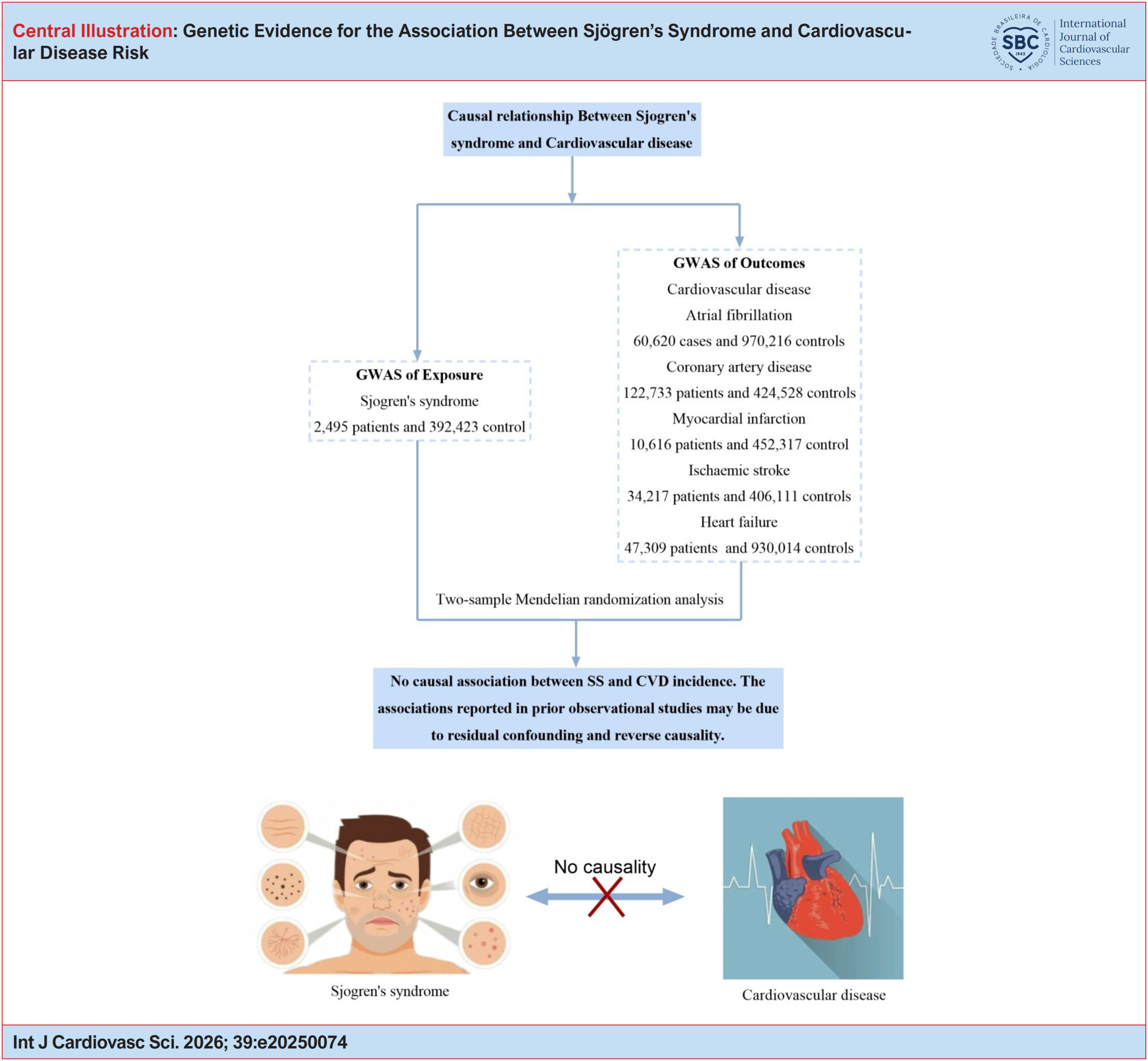
MR analysis revealed that SS was not significantly associated with the risk of various CVDs, including atrial fibrillation (AF) (odds ratio [OR] = 0.98, 95% confidence interval [CI] = 0.95–1.01; p = 0.22), ischemic stroke (IS) (OR = 0.99, 95% CI = 0.93–1.05; p = 0.68), heart failure (HF) (OR = 1.00, 95% CI = 0.96–1.04; p = 0.91), coronary artery disease (CAD) (OR = 0.99, 95% CI = 0.94–1.04; p = 0.60), and myocardial infaion (MI) (OR = 1.01, 95% CI = 0.97–1.06; p = 0.61).

Conclusions:

Our MR study did not provide genetic evidence supporting a causal association between SS and CVD incidence. The associations reported in prior observational studies may be due to residual confounding and reverse causality.

  • Cardiovascular Diseases
  • Coronary Artery Disease
  • Mendelian Randomization Analysis
  • Sjogren's Syndrome
Read Full Article
Creative Commons Attribution (CC BY) Creative Commons license
11/09/2026 DOI: 10.36660/ijcs.20250074 Views 3
Myocardial Infarction with Non-Obstructive Coronary Arteries: Clinical Profile, Diagnostic Investigation, and Outcomes in a Tertiary Center Cohort
IJCS
Original Article

Myocardial Infarction with Non-Obstructive Coronary Arteries: Clinical Profile, Diagnostic Investigation, and Outcomes in a Tertiary Center Cohort

Kelvyn Vital et al. Ricardo Pavanello Barbara Porto Valente Bruno Noshang Blaas … Bianca Fernandes Tavora Arruda Raphael Rossi Maria Isabel Del Monaco Fausto Feres

Abstract

Background:

Myocardial infarction with non-obstructive coronary arteries (MINOCA) represents a heterogeneous clinical syndrome associated with diverse pathophysiological mechanisms and a non-negligible prognosis. Despite conceptual advances, diagnostic uncertainties and significant variations in etiological investigation and clinical management persist in real-world practice, particularly in centers with limited access to advanced imaging modalities.

Objectives:

To describe the clinical profile, diagnostic strategies employed, and clinical outcomes of patients with MINOCA followed at a Brazilian tertiary center.

Methods:

Observational, retrospective study including consecutive patients diagnosed with MINOCA, defined according to the Fourth Universal Definition of Myocardial Infarction and European guidelines. Clinical, angiographic, and complementary diagnostic data, as well as the treatment instituted and clinical outcomes during follow-up, were collected.

Results:

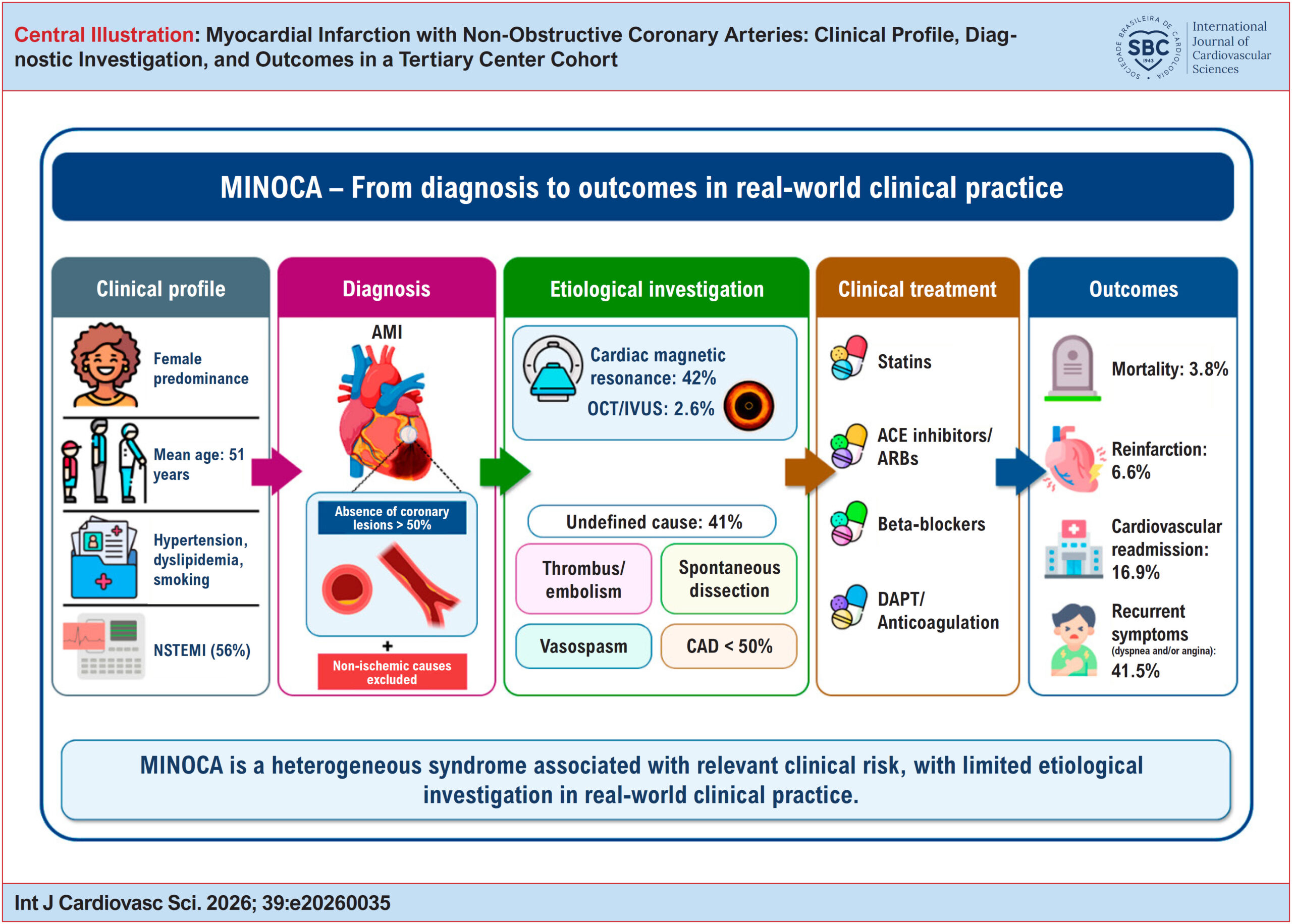
A total of 196 patients were included, with a mean age of 50.6 ± 11.8 years and a slight female predominance (52.6%). Systemic arterial hypertension (60.2%), dyslipidemia (45.9%), and current or former smoking (48.0%) were frequent. Cardiac magnetic resonance imaging was performed in 42.3% of cases, whereas intracoronary imaging methods were rarely used (2.6%). In 40.8% of patients, a definitive etiology could not be established. During follow-up (n = 183), mortality was 3.8%, reinfarction occurred in 6.6%, and new cardiovascular hospitalizations occurred in 16.9%.

Conclusions:

Patients with MINOCA present an intermediate-risk clinical profile and a relevant incidence of cardiovascular events during follow-up. The high proportion of cases without a defined etiological diagnosis reflects limitations in investigation and reinforces the need for more structured diagnostic strategies and individualized clinical management.

  • Coronary Artery Disease
  • MINOCA
  • Myocardial Infarction
Read Full Article
Creative Commons Attribution (CC BY) Creative Commons license
11/09/2026 DOI: 10.36660/ijcs.20260035 Views 4
Reversal of Therapeutic Recommendations in the American College of Cardiology Coronary Artery Disease Guidelines
IJCS
Original Article

Reversal of Therapeutic Recommendations in the American College of Cardiology Coronary Artery Disease Guidelines

Alessandra Carvalho Caldas et al. Denise Matias Daniel Medina Luis Claudio Lemos Correia

Abstract

Background:

Medical reversal is defined as the discontinuation of a procedure’s recommendation due to new evidence regarding its efficacy or safety. Cardiology is the specialty with the highest number of documented reversals, yet there is no information available about the probability of reversal.

Objectives:

To describe the frequency of medical reversal in the ischemic heart disease guidelines published by the American College of Cardiology/American Heart Association (ACC/AHA), according to levels of evidence.

Methods:

The most recent guidelines for stable coronary disease, non-ST-elevation acute coronary syndrome, and ST-elevation myocardial infarction were compared with the first version. Medical reversal was defined as a shift from a recommended procedure to a contraindicated one or the removal of the recommendation. The quality of evidence was categorized by the guidelines as high, moderate, or low.

Results:

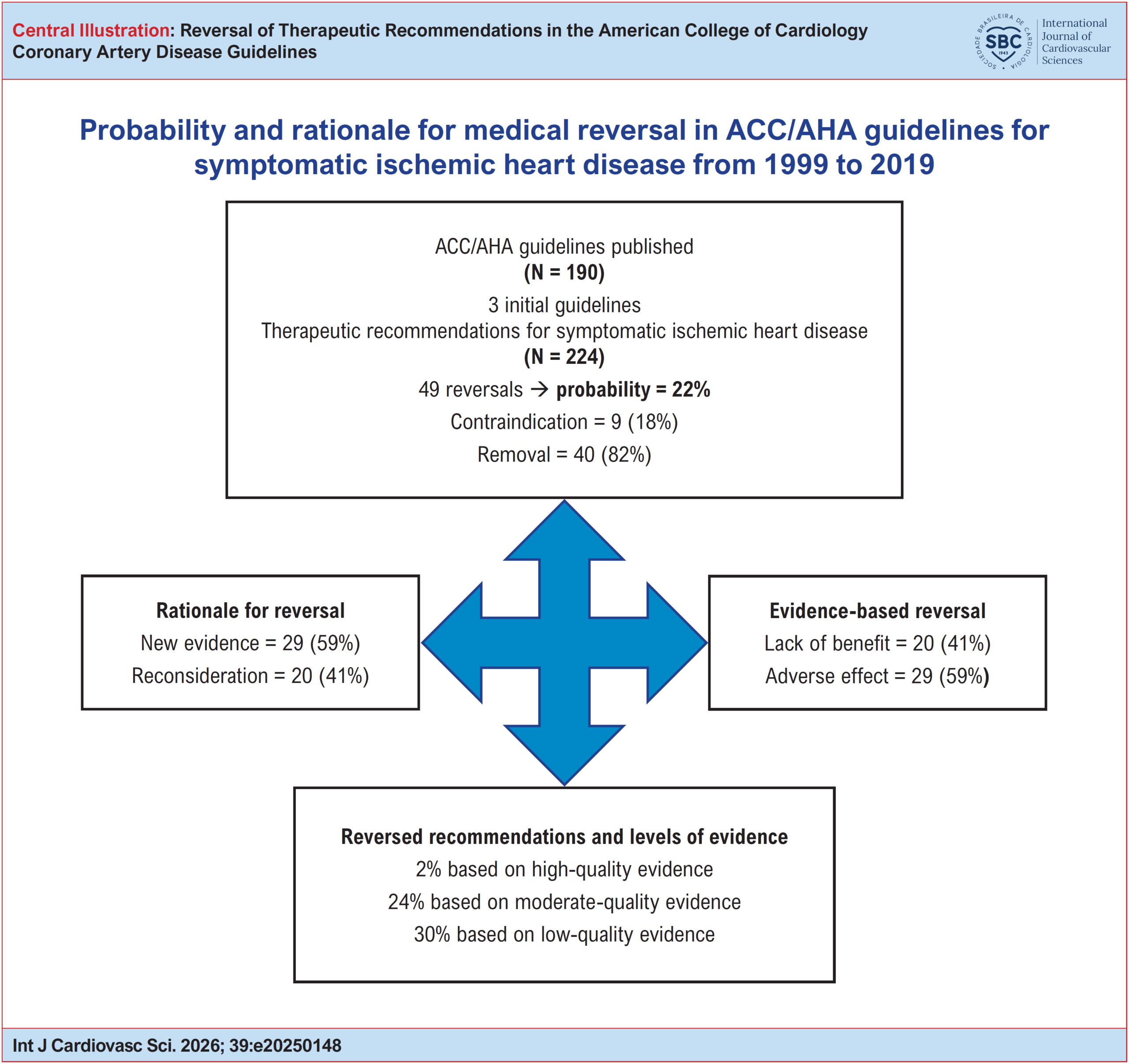
A total of 224 therapeutic recommendations were identified, with 19% based on high-quality evidence, 42% on moderate-quality evidence, and 39% on low-quality evidence. Forty-nine medical reversals were observed, constituting 22% of all therapeutic recommendations included in the first version of the guidelines. The probability of reversal for procedures based on high-quality evidence was 2%, compared with 25% for procedures with moderate-quality evidence and 30% for procedures with low-quality evidence.

Conclusion:

In the ACC/AHA ischemic heart disease guidelines, medical reversal is common in recommendations based on moderate or low-quality evidence, but rare in those with high-quality evidence.

  • Acute coronary syndrome
  • Coronary Artery Disease
  • Myocardial Infarction
Read Full Article
Creative Commons Attribution (CC BY) Creative Commons license
07/09/2026 DOI: 10.36660/ijcs.20250148 Views 2
Figure 1
ABCIC
Case Report

Coronary Artery Disease In A Rare Anatomical Scenario: Type IV Duplicated Left Anterior Descending Artery

Matheus Sacco Gomes et al. Amanda Raquel Costa Cruz Bruno Leal Martins Mario Henrique Caliano … Patricia de Souza Magalhães Daniel Bandeira Ricardo Costa Marinella Patrizia Centemero

Introduction

Congenital coronary anomalies comprise a heterogeneous group of anatomical variations, most often identified incidentally during non-invasive imaging studies or invasive diagnostic and therapeutic procedures. Studies show that approximately 1.3% of individuals undergoing coronary angiography present some form of coronary anomaly. Although most are considered benign, certain anomalies may be associated with myocardial ischemia, ventricular arrhythmias, and, in rare cases, sudden cardiac death. It is important to emphasize that coexistence with obstructive coronary artery disease (CAD) may amplify their clinical impact.

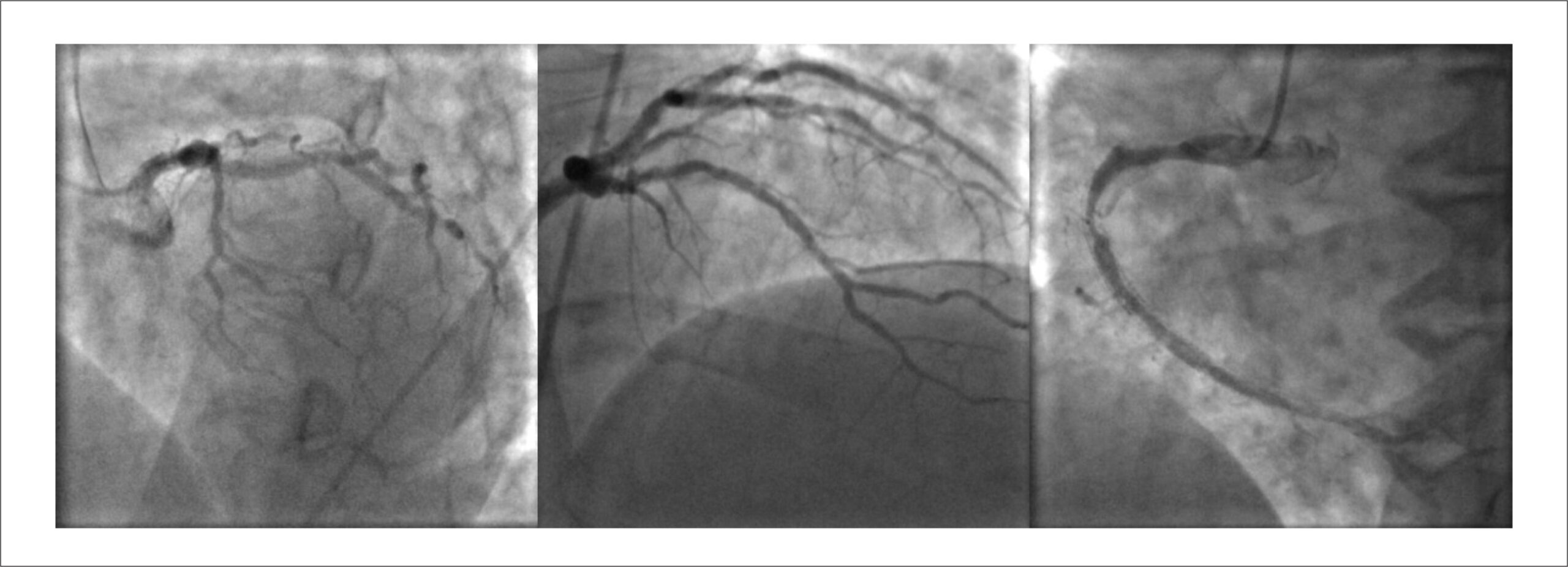
Among these variations, duplication of the left anterior descending (LAD) artery stands out due to its rarity and diagnostic relevance. According to the classification proposed by Spindola-Franco et al. (), this anomaly is divided into four types based on the origin and course of the branches. In Type I, the most frequent form, the short and long LAD originate from the bifurcation of the main LAD artery; the short LAD artery follows the anterior interventricular groove and terminates early, whereas the long LAD artery runs parallel along the left ventricular surface before rejoining the distal groove. In Type II, the short and long LAD also arise from the bifurcation of the main LAD artery; however, the long LAD artery courses to the right of the anterior interventricular groove before reaching the apex. In Type III, the long LAD artery has an initial intramyocardial trajectory before emerging distally on the epicardial surface. Finally, in Type IV, the rarest type, a short LAD artery originates from the left coronary artery, while a long LAD artery arises anomalously from the right coronary artery (RCA) or its sinus of Valsalva.² This long branch follows an intraseptal course before emerging in the anterior interventricular groove and reaching the apex, occurring in approximately 0.2% of patients undergoing coronary angiography.

[…]

  • Coronary Artery Disease
  • Drug-Eluting Stents
  • Interventional Ultrasonography
  • Percutaneous Coronary Intervention
Read Full Article
Creative Commons Attribution (CC BY) Creative Commons license
03/09/2026 DOI: 10.36660/abcimg.20260032i Views 1
IJCS
Viewpoint

Asymptomatic Patients With Suspected Coronary Artery Disease: What Are Clinicians Afraid Of?

Antônio Sérgio Cordeiro da Rocha et al. Dany Kruczan

Introduction

In contemporary practice, myocardial revascularization, particularly Percutaneous Coronary Intervention (PCI), is frequently performed in asymptomatic individuals with suspected Coronary Artery Disease (CAD). This occurs despite robust evidence from Randomized Clinical Trials (RCTs) over the past two decades demonstrating that, in patients with Chronic Coronary Syndromes (CCS), neither PCI nor Coronary Artery Bypass Grafting (CABG) reduces mortality when compared with Guideline-directed Medical Therapy (GDMT). In selected populations, revascularization confers symptomatic relief, particularly among patients with frequent angina, but without prognostic advantage.

The persistence of invasive strategies in asymptomatic patients appears to be driven largely by two cognitive biases: the “oculostenotic reflex”, the impulse to correct angiographically visible stenoses, and the “oculoischemic reflex”, the perceived need to revascularize documented ischemia irrespective of symptoms. Both are rooted in the fear that untreated coronary obstructions inevitably herald sudden cardiac death or Acute Myocardial Infarction (AMI).,

[…]

  • Acute coronary syndrome
  • Coronary Artery Disease
  • Percutaneous Coronary Intervention
  • Risk Factors
Read Full Article
Creative Commons Attribution (CC BY) Creative Commons license
21/08/2026 DOI: 10.36660/ijcs.20250075 Views 2
Association Between Inflammatory Hematologic Indices and Acute Coronary Syndrome Phenotypes
IJCS
Original Article

Association Between Inflammatory Hematologic Indices and Acute Coronary Syndrome Phenotypes

Fabiele de Lima Righi et al. Gustavo Sugai Paula Araujo Renato Jorge Alves

Abstract

Background:

The systemic immune-inflammation index (SII) and the systemic inflammation response index (SIRI) are inflammatory biomarkers derived from neutrophil (N), platelet (P), lymphocyte (L), and monocyte (M) counts. These indices have been associated with prognostic value in patients with coronary artery disease (CAD) and may contribute to risk stratification in acute coronary syndrome (ACS).

Objectives:

To evaluate the independent association between inflammatory hematologic indices and ACS phenotypes and to explore their relationship with cardiovascular risk factors.

Methods:

This retrospective study analyzed data collected from medical records between July 2022 and July 2023, including 333 patients aged ≥ 18 years of both sexes diagnosed with ACS and admitted to the emergency department of a public hospital in the state of São Paulo, Brazil. Sample was divided into two groups: i) ST-segment elevation myocardial infarction (STEMI) and ii) non-ST-segment elevation myocardial infarction plus unstable angina (NSTEMI+UA). SII was calculated as N × P / L and SIRI as N × M / L. The association between inflammatory indices and ACS phenotypes was assessed using multivariable logistic regression models. Statistical significance was set at 5%.

Results:

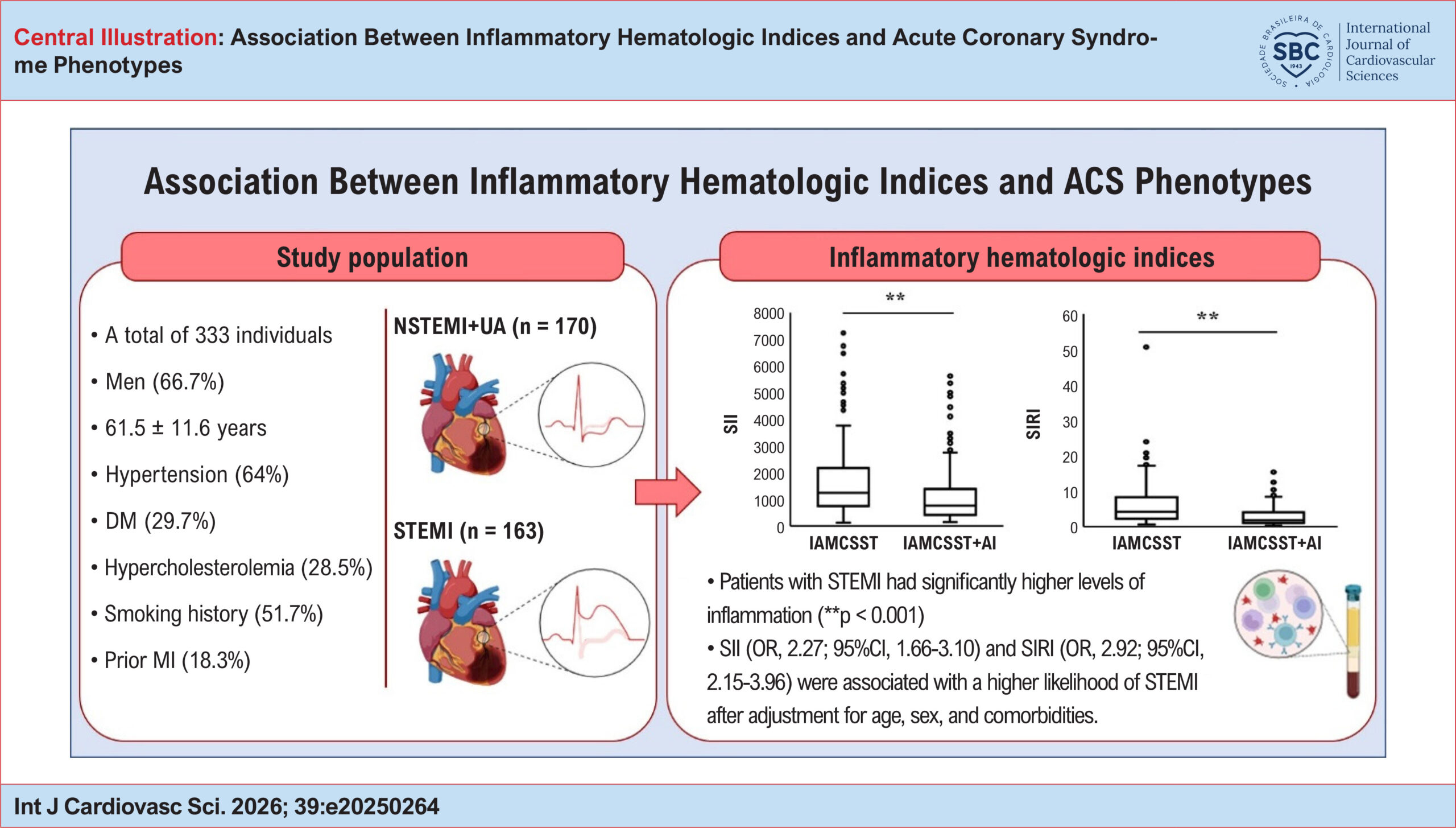
Higher values of the inflammatory indices SII (odds ratio [OR], 2.27; 95%CI, 1.66-3.10) and SIRI (OR, 2.92; 95%CI, 2.15-3.96), as well as a history of smoking, were independently associated with a higher likelihood of STEMI diagnosis. Additionally, the STEMI group showed significantly higher values of SII, SIRI, MLR, NLR, and PLR compared with the NSTEMI+UA group.

Conclusions:

Higher SII and SIRI values were independently associated with STEMI diagnosis, which suggests these indices may reflect differences in the inflammatory profile across ACS phenotypes.

  • Acute coronary syndrome
  • Biomarcadores
  • Coronary Artery Disease
  • Inflammation
Read Full Article
Creative Commons Attribution (CC BY) Creative Commons license
07/08/2026 DOI: 10.36660/ijcs.20250264 Views 1
Treatment Adherence and Cardiometabolic Goals in Patients with Coronary Artery Disease in the North Region of Brazil
IJCS
Original Article

Treatment Adherence and Cardiometabolic Goals in Patients with Coronary Artery Disease in the North Region of Brazil

Fernando Maia Coutinho et al. Talles L. Pereira Nogueira Dilma do Socorro Moraes de Souza Lucianna Serfaty de Holanda … Vitor Bruno Teixeira de Holanda Michele N. Assad Rafael M. Coutinho Ana Flávia Oliveira de Souza Márcio César Ribeiro Marvão Thiago da Silva Paulo

Abstract

Background:

Patients with coronary artery disease (CAD) are categorized by cardiovascular risk depending on associated risk factors and events, requiring more rigorous treatment goals.

Objective:

To investigate treatment adherence, using the Morisky–Green test, and achievement of metabolic goals at a tertiary public hospital in Belém, Pará, Brazil.

Methods:

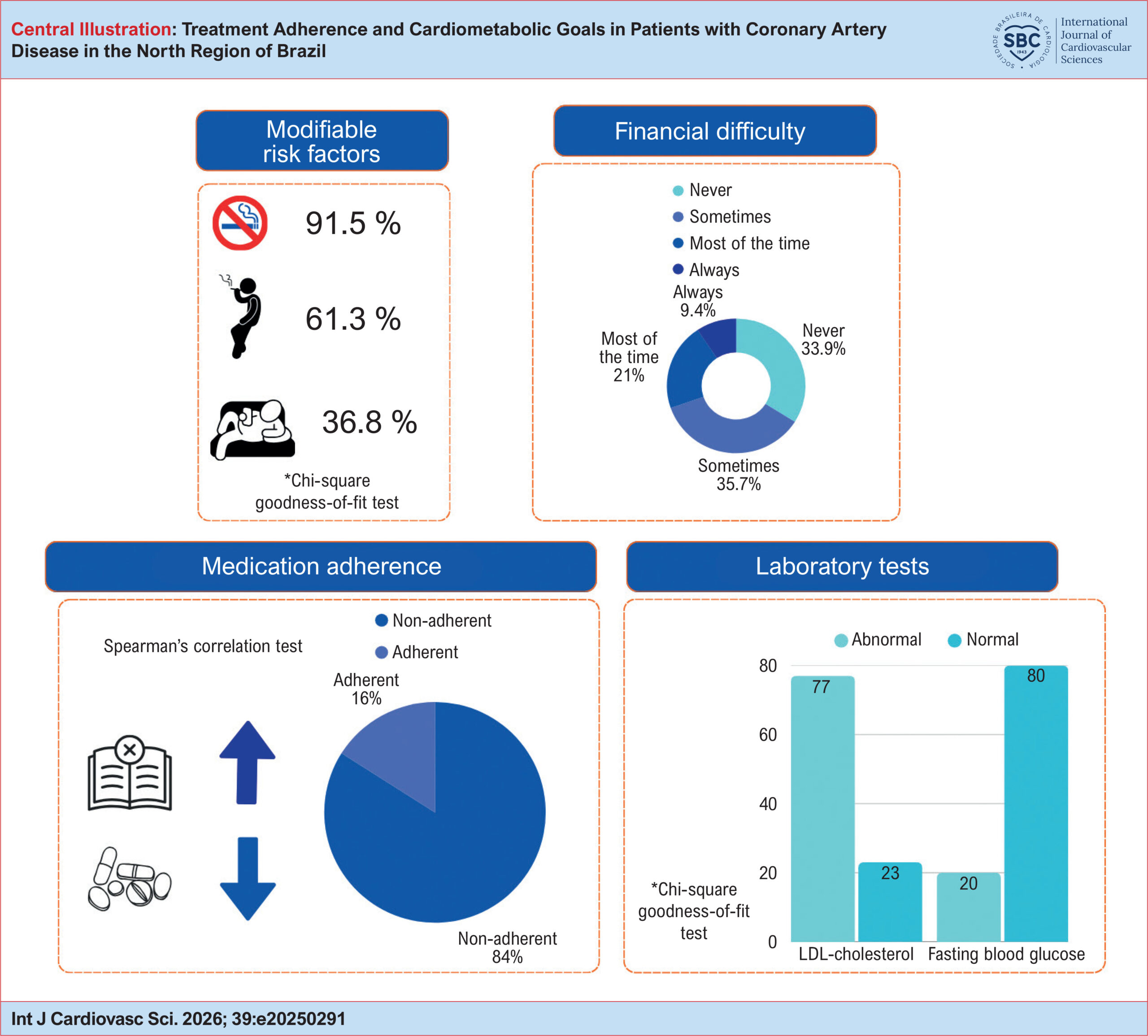
This observational, cross-sectional, and analytical study was conducted with a sample of 106 patients with CAD at very high cardiovascular risk, treated in the outpatient clinic of a tertiary care hospital. The following data were collected over a 4-month period: demographic information, medication adherence (Morisky–Green test), modifiable risk factors, and laboratory parameters (lipids, blood glucose, blood pressure, heart rate, and abdominal circumference). Associations were assessed using chi-square test or G test, and correlations were analyzed using Spearman’s test, adopting a significance level of 5% (p < 0.05).

Results:

Treatment adherence analysis showed an adherence rate of 16.0%. Low-density lipoprotein (LDL) -cholesterol levels were above the target of 50 mg/dL in 72.6% of patients, and normal blood glucose was achieved in 75.5%. Education level was the only epidemiological variable associated with therapeutic non-adherence (p = 0.0130). Regarding financial aspects, only 9.4% reported persistent difficulty in purchasing medications; among those reporting difficulty, high-potency statins were the most frequently cited (58.6%).

Conclusions:

Education level was shown to be a determining factor in understanding treatment, impacting adherence. Laboratory tests revealed significant deficiencies in lipid control, reinforcing the need for clinical optimization. Difficulties in accessing statins and low medication adherence underscore the importance of educational interventions and multidisciplinary approaches for better management of CAD.

  • Coronary Artery Disease
  • Risk Factors
  • Treatment Adherence and Compliance
Read Full Article
Creative Commons Attribution (CC BY) Creative Commons license
07/08/2026 DOI: 10.36660/ijcs.20250291
IJCS
Editorial

Coronary Artery Disease In Maintenance Hemodialysis Patients: Are We Acting Too Late?

Jorge Paulo Strogoff de Matos et al. Jocemir Ronaldo Lugon

The study by França et al. confirms the well-known high prevalence of Coronary Artery Disease (CAD) and the high mortality rate among patients with Chronic Kidney Disease (CKD) undergoing maintenance hemodialysis, which is mainly due to cardiovascular causes. The authors also found a significantly higher crude mortality rate among those who were not under statin use. However, this should be cautiously interpreted since no adjustment was made for confounding factors, and a bias cannot be ruled out, for example, that statins were not prescribed to those patients with a very low remaining life expectancy who would likely not benefit from the therapy.

The population undergoing renal replacement therapy is increasing worldwide. In Brazil alone, there are currently more than 150,000 patients on maintenance dialysis. In general, these patients are stratified and treated for CAD based on guidelines derived mainly from evidence from clinical trials in which, due to the study design, patients on dialysis therapy or those with advanced CKD were excluded.

[…]

  • chronic renal insufficiency
  • Coronary Artery Disease
  • renal dialysis
Read Full Article
Creative Commons Attribution (CC BY) Creative Commons license
27/07/2026 DOI: 10.36660/ijcs.20260021 Views 1
Figure 1
ABCIC
Editorial

Beyond Imaging: The Silent Impact of Depression on Coronary Artery Disease

Priscila Cestari Quagliato

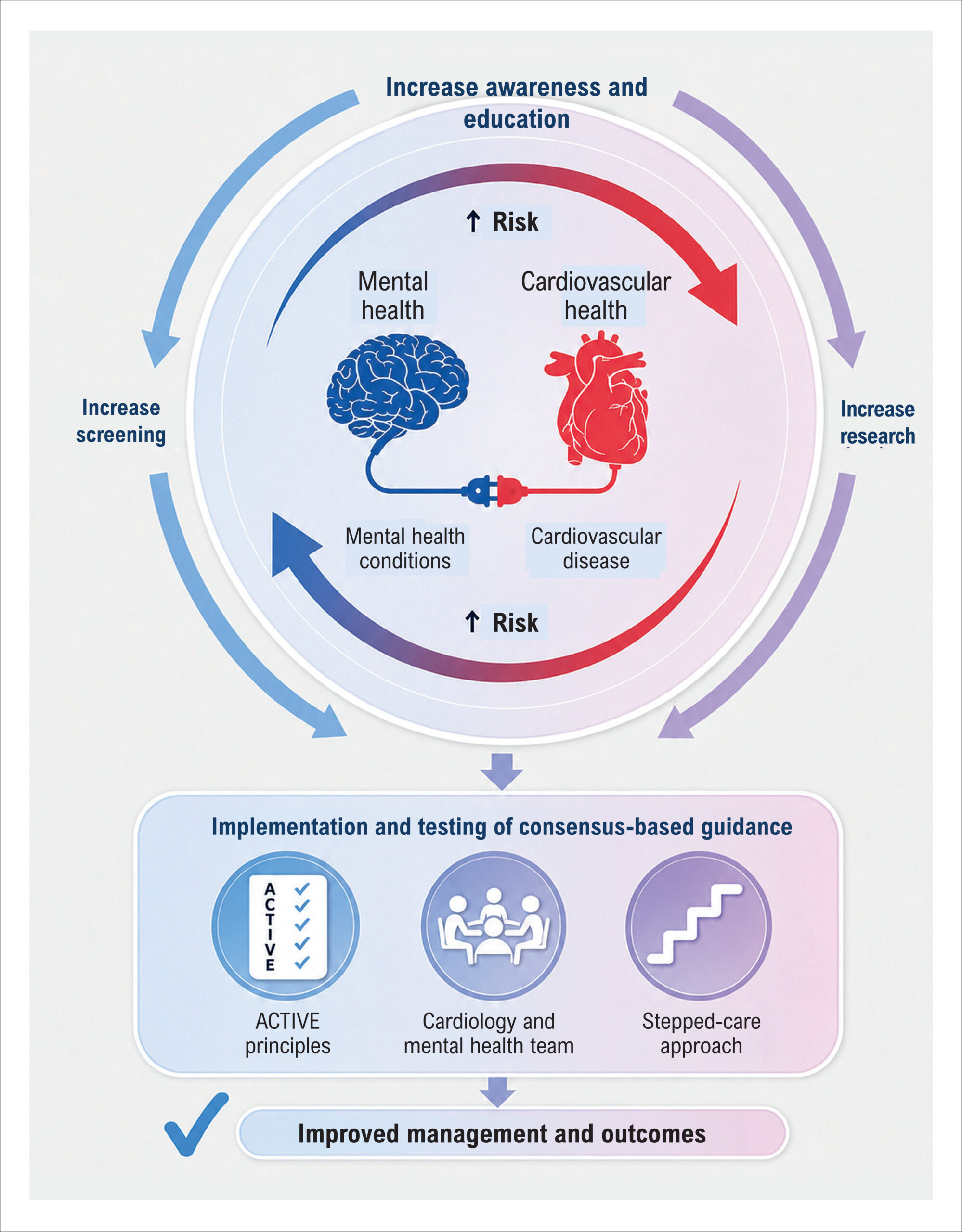
Coronary artery disease (CAD) remains the leading cause of global morbidity and mortality, and its intersection with mental health has received prominent attention in contemporary cardiology discussions. In 2025, the European Society of Cardiology published a guideline specifically addressing the multidirectional association between mental health and cardiovascular disease. Key issues were highlighted, including healthcare professionals’ limited awareness regarding the prevalence of mental disorders and their direct impacts on cardiovascular health, as well as inadequate recognition of severe mental illness and the stigmas associated with these conditions.

Mental disorders play a detrimental role in cardiovascular prevention, affecting treatment adherence and management of acute decompensations. The overlapping symptoms of the two conditions and the difficulties in monitoring chronic disease negatively impact patient prognosis.

[…]

  • Cardiology
  • Coronary Artery Disease
  • Depression
  • Mental Health
Read Full Article
Creative Commons Attribution (CC BY) Creative Commons license
27/07/2026 DOI: 10.36660/abcimg.20260074i Views 1
Exploring Risk Factors, Comorbidities, and Multiple Drug Therapy in Coronary Artery Disease Patients
IJCS
Original Article

Exploring Risk Factors, Comorbidities, and Multiple Drug Therapy in Coronary Artery Disease Patients

Ketan Inamdar et al. Harshada Kajave Akash Shete Jayant Pawar … Anmaria Thomas Madhur Kulkarni

Abstract

Background:

Coronary artery disease (CAD) continues to be a predominant global cause of morbidity and mortality, with rising prevalence in developing nations like India, emphasizing the need to address risk factors, multimorbidity, and polypharmacy to implement effective lifestyle interventions and drug therapies to enhance patient outcomes.

Objectives:

To evaluate the risk factors, comorbidities, and multiple drug therapy patterns among patients diagnosed with CAD in a tertiary care setting.

Methods:

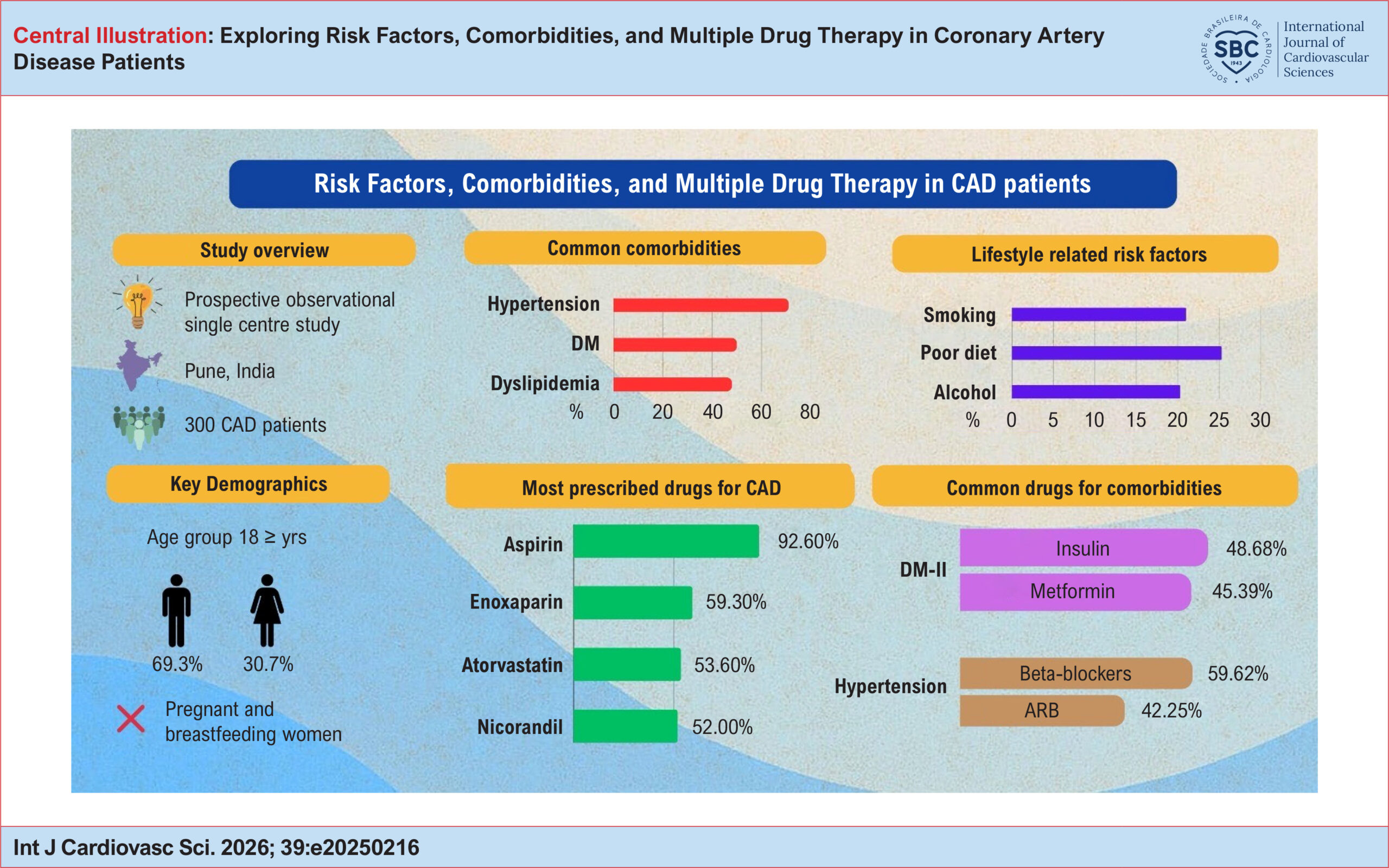
This prospective observational study used medical records to collect data on demographics, comorbidities, lifestyle factors, and medications. Descriptive statistics summarized findings, and Chi-square tests assessed associations between gender, risk factors, and CAD. The significance level adopted in the statistical analysis was 5%.

Results:

Out of 300 patients enrolled, 69.3% were male, and the highest disease prevalence was noted in the 66–75 age group. Hypertension was the most common comorbidity (71%), followed by diabetes mellitus (DM) (50%). Poor diet was the leading lifestyle risk factor (25.3%), followed by smoking (21%). A significant association existed between gender and CAD type (p = 0.002), with females showing higher angina prevalence and males showing more myocardial infarction (MI). For CAD management, aspirin (92.6%) and enoxaparin (59.3%) were most frequently prescribed, followed by atorvastatin (53.6%) and nicorandil (52%). For comorbidity management, beta-blockers (59.6%) and insulin (48.7%) were commonly prescribed. Increased use of ticagrelor and dapagliflozin was observed, indicating a greater alignment with evidence-based guideline recommendations.

Conclusion:

This study highlights the burden of multimorbidity and polypharmacy among CAD patients in India, emphasizing the need for individualized, evidence-based therapy.

  • Comorbidity
  • Coronary Artery Disease
  • Polypharmacy
  • Risk Factors
Read Full Article
Creative Commons Attribution (CC BY) Creative Commons license
24/07/2026 DOI: 10.36660/ijcs.20250216 Views 1
ABC
Letter to the Editor

Technology-Based Cardiac Rehabilitation and Exercise Capacity in Coronary Artery Disease: An Artificial Intelligence Analysis

Benil Nesli Ata

I read with great interest the article by Saklica et al. entitled “The Impact of Technology-Based Cardiac Rehabilitation on Exercise Capacity and Adherence in Patients with Coronary Artery Disease: An Artificial Intelligence Analysis,” recently published in Arquivos Brasileiros de Cardiologia. The study addresses an important and timely topic by examining the potential role of technology-supported cardiac rehabilitation programs and exploring the integration of artificial intelligence (AI)–based analyses in the evaluation of rehabilitation outcomes. Considering the persistent global underutilization of cardiac rehabilitation programs, studies exploring innovative and accessible rehabilitation strategies are of clear clinical importance.

One methodological aspect that warrants further consideration is the assessment of exercise capacity. In the present study, functional improvement was evaluated using the incremental shuttle walk test (ISWT). Although the ISWT is a practical and validated field test frequently used in rehabilitation settings, it remains a submaximal and effort-dependent measure. In patients with coronary artery disease, cardiopulmonary exercise testing (CPET) is generally regarded as the reference standard for evaluating exercise capacity because it provides objective physiological parameters such as peak oxygen uptake and ventilatory thresholds. The inclusion of CPET-derived variables could therefore have offered a more comprehensive evaluation of cardiopulmonary adaptations and strengthened the interpretation of the observed improvements in functional capacity.

[…]

  • Artificial Intelligence
  • Cardiac Rehabilitation
  • Coronary Artery Disease
  • digital health
  • Exercise
Read Full Article
Creative Commons Attribution (CC BY) Creative Commons license
20/07/2026 DOI: 10.36660/abc.20260179i Views 2
ABC
Editorial

Calcium Score, Non-Obstructive Coronary Artery Disease and Cardiovascular Events

Marcio Hiroshi Miname

Cardiovascular disease is the leading cause of morbidity and mortality in Brazil, except for 2021, when the COVID-19 pandemic caused the infectious disease to take that position. Cardiovascular risk stratification for atherosclerotic events aims to identify individuals at higher risk and, consequently, those with the greatest potential benefit from pharmacological therapy to reduce these events. However, risk prediction equations still lack sufficient calibration and discrimination for the Brazilian population. This opens a precedent for the incorporation of other laboratory or imaging biomarkers to complement and optimize the accuracy of cardiovascular risk stratification. The coronary calcium score (CCS) has been extensively analyzed in different populations, and its association with atherosclerotic coronary events is robust, culminating in its incorporation into Brazilian and American dyslipidemia guidelines..

However, it should be noted that the CCS only reflects the calcified part of the atheromatous plaque, not allowing for the assessment of the degree of luminal stenosis, the total composition of the plaque, or the total atherosclerotic burden. Nevertheless, there is a correlation between higher CCS and higher plaque burden.

[…]

  • Atherosclerosis
  • Calcium
  • Coronary Artery Disease
Read Full Article
Creative Commons Attribution (CC BY) Creative Commons license
20/07/2026 DOI: 10.36660/abc.20260405i Views 2
Coronary Artery Calcium Score, Risk Factors, and Clinical Outcomes in Nonobstructive Coronary Artery Disease: A Long-Term Follow-Up Study
ABC
Original Article

Coronary Artery Calcium Score, Risk Factors, and Clinical Outcomes in Nonobstructive Coronary Artery Disease: A Long-Term Follow-Up Study

Protásio Lemos Da Luz et al. Desiderio Favarato Alexandre A.C. Abizaid Luiz Antônio Machado Cesar … Carlos Vicente Serrano Jr. Antônio Carlos Palandri Chagas Carlos E. Rochitte Marco A. Gutierrez

Abstract

Background:

The prognostic value of coronary artery calcium (CAC) score in nonobstructive coronary artery disease (NObCAD; stenosis < 50%) remains insufficiently characterized.

Objectives:

To investigate the association between CAC score, cardiovascular risk factors, and clinical outcomes in patients with NObCAD.

Methods:

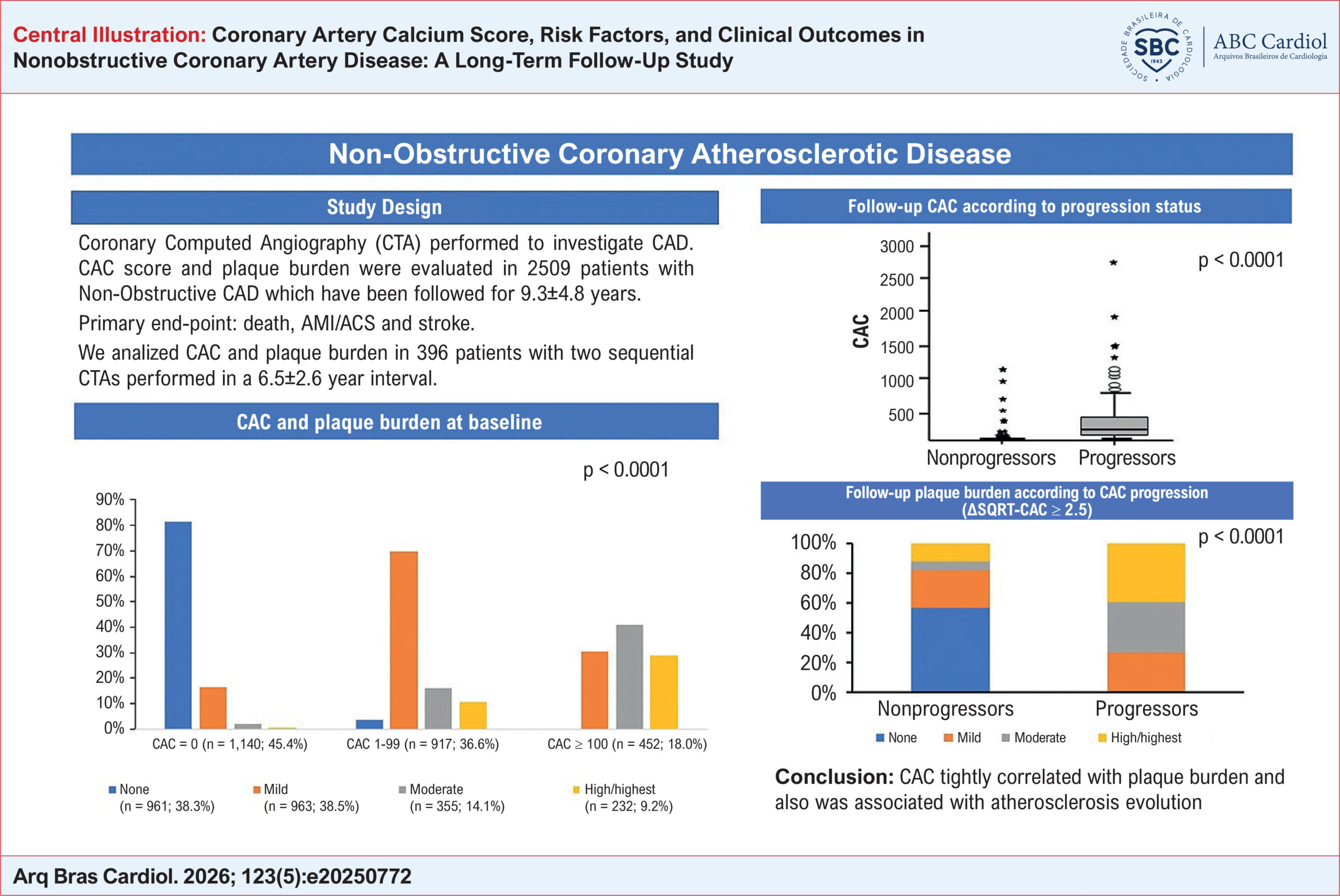
A total of 2,509 patients underwent coronary computed tomography angiography (CTA) and were followed for 8.9 ± 2.6 years. Plaque burden was classified according to CAD-RADS™ 2.0 into none, mild, moderate, and high/highest. The primary endpoint (PEP) was a composite of all-cause mortality, acute coronary syndrome/acute myocardial infarction, and stroke. Statistical significance was set at 5%.

Results:

CAC score was 0 in 45.4% of patients, 1-99 in 36.6%, and ≥ 100 in 18.0%. Correspondingly, 38.3% of patients had no coronary lesions, 38.5% had mild lesions, 14.1% had moderate lesions, and 9.2% had high/highest lesions. Among patients with CAC = 0, the absence of coronary lesions predominated (81.2%), whereas it was rare among those with CAC ≥ 100. The PEP occurred in 4.9% of patients, predominantly driven by all-cause mortality. Among the 396 patients with serial coronary CTA (mean interval: 6.5 ± 2.6 years), CAC progression (> 2.5 increase based on the square root method) was observed in 41.9%. Plaque burden increased in parallel. CAC score showed a positive association with plaque burden and cardiovascular risk factors.

Conclusions:

In NObCAD, CAC is present in more than half of patients and is associated with both plaque burden and cardiovascular risk factors. The incidence of PEP increases in proportion to risk factor burden and CAC levels. CAC and plaque burden progress concurrently over time, supporting the role of CAC as a surrogate marker of subclinical atherosclerosis progression.

  • Calcium
  • Coronary Artery Disease
  • Coronary Vessels
Read Full Article
Creative Commons Attribution (CC BY) Creative Commons license
17/07/2026 DOI: 10.36660/abc.20250772i Views 1
ABC
Editorial

Surgery is the Means, Not the End: Late Follow-Up of Coronary Artery Bypass Graft Surgery

João Carlos Ferreira Leal et al. Rafael Alessandro Ferreira Gomes Walter J. Gomes

Coronary artery bypass grafting (CABG) remains a leading treatment for coronary artery disease (CAD), particularly in high-risk patient subgroups such as those with multivessel disease, left ventricular dysfunction, diabetes mellitus, and high ischemic burden, as evidenced by decades of scientific evidence and its consistent long-term results.

Coronary artery disease (CAD) has a progressive, systemic, and chronic evolution, which makes long-term follow-up essential for interpreting the results in therapeutic strategies. Therefore, outcomes after coronary artery bypass grafting (CABG) cannot be limited solely to the technical success of the procedure or to in-hospital outcomes but must encompass a broader and more integrative long-term perspective.

[…]

  • Coronary Artery Disease
  • Myocardial Revascularization
  • Prognosis
Read Full Article
Creative Commons Attribution (CC BY) Creative Commons license
06/07/2026 DOI: 10.36660/abc.20260351i
Prognostic Value of Myocardial Perfusion Scintigraphy with IQ∙SPECT Technology in Patients with Suspected or Known Coronary Artery Disease
IJCS
Original Article

Prognostic Value of Myocardial Perfusion Scintigraphy with IQ∙SPECT Technology in Patients with Suspected or Known Coronary Artery Disease

Maria Fernanda Rezende et al. Davi Shunji Yahiro Fernando de Amorim Fernandes Jader Azevedo Claudio Tinoco Mesquita

Abstract

Background:

IQ∙SPECT is a collimator design coupled with a cardio-centric acquisition orbit and specific reconstruction algorithm that increases camera efficiency. However, there is no prognostic data derived from IQ∙SPECT exams.

Objectives:

To evaluate the prognostic value of IQ∙SPECT myocardial perfusion scintigraphy (MPS) in patients with suspected or known coronary artery disease (CAD).

Methods:

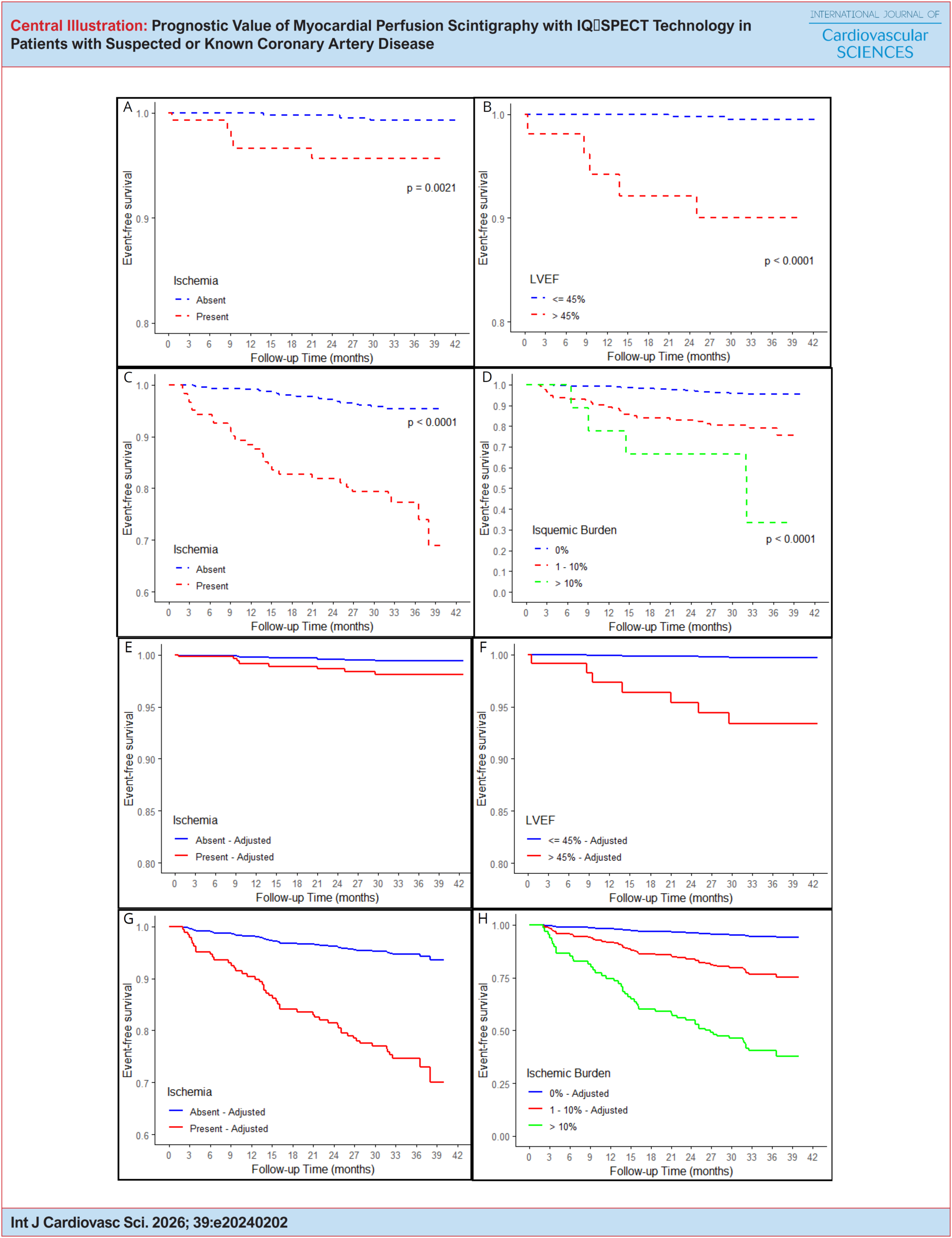
The study population consisted of 734 consecutive patients with suspected or known CAD submitted to MPS with IQ∙SPECT. Adequate follow-up was obtained in 625 patients. We retrospectively analyzed imaging and clinical data. The follow-up was obtained for no less than 12 months after the MPS study. Statistical significance was taken at p < 0.05.

Results:

Normal IQ∙SPECT compared to abnormal IQ∙SPECT had lower annualized incidence of hard events (0.2% and 1.1%, respectively, p = 0.02), late combined events (1.1% and 5.5%, respectively, p = 0.008), and revascularization (1% and 14%, respectively, p < 0.001). Left ventricular ejection fraction ≤ 45% was found to be the only clinical predictor of hard events (p < 0.0003, confidence interval [CI] = 5.25 to 129.02). However, for combined events, abnormal MPS (p < 0.0001, CI = 3.39 to 11.13, hazard ratio [HR] = 6.14) and dyspnea/fatigue (p = 0.013, CI = 1.28 to 8.4, HR = 3.3) obtained statistical significance. In contrast, ischemic burden ≥ 5% (p < 0.0001, HR = 30.3) was the most relevant parameter for revascularization, followed by thoracic pain (p = 0.002, HR = 2.4).

Conclusion:

Our study demonstrates that IQ SPECT MPS has significant prognostic capabilities with very low risk of adverse events in patients with normal findings.

  • Coronary Artery Disease
  • myocardial perfusion scintigraphy
  • Prognosis
Read Full Article
Creative Commons Attribution (CC BY) Creative Commons license
01/06/2026 DOI: 10.36660/ijcs.20240202 Views 1
IJCS
Editorial

Myocardial Perfusion Imaging: Always Evolving

Renata Christian Martins Felix

Myocardial perfusion assessed by nuclear medicine began to be used in clinical practice in the 1970s with the radiotracer 201-thallium chloride in two-dimensional images.

Advances in the development of equipment, from the possibility of three-dimensional images by single-photon emission computed tomography (SPECT), and new tracers, such as those linked to 99-technetium, have allowed the consolidation of nuclear cardiology as a non-invasive tool with high diagnostic accuracy in the context of coronary artery disease.

[…]

  • Coronary Artery Disease
  • Myocardial Perfusion Imaging
  • Predictive Value of Tests
  • Single Photon Emission Computed Tomography Computed Tomography
Read Full Article
Creative Commons Attribution (CC BY) Creative Commons license
01/06/2026 DOI: 10.36660/ijcs.20260007 Views 1
My Approach to Coronary Flow Assessment With Transthoracic Echocardiography
ABCIC
Review Article

My Approach to Coronary Flow Assessment With Transthoracic Echocardiography

José Maria Del Castillo et al. Issam Shehadeh

Abstract

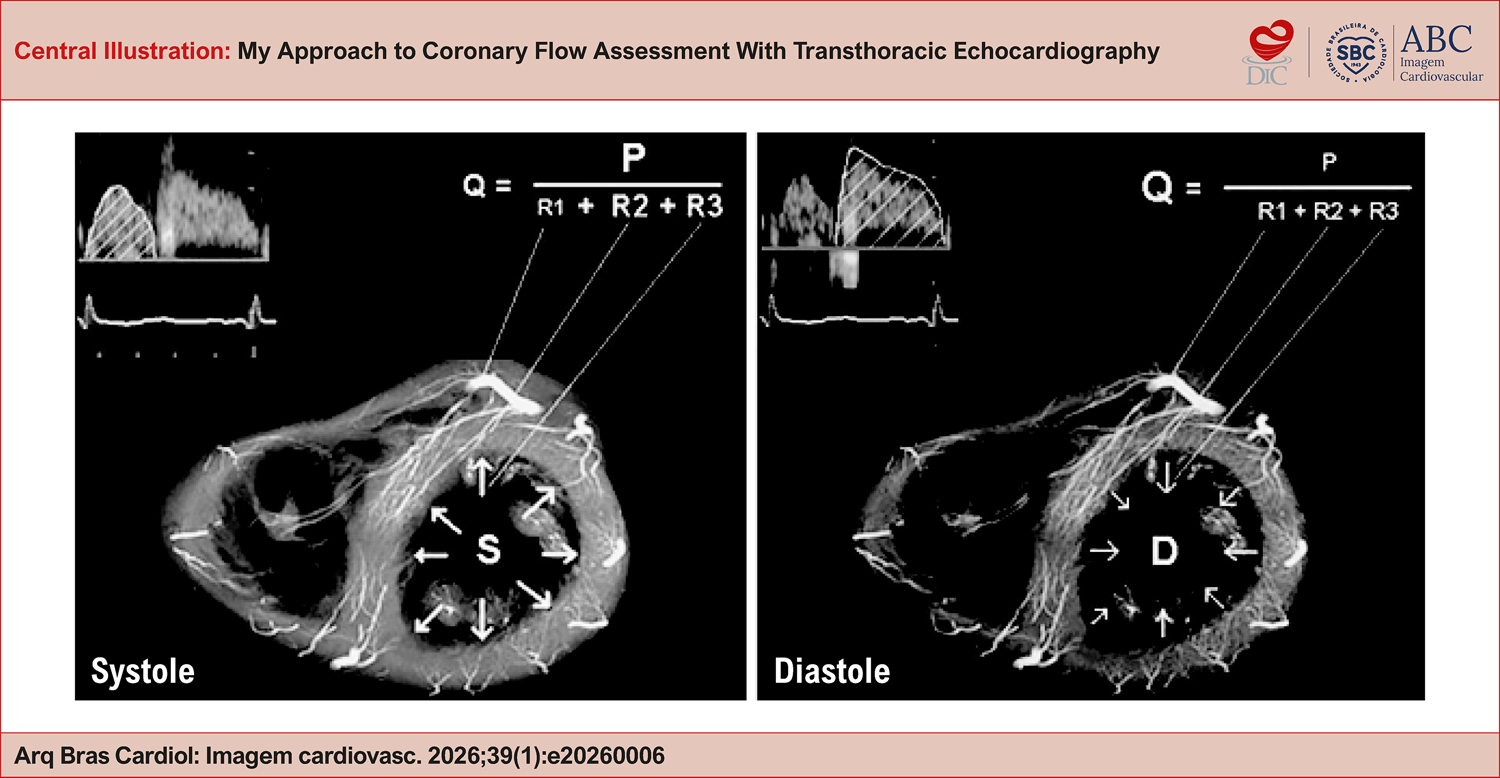
The assessment of coronary flow reserve is an extremely important step in stress echocardiography, both within and outside the context of coronary artery disease. For some, it is seen as an impossible parameter; for others, it is essential. In any case, everything begins with the proper visualization of the coronary arteries at rest. In this article, we will address theoretical and practical concepts for incorporating coronary flow study into the routine of the echocardiographer.

  • Coronary Artery Disease
  • Doppler ultrasonography
  • Ecocardiografia sob Estresse
Read Full Article
Creative Commons Attribution (CC BY) Creative Commons license
17/04/2026 DOI: 10.36660/abcimg.20260006i Views 1
ABC
Editorial

Coronary Artery Disease and Chronic Kidney Disease: A Tale of Two Organs

Igor Kranjec

“It was the best of times, it was the worst of times…” So begins Charles Dickens’s A Tale of Two Cities, a novel deeply rooted in London while casting a watchful eye across the Channel toward the upheaval of revolutionary Paris. In contrast to Dickens’s narrative of division, the two vital organs at the heart of this Editorial exist not in conflict, but in synergy. The heart and the kidneys work in tandem to maintain homeostasis; when one falters, the other inevitably follows. Cardiovascular abnormalities in chronic kidney disease (CKD) are driven by a complex interplay of traditional risk factors and non-traditional, CKD-specific stressors. As the glomerular filtration rate (GFR) declines, the clinical manifestations of coronary artery disease (CAD) become increasingly prevalent. Patients with concomitant CAD and CKD represent a distinct and challenging subgroup. They frequently present with atypical symptoms and are more likely to experience non-ST-segment myocardial infarction than stable exertional angina. Furthermore, sudden cardiac death is a tragically common endpoint in end-stage kidney disease.

Diagnostic clarity is often elusive in this population. Cardiac troponins are frequently chronically elevated even in the absence of acute coronary syndrome, though the exact mechanisms remain debated. Moreover, the diagnostic yield of exercise testing and pharmacologic perfusion imaging is diminished, leading to a higher incidence of both false-negative and false-positive results. While coronary calcification is ubiquitous in CKD and carries prognostic weight similar to that in the general population, its progression is significantly accelerated as renal function deteriorates. Histological studies further reveal a higher inflammatory burden within coronary plaques compared to non-renal controls. Despite these complexities, CKD patients remain systematically under-represented in clinical trials, leaving a vacuum of evidence-based guidelines regarding statin use, elective revascularization, and the optimal duration of dual antiplatelet therapy. The evaluation of CAD traditionally relies on clinical assessment integrated with diagnostic tools such as electrocardiography, stress testing, and echocardiography. Despite its known limitations, coronary luminal stenosis remains the conventional benchmark for CAD severity in daily practice, guiding management decisions following invasive coronary angiography or computed tomography angiography (CTA). However, emerging evidence suggests that plaque burden, rather than the degree of stenosis alone, is the primary predictor of cardiovascular risk, regardless of whether the CAD is obstructive or non-obstructive. CTA allows for an extensive characterization of this burden and the identification of high-risk plaque features. Furthermore, incorporating fractional flow reserve methods to account for diffuse CAD may refine the anatomical assessment of vessel-specific ischemia. GFR remains the definitive metric of kidney function. While the »gold standard« involves measuring the clearance of exogenous markers like inulin, this approach is too invasive, time-consuming, and costly for routine use. Consequently, clinical practice relies on GFR estimates (eGFR) derived from creatinine or cystatin C. The accuracy of these estimates is often compromised by non-GFR determinants of creatinine, such as diet, muscle mass, tubular secretion, and extrarenal elimination. Even in well-validated populations, 10% of patients may have estimation errors exceeding 30%. The Cockcroft-Gault (C-G) equation shares the inherent flaws of measured creatinine clearance. The Modification of Diet in Renal Disease (MDRD) equation is widely utilized, particularly in patients with advanced renal impairment, yet it loses precision in those with preserved kidney function. In contrast, the CKD-EPI (Chronic Kidney Disease Epidemiology Collaboration) equation—which utilizes the same variables as MDRD—offers superior accuracy at higher GFR levels by reducing systematic bias. Accordingly, the CKD-EPI equation is now the internationally recommended standard for routine laboratory practice.

[…]
  • chronic renal insufficiency
  • Coronary Artery Disease
  • Prognosis
Read Full Article
Creative Commons Attribution (CC BY) Creative Commons license
16/03/2026 DOI: 10.36660/abc.20260028i Views 1
Registry of Percutaneous Coronary Interventions in Very Small-Caliber Vessels: Analysis of a Sirolimus-Eluting Stent and Other Contemporary Drug-Eluting Stents
ABC
Original Article

Registry of Percutaneous Coronary Interventions in Very Small-Caliber Vessels: Analysis of a Sirolimus-Eluting Stent and Other Contemporary Drug-Eluting Stents

João Vitor Slaviero et al. André Luiz Langer Manica Rogério Eduardo Gomes Sarmento Leite Eduarda Paiva Borsa … Marcia Moura Schmidt Rodrigo Campos Ogando Julia Kurtz Teixeira Raphael Boesche Guimarães Alexandre Damiani Azmus Carlos A. M. Gottschall

Abstract

Background

Percutaneous coronary intervention (PCI) in very small-caliber vessels (≤2.25 mm) presents technical challenges and is associated with poorer outcomes compared to larger vessels. The Inspiron® stent, a drug-eluting stent (DES) manufactured in Brazil, has been evaluated in multiple studies; however, data on its performance in vessels smaller than 2.5 mm are lacking.

Objectives

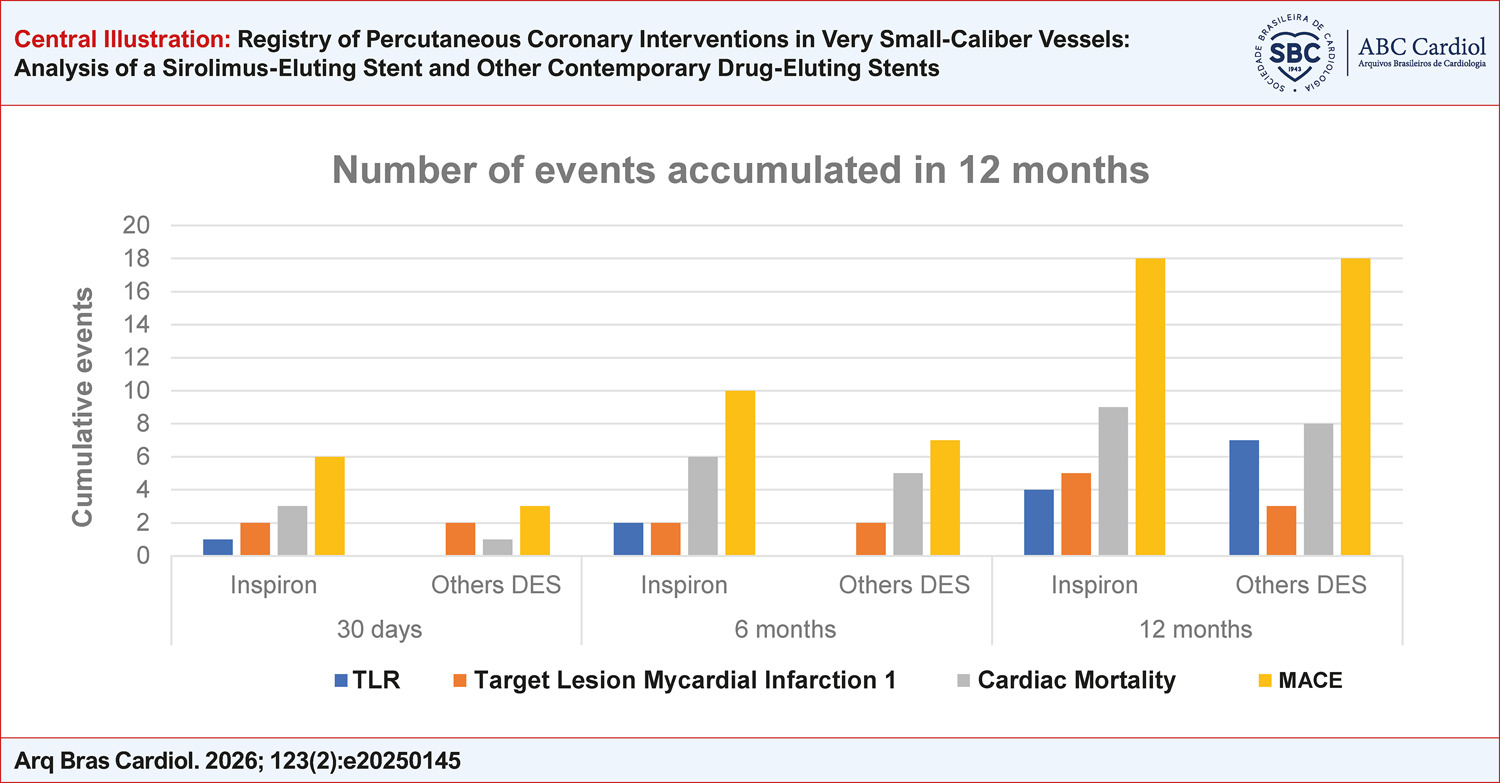
This study aimed to evaluate the clinical outcomes of PCI using DES in very small-caliber vessels and to compare the Inspiron® stent with other contemporary DES platforms. The primary endpoint was major adverse cardiac events (MACE), defined as cardiac death, target lesion myocardial infarction, and clinically driven target lesion revascularization.

Methods

We conducted an observational study including a consecutive sample at a Brazilian reference center from 2017 to 2021. Outcomes were assessed in-hospital, at 30 days, 6 months, and 12 months, using a 5% threshold for statistical significance.

Results

A total of 783 DES were implanted: 47% Inspiron® and 46.8% other DES. The mean patient age was 64.7 ± 11 years; 61% were male, and 42% had diabetes mellitus. At 12 months, the overall MACE rate was 4.54% (36/793), with no difference between groups (Inspiron®: 4.6% vs. other DES: 4.6%; p=1.000). Individual endpoints and stent thrombosis rates were also similar (4 [1.0%] vs. 2 [0.5%]; p=0.868).

Conclusion

our findings show that the Inspiron® stent has acceptable safety and efficacy and provides comparable 12-month clinical outcomes to other contemporary DES in very small-caliber coronary vessels.

  • Coronary Artery Disease
  • Drug-Eluting Stents
  • Percutaneous Coronary Intervention
  • Sirolimus
Read Full Article
Creative Commons Attribution (CC BY) Creative Commons license
16/03/2026 DOI: 10.36660/abc.20250145i Views 2
ABCIC
Editorial

Coronary CT Angiography in 2025: Long-Term Evidence, Artificial Intelligence, and the Photon-Counting Era

Tiago A. Magalhães

Coronary CT Angiography (CCTA) has become established as a first-line test in the evaluation of chest pain, supported by robust evidence of prognostic impact, advances in Artificial Intelligence (AI), and technological evolution with photon-counting CT. Publications in 2025 reposition CCTA as a central platform for risk stratification and therapeutic guidance in coronary artery disease.

The 10-year follow-up of the SCOT-HEART trial represents a major milestone in this process. Among 4,146 patients with stable chest pain randomized to standard care with or without CCTA, there was a sustained reduction in death from coronary heart disease or nonfatal myocardial infarction in the CCTA-guided group (HR 0.79; 95% CI 0.63–0.99). Although revascularization rates did not differ between groups, the use of preventive therapies was more intensive and consistently maintained over time in the CCTA arm. These findings demonstrate that the direct identification of atherosclerosis leads to more aggressive preventive interventions, with durable effects on clinical outcomes, establishing CCTA as a disease-modifying tool in chronic coronary syndromes.

[…]

  • Coronary Angiography
  • Coronary Artery Disease
  • Tomography
Read Full Article
Creative Commons Attribution (CC BY) Creative Commons license
04/03/2026 DOI: 10.36660/abcimg.20250106i Views 8
Inflammatory and Atherogenic Markers as Predictors of Coronary Artery Disease in Patients with Suspected Coronary Artery Disease Undergoing Coronary Angiography
IJCS
Original Article

Inflammatory and Atherogenic Markers as Predictors of Coronary Artery Disease in Patients with Suspected Coronary Artery Disease Undergoing Coronary Angiography

Veysi Can et al. Fuat Polat

Abstract

Background:

Coronary artery disease (CAD) remains a leading cause of death worldwide, with inflammation playing a key role in its pathophysiology. Inflammatory biomarkers may offer valuable insights into disease mechanisms and risk stratification, potentially informing therapeutic decisions.

Objectives:

This study aimed to investigate the association between key inflammatory markers — C-reactive protein (CRP), neutrophil-to-lymphocyte ratio (NLR), and platelet-to-lymphocyte ratio (PLR) — and both the presence and severity of coronary artery stenosis (CAS) in patients with suspected CAD undergoing coronary angiography.

Methods:

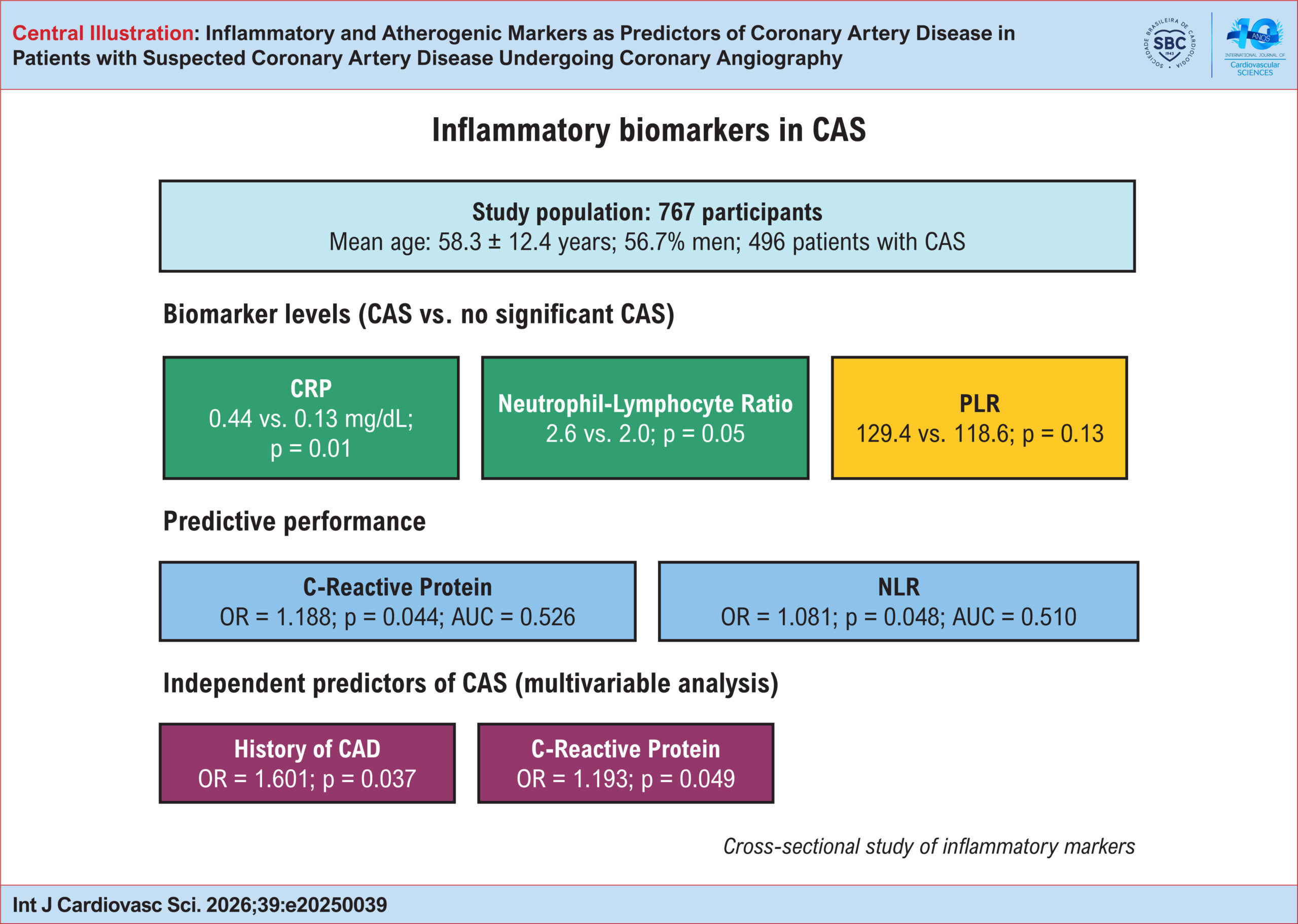
This retrospective study included 767 patients referred for coronary angiography due to suspected CAD. The primary outcome was the presence of significant CAS. Demographic data, medical history, and blood samples were collected. Statistical analyses included descriptive methods and regression modeling as well as receiver operating characteristic (ROC) curve analysis to determine optimal cutoff values for biomarkers, with area under the curve (AUC) used to assess predictive performance. A p-value < 0.05 was considered statistically significant.

Results:

Of the 767 patients (mean age 58.3±12.4 years; 56.7% men), 496 had significant CAS (≥ 50%) and 271 had nonsignificant CAS (< 50%). Levels of CRP (0.44 vs. 0.13 mg/dL, p = 0.01) and NLR (2.6 vs. 2.0, p = 0.05) were significantly higher in patients with CAS. No significant difference was observed for PLR (129.4 vs. 118.6, p = 0.13). In multivariable analysis, CRP (OR = 1.188, p = 0.044) and NLR (OR=1.567, p = 0.03) were identified as independent predictors of significant CAS. However, ROC curve analysis showed limited discriminative ability for both CRP (AUC = 0.526) and NLR (AUC = 0.510), with values only slightly above chance.

Conclusion:

Increased levels of CRP and NLR are significantly associated with CAS and may serve as potential biomarkers for detecting CAD.

  • Biomarcadores
  • C-Reactive Protein
  • Coronary Artery Disease
Read Full Article
Creative Commons Attribution (CC BY) Creative Commons license
02/03/2026 DOI: 10.36660/ijcs.20250039 Views 15
ABC
Original Article

Estimating Left Main Bifurcation Geometry: Are Geometric Models Reliable in Diseased Arteries?

Stefano Garzon et al. Lucas Pilotto José Mariani Felipe Bezerra … Guy Prado Willterson Bandeira Breno Almeida Pedro Lemos

Abstract

Background:

Accurate characterization of coronary bifurcation geometry is essential for planning and optimizing percutaneous coronary interventions. Although several geometric models have been proposed to predict coronary bifurcation dimensions, their performance in diseased vessels remains insufficiently explored.

Objective:

To assess the accuracy and precision of three geometric prediction models (Murray, Finet, and Huo–Kassab) in estimating left main coronary artery (LMCA) bifurcation diameters, using quantitative coronary angiography (QCA) and intravascular ultrasound (IVUS) as reference standards.

Methods:

This retrospective, single-center study included 13 patients undergoing IVUS evaluation of the LMCA, left anterior descending artery, and left circumflex artery. Bifurcation diameters predicted by each geometric model were compared with measurements obtained by QCA and IVUS. Accuracy, precision, and model ratios were calculated for each comparison. Agreement between predicted and measured values was further assessed using Bland–Altman analysis.

Results:

When compared with QCA, the Murray and Huo–Kassab models demonstrated higher accuracy (0.06 mm and −0.03 mm, respectively) and similar precision (0.95 mm for both) than the Finet model (accuracy −0.35 mm, precision 0.96 mm). In comparisons with IVUS, the Murray model showed the best performance, with an accuracy of −0.49 mm and a precision of 0.84 mm. Bland–Altman analysis indicated superior agreement for the Murray model, particularly when IVUS was used as the reference standard.

Conclusions:

In this population of patients with moderately diseased LMCA bifurcations, the Murray and Huo–Kassab models provided more accurate geometric predictions than the Finet model. Overall, the Murray model demonstrated the best performance, especially in IVUS-based assessments.

  • Coronary Angiography
  • Coronary Artery Disease
  • Coronary Vessels
Read Full Article
Creative Commons Attribution (CC BY) Creative Commons license
02/03/2026 DOI: 10.36660/abc.20250605i Views 1
Comparison of Different Glomerular Filtration Rate Formulas in the Prediction of Coronary Artery Disease Severity and Extent
ABC
Original Article

Comparison of Different Glomerular Filtration Rate Formulas in the Prediction of Coronary Artery Disease Severity and Extent

Monica Verdoia et al. Alyssa Clemente Aurelio Malabaila Chantal Montini Andrea Rognoni

Abstract

Background

Chronic kidney disease (CKD) is an established risk factor for coronary artery disease (CAD), displaying a linear relationship with glomerular filtration rate (GFR). The prognostic role of the different formulas for the estimation of GFR is still debated.

Objective

To evaluate the impact of GFR calculation in the prediction of angiographically assessed CAD.

Methods

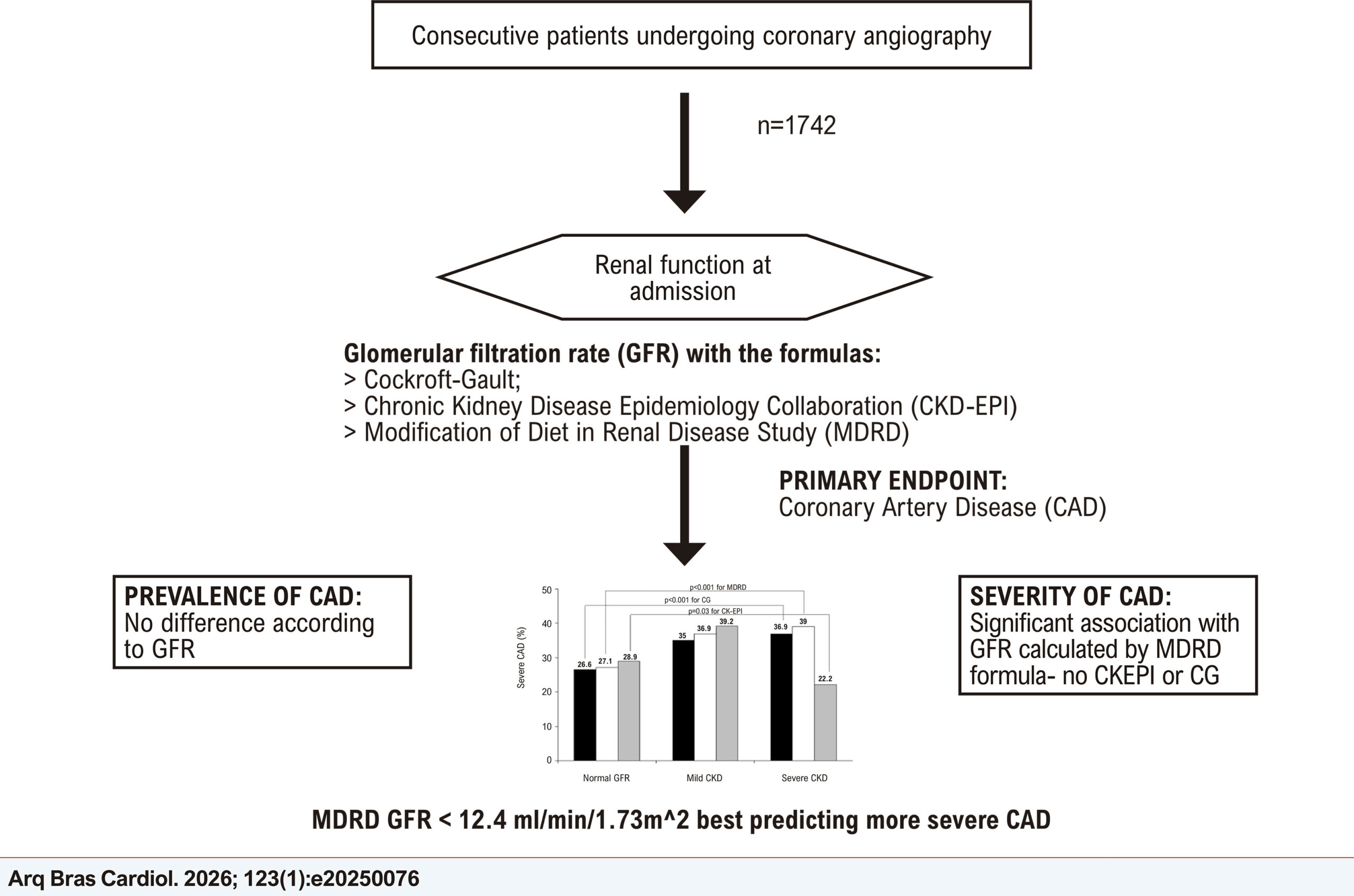
In consecutive patients undergoing coronary angiography, GFR was assessed at admission with the formulas Cockroft-Gault, Chronic Kidney Disease Epidemiology Collaboration (CKD-EPI), and Modification of Diet in Renal Disease Study (MDRD). A 2-sided p-value < 0.05 was considered statistically significant.

Results

Among 1742 patients, 79.8% displayed CAD. No difference in the mean values of GFR was observed in patients with and without CAD with the three different GFR formulas. We observed a significant association between severe CAD and GFR, by Cockcroft Gault (26.6% vs 35% vs 36.9%, p<0.001), MDRD (27.1% vs 36.9% vs 39%, p<0.001), and CKD-EPI (28.9% vs 39.2% vs 22.2%, p=0.03). In multivariate analysis, only MDRD remained statistically significant (adjusted OR[95%CI]= 1.27[1.01-1.59], p=0.04). In ROC curve analysis, we identified the value of 12.4 ml/min/1.73m^2 as the best predicting value for severe CAD with the MDRD formula. Higher rates of calcifications, restenosis, and chronic occlusion were observed for the Cockroft-Gault and MDRD formulas.

Conclusion

The present study showed a significant association between the extent of angiographically-defined CAD and GFR, estimated by the MDRD, but not for the Cockroft-Gault and CKD-EPI formulas. MDRD values below 12.4 ml/min/1.73m^2 best predicted more severe CAD.

  • Chronic Kidney Disease
  • Coronary Artery Disease
  • Glomerular Filtration Rate
Read Full Article
Creative Commons Attribution (CC BY) Creative Commons license
27/02/2026 DOI: 10.36660/abc.20250076i Views 6
Figure 1
ABCIC
Editorial

What Does Myocardial Work Offer Beyond Strain?

Luiz Otávio de Arruda Santos et al. Edgar Daminello Lucas Arraes de França

Introduction

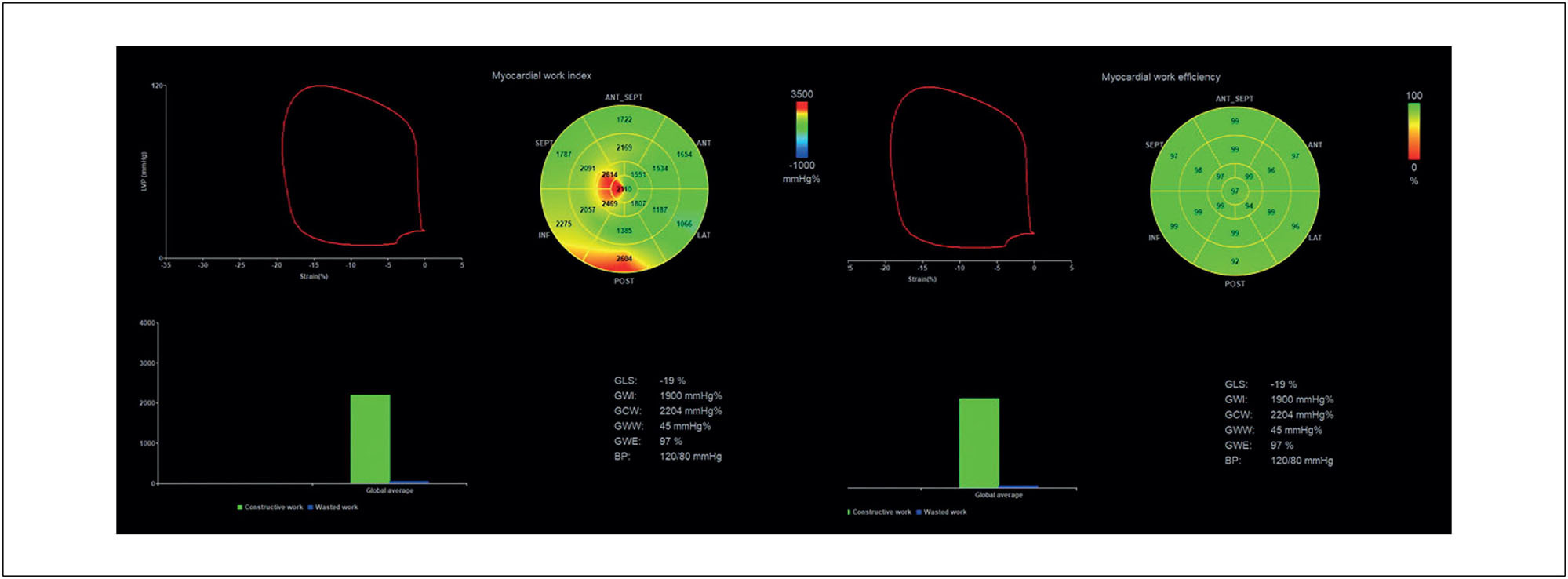
In contemporary cardiovascular imaging, one of the methods that has gained significant relevance by adding diagnostic and prognostic information is speckle-tracking–derived Longitudinal Strain, particularly the assessment of left ventricular Global Longitudinal Strain (GLS). However, although GLS evaluates global myocardial deformation of the left ventricle, it is highly dependent on loading conditions, which may interfere with the accurate interpretation of its results. In this context, an emerging technique has been introduced, also derived from speckle tracking: Myocardial Work (MW). Compared with strain, MW offers the advantage of mitigating afterload bias by incorporating systemic arterial pressure into longitudinal strain analysis, generating Pressure–Strain Loops (PSL) throughout the cardiac cycle. Thus, MW quantifies not only the extent of longitudinal myocardial deformation but also the load under which this deformation occurs, providing refined diagnostic insight into ventricular function. The methodology is based on the work of Russell et al., who validated the PSL area as a noninvasive index of myocardial work and also introduced the concept of wasted work resulting from contractile discoordination. In clinical practice, four global indices are derived: Global Work Index (GWI), Global Constructive Work (GCW), Global Wasted Work (GWW), and Global Work Efficiency (GWE = GCW / [GCW + GWW]) (). shows normal reference values for myocardial work and its indices derived from the Normal Reference Ranges for Echocardiography (NORRE) study of the European Association of Cardiovascular Imaging (EACVI).

[…]

  • Aortic Valve Stenosis
  • Cardiac Resynchronization Therapy
  • Coronary Artery Disease
  • Echocardiography
Read Full Article
Creative Commons Attribution (CC BY) Creative Commons license
03/02/2026 DOI: 10.36660/abcimg.20250103i Views 1

Could not load more articles. Please try again.

How to cite this article

EndNote RIS

Electronic Document Format (Vancouver)

Gao Y, Wu G, Jin T, Shen Z, Zhou N, Huang X. Genetic Evidence for the Association Between Sjögren’s Syndrome and Cardiovascular Disease Risk. International Journal of Cardiovascular Sciences 2026;39:e20250074.

Electronic Document Format (ABNT)

Gao, Yafang; Wu, Guohua; Jin, Tianyu; Shen, Zhijie; Zhou, Nannan; Huang, Xiaohong. Genetic Evidence for the Association Between Sjögren’s Syndrome and Cardiovascular Disease Risk. International Journal of Cardiovascular Sciences, v. 39, e20250074, Sep. 2026.

Electronic Document Format (APA)

Gao, Y., Wu, G., Jin, T., Shen, Z., Zhou, N., & Huang, X. (2026). Genetic Evidence for the Association Between Sjögren’s Syndrome and Cardiovascular Disease Risk. International Journal of Cardiovascular Sciences, 39, e20250074.

Electronic Document Format (ISO)

Gao, Yafang and Wu, Guohua and Jin, Tianyu and Shen, Zhijie and Zhou, Nannan and Huang, Xiaohong. Genetic Evidence for the Association Between Sjögren’s Syndrome and Cardiovascular Disease Risk. International Journal of Cardiovascular Sciences [online]. 2026, vol. 39, [cited 2026-10-14], e20250074. Available from: <https://journals.cardiol.br/en/article/genetic-evidence-for-the-association-between-sjogrens-syndrome-and-cardiovascular-disease-risk/>. ISSN 2359-4802

EndNote RIS

Electronic Document Format (Vancouver)

Vital K, Pavanello R, Valente BP, Blaas BN, Arruda BFT, Rossi R, Monaco MID, et al. Myocardial Infarction with Non-Obstructive Coronary Arteries: Clinical Profile, Diagnostic Investigation, and Outcomes in a Tertiary Center Cohort. International Journal of Cardiovascular Sciences 2026;39:e20260035.

Electronic Document Format (ABNT)

Vital, Kelvyn; Pavanello, Ricardo; Valente, Barbara Porto; Blaas, Bruno Noshang; Arruda, Bianca Fernandes Tavora; Rossi, Raphael; Monaco, Maria Isabel Del; Feres, Fausto. Myocardial Infarction with Non-Obstructive Coronary Arteries: Clinical Profile, Diagnostic Investigation, and Outcomes in a Tertiary Center Cohort. International Journal of Cardiovascular Sciences, v. 39, e20260035, Sep. 2026.

Electronic Document Format (APA)

Vital, K., Pavanello, R., Valente, B. P., Blaas, B. N., Arruda, B. F. T., Rossi, R., Monaco, M. I. D., & Feres, F. (2026). Myocardial Infarction with Non-Obstructive Coronary Arteries: Clinical Profile, Diagnostic Investigation, and Outcomes in a Tertiary Center Cohort. International Journal of Cardiovascular Sciences, 39, e20260035.

Electronic Document Format (ISO)

Vital, Kelvyn and Pavanello, Ricardo and Valente, Barbara Porto and Blaas, Bruno Noshang and Arruda, Bianca Fernandes Tavora and Rossi, Raphael and Monaco, Maria Isabel Del and Feres, Fausto. Myocardial Infarction with Non-Obstructive Coronary Arteries: Clinical Profile, Diagnostic Investigation, and Outcomes in a Tertiary Center Cohort. International Journal of Cardiovascular Sciences [online]. 2026, vol. 39, [cited 2026-10-14], e20260035. Available from: <https://journals.cardiol.br/en/article/myocardial-infarction-with-non-obstructive-coronary-arteries-clinical-profile-diagnostic-investigation-and-outcomes-in-a-tertiary-center-cohort/>. ISSN 2359-4802

EndNote RIS

Electronic Document Format (Vancouver)

Caldas AC, Matias D, Medina D, Correia LCL. Reversal of Therapeutic Recommendations in the American College of Cardiology Coronary Artery Disease Guidelines. International Journal of Cardiovascular Sciences 2026;39:e20250148.

Electronic Document Format (ABNT)

Caldas, Alessandra Carvalho; Matias, Denise; Medina, Daniel; Correia, Luis Claudio Lemos. Reversal of Therapeutic Recommendations in the American College of Cardiology Coronary Artery Disease Guidelines. International Journal of Cardiovascular Sciences, v. 39, e20250148, Sep. 2026.

Electronic Document Format (APA)

Caldas, A. C., Matias, D., Medina, D., & Correia, L. C. L. (2026). Reversal of Therapeutic Recommendations in the American College of Cardiology Coronary Artery Disease Guidelines. International Journal of Cardiovascular Sciences, 39, e20250148.

Electronic Document Format (ISO)

Caldas, Alessandra Carvalho and Matias, Denise and Medina, Daniel and Correia, Luis Claudio Lemos. Reversal of Therapeutic Recommendations in the American College of Cardiology Coronary Artery Disease Guidelines. International Journal of Cardiovascular Sciences [online]. 2026, vol. 39, [cited 2026-10-14], e20250148. Available from: <https://journals.cardiol.br/en/article/reversal-of-therapeutic-recommendations-in-the-american-college-of-cardiology-coronary-artery-disease-guidelines/>. ISSN 2359-4802

EndNote RIS

Electronic Document Format (Vancouver)

Gomes MS, Cruz ARC, Martins BL, Caliano MH, Magalhães PS, Bandeira D, Costa R, et al. Coronary Artery Disease In A Rare Anatomical Scenario: Type IV Duplicated Left Anterior Descending Artery. ABC Imagem Cardiovascular 2026;39(3):e20260032.

Electronic Document Format (ABNT)

Gomes, Matheus Sacco; Cruz, Amanda Raquel Costa; Martins, Bruno Leal; Caliano, Mario Henrique; Magalhães, Patricia de Souza; Bandeira, Daniel; Costa, Ricardo; Centemero, Marinella Patrizia. Coronary Artery Disease In A Rare Anatomical Scenario: Type IV Duplicated Left Anterior Descending Artery. ABC Imagem Cardiovascular, v. 39, n. 3, e20260032, Sep. 2026.

Electronic Document Format (APA)

Gomes, M. S., Cruz, A. R. C., Martins, B. L., Caliano, M. H., Magalhães, P. S., Bandeira, D., Costa, R., & Centemero, M. P. (2026). Coronary Artery Disease In A Rare Anatomical Scenario: Type IV Duplicated Left Anterior Descending Artery. ABC Imagem Cardiovascular, 39(3), e20260032.

Electronic Document Format (ISO)

Gomes, Matheus Sacco and Cruz, Amanda Raquel Costa and Martins, Bruno Leal and Caliano, Mario Henrique and Magalhães, Patricia de Souza and Bandeira, Daniel and Costa, Ricardo and Centemero, Marinella Patrizia. Coronary Artery Disease In A Rare Anatomical Scenario: Type IV Duplicated Left Anterior Descending Artery. ABC Imagem Cardiovascular [online]. 2026, vol. 39, n. 3, [cited 2026-10-14], e20260032. Available from: <https://journals.cardiol.br/en/article/coronary-artery-disease-in-a-rare-anatomical-scenario-type-iv-duplicated-left-anterior-descending-artery/>. ISSN 2318-8219

EndNote RIS

Electronic Document Format (Vancouver)

Rocha ASC, Kruczan D. Asymptomatic Patients With Suspected Coronary Artery Disease: What Are Clinicians Afraid Of?. International Journal of Cardiovascular Sciences 2026;39:e20250075.

Electronic Document Format (ABNT)

Rocha, Antônio Sérgio Cordeiro da; Kruczan, Dany. Asymptomatic Patients With Suspected Coronary Artery Disease: What Are Clinicians Afraid Of?. International Journal of Cardiovascular Sciences, v. 39, e20250075, Aug. 2026.

Electronic Document Format (APA)

Rocha, A. S. C. , & Kruczan, D. (2026). Asymptomatic Patients With Suspected Coronary Artery Disease: What Are Clinicians Afraid Of?. International Journal of Cardiovascular Sciences, 39, e20250075.

Electronic Document Format (ISO)

Rocha, Antônio Sérgio Cordeiro da and Kruczan, Dany. Asymptomatic Patients With Suspected Coronary Artery Disease: What Are Clinicians Afraid Of?. International Journal of Cardiovascular Sciences [online]. 2026, vol. 39, [cited 2026-10-14], e20250075. Available from: <https://journals.cardiol.br/en/article/asymptomatic-patients-with-suspected-coronary-artery-disease-what-are-clinicians-afraid-of/>. ISSN 2359-4802

EndNote RIS

Electronic Document Format (Vancouver)

Righi FL, Sugai G, Araujo P, Alves RJ. Association Between Inflammatory Hematologic Indices and Acute Coronary Syndrome Phenotypes. International Journal of Cardiovascular Sciences 2026;39:e20250264.

Electronic Document Format (ABNT)

Righi, Fabiele de Lima; Sugai, Gustavo; Araujo, Paula; Alves, Renato Jorge. Association Between Inflammatory Hematologic Indices and Acute Coronary Syndrome Phenotypes. International Journal of Cardiovascular Sciences, v. 39, e20250264, Aug. 2026.

Electronic Document Format (APA)

Righi, F. L., Sugai, G., Araujo, P., & Alves, R. J. (2026). Association Between Inflammatory Hematologic Indices and Acute Coronary Syndrome Phenotypes. International Journal of Cardiovascular Sciences, 39, e20250264.

Electronic Document Format (ISO)

Righi, Fabiele de Lima and Sugai, Gustavo and Araujo, Paula and Alves, Renato Jorge. Association Between Inflammatory Hematologic Indices and Acute Coronary Syndrome Phenotypes. International Journal of Cardiovascular Sciences [online]. 2026, vol. 39, [cited 2026-10-14], e20250264. Available from: <https://journals.cardiol.br/en/article/association-between-inflammatory-hematologic-indices-and-acute-coronary-syndrome-phenotypes/>. ISSN 2359-4802

EndNote RIS

Electronic Document Format (Vancouver)

Coutinho FM, Nogueira TLP, Souza DSM, Holanda LS, Holanda VBT, Assad MN, Coutinho RM, et al. Treatment Adherence and Cardiometabolic Goals in Patients with Coronary Artery Disease in the North Region of Brazil. International Journal of Cardiovascular Sciences 2026;39:e20250291.

Electronic Document Format (ABNT)

Coutinho, Fernando Maia; Nogueira, Talles L. Pereira; Souza, Dilma do Socorro Moraes de; Holanda, Lucianna Serfaty de; Holanda, Vitor Bruno Teixeira de; Assad, Michele N.; Coutinho, Rafael M.; Souza, Ana Flávia Oliveira de; Marvão, Márcio César Ribeiro; Paulo, Thiago da Silva. Treatment Adherence and Cardiometabolic Goals in Patients with Coronary Artery Disease in the North Region of Brazil. International Journal of Cardiovascular Sciences, v. 39, e20250291, Aug. 2026.

Electronic Document Format (APA)

Coutinho, F. M., Nogueira, T. L. P., Souza, D. S. M. , Holanda, L. S. , Holanda, V. B. T. , Assad, M. N., Coutinho, R. M., Souza, A. F. O. , Marvão, M. C. R., & Paulo, T. S. (2026). Treatment Adherence and Cardiometabolic Goals in Patients with Coronary Artery Disease in the North Region of Brazil. International Journal of Cardiovascular Sciences, 39, e20250291.

Electronic Document Format (ISO)

Coutinho, Fernando Maia and Nogueira, Talles L. Pereira and Souza, Dilma do Socorro Moraes de and Holanda, Lucianna Serfaty de and Holanda, Vitor Bruno Teixeira de and Assad, Michele N. and Coutinho, Rafael M. and Souza, Ana Flávia Oliveira de and Marvão, Márcio César Ribeiro and Paulo, Thiago da Silva. Treatment Adherence and Cardiometabolic Goals in Patients with Coronary Artery Disease in the North Region of Brazil. International Journal of Cardiovascular Sciences [online]. 2026, vol. 39, [cited 2026-10-14], e20250291. Available from: <https://journals.cardiol.br/en/article/treatment-adherence-and-cardiometabolic-goals-in-patients-with-coronary-artery-disease-in-the-north-region-of-brazil/>. ISSN 2359-4802

EndNote RIS

Electronic Document Format (Vancouver)

Matos JPS, Lugon JR. Coronary Artery Disease In Maintenance Hemodialysis Patients: Are We Acting Too Late?. International Journal of Cardiovascular Sciences 2026;39:e20260021.

Electronic Document Format (ABNT)

Matos, Jorge Paulo Strogoff de; Lugon, Jocemir Ronaldo. Coronary Artery Disease In Maintenance Hemodialysis Patients: Are We Acting Too Late?. International Journal of Cardiovascular Sciences, v. 39, e20260021, Jul. 2026.

Electronic Document Format (APA)

Matos, J. P. S. , & Lugon, J. R. (2026). Coronary Artery Disease In Maintenance Hemodialysis Patients: Are We Acting Too Late?. International Journal of Cardiovascular Sciences, 39, e20260021.

Electronic Document Format (ISO)

Matos, Jorge Paulo Strogoff de and Lugon, Jocemir Ronaldo. Coronary Artery Disease In Maintenance Hemodialysis Patients: Are We Acting Too Late?. International Journal of Cardiovascular Sciences [online]. 2026, vol. 39, [cited 2026-10-14], e20260021. Available from: <https://journals.cardiol.br/en/article/coronary-artery-disease-in-maintenance-hemodialysis-patients-are-we-acting-too-late/>. ISSN 2359-4802

EndNote RIS

Electronic Document Format (Vancouver)

Quagliato PC. Beyond Imaging: The Silent Impact of Depression on Coronary Artery Disease. ABC Imagem Cardiovascular 2026;39(2):e20260074.

Electronic Document Format (ABNT)

Quagliato, Priscila Cestari. Beyond Imaging: The Silent Impact of Depression on Coronary Artery Disease. ABC Imagem Cardiovascular, v. 39, n. 2, e20260074, Jul. 2026.

Electronic Document Format (APA)

Quagliato, P. C. (2026). Beyond Imaging: The Silent Impact of Depression on Coronary Artery Disease. ABC Imagem Cardiovascular, 39(2), e20260074.

Electronic Document Format (ISO)

Quagliato, Priscila Cestari. Beyond Imaging: The Silent Impact of Depression on Coronary Artery Disease. ABC Imagem Cardiovascular [online]. 2026, vol. 39, n. 2, [cited 2026-10-14], e20260074. Available from: <https://journals.cardiol.br/en/article/beyond-imaging-the-silent-impact-of-depression-on-coronary-artery-disease/>. ISSN 2318-8219

EndNote RIS

Electronic Document Format (Vancouver)

Inamdar K, Kajave H, Shete A, Pawar J, Thomas A, Kulkarni M. Exploring Risk Factors, Comorbidities, and Multiple Drug Therapy in Coronary Artery Disease Patients. International Journal of Cardiovascular Sciences 2026;39:e20250216.

Electronic Document Format (ABNT)

Inamdar, Ketan; Kajave, Harshada; Shete, Akash; Pawar, Jayant; Thomas, Anmaria; Kulkarni, Madhur. Exploring Risk Factors, Comorbidities, and Multiple Drug Therapy in Coronary Artery Disease Patients. International Journal of Cardiovascular Sciences, v. 39, e20250216, Jul. 2026.

Electronic Document Format (APA)

Inamdar, K., Kajave, H., Shete, A., Pawar, J., Thomas, A., & Kulkarni, M. (2026). Exploring Risk Factors, Comorbidities, and Multiple Drug Therapy in Coronary Artery Disease Patients. International Journal of Cardiovascular Sciences, 39, e20250216.

Electronic Document Format (ISO)

Inamdar, Ketan and Kajave, Harshada and Shete, Akash and Pawar, Jayant and Thomas, Anmaria and Kulkarni, Madhur. Exploring Risk Factors, Comorbidities, and Multiple Drug Therapy in Coronary Artery Disease Patients. International Journal of Cardiovascular Sciences [online]. 2026, vol. 39, [cited 2026-10-14], e20250216. Available from: <https://journals.cardiol.br/en/article/exploring-risk-factors-comorbidities-and-multiple-drug-therapy-in-coronary-artery-disease-patients/>. ISSN 2359-4802

EndNote RIS

Electronic Document Format (Vancouver)

Ata BN. Technology-Based Cardiac Rehabilitation and Exercise Capacity in Coronary Artery Disease: An Artificial Intelligence Analysis. Arquivos Brasileiros de Cardiologia 2026;123(5):e20260179.

Electronic Document Format (ABNT)

Ata, Benil Nesli. Technology-Based Cardiac Rehabilitation and Exercise Capacity in Coronary Artery Disease: An Artificial Intelligence Analysis. Arquivos Brasileiros de Cardiologia, v. 123, n. 5, e20260179, Jul. 2026.

Electronic Document Format (APA)

Ata, B. N. (2026). Technology-Based Cardiac Rehabilitation and Exercise Capacity in Coronary Artery Disease: An Artificial Intelligence Analysis. Arquivos Brasileiros de Cardiologia, 123(5), e20260179.

Electronic Document Format (ISO)

Ata, Benil Nesli. Technology-Based Cardiac Rehabilitation and Exercise Capacity in Coronary Artery Disease: An Artificial Intelligence Analysis. Arquivos Brasileiros de Cardiologia [online]. 2026, vol. 123, n. 5, [cited 2026-10-14], e20260179. Available from: <https://journals.cardiol.br/en/article/technology-based-cardiac-rehabilitation-and-exercise-capacity-in-coronary-artery-disease-an-artificial-intelligence-analysis/>. ISSN 0066-782X

EndNote RIS

Electronic Document Format (Vancouver)

Miname MH. Calcium Score, Non-Obstructive Coronary Artery Disease and Cardiovascular Events. Arquivos Brasileiros de Cardiologia 2026;123(5):e20260405.

Electronic Document Format (ABNT)

Miname, Marcio Hiroshi. Calcium Score, Non-Obstructive Coronary Artery Disease and Cardiovascular Events. Arquivos Brasileiros de Cardiologia, v. 123, n. 5, e20260405, Jul. 2026.

Electronic Document Format (APA)

Miname, M. H. (2026). Calcium Score, Non-Obstructive Coronary Artery Disease and Cardiovascular Events. Arquivos Brasileiros de Cardiologia, 123(5), e20260405.

Electronic Document Format (ISO)

Miname, Marcio Hiroshi. Calcium Score, Non-Obstructive Coronary Artery Disease and Cardiovascular Events. Arquivos Brasileiros de Cardiologia [online]. 2026, vol. 123, n. 5, [cited 2026-10-14], e20260405. Available from: <https://journals.cardiol.br/en/article/calcium-score-non-obstructive-coronary-artery-disease-and-cardiovascular-events/>. ISSN 0066-782X

EndNote RIS

Electronic Document Format (Vancouver)

Luz PLD, Favarato D, Abizaid AA, Cesar LAM, Serrano Jr. CV, Chagas ACP, Rochitte CE, et al. Coronary Artery Calcium Score, Risk Factors, and Clinical Outcomes in Nonobstructive Coronary Artery Disease: A Long-Term Follow-Up Study. Arquivos Brasileiros de Cardiologia 2026;123(5):e20250772.

Electronic Document Format (ABNT)

Luz, Protásio Lemos Da; Favarato, Desiderio; Abizaid, Alexandre A.C.; Cesar, Luiz Antônio Machado; Serrano Jr., Carlos Vicente; Chagas, Antônio Carlos Palandri; Rochitte, Carlos E.; Gutierrez, Marco A.. Coronary Artery Calcium Score, Risk Factors, and Clinical Outcomes in Nonobstructive Coronary Artery Disease: A Long-Term Follow-Up Study. Arquivos Brasileiros de Cardiologia, v. 123, n. 5, e20250772, Jul. 2026.

Electronic Document Format (APA)

Luz, P. L. D., Favarato, D., Abizaid, A. A., Cesar, L. A. M., Serrano Jr., C. V., Chagas, A. C. P., Rochitte, C. E., & Gutierrez, M. A. (2026). Coronary Artery Calcium Score, Risk Factors, and Clinical Outcomes in Nonobstructive Coronary Artery Disease: A Long-Term Follow-Up Study. Arquivos Brasileiros de Cardiologia, 123(5), e20250772.

Electronic Document Format (ISO)

Luz, Protásio Lemos Da and Favarato, Desiderio and Abizaid, Alexandre A.C. and Cesar, Luiz Antônio Machado and Serrano Jr., Carlos Vicente and Chagas, Antônio Carlos Palandri and Rochitte, Carlos E. and Gutierrez, Marco A.. Coronary Artery Calcium Score, Risk Factors, and Clinical Outcomes in Nonobstructive Coronary Artery Disease: A Long-Term Follow-Up Study. Arquivos Brasileiros de Cardiologia [online]. 2026, vol. 123, n. 5, [cited 2026-10-14], e20250772. Available from: <https://journals.cardiol.br/en/article/coronary-artery-calcium-score-risk-factors-and-clinical-outcomes-in-nonobstructive-coronary-artery-disease-a-long-term-follow-up-study/>. ISSN 0066-782X

EndNote RIS

Electronic Document Format (Vancouver)

Leal JCF, Gomes RAF, Gomes WJ. Surgery is the Means, Not the End: Late Follow-Up of Coronary Artery Bypass Graft Surgery. Arquivos Brasileiros de Cardiologia 2026;123(4):e20260351.

Electronic Document Format (ABNT)

Leal, João Carlos Ferreira; Gomes, Rafael Alessandro Ferreira; Gomes, Walter J.. Surgery is the Means, Not the End: Late Follow-Up of Coronary Artery Bypass Graft Surgery. Arquivos Brasileiros de Cardiologia, v. 123, n. 4, e20260351, Jul. 2026.

Electronic Document Format (APA)

Leal, J. C. F., Gomes, R. A. F., & Gomes, W. J. (2026). Surgery is the Means, Not the End: Late Follow-Up of Coronary Artery Bypass Graft Surgery. Arquivos Brasileiros de Cardiologia, 123(4), e20260351.

Electronic Document Format (ISO)

Leal, João Carlos Ferreira and Gomes, Rafael Alessandro Ferreira and Gomes, Walter J.. Surgery is the Means, Not the End: Late Follow-Up of Coronary Artery Bypass Graft Surgery. Arquivos Brasileiros de Cardiologia [online]. 2026, vol. 123, n. 4, [cited 2026-10-14], e20260351. Available from: <https://journals.cardiol.br/en/article/surgery-is-the-means-not-the-end-late-follow-up-of-coronary-artery-bypass-graft-surgery/>. ISSN 0066-782X

EndNote RIS

Electronic Document Format (Vancouver)

Rezende MF, Yahiro DS, Fernandes FA, Azevedo J, Mesquita CT. Prognostic Value of Myocardial Perfusion Scintigraphy with IQ∙SPECT Technology in Patients with Suspected or Known Coronary Artery Disease. International Journal of Cardiovascular Sciences 2026;39:e20240202.

Electronic Document Format (ABNT)

Rezende, Maria Fernanda; Yahiro, Davi Shunji; Fernandes, Fernando de Amorim; Azevedo, Jader; Mesquita, Claudio Tinoco. Prognostic Value of Myocardial Perfusion Scintigraphy with IQ∙SPECT Technology in Patients with Suspected or Known Coronary Artery Disease. International Journal of Cardiovascular Sciences, v. 39, e20240202, May. 2026.

Electronic Document Format (APA)

Rezende, M. F., Yahiro, D. S., Fernandes, F. A., Azevedo, J., & Mesquita, C. T. (2026). Prognostic Value of Myocardial Perfusion Scintigraphy with IQ∙SPECT Technology in Patients with Suspected or Known Coronary Artery Disease. International Journal of Cardiovascular Sciences, 39, e20240202.

Electronic Document Format (ISO)

Rezende, Maria Fernanda and Yahiro, Davi Shunji and Fernandes, Fernando de Amorim and Azevedo, Jader and Mesquita, Claudio Tinoco. Prognostic Value of Myocardial Perfusion Scintigraphy with IQ∙SPECT Technology in Patients with Suspected or Known Coronary Artery Disease. International Journal of Cardiovascular Sciences [online]. 2026, vol. 39, [cited 2026-10-14], e20240202. Available from: <https://journals.cardiol.br/en/article/prognostic-value-of-myocardial-perfusion-scintigraphy-with-iq%e2%88%99spect-technology-in-patients-with-suspected-or-known-coronary-artery-disease/>. ISSN 2359-4802

EndNote RIS

Electronic Document Format (Vancouver)

Felix RCM. Myocardial Perfusion Imaging: Always Evolving. International Journal of Cardiovascular Sciences 2026;39:e20260007.

Electronic Document Format (ABNT)

Felix, Renata Christian Martins. Myocardial Perfusion Imaging: Always Evolving. International Journal of Cardiovascular Sciences, v. 39, e20260007, May. 2026.

Electronic Document Format (APA)

Felix, R. C. M. (2026). Myocardial Perfusion Imaging: Always Evolving. International Journal of Cardiovascular Sciences, 39, e20260007.

Electronic Document Format (ISO)

Felix, Renata Christian Martins. Myocardial Perfusion Imaging: Always Evolving. International Journal of Cardiovascular Sciences [online]. 2026, vol. 39, [cited 2026-10-14], e20260007. Available from: <https://journals.cardiol.br/en/article/myocardial-perfusion-imaging-always-evolving/>. ISSN 2359-4802

EndNote RIS

Electronic Document Format (Vancouver)

Castillo JMD, Shehadeh I. My Approach to Coronary Flow Assessment With Transthoracic Echocardiography. ABC Imagem Cardiovascular 2026;39(1):e20260006.

Electronic Document Format (ABNT)

Castillo, José Maria Del; Shehadeh, Issam. My Approach to Coronary Flow Assessment With Transthoracic Echocardiography. ABC Imagem Cardiovascular, v. 39, n. 1, e20260006, Apr. 2026.

Electronic Document Format (APA)

Castillo, J. M. D., & Shehadeh, I. (2026). My Approach to Coronary Flow Assessment With Transthoracic Echocardiography. ABC Imagem Cardiovascular, 39(1), e20260006.

Electronic Document Format (ISO)

Castillo, José Maria Del and Shehadeh, Issam. My Approach to Coronary Flow Assessment With Transthoracic Echocardiography. ABC Imagem Cardiovascular [online]. 2026, vol. 39, n. 1, [cited 2026-10-14], e20260006. Available from: <https://journals.cardiol.br/en/article/my-approach-to-coronary-flow-assessment-with-transthoracic-echocardiography/>. ISSN 2318-8219

EndNote RIS

Electronic Document Format (Vancouver)

Kranjec I. Coronary Artery Disease and Chronic Kidney Disease: A Tale of Two Organs. Arquivos Brasileiros de Cardiologia 2026;123(1):e20260028.

Electronic Document Format (ABNT)

Kranjec, Igor. Coronary Artery Disease and Chronic Kidney Disease: A Tale of Two Organs. Arquivos Brasileiros de Cardiologia, v. 123, n. 1, e20260028, Mar. 2026.

Electronic Document Format (APA)

Kranjec, I. (2026). Coronary Artery Disease and Chronic Kidney Disease: A Tale of Two Organs. Arquivos Brasileiros de Cardiologia, 123(1), e20260028.

Electronic Document Format (ISO)

Kranjec, Igor. Coronary Artery Disease and Chronic Kidney Disease: A Tale of Two Organs. Arquivos Brasileiros de Cardiologia [online]. 2026, vol. 123, n. 1, [cited 2026-10-14], e20260028. Available from: <https://journals.cardiol.br/en/article/coronary-artery-disease-and-chronic-kidney-disease-a-tale-of-two-organs/>. ISSN 0066-782X

EndNote RIS

Electronic Document Format (Vancouver)

Slaviero JV, Manica ALL, Leite REGS, Borsa EP, Schmidt MM, Ogando RC, Teixeira JK, et al. Registry of Percutaneous Coronary Interventions in Very Small-Caliber Vessels: Analysis of a Sirolimus-Eluting Stent and Other Contemporary Drug-Eluting Stents. Arquivos Brasileiros de Cardiologia 2026;123(2):e20250145.

Electronic Document Format (ABNT)

Slaviero, João Vitor; Manica, André Luiz Langer; Leite, Rogério Eduardo Gomes Sarmento; Borsa, Eduarda Paiva; Schmidt, Marcia Moura; Ogando, Rodrigo Campos; Teixeira, Julia Kurtz; Guimarães, Raphael Boesche; Azmus, Alexandre Damiani; Gottschall, Carlos A. M.. Registry of Percutaneous Coronary Interventions in Very Small-Caliber Vessels: Analysis of a Sirolimus-Eluting Stent and Other Contemporary Drug-Eluting Stents. Arquivos Brasileiros de Cardiologia, v. 123, n. 2, e20250145, Mar. 2026.

Electronic Document Format (APA)

Slaviero, J. V., Manica, A. L. L., Leite, R. E. G. S., Borsa, E. P., Schmidt, M. M., Ogando, R. C., Teixeira, J. K., Guimarães, R. B., Azmus, A. D., & Gottschall, C. A. M. (2026). Registry of Percutaneous Coronary Interventions in Very Small-Caliber Vessels: Analysis of a Sirolimus-Eluting Stent and Other Contemporary Drug-Eluting Stents. Arquivos Brasileiros de Cardiologia, 123(2), e20250145.

Electronic Document Format (ISO)

Slaviero, João Vitor and Manica, André Luiz Langer and Leite, Rogério Eduardo Gomes Sarmento and Borsa, Eduarda Paiva and Schmidt, Marcia Moura and Ogando, Rodrigo Campos and Teixeira, Julia Kurtz and Guimarães, Raphael Boesche and Azmus, Alexandre Damiani and Gottschall, Carlos A. M.. Registry of Percutaneous Coronary Interventions in Very Small-Caliber Vessels: Analysis of a Sirolimus-Eluting Stent and Other Contemporary Drug-Eluting Stents. Arquivos Brasileiros de Cardiologia [online]. 2026, vol. 123, n. 2, [cited 2026-10-14], e20250145. Available from: <https://journals.cardiol.br/en/article/registry-of-percutaneous-coronary-interventions-in-very-small-caliber-vessels-analysis-of-a-sirolimus-eluting-stent-and-other-contemporary-drug-eluting-stents/>. ISSN 0066-782X

EndNote RIS

Electronic Document Format (Vancouver)

Magalhães TA. Coronary CT Angiography in 2025: Long-Term Evidence, Artificial Intelligence, and the Photon-Counting Era. ABC Imagem Cardiovascular 2026;39(1):e20250106.

Electronic Document Format (ABNT)

Magalhães, Tiago A.. Coronary CT Angiography in 2025: Long-Term Evidence, Artificial Intelligence, and the Photon-Counting Era. ABC Imagem Cardiovascular, v. 39, n. 1, e20250106, Mar. 2026.

Electronic Document Format (APA)

Magalhães, T. A. (2026). Coronary CT Angiography in 2025: Long-Term Evidence, Artificial Intelligence, and the Photon-Counting Era. ABC Imagem Cardiovascular, 39(1), e20250106.

Electronic Document Format (ISO)

Magalhães, Tiago A.. Coronary CT Angiography in 2025: Long-Term Evidence, Artificial Intelligence, and the Photon-Counting Era. ABC Imagem Cardiovascular [online]. 2026, vol. 39, n. 1, [cited 2026-10-14], e20250106. Available from: <https://journals.cardiol.br/en/article/coronary-ct-angiography-in-2025-long-term-evidence-artificial-intelligence-and-the-photon-counting-era/>. ISSN 2318-8219

EndNote RIS

Electronic Document Format (Vancouver)

Can V, Polat F. Inflammatory and Atherogenic Markers as Predictors of Coronary Artery Disease in Patients with Suspected Coronary Artery Disease Undergoing Coronary Angiography. International Journal of Cardiovascular Sciences 2026;39:e20250039.

Electronic Document Format (ABNT)

Can, Veysi; Polat, Fuat. Inflammatory and Atherogenic Markers as Predictors of Coronary Artery Disease in Patients with Suspected Coronary Artery Disease Undergoing Coronary Angiography. International Journal of Cardiovascular Sciences, v. 39, e20250039, Mar. 2026.

Electronic Document Format (APA)

Can, V., & Polat, F. (2026). Inflammatory and Atherogenic Markers as Predictors of Coronary Artery Disease in Patients with Suspected Coronary Artery Disease Undergoing Coronary Angiography. International Journal of Cardiovascular Sciences, 39, e20250039.

Electronic Document Format (ISO)

Can, Veysi and Polat, Fuat. Inflammatory and Atherogenic Markers as Predictors of Coronary Artery Disease in Patients with Suspected Coronary Artery Disease Undergoing Coronary Angiography. International Journal of Cardiovascular Sciences [online]. 2026, vol. 39, [cited 2026-10-14], e20250039. Available from: <https://journals.cardiol.br/en/article/inflammatory-and-atherogenic-markers-as-predictors-of-coronary-artery-disease-in-patients-with-suspected-coronary-artery-disease-undergoing-coronary-angiography/>. ISSN 2359-4802

EndNote RIS

Electronic Document Format (Vancouver)

Garzon S, Pilotto L, Mariani J, Bezerra F, Prado G, Bandeira W, Almeida B, et al. Estimating Left Main Bifurcation Geometry: Are Geometric Models Reliable in Diseased Arteries?. Arquivos Brasileiros de Cardiologia 2026;123(1):e20250605.

Electronic Document Format (ABNT)

Garzon, Stefano; Pilotto, Lucas; Mariani, José; Bezerra, Felipe; Prado, Guy; Bandeira, Willterson; Almeida, Breno; Lemos, Pedro. Estimating Left Main Bifurcation Geometry: Are Geometric Models Reliable in Diseased Arteries?. Arquivos Brasileiros de Cardiologia, v. 123, n. 1, e20250605, Mar. 2026.

Electronic Document Format (APA)

Garzon, S., Pilotto, L., Mariani, J., Bezerra, F., Prado, G., Bandeira, W., Almeida, B., & Lemos, P. (2026). Estimating Left Main Bifurcation Geometry: Are Geometric Models Reliable in Diseased Arteries?. Arquivos Brasileiros de Cardiologia, 123(1), e20250605.

Electronic Document Format (ISO)

Garzon, Stefano and Pilotto, Lucas and Mariani, José and Bezerra, Felipe and Prado, Guy and Bandeira, Willterson and Almeida, Breno and Lemos, Pedro. Estimating Left Main Bifurcation Geometry: Are Geometric Models Reliable in Diseased Arteries?. Arquivos Brasileiros de Cardiologia [online]. 2026, vol. 123, n. 1, [cited 2026-10-14], e20250605. Available from: <https://journals.cardiol.br/en/article/estimating-left-main-bifurcation-geometry-are-geometric-models-reliable-in-diseased-arteries/>. ISSN 0066-782X

EndNote RIS

Electronic Document Format (Vancouver)

Verdoia M, Clemente A, Malabaila A, Montini C, Rognoni A. Comparison of Different Glomerular Filtration Rate Formulas in the Prediction of Coronary Artery Disease Severity and Extent. Arquivos Brasileiros de Cardiologia 2026;123(1):e20250076.

Electronic Document Format (ABNT)

Verdoia, Monica; Clemente, Alyssa; Malabaila, Aurelio; Montini, Chantal; Rognoni, Andrea. Comparison of Different Glomerular Filtration Rate Formulas in the Prediction of Coronary Artery Disease Severity and Extent. Arquivos Brasileiros de Cardiologia, v. 123, n. 1, e20250076, Feb. 2026.

Electronic Document Format (APA)

Verdoia, M., Clemente, A., Malabaila, A., Montini, C., & Rognoni, A. (2026). Comparison of Different Glomerular Filtration Rate Formulas in the Prediction of Coronary Artery Disease Severity and Extent. Arquivos Brasileiros de Cardiologia, 123(1), e20250076.

Electronic Document Format (ISO)

Verdoia, Monica and Clemente, Alyssa and Malabaila, Aurelio and Montini, Chantal and Rognoni, Andrea. Comparison of Different Glomerular Filtration Rate Formulas in the Prediction of Coronary Artery Disease Severity and Extent. Arquivos Brasileiros de Cardiologia [online]. 2026, vol. 123, n. 1, [cited 2026-10-14], e20250076. Available from: <https://journals.cardiol.br/en/article/comparison-of-different-glomerular-filtration-rate-formulas-in-the-prediction-of-coronary-artery-disease-severity-and-extent/>. ISSN 0066-782X

EndNote RIS

Electronic Document Format (Vancouver)

Santos LOA, Daminello E, França LA. What Does Myocardial Work Offer Beyond Strain?. ABC Imagem Cardiovascular 2026;38(4):e20250103.

Electronic Document Format (ABNT)

Santos, Luiz Otávio de Arruda; Daminello, Edgar; França, Lucas Arraes de. What Does Myocardial Work Offer Beyond Strain?. ABC Imagem Cardiovascular, v. 38, n. 4, e20250103, Feb. 2026.

Electronic Document Format (APA)

Santos, L. O. A., Daminello, E., & França, L. A. (2026). What Does Myocardial Work Offer Beyond Strain?. ABC Imagem Cardiovascular, 38(4), e20250103.

Electronic Document Format (ISO)

Santos, Luiz Otávio de Arruda and Daminello, Edgar and França, Lucas Arraes de. What Does Myocardial Work Offer Beyond Strain?. ABC Imagem Cardiovascular [online]. 2026, vol. 38, n. 4, [cited 2026-10-14], e20250103. Available from: <https://journals.cardiol.br/en/article/what-does-myocardial-work-offer-beyond-strain/>. ISSN 2318-8219

  • About ABC Family
  • Internal Regulation
  • Editorial Board
  • Brazilian Society of Cardiology (SBC)

Issues

SBC Guidelines

  • Videos
  • Podcasts
  • News