ABC Family Arquivos Brasileiros de Cardiologia International Journal of Cardiovascular Sciences ABC Heart Failure & Cardiomyopathy ABC Imagem Cardiovascular
Português English
ABC Family
Português English
  • About
    • About ABC Family
    • Internal Regulation
    • Editorial Board
    • Brazilian Society of Cardiology (SBC)
  • Issues
  • SBC Guidelines
  • Content
    • Videos
    • Podcasts
    • News
  • About
    • About ABC Family
    • Internal Regulation
    • Editorial Board
    • Brazilian Society of Cardiology (SBC)
  • Issues
  • SBC Guidelines
  • Content
    • Videos
    • Podcasts
    • News

ABC Family

  • ABC Family
  • Arquivos Brasileiros de Cardiologia
  • International Journal of Cardiovascular Sciences
  • ABC Heart Failure & Cardiomyopathy
  • ABC Imagem Cardiovascular
Search in

No content found.

Journals
Ordering
Article types
Others

  1. Home
  2. Keyword: Respiratory Muscles
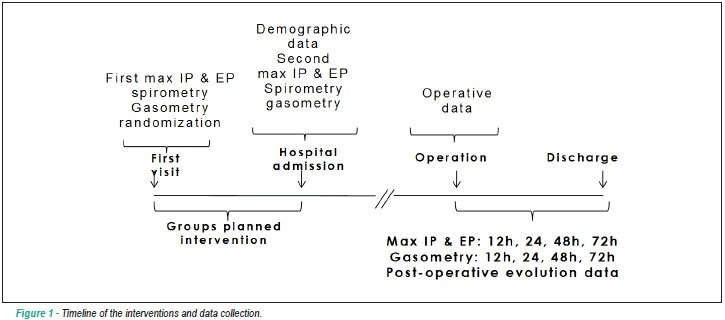
Figure 1
IJCS
Original Article

Ventilatory Muscle Strength Six Months After Coronary Artery Bypass Grafting in Patients Submitted to Inspiratory Muscular Training Based on Anaerobioc Threshold: A Clinical Trial

André Luiz Lisboa Cordeiro et al. Larissa Costa Almeida Jackeline Ferreira Dos Santos Leite Hayssa de Cássia Mascarenhas Barbosa … André Raimundo França Guimarães Luiz Alberto Forgiarini Junior Jandesson Cena Jefferson Petto

Abstract

Introduction

Coronary artery bypass grafting (CABG) surgery is associated with a decline in ventilatory muscle strength and lung function. Inspiratory muscle training (IMT) based on anaerobic threshold (AT) has been used to minimize the impact of CABG on these parameters, but the long-term impact is unknown.

Objective

To test the hypothesis that AT-based IMT improves inspiratory muscle strength and lung function even six months after CABG.

Methods

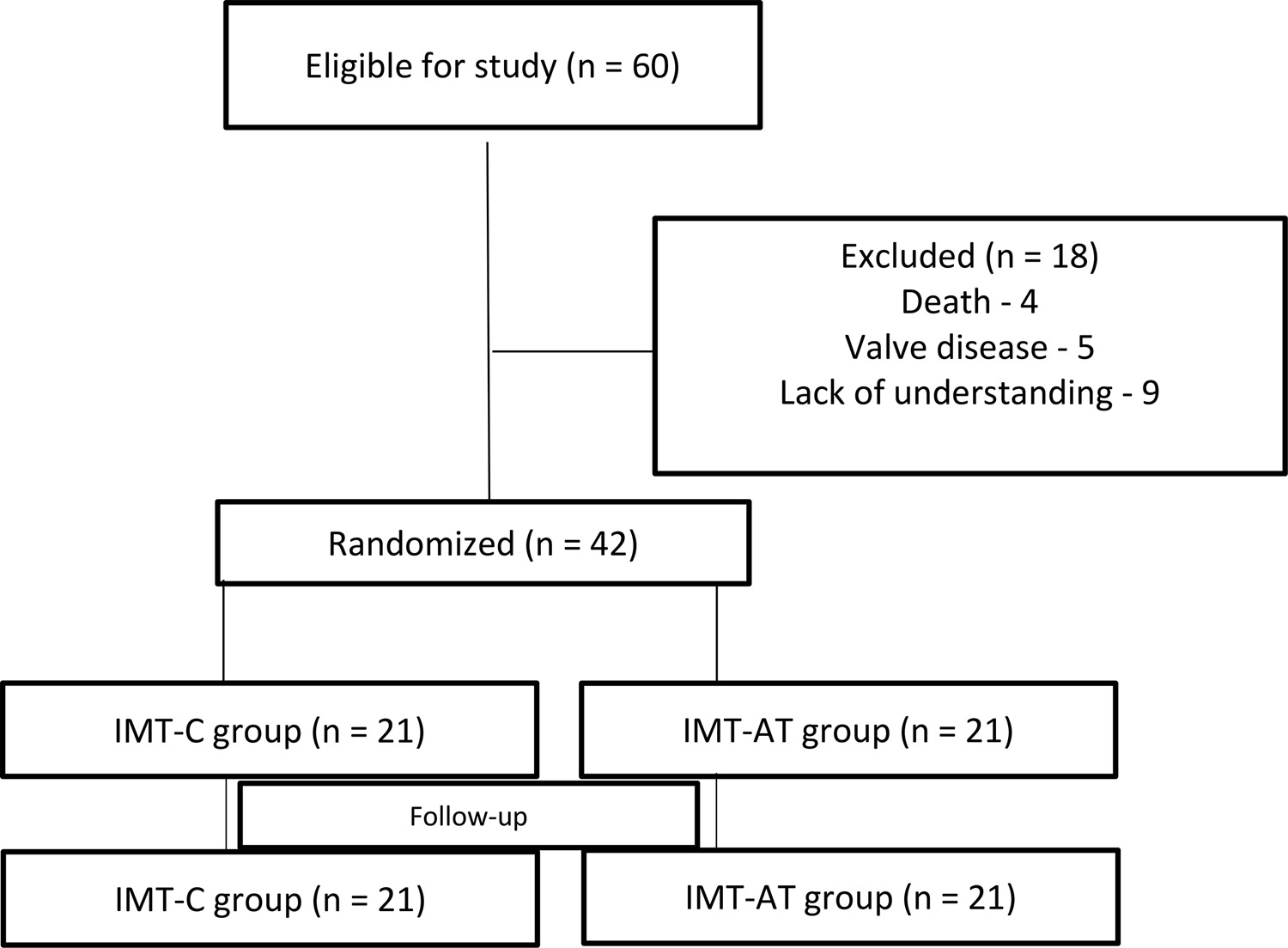
This is a randomized controlled clinical trial. In the preoperative period, maximum inspiratory pressure (MIP), maximum expiratory pressure (MEP), vital capacity (VC) and peak expiratory flow (PEF) rate were assessed. On the first postoperative day, patients were randomized into two groups: AT-based IMT (IMT-AT) (n=21) where the load was prescribed based on glycemic threshold and conventional IMT (IMT-C) (n=21), with load of 40% of MIP. Patients were trained during hospitalization until the day of discharge and were assessed at discharge and six months later. For within-group comparison, paired Student’s t-test or Wilcoxon test was used, and independent Student’s t-test or the Mann-Whitney test was used to analyze the different time points. A p<0.05 was considered significant.

Results

At six months after CABG surgery, statistical difference was found between the IMT-AT and the IMT-C groups in MIP (difference between the means of -5cmH2; 95% CI=- 8.21to-1.79) and VC (difference between the means of -2ml/kg;95%CI=-3.87to-0.13). No difference was found between groups in the other variables analyzed.

Conclusion

IMT-AT promoted greater recovery of inspiratory muscle strength and VC after six months of CABG when compared to conventional training.
  • Anaerobiosis
  • Breathing Exercises
  • Hospital Discharge
  • Muscular Strength
  • Myocardial Revascularization/surgery
  • Respiratory Muscles
Read Full Article
Creative Commons Attribution (CC BY) Creative Commons license
03/03/2023 DOI: 10.36660/ijcs.20210238 Views 1
ABC
Editorial

Lung Function and Inspiratory Muscle Strength in Heart Failure: Can They be Considered Potential Prognostic Markers?

Filipe Ferrari

Heart failure (HF) is a complex syndrome considered a major public health problem. Different HF subtypes are classically defined based on left ventricular ejection fraction (LVEF). Although its prognosis has improved in recent decades – explained, in part, by major therapeutic advances – HF persists with a high burden of mortality and negatively influences the quality of life., In this sense, common symptoms experienced in this disease, such as shortness of breath and exercise intolerance, contribute greatly to this sharp decline in the quality of life of individuals. Another condition, considered an important risk factor, which usually accompanies HF, is pulmonary dysfunction. The respiratory impairments observed in HF may be related to several reasons, such as an impairment of lung mechanics and gas diffusion, as well as respiratory muscle weakness – aggravating increased dyspnea, being a major limitation on physical exercise.

Spirometry is a widely used test that allows the analysis of lung function – by measuring the amount of air inhaled and exhaled to the maximum. Because chronic obstructive pulmonary disease shares similar signs and symptoms with HF, its identification in individuals with HF can be challenging; in this sense, spirometry can help confirm the diagnosis. About evaluating the potential severity of some lung diseases, the exercise test can also be useful, observing a series of parameters, such as the ratio of forced expiratory volume in 1 second/forced vital capacity (FEV1/FVC). The severity of the disease can still be classified based on FEV1 when it is below the lower limit of normal (ranging from mild when ≥70% of predicted to very severe when <35% of predicted). Although HF itself can lead to a decrease in FEV1 and FVC of about 20% of predicted, in addition to the fact that a worse FEV1 may predict higher mortality, convincing evidence examining the prognostic role of FEV1 in the HF setting still needs further investigation.

[…]

  • Exercise Tolerance
  • Heart Failure
  • Respiratory Insufficiency
  • Respiratory Muscles
  • Risk Assessment
  • Ventricular Function
Read Full Article
Creative Commons Attribution (CC BY) Creative Commons license
29/04/2022 DOI: 10.36660/abc.20211060 Views 2
ABC
Original Article

Relationship of Lung Function and Inspiratory Strength with Exercise Capacity and Prognosis in Heart Failure

Sergio Henrique Rodolpho Ramalho et al. Alexandra Correa Gervazoni Balbuena de Lima Fabiola Maria Ferreira da Silva Fausto Stauffer Junqueira de Souza … Lawrence Patrick Cahalin Graziella França Bernardelli Cipriano Gerson Cipriano Junior

Abstract

Background

Spirometry is underused in heart failure (HF) and the extent to which each defect associates with exercise capacity and prognosis is unclear.

Objective

To determine the distinct relationship of continuous %predicted FVC (ppFVC) and FEV1/FVC with: 1) maximal inspiratory pressure (MIP), left ventricular ejection fraction (LVEF), exercise performance; and 2) prognosis for the composite of cardiovascular death, heart transplantation or left ventricular assist device implant.

Methods

A cohort of 111 HF participants (AHA stages C/D) without diagnosed pneumopathy, spirometry, manovacuometry and maximum cardiopulmonary test. The association magnitudes were verified by linear and Cox (HR; 95% CI) regressions, age/sex adjusted. A p<0.05 was considered significant.

Results

Age was 57±12 years, 60% men, 64% in NYHA III. Every 10%-point increase in FEV1/FVC [β 7% (95% CI: 3–10)] and ppFVC [4% (2-6)] associated with ventilatory reserve (VRes), however only ppFVC associated with MIP [3.8 cmH2O (0.3-7.3)], LVEF [2.1% (0.5-3.8)] and VO2peak [0.5 mL/kg/min (0.1–1.0)], accounting for age/sex. In 2.2 years (mean), 22 events occurred, and neither FEV1/FVC (HR 1.44; 95% CI: 0.97–2.13) nor ppFVC (HR 1.13; 0.89–1.43) was significantly associated with the outcome. Only in the LVEF ≤50% subgroup (n=87, 20 events), FEV1/FVC (HR 1.50; 1.01–2.23), but not ppFVC, was associated with greater risk.

Conclusions

In chronic HF, reduced ppFVC associated with lower MIP, LVEF, VRes and VO2peak, but no distinct poorer prognosis over 2.2 years of follow-up. Distinctively, FEV1/FVC was associated only with VRes, and, in participants with LVEF ≤50%, FEV1/FVC reduction proportionally worsened prognosis. Therefore, FEV1/FVC and ppFVC add supplementary information regarding HF phenotyping.

  • Exercise Tolerance
  • Respiratory Insufficiency
  • Respiratory Muscles
  • Risk Assessment
  • Ventricular Function
Read Full Article
Creative Commons Attribution (CC BY) Creative Commons license
07/02/2022 DOI: 10.36660/abc.20201130
Effects of an inspiratory muscle rehabilitation program in the postoperative period of cardiac surgery
ABC
Artigo Original

Effects of an inspiratory muscle rehabilitation program in the postoperative period of cardiac surgery

Paulo Eduardo Gomes Ferreira et al. Alfredo José Rodrigues Paulo Roberto Barboza Évora

BACKGROUND: Respiratory muscles are affected after cardiac surgeries. OBJECTIVE: To verify whether the preoperative conditioning of the inspiratory muscles might help to decrease postoperative respiratory dysfunction. METHODS: Thirty volunteers of both genders and with a minimum age of 50 years, while waiting for myocardial revascularization and/or cardiac valve surgery, were randomly assigned to two groups. Fifteen patients were included in a domiciliary program of at least 2 weeks of preoperative training of the inspiratory muscles, using a device with a load corresponding to 40% of the maximum inspiratory pressure. The other 15 patients received general advice and did not train the inspiratory muscle. Spirometry, before and after the training program, as well as the evolution of the arterial blood gases and of the maximum inspiratory and expiratory pressure, before and after the operation were evaluated in both group. The clinical outcomes of the two groups were also compared. RESULTS: We observed that inspiratory muscle training increased the forced vital capacity, the maximum voluntary ventilation and the ratio between the forced expired volume during the first second and the forced vital capacity. The evolution of the arterial blood gases and of the maximum inspiratory and expiratory pressures before and after the operation was similar in both groups, with the outcomes also being similar. CONCLUSION: We concluded that our domiciliary program of inspiratory muscle training was safe and improved the forced vital capacity and the maximum voluntary ventilation, although the clinical benefits of this program were not clearly demonstrable in the present study.

  • physical therapy modalities
  • Postoperative Care
  • Rehabilitation
  • Respiratory Muscles
  • Thoracic Surgery
Read Full Article
Creative Commons Attribution (CC BY) Creative Commons license
23/06/2009 DOI: 10.1590/S0066-782X2009000400005 Views 2

How to cite this article

EndNote RIS

Electronic Document Format (Vancouver)

Cordeiro ALL, Almeida LC, Leite JFDS, Barbosa HCM, Guimarães ARF, Forgiarini Junior LA, Cena J, et al. Ventilatory Muscle Strength Six Months After Coronary Artery Bypass Grafting in Patients Submitted to Inspiratory Muscular Training Based on Anaerobioc Threshold: A Clinical Trial. International Journal of Cardiovascular Sciences 2023;36:e20210238.

Electronic Document Format (ABNT)

Cordeiro, André Luiz Lisboa; Almeida, Larissa Costa; Leite, Jackeline Ferreira Dos Santos; Barbosa, Hayssa de Cássia Mascarenhas; Guimarães, André Raimundo França; Forgiarini Junior, Luiz Alberto; Cena, Jandesson; Petto, Jefferson. Ventilatory Muscle Strength Six Months After Coronary Artery Bypass Grafting in Patients Submitted to Inspiratory Muscular Training Based on Anaerobioc Threshold: A Clinical Trial. International Journal of Cardiovascular Sciences, v. 36, e20210238, Mar. 2023.

Electronic Document Format (APA)

Cordeiro, A. L. L., Almeida, L. C., Leite, J. F. D. S., Barbosa, H. C. M., Guimarães, A. R. F., Forgiarini Junior, L. A., Cena, J., & Petto, J. (2023). Ventilatory Muscle Strength Six Months After Coronary Artery Bypass Grafting in Patients Submitted to Inspiratory Muscular Training Based on Anaerobioc Threshold: A Clinical Trial. International Journal of Cardiovascular Sciences, 36, e20210238.

Electronic Document Format (ISO)

Cordeiro, André Luiz Lisboa and Almeida, Larissa Costa and Leite, Jackeline Ferreira Dos Santos and Barbosa, Hayssa de Cássia Mascarenhas and Guimarães, André Raimundo França and Forgiarini Junior, Luiz Alberto and Cena, Jandesson and Petto, Jefferson. Ventilatory Muscle Strength Six Months After Coronary Artery Bypass Grafting in Patients Submitted to Inspiratory Muscular Training Based on Anaerobioc Threshold: A Clinical Trial. International Journal of Cardiovascular Sciences [online]. 2023, vol. 36, [cited 2026-10-14], e20210238. Available from: <https://journals.cardiol.br/en/article/ventilatory-muscle-strength-six-months-after-coronary-artery-bypass-grafting-in-patients-submitted-to-inspiratory-muscular-training-based-on-anaerobioc-threshold-a-clinical-trial/>. ISSN 2359-4802

EndNote RIS

Electronic Document Format (Vancouver)

Ferrari F. Lung Function and Inspiratory Muscle Strength in Heart Failure: Can They be Considered Potential Prognostic Markers?. Arquivos Brasileiros de Cardiologia 2022;118(4):692-3.

Electronic Document Format (ABNT)

Ferrari, Filipe. Lung Function and Inspiratory Muscle Strength in Heart Failure: Can They be Considered Potential Prognostic Markers?. Arquivos Brasileiros de Cardiologia, v. 118, n. 4, p. 692-693, Apr. 2022.

Electronic Document Format (APA)

Ferrari, F. (2022). Lung Function and Inspiratory Muscle Strength in Heart Failure: Can They be Considered Potential Prognostic Markers?. Arquivos Brasileiros de Cardiologia, 118(4), 692-693.

Electronic Document Format (ISO)

Ferrari, Filipe. Lung Function and Inspiratory Muscle Strength in Heart Failure: Can They be Considered Potential Prognostic Markers?. Arquivos Brasileiros de Cardiologia [online]. 2022, vol. 118, n. 4, [cited 2026-10-14], pp. 692-693. Available from: <https://journals.cardiol.br/en/article/lung-function-and-inspiratory-muscle-strength-in-heart-failure-can-they-be-considered-potential-prognostic-markers/>. ISSN 0066-782X

EndNote RIS

Electronic Document Format (Vancouver)

Ramalho SHR, Lima ACGB, Silva FMF, Souza FSJ, Cahalin LP, Cipriano GFB, Cipriano Junior G, et al. Relationship of Lung Function and Inspiratory Strength with Exercise Capacity and Prognosis in Heart Failure. Arquivos Brasileiros de Cardiologia 2022;118(4):680-91.

Electronic Document Format (ABNT)

Ramalho, Sergio Henrique Rodolpho; Lima, Alexandra Correa Gervazoni Balbuena de; Silva, Fabiola Maria Ferreira da; Souza, Fausto Stauffer Junqueira de; Cahalin, Lawrence Patrick; Cipriano, Graziella França Bernardelli; Cipriano Junior, Gerson. Relationship of Lung Function and Inspiratory Strength with Exercise Capacity and Prognosis in Heart Failure. Arquivos Brasileiros de Cardiologia, v. 118, n. 4, p. 680-691, Feb. 2022.

Electronic Document Format (APA)

Ramalho, S. H. R., Lima, A. C. G. B. , Silva, F. M. F. , Souza, F. S. J. , Cahalin, L. P., Cipriano, G. F. B., & Cipriano Junior, G. (2022). Relationship of Lung Function and Inspiratory Strength with Exercise Capacity and Prognosis in Heart Failure. Arquivos Brasileiros de Cardiologia, 118(4), 680-691.

Electronic Document Format (ISO)

Ramalho, Sergio Henrique Rodolpho and Lima, Alexandra Correa Gervazoni Balbuena de and Silva, Fabiola Maria Ferreira da and Souza, Fausto Stauffer Junqueira de and Cahalin, Lawrence Patrick and Cipriano, Graziella França Bernardelli and Cipriano Junior, Gerson. Relationship of Lung Function and Inspiratory Strength with Exercise Capacity and Prognosis in Heart Failure. Arquivos Brasileiros de Cardiologia [online]. 2022, vol. 118, n. 4, [cited 2026-10-14], pp. 680-691. Available from: <https://journals.cardiol.br/en/article/relationship-of-lung-function-and-inspiratory-strength-with-exercise-capacity-and-prognosis-in-heart-failure/>. ISSN 0066-782X

EndNote RIS

Electronic Document Format (Vancouver)

Ferreira PEG, Rodrigues AJ, Évora PRB. Effects of an inspiratory muscle rehabilitation program in the postoperative period of cardiac surgery. Arquivos Brasileiros de Cardiologia 2009;92(4):275-82.

Electronic Document Format (ABNT)

Ferreira, Paulo Eduardo Gomes; Rodrigues, Alfredo José; Évora, Paulo Roberto Barboza. Effects of an inspiratory muscle rehabilitation program in the postoperative period of cardiac surgery. Arquivos Brasileiros de Cardiologia, v. 92, n. 4, p. 275-282, Jun. 2009.

Electronic Document Format (APA)

Ferreira, P. E. G., Rodrigues, A. J., & Évora, P. R. B. (2009). Effects of an inspiratory muscle rehabilitation program in the postoperative period of cardiac surgery. Arquivos Brasileiros de Cardiologia, 92(4), 275-282.

Electronic Document Format (ISO)

Ferreira, Paulo Eduardo Gomes and Rodrigues, Alfredo José and Évora, Paulo Roberto Barboza. Effects of an inspiratory muscle rehabilitation program in the postoperative period of cardiac surgery. Arquivos Brasileiros de Cardiologia [online]. 2009, vol. 92, n. 4, [cited 2026-10-14], pp. 275-282. Available from: <https://journals.cardiol.br/en/article/effects-of-an-inspiratory-muscle-rehabilitation-program-in-the-postoperative-period-of-cardiac-surgery/>. ISSN 0066-782X

  • About ABC Family
  • Internal Regulation
  • Editorial Board
  • Brazilian Society of Cardiology (SBC)

Issues

SBC Guidelines

  • Videos
  • Podcasts
  • News