| ABC
ABC Family Arquivos Brasileiros de Cardiologia International Journal of Cardiovascular Sciences ABC Heart Failure & Cardiomyopathy ABC Imagem Cardiovascular
Português English
ABC Family | ABC
Português English
  • About
    • About the Journal
    • Internal Regulation
    • Editors Section
    • Editorial Board
    • History
    • SBC Award
  • Instructions to Authors
    • Guidelines for Publication
    • Editorial Policy
    • Ethics Policy
    • Policy on the Use of Artificial Intelligence
    • Mandatory Publication Form
    • Publication Fee
  • Issues
  • SBC Guidelines
  • Abstracts
    • How to Publish an Abstract Supplement?
    • Supplements from the Brazilian Congress of Cardiology
  • About
    • About the Journal
    • Internal Regulation
    • Editors Section
    • Editorial Board
    • History
    • SBC Award
  • Instructions to Authors
    • Guidelines for Publication
    • Editorial Policy
    • Ethics Policy
    • Policy on the Use of Artificial Intelligence
    • Mandatory Publication Form
    • Publication Fee
  • Issues
  • SBC Guidelines
  • Abstracts
    • How to Publish an Abstract Supplement?
    • Supplements from the Brazilian Congress of Cardiology

ABC Family

  • ABC Family
  • Arquivos Brasileiros de Cardiologia
  • International Journal of Cardiovascular Sciences
  • ABC Heart Failure & Cardiomyopathy
  • ABC Imagem Cardiovascular
Search in

No content found.

Journals
Ordering
Article types
Others

  1. Home
  2. ABC
  3. Issues
  4. 2023, Volume 120, Number 4
Editorial

mRNA, miRNA, lncRNA, ceRNA: The Future of Cardiovascular Research?

Gustavo Augusto Ferreira Mota et al. Mariana Gatto Cristina Schmitt Gregolin Sérgio Luiz Borges de Souza Marina Politi Okoshi

Despite significant advances in cardiovascular biomedicine, heart diseases still represent a major public health problem. Thus, it is important to understand the molecular mechanisms involved in the pathophysiology of cardiovascular disease.

Cardiac injury is followed by cardiac remodeling, a process defined as genomic alterations triggering molecular, cellular, and interstitial modifications that manifest clinically as changes in the heart’s size, shape, and function., Therefore, alterations in the synthesis and degradation of cellular proteins characterize cardiac remodeling.

[…]
  • Cardiomegaly
  • Epigenesis, Genetic
  • Heart Failure
  • Nucleic Acids
  • Ventricular Remodeling
Read Full Article
Creative Commons Attribution (CC BY) Creative Commons license
12/05/2023 DOI: 10.36660/abc.20230209 Views 1
Editorial

Human Development Index and Chronic Diseases in Brazil between 1980 and 2019

Alfredo José Mansur et al. Lucia Pereira Barroso

The human development index synthesizes dimensions of human societies taking into consideration life expectancy at birth, education, and standard of living. Life expectancy is an expression of the health conditions of a particular population. Education is expressed as years of schooling. The standard of living is indicated by gross national income per capita. It is recognized that the human development index does not encompass every social determinant of the experience of citizens of a specific human society. Nonetheless, it is useful and a recognized methodological approach for measurements and comparisons; however, inequalities, poverty, human security, empowerment, and other characteristics may be missed., That said, it is always opportune for the medical-scientific community to bear in mind the dimensions examined in the human development index and to develop recurrent studies and updates over time, as the conditions in which human societies live are dynamic.

In the current study, the authors evaluated the human development index in Brazil over four decades (1980-2019). The data (the underlying cause of death) were retrieved from death certificates in a Unified Health System (SUS) public database relative to chronic non-infectious diseases with time series analyses. Mortality was corrected for 100.000 inhabitants distributed in quartiles in each Brazilian state.

[…]

  • Chronic Disease/epidemiology
  • Human Development
  • Life Expectancy/trends
  • poverty
  • Primary Health Care
  • Social Marginalization
  • Unemployment
Read Full Article
Creative Commons Attribution (CC BY) Creative Commons license
08/05/2023 DOI: 10.36660/abc.20230213
Editorial

Can Intermittent Fasting Associated with a Low-Carb Diet Prevent Cardiovascular Disease in Pre-Diabetics?

Luciana Nicolau Aranha

Pre-diabetes is the term used to describe individuals who have altered glucose metabolism but do not meet the diagnostic criteria for diabetes. People with pre-diabetes have an increased risk of type 2 diabetes mellitus (DM2), cardiovascular disease (CVD), and all-cause mortality.,

Lifestyle changes, including diet and regular physical activity, are effective in preventing diabetes and CVD. Some nutritional approaches have been used to promote weight loss and glycemic control. Intermittent fasting is a dietary practice restricting calorie consumption during a controlled period, followed by ad libitum caloric consumption. A carbohydrate-restricted diet, known as low-carb, is characterized by carbohydrate intake below the lower limit of an acceptable macronutrient distribution range for healthy adults (i.e., < 45% of energy intake).

[…]

  • Caloric Restriction
  • Diet Low-Carbohydrate
  • Exercise
  • Fasting
  • Life Style
  • Physical activity
  • Prediabetic State
Read Full Article
Creative Commons Attribution (CC BY) Creative Commons license
01/05/2023 DOI: 10.36660/abc.20230182 Views 2
Editorial

In Search of the Perfect Marker

Luiz Maurino Abreu

Cardiovascular diseases are responsible for most contemporary morbidity and mortality. In Brazil, data show growth in indicators with a great socioeconomic impact.

Risk factors such as altered lipids, hypertension, smoking, diabetes, dietary errors, psychosocial factors, and physical inactivity are responsible for most of the risk of myocardial infarction worldwide in both sexes and at all ages in all regions, as was well demonstrated in the INTERHEART Study.

[…]

  • Atherosclerosis
  • Byomarkers
  • Coronary Artery Disease/prevention and control
  • Glycoprotein 130
  • Immunity
  • Oncostatin M
Read Full Article
Creative Commons Attribution (CC BY) Creative Commons license
01/05/2023 DOI: 10.36660/abc.20230193
Editorial

Brazilian Interventional Cardiology and Chronic Coronary Occlusions: Where Are We?

José Mariani Junior

The coronary atherosclerotic disease has several facets of clinical presentation; chronic coronary occlusion (CCO) is one that produces total obstruction of the lumen of the vessel, known or presumed for three months or more. It is present in 16-18% of patients with significant coronary disease.

Percutaneous treatment of this type of lesion is almost as old as the first coronary angioplasty performed by Andreas Gruntzig in 1979. Martin Kaltenbach first performed it in Frankfurt in the late 1970s and by Geoffrey Hartzler in Kansas City in the following decades., Since then, the growing and spectacular incorporation of technology into medicine, especially in Interventional Cardiology, associated with the knowledge and expertise of new techniques dedicated to complex coronary interventions, which include CCO, have allowed great, safe, and effective advances in the approach to these lesions.

[…]

  • Coronary Angiography/methods
  • Coronary Occlusion/mortality
  • Coronary Occlusion/therapy
  • Diagnostic Imaging/methods
  • Drug-Eluting Stents
  • Ultrasonography,Interventional/methods
Read Full Article
Creative Commons Attribution (CC BY) Creative Commons license
01/05/2023 DOI: 10.36660/abc.20230172
Figure 1
Editorial

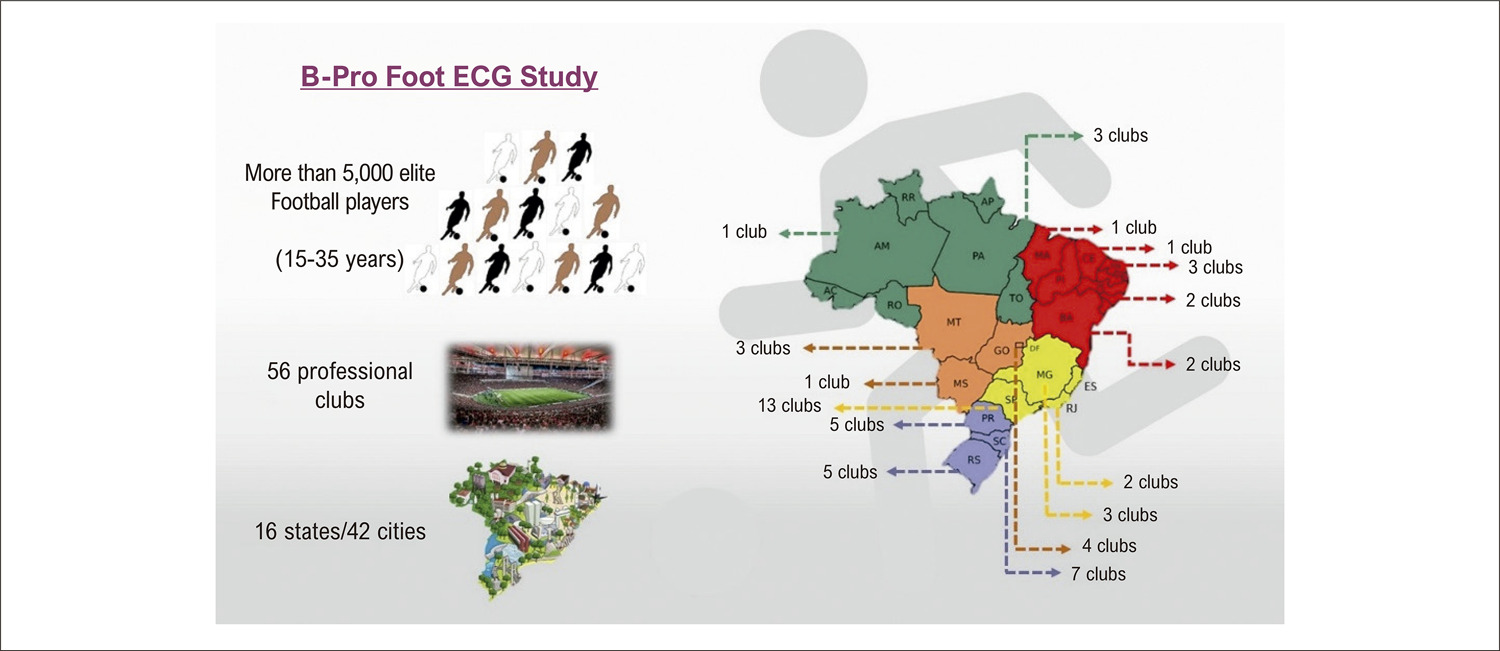
Electrocardiogram of Brazilian Elite Football Players: Filling a Gap

Ricardo Stein et al. Filipe Ferrari Anderson Donelli da Silveira

Introduction

The sudden death of a young, apparently healthy athlete is a tragedy, and the true incidence of sudden cardiac death (SCD) among athletes is controversial. Although estimates from studies in the United States and Europe are limited by various methodological issues, it is known that physical exertion in sports activity and training poses a 2.5 to 4.5 times higher risk of sudden cardiac arrest and SCD in relation to non-athletes and recreational athletes.–On the other hand, a consistent finding across studies is that male athletes have a three to five times higher incidence of SCD than female athletes.

Over the past few decades, much has been discussed about the role of the resting 12-lead electrocardiogram (ECG) in preventing SCD in young athletes. Studies carried out in different parts of the world have been published, and expert consensuses have been developed to standardize a very peculiar type of ECG.–

[…]

  • Athletes
  • Ethnicity and Health
  • Exercise
  • Heart Arrest
  • Mass Sreening
  • Soccer
  • Sudden Cardiac Death
Read Full Article
Creative Commons Attribution (CC BY) Creative Commons license
01/05/2023 DOI: 10.36660/abc.20230090 Views 2
Central Illustration
Original Article

Overview of Percutaneous Coronary Interventions for Chronic Total Occlusions Treated at Brazilian Centers Participating in the LATAM CTO Registry

Antonio Carlos Botelho da Silva et al. João Eduardo Tinoco de Paula Carlos M. Campos Marcelo Harada Ribeiro … Evandro Martins Filho Marcos Danillo Peixoto Oliveira Leandro Assumpção Côrtes Aníbal Pereira Abelin Cleverson Neves Zukowski Gustavo Cervino Martinelli Fábio Sândoli de Brito Antônio José Muniz Marcelo José de Carvalho Cantarelli Pedro Beraldo de Andrade César Rocha Medeiros Breno de Alencar Araripe Falcão Felipe Costa Fuchs Leonardo Sinnott Silva Tammuz Fattah Ramiro Caldas Degrazia José Armando Mangione Cristiano Guedes Bezerra Sandra Baradel João Brum Silveira Luiz Fernando Ybarra Daniel Weillenmann Carlos Gottschall Viviana Lemke Franciele Rosa da Silva Marcia Moura Schmidt Karlyse Claudino Belli Pedro Piccaro de Oliveira Alexandre Schaan de Quadros

Abstract

Background

Major advances have been seen in techniques and devices for performing percutaneous coronary interventions (PCIs) for chronic total occlusions (CTOs), but there are limited real-world practice data from developing countries.

Objectives

To report clinical and angiographic characteristics, procedural aspects, and clinical outcomes of CTO PCI performed at dedicated centers in Brazil.

Methods

Included patients underwent CTO PCI at centers participating in the LATAM CTO Registry, a Latin American multicenter registry dedicated to prospective collection of these data. Inclusion criteria were procedures performed in Brazil, age 18 years or over, and presence of CTO with PCI attempt. CTO was defined as a 100% lesion in an epicardial coronary artery, known or estimated to have lasted at least 3 months.

Results

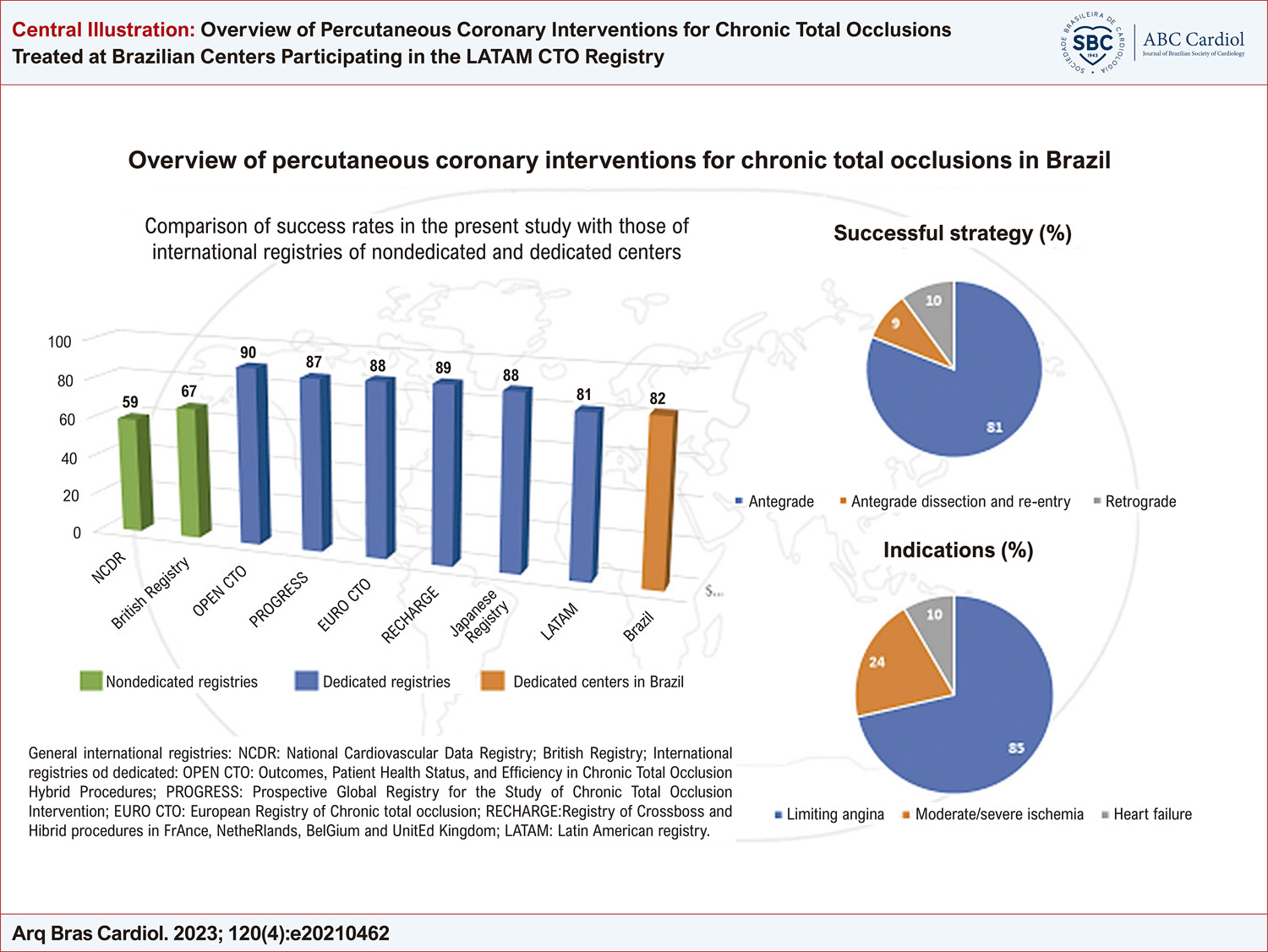
Data on 1196 CTO PCIs were included. Procedures were performed primarily for angina control (85%) and/or treatment of moderate/severe ischemia (24%). Technical success rate was 84%, being achieved with antegrade wire approaches in 81% of procedures, antegrade dissection and re-entry in 9%, and retrograde approaches in 10%. In-hospital adverse cardiovascular events occurred in 2.3% of cases, with a mortality rate of 0.75%.

Conclusions

CTOs can be treated effectively in Brazil by using PCI, with low complication rates. The scientific and technological development observed in this area in the past decade is reflected in the clinical practice of dedicated Brazilian centers.

  • Coronary Artery Disease
  • Coronary Occlusion
  • Equipment and Supplies Hospital/trends
  • Hospitals/trends
  • Percutaneous Coronary Intervention/trends
Read Full Article
Creative Commons Attribution (CC BY) Creative Commons license
01/05/2023 DOI: 10.36660/abc.20210462 Views 1
Figure 1
Research Letter

Creation of Cardiac Embryological Models for 3D Printing to Teach Anatomy and Embryology

Davi Shunji Yahiro et al. Juliana Cadilho da Silva Abrantes D’Angelo Carlo Magliano Claudio Tinoco Mesquita

Introduction

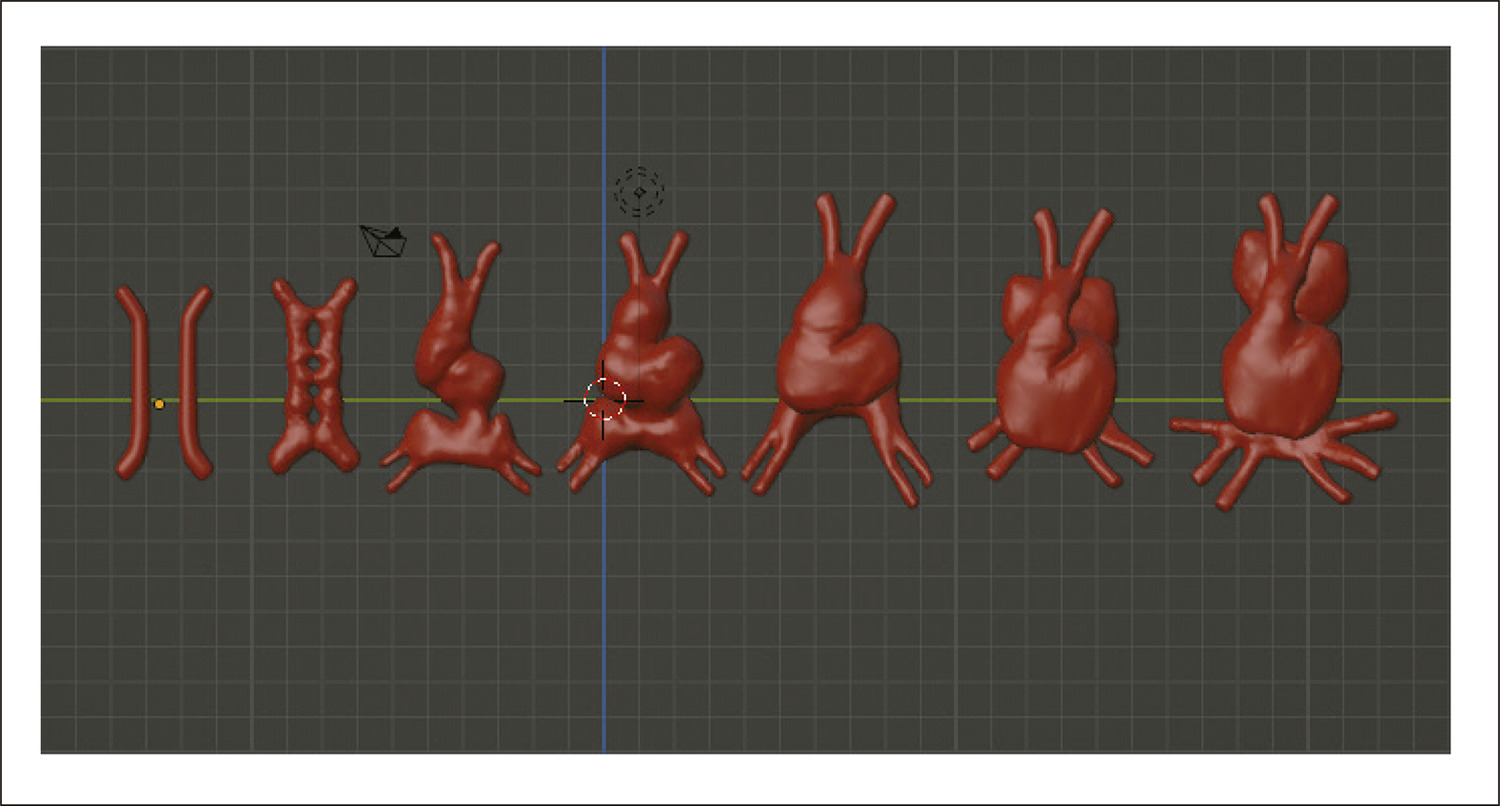
Medical students often struggle to visualize embryonic structures and understand morphological development. Studies report that students commonly consider Embryology to be a difficult subject and do not feel confident in the knowledge they have obtained. , Traditional embryology learning involves reading books and interpreting flat images, interfering with spatial perception and understanding of embryonic development.

Three-dimensional (3D) modeling technology commonly provides engineering, architecture, gaming, and film animation services. The development of 3D models consists of creating voxels and connecting vertices to form polygonal meshes. These meshes allow for perspective visualization and the designer’s ability to color, texture, and animate them, and they can be printed. The creation of 3D models can be very advantageous in Embryology, as studies show 3D technology as an aiding tool for teaching anatomy and planning complex surgeries. –

[…]

  • Heart/anatomy
  • Imaging, Three-Dimensional/trends
  • Medicine/embriology
Read Full Article
Creative Commons Attribution (CC BY) Creative Commons license
21/04/2023 DOI: 10.36660/abc.20220632 Views 3
Figure 1
Review Article

Effects of High-Intensity Interval Training on Central Blood Pressure: A Systematic Review and Meta-Analysis

Gustavo Henrique de Oliveira et al. Rogério Toshiro Passos Okawa Caroline Ferraz Simões João Carlos Locatelli … Victor Hugo de Souza Mendes Higor Barbosa Reck Wendell Arthur Lopes

Abstract

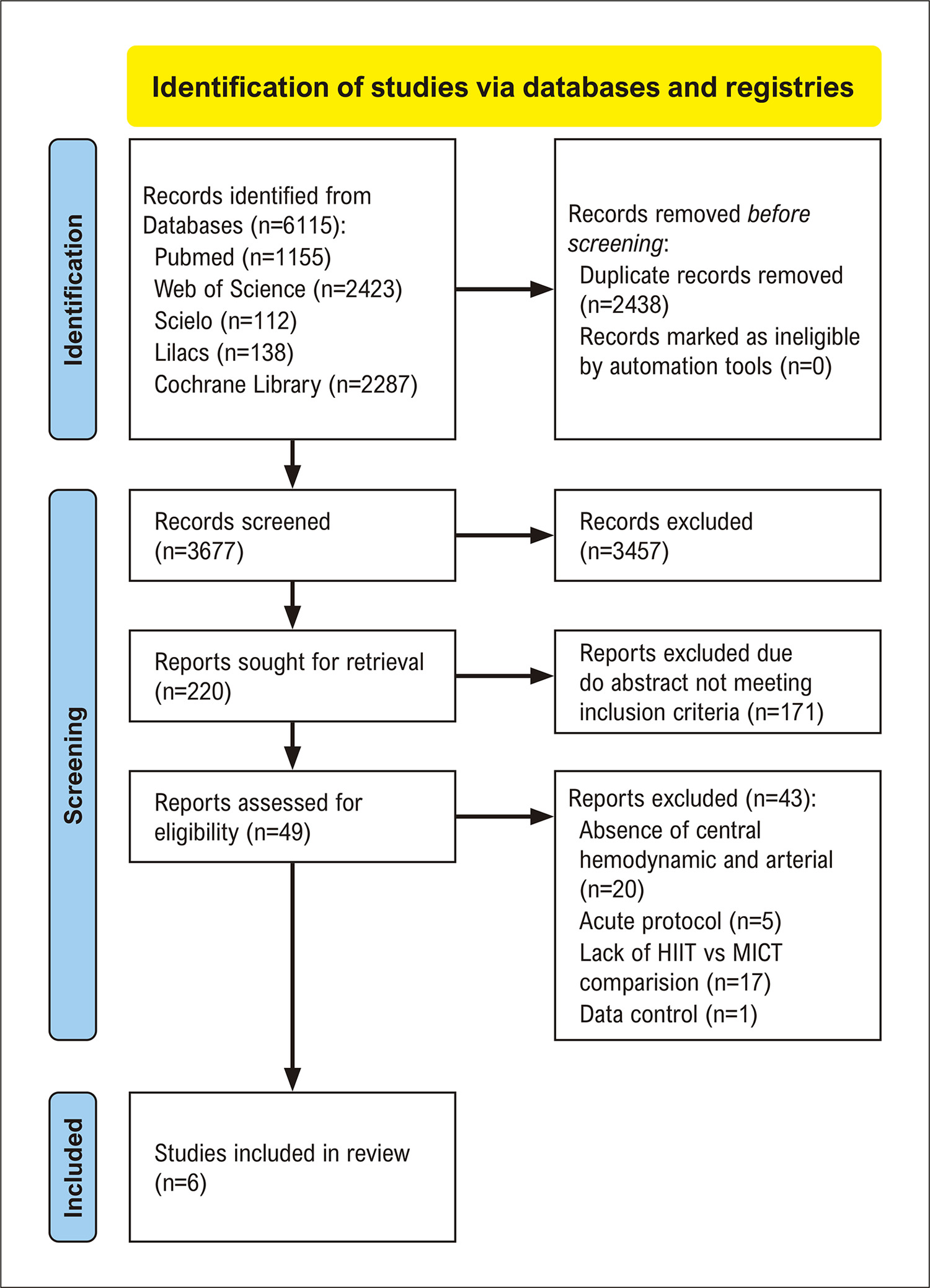
Central blood pressure (cBP) is considered an independent predictor of organ damage, cardiovascular events and all-cause mortality. Evidence has shown that high intensity interval training (HIIT) is superior to moderate-intensity continuous training (MICT) for improving cardiorespiratory fitness and vascular function. However, the effects of these aerobic training modalities on cBP have not yet been properly reviewed.This meta-analysis aims to investigate to effects of HIIT versus MICT on cBP.We conducted a meta-analysis of randomized controlled trials that compared HIIT versus MICT on cBP. Primary outcomes were measures of central systolic blood pressure (cSBP) and central diastolic blood pressure (cDBP). Peripheral systolic blood pressure (pSBP) and diastolic blood pressure (pDBP), pulse wave velocity (PWV) and maximal oxygen uptake (VO2max) were analyzed as second outcomes. Meta-analysis of mean differences (MD) was conducted using the random effects model.Our study included 163 patients enrolled in six trials. We found that HIIT was superior to MICT in reducing the cSBP (MD = -3.12 mmHg, 95% CI: -4.75 to -1.50, p = 0.0002) and SBP (MD = -2.67 mmHg, 95% CI: -5.18 to -0.16, p = 0.04), and increasing VO2max(MD = 2.49 mL/kg/min, 95% CI: 1.25 to 3.73, p = 0.001). However, no significant differences were reported for cDBP, DBP and PWV.HIIT was superior to MICT in reducing the cSBP, which suggests its potential role as a non-pharmacological therapy for high blood pressure.

  • Blood Pressure
  • Endurance Training
  • Hemodynamics
  • High-Intensity Interval Training
  • Vascular Stiffness
Read Full Article
Creative Commons Attribution (CC BY) Creative Commons license
21/04/2023 DOI: 10.36660/abc.20220398 Views 1
Editorial

Left Ventricular Mechanics: Untwisting the Pathways of the Cardiovascular Response to Exercise

Eduardo M. Vilela et al. Ricardo Fontes-Carvalho

Cardiovascular (CV) disease is a major cause of morbidity and mortality, with coronary artery disease (CAD) being one of its most challenging presentations. Over the years, several strategies have allowed marked improvements in its management. Physical exercise (a core component of cardiac rehabilitation programs) is currently a cornerstone of comprehensive contemporary secondary prevention strategies. While the benefits of physical exercise have been extensively described in the presence of CAD, the myriad mechanistic pathways by which this intervention exerts its various effects have yet to be fully ascertained., Indeed, while its positive impact on functional capacity has been highlighted, the relative role of exercise training in systolic function has shown some variability across different studies., While considering that differences in program designs and populations under study could, at least partially, help explain some of these divergences, the study of the mechanisms by which exercise could impact cardiac function (namely in the setting of CAD) remains a topic of considerable interest.

Advances in imaging modalities have allowed for an ever more precise understanding of CV physiology and the impact of different pathological processes., While ejection fraction (EF) remains the most ubiquitous parameter to assess left ventricular (LV) systolic function, other parameters, such as those derived from deformation imaging, have increasingly come under the spotlight to try to address some of the pitfalls related to EF.,, In this regard, the notion that different fiber orientations and their complex and dynamic interplay could be key to LV function has progressively led to the concept that the heart’s structural design has a particularly central role in its biomechanics and, thus, its overall function., These have also underscored the possible relevance of parameters such as global longitudinal strain (GLS) and ancillary measures such as LV twist and torsion., As previously detailed, these could allow insights into the coupling mechanisms between systole and diastole and global cardiac function.,,

[…]

  • Cardiovascuar Diseases/prevention and control
  • Coronary Artery Disease
  • Diagnostic Imaging/methods
  • Echocardiography/methods
Read Full Article
Creative Commons Attribution (CC BY) Creative Commons license
21/04/2023 DOI: 10.36660/abc.20230181 Views 1
Figure 1
Original Article

Influence of Physical Training after a Myocardial Infarction on Left Ventricular Contraction Mechanics

Márcio Silva Miguel Lima et al. Talia Falcão Dalçóquio Maria Cristina Donadio Abduch Jeane Mike Tsutsui … Wilson Mathias Jr José Carlos Nicolau

Abstract

Background

Exercise plays a positive role in the course of the ischemic heart disease, enhancing functional capacity and preventing ventricular remodeling.

Objective

To investigate the impact of exercise on left ventricular (LV) contraction mechanics after an uncomplicated acute myocardial infarction (AMI).

Methods

A total of 53 patients was included, 27 of whom were randomized to a supervised training program (TRAINING group), and 26 to a CONTROL group, who received usual recommendations on physical exercise after AMI. All patients underwent cardiopulmonary stress testing and a speckle tracking echocardiography to measure several parameters of LV contraction mechanics at one month and five months after AMI. A p value < 0.05 was considered statistically significant for the comparisons of the variables.

Results

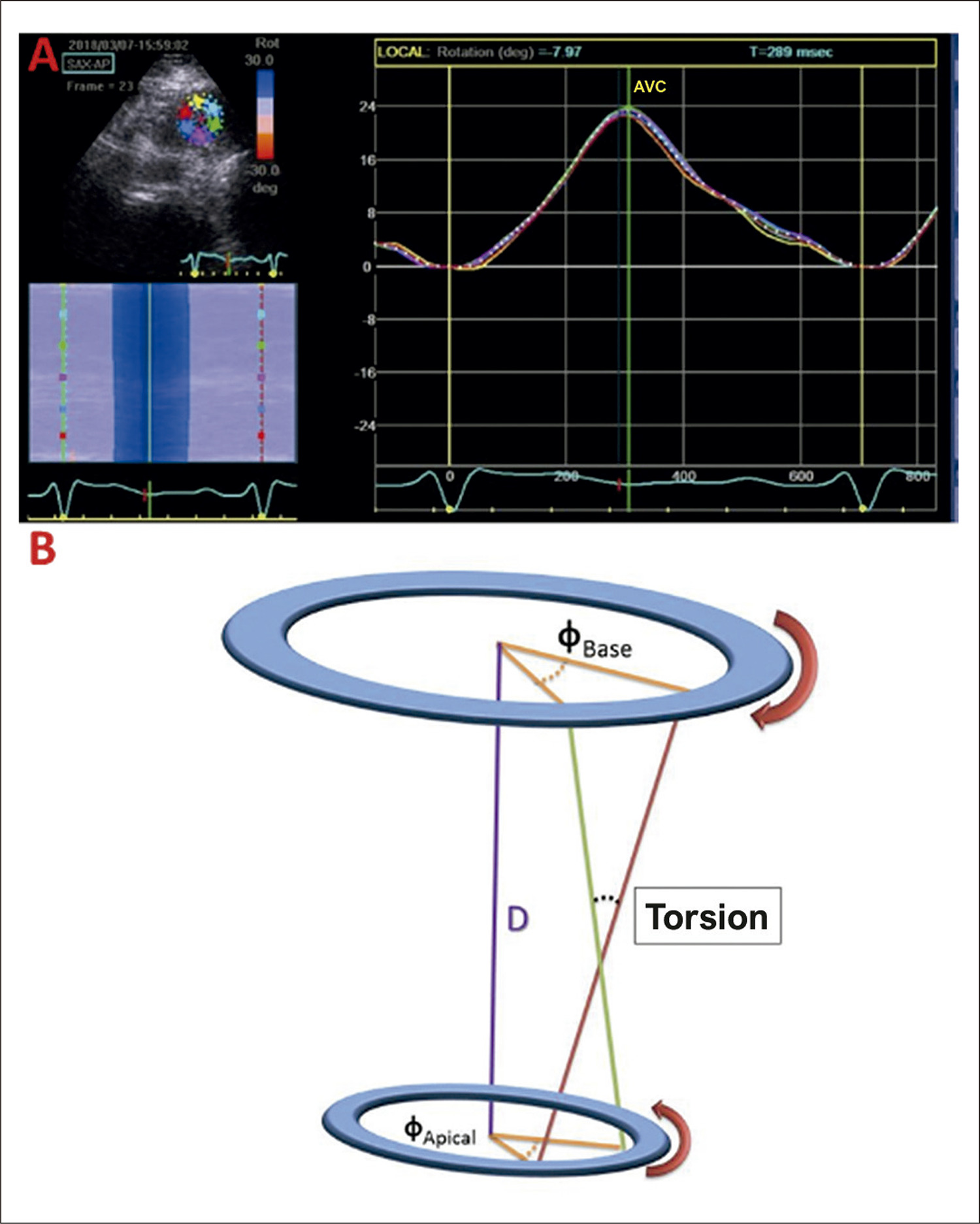
No significant difference were found in the analysis of LV longitudinal, radial and circumferential strain parameters between groups after the training period. After the training program, analysis of torsional mechanics demonstrated a reduction in the LV basal rotation in the TRAINING group in comparison to the CONTROL group (5.9±2.3 vs. 7.5±2.9o; p=0.03), and in the basal rotational velocity (53.6±18.4 vs.68.8±22.1 º/s; p=0.01), twist velocity (127.4±32.2 vs. 149.9±35.9 º/s; p=0.02) and torsion (2.4±0.4 vs. 2.8±0.8 º/cm; p=0.02).

Conclusions

Physical activity did not cause a significant improvement in LV longitudinal, radial and circumferential deformation parameters. However, the exercise had a significant impact on the LV torsional mechanics, consisting of a reduction in basal rotation, twist velocity, torsion and torsional velocity which can be interpreted as a ventricular “torsion reserve” in this population.

  • Exercise
  • Left Ventricular Dysfunction
  • Myocardial Infarction
Read Full Article
Creative Commons Attribution (CC BY) Creative Commons license
21/04/2023 DOI: 10.36660/abc.20220185 Views 1
Editorial

The Challenge of Making Cardiac Resonance a Global Reality

Hélder Jorge Andrade Gomes et al. Alcides Rocha de Figueredo Junior

Despite substantially reducing age-adjusted cardiovascular mortality rates in recent decades, cardiovascular disease remains the most common cause of death. Studies estimate that sudden cardiac death is responsible for approximately 50% of all deaths from cardiovascular causes, with ventricular tachycardia with degeneration to ventricular fibrillation and asystole being the most common fatal sequence of pathophysiological events.

The hard work done by authors of the article published in the Arquivos Brasileiros de Cardiologia illustrates the role of cardiac magnetic resonance (CMR) in the etiological elucidation of sudden death events encountered in clinical practice. In addition to the already expected Chagas and ischemic diseases, a wide variety of other diagnoses have been recognized: myocarditis, hypertrophic cardiomyopathy, dilated cardiomyopathy, arrhythmogenic heart disease, muscular dystrophy, hypertensive cardiomyopathy, metastases, non-compacted myocardium, and adrenergic cardiomyopathy (Takotsubo syndrome). The CMR was conclusive in more than 90% of cases and is a key tool for excluding structural heart disease and attributing the fatal event to extracardiac causes.

[…]

  • Cardiomyopathes
  • Cardiovascular Diseases, mortality
  • Death,Sudden
  • Diagnostic Imaging/trends
  • Endomyocardial Fibrosis
  • Magnetic Resonance Spectroscopy
  • Myocardial Ischemia
  • Stroke Volume
Read Full Article
Creative Commons Attribution (CC BY) Creative Commons license
21/04/2023 DOI: 10.36660/abc.20230187 Views 1
Figure 1
Original Article

Association between Mortality from Chronic Noncommunicable Diseases and Human Development Index in Brazil between 1980 and 2019

Sandra Chagas da Costa Feliciano et al. Paolo Blanco Villela Gláucia Maria Moraes de Oliveira

Abstract

Background

Chronic noncommunicable diseases (CNCDs) caused more than 734,000 deaths (55% of all deaths) in Brazil in 2019, with an important socioeconomic impact.

Objectives

To analyze the mortality rates from CNCDs in Brazil from 1980 to 2019 and their association with socioeconomic indicators.

Method

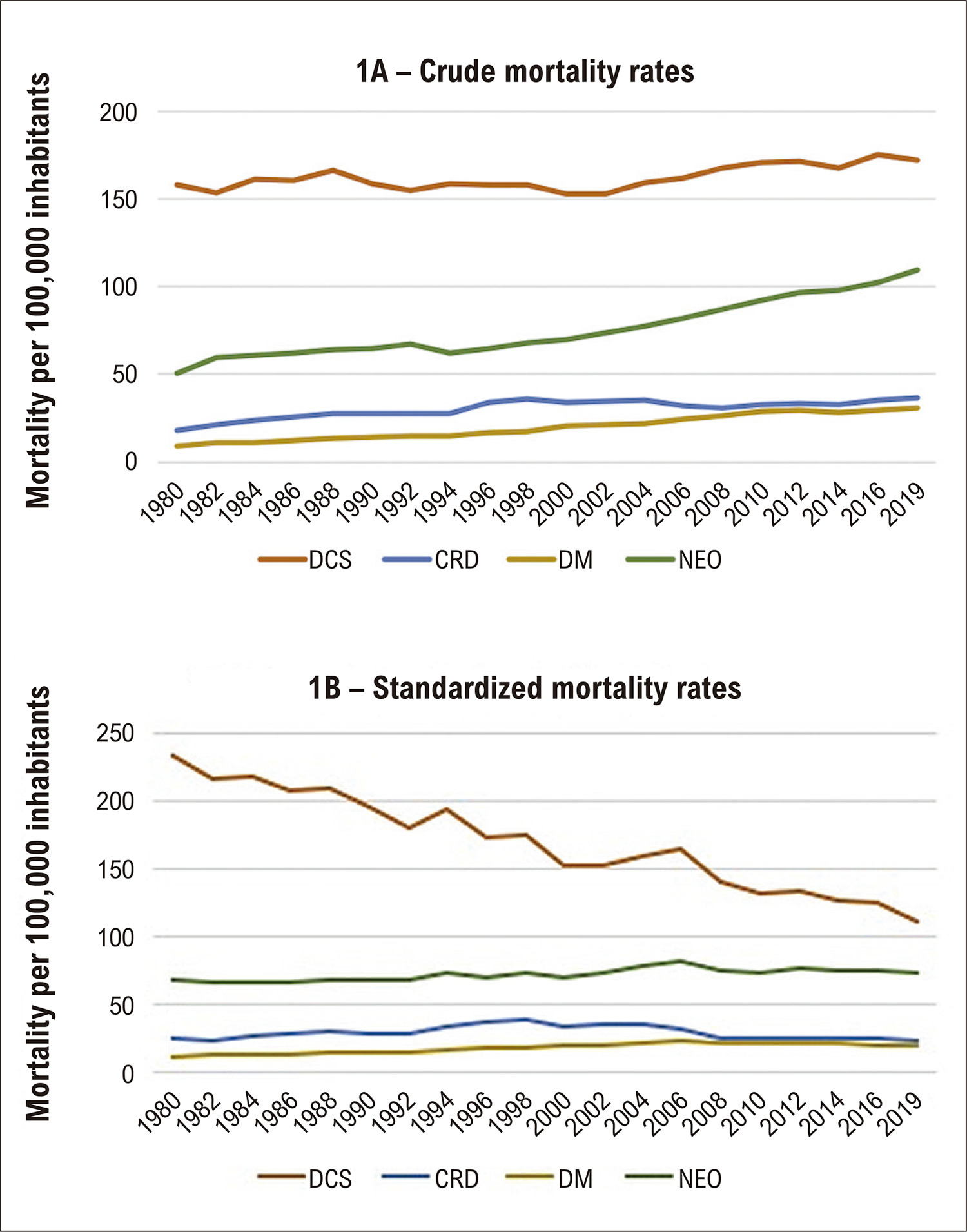
This was a descriptive, time-series study of deaths from CNCDs in Brazil from 1980 to 2019. Data on the annual frequencies of deaths and on population were obtained from the Department of Informatics of the Brazilian Unified Health System. Crude and standardized mortality rates per 100,000 inhabitants were estimated using the direct method (Brazilian population in 2000). The quartiles of each CNCD were calculated, where a quartile change, due to an increase in mortality rate, was represented by a chromatic gradient. The Municipal Human Development Index (MHDI) of each Brazilian federative unit was extracted from the Atlas Brasil website and correlated with the rates of CNCD mortality.

Results

There was a reduction in mortality rates due to diseases of the circulatory system during the period, except in the Northeast Region. There was also an increase in mortality from neoplasia and diabetes, while the rates of chronic respiratory diseases showed little variation. There was an inverse correlation between the federative units with greater reduction in CNCD mortality rates and the MHDI.

Conclusions

The observed decrease in mortality due to diseases of the circulatory system may reflect an improvement in socioeconomic indicators in Brazil during the period. The increase in mortality rates due to neoplasms is probably related to the aging of the population. The higher mortality rates of diabetes seem to be associated with an increase in the prevalence of obesity in Brazilian women.

  • Development Indicators
  • Epidemiology
  • Health of the Disabled
  • Mortality
  • Non Communicable Diseases
  • Public Health
Read Full Article
Creative Commons Attribution (CC BY) Creative Commons license
21/04/2023 DOI: 10.36660/abc.20211009 Views 2
Figure 1
Original Article

SLC26A4-AS1 Aggravates AngII-induced Cardiac Hypertrophy by Enhancing SLC26A4 Expression

Xiaoliang Han et al. Chao Li Qinjiong Ji Ling Zhang … Xiaofei Xie Huijuan Shang Hong Ye

Abstract

Background

It has been reported that solute carrier family 26 members 4 antisense RNA 1 (SLC26A4-AS1) is highly related to cardiac hypertrophy.

Objective

This research aims to investigate the role and specific mechanism of SLC26A4-AS1 in cardiac hypertrophy, providing a novel marker for cardiac hypertrophy treatment.

Methods

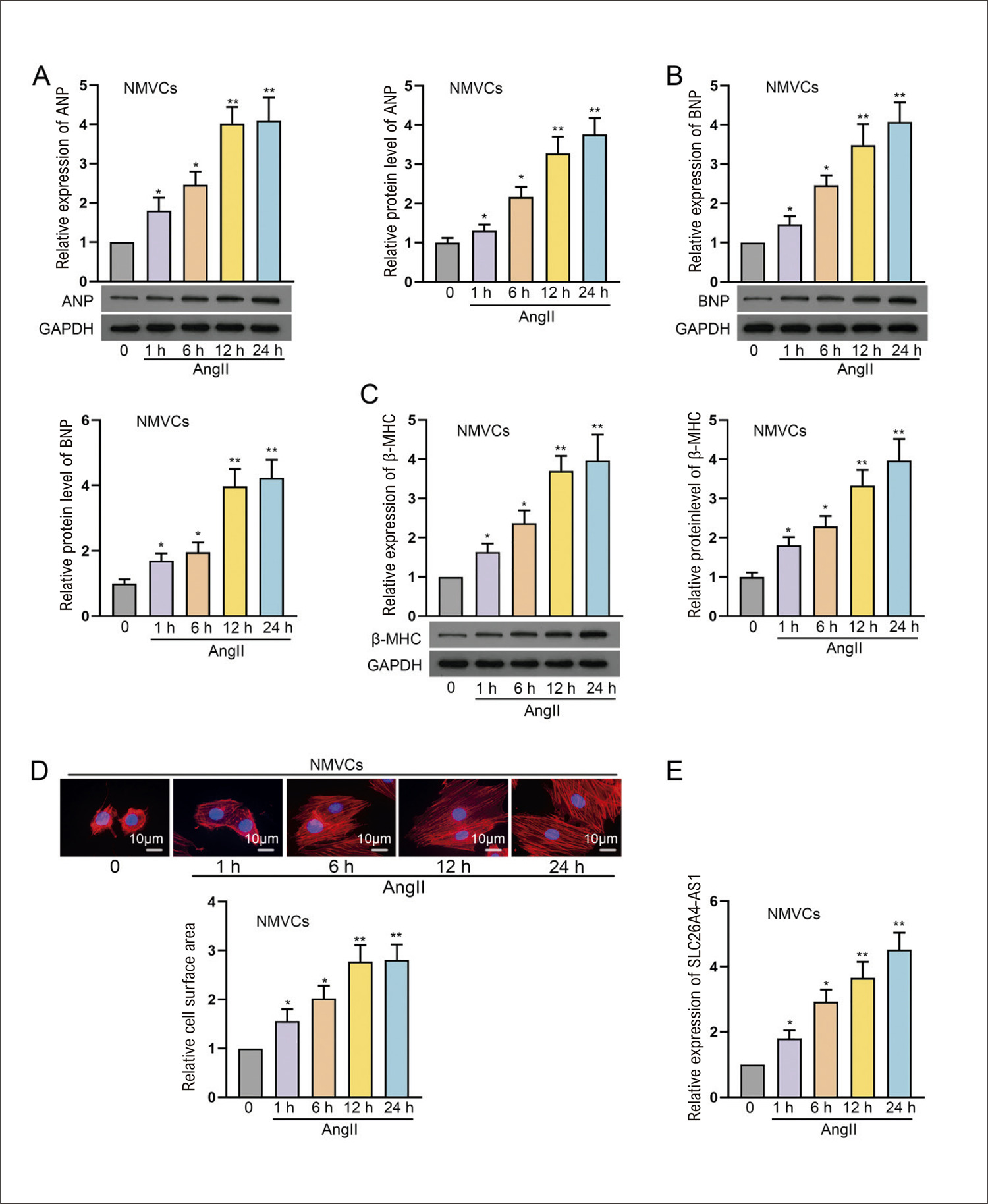
Angiotensin II (AngII) was infused into neonatal mouse ventricular cardiomyocytes (NMVCs) to induce cardiac hypertrophy. Gene expression was detected by quantitative real-time PCR (RT-qPCR). Protein levels were evaluated via western blot. Functional assays analyzed the role of SLC26A4-AS1. The mechanism of SLC26A4-AS1 was assessed by RNA-binding protein immunoprecipitation (RIP), RNA pull-down, and luciferase reporter assays. The P value <0.05 was identified as statistical significance. Student’s t-test evaluated the two-group comparison. The difference between different groups was analyzed by one-way analysis of variance (ANOVA).

Results

SLC26A4-AS1 is upregulated in AngII-treated NMVCs and promotes AngII-induced cardiac hypertrophy. SLC26A4-AS1 regulates its nearby gene solute carrier family 26 members 4 (SLC26A4) via functioning as a competing endogenous RNA (ceRNA) to modulate the microRNA (miR)-301a-3p and miR-301b-3p in NMVCs. SLC26A4-AS1 promotes AngII-induced cardiac hypertrophy via upregulating SLC26A4 or sponging miR-301a-3p/miR-301b-3p.

Conclusion

SLC26A4-AS1 aggravates AngII-induced cardiac hypertrophy via sponging miR-301a-3p or miR-301b-3p to enhance SLC26A4 expression.

  • Cardiomegaly
  • RNA
  • RNA, Long Noncoding
Read Full Article
Creative Commons Attribution (CC BY) Creative Commons license
21/04/2023 DOI: 10.36660/abc.20210933
Research Letter

Serving Two Masters: Resolving the Dilemma between Individual Patient Data Meta-Analysis and Aggregate Data Meta-Analysis from Statin Trials

Lucas Tramujas et al. Fernando Azevedo Medrado Júnior Alexandre Biasi Cavalcanti Carlos Eduardo Pompilio

Introduction

Elevated levels of low-density lipoprotein-cholesterol (LDL-C) have been established as an important risk factor for the development of atherosclerosis. As a corollary of this reasoning, an LDL-centric approach has emerged based on statins and other medications able to reduce LDL-C and cardiovascular risk.

The Cholesterol Treatment Trialists’ Collaboration, an individual patient data meta-analysis, found a log-linear relationship between the degree of LDL-C reduction and cardiovascular events. According to this, expert guidelines for preventing cardiovascular diseases recommend statin use for primary and secondary prevention.

[…]

  • Cardiovascular disease
  • Cholesterol
  • Meta-Analysis
Read Full Article
Creative Commons Attribution (CC BY) Creative Commons license
21/04/2023 DOI: 10.36660/abc.20220539
Central Illustration
Original Article

Association between RAAS Antagonism and COVID-19–related Mortality in Patients with Overweight/Obesity-related Hypertension: A Retrospective Cohort Study

Elham Shams et al. Vijayvardhan Kamalumpundi Linhai Cheng Adeyinka Taiwo … Amal Shibli-Rahhal Ayotunde O. Dokun Marcelo L.G. Correia

Abstract

Background

Angiotensin receptor blockers (ARB) and angiotensin-converting enzyme inhibitors (ACEI) increase the expression of ACE2, which is a receptor for entry of SARS-CoV-2 into cells. Though evidence suggests that ARB/ACEI are safe among the general population with COVID-19, their safety in patients with overweight/obesity-related hypertension deserves further evaluation.

Objective

We assessed the association between ARB/ACEI use and COVID-19 severity in patients with overweight/obesity-related hypertension.

Methods

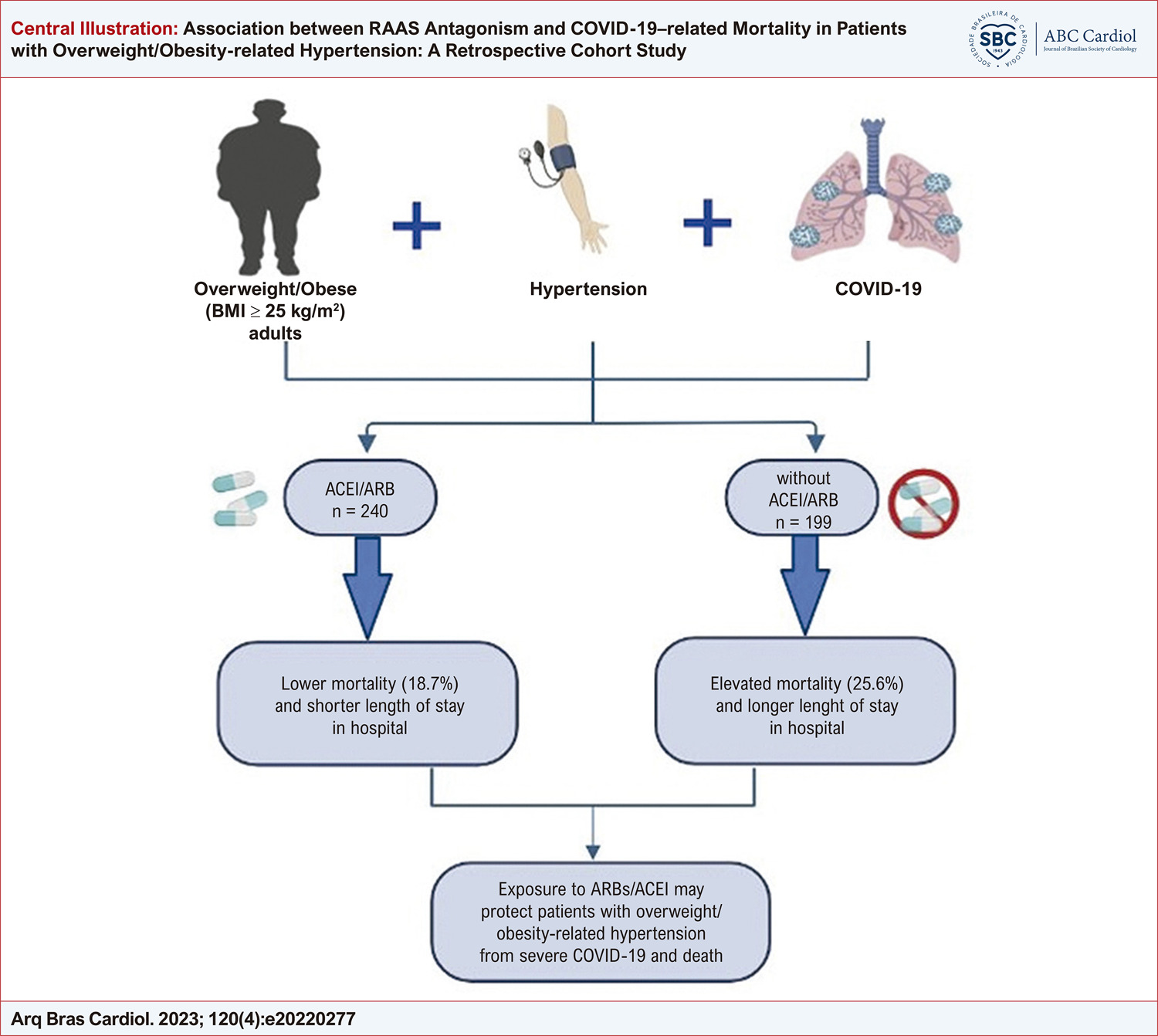
This study included 439 adult patients with overweight/obesity (body mass index ≥ 25 kg/m2) and hypertension, diagnosed with COVID-19 and admitted to University of Iowa Hospitals and Clinic from March 1 to December 7, 2020. Mortality and severity of COVID-19 were evaluated based on length of stay in hospital, intensive care unit admission, use of supplemental oxygen, mechanical ventilation, and vasopressors. Multivariable logistic regression was used to examine the associations of ARB/ACEI use with mortality and other markers of COVID-19 severity, with a two-sided alpha set at 0.05.

Results

Exposure to ARB (n = 91) and ACEI (n = 149) before hospitalization was significantly associated with lower mortality (odds ratio [OR] = 0.362, 95% confidence interval [CI] 0.149 to 0.880, p = 0.025) and a shorter length of stay (95% CI −0.217 to −0.025, p = 0.015). Additionally, patients using ARB/ACEI showed a non-significant trend toward lower intensive care unit admission (OR = 0.727, 95% CI 0.485 to 1.090, p = 0.123), use of supplemental oxygen (OR = 0.929, 95% CI 0.608 to 1.421, p = 0.734), mechanical ventilation (OR = 0.728, 95% CI 0.457 to 1.161, p = 0.182), and vasopressors (OR = 0.677, 95% CI 0.430 to 1.067, p = 0.093).

Conclusion

Results suggest that hospitalized patients with COVID-19 and overweight/obesity-related hypertension who were prescribed ARB/ACEI before admission to the hospital exhibit lower mortality and less severe COVID-19 than those who were not taking ARB/ACEI. The results also suggest that exposure to ARB/ACEI may protect patients with overweight/obesity-related hypertension from severe COVID-19 and death.

  • Angiotensin Receptor Antagonists
  • Angiotensin-Converting Enzyme Inhibitors
  • COVID-19
  • Hypertension
  • Obesity
Read Full Article
Creative Commons Attribution (CC BY) Creative Commons license
21/04/2023 DOI: 10.36660/abc.20220277
Figure 1
Original Article

Decreased Serum Levels of Soluble Oncostatin M Receptor (sOSMR) and Glycoprotein 130 (sgp130) in Patients with Coronary Artery Disease

Vanessa Mylenna Florêncio de Carvalho et al. Priscilla Stela Santana de Oliveira Amanda Pinheiro Barros de Albuquerque Moacyr Jesus Barreto de Melo Rêgo … Michelle Melgarejo da Rosa Dinaldo Cavalcanti de Oliveira Michelly Cristiny Pereira Maira Galdino da Rocha Pitta

Abstract

Background

Oncostatin M (OSM) is a pleiotropic cytokine which, after arterial injury, has proven to be to be rapidly expressed.

Objectives

To correlate the serum levels of OSM, soluble OSM receptor (sOSMR), and soluble fraction of glycoprotein 130 (sgp130) in patients with coronary artery disease (CAD) with clinical parameters.

Methods

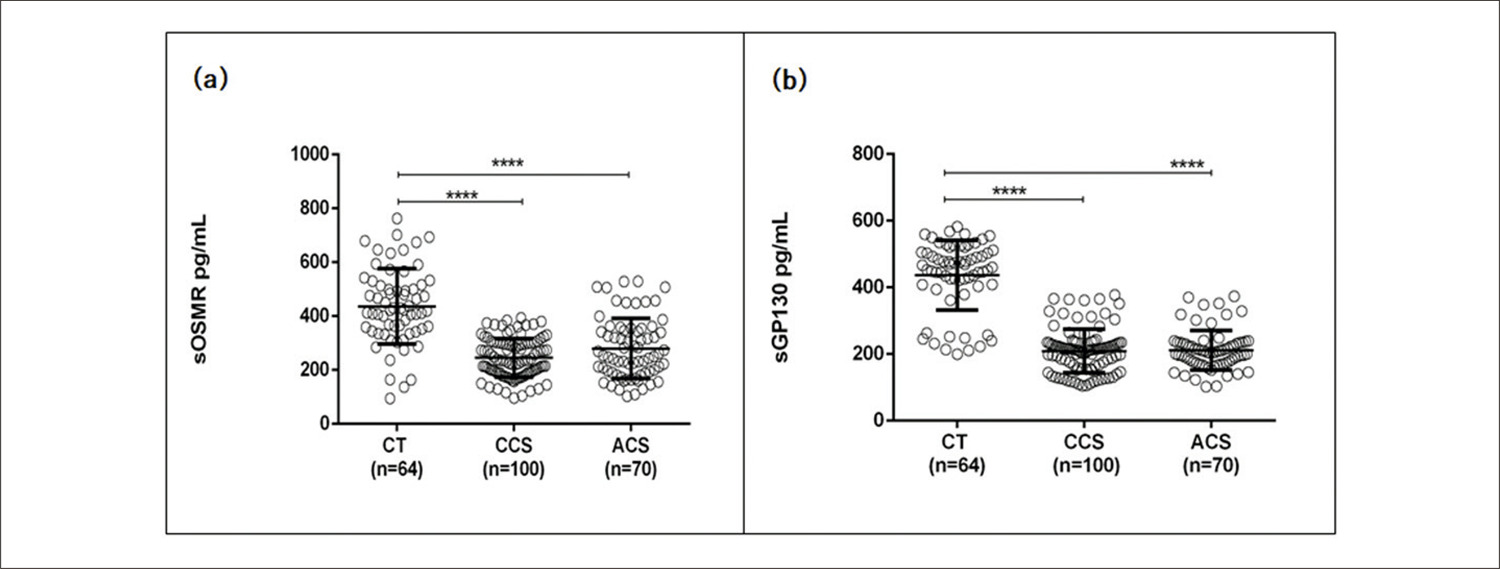
Levels of sOSMR and sgp130 were evaluated by ELISA and OSM by Western Blot, in patients with CCS (n=100), patients with ACS (n=70), and 64 control volunteers without clinical manifestations of the disease. P-values < 0.05 were considered to be statistically significant.

Results

CAD patients exhibited significantly lower levels of sOSMR and sgp130 and higher levels of OSM when compared to the controls (both p < 0.0001). Clinical analysis displayed, lower levels of sOSMR in men ([OR] = 2.05, p = 0.026), youth (OR = 1.68, p = 0.0272), hypertensives (OR = 2.19, p = 0.041), smokers (OR = 2.19, p = 0.017), patients that did not present dyslipidemia (OR = 2.32, p = 0.013), patients with Acute Myocardial Infarction [AMI] (OR = 3.01, p = 0.001) and patients not treated with statin (OR = 1.95, p = 0.031), antiplatelet agent (OR = 2.46, p = 0.005), inhibitors of calcium channels (OR = 3.15, p = 0.028), and antidiabetic drugs (OR = 2.97, p = 0.005). The levels of sOSMR were also correlated with gender, age, hypertension, and use of medications in multivariate analysis.

Conclusions

Our data suggest that the enhanced serum levels of OSM, and decreased levels of sOSMR and sGP130 in patients with cardiac injury may play an important role in the pathophysiological mechanism of the disease. Furthermore, lower levels of sOSMR were associated with gender, age, hypertension, and the use of medications.

  • Biomarkers
  • Coronary Disease
  • Glycoproteins
  • Immunity
  • Oncostatin M
Read Full Article
Creative Commons Attribution (CC BY) Creative Commons license
21/04/2023 DOI: 10.36660/abc.20220326 Views 2
Figure 1
Original Article

Cardiac Magnetic Resonance as an Etiological Diagnosis Tool in Recovered Sudden Cardiac Death or Unstable Ventricular Arrhythmia Patients

Paula C. Marçal et al. Maria Fernanda Braggion-Santos Danilo Tadao Wada Marcel Koenigkam Santos … Henrique Turin Moreira Gustavo Jardim Volpe André Schmidt

Abstract

Background

Cardiac magnetic resonance (CMR) has an increasing diagnostic relevance in survivors of sudden cardiac death (SCD) or unstable ventricular arrhythmia (UVA) in developed countries.

Objective

To evaluate retrospectively the additional role of CMR in a developing country where few resources are available, and should be used more effectively.

Methods

The study included SCD or UVA survivors admitted between 2009 and 2019 at a tertiary academic institution referred to CMR. Demographic, clinical, and laboratory data were collected from the medical records. CMR images and reports were reviewed and their impact on the final etiological diagnosis was determined. A descriptive analysis was performed and p<0.05 established as significant.

Results

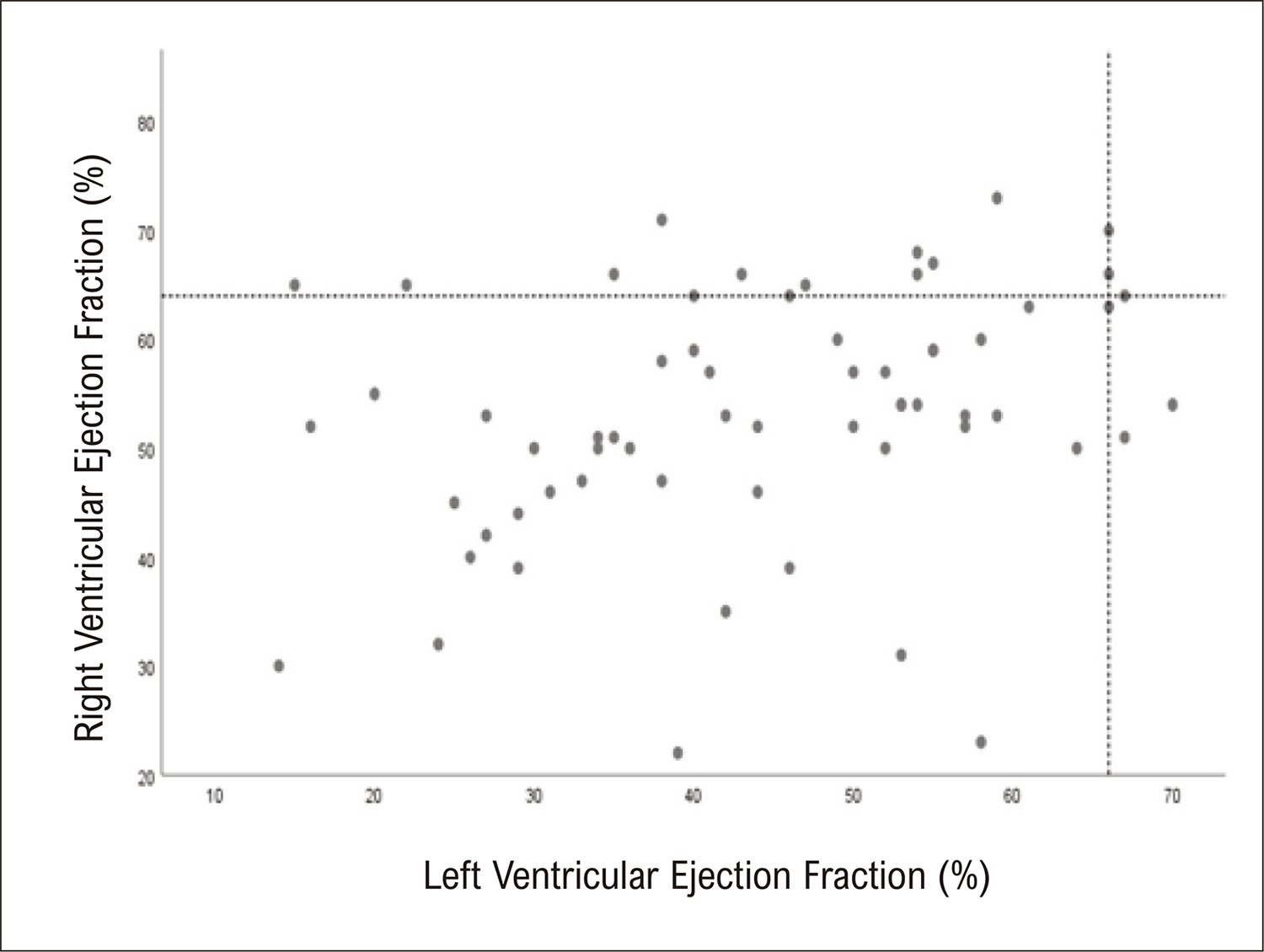
Sixty-four patients, 54.9±15.4 years old, and 42 (71.9%) males. Most events (81.3%) were out of the hospital and ventricular tachycardia was the most common rhythm. Cardiovascular medications were previously used by 55 patients, and beta-blockers were the most used medications (37.5%). Electrocardiogram had electrical inactive areas in 21.9% and all of them had fibrosis at CMR. Mean left ventricular ejection fraction (LVEF) was 44±14%, with 60.9% ≤50% and only 29.7% ≤35%. Late gadolinium enhancement was identified in 71.9%, with a transmural pattern in 43.8%. Chagas cardiomyopathy was the most common etiology (28.1%), followed by ischemic cardiomyopathy (17.2%). Among 26 without a previously identified etiology, CMR could define it (15 patients – 57%).

Conclusion

In accordance with previous studies in developed countries, CMR was capable of increasing etiological diagnosis and identifying the arrhythmogenic substrate, allowing better care in half of the underdiagnosed patients.

  • Cardiac magnetic resonance
  • Sudden Cardiac Death
  • Unstable Ventricular Tachycardia
  • ventricular arrhythmia
Read Full Article
Creative Commons Attribution (CC BY) Creative Commons license
21/04/2023 DOI: 10.36660/abc.20220411
Research Letter

Change of Strategy in Coronary Artery Bypass Graft Surgery Waiting List during the COVID-19 Pandemic: One-Year Follow-Up

Franc Jorge Sampaio Santos Pereira et al. Marília Prudente Menezes Gabriela Carolina Santamaria Naranjo José Henrique Herrmann Delamain … José Ribamar Costa Mario Issa Vivian Lerner Amato Fausto Feres Pedro Silvio Farsky

Introduction

The COVID-19 pandemic led to a significant occupation of intensive care beds, causing the suspension of elective cases of coronary artery bypass grafting (CABG).

At the same time, the evolution of techniques for the percutaneous treatment of coronary artery disease (CAD) has expanded the possibilities for this modality, and published studies have not shown a reduction in outcomes in stable patients with moderate/high ischemic burden under optimized clinical treatment (OCT).

[…]

  • Coronary Artery Disease/surgery
  • COVID-19
  • Intervention Coronary Percutaneous, Myocardial Infarction/complications
  • Myocardial Revascularization
  • Pandemic
  • Technology Applied to Waiting Lists
  • waiting lists
Read Full Article
Creative Commons Attribution (CC BY) Creative Commons license
21/04/2023 DOI: 10.36660/abc.20220582
Figure 1
Statement

Brazilian Position Statement for Familial Chylomicronemia Syndrome – 2023

Maria Cristina de Oliveira Izar et al. Raul Dias dos Santos Filho Marcelo Heitor Vieira Assad Antonio Carlos Palandri Chagas … Alceu de Oliveira Toledo Júnior Ana Cláudia Cavalcante Nogueira Ana Cristina Carneiro Fernandes Souto Ana Maria Lottenberg Ana Paula Marte Chacra Carlos Eduardo dos Santos Ferreira Charles Marques Lourenço Cynthia Melissa Valerio Dennys Esper Cintra Francisco Antonio Helfenstein Fonseca Gustavo Aguiar Campana Henrique Tria Bianco Josivan Gomes de Lima Maria Helane Costa Gurgel Castelo Marileia Scartezini Miguel Antonio Moretti Natasha Slhessarenko Fraife Barreto Rayana Elias Maia Renan Magalhães Montenegro Junior Renato Jorge Alves Roberta Marcondes Machado Figueiredo Rodrigo Ambrosio Fock Tânia Leme da Rocha Martinez Viviane Zorzanelli Rocha Giraldez

1. Cover Letter

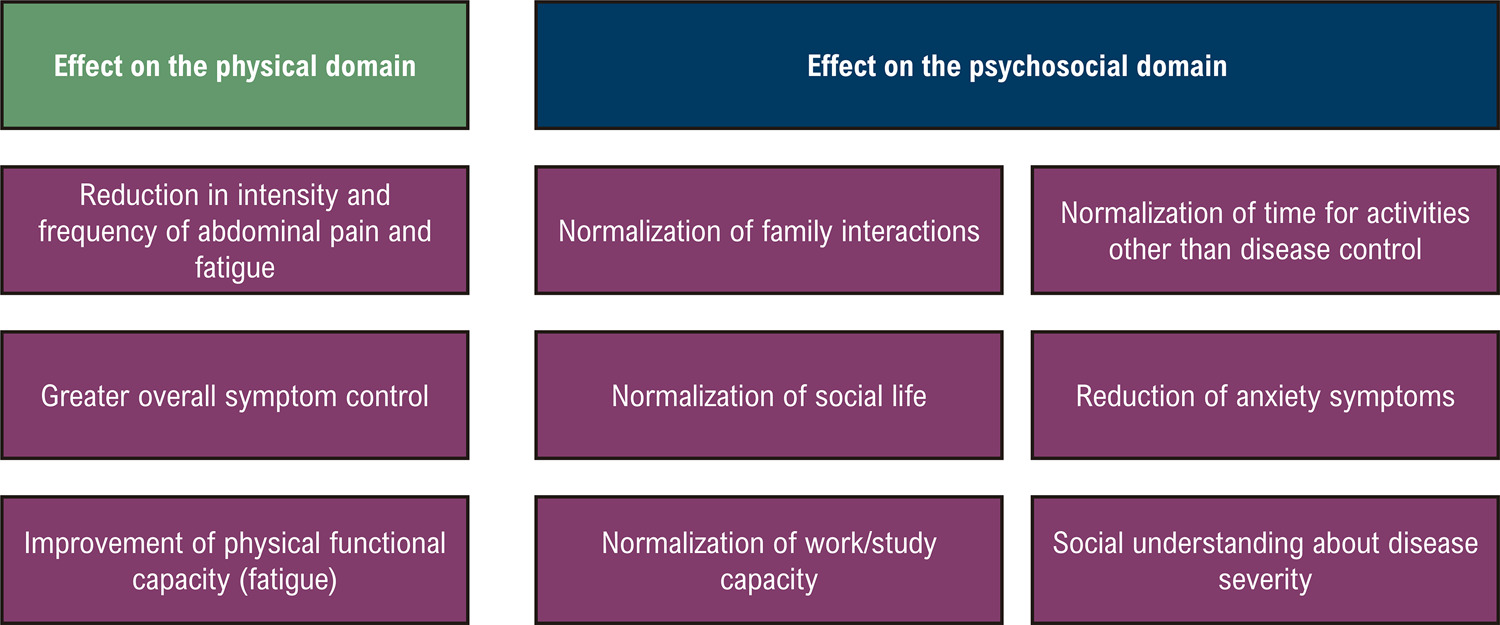
Familial chylomicronemia syndrome (FCS) is a severe form of dyslipidemia characterized by multiple signs and symptoms associated with a deficiency in lipoprotein lipase or one of its cofactors, leading to compromised triglyceride metabolism. FCS has an autosomal recessive pattern of inheritance and affects approximately 1 to 2 people per million, but it may be more frequent in consanguineous relationships. Knowledge of this condition is still limited, often contributing to delayed diagnosis when complications have already set in. Patients with FCS may have recurrent abdominal pain, episodes of pancreatitis, eruptive xanthomas, lipemia retinalis , hepatosplenomegaly, and a milky appearance of serum.

In classic, severe forms, clinical symptoms are present at birth or even in childhood, but they may manifest at any age, especially in carriers of new mutations. Patients with FCS usually see several specialists before a diagnosis is made. The clinical presentation of FCS may also be indistinguishable from that of multifactorial chylomicronemia syndrome, which is more common and also has a genetic basis, although it is influenced by environmental and lifestyle factors. In addition, multifactorial chylomicronemia syndrome may result from conditions such as hypothyroidism, uncontrolled diabetes, kidney disease, alcohol abuse, and use of certain medications, which makes its diagnosis even more difficult.

[…]

Read Full Article
Creative Commons Attribution (CC BY) Creative Commons license
14/04/2023 DOI: 10.36660/abc.20230203 Views 1
Letter to the Editor

CHA2DS2-VASc Score: What More Can it Predict?

Adnaldo da Silveira Maia

Dear Editor,

Kalkan et al. assessed the predictive value of the congestive heart failure, hypertension, age, diabetes mellitus, prior stroke, vascular disease, age, sex category (CHA2DS2-VASc) score for residual SYNTAX score (rSS) among patients with ST-segment elevation acute myocardial infarction (STEMI). The study included 688 patients divided into a low rSS group (group 1; scores up to 8) and a high rSS group (group 2; scores above 8).

[…]

  • Atrial Fibrillation
  • Covid-19/complications
  • Data Interpretation, Statistical
  • Myocardial Revascularization
  • ST Elevation Myocardial Infarction
Read Full Article
Creative Commons Attribution (CC BY) Creative Commons license
07/04/2023 DOI: 10.36660/abc.20220672 Views 1
Overexpression of the PTEN Gene in Myocardial Tissues of Coronary Bypass Surgery Patients
Original Article

Overexpression of the PTEN Gene in Myocardial Tissues of Coronary Bypass Surgery Patients

Reyhan Tahtasakal et al. Elif Funda Sener Nesrin Delibasi Zuhal Hamurcu … Ecmel Mehmetbeyoglu Keziban Korkmaz Bayram Isin Gunes Dincer Goksuluk Omer Naci Emirogullari

Abstract

Background:

Coronary artery disease is a complex disorder that causes death worldwide. One of the genes involved in developing this disease may be PTEN.

Objectives:

This study aimed to investigate the PTEN gene and protein expression in tissue and blood samples taken from coronary bypass surgery patients.

Methods:

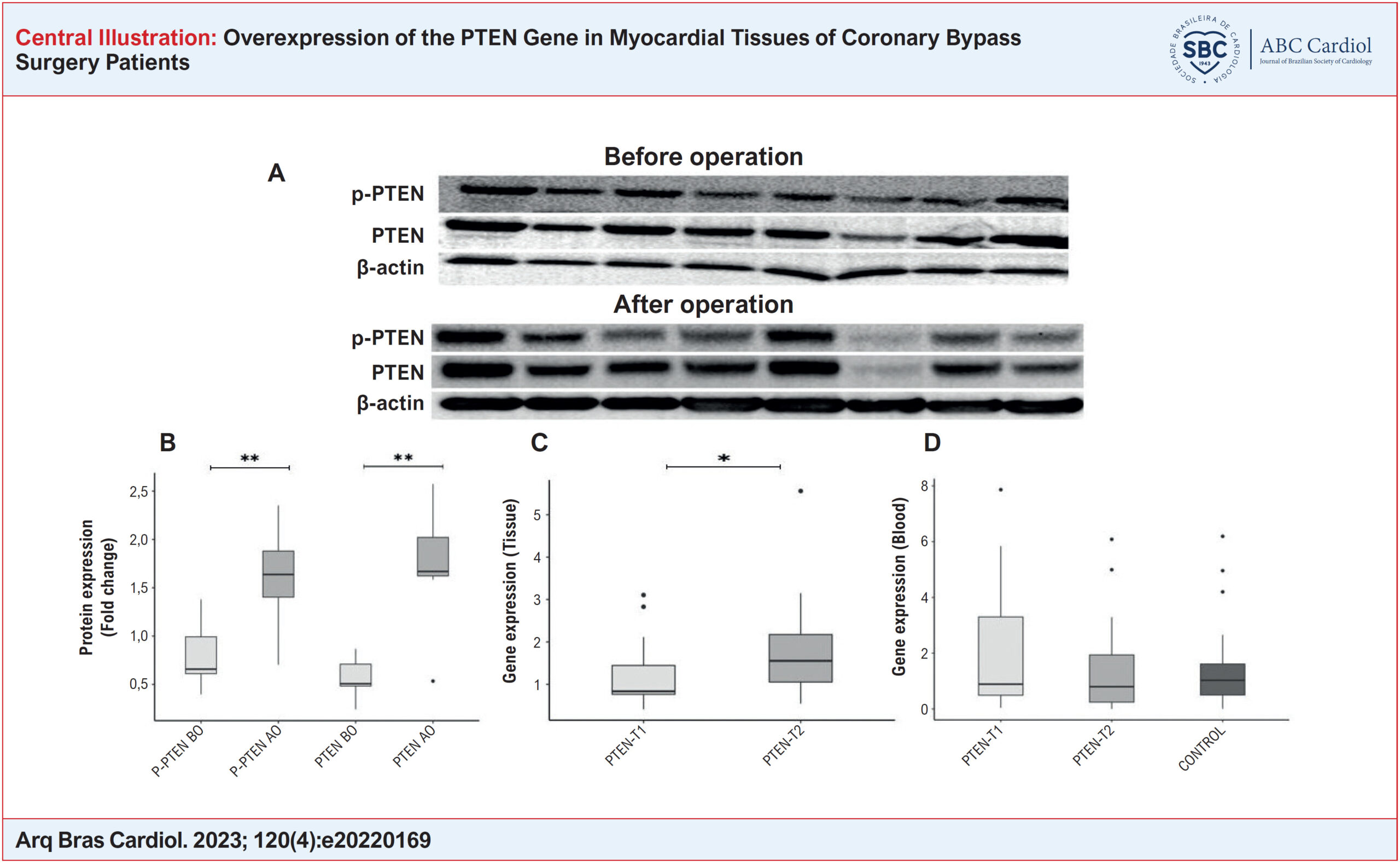
Molecular studies were performed at Erciyes University Genome and Stem Cell Center (GENKOK). Right atrial appendage and blood samples were taken from the central vein of 22 coronary bypass surgery patients before starting and ending cardiopulmonary bypass. PTEN expression was determined using quantitative real-time PCR and western blot analysis. The significance level was accepted as p<0.05.

Results:

There was no significant difference in the PTEN gene expression in blood samples taken before and after cardiopulmonary bypass. However, a substantial increase in both protein and gene expression levels of P-PTEN and PTEN was observed in the tissue samples. Myocardial expression of the PTEN gene was significantly increased at the end of the cardiopulmonary bypass. PTEN gene expression in the post-cardiopulmonary bypass period was increased when compared to the pre-bypass period, but it was insignificant when compared to healthy controls.

Conclusion:

This study first revealed the role of the PTEN gene by analyzing both mRNA and protein expression in coronary bypass patients, appearing in both myocardial tissue and blood samples. Increased levels of PTEN may be a marker in myocardial tissue for patients with coronary artery disease.

  • Coronary Bypass Surgery
  • Gene Expression
  • Myocardium
  • PTEN
Read Full Article
Creative Commons Attribution (CC BY) Creative Commons license
07/04/2023 DOI: 10.36660/abc.20220169 Views 2
Editorial

PTEN in the Context of Myocardial Revascularization: The Iceberg Tip?

Leonardo Rufino Garcia et al. André Monti Garzesi Marcello Laneza Felicio Leonardo Antônio Mamede Zornoff

Cardiovascular diseases significantly contribute to morbidity and mortality in Brazil and worldwide. Within this group of diseases, coronary artery disease stands out, accounting for about 12% of total deaths in Brazil and is a leading cause of death in North America.

In addition to lifestyle changes such as smoking cessation, weight loss with regular physical activity, control of comorbidities, notably diabetes and arterial hypertension, and drug treatment with antiplatelet agents, beta-blockers, and statins, a significant number of patients require treatment aimed at myocardial revascularization. Diabetic, multivessel-diseased patients with obstructions in the left main coronary artery greater than 50% or with depressed left ventricular function benefit the most. This fact is due to different factors, including a decrease in ischemia and symptoms, an improvement in quality of life, a decrease in the occurrence of infarcts, and, above all, mortality improvement.

[…]

  • Apoptosis
  • Cardiovascular Diseases
  • Cells Proliferation
  • Coronary Artery Disease/surgery
  • Glycolysis
  • Lipogenesis
  • Myocardial Revascularization/surgery
  • Phosphatidyglinositol-3 Kinases/metabolism
  • PTEN-Phosphohydrolase
Read Full Article
Creative Commons Attribution (CC BY) Creative Commons license
07/04/2023 DOI: 10.36660/abc.20230170
Hydroxychloroquine for Non-Hospitalized COVID-19 Patients: A Systematic Review and Meta-Analysis of Randomized Clinical Trials
Original Article

Hydroxychloroquine for Non-Hospitalized COVID-19 Patients: A Systematic Review and Meta-Analysis of Randomized Clinical Trials

Rosa Lucchetta et al. Jessica Y. Matuoka Haliton Alves de Oliveira Junior Gustavo Oliveira … Alexandre Biasi Cavalcanti Luciano Azevedo Otavio Berwanger Renato Delascio Lopes Regis Goulart Rosa Viviane Cordeiro Veiga Álvaro Avezum

Abstract

Background:

Previous systematic reviews have identified no benefit of hydroxychloroquine and chloroquine in non-hospitalized COVID-19 patients. After publication of these reviews, the results of COPE, the largest randomized trial conducted to date, became available.

Objectives:

To conduct a systematic review and meta-analyses of randomized clinical trials (RCTs) to synthesize the evidence on the efficacy and safety of hydroxychloroquine and chloroquine for non-hospitalized COVID-19 patients compared to placebo or standard of care.

Methods:

Searches were conducted in PubMed, Embase, The Cochrane Library, and ClinicalTrials.gov complemented by manual search. Pairwise meta-analyses, risk of bias, and evidence certainty assessments were conducted, including optimal information size analysis (OIS). A level of significance of 0.05 was adopted in the meta-analysis. PROSPERO: CRD42021265427.

Results:

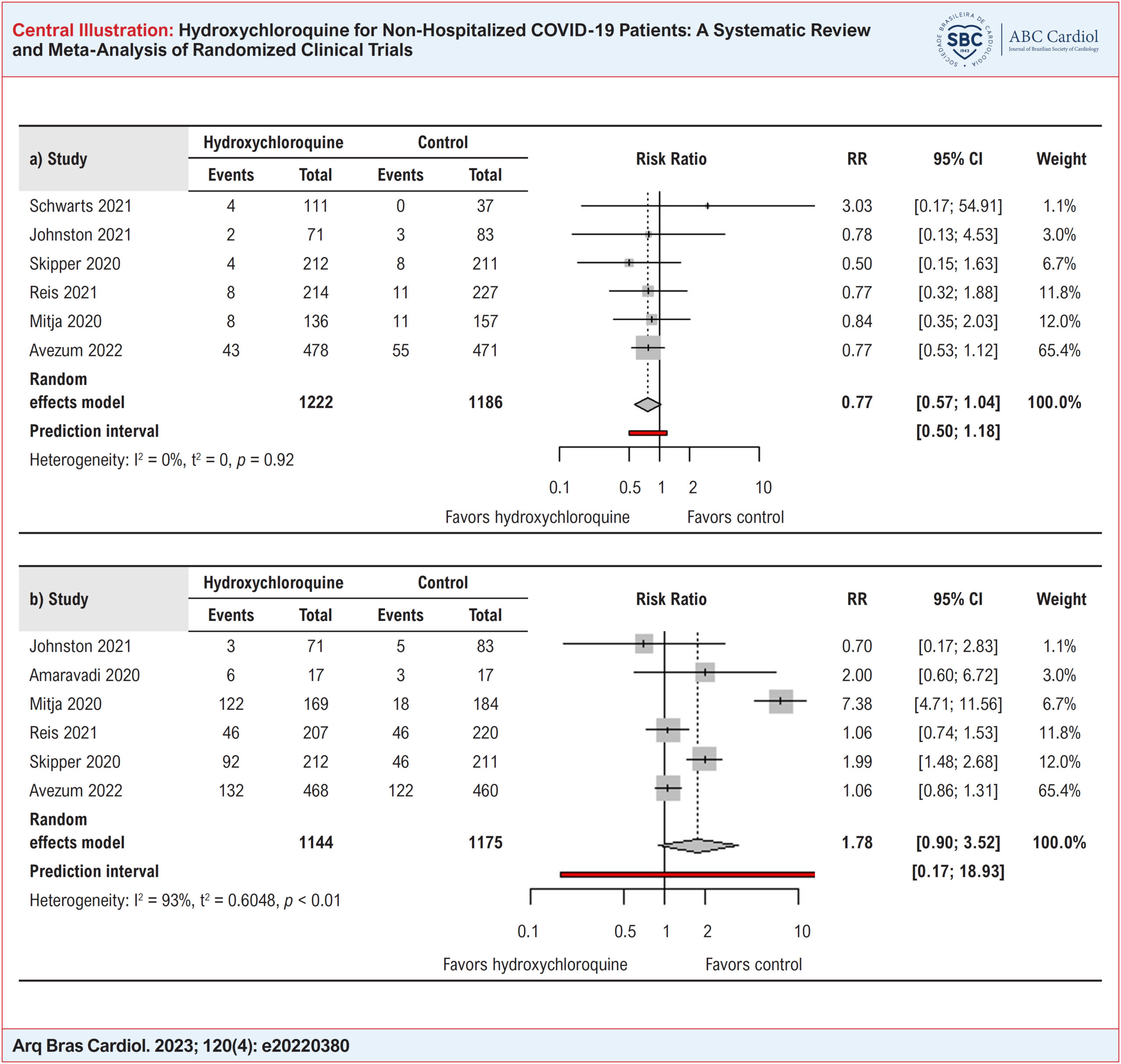
Eight RCTs with 3,219 participants were included. COVID-19 hospitalization and any adverse events rates were not significantly different between hydroxychloroquine (5.6% and 35.1%) and control (7.4% and 20.4%) (risk ratio, RR, 0.77, 95% confidence interval, CI, 0.57-1.04, I2: 0%; RR 1.78, 95%-CI 0.90; 3.52, I2: 93%, respectively). The OIS (7,880) was not reached for COVID-19 hospitalization, independently of the simulation for anticipated event rate and RR reduction estimate.

Conclusion:

Evidence of very low certainty showed lack of benefit with hydroxychloroquine in preventing COVID-19 hospitalizations. Despite being the systematic review with the largest number of participants included, the OIS, considering pre-vaccination response to infection, has not yet been reached.

  • COVID-19/drug therapy
  • Hydroxychloroquine
  • Meta-Analyis
  • Randomized controlled trials as topic
  • SARS-CoV-2
Read Full Article
Creative Commons Attribution (CC BY) Creative Commons license
07/04/2023 DOI: 10.36660/abc.20220380 Views 3

Could not load more articles. Please try again.

How to cite this article

EndNote RIS

Electronic Document Format (Vancouver)

Mota GAF, Gatto M, Gregolin CS, Souza SLB, Okoshi MP. mRNA, miRNA, lncRNA, ceRNA: The Future of Cardiovascular Research?. Arquivos Brasileiros de Cardiologia 2023;120(4):e20230209.

Electronic Document Format (ABNT)

Mota, Gustavo Augusto Ferreira; Gatto, Mariana; Gregolin, Cristina Schmitt; Souza, Sérgio Luiz Borges de; Okoshi, Marina Politi. mRNA, miRNA, lncRNA, ceRNA: The Future of Cardiovascular Research?. Arquivos Brasileiros de Cardiologia, v. 120, n. 4, e20230209, May. 2023.

Electronic Document Format (APA)

Mota, G. A. F., Gatto, M., Gregolin, C. S., Souza, S. L. B. , & Okoshi, M. P. (2023). mRNA, miRNA, lncRNA, ceRNA: The Future of Cardiovascular Research?. Arquivos Brasileiros de Cardiologia, 120(4), e20230209.

Electronic Document Format (ISO)

Mota, Gustavo Augusto Ferreira and Gatto, Mariana and Gregolin, Cristina Schmitt and Souza, Sérgio Luiz Borges de and Okoshi, Marina Politi. mRNA, miRNA, lncRNA, ceRNA: The Future of Cardiovascular Research?. Arquivos Brasileiros de Cardiologia [online]. 2023, vol. 120, n. 4, [cited 2026-10-14], e20230209. Available from: <https://journals.cardiol.br/en/article/mrna-mirna-lncrna-cerna-the-future-of-cardiovascular-research/>. ISSN 0066-782X

EndNote RIS

Electronic Document Format (Vancouver)

Mansur AJ, Barroso LP. Human Development Index and Chronic Diseases in Brazil between 1980 and 2019. Arquivos Brasileiros de Cardiologia 2023;120(4):e20230213.

Electronic Document Format (ABNT)

Mansur, Alfredo José; Barroso, Lucia Pereira. Human Development Index and Chronic Diseases in Brazil between 1980 and 2019. Arquivos Brasileiros de Cardiologia, v. 120, n. 4, e20230213, May. 2023.

Electronic Document Format (APA)

Mansur, A. J., & Barroso, L. P. (2023). Human Development Index and Chronic Diseases in Brazil between 1980 and 2019. Arquivos Brasileiros de Cardiologia, 120(4), e20230213.

Electronic Document Format (ISO)

Mansur, Alfredo José and Barroso, Lucia Pereira. Human Development Index and Chronic Diseases in Brazil between 1980 and 2019. Arquivos Brasileiros de Cardiologia [online]. 2023, vol. 120, n. 4, [cited 2026-10-14], e20230213. Available from: <https://journals.cardiol.br/en/article/human-development-index-and-chronic-diseases-in-brazil-between-1980-and-2019/>. ISSN 0066-782X

EndNote RIS

Electronic Document Format (Vancouver)

Aranha LN. Can Intermittent Fasting Associated with a Low-Carb Diet Prevent Cardiovascular Disease in Pre-Diabetics?. Arquivos Brasileiros de Cardiologia 2023;120(4):e20230182.

Electronic Document Format (ABNT)

Aranha, Luciana Nicolau. Can Intermittent Fasting Associated with a Low-Carb Diet Prevent Cardiovascular Disease in Pre-Diabetics?. Arquivos Brasileiros de Cardiologia, v. 120, n. 4, e20230182, Apr. 2023.

Electronic Document Format (APA)

Aranha, L. N. (2023). Can Intermittent Fasting Associated with a Low-Carb Diet Prevent Cardiovascular Disease in Pre-Diabetics?. Arquivos Brasileiros de Cardiologia, 120(4), e20230182.

Electronic Document Format (ISO)

Aranha, Luciana Nicolau. Can Intermittent Fasting Associated with a Low-Carb Diet Prevent Cardiovascular Disease in Pre-Diabetics?. Arquivos Brasileiros de Cardiologia [online]. 2023, vol. 120, n. 4, [cited 2026-10-14], e20230182. Available from: <https://journals.cardiol.br/en/article/can-intermittent-fasting-associated-with-a-low-carb-diet-prevent-cardiovascular-disease-in-pre-diabetics/>. ISSN 0066-782X

EndNote RIS

Electronic Document Format (Vancouver)

Abreu LM. In Search of the Perfect Marker. Arquivos Brasileiros de Cardiologia 2023;120(4):e20230193.

Electronic Document Format (ABNT)

Abreu, Luiz Maurino. In Search of the Perfect Marker. Arquivos Brasileiros de Cardiologia, v. 120, n. 4, e20230193, Apr. 2023.

Electronic Document Format (APA)

Abreu, L. M. (2023). In Search of the Perfect Marker. Arquivos Brasileiros de Cardiologia, 120(4), e20230193.

Electronic Document Format (ISO)

Abreu, Luiz Maurino. In Search of the Perfect Marker. Arquivos Brasileiros de Cardiologia [online]. 2023, vol. 120, n. 4, [cited 2026-10-14], e20230193. Available from: <https://journals.cardiol.br/en/article/in-search-of-the-perfect-marker/>. ISSN 0066-782X

EndNote RIS

Electronic Document Format (Vancouver)

Mariani Junior J. Brazilian Interventional Cardiology and Chronic Coronary Occlusions: Where Are We?. Arquivos Brasileiros de Cardiologia 2023;120(4):e20230172.

Electronic Document Format (ABNT)

Mariani Junior, José. Brazilian Interventional Cardiology and Chronic Coronary Occlusions: Where Are We?. Arquivos Brasileiros de Cardiologia, v. 120, n. 4, e20230172, Apr. 2023.

Electronic Document Format (APA)

Mariani Junior, J. (2023). Brazilian Interventional Cardiology and Chronic Coronary Occlusions: Where Are We?. Arquivos Brasileiros de Cardiologia, 120(4), e20230172.

Electronic Document Format (ISO)

Mariani Junior, José. Brazilian Interventional Cardiology and Chronic Coronary Occlusions: Where Are We?. Arquivos Brasileiros de Cardiologia [online]. 2023, vol. 120, n. 4, [cited 2026-10-14], e20230172. Available from: <https://journals.cardiol.br/en/article/brazilian-interventional-cardiology-and-chronic-coronary-occlusions-where-are-we/>. ISSN 0066-782X

EndNote RIS

Electronic Document Format (Vancouver)

Stein R, Ferrari F, Silveira AD. Electrocardiogram of Brazilian Elite Football Players: Filling a Gap. Arquivos Brasileiros de Cardiologia 2023;120(4):e20230090.

Electronic Document Format (ABNT)

Stein, Ricardo; Ferrari, Filipe; Silveira, Anderson Donelli da. Electrocardiogram of Brazilian Elite Football Players: Filling a Gap. Arquivos Brasileiros de Cardiologia, v. 120, n. 4, e20230090, Apr. 2023.

Electronic Document Format (APA)

Stein, R., Ferrari, F., & Silveira, A. D. (2023). Electrocardiogram of Brazilian Elite Football Players: Filling a Gap. Arquivos Brasileiros de Cardiologia, 120(4), e20230090.

Electronic Document Format (ISO)

Stein, Ricardo and Ferrari, Filipe and Silveira, Anderson Donelli da. Electrocardiogram of Brazilian Elite Football Players: Filling a Gap. Arquivos Brasileiros de Cardiologia [online]. 2023, vol. 120, n. 4, [cited 2026-10-14], e20230090. Available from: <https://journals.cardiol.br/en/article/electrocardiogram-of-brazilian-elite-football-players-filling-a-gap/>. ISSN 0066-782X

EndNote RIS

Electronic Document Format (Vancouver)

Silva ACB, Paula JET, Campos CM, Ribeiro MH, Martins Filho E, Oliveira MDP, Côrtes LA, et al. Overview of Percutaneous Coronary Interventions for Chronic Total Occlusions Treated at Brazilian Centers Participating in the LATAM CTO Registry. Arquivos Brasileiros de Cardiologia 2023;120(4):e20210462.

Electronic Document Format (ABNT)

Silva, Antonio Carlos Botelho da; Paula, João Eduardo Tinoco de; Campos, Carlos M.; Ribeiro, Marcelo Harada; Martins Filho, Evandro; Oliveira, Marcos Danillo Peixoto; Côrtes, Leandro Assumpção; Abelin, Aníbal Pereira; Zukowski, Cleverson Neves; Martinelli, Gustavo Cervino; Brito, Fábio Sândoli de; Muniz, Antônio José; Cantarelli, Marcelo José de Carvalho; Andrade, Pedro Beraldo de; Medeiros, César Rocha; Falcão, Breno de Alencar Araripe; Fuchs, Felipe Costa; Silva, Leonardo Sinnott; Fattah, Tammuz; Degrazia, Ramiro Caldas; Mangione, José Armando; Bezerra, Cristiano Guedes; Baradel, Sandra; Silveira, João Brum; Ybarra, Luiz Fernando; Weillenmann, Daniel; Gottschall, Carlos; Lemke, Viviana; Silva, Franciele Rosa da; Schmidt, Marcia Moura; Belli, Karlyse Claudino; Oliveira, Pedro Piccaro de; Quadros, Alexandre Schaan de. Overview of Percutaneous Coronary Interventions for Chronic Total Occlusions Treated at Brazilian Centers Participating in the LATAM CTO Registry. Arquivos Brasileiros de Cardiologia, v. 120, n. 4, e20210462, Apr. 2023.

Electronic Document Format (APA)

Silva, A. C. B. , Paula, J. E. T. , Campos, C. M., Ribeiro, M. H., Martins Filho, E., Oliveira, M. D. P., Côrtes, L. A., Abelin, A. P., Zukowski, C. N., Martinelli, G. C., Brito, F. S. , Muniz, A. J., Cantarelli, M. J. C., Andrade, P. B. , Medeiros, C. R., Falcão, B. A. A., Fuchs, F. C., Silva, L. S., Fattah, T., Degrazia, R. C., Mangione, J. A., Bezerra, C. G., Baradel, S., Silveira, J. B., Ybarra, L. F., Weillenmann, D., Gottschall, C., Lemke, V., Silva, F. R. , Schmidt, M. M., Belli, K. C., Oliveira, P. P. , & Quadros, A. S. (2023). Overview of Percutaneous Coronary Interventions for Chronic Total Occlusions Treated at Brazilian Centers Participating in the LATAM CTO Registry. Arquivos Brasileiros de Cardiologia, 120(4), e20210462.

Electronic Document Format (ISO)

Silva, Antonio Carlos Botelho da and Paula, João Eduardo Tinoco de and Campos, Carlos M. and Ribeiro, Marcelo Harada and Martins Filho, Evandro and Oliveira, Marcos Danillo Peixoto and Côrtes, Leandro Assumpção and Abelin, Aníbal Pereira and Zukowski, Cleverson Neves and Martinelli, Gustavo Cervino and Brito, Fábio Sândoli de and Muniz, Antônio José and Cantarelli, Marcelo José de Carvalho and Andrade, Pedro Beraldo de and Medeiros, César Rocha and Falcão, Breno de Alencar Araripe and Fuchs, Felipe Costa and Silva, Leonardo Sinnott and Fattah, Tammuz and Degrazia, Ramiro Caldas and Mangione, José Armando and Bezerra, Cristiano Guedes and Baradel, Sandra and Silveira, João Brum and Ybarra, Luiz Fernando and Weillenmann, Daniel and Gottschall, Carlos and Lemke, Viviana and Silva, Franciele Rosa da and Schmidt, Marcia Moura and Belli, Karlyse Claudino and Oliveira, Pedro Piccaro de and Quadros, Alexandre Schaan de. Overview of Percutaneous Coronary Interventions for Chronic Total Occlusions Treated at Brazilian Centers Participating in the LATAM CTO Registry. Arquivos Brasileiros de Cardiologia [online]. 2023, vol. 120, n. 4, [cited 2026-10-14], e20210462. Available from: <https://journals.cardiol.br/en/article/overview-of-percutaneous-coronary-interventions-for-chronic-total-occlusions-treated-at-brazilian-centers-participating-in-the-latam-cto-registry/>. ISSN 0066-782X

EndNote RIS

Electronic Document Format (Vancouver)

Yahiro DS, Abrantes JCS, Magliano DC, Mesquita CT. Creation of Cardiac Embryological Models for 3D Printing to Teach Anatomy and Embryology. Arquivos Brasileiros de Cardiologia 2023;120(4):e20220632.

Electronic Document Format (ABNT)

Yahiro, Davi Shunji; Abrantes, Juliana Cadilho da Silva; Magliano, D’Angelo Carlo; Mesquita, Claudio Tinoco. Creation of Cardiac Embryological Models for 3D Printing to Teach Anatomy and Embryology. Arquivos Brasileiros de Cardiologia, v. 120, n. 4, e20220632, Apr. 2023.

Electronic Document Format (APA)

Yahiro, D. S., Abrantes, J. C. S., Magliano, D. C., & Mesquita, C. T. (2023). Creation of Cardiac Embryological Models for 3D Printing to Teach Anatomy and Embryology. Arquivos Brasileiros de Cardiologia, 120(4), e20220632.

Electronic Document Format (ISO)

Yahiro, Davi Shunji and Abrantes, Juliana Cadilho da Silva and Magliano, D’Angelo Carlo and Mesquita, Claudio Tinoco. Creation of Cardiac Embryological Models for 3D Printing to Teach Anatomy and Embryology. Arquivos Brasileiros de Cardiologia [online]. 2023, vol. 120, n. 4, [cited 2026-10-14], e20220632. Available from: <https://journals.cardiol.br/en/article/creation-of-cardiac-embryological-models-for-3d-printing-to-teach-anatomy-and-embryology/>. ISSN 0066-782X

EndNote RIS

Electronic Document Format (Vancouver)

Oliveira GH, Okawa RTP, Simões CF, Locatelli JC, Mendes VHS, Reck HB, Lopes WA, et al. Effects of High-Intensity Interval Training on Central Blood Pressure: A Systematic Review and Meta-Analysis. Arquivos Brasileiros de Cardiologia 2023;120(4):e20220398.

Electronic Document Format (ABNT)

Oliveira, Gustavo Henrique de; Okawa, Rogério Toshiro Passos; Simões, Caroline Ferraz; Locatelli, João Carlos; Mendes, Victor Hugo de Souza; Reck, Higor Barbosa; Lopes, Wendell Arthur. Effects of High-Intensity Interval Training on Central Blood Pressure: A Systematic Review and Meta-Analysis. Arquivos Brasileiros de Cardiologia, v. 120, n. 4, e20220398, Apr. 2023.

Electronic Document Format (APA)

Oliveira, G. H. , Okawa, R. T. P., Simões, C. F., Locatelli, J. C., Mendes, V. H. S., Reck, H. B., & Lopes, W. A. (2023). Effects of High-Intensity Interval Training on Central Blood Pressure: A Systematic Review and Meta-Analysis. Arquivos Brasileiros de Cardiologia, 120(4), e20220398.

Electronic Document Format (ISO)

Oliveira, Gustavo Henrique de and Okawa, Rogério Toshiro Passos and Simões, Caroline Ferraz and Locatelli, João Carlos and Mendes, Victor Hugo de Souza and Reck, Higor Barbosa and Lopes, Wendell Arthur. Effects of High-Intensity Interval Training on Central Blood Pressure: A Systematic Review and Meta-Analysis. Arquivos Brasileiros de Cardiologia [online]. 2023, vol. 120, n. 4, [cited 2026-10-14], e20220398. Available from: <https://journals.cardiol.br/en/article/effects-of-high-intensity-interval-training-on-central-blood-pressure-a-systematic-review-and-meta-analysis/>. ISSN 0066-782X

EndNote RIS

Electronic Document Format (Vancouver)

Vilela EM, Fontes-Carvalho R. Left Ventricular Mechanics: Untwisting the Pathways of the Cardiovascular Response to Exercise. Arquivos Brasileiros de Cardiologia 2023;120(4):e20230181.

Electronic Document Format (ABNT)

Vilela, Eduardo M.; Fontes-Carvalho, Ricardo. Left Ventricular Mechanics: Untwisting the Pathways of the Cardiovascular Response to Exercise. Arquivos Brasileiros de Cardiologia, v. 120, n. 4, e20230181, Apr. 2023.

Electronic Document Format (APA)

Vilela, E. M., & Fontes-Carvalho, R. (2023). Left Ventricular Mechanics: Untwisting the Pathways of the Cardiovascular Response to Exercise. Arquivos Brasileiros de Cardiologia, 120(4), e20230181.

Electronic Document Format (ISO)

Vilela, Eduardo M. and Fontes-Carvalho, Ricardo. Left Ventricular Mechanics: Untwisting the Pathways of the Cardiovascular Response to Exercise. Arquivos Brasileiros de Cardiologia [online]. 2023, vol. 120, n. 4, [cited 2026-10-14], e20230181. Available from: <https://journals.cardiol.br/en/article/left-ventricular-mechanics-untwisting-the-pathways-of-the-cardiovascular-response-to-exercise/>. ISSN 0066-782X

EndNote RIS

Electronic Document Format (Vancouver)

Lima MSM, Dalçóquio TF, Abduch MCD, Tsutsui JM, Mathias Jr W, Nicolau JC. Influence of Physical Training after a Myocardial Infarction on Left Ventricular Contraction Mechanics. Arquivos Brasileiros de Cardiologia 2023;120(4):e20220185.

Electronic Document Format (ABNT)

Lima, Márcio Silva Miguel; Dalçóquio, Talia Falcão; Abduch, Maria Cristina Donadio; Tsutsui, Jeane Mike; Mathias Jr, Wilson; Nicolau, José Carlos. Influence of Physical Training after a Myocardial Infarction on Left Ventricular Contraction Mechanics. Arquivos Brasileiros de Cardiologia, v. 120, n. 4, e20220185, Apr. 2023.

Electronic Document Format (APA)

Lima, M. S. M., Dalçóquio, T. F., Abduch, M. C. D., Tsutsui, J. M., Mathias Jr, W., & Nicolau, J. C. (2023). Influence of Physical Training after a Myocardial Infarction on Left Ventricular Contraction Mechanics. Arquivos Brasileiros de Cardiologia, 120(4), e20220185.

Electronic Document Format (ISO)

Lima, Márcio Silva Miguel and Dalçóquio, Talia Falcão and Abduch, Maria Cristina Donadio and Tsutsui, Jeane Mike and Mathias Jr, Wilson and Nicolau, José Carlos. Influence of Physical Training after a Myocardial Infarction on Left Ventricular Contraction Mechanics. Arquivos Brasileiros de Cardiologia [online]. 2023, vol. 120, n. 4, [cited 2026-10-14], e20220185. Available from: <https://journals.cardiol.br/en/article/influence-of-physical-training-after-a-myocardial-infarction-on-left-ventricular-contraction-mechanics/>. ISSN 0066-782X

EndNote RIS

Electronic Document Format (Vancouver)

Gomes HJA, Figueredo Junior AR. The Challenge of Making Cardiac Resonance a Global Reality. Arquivos Brasileiros de Cardiologia 2023;120(4):e20230187.

Electronic Document Format (ABNT)

Gomes, Hélder Jorge Andrade; Figueredo Junior, Alcides Rocha de. The Challenge of Making Cardiac Resonance a Global Reality. Arquivos Brasileiros de Cardiologia, v. 120, n. 4, e20230187, Apr. 2023.

Electronic Document Format (APA)

Gomes, H. J. A., & Figueredo Junior, A. R. (2023). The Challenge of Making Cardiac Resonance a Global Reality. Arquivos Brasileiros de Cardiologia, 120(4), e20230187.

Electronic Document Format (ISO)

Gomes, Hélder Jorge Andrade and Figueredo Junior, Alcides Rocha de. The Challenge of Making Cardiac Resonance a Global Reality. Arquivos Brasileiros de Cardiologia [online]. 2023, vol. 120, n. 4, [cited 2026-10-14], e20230187. Available from: <https://journals.cardiol.br/en/article/the-challenge-of-making-cardiac-resonance-a-global-reality/>. ISSN 0066-782X

EndNote RIS

Electronic Document Format (Vancouver)

Feliciano SCC, Villela PB, Oliveira GMM. Association between Mortality from Chronic Noncommunicable Diseases and Human Development Index in Brazil between 1980 and 2019. Arquivos Brasileiros de Cardiologia 2023;120(4):e20211009.

Electronic Document Format (ABNT)

Feliciano, Sandra Chagas da Costa; Villela, Paolo Blanco; Oliveira, Gláucia Maria Moraes de. Association between Mortality from Chronic Noncommunicable Diseases and Human Development Index in Brazil between 1980 and 2019. Arquivos Brasileiros de Cardiologia, v. 120, n. 4, e20211009, Apr. 2023.

Electronic Document Format (APA)

Feliciano, S. C. C., Villela, P. B., & Oliveira, G. M. M. (2023). Association between Mortality from Chronic Noncommunicable Diseases and Human Development Index in Brazil between 1980 and 2019. Arquivos Brasileiros de Cardiologia, 120(4), e20211009.

Electronic Document Format (ISO)

Feliciano, Sandra Chagas da Costa and Villela, Paolo Blanco and Oliveira, Gláucia Maria Moraes de. Association between Mortality from Chronic Noncommunicable Diseases and Human Development Index in Brazil between 1980 and 2019. Arquivos Brasileiros de Cardiologia [online]. 2023, vol. 120, n. 4, [cited 2026-10-14], e20211009. Available from: <https://journals.cardiol.br/en/article/association-between-mortality-from-chronic-noncommunicable-diseases-and-human-development-index-in-brazil-between-1980-and-2019/>. ISSN 0066-782X

EndNote RIS

Electronic Document Format (Vancouver)

Han X, Li C, Ji Q, Zhang L, Xie X, Shang H, Ye H, et al. SLC26A4-AS1 Aggravates AngII-induced Cardiac Hypertrophy by Enhancing SLC26A4 Expression. Arquivos Brasileiros de Cardiologia 2023;120(4):e20210933.

Electronic Document Format (ABNT)

Han, Xiaoliang; Li, Chao; Ji, Qinjiong; Zhang, Ling; Xie, Xiaofei; Shang, Huijuan; Ye, Hong. SLC26A4-AS1 Aggravates AngII-induced Cardiac Hypertrophy by Enhancing SLC26A4 Expression. Arquivos Brasileiros de Cardiologia, v. 120, n. 4, e20210933, Apr. 2023.

Electronic Document Format (APA)

Han, X., Li, C., Ji, Q., Zhang, L., Xie, X., Shang, H., & Ye, H. (2023). SLC26A4-AS1 Aggravates AngII-induced Cardiac Hypertrophy by Enhancing SLC26A4 Expression. Arquivos Brasileiros de Cardiologia, 120(4), e20210933.

Electronic Document Format (ISO)

Han, Xiaoliang and Li, Chao and Ji, Qinjiong and Zhang, Ling and Xie, Xiaofei and Shang, Huijuan and Ye, Hong. SLC26A4-AS1 Aggravates AngII-induced Cardiac Hypertrophy by Enhancing SLC26A4 Expression. Arquivos Brasileiros de Cardiologia [online]. 2023, vol. 120, n. 4, [cited 2026-10-14], e20210933. Available from: <https://journals.cardiol.br/en/article/slc26a4-as1-aggravates-angii-induced-cardiac-hypertrophy-by-enhancing-slc26a4-expression/>. ISSN 0066-782X

EndNote RIS

Electronic Document Format (Vancouver)

Tramujas L, Medrado Júnior FA, Cavalcanti AB, Pompilio CE. Serving Two Masters: Resolving the Dilemma between Individual Patient Data Meta-Analysis and Aggregate Data Meta-Analysis from Statin Trials. Arquivos Brasileiros de Cardiologia 2023;120(4):e20220539.

Electronic Document Format (ABNT)

Tramujas, Lucas; Medrado Júnior, Fernando Azevedo; Cavalcanti, Alexandre Biasi; Pompilio, Carlos Eduardo. Serving Two Masters: Resolving the Dilemma between Individual Patient Data Meta-Analysis and Aggregate Data Meta-Analysis from Statin Trials. Arquivos Brasileiros de Cardiologia, v. 120, n. 4, e20220539, Apr. 2023.

Electronic Document Format (APA)

Tramujas, L., Medrado Júnior, F. A., Cavalcanti, A. B., & Pompilio, C. E. (2023). Serving Two Masters: Resolving the Dilemma between Individual Patient Data Meta-Analysis and Aggregate Data Meta-Analysis from Statin Trials. Arquivos Brasileiros de Cardiologia, 120(4), e20220539.

Electronic Document Format (ISO)

Tramujas, Lucas and Medrado Júnior, Fernando Azevedo and Cavalcanti, Alexandre Biasi and Pompilio, Carlos Eduardo. Serving Two Masters: Resolving the Dilemma between Individual Patient Data Meta-Analysis and Aggregate Data Meta-Analysis from Statin Trials. Arquivos Brasileiros de Cardiologia [online]. 2023, vol. 120, n. 4, [cited 2026-10-14], e20220539. Available from: <https://journals.cardiol.br/en/article/serving-two-masters-resolving-the-dilemma-between-individual-patient-data-meta-analysis-and-aggregate-data-meta-analysis-from-statin-trials/>. ISSN 0066-782X

EndNote RIS

Electronic Document Format (Vancouver)

Shams E, Kamalumpundi V, Cheng L, Taiwo A, Shibli-Rahhal A, Dokun AO, Correia ML, et al. Association between RAAS Antagonism and COVID-19–related Mortality in Patients with Overweight/Obesity-related Hypertension: A Retrospective Cohort Study. Arquivos Brasileiros de Cardiologia 2023;120(4):e20220277.

Electronic Document Format (ABNT)

Shams, Elham; Kamalumpundi, Vijayvardhan; Cheng, Linhai; Taiwo, Adeyinka; Shibli-Rahhal, Amal; Dokun, Ayotunde O.; Correia, Marcelo L.G.. Association between RAAS Antagonism and COVID-19–related Mortality in Patients with Overweight/Obesity-related Hypertension: A Retrospective Cohort Study. Arquivos Brasileiros de Cardiologia, v. 120, n. 4, e20220277, Apr. 2023.

Electronic Document Format (APA)

Shams, E., Kamalumpundi, V., Cheng, L., Taiwo, A., Shibli-Rahhal, A., Dokun, A. O., & Correia, M. L. (2023). Association between RAAS Antagonism and COVID-19–related Mortality in Patients with Overweight/Obesity-related Hypertension: A Retrospective Cohort Study. Arquivos Brasileiros de Cardiologia, 120(4), e20220277.

Electronic Document Format (ISO)

Shams, Elham and Kamalumpundi, Vijayvardhan and Cheng, Linhai and Taiwo, Adeyinka and Shibli-Rahhal, Amal and Dokun, Ayotunde O. and Correia, Marcelo L.G.. Association between RAAS Antagonism and COVID-19–related Mortality in Patients with Overweight/Obesity-related Hypertension: A Retrospective Cohort Study. Arquivos Brasileiros de Cardiologia [online]. 2023, vol. 120, n. 4, [cited 2026-10-14], e20220277. Available from: <https://journals.cardiol.br/en/article/association-between-raas-antagonism-and-covid-19-related-mortality-in-patients-with-overweight-obesity-related-hypertension-a-retrospective-cohort-study/>. ISSN 0066-782X

EndNote RIS

Electronic Document Format (Vancouver)

Carvalho VMF, Oliveira PSS, Albuquerque APB, Rêgo MJBM, Rosa MM, Oliveira DC, Pereira MC, et al. Decreased Serum Levels of Soluble Oncostatin M Receptor (sOSMR) and Glycoprotein 130 (sgp130) in Patients with Coronary Artery Disease. Arquivos Brasileiros de Cardiologia 2023;120(4):e20220326.

Electronic Document Format (ABNT)

Carvalho, Vanessa Mylenna Florêncio de; Oliveira, Priscilla Stela Santana de; Albuquerque, Amanda Pinheiro Barros de; Rêgo, Moacyr Jesus Barreto de Melo; Rosa, Michelle Melgarejo da; Oliveira, Dinaldo Cavalcanti de; Pereira, Michelly Cristiny; Pitta, Maira Galdino da Rocha. Decreased Serum Levels of Soluble Oncostatin M Receptor (sOSMR) and Glycoprotein 130 (sgp130) in Patients with Coronary Artery Disease. Arquivos Brasileiros de Cardiologia, v. 120, n. 4, e20220326, Apr. 2023.

Electronic Document Format (APA)

Carvalho, V. M. F. , Oliveira, P. S. S. , Albuquerque, A. P. B. , Rêgo, M. J. B. M., Rosa, M. M. , Oliveira, D. C. , Pereira, M. C., & Pitta, M. G. R. (2023). Decreased Serum Levels of Soluble Oncostatin M Receptor (sOSMR) and Glycoprotein 130 (sgp130) in Patients with Coronary Artery Disease. Arquivos Brasileiros de Cardiologia, 120(4), e20220326.

Electronic Document Format (ISO)

Carvalho, Vanessa Mylenna Florêncio de and Oliveira, Priscilla Stela Santana de and Albuquerque, Amanda Pinheiro Barros de and Rêgo, Moacyr Jesus Barreto de Melo and Rosa, Michelle Melgarejo da and Oliveira, Dinaldo Cavalcanti de and Pereira, Michelly Cristiny and Pitta, Maira Galdino da Rocha. Decreased Serum Levels of Soluble Oncostatin M Receptor (sOSMR) and Glycoprotein 130 (sgp130) in Patients with Coronary Artery Disease. Arquivos Brasileiros de Cardiologia [online]. 2023, vol. 120, n. 4, [cited 2026-10-14], e20220326. Available from: <https://journals.cardiol.br/en/article/decreased-serum-levels-of-soluble-oncostatin-m-receptor-sosmr-and-glycoprotein-130-sgp130-in-patients-with-coronary-artery-disease/>. ISSN 0066-782X

EndNote RIS

Electronic Document Format (Vancouver)

Marçal PC, Braggion-Santos MF, Wada DT, Santos MK, Moreira HT, Volpe GJ, Schmidt A, et al. Cardiac Magnetic Resonance as an Etiological Diagnosis Tool in Recovered Sudden Cardiac Death or Unstable Ventricular Arrhythmia Patients. Arquivos Brasileiros de Cardiologia 2023;120(4):e20220411.

Electronic Document Format (ABNT)

Marçal, Paula C.; Braggion-Santos, Maria Fernanda; Wada, Danilo Tadao; Santos, Marcel Koenigkam; Moreira, Henrique Turin; Volpe, Gustavo Jardim; Schmidt, André. Cardiac Magnetic Resonance as an Etiological Diagnosis Tool in Recovered Sudden Cardiac Death or Unstable Ventricular Arrhythmia Patients. Arquivos Brasileiros de Cardiologia, v. 120, n. 4, e20220411, Apr. 2023.

Electronic Document Format (APA)

Marçal, P. C., Braggion-Santos, M. F., Wada, D. T., Santos, M. K., Moreira, H. T., Volpe, G. J., & Schmidt, A. (2023). Cardiac Magnetic Resonance as an Etiological Diagnosis Tool in Recovered Sudden Cardiac Death or Unstable Ventricular Arrhythmia Patients. Arquivos Brasileiros de Cardiologia, 120(4), e20220411.

Electronic Document Format (ISO)

Marçal, Paula C. and Braggion-Santos, Maria Fernanda and Wada, Danilo Tadao and Santos, Marcel Koenigkam and Moreira, Henrique Turin and Volpe, Gustavo Jardim and Schmidt, André. Cardiac Magnetic Resonance as an Etiological Diagnosis Tool in Recovered Sudden Cardiac Death or Unstable Ventricular Arrhythmia Patients. Arquivos Brasileiros de Cardiologia [online]. 2023, vol. 120, n. 4, [cited 2026-10-14], e20220411. Available from: <https://journals.cardiol.br/en/article/cardiac-magnetic-resonance-as-an-etiological-diagnosis-tool-in-recovered-sudden-cardiac-death-or-unstable-ventricular-arrhythmia-patients/>. ISSN 0066-782X

EndNote RIS

Electronic Document Format (Vancouver)

Pereira FJSS, Menezes MP, Naranjo GCS, Delamain JHH, Costa JR, Issa M, Amato VL, et al. Change of Strategy in Coronary Artery Bypass Graft Surgery Waiting List during the COVID-19 Pandemic: One-Year Follow-Up. Arquivos Brasileiros de Cardiologia 2023;120(4):e20220582.

Electronic Document Format (ABNT)

Pereira, Franc Jorge Sampaio Santos; Menezes, Marília Prudente; Naranjo, Gabriela Carolina Santamaria; Delamain, José Henrique Herrmann; Costa, José Ribamar; Issa, Mario; Amato, Vivian Lerner; Feres, Fausto; Farsky, Pedro Silvio. Change of Strategy in Coronary Artery Bypass Graft Surgery Waiting List during the COVID-19 Pandemic: One-Year Follow-Up. Arquivos Brasileiros de Cardiologia, v. 120, n. 4, e20220582, Apr. 2023.

Electronic Document Format (APA)

Pereira, F. J. S. S., Menezes, M. P., Naranjo, G. C. S., Delamain, J. H. H., Costa, J. R., Issa, M., Amato, V. L., Feres, F., & Farsky, P. S. (2023). Change of Strategy in Coronary Artery Bypass Graft Surgery Waiting List during the COVID-19 Pandemic: One-Year Follow-Up. Arquivos Brasileiros de Cardiologia, 120(4), e20220582.

Electronic Document Format (ISO)

Pereira, Franc Jorge Sampaio Santos and Menezes, Marília Prudente and Naranjo, Gabriela Carolina Santamaria and Delamain, José Henrique Herrmann and Costa, José Ribamar and Issa, Mario and Amato, Vivian Lerner and Feres, Fausto and Farsky, Pedro Silvio. Change of Strategy in Coronary Artery Bypass Graft Surgery Waiting List during the COVID-19 Pandemic: One-Year Follow-Up. Arquivos Brasileiros de Cardiologia [online]. 2023, vol. 120, n. 4, [cited 2026-10-14], e20220582. Available from: <https://journals.cardiol.br/en/article/change-of-strategy-in-coronary-artery-bypass-graft-surgery-waiting-list-during-the-covid-19-pandemic-one-year-follow-up/>. ISSN 0066-782X

EndNote RIS

Electronic Document Format (Vancouver)

Izar MCO, Santos Filho RD, Assad MHV, Chagas ACP, Toledo Júnior AO, Nogueira ACC, Souto ACCF, et al. Brazilian Position Statement for Familial Chylomicronemia Syndrome – 2023. Arquivos Brasileiros de Cardiologia 2023;120(4):e20230203.

Electronic Document Format (ABNT)

Izar, Maria Cristina de Oliveira; Santos Filho, Raul Dias dos; Assad, Marcelo Heitor Vieira; Chagas, Antonio Carlos Palandri; Toledo Júnior, Alceu de Oliveira; Nogueira, Ana Cláudia Cavalcante; Souto, Ana Cristina Carneiro Fernandes; Lottenberg, Ana Maria; Chacra, Ana Paula Marte; Ferreira, Carlos Eduardo dos Santos; Lourenço, Charles Marques; Valerio, Cynthia Melissa; Cintra, Dennys Esper; Fonseca, Francisco Antonio Helfenstein; Campana, Gustavo Aguiar; Bianco, Henrique Tria; Lima, Josivan Gomes de; Castelo, Maria Helane Costa Gurgel; Scartezini, Marileia; Moretti, Miguel Antonio; Barreto, Natasha Slhessarenko Fraife; Maia, Rayana Elias; Montenegro Junior, Renan Magalhães; Alves, Renato Jorge; Figueiredo, Roberta Marcondes Machado; Fock, Rodrigo Ambrosio; Martinez, Tânia Leme da Rocha; Giraldez, Viviane Zorzanelli Rocha. Brazilian Position Statement for Familial Chylomicronemia Syndrome – 2023. Arquivos Brasileiros de Cardiologia, v. 120, n. 4, e20230203, Apr. 2023.

Electronic Document Format (APA)

Izar, M. C. O., Santos Filho, R. D. , Assad, M. H. V., Chagas, A. C. P., Toledo Júnior, A. O., Nogueira, A. C. C., Souto, A. C. C. F., Lottenberg, A. M., Chacra, A. P. M., Ferreira, C. E. S., Lourenço, C. M., Valerio, C. M., Cintra, D. E., Fonseca, F. A. H., Campana, G. A., Bianco, H. T., Lima, J. G. , Castelo, M. H. C. G., Scartezini, M., Moretti, M. A., Barreto, N. S. F., Maia, R. E., Montenegro Junior, R. M., Alves, R. J., Figueiredo, R. M. M., Fock, R. A., Martinez, T. L. R., & Giraldez, V. Z. R. (2023). Brazilian Position Statement for Familial Chylomicronemia Syndrome – 2023. Arquivos Brasileiros de Cardiologia, 120(4), e20230203.

Electronic Document Format (ISO)

Izar, Maria Cristina de Oliveira and Santos Filho, Raul Dias dos and Assad, Marcelo Heitor Vieira and Chagas, Antonio Carlos Palandri and Toledo Júnior, Alceu de Oliveira and Nogueira, Ana Cláudia Cavalcante and Souto, Ana Cristina Carneiro Fernandes and Lottenberg, Ana Maria and Chacra, Ana Paula Marte and Ferreira, Carlos Eduardo dos Santos and Lourenço, Charles Marques and Valerio, Cynthia Melissa and Cintra, Dennys Esper and Fonseca, Francisco Antonio Helfenstein and Campana, Gustavo Aguiar and Bianco, Henrique Tria and Lima, Josivan Gomes de and Castelo, Maria Helane Costa Gurgel and Scartezini, Marileia and Moretti, Miguel Antonio and Barreto, Natasha Slhessarenko Fraife and Maia, Rayana Elias and Montenegro Junior, Renan Magalhães and Alves, Renato Jorge and Figueiredo, Roberta Marcondes Machado and Fock, Rodrigo Ambrosio and Martinez, Tânia Leme da Rocha and Giraldez, Viviane Zorzanelli Rocha. Brazilian Position Statement for Familial Chylomicronemia Syndrome – 2023. Arquivos Brasileiros de Cardiologia [online]. 2023, vol. 120, n. 4, [cited 2026-10-14], e20230203. Available from: <https://journals.cardiol.br/en/article/brazilian-position-statement-for-familial-chylomicronemia-syndrome-2023/>. ISSN 0066-782X

EndNote RIS

Electronic Document Format (Vancouver)

Maia AS. CHA2DS2-VASc Score: What More Can it Predict?. Arquivos Brasileiros de Cardiologia 2023;120(4):e20220672.

Electronic Document Format (ABNT)

Maia, Adnaldo da Silveira. CHA2DS2-VASc Score: What More Can it Predict?. Arquivos Brasileiros de Cardiologia, v. 120, n. 4, e20220672, Apr. 2023.

Electronic Document Format (APA)

Maia, A. S. (2023). CHA2DS2-VASc Score: What More Can it Predict?. Arquivos Brasileiros de Cardiologia, 120(4), e20220672.

Electronic Document Format (ISO)

Maia, Adnaldo da Silveira. CHA2DS2-VASc Score: What More Can it Predict?. Arquivos Brasileiros de Cardiologia [online]. 2023, vol. 120, n. 4, [cited 2026-10-14], e20220672. Available from: <https://journals.cardiol.br/en/article/cha2ds2-vasc-score-what-more-can-it-predict/>. ISSN 0066-782X

EndNote RIS

Electronic Document Format (Vancouver)

Tahtasakal R, Sener EF, Delibasi N, Hamurcu Z, Mehmetbeyoglu E, Bayram KK, Gunes I, et al. Overexpression of the PTEN Gene in Myocardial Tissues of Coronary Bypass Surgery Patients. Arquivos Brasileiros de Cardiologia 2023;120(4):e20220169.

Electronic Document Format (ABNT)

Tahtasakal, Reyhan; Sener, Elif Funda; Delibasi, Nesrin; Hamurcu, Zuhal; Mehmetbeyoglu, Ecmel; Bayram, Keziban Korkmaz; Gunes, Isin; Goksuluk, Dincer; Emirogullari, Omer Naci. Overexpression of the PTEN Gene in Myocardial Tissues of Coronary Bypass Surgery Patients. Arquivos Brasileiros de Cardiologia, v. 120, n. 4, e20220169, Apr. 2023.

Electronic Document Format (APA)

Tahtasakal, R., Sener, E. F., Delibasi, N., Hamurcu, Z., Mehmetbeyoglu, E., Bayram, K. K., Gunes, I., Goksuluk, D., & Emirogullari, O. N. (2023). Overexpression of the PTEN Gene in Myocardial Tissues of Coronary Bypass Surgery Patients. Arquivos Brasileiros de Cardiologia, 120(4), e20220169.

Electronic Document Format (ISO)

Tahtasakal, Reyhan and Sener, Elif Funda and Delibasi, Nesrin and Hamurcu, Zuhal and Mehmetbeyoglu, Ecmel and Bayram, Keziban Korkmaz and Gunes, Isin and Goksuluk, Dincer and Emirogullari, Omer Naci. Overexpression of the PTEN Gene in Myocardial Tissues of Coronary Bypass Surgery Patients. Arquivos Brasileiros de Cardiologia [online]. 2023, vol. 120, n. 4, [cited 2026-10-14], e20220169. Available from: <https://journals.cardiol.br/en/article/overexpression-of-the-pten-gene-in-myocardial-tissues-of-coronary-bypass-surgery-patients/>. ISSN 0066-782X

EndNote RIS

Electronic Document Format (Vancouver)

Garcia LR, Garzesi AM, Felicio ML, Zornoff LAM. PTEN in the Context of Myocardial Revascularization: The Iceberg Tip?. Arquivos Brasileiros de Cardiologia 2023;120(4):e20230170.

Electronic Document Format (ABNT)

Garcia, Leonardo Rufino; Garzesi, André Monti; Felicio, Marcello Laneza; Zornoff, Leonardo Antônio Mamede. PTEN in the Context of Myocardial Revascularization: The Iceberg Tip?. Arquivos Brasileiros de Cardiologia, v. 120, n. 4, e20230170, Apr. 2023.

Electronic Document Format (APA)

Garcia, L. R., Garzesi, A. M., Felicio, M. L., & Zornoff, L. A. M. (2023). PTEN in the Context of Myocardial Revascularization: The Iceberg Tip?. Arquivos Brasileiros de Cardiologia, 120(4), e20230170.

Electronic Document Format (ISO)

Garcia, Leonardo Rufino and Garzesi, André Monti and Felicio, Marcello Laneza and Zornoff, Leonardo Antônio Mamede. PTEN in the Context of Myocardial Revascularization: The Iceberg Tip?. Arquivos Brasileiros de Cardiologia [online]. 2023, vol. 120, n. 4, [cited 2026-10-14], e20230170. Available from: <https://journals.cardiol.br/en/article/pten-in-the-context-of-myocardial-revascularization-the-iceberg-tip/>. ISSN 0066-782X

EndNote RIS

Electronic Document Format (Vancouver)

Lucchetta R, Matuoka JY, Oliveira Junior HA, Oliveira G, Cavalcanti AB, Azevedo L, Berwanger O, et al. Hydroxychloroquine for Non-Hospitalized COVID-19 Patients: A Systematic Review and Meta-Analysis of Randomized Clinical Trials. Arquivos Brasileiros de Cardiologia 2023;120(4):e20220380.

Electronic Document Format (ABNT)

Lucchetta, Rosa; Matuoka, Jessica Y.; Oliveira Junior, Haliton Alves de; Oliveira, Gustavo; Cavalcanti, Alexandre Biasi; Azevedo, Luciano; Berwanger, Otavio; Lopes, Renato Delascio; Rosa, Regis Goulart; Veiga, Viviane Cordeiro; Avezum, Álvaro. Hydroxychloroquine for Non-Hospitalized COVID-19 Patients: A Systematic Review and Meta-Analysis of Randomized Clinical Trials. Arquivos Brasileiros de Cardiologia, v. 120, n. 4, e20220380, Apr. 2023.

Electronic Document Format (APA)

Lucchetta, R., Matuoka, J. Y., Oliveira Junior, H. A. , Oliveira, G., Cavalcanti, A. B., Azevedo, L., Berwanger, O., Lopes, R. D., Rosa, R. G., Veiga, V. C., & Avezum, (2023). Hydroxychloroquine for Non-Hospitalized COVID-19 Patients: A Systematic Review and Meta-Analysis of Randomized Clinical Trials. Arquivos Brasileiros de Cardiologia, 120(4), e20220380.

Electronic Document Format (ISO)

Lucchetta, Rosa and Matuoka, Jessica Y. and Oliveira Junior, Haliton Alves de and Oliveira, Gustavo and Cavalcanti, Alexandre Biasi and Azevedo, Luciano and Berwanger, Otavio and Lopes, Renato Delascio and Rosa, Regis Goulart and Veiga, Viviane Cordeiro and Avezum, Álvaro. Hydroxychloroquine for Non-Hospitalized COVID-19 Patients: A Systematic Review and Meta-Analysis of Randomized Clinical Trials. Arquivos Brasileiros de Cardiologia [online]. 2023, vol. 120, n. 4, [cited 2026-10-14], e20220380. Available from: <https://journals.cardiol.br/en/article/hydroxychloroquine-for-non-hospitalized-covid-19-patients-a-systematic-review-and-meta-analysis-of-randomized-clinical-trials/>. ISSN 0066-782X

Sede – Rio de Janeiro
Av. Marechal Câmara, 160
3º andar – Sala: 330 – Centro
Rio de Janeiro – CEP: 20020-907
Tel.: (55 +21) 3478-2700
ou (21) 99386-3961
E-mail: revista@cardiol.br

Sede – São Paulo
Alameda Santos, 705 – 11º andar
Cerqueira César | São Paulo
CEP: 01419-001
Tel.: (55 +11) 3411-5500
E-mail: revista@cardiol.br

  • About the Journal
  • Internal Regulation
  • Editors Section
  • Editorial Board
  • History
  • SBC Award

  • Guidelines for Publication
  • Editorial Policy
  • Ethics Policy
  • Policy on the Use of Artificial Intelligence
  • Mandatory Publication Form
  • Publication Fee

Issues

SBC Guidelines

  • How to Publish an Abstract Supplement?
  • Supplements from the Brazilian Congress of Cardiology