ABC Family Arquivos Brasileiros de Cardiologia International Journal of Cardiovascular Sciences ABC Heart Failure & Cardiomyopathy ABC Imagem Cardiovascular
Português English
ABC Family
Português English
  • About
    • About ABC Family
    • Internal Regulation
    • Editorial Board
    • Brazilian Society of Cardiology (SBC)
  • Issues
  • SBC Guidelines
  • Content
    • Videos
    • Podcasts
    • News
  • About
    • About ABC Family
    • Internal Regulation
    • Editorial Board
    • Brazilian Society of Cardiology (SBC)
  • Issues
  • SBC Guidelines
  • Content
    • Videos
    • Podcasts
    • News

ABC Family

  • ABC Family
  • Arquivos Brasileiros de Cardiologia
  • International Journal of Cardiovascular Sciences
  • ABC Heart Failure & Cardiomyopathy
  • ABC Imagem Cardiovascular
Search in

No content found.

Journals
Ordering
Article types
Others

  1. Home
  2. Keyword: Life Style
ABC
Editorial

Alcohol Consumption and Its Association with Lifestyle in Individuals with and without Cardiovascular Disease

Paulo Henrique Godoy

The association between alcohol consumption and lifestyle is multifaceted. The amount and pattern of alcohol intake both influence and are influenced by other lifestyle factors, such as dietary habits, physical activity, smoking, sleep, body composition, and socioeconomic status, among others.–

Higher levels of alcohol consumption are generally associated with less healthy lifestyle behaviors (LSB). Excessive alcohol intake is frequently accompanied by increased caloric consumption, poorer dietary quality, and a higher prevalence of smoking and physical inactivity.,

[…]

  • Alcohol Drinking
  • Cardiovascular Diseases
  • Life Style
Read Full Article
Creative Commons Attribution (CC BY) Creative Commons license
15/12/2025 DOI: 10.36660/abc.20250542i Views 2
Harmful Alcohol Consumption in Patients with Heart Disease: A Risk Analysis by Lifestyle Behavior – The Brazilian PROSA Project (Projeto Saúde e Álcool)
ABC
Original Article

Harmful Alcohol Consumption in Patients with Heart Disease: A Risk Analysis by Lifestyle Behavior – The Brazilian PROSA Project (Projeto Saúde e Álcool)

Martino Martinelli-Filho et al. Caio Vitale Spaggiari Roberta Vanalli Baroni Cinthya Ibrahim Guirao Gomes … Thiago Ovanessian Hueb Sergio Augusto Mezzalira Martins Anísio Alexandre Andrade Pedrosa Silvana Angelina Dório Nishioka Sergio Freitas de Siqueira

Abstract

Background

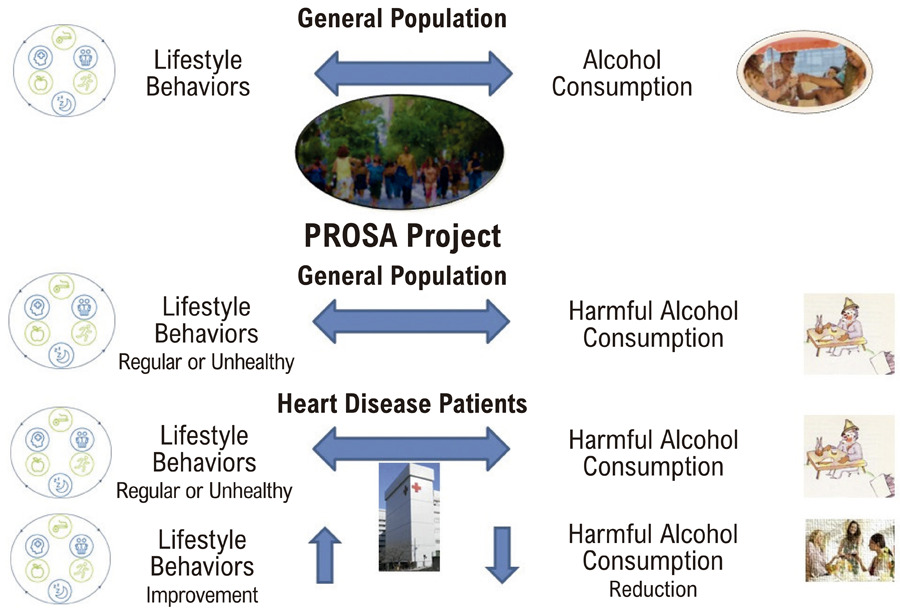
Moderate alcohol intake appears to have a protective cardiovascular effect, whereas harmful alcohol consumption (HAC) is associated with a high rate of chronic diseases and mortality. The amount of alcohol intake has been associated with lifestyle behaviors; however, this relationship has not been assessed in patients with heart disease (HD).

Objective

To evaluate the association between lifestyle behavior and HAC in HD patients.

Methods

This is an observational study that included one group of patients with HD and one group of volunteers designed to assess the association of HAC with lifestyle behavior using a score of lifestyle behavior (the LBS score). We assessed alcohol consumption using the AUDIT-C test. LBS was developed by assigning 1 point to each variable – smoking; overweight or obese (body mass index ≥24.9); anxiety; depression and lack of physical activity, and classified into healthy (0/1 point), regular (2/3 points), or unhealthy (4/5 points). Statistical analysis adopted as a significance level p-value <0.05.

Results

The study included 1,999 patients with HD and 2,081 volunteers. Regression analysis controlled for age and sex, revealed that regular and unhealthy LBS are independent predictors of HAC (OR= 1.35, p=0.04 and OR= 1.76, p=0.001, respectively) in HD patients, similar as volunteers. Good discrimination capability of the regression model was reported in the temporal validation (ROC 0.80). Furthermore, LBS improvements were associated with HAC reductions (p=0.02).

Conclusions

This study showed that risk assessment for HAC using a new lifestyle score is a reliable predictor in HD patients. Also, it was observed that improving lifestyle behavior may help to reduce HAC.

  • Alcohol Consumption
  • Heart Diseases
  • Life Style
Read Full Article
Creative Commons Attribution (CC BY) Creative Commons license
07/11/2025 DOI: 10.36660/abc.20240744i Views 1
Lifestyle and Hypertension in Brazil and Spain
IJCS
Original Article

Lifestyle and Hypertension in Brazil and Spain

Giovanna Lucieri Alonso Costa et al. Jurema Correa Mota Marina Ururahy Soriano de Sousa Flavio Kapczinski … Jose Cervera-Martínez Vicent Balanzá-Martínez Raquel B. De Boni

Abstract

Background:

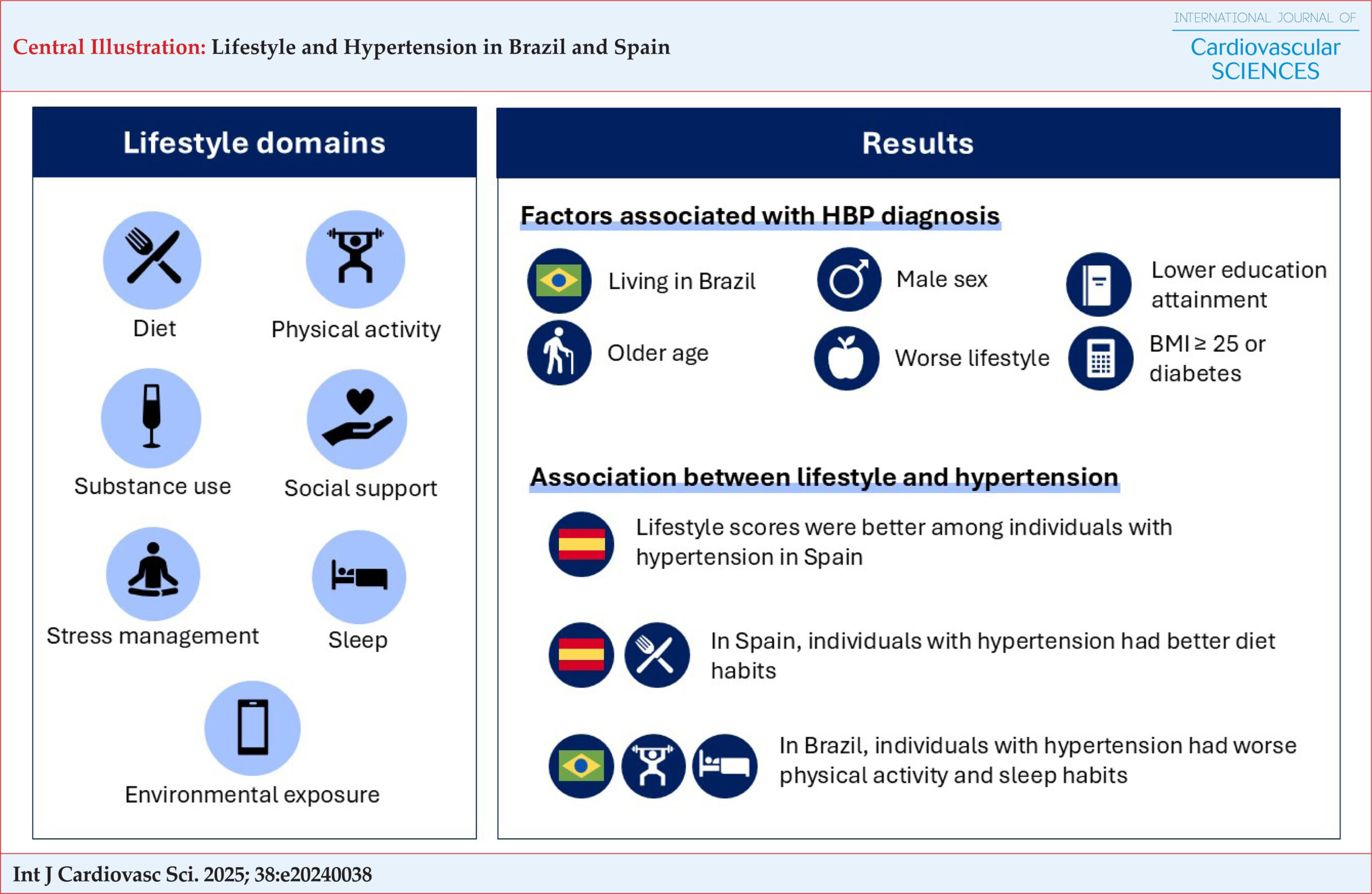
Hypertension is the main risk factor for cardiovascular mortality worldwide. Lifestyle medicine (LM) assesses health through seven domains (diet, physical activity, substance use, sleep, social support, stress management, and environmental exposure), which also include risk factors for hypertension.

Purpose:

To evaluate the association between lifestyle and hypertension in Brazil and Spain.

Methods:

Secondary analysis of data from two web surveys conducted in 2020 in Brazil and Spain, which assessed lifestyle through a multidimensional scale. We enrolled 5224 individuals of both genders, aged > 18 years, living in Brazil and Spain, and with Internet access. The main outcome was a self-reported hypertension diagnosis. We calculated the absolute and relative frequency of the independent variables and evaluated the factors associated with hypertension in logistic regression models.

Results:

76.2% of participants were women, 57.9% were > 42 years old, and 66.9% had finished higher education. Over the last 12 months, 19.6% of Brazilians and 9.2% of Spanish reported diagnosis/treatment of hypertension. Male and older groups living in Brazil, with lower education and worse lifestyles, were more likely to report hypertension. General lifestyle score was not associated with hypertension in Brazil, while hypertensive individuals had better scores in Spain (p < 0.001). Hypertensive individuals had worse lifestyle scores in physical activity (p < 0.05) and sleep (p < 0.05) in Brazil and better diet scores in Spain (p < 0.001). Environmental exposure was better among hypertensive individuals in both countries (p < 0.001). Our results point to cultural and socioeconomic differences between both countries.

Conclusion:

LM is an important strategy for the prevention/treatment of chronic diseases such as hypertension

  • COVID-19
  • Diet
  • Hypertension
  • Life Style
Read Full Article
Creative Commons Attribution (CC BY) Creative Commons license
24/03/2025 DOI: 10.36660/ijcs.20240038 Views 2
The Six Pillars of Lifestyle Medicine in Managing Noncommunicable Diseases – The Gaps in Current Guidelines
ABC
Review Article

The Six Pillars of Lifestyle Medicine in Managing Noncommunicable Diseases – The Gaps in Current Guidelines

Rafaella Rogatto de Faria et al. Sergio Freitas de Siqueira Francisco Aguerre Haddad Gustavo Del Monte Silva … Caio Vitale Spaggiari Martino Martinelli Filho

Abstract

Background:

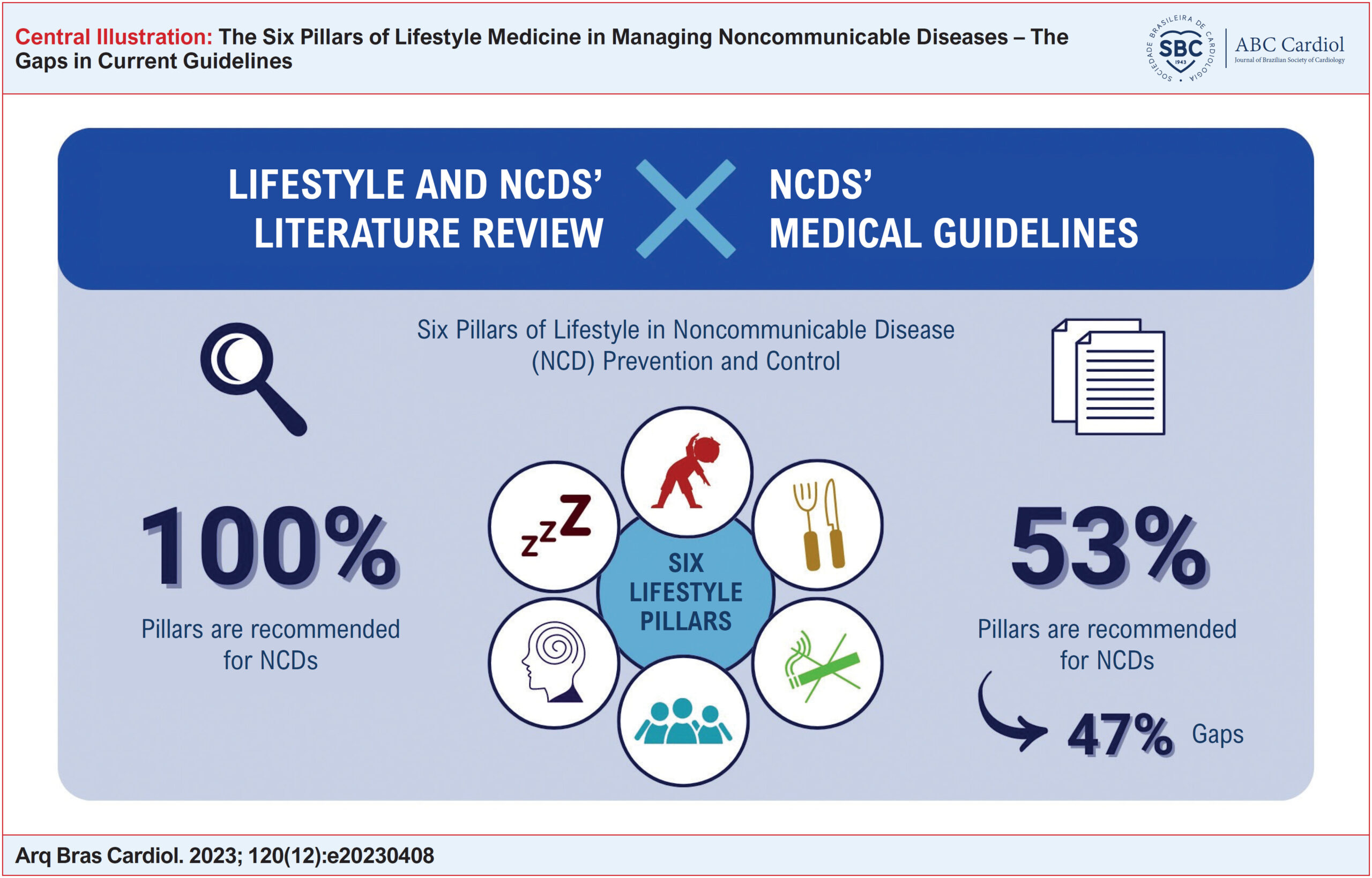
Noncommunicable diseases (NCDs), also known as chronic diseases that are long-lasting, are considered the major cause of death and disability worldwide, and the six pillars of lifestyle medicine (nutrition, exercise, toxic control, stress management, restorative sleep, and social connection) play an important role in a holistic management of their prevention and treatment. In addition, medical guidelines are the most accepted documents with recommendations to manage NCDs.

Objective:

The present study aims to analyze the lack of lifestyle pillars concerning the major Brazilian medical guidelines for NCDs and identify evidence in the literature that could justify their inclusion in the documents.

Method:

Brazilian guidelines were selected according to the most relevant causes of death in Brazil, given by the Mortality Information System, published by the Brazilian Ministry of Health in 2019. Journals were screened in the PUBMED library according to the disease and non-mentioned pillars of lifestyle.

Results:

Relevant causes of deaths in Brazil are acute myocardial infarction (AMI), diabetes mellitus (DM), and chronic obstructive pulmonary diseases (COPD). Six guidelines related to these NCDs were identified, and all address aspects of lifestyle, but only one, regarding cardiovascular prevention, highlights all six pillars. Despite this, a literature search involving over 50 articles showed that there is evidence that all the pillars can help control each of these NCDs.

Conclusion:

Rarely are the six pillars of lifestyle contemplated in Brazilian guidelines for AMI, DM, and COPD. The literature review identified evidence of all lifestyle pillars to offer a holistic approach for the management and prevention of NCDs.

  • Holistic Health
  • Life Style
  • Noncommunicable Diseases
  • Practice Guideline
Read Full Article
Creative Commons Attribution (CC BY) Creative Commons license
08/01/2024 DOI: 10.36660/abc.20230408 Views 1
ABC
Editorial

Can Intermittent Fasting Associated with a Low-Carb Diet Prevent Cardiovascular Disease in Pre-Diabetics?

Luciana Nicolau Aranha

Pre-diabetes is the term used to describe individuals who have altered glucose metabolism but do not meet the diagnostic criteria for diabetes. People with pre-diabetes have an increased risk of type 2 diabetes mellitus (DM2), cardiovascular disease (CVD), and all-cause mortality.,

Lifestyle changes, including diet and regular physical activity, are effective in preventing diabetes and CVD. Some nutritional approaches have been used to promote weight loss and glycemic control. Intermittent fasting is a dietary practice restricting calorie consumption during a controlled period, followed by ad libitum caloric consumption. A carbohydrate-restricted diet, known as low-carb, is characterized by carbohydrate intake below the lower limit of an acceptable macronutrient distribution range for healthy adults (i.e., < 45% of energy intake).

[…]

  • Caloric Restriction
  • Diet Low-Carbohydrate
  • Exercise
  • Fasting
  • Life Style
  • Physical activity
  • Prediabetic State
Read Full Article
Creative Commons Attribution (CC BY) Creative Commons license
01/05/2023 DOI: 10.36660/abc.20230182 Views 2
ABC
Editorial

The Influence of Obesity and Physical Activity on Cardiovascular Risk

Claudio Leinig Pereira da Cunha

Atherosclerotic cardiovascular disease (ACVD) is common in the general population, affecting most adults over 60 years of age. The disease includes four main areas: (1) Coronary heart disease, (2) Cerebrovascular disease, (3) Peripheral arterial disease, and (4) Aortic atherosclerosis with aneurysms. The conditions traditionally associated with the installation of ACVD (the so-called “risk factors”) are dyslipidemia, diabetes mellitus, arterial hypertension, smoking, obesity, sedentary lifestyle and a family history of ACVD. Atherosclerotic vascular changes may begin in childhood, setting the stage for cardiovascular events in adulthood. Tornquist et al. present in this issue of Arquivos Brasileiros de Cardiologia some aspects of obesity and cardiorespiratory fitness in relation to cardiometabolic risk in children.

Obesity is a public health problem that has expanded worldwide. According to a report by the World Health Organization in 2016, obesity has tripled since 1980. The prevalence of obesity and overweight also increased among young people, from 16% in 1980 to 23% in 2013.

[…]

  • Cardiovascular Diseases
  • diabetes
  • Dyslipidemias
  • Life Style
  • Obesity
  • Risk Factors
  • Sedentarism, Peripheral Artery Disease
Read Full Article
Creative Commons Attribution (CC BY) Creative Commons license
05/08/2022 DOI: 10.36660/abc.20220381 Views 1
ABC
Editorial

Much More Than Just Women: Wonder Women

Marcia Koike et al. Luciana Aikawa

The impact of the SARS-Cov2 pandemic hit the world quickly and overwhelmingly and highlighted the heroes of the white cover: healthcare professionals. It took more than two years of uninterrupted work, facing various challenges and external and internal conflicts to preserve the patient’s life, colleagues, their families and themselves. A complicated scenario, not only due to the overload of professional demand but also the scientific lack of knowledge of what we were facing. Scientists worldwide have joined forces to disseminate scientific evidence, and, at the same time, medical societies have mobilized to optimize care procedures with protection for active professionals.

Stress and Burnout syndrome are part of occupational diseases in health professionals. However, the particular scenario of Covid-19 has shown that although it is not easy to be on the front lines in the fight against SARS-CoV2, nurses and doctors demonstrated high stress and exhaustion in studies, so behavioral/collective strategies can help.– This mini-editorial is dedicated to female doctors.

[…]

  • Betacoronavirus
  • COVID-19
  • Efficiency
  • Epidemiology
  • Health Occupations
  • Life Style
  • Medical Profissional
  • Medicals
  • Pandemics
  • Professional Practice
  • SARS-CoV2
  • Staff Development/ethics
  • Women/psychology
Read Full Article
Creative Commons Attribution (CC BY) Creative Commons license
05/08/2022 DOI: 10.36660/abc.20220443 Views 1
IJCS
Editorial

Is Patient Education about the Benefits of Physical Activity a Good Adjunct Treatment Strategy in Hypertension?

Dário C. Sobral Filho et al. Maria de Fátima Monteiro

Systemic arterial hypertension (SAH) is a chronic condition that is highly prevalent worldwide. It occurs without symptoms in most individuals and represents the main modifiable risk factor for cardiovascular disease. The adoption of behaviors that do not involve medication, such as changes in lifestyle and regular practice of physical exercise, along with strict adherence to prescribed medication, is a major challenge in the treatment of this disorder.,

The guidelines of the American Heart Association and the American College of Cardiology on hypertension recommend the implementation of lifestyle changes as the first line of treatment for low- to moderate-risk groups, thereby emphasizing the importance of such measures.

[…]

  • Antihipertensive Drugs
  • Cardiovascular Diseases
  • Exercise, Blood Pressure
  • Hypertension
  • Life Style
  • Overweight
  • Physical activity
  • Risk Factors
Read Full Article
Creative Commons Attribution (CC BY) Creative Commons license
13/07/2022 DOI: 10.36660/ijcs.20210257 Views 1
ABC
Editorial

NYHA Classification and Cardiopulmonary Exercise Test Variables in Patients with Heart Failure

Ricardo Vivacqua Cardoso Costa

Heart failure (HF) is considered a prevalent disease, limiting survival and constituting one of the leading causes of hospitalization or death in several countries, including Brazil. Therefore, clinical classification in patients with HF can be considered important as an initial reference, as it informs the functional condition of these patients. Classically, the subjective classification of the New York Heart Association (NYHA) and the objective classification of Weber are the most used. The NYHA functional classification and oxygen consumption at peak exertion were decisive in determining the functional condition of patients with Chagas disease. However, certain patients with minor symptoms are at high risk of hospitalization or death.

In patients with HF, the 6-minute walk test is also considered in assessing functional and prognostic capacity. This test has a predictive value for mortality in patients with HF functional class II and III (NYHA).

[…]

  • Exercise Test
  • Heart Failure
  • Hospitalization
  • Life Style
  • Mortality
  • Oxygen Consumption
  • Physical activity
  • Walk Test
Read Full Article
Creative Commons Attribution (CC BY) Creative Commons license
10/06/2022 DOI: 10.36660/abc.20220196 Views 2
ABC
Editorial

Himalayan Salt and Table Salt Intake among Hypertensive Individuals

Mariana de Souza Dorna et al. Marcos Mitsuo Seki

With the involvement of approximately 30% of the Brazilian population, arterial hypertension is listed as one of the main causes of cardiovascular disease. The current WHO recommendation for sodium intake is < 2g/person/day, or 5g salt/person/day. However, it is already known that the salt intake pattern of the Brazilian population reaches up to 12g/day. Although the increase in blood pressure has a multifactorial etiology, excessive sodium intake is among the main causes. ,

This element has important physiological functions such as regulation of extracellular volume, nerve conduction and muscle function. There is little disagreement in the literature about the benefits of reducing sodium intake for the hypertensive population. A strategy widely addressed by social media and in print was the adoption of Himalayan Salt for being rich in iron, zinc, calcium, magnesium and potassium and its supposed benefits over table salt in pressure control on hypertensive patients. – In this context, Loyola IP et al. evaluated the impact of table salt and Himalayan salt intake on blood pressure parameters and urinary sodium concentration in hypertensive individuals.

[…]

  • Hypertension
  • Life Style
  • Physical activity
  • Risk Factors
  • Salt Intake
  • Sodium Chloride, Dietary
  • Urinalysis/methods
Read Full Article
Creative Commons Attribution (CC BY) Creative Commons license
13/05/2022 DOI: 10.36660/abc.20220243 Views 1
ABC
Editorial

Chronological Age or Biological Age, Mainly a Matter of Lifestyle

Paulo César B. Veiga Jardim et al. Thiago de Souza Veiga Jardim

Despite the significant global socioeconomic disparities, the world’s population has grown exponentially, and the average life continues to increase significantly.–

If at the beginning of the 19th century, life expectancy in Europe was around 35 years, at present, only the African continent has populations with an average life expectancy of fewer than 60 years.–

[…]

  • Aged
  • body mass index
  • Genetics
  • Healthy Aging
  • Life Style
  • Obesity
  • Sedentarism
  • Spirituality
  • Stress
  • Vascular Stiffness
Read Full Article
Creative Commons Attribution (CC BY) Creative Commons license
20/09/2021 DOI: 10.36660/abc.20210732
IJCS
Original Article

Better Adequacy of Food Intake According to Dietary Recommendations of National Cholesterol Education Program in Vegetarian Compared to Omnivorous Men

Luiza Antoniazzi et al. Julio Acosta-Navarro Adriana Midori Oki Maria Carlos Bonfim Maria Cristina Almeida Gaspar

Abstract

Background

The lower frequency of cardiovascular (CV) risk factors observed in vegetarians compared to omnivores may be due to more appropriate nutrient intake according to recommendations for the prevention of cardiovascular diseases.

Objective

To compare the dietary adequacy according to the recommendations of the National Cholesterol Education Program (NCEP) in apparently healthy vegetarian (VEG) and omnivorous (OMN) men.

Methods

This was a cross-sectional study, conducted with apparently healthy men (44 omnivorous and 44 vegetarians, ≥ 35 years), who were assessed for daily food consumption, anthropometric data, physical exercise status, and clinical data. Multiple logistic regression was used to test the association between the type of diet and the dietary adequacy. Significant values were considered for p<0.05.

Results

Several clinical CV risk markers were significantly lower in VEG when compared to OMN: body mass index (BMI) (23.1 vs. 27.3 kg/m2), systolic blood pressure (119.5 vs. 129.2 mmHg), and diastolic blood pressure (75.7 vs. 83.9 mmHg). VEG presented significant lower values of blood lipids and glucose. No significant difference was observed in caloric intake; however, VEG consumed significantly more carbohydrates, dietary fibers, and polyunsaturated fats. VEG presented an adequate consumption of dietary cholesterol and saturated and polyunsaturated fatty acids, regardless of caloric intake and age.

Conclusion

VEG were more likely to consume saturated fatty acids, dietary cholesterol, and fibers according to the recommendations of NCEP, factors that may contribute to lower levels of CV risk markers than OMN.

  • Cardiovascular Diseases
  • Life Style
  • Lipids
  • Risk Factors
  • Vegetarian diet
Read Full Article
Creative Commons Attribution (CC BY) Creative Commons license
03/09/2021 DOI: 10.36660/ijcs.20200258 Views 1
ABC
Original Article

Recent Trends in Cardiovascular Mortality in Rio de Janeiro State Health Regions and Capital

Maria Luiza Garcia Rosa et al. Claudio Tinoco Mesquita Lucas Zanetti de Albuquerque Willian Douglas de Souza Silva … Vinicius de Padua Vieira Alves Roger Freitas Ramirez Jordan Ricardo Cardoso de Matos Ana Luisa Guedes de França e Silva Erito Marques de Souza Filho

Abstract

Background:

Cardiovascular disease (CVD) mortality, after several decades of decrease, has shown a tendency towards the stabilization in some countries, including Brazil and Rio de Janeiro state. This new tendency was not further analyzed by gender, age group and region of the Rio de Janeiro state.

Objective:

To analyze the trends of premature and late mortality from CVD, ischemic heart disease (IHD) and cerebrovascular disease (CBVD) by gender in the city of Rio de Janeiro (capital) and the health regions of Rio de Janeiro state (from 1996 to 2016.

Methods:

Data on deaths and the population were obtained from DATASUS/MS. The rates were compensated by ill-defined codes, corrected by Ill-Defined Cardiovascular codes and gender and age-adjusted by the direct method (reference population – population of the state of Rio de Janeiro – 2000 census). The Joinpoint Trend Analysis Software was employed.

Results:

IHD mortality stabilized or even increased for at least 50% of the analyzed areas (EAPC≥0). No change was observed. in the “North” and “Northwest” regions For CBVD, just one region showed stability regarding mortality (EAPC close to 0). For the other regions, the rate continued to decrease (APC<0) until 2016.

Conclusion:

These results observed in Rio de Janeiro are possibly appropriate to various Brazilian regions and demonstrate that a serious public health response is needed to address lifestyle behaviors. Primary care physicians should also be familiar with the unfavorable tendency in coronary heart disease among younger adults in recent years and actively screen for risk factors for cardiovascular disease, paying special attention to women.

  • Cardiovascular Diseases/prevention and control
  • Cerebrovascular Diseases/prevention and control
  • Disease Prevention
  • Epidemiology
  • Life Style
  • Risk Factors
Read Full Article
Creative Commons Attribution (CC BY) Creative Commons license
16/04/2021 DOI: 10.36660/abc.20190742 Views 1
Figure 1
ABC
Original Article

Cardiovascular Risk Factors in Cardiology Specialists from the Brazilian Society of Cardiology

Maria Emília Figueiredo Teixeira et al. Priscila Valverde de O. Vitorino Celso Amodeo Tânia Martinez … Andréa Araujo Brandão Eduardo Costa Duarte Barbosa Audes Diógenes Magalhães Feitosa Paulo Cesar B. Veiga Jardim Ana Luiza Lima Souza Weimar Kunz Sebba Barroso

Abstract

Background:

A major cause of death worldwide, cardiovascular diseases and their prevalence in cardiologists are little known.

Objectives:

To describe life habits and cardiovascular risk factors (CVRF) and to investigate the prevalence of diagnosis, awareness, and control of these CVRF among cardiologists members affiliated to and specialists from the Brazilian Society of Cardiology.

Methods:

National multicenter cross-sectional study to assess Brazilian cardiologists using a questionnaire on life habits, preexisting diseases, current medications, anthropometric measurements, blood pressure, and levels of glucose and lipids.

Results:

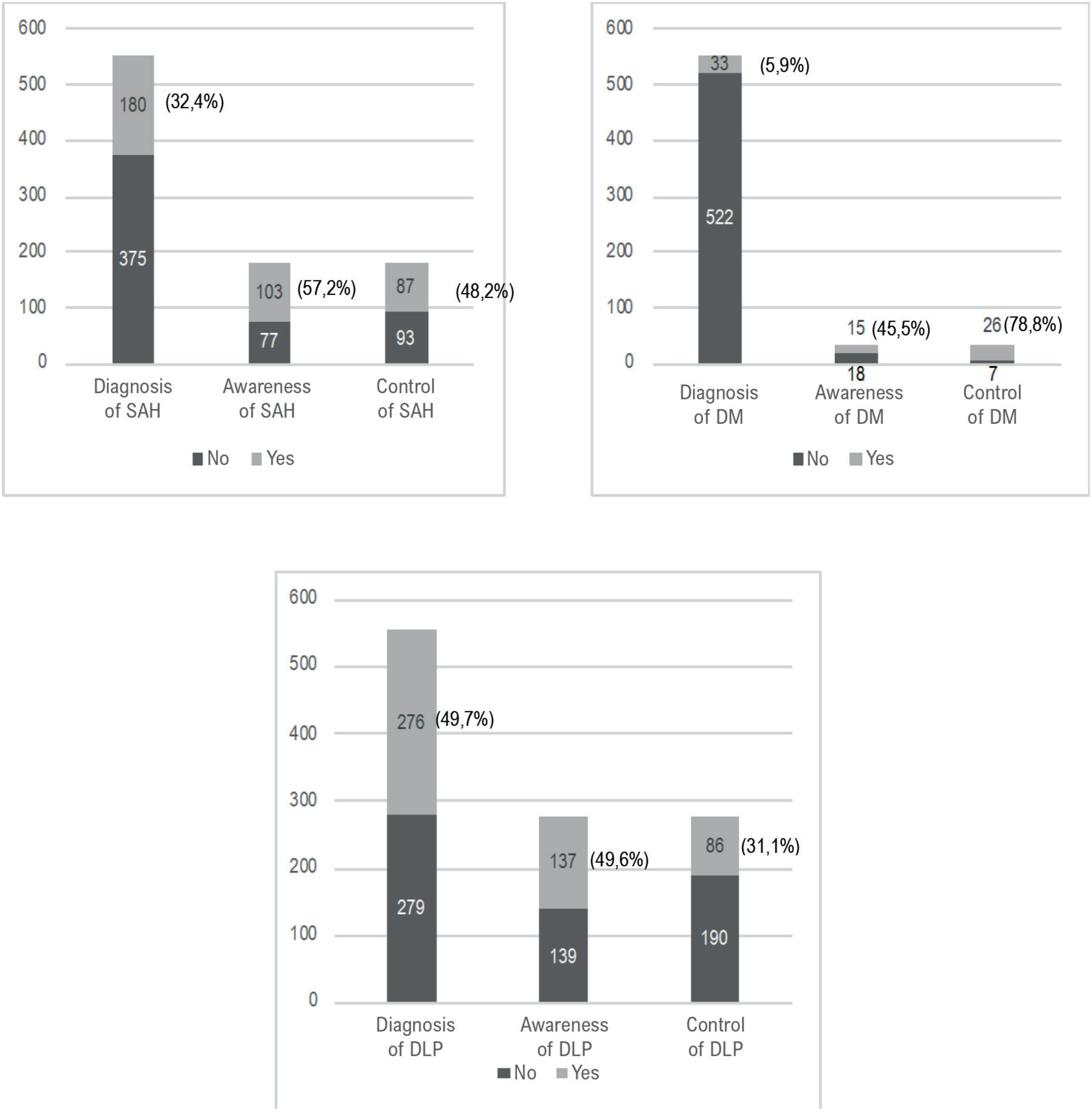
A total of 555 cardiologists were evaluated, of which 67.9% were male, with a mean age of 47.2±11.7 years. Most were non-smoker (88.7%) and physically active (77.1%), consumed alcohol (78.2%), had normal weight circumference (51.7%), and were overweight (56.1%). The prevalence of systemic arterial hypertension (SAH), diabetes mellitus (DM), and dyslipidemia (DLP) were 32.4%, 5.9%, and 49.7%, respectively, of which only 57.2%, 45.5%, and 49.6%, respectively, were aware of the diseases.

Conclusions:

The Brazilian cardiologists participating in the study had a high prevalence of SAH, DM and DLP, but only a half of participants were aware of these conditions and, among these, the rates of controlled disease were low for SAH and DLP, although cardiologists are professionals with great knowledge about these CVRF. These findings represent a warning sign for the approach of CVRF in Brazilian cardiologists and encourage the conduction of future studies.

  • antropometry
  • Cardiologists
  • Cardiovascular Diseases
  • Diabetes Mellitus
  • Dsylipidemias
  • Hypertension
  • Life Style
  • Risk Factors
Read Full Article
Creative Commons Attribution (CC BY) Creative Commons license
16/04/2021 DOI: 10.36660/abc.20200125
ABC
Editorial

Lifestyle in the Very Elderly Matters

Fernando H. Y. Cesena

According to the estimates and projections of the 2019 Revision of World Population Prospects, life expectancy will continue to rise in the following 30 years worldwide, the percentage of the population aged 65 years or over will jump from 9% in 2020 to 16% in 2050, and the number of persons aged 80 years or over will triple up to 2050.

The biology of aging and implicated genes has been studied for a long time as a basis for the search for therapies that may mitigate age-related processes, such as dementia and cardiovascular disease. Among the multitude of aspects that have been explored, the research involving apolipoprotein E (apoE) assumes particular relevance. ApoE is a 299-amino acid protein mainly synthesized by the hepatocytes. Like any other apolipoprotein, apoE is a constituent of lipoproteins and, therefore, has a role in lipid metabolism. In the plasma, apoE is primarily carried by triglyceride-rich lipoproteins and mediates the clearance of their remnants by the low-density lipoprotein receptor. In the brain, in situ produced apoE acts on the redistribution of lipids to neurons, as well as in the clearance of β-amyloid, much known for its association with Alzheimer disease.,

[…]

  • aging
  • Apolipoproteins E
  • Life Style
Read Full Article
Creative Commons Attribution (CC BY) Creative Commons license
07/12/2020 DOI: 10.36660/abc.20200586 Views 1
Figure 1
ABC
Original Article

Blood Pressure Control and Associated Factors in a Real-World Team-Based Care Center

Thiago Veiga Jardim et al. Ana Luiza Lima Souza Weimar Kunz Sebba Barroso Paulo Cesar B. Veiga Jardim

Abstract

Background

Although team-based care is recommended for patients with hypertension, results of this intervention in a real-world setting are missing in the literature.

Objective

To report the results of a real-world long-term team-based care for hypertensive patients we conducted this study.

Methods

Data of hypertensive patients attending a multidisciplinary treatment center located in the Midwest region of Brazil in June 2017 with at least two follow-up visits were retrospectively assessed. Anthropometric, blood pressure (BP), follow-up time, pharmacological treatment, diabetes and lifestyle data were collected from the last visit to the service. BP values < 140 x 90 mmHg in non-diabetics and < 130 x 80 mmHg in diabetics were considered controlled. A logistic regression model was built to identify variables independently associated to BP control. Significance level adopted p < 0.05.

Results

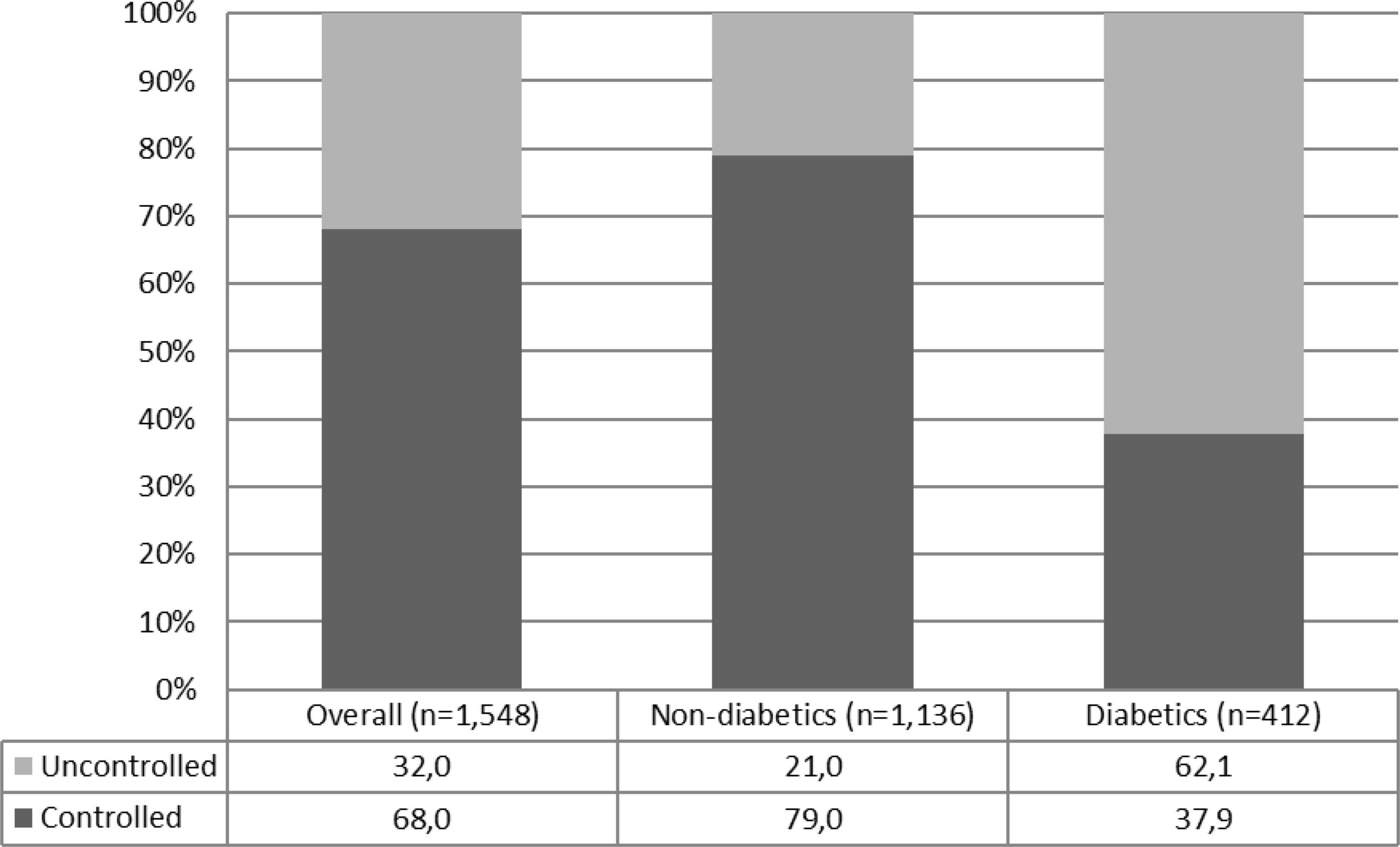
A total of 1,548 patients were included, with a mean follow-up time of 7.6 ± 7.1 years. Most patients were female (73.6%; n=1,139) with a mean age of 61.8 ±12.8 years. BP control rates in all the sample, and in non-diabetics and diabetics were 68%, 79%, and 37.9%, respectively. Diabetes was inversely associated with BP control (OR 0.16; 95%CI 0.12-0.20; p<0.001) while age ≥ 60 years (OR 1.48; 95%CI 1.15-1.91; p=0.003) and female sex (OR 1.38; 95%CI 1.05-1.82; p=0.020) were directly associated.

Conclusions

A BP control rate around 70% was found in patients attending a multidisciplinary team care center for hypertension. Focus on patients with diabetes, younger than 60 years and males should be given to further improve these results. (Arq Bras Cardiol. 2020; 115(2):174-181)

  • Blood Pressure/prevention and control
  • Exercise
  • Hypertension
  • Life Style
  • Obesity
  • Sedentarism
  • Treatment Adherence and Compliance
Read Full Article
Creative Commons Attribution (CC BY) Creative Commons license
28/08/2020 DOI: 10.36660/abc.20180384 Views 1
Figure 1
ABC
Viewpoint

Pharmacological Treatment of Hypertension: From the Golden Trio to the Octet

Audes Diógenes Magalhães Feitosa et al. Marco Mota-Gomes Oswaldo Passarelli Júnior Weimar Kunz Sebba Barroso … Roberto Dischinger Miranda Eduardo Costa Duarte Barbosa Andrea A. Brandão Wilson Nadruz

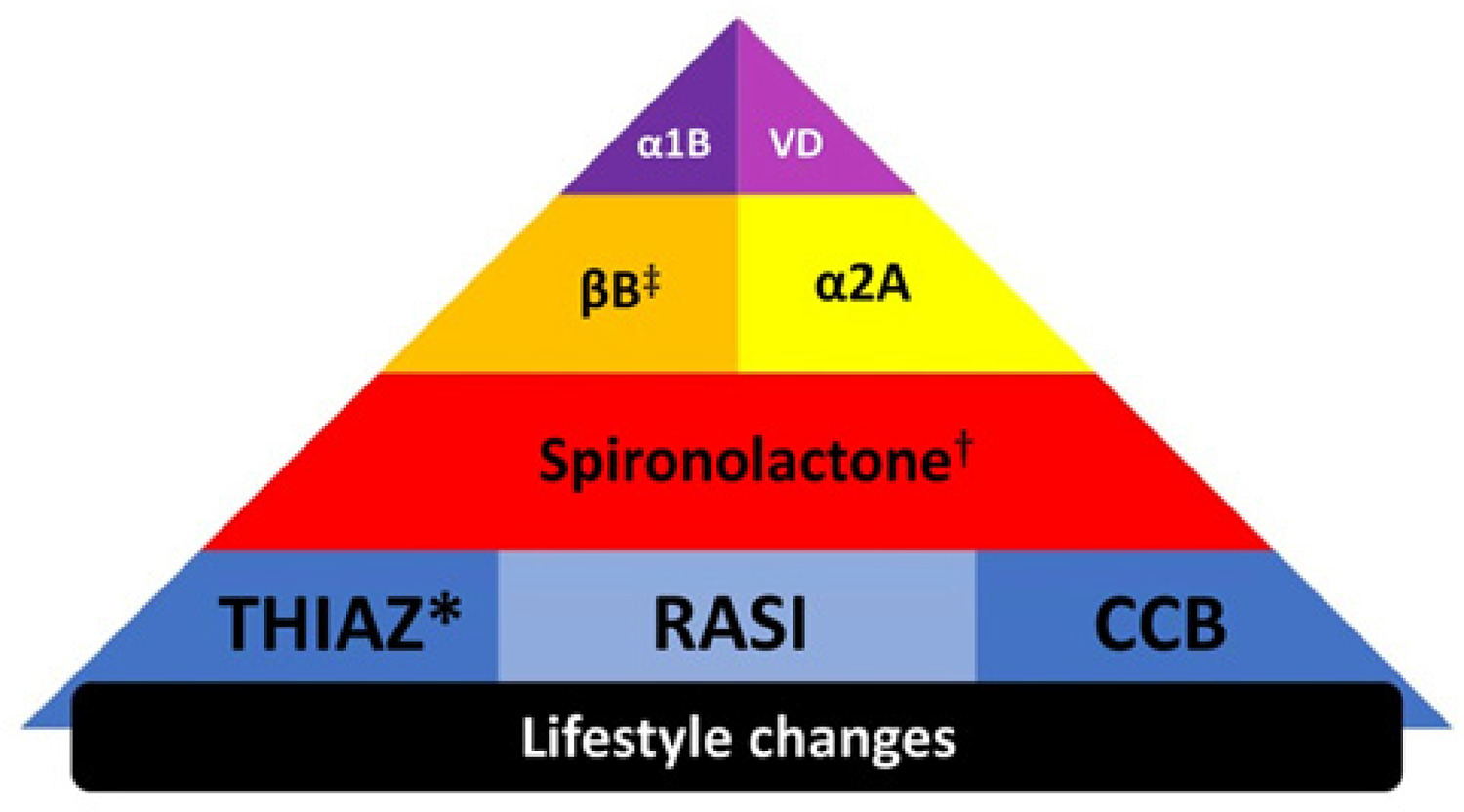
The treatment of hypertension comprises numerous pharmacological options, which may hinder patient management standardization, thus contributing to therapeutic failure. However, in more recent years, several studies and guidelines from diverse hypertension and cardiology societies have suggested preferential pharmacological classes to treat hypertension. – Based on this evidence, the present report aims to propose a simple and practical pharmacological treatment algorithm that can be applied to patients ranging from stage 1 to refractory hypertension cases ( ).

[…]

  • antihypertensive agents
  • Drug Therapy
  • Exercise
  • Hypertension
  • Life Style
  • medication adherence
  • Weight Loss
Read Full Article
Creative Commons Attribution (CC BY) Creative Commons license
28/08/2020 DOI: 10.36660/abc.20190780 Views 1
ABC
Editorial

High-intensity Interval Training versus Continuous Exercise: Is There a Difference Regarding the Magnitude of Blood Pressure Reduction?

Filipe Ferrari et al. Vítor Magnus Martins

Short Editorial related to the article Acute Effect of Interval vs. Continuous Exercise on Blood Pressure: Systematic Review and Meta-Analysis

Systemic arterial hypertension (SAH) is strongly associated with adverse cardiovascular events, including heart failure, ischemic heart disease and cerebrovascular diseases.With a high prevalence worldwide, SAH is commonly associated with risk factors such as family history, obesity, high sodium intake and physical inactivity. Therefore, it is estimated that countries such as the United States and England have 1/3 of hypertensive individuals.In Brazil, specifically in 2016, a prevalence rate > 32% of SAH (36 million) was reported in adult individuals, being > 60% in the elderly. SAH contributed, directly or indirectly, to 50% of deaths from cardiovascular diseases.

[…]

  • Arterial Pressure
  • Exercise
  • Exercise Therapy
  • Heart Failure
  • Hypertension
  • Life Style
  • Post-Exercise Hypotension
  • Risk Factors
Read Full Article
Creative Commons Attribution (CC BY) Creative Commons license
07/08/2020 DOI: 10.36660/abc.20200261 Views 1
IJCS
Editorial

Are we Improving Adherence to Cardiovascular Guidelines?

Luciana Nicolau Aranha et al. Gláucia Maria Moraes de Oliveira

Chronic noncommunicable diseases (NCDs) comprise the world’s leading group of causes of death, accounting for premature deaths, loss of quality of life, and adverse economic and social impacts. They represent about 70% of global deaths, close to 38 million deaths annually, significantly exceeding deaths from external causes and infectious diseases, such as COVID-19. Almost 45% of the deaths, more than 17 million, occur as a result of cardiovascular disease (CVD). The same happens in Brazil, where 72% of the deaths are due to NCDs, and about 30%, to CVD.

Dyslipidemia is a significant risk factor for CVD, particularly coronary artery disease (CAD) and stroke. Prospective and long-term epidemiological studies have shown that individuals with healthier lifestyles and fewer risk factors for CAD could improve their life expectancy by decreasing cardiovascular morbidity and mortality. The Framingham Offspring Study, which followed 3501 participants from 1987 to 2011, has demonstrated that low levels of high-density lipoprotein (HDL) or high levels of low-density lipoprotein (LDL) and triglycerides, alone or in any combination, are associated with increased risk for CVDs. Therefore, intervention measures are necessary to reduce morbidity and mortality, as well as the cost of hospitalization due to those diseases. In addition, improving the quality of life and health of the population is essential.

[…]

  • Cardiovascular Diseases/complications, Mortality
  • Cardiovascular Diseases/prevention and control
  • COVID-19
  • Dyslipidemias
  • Hydroxymethylglutaryl-CoA Reductase Inhibition/therapeutic use
  • Life Style
  • Patient Compliance
  • Tabagism
  • Triglycerides
Read Full Article
Creative Commons Attribution (CC BY) Creative Commons license
31/07/2020 DOI: 10.36660/ijcs.20200131 Views 1
ABC
Original Article

Hypertension in Workers: The Role of Physical Activity and its Different Dimensions

Uelito Everaldo Souza Ribeiro Junior et al. Rita de Cassia Pereira Fernandes

Abstract

Background

Physical activity, each type in its own manner, whether occupational, domestic or leisure, can play a significant role regarding high blood pressure (HBP). However, practicing physical activity only at leisure time, or in specific situations, can be insufficient to achieve the effective control of HBP.

Objective

To analyze the isolated and cumulative effect of different types of physical activity and the prevalence of HBP among workers.

Methods

A cross-sectional study with 1,070 Urban Cleaning and Footwear Industry workers in Bahia, who answered a survey, conducted by an interviewer on sociodemographic, occupational, lifestyle and hypertensive morbidity aspects. Weight, height, waist circumference and blood pressure were measured. Case of HBP: Systolic blood pressure ≥140 or diastolic blood pressure ≥90, or regular treatment for HBP. The occupational, domestic and leisure aspects of Physical Activity were studied. A multivariate analysis with Cox Regression was performed for cross-sectional studies.

Results

The prevalence of HBP was 24%, being 37% among workers aged between 35-44 years, and 51% among workers aged between 45-54 years. The multivariate model showed that workers who were active in one form of physical activity only or no forms had 62% higher BP levels and that these levels were 25% higher among workers who were active in two out of three physical activity forms. Being a male, being older (> 31 years old) and being overweight were characteristics associated with HBP, with prevalence ratios of 1.62, 2.10 and 2.26, respectively.

Conclusions

There was a cumulative effect of the form of physical activity on the occurrence of HBP. Classifying active subjects at work or at home as inactive persons by relying only on the leisure form can lead to methodological errors. (Arq Bras Cardiol. 2020; 114(5):755-761)

  • Anthropometry
  • Hypertension
  • Life Style
  • Motor Activity
  • Physical Exerton
  • Socioeconomic Factors
  • Urban Cleaning Service
  • Work
  • Workers
Read Full Article
Creative Commons Attribution (CC BY) Creative Commons license
01/06/2020 DOI: 10.36660/abc.20190065 Views 1
IJCS
Editorial

The Importance of Cardiovascular Risk in Primary Healthcare

Erika Maria Gonçalves Campana et al. Rafael Santos Costa

Cardiovascular Diseases (CVDs) are the leading cause of death in Brazil and worldwide, determining increased morbidity and disability-adjusted life years. The implementation of health policies, among them, encouraging healthy lifestyle habits and providing access to primary and secondary CVD prevention measures, associated with the treatment of cardiovascular (CV) events are essential to control CVD in all countries, including Brazil.

Arterial hypertension (AH) has a high prevalence in Brazil. It varies according with the population studied and the assessment method used. It is often associated with metabolic disorders, functional and/or structural changes in target organs, being worsened by the presence of other risk factors (RF), such as dyslipidemia, abdominal obesity, glucose intolerance and diabetes mellitus (DM).

[…]

  • Cardiovascular Diseases, mortality
  • Cardiovascular Diseases/prevention and control
  • Hypertension
  • Life Style
  • Obesity
  • Risk Factors
  • Treatment Adherence
Read Full Article
Creative Commons Attribution (CC BY) Creative Commons license
29/05/2020 DOI: 10.36660/ijcs.20200074 Views 2
ABC
Viewpoint

Physical Exercise in Patients with Heart Disease and in the General Population in Times of Coronavirus

Ricardo Stein

I will begin this text without speaking about exercise. I want to emphasize that individuals with chronic diseases, such as hypertension, heart failure, different types of myocardiopathy, and some forms of arrhythmia are at an increased risk of fatal outcomes after contracting SARS-COV-2 and developing the infection denominated COVID-19. In the same manner, those who have undergone mechanical or surgical revascularization, individuals with prosthetic valves (whether biological or metallic), pacemakers, implanted defibrillators, or other devices, as well as those with some forms of congenital heart disease are also part of a higher risk group.

First point: The patients described above are definitely at a higher risk and they are part of the risk group regardless of age.*

[…]

  • Cardiovascular Diseases
  • Coronavirus
  • COVID-19
  • Exercise
  • Healthy Diet
  • Life Style
  • Physical activity
  • Residence
  • Risk Factors
  • Sedentarism
Read Full Article
Creative Commons Attribution (CC BY) Creative Commons license
11/05/2020 DOI: 10.36660/abc.20200281 Views 1
IJCS
Original Article

Evaluation of Cardiovascular Risk in Hypertensive Individuals Attending a Primary Health Care Center

Tiago Ricardo Moreira et al. Luana Vieira Toledo Érica Toledo Mendonça Renata Maria Colodette … Luciana Saraiva Silva Rosângela Minardi Mitre Cotta

Abstract

Background:

Cardiovascular risk (CVR) stratification has traditionally been used as a strategy for the prevention of cardiovascular diseases in asymptomatic people.

Objective:

To identify the CVR in hypertensive patients attending a primary health care center, using the Framingham risk score, and to evaluate possible associations and correlations with sociodemographic, clinical and laboratory variables not included in this score. This cross-sectional study was conducted with hypertensive patients treated in a primary health care center in Brazil (n = 166).

Methods:

Data collection, administration of questionnaires, anthropometric measurements and laboratory tests were performed from July to August 2013. Multiple linear regression was used in the analysis. A two-tailed p-value < 0.05 was considered significant.

Results:

High CVR was independently associated with male sex (B = 8.73; 95%CI: 6.27: 11.19), high serum levels of total cholesterol (B = 0.05; IC95%: 0.02: 0.08), number of drugs used (B = 0.55; 95%Ci: 0.12: 0.98) and a low glomerular filtration rate (GFR) (B = -0.11; 95%CI: -0.18 : -0.03).

Conclusion:

The results of this study reinforce the importance of continuous and longitudinal care practices directed to hypertensive patients aiming at early detection of risk factors and appropriate intervention to improve the prognosis of this population.

  • Cardiovascular Diseases, mortality
  • Hypertension
  • Life Style
  • Obesity
  • Prevention and Control
  • Risk Factors
  • Sedentarism
  • Treatment Adherence anf Compliance
Read Full Article
Creative Commons Attribution (CC BY) Creative Commons license
03/02/2020 DOI: 10.36660/ijcs.20180078 Views 1
IJCS
Original Article

Association between Central Obesity and Biochemical Markers of Cardiometabolic Risk in Elderly Attended in Geriatric Ambulatory – Lagarto/SE

Ana Caroline de Souza Almeida et al. Carolina Cunha de Oliveira Emanuelle Dias Costa Adenilda Queiroz S Deiró

Abstract

Backgroud:

Central obesity, especially visceral adipose tissue (VAT), represents a health risk due to its endocrine and metabolic capacity, contributing to the development of the atherogenic profile and strongly associating with cardiovascular morbimortality.

Objective:

To identify the association between central obesity and biochemical markers of cardiometabolic risk in elderly patients treated at a geriatric outpatient clinic in Lagarto-SE.

Method:

This is a cross-sectional study of 159 elderly people of both sexes. Central adiposity was considered an independent variable, identified by measuring the Waist Circumference (WC). Total Cholesterol (TC), LDL-c, HDL-c, non-HDL-c, triglycerides, glycemia and Castelli I and II indices were considered dependent variables. Pearson’s chi-square test was used to evaluate the association between central obesity and biochemical markers of cardiometabolic risk. Those with p < 0.20 were used in the bivariate regression analysis, adopting a 95% confidence interval.

Results:

Mean age was 70.9 ± 7.5 years. Central obesity was present in 43.2% of males and 56.8% of females (p = 0.002). There was statistically significant association between HDL-c, HDL-C and Castelli I Index and central obesity. Individuals with central obesity are 2.48 and 3.13 times more likely to develop changes in HDL-C and Castelli I index, respectively.

Conclusion:

There is an association between central obesity and biochemical markers of cardiometabolic risk in the elderly.

  • Cardiovascular Diseases
  • Diabetes Mellitus
  • Dyslipidemias
  • Elderly
  • Hypertension
  • Life Style
  • Metabolic Syndrome
  • Obesity
  • Prevention and Control
  • Risk Factors
Read Full Article
Creative Commons Attribution (CC BY) Creative Commons license
03/02/2020 DOI: 10.36660/ijcs.20190055

Could not load more articles. Please try again.

How to cite this article

EndNote RIS

Electronic Document Format (Vancouver)

Godoy PH. Alcohol Consumption and Its Association with Lifestyle in Individuals with and without Cardiovascular Disease. Arquivos Brasileiros de Cardiologia 2025;122(10):e20250542.

Electronic Document Format (ABNT)

Godoy, Paulo Henrique. Alcohol Consumption and Its Association with Lifestyle in Individuals with and without Cardiovascular Disease. Arquivos Brasileiros de Cardiologia, v. 122, n. 10, e20250542, Dec. 2025.

Electronic Document Format (APA)

Godoy, P. H. (2025). Alcohol Consumption and Its Association with Lifestyle in Individuals with and without Cardiovascular Disease. Arquivos Brasileiros de Cardiologia, 122(10), e20250542.

Electronic Document Format (ISO)

Godoy, Paulo Henrique. Alcohol Consumption and Its Association with Lifestyle in Individuals with and without Cardiovascular Disease. Arquivos Brasileiros de Cardiologia [online]. 2025, vol. 122, n. 10, [cited 2026-10-14], e20250542. Available from: <https://journals.cardiol.br/en/article/alcohol-consumption-and-its-association-with-lifestyle-in-individuals-with-and-without-cardiovascular-disease/>. ISSN 0066-782X

EndNote RIS

Electronic Document Format (Vancouver)

Martinelli-Filho M, Spaggiari CV, Baroni RV, Gomes CIG, Hueb TO, Martins SAM, Pedrosa AAA, et al. Harmful Alcohol Consumption in Patients with Heart Disease: A Risk Analysis by Lifestyle Behavior – The Brazilian PROSA Project (Projeto Saúde e Álcool). Arquivos Brasileiros de Cardiologia 2025;122(10):e20240744.

Electronic Document Format (ABNT)

Martinelli-Filho, Martino; Spaggiari, Caio Vitale; Baroni, Roberta Vanalli; Gomes, Cinthya Ibrahim Guirao; Hueb, Thiago Ovanessian; Martins, Sergio Augusto Mezzalira; Pedrosa, Anísio Alexandre Andrade; Nishioka, Silvana Angelina Dório; Siqueira, Sergio Freitas de. Harmful Alcohol Consumption in Patients with Heart Disease: A Risk Analysis by Lifestyle Behavior – The Brazilian PROSA Project (Projeto Saúde e Álcool). Arquivos Brasileiros de Cardiologia, v. 122, n. 10, e20240744, Nov. 2025.

Electronic Document Format (APA)

Martinelli-Filho, M., Spaggiari, C. V., Baroni, R. V., Gomes, C. I. G., Hueb, T. O., Martins, S. A. M., Pedrosa, A. A. A., Nishioka, S. A. D., & Siqueira, S. F. (2025). Harmful Alcohol Consumption in Patients with Heart Disease: A Risk Analysis by Lifestyle Behavior – The Brazilian PROSA Project (Projeto Saúde e Álcool). Arquivos Brasileiros de Cardiologia, 122(10), e20240744.

Electronic Document Format (ISO)

Martinelli-Filho, Martino and Spaggiari, Caio Vitale and Baroni, Roberta Vanalli and Gomes, Cinthya Ibrahim Guirao and Hueb, Thiago Ovanessian and Martins, Sergio Augusto Mezzalira and Pedrosa, Anísio Alexandre Andrade and Nishioka, Silvana Angelina Dório and Siqueira, Sergio Freitas de. Harmful Alcohol Consumption in Patients with Heart Disease: A Risk Analysis by Lifestyle Behavior – The Brazilian PROSA Project (Projeto Saúde e Álcool). Arquivos Brasileiros de Cardiologia [online]. 2025, vol. 122, n. 10, [cited 2026-10-14], e20240744. Available from: <https://journals.cardiol.br/en/article/harmful-alcohol-consumption-in-patients-with-heart-disease-a-risk-analysis-by-lifestyle-behavior-the-brazilian-prosa-project-projeto-saude-e-alcool/>. ISSN 0066-782X

EndNote RIS

Electronic Document Format (Vancouver)

Costa GLA, Mota JC, Sousa MUS, Kapczinski F, Cervera-Martínez J, Balanzá-Martínez V, Boni RBD, et al. Lifestyle and Hypertension in Brazil and Spain. International Journal of Cardiovascular Sciences 2025;38:e20240038.

Electronic Document Format (ABNT)

Costa, Giovanna Lucieri Alonso; Mota, Jurema Correa; Sousa, Marina Ururahy Soriano de; Kapczinski, Flavio; Cervera-Martínez, Jose; Balanzá-Martínez, Vicent; Boni, Raquel B. De. Lifestyle and Hypertension in Brazil and Spain. International Journal of Cardiovascular Sciences, v. 38, e20240038, Mar. 2025.

Electronic Document Format (APA)

Costa, G. L. A., Mota, J. C., Sousa, M. U. S. , Kapczinski, F., Cervera-Martínez, J., Balanzá-Martínez, V., & Boni, R. B. D. (2025). Lifestyle and Hypertension in Brazil and Spain. International Journal of Cardiovascular Sciences, 38, e20240038.

Electronic Document Format (ISO)

Costa, Giovanna Lucieri Alonso and Mota, Jurema Correa and Sousa, Marina Ururahy Soriano de and Kapczinski, Flavio and Cervera-Martínez, Jose and Balanzá-Martínez, Vicent and Boni, Raquel B. De. Lifestyle and Hypertension in Brazil and Spain. International Journal of Cardiovascular Sciences [online]. 2025, vol. 38, [cited 2026-10-14], e20240038. Available from: <https://journals.cardiol.br/en/article/lifestyle-and-hypertension-in-brazil-and-spain/>. ISSN 2359-4802

EndNote RIS

Electronic Document Format (Vancouver)

Faria RR, Siqueira SF, Haddad FA, Silva GDM, Spaggiari CV, Martinelli Filho M. The Six Pillars of Lifestyle Medicine in Managing Noncommunicable Diseases – The Gaps in Current Guidelines. Arquivos Brasileiros de Cardiologia 2024;120(12):e20230408.

Electronic Document Format (ABNT)

Faria, Rafaella Rogatto de; Siqueira, Sergio Freitas de; Haddad, Francisco Aguerre; Silva, Gustavo Del Monte; Spaggiari, Caio Vitale; Martinelli Filho, Martino. The Six Pillars of Lifestyle Medicine in Managing Noncommunicable Diseases – The Gaps in Current Guidelines. Arquivos Brasileiros de Cardiologia, v. 120, n. 12, e20230408, Jan. 2024.

Electronic Document Format (APA)

Faria, R. R. , Siqueira, S. F. , Haddad, F. A., Silva, G. D. M., Spaggiari, C. V., & Martinelli Filho, M. (2024). The Six Pillars of Lifestyle Medicine in Managing Noncommunicable Diseases – The Gaps in Current Guidelines. Arquivos Brasileiros de Cardiologia, 120(12), e20230408.

Electronic Document Format (ISO)

Faria, Rafaella Rogatto de and Siqueira, Sergio Freitas de and Haddad, Francisco Aguerre and Silva, Gustavo Del Monte and Spaggiari, Caio Vitale and Martinelli Filho, Martino. The Six Pillars of Lifestyle Medicine in Managing Noncommunicable Diseases – The Gaps in Current Guidelines. Arquivos Brasileiros de Cardiologia [online]. 2024, vol. 120, n. 12, [cited 2026-10-14], e20230408. Available from: <https://journals.cardiol.br/en/article/the-six-pillars-of-lifestyle-medicine-in-managing-noncommunicable-diseases-the-gaps-in-current-guidelines/>. ISSN 0066-782X

EndNote RIS

Electronic Document Format (Vancouver)

Aranha LN. Can Intermittent Fasting Associated with a Low-Carb Diet Prevent Cardiovascular Disease in Pre-Diabetics?. Arquivos Brasileiros de Cardiologia 2023;120(4):e20230182.

Electronic Document Format (ABNT)

Aranha, Luciana Nicolau. Can Intermittent Fasting Associated with a Low-Carb Diet Prevent Cardiovascular Disease in Pre-Diabetics?. Arquivos Brasileiros de Cardiologia, v. 120, n. 4, e20230182, Apr. 2023.

Electronic Document Format (APA)

Aranha, L. N. (2023). Can Intermittent Fasting Associated with a Low-Carb Diet Prevent Cardiovascular Disease in Pre-Diabetics?. Arquivos Brasileiros de Cardiologia, 120(4), e20230182.

Electronic Document Format (ISO)

Aranha, Luciana Nicolau. Can Intermittent Fasting Associated with a Low-Carb Diet Prevent Cardiovascular Disease in Pre-Diabetics?. Arquivos Brasileiros de Cardiologia [online]. 2023, vol. 120, n. 4, [cited 2026-10-14], e20230182. Available from: <https://journals.cardiol.br/en/article/can-intermittent-fasting-associated-with-a-low-carb-diet-prevent-cardiovascular-disease-in-pre-diabetics/>. ISSN 0066-782X

EndNote RIS

Electronic Document Format (Vancouver)

Cunha CLP. The Influence of Obesity and Physical Activity on Cardiovascular Risk. Arquivos Brasileiros de Cardiologia 2022;119(2):244-5.

Electronic Document Format (ABNT)

Cunha, Claudio Leinig Pereira da. The Influence of Obesity and Physical Activity on Cardiovascular Risk. Arquivos Brasileiros de Cardiologia, v. 119, n. 2, p. 244-245, Aug. 2022.

Electronic Document Format (APA)

Cunha, C. L. P. (2022). The Influence of Obesity and Physical Activity on Cardiovascular Risk. Arquivos Brasileiros de Cardiologia, 119(2), 244-245.

Electronic Document Format (ISO)

Cunha, Claudio Leinig Pereira da. The Influence of Obesity and Physical Activity on Cardiovascular Risk. Arquivos Brasileiros de Cardiologia [online]. 2022, vol. 119, n. 2, [cited 2026-10-14], pp. 244-245. Available from: <https://journals.cardiol.br/en/article/the-influence-of-obesity-and-physical-activity-on-cardiovascular-risk/>. ISSN 0066-782X

EndNote RIS

Electronic Document Format (Vancouver)

Koike M, Aikawa L. Much More Than Just Women: Wonder Women. Arquivos Brasileiros de Cardiologia 2022;119(2):317-8.

Electronic Document Format (ABNT)

Koike, Marcia; Aikawa, Luciana. Much More Than Just Women: Wonder Women. Arquivos Brasileiros de Cardiologia, v. 119, n. 2, p. 317-318, Aug. 2022.

Electronic Document Format (APA)

Koike, M., & Aikawa, L. (2022). Much More Than Just Women: Wonder Women. Arquivos Brasileiros de Cardiologia, 119(2), 317-318.

Electronic Document Format (ISO)

Koike, Marcia and Aikawa, Luciana. Much More Than Just Women: Wonder Women. Arquivos Brasileiros de Cardiologia [online]. 2022, vol. 119, n. 2, [cited 2026-10-14], pp. 317-318. Available from: <https://journals.cardiol.br/en/article/much-more-than-just-women-wonder-women/>. ISSN 0066-782X

EndNote RIS

Electronic Document Format (Vancouver)

Sobral Filho DC, Monteiro MF. Is Patient Education about the Benefits of Physical Activity a Good Adjunct Treatment Strategy in Hypertension?. International Journal of Cardiovascular Sciences 2022;35(4):431-3.

Electronic Document Format (ABNT)

Sobral Filho, Dário C.; Monteiro, Maria de Fátima. Is Patient Education about the Benefits of Physical Activity a Good Adjunct Treatment Strategy in Hypertension?. International Journal of Cardiovascular Sciences, v. 35, n. 4, p. 431-433, Jul. 2022.

Electronic Document Format (APA)

Sobral Filho, D. C., & Monteiro, M. F. (2022). Is Patient Education about the Benefits of Physical Activity a Good Adjunct Treatment Strategy in Hypertension?. International Journal of Cardiovascular Sciences, 35(4), 431-433.

Electronic Document Format (ISO)

Sobral Filho, Dário C. and Monteiro, Maria de Fátima. Is Patient Education about the Benefits of Physical Activity a Good Adjunct Treatment Strategy in Hypertension?. International Journal of Cardiovascular Sciences [online]. 2022, vol. 35, n. 4, [cited 2026-10-14], pp. 431-433. Available from: <https://journals.cardiol.br/en/article/is-patient-education-about-the-benefits-of-physical-activity-a-good-adjunct-treatment-strategy-in-hypertension/>. ISSN 2359-4802

EndNote RIS

Electronic Document Format (Vancouver)

Costa RVC. NYHA Classification and Cardiopulmonary Exercise Test Variables in Patients with Heart Failure. Arquivos Brasileiros de Cardiologia 2022;118(6):1124-5.

Electronic Document Format (ABNT)

Costa, Ricardo Vivacqua Cardoso. NYHA Classification and Cardiopulmonary Exercise Test Variables in Patients with Heart Failure. Arquivos Brasileiros de Cardiologia, v. 118, n. 6, p. 1124-1125, Jun. 2022.

Electronic Document Format (APA)

Costa, R. V. C. (2022). NYHA Classification and Cardiopulmonary Exercise Test Variables in Patients with Heart Failure. Arquivos Brasileiros de Cardiologia, 118(6), 1124-1125.

Electronic Document Format (ISO)

Costa, Ricardo Vivacqua Cardoso. NYHA Classification and Cardiopulmonary Exercise Test Variables in Patients with Heart Failure. Arquivos Brasileiros de Cardiologia [online]. 2022, vol. 118, n. 6, [cited 2026-10-14], pp. 1124-1125. Available from: <https://journals.cardiol.br/en/article/nyha-classification-and-cardiopulmonary-exercise-test-variables-in-patients-with-heart-failure/>. ISSN 0066-782X

EndNote RIS

Electronic Document Format (Vancouver)

Dorna MS, Seki MM. Himalayan Salt and Table Salt Intake among Hypertensive Individuals. Arquivos Brasileiros de Cardiologia 2022;118(5):883-4.

Electronic Document Format (ABNT)

Dorna, Mariana de Souza; Seki, Marcos Mitsuo. Himalayan Salt and Table Salt Intake among Hypertensive Individuals. Arquivos Brasileiros de Cardiologia, v. 118, n. 5, p. 883-884, May. 2022.

Electronic Document Format (APA)

Dorna, M. S., & Seki, M. M. (2022). Himalayan Salt and Table Salt Intake among Hypertensive Individuals. Arquivos Brasileiros de Cardiologia, 118(5), 883-884.

Electronic Document Format (ISO)

Dorna, Mariana de Souza and Seki, Marcos Mitsuo. Himalayan Salt and Table Salt Intake among Hypertensive Individuals. Arquivos Brasileiros de Cardiologia [online]. 2022, vol. 118, n. 5, [cited 2026-10-14], pp. 883-884. Available from: <https://journals.cardiol.br/en/article/himalayan-salt-and-table-salt-intake-among-hypertensive-individuals/>. ISSN 0066-782X

EndNote RIS

Electronic Document Format (Vancouver)

Jardim PCBV, Jardim TSV. Chronological Age or Biological Age, Mainly a Matter of Lifestyle. Arquivos Brasileiros de Cardiologia 2021;117(3):463-4.

Electronic Document Format (ABNT)

Jardim, Paulo César B. Veiga; Jardim, Thiago de Souza Veiga. Chronological Age or Biological Age, Mainly a Matter of Lifestyle. Arquivos Brasileiros de Cardiologia, v. 117, n. 3, p. 463-464, Sep. 2021.

Electronic Document Format (APA)

Jardim, P. C. B. V., & Jardim, T. S. V. (2021). Chronological Age or Biological Age, Mainly a Matter of Lifestyle. Arquivos Brasileiros de Cardiologia, 117(3), 463-464.

Electronic Document Format (ISO)

Jardim, Paulo César B. Veiga and Jardim, Thiago de Souza Veiga. Chronological Age or Biological Age, Mainly a Matter of Lifestyle. Arquivos Brasileiros de Cardiologia [online]. 2021, vol. 117, n. 3, [cited 2026-10-14], pp. 463-464. Available from: <https://journals.cardiol.br/en/article/chronological-age-or-biological-age-mainly-a-matter-of-lifestyle/>. ISSN 0066-782X

EndNote RIS

Electronic Document Format (Vancouver)

Antoniazzi L, Acosta-Navarro J, Oki AM, Bonfim MC, Gaspar MCA. Better Adequacy of Food Intake According to Dietary Recommendations of National Cholesterol Education Program in Vegetarian Compared to Omnivorous Men. International Journal of Cardiovascular Sciences 2021;35(1):1-10.

Electronic Document Format (ABNT)

Antoniazzi, Luiza; Acosta-Navarro, Julio; Oki, Adriana Midori; Bonfim, Maria Carlos; Gaspar, Maria Cristina Almeida. Better Adequacy of Food Intake According to Dietary Recommendations of National Cholesterol Education Program in Vegetarian Compared to Omnivorous Men. International Journal of Cardiovascular Sciences, v. 35, n. 1, p. 1-10, Sep. 2021.

Electronic Document Format (APA)

Antoniazzi, L., Acosta-Navarro, J., Oki, A. M., Bonfim, M. C., & Gaspar, M. C. A. (2021). Better Adequacy of Food Intake According to Dietary Recommendations of National Cholesterol Education Program in Vegetarian Compared to Omnivorous Men. International Journal of Cardiovascular Sciences, 35(1), 1-10.

Electronic Document Format (ISO)

Antoniazzi, Luiza and Acosta-Navarro, Julio and Oki, Adriana Midori and Bonfim, Maria Carlos and Gaspar, Maria Cristina Almeida. Better Adequacy of Food Intake According to Dietary Recommendations of National Cholesterol Education Program in Vegetarian Compared to Omnivorous Men. International Journal of Cardiovascular Sciences [online]. 2021, vol. 35, n. 1, [cited 2026-10-14], pp. 1-10. Available from: <https://journals.cardiol.br/en/article/better-adequacy-of-food-intake-according-to-dietary-recommendations-of-national-cholesterol-education-program-in-vegetarian-compared-to-omnivorous-men/>. ISSN 2359-4802

EndNote RIS

Electronic Document Format (Vancouver)

Rosa MLG, Mesquita CT, Albuquerque LZ, Silva WDS, Alves VPV, Jordan RFR, Matos RC, et al. Recent Trends in Cardiovascular Mortality in Rio de Janeiro State Health Regions and Capital. Arquivos Brasileiros de Cardiologia 2021;116(4):763-71.

Electronic Document Format (ABNT)

Rosa, Maria Luiza Garcia; Mesquita, Claudio Tinoco; Albuquerque, Lucas Zanetti de; Silva, Willian Douglas de Souza; Alves, Vinicius de Padua Vieira; Jordan, Roger Freitas Ramirez; Matos, Ricardo Cardoso de; Silva, Ana Luisa Guedes de França e; Souza Filho, Erito Marques de. Recent Trends in Cardiovascular Mortality in Rio de Janeiro State Health Regions and Capital. Arquivos Brasileiros de Cardiologia, v. 116, n. 4, p. 763-771, Apr. 2021.

Electronic Document Format (APA)

Rosa, M. L. G., Mesquita, C. T., Albuquerque, L. Z. , Silva, W. D. S., Alves, V. P. V., Jordan, R. F. R., Matos, R. C. , Silva, A. L. G. F. , & Souza Filho, E. M. (2021). Recent Trends in Cardiovascular Mortality in Rio de Janeiro State Health Regions and Capital. Arquivos Brasileiros de Cardiologia, 116(4), 763-771.

Electronic Document Format (ISO)

Rosa, Maria Luiza Garcia and Mesquita, Claudio Tinoco and Albuquerque, Lucas Zanetti de and Silva, Willian Douglas de Souza and Alves, Vinicius de Padua Vieira and Jordan, Roger Freitas Ramirez and Matos, Ricardo Cardoso de and Silva, Ana Luisa Guedes de França e and Souza Filho, Erito Marques de. Recent Trends in Cardiovascular Mortality in Rio de Janeiro State Health Regions and Capital. Arquivos Brasileiros de Cardiologia [online]. 2021, vol. 116, n. 4, [cited 2026-10-14], pp. 763-771. Available from: <https://journals.cardiol.br/en/article/recent-trends-in-cardiovascular-mortality-in-rio-de-janeiro-state-health-regions-and-capital/>. ISSN 0066-782X

EndNote RIS

Electronic Document Format (Vancouver)

Teixeira MEF, Vitorino PVO, Amodeo C, Martinez T, Brandão AA, Barbosa ECD, Feitosa ADM, et al. Cardiovascular Risk Factors in Cardiology Specialists from the Brazilian Society of Cardiology. Arquivos Brasileiros de Cardiologia 2021;116(4):774-81.

Electronic Document Format (ABNT)

Teixeira, Maria Emília Figueiredo; Vitorino, Priscila Valverde de O.; Amodeo, Celso; Martinez, Tânia; Brandão, Andréa Araujo; Barbosa, Eduardo Costa Duarte; Feitosa, Audes Diógenes Magalhães; Jardim, Paulo Cesar B. Veiga; Souza, Ana Luiza Lima; Barroso, Weimar Kunz Sebba. Cardiovascular Risk Factors in Cardiology Specialists from the Brazilian Society of Cardiology. Arquivos Brasileiros de Cardiologia, v. 116, n. 4, p. 774-781, Apr. 2021.

Electronic Document Format (APA)

Teixeira, M. E. F., Vitorino, P. V. O., Amodeo, C., Martinez, T., Brandão, A. A., Barbosa, E. C. D., Feitosa, A. D. M., Jardim, P. C. B. V., Souza, A. L. L., & Barroso, W. K. S. (2021). Cardiovascular Risk Factors in Cardiology Specialists from the Brazilian Society of Cardiology. Arquivos Brasileiros de Cardiologia, 116(4), 774-781.

Electronic Document Format (ISO)

Teixeira, Maria Emília Figueiredo and Vitorino, Priscila Valverde de O. and Amodeo, Celso and Martinez, Tânia and Brandão, Andréa Araujo and Barbosa, Eduardo Costa Duarte and Feitosa, Audes Diógenes Magalhães and Jardim, Paulo Cesar B. Veiga and Souza, Ana Luiza Lima and Barroso, Weimar Kunz Sebba. Cardiovascular Risk Factors in Cardiology Specialists from the Brazilian Society of Cardiology. Arquivos Brasileiros de Cardiologia [online]. 2021, vol. 116, n. 4, [cited 2026-10-14], pp. 774-781. Available from: <https://journals.cardiol.br/en/article/cardiovascular-risk-factors-in-cardiology-specialists-from-the-brazilian-society-of-cardiology/>. ISSN 0066-782X

EndNote RIS

Electronic Document Format (Vancouver)

Cesena FHY. Lifestyle in the Very Elderly Matters. Arquivos Brasileiros de Cardiologia 2020;115(5):882-4.

Electronic Document Format (ABNT)

Cesena, Fernando H. Y.. Lifestyle in the Very Elderly Matters. Arquivos Brasileiros de Cardiologia, v. 115, n. 5, p. 882-884, Dec. 2020.

Electronic Document Format (APA)

Cesena, F. H. Y. (2020). Lifestyle in the Very Elderly Matters. Arquivos Brasileiros de Cardiologia, 115(5), 882-884.

Electronic Document Format (ISO)

Cesena, Fernando H. Y.. Lifestyle in the Very Elderly Matters. Arquivos Brasileiros de Cardiologia [online]. 2020, vol. 115, n. 5, [cited 2026-10-14], pp. 882-884. Available from: <https://journals.cardiol.br/en/article/lifestyle-in-the-very-elderly-matters/>. ISSN 0066-782X

EndNote RIS

Electronic Document Format (Vancouver)

Jardim TV, Souza ALL, Barroso WKS, Jardim PCBV. Blood Pressure Control and Associated Factors in a Real-World Team-Based Care Center. Arquivos Brasileiros de Cardiologia 2020;115(2):174-81.

Electronic Document Format (ABNT)

Jardim, Thiago Veiga; Souza, Ana Luiza Lima; Barroso, Weimar Kunz Sebba; Jardim, Paulo Cesar B. Veiga. Blood Pressure Control and Associated Factors in a Real-World Team-Based Care Center. Arquivos Brasileiros de Cardiologia, v. 115, n. 2, p. 174-181, Aug. 2020.

Electronic Document Format (APA)

Jardim, T. V., Souza, A. L. L., Barroso, W. K. S., & Jardim, P. C. B. V. (2020). Blood Pressure Control and Associated Factors in a Real-World Team-Based Care Center. Arquivos Brasileiros de Cardiologia, 115(2), 174-181.

Electronic Document Format (ISO)

Jardim, Thiago Veiga and Souza, Ana Luiza Lima and Barroso, Weimar Kunz Sebba and Jardim, Paulo Cesar B. Veiga. Blood Pressure Control and Associated Factors in a Real-World Team-Based Care Center. Arquivos Brasileiros de Cardiologia [online]. 2020, vol. 115, n. 2, [cited 2026-10-14], pp. 174-181. Available from: <https://journals.cardiol.br/en/article/blood-pressure-control-and-associated-factors-in-a-real-world-team-based-care-center/>. ISSN 0066-782X

EndNote RIS

Electronic Document Format (Vancouver)

Feitosa ADM, Mota-Gomes M, Passarelli Júnior O, Barroso WKS, Miranda RD, Barbosa ECD, Brandão AA, et al. Pharmacological Treatment of Hypertension: From the Golden Trio to the Octet. Arquivos Brasileiros de Cardiologia 2020;115(2):270-2.

Electronic Document Format (ABNT)

Feitosa, Audes Diógenes Magalhães; Mota-Gomes, Marco; Passarelli Júnior, Oswaldo; Barroso, Weimar Kunz Sebba; Miranda, Roberto Dischinger; Barbosa, Eduardo Costa Duarte; Brandão, Andrea A.; Nadruz, Wilson. Pharmacological Treatment of Hypertension: From the Golden Trio to the Octet. Arquivos Brasileiros de Cardiologia, v. 115, n. 2, p. 270-272, Aug. 2020.

Electronic Document Format (APA)

Feitosa, A. D. M., Mota-Gomes, M., Passarelli Júnior, O., Barroso, W. K. S., Miranda, R. D., Barbosa, E. C. D., Brandão, A. A., & Nadruz, W. (2020). Pharmacological Treatment of Hypertension: From the Golden Trio to the Octet. Arquivos Brasileiros de Cardiologia, 115(2), 270-272.

Electronic Document Format (ISO)

Feitosa, Audes Diógenes Magalhães and Mota-Gomes, Marco and Passarelli Júnior, Oswaldo and Barroso, Weimar Kunz Sebba and Miranda, Roberto Dischinger and Barbosa, Eduardo Costa Duarte and Brandão, Andrea A. and Nadruz, Wilson. Pharmacological Treatment of Hypertension: From the Golden Trio to the Octet. Arquivos Brasileiros de Cardiologia [online]. 2020, vol. 115, n. 2, [cited 2026-10-14], pp. 270-272. Available from: <https://journals.cardiol.br/en/article/pharmacological-treatment-of-hypertension-from-the-golden-trio-to-the-octet/>. ISSN 0066-782X

EndNote RIS

Electronic Document Format (Vancouver)

Ferrari F, Martins VM. High-intensity Interval Training versus Continuous Exercise: Is There a Difference Regarding the Magnitude of Blood Pressure Reduction?. Arquivos Brasileiros de Cardiologia 2020;115(1):15-6.

Electronic Document Format (ABNT)

Ferrari, Filipe; Martins, Vítor Magnus. High-intensity Interval Training versus Continuous Exercise: Is There a Difference Regarding the Magnitude of Blood Pressure Reduction?. Arquivos Brasileiros de Cardiologia, v. 115, n. 1, p. 15-16, Aug. 2020.

Electronic Document Format (APA)

Ferrari, F., & Martins, V. M. (2020). High-intensity Interval Training versus Continuous Exercise: Is There a Difference Regarding the Magnitude of Blood Pressure Reduction?. Arquivos Brasileiros de Cardiologia, 115(1), 15-16.

Electronic Document Format (ISO)

Ferrari, Filipe and Martins, Vítor Magnus. High-intensity Interval Training versus Continuous Exercise: Is There a Difference Regarding the Magnitude of Blood Pressure Reduction?. Arquivos Brasileiros de Cardiologia [online]. 2020, vol. 115, n. 1, [cited 2026-10-14], pp. 15-16. Available from: <https://journals.cardiol.br/en/article/high-intensity-interval-training-versus-continuous-exercise-is-there-a-difference-regarding-the-magnitude-of-blood-pressure-reduction/>. ISSN 0066-782X

EndNote RIS

Electronic Document Format (Vancouver)

Aranha LN, Oliveira GMM. Are we Improving Adherence to Cardiovascular Guidelines?. International Journal of Cardiovascular Sciences 2020;33(4):377-9.

Electronic Document Format (ABNT)

Aranha, Luciana Nicolau; Oliveira, Gláucia Maria Moraes de. Are we Improving Adherence to Cardiovascular Guidelines?. International Journal of Cardiovascular Sciences, v. 33, n. 4, p. 377-379, Jul. 2020.

Electronic Document Format (APA)

Aranha, L. N., & Oliveira, G. M. M. (2020). Are we Improving Adherence to Cardiovascular Guidelines?. International Journal of Cardiovascular Sciences, 33(4), 377-379.

Electronic Document Format (ISO)

Aranha, Luciana Nicolau and Oliveira, Gláucia Maria Moraes de. Are we Improving Adherence to Cardiovascular Guidelines?. International Journal of Cardiovascular Sciences [online]. 2020, vol. 33, n. 4, [cited 2026-10-14], pp. 377-379. Available from: <https://journals.cardiol.br/en/article/are-we-improving-adherence-to-cardiovascular-guidelines/>. ISSN 2359-4802

EndNote RIS

Electronic Document Format (Vancouver)

Ribeiro Junior UES, Fernandes RCP. Hypertension in Workers: The Role of Physical Activity and its Different Dimensions. Arquivos Brasileiros de Cardiologia 2020;114(5):755-61.

Electronic Document Format (ABNT)

Ribeiro Junior, Uelito Everaldo Souza; Fernandes, Rita de Cassia Pereira. Hypertension in Workers: The Role of Physical Activity and its Different Dimensions. Arquivos Brasileiros de Cardiologia, v. 114, n. 5, p. 755-761, May. 2020.

Electronic Document Format (APA)

Ribeiro Junior, U. E. S., & Fernandes, R. C. P. (2020). Hypertension in Workers: The Role of Physical Activity and its Different Dimensions. Arquivos Brasileiros de Cardiologia, 114(5), 755-761.

Electronic Document Format (ISO)

Ribeiro Junior, Uelito Everaldo Souza and Fernandes, Rita de Cassia Pereira. Hypertension in Workers: The Role of Physical Activity and its Different Dimensions. Arquivos Brasileiros de Cardiologia [online]. 2020, vol. 114, n. 5, [cited 2026-10-14], pp. 755-761. Available from: <https://journals.cardiol.br/en/article/hypertension-in-workers-the-role-of-physical-activity-and-its-different-dimensions/>. ISSN 0066-782X

EndNote RIS

Electronic Document Format (Vancouver)

Campana EMG, Costa RS. The Importance of Cardiovascular Risk in Primary Healthcare. International Journal of Cardiovascular Sciences 2020;33(3):225-6.

Electronic Document Format (ABNT)

Campana, Erika Maria Gonçalves; Costa, Rafael Santos. The Importance of Cardiovascular Risk in Primary Healthcare. International Journal of Cardiovascular Sciences, v. 33, n. 3, p. 225-226, May. 2020.

Electronic Document Format (APA)

Campana, E. M. G., & Costa, R. S. (2020). The Importance of Cardiovascular Risk in Primary Healthcare. International Journal of Cardiovascular Sciences, 33(3), 225-226.

Electronic Document Format (ISO)

Campana, Erika Maria Gonçalves and Costa, Rafael Santos. The Importance of Cardiovascular Risk in Primary Healthcare. International Journal of Cardiovascular Sciences [online]. 2020, vol. 33, n. 3, [cited 2026-10-14], pp. 225-226. Available from: <https://journals.cardiol.br/en/article/the-importance-of-cardiovascular-risk-in-primary-healthcare/>. ISSN 2359-4802

EndNote RIS

Electronic Document Format (Vancouver)

Stein R. Physical Exercise in Patients with Heart Disease and in the General Population in Times of Coronavirus. Arquivos Brasileiros de Cardiologia 2020;114(5):827-8.

Electronic Document Format (ABNT)

Stein, Ricardo. Physical Exercise in Patients with Heart Disease and in the General Population in Times of Coronavirus. Arquivos Brasileiros de Cardiologia, v. 114, n. 5, p. 827-828, May. 2020.

Electronic Document Format (APA)

Stein, R. (2020). Physical Exercise in Patients with Heart Disease and in the General Population in Times of Coronavirus. Arquivos Brasileiros de Cardiologia, 114(5), 827-828.

Electronic Document Format (ISO)

Stein, Ricardo. Physical Exercise in Patients with Heart Disease and in the General Population in Times of Coronavirus. Arquivos Brasileiros de Cardiologia [online]. 2020, vol. 114, n. 5, [cited 2026-10-14], pp. 827-828. Available from: <https://journals.cardiol.br/en/article/physical-exercise-in-patients-with-heart-disease-and-in-the-general-population-in-times-of-coronavirus/>. ISSN 0066-782X

EndNote RIS

Electronic Document Format (Vancouver)

Moreira TR, Toledo LV, Mendonça T, Colodette RM, Silva LS, Cotta RMM. Evaluation of Cardiovascular Risk in Hypertensive Individuals Attending a Primary Health Care Center. International Journal of Cardiovascular Sciences 2020;33(3):217-24.

Electronic Document Format (ABNT)

Moreira, Tiago Ricardo; Toledo, Luana Vieira; Mendonça, Érica Toledo; Colodette, Renata Maria; Silva, Luciana Saraiva; Cotta, Rosângela Minardi Mitre. Evaluation of Cardiovascular Risk in Hypertensive Individuals Attending a Primary Health Care Center. International Journal of Cardiovascular Sciences, v. 33, n. 3, p. 217-224, Feb. 2020.

Electronic Document Format (APA)

Moreira, T. R., Toledo, L. V., Mendonça, T., Colodette, R. M., Silva, L. S., & Cotta, R. M. M. (2020). Evaluation of Cardiovascular Risk in Hypertensive Individuals Attending a Primary Health Care Center. International Journal of Cardiovascular Sciences, 33(3), 217-224.

Electronic Document Format (ISO)

Moreira, Tiago Ricardo and Toledo, Luana Vieira and Mendonça, Érica Toledo and Colodette, Renata Maria and Silva, Luciana Saraiva and Cotta, Rosângela Minardi Mitre. Evaluation of Cardiovascular Risk in Hypertensive Individuals Attending a Primary Health Care Center. International Journal of Cardiovascular Sciences [online]. 2020, vol. 33, n. 3, [cited 2026-10-14], pp. 217-224. Available from: <https://journals.cardiol.br/en/article/evaluation-of-cardiovascular-risk-in-hypertensive-individuals-attending-a-primary-health-care-center/>. ISSN 2359-4802

EndNote RIS

Electronic Document Format (Vancouver)

Almeida ACS, Oliveira CC, Costa ED, Deiró AQS. Association between Central Obesity and Biochemical Markers of Cardiometabolic Risk in Elderly Attended in Geriatric Ambulatory – Lagarto/SE. International Journal of Cardiovascular Sciences 2020;33(3):245-51.

Electronic Document Format (ABNT)

Almeida, Ana Caroline de Souza; Oliveira, Carolina Cunha de; Costa, Emanuelle Dias; Deiró, Adenilda Queiroz S. Association between Central Obesity and Biochemical Markers of Cardiometabolic Risk in Elderly Attended in Geriatric Ambulatory – Lagarto/SE. International Journal of Cardiovascular Sciences, v. 33, n. 3, p. 245-251, Feb. 2020.

Electronic Document Format (APA)

Almeida, A. C. S., Oliveira, C. C. , Costa, E. D., & Deiró, A. Q. S. (2020). Association between Central Obesity and Biochemical Markers of Cardiometabolic Risk in Elderly Attended in Geriatric Ambulatory – Lagarto/SE. International Journal of Cardiovascular Sciences, 33(3), 245-251.

Electronic Document Format (ISO)

Almeida, Ana Caroline de Souza and Oliveira, Carolina Cunha de and Costa, Emanuelle Dias and Deiró, Adenilda Queiroz S. Association between Central Obesity and Biochemical Markers of Cardiometabolic Risk in Elderly Attended in Geriatric Ambulatory – Lagarto/SE. International Journal of Cardiovascular Sciences [online]. 2020, vol. 33, n. 3, [cited 2026-10-14], pp. 245-251. Available from: <https://journals.cardiol.br/en/article/association-between-central-obesity-and-biochemical-markers-of-cardiometabolic-risk-in-elderly-attended-in-geriatric-ambulatory-lagarto-se/>. ISSN 2359-4802

  • About ABC Family
  • Internal Regulation
  • Editorial Board
  • Brazilian Society of Cardiology (SBC)

Issues

SBC Guidelines

  • Videos
  • Podcasts
  • News