ABC Family Arquivos Brasileiros de Cardiologia International Journal of Cardiovascular Sciences ABC Heart Failure & Cardiomyopathy ABC Imagem Cardiovascular
Português English
ABC Family
Português English
  • About
    • About ABC Family
    • Internal Regulation
    • Editorial Board
    • Brazilian Society of Cardiology (SBC)
  • Issues
  • SBC Guidelines
  • Content
    • Videos
    • Podcasts
    • News
  • About
    • About ABC Family
    • Internal Regulation
    • Editorial Board
    • Brazilian Society of Cardiology (SBC)
  • Issues
  • SBC Guidelines
  • Content
    • Videos
    • Podcasts
    • News

ABC Family

  • ABC Family
  • Arquivos Brasileiros de Cardiologia
  • International Journal of Cardiovascular Sciences
  • ABC Heart Failure & Cardiomyopathy
  • ABC Imagem Cardiovascular
Search in

No content found.

Journals
Ordering
Article types
Others

  1. Home
  2. Keyword: RNA
ABC
Editorial

Functional RNA Applications in Cardiovascular Precision Medicine: Advances and Diagnostic Perspectives

Mariana Gatto et al. Gustavo Augusto Ferreira Mota Luana Urbano Pagan Marina Politi Okoshi

In recent years, advancements in diagnostic tools have revolutionized biomedical research, particularly in the identification and understanding of various diseases. High-precision technologies such as Next-Generation Sequencing (NGS), coupled with bioinformatics platforms, have enabled detailed analyses of genetic and transcriptomic profiles. This progress has facilitated the detection of genetic variants, molecular signatures, and gene expression patterns, thereby refining the diagnosis of complex diseases and unveiling novel therapeutic targets.

Among these technologies, RNA sequencing (RNA-Seq) —an NGS-based approach for sequencing and quantifying RNA transcripts—has emerged as a key tool. Transcripts can be classified into coding RNAs, such as messenger RNAs (mRNAs) that guide protein synthesis, and non-coding RNAs, including long non-coding RNAs (lncRNAs) and microRNAs (miRNAs), which play regulatory roles in gene expression.LncRNAs modulate transcriptional, epigenetic, and post-transcriptional activity of target genes, whereas miRNAs generally promote mRNA degradation or inhibit translation. The analysis of RNA expression and molecular interactions has broadened our understanding of gene regulatory networks, with promising applications in oncology, inflammatory diseases, and cardiovascular conditions.

[…]
  • coronary circulation
  • Diagnosis
  • RNA
Read Full Article
Creative Commons Attribution (CC BY) Creative Commons license
01/12/2025 DOI: 10.36660/abc.20250553i Views 3
Protective Effect of Long Noncoding RNA OXCT1-AS1 on Doxorubicin-Induced Apoptosis of Human Myocardial Cells by the Competitive Endogenous RNA Pattern
ABC
Original Article

Protective Effect of Long Noncoding RNA OXCT1-AS1 on Doxorubicin-Induced Apoptosis of Human Myocardial Cells by the Competitive Endogenous RNA Pattern

Zhen Chen et al. Yijue Liu Rui Ma Mengli Zhang … Xian Wu Huan Pen Feng Gui Yafeng Liu Hao Xia Niandan Hu Bo Ai Jun Xiong Hongxia Xia Wenqiang Li Fen Ai

Abstract

Background:

The anthracycline chemotherapeutic antibiotic doxorubicin (DOX) can induce cumulative cardiotoxicity and lead to cardiac dysfunction. Long non-coding RNAs (lncRNAs) can function as important regulators in DOX-induced myocardial injury.

Objective:

This study aims to investigate the functional role and molecular mechanism of lncRNA OXCT1 antisense RNA 1 (OXCT1-AS1) in DOX-induced myocardial cell injury in vitro.

Methods:

Human cardiomyocytes (AC16) were stimulated with DOX to induce a myocardial cell injury model. OXCT1-AS1, miR-874-3p, and BDH1 expression in AC16 cells were determined by RT-qPCR. AC16 cell viability was measured by XTT assay. Flow cytometry was employed to assess the apoptosis of AC16 cells. Western blotting was used to evaluate protein levels of apoptosis-related markers. Dual-luciferase reporter assay was conducted to verify the binding ability between miR-874-3p and OXCT1-AS1 and between miR-874-3p and BDH1. The value of p<0.05 indicated statistical significance.

Results:

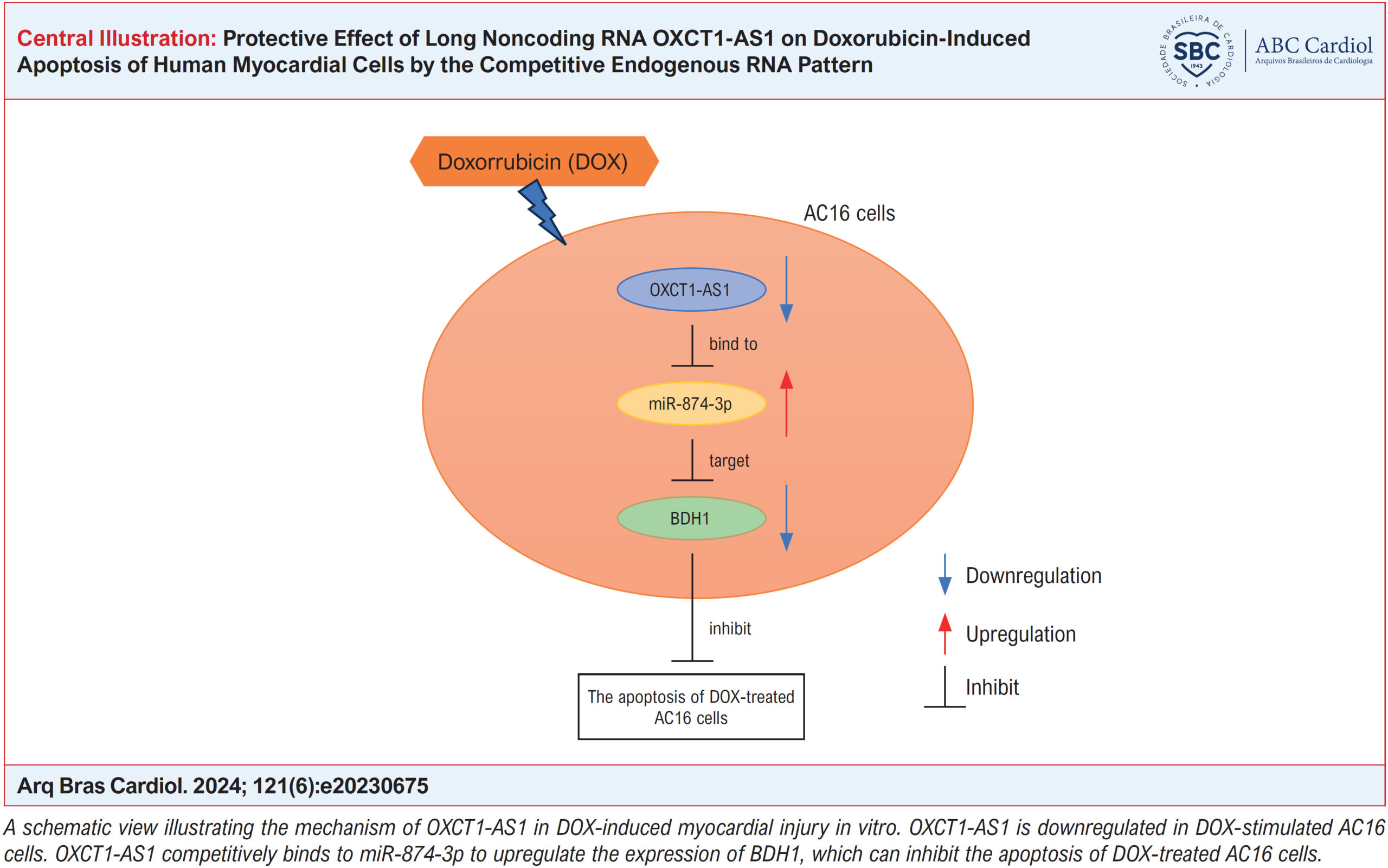
OXCT1-AS1 expression was decreased in DOX-treated AC16 cells. Overexpression of OXCT1-AS1 reversed the reduction of cell viability and promotion of cell apoptosis caused by DOX. OXCT1-AS1 is competitively bound to miR-874-3p to upregulate BDH1. BDH1 overexpression restored AC16 cell viability and suppressed cell apoptosis under DOX stimulation. Knocking down BDH1 reversed OXCT1-AS1-mediated attenuation of AC16 cell apoptosis under DOX treatment.

Conclusion:

LncRNA OXCT1-AS1 protects human myocardial cells AC16 from DOX-induced apoptosis via the miR-874-3p/BDH1 axis.

  • Apoptosis
  • Cardiac Myocytes
  • Doxorubicin
  • RNA
Read Full Article
Creative Commons Attribution (CC BY) Creative Commons license
01/07/2024 DOI: 10.36660/abc.20230675i
Figure 1
ABC
Original Article

SLC26A4-AS1 Aggravates AngII-induced Cardiac Hypertrophy by Enhancing SLC26A4 Expression

Xiaoliang Han et al. Chao Li Qinjiong Ji Ling Zhang … Xiaofei Xie Huijuan Shang Hong Ye

Abstract

Background

It has been reported that solute carrier family 26 members 4 antisense RNA 1 (SLC26A4-AS1) is highly related to cardiac hypertrophy.

Objective

This research aims to investigate the role and specific mechanism of SLC26A4-AS1 in cardiac hypertrophy, providing a novel marker for cardiac hypertrophy treatment.

Methods

Angiotensin II (AngII) was infused into neonatal mouse ventricular cardiomyocytes (NMVCs) to induce cardiac hypertrophy. Gene expression was detected by quantitative real-time PCR (RT-qPCR). Protein levels were evaluated via western blot. Functional assays analyzed the role of SLC26A4-AS1. The mechanism of SLC26A4-AS1 was assessed by RNA-binding protein immunoprecipitation (RIP), RNA pull-down, and luciferase reporter assays. The P value <0.05 was identified as statistical significance. Student’s t-test evaluated the two-group comparison. The difference between different groups was analyzed by one-way analysis of variance (ANOVA).

Results

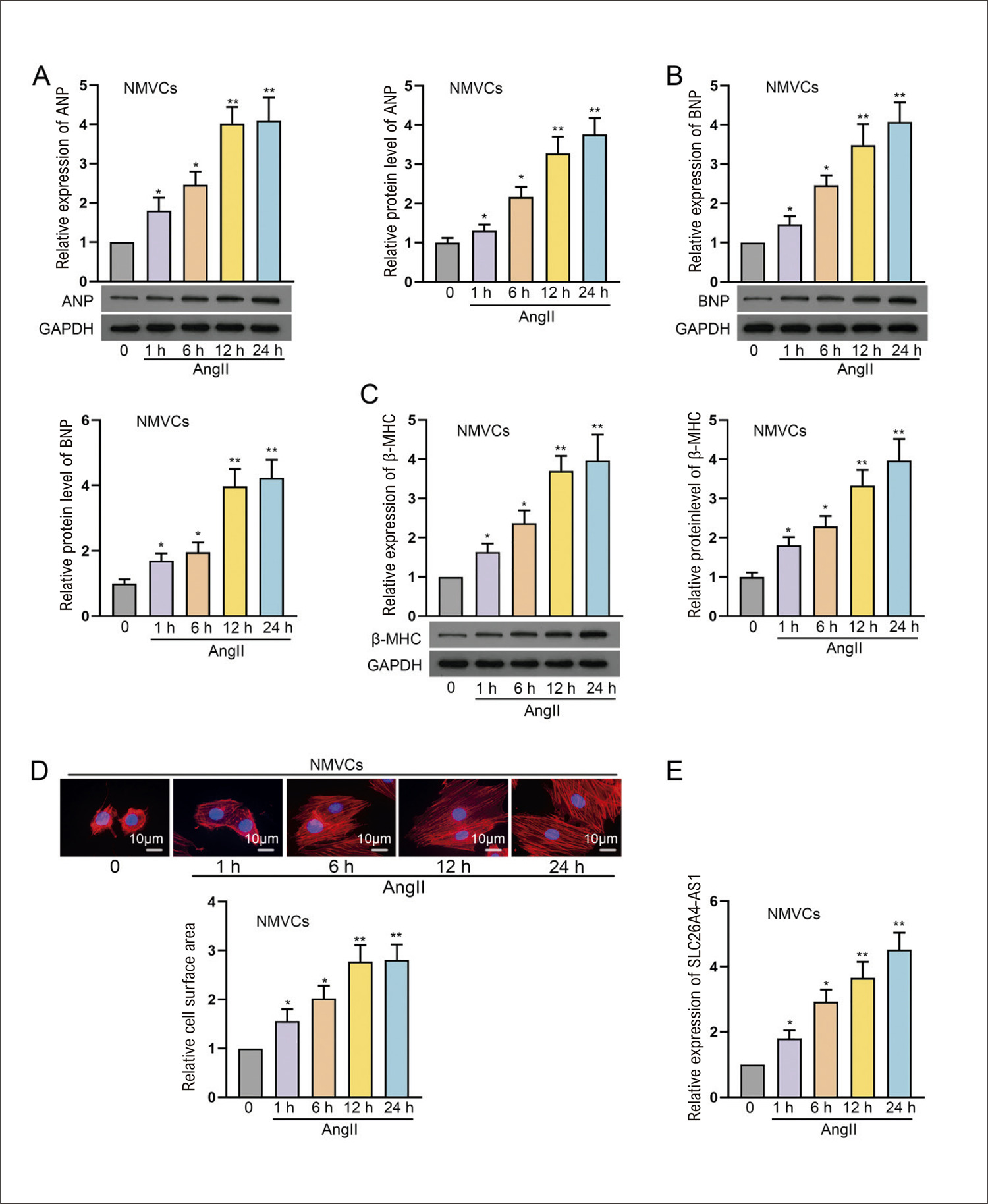
SLC26A4-AS1 is upregulated in AngII-treated NMVCs and promotes AngII-induced cardiac hypertrophy. SLC26A4-AS1 regulates its nearby gene solute carrier family 26 members 4 (SLC26A4) via functioning as a competing endogenous RNA (ceRNA) to modulate the microRNA (miR)-301a-3p and miR-301b-3p in NMVCs. SLC26A4-AS1 promotes AngII-induced cardiac hypertrophy via upregulating SLC26A4 or sponging miR-301a-3p/miR-301b-3p.

Conclusion

SLC26A4-AS1 aggravates AngII-induced cardiac hypertrophy via sponging miR-301a-3p or miR-301b-3p to enhance SLC26A4 expression.

  • Cardiomegaly
  • RNA
  • RNA, Long Noncoding
Read Full Article
Creative Commons Attribution (CC BY) Creative Commons license
21/04/2023 DOI: 10.36660/abc.20210933

How to cite this article

EndNote RIS

Electronic Document Format (Vancouver)

Gatto M, Mota GAF, Pagan LU, Okoshi MP. Functional RNA Applications in Cardiovascular Precision Medicine: Advances and Diagnostic Perspectives. Arquivos Brasileiros de Cardiologia 2025;122(9):e20250553.

Electronic Document Format (ABNT)

Gatto, Mariana; Mota, Gustavo Augusto Ferreira; Pagan, Luana Urbano; Okoshi, Marina Politi. Functional RNA Applications in Cardiovascular Precision Medicine: Advances and Diagnostic Perspectives. Arquivos Brasileiros de Cardiologia, v. 122, n. 9, e20250553, Nov. 2025.

Electronic Document Format (APA)

Gatto, M., Mota, G. A. F., Pagan, L. U., & Okoshi, M. P. (2025). Functional RNA Applications in Cardiovascular Precision Medicine: Advances and Diagnostic Perspectives. Arquivos Brasileiros de Cardiologia, 122(9), e20250553.

Electronic Document Format (ISO)

Gatto, Mariana and Mota, Gustavo Augusto Ferreira and Pagan, Luana Urbano and Okoshi, Marina Politi. Functional RNA Applications in Cardiovascular Precision Medicine: Advances and Diagnostic Perspectives. Arquivos Brasileiros de Cardiologia [online]. 2025, vol. 122, n. 9, [cited 2026-10-15], e20250553. Available from: <https://journals.cardiol.br/en/article/functional-rna-applications-in-cardiovascular-precision-medicine-advances-and-diagnostic-perspectives/>. ISSN 0066-782X

EndNote RIS

Electronic Document Format (Vancouver)

Chen Z, Liu Y, Ma R, Zhang M, Wu X, Pen H, Gui F, et al. Protective Effect of Long Noncoding RNA OXCT1-AS1 on Doxorubicin-Induced Apoptosis of Human Myocardial Cells by the Competitive Endogenous RNA Pattern. Arquivos Brasileiros de Cardiologia 2024;121(6):e20230675.

Electronic Document Format (ABNT)

Chen, Zhen; Liu, Yijue; Ma, Rui; Zhang, Mengli; Wu, Xian; Pen, Huan; Gui, Feng; Liu, Yafeng; Xia, Hao; Hu, Niandan; Ai, Bo; Xiong, Jun; Xia, Hongxia; Li, Wenqiang; Ai, Fen. Protective Effect of Long Noncoding RNA OXCT1-AS1 on Doxorubicin-Induced Apoptosis of Human Myocardial Cells by the Competitive Endogenous RNA Pattern. Arquivos Brasileiros de Cardiologia, v. 121, n. 6, e20230675, Jun. 2024.

Electronic Document Format (APA)

Chen, Z., Liu, Y., Ma, R., Zhang, M., Wu, X., Pen, H., Gui, F., Liu, Y., Xia, H., Hu, N., Ai, B., Xiong, J., Xia, H., Li, W., & Ai, F. (2024). Protective Effect of Long Noncoding RNA OXCT1-AS1 on Doxorubicin-Induced Apoptosis of Human Myocardial Cells by the Competitive Endogenous RNA Pattern. Arquivos Brasileiros de Cardiologia, 121(6), e20230675.

Electronic Document Format (ISO)

Chen, Zhen and Liu, Yijue and Ma, Rui and Zhang, Mengli and Wu, Xian and Pen, Huan and Gui, Feng and Liu, Yafeng and Xia, Hao and Hu, Niandan and Ai, Bo and Xiong, Jun and Xia, Hongxia and Li, Wenqiang and Ai, Fen. Protective Effect of Long Noncoding RNA OXCT1-AS1 on Doxorubicin-Induced Apoptosis of Human Myocardial Cells by the Competitive Endogenous RNA Pattern. Arquivos Brasileiros de Cardiologia [online]. 2024, vol. 121, n. 6, [cited 2026-10-15], e20230675. Available from: <https://journals.cardiol.br/en/article/protective-effect-of-long-noncoding-rna-oxct1-as1-on-doxorubicin-induced-apoptosis-of-human-myocardial-cells-by-the-competitive-endogenous-rna-pattern/>. ISSN 0066-782X

EndNote RIS

Electronic Document Format (Vancouver)

Han X, Li C, Ji Q, Zhang L, Xie X, Shang H, Ye H, et al. SLC26A4-AS1 Aggravates AngII-induced Cardiac Hypertrophy by Enhancing SLC26A4 Expression. Arquivos Brasileiros de Cardiologia 2023;120(4):e20210933.

Electronic Document Format (ABNT)

Han, Xiaoliang; Li, Chao; Ji, Qinjiong; Zhang, Ling; Xie, Xiaofei; Shang, Huijuan; Ye, Hong. SLC26A4-AS1 Aggravates AngII-induced Cardiac Hypertrophy by Enhancing SLC26A4 Expression. Arquivos Brasileiros de Cardiologia, v. 120, n. 4, e20210933, Apr. 2023.

Electronic Document Format (APA)

Han, X., Li, C., Ji, Q., Zhang, L., Xie, X., Shang, H., & Ye, H. (2023). SLC26A4-AS1 Aggravates AngII-induced Cardiac Hypertrophy by Enhancing SLC26A4 Expression. Arquivos Brasileiros de Cardiologia, 120(4), e20210933.

Electronic Document Format (ISO)

Han, Xiaoliang and Li, Chao and Ji, Qinjiong and Zhang, Ling and Xie, Xiaofei and Shang, Huijuan and Ye, Hong. SLC26A4-AS1 Aggravates AngII-induced Cardiac Hypertrophy by Enhancing SLC26A4 Expression. Arquivos Brasileiros de Cardiologia [online]. 2023, vol. 120, n. 4, [cited 2026-10-15], e20210933. Available from: <https://journals.cardiol.br/en/article/slc26a4-as1-aggravates-angii-induced-cardiac-hypertrophy-by-enhancing-slc26a4-expression/>. ISSN 0066-782X

  • About ABC Family
  • Internal Regulation
  • Editorial Board
  • Brazilian Society of Cardiology (SBC)

Issues

SBC Guidelines

  • Videos
  • Podcasts
  • News