ABC Family Arquivos Brasileiros de Cardiologia International Journal of Cardiovascular Sciences ABC Heart Failure & Cardiomyopathy ABC Imagem Cardiovascular
Português English
ABC Family
Português English
  • About
    • About ABC Family
    • Internal Regulation
    • Editorial Board
    • Brazilian Society of Cardiology (SBC)
  • Issues
  • SBC Guidelines
  • Content
    • Videos
    • Podcasts
    • News
  • About
    • About ABC Family
    • Internal Regulation
    • Editorial Board
    • Brazilian Society of Cardiology (SBC)
  • Issues
  • SBC Guidelines
  • Content
    • Videos
    • Podcasts
    • News

ABC Family

  • ABC Family
  • Arquivos Brasileiros de Cardiologia
  • International Journal of Cardiovascular Sciences
  • ABC Heart Failure & Cardiomyopathy
  • ABC Imagem Cardiovascular
Search in

No content found.

Journals
Ordering
Article types
Others

  1. Home
  2. Keyword: poverty
ABC
Editorial

Improving Outcomes of Patients with Acute Coronary Disease in Real Life: The Case of Applying in Practice What We Already Know from Clinical Studies

Stefano Garzon et al. Pedro A. Lemos

Cardiovascular diseases are one the leading causes of death in the world in both developed and developing countries, and according to the World Health Organization, 75% of these deaths are expected to happen in developing countries. Socioeconomic deprivation is a major determinant of cardiovascular mortality associated with more exposure to risk factors and premature deaths. Cardiovascular diseases also take a great toll on the economy. A recent study conducted in Australia projects a total healthcare cost of cardiovascular diseases from 2020 to 2029 of almost 62 billion Australian dollars, with productivity losses of almost 79 billion, with a total cost surpassing 140 billion over 10 years.

Brazil is a developing country of continental dimensions, with marked regional, racial, and socioeconomic disparities. From the 1960s onwards, the country underwent a fast demographic change, with a rapidly aging population and transitioning from predominantly rural to urban. A large proportion of the Brazilian population is exposed to known risk factors of cardiovascular disease, such as low educational levels, poor living and dietary habits, tobacco use, obesity, air pollution, and poorly-controlled risk factors such as hypertension, diabetes, and hyperlipidemia, all of which are associated with higher cardiovascular mortality. Although Brazil has a Universal Healthcare System (SUS), healthcare access is highly heterogeneous, overcrowded, and underfunded, and frequently fails to provide proper care to the Brazilian population.

[…]

  • Cardiovascular Diseases, mortality
  • Coronary Artery Disease
  • Development Countries
  • Percutaneous Coronary Intervention
  • poverty
  • Risk Factors
  • Unified System Health
Read Full Article
Creative Commons Attribution (CC BY) Creative Commons license
19/06/2023 DOI: 10.36660/abc.20230283
ABC
Editorial

Human Development Index and Chronic Diseases in Brazil between 1980 and 2019

Alfredo José Mansur et al. Lucia Pereira Barroso

The human development index synthesizes dimensions of human societies taking into consideration life expectancy at birth, education, and standard of living. Life expectancy is an expression of the health conditions of a particular population. Education is expressed as years of schooling. The standard of living is indicated by gross national income per capita. It is recognized that the human development index does not encompass every social determinant of the experience of citizens of a specific human society. Nonetheless, it is useful and a recognized methodological approach for measurements and comparisons; however, inequalities, poverty, human security, empowerment, and other characteristics may be missed., That said, it is always opportune for the medical-scientific community to bear in mind the dimensions examined in the human development index and to develop recurrent studies and updates over time, as the conditions in which human societies live are dynamic.

In the current study, the authors evaluated the human development index in Brazil over four decades (1980-2019). The data (the underlying cause of death) were retrieved from death certificates in a Unified Health System (SUS) public database relative to chronic non-infectious diseases with time series analyses. Mortality was corrected for 100.000 inhabitants distributed in quartiles in each Brazilian state.

[…]

  • Chronic Disease/epidemiology
  • Human Development
  • Life Expectancy/trends
  • poverty
  • Primary Health Care
  • Social Marginalization
  • Unemployment
Read Full Article
Creative Commons Attribution (CC BY) Creative Commons license
08/05/2023 DOI: 10.36660/abc.20230213
Figure 1
IJCS
Viewpoint

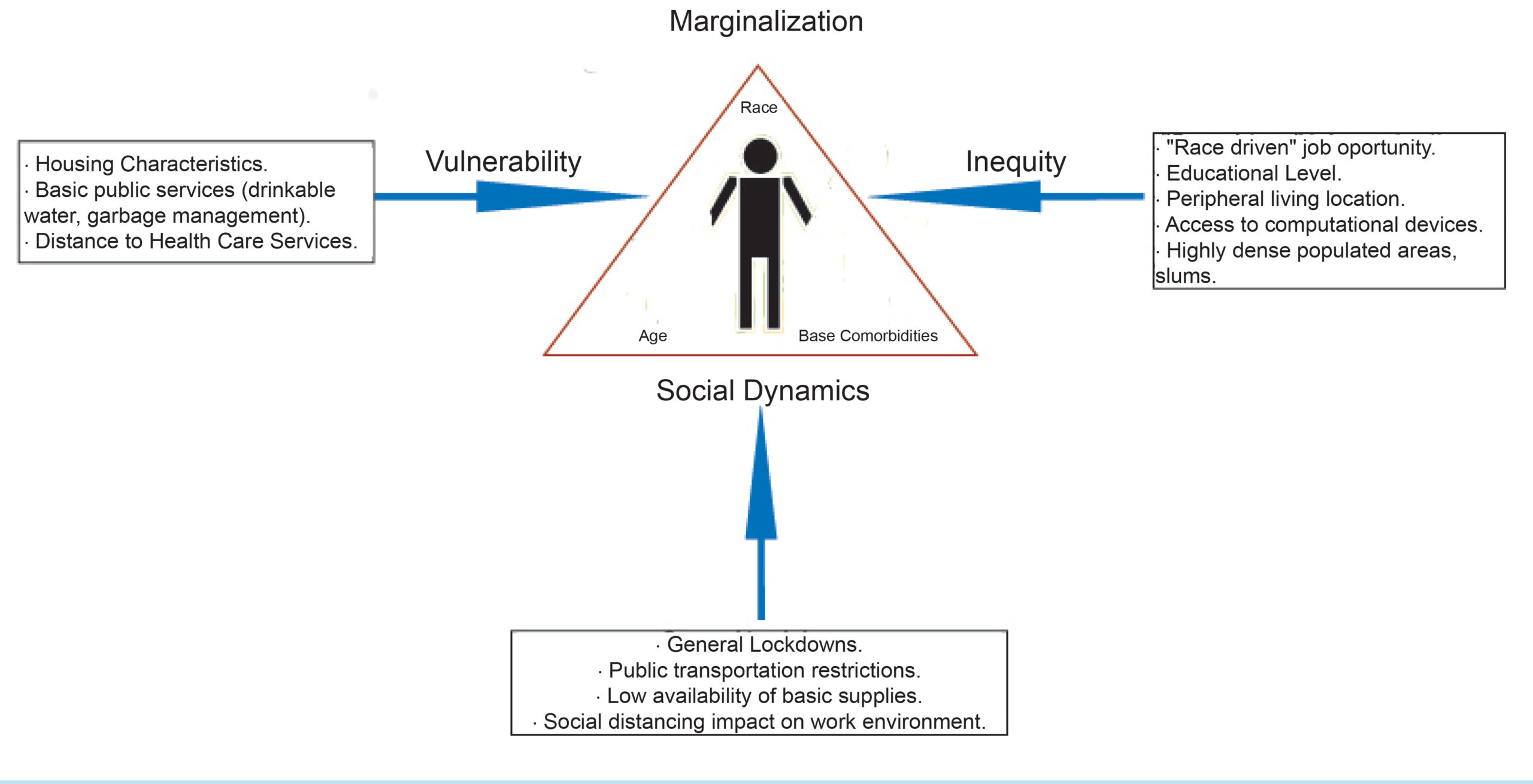
Marginalization, Vulnerability and Economic Dynamics in COVID-19

Andres Felipe Valencia Rendon et al. Isabela Mendes Volschan Manoella de Novais Pereira Alessandra de Freitas Pimentel … Wagner Lima Monteiro Gláucia Maria Moraes de Oliveira

Abstract

COVID-19, caused by the coronavirus family SARS-CoV-2 and declared a pandemic in March 2020, continues to spread. Its enormous and unprecedented impact on our society has evidenced the huge social inequity of our modern society, in which the most vulnerable individuals have been pushed into even worse socioeconomic situations, struggling to survive.

As the pandemic continues, we witness the huge suffering of the most marginalized populations around the globe, even in developed, high-income latitudes, such as North America and Europe. That is even worse in low-income regions, such as Brazil, where the public healthcare infrastructure had already been struggling before the pandemic.

Cities with even more evident social inequity have been impacted the most, leaving the most socioeconomically disadvantaged ones, such as slum residents and black people, continuously inflating the statistics of COVID-19 sufferers.

Poverty, marginalization, and inequity have been well-known risk factors for morbidity and mortality from other diseases. However, COVID-19 has deepened our society’s wound. It is up to us to heal it up. If we really care for the others and want to survive as a species, we must fight social inequity.

  • Brazil
  • Coronavirus-19
  • COVID-19
  • Disaster Vulnerability
  • Ethnicity and Health
  • Population Dynamics
  • poverty
  • Social Marginalization
Read Full Article
Creative Commons Attribution (CC BY) Creative Commons license
03/05/2021 DOI: 10.36660/ijcs.20210029 Views 1
Mild stunting is associated with higher blood pressure in overweight adolescents
ABC
Artigo Original

Mild stunting is associated with higher blood pressure in overweight adolescents

Ana Paula Grotti Clemente et al. Carla Danusa Santos Ana Amelia Benedito Silva Vinicius Jose Martins … Anna Carolina Marchesano Mariana Belluca Fernandes Maria Paula Albuquerque Ana Lydia Sawaya

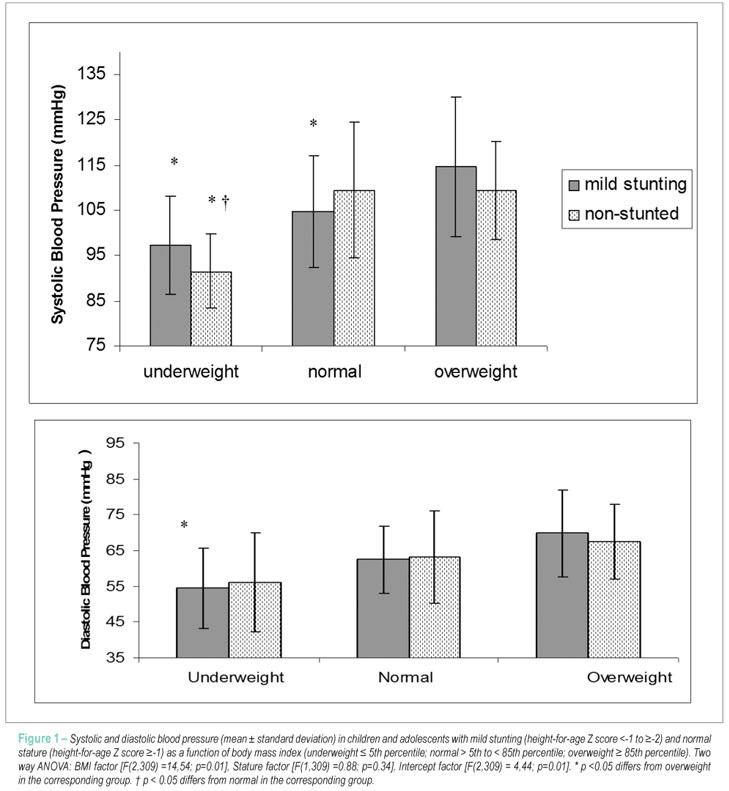
BACKGROUND: Studies have shown that pre/postnatal undernutrition leads to higher risk of non communicable diseases such as diabetes, hypertension and obesity in adulthood. OBJECTIVE: To determine whether overweight adolescents with mild stunting [height-for-age Z scores (HAZ) in the range -2] have higher blood pressure than overweight individuals with normal stature (HAZ >-1). MEHTODS: Participants were classified as mildly stunted or of normal stature, and further stratified according to body mass index-for-age percentiles as overweight, normal or underweight. Systolic (SBP) and diastolic (DPB) blood pressures were determined according to guidelines, and abdominal fat was analyzed by dual energy X-ray absorptiometry. RESULTS: Mild stunted overweight individuals showed higher DBP values (p=0.001) than their underweight counterparts (69.75 ± 12.03 and 54.46±11.24 mmHg, respectively), but similar to those of normal BMI. No differences were found in DBP values of normal, overweight and underweight individuals among the normal stature groups. An increase in SBP (p=0.01) among mild stunted individuals was found when those with overweight were compared to their underweight and normal BMI counterparts (114.70 ± 15.46, 97.38 ± 10.87 and 104.72 ± 12.24 mmHg, respectively). Although no differences were observed in the means of SBP between mild stunting and normal stature groups, a significant intercept was found (p=0.01), revealing higher SBP among stunted individuals. There was a correlation between SBP and abdominal fat (r=0.42, ρ=0.02) in the stunted group. CONCLUSION: Stunted individuals with overweight showed higher SBP than those of normal stature and overweight. These findings confirm that mild stunting increase the risk of future hypertension and alterations are evident at early age.

  • Adolescent
  • Blood Pressure
  • Overweight
  • poverty
Read Full Article
Creative Commons Attribution (CC BY) Creative Commons license
08/12/2011 DOI: 10.1590/S0066-782X2011005000115 Views 1

How to cite this article

EndNote RIS

Electronic Document Format (Vancouver)

Garzon S, Lemos PA. Improving Outcomes of Patients with Acute Coronary Disease in Real Life: The Case of Applying in Practice What We Already Know from Clinical Studies. Arquivos Brasileiros de Cardiologia 2023;120(5):e20230283.

Electronic Document Format (ABNT)

Garzon, Stefano; Lemos, Pedro A.. Improving Outcomes of Patients with Acute Coronary Disease in Real Life: The Case of Applying in Practice What We Already Know from Clinical Studies. Arquivos Brasileiros de Cardiologia, v. 120, n. 5, e20230283, Jun. 2023.

Electronic Document Format (APA)

Garzon, S., & Lemos, P. A. (2023). Improving Outcomes of Patients with Acute Coronary Disease in Real Life: The Case of Applying in Practice What We Already Know from Clinical Studies. Arquivos Brasileiros de Cardiologia, 120(5), e20230283.

Electronic Document Format (ISO)

Garzon, Stefano and Lemos, Pedro A.. Improving Outcomes of Patients with Acute Coronary Disease in Real Life: The Case of Applying in Practice What We Already Know from Clinical Studies. Arquivos Brasileiros de Cardiologia [online]. 2023, vol. 120, n. 5, [cited 2026-10-14], e20230283. Available from: <https://journals.cardiol.br/en/article/improving-outcomes-of-patients-with-acute-coronary-disease-in-real-life-the-case-of-applying-in-practice-what-we-already-know-from-clinical-studies/>. ISSN 0066-782X

EndNote RIS

Electronic Document Format (Vancouver)

Mansur AJ, Barroso LP. Human Development Index and Chronic Diseases in Brazil between 1980 and 2019. Arquivos Brasileiros de Cardiologia 2023;120(4):e20230213.

Electronic Document Format (ABNT)

Mansur, Alfredo José; Barroso, Lucia Pereira. Human Development Index and Chronic Diseases in Brazil between 1980 and 2019. Arquivos Brasileiros de Cardiologia, v. 120, n. 4, e20230213, May. 2023.

Electronic Document Format (APA)

Mansur, A. J., & Barroso, L. P. (2023). Human Development Index and Chronic Diseases in Brazil between 1980 and 2019. Arquivos Brasileiros de Cardiologia, 120(4), e20230213.

Electronic Document Format (ISO)

Mansur, Alfredo José and Barroso, Lucia Pereira. Human Development Index and Chronic Diseases in Brazil between 1980 and 2019. Arquivos Brasileiros de Cardiologia [online]. 2023, vol. 120, n. 4, [cited 2026-10-14], e20230213. Available from: <https://journals.cardiol.br/en/article/human-development-index-and-chronic-diseases-in-brazil-between-1980-and-2019/>. ISSN 0066-782X

EndNote RIS

Electronic Document Format (Vancouver)

Rendon AFV, Volschan IM, Pereira MN, Pimentel AF, Monteiro WL, Oliveira GMM. Marginalization, Vulnerability and Economic Dynamics in COVID-19. International Journal of Cardiovascular Sciences 2021;34(3):319-23.

Electronic Document Format (ABNT)

Rendon, Andres Felipe Valencia; Volschan, Isabela Mendes; Pereira, Manoella de Novais; Pimentel, Alessandra de Freitas; Monteiro, Wagner Lima; Oliveira, Gláucia Maria Moraes de. Marginalization, Vulnerability and Economic Dynamics in COVID-19. International Journal of Cardiovascular Sciences, v. 34, n. 3, p. 319-323, May. 2021.

Electronic Document Format (APA)

Rendon, A. F. V., Volschan, I. M., Pereira, M. N., Pimentel, A. F., Monteiro, W. L., & Oliveira, G. M. M. (2021). Marginalization, Vulnerability and Economic Dynamics in COVID-19. International Journal of Cardiovascular Sciences, 34(3), 319-323.

Electronic Document Format (ISO)

Rendon, Andres Felipe Valencia and Volschan, Isabela Mendes and Pereira, Manoella de Novais and Pimentel, Alessandra de Freitas and Monteiro, Wagner Lima and Oliveira, Gláucia Maria Moraes de. Marginalization, Vulnerability and Economic Dynamics in COVID-19. International Journal of Cardiovascular Sciences [online]. 2021, vol. 34, n. 3, [cited 2026-10-14], pp. 319-323. Available from: <https://journals.cardiol.br/en/article/marginalization-vulnerability-and-economic-dynamics-in-covid-19/>. ISSN 2359-4802

EndNote RIS

Electronic Document Format (Vancouver)

Clemente APG, Santos CD, Silva AAB, Martins VJ, Marchesano AC, Fernandes MB, Albuquerque MP, et al. Mild stunting is associated with higher blood pressure in overweight adolescents. Arquivos Brasileiros de Cardiologia 2011;98(1):06-12.

Electronic Document Format (ABNT)

Clemente, Ana Paula Grotti; Santos, Carla Danusa; Silva, Ana Amelia Benedito; Martins, Vinicius Jose; Marchesano, Anna Carolina; Fernandes, Mariana Belluca; Albuquerque, Maria Paula; Sawaya, Ana Lydia. Mild stunting is associated with higher blood pressure in overweight adolescents. Arquivos Brasileiros de Cardiologia, v. 98, n. 1, p. 06-12, Dec. 2011.

Electronic Document Format (APA)

Clemente, A. P. G., Santos, C. D., Silva, A. A. B., Martins, V. J., Marchesano, A. C., Fernandes, M. B., Albuquerque, M. P., & Sawaya, A. L. (2011). Mild stunting is associated with higher blood pressure in overweight adolescents. Arquivos Brasileiros de Cardiologia, 98(1), 06-12.

Electronic Document Format (ISO)

Clemente, Ana Paula Grotti and Santos, Carla Danusa and Silva, Ana Amelia Benedito and Martins, Vinicius Jose and Marchesano, Anna Carolina and Fernandes, Mariana Belluca and Albuquerque, Maria Paula and Sawaya, Ana Lydia. Mild stunting is associated with higher blood pressure in overweight adolescents. Arquivos Brasileiros de Cardiologia [online]. 2011, vol. 98, n. 1, [cited 2026-10-14], pp. 06-12. Available from: <https://journals.cardiol.br/en/article/mild-stunting-is-associated-with-higher-blood-pressure-in-overweight-adolescents/>. ISSN 0066-782X

  • About ABC Family
  • Internal Regulation
  • Editorial Board
  • Brazilian Society of Cardiology (SBC)

Issues

SBC Guidelines

  • Videos
  • Podcasts
  • News