ABC Family Arquivos Brasileiros de Cardiologia International Journal of Cardiovascular Sciences ABC Heart Failure & Cardiomyopathy ABC Imagem Cardiovascular
Português English
ABC Family
Português English
  • About
    • About ABC Family
    • Internal Regulation
    • Editorial Board
    • Brazilian Society of Cardiology (SBC)
  • Issues
  • SBC Guidelines
  • Content
    • Videos
    • Podcasts
    • News
  • About
    • About ABC Family
    • Internal Regulation
    • Editorial Board
    • Brazilian Society of Cardiology (SBC)
  • Issues
  • SBC Guidelines
  • Content
    • Videos
    • Podcasts
    • News

ABC Family

  • ABC Family
  • Arquivos Brasileiros de Cardiologia
  • International Journal of Cardiovascular Sciences
  • ABC Heart Failure & Cardiomyopathy
  • ABC Imagem Cardiovascular
Search in

No content found.

Journals
Ordering
Article types
Others

  1. Home
  2. Keyword: Angiotensin Receptor Antagonists
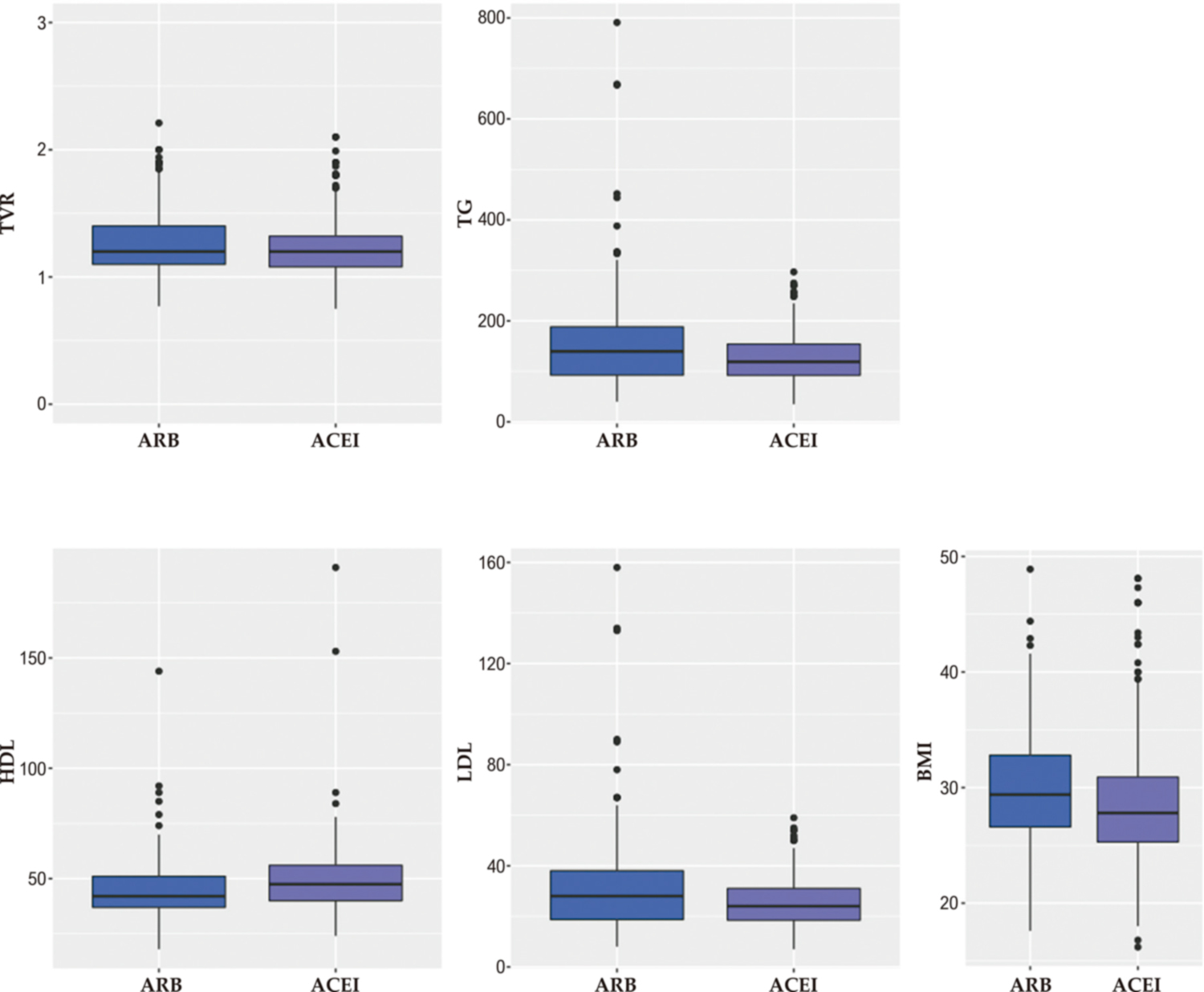
Figure 1
IJCS
Original Article

Comparison of Angiotensin Receptor Blockers and Angiotensin-Converting Enzyme Inhibitors in the Management of Arterial Stiffness and Target Organ Damage in Patients with Hypertension

Gilberto Campos Guimarães Filho et al. Reila Campos Guimarães de Araújo Karynne Borges Cabral Cácia Régia de Paula

Abstract

Background

Arterial stiffness and hypertension are strong predictors of cardiovascular disease and mortality. Angiotensin-converting enzyme inhibitors (ACEI) and angiotensin receptor blockers (ARB) are first-line antihypertensive agents in reducing blood pressure and arterial stiffness.

Objective

The objective of this study was to compare the effects of ACEI and ARB in reducing arterial stiffness and preventing target organ damage in patients with hypertension.

Methods

This observational study included 654 participants who attend routine consultations at an outpatient hypertension clinic in 2 university hospitals. Patients were interviewed, and they underwent central and peripheral blood pressure measurements. Doppler echocardiography, carotid ultrasound, biochemical tests, and anthropometric parameters were carried out. Shapiro-Wilk, chi-square, and Fisher’s exact test were used. A significance level of 5% was adopted.

Results

A total of 659 participants were evaluated in the study (398 from the ARB group and 256 from the ACEI group). Age, body mass index (BMI), central and peripheral blood pressure measurements, pulse wave velocity (PWV), left ventricular mass index, and carotid intima-media thickness did not show differences between the groups (p > 0.05). After linear regression analysis, the ACEI group had lower values of total vascular resistance (TVR) (p = 0.003) and augmentation pressure (p = 0.008), when compared to the ARB group.

Conclusion

This study showed that the ACEI group had a greater reduction in augmentation pressure and PWV. There were no differences between the groups regarding the improvement of outcomes related to central arterial pressure, PWV, and cardiac and vascular target organ damage.
  • Angiotensin Receptor Antagonists
  • Angiotensin-Converting Enzyme Inhibitors
  • Hypertension
  • Pulse Wave Analysis
  • Vascular Stiffness
Read Full Article
Creative Commons Attribution (CC BY) Creative Commons license
25/08/2023 DOI: 10.36660/ijcs.20220162 Views 1
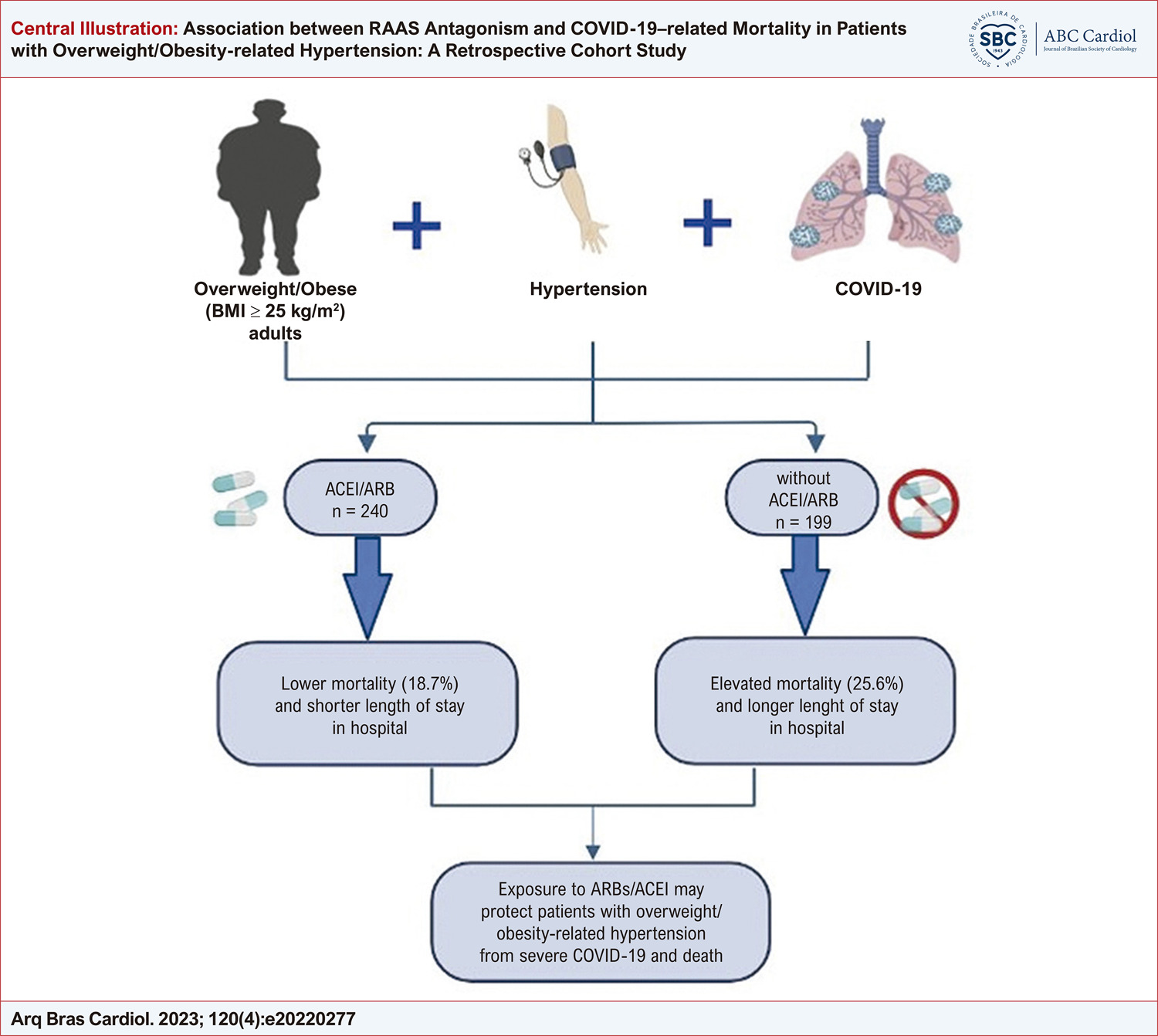
Central Illustration
ABC
Original Article

Association between RAAS Antagonism and COVID-19–related Mortality in Patients with Overweight/Obesity-related Hypertension: A Retrospective Cohort Study

Elham Shams et al. Vijayvardhan Kamalumpundi Linhai Cheng Adeyinka Taiwo … Amal Shibli-Rahhal Ayotunde O. Dokun Marcelo L.G. Correia

Abstract

Background

Angiotensin receptor blockers (ARB) and angiotensin-converting enzyme inhibitors (ACEI) increase the expression of ACE2, which is a receptor for entry of SARS-CoV-2 into cells. Though evidence suggests that ARB/ACEI are safe among the general population with COVID-19, their safety in patients with overweight/obesity-related hypertension deserves further evaluation.

Objective

We assessed the association between ARB/ACEI use and COVID-19 severity in patients with overweight/obesity-related hypertension.

Methods

This study included 439 adult patients with overweight/obesity (body mass index ≥ 25 kg/m2) and hypertension, diagnosed with COVID-19 and admitted to University of Iowa Hospitals and Clinic from March 1 to December 7, 2020. Mortality and severity of COVID-19 were evaluated based on length of stay in hospital, intensive care unit admission, use of supplemental oxygen, mechanical ventilation, and vasopressors. Multivariable logistic regression was used to examine the associations of ARB/ACEI use with mortality and other markers of COVID-19 severity, with a two-sided alpha set at 0.05.

Results

Exposure to ARB (n = 91) and ACEI (n = 149) before hospitalization was significantly associated with lower mortality (odds ratio [OR] = 0.362, 95% confidence interval [CI] 0.149 to 0.880, p = 0.025) and a shorter length of stay (95% CI −0.217 to −0.025, p = 0.015). Additionally, patients using ARB/ACEI showed a non-significant trend toward lower intensive care unit admission (OR = 0.727, 95% CI 0.485 to 1.090, p = 0.123), use of supplemental oxygen (OR = 0.929, 95% CI 0.608 to 1.421, p = 0.734), mechanical ventilation (OR = 0.728, 95% CI 0.457 to 1.161, p = 0.182), and vasopressors (OR = 0.677, 95% CI 0.430 to 1.067, p = 0.093).

Conclusion

Results suggest that hospitalized patients with COVID-19 and overweight/obesity-related hypertension who were prescribed ARB/ACEI before admission to the hospital exhibit lower mortality and less severe COVID-19 than those who were not taking ARB/ACEI. The results also suggest that exposure to ARB/ACEI may protect patients with overweight/obesity-related hypertension from severe COVID-19 and death.

  • Angiotensin Receptor Antagonists
  • Angiotensin-Converting Enzyme Inhibitors
  • COVID-19
  • Hypertension
  • Obesity
Read Full Article
Creative Commons Attribution (CC BY) Creative Commons license
21/04/2023 DOI: 10.36660/abc.20220277

How to cite this article

EndNote RIS

Electronic Document Format (Vancouver)

Guimarães Filho GC, Araújo RCG, Cabral KB, Paula CR. Comparison of Angiotensin Receptor Blockers and Angiotensin-Converting Enzyme Inhibitors in the Management of Arterial Stiffness and Target Organ Damage in Patients with Hypertension. International Journal of Cardiovascular Sciences 2023;36:e20220162.

Electronic Document Format (ABNT)

Guimarães Filho, Gilberto Campos; Araújo, Reila Campos Guimarães de; Cabral, Karynne Borges; Paula, Cácia Régia de. Comparison of Angiotensin Receptor Blockers and Angiotensin-Converting Enzyme Inhibitors in the Management of Arterial Stiffness and Target Organ Damage in Patients with Hypertension. International Journal of Cardiovascular Sciences, v. 36, e20220162, Aug. 2023.

Electronic Document Format (APA)

Guimarães Filho, G. C., Araújo, R. C. G. , Cabral, K. B., & Paula, C. R. (2023). Comparison of Angiotensin Receptor Blockers and Angiotensin-Converting Enzyme Inhibitors in the Management of Arterial Stiffness and Target Organ Damage in Patients with Hypertension. International Journal of Cardiovascular Sciences, 36, e20220162.

Electronic Document Format (ISO)

Guimarães Filho, Gilberto Campos and Araújo, Reila Campos Guimarães de and Cabral, Karynne Borges and Paula, Cácia Régia de. Comparison of Angiotensin Receptor Blockers and Angiotensin-Converting Enzyme Inhibitors in the Management of Arterial Stiffness and Target Organ Damage in Patients with Hypertension. International Journal of Cardiovascular Sciences [online]. 2023, vol. 36, [cited 2026-10-14], e20220162. Available from: <https://journals.cardiol.br/en/article/comparison-of-angiotensin-receptor-blockers-and-angiotensin-converting-enzyme-inhibitors-in-the-management-of-arterial-stiffness-and-target-organ-damage-in-patients-with-hypertension/>. ISSN 2359-4802

EndNote RIS

Electronic Document Format (Vancouver)

Shams E, Kamalumpundi V, Cheng L, Taiwo A, Shibli-Rahhal A, Dokun AO, Correia ML, et al. Association between RAAS Antagonism and COVID-19–related Mortality in Patients with Overweight/Obesity-related Hypertension: A Retrospective Cohort Study. Arquivos Brasileiros de Cardiologia 2023;120(4):e20220277.

Electronic Document Format (ABNT)

Shams, Elham; Kamalumpundi, Vijayvardhan; Cheng, Linhai; Taiwo, Adeyinka; Shibli-Rahhal, Amal; Dokun, Ayotunde O.; Correia, Marcelo L.G.. Association between RAAS Antagonism and COVID-19–related Mortality in Patients with Overweight/Obesity-related Hypertension: A Retrospective Cohort Study. Arquivos Brasileiros de Cardiologia, v. 120, n. 4, e20220277, Apr. 2023.

Electronic Document Format (APA)

Shams, E., Kamalumpundi, V., Cheng, L., Taiwo, A., Shibli-Rahhal, A., Dokun, A. O., & Correia, M. L. (2023). Association between RAAS Antagonism and COVID-19–related Mortality in Patients with Overweight/Obesity-related Hypertension: A Retrospective Cohort Study. Arquivos Brasileiros de Cardiologia, 120(4), e20220277.

Electronic Document Format (ISO)

Shams, Elham and Kamalumpundi, Vijayvardhan and Cheng, Linhai and Taiwo, Adeyinka and Shibli-Rahhal, Amal and Dokun, Ayotunde O. and Correia, Marcelo L.G.. Association between RAAS Antagonism and COVID-19–related Mortality in Patients with Overweight/Obesity-related Hypertension: A Retrospective Cohort Study. Arquivos Brasileiros de Cardiologia [online]. 2023, vol. 120, n. 4, [cited 2026-10-14], e20220277. Available from: <https://journals.cardiol.br/en/article/association-between-raas-antagonism-and-covid-19-related-mortality-in-patients-with-overweight-obesity-related-hypertension-a-retrospective-cohort-study/>. ISSN 0066-782X

  • About ABC Family
  • Internal Regulation
  • Editorial Board
  • Brazilian Society of Cardiology (SBC)

Issues

SBC Guidelines

  • Videos
  • Podcasts
  • News