ABC Family Arquivos Brasileiros de Cardiologia International Journal of Cardiovascular Sciences ABC Heart Failure & Cardiomyopathy ABC Imagem Cardiovascular
Português English
ABC Family
Português English
  • About
    • About ABC Family
    • Internal Regulation
    • Editorial Board
    • Brazilian Society of Cardiology (SBC)
  • Issues
  • SBC Guidelines
  • Content
    • Videos
    • Podcasts
    • News
  • About
    • About ABC Family
    • Internal Regulation
    • Editorial Board
    • Brazilian Society of Cardiology (SBC)
  • Issues
  • SBC Guidelines
  • Content
    • Videos
    • Podcasts
    • News

ABC Family

  • ABC Family
  • Arquivos Brasileiros de Cardiologia
  • International Journal of Cardiovascular Sciences
  • ABC Heart Failure & Cardiomyopathy
  • ABC Imagem Cardiovascular
Search in

No content found.

Journals
Ordering
Article types
Others

  1. Home
  2. Keyword: Development Indicators
Figure 1
ABC
Original Article

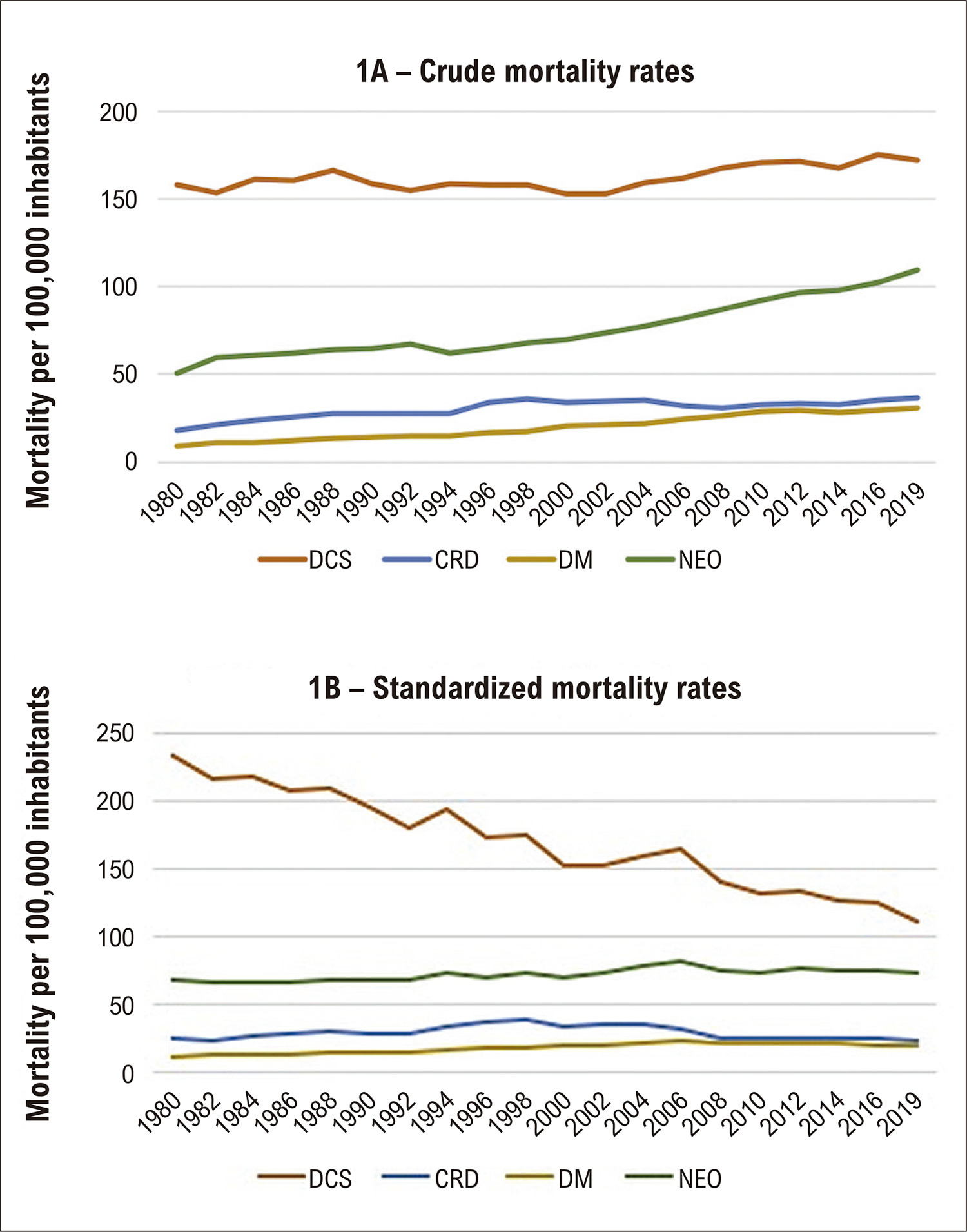
Association between Mortality from Chronic Noncommunicable Diseases and Human Development Index in Brazil between 1980 and 2019

Sandra Chagas da Costa Feliciano et al. Paolo Blanco Villela Gláucia Maria Moraes de Oliveira

Abstract

Background

Chronic noncommunicable diseases (CNCDs) caused more than 734,000 deaths (55% of all deaths) in Brazil in 2019, with an important socioeconomic impact.

Objectives

To analyze the mortality rates from CNCDs in Brazil from 1980 to 2019 and their association with socioeconomic indicators.

Method

This was a descriptive, time-series study of deaths from CNCDs in Brazil from 1980 to 2019. Data on the annual frequencies of deaths and on population were obtained from the Department of Informatics of the Brazilian Unified Health System. Crude and standardized mortality rates per 100,000 inhabitants were estimated using the direct method (Brazilian population in 2000). The quartiles of each CNCD were calculated, where a quartile change, due to an increase in mortality rate, was represented by a chromatic gradient. The Municipal Human Development Index (MHDI) of each Brazilian federative unit was extracted from the Atlas Brasil website and correlated with the rates of CNCD mortality.

Results

There was a reduction in mortality rates due to diseases of the circulatory system during the period, except in the Northeast Region. There was also an increase in mortality from neoplasia and diabetes, while the rates of chronic respiratory diseases showed little variation. There was an inverse correlation between the federative units with greater reduction in CNCD mortality rates and the MHDI.

Conclusions

The observed decrease in mortality due to diseases of the circulatory system may reflect an improvement in socioeconomic indicators in Brazil during the period. The increase in mortality rates due to neoplasms is probably related to the aging of the population. The higher mortality rates of diabetes seem to be associated with an increase in the prevalence of obesity in Brazilian women.
  • Development Indicators
  • Epidemiology
  • Health of the Disabled
  • Mortality
  • Non Communicable Diseases
  • Public Health
Read Full Article
Creative Commons Attribution (CC BY) Creative Commons license
21/04/2023 DOI: 10.36660/abc.20211009 Views 2
Figure 1
ABC
Original Article

Mortality Due to Heart Failure and Socioeconomic Development in Brazil between 1980 and 2018

Sonia Carvalho Santos et al. Paolo Blanco Villela Gláucia Maria Moraes de Oliveira

Abstract

Background

Studies on mortality from heart failure (HF) in Brazil and in the country’s Geographic Regions (GRs) are scarce.

Objective

To analyze the temporal progression of HF mortality rates by sex and age group in Brazil and its GRs and Federative Units (FUs) from 1980 to 2018, and the associations between mortality rates at each FU and the Municipal Human Development Index (MHDI).

Methods

Time series analysis of deaths due to HF categorized by sex and age groups in Brazil and Brazilian GRs and FUs from 1980 to 2018. Death and population data were obtained from the DATASUS for estimation of crude and standardized mortality rates per 100,000 inhabitants (direct method, Brazilian population in the year 2000). We calculated the 3-year moving averages of the standardized rates. The MHDIs of the FUs in 1991 and 2010 were obtained from Atlas Brasil and were correlated with mortality rates using Pearson’s correlation at a 5% significance level.

Results

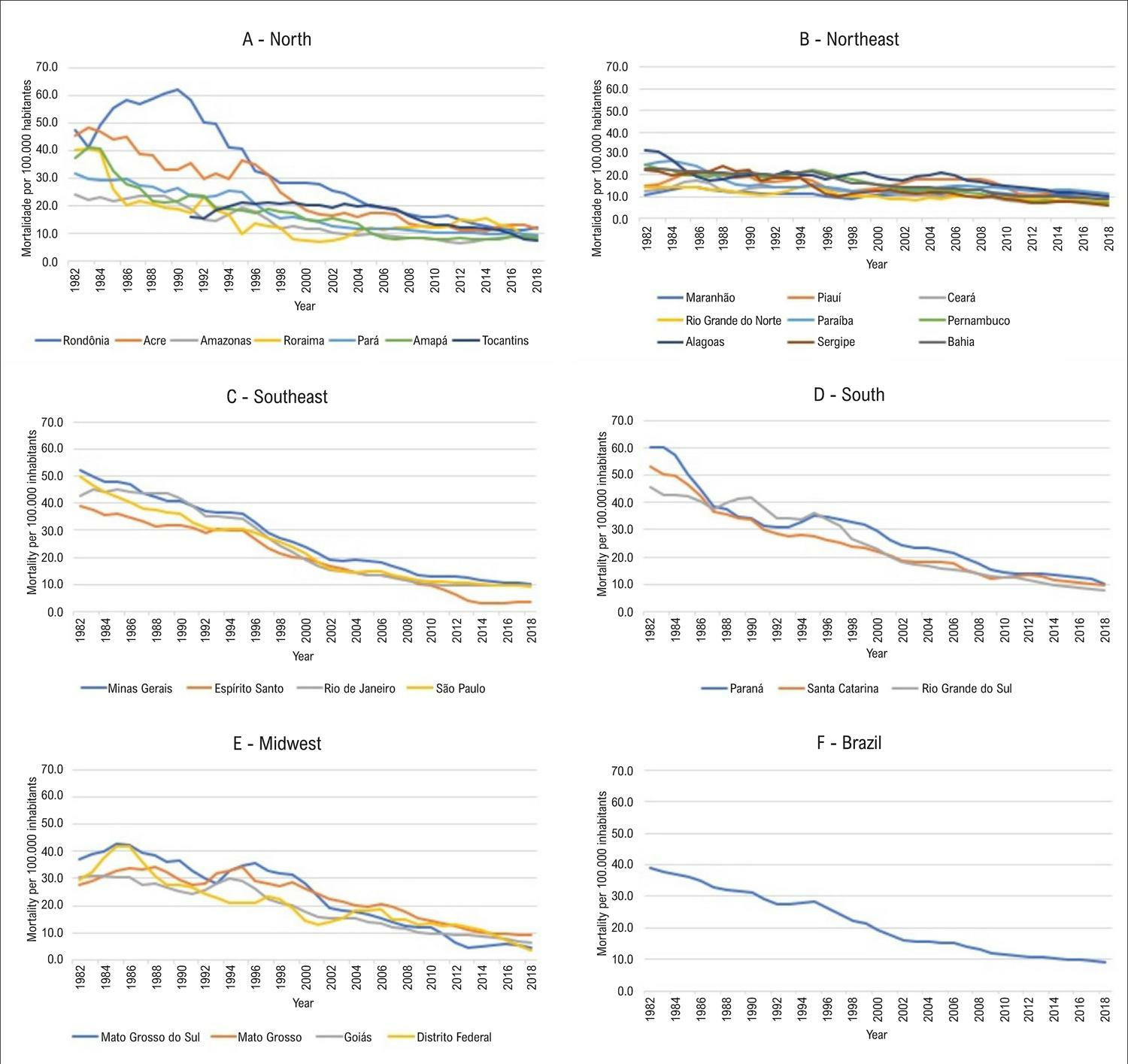
Mortality due to HF decreased in Brazil after 2008, reaching a similar level at the end of 2018 in the GRs and FUs, and was higher in men during almost all periods and age groups, except for those over the age of 60 years after 1995 in the South region. There was an inverse relationship between MHDI and reduction in mortality rates (0.73).

Conclusion

There was a progressive reduction in mortality rates due to HF in Brazil from 2008 to 2018, with similar levels in 2018 in the GRs and FUs and higher rates in men. These reductions appear to be related more to the 2010 MHDI than the percentage increase over time.

  • Development Indicators
  • Heart Failure
  • Mortality Registries
Read Full Article
Creative Commons Attribution (CC BY) Creative Commons license
08/10/2021 DOI: 10.36660/abc.20200902 Views 1

How to cite this article

EndNote RIS

Electronic Document Format (Vancouver)

Feliciano SCC, Villela PB, Oliveira GMM. Association between Mortality from Chronic Noncommunicable Diseases and Human Development Index in Brazil between 1980 and 2019. Arquivos Brasileiros de Cardiologia 2023;120(4):e20211009.

Electronic Document Format (ABNT)

Feliciano, Sandra Chagas da Costa; Villela, Paolo Blanco; Oliveira, Gláucia Maria Moraes de. Association between Mortality from Chronic Noncommunicable Diseases and Human Development Index in Brazil between 1980 and 2019. Arquivos Brasileiros de Cardiologia, v. 120, n. 4, e20211009, Apr. 2023.

Electronic Document Format (APA)

Feliciano, S. C. C., Villela, P. B., & Oliveira, G. M. M. (2023). Association between Mortality from Chronic Noncommunicable Diseases and Human Development Index in Brazil between 1980 and 2019. Arquivos Brasileiros de Cardiologia, 120(4), e20211009.

Electronic Document Format (ISO)

Feliciano, Sandra Chagas da Costa and Villela, Paolo Blanco and Oliveira, Gláucia Maria Moraes de. Association between Mortality from Chronic Noncommunicable Diseases and Human Development Index in Brazil between 1980 and 2019. Arquivos Brasileiros de Cardiologia [online]. 2023, vol. 120, n. 4, [cited 2026-10-14], e20211009. Available from: <https://journals.cardiol.br/en/article/association-between-mortality-from-chronic-noncommunicable-diseases-and-human-development-index-in-brazil-between-1980-and-2019/>. ISSN 0066-782X

EndNote RIS

Electronic Document Format (Vancouver)

Santos SC, Villela PB, Oliveira GMM. Mortality Due to Heart Failure and Socioeconomic Development in Brazil between 1980 and 2018. Arquivos Brasileiros de Cardiologia 2021;117(5):944-51.

Electronic Document Format (ABNT)

Santos, Sonia Carvalho; Villela, Paolo Blanco; Oliveira, Gláucia Maria Moraes de. Mortality Due to Heart Failure and Socioeconomic Development in Brazil between 1980 and 2018. Arquivos Brasileiros de Cardiologia, v. 117, n. 5, p. 944-951, Oct. 2021.

Electronic Document Format (APA)

Santos, S. C., Villela, P. B., & Oliveira, G. M. M. (2021). Mortality Due to Heart Failure and Socioeconomic Development in Brazil between 1980 and 2018. Arquivos Brasileiros de Cardiologia, 117(5), 944-951.

Electronic Document Format (ISO)

Santos, Sonia Carvalho and Villela, Paolo Blanco and Oliveira, Gláucia Maria Moraes de. Mortality Due to Heart Failure and Socioeconomic Development in Brazil between 1980 and 2018. Arquivos Brasileiros de Cardiologia [online]. 2021, vol. 117, n. 5, [cited 2026-10-14], pp. 944-951. Available from: <https://journals.cardiol.br/en/article/mortality-due-to-heart-failure-and-socioeconomic-development-in-brazil-between-1980-and-2018/>. ISSN 0066-782X

  • About ABC Family
  • Internal Regulation
  • Editorial Board
  • Brazilian Society of Cardiology (SBC)

Issues

SBC Guidelines

  • Videos
  • Podcasts
  • News