ABC Family Arquivos Brasileiros de Cardiologia International Journal of Cardiovascular Sciences ABC Heart Failure & Cardiomyopathy ABC Imagem Cardiovascular
Português English
ABC Family
Português English
  • About
    • About ABC Family
    • Internal Regulation
    • Editorial Board
    • Brazilian Society of Cardiology (SBC)
  • Issues
  • SBC Guidelines
  • Content
    • Videos
    • Podcasts
    • News
  • About
    • About ABC Family
    • Internal Regulation
    • Editorial Board
    • Brazilian Society of Cardiology (SBC)
  • Issues
  • SBC Guidelines
  • Content
    • Videos
    • Podcasts
    • News

ABC Family

  • ABC Family
  • Arquivos Brasileiros de Cardiologia
  • International Journal of Cardiovascular Sciences
  • ABC Heart Failure & Cardiomyopathy
  • ABC Imagem Cardiovascular
Search in

No content found.

Journals
Ordering
Article types
Others

  1. Home
  2. Keyword: Post-Exercise Hypotension
ABC
Editorial

High-intensity Interval Training versus Continuous Exercise: Is There a Difference Regarding the Magnitude of Blood Pressure Reduction?

Filipe Ferrari et al. Vítor Magnus Martins

Short Editorial related to the article Acute Effect of Interval vs. Continuous Exercise on Blood Pressure: Systematic Review and Meta-Analysis

Systemic arterial hypertension (SAH) is strongly associated with adverse cardiovascular events, including heart failure, ischemic heart disease and cerebrovascular diseases.With a high prevalence worldwide, SAH is commonly associated with risk factors such as family history, obesity, high sodium intake and physical inactivity. Therefore, it is estimated that countries such as the United States and England have 1/3 of hypertensive individuals.In Brazil, specifically in 2016, a prevalence rate > 32% of SAH (36 million) was reported in adult individuals, being > 60% in the elderly. SAH contributed, directly or indirectly, to 50% of deaths from cardiovascular diseases.

[…]

  • Arterial Pressure
  • Exercise
  • Exercise Therapy
  • Heart Failure
  • Hypertension
  • Life Style
  • Post-Exercise Hypotension
  • Risk Factors
Read Full Article
Creative Commons Attribution (CC BY) Creative Commons license
07/08/2020 DOI: 10.36660/abc.20200261 Views 1
Figure 3
ABC
Original Article

Acute Effect of Interval vs. Continuous Exercise on Blood Pressure: Systematic Review and Meta-Analysis

Raphael José Perrier-Melo et al. Eduardo Caldas Costa Breno Quintella Farah Manoel da Cunha Costa

Abstract

Background

Continuous aerobic exercise (CE) is one of the main non-pharmacological recommendations for hypertension prevention and treatment. CE is safe and effective to reduce blood pressure chronically, as well as in the first few hours after its performance, a phenomenon known as post-exercise hypotension (PEH). Interval exercise (IE) also results in PEH.

Objective

This systematic review and meta-analysis sought to compare the magnitude of PEH between CE and IE in adults.

Methods

A systematic review of studies published in journals indexed in the PubMed, Web of Knowledge, Scopus and CENTRAL databases was performed until March 2020, which compared the magnitude of PEH between CE and IE. PEH was defined as between 45-60 minutes post-exercise. The differences between groups on blood pressure were analyzed using the random effects model. Data were reported as weighted mean difference (WMD) and 95% confidence interval (CI). A p-value <0.05 was considered statistically significant. The TESTEX scale (0-15) was used to verify the methodological quality of the studies.

Results

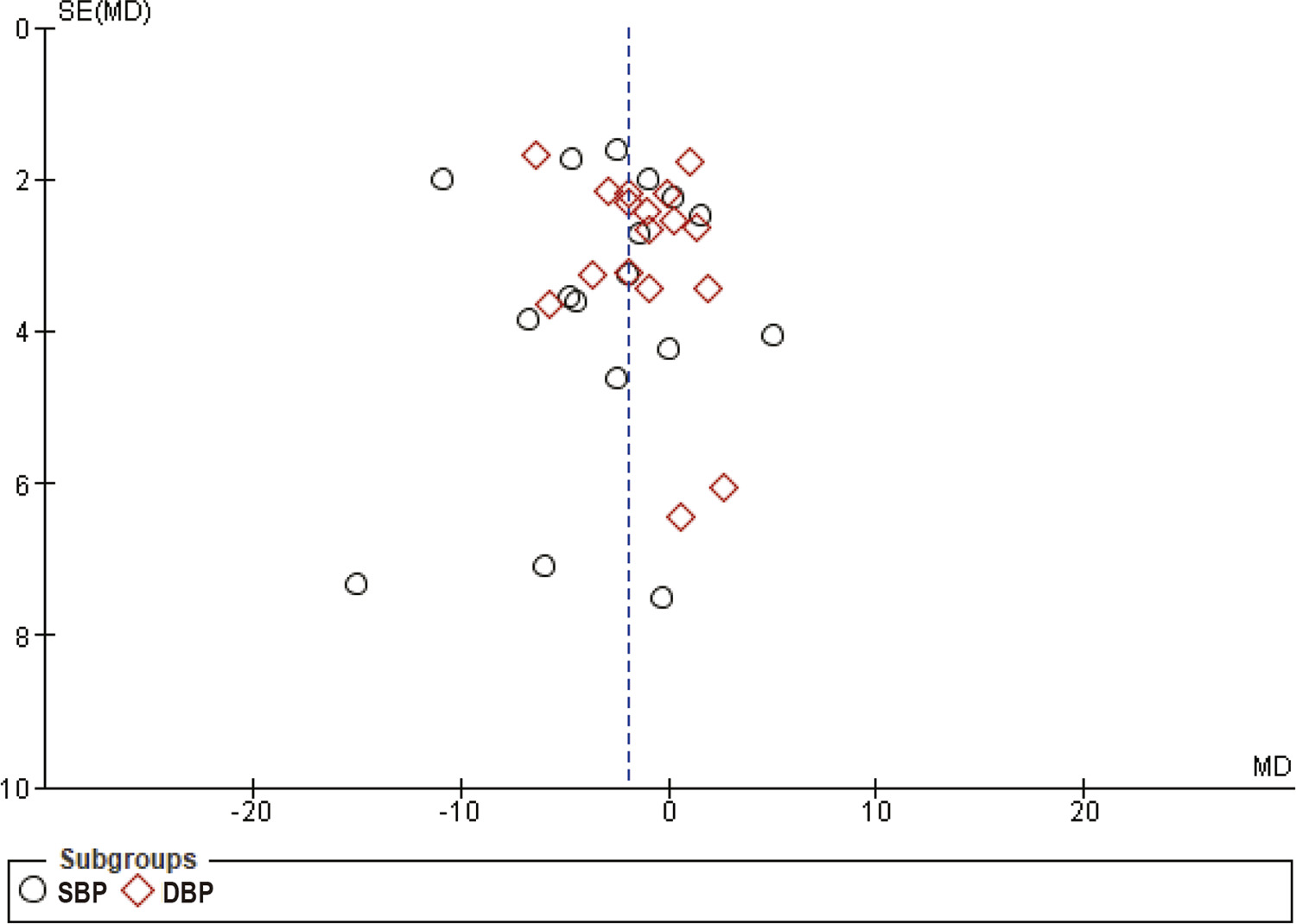
The IE showed a higher magnitude of PEH on systolic blood pressure (WMD: -2.93 mmHg [95% CI: -4.96, -0.90], p = 0.005, I2 = 50%) and diastolic blood pressure (WMD: -1,73 mmHg [IC95%: 2,94, -0,51], p= 0.005, I2= 0%) when compared to CE (12 studies, 196 participants). The scores of the studies on the TEXTEX scale varied from 10 to 11 points.

Conclusions

The IE resulted in a higher magnitude of PEH when compared to CE between 45 and 60 minutes post-exercise. The absence of adverse event data during IE and CE in the studies prevents comparisons of the safety of these strategies. (Arq Bras Cardiol. 2020; 115(1):5-14)

  • Blood Pressure
  • Exercise
  • Exercise Therapy
  • Hypertension
  • Post-Exercise Hypotension
  • Review
Read Full Article
Creative Commons Attribution (CC BY) Creative Commons license
07/08/2020 DOI: 10.36660/abc.20190107 Views 3
ABC
Editorial

Group Means and Inter-Individual Analysis in Post-exercise Hypotension: Effects of Citrulline Malate Oral Supplementation

Leandro C. Brito

Hypertension is pointed out as one of the most aggressive risk factor for cardiovascular morbidity and mortality, since it is directly associated with nearly 8 million obits per year related to cardiovascular diseases such as cardiac arrest or stroke. Hypertensives with low levels of physical activity present higher risk of cardiovascular morbidity and mortality even when receiving anti-hypertensive medication. The regular practice of exercise, mainly aerobic exercises, is highly recommended due to its hypotensive effect. Actually, a single session of exercise is already able to promote a sustained reduction of blood pressure, this phenomenon is called post-exercise hypotension (PEH).–

Kenney and Seals were the first to term the most accepted version of PEH as a phenomenon – It is the decrease of systolic and/or diastolic blood pressure after an acute session of exercise to below a control value followed by no clinical hypotensive symptom. PEH has been faced as a clinically relevant tool, mainly due to its known magnitude and for lasting many hours. In this context, a meta-analysis including 65 studies recently showed reductions of blood pressure averaging from 6/4 mmHg for systolic/diastolic after aerobic exercise session, while hour-to-hour analysis reported a decrease for 16 hours.

[…]

  • Blood Pressure
  • Cardiovascular Diseases
  • Citrulline
  • Exercise
  • Hypertension
  • Mortality & Morbidity
  • Post-Exercise Hypotension
Read Full Article
Creative Commons Attribution (CC BY) Creative Commons license
02/09/2019 DOI: 10.5935/abc.20190152
Figure 1
IJCS
Original Article

Hypotensive Response to Continuous Aerobic and High-Intensity Interval Exercise Matched by Volume in Sedentary Subjects

Francesco Pinto Boeno et al. Thiago Rozales Ramis Juliano Boufleur Farinha Cesar Moritz … Vagner Pereira dos Santos Alvaro Reischak de Oliveira Bruno Costa Teixeira

Abstract

Background:

Systemic arterial hypertension (SAH) is one of the main risk factors for heart disease. Among the benefits linked to different modalities of physical exercise, post-exercise hypotension (PEH) is a key point for exercise prescription in this condition.

Objective:

To investigate and compare PEH in response to continuous aerobic exercise (CONT) and high-intensity interval exercise (HIIE), matched by volume, in sedentary individuals.

Methods:

A randomized cross-over study, composed of sedentary, healthy male subjects submitted to two acute physical exercise protocols matched by volume, HIIE and CONT, on a treadmill. Hemodynamic measures for the evaluation of PEH were performed pre, immediately after exercise and every five minutes thereafter, during one hour of recovery. Two-way ANOVA with repeated measurements was used for comparisons between groups and Bonferroni post hoc test as appropriate. P < 0.05 was considered significant.

Results:

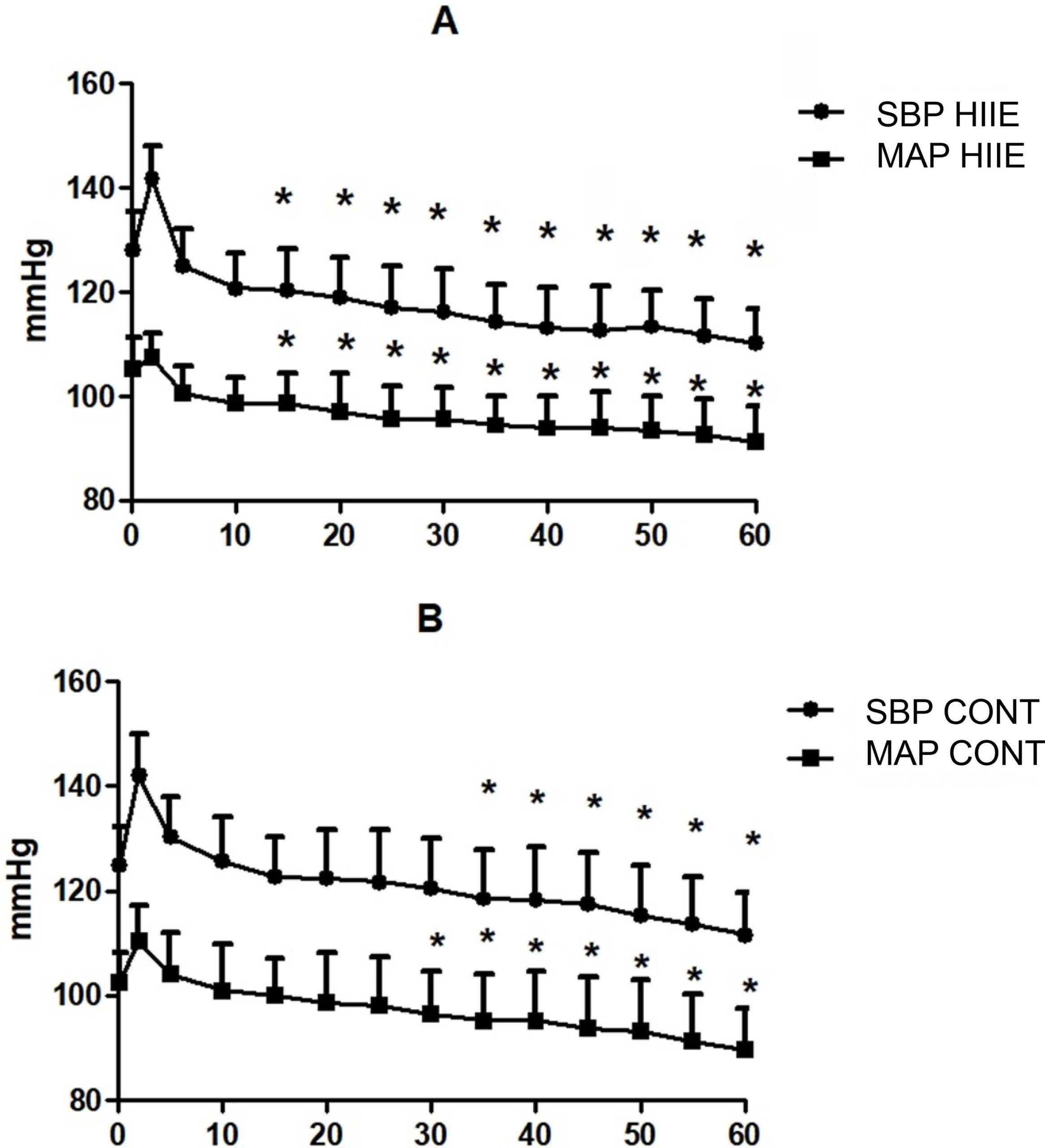
Both exercise protocols promoted significant PEH, with reductions in systolic blood pressure (SBP) and mean arterial pressure (MAP). HIIE promoted a reduction of SBP and MAP at the 15th minute, whereas the same effect was observed at the 30th following CONT.

Conclusion:

Both HIIE and CONT, matched by volume, promote PEH of similar magnitude. However, PEH occurs earlier following HIIE, suggesting a better time / effectiveness ratio, and an additional beneficial effect of this modality.

  • Adherence Guidelines
  • Blood Pressure
  • Cardiomegaly
  • Exercise
  • High-Intensity Interval Exercise
  • Hypertensio/physiopathology
  • Post-Exercise Hypotension
  • Sedentarsm
Read Full Article
Creative Commons Attribution (CC BY) Creative Commons license
01/01/2019 DOI: 10.5935/2359-4802.20180084 Views 1
Chart 1
ABC
Review Article

Acute Effects of Exercise on Blood Pressure: A Meta-Analytic Investigation

Elizabeth Carpio-Rivera et al. José Moncada-Jiménez Walter Salazar-Rojas Andrea Solera-Herrera

Abstract

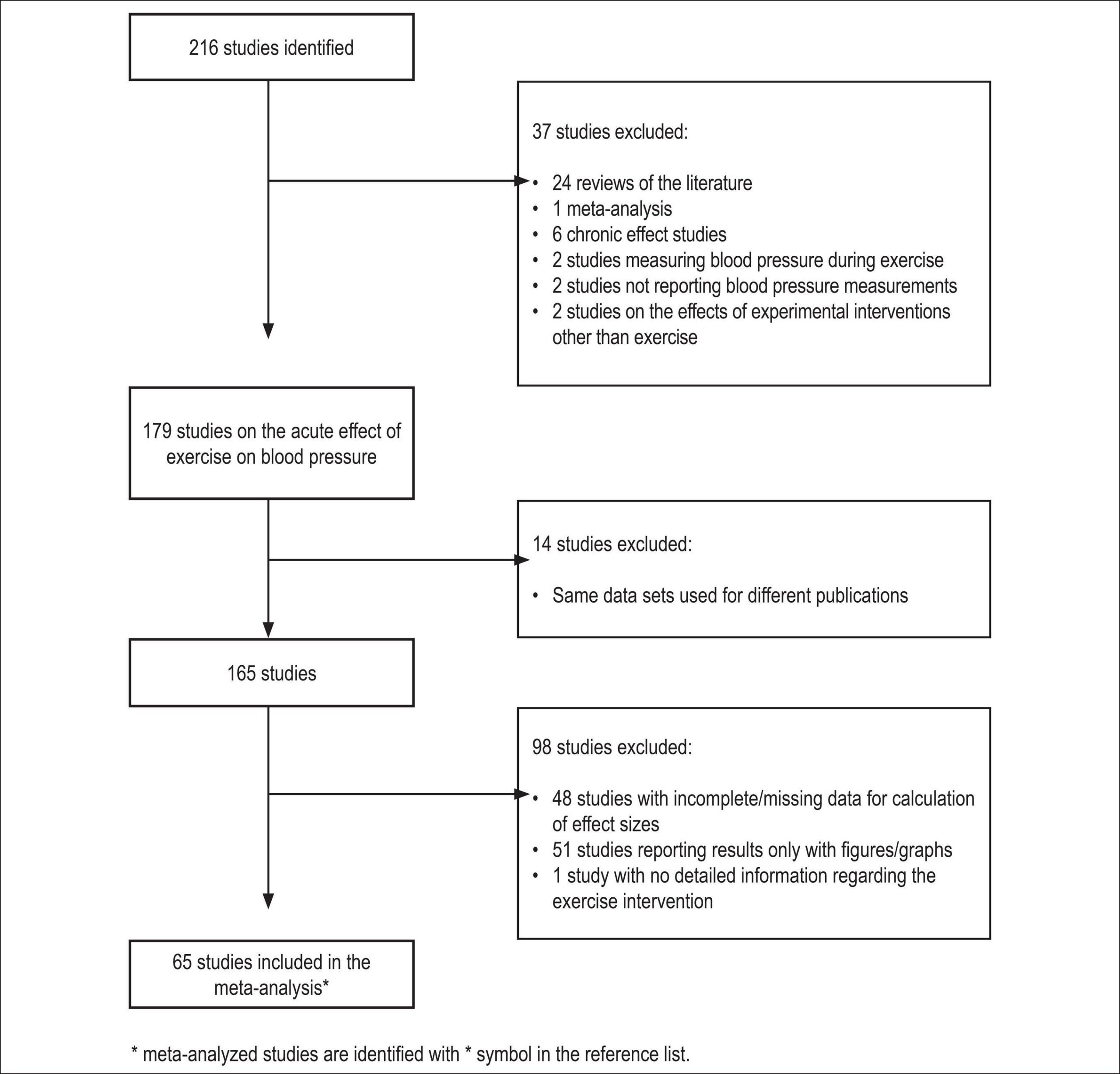
Hypertension affects 25% of the world’s population and is considered a risk factor for cardiovascular disorders and other diseases. The aim of this study was to examine the evidence regarding the acute effect of exercise on blood pressure (BP) using meta-analytic measures. Sixty-five studies were compared using effect sizes (ES), and heterogeneity and Z tests to determine whether the ES were different from zero. The mean corrected global ES for exercise conditions were -0.56 (-4.80 mmHg) for systolic BP (sBP) and -0.44 (-3.19 mmHg) for diastolic BP (dBP; z ≠ 0 for all; p < 0.05). The reduction in BP was significant regardless of the participant’s initial BP level, gender, physical activity level, antihypertensive drug intake, type of BP measurement, time of day in which the BP was measured, type of exercise performed, and exercise training program (p < 0.05 for all). ANOVA tests revealed that BP reductions were greater if participants were males, not receiving antihypertensive medication, physically active, and if the exercise performed was jogging. A significant inverse correlation was found between age and BP ES, body mass index (BMI) and sBP ES, duration of the exercise’s session and sBP ES, and between the number of sets performed in the resistance exercise program and sBP ES (p < 0.05). Regardless of the characteristics of the participants and exercise, there was a reduction in BP in the hours following an exercise session. However, the hypotensive effect was greater when the exercise was performed as a preventive strategy in those physically active and without antihypertensive medication.

  • Acute effect
  • Blood Pressure
  • Meta-Analysis
  • Physical activity
  • Post-Exercise Hypotension
  • Training
Read Full Article
Creative Commons Attribution (CC BY) Creative Commons license
06/05/2016 DOI: 10.5935/abc.20160064 Views 1
ABC
Original Article

Hypotensive Response Magnitude and Duration in Hypertensives: Continuous and Interval Exercise

Raphael Santos Teodoro de Carvalho et al. Cássio Mascarenhas Robert Pires Gustavo Cardoso Junqueira Dayana Freitas Leila Maria Marchi-Alves

Background:

Although exercise training is known to promote post-exercise hypotension, there is currently no consistent argument about the effects of manipulating its various components (intensity, duration, rest periods, types of exercise, training methods) on the magnitude and duration of hypotensive response.

Objective:

To compare the effect of continuous and interval exercises on hypotensive response magnitude and duration in hypertensive patients by using ambulatory blood pressure monitoring (ABPM).

Methods:

The sample consisted of 20 elderly hypertensives. Each participant underwent three ABPM sessions: one control ABPM, without exercise; one ABPM after continuous exercise; and one ABPM after interval exercise. Systolic blood pressure (SBP), diastolic blood pressure (DBP), mean arterial pressure (MAP), heart rate (HR) and double product (DP) were monitored to check post-exercise hypotension and for comparison between each ABPM.

Results:

ABPM after continuous exercise and after interval exercise showed post-exercise hypotension and a significant reduction (p < 0.05) in SBP, DBP, MAP and DP for 20 hours as compared with control ABPM. Comparing ABPM after continuous and ABPM after interval exercise, a significant reduction (p < 0.05) in SBP, DBP, MAP and DP was observed in the latter.

Conclusion:

Continuous and interval exercise trainings promote post-exercise hypotension with reduction in SBP, DBP, MAP and DP in the 20 hours following exercise. Interval exercise training causes greater post-exercise hypotension and lower cardiovascular overload as compared with continuous exercise.

  • Ambulatory
  • Blood Pressure
  • blood pressure monitoring
  • Exercise
  • Hypertension
  • Post-Exercise Hypotension
Read Full Article
Creative Commons Attribution (CC BY) Creative Commons license
16/12/2014 DOI: 10.5935/abc.20140193 Views 1
ABC
Artigo Original

Exercise duration determines the magnitude and duration of post-exercise hypotension

Cláudia Lúcia de Moraes Forjaz et al. Danilo Forghieri Santaella Liliane Onda Rezende Antonio Carlos Pereira Barretto Carlos Eduardo Negrão

PURPOSE: Considering that exercise duration may play a role in post-exercise hypotension, we tested the hypothesis that a prolonged submaximal exercise would lead to a greater and longer blood pressure fall after exercise than a shorter exercise bout. METHODS: Experimental protocol – 10 subjects were submitted to two cycle ergometer exercise trials (25 and 45min) at 50% of VO2 peak. Control protocol – 12 subjects rested in the sitting position for 45min. Blood pressure (BP) was measured before (20min) and after (90min) rest or exercise bouts. RESULTS: Systolic BP decreased significantly after exercise and this reduction was greater and lasted longer after 45min of exercise. Mean and diastolic BP decreased after exercise and they were significantly lower during the 45min session. Control protocol – no change in BP was observed after resting condition. CONCLUSION: A longer exercise bout leads to a greater and longer post-exercise hypotension.

  • exercise duration
  • Post-Exercise Hypotension
Read Full Article
Creative Commons Attribution (CC BY) Creative Commons license
08/01/2002 DOI: 10.1590/S0066-782X1998000200006

How to cite this article

EndNote RIS

Electronic Document Format (Vancouver)

Ferrari F, Martins VM. High-intensity Interval Training versus Continuous Exercise: Is There a Difference Regarding the Magnitude of Blood Pressure Reduction?. Arquivos Brasileiros de Cardiologia 2020;115(1):15-6.

Electronic Document Format (ABNT)

Ferrari, Filipe; Martins, Vítor Magnus. High-intensity Interval Training versus Continuous Exercise: Is There a Difference Regarding the Magnitude of Blood Pressure Reduction?. Arquivos Brasileiros de Cardiologia, v. 115, n. 1, p. 15-16, Aug. 2020.

Electronic Document Format (APA)

Ferrari, F., & Martins, V. M. (2020). High-intensity Interval Training versus Continuous Exercise: Is There a Difference Regarding the Magnitude of Blood Pressure Reduction?. Arquivos Brasileiros de Cardiologia, 115(1), 15-16.

Electronic Document Format (ISO)

Ferrari, Filipe and Martins, Vítor Magnus. High-intensity Interval Training versus Continuous Exercise: Is There a Difference Regarding the Magnitude of Blood Pressure Reduction?. Arquivos Brasileiros de Cardiologia [online]. 2020, vol. 115, n. 1, [cited 2026-10-14], pp. 15-16. Available from: <https://journals.cardiol.br/en/article/high-intensity-interval-training-versus-continuous-exercise-is-there-a-difference-regarding-the-magnitude-of-blood-pressure-reduction/>. ISSN 0066-782X

EndNote RIS

Electronic Document Format (Vancouver)

Perrier-Melo RJ, Costa EC, Farah BQ, Costa MC. Acute Effect of Interval vs. Continuous Exercise on Blood Pressure: Systematic Review and Meta-Analysis. Arquivos Brasileiros de Cardiologia 2020;115(1):5-14.

Electronic Document Format (ABNT)

Perrier-Melo, Raphael José; Costa, Eduardo Caldas; Farah, Breno Quintella; Costa, Manoel da Cunha. Acute Effect of Interval vs. Continuous Exercise on Blood Pressure: Systematic Review and Meta-Analysis. Arquivos Brasileiros de Cardiologia, v. 115, n. 1, p. 5-14, Aug. 2020.

Electronic Document Format (APA)

Perrier-Melo, R. J., Costa, E. C., Farah, B. Q., & Costa, M. C. (2020). Acute Effect of Interval vs. Continuous Exercise on Blood Pressure: Systematic Review and Meta-Analysis. Arquivos Brasileiros de Cardiologia, 115(1), 5-14.

Electronic Document Format (ISO)

Perrier-Melo, Raphael José and Costa, Eduardo Caldas and Farah, Breno Quintella and Costa, Manoel da Cunha. Acute Effect of Interval vs. Continuous Exercise on Blood Pressure: Systematic Review and Meta-Analysis. Arquivos Brasileiros de Cardiologia [online]. 2020, vol. 115, n. 1, [cited 2026-10-14], pp. 5-14. Available from: <https://journals.cardiol.br/en/article/acute-effect-of-interval-vs-continuous-exercise-on-blood-pressure-systematic-review-and-meta-analysis/>. ISSN 0066-782X

EndNote RIS

Electronic Document Format (Vancouver)

Brito LC. Group Means and Inter-Individual Analysis in Post-exercise Hypotension: Effects of Citrulline Malate Oral Supplementation. Arquivos Brasileiros de Cardiologia 2019;113(2):229-30.

Electronic Document Format (ABNT)

Brito, Leandro C.. Group Means and Inter-Individual Analysis in Post-exercise Hypotension: Effects of Citrulline Malate Oral Supplementation. Arquivos Brasileiros de Cardiologia, v. 113, n. 2, p. 229-230, Sep. 2019.

Electronic Document Format (APA)

Brito, L. C. (2019). Group Means and Inter-Individual Analysis in Post-exercise Hypotension: Effects of Citrulline Malate Oral Supplementation. Arquivos Brasileiros de Cardiologia, 113(2), 229-230.

Electronic Document Format (ISO)

Brito, Leandro C.. Group Means and Inter-Individual Analysis in Post-exercise Hypotension: Effects of Citrulline Malate Oral Supplementation. Arquivos Brasileiros de Cardiologia [online]. 2019, vol. 113, n. 2, [cited 2026-10-14], pp. 229-230. Available from: <https://journals.cardiol.br/en/article/group-means-and-inter-individual-analysis-in-post-exercise-hypotension-effects-of-citrulline-malate-oral-supplementation/>. ISSN 0066-782X

EndNote RIS

Electronic Document Format (Vancouver)

Boeno FP, Ramis TR, Farinha JB, Moritz C, Santos VP, Oliveira AR, Teixeira BC, et al. Hypotensive Response to Continuous Aerobic and High-Intensity Interval Exercise Matched by Volume in Sedentary Subjects. International Journal of Cardiovascular Sciences 2019;32(1):48-54.

Electronic Document Format (ABNT)

Boeno, Francesco Pinto; Ramis, Thiago Rozales; Farinha, Juliano Boufleur; Moritz, Cesar; Santos, Vagner Pereira dos; Oliveira, Alvaro Reischak de; Teixeira, Bruno Costa. Hypotensive Response to Continuous Aerobic and High-Intensity Interval Exercise Matched by Volume in Sedentary Subjects. International Journal of Cardiovascular Sciences, v. 32, n. 1, p. 48-54, Dec. 2018.

Electronic Document Format (APA)

Boeno, F. P., Ramis, T. R., Farinha, J. B., Moritz, C., Santos, V. P. , Oliveira, A. R. , & Teixeira, B. C. (2019). Hypotensive Response to Continuous Aerobic and High-Intensity Interval Exercise Matched by Volume in Sedentary Subjects. International Journal of Cardiovascular Sciences, 32(1), 48-54.

Electronic Document Format (ISO)

Boeno, Francesco Pinto and Ramis, Thiago Rozales and Farinha, Juliano Boufleur and Moritz, Cesar and Santos, Vagner Pereira dos and Oliveira, Alvaro Reischak de and Teixeira, Bruno Costa. Hypotensive Response to Continuous Aerobic and High-Intensity Interval Exercise Matched by Volume in Sedentary Subjects. International Journal of Cardiovascular Sciences [online]. 2019, vol. 32, n. 1, [cited 2026-10-14], pp. 48-54. Available from: <https://journals.cardiol.br/en/article/hypotensive-response-to-continuous-aerobic-and-high-intensity-interval-exercise-matched-by-volume-in-sedentary-subjects/>. ISSN 2359-4802

EndNote RIS

Electronic Document Format (Vancouver)

Carpio-Rivera E, Moncada-Jiménez J, Salazar-Rojas W, Solera-Herrera A. Acute Effects of Exercise on Blood Pressure: A Meta-Analytic Investigation. Arquivos Brasileiros de Cardiologia 2016;106(5):422-33.

Electronic Document Format (ABNT)

Carpio-Rivera, Elizabeth; Moncada-Jiménez, José; Salazar-Rojas, Walter; Solera-Herrera, Andrea. Acute Effects of Exercise on Blood Pressure: A Meta-Analytic Investigation. Arquivos Brasileiros de Cardiologia, v. 106, n. 5, p. 422-433, May. 2016.

Electronic Document Format (APA)

Carpio-Rivera, E., Moncada-Jiménez, J., Salazar-Rojas, W., & Solera-Herrera, A. (2016). Acute Effects of Exercise on Blood Pressure: A Meta-Analytic Investigation. Arquivos Brasileiros de Cardiologia, 106(5), 422-433.

Electronic Document Format (ISO)

Carpio-Rivera, Elizabeth and Moncada-Jiménez, José and Salazar-Rojas, Walter and Solera-Herrera, Andrea. Acute Effects of Exercise on Blood Pressure: A Meta-Analytic Investigation. Arquivos Brasileiros de Cardiologia [online]. 2016, vol. 106, n. 5, [cited 2026-10-14], pp. 422-433. Available from: <https://journals.cardiol.br/en/article/acute-effects-of-exercise-on-blood-pressure-a-meta-analytic-investigation/>. ISSN 0066-782X

EndNote RIS

Electronic Document Format (Vancouver)

Carvalho RST, Pires CMR, Junqueira GC, Freitas D, Marchi-Alves LM. Hypotensive Response Magnitude and Duration in Hypertensives: Continuous and Interval Exercise. Arquivos Brasileiros de Cardiologia 2014;104(3):234-41.

Electronic Document Format (ABNT)

Carvalho, Raphael Santos Teodoro de; Pires, Cássio Mascarenhas Robert; Junqueira, Gustavo Cardoso; Freitas, Dayana; Marchi-Alves, Leila Maria. Hypotensive Response Magnitude and Duration in Hypertensives: Continuous and Interval Exercise. Arquivos Brasileiros de Cardiologia, v. 104, n. 3, p. 234-241, Dec. 2014.

Electronic Document Format (APA)

Carvalho, R. S. T. , Pires, C. M. R., Junqueira, G. C., Freitas, D., & Marchi-Alves, L. M. (2014). Hypotensive Response Magnitude and Duration in Hypertensives: Continuous and Interval Exercise. Arquivos Brasileiros de Cardiologia, 104(3), 234-241.

Electronic Document Format (ISO)

Carvalho, Raphael Santos Teodoro de and Pires, Cássio Mascarenhas Robert and Junqueira, Gustavo Cardoso and Freitas, Dayana and Marchi-Alves, Leila Maria. Hypotensive Response Magnitude and Duration in Hypertensives: Continuous and Interval Exercise. Arquivos Brasileiros de Cardiologia [online]. 2014, vol. 104, n. 3, [cited 2026-10-14], pp. 234-241. Available from: <https://journals.cardiol.br/en/article/hypotensive-response-magnitude-and-duration-in-hypertensives-continuous-and-interval-exercise/>. ISSN 0066-782X

EndNote RIS

Electronic Document Format (Vancouver)

Forjaz CLM, Santaella DF, Rezende LO, Barretto ACP, Negrão CE. Exercise duration determines the magnitude and duration of post-exercise hypotension. Arquivos Brasileiros de Cardiologia 2002;70(2):99-104.

Electronic Document Format (ABNT)

Forjaz, Cláudia Lúcia de Moraes; Santaella, Danilo Forghieri; Rezende, Liliane Onda; Barretto, Antonio Carlos Pereira; Negrão, Carlos Eduardo. Exercise duration determines the magnitude and duration of post-exercise hypotension. Arquivos Brasileiros de Cardiologia, v. 70, n. 2, p. 99-104, Jan. 2002.

Electronic Document Format (APA)

Forjaz, C. L. M., Santaella, D. F., Rezende, L. O., Barretto, A. C. P., & Negrão, C. E. (2002). Exercise duration determines the magnitude and duration of post-exercise hypotension. Arquivos Brasileiros de Cardiologia, 70(2), 99-104.

Electronic Document Format (ISO)

Forjaz, Cláudia Lúcia de Moraes and Santaella, Danilo Forghieri and Rezende, Liliane Onda and Barretto, Antonio Carlos Pereira and Negrão, Carlos Eduardo. Exercise duration determines the magnitude and duration of post-exercise hypotension. Arquivos Brasileiros de Cardiologia [online]. 2002, vol. 70, n. 2, [cited 2026-10-14], pp. 99-104. Available from: <https://journals.cardiol.br/en/article/exercise-duration-determines-the-magnitude-and-duration-of-post-exercise-hypotension/>. ISSN 0066-782X

  • About ABC Family
  • Internal Regulation
  • Editorial Board
  • Brazilian Society of Cardiology (SBC)

Issues

SBC Guidelines

  • Videos
  • Podcasts
  • News