ABC Family Arquivos Brasileiros de Cardiologia International Journal of Cardiovascular Sciences ABC Heart Failure & Cardiomyopathy ABC Imagem Cardiovascular
Português English
ABC Family
Português English
  • About
    • About ABC Family
    • Internal Regulation
    • Editorial Board
    • Brazilian Society of Cardiology (SBC)
  • Issues
  • SBC Guidelines
  • Content
    • Videos
    • Podcasts
    • News
  • About
    • About ABC Family
    • Internal Regulation
    • Editorial Board
    • Brazilian Society of Cardiology (SBC)
  • Issues
  • SBC Guidelines
  • Content
    • Videos
    • Podcasts
    • News

ABC Family

  • ABC Family
  • Arquivos Brasileiros de Cardiologia
  • International Journal of Cardiovascular Sciences
  • ABC Heart Failure & Cardiomyopathy
  • ABC Imagem Cardiovascular
Search in

No content found.

Journals
Ordering
Article types
Others

  1. Home
  2. Keyword: antropometry
Figure 1
ABC
Original Article

Cardiovascular Risk Factors in Cardiology Specialists from the Brazilian Society of Cardiology

Maria Emília Figueiredo Teixeira et al. Priscila Valverde de O. Vitorino Celso Amodeo Tânia Martinez … Andréa Araujo Brandão Eduardo Costa Duarte Barbosa Audes Diógenes Magalhães Feitosa Paulo Cesar B. Veiga Jardim Ana Luiza Lima Souza Weimar Kunz Sebba Barroso

Abstract

Background:

A major cause of death worldwide, cardiovascular diseases and their prevalence in cardiologists are little known.

Objectives:

To describe life habits and cardiovascular risk factors (CVRF) and to investigate the prevalence of diagnosis, awareness, and control of these CVRF among cardiologists members affiliated to and specialists from the Brazilian Society of Cardiology.

Methods:

National multicenter cross-sectional study to assess Brazilian cardiologists using a questionnaire on life habits, preexisting diseases, current medications, anthropometric measurements, blood pressure, and levels of glucose and lipids.

Results:

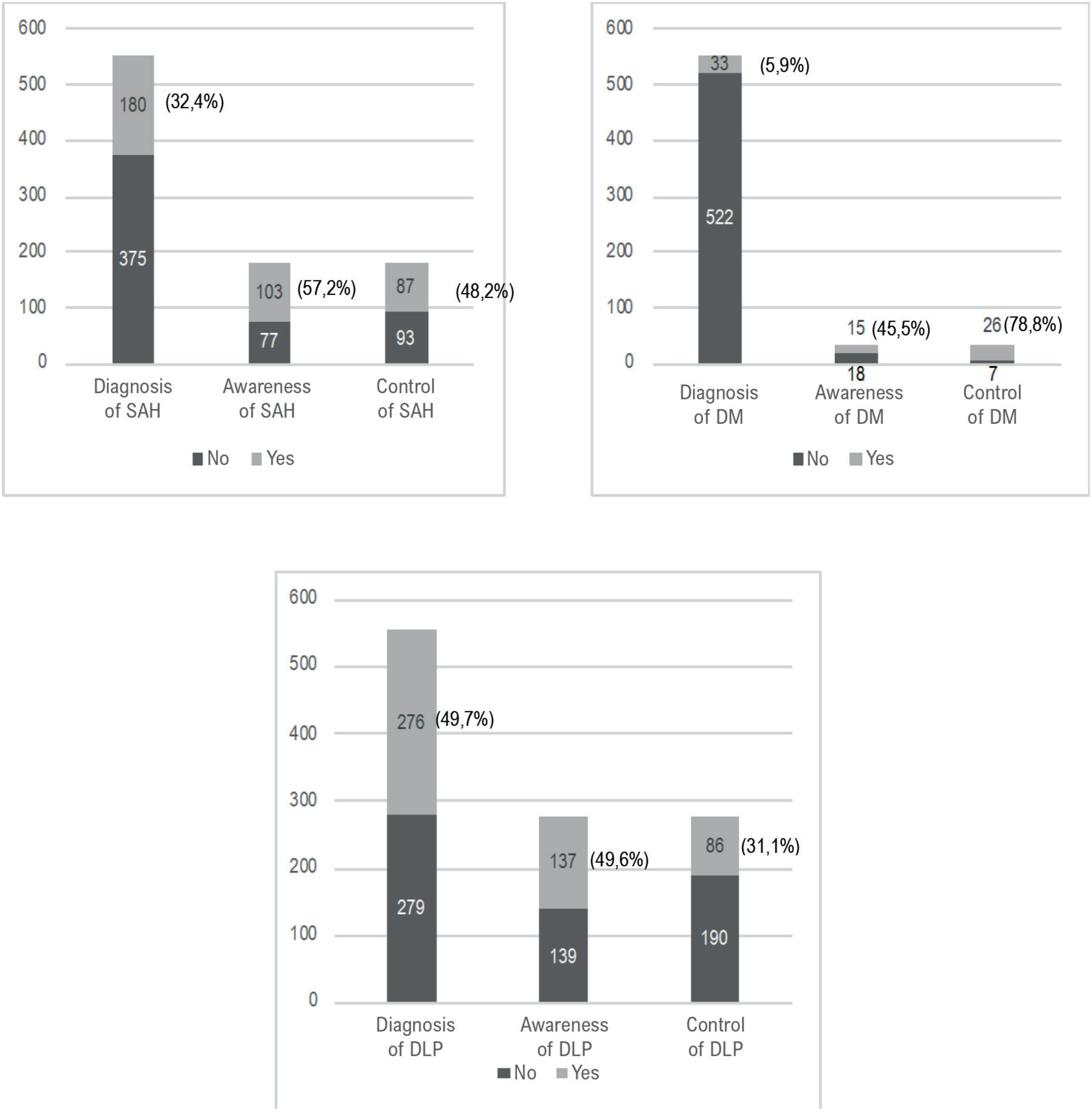
A total of 555 cardiologists were evaluated, of which 67.9% were male, with a mean age of 47.2±11.7 years. Most were non-smoker (88.7%) and physically active (77.1%), consumed alcohol (78.2%), had normal weight circumference (51.7%), and were overweight (56.1%). The prevalence of systemic arterial hypertension (SAH), diabetes mellitus (DM), and dyslipidemia (DLP) were 32.4%, 5.9%, and 49.7%, respectively, of which only 57.2%, 45.5%, and 49.6%, respectively, were aware of the diseases.

Conclusions:

The Brazilian cardiologists participating in the study had a high prevalence of SAH, DM and DLP, but only a half of participants were aware of these conditions and, among these, the rates of controlled disease were low for SAH and DLP, although cardiologists are professionals with great knowledge about these CVRF. These findings represent a warning sign for the approach of CVRF in Brazilian cardiologists and encourage the conduction of future studies.
  • antropometry
  • Cardiologists
  • Cardiovascular Diseases
  • Diabetes Mellitus
  • Dsylipidemias
  • Hypertension
  • Life Style
  • Risk Factors
Read Full Article
Creative Commons Attribution (CC BY) Creative Commons license
16/04/2021 DOI: 10.36660/abc.20200125
Different measurements of the sagittal abdominal diameter and waist perimeter in the prediction of HOMA-IR
ABC
Artigo Original

Different measurements of the sagittal abdominal diameter and waist perimeter in the prediction of HOMA-IR

Ana Carolina Junqueira Vasques et al. Lina Enriqueta Frandsen Paez de Lima Rosado Gilberto Paixão Rosado Rita de Cassia Lanes Ribeiro … Sylvia do Carmo Castro Franceschini Bruno Geloneze Silvia Eloiza Priore Dirce Ribeiro de Oliveira

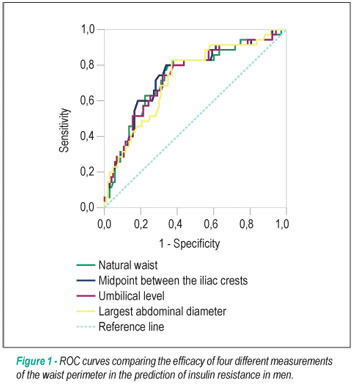
BACKGROUND: The correlation between the increase in visceral fat and insulin resistance makes the sagittal abdominal diameter and the waist perimeter as potential tools for the prediction of insulin resistance. OBJECTIVE: To assess the reproducibility of different measurements of the sagittal abdominal diameter and the waist perimeter and analyze the discriminating power of the measurements when predicting insulin resistance. METHODS: A total of 190 adult males were studied. The sagittal abdominal diameter (smallest girth, larger abdominal diameter, umbilical level and midpoint between the iliac crests) and the waist perimeter (umbilical level, smallest girth, immediately above the iliac crest and midpoint between the iliac crest and the last rib) were measured at four different sites. Insulin resistance was assessed by the homeostasis model of assessment-insulin resistance (HOMA-IR) index. RESULTS: All measurements presented an intraclass correlation of 0.986-0.999. The sagittal abdominal diameter measured at the smallest girth (r=0.482 and AUC=0.739±0.049) and the waist perimeter measured at the midpoint between the last rib and the iliac crest (r=0.464 and AUC=0.746±0.05) presented the highest correlations with the HOMA-IR and the best discriminating power for HOMA-IR according to the ROC analysis (p<0.001). CONCLUSION: The sagittal abdominal diameter and waist perimeter showed to be highly reproducible and the sagittal abdominal diameter (smallest girth) and waist perimeter (midpoint between the iliac crest and the last rib) presented the best performance when predicting HOMA-IR. Further studies in other groups of the Brazilian population must be carried out to allow the use of these indicators of insulin resistance in the population as a whole, following standardized procedures.

  • abdominal circunference
  • Abdominal Fat
  • antropometry
  • Insulin Resistance
  • Obesity
Read Full Article
Creative Commons Attribution (CC BY) Creative Commons license
09/10/2009 DOI: 10.1590/S0066-782X2009005000001 Views 1
Obesity and coronary intervention: should we continue to use Body Mass Index as a risk factor?
ABC
Artigo Original

Obesity and coronary intervention: should we continue to use Body Mass Index as a risk factor?

José Carlos Estival Tarastchuk et al. Ênio Eduardo Guérios Ronaldo da Rocha Loures Bueno Paulo Maurício Piá de Andrade … Deborah Christina Nercolini João Gustavo Gongora Ferraz Eduardo Doubrawa

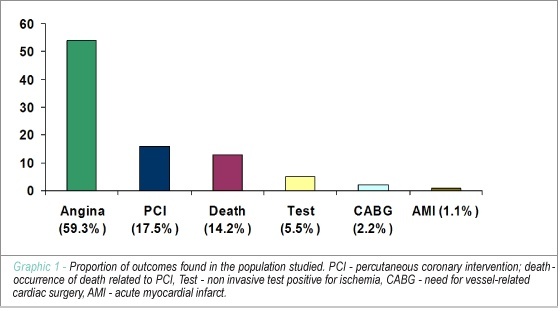
BACKGROUND: Central anthropometric indexes are better than the body mass index to discriminate elevated coronary risk. However, the Body Mass Index (BMI) is still the most frequently studied anthropometric index on outcomes of patients undergoing percutaneous coronary angioplasty (PCI). OBJECTIVE: To recognize, among several anthropometric indexes of obesity, which one best discriminates MACE (Major Adverse Cardiac Events) after PCI. METHODS: Subjects were 308 patients (mean age 61.92±11.06 years, 60.7% of them men) who had undergone successful coronary angioplasties. Six months after the procedure, patients were contacted for clinical follow-up. Major Adverse Cardiac Events included death, acute myocardial infarction, cardiac surgery, reintervention, angina, or evidence of myocardial ischemia on a non-invasive test. Patients were divided into 2 groups: Group 1 (with MACE, n=91, 29.5%), Group 2 (with no MACE, n= 217; 70.45%). For men and women, the anthropometric indexes studied and their respective cut-off points were waist circumference >90/80 cm, Waist-Hip Ratio > 0.90/0.80cm, Conicity Index > 1.25/1.18, and Body Mass Index > 30. RESULTS: There were more cases of familial history and previous infarct in Group 2. For men, waist circumference >90cm (p=0.0498) in multivariate analyses was an independent predictor of MACE. BMI was not related to MACE. In Group 1, the prevalence of an elevated BMI was significantly different compared to the other anthropometric indexes studied (p<0.0001). CONCLUSION: Waist circumference was an independent predictor of MACE in men. Body Mass Index was not related to MACE and was the least frequent anthropometric index in the MACE group.

  • Angioplasty transluminal percutaneous coronary
  • antropometry
  • body mass index
  • Obesity
Read Full Article
Creative Commons Attribution (CC BY) Creative Commons license
27/05/2008 DOI: 10.1590/S0066-782X2008000500001

How to cite this article

EndNote RIS

Electronic Document Format (Vancouver)

Teixeira MEF, Vitorino PVO, Amodeo C, Martinez T, Brandão AA, Barbosa ECD, Feitosa ADM, et al. Cardiovascular Risk Factors in Cardiology Specialists from the Brazilian Society of Cardiology. Arquivos Brasileiros de Cardiologia 2021;116(4):774-81.

Electronic Document Format (ABNT)

Teixeira, Maria Emília Figueiredo; Vitorino, Priscila Valverde de O.; Amodeo, Celso; Martinez, Tânia; Brandão, Andréa Araujo; Barbosa, Eduardo Costa Duarte; Feitosa, Audes Diógenes Magalhães; Jardim, Paulo Cesar B. Veiga; Souza, Ana Luiza Lima; Barroso, Weimar Kunz Sebba. Cardiovascular Risk Factors in Cardiology Specialists from the Brazilian Society of Cardiology. Arquivos Brasileiros de Cardiologia, v. 116, n. 4, p. 774-781, Apr. 2021.

Electronic Document Format (APA)

Teixeira, M. E. F., Vitorino, P. V. O., Amodeo, C., Martinez, T., Brandão, A. A., Barbosa, E. C. D., Feitosa, A. D. M., Jardim, P. C. B. V., Souza, A. L. L., & Barroso, W. K. S. (2021). Cardiovascular Risk Factors in Cardiology Specialists from the Brazilian Society of Cardiology. Arquivos Brasileiros de Cardiologia, 116(4), 774-781.

Electronic Document Format (ISO)

Teixeira, Maria Emília Figueiredo and Vitorino, Priscila Valverde de O. and Amodeo, Celso and Martinez, Tânia and Brandão, Andréa Araujo and Barbosa, Eduardo Costa Duarte and Feitosa, Audes Diógenes Magalhães and Jardim, Paulo Cesar B. Veiga and Souza, Ana Luiza Lima and Barroso, Weimar Kunz Sebba. Cardiovascular Risk Factors in Cardiology Specialists from the Brazilian Society of Cardiology. Arquivos Brasileiros de Cardiologia [online]. 2021, vol. 116, n. 4, [cited 2026-10-14], pp. 774-781. Available from: <https://journals.cardiol.br/en/article/cardiovascular-risk-factors-in-cardiology-specialists-from-the-brazilian-society-of-cardiology/>. ISSN 0066-782X

EndNote RIS

Electronic Document Format (Vancouver)

Vasques ACJ, Rosado LEFPL, Rosado GP, Ribeiro RCL, Franceschini SCC, Geloneze B, Priore SE, et al. Different measurements of the sagittal abdominal diameter and waist perimeter in the prediction of HOMA-IR. Arquivos Brasileiros de Cardiologia 2009;93(5):511-8.

Electronic Document Format (ABNT)

Vasques, Ana Carolina Junqueira; Rosado, Lina Enriqueta Frandsen Paez de Lima; Rosado, Gilberto Paixão; Ribeiro, Rita de Cassia Lanes; Franceschini, Sylvia do Carmo Castro; Geloneze, Bruno; Priore, Silvia Eloiza; Oliveira, Dirce Ribeiro de. Different measurements of the sagittal abdominal diameter and waist perimeter in the prediction of HOMA-IR. Arquivos Brasileiros de Cardiologia, v. 93, n. 5, p. 511-518, Oct. 2009.

Electronic Document Format (APA)

Vasques, A. C. J., Rosado, L. E. F. P. L., Rosado, G. P., Ribeiro, R. C. L., Franceschini, S. C. C., Geloneze, B., Priore, S. E., & Oliveira, D. R. (2009). Different measurements of the sagittal abdominal diameter and waist perimeter in the prediction of HOMA-IR. Arquivos Brasileiros de Cardiologia, 93(5), 511-518.

Electronic Document Format (ISO)

Vasques, Ana Carolina Junqueira and Rosado, Lina Enriqueta Frandsen Paez de Lima and Rosado, Gilberto Paixão and Ribeiro, Rita de Cassia Lanes and Franceschini, Sylvia do Carmo Castro and Geloneze, Bruno and Priore, Silvia Eloiza and Oliveira, Dirce Ribeiro de. Different measurements of the sagittal abdominal diameter and waist perimeter in the prediction of HOMA-IR. Arquivos Brasileiros de Cardiologia [online]. 2009, vol. 93, n. 5, [cited 2026-10-14], pp. 511-518. Available from: <https://journals.cardiol.br/en/article/different-measurements-of-the-sagittal-abdominal-diameter-and-waist-perimeter-in-the-prediction-of-homa-ir/>. ISSN 0066-782X

EndNote RIS

Electronic Document Format (Vancouver)

Tarastchuk JCE, Guérios E, Bueno RRL, Andrade PMP, Nercolini DC, Ferraz JGG, Doubrawa E, et al. Obesity and coronary intervention: should we continue to use Body Mass Index as a risk factor?. Arquivos Brasileiros de Cardiologia 2008;90(5):311-6.

Electronic Document Format (ABNT)

Tarastchuk, José Carlos Estival; Guérios, Ênio Eduardo; Bueno, Ronaldo da Rocha Loures; Andrade, Paulo Maurício Piá de; Nercolini, Deborah Christina; Ferraz, João Gustavo Gongora; Doubrawa, Eduardo. Obesity and coronary intervention: should we continue to use Body Mass Index as a risk factor?. Arquivos Brasileiros de Cardiologia, v. 90, n. 5, p. 311-316, May. 2008.

Electronic Document Format (APA)

Tarastchuk, J. C. E., Guérios, E., Bueno, R. R. L., Andrade, P. M. P. , Nercolini, D. C., Ferraz, J. G. G., & Doubrawa, E. (2008). Obesity and coronary intervention: should we continue to use Body Mass Index as a risk factor?. Arquivos Brasileiros de Cardiologia, 90(5), 311-316.

Electronic Document Format (ISO)

Tarastchuk, José Carlos Estival and Guérios, Ênio Eduardo and Bueno, Ronaldo da Rocha Loures and Andrade, Paulo Maurício Piá de and Nercolini, Deborah Christina and Ferraz, João Gustavo Gongora and Doubrawa, Eduardo. Obesity and coronary intervention: should we continue to use Body Mass Index as a risk factor?. Arquivos Brasileiros de Cardiologia [online]. 2008, vol. 90, n. 5, [cited 2026-10-14], pp. 311-316. Available from: <https://journals.cardiol.br/en/article/obesity-and-coronary-intervention-should-we-continue-to-use-body-mass-index-as-a-risk-factor/>. ISSN 0066-782X

  • About ABC Family
  • Internal Regulation
  • Editorial Board
  • Brazilian Society of Cardiology (SBC)

Issues

SBC Guidelines

  • Videos
  • Podcasts
  • News