ABC Family Arquivos Brasileiros de Cardiologia International Journal of Cardiovascular Sciences ABC Heart Failure & Cardiomyopathy ABC Imagem Cardiovascular
Português English
ABC Family
Português English
  • About
    • About ABC Family
    • Internal Regulation
    • Editorial Board
    • Brazilian Society of Cardiology (SBC)
  • Issues
  • SBC Guidelines
  • Content
    • Videos
    • Podcasts
    • News
  • About
    • About ABC Family
    • Internal Regulation
    • Editorial Board
    • Brazilian Society of Cardiology (SBC)
  • Issues
  • SBC Guidelines
  • Content
    • Videos
    • Podcasts
    • News

ABC Family

  • ABC Family
  • Arquivos Brasileiros de Cardiologia
  • International Journal of Cardiovascular Sciences
  • ABC Heart Failure & Cardiomyopathy
  • ABC Imagem Cardiovascular
Search in

No content found.

Journals
Ordering
Article types
Others

  1. Home
  2. Keyword: Sodium Chloride, Dietary
ABC
Editorial

Himalayan Salt and Table Salt Intake among Hypertensive Individuals

Mariana de Souza Dorna et al. Marcos Mitsuo Seki

With the involvement of approximately 30% of the Brazilian population, arterial hypertension is listed as one of the main causes of cardiovascular disease. The current WHO recommendation for sodium intake is < 2g/person/day, or 5g salt/person/day. However, it is already known that the salt intake pattern of the Brazilian population reaches up to 12g/day. Although the increase in blood pressure has a multifactorial etiology, excessive sodium intake is among the main causes. ,

This element has important physiological functions such as regulation of extracellular volume, nerve conduction and muscle function. There is little disagreement in the literature about the benefits of reducing sodium intake for the hypertensive population. A strategy widely addressed by social media and in print was the adoption of Himalayan Salt for being rich in iron, zinc, calcium, magnesium and potassium and its supposed benefits over table salt in pressure control on hypertensive patients. – In this context, Loyola IP et al. evaluated the impact of table salt and Himalayan salt intake on blood pressure parameters and urinary sodium concentration in hypertensive individuals.

[…]

  • Hypertension
  • Life Style
  • Physical activity
  • Risk Factors
  • Salt Intake
  • Sodium Chloride, Dietary
  • Urinalysis/methods
Read Full Article
Creative Commons Attribution (CC BY) Creative Commons license
13/05/2022 DOI: 10.36660/abc.20220243 Views 1
ABC
Editorial

Dietary Salt Reduction: Illusion or Reality?

Nereida Kilza da Costa Lima

In spite of ample knowledge regarding systemic arterial hypertension as the main risk factor for cardiovascular diseases, the rates of control have shown a modest progressive increase, especially in Brazil. Brazilian studies have provided evidence that 50% to 60% of people with hypertension are receiving treatment, while only 20% to 30% of all people with hypertension are controlled.

The main difficulty in controlling systemic arterial hypertension lies in managing long-term patient adherence, given that the majority of patients are asymptomatic, and they eventually begin to have symptoms as a result of antihypertensive medication use.

[…]

  • Cardiovascular Diseases, mortality
  • Developing Countries
  • Hypertension/prevention and control
  • medication adherence
  • Sodium Chloride, Dietary
Read Full Article
Creative Commons Attribution (CC BY) Creative Commons license
06/04/2020 DOI: 10.36660/abc.20200155 Views 1
Figure 1
ABC
Original Article

Hypertensives' Knowledge About High-Sodium Foods and Their Behavior

Juliana de Fátima Teixeira et al. Maíra Ribas Goulart Fernanda Michielin Busnello Lucia Campos Pellanda

Abstract

Background:

In Brazil, the prevalence of systemic arterial hypertension (SAH) is approximately 30% of the total population. In 2010, SAH was the cause of death of about 9.4 million people worldwide. A healthy dietary pattern is important to maintain proper blood pressure levels and, consequently, disease control.

Objectives:

To describe the knowledge and practices of hypertensive patients cared for at a public hypertension outpatient clinic, and its relationship with high-sodium food.

Methods:

We applied a questionnaire to patients with questions related to sociodemographics, dietary pattern, frequency of ingestion of certain foods, and knowledge about their own disease.

Results:

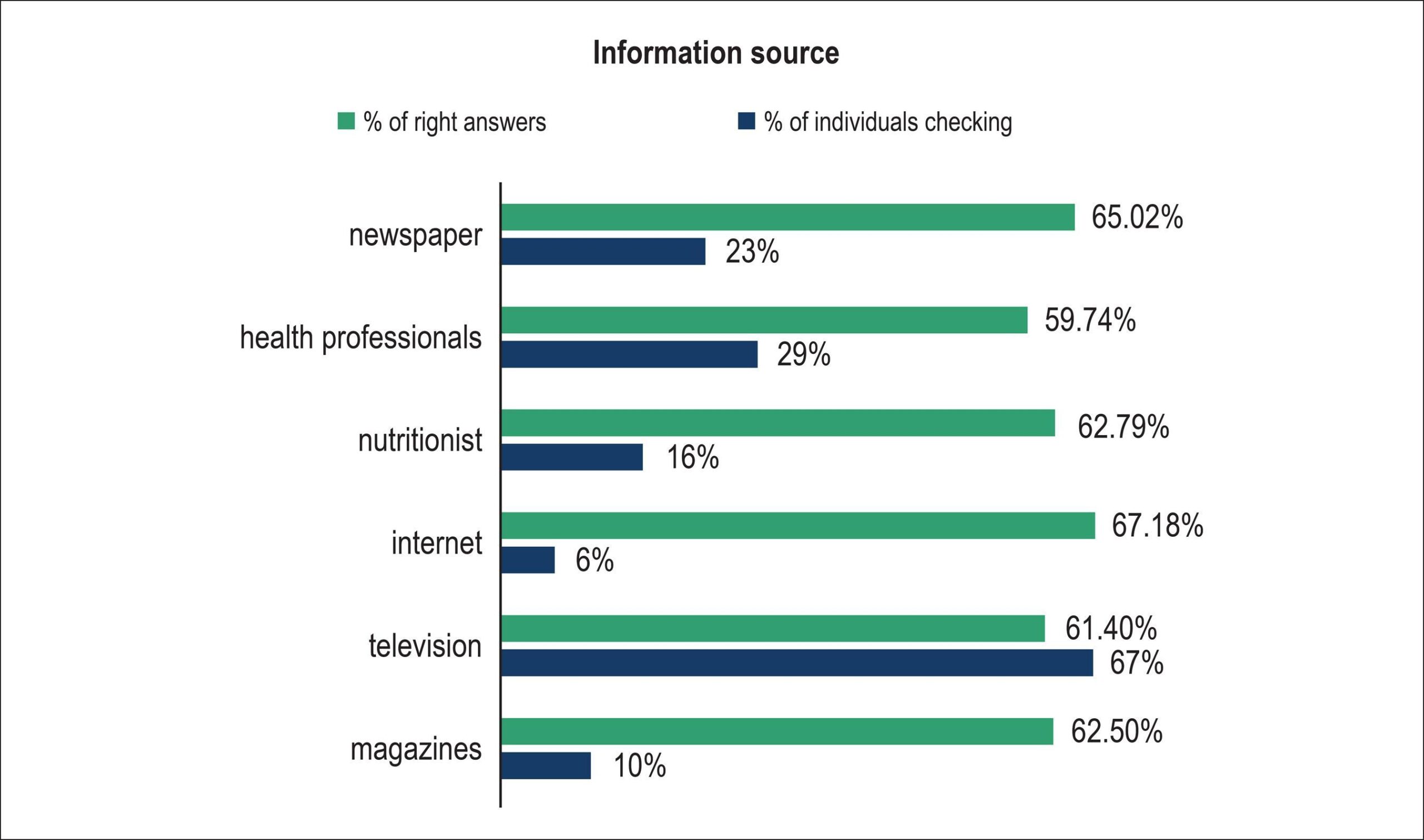
We studied 221 patients, 56.1% of whom were women, and 53.8% had only elementary education. Their mean age was 57.7 ±13.5 years, and 75.6% of them reported having high blood pressure, and 11.3%, diabetes mellitus. Regarding dietary pattern, 62% used ready-to-use seasonings, but 94.1% reported not adding extra salt to their ready meals. Regarding patients’ knowledge about high-sodium foods and SAH, only 8 patients had 100% of right answers, 37 patients had 73.8%, and 42 patients, 57% of right answers.

Conclusion:

Knowledge about SAH prevention and high-sodium foods was insufficient. Based on this study’s findings, more effective educational strategies targeted at this population can be developed.

  • Food habits
  • Hypertension / prevention & control
  • Hypertension/mortality
  • Sodium Chloride, Dietary
Read Full Article
Creative Commons Attribution (CC BY) Creative Commons license
15/04/2016 DOI: 10.5935/abc.20160049 Views 1
ABC
Artigo Original

Cross-cultural adaptation into Brazilian portuguese of the Dietary Sodium Restriction Questionnaire (DSRQ)

Karina Sanches Machado d'Almeida et al. Gabriela Correa Souza Eneida Rejane Rabelo

BACKGROUND: Sodium restriction is a non-pharmacological measure often recommended to patients with heart failure (HF). However, adherence is low, being among the most common causes of HF decompensation. The Dietary Sodium Restriction Questionnaire (DSRQ) aims at identifying factors that affect adherence to dietary sodium restriction by patients with HF. In Brazil, there are no instruments to assess these factors. OBJECTIVE: Perform the transcultural adaptation of DSRQ. METHODS: Methodological study that involved the following steps: translation, synthesis, back-translation, review by an expert committee, pretest of the final version and analysis of interobserver agreement. In the pretest, items and their understanding were evaluated, as well as internal consistency by Cronbach’s alpha. The instrument was simultaneously and independently administered by two researchers and the kappa test was used for agreement analysis. RESULTS: Only one question underwent major semantic and/or cultural alteration. At the pretest, Cronbach’s alpha for the total obtained was 0.77; for the Attitude, Subjective Norm and Behavioral Control scales were obtained, respectively: 0.66, 0.50 and 0.85. At the agreement step, the Kappa was calculated for 12 of the 16 questions, with values ranging from 0.62 to 1.00. In items for which the calculation was not possible, the incidence of equal responses ranged from 95% to 97.5%. CONCLUSION: Based on the transcultural adaptation of DSRQ, it was possible to propose a version of the questionnaire for further evaluation of psychometric properties.

  • Heart Failure
  • questionnaires
  • Sodium Chloride, Dietary
  • translating
Read Full Article
Creative Commons Attribution (CC BY) Creative Commons license
15/12/2011 DOI: 10.1590/S0066-782X2011005000122

How to cite this article

EndNote RIS

Electronic Document Format (Vancouver)

Dorna MS, Seki MM. Himalayan Salt and Table Salt Intake among Hypertensive Individuals. Arquivos Brasileiros de Cardiologia 2022;118(5):883-4.

Electronic Document Format (ABNT)

Dorna, Mariana de Souza; Seki, Marcos Mitsuo. Himalayan Salt and Table Salt Intake among Hypertensive Individuals. Arquivos Brasileiros de Cardiologia, v. 118, n. 5, p. 883-884, May. 2022.

Electronic Document Format (APA)

Dorna, M. S., & Seki, M. M. (2022). Himalayan Salt and Table Salt Intake among Hypertensive Individuals. Arquivos Brasileiros de Cardiologia, 118(5), 883-884.

Electronic Document Format (ISO)

Dorna, Mariana de Souza and Seki, Marcos Mitsuo. Himalayan Salt and Table Salt Intake among Hypertensive Individuals. Arquivos Brasileiros de Cardiologia [online]. 2022, vol. 118, n. 5, [cited 2026-10-14], pp. 883-884. Available from: <https://journals.cardiol.br/en/article/himalayan-salt-and-table-salt-intake-among-hypertensive-individuals/>. ISSN 0066-782X

EndNote RIS

Electronic Document Format (Vancouver)

Lima NKC. Dietary Salt Reduction: Illusion or Reality?. Arquivos Brasileiros de Cardiologia 2020;114(3):562-3.

Electronic Document Format (ABNT)

Lima, Nereida Kilza da Costa. Dietary Salt Reduction: Illusion or Reality?. Arquivos Brasileiros de Cardiologia, v. 114, n. 3, p. 562-563, Apr. 2020.

Electronic Document Format (APA)

Lima, N. K. C. (2020). Dietary Salt Reduction: Illusion or Reality?. Arquivos Brasileiros de Cardiologia, 114(3), 562-563.

Electronic Document Format (ISO)

Lima, Nereida Kilza da Costa. Dietary Salt Reduction: Illusion or Reality?. Arquivos Brasileiros de Cardiologia [online]. 2020, vol. 114, n. 3, [cited 2026-10-14], pp. 562-563. Available from: <https://journals.cardiol.br/en/article/dietary-salt-reduction-illusion-or-reality/>. ISSN 0066-782X

EndNote RIS

Electronic Document Format (Vancouver)

Teixeira JF, Goulart MR, Busnello FM, Pellanda LC. Hypertensives’ Knowledge About High-Sodium Foods and Their Behavior. Arquivos Brasileiros de Cardiologia 2016;106(5):404-10.

Electronic Document Format (ABNT)

Teixeira, Juliana de Fátima; Goulart, Maíra Ribas; Busnello, Fernanda Michielin; Pellanda, Lucia Campos. Hypertensives’ Knowledge About High-Sodium Foods and Their Behavior. Arquivos Brasileiros de Cardiologia, v. 106, n. 5, p. 404-410, Apr. 2016.

Electronic Document Format (APA)

Teixeira, J. F., Goulart, M. R., Busnello, F. M., & Pellanda, L. C. (2016). Hypertensives’ Knowledge About High-Sodium Foods and Their Behavior. Arquivos Brasileiros de Cardiologia, 106(5), 404-410.

Electronic Document Format (ISO)

Teixeira, Juliana de Fátima and Goulart, Maíra Ribas and Busnello, Fernanda Michielin and Pellanda, Lucia Campos. Hypertensives’ Knowledge About High-Sodium Foods and Their Behavior. Arquivos Brasileiros de Cardiologia [online]. 2016, vol. 106, n. 5, [cited 2026-10-14], pp. 404-410. Available from: <https://journals.cardiol.br/en/article/hypertensives-knowledge-about-high-sodium-foods-and-their-behavior/>. ISSN 0066-782X

EndNote RIS

Electronic Document Format (Vancouver)

d’Almeida KSM, Souza GC, Rabelo ER. Cross-cultural adaptation into Brazilian portuguese of the Dietary Sodium Restriction Questionnaire (DSRQ). Arquivos Brasileiros de Cardiologia 2011;98(1):70-5.

Electronic Document Format (ABNT)

d’Almeida, Karina Sanches Machado; Souza, Gabriela Correa; Rabelo, Eneida Rejane. Cross-cultural adaptation into Brazilian portuguese of the Dietary Sodium Restriction Questionnaire (DSRQ). Arquivos Brasileiros de Cardiologia, v. 98, n. 1, p. 70-75, Dec. 2011.

Electronic Document Format (APA)

d’Almeida, K. S. M., Souza, G. C., & Rabelo, E. R. (2011). Cross-cultural adaptation into Brazilian portuguese of the Dietary Sodium Restriction Questionnaire (DSRQ). Arquivos Brasileiros de Cardiologia, 98(1), 70-75.

Electronic Document Format (ISO)

d’Almeida, Karina Sanches Machado and Souza, Gabriela Correa and Rabelo, Eneida Rejane. Cross-cultural adaptation into Brazilian portuguese of the Dietary Sodium Restriction Questionnaire (DSRQ). Arquivos Brasileiros de Cardiologia [online]. 2011, vol. 98, n. 1, [cited 2026-10-14], pp. 70-75. Available from: <https://journals.cardiol.br/en/article/cross-cultural-adaptation-into-brazilian-portuguese-of-the-dietary-sodium-restriction-questionnaire-dsrq/>. ISSN 0066-782X

  • About ABC Family
  • Internal Regulation
  • Editorial Board
  • Brazilian Society of Cardiology (SBC)

Issues

SBC Guidelines

  • Videos
  • Podcasts
  • News