Sarah Mattos Moraes et al. Matheus Evangelista da Costa Flávia Carvalho Leão Reis Kleisson Antônio Pontes Maia
Abstract
Background:
There is a lack of epidemiological data regarding the cardiovascular risk profile of patients with chronic kidney disease (CKD) undergoing hemodialysis in the Brazilian state of Minas Gerais.
Objective:
To analyze the lipid profile and assess the prevalence of traditional cardiovascular risk factors among patients with CKD on hemodialysis treated at an academic healthcare institution in Belo Horizonte, Minas Gerais, Brazil.
Methods:
This was a cross-sectional, observational, and non-interventional study. The researchers obtained clinical, laboratory, and demographic data from medical records and conducted structured individual interviews with all participants. The chi-square test of independence, Fisher’s exact test, and the Wilcoxon rank-sum test were applied. A significance level of 0.05 was adopted to establish the statistical validity of comparisons.
Results:
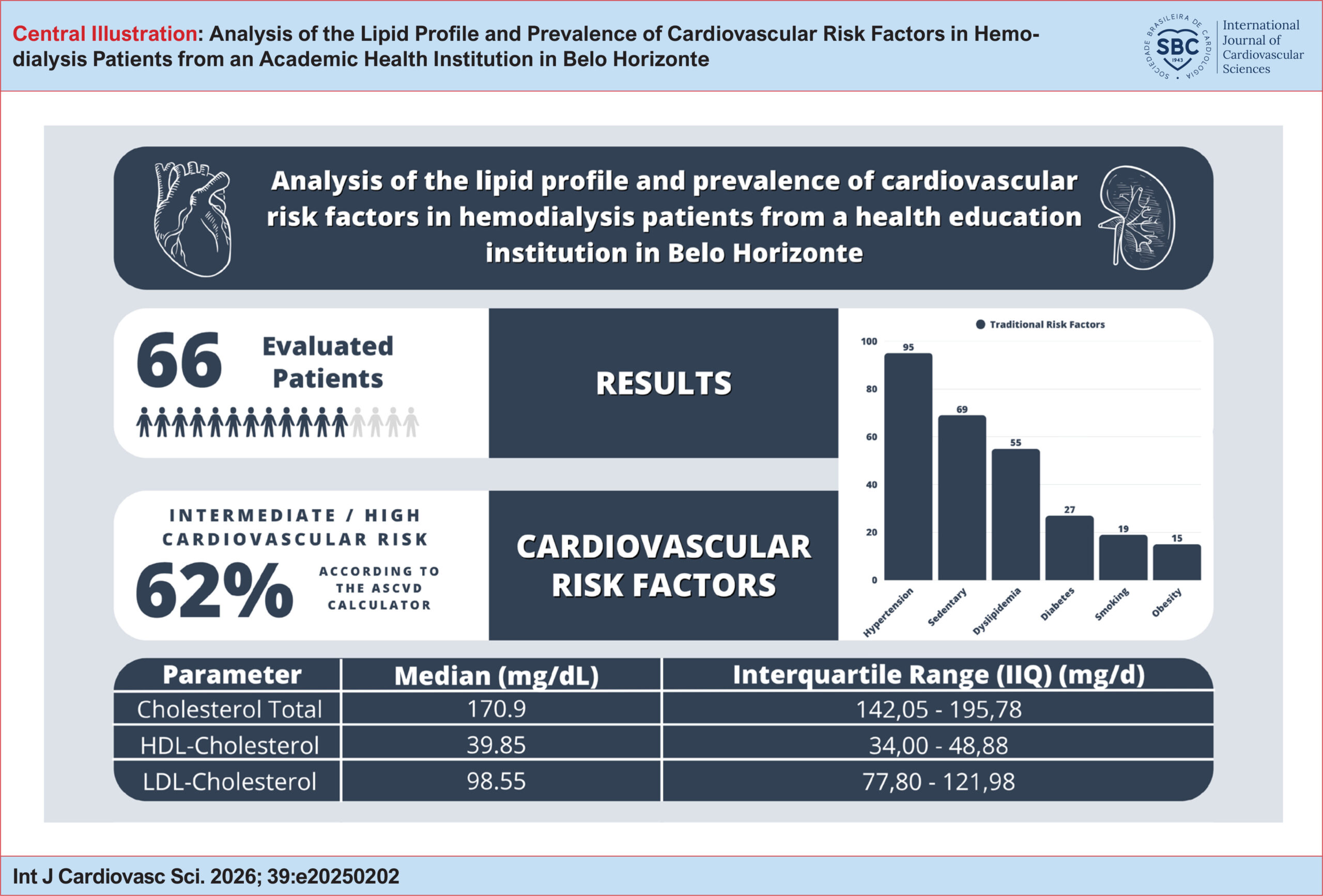
A total of 66 patients were included, representing 91.6% of all individuals undergoing hemodialysis at the study center. The mean age was 56 years. Among participants, 59% were male, and 89% self-identified as mixed race. A high prevalence of traditional cardiovascular risk factors was observed, including hypertension (95%), physical inactivity (69%), dyslipidemia (55%), diabetes mellitus (27%), current smoker (19%), and obesity (15%). The lipid profile analysis showed a median total cholesterol level of 170.9 mg/dL (interquartile range: 142.05 to 195.78 mg/dL) and Low-Density Lipoprotein (LDL-cholesterol) of 98.55 mg/dL (interquartile range: 77.80 to 121.98 mg/dL).
Conclusion:
This study demonstrated a high burden of cardiovascular risk factors among hemodialysis patients, with systemic arterial hypertension, dyslipidemia, physical inactivity, and diabetes mellitus being the most prevalent conditions. Furthermore, the lipid profile findings suggest suboptimal control of this lipid fraction in the studied population.