ABC Family Arquivos Brasileiros de Cardiologia International Journal of Cardiovascular Sciences ABC Heart Failure & Cardiomyopathy ABC Imagem Cardiovascular
Português English
ABC Family
Português English
  • About
    • About ABC Family
    • Internal Regulation
    • Editorial Board
    • Brazilian Society of Cardiology (SBC)
  • Issues
  • SBC Guidelines
  • Content
    • Videos
    • Podcasts
    • News
  • About
    • About ABC Family
    • Internal Regulation
    • Editorial Board
    • Brazilian Society of Cardiology (SBC)
  • Issues
  • SBC Guidelines
  • Content
    • Videos
    • Podcasts
    • News

ABC Family

  • ABC Family
  • Arquivos Brasileiros de Cardiologia
  • International Journal of Cardiovascular Sciences
  • ABC Heart Failure & Cardiomyopathy
  • ABC Imagem Cardiovascular
Search in

No content found.

Journals
Ordering
Article types
Others

  1. Home
  2. Keyword: Vegetarian diet
IJCS
Editorial

Cardiovascular Benefits of Plant-Based Diets

Marcella Rodrigues Guedes et al. Márcia Regina Simas Torres Klein

Increasing evidence suggests that plant-based dietary patterns, characterized by higher intake of plant foods and lower intake of animal foods, confer benefits to cardiovascular health. – Vegetarian diets are a subset of plant-based diets that exclude some or all animal products (vegan diets).

A meta-analysis of 86 cross-sectional and 10 cohort prospective studies evaluated the association between vegetarian, vegan diets, risk factors for chronic diseases, risk of all-cause mortality, incidence, and mortality from cardio-cerebrovascular diseases. The overall analysis of cross-sectional studies revealed significantly reduced levels of body mass index, total cholesterol, LDL-cholesterol, and glucose levels in vegetarians and vegans compared with omnivores. In relation to cohort studies, the analysis showed a significantly reduced risk of incidence and/or mortality from ischemic heart disease by 25%.

[…]

  • Cardiovascular Health
  • Plant-based diet
  • Vegetarian diet
Read Full Article
Creative Commons Attribution (CC BY) Creative Commons license
14/01/2022 DOI: 10.36660/ijcs.20210262 Views 1
IJCS
Original Article

Better Adequacy of Food Intake According to Dietary Recommendations of National Cholesterol Education Program in Vegetarian Compared to Omnivorous Men

Luiza Antoniazzi et al. Julio Acosta-Navarro Adriana Midori Oki Maria Carlos Bonfim Maria Cristina Almeida Gaspar

Abstract

Background

The lower frequency of cardiovascular (CV) risk factors observed in vegetarians compared to omnivores may be due to more appropriate nutrient intake according to recommendations for the prevention of cardiovascular diseases.

Objective

To compare the dietary adequacy according to the recommendations of the National Cholesterol Education Program (NCEP) in apparently healthy vegetarian (VEG) and omnivorous (OMN) men.

Methods

This was a cross-sectional study, conducted with apparently healthy men (44 omnivorous and 44 vegetarians, ≥ 35 years), who were assessed for daily food consumption, anthropometric data, physical exercise status, and clinical data. Multiple logistic regression was used to test the association between the type of diet and the dietary adequacy. Significant values were considered for p<0.05.

Results

Several clinical CV risk markers were significantly lower in VEG when compared to OMN: body mass index (BMI) (23.1 vs. 27.3 kg/m2), systolic blood pressure (119.5 vs. 129.2 mmHg), and diastolic blood pressure (75.7 vs. 83.9 mmHg). VEG presented significant lower values of blood lipids and glucose. No significant difference was observed in caloric intake; however, VEG consumed significantly more carbohydrates, dietary fibers, and polyunsaturated fats. VEG presented an adequate consumption of dietary cholesterol and saturated and polyunsaturated fatty acids, regardless of caloric intake and age.

Conclusion

VEG were more likely to consume saturated fatty acids, dietary cholesterol, and fibers according to the recommendations of NCEP, factors that may contribute to lower levels of CV risk markers than OMN.

  • Cardiovascular Diseases
  • Life Style
  • Lipids
  • Risk Factors
  • Vegetarian diet
Read Full Article
Creative Commons Attribution (CC BY) Creative Commons license
03/09/2021 DOI: 10.36660/ijcs.20200258 Views 1
Figure 1
IJCS
Original Article

Vegetarian Diets and Cardiovascular Risk in Women

Bianca Oliveira et al. Luciana Nicolau Aranha Priscila dos Santos Gomes Olivares Tamira Guilherme Rocha Negrão … Glorimar Rosa Gláucia Maria Moraes de Oliveira

Abstract

Introduction:

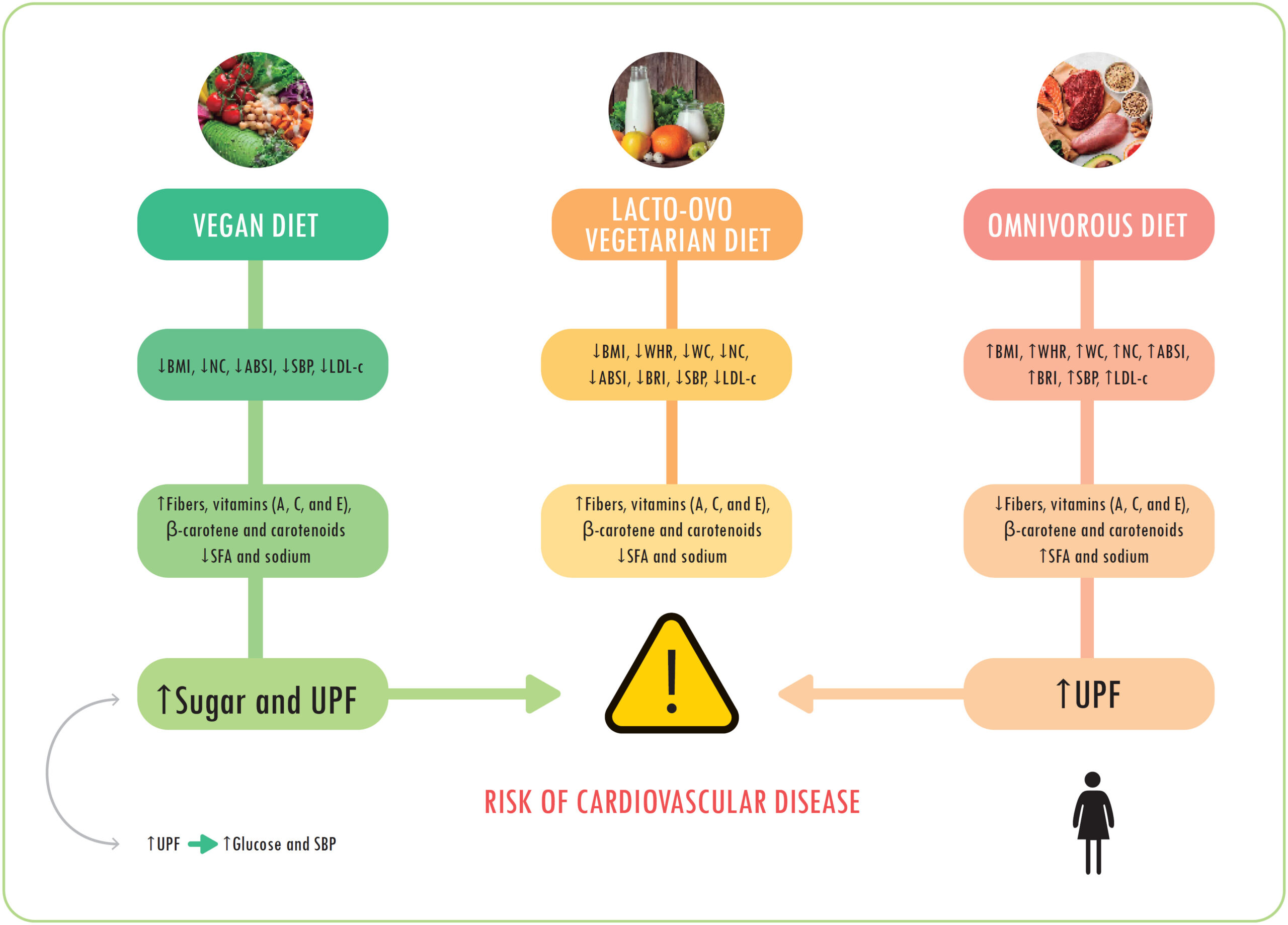
Vegetarian diets have favorable effects on cardiovascular risk, provided that they do not contain ultra-processed foods (UPF).

Objective:

To compare the metabolic profile, cardiovascular risk, body composition, and food consumption in vegan (VEG), lacto-ovo vegetarian (LOV), and omnivorous (OMNI) women. To verify the association between UPF consumption and cardiovascular risk.

Methods:

Cross-sectional study with 119 VEG (n = 43), LOV (n = 38), and OMNI (n = 38) women. Anthropometric and biochemical parameters and the Framingham risk score were assessed. Food consumption was assessed by means of a 3-day food register, and intake of macronutrients, micronutrients, and UPF was estimated. The correlation between UPF consumption and cardiovascular risk was assessed using Spearman’s coefficient, with a significance level of 5%.

Results:

The groups showed low cardiovascular risk, without significant difference between them. The VEG and LOV groups had lower body mass index, neck circumference, body shape index, and systolic blood pressure (p < 0.05) than the OMNI group; greater consumption of carbohydrates, sugars, dietary fibers, micronutrients, beta-carotene, and carotenoids; and lower consumption of total fat, saturated fatty acids, and cholesterol (p < 0.05). Consumption of UPF was lower in the LOV group (5.7 [0.0– 19.8]) than in the OMNI group (14.9 [5.1 – 22.3]; p < 0.05). UPF consumption was associated with SBP (ρ = 0.439; p = 0.007) and blood sugar (ρ = 0.422; p = 0.010) in the VEG group, and in the LOV group it was inversely associated with LDL-c (ρ = −0.456; p = 0.010).

Conclusion:

Vegetarian women showed better body composition and dietary quality than OMNI women. It is important to take consumption of UPF in vegetarians into consideration, in order to improve cardiovascular risk in women.

  • Industrialized Foods
  • Risk Factors
  • Vegan
  • Vegetarian diet
  • Women
Read Full Article
Creative Commons Attribution (CC BY) Creative Commons license
19/07/2021 DOI: 10.36660/ijcs.20210010 Views 1
ABC
Artigo Original

Vegetarian diet and cholesterol and triglycerides levels

Simone Grigoletto De Biase et al. Sabrina Francine Carrocha Fernandes Reinaldo José Gianini João Luiz Garcia Duarte

OBJECTIVE: Compare levels of triglyceride (TG), total cholesterol (TC), low density lipoprotein (LDL) and high density lipoprotein (HDL) among vegetarians and omnivores. METHODS: Blood samples were collected from 76 individuals – both males and females – separated in four different diet groups: omnivores, lacto-ovo vegetarians, lacto vegetarians, and restricted vegetarians (or vegans). Dosing was done for: TC, LDL, HDL and TG. RESULTS: Significant difference was reported for TC, LDL and TG levels among the samples. Higher levels were reported by omnivores, with decreased levels for vegetarians as animal products were restricted, with lowest levels having been reported by vegans. Mean and standard deviation for TC were 208.09 ± 49.09 mg/dl in the group of omnivores, and 141.06 ± 30.56 mg/dl in the group of vegans (p < 0.001). LDL values for omnivores and vegans were respectively: 123.43 ± 42.67 mg/dl and 69.28 ± 29.53 mg/dl (p < 0.001). As for TG, those values were 155.68 ± 119.84 mg/dl and 81.67 ± 81.90 mg/dl (p < 0.01). As for HDL level no difference was reported between the samples, but HDL/TC ratio was significantly higher in vegans (p = 0.01). CONCLUSION: Vegetarian diet was associated to lower levels of TG, TC and LDL as compared to the diet of omnivores.

  • Cholesterol
  • Triglycerides
  • Vegetarian diet
Read Full Article
Creative Commons Attribution (CC BY) Creative Commons license
07/03/2007 DOI: 10.1590/S0066-782X2007000100006

How to cite this article

EndNote RIS

Electronic Document Format (Vancouver)

Guedes MR, Klein MRST. Cardiovascular Benefits of Plant-Based Diets. International Journal of Cardiovascular Sciences 2022;35(1):11-3.

Electronic Document Format (ABNT)

Guedes, Marcella Rodrigues; Klein, Márcia Regina Simas Torres. Cardiovascular Benefits of Plant-Based Diets. International Journal of Cardiovascular Sciences, v. 35, n. 1, p. 11-13, Jan. 2022.

Electronic Document Format (APA)

Guedes, M. R., & Klein, M. R. S. T. (2022). Cardiovascular Benefits of Plant-Based Diets. International Journal of Cardiovascular Sciences, 35(1), 11-13.

Electronic Document Format (ISO)

Guedes, Marcella Rodrigues and Klein, Márcia Regina Simas Torres. Cardiovascular Benefits of Plant-Based Diets. International Journal of Cardiovascular Sciences [online]. 2022, vol. 35, n. 1, [cited 2026-10-14], pp. 11-13. Available from: <https://journals.cardiol.br/en/article/cardiovascular-benefits-of-plant-based-diets/>. ISSN 2359-4802

EndNote RIS

Electronic Document Format (Vancouver)

Antoniazzi L, Acosta-Navarro J, Oki AM, Bonfim MC, Gaspar MCA. Better Adequacy of Food Intake According to Dietary Recommendations of National Cholesterol Education Program in Vegetarian Compared to Omnivorous Men. International Journal of Cardiovascular Sciences 2021;35(1):1-10.

Electronic Document Format (ABNT)

Antoniazzi, Luiza; Acosta-Navarro, Julio; Oki, Adriana Midori; Bonfim, Maria Carlos; Gaspar, Maria Cristina Almeida. Better Adequacy of Food Intake According to Dietary Recommendations of National Cholesterol Education Program in Vegetarian Compared to Omnivorous Men. International Journal of Cardiovascular Sciences, v. 35, n. 1, p. 1-10, Sep. 2021.

Electronic Document Format (APA)

Antoniazzi, L., Acosta-Navarro, J., Oki, A. M., Bonfim, M. C., & Gaspar, M. C. A. (2021). Better Adequacy of Food Intake According to Dietary Recommendations of National Cholesterol Education Program in Vegetarian Compared to Omnivorous Men. International Journal of Cardiovascular Sciences, 35(1), 1-10.

Electronic Document Format (ISO)

Antoniazzi, Luiza and Acosta-Navarro, Julio and Oki, Adriana Midori and Bonfim, Maria Carlos and Gaspar, Maria Cristina Almeida. Better Adequacy of Food Intake According to Dietary Recommendations of National Cholesterol Education Program in Vegetarian Compared to Omnivorous Men. International Journal of Cardiovascular Sciences [online]. 2021, vol. 35, n. 1, [cited 2026-10-14], pp. 1-10. Available from: <https://journals.cardiol.br/en/article/better-adequacy-of-food-intake-according-to-dietary-recommendations-of-national-cholesterol-education-program-in-vegetarian-compared-to-omnivorous-men/>. ISSN 2359-4802

EndNote RIS

Electronic Document Format (Vancouver)

Oliveira B, Aranha LN, Olivares PSG, Negrão TGR, Rosa G, Oliveira GMM. Vegetarian Diets and Cardiovascular Risk in Women. International Journal of Cardiovascular Sciences 2021;34(4):461-70.

Electronic Document Format (ABNT)

Oliveira, Bianca; Aranha, Luciana Nicolau; Olivares, Priscila dos Santos Gomes; Negrão, Tamira Guilherme Rocha; Rosa, Glorimar; Oliveira, Gláucia Maria Moraes de. Vegetarian Diets and Cardiovascular Risk in Women. International Journal of Cardiovascular Sciences, v. 34, n. 4, p. 461-470, Jul. 2021.

Electronic Document Format (APA)

Oliveira, B., Aranha, L. N., Olivares, P. S. G., Negrão, T. G. R., Rosa, G., & Oliveira, G. M. M. (2021). Vegetarian Diets and Cardiovascular Risk in Women. International Journal of Cardiovascular Sciences, 34(4), 461-470.

Electronic Document Format (ISO)

Oliveira, Bianca and Aranha, Luciana Nicolau and Olivares, Priscila dos Santos Gomes and Negrão, Tamira Guilherme Rocha and Rosa, Glorimar and Oliveira, Gláucia Maria Moraes de. Vegetarian Diets and Cardiovascular Risk in Women. International Journal of Cardiovascular Sciences [online]. 2021, vol. 34, n. 4, [cited 2026-10-14], pp. 461-470. Available from: <https://journals.cardiol.br/en/article/vegetarian-diets-and-cardiovascular-risk-in-women/>. ISSN 2359-4802

EndNote RIS

Electronic Document Format (Vancouver)

Biase SGD, Fernandes SFC, Gianini RJ, Duarte JLG. Vegetarian diet and cholesterol and triglycerides levels. Arquivos Brasileiros de Cardiologia 2007;88(1):35-9.

Electronic Document Format (ABNT)

Biase, Simone Grigoletto De; Fernandes, Sabrina Francine Carrocha; Gianini, Reinaldo José; Duarte, João Luiz Garcia. Vegetarian diet and cholesterol and triglycerides levels. Arquivos Brasileiros de Cardiologia, v. 88, n. 1, p. 35-39, Mar. 2007.

Electronic Document Format (APA)

Biase, S. G. D., Fernandes, S. F. C., Gianini, R. J., & Duarte, J. L. G. (2007). Vegetarian diet and cholesterol and triglycerides levels. Arquivos Brasileiros de Cardiologia, 88(1), 35-39.

Electronic Document Format (ISO)

Biase, Simone Grigoletto De and Fernandes, Sabrina Francine Carrocha and Gianini, Reinaldo José and Duarte, João Luiz Garcia. Vegetarian diet and cholesterol and triglycerides levels. Arquivos Brasileiros de Cardiologia [online]. 2007, vol. 88, n. 1, [cited 2026-10-14], pp. 35-39. Available from: <https://journals.cardiol.br/en/article/vegetarian-diet-and-cholesterol-and-triglycerides-levels/>. ISSN 0066-782X

  • About ABC Family
  • Internal Regulation
  • Editorial Board
  • Brazilian Society of Cardiology (SBC)

Issues

SBC Guidelines

  • Videos
  • Podcasts
  • News