ABC Family Arquivos Brasileiros de Cardiologia International Journal of Cardiovascular Sciences ABC Heart Failure & Cardiomyopathy ABC Imagem Cardiovascular
Português English
ABC Family
Português English
  • About
    • About ABC Family
    • Internal Regulation
    • Editorial Board
    • Brazilian Society of Cardiology (SBC)
  • Issues
  • SBC Guidelines
  • Content
    • Videos
    • Podcasts
    • News
  • About
    • About ABC Family
    • Internal Regulation
    • Editorial Board
    • Brazilian Society of Cardiology (SBC)
  • Issues
  • SBC Guidelines
  • Content
    • Videos
    • Podcasts
    • News

ABC Family

  • ABC Family
  • Arquivos Brasileiros de Cardiologia
  • International Journal of Cardiovascular Sciences
  • ABC Heart Failure & Cardiomyopathy
  • ABC Imagem Cardiovascular
Search in

No content found.

Journals
Ordering
Article types
Others

  1. Home
  2. Keyword: Myocardial Reperfusion
Geographic Variation in Door-to-Needle Time among Patients with STEMI from the Metropolitan Region of Rio de Janeiro: Results of the EQUITY-MI Cohort
ABC
Original Article

Geographic Variation in Door-to-Needle Time among Patients with STEMI from the Metropolitan Region of Rio de Janeiro: Results of the EQUITY-MI Cohort

Eric Costa de Almeida et al. Felipe Neves Albuquerque Esmeralci Ferreira Roberto Pozzan … Pedro Pimenta de Mello Spineti Pâmela Sousa Monteiro Williana Oliveira de Araújo Rhayana Vitória da Rosa Silva Carla Maciel Caminhas Thales Cardoso Whately João Gabriel Monteiro Junqueira Denilson Campos de Albuquerque

Abstract

Background

There is a gap in information regarding the reperfusion strategies used and the evolution of patients with ST-segment elevation myocardial infarction (STEMI) in the state of Rio de Janeiro.

Objective

To assess thrombolysis time in the diverse regions of the state capital and metropolitan area of Rio de Janeiro, as well as the outcome of post-infarction heart failure.

Methods

EQUITY-MI is a prospective cohort study of patients diagnosed with STEMI and referred to a single reperfusion center. Continuous variables were analyzed using the Kruskal–Wallis test, and categorical variables were analyzed using the chi-square test. In order to estimate the effect of door-to-needle time (DNT), generalized linear regression models with gamma distribution and log link function were applied, in addition to quantile regression to estimate the effect at the 25%, 50%, and 75% quantiles, both adjusted for sex, age, race, and education level. The significance level applied was 0.05.

Results

The study included 457 patients, with a mean age of 60.4 years, 79% of whom received thrombolysis, with a median DNT of 77 minutes, and 20.9% were thrombolyzed within 30 minutes, with no statistical difference between regions (p = 0.23). The Baixada Fluminense region presented the highest adjusted mean DNT (165.9 minutes), with a time difference compared to the North Zone (0.61; 0.44 to 0.87; p = 0.003) and West Zone (0.69; 0.51 to 0.96; p = 0.022). It also presented the highest DNT in all intervals (Q25, Q50, Q75). After infarction, 63.5% of patients presented heart failure.

Conclusion

There was a general delay in DNT for patients included in the EQUITY-MI study, with worse systematic performance in the Baixada Fluminense region, in addition to a high incidence of post-infarction heart failure.
  • Health Policy
  • Mortality
  • Myocardial Infarction
  • Myocardial Reperfusion
  • Thrombolytic Therapy
Read Full Article
Creative Commons Attribution (CC BY) Creative Commons license
27/02/2026 DOI: 10.36660/abc.20250401i Views 24
ST-Segment Elevation Myocardial Infarction Metrics Before and During the COVID-19 Pandemic: Experience from a Brazilian Center
IJCS
Original Article

ST-Segment Elevation Myocardial Infarction Metrics Before and During the COVID-19 Pandemic: Experience from a Brazilian Center

Caio de Assis Moura Tavares et al. Tarso A. D. Accorsi Milena Ribeiro Paixão Tarsila Mota … Fabio Pitta Pedro Alves Lemos Marcelo Franken Karine De Amicis Lima Karen Francine Kohler José Leão de Souza Jr.

Abstract

Background:

The impact of the COVID-19 pandemic on the healthcare of patients with ST-segment elevation acute myocardial infarction (STEMI) in Brazil remains unclear.

Objective:

Provide a descriptive analysis of clinical profiles, time intervals, performance metrics, and outcomes in patients with STEMI before and during the COVID-19 pandemic.

Methods:

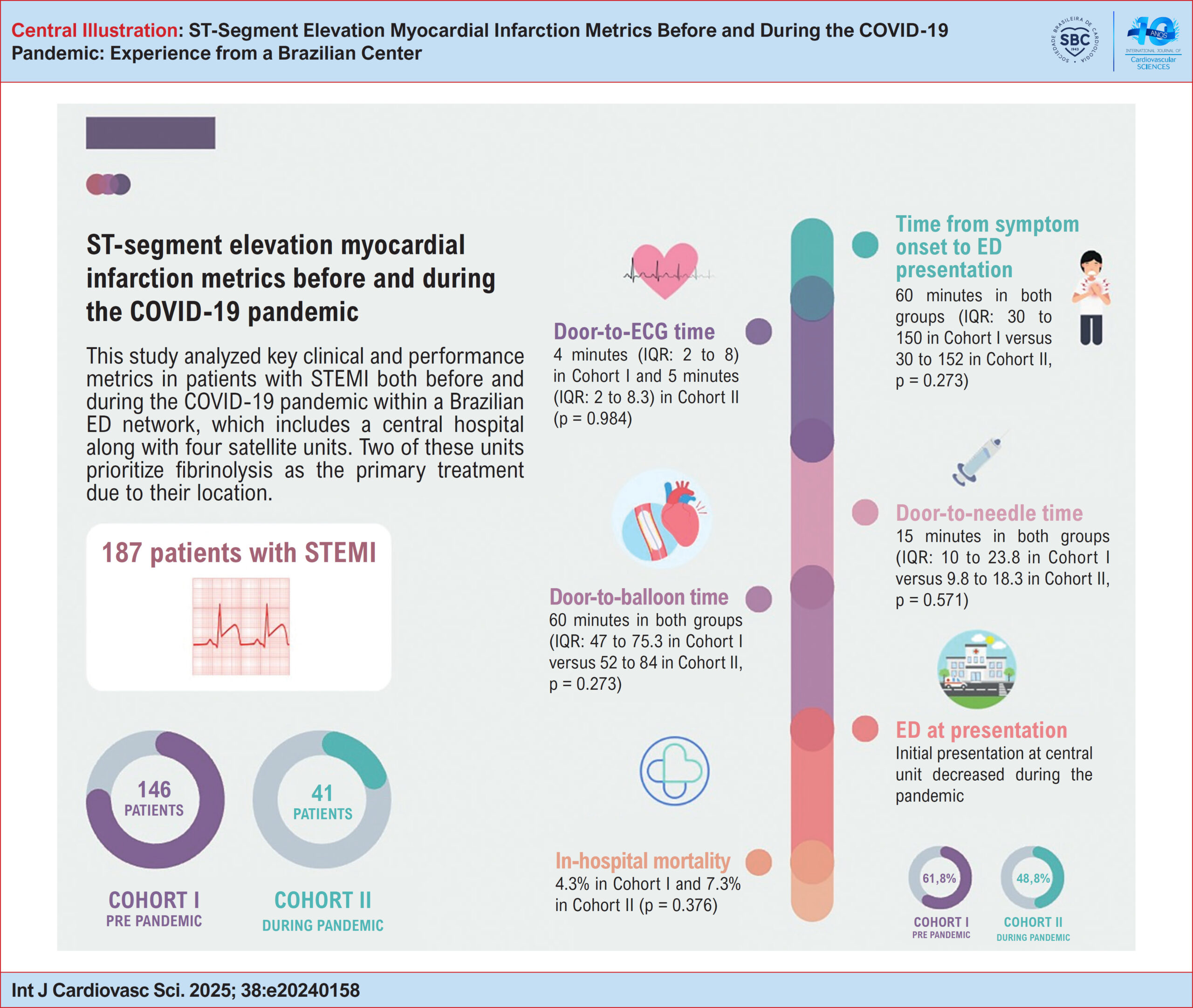
Among a cohort of 193 patients with STEMI diagnosed in five emergency departments within a single Brazilian healthcare network, 187 patients were included between January 2017 and April 2021 and stratified into two cohorts: Cohort I (pre-pandemic, 146 patients) and Cohort II (pandemic, 41 patients). Statistical significance was defined as a two-sided p value < 0.05.

Results:

The mean age of the participants was 62.7 years (standard deviation: 13.2); 83.4% were male, and 86.1% underwent primary percutaneous coronary intervention (PCI). Duration from symptom onset to emergency department presentation was 60 minutes in both cohorts (interquartile range, IQR: 30 to 150 in Cohort I versus 30 to 152 in Cohort II, p = 0.273). Total ischemic time was 132 minutes in Cohort I (IQR: 94 to 222), and 117 minutes in Cohort II (IQR: 76.3 to 185.6) (p = 0.159). The observed STEMI time delays and performance metrics were comparable between groups, with reperfusion rates within the recommended time frame above 90% in both cohorts. Hospital mortality was 3.4% in Cohort I and 7.3% in Cohort II (p = 0.376).

Conclusion:

In the context of the COVID-19 pandemic, within a private healthcare network system in Brazil, this study did not uncover statistically significant disparities in clinical profiles, time intervals, performance metrics, or in-hospital mortality when compared to the pre-pandemic period.

  • Angioplasty
  • COVID-19
  • Fibrinolysis
  • Myocardial Reperfusion
  • ST Elevation Myocardial Infarction
Read Full Article
Creative Commons Attribution (CC BY) Creative Commons license
02/06/2025 DOI: 10.36660/ijcs.20240158 Views 1
ABC
Editorial

Acute Myocardial Infarction: Do We Need Markers for Microcirculation Injury? Moreover, Would the Fibrinogen/Albumin Ratio Be the Answer?

Ricardo Wang et al. Fernando Carvalho Neuenschwander

Acute myocardial infarction (AMI) is the leading cause of death in the world and the second cause of death in Brazil. The biggest advance in its treatment was reperfusion therapy, be it medication, through the use of fibrinolytics or coronary angioplasty with stent implantation. The latter, in addition to the superiority in the quality of reperfusion, has been shown to be time-sensitive; the earlier the intervention, the greater the reduction in cardiovascular outcomes, both in the context of Acute Coronary Syndrome without ST-Segment Elevation and especially with ST segment elevation.

In the context of ST-segment elevation AMI (STEMI), the time between symptoms and reperfusion by primary angioplasty is considered the main reduction in cardiovascular death, leading to the preservation of ventricular function and earlier recovery.

[…]

  • Albumins
  • Fibrinolytic Agents
  • Mortality
  • Myocardial Infarction
  • Myocardial Reperfusion
  • No-Reflow Phenomenon
  • Stents
Read Full Article
Creative Commons Attribution (CC BY) Creative Commons license
04/03/2024 DOI: 10.36660/abc.20230809 Views 1
ABC
Editorial

ST-Elevation Acute Myocardial Infarction Treated with Primary Percutaneous Coronary Intervention: The Importance of Local Data

José C. Nicolau

Castro et al. should be commended for providing the scientific community with a useful publication analyzing predictors of all-cause mortality in patients with ST-elevation acute myocardial infarction (STEMI) who are submitted to primary percutaneous coronary intervention (PPCI).

PPCI is the preferred method of reperfusion for patients with STEMI presenting within 12 hours of evolution from onset of symptoms. To the best of my knowledge, the most recent meta-analysis comparing fibrinolytic therapy with PPCI found odds ratios of 0.73 (p = 0.002), 0.38 (p < 0.001), 0.38 (p < 0.001), and 1.03 (p = 0.86) for all-cause death, reinfarction, stroke, and major bleeding, respectively. However, absence of widespread availability of catheterization laboratories and logistical problems, mainly related to transportation, limit the access of patients with STEMI to this form of treatment. This is highlighted in the present publication, where only 0.26% of the analyzed population was from the vast North Region of Brazil, whereas the majority (58%) was from the Southeast Region. Maybe more importantly, the utilization of reperfusion therapies (fibrinolytics or PPCI) in general is far from ideal in Brazil, and important regional differences have been observed. , Importantly, the previously cited meta-analysis by Fazel et al. found odds ratios of 0.79, 0.53, 0.70, and 1.19 for all-cause deaths, reinfarction, stroke, and major bleeding, respectively, when comparing the pharmacoinvasive approach with fibrinolytic treatment, which can be an option for issues related to access to PPCI.

[…]

  • Epidemiology
  • Fibrinolityc Therapy
  • Mortality
  • Myocardial Reperfusion
  • Percutaneous Coronary Intervention
  • ST Elevation Myocardial Infarction
Read Full Article
Creative Commons Attribution (CC BY) Creative Commons license
05/09/2022 DOI: 10.36660/abc.20220557
Figure 1
ABC
Original Article

Predictors of Hospital Mortality Based on Primary Angioplasty Treatment: A Multicenter Case-Control Study

Pedro Paulo Neves de Castro et al. Marco Antonio Nazaré Castro Guilherme Abreu Nascimento Isabel Moura José Luiz Barros Pena

Abstract

Background

Identification of high-risk patients undergoing primary angioplasty (PCI) is essential.

Objective

Identify factors related to the causes of death in PCI patients.

Methods

This work consisted of a multicenter case-control study using a Brazilian registry of cardiovascular interventions as the data source. The association between each variable and death was assessed using a binary logistic regression model, p <0.05 was considered significant.

Results

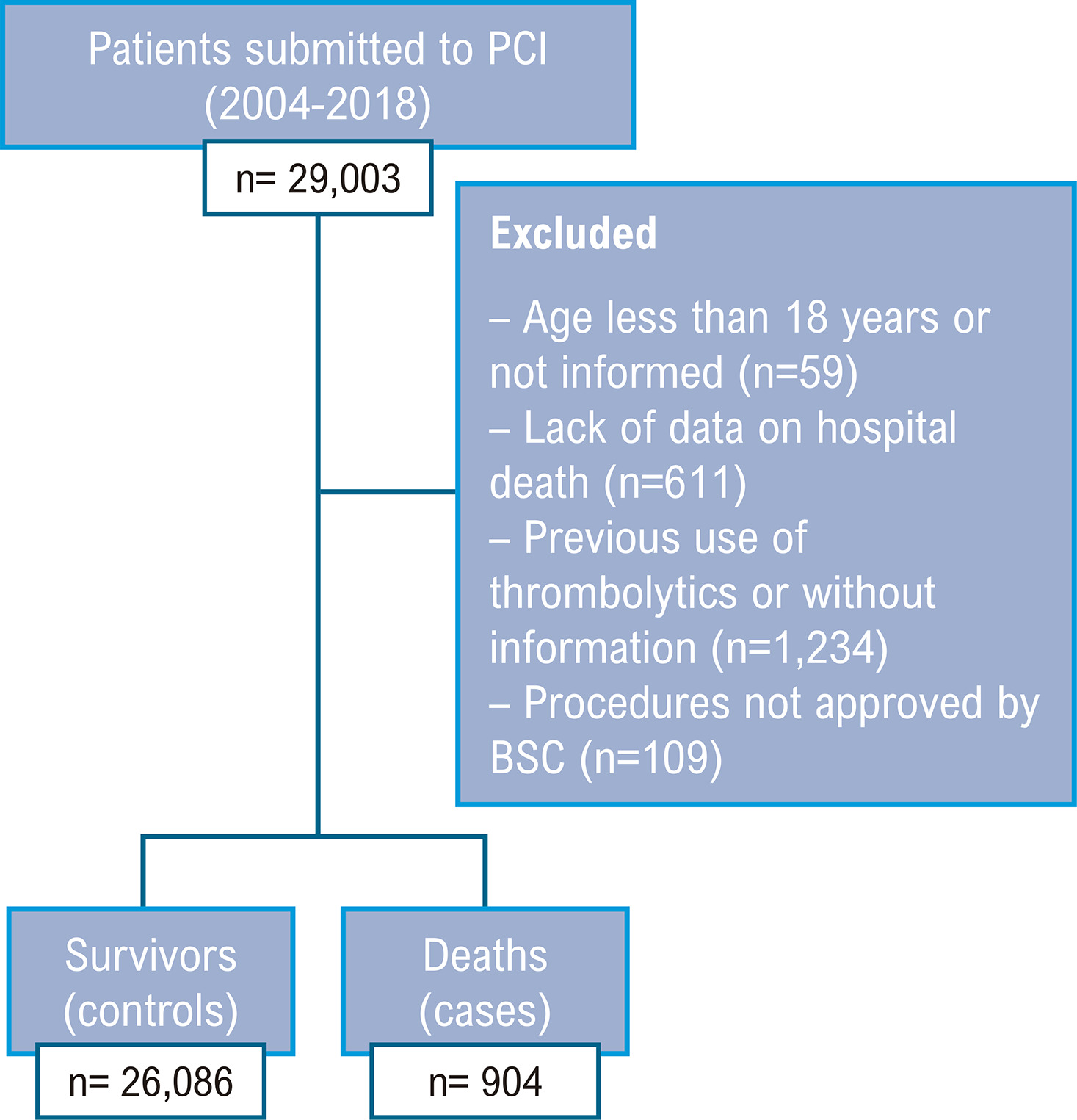
A total of 26,990 records were analyzed, of which 18,834 (69.8%) were male patients, with a median age of 61 (±17) years. In the multivariate analysis, the main variables related to the causes of death with their respective odds ratios and 95%confidence intervals (CI) were advanced age, 70-79 years (2.46; 1.64-3.79) and ≥ 80 years (3.69; 2.38-5.81), p<0.001; the classification of Killip II (2.71; 1.92-3.83), Killip III (8.14; 5.67-11.64), and Killip IV (19.83; 14.85-26.69), p<0.001; accentuated global dysfunction (3.63; 2,39-5.68), p<0.001; and the occurrence of infarction after intervention (5.01; 2.57-9.46), p<0.001. The main protective factor was the post-intervention thrombolysis in myocardial infarction (TIMI) III flow (0.18; 0.13-0.24), p<0.001, followed by TIMI II (0.59; 0.41 -0.86), p=0.005, and male (0.79; 0.64-0.98), p = 0.032; dyslipidemia (0.69; 0.59-0.85), p<0.001; and number of lesions treated (0.86; 0.9-0.94), p<0.001.

Conclusion

The predictors of mortality in patients undergoing PCI were Killip’s classification, reinfarction, advanced age, severe left ventricular dysfunction, female gender, and post-intervention TIMI 0 / I flow.

  • Acute Myocardial Infarction
  • Database
  • Mortality
  • Myocardial Reperfusion
  • Percutaneous Coronary Intervention
Read Full Article
Creative Commons Attribution (CC BY) Creative Commons license
05/08/2022 DOI: 10.36660/abc.20210015
ABC
Editorial

If “Time Is Muscle,” Then the Patient's Knowledge Must Save Time

Daniel Ferreira

More than half a century ago, Eugene Braunwald’s group experimental work on the factors influencing infarct size following coronary artery occlusions led to the concept of “Time is Muscle” in what relates to acute myocardial infarction management.

Timely reperfusion of the occluded coronary arteries is critical to saving at-risk ischemic myocardial cells in acute ST-elevation myocardial infarction (STEMI).

[…]

  • Awareness
  • Comprehensive Health Care/economics
  • Myocardial Infarction
  • Myocardial Ischemia/therapy
  • Myocardial Reperfusion
  • Percutaneous Coronary Intervention/methods
Read Full Article
Creative Commons Attribution (CC BY) Creative Commons license
11/07/2022 DOI: 10.36660/abc.20220392
Central illustration
ABCHF
Viewpoint

Shock Teams: A Call to Action for the Brazilian Cardiology Community

Livia Adams Goldraich et al. Laura Hastenteufel Felipe H. Valle Nadine Clausell

Introduction

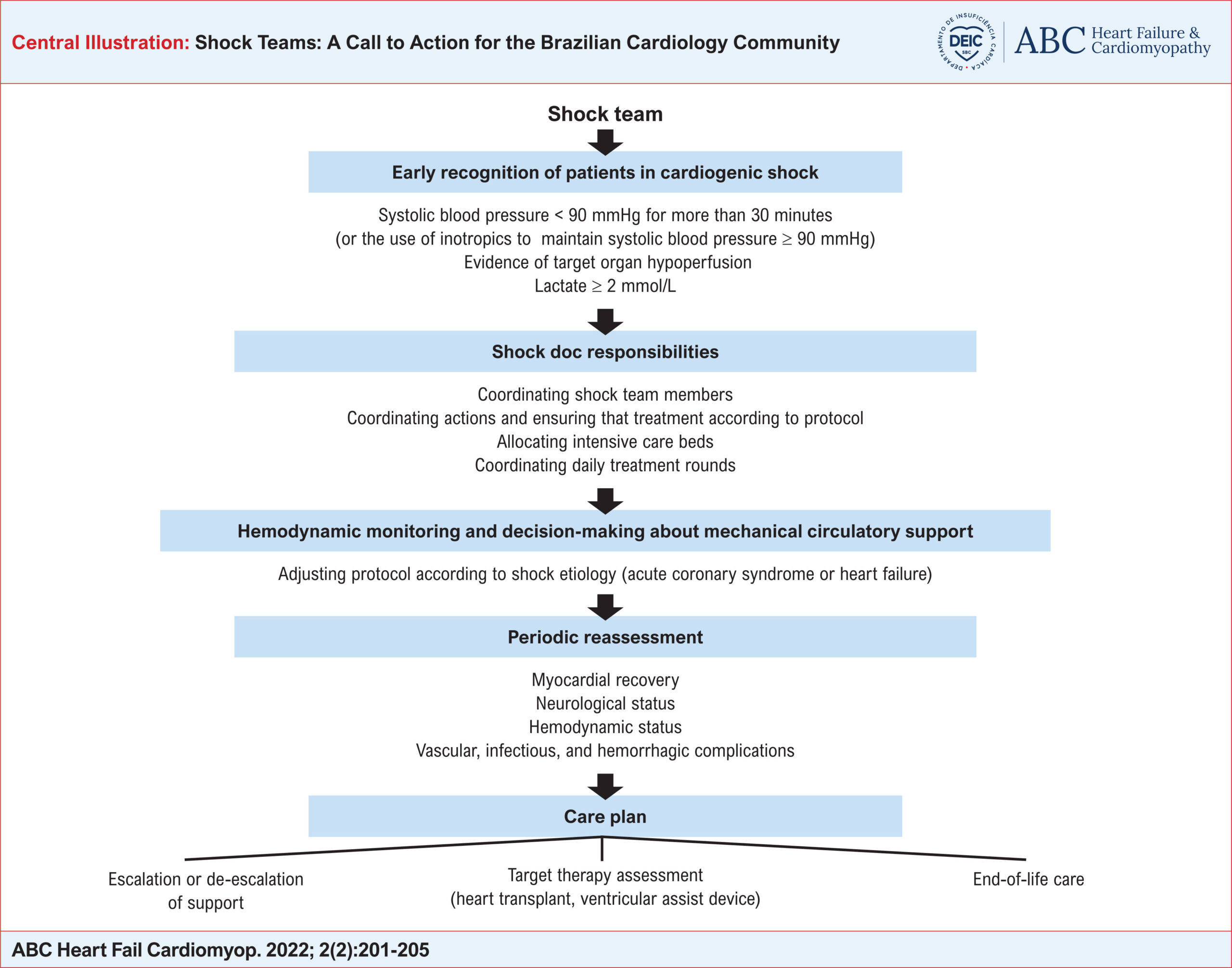
Despite advances in diagnosis and treatment over the last 30 years, especially in myocardial reperfusion therapies, mortality from cardiogenic shock remains high worldwide, with 50% of cases resulting in adverse outcomes., In particular, there has been an increase in the incidence of non-ischemic cardiogenic shock (ie, associated with acute and/or advanced chronic heart failure), which has led to a shift with less patients hospitalized due to acute ischemic syndromes in critical cardiology units..,

In the last decade, due to persistently high mortality and the complexity of presentation and treatment involved in cardiogenic shock, especially of non-ischemic etiology, some institutions, particularly in the United States, developed process of care to improve outcomes for these patients, resulting in “shock teams”, which were based on other successful initiatives to manage critical situations through multidisciplinary teams acting according to systematized protocols, such as rapid response teams, trauma teams, and stroke teams.,

[…]

  • Cardiogenic shock
  • Heart Failure
  • Myocardial Reperfusion
Read Full Article
Creative Commons Attribution (CC BY) Creative Commons license
29/06/2022 DOI: 10.36660/abchf.20220032 Views 2
ABCIC
Case Report

Spasm of the Internal Thoracic Artery. Value of Echocardiography and Doppler in Long-term Follow-up

José Sebastião de Abreu et al. Tereza Cristina Pinheiro Diogenes Ana Gardenia L. Ponte Farias Marilia Esther Benevides Abreu … Renan Abreu Freire José Erirtônio Façanha Barreto

[…]

  • Echocardiography, Doppler/methods
  • Heart Aneurysm
  • Internal Mammary-Coronary Artery Anastomosis
  • Mammary Arteries
  • Myocardial Reperfusion
  • Spasm
Read Full Article
Creative Commons Attribution (CC BY) Creative Commons license
04/02/2022 DOI: 10.5935/2318-8219.20180045 Views 1
ABC
Editorial

Preconditioning in Ischemia-Reperfusion Lesion

Mariana Gatto et al. Gustavo Augusto Ferreira Mota Luana Urbano Pagan Mariana Janini Gomes Marina Politi Okoshi

Ischemic heart disease is characterized by a decrease in myocardial blood flow, which reduces the relationship between oxygen supply and demand. The condition has attracted the attention of the scientific community due to its high incidence, elevated morbidity and mortality, and high therapeutic cost. The treatment primarily relies on myocardial revascularization. Paradoxically, reperfusion and restoration of blood flow can cause additional damage, called myocardial ischemia-reperfusion (IR) injury. Several mechanisms are involved in the IR injury, such as ionic homeostasis change, intracellular calcium transient alteration, metabolic and mitochondrial dysfunction, inflammation, and reactive oxygen species increase., These factors may contribute to an increase in the myocardial necrosis size, post-ischemia heart failure, and death.

First identified in the mid-1980s, ischemic preconditioning is a process whereby repeated application of short periods of ischemia alternating with reperfusion protect the myocardium from longer ischemic insults, therefore reducing the infarction size., The beneficial effect of ischemic preconditioning was shown in angina patients; when evolving to myocardial infarction, they had a smaller infarcted area and a better clinical prognosis than previously asymptomatic patients., Additionally, preconditioning of rats with acute physical stress prior to the IR insult reduced infarct size and improved hemodynamic parameters.

[…]

  • Animal
  • Apoptosis
  • Drug Therapy
  • Myocardial Ischemia
  • Myocardial Reperfusion
  • Physical Conditioning
  • Rats
Read Full Article
Creative Commons Attribution (CC BY) Creative Commons license
03/12/2021 DOI: 10.36660/abc.20210908
Figure 1
ABC
Original Article

Dexmedetomidine Preconditioning Reduces Myocardial Ischemia-Reperfusion Injury in Rats by Inhibiting the PERK Pathway

YuJiao Chen et al. Song Cao Hui Chen CunZhi Yin … XinPeng Xu ZaiQun Yang

Abstract

Background

Ischemic heart disease has attracted much attention due to its high mortality rates, treatment costs and the increasing morbidity in the young population. Strategies for reperfusion have reduced mortality. However, reperfusion can lead to cardiomyocyte death and subsequent irreversible myocardial damage. At present, the timely and targeted treatment of ischemia-reperfusion (I/R) injury is often lacking.

Objectives

To evaluate if dexmedetomidine (DEX) has a protective effect in myocardiual I/R and explore the possible mechanism behind it.

Methods

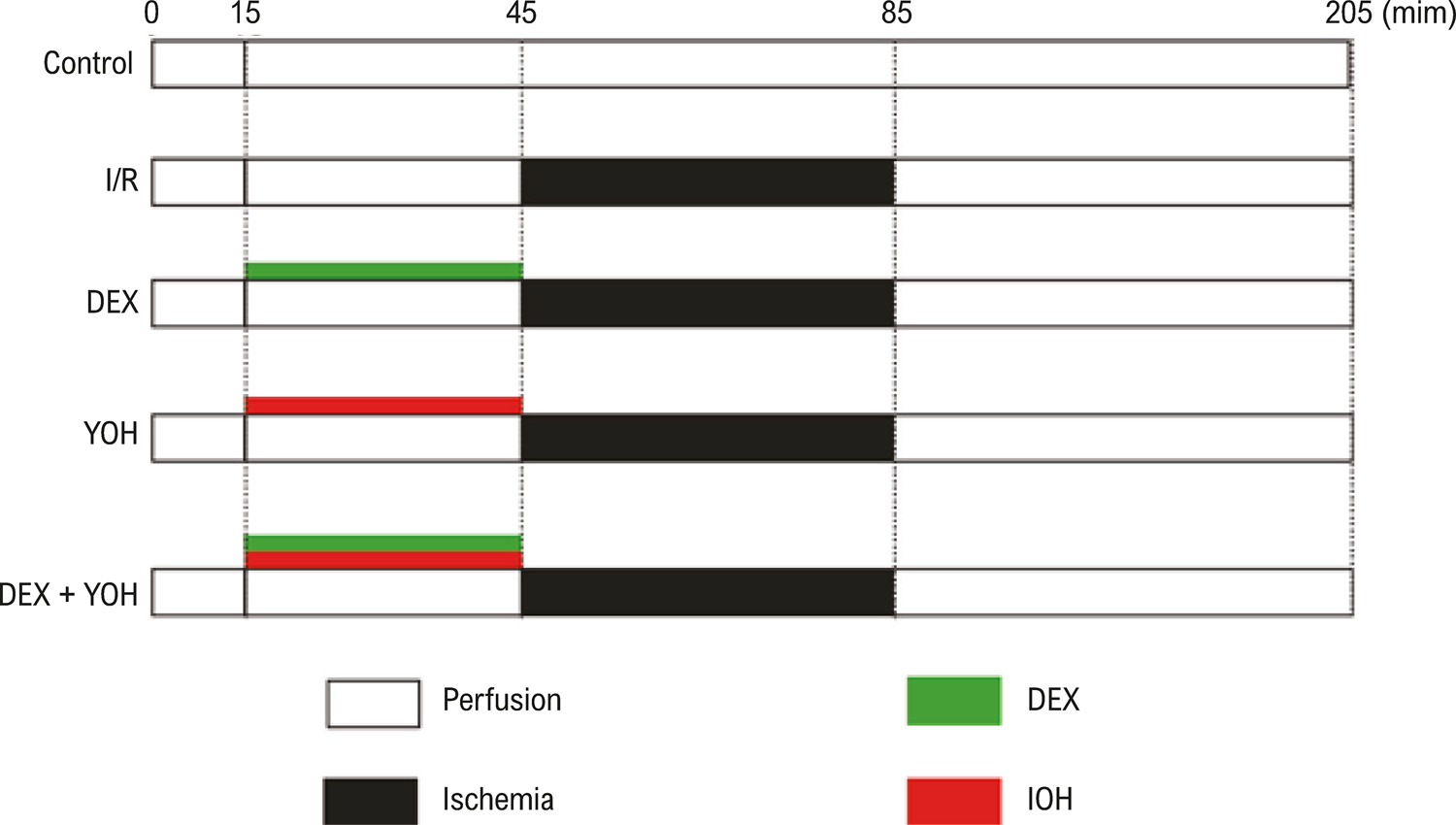
Rat hearts were perfused with a Langendorff perfusion system, and randomly assigned to five groups: control group, perfused with Krebs-Henseleit (K-H) solution for 205 minutes without ischemia; and four test groups that underwent 40 minutes of global ischemia and 120 min of reperfusion. The DEX group, the yohimbine (YOH) group and the DEX + YOH group were perfused with DEX (10 nM), YOH (1 μM) or the combination of DEX and YOH prior to reperfusion, respectively. Cardiac hemodynamics, myocardial infarct size, and myocardial histology were evaluated. The expression of glucose-related protein 78 (GRP78), protein kinase R-like ER kinase (PERK), phosphorylated PERK, eukaryotic initiation factor 2α (eIF2α), phosphorylated eIF2α, activating transcription factor 4 (ATF4), and CCAAT/enhancer-binding protein homologous protein (CHOP) were assessed. P<0.05 was considered to indicate a statistically significant difference.

Results

DEX preconditioning improved the cardiac function of I/R hearts, reduced myocardial infarction, myocardial apoptosis, and the expression of GRP78, p-PERK, eIF2α, p-eIF2α, ATF4 and CHOP.

Conclusions

DEX pretreatment reduced myocardial I/R injury by suppressing apoptosis, which was induced by the PERK pathway.

  • Dexmedetomidine
  • Hipnotics and Sedatives
  • Ischemic Cardiomyopathy/mortality
  • Myocardial Reperfusion
  • Protein Kinases
  • Rats
Read Full Article
Creative Commons Attribution (CC BY) Creative Commons license
08/10/2021 DOI: 10.36660/abc.20200672 Views 1
Figure 1
ABC
Original Article

Accuracy of Post-thrombolysis ST-segment Reduction as an Adequate Reperfusion Predictor in the Pharmaco-Invasive Approach

Henrique Tria Bianco et al. Rui Povoa Maria Cristina Izar Braulio Luna Filho … Flavio Tocci Moreira Edson Stefanini Henrique Andrade Fonseca Adriano Henrique Pereira Barbosa Claudia Maria Rodrigues Alves Adriano Mendes Caixeta Iran Gonçalves Jr Pedro Ivo de Marqui Moraes Renato Delascio Lopes Angelo Amato Vincenzo de Paola Dirceu Almeida Valdir Ambrosio Moises Francisco A. H. Fonseca

Abstract

Background

Primary percutaneous coronary intervention is considered the “gold standard” for coronary reperfusion. However, when not available, the drug-invasive strategy is an alternative method and the electrocardiogram (ECG) has been used to identify reperfusion success.

Objectives

Our study aimed to assess ST-Segment changes in post-thrombolysis and their power to predict recanalization and using the angiographic scores TIMI-flow and Myocardial Blush Grade (MBG) as an ideal reperfusion criterion.

Methods

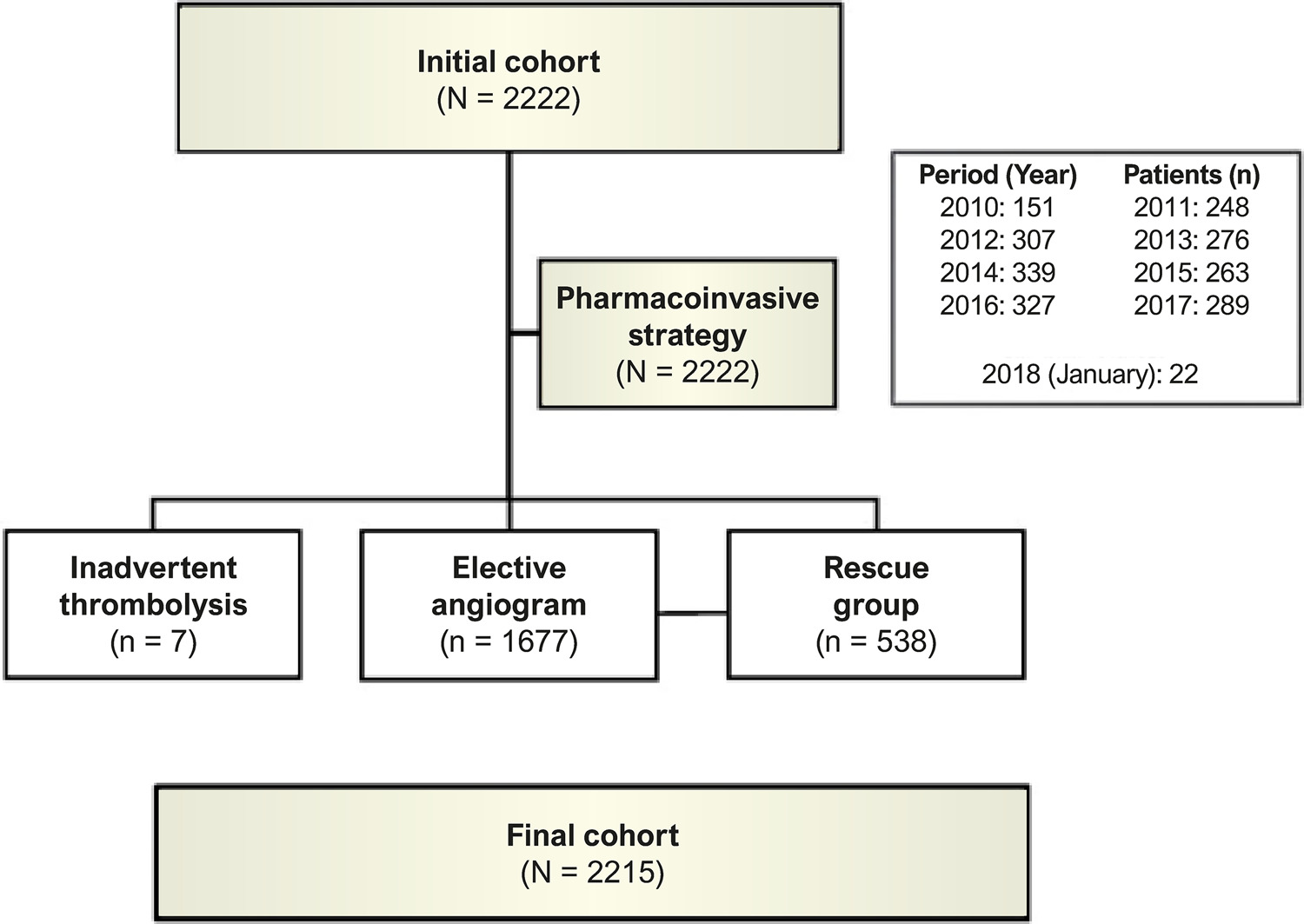
2,215 patients with ST-Segment Elevation Myocardial Infarction (STEMI) undergoing fibrinolysis [(Tenecteplase)-TNK] and referred to coronary angiography within 24 h post-fibrinolysis or immediately referred to rescue therapy were studied. The ECG was performed pre- and 60 min-post-TNK. The patients were categorized into 2 groups: those with ideal reperfusion (TIMI-3 and MBG-3) and those with inadequate reperfusion (TIMI and MBG 50%. A p-value <0.05 was considered for the analyses, with bicaudal tests.

Results

The ECG reperfusion criterion showed a positive predictive value of 56%; negative predictive value of 66%; sensitivity of 79%; and specificity of 40%. There was a weak positive correlation between ST-Segment reduction and ideal reperfusion angiographic data (r = 0.21; p <0.001) and low diagnostic accuracy, with an AUC of 0.60 (95%CI: 0.57-0.62).

Conclusion

The ST-Segment reduction was not able to accurately identify patients with adequate angiographic reperfusion. Therefore, even patients with apparently successful reperfusion should be referred to angiography soon, to ensure adequate macro and microvascular coronary flow.

  • Chest Pain
  • Coronary Angiography
  • Electrocardiography/methods
  • Myocardial Infarction
  • Myocardial Reperfusion
  • Percutaneous Coronary Intervention
  • Thrombolytic Therapy
Read Full Article
Creative Commons Attribution (CC BY) Creative Commons license
26/07/2021 DOI: 10.36660/abc.20200241 Views 2
ABC
Editorial

Coronary Reperfusion in Acute Myocardial Infarction: Trying the Optimal. Executing the Possible

Brivaldo Markman Filho et al. Sandro Gonçalves de Lima

The infarction-related artery reperfusion strategy began in the 1970s with the intracoronary administration of fibrinolytics., This was followed by intravenous administration and mechanical thrombolysis of the “culprit” artery, initially with simple angioplasty and, later, with stenting. All of these procedures had a common goal: to reduce the ischemic/necrotic area, preserve muscle, improve ventricular function and, consequently, survival.

The success of the procedure depends on the time from the onset of symptoms to the moment of the chosen intervention, whether chemical or percutaneous. According to different guidelines, this interval is about 12 hours. The earlier the diagnosis and intervention, the better the clinical outcomes will be.

[…]

  • Cardiovascular Diseases
  • Fibrinolytic Agents
  • Myocardial Infarction
  • Myocardial Reperfusion
  • Percutaneous Coronary Intervention
Read Full Article
Creative Commons Attribution (CC BY) Creative Commons license
26/07/2021 DOI: 10.36660/abc.20210500 Views 1
Figure 1
ABC
Original Article

Influence of Geographical Location on Access to Reperfusion Therapies and Mortality of Patients with STEMI in Sergipe: VICTIM Register

Jeferson Cunha Oliveira et al. Guilherme José dos Santos Ferreira Jussiely Cunha Oliveira Ticiane Clair Remacre Munareto Lima … Ikaro Daniel de Carvalho Barreto Laís Costa Souza Oliveira Larissa Andreline Maia Arcelino Antônio Carlos Sousa José Augusto Soares Barreto-Filho

Abstract

Background

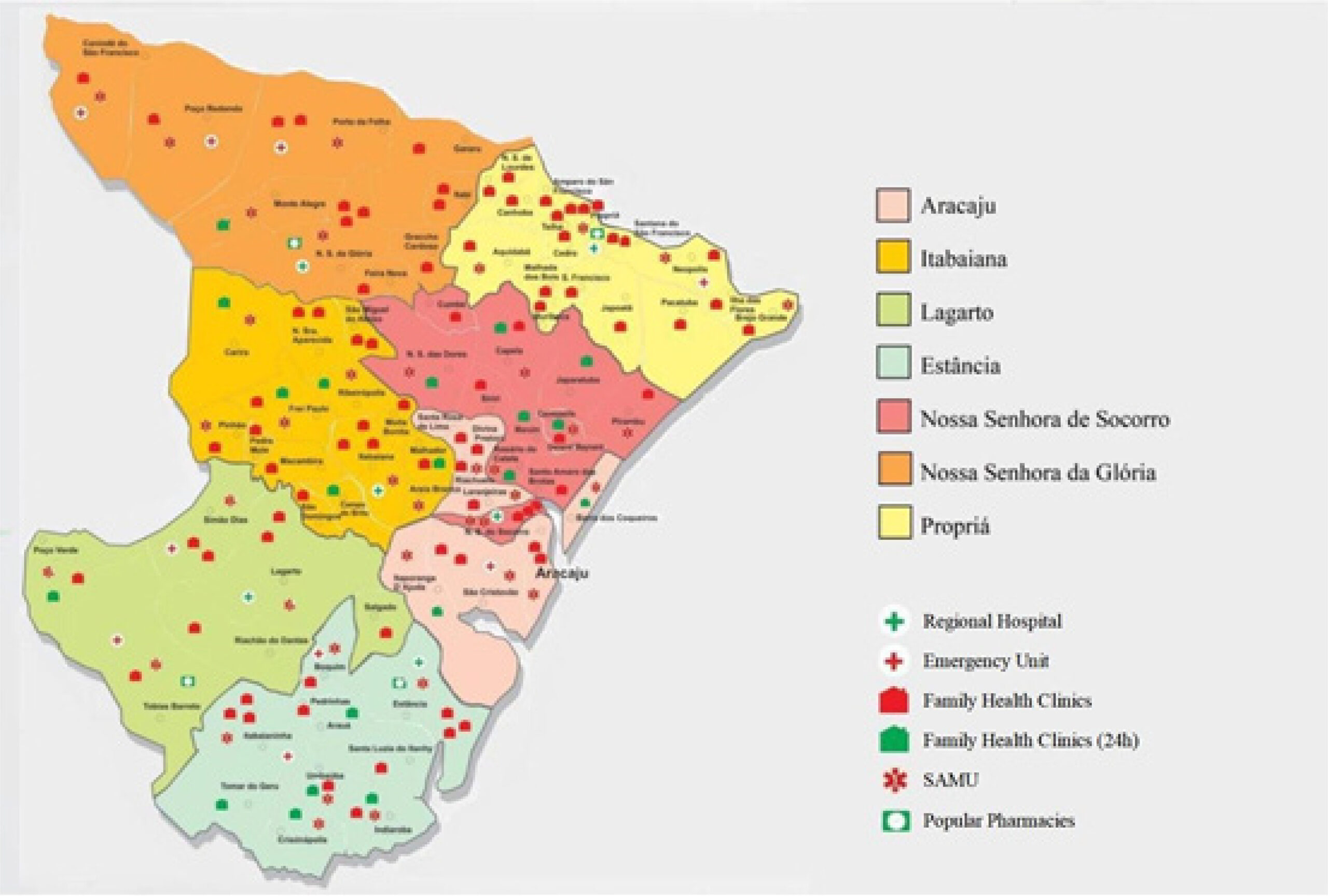
The concentration of high-complexity services in Aracaju, Sergipe can impose certain disparity in the quality of care for the patients with ST-segment elevation acute myocardial infarction (STEMI) (STEMI) who receive care from Brazil’s Unified Health System (SUS, acronym in Portuguese) and whose symptoms started in other health regions of the state.

Objective

To evaluate disparities in access to reperfusion therapies and 30-day mortality, among patients with STEMI, who were users of SUS, in each of the 7 health regions of Sergipe.

Methods

A total of 844 patients with STEMI in the period from 2014 to 2018, assisted by the only hospital with the capacity to offer primary percutaneous coronary intervention (PPCI) to SUS users in the state of Sergipe, were evaluated. The patients were divided into 7 groups according to the location at the onset of symptoms, following the existing division of health regions in the state. For comparison between groups, a significant difference was considered when p < 0.05.

Results

Of the total of 844 patients suffering from STEMI who were transferred to the hospital with PPCI that serves SUS patients, 386 patients (45.8%) underwent primary angioplasty. The mean rate of fibrinolytic use was 2.6%, with no differences between the regions. The mean total time of arrival to the hospital with PPCI was 21 hours and 55 minutes, with a median of 10 hours and 22 minutes (6 hours and 30 minutes to 22 hours and 52 minutes). Total 30-day mortality was 12.8%, but without differences between the regions, even when adjusted for age and sex.

Conclusions

This study reveals that fibrinolytics are underused throughout the state and that there is a significant delay in access to the hospital with PPCI, in all health regions of Sergipe.

  • Cardiovascular Diseases
  • Cross-Sectional Studies
  • Epidemiology
  • Mortality
  • Myocardial Infarction
  • Myocardial Reperfusion
Read Full Article
Creative Commons Attribution (CC BY) Creative Commons license
26/07/2021 DOI: 10.36660/abc.20200015 Views 1
ABC
Original Article

Percutaneous Coronary Intervention in Unprotected Left Main Coronary Artery Lesions

Douglas dos Santos Grion et al. Debora Carvalho Grion Igor Veiga Silverio Leonardo Shingu de Oliveira … Isabela Faria Larini Anna Victória Martins Juliana Moreira Marianne Machado Lissa Shizue Tateiwa Niekawa Adriana dos Santos Grion Cintia Magalhães Carvalho Grion

Abstract

Background

The advent of drug-eluting stents allowed the percutaneous coronary intervention to present safe results in lesions in the left main coronary artery.

Objectives

To analyze the results of the percutaneous treatment of unprotected left main coronary artery lesion with the use of intravascular ultrasound.

Methods

Study of consecutive case series carried out from January 2010 to December 2018. Clinical data were collected from patients as well as prognostic scores and data on coronary lesion. Low-grade residual lesion (less than 50%) on angiography and minimum luminal area greater than 6 mm2on intravascular ultrasound were considered successful. The adopted significance level was 5%.

Results

107 cases were analyzed. The multivessel lesion was predominant, with most (39.25%) of the lesions being found in three vessels in addition to the left main coronary artery. The SYNTAX score had a mean of 46.80 (SD: 22.95), and 70 (65.42%) patients had a SYNTAX score above 32 points. Angiographic success of percutaneous intervention was considered in 106 (99.06%) patients. The overall rate of major cardiac and cerebrovascular events in the hospital outcome was 6.54%, being similar in patients with SYNTAX score ≤ 32 (8.10%) and ≥ 33 (5.71%; p = 0.68).

Conclusions

Percutaneous intervention in cases of unprotected left main coronary artery lesion was safely performed and presented excellent results. Considerable angiographic success of treatment guided by intravascular ultrasound was achieved. The rate of major cardiac and cerebrovascular events was similar between patients at low and high risks.

  • Coronary Artery Diseases
  • Drug–Eluting Stents/trends
  • Myocardial Reperfusion
  • Percutaneous Coronary Intervention/methods
  • Ultrasonography, Interventional/methods
Read Full Article
Creative Commons Attribution (CC BY) Creative Commons license
14/06/2021 DOI: 10.36660/abc.20190653 Views 1
Figure 1
IJCS
Review Article

Reperfusion Strategies in Acute Myocardial Infarction: State of the Art

Fernando Oswaldo Dias Rangel

Abstract

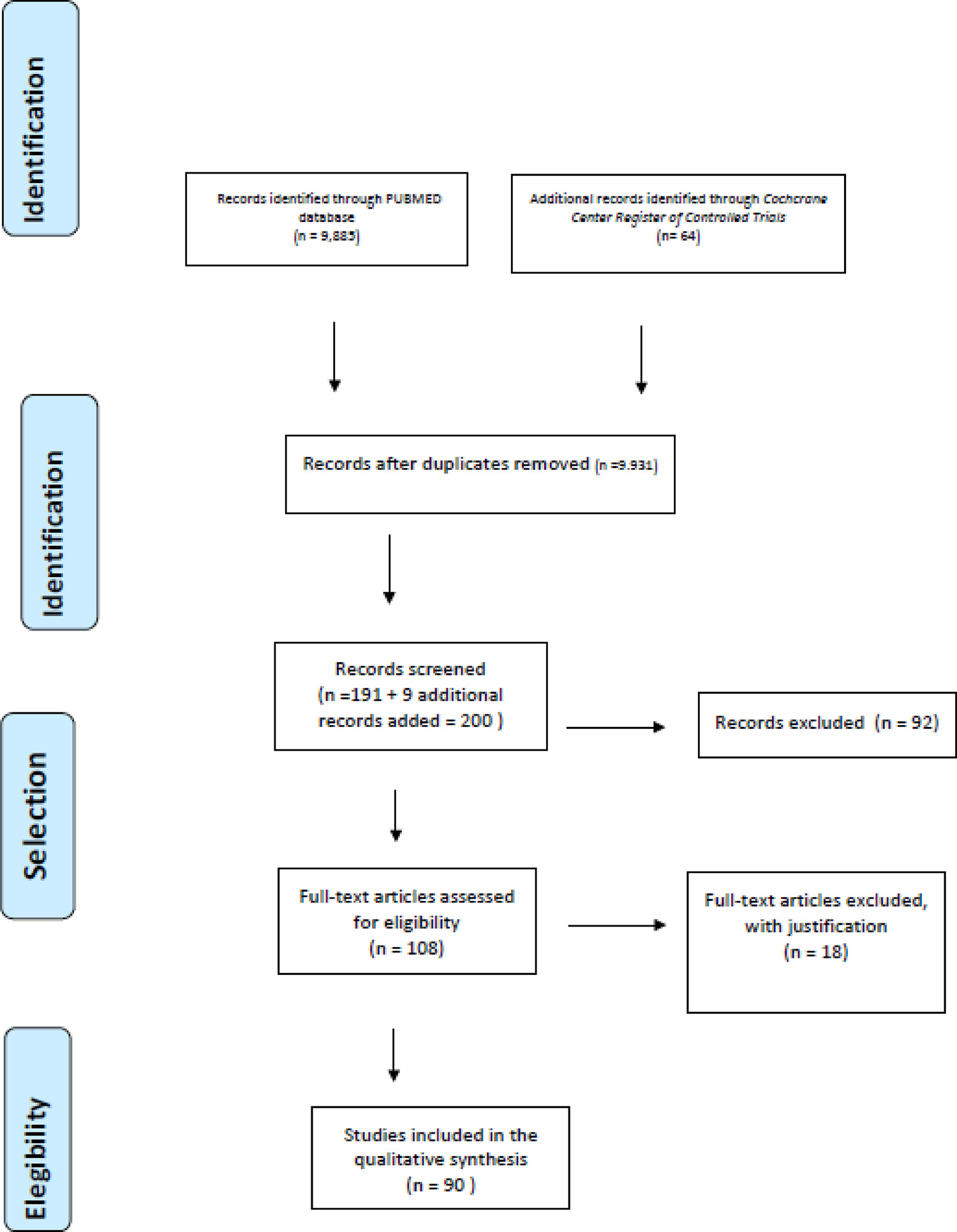
ST elevation myocardial infarction (STEMI) is a highly prevalent condition worldwide. Reperfusion therapy is strongly associated with the prognosis of STEMI and must be performed with a high standard of quality and without delay. A systematic review of different reperfusion strategies for STEMI was conducted, including randomized controlled trials that included major cardiovascular events (MACE), and systematic reviews in the last 5 years through the PRISMA ( Preferred Reporting Items for Systematic Reviews and Meta-Analysis) methodology. The research was done in the PubMed and Cochrane Central Register of Controlled Trials databases, in addition to a few manual searches. After the exclusion criteria were applied, 90 articles were selected for this review. Despite the reestablishment of IRA patency in PCI for STEMI, microvascular lesions occur in a significant proportion of these patients, which can compromise ventricular function and clinical course. Several therapeutic strategies – intracoronary administration of nicorandil, nitrates, melatonin, antioxidant drugs (quercetin, glutathione), anti-inflammatory substances (tocilizumab [an inhibitor of interleukin 6], inclacumab, P-selectin inhibitor), immunosuppressants (cyclosporine), erythropoietin and ischemic pre- and post-conditioning and stem cell therapy – have been tested to reduce reperfusion injury, ventricular remodeling and serious cardiovascular events, with heterogeneous results: These therapies need confirmation in larger studies to be implemented in clinical practice

  • Acute Myocardial Infarction/therapy
  • Morbidity and Mortality
  • Myocardial Reperfusion
  • Myocardial Stunning
  • Ventricular Remodeling
Read Full Article
Creative Commons Attribution (CC BY) Creative Commons license
09/06/2021 DOI: 10.36660/ijcs.20200226 Views 2
Figure 1
ABC
Original Article

Access to Reperfusion Therapy and Mortality in Women with ST-Segment–Elevation Myocardial Infarction: VICTIM Register

Jussiely Cunha Oliveira et al. Mayse Pereira Souza Barros Ikaro Daniel de Carvalho Barreto Rubens Cruz Silva Filho … Volfanio Araújo Andrade André de Melo Oliveira Ticiane Clair Remacre Munareto Lima Jeferson Cunha Oliveira Larissa Andreline Maia Arcelino Laís Costa Souza Oliveira Eduesley Santana-Santos Marcos Antônio Almeida-Santos Antônio Carlos Sousa José Augusto Soares Barreto Filho

Abstract

Background:

Myocardial reperfusion is a fundamental part of the treatment for ST elevation myocardial infarction (STEMI) and is responsible for reducing morbidity and mortality in affected patients. However, reperfusion rates are usually lower and mortality rates higher in women compared to men.

Objectives:

To evaluate the prevalence of the use of reperfusion therapies among women and men with STEMI in hospitals where percutaneous coronary intervention (PCI) is available in the state of Sergipe.

Methods:

This is a cross-sectional study that used data from the VICTIM Register. Patients diagnosed with STEMI admitted to the four hospitals (one public and three private) where PCI is available in the state of Sergipe were evaluated, from December 2014 to June 2018. A multivariate analysis with adjusted model using mortality as a dependent variable was made. In all analyses, the level of significance adopted was 5% (p < 0.05).

Results:

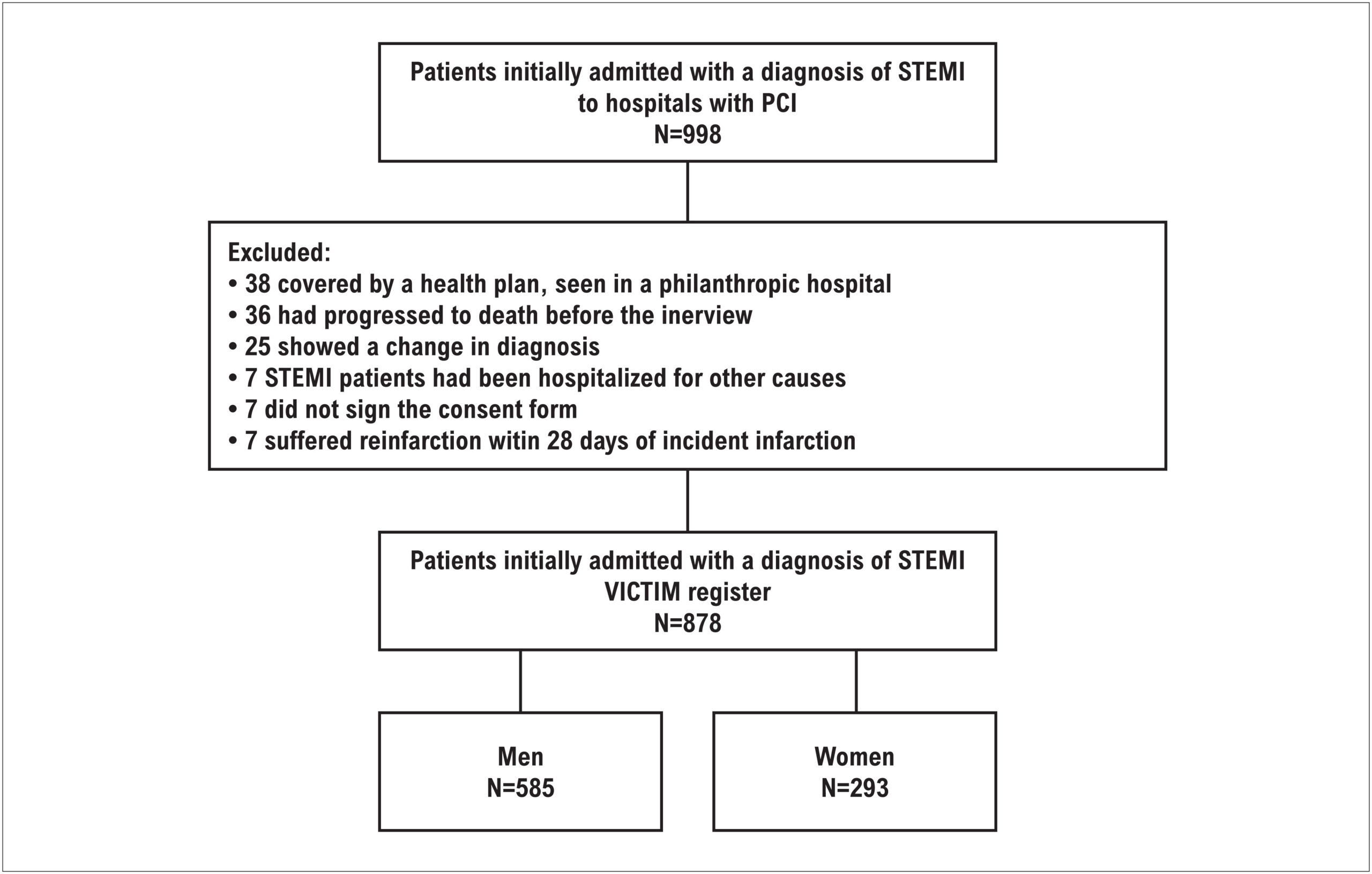
A total of 878 volunteers with a confirmed diagnosis of STEMI, of which 33.4% were women, were included in the study. Only 53.3% of the patients underwent myocardial reperfusion (134 women versus 334 men). Fibrinolysis was performed only in 2.3% of all patients (1.7% of women versus 2.6% of men; p = 0.422). The rate of primary PCI was lower (44% versus 54.5%; p = 0.003) and hospital mortality was higher (16.1% versus 6.7%; p < 0.001) in women than in men.

Conclusion:

Women have significantly lower rates of primary PCI and higher hospital mortality. Reperfusion rates were low in both sexes and there was a clear underutilization of thrombolytic agents.

  • Gender and Health
  • Healthcare Disparities
  • Morbimortality
  • Myocardial Infarction
  • Myocardial Reperfusion
  • Percutaneous Coronary Intervention
  • Women
Read Full Article
Creative Commons Attribution (CC BY) Creative Commons license
16/04/2021 DOI: 10.36660/abc.20190468 Views 1
ABC
Editorial

Gender Equity in Access to Reperfusion in Acute Myocardial Infarction: Still A Long Way to Go

Clara L. Fraga et al. Frederico V. B. Macedo Rodrigo T. L. Rocha Domingos Sávio G. Ferreira Filho Bruno R. Nascimento

Ischemic heart disease is the main cause of death worldwide, and its most severe presentation ST-elevation acute myocardial infarction (STEMI), which corresponds to approximately 1/3 of the presentations, and early reperfusion is the main strategy for reducing mortality. Despite broad historical knowledge of gender-related differences in treatment and prognosis of patients with an acute presentation of ischemic heart disease, male individuals, in addition to having earlier access to health systems, are even more likely to undergo a diagnostic coronary angiography and urgent revascularization than women.– The article “Access to Reperfusion Therapies and Mortality in Women with Acute Myocardial Infarction with ST-Segment Elevation: the VICTIM Registry” demonstrates very well this difference in access to reperfusion therapies in the Brazilian scenario. When evaluating 878 patients admitted with STEMI in the northeastern state of Sergipe, Brazil, it was observed that female individuals were less frequently submitted to reperfusion strategies when compared to males, both primary percutaneous coronary interventions (PCI) (44% x 54.5%; p = 0.003) and fibrinolysis (1.7% x 2.6%; p = 0.422). This scenario is in line with data from other previous studies on this topic carried out in different settings (). In the VICTIM registry, higher in-hospital mortality was observed in the female gender (16.1% x 6.7*; p <0.001), probably as a consequence of this lower access to reperfusion therapies. These data are consistent with systematic reviews of the literature on the topic.

Would the delay in calling for help be one of the reasons why women are less frequently submitted to revascularization therapies? The aforementioned study demonstrated that this does not seem to have been the problem in Sergipe, with the time spent calling for help after symptom onset being statistically similar between the genders. However, female patients underwent a greater delay in the primary hospital, until referral to a unit with infrastructure to perform the percutaneous reperfusion (transfer delay). These data differ in part from the findings of a recent study carried out in Italy, in which the mean time from symptom onset to presentation at the hospital was longer for women (280 x 240 minutes), with only 23.2% of women x 29.1 % of men undergoing a delay <120 minutes until hospital admission (p = 0.002). As in the VICTIM study, there was an impact on mortality: in cases with delay ≥120 minutes, mortality rates were higher among women (5.5% x 2.8%), whereas in cases with presentation <120 minutes, mortality was considerably lower and statistically similar between genders (2.0% in women vs. 1.6% in men).

[…]

  • Men
  • Myocardial Infarction
  • Myocardial Ischemia
  • Myocardial Reperfusion
  • Myocardial Revascularization
  • Womens
Read Full Article
Creative Commons Attribution (CC BY) Creative Commons license
16/04/2021 DOI: 10.36660/abc.20210082 Views 2
Figure 1
IJCS
Editorial

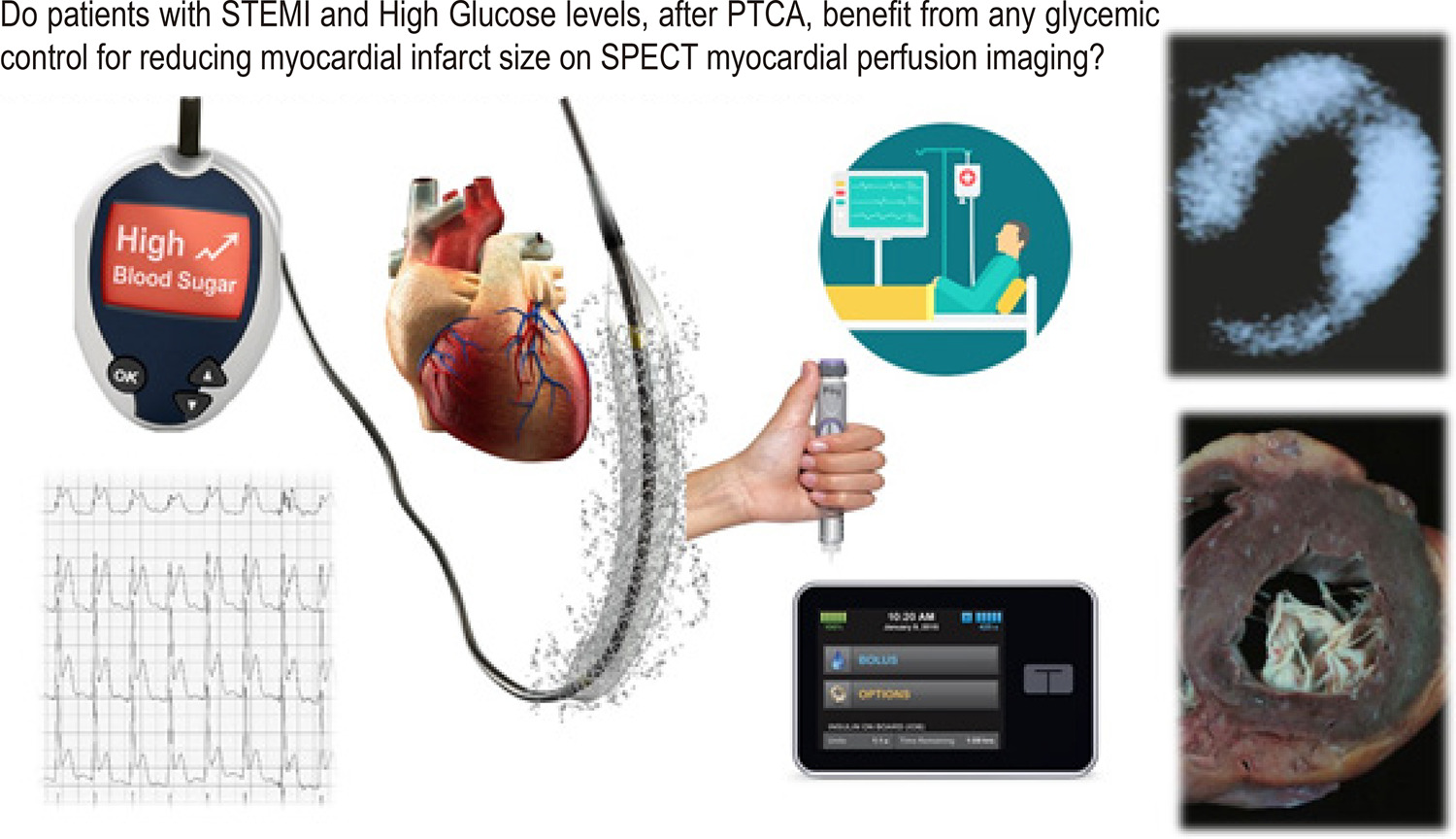
After a STEMI, is Less Sugar more Protective to Myocardium?

Rafael Willain Lopes et al. Alexandre Hohl

The infarct size reduction in acute myocardial infarction (AMI) has been studied for more than 50 years. Animal experiments were conducted in the 1970s, followed by the first clinical studies to reduce infarct size (IS), with fibrinolytic agents or with mechanical coronary angioplasty (PTCA). The clinical experience of coronary reperfusion indicated that left ventricle function was not normalized in 30% of the patients, and despite unblocking the epicardial vessel, demonstrated hemodynamically, there was no equivalent in myocardial perfusion. New concepts emerged such as reperfusion injury, microvascular dysfunction, “no-reflow” phenomenon, and stunned and hibernating myocardium, which became the focus of basic research and clinical investigation. To improve characterization, different technologies were used, such as contrast echocardiography, isotopic studies, including positron emission tomography, and magnetic resonance.

Cardioprotection (CP) aims to reduce IS and improve clinical outcomes. The translation of CP from preclinical and promising proof-of-concept studies to clinical benefit (CB) for patients has been quite unsatisfactory. Almost all these studies that did not translate into CB had infarct size reduction as the primary endpoint and used protocols selected to achieve IS reduction.

[…]

  • Angioplasty
  • Diagnostic Imaging
  • Fibrinolytic Agents
  • Myocardial Reperfusion
  • Myocardial Stunning
  • Percutaneous Coronary Intervention
  • ST Elevation Myocardial Infarction
  • Ventricular Dysfunction, Left
Read Full Article
Creative Commons Attribution (CC BY) Creative Commons license
09/10/2020 DOI: 10.36660/ijcs.20200173 Views 1
Figure 1
IJCS
Original Article

Implementation of an Acute Coronary Syndrome Simulation Training Strategy for Emergency Healthcare Professionals

Maíra Viana Rego Souza-Silva et al. Priscilla Fortes de Oliveira Passos Thais Ribeiro Lemos Bárbara Campos Abreu Marino … Thatiane Dantas Dias Geisiane Sousa Braga Machado Edson Alexandre Silva Carvalho Gabriel Almeida Silqueira Rocha Antonio Luiz Ribeiro Milena Soriano Marcolino

Abstract

Background:

The knowledge on the management of patients with acute coronary syndrome (ACS) is essential to reduce the gap between evidence and practice.

Objective:

To describe a simulation training strategy for emergency healthcare professionals and provide preliminary data on knowledge acquisition, learners’ confidence and prescription of medications after training.

Methods:

The training was part of the implementation of two myocardial infarction systems of care. It comprehended lectures and simulation-based learning using high and low-fidelity mannequins and actors. It was tested in two phases: the first one in Belo Horizonte and the second one in Montes Claros, both in the state of Minas Gerais. A test was applied before and after training to assess knowledge acquisition. Confidence to perform thrombolysis in ST-elevation myocardial infarction (STEMI) patients was assessed using a questionnaire, and the impact on medication prescription analyzed STEMI patients admitted to hospitals in Montes Claros.

Results:

In the first phase, 156 professionals answered both tests: 70% of them improved their results and the median number of right answers increased (6, interquartile range [IQR] 5-7; vs 7 ([IQR] 6-9; p < 0.05). In the second phase, 242 professionals answered both tests: 58% of the physicians and 83% of the nurses obtained better test scores. Participants referred a positive impact on their clinical practice, 95% reported feeling very secure when perform fibrinolysis after the training, and there was also an impact on medication prescription.

Conclusions:

There was an impact on the learners’ knowledge acquisition and confidence using our two-phase training model, with evidence of impact on performance.

  • Acute coronary syndrome
  • Emergency Service Hospital
  • Myocardial Infarction
  • Myocardial Reperfusion
  • Quality Indicators,Health Care
Read Full Article
Creative Commons Attribution (CC BY) Creative Commons license
21/01/2019 DOI: 10.5935/2359-4802.20180098 Views 1
Figure 1
ABC
Original Article

Regional QT Interval Dispersion as an Early Predictor of Reperfusion in Patients with Acute Myocardial Infarction after Fibrinolytic Therapy

Gabriel Dotta et al. Francisco Antonio Helfenstein Fonseca Maria Cristina de Oliveira Izar Marco Tulio de Souza … Flavio Tocci Moreira Luiz Fernando Muniz Pinheiro Adriano Henrique Pereira Barbosa Adriano Mendes Caixeta Rui Manoel Santos Póvoa Antônio Carlos Carvalho Henrique Tria Bianco

Abstract

Background:

Patients with ST-elevation acute myocardial infarction attending primary care centers, treated with pharmaco-invasive strategy, are submitted to coronary angiography within 2-24 hours of fibrinolytic treatment. In this context, the knowledge about biomarkers of reperfusion, such as 50% ST-segment resolution is crucial.

Objective:

To evaluate the performance of QT interval dispersion in addition to other classical criteria, as an early marker of reperfusion after thrombolytic therapy.

Methods:

Observational study including 104 patients treated with tenecteplase (TNK), referred for a tertiary hospital. Electrocardiographic analysis consisted of measurements of the QT interval and QT dispersion in the 12 leads or in the ST-segment elevation area prior to and 60 minutes after TNK administration. All patients underwent angiography, with determination of TIMI flow and Blush grade in the culprit artery. P-values < 0.05 were considered statistically significant.

Results:

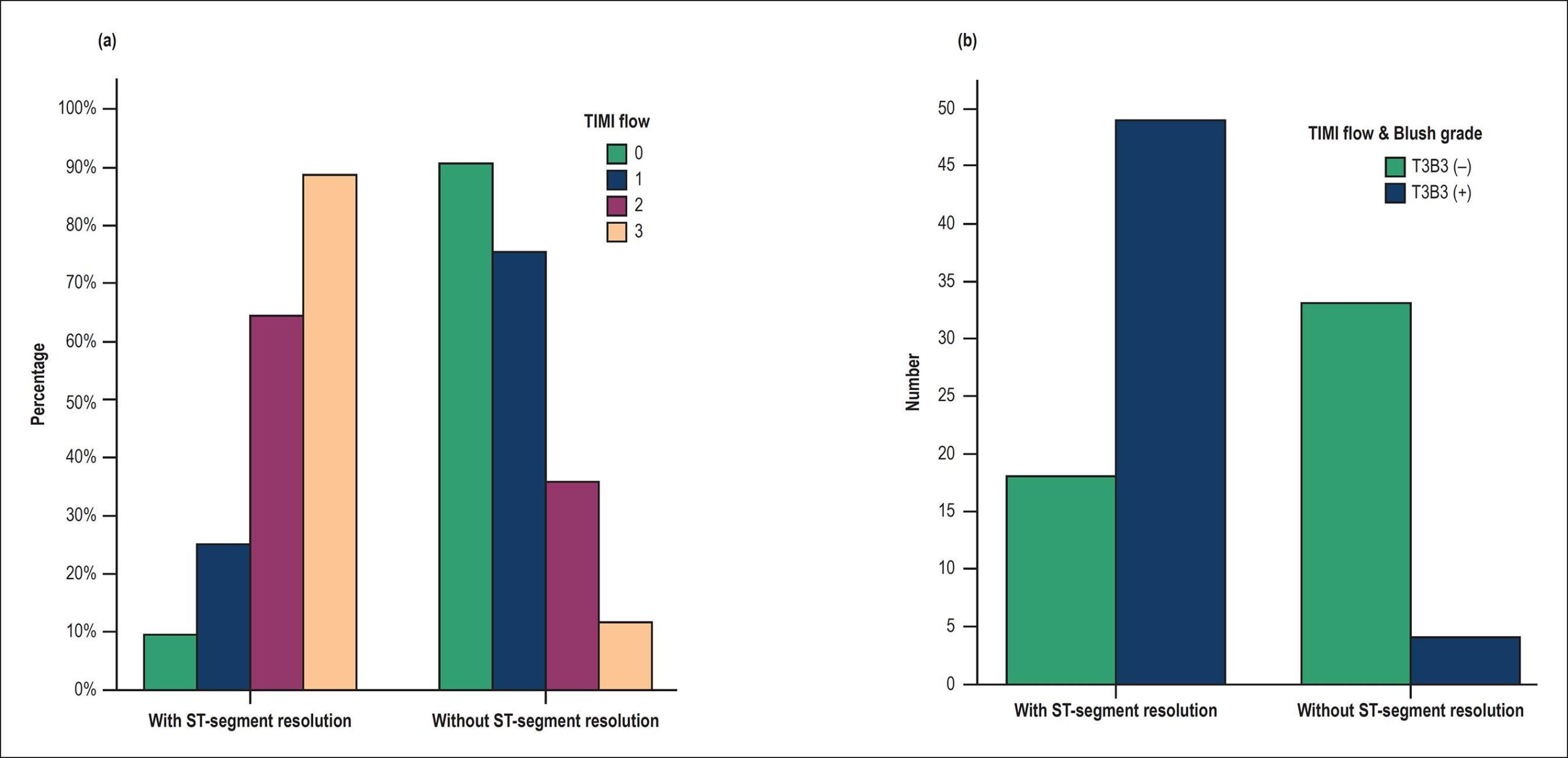
We found an increase in regional dispersion of the QT interval, corrected for heart rate (regional QTcD) 60 minutes after thrombolysis (p = 0.06) in anterior wall infarction in patients with TIMI flow 3 and Blush grade 3 [T3B3(+)]. When regional QTcD was added to the electrocardiographic criteria for reperfusion (i.e., > 50% ST-segment resolution), the area under the curve increased to 0.87 [(0.78-0.96). 95% IC. p 50% and regional QTcD > 13 ms, we found a 93% sensitivity and 71% specificity for reperfusion in T3B3(+), and 6% of patients with successful reperfusion were reclassified.

Conclusion:

Our data suggest that regional QTcD is a promising non-invasive instrument for detection of reperfusion in the culprit artery 60 minutes after thrombolysis.

  • Biomarkers
  • Electrocardiography
  • Myocardial Reperfusion
  • Percutaneous Coronary Intervention
  • ST Elevation Myocardial Infarction
Read Full Article
Creative Commons Attribution (CC BY) Creative Commons license
17/12/2018 DOI: 10.5935/abc.20180239 Views 1
Figure 1
ABC
Original Article

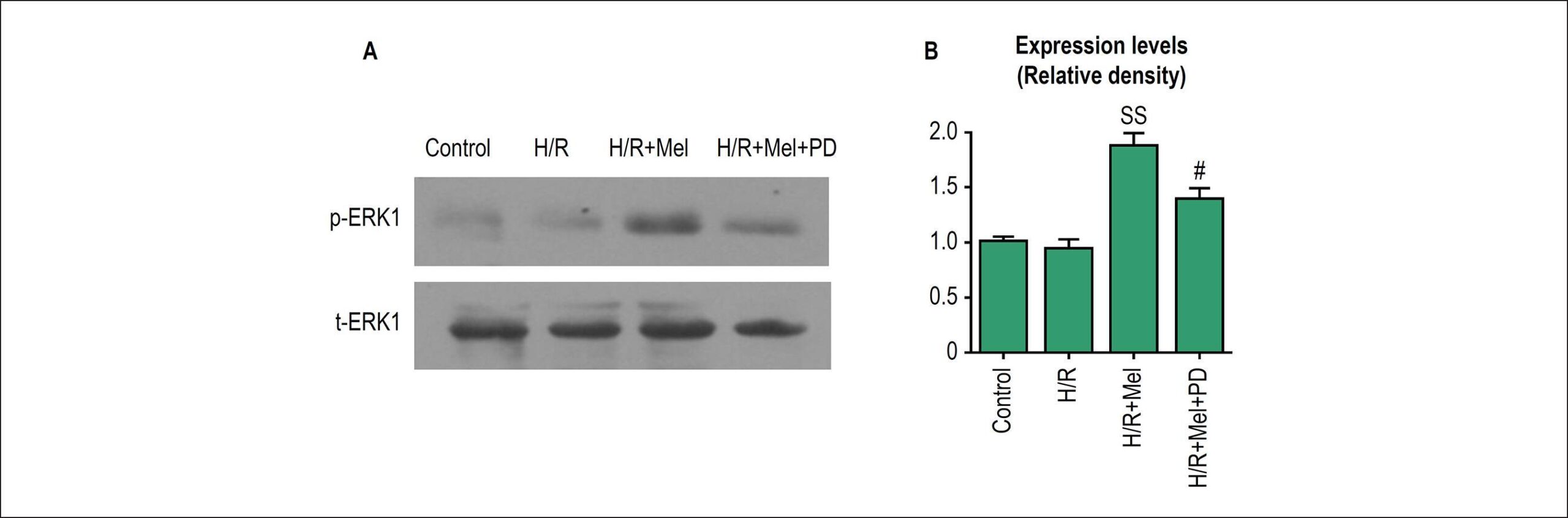
Melatonin-Induced Protective Effects on Cardiomyocytes Against Reperfusion Injury Partly Through Modulation of IP3R and SERCA2a Via Activation of ERK1

Shunying Hu et al. Pingjun Zhu Hao Zhou Ying Zhang Yundai Chen

Resumo

Background:

Melatonin is a neuroendocrine hormone synthesized primarily by the pineal gland that is indicated to effectively prevent myocardial reperfusion injury. It is unclear whether melatonin protects cardiac function from reperfusion injury by modulating intracellular calcium homeostasis.

Objective:

Demonstrate that melatonin protect against myocardial reperfusion injury through modulating IP3R and SERCA2a to maintain calcium homeostasis via activation of ERK1 in cardiomyocytes.

Methods:

In vitro experiments were performed using H9C2 cells undergoing simulative hypoxia/reoxygenation (H/R) induction. Expression level of ERK1, IP3R and SERCA2a were assessed by Western Blots. Cardiomyocytes apoptosis was detected by TUNEL. Phalloidin-staining was used to assess alteration of actin filament organization of cardiomyocytes. Fura-2 /AM was used to measure intracellular Ca2+ concentration. Performing in vivo experiments, myocardial expression of IP3R and SERCA2a were detected by immunofluorescence staining using myocardial ischemia/ reperfusion (I/R) model in rats.

Results:

In vitro results showed that melatonin induces ERK1 activation in cardiomyocytes against H/R which was inhibited by PD98059 (ERK1 inhibitor). The results showed melatonin inhibit apoptosis of cardiomyocytes and improve actin filament organization in cardiomyocytes against H/R, because both could be reversed by PD98059. Melatonin was showed to reduce calcium overload, further to inhibit IP3R expression and promote SERCA2a expression via ERK1 pathway in cardiomyocytes against H/R. Melatonin induced lower IP3R and higher SERCA2a expression in myocardium that were reversed by PD98059.

Conclusion:

melatonin-induced cardioprotection against reperfusion injury is at least partly through modulation of IP3R and SERCA2a to maintain intracellular calcium homeostasis via activation of ERK1.

  • Cardiac Myocytes
  • Heart Failure
  • Melatonin
  • Myocardial Infarction
  • Myocardial Reperfusion
Read Full Article
Creative Commons Attribution (CC BY) Creative Commons license
01/01/2018 DOI: 10.5935/abc.20180008 Views 1
Figure 1
ABC
Original Article

Effects of Nitrate Intake on Myocardial Ischemia-Reperfusion Injury in Diabetic Rats

Sajad Jeddi et al. Saeedeh Khalifi Mahboubeh Ghanbari Fatemeh Bageripour Asghar Ghasemi

Abstract

Background:

Coronary artery disease is 2-3 times more common in diabetic individuals. Dietary nitrate/nitrite has beneficial effects in both diabetes and cardiovascular disease. It also has protective effects against myocardial ischemia-reperfusion (IR) injury in healthy animals. However, the effects of nitrate on myocardial IR injury in diabetic rats have not yet been investigated.

Objective:

We examined the effects of dietary nitrate on myocardial IR injury in streptozotocin-nicotinamide-induced diabetic rats.

Method:

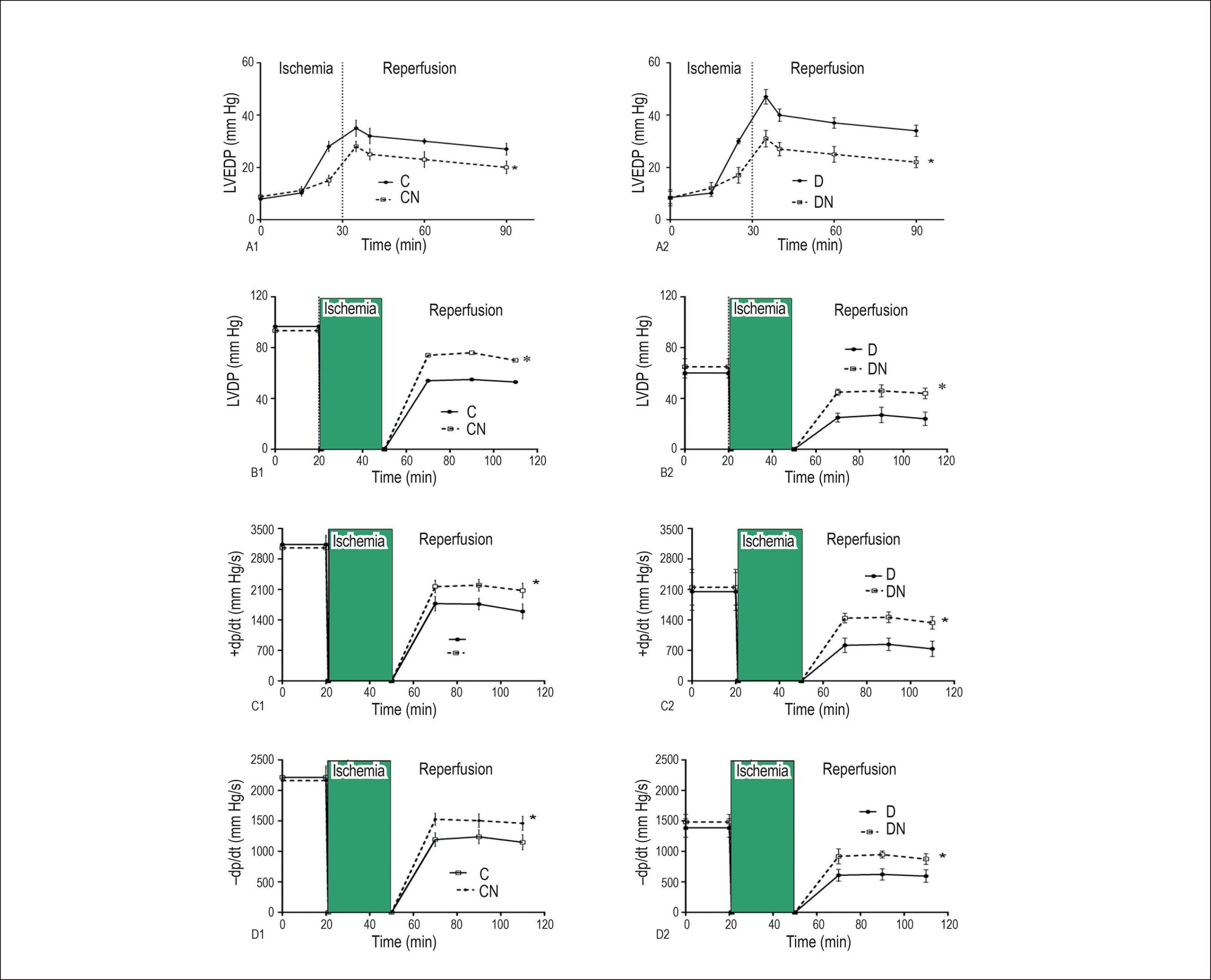
Rats were divided into four groups (n=7 in each group): control, control+nitrate, diabetes, and diabetes+nitrate. Type 2 diabetes was induced by injection of streptozotocin and nicotinamide. Nitrate (sodium nitrate) was added to drinking water (100 mg/L) for 2 months. The hearts were perfused in a Langendorff apparatus at 2 months and assessed before (baseline) and after myocardial IR for the following parameters: left ventricular developed pressure (LVDP), minimum and maximum rates of pressure change in the left ventricle (±dP/dt), endothelial nitric oxide (NO) synthase (eNOS) and inducible NO synthase (iNOS) mRNA expression, and levels of malondialdehyde (MDA) and NO metabolites (NOx).

Results:

Recovery of LVDP and ±dP/dt was lower in diabetic rats versus controls, but almost normalized after nitrate intake. Diabetic rats had lower eNOS and higher iNOS expression both at baseline and after IR, and dietary nitrate restored these parameters to normal values after IR. Compared with controls, heart NOx level was lower in diabetic rats at baseline but was higher after IR. Diabetic rats had higher MDA levels both at baseline and after IR, which along with heart NOx levels decreased following nitrate intake.

Conclusion:

Dietary nitrate in diabetic rats provides cardioprotection against IR injury by regulating eNOS and iNOS expression and inhibiting lipid peroxidation in the heart.

  • Coronary Artery Disease
  • diabetes
  • Ischemia
  • Myocardial Reperfusion
  • Nitrates
  • Nitrites
Read Full Article
Creative Commons Attribution (CC BY) Creative Commons license
01/10/2016 DOI: 10.5935/abc.20160137 Views 1
ABC
Letter to the Editor

Left Atrial Volume Index as Predictor of Events in Acute Coronary Syndrome

Luciano Barros Pires et al. Rodrigo Pires dos Santos

Dear Editor,

The Left Atrial Volume Index (LAVi) is a measurement that has gained importance in daily clinical practice due to evidence of its capacity to predict mortality, in patients followed after an Acute Myocardial Infarction (AMI), as well as in the general population.

[…]

  • Acute Coronary Syndrome / mortality
  • Atrial Fibrillation
  • Heart Atria
  • Myocardial Reperfusion
  • Organ Size
Read Full Article
Creative Commons Attribution (CC BY) Creative Commons license
01/04/2015 DOI: 10.5935/abc.20150030
Myocardial perfusion imaging and cardiac involvement in the indeterminate phase of chagas disease
ABC
Artigo Original

Myocardial perfusion imaging and cardiac involvement in the indeterminate phase of chagas disease

Amalia Peix et al. Raymid García Jesús Sánchez Lázaro O. Cabrera … Kenia Padrón Oscar Vedia Hugo V. Choque Jorge Fraga Juan Bandera Alberto Hernández-Cañero

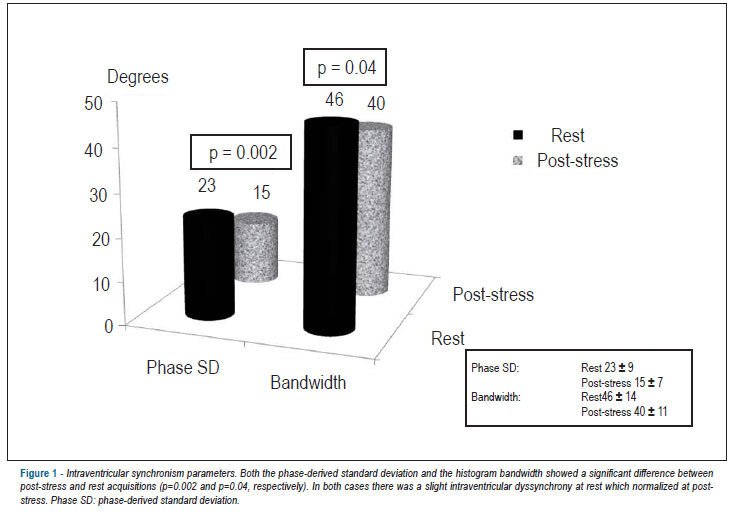
BACKGROUND: Myocardial perfusion imaging (MPI) has been used in the assessment of chagasic heart disease. OBJECTIVE: To investigate the value of gated-single photon emission computed tomography (gated-SPECT) MPI to detect early cardiac involvement in chagasic patients in the indeterminate phase, who present segmental motion abnormalities detected by tissue Doppler imaging (TDI)-derived strain. METHODS: Forty individuals (mean age: 25±2 years, 50% males) from an endemic area of Chagas disease and with positive serologic diagnosis, were included. All underwent gated-SPECT two-day (stress-rest) MPI and echocardiography. RESULTS: Thirty individuals (75%) showed a normal scan. In three cases (8%) the MPI was slightly abnormal, and in seven it was equivocal. In all cases with reversible defects, the affected segments were coincident with those with motion abnormalities. A post-stress left ventricular ejection fraction (LVEF) reduction > 5% (ΔLVEF < -5%) was found in 11 out of 40 individuals (28%). Both the phase-derived standard deviation and the histogram bandwidth showed a significant difference between post-stress and rest. In both cases there was a slight dyssynchrony at rest which normalized at post-stress. CONCLUSIONS: A stress-rest gated-SPECT is a valid approach to detect early myocardial alterations, as well as intraventricular dyssynchrony in the indeterminate phase of Chagas disease in patients with segmental motion abnormalities previously detected by TDI-derived strain.

  • Chagas disease
  • Myocardial Reperfusion
  • Radionuclide Imaging
  • Stroke Volume
Read Full Article
Creative Commons Attribution (CC BY) Creative Commons license
11/03/2013 DOI: 10.5935/abc.20130023

Could not load more articles. Please try again.

How to cite this article

EndNote RIS

Electronic Document Format (Vancouver)

Almeida EC, Albuquerque FN, Ferreira E, Pozzan R, Spineti PPM, Monteiro PS, Araújo WO, et al. Geographic Variation in Door-to-Needle Time among Patients with STEMI from the Metropolitan Region of Rio de Janeiro: Results of the EQUITY-MI Cohort. Arquivos Brasileiros de Cardiologia 2026;122(12):e20250401.

Electronic Document Format (ABNT)

Almeida, Eric Costa de; Albuquerque, Felipe Neves; Ferreira, Esmeralci; Pozzan, Roberto; Spineti, Pedro Pimenta de Mello; Monteiro, Pâmela Sousa; Araújo, Williana Oliveira de; Silva, Rhayana Vitória da Rosa; Caminhas, Carla Maciel; Whately, Thales Cardoso; Junqueira, João Gabriel Monteiro; Albuquerque, Denilson Campos de. Geographic Variation in Door-to-Needle Time among Patients with STEMI from the Metropolitan Region of Rio de Janeiro: Results of the EQUITY-MI Cohort. Arquivos Brasileiros de Cardiologia, v. 122, n. 12, e20250401, Feb. 2026.

Electronic Document Format (APA)

Almeida, E. C. , Albuquerque, F. N., Ferreira, E., Pozzan, R., Spineti, P. P. M., Monteiro, P. S., Araújo, W. O. , Silva, R. V. R., Caminhas, C. M., Whately, T. C., Junqueira, J. G. M., & Albuquerque, D. C. (2026). Geographic Variation in Door-to-Needle Time among Patients with STEMI from the Metropolitan Region of Rio de Janeiro: Results of the EQUITY-MI Cohort. Arquivos Brasileiros de Cardiologia, 122(12), e20250401.

Electronic Document Format (ISO)

Almeida, Eric Costa de and Albuquerque, Felipe Neves and Ferreira, Esmeralci and Pozzan, Roberto and Spineti, Pedro Pimenta de Mello and Monteiro, Pâmela Sousa and Araújo, Williana Oliveira de and Silva, Rhayana Vitória da Rosa and Caminhas, Carla Maciel and Whately, Thales Cardoso and Junqueira, João Gabriel Monteiro and Albuquerque, Denilson Campos de. Geographic Variation in Door-to-Needle Time among Patients with STEMI from the Metropolitan Region of Rio de Janeiro: Results of the EQUITY-MI Cohort. Arquivos Brasileiros de Cardiologia [online]. 2026, vol. 122, n. 12, [cited 2026-10-14], e20250401. Available from: <https://journals.cardiol.br/en/article/geographic-variation-in-door-to-needle-time-among-patients-with-stemi-from-the-metropolitan-region-of-rio-de-janeiro-results-of-the-equity-mi-cohort/>. ISSN 0066-782X

EndNote RIS

Electronic Document Format (Vancouver)

Tavares CAM, Accorsi TAD, Paixão MR, Mota T, Pitta F, Lemos PA, Franken M, et al. ST-Segment Elevation Myocardial Infarction Metrics Before and During the COVID-19 Pandemic: Experience from a Brazilian Center. International Journal of Cardiovascular Sciences 2025;38:e20240158.

Electronic Document Format (ABNT)

Tavares, Caio de Assis Moura; Accorsi, Tarso A. D.; Paixão, Milena Ribeiro; Mota, Tarsila; Pitta, Fabio; Lemos, Pedro Alves; Franken, Marcelo; Lima, Karine De Amicis; Kohler, Karen Francine; Souza Jr., José Leão de. ST-Segment Elevation Myocardial Infarction Metrics Before and During the COVID-19 Pandemic: Experience from a Brazilian Center. International Journal of Cardiovascular Sciences, v. 38, e20240158, Jun. 2025.

Electronic Document Format (APA)

Tavares, C. A. M., Accorsi, T. A. D., Paixão, M. R., Mota, T., Pitta, F., Lemos, P. A., Franken, M., Lima, K. D. A., Kohler, K. F., & Souza Jr., J. L. (2025). ST-Segment Elevation Myocardial Infarction Metrics Before and During the COVID-19 Pandemic: Experience from a Brazilian Center. International Journal of Cardiovascular Sciences, 38, e20240158.

Electronic Document Format (ISO)

Tavares, Caio de Assis Moura and Accorsi, Tarso A. D. and Paixão, Milena Ribeiro and Mota, Tarsila and Pitta, Fabio and Lemos, Pedro Alves and Franken, Marcelo and Lima, Karine De Amicis and Kohler, Karen Francine and Souza Jr., José Leão de. ST-Segment Elevation Myocardial Infarction Metrics Before and During the COVID-19 Pandemic: Experience from a Brazilian Center. International Journal of Cardiovascular Sciences [online]. 2025, vol. 38, [cited 2026-10-14], e20240158. Available from: <https://journals.cardiol.br/en/article/st-segment-elevation-myocardial-infarction-metrics-before-and-during-the-covid-19-pandemic-experience-from-a-brazilian-center/>. ISSN 2359-4802

EndNote RIS

Electronic Document Format (Vancouver)

Wang R, Neuenschwander FC. Acute Myocardial Infarction: Do We Need Markers for Microcirculation Injury? Moreover, Would the Fibrinogen/Albumin Ratio Be the Answer?. Arquivos Brasileiros de Cardiologia 2024;120(11):e20230809.

Electronic Document Format (ABNT)

Wang, Ricardo; Neuenschwander, Fernando Carvalho. Acute Myocardial Infarction: Do We Need Markers for Microcirculation Injury? Moreover, Would the Fibrinogen/Albumin Ratio Be the Answer?. Arquivos Brasileiros de Cardiologia, v. 120, n. 11, e20230809, Mar. 2024.

Electronic Document Format (APA)

Wang, R., & Neuenschwander, F. C. (2024). Acute Myocardial Infarction: Do We Need Markers for Microcirculation Injury? Moreover, Would the Fibrinogen/Albumin Ratio Be the Answer?. Arquivos Brasileiros de Cardiologia, 120(11), e20230809.

Electronic Document Format (ISO)

Wang, Ricardo and Neuenschwander, Fernando Carvalho. Acute Myocardial Infarction: Do We Need Markers for Microcirculation Injury? Moreover, Would the Fibrinogen/Albumin Ratio Be the Answer?. Arquivos Brasileiros de Cardiologia [online]. 2024, vol. 120, n. 11, [cited 2026-10-14], e20230809. Available from: <https://journals.cardiol.br/en/article/acute-myocardial-infarction-do-we-need-markers-for-microcirculation-injury-moreover-would-the-fibrinogen-albumin-ratio-be-the-answer/>. ISSN 0066-782X

EndNote RIS

Electronic Document Format (Vancouver)

Nicolau JC. ST-Elevation Acute Myocardial Infarction Treated with Primary Percutaneous Coronary Intervention: The Importance of Local Data. Arquivos Brasileiros de Cardiologia 2022;119(3):458-9.

Electronic Document Format (ABNT)

Nicolau, José C.. ST-Elevation Acute Myocardial Infarction Treated with Primary Percutaneous Coronary Intervention: The Importance of Local Data. Arquivos Brasileiros de Cardiologia, v. 119, n. 3, p. 458-459, Sep. 2022.

Electronic Document Format (APA)

Nicolau, J. C. (2022). ST-Elevation Acute Myocardial Infarction Treated with Primary Percutaneous Coronary Intervention: The Importance of Local Data. Arquivos Brasileiros de Cardiologia, 119(3), 458-459.

Electronic Document Format (ISO)

Nicolau, José C.. ST-Elevation Acute Myocardial Infarction Treated with Primary Percutaneous Coronary Intervention: The Importance of Local Data. Arquivos Brasileiros de Cardiologia [online]. 2022, vol. 119, n. 3, [cited 2026-10-14], pp. 458-459. Available from: <https://journals.cardiol.br/en/article/st-elevation-acute-myocardial-infarction-treated-with-primary-percutaneous-coronary-intervention-the-importance-of-local-data/>. ISSN 0066-782X

EndNote RIS

Electronic Document Format (Vancouver)

Castro PPN, Castro MAN, Nascimento GA, Moura I, Pena JLB. Predictors of Hospital Mortality Based on Primary Angioplasty Treatment: A Multicenter Case-Control Study. Arquivos Brasileiros de Cardiologia 2022;119(3):448-57.

Electronic Document Format (ABNT)

Castro, Pedro Paulo Neves de; Castro, Marco Antonio Nazaré; Nascimento, Guilherme Abreu; Moura, Isabel; Pena, José Luiz Barros. Predictors of Hospital Mortality Based on Primary Angioplasty Treatment: A Multicenter Case-Control Study. Arquivos Brasileiros de Cardiologia, v. 119, n. 3, p. 448-457, Aug. 2022.

Electronic Document Format (APA)

Castro, P. P. N. , Castro, M. A. N., Nascimento, G. A., Moura, I., & Pena, J. L. B. (2022). Predictors of Hospital Mortality Based on Primary Angioplasty Treatment: A Multicenter Case-Control Study. Arquivos Brasileiros de Cardiologia, 119(3), 448-457.

Electronic Document Format (ISO)

Castro, Pedro Paulo Neves de and Castro, Marco Antonio Nazaré and Nascimento, Guilherme Abreu and Moura, Isabel and Pena, José Luiz Barros. Predictors of Hospital Mortality Based on Primary Angioplasty Treatment: A Multicenter Case-Control Study. Arquivos Brasileiros de Cardiologia [online]. 2022, vol. 119, n. 3, [cited 2026-10-14], pp. 448-457. Available from: <https://journals.cardiol.br/en/article/predictors-of-hospital-mortality-based-on-primary-angioplasty-treatment-a-multicenter-case-control-study/>. ISSN 0066-782X

EndNote RIS

Electronic Document Format (Vancouver)

Ferreira D. If “Time Is Muscle,” Then the Patient’s Knowledge Must Save Time. Arquivos Brasileiros de Cardiologia 2022;119(1):35-6.

Electronic Document Format (ABNT)

Ferreira, Daniel. If “Time Is Muscle,” Then the Patient’s Knowledge Must Save Time. Arquivos Brasileiros de Cardiologia, v. 119, n. 1, p. 35-36, Jul. 2022.

Electronic Document Format (APA)

Ferreira, D. (2022). If “Time Is Muscle,” Then the Patient’s Knowledge Must Save Time. Arquivos Brasileiros de Cardiologia, 119(1), 35-36.

Electronic Document Format (ISO)

Ferreira, Daniel. If “Time Is Muscle,” Then the Patient’s Knowledge Must Save Time. Arquivos Brasileiros de Cardiologia [online]. 2022, vol. 119, n. 1, [cited 2026-10-14], pp. 35-36. Available from: <https://journals.cardiol.br/en/article/if-time-is-muscle-then-the-patients-knowledge-must-save-time/>. ISSN 0066-782X

EndNote RIS

Electronic Document Format (Vancouver)

Goldraich LA, Hastenteufel L, Valle FH, Clausell N. Shock Teams: A Call to Action for the Brazilian Cardiology Community. ABC: Heart Failure & Cardiomyopathy 2022;2(2):201-5.

Electronic Document Format (ABNT)

Goldraich, Livia Adams; Hastenteufel, Laura; Valle, Felipe H.; Clausell, Nadine. Shock Teams: A Call to Action for the Brazilian Cardiology Community. ABC: Heart Failure & Cardiomyopathy, v. 2, n. 2, p. 201-205, Jun. 2022.

Electronic Document Format (APA)

Goldraich, L. A., Hastenteufel, L., Valle, F. H., & Clausell, N. (2022). Shock Teams: A Call to Action for the Brazilian Cardiology Community. ABC: Heart Failure & Cardiomyopathy, 2(2), 201-205.

Electronic Document Format (ISO)

Goldraich, Livia Adams and Hastenteufel, Laura and Valle, Felipe H. and Clausell, Nadine. Shock Teams: A Call to Action for the Brazilian Cardiology Community. ABC: Heart Failure & Cardiomyopathy [online]. 2022, vol. 2, n. 2, [cited 2026-10-14], pp. 201-205. Available from: <https://journals.cardiol.br/en/article/shock-teams-a-call-to-action-for-the-brazilian-cardiology-community/>

EndNote RIS

Electronic Document Format (Vancouver)

Abreu JS, Diogenes TCP, Farias AGLP, Abreu MEB, Freire RA, Barreto JEF. Spasm of the Internal Thoracic Artery. Value of Echocardiography and Doppler in Long-term Follow-up. Arquivos Brasileiros de Cardiologia Imagem cardiovascular 2022;31(4):314-7.

Electronic Document Format (ABNT)

Abreu, José Sebastião de; Diogenes, Tereza Cristina Pinheiro; Farias, Ana Gardenia L. Ponte; Abreu, Marilia Esther Benevides; Freire, Renan Abreu; Barreto, José Erirtônio Façanha. Spasm of the Internal Thoracic Artery. Value of Echocardiography and Doppler in Long-term Follow-up. Arquivos Brasileiros de Cardiologia Imagem cardiovascular, v. 31, n. 4, p. 314-317, Feb. 2022.

Electronic Document Format (APA)

Abreu, J. S. , Diogenes, T. C. P., Farias, A. G. L. P., Abreu, M. E. B., Freire, R. A., & Barreto, J. E. F. (2022). Spasm of the Internal Thoracic Artery. Value of Echocardiography and Doppler in Long-term Follow-up. Arquivos Brasileiros de Cardiologia Imagem cardiovascular, 31(4), 314-317.

Electronic Document Format (ISO)

Abreu, José Sebastião de and Diogenes, Tereza Cristina Pinheiro and Farias, Ana Gardenia L. Ponte and Abreu, Marilia Esther Benevides and Freire, Renan Abreu and Barreto, José Erirtônio Façanha. Spasm of the Internal Thoracic Artery. Value of Echocardiography and Doppler in Long-term Follow-up. Arquivos Brasileiros de Cardiologia Imagem cardiovascular [online]. 2022, vol. 31, n. 4, [cited 2026-10-14], pp. 314-317. Available from: <https://journals.cardiol.br/en/article/spasm-of-the-internal-thoracic-artery-value-of-echocardiography-and-doppler-in-long-term-follow-up/>. ISSN 2318-8219

EndNote RIS

Electronic Document Format (Vancouver)

Gatto M, Mota GAF, Pagan LU, Gomes MJ, Okoshi MP. Preconditioning in Ischemia-Reperfusion Lesion. Arquivos Brasileiros de Cardiologia 2021;117(6):1145-6.

Electronic Document Format (ABNT)

Gatto, Mariana; Mota, Gustavo Augusto Ferreira; Pagan, Luana Urbano; Gomes, Mariana Janini; Okoshi, Marina Politi. Preconditioning in Ischemia-Reperfusion Lesion. Arquivos Brasileiros de Cardiologia, v. 117, n. 6, p. 1145-1146, Dec. 2021.

Electronic Document Format (APA)

Gatto, M., Mota, G. A. F., Pagan, L. U., Gomes, M. J., & Okoshi, M. P. (2021). Preconditioning in Ischemia-Reperfusion Lesion. Arquivos Brasileiros de Cardiologia, 117(6), 1145-1146.

Electronic Document Format (ISO)

Gatto, Mariana and Mota, Gustavo Augusto Ferreira and Pagan, Luana Urbano and Gomes, Mariana Janini and Okoshi, Marina Politi. Preconditioning in Ischemia-Reperfusion Lesion. Arquivos Brasileiros de Cardiologia [online]. 2021, vol. 117, n. 6, [cited 2026-10-14], pp. 1145-1146. Available from: <https://journals.cardiol.br/en/article/preconditioning-in-ischemia-reperfusion-lesion/>. ISSN 0066-782X

EndNote RIS

Electronic Document Format (Vancouver)

Chen Y, Cao S, Chen H, Yin C, Xu X, Yang Z. Dexmedetomidine Preconditioning Reduces Myocardial Ischemia-Reperfusion Injury in Rats by Inhibiting the PERK Pathway. Arquivos Brasileiros de Cardiologia 2021;117(6):1134-4.

Electronic Document Format (ABNT)

Chen, YuJiao; Cao, Song; Chen, Hui; Yin, CunZhi; Xu, XinPeng; Yang, ZaiQun. Dexmedetomidine Preconditioning Reduces Myocardial Ischemia-Reperfusion Injury in Rats by Inhibiting the PERK Pathway. Arquivos Brasileiros de Cardiologia, v. 117, n. 6, p. 1134-1144, Oct. 2021.

Electronic Document Format (APA)

Chen, Y., Cao, S., Chen, H., Yin, C., Xu, X., & Yang, Z. (2021). Dexmedetomidine Preconditioning Reduces Myocardial Ischemia-Reperfusion Injury in Rats by Inhibiting the PERK Pathway. Arquivos Brasileiros de Cardiologia, 117(6), 1134-1144.

Electronic Document Format (ISO)

Chen, YuJiao and Cao, Song and Chen, Hui and Yin, CunZhi and Xu, XinPeng and Yang, ZaiQun. Dexmedetomidine Preconditioning Reduces Myocardial Ischemia-Reperfusion Injury in Rats by Inhibiting the PERK Pathway. Arquivos Brasileiros de Cardiologia [online]. 2021, vol. 117, n. 6, [cited 2026-10-14], pp. 1134-1144. Available from: <https://journals.cardiol.br/en/article/dexmedetomidine-preconditioning-reduces-myocardial-ischemia-reperfusion-injury-in-rats-by-inhibiting-the-perk-pathway/>. ISSN 0066-782X

EndNote RIS

Electronic Document Format (Vancouver)

Bianco HT, Povoa R, Izar MC, Luna Filho B, Moreira FT, Stefanini E, Fonseca HA, et al. Accuracy of Post-thrombolysis ST-segment Reduction as an Adequate Reperfusion Predictor in the Pharmaco-Invasive Approach. Arquivos Brasileiros de Cardiologia 2021;117(1):15-2.

Electronic Document Format (ABNT)

Bianco, Henrique Tria; Povoa, Rui; Izar, Maria Cristina; Luna Filho, Braulio; Moreira, Flavio Tocci; Stefanini, Edson; Fonseca, Henrique Andrade; Barbosa, Adriano Henrique Pereira; Alves, Claudia Maria Rodrigues; Caixeta, Adriano Mendes; Gonçalves Jr, Iran; Moraes, Pedro Ivo de Marqui; Lopes, Renato Delascio; Paola, Angelo Amato Vincenzo de; Almeida, Dirceu; Moises, Valdir Ambrosio; Fonseca, Francisco A. H.. Accuracy of Post-thrombolysis ST-segment Reduction as an Adequate Reperfusion Predictor in the Pharmaco-Invasive Approach. Arquivos Brasileiros de Cardiologia, v. 117, n. 1, p. 15-25, Jul. 2021.

Electronic Document Format (APA)

Bianco, H. T., Povoa, R., Izar, M. C., Luna Filho, B., Moreira, F. T., Stefanini, E., Fonseca, H. A., Barbosa, A. H. P., Alves, C. M. R., Caixeta, A. M., Gonçalves Jr, I., Moraes, P. I. M., Lopes, R. D., Paola, A. A. V. , Almeida, D., Moises, V. A., & Fonseca, F. A. H. (2021). Accuracy of Post-thrombolysis ST-segment Reduction as an Adequate Reperfusion Predictor in the Pharmaco-Invasive Approach. Arquivos Brasileiros de Cardiologia, 117(1), 15-25.

Electronic Document Format (ISO)

Bianco, Henrique Tria and Povoa, Rui and Izar, Maria Cristina and Luna Filho, Braulio and Moreira, Flavio Tocci and Stefanini, Edson and Fonseca, Henrique Andrade and Barbosa, Adriano Henrique Pereira and Alves, Claudia Maria Rodrigues and Caixeta, Adriano Mendes and Gonçalves Jr, Iran and Moraes, Pedro Ivo de Marqui and Lopes, Renato Delascio and Paola, Angelo Amato Vincenzo de and Almeida, Dirceu and Moises, Valdir Ambrosio and Fonseca, Francisco A. H.. Accuracy of Post-thrombolysis ST-segment Reduction as an Adequate Reperfusion Predictor in the Pharmaco-Invasive Approach. Arquivos Brasileiros de Cardiologia [online]. 2021, vol. 117, n. 1, [cited 2026-10-14], pp. 15-25. Available from: <https://journals.cardiol.br/en/article/accuracy-of-post-thrombolysis-st-segment-reduction-as-an-adequate-reperfusion-predictor-in-the-pharmaco-invasive-approach/>. ISSN 0066-782X

EndNote RIS

Electronic Document Format (Vancouver)

Markman Filho B, Lima SG. Coronary Reperfusion in Acute Myocardial Infarction: Trying the Optimal. Executing the Possible. Arquivos Brasileiros de Cardiologia 2021;117(1):130-1.

Electronic Document Format (ABNT)

Markman Filho, Brivaldo; Lima, Sandro Gonçalves de. Coronary Reperfusion in Acute Myocardial Infarction: Trying the Optimal. Executing the Possible. Arquivos Brasileiros de Cardiologia, v. 117, n. 1, p. 130-131, Jul. 2021.

Electronic Document Format (APA)

Markman Filho, B., & Lima, S. G. (2021). Coronary Reperfusion in Acute Myocardial Infarction: Trying the Optimal. Executing the Possible. Arquivos Brasileiros de Cardiologia, 117(1), 130-131.

Electronic Document Format (ISO)

Markman Filho, Brivaldo and Lima, Sandro Gonçalves de. Coronary Reperfusion in Acute Myocardial Infarction: Trying the Optimal. Executing the Possible. Arquivos Brasileiros de Cardiologia [online]. 2021, vol. 117, n. 1, [cited 2026-10-14], pp. 130-131. Available from: <https://journals.cardiol.br/en/article/coronary-reperfusion-in-acute-myocardial-infarction-trying-the-optimal-executing-the-possible/>. ISSN 0066-782X

EndNote RIS

Electronic Document Format (Vancouver)

Oliveira JC, Ferreira GJS, Oliveira JC, Lima TCRM, Barreto IDC, Oliveira LCS, Arcelino LAM, et al. Influence of Geographical Location on Access to Reperfusion Therapies and Mortality of Patients with STEMI in Sergipe: VICTIM Register. Arquivos Brasileiros de Cardiologia 2021;117(1):120-9.

Electronic Document Format (ABNT)

Oliveira, Jeferson Cunha; Ferreira, Guilherme José dos Santos; Oliveira, Jussiely Cunha; Lima, Ticiane Clair Remacre Munareto; Barreto, Ikaro Daniel de Carvalho; Oliveira, Laís Costa Souza; Arcelino, Larissa Andreline Maia; Sousa, Antônio Carlos; Barreto-Filho, José Augusto Soares. Influence of Geographical Location on Access to Reperfusion Therapies and Mortality of Patients with STEMI in Sergipe: VICTIM Register. Arquivos Brasileiros de Cardiologia, v. 117, n. 1, p. 120-129, Jul. 2021.

Electronic Document Format (APA)

Oliveira, J. C., Ferreira, G. J. S., Oliveira, J. C., Lima, T. C. R. M., Barreto, I. D. C., Oliveira, L. C. S., Arcelino, L. A. M., Sousa, A. C., & Barreto-Filho, J. A. S. (2021). Influence of Geographical Location on Access to Reperfusion Therapies and Mortality of Patients with STEMI in Sergipe: VICTIM Register. Arquivos Brasileiros de Cardiologia, 117(1), 120-129.

Electronic Document Format (ISO)

Oliveira, Jeferson Cunha and Ferreira, Guilherme José dos Santos and Oliveira, Jussiely Cunha and Lima, Ticiane Clair Remacre Munareto and Barreto, Ikaro Daniel de Carvalho and Oliveira, Laís Costa Souza and Arcelino, Larissa Andreline Maia and Sousa, Antônio Carlos and Barreto-Filho, José Augusto Soares. Influence of Geographical Location on Access to Reperfusion Therapies and Mortality of Patients with STEMI in Sergipe: VICTIM Register. Arquivos Brasileiros de Cardiologia [online]. 2021, vol. 117, n. 1, [cited 2026-10-14], pp. 120-129. Available from: <https://journals.cardiol.br/en/article/influence-of-geographical-location-on-access-to-reperfusion-therapies-and-mortality-of-patients-with-stemi-in-sergipe-victim-register/>. ISSN 0066-782X

EndNote RIS

Electronic Document Format (Vancouver)

Grion DS, Grion DC, Silverio IV, Oliveira LS, Larini IF, Martins AV, Moreira J, et al. Percutaneous Coronary Intervention in Unprotected Left Main Coronary Artery Lesions. Arquivos Brasileiros de Cardiologia 2021;116(6):1101-8.

Electronic Document Format (ABNT)

Grion, Douglas dos Santos; Grion, Debora Carvalho; Silverio, Igor Veiga; Oliveira, Leonardo Shingu de; Larini, Isabela Faria; Martins, Anna Victória; Moreira, Juliana; Machado, Marianne; Niekawa, Lissa Shizue Tateiwa; Grion, Adriana dos Santos; Grion, Cintia Magalhães Carvalho. Percutaneous Coronary Intervention in Unprotected Left Main Coronary Artery Lesions. Arquivos Brasileiros de Cardiologia, v. 116, n. 6, p. 1101-1108, Jun. 2021.

Electronic Document Format (APA)

Grion, D. S., Grion, D. C., Silverio, I. V., Oliveira, L. S. , Larini, I. F., Martins, A. V., Moreira, J., Machado, M., Niekawa, L. S. T., Grion, A. S., & Grion, C. M. C. (2021). Percutaneous Coronary Intervention in Unprotected Left Main Coronary Artery Lesions. Arquivos Brasileiros de Cardiologia, 116(6), 1101-1108.

Electronic Document Format (ISO)

Grion, Douglas dos Santos and Grion, Debora Carvalho and Silverio, Igor Veiga and Oliveira, Leonardo Shingu de and Larini, Isabela Faria and Martins, Anna Victória and Moreira, Juliana and Machado, Marianne and Niekawa, Lissa Shizue Tateiwa and Grion, Adriana dos Santos and Grion, Cintia Magalhães Carvalho. Percutaneous Coronary Intervention in Unprotected Left Main Coronary Artery Lesions. Arquivos Brasileiros de Cardiologia [online]. 2021, vol. 116, n. 6, [cited 2026-10-14], pp. 1101-1108. Available from: <https://journals.cardiol.br/en/article/percutaneous-coronary-intervention-in-unprotected-left-main-coronary-artery-lesions/>. ISSN 0066-782X

EndNote RIS

Electronic Document Format (Vancouver)

Rangel FOD. Reperfusion Strategies in Acute Myocardial Infarction: State of the Art. International Journal of Cardiovascular Sciences 2021;35(1):113-22.

Electronic Document Format (ABNT)

Rangel, Fernando Oswaldo Dias. Reperfusion Strategies in Acute Myocardial Infarction: State of the Art. International Journal of Cardiovascular Sciences, v. 35, n. 1, p. 113-122, Jun. 2021.

Electronic Document Format (APA)

Rangel, F. O. D. (2021). Reperfusion Strategies in Acute Myocardial Infarction: State of the Art. International Journal of Cardiovascular Sciences, 35(1), 113-122.

Electronic Document Format (ISO)

Rangel, Fernando Oswaldo Dias. Reperfusion Strategies in Acute Myocardial Infarction: State of the Art. International Journal of Cardiovascular Sciences [online]. 2021, vol. 35, n. 1, [cited 2026-10-14], pp. 113-122. Available from: <https://journals.cardiol.br/en/article/reperfusion-strategies-in-acute-myocardial-infarction-state-of-the-art/>. ISSN 2359-4802

EndNote RIS

Electronic Document Format (Vancouver)

Oliveira JC, Barros MPS, Barreto IDC, Silva Filho RC, Andrade VA, Oliveira AM, Lima TCRM, et al. Access to Reperfusion Therapy and Mortality in Women with ST-Segment–Elevation Myocardial Infarction: VICTIM Register. Arquivos Brasileiros de Cardiologia 2021;116(4):695-703.

Electronic Document Format (ABNT)

Oliveira, Jussiely Cunha; Barros, Mayse Pereira Souza; Barreto, Ikaro Daniel de Carvalho; Silva Filho, Rubens Cruz; Andrade, Volfanio Araújo; Oliveira, André de Melo; Lima, Ticiane Clair Remacre Munareto; Oliveira, Jeferson Cunha; Arcelino, Larissa Andreline Maia; Oliveira, Laís Costa Souza; Santana-Santos, Eduesley; Almeida-Santos, Marcos Antônio; Sousa, Antônio Carlos; Barreto Filho, José Augusto Soares. Access to Reperfusion Therapy and Mortality in Women with ST-Segment–Elevation Myocardial Infarction: VICTIM Register. Arquivos Brasileiros de Cardiologia, v. 116, n. 4, p. 695-703, Apr. 2021.

Electronic Document Format (APA)

Oliveira, J. C., Barros, M. P. S., Barreto, I. D. C., Silva Filho, R. C., Andrade, V. A., Oliveira, A. M., Lima, T. C. R. M., Oliveira, J. C., Arcelino, L. A. M., Oliveira, L. C. S., Santana-Santos, E., Almeida-Santos, M. A., Sousa, A. C., & Barreto Filho, J. A. S. (2021). Access to Reperfusion Therapy and Mortality in Women with ST-Segment–Elevation Myocardial Infarction: VICTIM Register. Arquivos Brasileiros de Cardiologia, 116(4), 695-703.

Electronic Document Format (ISO)

Oliveira, Jussiely Cunha and Barros, Mayse Pereira Souza and Barreto, Ikaro Daniel de Carvalho and Silva Filho, Rubens Cruz and Andrade, Volfanio Araújo and Oliveira, André de Melo and Lima, Ticiane Clair Remacre Munareto and Oliveira, Jeferson Cunha and Arcelino, Larissa Andreline Maia and Oliveira, Laís Costa Souza and Santana-Santos, Eduesley and Almeida-Santos, Marcos Antônio and Sousa, Antônio Carlos and Barreto Filho, José Augusto Soares. Access to Reperfusion Therapy and Mortality in Women with ST-Segment–Elevation Myocardial Infarction: VICTIM Register. Arquivos Brasileiros de Cardiologia [online]. 2021, vol. 116, n. 4, [cited 2026-10-14], pp. 695-703. Available from: <https://journals.cardiol.br/en/article/access-to-reperfusion-therapy-and-mortality-in-women-with-st-segment-elevation-myocardial-infarction-victim-register/>. ISSN 0066-782X

EndNote RIS

Electronic Document Format (Vancouver)

Fraga CL, Macedo FVB, Rocha RTL, Ferreira Filho DSG, Nascimento BR. Gender Equity in Access to Reperfusion in Acute Myocardial Infarction: Still A Long Way to Go. Arquivos Brasileiros de Cardiologia 2021;116(4):704-5.

Electronic Document Format (ABNT)

Fraga, Clara L.; Macedo, Frederico V. B.; Rocha, Rodrigo T. L.; Ferreira Filho, Domingos Sávio G.; Nascimento, Bruno R.. Gender Equity in Access to Reperfusion in Acute Myocardial Infarction: Still A Long Way to Go. Arquivos Brasileiros de Cardiologia, v. 116, n. 4, p. 704-705, Apr. 2021.

Electronic Document Format (APA)

Fraga, C. L., Macedo, F. V. B., Rocha, R. T. L., Ferreira Filho, D. S. G., & Nascimento, B. R. (2021). Gender Equity in Access to Reperfusion in Acute Myocardial Infarction: Still A Long Way to Go. Arquivos Brasileiros de Cardiologia, 116(4), 704-705.

Electronic Document Format (ISO)

Fraga, Clara L. and Macedo, Frederico V. B. and Rocha, Rodrigo T. L. and Ferreira Filho, Domingos Sávio G. and Nascimento, Bruno R.. Gender Equity in Access to Reperfusion in Acute Myocardial Infarction: Still A Long Way to Go. Arquivos Brasileiros de Cardiologia [online]. 2021, vol. 116, n. 4, [cited 2026-10-14], pp. 704-705. Available from: <https://journals.cardiol.br/en/article/gender-equity-in-access-to-reperfusion-in-acute-myocardial-infarction-still-a-long-way-to-go/>. ISSN 0066-782X

EndNote RIS

Electronic Document Format (Vancouver)

Lopes RW, Hohl A. After a STEMI, is Less Sugar more Protective to Myocardium?. International Journal of Cardiovascular Sciences 2020;33(5):506-8.

Electronic Document Format (ABNT)

Lopes, Rafael Willain; Hohl, Alexandre. After a STEMI, is Less Sugar more Protective to Myocardium?. International Journal of Cardiovascular Sciences, v. 33, n. 5, p. 506-508, Oct. 2020.

Electronic Document Format (APA)

Lopes, R. W., & Hohl, A. (2020). After a STEMI, is Less Sugar more Protective to Myocardium?. International Journal of Cardiovascular Sciences, 33(5), 506-508.

Electronic Document Format (ISO)

Lopes, Rafael Willain and Hohl, Alexandre. After a STEMI, is Less Sugar more Protective to Myocardium?. International Journal of Cardiovascular Sciences [online]. 2020, vol. 33, n. 5, [cited 2026-10-14], pp. 506-508. Available from: <https://journals.cardiol.br/en/article/after-a-stemi-is-less-sugar-more-protective-to-myocardium/>. ISSN 2359-4802

EndNote RIS

Electronic Document Format (Vancouver)

Souza-Silva MVR, Passos PFO, Lemos TR, Marino BCA, Dias TD, Machado GSB, Carvalho EAS, et al. Implementation of an Acute Coronary Syndrome Simulation Training Strategy for Emergency Healthcare Professionals. International Journal of Cardiovascular Sciences 2019;32(3):227-3.

Electronic Document Format (ABNT)

Souza-Silva, Maíra Viana Rego; Passos, Priscilla Fortes de Oliveira; Lemos, Thais Ribeiro; Marino, Bárbara Campos Abreu; Dias, Thatiane Dantas; Machado, Geisiane Sousa Braga; Carvalho, Edson Alexandre Silva; Rocha, Gabriel Almeida Silqueira; Ribeiro, Antonio Luiz; Marcolino, Milena Soriano. Implementation of an Acute Coronary Syndrome Simulation Training Strategy for Emergency Healthcare Professionals. International Journal of Cardiovascular Sciences, v. 32, n. 3, p. 227-237, Jan. 2019.

Electronic Document Format (APA)

Souza-Silva, M. V. R., Passos, P. F. O., Lemos, T. R., Marino, B. C. A., Dias, T. D., Machado, G. S. B., Carvalho, E. A. S., Rocha, G. A. S., Ribeiro, A. L., & Marcolino, M. S. (2019). Implementation of an Acute Coronary Syndrome Simulation Training Strategy for Emergency Healthcare Professionals. International Journal of Cardiovascular Sciences, 32(3), 227-237.

Electronic Document Format (ISO)

Souza-Silva, Maíra Viana Rego and Passos, Priscilla Fortes de Oliveira and Lemos, Thais Ribeiro and Marino, Bárbara Campos Abreu and Dias, Thatiane Dantas and Machado, Geisiane Sousa Braga and Carvalho, Edson Alexandre Silva and Rocha, Gabriel Almeida Silqueira and Ribeiro, Antonio Luiz and Marcolino, Milena Soriano. Implementation of an Acute Coronary Syndrome Simulation Training Strategy for Emergency Healthcare Professionals. International Journal of Cardiovascular Sciences [online]. 2019, vol. 32, n. 3, [cited 2026-10-14], pp. 227-237. Available from: <https://journals.cardiol.br/en/article/implementation-of-an-acute-coronary-syndrome-simulation-training-strategy-for-emergency-healthcare-professionals/>. ISSN 2359-4802

EndNote RIS

Electronic Document Format (Vancouver)

Dotta G, Fonseca FAH, Izar MCO, Souza MT, Moreira FT, Pinheiro LFM, Barbosa AHP, et al. Regional QT Interval Dispersion as an Early Predictor of Reperfusion in Patients with Acute Myocardial Infarction after Fibrinolytic Therapy. Arquivos Brasileiros de Cardiologia 2018;112(1):20-9.

Electronic Document Format (ABNT)

Dotta, Gabriel; Fonseca, Francisco Antonio Helfenstein; Izar, Maria Cristina de Oliveira; Souza, Marco Tulio de; Moreira, Flavio Tocci; Pinheiro, Luiz Fernando Muniz; Barbosa, Adriano Henrique Pereira; Caixeta, Adriano Mendes; Póvoa, Rui Manoel Santos; Carvalho, Antônio Carlos; Bianco, Henrique Tria. Regional QT Interval Dispersion as an Early Predictor of Reperfusion in Patients with Acute Myocardial Infarction after Fibrinolytic Therapy. Arquivos Brasileiros de Cardiologia, v. 112, n. 1, p. 20-29, Dec. 2018.

Electronic Document Format (APA)

Dotta, G., Fonseca, F. A. H., Izar, M. C. O., Souza, M. T. , Moreira, F. T., Pinheiro, L. F. M., Barbosa, A. H. P., Caixeta, A. M., Póvoa, R. M. S., Carvalho, A. C., & Bianco, H. T. (2018). Regional QT Interval Dispersion as an Early Predictor of Reperfusion in Patients with Acute Myocardial Infarction after Fibrinolytic Therapy. Arquivos Brasileiros de Cardiologia, 112(1), 20-29.

Electronic Document Format (ISO)

Dotta, Gabriel and Fonseca, Francisco Antonio Helfenstein and Izar, Maria Cristina de Oliveira and Souza, Marco Tulio de and Moreira, Flavio Tocci and Pinheiro, Luiz Fernando Muniz and Barbosa, Adriano Henrique Pereira and Caixeta, Adriano Mendes and Póvoa, Rui Manoel Santos and Carvalho, Antônio Carlos and Bianco, Henrique Tria. Regional QT Interval Dispersion as an Early Predictor of Reperfusion in Patients with Acute Myocardial Infarction after Fibrinolytic Therapy. Arquivos Brasileiros de Cardiologia [online]. 2018, vol. 112, n. 1, [cited 2026-10-14], pp. 20-29. Available from: <https://journals.cardiol.br/en/article/regional-qt-interval-dispersion-as-an-early-predictor-of-reperfusion-in-patients-with-acute-myocardial-infarction-after-fibrinolytic-therapy/>. ISSN 0066-782X

EndNote RIS

Electronic Document Format (Vancouver)

Hu S, Zhu P, Zhou H, Zhang Y, Chen Y. Melatonin-Induced Protective Effects on Cardiomyocytes Against Reperfusion Injury Partly Through Modulation of IP3R and SERCA2a Via Activation of ERK1. Arquivos Brasileiros de Cardiologia 2018;110(1):44-51.

Electronic Document Format (ABNT)

Hu, Shunying; Zhu, Pingjun; Zhou, Hao; Zhang, Ying; Chen, Yundai. Melatonin-Induced Protective Effects on Cardiomyocytes Against Reperfusion Injury Partly Through Modulation of IP3R and SERCA2a Via Activation of ERK1. Arquivos Brasileiros de Cardiologia, v. 110, n. 1, p. 44-51, Dec. 2017.

Electronic Document Format (APA)

Hu, S., Zhu, P., Zhou, H., Zhang, Y., & Chen, Y. (2018). Melatonin-Induced Protective Effects on Cardiomyocytes Against Reperfusion Injury Partly Through Modulation of IP3R and SERCA2a Via Activation of ERK1. Arquivos Brasileiros de Cardiologia, 110(1), 44-51.

Electronic Document Format (ISO)

Hu, Shunying and Zhu, Pingjun and Zhou, Hao and Zhang, Ying and Chen, Yundai. Melatonin-Induced Protective Effects on Cardiomyocytes Against Reperfusion Injury Partly Through Modulation of IP3R and SERCA2a Via Activation of ERK1. Arquivos Brasileiros de Cardiologia [online]. 2018, vol. 110, n. 1, [cited 2026-10-14], pp. 44-51. Available from: <https://journals.cardiol.br/en/article/melatonin-induced-protective-effects-on-cardiomyocytes-against-reperfusion-injury-partly-through-modulation-of-ip3r-and-serca2a-via-activation-of-erk1/>. ISSN 0066-782X

EndNote RIS

Electronic Document Format (Vancouver)

Jeddi S, Khalifi S, Ghanbari M, Bageripour F, Ghasemi A. Effects of Nitrate Intake on Myocardial Ischemia-Reperfusion Injury in Diabetic Rats. Arquivos Brasileiros de Cardiologia 2016;107(4):339-47.

Electronic Document Format (ABNT)

Jeddi, Sajad; Khalifi, Saeedeh; Ghanbari, Mahboubeh; Bageripour, Fatemeh; Ghasemi, Asghar. Effects of Nitrate Intake on Myocardial Ischemia-Reperfusion Injury in Diabetic Rats. Arquivos Brasileiros de Cardiologia, v. 107, n. 4, p. 339-347, Sep. 2016.

Electronic Document Format (APA)

Jeddi, S., Khalifi, S., Ghanbari, M., Bageripour, F., & Ghasemi, A. (2016). Effects of Nitrate Intake on Myocardial Ischemia-Reperfusion Injury in Diabetic Rats. Arquivos Brasileiros de Cardiologia, 107(4), 339-347.

Electronic Document Format (ISO)

Jeddi, Sajad and Khalifi, Saeedeh and Ghanbari, Mahboubeh and Bageripour, Fatemeh and Ghasemi, Asghar. Effects of Nitrate Intake on Myocardial Ischemia-Reperfusion Injury in Diabetic Rats. Arquivos Brasileiros de Cardiologia [online]. 2016, vol. 107, n. 4, [cited 2026-10-14], pp. 339-347. Available from: <https://journals.cardiol.br/en/article/effects-of-nitrate-intake-on-myocardial-ischemia-reperfusion-injury-in-diabetic-rats/>. ISSN 0066-782X

EndNote RIS

Electronic Document Format (Vancouver)

Pires LB, Santos RP. Left Atrial Volume Index as Predictor of Events in Acute Coronary Syndrome. Arquivos Brasileiros de Cardiologia 2015;104(4):333.

Electronic Document Format (ABNT)

Pires, Luciano Barros; Santos, Rodrigo Pires dos. Left Atrial Volume Index as Predictor of Events in Acute Coronary Syndrome. Arquivos Brasileiros de Cardiologia, v. 104, n. 4, p. 333-333, Mar. 2015.

Electronic Document Format (APA)

Pires, L. B., & Santos, R. P. (2015). Left Atrial Volume Index as Predictor of Events in Acute Coronary Syndrome. Arquivos Brasileiros de Cardiologia, 104(4), 333-333.

Electronic Document Format (ISO)

Pires, Luciano Barros and Santos, Rodrigo Pires dos. Left Atrial Volume Index as Predictor of Events in Acute Coronary Syndrome. Arquivos Brasileiros de Cardiologia [online]. 2015, vol. 104, n. 4, [cited 2026-10-14], pp. 333-333. Available from: <https://journals.cardiol.br/en/article/left-atrial-volume-index-as-predictor-of-events-in-acute-coronary-syndrome/>. ISSN 0066-782X

EndNote RIS

Electronic Document Format (Vancouver)

Peix A, García R, Sánchez J, Cabrera LO, Padrón K, Vedia O, Choque HV, et al. Myocardial perfusion imaging and cardiac involvement in the indeterminate phase of chagas disease. Arquivos Brasileiros de Cardiologia 2013;100(2):114-7.

Electronic Document Format (ABNT)

Peix, Amalia; García, Raymid; Sánchez, Jesús; Cabrera, Lázaro O.; Padrón, Kenia; Vedia, Oscar; Choque, Hugo V.; Fraga, Jorge; Bandera, Juan; Hernández-Cañero, Alberto. Myocardial perfusion imaging and cardiac involvement in the indeterminate phase of chagas disease. Arquivos Brasileiros de Cardiologia, v. 100, n. 2, p. 114-117, Mar. 2013.

Electronic Document Format (APA)

Peix, A., García, R., Sánchez, J., Cabrera, L. O., Padrón, K., Vedia, O., Choque, H. V., Fraga, J., Bandera, J., & Hernández-Cañero, A. (2013). Myocardial perfusion imaging and cardiac involvement in the indeterminate phase of chagas disease. Arquivos Brasileiros de Cardiologia, 100(2), 114-117.

Electronic Document Format (ISO)

Peix, Amalia and García, Raymid and Sánchez, Jesús and Cabrera, Lázaro O. and Padrón, Kenia and Vedia, Oscar and Choque, Hugo V. and Fraga, Jorge and Bandera, Juan and Hernández-Cañero, Alberto. Myocardial perfusion imaging and cardiac involvement in the indeterminate phase of chagas disease. Arquivos Brasileiros de Cardiologia [online]. 2013, vol. 100, n. 2, [cited 2026-10-14], pp. 114-117. Available from: <https://journals.cardiol.br/en/article/myocardial-perfusion-imaging-and-cardiac-involvement-in-the-indeterminate-phase-of-chagas-disease/>. ISSN 0066-782X

  • About ABC Family
  • Internal Regulation
  • Editorial Board
  • Brazilian Society of Cardiology (SBC)

Issues

SBC Guidelines

  • Videos
  • Podcasts
  • News