ABC Family Arquivos Brasileiros de Cardiologia International Journal of Cardiovascular Sciences ABC Heart Failure & Cardiomyopathy ABC Imagem Cardiovascular
Português English
ABC Family
Português English
  • About
    • About ABC Family
    • Internal Regulation
    • Editorial Board
    • Brazilian Society of Cardiology (SBC)
  • Issues
  • SBC Guidelines
  • Content
    • Videos
    • Podcasts
    • News
  • About
    • About ABC Family
    • Internal Regulation
    • Editorial Board
    • Brazilian Society of Cardiology (SBC)
  • Issues
  • SBC Guidelines
  • Content
    • Videos
    • Podcasts
    • News

ABC Family

  • ABC Family
  • Arquivos Brasileiros de Cardiologia
  • International Journal of Cardiovascular Sciences
  • ABC Heart Failure & Cardiomyopathy
  • ABC Imagem Cardiovascular
Search in

No content found.

Journals
Ordering
Article types
Others

  1. Home
  2. Keyword: Physical Conditioning
ABC
Editorial

Preconditioning in Ischemia-Reperfusion Lesion

Mariana Gatto et al. Gustavo Augusto Ferreira Mota Luana Urbano Pagan Mariana Janini Gomes Marina Politi Okoshi

Ischemic heart disease is characterized by a decrease in myocardial blood flow, which reduces the relationship between oxygen supply and demand. The condition has attracted the attention of the scientific community due to its high incidence, elevated morbidity and mortality, and high therapeutic cost. The treatment primarily relies on myocardial revascularization. Paradoxically, reperfusion and restoration of blood flow can cause additional damage, called myocardial ischemia-reperfusion (IR) injury. Several mechanisms are involved in the IR injury, such as ionic homeostasis change, intracellular calcium transient alteration, metabolic and mitochondrial dysfunction, inflammation, and reactive oxygen species increase., These factors may contribute to an increase in the myocardial necrosis size, post-ischemia heart failure, and death.

First identified in the mid-1980s, ischemic preconditioning is a process whereby repeated application of short periods of ischemia alternating with reperfusion protect the myocardium from longer ischemic insults, therefore reducing the infarction size., The beneficial effect of ischemic preconditioning was shown in angina patients; when evolving to myocardial infarction, they had a smaller infarcted area and a better clinical prognosis than previously asymptomatic patients., Additionally, preconditioning of rats with acute physical stress prior to the IR insult reduced infarct size and improved hemodynamic parameters.

[…]
  • Animal
  • Apoptosis
  • Drug Therapy
  • Myocardial Ischemia
  • Myocardial Reperfusion
  • Physical Conditioning
  • Rats
Read Full Article
Creative Commons Attribution (CC BY) Creative Commons license
03/12/2021 DOI: 10.36660/abc.20210908
ABC
Editorial

Physical Activity Knowledge and Levels among Children with Congenital Heart Disease

Adilson Marques et al. Bruna Gouveia

The benefits of physical activity are well documented. Among children and adolescents, physical activity improves cardiovascular, bone and metabolic health, fitness levels, weight status, and sleep. Also, there is evidence of the cognitive, psychological and social benefits of physical activity.The health benefits of physical activity are transversal to all children, including those living with a chronic disease, such as congenital heart disease (CHD), preventing comorbidities, while improving quality of life.,

The importance of physical activity for children with CHD has been documented for a long time. Engagement in physical activity is of high importance for children with CHD because they are at risk of developing other cardiovascular and metabolic diseases,, increasing signs of depression and anxiety. In addition, when present, these health problems can be mitigated by an active lifestyle.–

[…]

  • Adolescents
  • Children
  • Comorbidity
  • Exercise/ Physical Activity
  • Heart Defects, Congenital
  • Knowledge
  • Physical Conditioning
  • Quality of life
Read Full Article
Creative Commons Attribution (CC BY) Creative Commons license
01/06/2020 DOI: 10.36660/abc.20200286 Views 1
ABC
Editorial

Physical Inactivity in Brazil and Sweden – Different Countries, Similar Problem

Ricardo Stein et al. Mats Börjesson

Does Sweden and Brazil have the same problem?

Low or decreasing PA levels often correspond with a high or rising gross national product. In high-income countries, 26% of men and 35% of women were insufficiently physically active, as compared to 12% of men and 24% of women in low-income countries. This drop is partly due to inactivity during leisure time and sedentary behavior at home or during work. Also, an increase in car, bus and train use has contributed to insufficient PA. Besides, fear of violence and crime in outdoor areas, pollution, high-density traffic, lack of parks, sidewalks and sports/recreation facilities discourage people from becoming more active.

There is a known socioeconomic division regarding PA levels in Europe; the Eurobarometer (), a survey series based on self-reported activity levels and sports participation, shows that 91% of Swedes of all ages, but only 22% of Bulgarians report to exercise. Populations from highly industrialized countries from northern and western Europe tend to practice more exercise/sports activities, compared with southeastern European countries. This, somehow, illustrates the well-known socioeconomic difference, in which higher education is associated with more sitting time, but also more “gym-cards” and higher fitness, typical of northern Europe, in contrast with other European countries.

[…]

  • Exercise
  • Lifestyle
  • Physical Conditioning
  • physical fitness
Read Full Article
Creative Commons Attribution (CC BY) Creative Commons license
01/02/2019 DOI: 10.5935/abc.20190010
Cardiac implications after myocardial infarction in rats previously undergoing physical exercise
ABC
Original Article

Cardiac implications after myocardial infarction in rats previously undergoing physical exercise

Eduardo Carvalho de Arruda Veiga et al. Leslie Andrews Portes Danilo Sales Bocalini Ednei Luiz Antonio … Alexandra Alberta dos Santos Marília Higuchi Santos Flavio André Silva Paulo José Ferreira Tucci

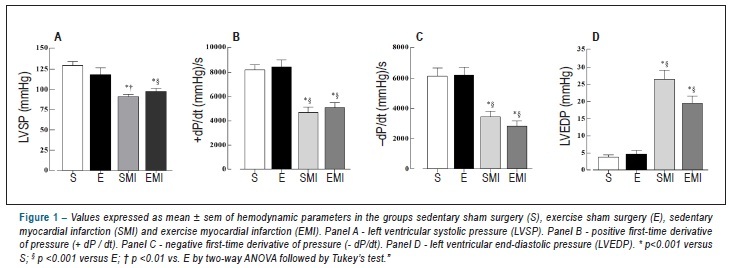
BACKGROUND: Few studies have analyzed the cardiac effects of exercise prior to coronary occlusion. OBJECTIVE: To evaluate the effects of myocardial infarction in rats undergoing physical exercise. METHODS: Female rats underwent swimming exercise or were kept sedentary for eight weeks and were randomized to coronary occlusion or sham surgery, in one of the following four groups: Sedentary (S), exercise (E), Sedentary myocardial infarction (SMI) and Exercise myocardial infarction (EMI). After six weeks, their biometrics, Doppler echocardiography, hemodynamics and myocardial mechanics were analyzed. RESULTS: No cardioprotection was observed in EMI animals and there was no difference in infarct size (%LV) between EMI (38.50 ± 4.60%) and SMI (36.58 ± 4.11%). Water content of the lung (%) of SMI (80 ± 0.59) and EMI (80 ± 0.57) was higher than that of S (78 ± 0.15) and E (78 ± 0.57) groups. Left ventricular systolic pressure (mmHg) (S: 130 ± 5, E: 118 ± 8; SMI: 91 ± 3; EMI: 98 ± 3) and the first positive time derivative (mmHg) positive pressure (S: 8216 ± 385; E: 8437 ± 572; SMI: 4674 ± 455; EMI: 5080 ± 412) of S and E were higher than those of SMI and EMI. The transverse fractional shortening (%) of SMI (27 ± 2) and EMI (25 ± 2) were similar and lower than that of E (65 ± 2) and S (69 ± 2). The E/A ratio was higher in SMI (5.14 ± 0.61) and EMI (4.73 ± 0.57) compared to S (2.96 ± 0.24) and E (2.83 ± 0 21). In studies of isolated papillary muscle, depression of the contractile capacity observed was similar to that of SMI and EMI, and there was no change in myocardial stiffness. CONCLUSION: Previous training by swimming did not attenuate cardiac implications due to myocardial infarction.

  • Animal
  • Myocardial Infarction
  • Physical Conditioning
  • Rats
  • Swimming
Read Full Article
Creative Commons Attribution (CC BY) Creative Commons license
11/12/2012 DOI: 10.1590/S0066-782X2012005000117

How to cite this article

EndNote RIS

Electronic Document Format (Vancouver)

Gatto M, Mota GAF, Pagan LU, Gomes MJ, Okoshi MP. Preconditioning in Ischemia-Reperfusion Lesion. Arquivos Brasileiros de Cardiologia 2021;117(6):1145-6.

Electronic Document Format (ABNT)

Gatto, Mariana; Mota, Gustavo Augusto Ferreira; Pagan, Luana Urbano; Gomes, Mariana Janini; Okoshi, Marina Politi. Preconditioning in Ischemia-Reperfusion Lesion. Arquivos Brasileiros de Cardiologia, v. 117, n. 6, p. 1145-1146, Dec. 2021.

Electronic Document Format (APA)

Gatto, M., Mota, G. A. F., Pagan, L. U., Gomes, M. J., & Okoshi, M. P. (2021). Preconditioning in Ischemia-Reperfusion Lesion. Arquivos Brasileiros de Cardiologia, 117(6), 1145-1146.

Electronic Document Format (ISO)

Gatto, Mariana and Mota, Gustavo Augusto Ferreira and Pagan, Luana Urbano and Gomes, Mariana Janini and Okoshi, Marina Politi. Preconditioning in Ischemia-Reperfusion Lesion. Arquivos Brasileiros de Cardiologia [online]. 2021, vol. 117, n. 6, [cited 2026-10-14], pp. 1145-1146. Available from: <https://journals.cardiol.br/en/article/preconditioning-in-ischemia-reperfusion-lesion/>. ISSN 0066-782X

EndNote RIS

Electronic Document Format (Vancouver)

Marques A, Gouveia B. Physical Activity Knowledge and Levels among Children with Congenital Heart Disease. Arquivos Brasileiros de Cardiologia 2020;114(5):793-4.

Electronic Document Format (ABNT)

Marques, Adilson; Gouveia, Bruna. Physical Activity Knowledge and Levels among Children with Congenital Heart Disease. Arquivos Brasileiros de Cardiologia, v. 114, n. 5, p. 793-794, May. 2020.

Electronic Document Format (APA)

Marques, A., & Gouveia, B. (2020). Physical Activity Knowledge and Levels among Children with Congenital Heart Disease. Arquivos Brasileiros de Cardiologia, 114(5), 793-794.

Electronic Document Format (ISO)

Marques, Adilson and Gouveia, Bruna. Physical Activity Knowledge and Levels among Children with Congenital Heart Disease. Arquivos Brasileiros de Cardiologia [online]. 2020, vol. 114, n. 5, [cited 2026-10-14], pp. 793-794. Available from: <https://journals.cardiol.br/en/article/physical-activity-knowledge-and-levels-among-children-with-congenital-heart-disease/>. ISSN 0066-782X

EndNote RIS

Electronic Document Format (Vancouver)

Stein R, Börjesson M. Physical Inactivity in Brazil and Sweden – Different Countries, Similar Problem. Arquivos Brasileiros de Cardiologia 2019;112(2):119-20.

Electronic Document Format (ABNT)

Stein, Ricardo; Börjesson, Mats. Physical Inactivity in Brazil and Sweden – Different Countries, Similar Problem. Arquivos Brasileiros de Cardiologia, v. 112, n. 2, p. 119-120, Jan. 2019.

Electronic Document Format (APA)

Stein, R., & Börjesson, M. (2019). Physical Inactivity in Brazil and Sweden – Different Countries, Similar Problem. Arquivos Brasileiros de Cardiologia, 112(2), 119-120.

Electronic Document Format (ISO)

Stein, Ricardo and Börjesson, Mats. Physical Inactivity in Brazil and Sweden – Different Countries, Similar Problem. Arquivos Brasileiros de Cardiologia [online]. 2019, vol. 112, n. 2, [cited 2026-10-14], pp. 119-120. Available from: <https://journals.cardiol.br/en/article/physical-inactivity-in-brazil-and-sweden-different-countries-similar-problem/>. ISSN 0066-782X

EndNote RIS

Electronic Document Format (Vancouver)

Veiga ECA, Portes LA, Bocalini DS, Antonio EL, Santos AA, Santos MH, Silva FA, et al. Cardiac implications after myocardial infarction in rats previously undergoing physical exercise. Arquivos Brasileiros de Cardiologia 2012;100(1):37-43.

Electronic Document Format (ABNT)

Veiga, Eduardo Carvalho de Arruda; Portes, Leslie Andrews; Bocalini, Danilo Sales; Antonio, Ednei Luiz; Santos, Alexandra Alberta dos; Santos, Marília Higuchi; Silva, Flavio André; Tucci, Paulo José Ferreira. Cardiac implications after myocardial infarction in rats previously undergoing physical exercise. Arquivos Brasileiros de Cardiologia, v. 100, n. 1, p. 37-43, Dec. 2012.

Electronic Document Format (APA)

Veiga, E. C. A., Portes, L. A., Bocalini, D. S., Antonio, E. L., Santos, A. A. , Santos, M. H., Silva, F. A., & Tucci, P. J. F. (2012). Cardiac implications after myocardial infarction in rats previously undergoing physical exercise. Arquivos Brasileiros de Cardiologia, 100(1), 37-43.

Electronic Document Format (ISO)

Veiga, Eduardo Carvalho de Arruda and Portes, Leslie Andrews and Bocalini, Danilo Sales and Antonio, Ednei Luiz and Santos, Alexandra Alberta dos and Santos, Marília Higuchi and Silva, Flavio André and Tucci, Paulo José Ferreira. Cardiac implications after myocardial infarction in rats previously undergoing physical exercise. Arquivos Brasileiros de Cardiologia [online]. 2012, vol. 100, n. 1, [cited 2026-10-14], pp. 37-43. Available from: <https://journals.cardiol.br/en/article/cardiac-implications-after-myocardial-infarction-in-rats-previously-undergoing-physical-exercise/>. ISSN 0066-782X

  • About ABC Family
  • Internal Regulation
  • Editorial Board
  • Brazilian Society of Cardiology (SBC)

Issues

SBC Guidelines

  • Videos
  • Podcasts
  • News