ABC Family Arquivos Brasileiros de Cardiologia International Journal of Cardiovascular Sciences ABC Heart Failure & Cardiomyopathy ABC Imagem Cardiovascular
Português English
ABC Family
Português English
  • About
    • About ABC Family
    • Internal Regulation
    • Editorial Board
    • Brazilian Society of Cardiology (SBC)
  • Issues
  • SBC Guidelines
  • Content
    • Videos
    • Podcasts
    • News
  • About
    • About ABC Family
    • Internal Regulation
    • Editorial Board
    • Brazilian Society of Cardiology (SBC)
  • Issues
  • SBC Guidelines
  • Content
    • Videos
    • Podcasts
    • News

ABC Family

  • ABC Family
  • Arquivos Brasileiros de Cardiologia
  • International Journal of Cardiovascular Sciences
  • ABC Heart Failure & Cardiomyopathy
  • ABC Imagem Cardiovascular
Search in

No content found.

Journals
Ordering
Article types
Others

  1. Home
  2. Keyword: Cardiac Myocytes
Protective Effect of Long Noncoding RNA OXCT1-AS1 on Doxorubicin-Induced Apoptosis of Human Myocardial Cells by the Competitive Endogenous RNA Pattern
ABC
Original Article

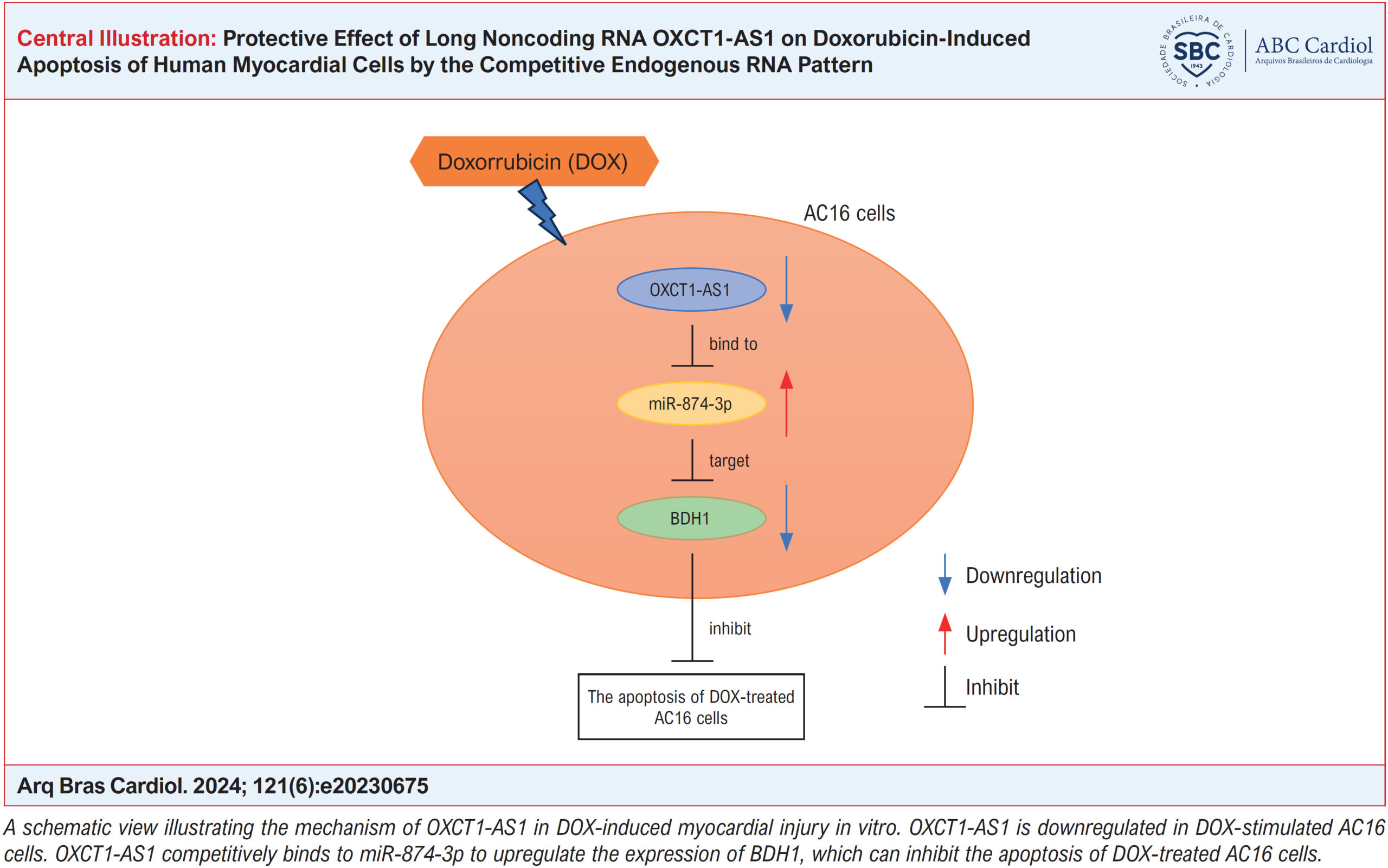
Protective Effect of Long Noncoding RNA OXCT1-AS1 on Doxorubicin-Induced Apoptosis of Human Myocardial Cells by the Competitive Endogenous RNA Pattern

Zhen Chen et al. Yijue Liu Rui Ma Mengli Zhang … Xian Wu Huan Pen Feng Gui Yafeng Liu Hao Xia Niandan Hu Bo Ai Jun Xiong Hongxia Xia Wenqiang Li Fen Ai

Abstract

Background:

The anthracycline chemotherapeutic antibiotic doxorubicin (DOX) can induce cumulative cardiotoxicity and lead to cardiac dysfunction. Long non-coding RNAs (lncRNAs) can function as important regulators in DOX-induced myocardial injury.

Objective:

This study aims to investigate the functional role and molecular mechanism of lncRNA OXCT1 antisense RNA 1 (OXCT1-AS1) in DOX-induced myocardial cell injury in vitro.

Methods:

Human cardiomyocytes (AC16) were stimulated with DOX to induce a myocardial cell injury model. OXCT1-AS1, miR-874-3p, and BDH1 expression in AC16 cells were determined by RT-qPCR. AC16 cell viability was measured by XTT assay. Flow cytometry was employed to assess the apoptosis of AC16 cells. Western blotting was used to evaluate protein levels of apoptosis-related markers. Dual-luciferase reporter assay was conducted to verify the binding ability between miR-874-3p and OXCT1-AS1 and between miR-874-3p and BDH1. The value of p<0.05 indicated statistical significance.

Results:

OXCT1-AS1 expression was decreased in DOX-treated AC16 cells. Overexpression of OXCT1-AS1 reversed the reduction of cell viability and promotion of cell apoptosis caused by DOX. OXCT1-AS1 is competitively bound to miR-874-3p to upregulate BDH1. BDH1 overexpression restored AC16 cell viability and suppressed cell apoptosis under DOX stimulation. Knocking down BDH1 reversed OXCT1-AS1-mediated attenuation of AC16 cell apoptosis under DOX treatment.

Conclusion:

LncRNA OXCT1-AS1 protects human myocardial cells AC16 from DOX-induced apoptosis via the miR-874-3p/BDH1 axis.
  • Apoptosis
  • Cardiac Myocytes
  • Doxorubicin
  • RNA
Read Full Article
Creative Commons Attribution (CC BY) Creative Commons license
01/07/2024 DOI: 10.36660/abc.20230675i
Resistance Exercise Training Mitigates Cardiac Remodeling Induced by a High-Fat Diet in Rodents: A Systematic Review
ABC
Original Article

Resistance Exercise Training Mitigates Cardiac Remodeling Induced by a High-Fat Diet in Rodents: A Systematic Review

Alexandre Martins Oliveira Portes et al. Sebastião Felipe Ferreira Costa Luciano Bernardes Leite Victor Neiva Lavorato … Denise Coutinho de Miranda Anselmo Gomes de Moura Leôncio Lopes Soares Mauro César Isoldi Antônio José Natali

Abstract

Background

Obesity is associated with the development of cardiovascular diseases and is a serious public health problem. In animal models, high-fat diet (HFD) feeding impairs cardiac structure and function and promotes oxidative stress and apoptosis. Resistance exercise training (RT), however, has been recommended as coadjutant in the treatment of cardiometabolic diseases, including obesity, because it increases energy expenditure and stimulates lipolysis.

Objective

In this systematic review, we aimed to assess the benefits of RT on the heart of rats and mice fed HFD.

Methods

Original studies were identified by searching PubMed, Scopus, and Embase databases from December 2007 to December 2022. This study was conducted in accordance with the criteria established by PRISMA and registered in PROSPERO (CRD42022369217). The risk of bias and methodological quality was evaluated by SYRCLE and CAMARADES, respectively. Eligible studies included original articles published in English that evaluated cardiac outcomes in rodents submitted to over 4 weeks of RT and controlled by a sedentary, HFD-fed control group (n = 5).

Results

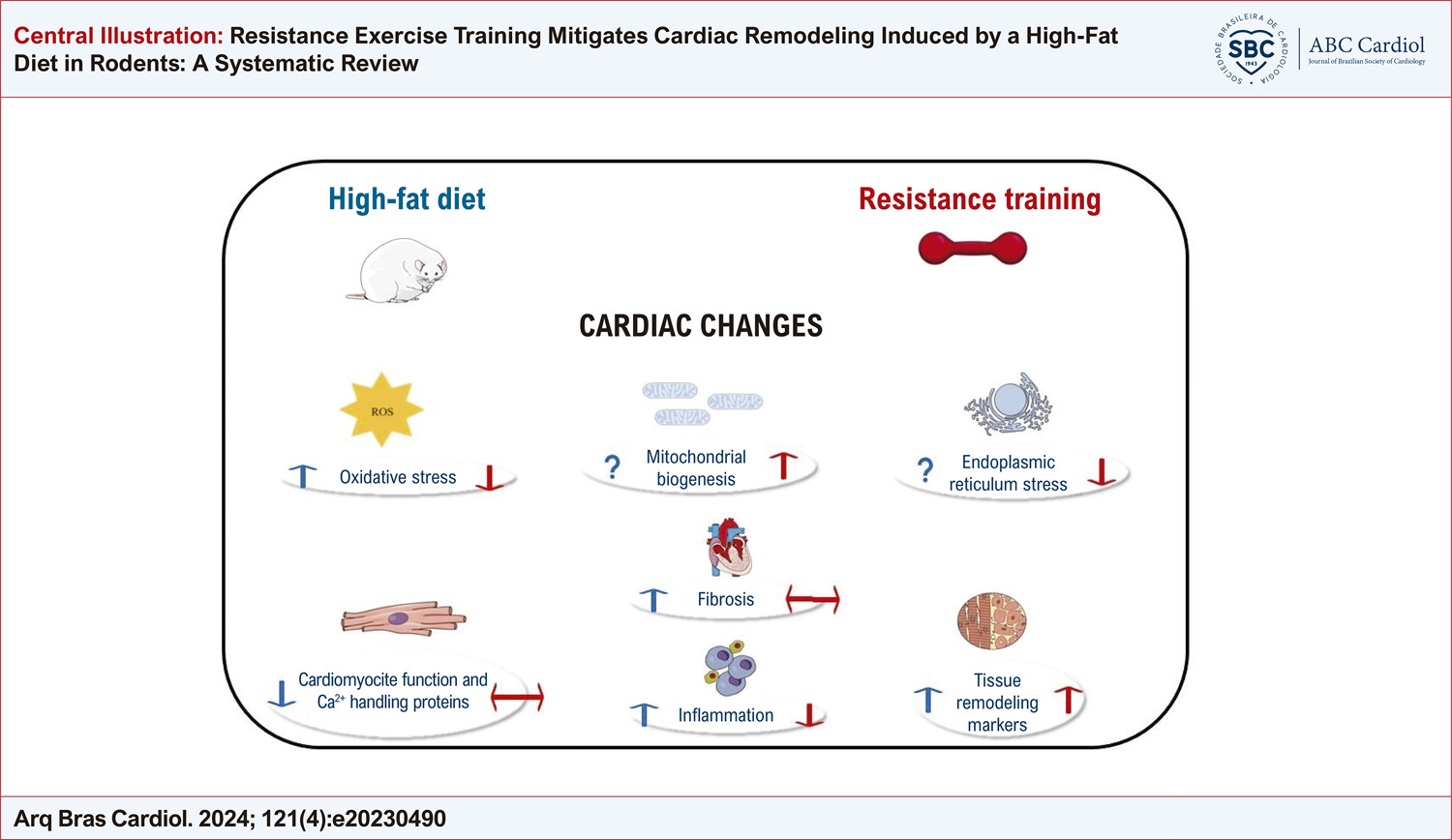
The results showed that RT mitigates cardiac oxidative stress, inflammation, and endoplasmic reticulum stress. It also modifies the activity of structural remodeling markers, although it does not alter biometric parameters, histomorphometric parameters, or the contractile function of cardiomyocytes.

Conclusion

Our results indicate that RT partially counteracts the HFD-induced adverse cardiac remodeling by increasing the activity of structural remodeling markers; elevating mitochondrial biogenesis; reducing oxidative stress, inflammatory markers, and endoplasmic reticulum stress; and improving hemodynamic, anthropometric, and metabolic parameters.

  • Cardiac Myocytes
  • esistance Training
  • High-Fat Diet
  • systematic review
Read Full Article
Creative Commons Attribution (CC BY) Creative Commons license
26/04/2024 DOI: 10.36660/abc.20230490i Views 1
Figure 1
ABC
Original Article

Melatonin-Induced Protective Effects on Cardiomyocytes Against Reperfusion Injury Partly Through Modulation of IP3R and SERCA2a Via Activation of ERK1

Shunying Hu et al. Pingjun Zhu Hao Zhou Ying Zhang Yundai Chen

Resumo

Background:

Melatonin is a neuroendocrine hormone synthesized primarily by the pineal gland that is indicated to effectively prevent myocardial reperfusion injury. It is unclear whether melatonin protects cardiac function from reperfusion injury by modulating intracellular calcium homeostasis.

Objective:

Demonstrate that melatonin protect against myocardial reperfusion injury through modulating IP3R and SERCA2a to maintain calcium homeostasis via activation of ERK1 in cardiomyocytes.

Methods:

In vitro experiments were performed using H9C2 cells undergoing simulative hypoxia/reoxygenation (H/R) induction. Expression level of ERK1, IP3R and SERCA2a were assessed by Western Blots. Cardiomyocytes apoptosis was detected by TUNEL. Phalloidin-staining was used to assess alteration of actin filament organization of cardiomyocytes. Fura-2 /AM was used to measure intracellular Ca2+ concentration. Performing in vivo experiments, myocardial expression of IP3R and SERCA2a were detected by immunofluorescence staining using myocardial ischemia/ reperfusion (I/R) model in rats.

Results:

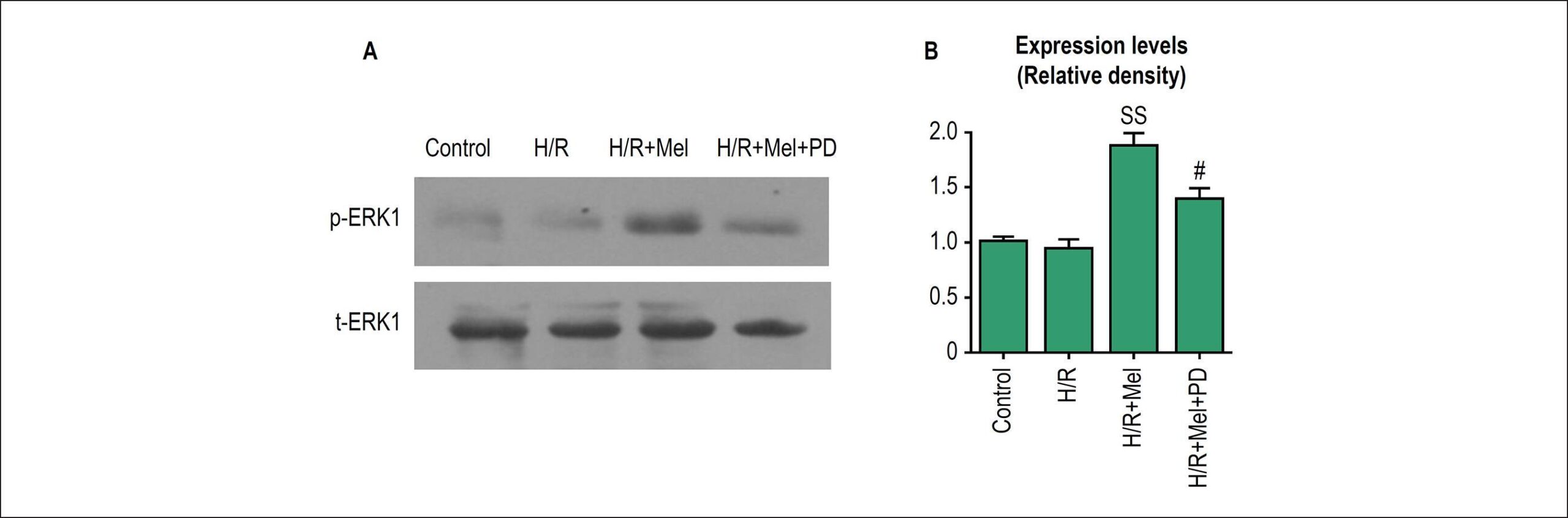
In vitro results showed that melatonin induces ERK1 activation in cardiomyocytes against H/R which was inhibited by PD98059 (ERK1 inhibitor). The results showed melatonin inhibit apoptosis of cardiomyocytes and improve actin filament organization in cardiomyocytes against H/R, because both could be reversed by PD98059. Melatonin was showed to reduce calcium overload, further to inhibit IP3R expression and promote SERCA2a expression via ERK1 pathway in cardiomyocytes against H/R. Melatonin induced lower IP3R and higher SERCA2a expression in myocardium that were reversed by PD98059.

Conclusion:

melatonin-induced cardioprotection against reperfusion injury is at least partly through modulation of IP3R and SERCA2a to maintain intracellular calcium homeostasis via activation of ERK1.

  • Cardiac Myocytes
  • Heart Failure
  • Melatonin
  • Myocardial Infarction
  • Myocardial Reperfusion
Read Full Article
Creative Commons Attribution (CC BY) Creative Commons license
01/01/2018 DOI: 10.5935/abc.20180008 Views 1

How to cite this article

EndNote RIS

Electronic Document Format (Vancouver)

Chen Z, Liu Y, Ma R, Zhang M, Wu X, Pen H, Gui F, et al. Protective Effect of Long Noncoding RNA OXCT1-AS1 on Doxorubicin-Induced Apoptosis of Human Myocardial Cells by the Competitive Endogenous RNA Pattern. Arquivos Brasileiros de Cardiologia 2024;121(6):e20230675.

Electronic Document Format (ABNT)

Chen, Zhen; Liu, Yijue; Ma, Rui; Zhang, Mengli; Wu, Xian; Pen, Huan; Gui, Feng; Liu, Yafeng; Xia, Hao; Hu, Niandan; Ai, Bo; Xiong, Jun; Xia, Hongxia; Li, Wenqiang; Ai, Fen. Protective Effect of Long Noncoding RNA OXCT1-AS1 on Doxorubicin-Induced Apoptosis of Human Myocardial Cells by the Competitive Endogenous RNA Pattern. Arquivos Brasileiros de Cardiologia, v. 121, n. 6, e20230675, Jun. 2024.

Electronic Document Format (APA)

Chen, Z., Liu, Y., Ma, R., Zhang, M., Wu, X., Pen, H., Gui, F., Liu, Y., Xia, H., Hu, N., Ai, B., Xiong, J., Xia, H., Li, W., & Ai, F. (2024). Protective Effect of Long Noncoding RNA OXCT1-AS1 on Doxorubicin-Induced Apoptosis of Human Myocardial Cells by the Competitive Endogenous RNA Pattern. Arquivos Brasileiros de Cardiologia, 121(6), e20230675.

Electronic Document Format (ISO)

Chen, Zhen and Liu, Yijue and Ma, Rui and Zhang, Mengli and Wu, Xian and Pen, Huan and Gui, Feng and Liu, Yafeng and Xia, Hao and Hu, Niandan and Ai, Bo and Xiong, Jun and Xia, Hongxia and Li, Wenqiang and Ai, Fen. Protective Effect of Long Noncoding RNA OXCT1-AS1 on Doxorubicin-Induced Apoptosis of Human Myocardial Cells by the Competitive Endogenous RNA Pattern. Arquivos Brasileiros de Cardiologia [online]. 2024, vol. 121, n. 6, [cited 2026-10-14], e20230675. Available from: <https://journals.cardiol.br/en/article/protective-effect-of-long-noncoding-rna-oxct1-as1-on-doxorubicin-induced-apoptosis-of-human-myocardial-cells-by-the-competitive-endogenous-rna-pattern/>. ISSN 0066-782X

EndNote RIS

Electronic Document Format (Vancouver)

Portes AMO, Costa SFF, Leite LB, Lavorato VN, Miranda DC, Moura AG, Soares LL, et al. Resistance Exercise Training Mitigates Cardiac Remodeling Induced by a High-Fat Diet in Rodents: A Systematic Review. Arquivos Brasileiros de Cardiologia 2024;121(4):e20230490.

Electronic Document Format (ABNT)

Portes, Alexandre Martins Oliveira; Costa, Sebastião Felipe Ferreira; Leite, Luciano Bernardes; Lavorato, Victor Neiva; Miranda, Denise Coutinho de; Moura, Anselmo Gomes de; Soares, Leôncio Lopes; Isoldi, Mauro César; Natali, Antônio José. Resistance Exercise Training Mitigates Cardiac Remodeling Induced by a High-Fat Diet in Rodents: A Systematic Review. Arquivos Brasileiros de Cardiologia, v. 121, n. 4, e20230490, Apr. 2024.

Electronic Document Format (APA)

Portes, A. M. O., Costa, S. F. F., Leite, L. B., Lavorato, V. N., Miranda, D. C. , Moura, A. G. , Soares, L. L., Isoldi, M. C., & Natali, A. J. (2024). Resistance Exercise Training Mitigates Cardiac Remodeling Induced by a High-Fat Diet in Rodents: A Systematic Review. Arquivos Brasileiros de Cardiologia, 121(4), e20230490.

Electronic Document Format (ISO)

Portes, Alexandre Martins Oliveira and Costa, Sebastião Felipe Ferreira and Leite, Luciano Bernardes and Lavorato, Victor Neiva and Miranda, Denise Coutinho de and Moura, Anselmo Gomes de and Soares, Leôncio Lopes and Isoldi, Mauro César and Natali, Antônio José. Resistance Exercise Training Mitigates Cardiac Remodeling Induced by a High-Fat Diet in Rodents: A Systematic Review. Arquivos Brasileiros de Cardiologia [online]. 2024, vol. 121, n. 4, [cited 2026-10-14], e20230490. Available from: <https://journals.cardiol.br/en/article/resistance-exercise-training-mitigates-cardiac-remodeling-induced-by-a-high-fat-diet-in-rodents-a-systematic-review/>. ISSN 0066-782X

EndNote RIS

Electronic Document Format (Vancouver)

Hu S, Zhu P, Zhou H, Zhang Y, Chen Y. Melatonin-Induced Protective Effects on Cardiomyocytes Against Reperfusion Injury Partly Through Modulation of IP3R and SERCA2a Via Activation of ERK1. Arquivos Brasileiros de Cardiologia 2018;110(1):44-51.

Electronic Document Format (ABNT)

Hu, Shunying; Zhu, Pingjun; Zhou, Hao; Zhang, Ying; Chen, Yundai. Melatonin-Induced Protective Effects on Cardiomyocytes Against Reperfusion Injury Partly Through Modulation of IP3R and SERCA2a Via Activation of ERK1. Arquivos Brasileiros de Cardiologia, v. 110, n. 1, p. 44-51, Dec. 2017.

Electronic Document Format (APA)

Hu, S., Zhu, P., Zhou, H., Zhang, Y., & Chen, Y. (2018). Melatonin-Induced Protective Effects on Cardiomyocytes Against Reperfusion Injury Partly Through Modulation of IP3R and SERCA2a Via Activation of ERK1. Arquivos Brasileiros de Cardiologia, 110(1), 44-51.

Electronic Document Format (ISO)

Hu, Shunying and Zhu, Pingjun and Zhou, Hao and Zhang, Ying and Chen, Yundai. Melatonin-Induced Protective Effects on Cardiomyocytes Against Reperfusion Injury Partly Through Modulation of IP3R and SERCA2a Via Activation of ERK1. Arquivos Brasileiros de Cardiologia [online]. 2018, vol. 110, n. 1, [cited 2026-10-14], pp. 44-51. Available from: <https://journals.cardiol.br/en/article/melatonin-induced-protective-effects-on-cardiomyocytes-against-reperfusion-injury-partly-through-modulation-of-ip3r-and-serca2a-via-activation-of-erk1/>. ISSN 0066-782X

  • About ABC Family
  • Internal Regulation
  • Editorial Board
  • Brazilian Society of Cardiology (SBC)

Issues

SBC Guidelines

  • Videos
  • Podcasts
  • News