ABC Family Arquivos Brasileiros de Cardiologia International Journal of Cardiovascular Sciences ABC Heart Failure & Cardiomyopathy ABC Imagem Cardiovascular
Português English
ABC Family
Português English
  • About
    • About ABC Family
    • Internal Regulation
    • Editorial Board
    • Brazilian Society of Cardiology (SBC)
  • Issues
  • SBC Guidelines
  • Content
    • Videos
    • Podcasts
    • News
  • About
    • About ABC Family
    • Internal Regulation
    • Editorial Board
    • Brazilian Society of Cardiology (SBC)
  • Issues
  • SBC Guidelines
  • Content
    • Videos
    • Podcasts
    • News

ABC Family

  • ABC Family
  • Arquivos Brasileiros de Cardiologia
  • International Journal of Cardiovascular Sciences
  • ABC Heart Failure & Cardiomyopathy
  • ABC Imagem Cardiovascular
Search in

No content found.

Journals
Ordering
Article types
Others

  1. Home
  2. Keyword: Albumins
ABC
Editorial

Acute Myocardial Infarction: Do We Need Markers for Microcirculation Injury? Moreover, Would the Fibrinogen/Albumin Ratio Be the Answer?

Ricardo Wang et al. Fernando Carvalho Neuenschwander

Acute myocardial infarction (AMI) is the leading cause of death in the world and the second cause of death in Brazil. The biggest advance in its treatment was reperfusion therapy, be it medication, through the use of fibrinolytics or coronary angioplasty with stent implantation. The latter, in addition to the superiority in the quality of reperfusion, has been shown to be time-sensitive; the earlier the intervention, the greater the reduction in cardiovascular outcomes, both in the context of Acute Coronary Syndrome without ST-Segment Elevation and especially with ST segment elevation.

In the context of ST-segment elevation AMI (STEMI), the time between symptoms and reperfusion by primary angioplasty is considered the main reduction in cardiovascular death, leading to the preservation of ventricular function and earlier recovery.

[…]

  • Albumins
  • Fibrinolytic Agents
  • Mortality
  • Myocardial Infarction
  • Myocardial Reperfusion
  • No-Reflow Phenomenon
  • Stents
Read Full Article
Creative Commons Attribution (CC BY) Creative Commons license
04/03/2024 DOI: 10.36660/abc.20230809 Views 1
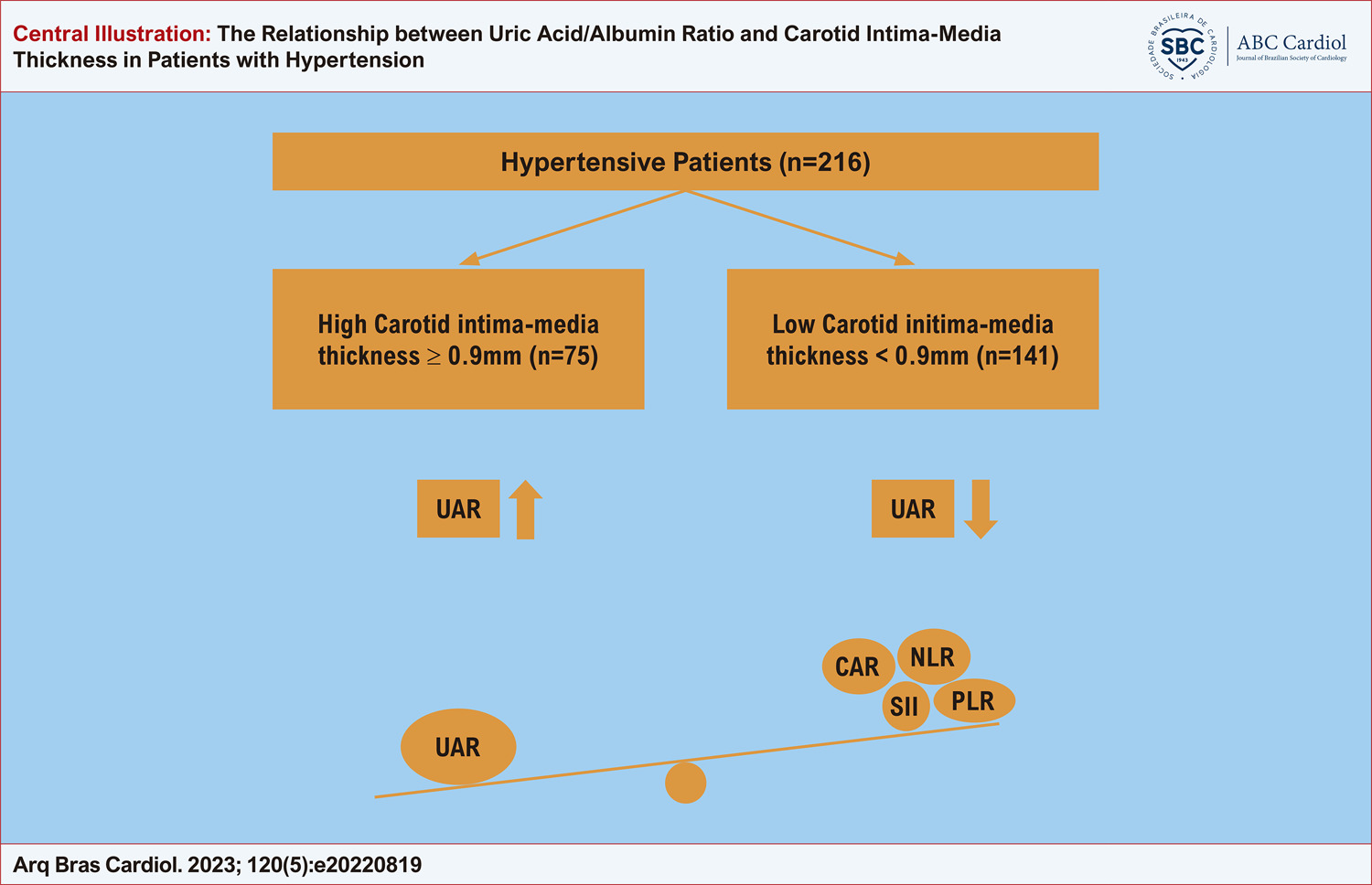
Central Illustration
ABC
Original Article

The Relationship between Uric Acid/Albumin Ratio and Carotid Intima-Media Thickness in Patients with Hypertension

Faysal Şaylık et al. Tufan Çınar Murat Selçuk İbrahim Halil Tanboğa

Abstract

Background

Hypertension causes subendothelial inflammation and dysfunction in resulting atherosclerosis. Carotid intima-media thickness (CIMT) is a useful marker of endothelial dysfunction and atherosclerosis. The uric acid to albumin ratio (UAR) has emerged as a novel marker for predicting cardiovascular events.

Objective

We aimed to investigate the association of UAR with CIMT in hypertensive patients.

Methods

Two hundred sixteen consecutive hypertensive patients were enrolled in this prospective study. All patients underwent carotid ultrasonography to classify low (CIMT < 0.9 mm) and high (CIMT ≥ 0.9 mm) CIMT groups. The predictive ability of UAR for high CIMT was compared with systemic immune inflammation index (SII), neutrophil/lymphocyte ratio (NLR), platelet/lymphocyte ratio (PLR), and C-reactive protein/albumin ratio (CAR). A two-sided p-value <0.05 was accepted as statistically significant.

Results

Patients with high CIMT were older and had higher UAR, SII, NLR, and CAR than low CIMT. Age, UAR, SII, NLR, and CAR, but not PLR, were associated with high CIMT. In multivariable analysis, age, CRP, SII, and UAR were independent predictors of high CIMT. The discrimination ability of UAR was higher than uric acid, albumin, SII, NLR, and CAR, and UAR had a higher model fit than those variables. UAR had higher additive improvement in detecting high CIMT than other variables, as assessed with net-reclassification improvement, IDI, and C-statistics. UAR was also significantly correlated with CIMT.

Conclusion

UAR might be used to predict high CIMT and might be useful for risk stratification in hypertensive patients.

  • Albumins
  • Biomarkers
  • Carotid Intima-Media Thickness
  • Hypertension
  • uric acid
Read Full Article
Creative Commons Attribution (CC BY) Creative Commons license
21/04/2023 DOI: 10.36660/abc.20220819 Views 1
ABC
Original Article

Association of C-Reactive Protein to Albumin Ratio in Patients with Isolated Coronary Artery Ectasia

Alper Sercelik et al. Okan Tanrıverdi Lutfu Askin Serdar Turkmen

Abstract

Background

Coronary artery ectasia (CAE) is defined as diffuse or localized dilatation of coronary artery lumen with a diameter of 1.5 to 2.0 times the adjacent normal coronary artery. The C-reactive protein to albumin ratio (CAR) is a useful inflammatory marker, which has been documented in coronary artery disease.

Objective

To analyze the association of CAE and CAR.

Methods

A case-control protocol was used in this study. We included 102 consecutive patients with isolated CAE without stenosis (56 men and 46 women; mean age 60.4 ± 8.8 years). The control subjects consisted of an equal number of sex and age matched patients with normal coronary arteries (55 men and 47 women; mean age 61.2 ± 9.1 years). Clinical features, laboratory findings, and medication use history were recorded. Student’s t test, Mann-Whitney U test, chi-square test, and linear and logistic regression analysis were performed. A 2-sided p < 0.05 was statistically considered significant.

Results

The CAR was increased in patients with CAE compared to the controls (32 and 16; p < 0.001). In addition, the CAR was found to be an independent predictor of CAE (OR = 2.202; 95% CI 1.184 – 5.365; p < 0.001).

Conclusion

In the present study, we determined that CAR levels were significantly higher in the CAE group than in the control group, and the CAR was significantly correlated with CAE. (Arq Bras Cardiol. 2020; [online].ahead print, PP.0-0)

  • Albumins
  • C-Reactie Protein
  • Coronary Aneurysm
  • Coronary Artery Disease / complications
  • Dilatation, Pathologic (ectasig
  • Inflammation
Read Full Article
Creative Commons Attribution (CC BY) Creative Commons license
16/12/2020 DOI: 10.36660/abc.20190476 Views 1

How to cite this article

EndNote RIS

Electronic Document Format (Vancouver)

Wang R, Neuenschwander FC. Acute Myocardial Infarction: Do We Need Markers for Microcirculation Injury? Moreover, Would the Fibrinogen/Albumin Ratio Be the Answer?. Arquivos Brasileiros de Cardiologia 2024;120(11):e20230809.

Electronic Document Format (ABNT)

Wang, Ricardo; Neuenschwander, Fernando Carvalho. Acute Myocardial Infarction: Do We Need Markers for Microcirculation Injury? Moreover, Would the Fibrinogen/Albumin Ratio Be the Answer?. Arquivos Brasileiros de Cardiologia, v. 120, n. 11, e20230809, Mar. 2024.

Electronic Document Format (APA)

Wang, R., & Neuenschwander, F. C. (2024). Acute Myocardial Infarction: Do We Need Markers for Microcirculation Injury? Moreover, Would the Fibrinogen/Albumin Ratio Be the Answer?. Arquivos Brasileiros de Cardiologia, 120(11), e20230809.

Electronic Document Format (ISO)

Wang, Ricardo and Neuenschwander, Fernando Carvalho. Acute Myocardial Infarction: Do We Need Markers for Microcirculation Injury? Moreover, Would the Fibrinogen/Albumin Ratio Be the Answer?. Arquivos Brasileiros de Cardiologia [online]. 2024, vol. 120, n. 11, [cited 2026-10-14], e20230809. Available from: <https://journals.cardiol.br/en/article/acute-myocardial-infarction-do-we-need-markers-for-microcirculation-injury-moreover-would-the-fibrinogen-albumin-ratio-be-the-answer/>. ISSN 0066-782X

EndNote RIS

Electronic Document Format (Vancouver)

Şaylık F, Çınar T, Selçuk M, Tanboğa H. The Relationship between Uric Acid/Albumin Ratio and Carotid Intima-Media Thickness in Patients with Hypertension. Arquivos Brasileiros de Cardiologia 2023;120(5):e20220819.

Electronic Document Format (ABNT)

Şaylık, Faysal; Çınar, Tufan; Selçuk, Murat; Tanboğa, İbrahim Halil. The Relationship between Uric Acid/Albumin Ratio and Carotid Intima-Media Thickness in Patients with Hypertension. Arquivos Brasileiros de Cardiologia, v. 120, n. 5, e20220819, Apr. 2023.

Electronic Document Format (APA)

Şaylık, F., Çınar, T., Selçuk, M., & Tanboğa, H. (2023). The Relationship between Uric Acid/Albumin Ratio and Carotid Intima-Media Thickness in Patients with Hypertension. Arquivos Brasileiros de Cardiologia, 120(5), e20220819.

Electronic Document Format (ISO)

Şaylık, Faysal and Çınar, Tufan and Selçuk, Murat and Tanboğa, İbrahim Halil. The Relationship between Uric Acid/Albumin Ratio and Carotid Intima-Media Thickness in Patients with Hypertension. Arquivos Brasileiros de Cardiologia [online]. 2023, vol. 120, n. 5, [cited 2026-10-14], e20220819. Available from: <https://journals.cardiol.br/en/article/the-relationship-between-uric-acid-albumin-ratio-and-carotid-intima-media-thickness-in-patients-with-hypertension-2/>. ISSN 0066-782X

EndNote RIS

Electronic Document Format (Vancouver)

Sercelik A, Tanrıverdi O, Askin L, Turkmen S. Association of C-Reactive Protein to Albumin Ratio in Patients with Isolated Coronary Artery Ectasia. Arquivos Brasileiros de Cardiologia 2020;116(1):48-54.

Electronic Document Format (ABNT)

Sercelik, Alper; Tanrıverdi, Okan; Askin, Lutfu; Turkmen, Serdar. Association of C-Reactive Protein to Albumin Ratio in Patients with Isolated Coronary Artery Ectasia. Arquivos Brasileiros de Cardiologia, v. 116, n. 1, p. 48-54, Dec. 2020.

Electronic Document Format (APA)

Sercelik, A., Tanrıverdi, O., Askin, L., & Turkmen, S. (2020). Association of C-Reactive Protein to Albumin Ratio in Patients with Isolated Coronary Artery Ectasia. Arquivos Brasileiros de Cardiologia, 116(1), 48-54.

Electronic Document Format (ISO)

Sercelik, Alper and Tanrıverdi, Okan and Askin, Lutfu and Turkmen, Serdar. Association of C-Reactive Protein to Albumin Ratio in Patients with Isolated Coronary Artery Ectasia. Arquivos Brasileiros de Cardiologia [online]. 2020, vol. 116, n. 1, [cited 2026-10-14], pp. 48-54. Available from: <https://journals.cardiol.br/en/article/association-of-c-reactive-protein-to-albumin-ratio-in-patients-with-isolated-coronary-artery-ectasia/>. ISSN 0066-782X

  • About ABC Family
  • Internal Regulation
  • Editorial Board
  • Brazilian Society of Cardiology (SBC)

Issues

SBC Guidelines

  • Videos
  • Podcasts
  • News