ABC Family Arquivos Brasileiros de Cardiologia International Journal of Cardiovascular Sciences ABC Heart Failure & Cardiomyopathy ABC Imagem Cardiovascular
Português English
ABC Family
Português English
  • About
    • About ABC Family
    • Internal Regulation
    • Editorial Board
    • Brazilian Society of Cardiology (SBC)
  • Issues
  • SBC Guidelines
  • Content
    • Videos
    • Podcasts
    • News
  • About
    • About ABC Family
    • Internal Regulation
    • Editorial Board
    • Brazilian Society of Cardiology (SBC)
  • Issues
  • SBC Guidelines
  • Content
    • Videos
    • Podcasts
    • News

ABC Family

  • ABC Family
  • Arquivos Brasileiros de Cardiologia
  • International Journal of Cardiovascular Sciences
  • ABC Heart Failure & Cardiomyopathy
  • ABC Imagem Cardiovascular
Search in

No content found.

Journals
Ordering
Article types
Others

  1. Home
  2. Keyword: Fibrinolysis
ST-Segment Elevation Myocardial Infarction Metrics Before and During the COVID-19 Pandemic: Experience from a Brazilian Center
IJCS
Original Article

ST-Segment Elevation Myocardial Infarction Metrics Before and During the COVID-19 Pandemic: Experience from a Brazilian Center

Caio de Assis Moura Tavares et al. Tarso A. D. Accorsi Milena Ribeiro Paixão Tarsila Mota … Fabio Pitta Pedro Alves Lemos Marcelo Franken Karine De Amicis Lima Karen Francine Kohler José Leão de Souza Jr.

Abstract

Background:

The impact of the COVID-19 pandemic on the healthcare of patients with ST-segment elevation acute myocardial infarction (STEMI) in Brazil remains unclear.

Objective:

Provide a descriptive analysis of clinical profiles, time intervals, performance metrics, and outcomes in patients with STEMI before and during the COVID-19 pandemic.

Methods:

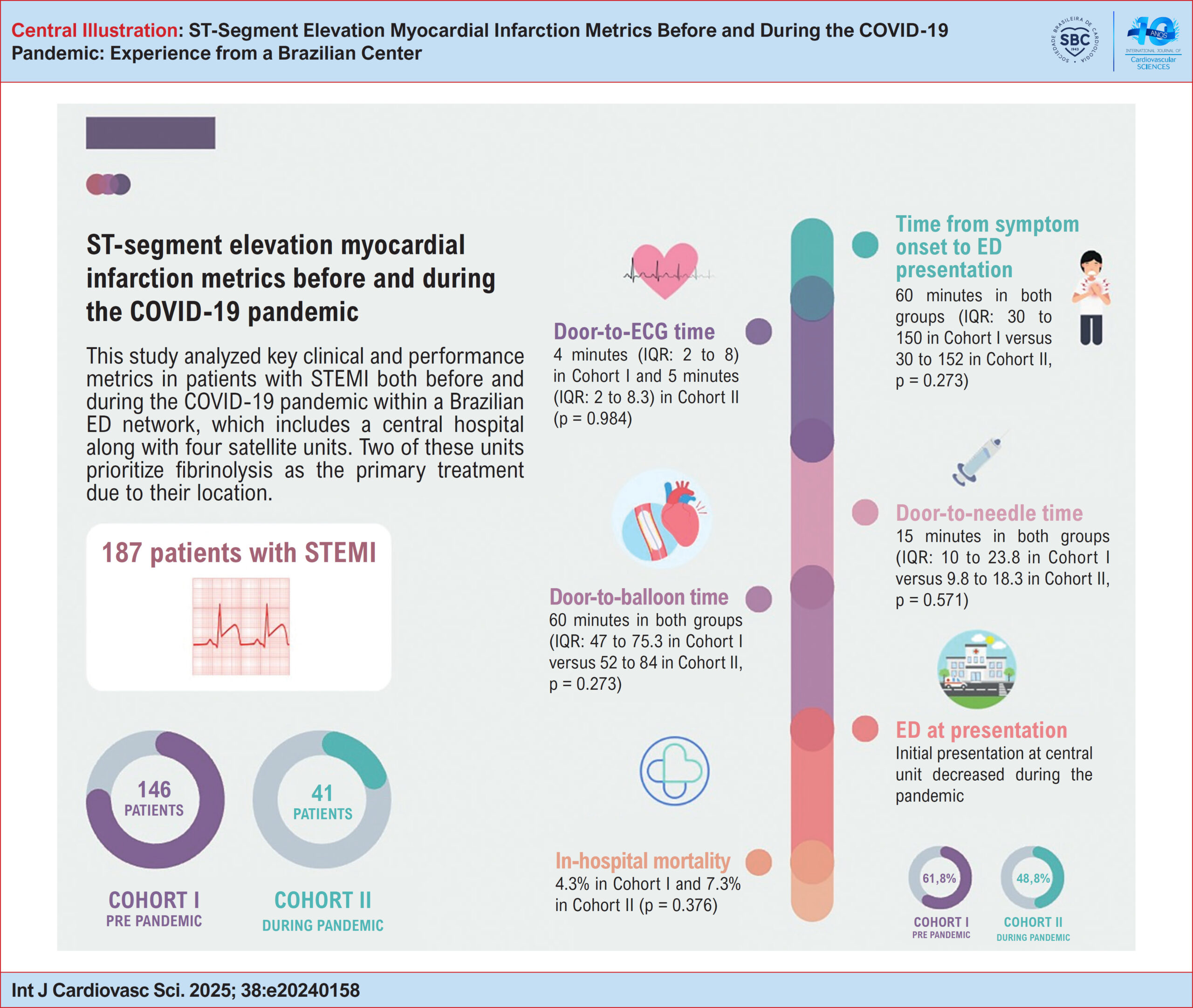
Among a cohort of 193 patients with STEMI diagnosed in five emergency departments within a single Brazilian healthcare network, 187 patients were included between January 2017 and April 2021 and stratified into two cohorts: Cohort I (pre-pandemic, 146 patients) and Cohort II (pandemic, 41 patients). Statistical significance was defined as a two-sided p value < 0.05.

Results:

The mean age of the participants was 62.7 years (standard deviation: 13.2); 83.4% were male, and 86.1% underwent primary percutaneous coronary intervention (PCI). Duration from symptom onset to emergency department presentation was 60 minutes in both cohorts (interquartile range, IQR: 30 to 150 in Cohort I versus 30 to 152 in Cohort II, p = 0.273). Total ischemic time was 132 minutes in Cohort I (IQR: 94 to 222), and 117 minutes in Cohort II (IQR: 76.3 to 185.6) (p = 0.159). The observed STEMI time delays and performance metrics were comparable between groups, with reperfusion rates within the recommended time frame above 90% in both cohorts. Hospital mortality was 3.4% in Cohort I and 7.3% in Cohort II (p = 0.376).

Conclusion:

In the context of the COVID-19 pandemic, within a private healthcare network system in Brazil, this study did not uncover statistically significant disparities in clinical profiles, time intervals, performance metrics, or in-hospital mortality when compared to the pre-pandemic period.
  • Angioplasty
  • COVID-19
  • Fibrinolysis
  • Myocardial Reperfusion
  • ST Elevation Myocardial Infarction
Read Full Article
Creative Commons Attribution (CC BY) Creative Commons license
02/06/2025 DOI: 10.36660/ijcs.20240158 Views 1
ABC
Editorial

Evaluation of Serum Levels of Inflammation, Fibrinolysis and Oxidative Stress Markers in Coronary Artery Disease Prediction: A Cross-Sectional Study

Iran Castro et al. Hugo Fontana Filho

When assessing patients with coronary artery disease (CAD) traditional risk factors such as diabetes mellitus, hypertension, dyslipidemia, smoking, stress, physical inactivity, obesity, and family history are not found in 20% of the patients, and up to 40% of patients have only 1 risk factor. Considering the high prevalence of CAD and the fact that despite the numerous efforts made in primary prevention, the disease still has a high incidence, identifying markers that can predict at-risk patients is a goal that should always be pursued.

However, when evaluating a possible marker of disease, it must meet certain criteria. It should identify individuals at risk (accuracy), its results should be the same when repeated in other patients (reliability) and, especially, it should allow early intervention aiming at reducing the incidence of the problem (therapeutic impact).

[…]

  • Biomarkers
  • Coronary Artery Diseases/physiopathology
  • Fibrinolysis
  • Inflammation
  • Oxidative Stress
Read Full Article
Creative Commons Attribution (CC BY) Creative Commons license
04/11/2019 DOI: 10.5935/abc.20190214 Views 1
ABC
Editorial

Reperfusion Criteria in Patients Submitted to Fibrinolysis: Is There Room for Improvement?

Milena Soriano Marcolino et al. Antonio Luiz Pinho Ribeiro

Many ST-elevation acute myocardial infarction (STEMI) patients seek care in hospitals without percutaneous coronary intervention (PCI) capability and cannot be submitted to PCI within the guideline-recommended timelines, and, instead, they are often submitted to fibrinolysis as the initial reperfusion therapy. Rapid, simple and readily available bedside measures are of utmost importance for timely assessment of the efficacy of reperfusion therapy early after fibrinolysis in acute STEMI, in order to immediately identify the ones who require rescue PCI.,

In an editorial for Circulation in 2001, Gibson stated “In a time of dizzying advances in diagnostic modalities, it is refreshing to see what a useful, simple, noninvasive, broadly accessible, easily repeatable/applied, and affordable tool the electrocardiography (ECG) is”. This is still up to date. Multiple studies have demonstrated improved outcomes among patients who achieve complete ST resolution at 60-90 minutes after fibrinolytic therapy, and it is recommended that the absence of > 50% reduction in ST elevation in the worst lead at 60-90 minutes should prompt strong consideration of coronary angiography and rescue PCI. , However, this measure, combined with the absence of reperfusion arrhythmias at 2 hours after treatment, has a positive predictive value of 87% and a negative predictive value of 83% to predict failure of reperfusion, , indicating that there is still room for improvement in accuracy.

[…]

  • Electrocardiography/methods
  • Fibrinolysis
  • Percutaneous Coronary Intervention/economics
  • ST Elevation Myocardial Infarction/mortality
  • Thrombolytic THerapy/methods
  • Time Factors
Read Full Article
Creative Commons Attribution (CC BY) Creative Commons license
01/01/2019 DOI: 10.5935/abc.20180245
Acute thrombosis of mechanical mitral valve prosthesis successfully treated with thrombolysis
ABC
Case Report

Acute thrombosis of mechanical mitral valve prosthesis successfully treated with thrombolysis

Wilson Coelho Pereira Filho et al. Abrahão Hallack Neto Leandro Caetano Pimentel Glauco Resende Bonato … Felipe de Sousa Possani Moisés Caminatti

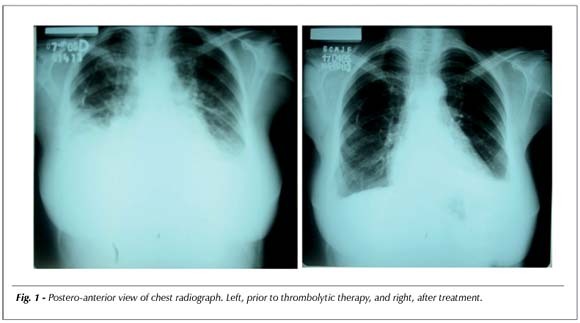
A 61-year-old female patient using a mechanical prosthesis for 11 years was admitted to the hospital with sudden dyspnea, pallor and atrial fibrillation. The diagnostic evaluation included transesophageal echocardiogram, which showed a significantly reduced motion of one of the leaflets of the mitral prosthesis and immobility of the other, in addition to a thickened structure compatible with a thrombus adherent to the valve. The patient was diagnosed with thrombosis of mechanical mitral valve prosthesis. Thrombolytic therapy (rtPA) was started successfully. The patient has been followed up for more than one year with a favorable outcome.

  • Fibrinolysis
  • Heart Valve Prosthesis
  • Thrombolytic Therapy
  • Thrombosis
Read Full Article
Creative Commons Attribution (CC BY) Creative Commons license
15/06/2007 DOI: 10.1590/S0066-782X2007000500024

How to cite this article

EndNote RIS

Electronic Document Format (Vancouver)

Tavares CAM, Accorsi TAD, Paixão MR, Mota T, Pitta F, Lemos PA, Franken M, et al. ST-Segment Elevation Myocardial Infarction Metrics Before and During the COVID-19 Pandemic: Experience from a Brazilian Center. International Journal of Cardiovascular Sciences 2025;38:e20240158.

Electronic Document Format (ABNT)

Tavares, Caio de Assis Moura; Accorsi, Tarso A. D.; Paixão, Milena Ribeiro; Mota, Tarsila; Pitta, Fabio; Lemos, Pedro Alves; Franken, Marcelo; Lima, Karine De Amicis; Kohler, Karen Francine; Souza Jr., José Leão de. ST-Segment Elevation Myocardial Infarction Metrics Before and During the COVID-19 Pandemic: Experience from a Brazilian Center. International Journal of Cardiovascular Sciences, v. 38, e20240158, Jun. 2025.

Electronic Document Format (APA)

Tavares, C. A. M., Accorsi, T. A. D., Paixão, M. R., Mota, T., Pitta, F., Lemos, P. A., Franken, M., Lima, K. D. A., Kohler, K. F., & Souza Jr., J. L. (2025). ST-Segment Elevation Myocardial Infarction Metrics Before and During the COVID-19 Pandemic: Experience from a Brazilian Center. International Journal of Cardiovascular Sciences, 38, e20240158.

Electronic Document Format (ISO)

Tavares, Caio de Assis Moura and Accorsi, Tarso A. D. and Paixão, Milena Ribeiro and Mota, Tarsila and Pitta, Fabio and Lemos, Pedro Alves and Franken, Marcelo and Lima, Karine De Amicis and Kohler, Karen Francine and Souza Jr., José Leão de. ST-Segment Elevation Myocardial Infarction Metrics Before and During the COVID-19 Pandemic: Experience from a Brazilian Center. International Journal of Cardiovascular Sciences [online]. 2025, vol. 38, [cited 2026-10-14], e20240158. Available from: <https://journals.cardiol.br/en/article/st-segment-elevation-myocardial-infarction-metrics-before-and-during-the-covid-19-pandemic-experience-from-a-brazilian-center/>. ISSN 2359-4802

EndNote RIS

Electronic Document Format (Vancouver)

Castro I, Fontana Filho H. Evaluation of Serum Levels of Inflammation, Fibrinolysis and Oxidative Stress Markers in Coronary Artery Disease Prediction: A Cross-Sectional Study. Arquivos Brasileiros de Cardiologia 2019;113(4):675-6.

Electronic Document Format (ABNT)

Castro, Iran; Fontana Filho, Hugo. Evaluation of Serum Levels of Inflammation, Fibrinolysis and Oxidative Stress Markers in Coronary Artery Disease Prediction: A Cross-Sectional Study. Arquivos Brasileiros de Cardiologia, v. 113, n. 4, p. 675-676, Nov. 2019.

Electronic Document Format (APA)

Castro, I., & Fontana Filho, H. (2019). Evaluation of Serum Levels of Inflammation, Fibrinolysis and Oxidative Stress Markers in Coronary Artery Disease Prediction: A Cross-Sectional Study. Arquivos Brasileiros de Cardiologia, 113(4), 675-676.

Electronic Document Format (ISO)

Castro, Iran and Fontana Filho, Hugo. Evaluation of Serum Levels of Inflammation, Fibrinolysis and Oxidative Stress Markers in Coronary Artery Disease Prediction: A Cross-Sectional Study. Arquivos Brasileiros de Cardiologia [online]. 2019, vol. 113, n. 4, [cited 2026-10-14], pp. 675-676. Available from: <https://journals.cardiol.br/en/article/evaluation-of-serum-levels-of-inflammation-fibrinolysis-and-oxidative-stress-markers-in-coronary-artery-disease-prediction-a-cross-sectional-study-2/>. ISSN 0066-782X

EndNote RIS

Electronic Document Format (Vancouver)

Marcolino MS, Ribeiro ALP. Reperfusion Criteria in Patients Submitted to Fibrinolysis: Is There Room for Improvement?. Arquivos Brasileiros de Cardiologia 2019;112(1):30-1.

Electronic Document Format (ABNT)

Marcolino, Milena Soriano; Ribeiro, Antonio Luiz Pinho. Reperfusion Criteria in Patients Submitted to Fibrinolysis: Is There Room for Improvement?. Arquivos Brasileiros de Cardiologia, v. 112, n. 1, p. 30-31, Dec. 2018.

Electronic Document Format (APA)

Marcolino, M. S., & Ribeiro, A. L. P. (2019). Reperfusion Criteria in Patients Submitted to Fibrinolysis: Is There Room for Improvement?. Arquivos Brasileiros de Cardiologia, 112(1), 30-31.

Electronic Document Format (ISO)

Marcolino, Milena Soriano and Ribeiro, Antonio Luiz Pinho. Reperfusion Criteria in Patients Submitted to Fibrinolysis: Is There Room for Improvement?. Arquivos Brasileiros de Cardiologia [online]. 2019, vol. 112, n. 1, [cited 2026-10-14], pp. 30-31. Available from: <https://journals.cardiol.br/en/article/reperfusion-criteria-in-patients-submitted-to-fibrinolysis-is-there-room-for-improvement/>. ISSN 0066-782X

EndNote RIS

Electronic Document Format (Vancouver)

Pereira Filho WC, Hallack Neto A, Pimentel LC, Bonato GR, Possani FS, Caminatti M. Acute thrombosis of mechanical mitral valve prosthesis successfully treated with thrombolysis. Arquivos Brasileiros de Cardiologia 2007;88(5):e115-7.

Electronic Document Format (ABNT)

Pereira Filho, Wilson Coelho; Hallack Neto, Abrahão; Pimentel, Leandro Caetano; Bonato, Glauco Resende; Possani, Felipe de Sousa; Caminatti, Moisés. Acute thrombosis of mechanical mitral valve prosthesis successfully treated with thrombolysis. Arquivos Brasileiros de Cardiologia, v. 88, n. 5, p. e115-e117, Jun. 2007.

Electronic Document Format (APA)

Pereira Filho, W. C., Hallack Neto, A., Pimentel, L. C., Bonato, G. R., Possani, F. S., & Caminatti, M. (2007). Acute thrombosis of mechanical mitral valve prosthesis successfully treated with thrombolysis. Arquivos Brasileiros de Cardiologia, 88(5), e115-e117.

Electronic Document Format (ISO)

Pereira Filho, Wilson Coelho and Hallack Neto, Abrahão and Pimentel, Leandro Caetano and Bonato, Glauco Resende and Possani, Felipe de Sousa and Caminatti, Moisés. Acute thrombosis of mechanical mitral valve prosthesis successfully treated with thrombolysis. Arquivos Brasileiros de Cardiologia [online]. 2007, vol. 88, n. 5, [cited 2026-10-14], pp. e115-e117. Available from: <https://journals.cardiol.br/en/article/acute-thrombosis-of-mechanical-mitral-valve-prosthesis-successfully-treated-with-thrombolysis/>. ISSN 0066-782X

  • About ABC Family
  • Internal Regulation
  • Editorial Board
  • Brazilian Society of Cardiology (SBC)

Issues

SBC Guidelines

  • Videos
  • Podcasts
  • News