ABC Family Arquivos Brasileiros de Cardiologia International Journal of Cardiovascular Sciences ABC Heart Failure & Cardiomyopathy ABC Imagem Cardiovascular
Português English
ABC Family
Português English
  • About
    • About ABC Family
    • Internal Regulation
    • Editorial Board
    • Brazilian Society of Cardiology (SBC)
  • Issues
  • SBC Guidelines
  • Content
    • Videos
    • Podcasts
    • News
  • About
    • About ABC Family
    • Internal Regulation
    • Editorial Board
    • Brazilian Society of Cardiology (SBC)
  • Issues
  • SBC Guidelines
  • Content
    • Videos
    • Podcasts
    • News

ABC Family

  • ABC Family
  • Arquivos Brasileiros de Cardiologia
  • International Journal of Cardiovascular Sciences
  • ABC Heart Failure & Cardiomyopathy
  • ABC Imagem Cardiovascular
Search in

No content found.

Journals
Ordering
Article types
Others

  1. Home
  2. Keyword: Carotid Artery Diseases
Figure 1
ABCIC
Case Report

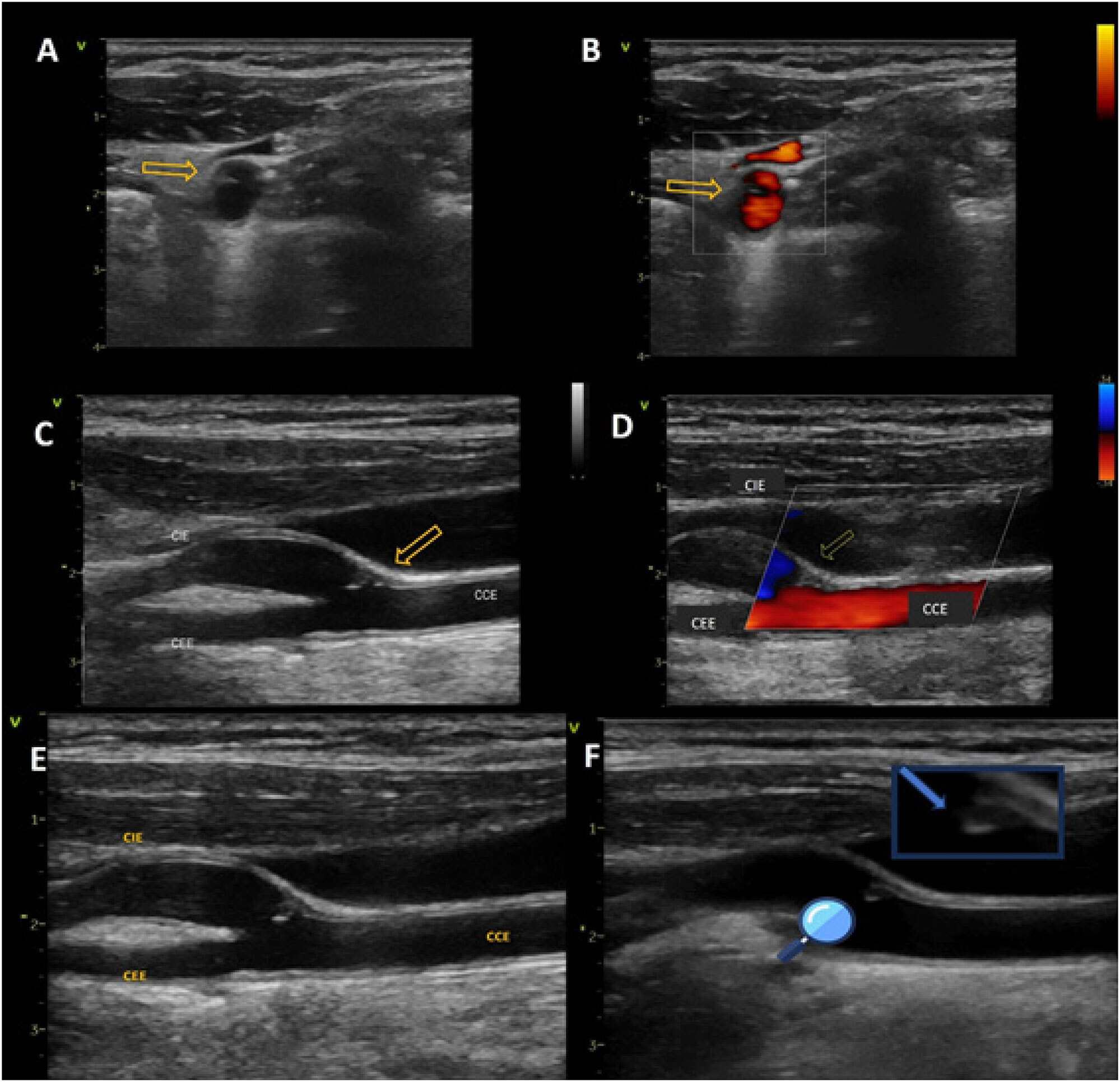
Ultrasound in the Diagnosis of Carotid Web: Report of Two Cases and Review

Ana Claudia Gomes Pereira Petisco et al. Paulo Magno Martins Dourado Larissa Almeida Dourado João Paulo Almeida Dourado Ricardo Thomaz Tebaldi

Introduction

Carotid web (CW) is a nonatherosclerotic disease of the extracranial carotid artery, described as an atypical, still little known, and poorly diagnosed focal fibromuscular dysplasia (FMD). CW has been associated with the occurrence of cerebral vascular accidents (CVAs) and transient ischemic attacks (TIAs), affecting young patients, with no other known causes.

[…]

  • Carotid Arteries Ultrasonography
  • Carotid Artery Diseases
  • Fibromuscular Dysplasia
Read Full Article
Creative Commons Attribution (CC BY) Creative Commons license
28/03/2024 DOI: 10.36660/abcimg.20230117i Views 1
ABC
Editorial

Can PM20D1 be a New Kid on the Block in Cardiovascular Risk Stratification? Do Not Run before You Can Walk

Ana Teresa Timóteo

Cardiovascular diseases are the leading cause of death worldwide, representing around 30% of all deaths, particularly in developed countries, including cardiovascular and cerebral-vascular diseases. Furthermore, in the analysis of the Global Burden of Diseases 2019 report, cardiovascular risk factors represent 75% of all cardiovascular burden, particularly hypertension, with an important impact on mortality. This is also relevant in Portuguese-speaking countries. Carotid intima-media thickness has long been recognized as a surrogate marker for coronary artery disease and has a relevant prognostic impact. For that reason, it is a useful tool in cardiovascular risk stratification.

N-acyl amino acids (NAAA) are a family of cold-inducible circulating lipids that stimulate thermogenesis, and their biosynthesis in brown adipocytes is mediated by a secreted enzyme called Peptidase M20 domain containing 1 (PM20D1). PM20D1 and NAAA activity regulation in blood plasma is still largely unknown. However, what is already known is that PM20D1 circulates in tight association with both low- and high-density lipoproteins that are powerful co-activators of PM20D1 activity in vitro and NAAA biosynthesis in vivo. Serum albumin is also a physiologic NAAA carrier that separates NAAA away from their sites of production, conferring resistance to hydrolytic degradation and establishing an equilibrium between thermogenic “free” versus inactive “bound” fractions. It has been hypothesized that lipoprotein particles are probably the main extracellular sites of NAAA biosynthesis, and this supports the concept that a lipoprotein-albumin network regulates the activity of circulating thermogenic lipid family.

[…]

  • Alzheimer Diseases
  • Cardiovascular Diseases
  • Carotid Artery Diseases
  • Diabetes Mellitus, Type 2
  • Hypertension
  • Insulin Resistance
  • Metabolic Syndrome
  • Neurodegenerative Diseases
  • Obesity
  • PM20D1
Read Full Article
Creative Commons Attribution (CC BY) Creative Commons license
05/09/2022 DOI: 10.36660/abc.20220462 Views 1
Figure 1
ABC
Original Article

Clinical Significance of Peptidase M20 Domain Containing 1 Ii Patients with Carotid Atherosclerosis

Xincheng Huang et al. Peiyuan He Linling Wu

Abstract

Background

Atherosclerosis is the main cause for most cardiovascular diseases, and new biomarkers for this condition are always needed. Peptidase M20 domain containing 1 (PM20D1) is associated with both lipid metabolism and obesity. However, no study focuses on the role of PM20D1 in carotid atherosclerosis.

Objective

The present study aimed to investigate the role of PM20D1 in carotid atherosclerosis patients.

Methods

The present prospective observational study contained a total of 231 carotid atherosclerosis patients, who went to our department between July 2018 and December 2019. Blood samples and medical characteristics were also obtained from 231 healthy individuals with the same body mass index distribution of carotid atherosclerosis patients. Serum PM20D1 was determined using enzyme-linked immunosorbent assay. Clinical and demographic characteristics of all patients were collected, including age, sex, body mass index and medical history. Levels of C-reactive protein, tumor necrosis factor, homocysteine, as well as total cholesterol, triglyceride, high-density leptin cholesterol and low-density leptin cholesterol were recorded. Statistical analysis was conducted using the SPSS software, with p<0.05 as statistically different.

Results

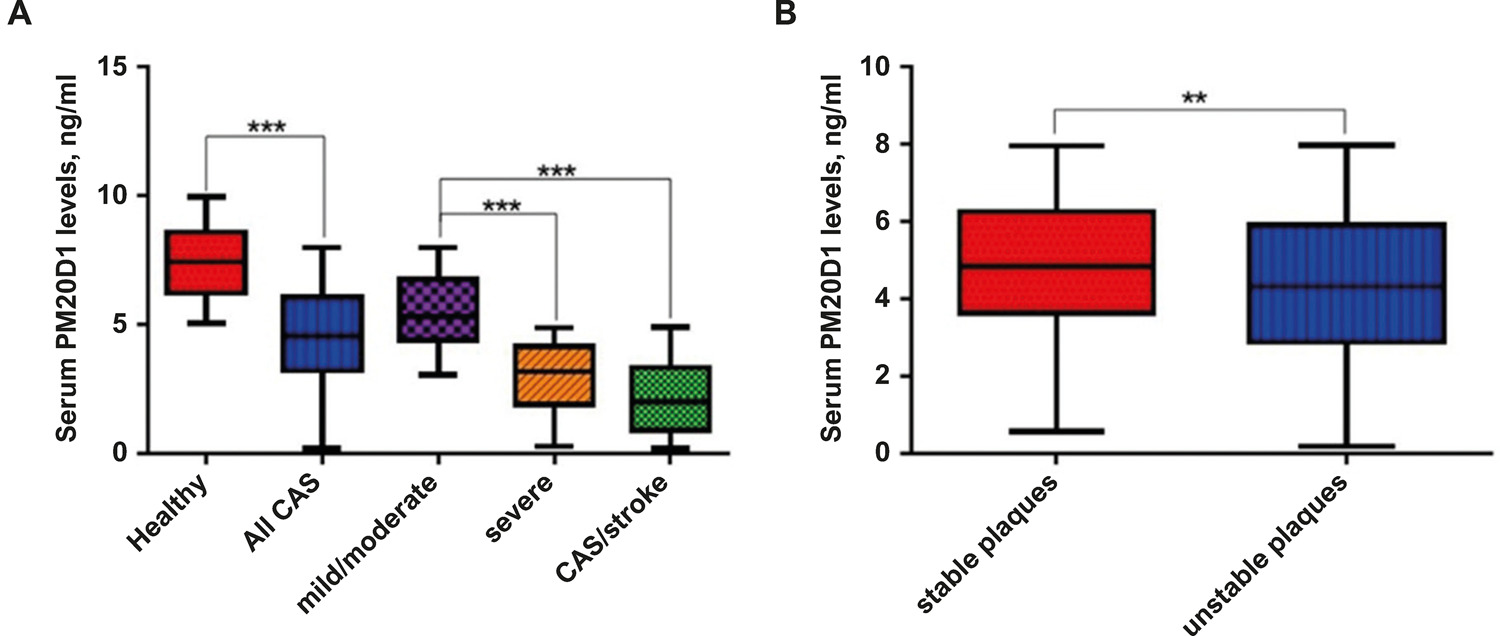
Serum PM20D1 levels were markedly lower in carotid atherosclerosis patients when compared to the healthy control, which were significantly lower in severe carotid atherosclerosis patients and carotid atherosclerosis/stroke patients. Patients with unstable plaques showed markedly lower PM20D1 when compared to patients with stable plaques. No significant difference was found among carotid atherosclerosis patients with different body mass index. Patients with higher PM20D1 levels showed significantly lower expression of C-reactive protein, tumor necrosis factor, homocysteine, triglyceride, total cholesterol and low-density leptin cholesterol. PM20D1 was negatively correlated with C-reactive protein, tumor necrosis factor, homocysteine, total cholesterol and low-density leptin cholesterol in carotid atherosclerosis patients, and could be used as a biomarker for severe carotid atherosclerosis patients or carotid atherosclerosis patients with stroke. Sex, tumor necrosis factor, homocysteine and PM20D1 were risk factors for carotid atherosclerosis.

Conclusion

PM20D1 was decreased in carotid atherosclerosis patients and was associated with severity, plaque stability, and levels of C-reactive protein, tumor necrosis factor, homocysteine, triglyceride, total cholesterol and low-density leptin cholesterol in carotid atherosclerosis patients.
  • body mass index
  • Carotid Artery Diseases
  • Lipids
Read Full Article
Creative Commons Attribution (CC BY) Creative Commons license
09/05/2022 DOI: 10.36660/abc.20210799 Views 1
ABCIC
Original Article

Carotid Evaluation in Patients with Suspected Coronary Disease: Is There a Negative Prediction?

José Luiz Fernandes Molina Filho et al. Francisco das Chagas Lima e Silva

Abstract

Introduction

Due to its prevalence and gravity, coronary diseases require a more definite and early sort of diagnosis. Thus, there is extreme urgency in identifying patients under the risk of such problem. The most important indicator of risk is a previous manifestation of atherosclerosis itself. In this context, the study of subclinical atherosclerosis may bring to light essential information.

Objective

To evaluate if there is any connection between carotid and coronary alterations; if the absence of atherosclerosis in the arterial bed may indicate absence of obstructive atherosclerotic disease in the coronary bed; and if the absence of carotid lesion might substantiate the non indication of coronarography, keeping in mind the clinical characteristics of each patient.

Methods

This study was observational, transversal, analytic and comparative. Fifty consecutive patients were included, having clinical indication for coronarography. A vascular ultrasound exam of the carotids was performed for a comparison of the results.

Results

All patients with no carotid plaque, evaluated using vascular ultrasound, did not present any significant coronary obstruction, as evaluated via coronarography. All patients who showed significant carotid obstruction, ≥ 50%, also presented significant coronary obstruction, ≥ 70%. Among the evaluated points, only the result of the vascular ultrasound exam of the carotids was seen as a risk predictor in the findings obtained via vascular ultrasound (odds ratio of 2,58; confidence interval 1,66-4,02; p < 0,001).

Conclusion

There was a positive association between the degree of the atherosclerotic lesion of the carotid and of the coronary. No patient without carotid lesion showed significant obstruction of coronary artery, presenting high negative predictive value.

  • Atherosclerosis
  • Cardiac Catheterization
  • Carotid Artery Diseases
  • Coronary Diseases
  • Ultrasonography, Doppler
Read Full Article
Creative Commons Attribution (CC BY) Creative Commons license
14/01/2022 DOI: 10.5935/2318-8219.20200023 Views 1
ABC
Editorial

Estimating Cardiovascular Risk in HIV-Infected Patients

Marcio Sommer Bittencourt

From the initial reports of HIV infections in 1981, substantial progress in the prevention, detection and treatment have led to a marked reduction in mortality. Among them, the use of highly active antiretroviral therapy (HAART) with the combination of multiple antiretroviral drugs acting in different phases of the viral cycle resulted in impressive reductions in transmission and infectious complications. This increase in survival led to a large and growing population of persons living with HIV (PLWH) as a chronic condition in a setting where other non-infectious complications became more common.

Among those novel conditions affecting PLWH, cardiovascular complications became the leading cause of morbidity and mortality, at least in countries with adequate access to care and widespread use of HAART. The increase in cardiovascular risk in PLWH is multifactorial. First, studies suggest that PLWH are more likely to be diabetics and smokers. Second, those individuals are more likely to have higher triglycerides and lower HDL-C, though LDL-C and total cholesterol were also reduced. It also seems possible that HIV infection is responsible for increases in blood pressure and glucose levels by different mechanisms. However, considerable evidence supports the concept that traditional risk factors do not fully account for the higher cardiovascular risk in those individuals, as the changes in the cardiovascular system in PWLH is multifactorial and at least partially mediated by inflammation and immune activation, leading to endothelial dysfunction, changes in vascular elasticity, coagulation.

[…]

  • Acquired Immunodeficiency Syndrome/complications
  • Antiretroviral Therapy
  • Carotid Artery Diseases
  • Highly Active
  • HIV
  • Risk Factors
Read Full Article
Creative Commons Attribution (CC BY) Creative Commons license
10/02/2020 DOI: 10.36660/abc.20190747 Views 1
ABC
Editorial

Cardiovascular Conditions of Patients on HIV Therapy

Alfredo José Mansur

Successful anti-infective therapy of patients submitted to contemporary HIV treatment decreased mortality between 2007 and 2017 by 51% in association with a decrease in of 17% in incidence; decrease in mortality associated with a smaller decrease in incidence means more people living with HIV disease. In Brazil, annualised rate of change in mortality was -1.2% (-1.4% to -1.0%). In many countries the survival rate of patients increased. Therefore, other non-infectious ailments such as prevalent cardiovascular diseases came to the attention of physicians in charge for the patients.

Prevention is a mainstay in the health care of patients. Patients on successful HIV treatment may incur in either asymptomatic or symptomatic conditions that may be risk factors for cardiovascular diseases or demonstrate metabolic abnormalities that need medical attention. Further, new technologies were studied in order to investigate in more depth vascular health either as screening, or a diagnostic tool or treatment strategies.

[…]

  • Antiretroviral Therapy
  • Atherosclerosis
  • Cardiovascular Diseases
  • Carotid Artery Diseases
  • Epidemiology
  • HIV
  • HIV Infections
  • Risk Factors
Read Full Article
Creative Commons Attribution (CC BY) Creative Commons license
10/02/2020 DOI: 10.36660/abc.20190810
Figure 1
ABC
Original Article

Subclinical Carotid Atherosclerosis and Reduced DAD Score for Cardiovascular Risk Stratification in HIV-Positive Patients

Achilles Gustavo Silva et al. Rafael Vieira Paulo Mario León Silva-Vergara

Abstract

Background:

HIV-positive patients are twice as likely than the general population to have a heart attack and are four times at greater risk of sudden death. In addition to the increased risk, these individuals present with cardiovascular events on average approximately 10 years earlier than the general population.

Objective:

To compare Framingham and reduced DAD (Data Collection on Adverse Effects of Anti-HIV Drugs Cohort) scores for cardiovascular risk assessment in HIV-positive patients and potential impact on clinical decision after evaluation of subclinical carotid atherosclerosis.

Methods:

Seventy-one HIV-positive patients with no history of cardiovascular disease were clinically evaluated, stratified by the Framingham 2008 and reduced DAD scores and submitted to subclinical carotid atherosclerosis evaluation. Agreement between scores was assessed by Kappa index and p < 0.05 was considered statistically significant.

Results:

mean age was 47.2 and 53.5% among males. The rate of subclinical atherosclerosis was 39.4%. Agreement between scores was 49% with Kappa of 0.735 in high-risk patients. There was no significant difference between scores by ROC curve discrimination analysis. Among patients with intermediate risk and Framingham and reduced DAD scores, 62.5% and 30.8% had carotid atherosclerosis, respectively.

Conclusion:

The present study showed a correlation between the scores and medium-intimal thickening, besides a high correlation between patients classified as high risk by the Framingham 2008 and reduced DAD scores. The high prevalence of carotid atherosclerosis in intermediate risk patients suggests that most of them could be reclassified as high risk.

  • Acquired Immunodeficiency Syndrome/complications
  • Antiretroviral Therapy Highly Active
  • Carotid Artery Diseases
  • HIV
  • Indicators of Morbidity
  • Risk Factors
Read Full Article
Creative Commons Attribution (CC BY) Creative Commons license
28/10/2019 DOI: 10.5935/abc.20190227 Views 1
Figure 1
ABC
Review Article

Risk-Benefit Assessment of Carotid Revascularization

Pedro Piccaro de Oliveira et al. José Luiz da Costa Vieira Raphael Boesche Guimarães Eduardo Dytz Almeida … Simone Louise Savaris Vera Lucia Portal

Abstract

Severe carotid atherosclerotic disease is responsible for 14% of all strokes, which result in a high rate of morbidity and mortality. In recent years, advances in clinical treatment of cardiovascular diseases have resulted in a significant decrease in mortality due to these causes.

To review the main studies on carotid revascularization, evaluating the relationship between risks and benefits of this procedure.

The data reviewed show that, for a net benefit, carotid intervention should only be performed in cases of a periprocedural risk of less than 6% in symptomatic patients. The medical therapy significantly reduced the revascularization net benefit ratio for stroke prevention in asymptomatic patients. Real life registries indicate that carotid stenting is associated with a greater periprocedural risk. The operator annual procedure volume and patient age has an important influence in the rate of stroke and death after carotid stenting. Symptomatic patients have a higher incidence of death and stroke after the procedure. Revascularization has the greatest benefit in the first weeks of the event.

There is a discrepancy in the scientific literature about carotid revascularization and/or clinical treatment, both in primary and secondary prevention of patients with carotid artery injury. The identification of patients who will really benefit is a dynamic process subject to constant review.

  • Atherosclerosis
  • Carotid Artery Diseases
  • Endarterectomy, Carotid
  • Indicators of Morbidity and Mortality
  • Risk Assessment
  • Stroke
Read Full Article
Creative Commons Attribution (CC BY) Creative Commons license
01/10/2018 DOI: 10.5935/abc.20180208 Views 2
Correlation between the intima-media thickness of the proximal and distal common carotids
ABC
Artigo Original

Correlation between the intima-media thickness of the proximal and distal common carotids

Leonard Hermann Roelke et al. Sergio Lamego Rodrigues Paulo Andrade Lotufo Jose Geraldo Mill

BACKGROUND: Increased IMT (intima-media thickness) in carotids is used as an early atherosclerosis marker and to evaluate the risk of cardiovascular problems. Ultrasound is used in the evaluation because it is accessible and low cost. Measurements for different carotid regions are described. OBJECTIVE:To compare the proximal and distal region IMTs for the bilateral common carotid and guide its use in clinical practice. METHODS: The IMT was measured in the proximal and distal common carotid arteries of 798 individuals (35-74 years old) of both genders using high-resolution ultrasound. Pearson’s correlation coefficient was used to establish associations. The analyses were initially performed for the entire sample as well as subgroups with IMT 0.90 mm for at least one measurement site. The statistical significance was p < 0.05. RESULTS: The correlations investigated were significant. In the group with an IMT 0.90 mm, the correlations were significantly reduced to between 0.20 and 0.40. CONCLUSION: The data suggest that the IMT is more uniform along the carotid during early development and tends develop focally as it progresses. Therefore, in clinical evaluations of patients, the common carotid length should be investigated bilaterally to better use the available software and discern the IMT.

  • Cardiovascular Diseases
  • Carotid Artery Diseases
  • Carotid Artery, Common
  • Carotid Intima-Media Thickness
Read Full Article
Creative Commons Attribution (CC BY) Creative Commons license
23/07/2013 DOI: 10.5935/abc.20130151 Views 1
Association between ankle-brachial index and carotid atherosclerotic disease
ABC
Artigo Original

Association between ankle-brachial index and carotid atherosclerotic disease

Augusto Cezar Lacerda Brasileiro et al. Dinaldo Cavalcanti de Oliveira Edgar Guimarães Victor Danielle A. G. Cavalcanti Oliveira Laecio Leitão Batista

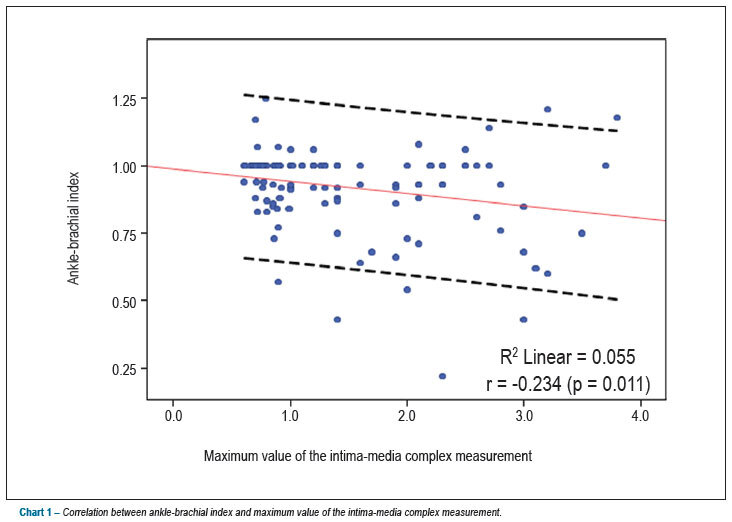
BACKGROUND: The association between the ankle brachial index (ABI) and the measurement of intimal medial thickness (IMT) has not been fully studied. OBJECTIVE: We aimed to evaluate whether the prevalence of carotid atherosclerosis was higher in patients with ABI 0.9. METHODS: From January 2011 to December 2011, 118 patients (48 men and 70 women) were enrolled. ABI and IMT Measurements were performed in all patients. Patients were divided in Group 1 (ABI 0.9) according to ABI values. Mann-Whitney, Chi-square and Fischer tests were used for comparison among the groups. Pearson’s correlation was used to assess correlation between ABI and IMT. RESULTS: The prevalence of ABI 1.5 mm was 34.7 %. Clinical characteristics were similar between groups 1 and 2: mean age (64 ± 9 vs. 62 ± 7.2 years, p = 0.1), male gender (40% vs. 41%, p = 0.9), hypertension (74% vs. 59%, p = 0.1), diabetes mellitus (54% vs. 35%, p = 0.051), dyslipidemia (26% vs. 24%, p = 0.8), smoking (57% vs. 65%, p = 0.4). The prevalence of carotid atherosclerosis was higher in group 1 (48.6% vs. 28.9%, p = 0.04). Pearson’s correlation between ABI and IMT was -0.235, with a p value = 0.01. CONCLUSION: Patients with ABI < 0.9 showed a higher prevalence of carotid atherosclerosis. There was a negative correlation between ABI and IMT.

  • Ankle Brachial Index
  • Carotid Artery Diseases
  • Ultrasonography
Read Full Article
Creative Commons Attribution (CC BY) Creative Commons license
09/04/2013 DOI: 10.5935/abc.20130057
ABC
Artigo Original

Prevalence of carotid stenosis in patients referred to myocardial revascularization surgery

Marcelo Pereira da Rosa et al. Vera Lúcia Portal

BACKGROUND: Although the carotid stenosis is the main cause of cerebrovascular accident, the prevalence of clinically significant stenosis (>50%) remains unknown in our country, mainly in individuals with a surgical indication for elective myocardial revascularization surgery. OBJECTIVE: To identify the prevalence and degree of carotid stenosis in individuals with a surgical indication for MRS in a reference center in Cardiology in Brazil. METHODS: Transversal study of 457 consecutive patients of both genders, evaluated between May 2007 and April 2008 through ultrasonography with color Doppler of the carotid arteries, during the preoperative period of elective MRS. The statistical analysis was performed with the SPSS program, version 10.1. A p value <0.05 was considered significant. Seven patients were lost throughout the study. RESULTS: The mean age (±standard deviation) was 62.2 ± 9.4 years and 65.6% of the patients were males. The prevalence of significant carotid stenosis was 18.7%. As for the stratification of the degree of carotid stenosis: absence of stenosis was observed in 3.6%; stenosis < 50% was observed in 77.8%; stenosis between 50% and 69% was observed in 11.6%; stenosis between 70% and 99% was observed in 6.9% and arterial occlusion was observed in 0.2% of the individuals. The sensitivity and specificity regarding the carotid bruit were 34.5% and 88.8%, respectively. CONCLUSION: The prevalence of significant carotid stenosis was high in the studied sample, which suggests this is a high-risk population for the occurrence of cerebrovascular accident.

  • Carotid Artery Diseases
  • Carotid Stenosis
  • Coronary Artery Bypass
  • Coronary Artery Disease
Read Full Article
Creative Commons Attribution (CC BY) Creative Commons license
15/01/2010 DOI: 10.1590/S0066-782X2010005000002 Views 1

How to cite this article

EndNote RIS

Electronic Document Format (Vancouver)

Petisco ACGP, Dourado PMM, Dourado LA, Dourado JPA, Tebaldi RT. Ultrasound in the Diagnosis of Carotid Web: Report of Two Cases and Review. ABC Imagem Cardiovascular 2024;37(1):e20230117.

Electronic Document Format (ABNT)

Petisco, Ana Claudia Gomes Pereira; Dourado, Paulo Magno Martins; Dourado, Larissa Almeida; Dourado, João Paulo Almeida; Tebaldi, Ricardo Thomaz. Ultrasound in the Diagnosis of Carotid Web: Report of Two Cases and Review. ABC Imagem Cardiovascular, v. 37, n. 1, e20230117, Mar. 2024.

Electronic Document Format (APA)

Petisco, A. C. G. P., Dourado, P. M. M., Dourado, L. A., Dourado, J. P. A., & Tebaldi, R. T. (2024). Ultrasound in the Diagnosis of Carotid Web: Report of Two Cases and Review. ABC Imagem Cardiovascular, 37(1), e20230117.

Electronic Document Format (ISO)

Petisco, Ana Claudia Gomes Pereira and Dourado, Paulo Magno Martins and Dourado, Larissa Almeida and Dourado, João Paulo Almeida and Tebaldi, Ricardo Thomaz. Ultrasound in the Diagnosis of Carotid Web: Report of Two Cases and Review. ABC Imagem Cardiovascular [online]. 2024, vol. 37, n. 1, [cited 2026-10-14], e20230117. Available from: <https://journals.cardiol.br/en/article/ultrasound-in-the-diagnosis-of-carotid-web-report-of-two-cases-and-review/>. ISSN 2318-8219

EndNote RIS

Electronic Document Format (Vancouver)

Timóteo AT. Can PM20D1 be a New Kid on the Block in Cardiovascular Risk Stratification? Do Not Run before You Can Walk. Arquivos Brasileiros de Cardiologia 2022;119(3):380-1.

Electronic Document Format (ABNT)

Timóteo, Ana Teresa. Can PM20D1 be a New Kid on the Block in Cardiovascular Risk Stratification? Do Not Run before You Can Walk. Arquivos Brasileiros de Cardiologia, v. 119, n. 3, p. 380-381, Sep. 2022.

Electronic Document Format (APA)

Timóteo, A. T. (2022). Can PM20D1 be a New Kid on the Block in Cardiovascular Risk Stratification? Do Not Run before You Can Walk. Arquivos Brasileiros de Cardiologia, 119(3), 380-381.

Electronic Document Format (ISO)

Timóteo, Ana Teresa. Can PM20D1 be a New Kid on the Block in Cardiovascular Risk Stratification? Do Not Run before You Can Walk. Arquivos Brasileiros de Cardiologia [online]. 2022, vol. 119, n. 3, [cited 2026-10-14], pp. 380-381. Available from: <https://journals.cardiol.br/en/article/can-pm20d1-be-a-new-kid-on-the-block-in-cardiovascular-risk-stratification-do-not-run-before-you-can-walk/>. ISSN 0066-782X

EndNote RIS

Electronic Document Format (Vancouver)

Huang X, He P, Wu L. Clinical Significance of Peptidase M20 Domain Containing 1 Ii Patients with Carotid Atherosclerosis. Arquivos Brasileiros de Cardiologia 2022;119(3):372-9.

Electronic Document Format (ABNT)

Huang, Xincheng; He, Peiyuan; Wu, Linling. Clinical Significance of Peptidase M20 Domain Containing 1 Ii Patients with Carotid Atherosclerosis. Arquivos Brasileiros de Cardiologia, v. 119, n. 3, p. 372-379, May. 2022.

Electronic Document Format (APA)

Huang, X., He, P., & Wu, L. (2022). Clinical Significance of Peptidase M20 Domain Containing 1 Ii Patients with Carotid Atherosclerosis. Arquivos Brasileiros de Cardiologia, 119(3), 372-379.

Electronic Document Format (ISO)

Huang, Xincheng and He, Peiyuan and Wu, Linling. Clinical Significance of Peptidase M20 Domain Containing 1 Ii Patients with Carotid Atherosclerosis. Arquivos Brasileiros de Cardiologia [online]. 2022, vol. 119, n. 3, [cited 2026-10-14], pp. 372-379. Available from: <https://journals.cardiol.br/en/article/clinical-significance-of-peptidase-m20-domain-containing-1-ii-patients-with-carotid-atherosclerosis/>. ISSN 0066-782X

EndNote RIS

Electronic Document Format (Vancouver)

Molina Filho JLF, Silva FCL. Carotid Evaluation in Patients with Suspected Coronary Disease: Is There a Negative Prediction?. Arquivos Brasileiros de Cardiologia Imagem cardiovascular 2022;33(2):1-8.

Electronic Document Format (ABNT)

Molina Filho, José Luiz Fernandes; Silva, Francisco das Chagas Lima e. Carotid Evaluation in Patients with Suspected Coronary Disease: Is There a Negative Prediction?. Arquivos Brasileiros de Cardiologia Imagem cardiovascular, v. 33, n. 2, p. 1-8, Jan. 2022.

Electronic Document Format (APA)

Molina Filho, J. L. F., & Silva, F. C. L. (2022). Carotid Evaluation in Patients with Suspected Coronary Disease: Is There a Negative Prediction?. Arquivos Brasileiros de Cardiologia Imagem cardiovascular, 33(2), 1-8.

Electronic Document Format (ISO)

Molina Filho, José Luiz Fernandes and Silva, Francisco das Chagas Lima e. Carotid Evaluation in Patients with Suspected Coronary Disease: Is There a Negative Prediction?. Arquivos Brasileiros de Cardiologia Imagem cardiovascular [online]. 2022, vol. 33, n. 2, [cited 2026-10-14], pp. 1-8. Available from: <https://journals.cardiol.br/en/article/carotid-evaluation-in-patients-with-suspected-coronary-disease-is-there-a-negative-prediction/>. ISSN 2318-8219

EndNote RIS

Electronic Document Format (Vancouver)

Bittencourt MS. Estimating Cardiovascular Risk in HIV-Infected Patients. Arquivos Brasileiros de Cardiologia 2020;114(1):76-7.

Electronic Document Format (ABNT)

Bittencourt, Marcio Sommer. Estimating Cardiovascular Risk in HIV-Infected Patients. Arquivos Brasileiros de Cardiologia, v. 114, n. 1, p. 76-77, Feb. 2020.

Electronic Document Format (APA)

Bittencourt, M. S. (2020). Estimating Cardiovascular Risk in HIV-Infected Patients. Arquivos Brasileiros de Cardiologia, 114(1), 76-77.

Electronic Document Format (ISO)

Bittencourt, Marcio Sommer. Estimating Cardiovascular Risk in HIV-Infected Patients. Arquivos Brasileiros de Cardiologia [online]. 2020, vol. 114, n. 1, [cited 2026-10-14], pp. 76-77. Available from: <https://journals.cardiol.br/en/article/estimating-cardiovascular-risk-in-hiv-infected-patients/>. ISSN 0066-782X

EndNote RIS

Electronic Document Format (Vancouver)

Mansur AJ. Cardiovascular Conditions of Patients on HIV Therapy. Arquivos Brasileiros de Cardiologia 2020;114(1):98-9.

Electronic Document Format (ABNT)

Mansur, Alfredo José. Cardiovascular Conditions of Patients on HIV Therapy. Arquivos Brasileiros de Cardiologia, v. 114, n. 1, p. 98-99, Feb. 2020.

Electronic Document Format (APA)

Mansur, A. J. (2020). Cardiovascular Conditions of Patients on HIV Therapy. Arquivos Brasileiros de Cardiologia, 114(1), 98-99.

Electronic Document Format (ISO)

Mansur, Alfredo José. Cardiovascular Conditions of Patients on HIV Therapy. Arquivos Brasileiros de Cardiologia [online]. 2020, vol. 114, n. 1, [cited 2026-10-14], pp. 98-99. Available from: <https://journals.cardiol.br/en/article/cardiovascular-conditions-of-patients-on-hiv-therapy/>. ISSN 0066-782X

EndNote RIS

Electronic Document Format (Vancouver)

Silva AG, Paulo RV, Silva-Vergara ML. Subclinical Carotid Atherosclerosis and Reduced DAD Score for Cardiovascular Risk Stratification in HIV-Positive Patients. Arquivos Brasileiros de Cardiologia 2019;114(1):68-75.

Electronic Document Format (ABNT)

Silva, Achilles Gustavo; Paulo, Rafael Vieira; Silva-Vergara, Mario León. Subclinical Carotid Atherosclerosis and Reduced DAD Score for Cardiovascular Risk Stratification in HIV-Positive Patients. Arquivos Brasileiros de Cardiologia, v. 114, n. 1, p. 68-75, Oct. 2019.

Electronic Document Format (APA)

Silva, A. G., Paulo, R. V., & Silva-Vergara, M. L. (2019). Subclinical Carotid Atherosclerosis and Reduced DAD Score for Cardiovascular Risk Stratification in HIV-Positive Patients. Arquivos Brasileiros de Cardiologia, 114(1), 68-75.

Electronic Document Format (ISO)

Silva, Achilles Gustavo and Paulo, Rafael Vieira and Silva-Vergara, Mario León. Subclinical Carotid Atherosclerosis and Reduced DAD Score for Cardiovascular Risk Stratification in HIV-Positive Patients. Arquivos Brasileiros de Cardiologia [online]. 2019, vol. 114, n. 1, [cited 2026-10-14], pp. 68-75. Available from: <https://journals.cardiol.br/en/article/subclinical-carotid-atherosclerosis-and-reduced-dad-score-for-cardiovascular-risk-stratification-in-hiv-positive-patients/>. ISSN 0066-782X

EndNote RIS

Electronic Document Format (Vancouver)

Oliveira PP, Vieira JLC, Guimarães RB, Almeida ED, Savaris SL, Portal VL. Risk-Benefit Assessment of Carotid Revascularization. Arquivos Brasileiros de Cardiologia 2018;111(4):618-25.

Electronic Document Format (ABNT)

Oliveira, Pedro Piccaro de; Vieira, José Luiz da Costa; Guimarães, Raphael Boesche; Almeida, Eduardo Dytz; Savaris, Simone Louise; Portal, Vera Lucia. Risk-Benefit Assessment of Carotid Revascularization. Arquivos Brasileiros de Cardiologia, v. 111, n. 4, p. 618-625, Sep. 2018.

Electronic Document Format (APA)

Oliveira, P. P. , Vieira, J. L. C., Guimarães, R. B., Almeida, E. D., Savaris, S. L., & Portal, V. L. (2018). Risk-Benefit Assessment of Carotid Revascularization. Arquivos Brasileiros de Cardiologia, 111(4), 618-625.

Electronic Document Format (ISO)

Oliveira, Pedro Piccaro de and Vieira, José Luiz da Costa and Guimarães, Raphael Boesche and Almeida, Eduardo Dytz and Savaris, Simone Louise and Portal, Vera Lucia. Risk-Benefit Assessment of Carotid Revascularization. Arquivos Brasileiros de Cardiologia [online]. 2018, vol. 111, n. 4, [cited 2026-10-14], pp. 618-625. Available from: <https://journals.cardiol.br/en/article/risk-benefit-assessment-of-carotid-revascularization/>. ISSN 0066-782X

EndNote RIS

Electronic Document Format (Vancouver)

Roelke LH, Rodrigues SL, Lotufo PA, Mill JG. Correlation between the intima-media thickness of the proximal and distal common carotids. Arquivos Brasileiros de Cardiologia 2013;101(3):211-6.

Electronic Document Format (ABNT)

Roelke, Leonard Hermann; Rodrigues, Sergio Lamego; Lotufo, Paulo Andrade; Mill, Jose Geraldo. Correlation between the intima-media thickness of the proximal and distal common carotids. Arquivos Brasileiros de Cardiologia, v. 101, n. 3, p. 211-216, Jul. 2013.

Electronic Document Format (APA)

Roelke, L. H., Rodrigues, S. L., Lotufo, P. A., & Mill, J. G. (2013). Correlation between the intima-media thickness of the proximal and distal common carotids. Arquivos Brasileiros de Cardiologia, 101(3), 211-216.

Electronic Document Format (ISO)

Roelke, Leonard Hermann and Rodrigues, Sergio Lamego and Lotufo, Paulo Andrade and Mill, Jose Geraldo. Correlation between the intima-media thickness of the proximal and distal common carotids. Arquivos Brasileiros de Cardiologia [online]. 2013, vol. 101, n. 3, [cited 2026-10-14], pp. 211-216. Available from: <https://journals.cardiol.br/en/article/correlation-between-the-intima-media-thickness-of-the-proximal-and-distal-common-carotids/>. ISSN 0066-782X

EndNote RIS

Electronic Document Format (Vancouver)

Brasileiro ACL, Oliveira DC, Victor EG, Oliveira DAGC, Batista LL. Association between ankle-brachial index and carotid atherosclerotic disease. Arquivos Brasileiros de Cardiologia 2013;100(5):422-8.

Electronic Document Format (ABNT)

Brasileiro, Augusto Cezar Lacerda; Oliveira, Dinaldo Cavalcanti de; Victor, Edgar Guimarães; Oliveira, Danielle A. G. Cavalcanti; Batista, Laecio Leitão. Association between ankle-brachial index and carotid atherosclerotic disease. Arquivos Brasileiros de Cardiologia, v. 100, n. 5, p. 422-428, Apr. 2013.

Electronic Document Format (APA)

Brasileiro, A. C. L., Oliveira, D. C. , Victor, E. G., Oliveira, D. A. G. C., & Batista, L. L. (2013). Association between ankle-brachial index and carotid atherosclerotic disease. Arquivos Brasileiros de Cardiologia, 100(5), 422-428.

Electronic Document Format (ISO)

Brasileiro, Augusto Cezar Lacerda and Oliveira, Dinaldo Cavalcanti de and Victor, Edgar Guimarães and Oliveira, Danielle A. G. Cavalcanti and Batista, Laecio Leitão. Association between ankle-brachial index and carotid atherosclerotic disease. Arquivos Brasileiros de Cardiologia [online]. 2013, vol. 100, n. 5, [cited 2026-10-14], pp. 422-428. Available from: <https://journals.cardiol.br/en/article/association-between-ankle-brachial-index-and-carotid-atherosclerotic-disease/>. ISSN 0066-782X

EndNote RIS

Electronic Document Format (Vancouver)

Rosa MP, Portal VL. Prevalence of carotid stenosis in patients referred to myocardial revascularization surgery. Arquivos Brasileiros de Cardiologia 2010;94(2):182-7.

Electronic Document Format (ABNT)

Rosa, Marcelo Pereira da; Portal, Vera Lúcia. Prevalence of carotid stenosis in patients referred to myocardial revascularization surgery. Arquivos Brasileiros de Cardiologia, v. 94, n. 2, p. 182-187, Jan. 2010.

Electronic Document Format (APA)

Rosa, M. P. , & Portal, V. L. (2010). Prevalence of carotid stenosis in patients referred to myocardial revascularization surgery. Arquivos Brasileiros de Cardiologia, 94(2), 182-187.

Electronic Document Format (ISO)

Rosa, Marcelo Pereira da and Portal, Vera Lúcia. Prevalence of carotid stenosis in patients referred to myocardial revascularization surgery. Arquivos Brasileiros de Cardiologia [online]. 2010, vol. 94, n. 2, [cited 2026-10-14], pp. 182-187. Available from: <https://journals.cardiol.br/en/article/prevalence-of-carotid-stenosis-in-patients-referred-to-myocardial-revascularization-surgery/>. ISSN 0066-782X

  • About ABC Family
  • Internal Regulation
  • Editorial Board
  • Brazilian Society of Cardiology (SBC)

Issues

SBC Guidelines

  • Videos
  • Podcasts
  • News