Marciane Maria Rover et al. Geraldine Trott Fernando Luís Scolari Mariana Motta Dias da Silva … Denise de Souza Rosa da Rosa Minho dos Santos Ana Paula Aquistapase Dagnino Juliana de Mesquita Neto Gabriel Pozza Estivalete Amanda Christina Kozesinski-Nakatani Milena Soriano Marcolino Bruna Brandão Barreto Paulo Roberto Schvartzman Ana Carolina Peçanha Antonio Caroline Cabral Robinson Maicon Falavigna Andreia Biolo Carisi Anne Polanczyk Regis Goulart Rosa
Abstract
Background
The long-term effects of mild COVID-19 on physical, cognitive, and mental health are not yet well understood.
Objective
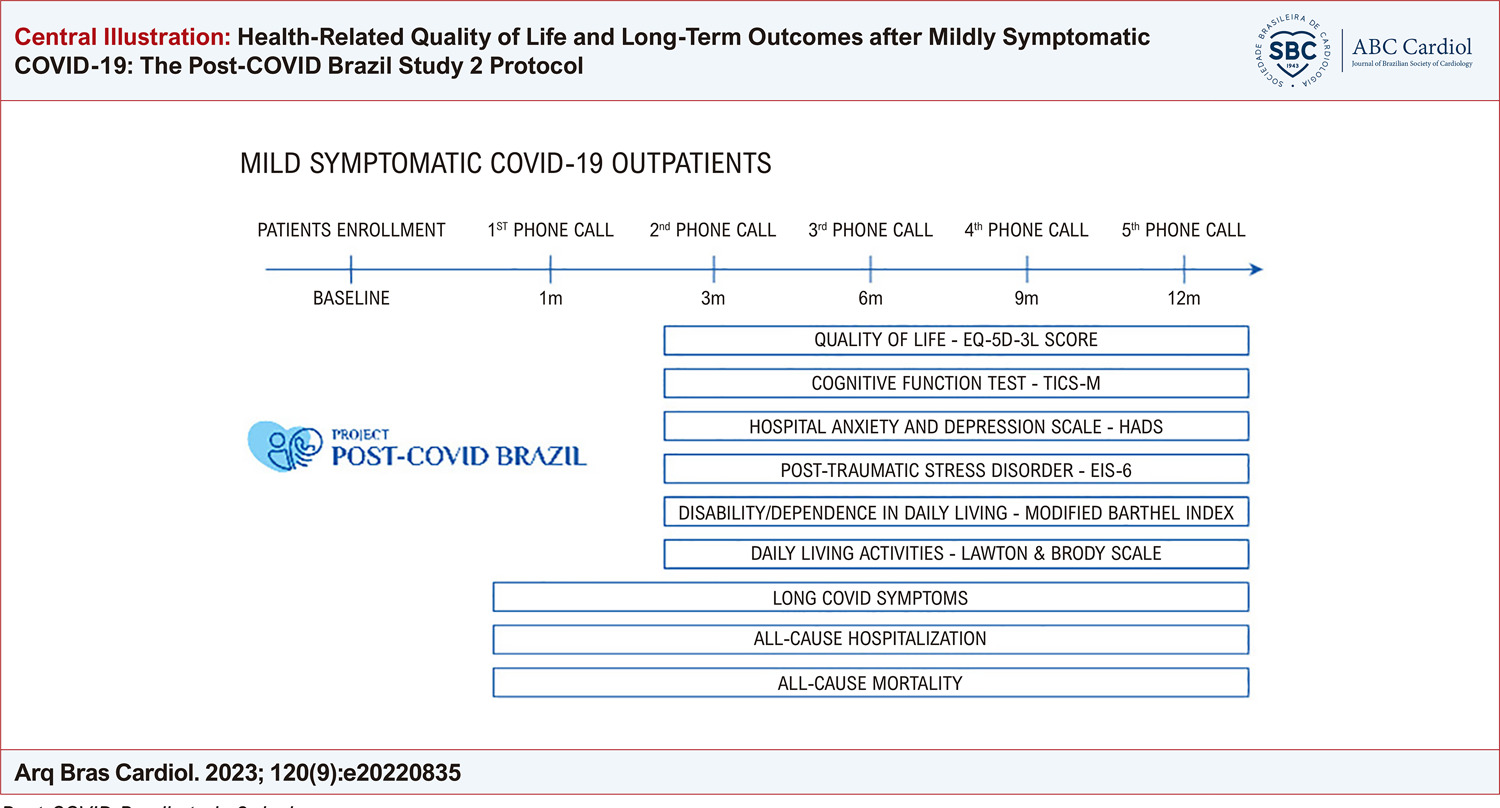
The purpose of this paper is to describe the protocol for the ongoing “Post-COVID Brazil” study 2, which aims to evaluate the factors associated with health-related quality of life and long-term cardiovascular and non-cardiovascular outcomes one year after a mild episode of symptomatic COVID-19.
Methods
The “Post-COVID Brazil” study 2 is a prospective multicenter study that plans to enroll 1047 patients (NCT05197647). Centralized, structured telephone interviews are conducted at 1, 3, 6, 9, and 12 months after COVID-19 diagnosis. The primary outcome is the health-related quality-of-life utility score, assessed using the EuroQol-5D-3L (EQ-5D-3L) questionnaire at 12 months. Secondary endpoints include the EQ-5D-3L at 3, 6, and 9 months, as well as all-cause mortality, major cardiovascular events, hospitalization, return to work or education, persistent symptoms, new disabilities in instrumental activities of daily living, cognitive impairment, anxiety, depression, and post-traumatic stress symptoms at 3, 6, 9, and 12 months after SARS-CoV-2 infection. A p-value < 0.05 will be considered statistically significant for all analyses.
Results
The primary endpoint will be presented as the overall frequency of the EQ-5D-3L domains 12 months after SARS-CoV-2 infection. Main analysis will explore the association of independent variables with the study outcomes.
Conclusion
The “Post-COVID Brazil” study 2 aims to clarify the impact of long COVID on the quality of life and cardiovascular and non-cardiovascular outcomes of Brazilian patients who have had mild COVID-19.