ABC Family Arquivos Brasileiros de Cardiologia International Journal of Cardiovascular Sciences ABC Heart Failure & Cardiomyopathy ABC Imagem Cardiovascular
Português English
ABC Family
Português English
  • About
    • About ABC Family
    • Internal Regulation
    • Editorial Board
    • Brazilian Society of Cardiology (SBC)
  • Issues
  • SBC Guidelines
  • Content
    • Videos
    • Podcasts
    • News
  • About
    • About ABC Family
    • Internal Regulation
    • Editorial Board
    • Brazilian Society of Cardiology (SBC)
  • Issues
  • SBC Guidelines
  • Content
    • Videos
    • Podcasts
    • News

ABC Family

  • ABC Family
  • Arquivos Brasileiros de Cardiologia
  • International Journal of Cardiovascular Sciences
  • ABC Heart Failure & Cardiomyopathy
  • ABC Imagem Cardiovascular
Search in

No content found.

Journals
Ordering
Article types
Others

  1. Home
  2. Keyword: LDL-cholesterol
Critical Analysis of the Clinical and Lipidic Profile of Patients with Acute Coronary Syndrome in a Public Hospital in São Paulo
IJCS
Original Article

Critical Analysis of the Clinical and Lipidic Profile of Patients with Acute Coronary Syndrome in a Public Hospital in São Paulo

Giovanna Ristori Costa et al. Luís Fernando Ferreira Cavalcante Renato Jorge Alves

Abstract

Background:

Myocardial infarction (MI) is highly influenced by risk factors such as dyslipidemia. Achieving low-density lipoprotein cholesterol (LDL-C) goals is key to reducing the residual cardiovascular risk. However, the proportion of patients with MI who accomplish this goal is unknown.

Objective:

Assess risk factors, lipid profile evolution from admission to the first outpatient consultation, and the therapy administered.

Methods:

This is a descriptive study of patient charts from a public hospital in São Paulo from June 2021 to March 2022. The statistical analyses employed were the Chi-square test and the paired t-test, with significance defined as p-values < 0.05.

Results:

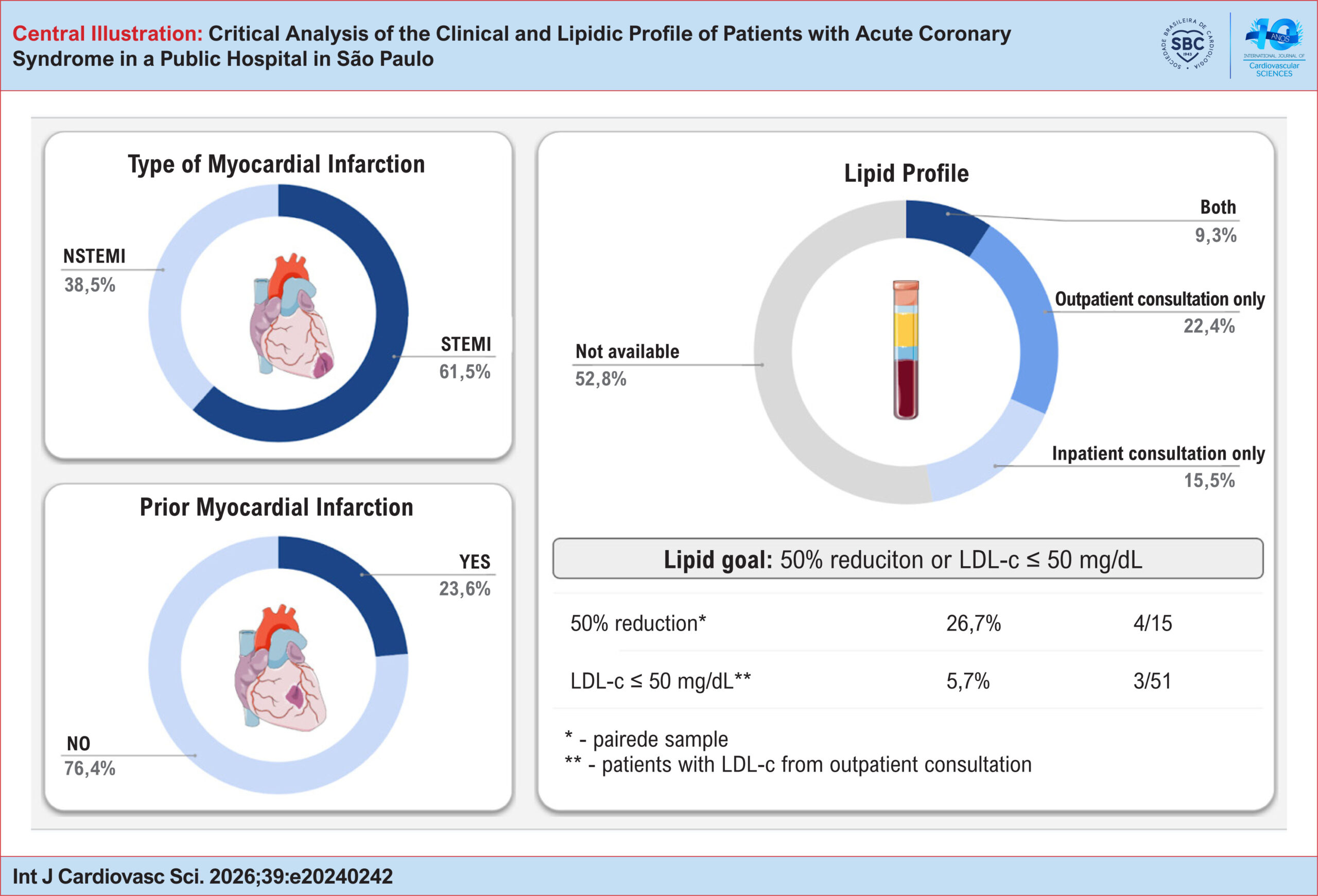
ST-elevation MI (STEMI) occurred in 61% of the patients. Among the patients with previous MI, 50% did not use statins. There was a correlation between STEMI and no statin use (p < 0.05). At hospital discharge, 12%, 17%, and 13% lacked prescriptions for aspirin, clopidogrel, and statins, respectively. At the first outpatient consultation, only 8% of patients with available data reached the absolute LDL-C goal of <50 mg/dL. Only 9% of patients had their cholesterol levels assessed at admission and at the first outpatient consultation, while 26.7% of those achieved at least a 50% LDL-C reduction. The mean LDL-C reduction was 25% (p < 0.05).

Conclusion:

Considering the severity of the assessed patients, the cardiovascular risk stratification was ineffective, the pharmacologic therapy was not optimized, and the achievement of the LDL-C goals according to guidelines was unsatisfactory in this population.

  • Hydroxymethylglutaryl-CoA Reductase Inhibitors
  • LDL-cholesterol
  • Lipids
Read Full Article
Creative Commons Attribution (CC BY) Creative Commons license
13/03/2026 DOI: 10.36660/ijcs.20240242 Views 1
Figure 1
ABC
Original Article

Impact of Atherogenic Indexes in Saphenous Vein Graft Stenosis

Fethi Yavuz et al. Salih Kilic Mehmet Kaplan Arafat Yıldırım … Mehmet Kucukosmanoglu Mustafa Dogdus

Abstract

Background

Saphenous vein grafts (SVG) are frequently used in patients that have undergone coronary artery bypass graft (CABG) surgery. Objectives: To evaluate the relationship between atherogenic indexes and SVG stenosis.

Methods

Altogether, 534 patients (27.7% women, mean age 65±8.4 years) that underwent CABG and elective coronary angiography were included in the study. Patients with at least one SVG stenosis ≥50% were allocated to the stenosis group SVG (+) (n=259) and patients without stenosis were categorized as SVG (-) (n=275). Atherogenic index of plasma (AIP) and atherogenic coefficient (AC) were calculated from the patients’ routine lipid parameters. The level of significance was p<0.05.

Results

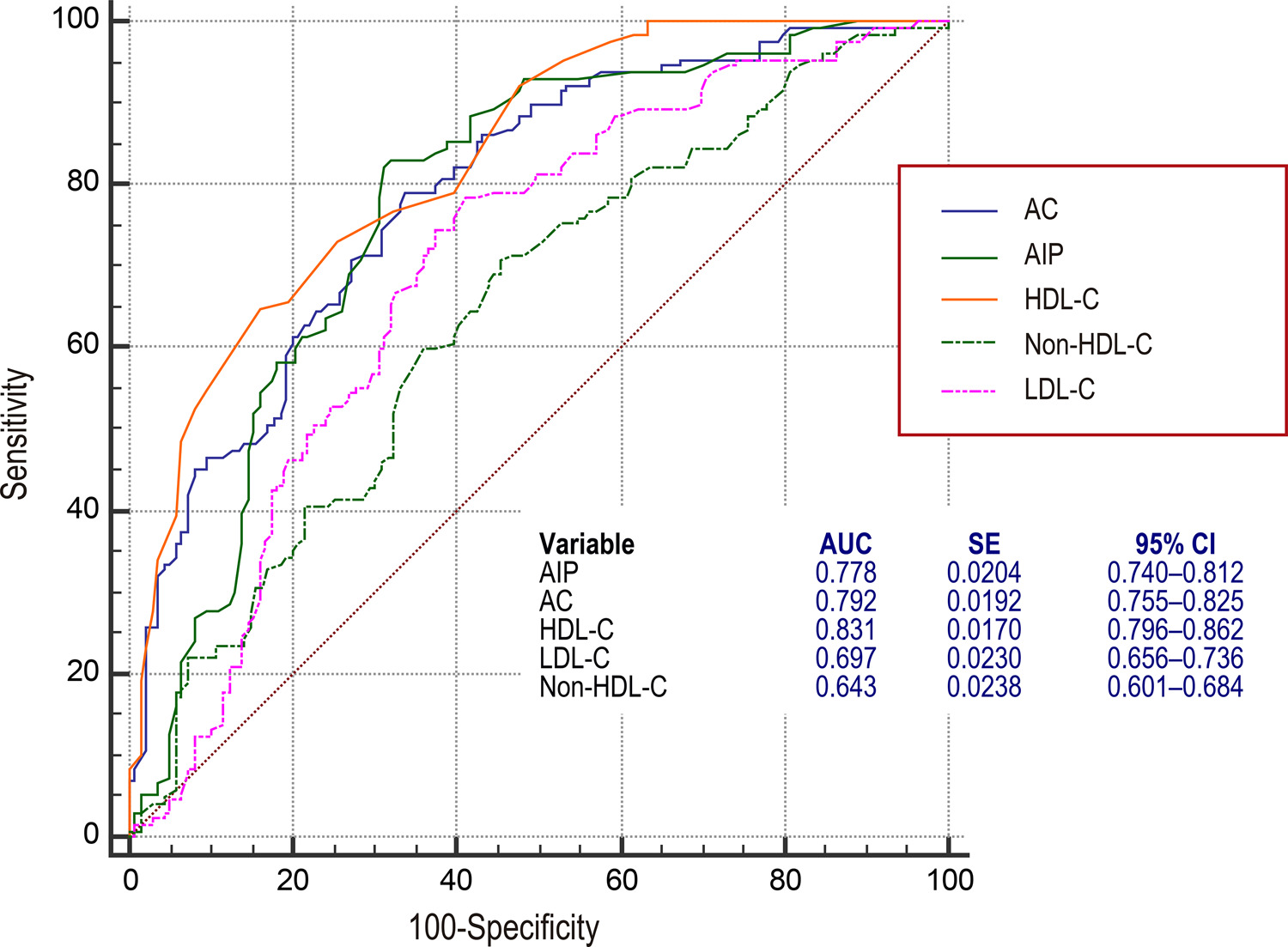
The number of patients with a history of hypertension (HT), diabetes mellitus (DM), stroke, and heart failure was significantly higher in the SVG (+) group than in the SVG (-) group. Total cholesterol, triglycerides, LDL-C were significantly higher and HDL-C was lower in the SVG (+) group than in the SVG (-) group. AIP (p<0.001) and AC (p<0.001) were significantly higher in the SVG (+) group than in the SVG (-) group. The receiver operating characteristic (ROC) analysis show that both AIP and AC were better than HDL-C, LDL-C and non-HDL-C at predicting SVG stenosis. In the multivariate analysis, history of DM, HT, stroke, heart failure (HF), number of saphenous grafts, HDL-C, LDL-C, non-HDL-C, AIP and AC were found to be independent risk factors for SVG stenosis.

Conclusion

AIP and AC were independent predictors of SVG stenosis. Moreover, both AIP and AC have better performance in predicting SVG stenosis than LDL-C, HDL-C and non-HDL-C. (Arq Bras Cardiol. 2020; 115(3):538-544)

  • Diabetes Mellitus
  • HDL, Cholesterol
  • Hypertension
  • LDL-cholesterol
  • Plaque, Atherosclerotic
  • Saphenous Vein/Stenosis
  • Saphenous Vein/transplantation
  • Stroke
Read Full Article
Creative Commons Attribution (CC BY) Creative Commons license
28/09/2020 DOI: 10.36660/abc.20190683 Views 2
Low rate of achieving LDL-cholesterol objective in a low income population
ABC
Artigo Original

Low rate of achieving LDL-cholesterol objective in a low income population

Luciano J Vacanti et al. Silvio C. de Moraes Santos Alessandro M Fujita David S Lima … Alan F Lopes Rodrigo Vetorazi Ana Sellera Nataly R Scarin

OBJECTIVE: To assess the percentage of patients suitable to the objectives preconized by III Diretrizes sobre Dislipidemias da Sociedade Brasileira de Cardiologia (3rd Guidelines on Dyslipidemia of Brazilian Society of Cardiology), in a low income population. To determine whether there was a difference of that percentage in high risk patients, according to their age (75 years old). METHODS: We analyzed, consecutively, 190 patients, divided in two groups: 51 low and middle risk patients (G I) and 139 high risk patients for coronaray artery disease (G II). The sample was characterized by low income patients (69% for the patients had a family income between 1 and 2 minimum salaries), whose hypolipidemic therapy was irregularly supplied by the State. RESULTS: G I and G II showed, respectively, 70.1±13.7 years old and 13.7% of men and 68.5±10.6 years old and 62.6% of men. Among patients from G II, 30% showed LDL-cholesterol within the preconized objectives. The frequency of patients suitable to the objectives was significantly lower in individuals with 75 years of age or older than among those younger than 75 years old (16% vs. 30%, p=0.04). CONCLUSION: In a predominantly low income population and without continuous assistance from the State to purchase statins, the achievement of preconized objectives for LDL-cholesterol, by 3rd Guidelines on Dyslipidemia of Brasilian Society of Cardiology, is low and also significantly lower among very old patients, with a high risk profile for atherosclerosis.

  • Coronary Artery Disease
  • dyslipidemia
  • hypolipidemic therapy
  • LDL-cholesterol
Read Full Article
Creative Commons Attribution (CC BY) Creative Commons license
10/10/2005 DOI: 10.1590/S0066-782X2005001600003 Views 2

How to cite this article

EndNote RIS

Electronic Document Format (Vancouver)

Costa GR, Cavalcante LFF, Alves RJ. Critical Analysis of the Clinical and Lipidic Profile of Patients with Acute Coronary Syndrome in a Public Hospital in São Paulo. International Journal of Cardiovascular Sciences 2026;39:e20240242.

Electronic Document Format (ABNT)

Costa, Giovanna Ristori; Cavalcante, Luís Fernando Ferreira; Alves, Renato Jorge. Critical Analysis of the Clinical and Lipidic Profile of Patients with Acute Coronary Syndrome in a Public Hospital in São Paulo. International Journal of Cardiovascular Sciences, v. 39, e20240242, Mar. 2026.

Electronic Document Format (APA)

Costa, G. R., Cavalcante, L. F. F., & Alves, R. J. (2026). Critical Analysis of the Clinical and Lipidic Profile of Patients with Acute Coronary Syndrome in a Public Hospital in São Paulo. International Journal of Cardiovascular Sciences, 39, e20240242.

Electronic Document Format (ISO)

Costa, Giovanna Ristori and Cavalcante, Luís Fernando Ferreira and Alves, Renato Jorge. Critical Analysis of the Clinical and Lipidic Profile of Patients with Acute Coronary Syndrome in a Public Hospital in São Paulo. International Journal of Cardiovascular Sciences [online]. 2026, vol. 39, [cited 2026-10-14], e20240242. Available from: <https://journals.cardiol.br/en/article/critical-analysis-of-the-clinical-and-lipidic-profile-of-patients-with-acute-coronary-syndrome-in-a-public-hospital-in-sao-paulo/>. ISSN 2359-4802

EndNote RIS

Electronic Document Format (Vancouver)

Yavuz F, Kilic S, Kaplan M, Yıldırım A, Kucukosmanoglu M, Dogdus M. Impact of Atherogenic Indexes in Saphenous Vein Graft Stenosis. Arquivos Brasileiros de Cardiologia 2020;115(3):538-44.

Electronic Document Format (ABNT)

Yavuz, Fethi; Kilic, Salih; Kaplan, Mehmet; Yıldırım, Arafat; Kucukosmanoglu, Mehmet; Dogdus, Mustafa. Impact of Atherogenic Indexes in Saphenous Vein Graft Stenosis. Arquivos Brasileiros de Cardiologia, v. 115, n. 3, p. 538-544, Sep. 2020.

Electronic Document Format (APA)

Yavuz, F., Kilic, S., Kaplan, M., Yıldırım, A., Kucukosmanoglu, M., & Dogdus, M. (2020). Impact of Atherogenic Indexes in Saphenous Vein Graft Stenosis. Arquivos Brasileiros de Cardiologia, 115(3), 538-544.

Electronic Document Format (ISO)

Yavuz, Fethi and Kilic, Salih and Kaplan, Mehmet and Yıldırım, Arafat and Kucukosmanoglu, Mehmet and Dogdus, Mustafa. Impact of Atherogenic Indexes in Saphenous Vein Graft Stenosis. Arquivos Brasileiros de Cardiologia [online]. 2020, vol. 115, n. 3, [cited 2026-10-14], pp. 538-544. Available from: <https://journals.cardiol.br/en/article/impact-of-atherogenic-indexes-in-saphenous-vein-graft-stenosis/>. ISSN 0066-782X

EndNote RIS

Electronic Document Format (Vancouver)

Vacanti LJ, Santos SCM, Fujita AM, Lima DS, Lopes AF, Vetorazi R, Sellera A, et al. Low rate of achieving LDL-cholesterol objective in a low income population. Arquivos Brasileiros de Cardiologia 2005;85(3):162-5.

Electronic Document Format (ABNT)

Vacanti, Luciano J; Santos, Silvio C. de Moraes; Fujita, Alessandro M; Lima, David S; Lopes, Alan F; Vetorazi, Rodrigo; Sellera, Ana; Scarin, Nataly R. Low rate of achieving LDL-cholesterol objective in a low income population. Arquivos Brasileiros de Cardiologia, v. 85, n. 3, p. 162-165, Oct. 2005.

Electronic Document Format (APA)

Vacanti, L. J., Santos, S. C. M., Fujita, A. M., Lima, D. S., Lopes, A. F., Vetorazi, R., Sellera, A., & Scarin, N. R. (2005). Low rate of achieving LDL-cholesterol objective in a low income population. Arquivos Brasileiros de Cardiologia, 85(3), 162-165.

Electronic Document Format (ISO)

Vacanti, Luciano J and Santos, Silvio C. de Moraes and Fujita, Alessandro M and Lima, David S and Lopes, Alan F and Vetorazi, Rodrigo and Sellera, Ana and Scarin, Nataly R. Low rate of achieving LDL-cholesterol objective in a low income population. Arquivos Brasileiros de Cardiologia [online]. 2005, vol. 85, n. 3, [cited 2026-10-14], pp. 162-165. Available from: <https://journals.cardiol.br/en/article/low-rate-of-achieving-ldl-cholesterol-objective-in-a-low-income-population/>. ISSN 0066-782X

  • About ABC Family
  • Internal Regulation
  • Editorial Board
  • Brazilian Society of Cardiology (SBC)

Issues

SBC Guidelines

  • Videos
  • Podcasts
  • News