ABC Family Arquivos Brasileiros de Cardiologia International Journal of Cardiovascular Sciences ABC Heart Failure & Cardiomyopathy ABC Imagem Cardiovascular
Português English
ABC Family
Português English
  • About
    • About ABC Family
    • Internal Regulation
    • Editorial Board
    • Brazilian Society of Cardiology (SBC)
  • Issues
  • SBC Guidelines
  • Content
    • Videos
    • Podcasts
    • News
  • About
    • About ABC Family
    • Internal Regulation
    • Editorial Board
    • Brazilian Society of Cardiology (SBC)
  • Issues
  • SBC Guidelines
  • Content
    • Videos
    • Podcasts
    • News

ABC Family

  • ABC Family
  • Arquivos Brasileiros de Cardiologia
  • International Journal of Cardiovascular Sciences
  • ABC Heart Failure & Cardiomyopathy
  • ABC Imagem Cardiovascular
Search in

No content found.

Journals
Ordering
Article types
Others

  1. Home
  2. Keyword: Cholesterol, HDL
ABC
Editorial

Antiinflammatory and Cardioprotective Effects of HDL-C: Association With Autoantibodies Against Oxidized LDL?

Estêvão Lanna Figueiredo et al. Ricardo Wang

The accumulation of lipoproteins containing apolipoprotein B (ApoB), mainly low-density lipoprotein (LDL), in the arterial intima has been attributed to one of the initial steps of atherogenesis. In other studies, oxidized LDL and macrophages are the main pathogenic factors for the development of atherosclerosis., In turn, there is increasing evidence of the protective role of autoantibodies against oxidized LDL (oxLDL-AboxLDL-Ab in atherogenesis, a fact that can be potentiated by high-density lipoprotein (HDL).,

In this volume of Arquivos Brasileiros de Cardiologia, Nunez et al. evaluated the hypothesis that individuals with higher levels of HDL-C would have elevated levels of oxLDL-Ab. This is a cross-sectional study that included 193 consecutive healthy individuals aged ≥ 18 years and excluded patients with coronary artery disease (CAD), stroke, secondary causes of HDL elevation or reduction, use of lipid-lowering drugs, alcoholism, and smoking. The subjects underwent a detailed physical examination, blood pressure measurements and carotid ultrasound, in addition to biochemical analyzes of peripheral blood. Participants were divided into tertiles, according to HDL-C levels: low (80 mg/dL: n=63).

[…]

  • Atherosclerosis
  • Cholesterol, HDL
  • Lipoproteins, HDL
Read Full Article
Creative Commons Attribution (CC BY) Creative Commons license
25/11/2022 DOI: 10.36660/abc.20220703
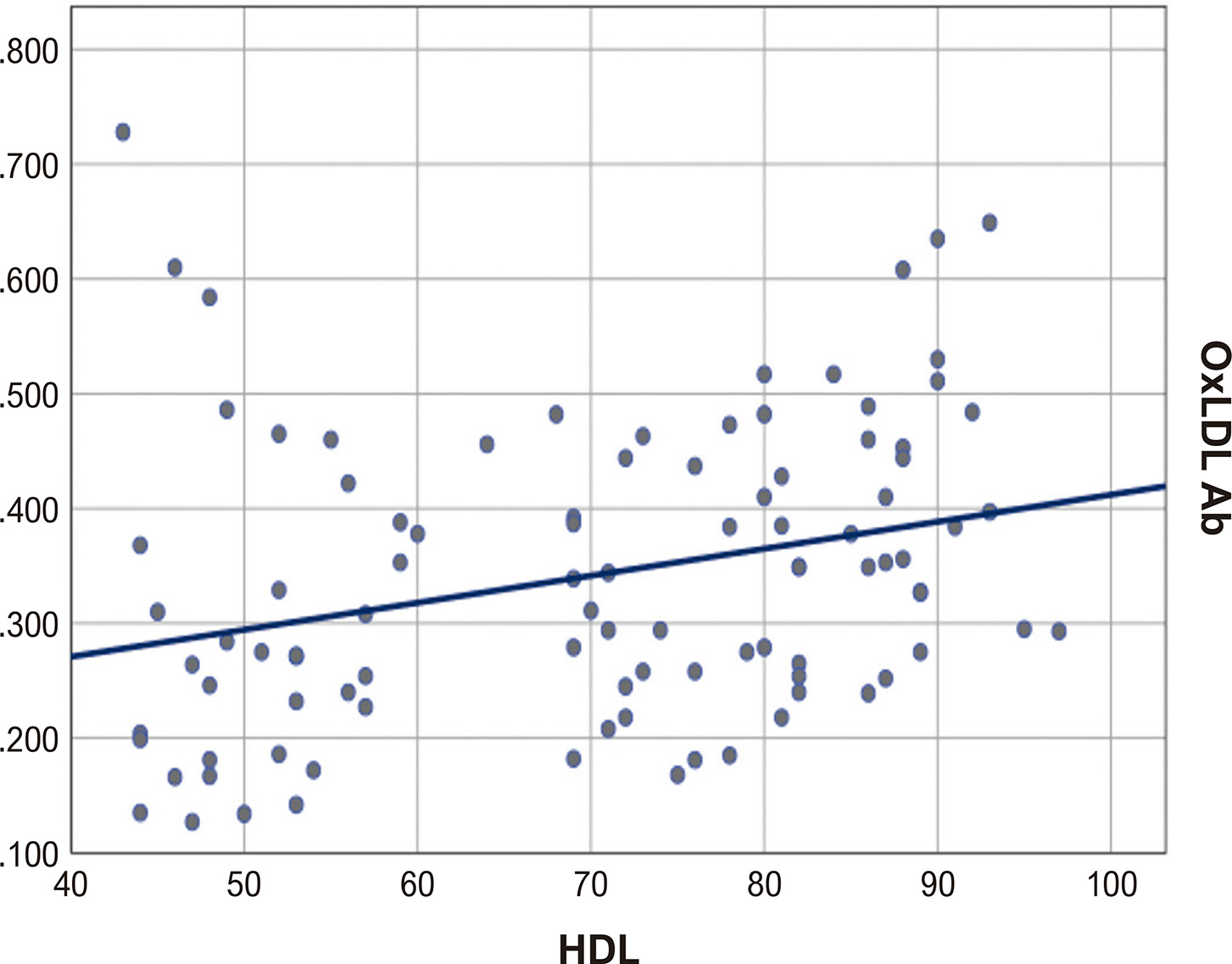
Figure 1
ABC
Original Article

Positive Association between Autoantibodies Against Oxidized LDL and HDL-C: A Novel Mechanism for HDL Cardioprotection?

Carla Evelyn Coimbra Nunez et al. Joaquim Barreto Oliveira Silvia de Barros-Mazon Vanessa H. S. Zago … Denise Beheregaray Kaplan Ruy T. Nakamura Magnus Ake Gidlund Erica I. L. Gomes Patricia Miralda Cazita Edna Nakandakare Helison R. Carmo Andrei C. Sposito Eliana Cotta de Faria

Abstract

Background

In the atherosclerotic plaque microenvironment, oxidized phospholipids expressed in the oxidized low-density lipoprotein (oxLDL) surface bind to scavenger receptors of macrophages eliciting foam cell formation and plaque progression. Auto-antibodies against oxLDL (oxLDL-Ab) interact with oxidative epitopes leading to the formation of immune complexes that are unable to interact with macrophage receptors, thus abrogating atherogenesis. Release of oxLDL-Ab by B cells involves interleukin 5 and Th2 response, which in turn are potentiated by HDL. Thereby, we hypothesized that individuals with higher levels of HDL-C may plausibly display elevated titers of oxLDL-Ab.

Objective

To evaluate the relationship between HDL-C and oxLDL-Ab levels.

Methods

Asymptomatic individuals (n = 193) were grouped according to their HDL-C concentration to one of three categories: low ( 80 mg/dL). P values < 0.05 were considered statistically significant.

Results

Our analysis included 193 individuals (mean age: 47 years; male: 26.3%). Compared to individuals in the lowest HDL-C tertile, those in the highest tertile were older (36 versus 53 years; p = 0.001) and less frequently male (42.6% versus 20.9%; p = 0.001). Mean values of oxLDL-Ab increased as the HDL-C group escalated (0.31, 0.33 and 0.43 units, respectively; p = 0.001 for trend). Simple linear regression found a significant, positive relationship between the independent variable, HDL-C, and the dependent variable, oxLDL-Ab (R = 0.293; p = 0.009). This relation remained significant (R = 0.30; p = 0.044), after adjustment by covariates. Apolipoprotein AI levels were also related to oxLDL-Ab in both simple and adjusted linear regression models.

Conclusion

HDL-C and oxLDL-Ab are independently related.

  • Atherosclerosis
  • Cholesterol, HDL
  • Lipoproteins, IDL
Read Full Article
Creative Commons Attribution (CC BY) Creative Commons license
24/08/2022 DOI: 10.36660/abc.20210796 Views 1
ABC
Editorial

Physical Activity and HDL-C: Are There Gender Differences in the Dose-response Effect?

Filipe Ferrari et al. Raul D. Santos

HDL: Basic Functions and Cardiovascular Controversies

High-density lipoproteins (HDL) are a heterogeneous group of particles whose primary function is to promote reverse cholesterol transport. Evidence generated over decades has taught us that having low plasma concentrations of HDL-cholesterol (HDL-C) does not seem to be healthy. Also in 1964, Kannel et al. demonstrated – through an analysis of the Framingham cohort – a strong inverse relationship between plasma levels of HDL-C and atherosclerotic cardiovascular disease. However, this paradigm has changed in recent years. The causal role of HDL in cardiovascular risk reduction has been challenged by Mendelian randomization studies, which failed to demonstrate reduced risk of myocardial infarction in individuals with some genetic variants that increased HDL-C., In addition, the elevation of HDL-C obtained pharmacologically with cholesterol ester transporter protein (CETP) inhibitors did not lead to a reduction in cardiovascular events either. Finally, studies showing an association of higher mortality with high and low HDL-C levels raised further questions about this situation. Thus, today it is believed that the cardiovascular protection of HDL is, to say the least, controversial, and that HDL-C seems to act much more as a cardiovascular risk marker than as a causal factor.

[…]

  • Cardiovascular Diseases
  • Cholesterol, HDL
  • Exercise
Read Full Article
Creative Commons Attribution (CC BY) Creative Commons license
20/09/2021 DOI: 10.36660/abc.20210551
ABC
Counterpoint

Counterpoint: Flexibilization of Fasting for Laboratory Determination of the Lipid Profile in Brazil: Science or Convenience?

Maria Cristina de Oliveira Izar

National and international guidelines for the management of dyslipidemias classically recommend measuring lipid profiles after fasting for at least 8 h.– Lipid targets for assessing cardiovascular risk traditionally rely on plasma total-cholesterol and low-density lipoprotein-cholesterol (LDL-c) levels, with the latter being calculated by the Friedewald equation.

Some imprecision due to low or high triglycerides in calculating LDL-cholesterol may affect cardiovascular risk assessment, the definition of a therapeutic target, and the need to intensify the treatment., Accurate results require triglyceride levels below 400 mg/dL, but above 100 mg/dL the calculated LDL-c starts to be underestimated, when compared to ultracentrifugation measurements. Another limitation to the use of the formula is that samples must not contain beta-VLDL, as in the case of type III hyperlipoproteinemia. When one of these conditions are not satisfied, the equation cannot be used due to imprecision.–

[…]

  • Cholesterol
  • Cholesterol, HDL
  • Cholesterol, LDL
  • Dyslipidemias
  • Fasting
  • Lipids
  • Triglycerides
Read Full Article
Creative Commons Attribution (CC BY) Creative Commons license
01/11/2018 DOI: 10.5935/abc.20180192 Views 1
ABC
Viewpoint

Flexibilization of Fasting for Laboratory Determination of the Lipid Profile in Brazil: Science or Convenience?

Caio Maurício Mendes de Cordova et al. Caroline Galgowski

A statement endorsed by medical specialty associations has been published in our country recommending the flexibilization of fasting before blood drawing for the laboratory determination of the lipid profile encompassing total cholesterol (TC), high-density lipoprotein cholesterol (HDL-c), triglycerides (TG) content and the corresponding calculation of non-HDL-cholesterol (TC – HDL-c). It was considered that non-fasting results do not clinically differ from fasting ones, and prospective studies and meta-analyses have consistently demonstrated that non-HDL-C at a non-fasting state would be at least as good as LDL-c in the prediction of CVD. It was also recommended that when TG > 4.52 mmol/L the formula proposed by Martin et al. should be used for LDL-c estimation.

The statement was based on the European Consensus on the matter published by Nordestgaard et al. However, the automatic application of this approach in Brazil deserves deeper consideration, considering the impact that it may cause on patient care. Furthermore, it is far from a consensus among clinical laboratory scientists and professionals in the country, as it became evident during the 44th Brazilian Congress of Clinical Analysis held last June 11-14th, 2017, and the 51st Brazilian Congress of Clinical Pathology and Laboratory Medicine, held last September 26-29th, 2017.

[…]

  • Cholesterol
  • Cholesterol, HDL
  • Cholesterol, LDL
  • Fasting
  • Lipids
  • Triglycerides
Read Full Article
Creative Commons Attribution (CC BY) Creative Commons license
01/11/2018 DOI: 10.5935/abc.20180174 Views 1
ABC
Artigo Original

Importance of HDL-c for the occurrence of cardiovascular disease in the elderly

Elizabete Viana de Freitas et al. Andréa Araújo Brandão Roberto Pozzan Maria Eliane Magalhães … Flávia Fonseca Oswaldo Pizzi Érika Campana Ayrton Pires Brandão

BACKGROUND: Studies on the impact of HDL-c and the occurrence of cardiovascular disease (CV) in the elderly are scarce. OBJECTIVE: To evaluate the clinical and laboratory variables and the occurrence of CV events in elderly patients stratified according to the behavior of HDL-c during an eight-year follow up. METHODS: We evaluated 81 elderly patients, mean age of 68.51 ± 6.32 years (38.2% male), in two stages (A1 and A2), with a minimum interval of five years. The subjects were divided into 3 groups according to HDL-c levels: normal HDL-c in both assessments (NG) (n = 31), low HDL-c in both assessments (LG) (n = 21) and variable HDL-c in A1 and A2 (VG) (n = 29). Main CV events were recorded: coronary heart disease (angina, myocardial infarction, percutaneous / surgical myocardial revascularization), stroke, transient ischemic attack, carotid disease, dementia and heart failure. RESULTS: The groups did not differ in gender and age in A1 and A2. Mean triglyceride levels were lower in the NG in A1 (p = 0.027) and A2 (p = 0.016) than in the LG. The distribution of CV events was as follows: 13 events in the NG (41.9%), 16 (76.2%) in the LG, and 12 (41.4%) in the VG (χ2 = 7.149, p = 0.024). The logistic regression analysis showed that the older the patient (OR = 1.187, p = 0.0230) and the lower the HDL-c (OR = 0.9372, p = 0.0102), the greater the occurrence of events CV. CONCLUSION: Permanently low HDL-c during eight years of monitoring is a risk factor for the development of CV events in the elderly.

  • aging
  • Cardiovascular Diseases
  • Cholesterol, HDL
Read Full Article
Creative Commons Attribution (CC BY) Creative Commons license
22/10/2009 DOI: 10.1590/S0066-782X2009000900006
Lipid transfer to HDL in type-2 diabetic patients: associations with microalbuminuria, statin, and insulin
ABC
Artigo Original

Lipid transfer to HDL in type-2 diabetic patients: associations with microalbuminuria, statin, and insulin

Gilson Soares Feitosa-Filho et al. Talita de Mattos Seydell Alina Coutinho Rodrigues Feitosa Raul Cavalcante Maranhão José Antônio Franchini Ramires

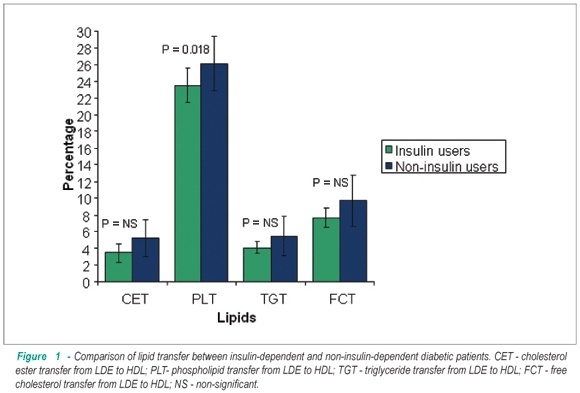
BACKGROUND: Type-2 diabetes mellitus (T2DM) is an isolated risk factor for coronary artery disease, especially when associated with microalbuminuria (MA). Structural and functional changes in lipoproteins have not yet been fully elucidated in this context. OBJECTIVE: To assess lipid transfer (T) to HDL in type-2 diabetic patients and its association with microalbuminuria and treatment with statins or insulin. METHODS: Thirty-three patients with type-2 diabetes mellitus and 34 age-matched control subjects were studied. A synthetic cholesterol-rich nanoemulsion radiolabeled with ³H- triglycerides (TG) and 14C-free cholesterol (FC) or ³H- cholesteryl ester (CE) and 14C-phospholipids (PL) was incubated with plasma. Both the nanoemulsion and lipoproteins were precipitated, except for HDL, which was counted for radioactivity. RESULTS: PLT (%) was higher in the T2DM group than in the control group (25.2 ± 3.2 and 19.7 ± 3.2 respectively; p < 0.001), as was free cholesterol (% FC): 9.1 ± 2.7 and 6.3 ± 1.5 respectively; p < 0.001. The diagnosis of microalbuminuria (MA) was not associated with changes in lipid transfers. Insulin therapy was associated with lower PLT rates: 23.5 ± 2.1 versus 26.1 ± 3.3; p = 0.018. Statin therapy, in turn, was associated with a drop in all lipid transfers – CET 3.5 ± 0.9; PLT: 23.8 ± 2.0; TGT: 3.9 ± 0.8; FCT: 7.4 ± 1.3 – as compared to the group that was not on statin therapy (CET: 5.9 ± 2.4; PLT: 26.9 ± 3.6; TGT: 6.4 ± 2.2; FCT: 11.1 ± 2.6). CONCLUSION:Type-2 diabetes mellitus increased lipid transfer to HDL particles, whereas statin therapy decreased all lipid transfers. The presence of MA was not associated with changes in lipid transfer.

  • albuminuria
  • Cholesterol, HDL
  • Diabetes Mellitus, Type 2
  • diabetic nephropathies
  • Hydroxymethylglutaryl-CoA Reductase Inhibitors
  • Insulin
  • Lipoproteins
Read Full Article
Creative Commons Attribution (CC BY) Creative Commons license
06/04/2009 DOI: 10.1590/S0066-782X2009000200005

How to cite this article

EndNote RIS

Electronic Document Format (Vancouver)

Figueiredo EL, Wang R. Antiinflammatory and Cardioprotective Effects of HDL-C: Association With Autoantibodies Against Oxidized LDL?. Arquivos Brasileiros de Cardiologia 2022;119(5):722-3.

Electronic Document Format (ABNT)

Figueiredo, Estêvão Lanna; Wang, Ricardo. Antiinflammatory and Cardioprotective Effects of HDL-C: Association With Autoantibodies Against Oxidized LDL?. Arquivos Brasileiros de Cardiologia, v. 119, n. 5, p. 722-723, Nov. 2022.

Electronic Document Format (APA)

Figueiredo, E. L., & Wang, R. (2022). Antiinflammatory and Cardioprotective Effects of HDL-C: Association With Autoantibodies Against Oxidized LDL?. Arquivos Brasileiros de Cardiologia, 119(5), 722-723.

Electronic Document Format (ISO)

Figueiredo, Estêvão Lanna and Wang, Ricardo. Antiinflammatory and Cardioprotective Effects of HDL-C: Association With Autoantibodies Against Oxidized LDL?. Arquivos Brasileiros de Cardiologia [online]. 2022, vol. 119, n. 5, [cited 2026-10-14], pp. 722-723. Available from: <https://journals.cardiol.br/en/article/antiinflammatory-and-cardioprotective-effects-of-hdl-c-association-with-autoantibodies-against-oxidized-ldl/>. ISSN 0066-782X

EndNote RIS

Electronic Document Format (Vancouver)

Nunez CEC, Oliveira JB, Barros-Mazon S, Zago VHS, Kaplan DB, Nakamura RT, Gidlund MA, et al. Positive Association between Autoantibodies Against Oxidized LDL and HDL-C: A Novel Mechanism for HDL Cardioprotection?. Arquivos Brasileiros de Cardiologia 2022;119(5):714-21.

Electronic Document Format (ABNT)

Nunez, Carla Evelyn Coimbra; Oliveira, Joaquim Barreto; Barros-Mazon, Silvia de; Zago, Vanessa H. S.; Kaplan, Denise Beheregaray; Nakamura, Ruy T.; Gidlund, Magnus Ake; Gomes, Erica I. L.; Cazita, Patricia Miralda; Nakandakare, Edna; Carmo, Helison R.; Sposito, Andrei C.; Faria, Eliana Cotta de. Positive Association between Autoantibodies Against Oxidized LDL and HDL-C: A Novel Mechanism for HDL Cardioprotection?. Arquivos Brasileiros de Cardiologia, v. 119, n. 5, p. 714-721, Aug. 2022.

Electronic Document Format (APA)

Nunez, C. E. C., Oliveira, J. B., Barros-Mazon, S. , Zago, V. H. S., Kaplan, D. B., Nakamura, R. T., Gidlund, M. A., Gomes, E. I. L., Cazita, P. M., Nakandakare, E., Carmo, H. R., Sposito, A. C., & Faria, E. C. (2022). Positive Association between Autoantibodies Against Oxidized LDL and HDL-C: A Novel Mechanism for HDL Cardioprotection?. Arquivos Brasileiros de Cardiologia, 119(5), 714-721.

Electronic Document Format (ISO)

Nunez, Carla Evelyn Coimbra and Oliveira, Joaquim Barreto and Barros-Mazon, Silvia de and Zago, Vanessa H. S. and Kaplan, Denise Beheregaray and Nakamura, Ruy T. and Gidlund, Magnus Ake and Gomes, Erica I. L. and Cazita, Patricia Miralda and Nakandakare, Edna and Carmo, Helison R. and Sposito, Andrei C. and Faria, Eliana Cotta de. Positive Association between Autoantibodies Against Oxidized LDL and HDL-C: A Novel Mechanism for HDL Cardioprotection?. Arquivos Brasileiros de Cardiologia [online]. 2022, vol. 119, n. 5, [cited 2026-10-14], pp. 714-721. Available from: <https://journals.cardiol.br/en/article/positive-association-between-autoantibodies-against-oxidized-ldl-and-hdl-c-a-novel-mechanism-for-hdl-cardioprotection/>. ISSN 0066-782X

EndNote RIS

Electronic Document Format (Vancouver)

Ferrari F, Santos RD. Physical Activity and HDL-C: Are There Gender Differences in the Dose-response Effect?. Arquivos Brasileiros de Cardiologia 2021;117(3):501-2.

Electronic Document Format (ABNT)

Ferrari, Filipe; Santos, Raul D.. Physical Activity and HDL-C: Are There Gender Differences in the Dose-response Effect?. Arquivos Brasileiros de Cardiologia, v. 117, n. 3, p. 501-502, Sep. 2021.

Electronic Document Format (APA)

Ferrari, F., & Santos, R. D. (2021). Physical Activity and HDL-C: Are There Gender Differences in the Dose-response Effect?. Arquivos Brasileiros de Cardiologia, 117(3), 501-502.

Electronic Document Format (ISO)

Ferrari, Filipe and Santos, Raul D.. Physical Activity and HDL-C: Are There Gender Differences in the Dose-response Effect?. Arquivos Brasileiros de Cardiologia [online]. 2021, vol. 117, n. 3, [cited 2026-10-14], pp. 501-502. Available from: <https://journals.cardiol.br/en/article/physical-activity-and-hdl-c-are-there-gender-differences-in-the-dose-response-effect/>. ISSN 0066-782X

EndNote RIS

Electronic Document Format (Vancouver)

Izar MCO. Counterpoint: Flexibilization of Fasting for Laboratory Determination of the Lipid Profile in Brazil: Science or Convenience?. Arquivos Brasileiros de Cardiologia 2018;111(5):750-2.

Electronic Document Format (ABNT)

Izar, Maria Cristina de Oliveira. Counterpoint: Flexibilization of Fasting for Laboratory Determination of the Lipid Profile in Brazil: Science or Convenience?. Arquivos Brasileiros de Cardiologia, v. 111, n. 5, p. 750-752, Oct. 2018.

Electronic Document Format (APA)

Izar, M. C. O. (2018). Counterpoint: Flexibilization of Fasting for Laboratory Determination of the Lipid Profile in Brazil: Science or Convenience?. Arquivos Brasileiros de Cardiologia, 111(5), 750-752.

Electronic Document Format (ISO)

Izar, Maria Cristina de Oliveira. Counterpoint: Flexibilization of Fasting for Laboratory Determination of the Lipid Profile in Brazil: Science or Convenience?. Arquivos Brasileiros de Cardiologia [online]. 2018, vol. 111, n. 5, [cited 2026-10-14], pp. 750-752. Available from: <https://journals.cardiol.br/en/article/counterpoint-flexibilization-of-fasting-for-laboratory-determination-of-the-lipid-profile-in-brazil-science-or-convenience/>. ISSN 0066-782X

EndNote RIS

Electronic Document Format (Vancouver)

Cordova CMM, Galgowski C. Flexibilization of Fasting for Laboratory Determination of the Lipid Profile in Brazil: Science or Convenience?. Arquivos Brasileiros de Cardiologia 2018;111(5):747-9.

Electronic Document Format (ABNT)

Cordova, Caio Maurício Mendes de; Galgowski, Caroline. Flexibilization of Fasting for Laboratory Determination of the Lipid Profile in Brazil: Science or Convenience?. Arquivos Brasileiros de Cardiologia, v. 111, n. 5, p. 747-749, Oct. 2018.

Electronic Document Format (APA)

Cordova, C. M. M. , & Galgowski, C. (2018). Flexibilization of Fasting for Laboratory Determination of the Lipid Profile in Brazil: Science or Convenience?. Arquivos Brasileiros de Cardiologia, 111(5), 747-749.

Electronic Document Format (ISO)

Cordova, Caio Maurício Mendes de and Galgowski, Caroline. Flexibilization of Fasting for Laboratory Determination of the Lipid Profile in Brazil: Science or Convenience?. Arquivos Brasileiros de Cardiologia [online]. 2018, vol. 111, n. 5, [cited 2026-10-14], pp. 747-749. Available from: <https://journals.cardiol.br/en/article/flexibilization-of-fasting-for-laboratory-determination-of-the-lipid-profile-in-brazil-science-or-convenience/>. ISSN 0066-782X

EndNote RIS

Electronic Document Format (Vancouver)

Freitas EV, Brandão AA, Pozzan R, Magalhães ME, Fonseca F, Pizzi O, Campana , et al. Importance of HDL-c for the occurrence of cardiovascular disease in the elderly. Arquivos Brasileiros de Cardiologia 2009;93(3):231-8.

Electronic Document Format (ABNT)

Freitas, Elizabete Viana de; Brandão, Andréa Araújo; Pozzan, Roberto; Magalhães, Maria Eliane; Fonseca, Flávia; Pizzi, Oswaldo; Campana, Érika; Brandão, Ayrton Pires. Importance of HDL-c for the occurrence of cardiovascular disease in the elderly. Arquivos Brasileiros de Cardiologia, v. 93, n. 3, p. 231-238, Oct. 2009.

Electronic Document Format (APA)

Freitas, E. V. , Brandão, A. A., Pozzan, R., Magalhães, M. E., Fonseca, F., Pizzi, O., Campana, , & Brandão, A. P. (2009). Importance of HDL-c for the occurrence of cardiovascular disease in the elderly. Arquivos Brasileiros de Cardiologia, 93(3), 231-238.

Electronic Document Format (ISO)

Freitas, Elizabete Viana de and Brandão, Andréa Araújo and Pozzan, Roberto and Magalhães, Maria Eliane and Fonseca, Flávia and Pizzi, Oswaldo and Campana, Érika and Brandão, Ayrton Pires. Importance of HDL-c for the occurrence of cardiovascular disease in the elderly. Arquivos Brasileiros de Cardiologia [online]. 2009, vol. 93, n. 3, [cited 2026-10-14], pp. 231-238. Available from: <https://journals.cardiol.br/article/importance-of-hdl-c-for-the-occurrence-of-cardiovascular-disease-in-the-elderly/>. ISSN 0066-782X

EndNote RIS

Electronic Document Format (Vancouver)

Feitosa-Filho GS, Seydell TM, Feitosa ACR, Maranhão RC, Ramires JAF. Lipid transfer to HDL in type-2 diabetic patients: associations with microalbuminuria, statin, and insulin. Arquivos Brasileiros de Cardiologia 2009;92(2):100-6.

Electronic Document Format (ABNT)

Feitosa-Filho, Gilson Soares; Seydell, Talita de Mattos; Feitosa, Alina Coutinho Rodrigues; Maranhão, Raul Cavalcante; Ramires, José Antônio Franchini. Lipid transfer to HDL in type-2 diabetic patients: associations with microalbuminuria, statin, and insulin. Arquivos Brasileiros de Cardiologia, v. 92, n. 2, p. 100-106, Apr. 2009.

Electronic Document Format (APA)

Feitosa-Filho, G. S., Seydell, T. M., Feitosa, A. C. R., Maranhão, R. C., & Ramires, J. A. F. (2009). Lipid transfer to HDL in type-2 diabetic patients: associations with microalbuminuria, statin, and insulin. Arquivos Brasileiros de Cardiologia, 92(2), 100-106.

Electronic Document Format (ISO)

Feitosa-Filho, Gilson Soares and Seydell, Talita de Mattos and Feitosa, Alina Coutinho Rodrigues and Maranhão, Raul Cavalcante and Ramires, José Antônio Franchini. Lipid transfer to HDL in type-2 diabetic patients: associations with microalbuminuria, statin, and insulin. Arquivos Brasileiros de Cardiologia [online]. 2009, vol. 92, n. 2, [cited 2026-10-14], pp. 100-106. Available from: <https://journals.cardiol.br/en/article/lipid-transfer-to-hdl-in-type-2-diabetic-patients-associations-with-microalbuminuria-statin-and-insulin/>. ISSN 0066-782X

  • About ABC Family
  • Internal Regulation
  • Editorial Board
  • Brazilian Society of Cardiology (SBC)

Issues

SBC Guidelines

  • Videos
  • Podcasts
  • News