ABC Family Arquivos Brasileiros de Cardiologia International Journal of Cardiovascular Sciences ABC Heart Failure & Cardiomyopathy ABC Imagem Cardiovascular
Português English
ABC Family
Português English
  • About
    • About ABC Family
    • Internal Regulation
    • Editorial Board
    • Brazilian Society of Cardiology (SBC)
  • Issues
  • SBC Guidelines
  • Content
    • Videos
    • Podcasts
    • News
  • About
    • About ABC Family
    • Internal Regulation
    • Editorial Board
    • Brazilian Society of Cardiology (SBC)
  • Issues
  • SBC Guidelines
  • Content
    • Videos
    • Podcasts
    • News

ABC Family

  • ABC Family
  • Arquivos Brasileiros de Cardiologia
  • International Journal of Cardiovascular Sciences
  • ABC Heart Failure & Cardiomyopathy
  • ABC Imagem Cardiovascular
Search in

No content found.

Journals
Ordering
Article types
Others

  1. Home
  2. Keyword: Hormones
Figure 1
ABC
Original Article

Adropin and Irisin in Patients with Cardiac Cachexia

Ali Kemal Kalkan et al. Huseyin Altug Cakmak Mehmet Erturk Kübra Erol Kalkan … Fatih Uzun Omer Tasbulak Vesile Ornek Diker Suleyman Aydin Ahmet Celik

Abstract

Background:

Cardiac cachexia is an important predictive factor of the reduction in survival of patients with heart failure with reduced ejection fraction.

Objectives:

The aims of the present study were to evaluate adropin and irisin levels in cachectic and non-cachectic subjects and the relationships between the levels of these proteins and clinical and laboratory parameters in patients with HFrEF.

Methods:

The clinical records of patients who were admitted to the cardiology outpatient clinic for heart failure with reduced ejection fraction were screened. Cachectic patients were identified and assigned to the study group (n = 44, mean age, 65.4 ± 11.2 y; 61.4% men). Heart failure with reduced ejection fraction patients without weight loss were enrolled as the control group (n = 42, mean age, 61.0 ± 16.5 y; 64.3% men). The serum adropin and irisin levels of all patients were measured. A p-value < 0.05 was considered significant.

Results:

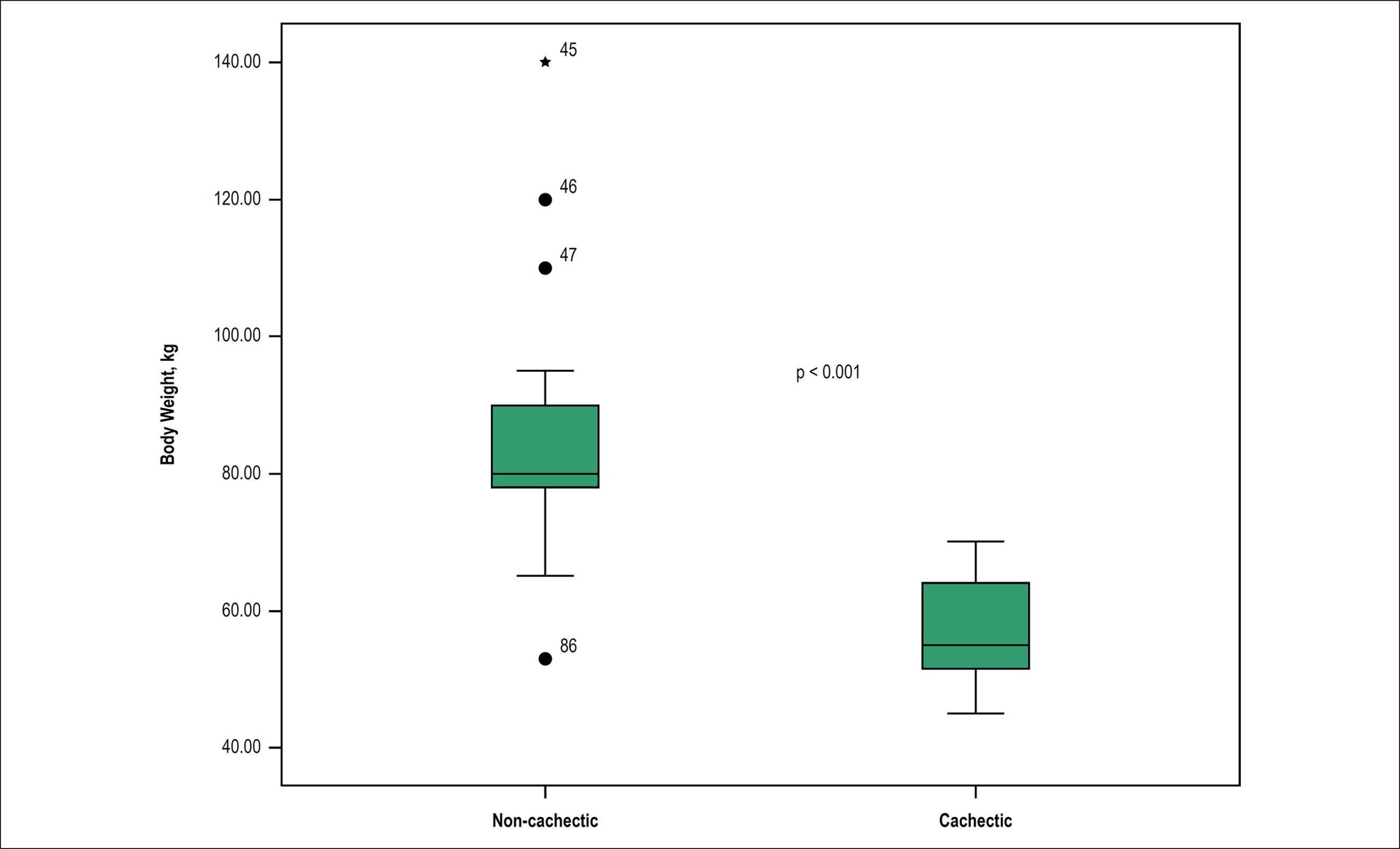
Serum adropin and irisin levels were significantly higher in the cachexia group than in the controls (Adropin (ng/L); 286.1 (231.3-404.0) vs 213.7 (203.1-251.3); p < 0.001, Irisin (µg/mL); 2.6 (2.2-4.4) vs 2.1 (1.8-2.4); p = 0.001). Serum adropin and irisin levels were positively correlated with brain natriuretic peptide (BNP) levels and New York Heart Association (NYHA) class and negatively correlated with body mass index (BMI) and serum albumin levels (all p values: < 0.001). In a multivariate analysis, adropin was the only independent predictor of cachexia in the heart failure with reduced ejection fraction patients (OR: 1.021; 95% CI: 1.004−1.038; p = 0.017).

Conclusions:

The results suggest that adropin and irisin may be novel markers of cardiac cachexia in heart failure with reduced ejection fraction patients. Adropin and irisin are related with the severity of heart failure.
  • Adropin
  • Cachexia / complications
  • Heart Failure / physiopathology, Hypertrophy, Left Ventricular
  • Hormones
  • Peptides
  • Ventricular Function, Left
Read Full Article
Creative Commons Attribution (CC BY) Creative Commons license
02/07/2018 DOI: 10.5935/abc.20180109
Cardiovascular risks of androgen deprivation therapy
ABC
Revisão

Cardiovascular risks of androgen deprivation therapy

Adriano Freitas Ribeiro et al. César Camara Carlos Alexandre Segre Miguel Srougi Carlos V. Serrano Jr

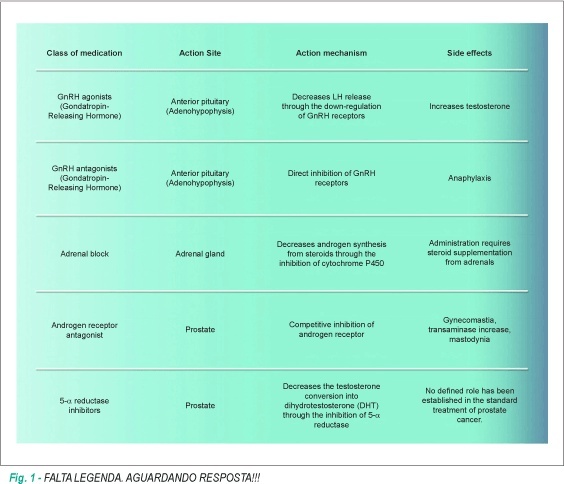
Prostate adenocarcinoma is the most common cancer type in the male sex after skin cancer. Among the several types of treatment for prostate cancer, the androgen deprivation therapy has been highly recommended in patients with metastatic or locally advanced disease, which probably results in increased survival. However, the androgen deprivation is the cause of several adverse effects. Complications such as osteoporosis, sexual dysfunction, gynecomastia, anemia and body composition alterations are well-known effects of the therapy. Recently, a number of metabolic complications have been described, such as increase in the abdominal circumference, insulin resistance, hyperglycemia, diabetes, dyslipidemia and metabolic syndrome, with a consequent increase in the risk of coronary events and cardiovascular mortality in this specific population. This update article presents a literature review carried out at MEDLINE database of all literature published in English from 1966 to June 2009, using the following key words: androgen deprivation therapy, androgen suppression therapy, hormone treatment, prostate cancer, metabolic syndrome and cardiovascular disease, with the objective of analyzing which would be the actual cardiovascular risks of androgen deprivation therapy, also called androgen suppression, in patients with prostate cancer.

  • Androgens
  • Cardiovascular Diseases
  • endocrine system diseases
  • Hormones
  • Risk
Read Full Article
Creative Commons Attribution (CC BY) Creative Commons license
13/10/2010 DOI: 10.1590/S0066-782X2010001300019 Views 1
ABC
Artigo Original

Transdermal estradiol and lipid profile: effects on a specific group of Brazilian postmenopausal women

Daniel R. Callejon et al. Danyelle Romana. A. Rios Sílvio A. Franceschini Maria Regina T. Toloi

BACKGROUND: In postmenopausal women, significant changes occur that can induce cardiovascular diseases, such as atherogenic lipid profile, due to an increase in total cholesterol and LDL levels, and a decrease in HDL cholesterol levels. The hormone replacement therapy (HRT) can prevent these changes in lipid profile. OBJECTIVE: Verify the effects of HRT consisting of transdermal estradiol gel associated with medroxyprogesterone acetate on the lipid profile and biochemical parameters in Brazilian postmenopausal women. METHODS: This study is an open prospective longitudinal study, in which thirty postmenopausal women received transdermal estradiol gel (1 mg/day) continuously combined with oral medroxyprogesterone acetate (MPA) (5 mg/day) for 12 days/month. The following parameters were determined: total cholesterol, triglycerides, high density lipoprotein (HDL), low density lipoprotein (LDL), very low density lipoprotein (VLDL), glucose, aspartate aminotransferase (AST), alanine aminotransferase (ALT), gama glutamyl transferase (GGT) and follicle-stimulating hormone (FSH). RESULTS: The parameters of the lipid profile did not show a significant decrease, while the levels of GGT and FSH had a statistically significant decrease. CONCLUSIONS: the treatment with transdermal estradiol gel did not have a significant impact on the lipid profile, thus not resulting in a beneficial effect on cardiovascular disease markers, suggesting that the dose, administration route and the time of treatment were important for these results. Moreover, the treatment using small dose and the transdermal administration route also had a significant hepatic effect in this population. Therefore, this treatment might provide interesting effects on the lipid profile in Brazilian postmenopausal women.

  • Cardiovascular Diseases
  • estradiol
  • Hormones
  • Lipids
  • Postmenopause
Read Full Article
Creative Commons Attribution (CC BY) Creative Commons license
05/05/2010 DOI: 10.1590/S0066-782X2009001200010

How to cite this article

EndNote RIS

Electronic Document Format (Vancouver)

Kalkan AK, Cakmak HA, Erturk M, Kalkan KE, Uzun F, Tasbulak O, Diker VO, et al. Adropin and Irisin in Patients with Cardiac Cachexia. Arquivos Brasileiros de Cardiologia 2018;111(1):39-47.

Electronic Document Format (ABNT)

Kalkan, Ali Kemal; Cakmak, Huseyin Altug; Erturk, Mehmet; Kalkan, Kübra Erol; Uzun, Fatih; Tasbulak, Omer; Diker, Vesile Ornek; Aydin, Suleyman; Celik, Ahmet. Adropin and Irisin in Patients with Cardiac Cachexia. Arquivos Brasileiros de Cardiologia, v. 111, n. 1, p. 39-47, Jul. 2018.

Electronic Document Format (APA)

Kalkan, A. K., Cakmak, H. A., Erturk, M., Kalkan, K. E., Uzun, F., Tasbulak, O., Diker, V. O., Aydin, S., & Celik, A. (2018). Adropin and Irisin in Patients with Cardiac Cachexia. Arquivos Brasileiros de Cardiologia, 111(1), 39-47.

Electronic Document Format (ISO)

Kalkan, Ali Kemal and Cakmak, Huseyin Altug and Erturk, Mehmet and Kalkan, Kübra Erol and Uzun, Fatih and Tasbulak, Omer and Diker, Vesile Ornek and Aydin, Suleyman and Celik, Ahmet. Adropin and Irisin in Patients with Cardiac Cachexia. Arquivos Brasileiros de Cardiologia [online]. 2018, vol. 111, n. 1, [cited 2026-10-14], pp. 39-47. Available from: <https://journals.cardiol.br/en/article/adropin-and-irisin-in-patients-with-cardiac-cachexia-2/>. ISSN 0066-782X

EndNote RIS

Electronic Document Format (Vancouver)

Ribeiro AF, Camara C, Segre CA, Srougi M, Serrano Jr CV. Cardiovascular risks of androgen deprivation therapy. Arquivos Brasileiros de Cardiologia 2010;95(3):412-5.

Electronic Document Format (ABNT)

Ribeiro, Adriano Freitas; Camara, César; Segre, Carlos Alexandre; Srougi, Miguel; Serrano Jr, Carlos V.. Cardiovascular risks of androgen deprivation therapy. Arquivos Brasileiros de Cardiologia, v. 95, n. 3, p. 412-415, Oct. 2010.

Electronic Document Format (APA)

Ribeiro, A. F., Camara, C., Segre, C. A., Srougi, M., & Serrano Jr, C. V. (2010). Cardiovascular risks of androgen deprivation therapy. Arquivos Brasileiros de Cardiologia, 95(3), 412-415.

Electronic Document Format (ISO)

Ribeiro, Adriano Freitas and Camara, César and Segre, Carlos Alexandre and Srougi, Miguel and Serrano Jr, Carlos V.. Cardiovascular risks of androgen deprivation therapy. Arquivos Brasileiros de Cardiologia [online]. 2010, vol. 95, n. 3, [cited 2026-10-14], pp. 412-415. Available from: <https://journals.cardiol.br/en/article/cardiovascular-risks-of-androgen-deprivation-therapy/>. ISSN 0066-782X

EndNote RIS

Electronic Document Format (Vancouver)

Callejon DR, Rios DRA, Franceschini SA, Toloi MRT. Transdermal estradiol and lipid profile: effects on a specific group of Brazilian postmenopausal women. Arquivos Brasileiros de Cardiologia 2010;93(6):617-22.

Electronic Document Format (ABNT)

Callejon, Daniel R.; Rios, Danyelle Romana. A.; Franceschini, Sílvio A.; Toloi, Maria Regina T.. Transdermal estradiol and lipid profile: effects on a specific group of Brazilian postmenopausal women. Arquivos Brasileiros de Cardiologia, v. 93, n. 6, p. 617-622, May. 2010.

Electronic Document Format (APA)

Callejon, D. R., Rios, D. R. A., Franceschini, S. A., & Toloi, M. R. T. (2010). Transdermal estradiol and lipid profile: effects on a specific group of Brazilian postmenopausal women. Arquivos Brasileiros de Cardiologia, 93(6), 617-622.

Electronic Document Format (ISO)

Callejon, Daniel R. and Rios, Danyelle Romana. A. and Franceschini, Sílvio A. and Toloi, Maria Regina T.. Transdermal estradiol and lipid profile: effects on a specific group of Brazilian postmenopausal women. Arquivos Brasileiros de Cardiologia [online]. 2010, vol. 93, n. 6, [cited 2026-10-14], pp. 617-622. Available from: <https://journals.cardiol.br/en/article/transdermal-estradiol-and-lipid-profile-effects-on-a-specific-group-of-brazilian-postmenopausal-women/>. ISSN 0066-782X

  • About ABC Family
  • Internal Regulation
  • Editorial Board
  • Brazilian Society of Cardiology (SBC)

Issues

SBC Guidelines

  • Videos
  • Podcasts
  • News