ABC Family Arquivos Brasileiros de Cardiologia International Journal of Cardiovascular Sciences ABC Heart Failure & Cardiomyopathy ABC Imagem Cardiovascular
Português English
ABC Family
Português English
  • About
    • About ABC Family
    • Internal Regulation
    • Editorial Board
    • Brazilian Society of Cardiology (SBC)
  • Issues
  • SBC Guidelines
  • Content
    • Videos
    • Podcasts
    • News
  • About
    • About ABC Family
    • Internal Regulation
    • Editorial Board
    • Brazilian Society of Cardiology (SBC)
  • Issues
  • SBC Guidelines
  • Content
    • Videos
    • Podcasts
    • News

ABC Family

  • ABC Family
  • Arquivos Brasileiros de Cardiologia
  • International Journal of Cardiovascular Sciences
  • ABC Heart Failure & Cardiomyopathy
  • ABC Imagem Cardiovascular
Search in

No content found.

Journals
Ordering
Article types
Others

  1. Home
  2. Keyword: Cardiomyopathies
ABC
Special Article

Cardiovascular Statistics – Brazil 2026

Gláucia Maria Moraes de Oliveira et al. Luisa Campos Caldeira Brant Carisi Anne Polanczyk Deborah Carvalho Malta … Andreia Biolo Bruno Ramos Nascimento Maria de Fatima Marinho de Souza Andrea Rocha De Lorenzo Antonio Aurélio de Paiva Fagundes Júnior Arthur Gus Manfro Beatriz D. Schaan Christina Grüne de Souza e Silva Fábio Morato de Castilho Fernando Henpin Yue Cesena Gabriel Porto Soares Gesner Francisco Xavier Junior Jose Augusto Soares Barreto Filho Lucia Campos Pellanda Luciana Nicolau Aranha Luis Eduardo Paim Rohde Luiz Guilherme Passaglia Marcelo Martins Pinto-Filho M. Julia Machline-Carrion Marcio Sommer Bittencourt Octavio M. Pontes Neto Paolo Blanco Villela Paulo Henrique Godoy Renato Azeredo Teixeira Ricardo Stein Roney Orismar Sampaio Thais Rocha Salim Thomas A. Gaziano Pablo Perel Gregory A. Roth Antonio Luiz Pinho Ribeiro

Cardiovascular Statistics – Brazil was established to provide a periodic, comprehensive, evidence-based assessment of cardiovascular health in Brazil and to support clinical practice, research, public health planning, and policy development. Developed under the auspices of the Brazilian Society of Cardiology, the initiative brings together a multidisciplinary network of investigators from academic institutions across the country who are responsible for reviewing, analyzing, and interpreting data from multiple complementary sources. Since its first edition in 2020, Cardiovascular Statistics – Brazil has sought not only to quantify the burden of cardiovascular diseases (CVDs) and their risk factors but also to identify temporal trends, regional disparities, gaps in care, and emerging challenges for the Brazilian health system. The project is modeled on international initiatives such as the American Heart Association’s Heart Disease and Stroke Statistics Update, while incorporating data sources and perspectives that reflect Brazil’s unique epidemiological, demographic, and healthcare characteristics.

(…)

  • Atrial Fibrillation
  • Atrial flutter
  • Brazil
  • Cardiomyopathies
  • Cardiovascular Diseases
  • Cerebrovascular Disorders
  • chronic renal insufficiency
  • Congenital Heart Defects
  • Coronary Disease
  • Diabetes Mellitus
  • Diet
  • Dyslipidemias
  • Exercise
  • Heart Failure
  • Heart Valve Diseases
  • Hypertension
  • Obesity
  • Overweight
  • Statistics
  • Tobacco Use Disorder
Read Full Article
Creative Commons Attribution (CC BY) Creative Commons license
07/10/2026 DOI: 10.36660/abc.20260832i Views 1
Figure 1
ABCHF
Original Article

Shifting Patterns of Out-Of-Hospital Mortality and Premature Life Loss in Cardiomyopathies: A Nationwide Population-Based Study

Alvaro Perazzo et al. Gabriel Kaleb Martins Arina Peixoto Nobre Arthur Línniker Lopes de Oliveira … Jose Roberto de Araújo Junior Gabriela Lucena Montenegro Carlos Eduardo Lucena Montenegro Patricia Bezerra Rocha Montenegro João Henrique Torres Flavio Feijó Deuzenny Tenório Diana Patrícia Lamprea Sepúlveda Samuel Padovani Steffen Sérgio Tavares Montenegro Fábio Antonio Gaiotto Fernando Moraes

Abstract

Background:

Cardiomyopathies are a major cause of cardiovascular mortality, presenting age-dependent phenotypes ranging from sudden cardiac death (SCD) to progressive heart failure. Despite declining mortality rates, gaps in prevention and access to advanced therapies may manifest as shifts in the place of death and persistent premature mortality.

Objectives:

To evaluate temporal trends in cardiomyopathy-related mortality in Brazil, assess age-related patterns in the place of death, and quantify premature mortality through years of life lost (YLL).

Methods:

This nationwide, population-based ecological study analyzed 369,570 deaths in Brazil (1996–2024) in which cardiomyopathy (ICD-10 I42) was the underlying cause. Temporal trends were assessed using Poisson regression, and associations between age and place of death were evaluated using odds ratios (OR). The YLL were calculated using national life tables.

Results:

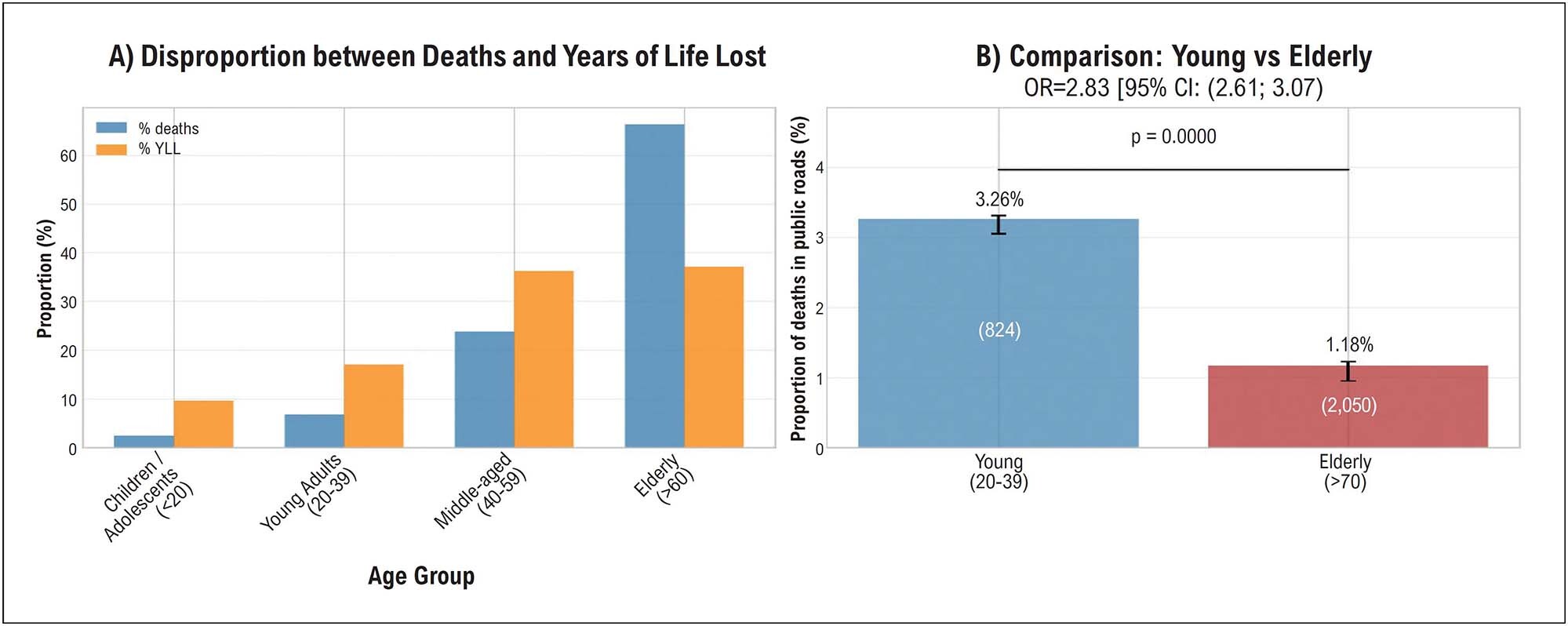
Age-adjusted mortality declined by 1.7% annually (p<0.001). Hospital deaths decreased from 75% to 43%, whereas home deaths increased from 20% to 38%, with a significant inflection point around 2011. Public roadway deaths, used as a proxy for SCD, were more frequent among adults aged 20–39 years (4.8%) than among those aged ≥60 years (0.8%; OR 2.88, 95% CI 2.68–3.10). Total YLL reached 6.83 million years. Individuals aged 20–39 years accounted for only 5.5% of deaths but contributed 12.8% of total YLL, averaging 42.9 years lost per death.

Conclusions:

Despite declining mortality, out-of-hospital deaths have become more frequent. Excess YLL among young adults highlights gaps in SCD prevention. Age-tailored strategies are needed to reduce premature mortality.

  • Cardiomyopathies
  • Epidemiology
  • Life Expectancy
  • Mortality
Read Full Article
Creative Commons Attribution (CC BY) Creative Commons license
29/09/2026 DOI: 10.36660/abchf.20260024i Views 14
Effects of Pacemakers on Ventricular Functions and Early Variables Associated with Induced Cardiomyopathy
ABC
Original Article

Effects of Pacemakers on Ventricular Functions and Early Variables Associated with Induced Cardiomyopathy

Sanjeev Kumar et al. Chandra Bhan Meena Navida Babbar Anil Bhandari … Dhananjay Singh Shekhawat Ankita Meel

Abstract

Background

Right ventricular (RV) pacing can alter ventricular mechanics and may lead to ventricular dysfunction, even in patients with preserved baseline left ventricular ejection fraction (LVEF) and structurally normal hearts.

Objective

This study examines the hemodynamic effects of right ventricular pacing on left ventricular function and volume, and identifies early variables associated with pacemaker-induced left ventricular dysfunction and cardiomyopathy in patients with dual-chamber RV pacemakers.

Methods

The study enrolled patients undergoing dual-chamber RV pacemaker implantation without any structural abnormality of the heart. Data on biventricular functions, LV volumes, and global longitudinal strain (GLS) were collected with 2D, speckle tracking, and 3D echocardiography. Paired continuous variables were compared using two-sided tests with a significance level of 0.05.

Result

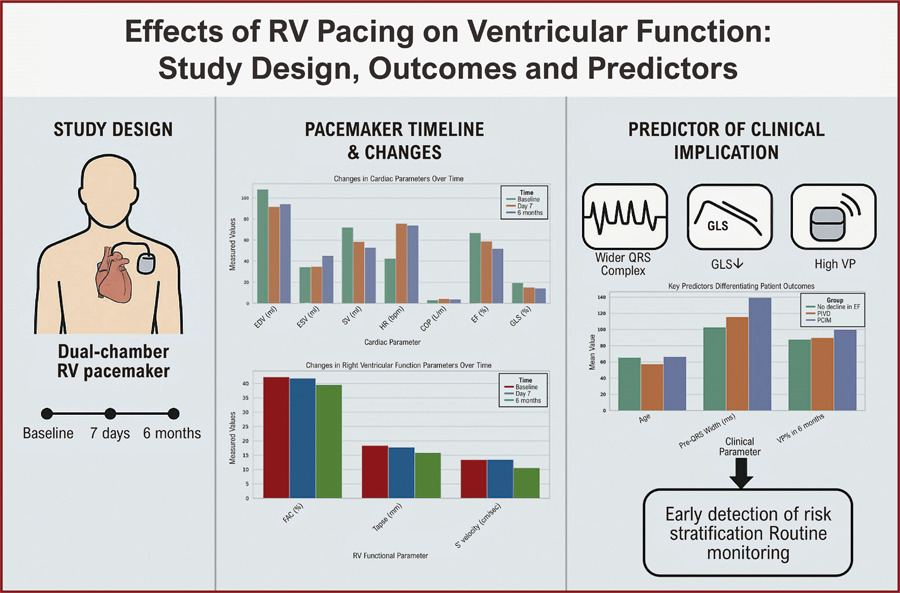
Out of 75 patients, 20 experienced LV systolic dysfunction, 15 developed PIVD, and five developed PICM. In comparison to the control group, patients with PICM had lower GLS (17.02 vs. 19.27; p<0.05), wider QRS width (139.57 vs. 102.75; p < 0.05), and greater ventricular pacing percentage (VP%; 94.32 vs. 84.03; p = 0.06).

Conclusion

RV pacing resulted in a substantial decline in LV systolic function in the short and long term. Concurrently, RV functions declined over the long term (six months). Diminished GLS at seven days, a broader pre-implantation QRS complex, and an elevation in VP% are early indicators of PIVD and PICM. Routine patient monitoring for these indicators can be beneficial for timely intervention on a case-by-case basis.

  • Artificial Pacemaker
  • Cardiomyopathies
  • Heart Failure
  • Three-Dimensional Echocardiography
Read Full Article
Creative Commons Attribution (CC BY) Creative Commons license
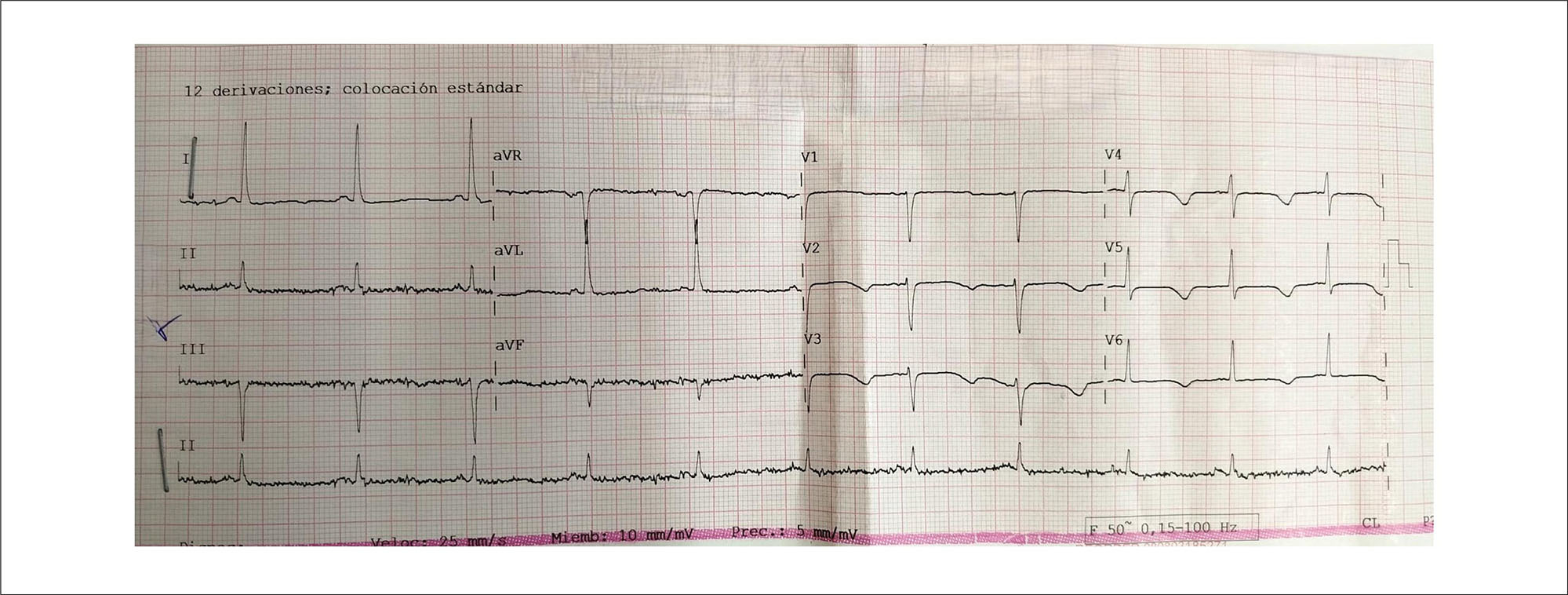
18/09/2026 DOI: 10.36660/abc.20250566i Views 1
Figure 1
ABCHF
Editorial

ABC Heart Failure & Cardiomyopathy: Management Review and Indexing Perspectives

Germano Emílio Conceição-Souza

Introduction – context and mission

ABC Heart Failure & Cardiomyopathy (ABC HF) was established in 2021 as a specialized journal within Brazilian Society of Cardiology’s (SBC) family of scientific journals. The creation of ABC HF responded to a longstanding request from the Department of Heart Failure (DEIC-SBC) for a dedicated platform for disseminating high-quality research in the fields of heart failure and cardiomyopathies, including their various diagnostic and therapeutic approaches.

The mission of ABC HF goes beyond merely publishing scientific articles. The journal aims to create an environment that encourages the production and dissemination of knowledge, thereby strengthening scientific exchange and establishing itself as a reliable source of information for researchers and healthcare professionals in Portuguese-speaking countries and Latin America, regions that are particularly affected by the significant impact of heart failure.

[…]

  • Abstracting and Indexing
  • Cardiomyopathies
  • Heart Failure
  • Heart Transplantation
  • Publishing
Read Full Article
Creative Commons Attribution (CC BY) Creative Commons license
24/08/2026 DOI: 10.36660/abchf.20260033i Views 1
ABC
Editorial

Mortality from Cardiomyopathies in Brazil

André Rodrigues Durães

Cardiomyopathies represent a heterogeneous group of heart muscle diseases that, although individually less prevalent than coronary artery disease, impose a substantial burden of morbidity and mortality on a global scale. Data from the Global Burden of Disease (GBD) 2021 estimate that cardiomyopathies were responsible for approximately 1.2 million deaths worldwide, with an age-standardized mortality rate of 14.3 per 100,000 inhabitants, and more than 28 million disability-adjusted life years (DALYs) lost annually., Despite therapeutic advances in recent decades, the epidemiological trajectory of these conditions remains marked by profound regional inequalities, both between countries on different continents and within the same national territory. It is in this context that the study by Silva et al. offers a timely and necessary contribution by analyzing the epidemiological profile, as well as the spatiotemporal evolution of mortality from cardiomyopathies in Brazil between 2001 and 2021.

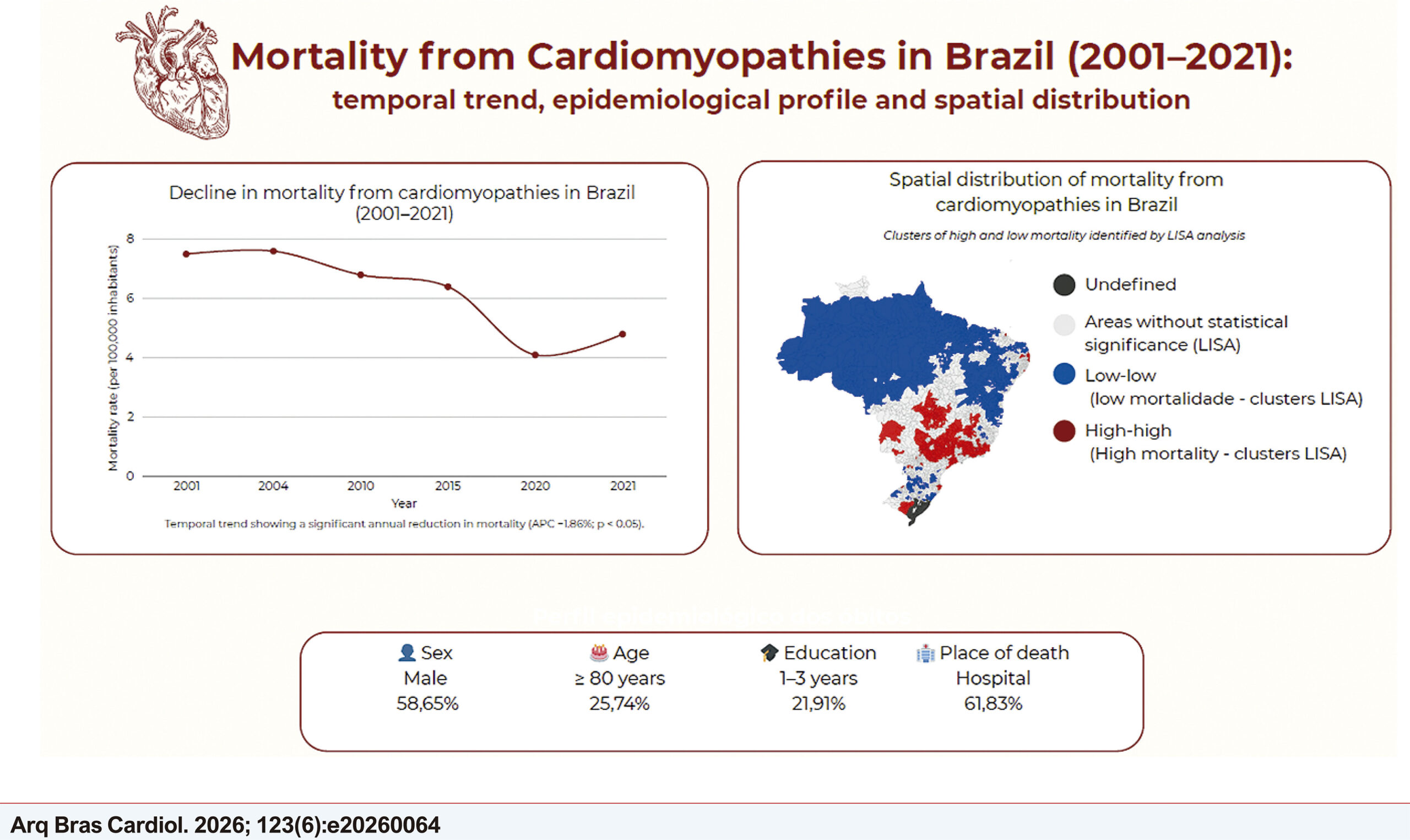
This is an important ecological epidemiological study that used data from the Mortality Information System (SIM) to examine more than 200,000 deaths from cardiomyopathies over a two-decade period. The average mortality rate was observed to be 6.66 per 100,000 inhabitants, reaching 7.64 per 100,000 in 2004 and falling to 4.15 per 100,000 in 2020. A significant annual reduction of 1.86% (p<0.05) was observed, and spatial analysis revealed clusters of high mortality, mainly in the Central-West, South, and Southeast regions.

[…]

  • Brazil
  • Cardiomyopathies
  • Mortality
Read Full Article
Creative Commons Attribution (CC BY) Creative Commons license
07/08/2026 DOI: 10.36660/abc.20260438i Views 2
ABCIC
Editorial

A New Frontier in Cardiovascular Prevention: Beyond Prohibition, Clinical Management of Anabolic Steroid Users

Fabio Roston et al. Alexandre Aby Azar Ribeiro Naiara Caroline Makiniks Luiz Felipe Branco Ribeiro Liliana Ludwing Ziegler

Subclinical Diagnosis: The Role of Advanced Echocardiography

Conventional cardiac assessment often fails to detect early damage, as Left Ventricular Ejection Fraction (LVEF) may remain within normal limits despite established myocardial injury. The literature highlights that AAS users exhibit alterations in cardiac geometry and function, including pathological hypertrophy, diastolic dysfunction, and biventricular impairment.,

In this setting, echocardiography incorporating advanced measurements such as myocardial strain has emerged as an essential diagnostic tool. Although LVEF may remain preserved during the early stages, myocardial deformation (strain) analysis enables the detection of incipient systolic dysfunction resulting from fibrosis and myofibrillar destruction caused by the direct toxic effects of androgens. Recent studies have demonstrated that both current and former AAS users may exhibit persistent biventricular cardiomyopathy, reinforcing the need for continuous monitoring.

[…]

  • Anabolic Androgenic Steroids
  • Cardiomyopathies
  • Myocardial Infarction
Read Full Article
Creative Commons Attribution (CC BY) Creative Commons license
31/07/2026 DOI: 10.36660/abcimg.20260076i Views 1
Spatiotemporal Analysis of Mortality from Cardiomyopathies in Brazil between 2001 and 2021
ABC
Original Article

Spatiotemporal Analysis of Mortality from Cardiomyopathies in Brazil between 2001 and 2021

Luiz Fernando Kubrusly et al. Ana Clara Abdo Lopes Fernanda Ritt de Souza Gustavo Ferrucio Dieter … Laura Nadolny Leonardo Moreira Dias Letícia Moreira Dias Luis Gustavo Machado Farias Roberto Oliveira Basso Vitória Naomi Okimura

Abstract

Background

Brazil presents regional variations in mortality from cardiomyopathies, influenced by demographic characteristics, socioeconomic inequalities, and differences in access to health services. Between 2001 and 2021, 272,448 deaths from the disease were recorded in the country.

Objective

To analyze, at the national level, the epidemiological profile and the spatiotemporal distribution of mortality from cardiomyopathies in Brazil, from 2001 to 2021.

Methods

Epidemiological study based on secondary data from the Mortality Information System (SIM/DATASUS) and population estimates from IBGE. Crude mortality rates were calculated per municipality. Temporal analysis was performed using Joinpoint, estimating the annual percentage change (APC). Spatial analysis used GeoDa, with Bayesian smoothing and evaluation of spatial autocorrelation using the Global Moran’s I and LISA indices. Statistical significance was set at p < 0.05.

Results

There were 272,448 deaths due to cardiomyopathies, predominantly in men (58.65%), individuals aged 80 or older (25.74%), white individuals (52.18%), married individuals (36.77%), and those with 1 to 3 years of completed schooling (21.91%). The average mortality rate was 6.66 per 100,000 inhabitants, reaching 7.64 per 100,000 in 2004 and falling to 4.15 per 100,000 in 2020. A significant annual reduction of 1.86% was observed (p < 0.05). Spatial analysis revealed clusters of high mortality, mainly in the Midwest, South, and Southeast regions, with Corumbá de Goiás standing out (49.34/100,000).

Conclusion

There was a significant reduction in mortality from cardiomyopathies, despite the persistence of critical areas that require targeted strategies for surveillance, early diagnosis, and appropriate management.

  • Cardiomyopathies
  • Epidemiology
  • Mortality
  • Spatio-Temporal Analysis
Read Full Article
Creative Commons Attribution (CC BY) Creative Commons license
27/07/2026 DOI: 10.36660/abc.20260064i Views 3
ABC
Editorial

Beyond Ventricular Pacing: Is Atrial Cardiomyopathy a Determinant of Clinical Outcome after Pacemaker Implantation?

Bianca Lopes Cunha et al. Helena Nogueira Brasil Patrícia de Araújo Matias Eduardo Arrais Rocha

The study “Clinical Outcomes Following Pacemaker Implantation: A 3-Year Comparative Study of Sick Sinus Syndrome and Atrioventricular Block” presents a relevant comparative analysis between patients with sick sinus syndrome (SSS) and atrioventricular block (AVB) who underwent permanent pacemaker implantation and were followed for three years. The main merit of the work lies in the clinical evaluation and assessment of cardiac remodeling, atrial fibrillation (AF) rates, readmissions, and mortality compared between the two groups.

Among the study’s strengths are the relatively long follow-up period, with serial echocardiographic evaluation, showing important differences between the patterns of cardiac remodeling. Patients with SSS showed a progressive increase in left atrial volume (LAV) and left ventricular end-diastolic diameter (LVDD), in addition to a significant worsening of mitral regurgitation (MR). In contrast, patients with left atrial block (LAB), even with a ventricular pacing load above 90%, showed relative stability in atrial and ventricular dimensions. Both groups had slight reductions in ejection fraction (EF), high rates of AF, hospitalizations, and mortality, without significant differences between the groups. These findings partially challenge the classic concept that right ventricular pacing alone is the main cause of cardiac remodeling.

[…]

  • Artificial Pacemaker
  • Cardiomyopathies
  • Ventricular Remodeling
Read Full Article
Creative Commons Attribution (CC BY) Creative Commons license
27/07/2026 DOI: 10.36660/abc.20260425i Views 1
Figure 1
ABC
Research Letter

Conflicting Clues in Severe LV Hypertrophy: An Unusual Presentation of ATTR Amyloidosis

Ana Sofia Nogueira Fernandes et al. João Faria Catarina Ferreira Vieira

Introduction

In recent decades, major advances have reshaped the clinical and epidemiological understanding of transthyretin (TTR) cardiac amyloidosis (ATTR). Progress in cardiovascular imaging has enabled earlier and more accurate identification of the disease. In particular, bone scintigraphy with 99mTc-labeled tracers has markedly simplified the non-invasive diagnosis of ATTR cardiomyopathy, substantially reducing the need for endomyocardial biopsy in most cases., Nevertheless, diagnostic challenges may arise when clinical, genetic, and imaging findings are discordant. We report a case of biopsy-proven hereditary ATTR (ATTRv) cardiomyopathy with negative bone scintigraphy, illustrating an important diagnostic pitfall within the contemporary diagnostic algorithm.

[…]

  • Amyloidosis
  • Cardiomyopathies
  • Hypertrophy
  • Syncope
Read Full Article
Creative Commons Attribution (CC BY) Creative Commons license
20/07/2026 DOI: 10.36660/abc.20250832i Views 1
Figure 1
ABC
Research Letter

Reversibility of Heart Failure after Catheter Ablation in Patients with Ventricular Pre-Excitation-Induced Cardiomyopathy

Samuel Santos Boa Morte et al. Luiz Pereira de Magalhães Jussara de Oliveira Pinheiro Duarte Alex Teixeira Guabiru … Adimeia Souza Santos Eduardo Faria Soares de Magalhães Roque Aras

Introduction

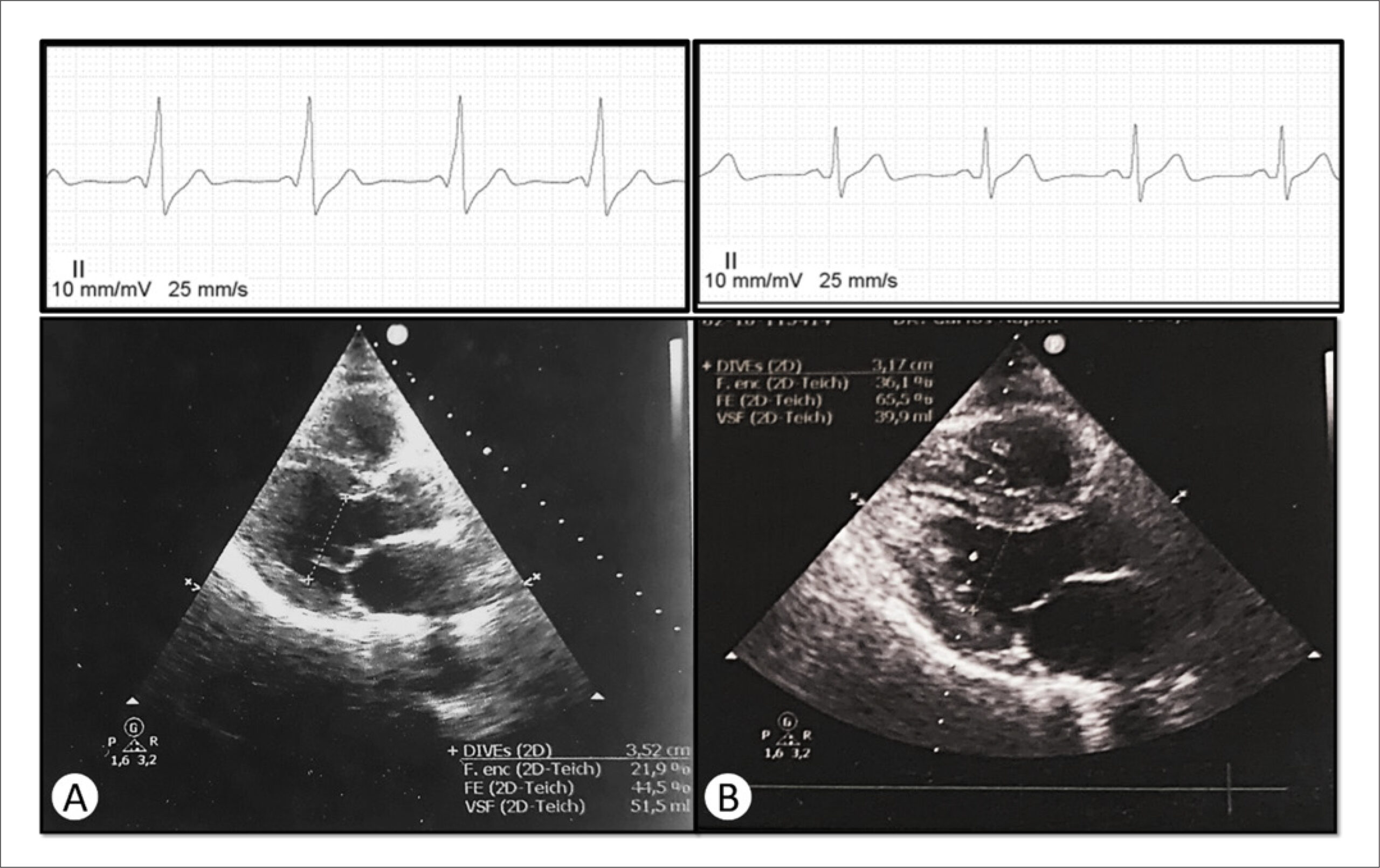
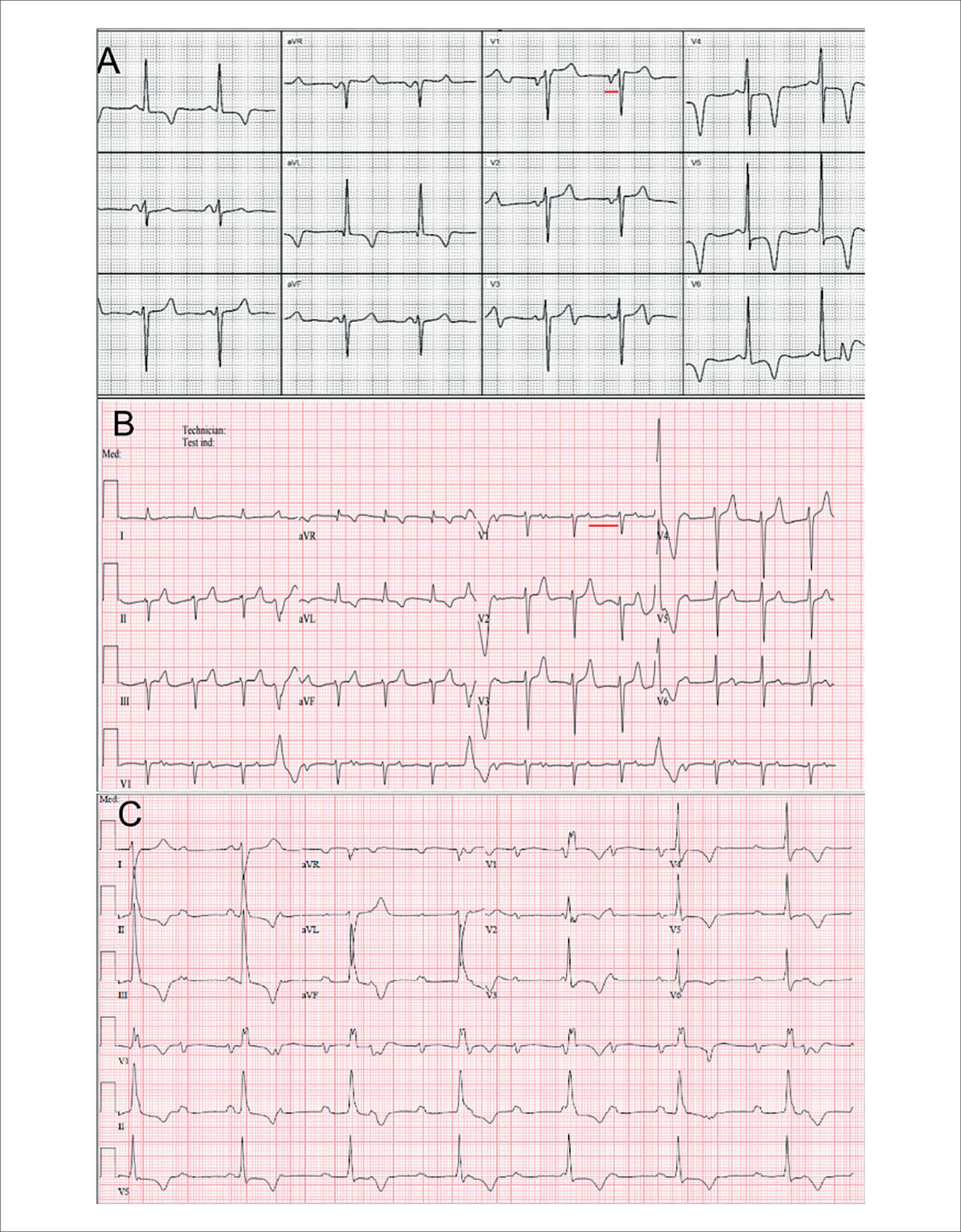
Ventricular pre-excitation is characterized by the presence of an atrioventricular accessory pathway, predisposing patients to cardiac arrhythmias that may lead to syncope, palpitations, or sudden death. Although rare, a possible complication is the development of heart failure (HF), referred to as pre-excitation–induced cardiomyopathy. It has been suggested that the eccentric ventricular activation caused by the accessory pathway leads to mechanical ventricular dyssynchrony, resulting in structural alterations and ventricular dysfunction. Case reports have described improvement of HF after catheter ablation of the accessory pathway. It is important to alert the medical community to this rare entity, which should be considered in patients with ventricular pre-excitation and reduced ejection fraction, as it represents a potentially reversible cause of HF following ablation.

[…]

  • Cardiomyopathies
  • Catheter Ablation
  • Heart Failure
Read Full Article
Creative Commons Attribution (CC BY) Creative Commons license
17/07/2026 DOI: 10.36660/abc.20250192i Views 2
ABC
Editorial

The Thickness That Deceives: The Role of Imaging, Biopsy, and Genetics in the Evaluation of Ventricular Hypertrophy

Murillo de Oliveira Antunes

Increased ventricular wall thickness is a common finding in cardiovascular practice and is frequently attributed either to secondary myocardial hypertrophy or to sarcomeric hypertrophic cardiomyopathy (HCM). However, this phenotype may conceal a broad spectrum of genetic, infiltrative, and storage diseases, each associated with distinct prognostic implications and therapeutic strategies. Accurate differentiation between true myocardial hypertrophy and HCM phenocopies—or genocopies—remains a major diagnostic challenge and requires a multimodality approach integrating advanced cardiac imaging, endomyocardial biopsy (EMB), and genetic testing.–

Cardiac imaging has evolved beyond morphological assessment. Cardiac magnetic resonance (CMR) with tissue characterization has become a cornerstone of noninvasive evaluation in patients with increased myocardial thickness. Parametric mapping techniques, including T1 and T2 mapping and extracellular volume (ECV) quantification, allow the detection of myocardial compositional changes such as edema, fibrosis, and infiltration, providing important diagnostic clues for conditions such as cardiac amyloidosis, Fabry disease, and glycogen storage cardiomyopathies (e.g., PRKAG2-related disease).– In addition, specific late gadolinium enhancement patterns may further support the suspicion of non-sarcomeric etiologies.,

[…]

  • Biopsy
  • Cardiomyopathies
  • Diagnostic Imaging
  • Genetics
Read Full Article
Creative Commons Attribution (CC BY) Creative Commons license
15/05/2026 DOI: 10.36660/abc.20260119i Views 1
Atrial Cardiomyopathy Detected by Electrocardiogram: Association with Stroke in a Brazilian Electronic Cohort
ABC
Original Article

Atrial Cardiomyopathy Detected by Electrocardiogram: Association with Stroke in a Brazilian Electronic Cohort

Filipe Antunes de Lêu et al. Gabriela Miana de Mattos Paixão Ana Cecilia Oliveira Carla Paula Moreira Soares … Paulo R. Gomes Peter Macfarlane Antônio Luiz Pinho Ribeiro

Abstract

Background

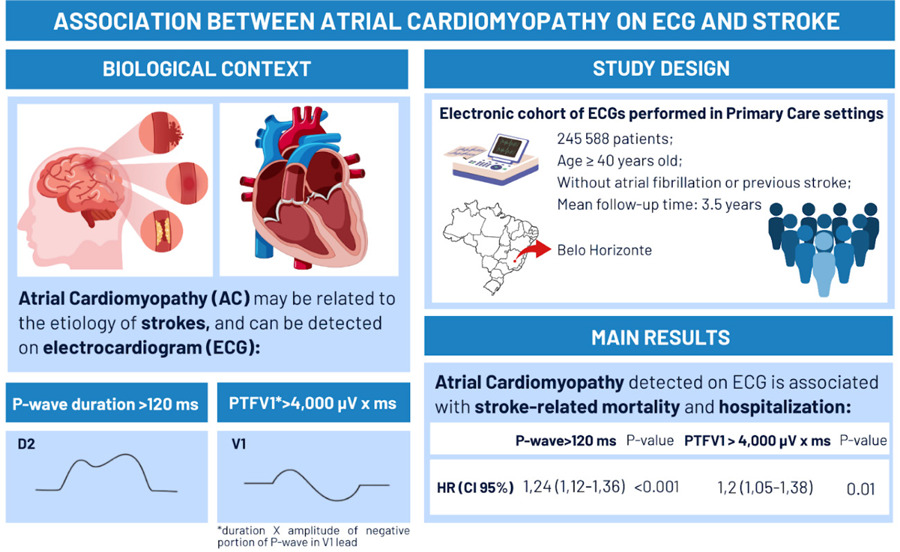
Atrial cardiomyopathy (AC) is a condition detectable by electrocardiogram (ECG) that may play a significant role in the pathophysiology of the etiology of strokes, independently of atrial fibrillation (AF).

Objectives

To evaluate the association between ECG markers of AC (prolonged P-wave duration >120 ms and P-terminal force in V1 (PTFV1) >4,000 µV·ms) as well as the occurrence of mortality and hospitalization due to stroke.

Methods

This retrospective cohort study included patients from Belo Horizonte who underwent ECGs between 2006 and 2018. Patients aged ≥40 years, in sinus rhythm, and without a previous history of stroke at baseline ECG were included. Clinical and ECG data were linked to mortality (SIM) and hospitalization (SIH) public databases. Cox regression was used to calculate hazard ratios (HRs), and incremental adjustment models for age, sex, cardiovascular risk factors, and left ventricular hypertrophy were employed. Statistical significance was set at p<0.05.

Results

245,588 patients were included. 26.3% had prolonged P-wave duration >120 ms, and 10.1% had elevated PTFV1 >4,000 µV·ms. Mean follow-up duration was 3.5 years. AC was associated with mortality and hospitalization due to stroke (HR 1.24; 95% CI, 1.12–1.36 for P-wave duration >120 ms; p4,000 µV·ms; p<0.001).

Conclusion

ECG markers of AC are associated with death or hospitalization due to stroke, as well as cardiovascular mortality and incident AF in a large, representative Brazilian cohort, highlighting their prognostic value.

  • Cardiomyopathies
  • Cohort Studies
  • Electrocardiography
  • Mortality
  • Stroke
Read Full Article
Creative Commons Attribution (CC BY) Creative Commons license
01/05/2026 DOI: 10.36660/abc.20250625i Views 2
Figure 1
ABC
Research Letter

Late-Onset Fabry Disease: Diagnostic Challenges and Clinical Evolution

Hernán Patricio García Mejía et al. Heleuterio da Conceição Nicolau Madogolele Manuela Cristina Ribeiro Dias Barroso Matheus Carvalho Alves Nogueira … Kevin Rafael de Paula Morales Cristhian Espinoza Romero Luciano Nastari Fábio Fernandes

Introduction

Simultaneous cardiac and renal involvement can result from various systemic conditions, such as hypertension, autoimmune diseases, infiltrative diseases, and hereditary syndromes. Fabry disease (FD) is an X-linked genetic disorder caused by a deficiency or absence of the enzyme α-galactosidase A, leading to the progressive accumulation of glycosphingolipids, especially globotriaosylceramide (Gb3), in various tissues. This accumulation of Gb3 promotes multisystemic dysfunctions, with heterogeneous clinical manifestations that vary according to sex, the degree of residual enzymatic activity, and the form of presentation, classic or non-classic.,

The estimated incidence of FD ranges from 1 in 40,000 to 1 in 117,000 individuals worldwide. In Brazil, the epidemiology of FD remains poorly defined due to the rarity of the condition and underreporting of cases, which reinforces the value of clinical reports such as this one.

[…]

  • Cardiac Conduction System Disease
  • Cardiomyopathies
  • Fabry Disease
  • Left Ventricular Hypertrophy
Read Full Article
Creative Commons Attribution (CC BY) Creative Commons license
17/04/2026 DOI: 10.36660/abc.20250554i Views 3
Figure 1
ABCIC
Case Report

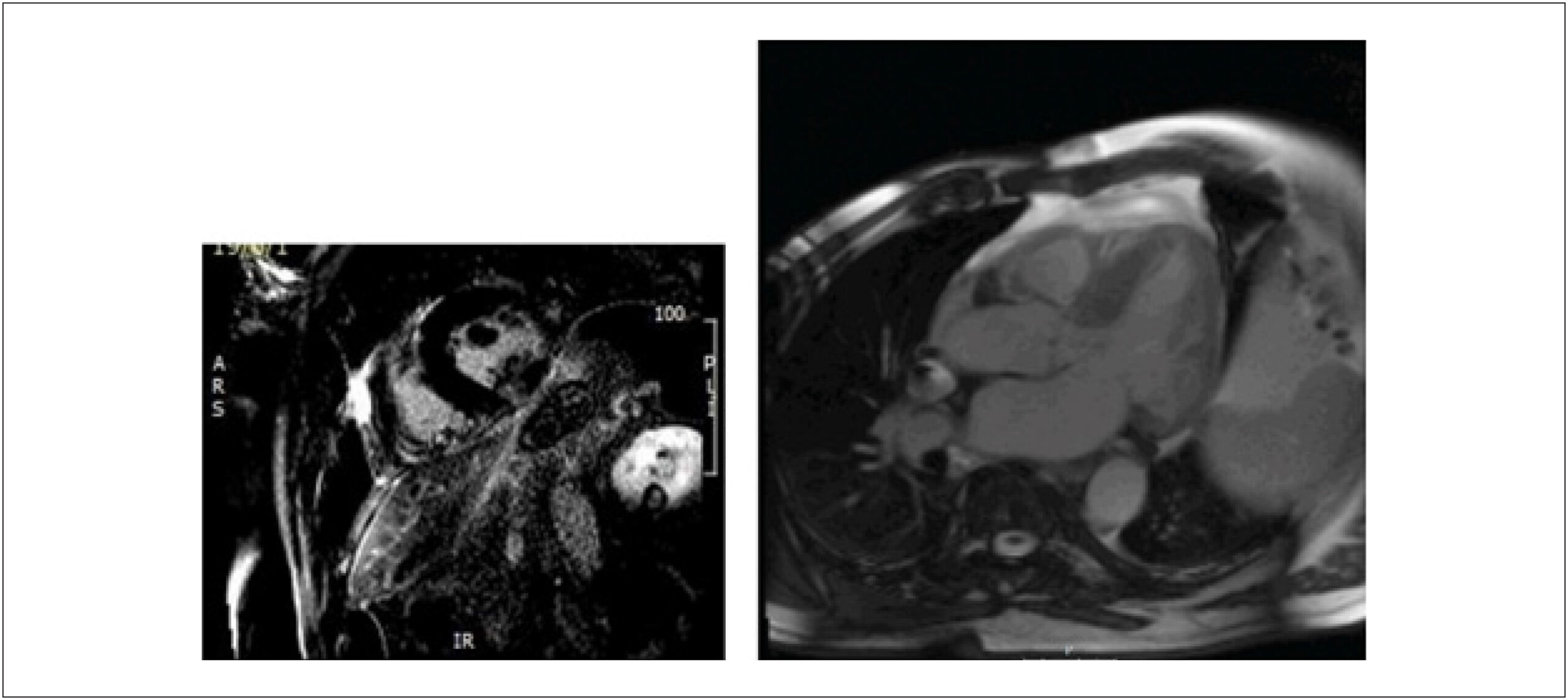
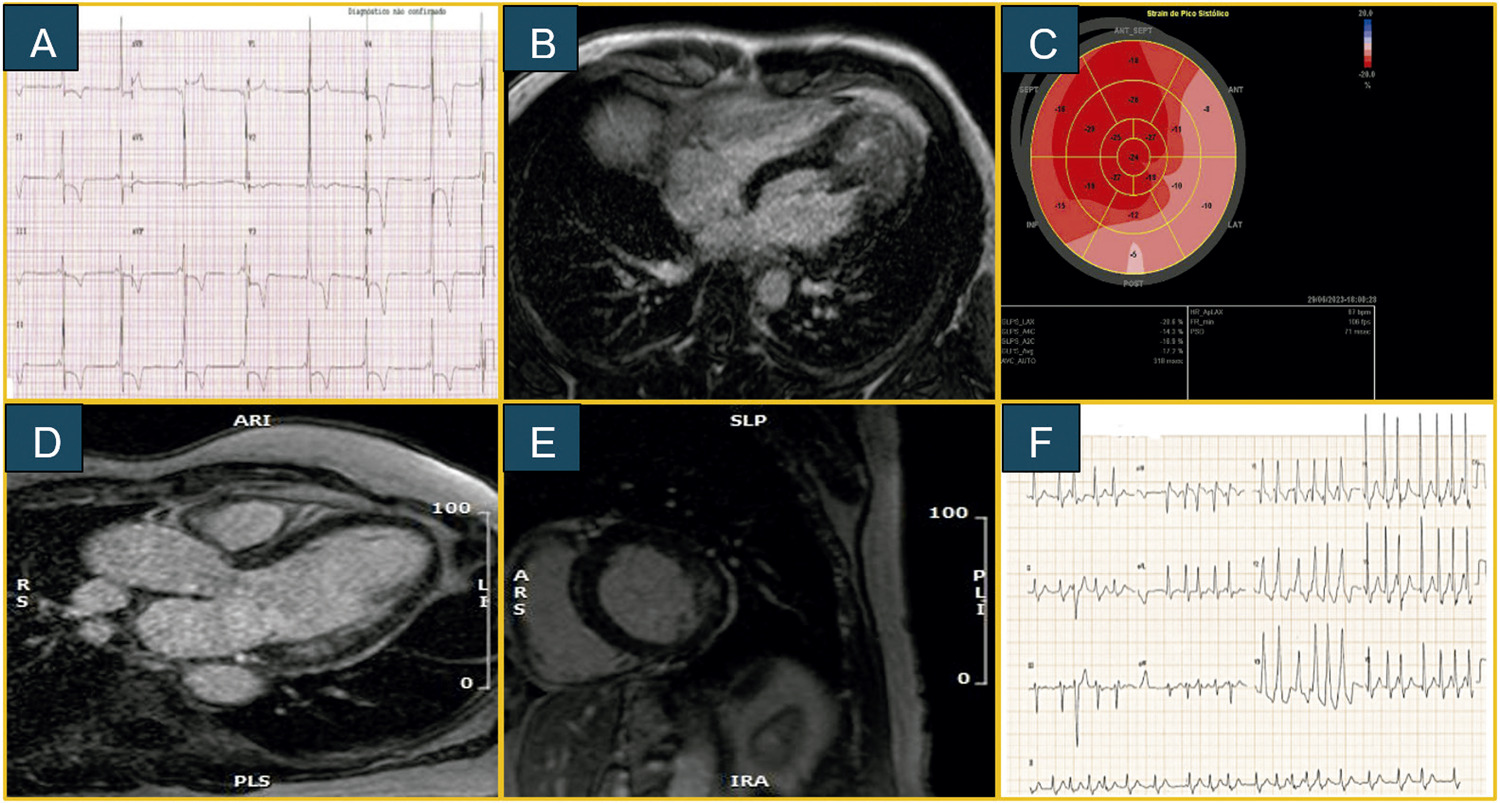
Hypocalcemia and Reversible Cardiomyopathy Assessed by Magnetic Resonance Imaging

Bruno Lenzi et al. Gustavo Tortajada Victoria Rabaza Ernesto Cairoli Gabriel Parma

Introduction

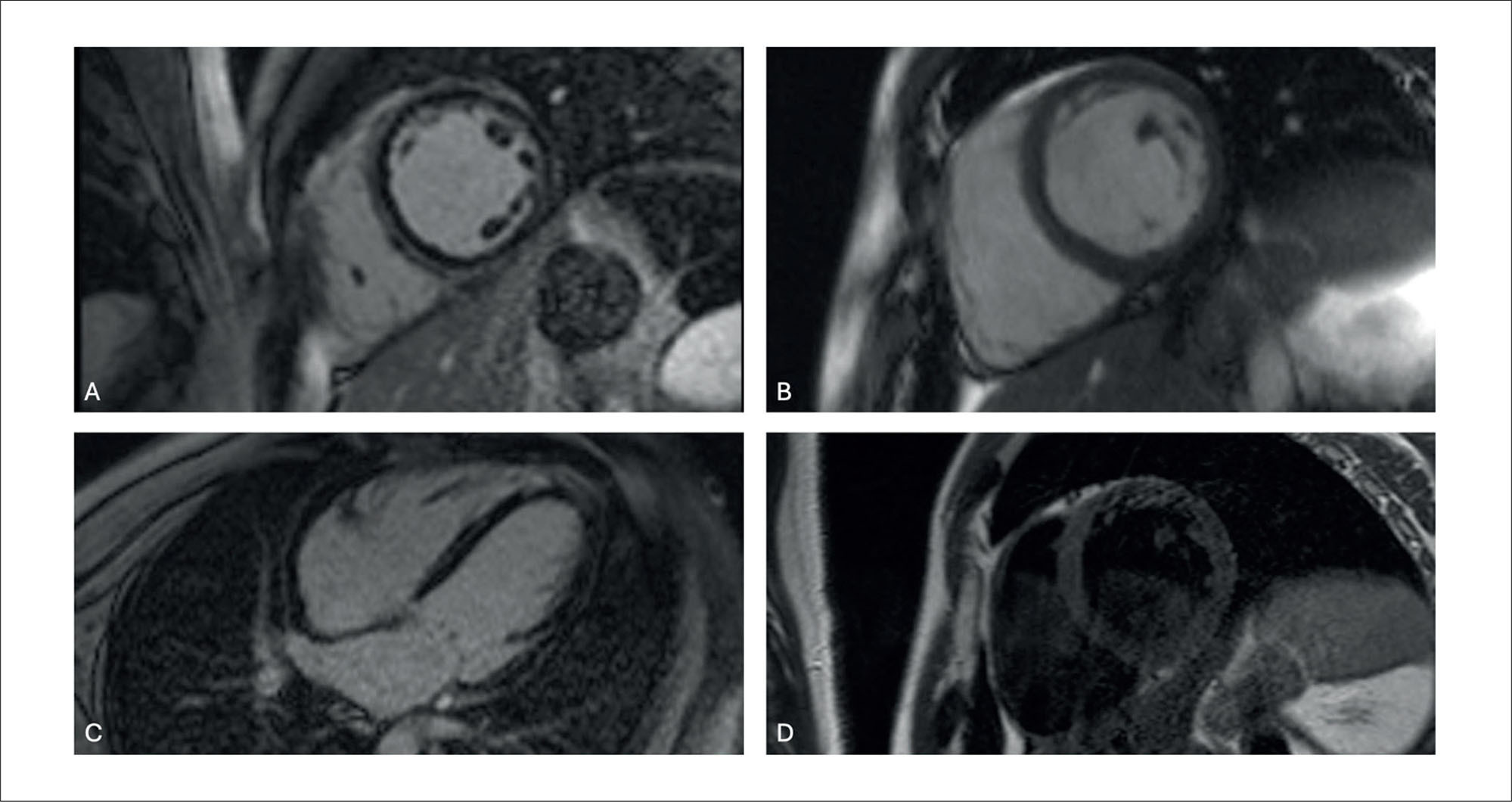
Calcium is a fundamental component of biological systems and plays a key role in excitation-contraction coupling in cardiac myocytes. Calcium entry triggers a mechanism known as calcium-induced calcium release, in which calcium released from the sarcoplasmic reticulum is modulated by the influx of calcium from the extracellular space. Muscle contraction subsequently occurs through the interaction between calcium and the troponin-tropomyosin complex. In the heart, intracellular calcium is the primary regulator of contractile force (inotropism).

Hypocalcemia-induced cardiomyopathy is a rare condition with few reports in the scientific literature. We present a clinical case associated with hypoparathyroidism, one of the main causes of chronic hypocalcemia. This case report includes a novel element: the use of cardiac Magnetic Resonance Imaging (cMRI), which, to our knowledge, has not been previously described in the literature.

[…]

  • Cardiomyopathies
  • Case Reports
  • Hypocalcemia
Read Full Article
Creative Commons Attribution (CC BY) Creative Commons license
31/12/2025 DOI: 10.36660/abcimg.20250048i Views 1
Diagnostic Utility of P-Wave Duration in Identifying Left Atrial Enlargement: Insights from the ELSA-Brasil Cohort
ABC
Original Article

Diagnostic Utility of P-Wave Duration in Identifying Left Atrial Enlargement: Insights from the ELSA-Brasil Cohort

Ana Cecília de Sena Oliveira et al. Vinicius Tostes Carvalho Marcelo Martins Pinto-Filho Luisa Caldeira Brant … Sandhi Maria Barreto Murilo Foppa Antonio Luiz Pinho Ribeiro

Abstract

Background

Atrial cardiomyopathy encompasses various atrial abnormalities, including left atrial enlargement (LAE), which is associated with adverse cardiovascular and neurocognitive outcomes. P-wave duration ≥120 ms on 12-lead electrocardiogram (ECG) is a widely available, cost-effective tool and one of the main diagnostic criteria adopted. However, its diagnostic performance in large-scale studies remains underexplored.

Objectives

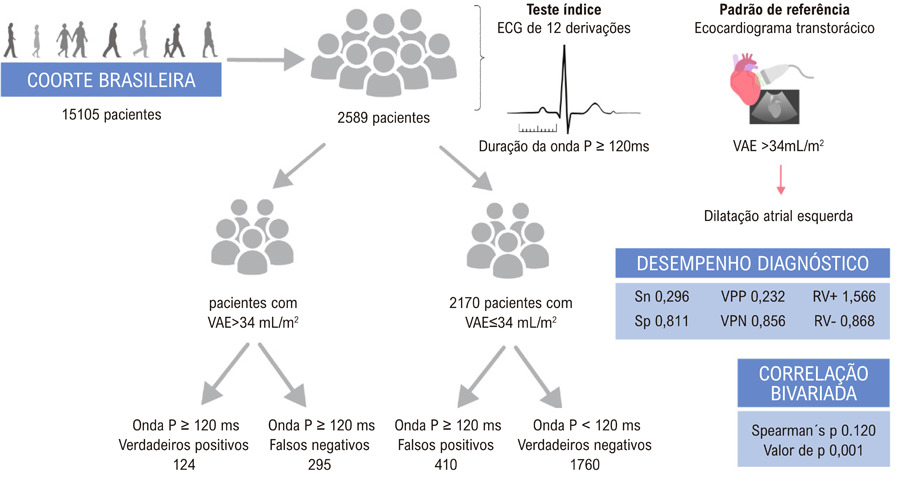
To evaluate the correlation between P-wave duration and left atrial volume (LAV) measured by transthoracic echocardiogram (TTE) and determine the diagnostic accuracy of P-wave duration ≥120 ms for identifying LAE.

Methods

We conducted a cross-sectional analysis of baseline data from the ELSA-Brasil cohort participants in sinus rhythm. P-wave duration was automatically measured via standard 12-lead ECG, with ≥120 ms indicating enlargement. LAE was defined as LAV>34 mL/m2 by TTE. Spearman’s rank test assessed correlation. Diagnostic performance metrics – sensitivity (Sn), specificity (Sp), positive predictive value (PPV), and negative predictive value (NPV), positive and negative likelihood ratio (LR+ and LR-) – were calculated. Also, a Receiver Operating Characteristic (ROC) was constructed. Statistical significance was set at p-value<0.05 with 95% confidence interval.

Results

The study included 2589 participants, 419 (16,1%) with LAV index>34 mL/m2. P-wave duration correlated weakly with LAV (Spearman’s ρ = 0.120, p < 0.001). Diagnostic accuracy measurements were AUC = 0.557 ± 0.032; Sn = 0.296; Sp = 0.811; PPV = 0.232; NPV = 0.856; LR+ 1.566; LR- 0.868.

Conclusion

P-wave duration demonstrates limited diagnostic value for identifying LAE, suggesting against its recommendation as a standalone diagnostic criterion for this condition.

  • Cardiomyopathies
  • Echocardiography
  • Electrocardiography
  • Heart Atria
Read Full Article
Creative Commons Attribution (CC BY) Creative Commons license
15/12/2025 DOI: 10.36660/abc.20250151i Views 1
Figure 1
ABCIC
Case Report

Long-term Follow-Up of a Patient with FLNC Gene Mutation-Related Cardiomyopathy: A Case Report

Isabela Bispo Santos da Silva Costa et al. Bruno Soares da Silva Rangel Antonio Tito Paladino Filho Bruno Normande Colombo … Thamara Carvalho Morais Ludhmila Abrahão Hajjar

Introduction

Heart Failure (HF) is estimated to affect approximately 26 million people worldwide., In Brazil, prevalence is high, with about 2 million diagnosed patients and an incidence of roughly 240,000 new cases every year. Between 2011 and 2021, more than 2.5 million HF-related hospitalizations were recorded in the Brazilian Unified Health System (SUS), underscoring the relevance of the disease in the national context. These figures highlight the need for early diagnostic strategies and etiological definition for the appropriate management of these patients. Establishing an etiological diagnosis is often challenging but essential to provide disease-specific treatments and improve prognosis. Diagnosis encompasses multimodality cardiac imaging, with Cardiac Magnetic Resonance imaging (CMR) being a useful tool for evaluating non-ischemic cardiomyopathy phenotypes and establishing an etiological diagnosis.

[…]

  • Arrhythmias Cardiac
  • Cardiac Magnetic Resonance Imaging
  • Cardiomyopathies
  • Genetics
  • Sudden Cardiac Death
Read Full Article
Creative Commons Attribution (CC BY) Creative Commons license
03/12/2025 DOI: 10.36660/abcimg.20250071i
ABCIC
Editorial

Between the Physiological and the Pathological Spectra: When the Athlete's Heart Demands More Than Admiration

Antonio Amador Calvilho Júnior et al. Julia Galetto Nisgoski Maria Eduarda da Silva Pires Joao Nádson Granja Nunes Beatriz Moraes dos Santos Branco

The increasing participation in high-intensity sports has expanded the role of cardiology in athlete screening and monitoring. Although Sudden Cardiac Death (SCD) is rare, it has a deep impact on society as a whole. Echocardiography is central in this setting, serving as the primary imaging modality to distinguish physiological remodeling in the athlete’s heart from structural cardiomyopathies.

Prolonged and intense exercise induces adaptive phenotypic and physiological changes that enhance myocardial performance. These adaptations, known as “athlete’s heart,” are extensively studied because they need to be differentiated from potentially fatal cardiovascular diseases.– The Athlete’s Heart shares phenotypic characteristics with several pathological conditions, such as Hypertrophic Cardiomyopathy (HCM), Dilated Cardiomyopathy (DCM), and Arrhythmogenic Right Ventricular Cardiomyopathy (ARVC). Cardiologists need to be aware of these overlaps to correctly diagnose and prevent serious outcomes, especially in young, apparently healthy individuals, who may not experience symptoms until they engage in intense exercise. Equally important is the ability to identify normal adaptive cardiac remodeling, thereby enabling precise screening and appropriate guidance for elite athletes.

[…]

  • Cardiomyopathies
  • Echocardiography
  • Exercise-Induced Cardiomegaly
Read Full Article
Creative Commons Attribution (CC BY) Creative Commons license
14/11/2025 DOI: 10.36660/abcimg.20250059i
Central Illustration
ABCHF
Review Article

The Multiple Faces of Cardiomyopathy Due to Filamin C Gene Variants (FLNC)

Frank Nunes et al. Raquel Germer Toja Couto Diane Xavier de Avila Ana Flavia Malheiros Torbey … Kárila Scarduelli Luciano Estevão Lanna Figueiredo Evandro Tinoco Mesquita

Abstract

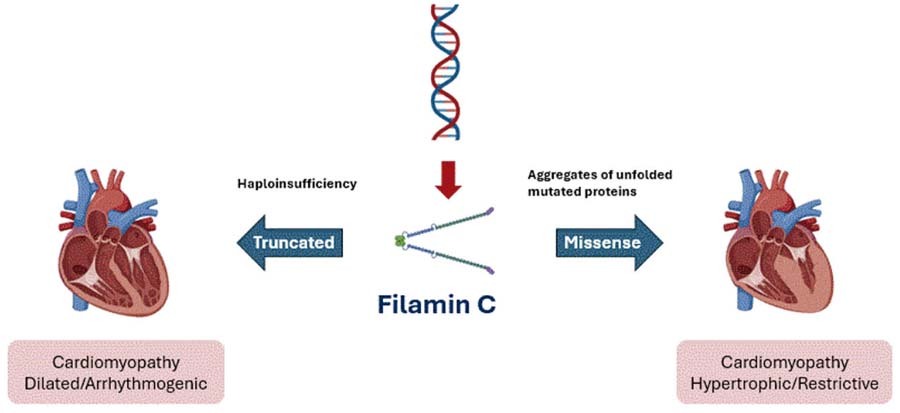
Filamin C is an essential protein for the integrity of the sarcomere and cytoskeleton of cardiomyocytes. Pathogenic variants in the FLNC gene are associated with a wide range of cardiomyopathies and may present distinct phenotypes depending on the type of genetic alteration. Truncated variants are frequently associated with dilated and arrhythmogenic cardiomyopathy, while missense variants are more related to hypertrophic and restrictive forms. These phenotypic differences reflect the molecular and structural impact of the FLNC variant on filamin C protein, with direct implications for clinical management. Diagnosis and risk stratification are challenging, requiring a multimodal approach that integrates clinical, genetic, and imaging data, especially cardiac magnetic resonance imaging, which is essential for the detection of myocardial fibrosis and for prognostic assessment. Recent evidence indicates that pathogenic FLNC variants have also been rarely associated with severe acute myocarditis, often presenting with malignant ventricular arrhythmias and systolic dysfunction. Accurate diagnosis, continuous monitoring, and family counseling are essential to define the best therapeutic and prognostic approach for patients, especially those at high risk of sudden cardiac death (SCD), thus allowing personalized and preventive interventions.

  • Cardiomyopathies
  • Filamins
  • Sudden Cardiac Death
Read Full Article
Creative Commons Attribution (CC BY) Creative Commons license
20/10/2025 DOI: 10.36660/abchf.20250008i Views 2
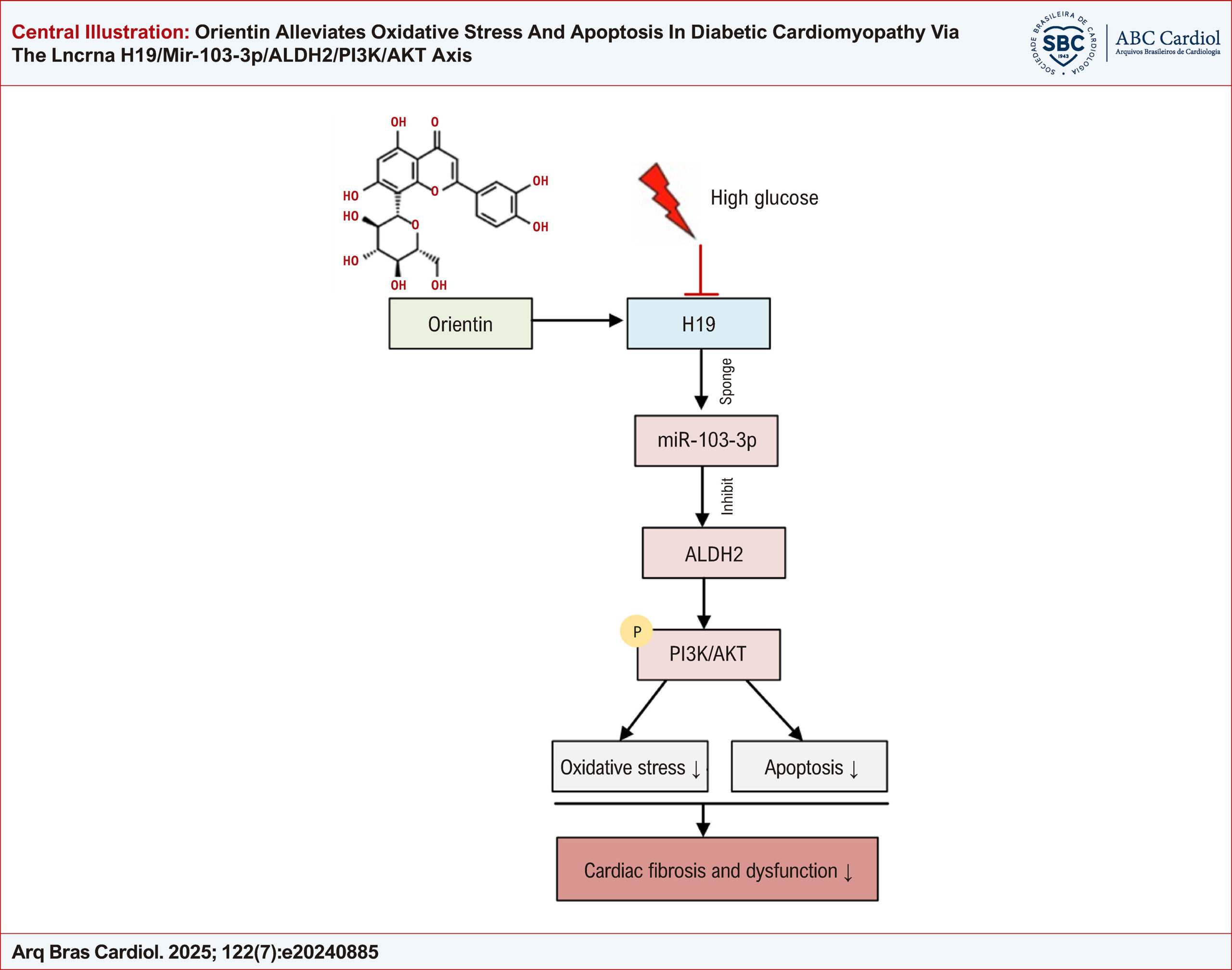
Orientin Alleviates Oxidative Stress And Apoptosis In Diabetic Cardiomyopathy Via The Lncrna H19/Mir-103-3p/ALDH2/PI3K/AKT Axis
ABC
Research Article

Orientin Alleviates Oxidative Stress And Apoptosis In Diabetic Cardiomyopathy Via The Lncrna H19/Mir-103-3p/ALDH2/PI3K/AKT Axis

Xun Wang et al. Xiaofang Xiong Wei Jiang Shanshan Xu Jun Li

Abstract

Background

Diabetic cardiomyopathy (DCM) is an irreversible cardiovascular complication of diabetes mellitus characterized by detrimental cardiac remodeling. Orientin, a water-soluble flavonoid present in many medicinal plants, exerts various pharmacological effects.

Objectives

To investigate the cardioprotective effects of orientin in diabetic conditions and elucidate the mechanisms associated with non-coding RNAs.

Methods

The streptozotocin-induced DCM model was established by a combined use of streptozotocin and a high-fat diet. Cardiac structure and function in diabetes mellitus mice were evaluated using histological and echocardiographic analyses. Masson, TUNEL, western blot, and ELISA in mouse hearts were performed to analyze cardiac fibrosis, apoptosis, and oxidative stress. Expression levels of lncRNA H19, miR-103-3p, ALDH2, and PI3K/AKT-related proteins in mouse heart and HL-1 cells were evaluated using real-time qPCR or western blot. The significance level was set at p<0.05.

Results

Orientin improved cardiac function and ameliorated cardiac injury in diabetic mice. Orientin inhibited cardiac fibrosis, reduced cardiomyocyte apoptosis, and increased the activities of antioxidant enzymes. In pathological conditions, H19 and ALDH2 levels were reduced while miR-103-3p levels increased, which were reversed by orientin. H19 upregulated ALDH2 expression by binding to miR-103-3p and activated the PI3K/AKT pathway in high glucose-treated HL-1 cells. H19 depletion or PI3K inhibitor reversed the effects of orientin on apoptosis and oxidative stress in HL-1 cells under high glucose conditions.

Conclusions

These findings reveal a protective mechanism of orientin in DCM, which involves the regulation of the H19/miR-103-3p/ALDH2/PI3K/AKT signaling axis, providing a potential strategy for treating DCM.

  • Apoptosis
  • Cardiomyopathies
  • Oxidative Stress
Read Full Article
Creative Commons Attribution (CC BY) Creative Commons license
15/08/2025 DOI: 10.36660/abc.20240885i Views 1
Figure 1
ABCIC
Editorial

Radiofrequency in Obstructive Hypertrophic Cardiomyopathy: The Role of Imaging in the Assessment of Septal Thickness and Gradient Reduction

Alexandre Costa Souza et al. Marcus Vinicius Silva Freire de Carvalho

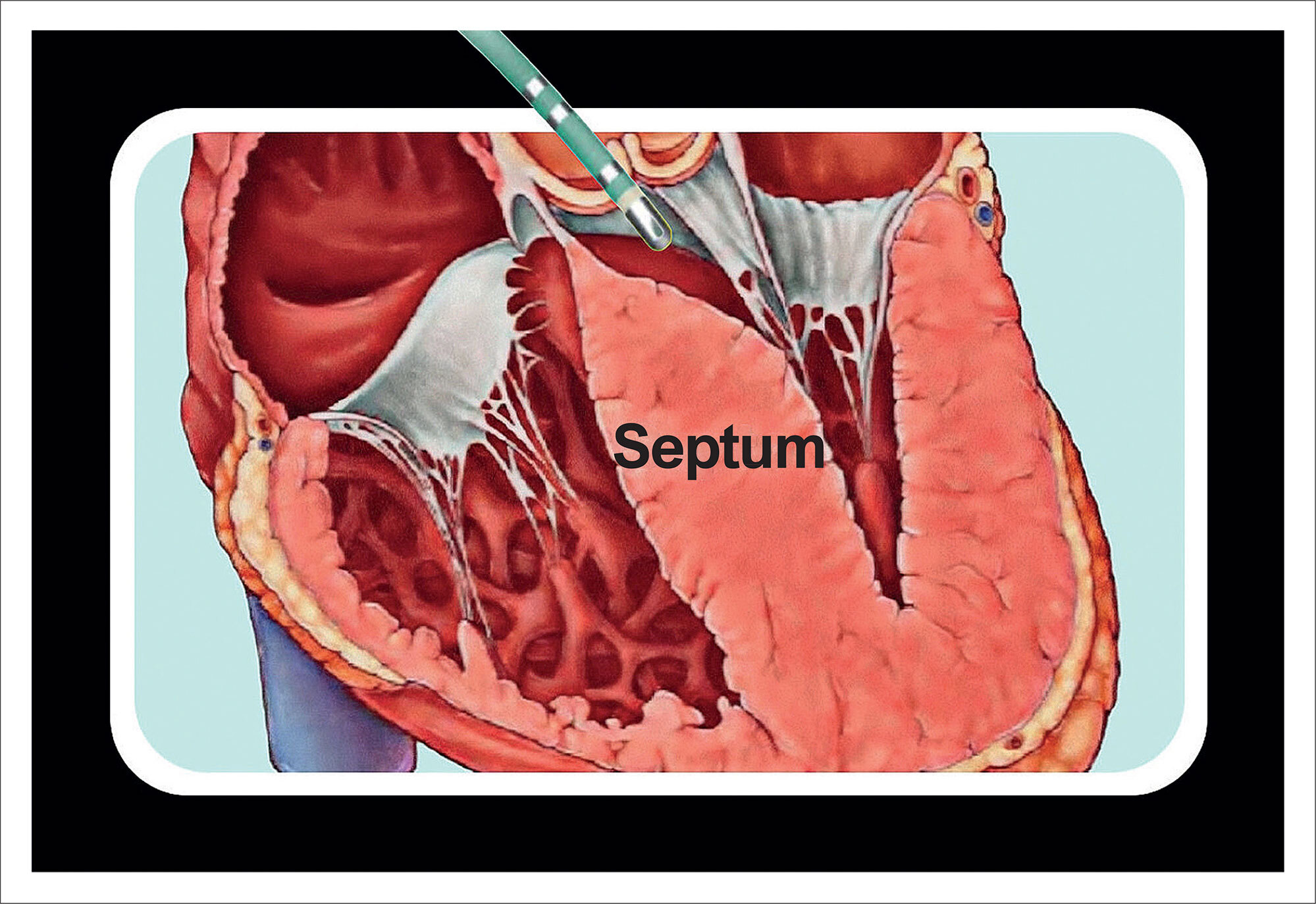
Obstructive hypertrophic cardiomyopathy (HCM) is a genetic disorder characterized by pronounced myocardial hypertrophy and varying degrees of fibrosis. The obstruction of the left ventricular outflow tract (LVOT) is an anatomical condition with dynamic behavior that can lead to symptoms such as exercise intolerance and reduced functional class, and is also associated with cases of sudden cardiac death.

The indication for invasive treatment aimed at reducing the intraventricular gradient is reserved for symptomatic patients —those who are refractory to medical therapy — with a gradient ≥ 50 mmHg. Common interventional therapies for this condition include surgical myectomy or, in a less invasive approach, alcohol septal ablation of coronary septal branches. However, these interventions have shown highly variable outcomes in the literature and remain infrequently used in clinical practice.,

[…]

  • Cardiomyopathies
  • Left Ventricular Outflow Obstruction
  • Radiofrequency Ablation
Read Full Article
Creative Commons Attribution (CC BY) Creative Commons license
27/06/2025 DOI: 10.36660/abcimg.20250024i Views 1
ABC
Letter to the Editor

Broadening Insights into Implantable Cardioverter Defibrillator Appropriateness: The Role of Economic and Psychosocial Markers, Cardiomyopathy Subtypes, and Advanced Therapies

Ömer Faruk Yılmaz et al. Yusuf Ziya Şener

Dear Editor,

We read with great interest the article by Carvalho et al. titled “Potentially Inappropriate Cardioverter Defibrillator Implants in Secondary Prevention of Death”, which highlights the critical role of socioeconomic and psychosocial markers (EPSM) in predicting early mortality post-implantable cardioverter defibrillator (ICD) implantation. While the study provides valuable insights into multidisciplinary team (MDT) assessments, we would like to address two significant limitations that could refine future research and clinical practice.

[…]

  • Cardiomyopathies
  • Defibrillators
  • Heart Failure
  • Mortality
  • Therapeutics
Read Full Article
Creative Commons Attribution (CC BY) Creative Commons license
16/06/2025 DOI: 10.36660/abc.20250066i Views 1
Central Illustration
ABCHF
Review Article

Genetic Cardiomyopathies: An Overview of the Main Associated Pathogenic Mutations

Flavia Misawa Hama et al. Edson Gabriel Rocha Estela Azeka

Abstract

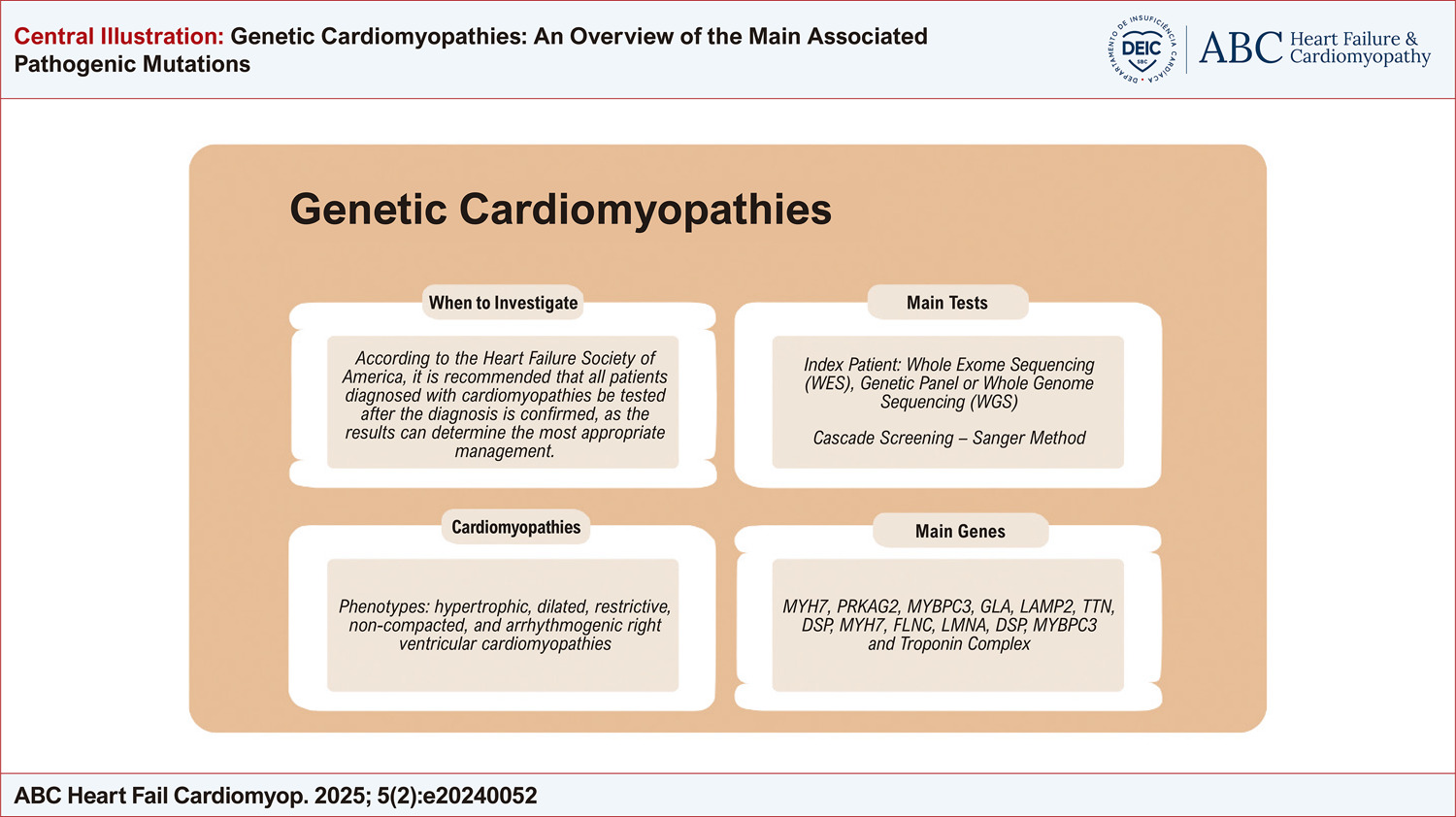
Cardiomyopathies are pathological conditions associated with progressive dysfunction of cardiomyocytes, excluding situations in which other concomitant diseases may justify such progression. Their presentations can evolve with several phenotypes, the main ones being hypertrophic, dilated, restrictive, non-compacted, and arrhythmogenic phenotypes of the right ventricle (). Regarding this topic’s relevance, dilated and hypertrophic cardiomyopathies have a genetic origin in 30 to 50% of cases, evaluating these etiologies is a crucial tool in patient management. Assessing the risk of genetic transmission and the likelihood of phenotypic manifestation across generations requires identifying and classifying each gene’s inheritance pattern and mutation type associated with structural cardiomyopathy. Additionally, determining the structural protein affected facilitates understanding the pathophysiological phenomenon and the phenotype manifested by the variant carrier. Considering the growing advent of the genetic approach to cardiomyopathies, the Heart Failure Society of America, in collaboration with the American College of Medical Genetics and Genomics, developed a guide for the investigation and follow-up of these cases. However, in this study, the time to request the genetic tests was not evaluated. It is recommended that the tests be requested at any time after diagnosis confirmation since their results can contribute to guiding the most appropriate follow-up approach. Despite the multitude of existing variants related to genetic cardiomyopathies, some are of greater clinical interest due to their impact on risk stratification and interest in family screening, namely: MYH7, PRKAG2, MYBPC3, GLA, LAMP2, TTN, DSP, MYH7, FLNC, LMNA, DSP, MYBPC3 and Troponin Complex (). Recognizing the main mutations associated with cardiomyopathies and the phenotypes related to them enables a more individualized medicine approach with early interventions and risk stratification. Genetic evaluation is essential for screening family members and optimizing patient management, which may vary depending on the identified mutation.

  • Cardiomyopathies
  • Dilated Cardiomyopathy
  • Hypertrophic Cardiomyopathy
Read Full Article
Creative Commons Attribution (CC BY) Creative Commons license
26/05/2025 DOI: 10.36660/abchf.20240052i Views 1
Patisiran Treatment in the Brazilian Subpopulation of the Phase 3 APOLLO-B Study in Transthyretin Amyloidosis with Cardiomyopathy: Post Hoc Analysis
ABC
Original Article

Patisiran Treatment in the Brazilian Subpopulation of the Phase 3 APOLLO-B Study in Transthyretin Amyloidosis with Cardiomyopathy: Post Hoc Analysis

Claudio Tinoco Mesquita et al. Pedro Schwartzmann Edileide Barros Correia Marcus V. Simões … Andreia Biolo Daniel Rodriguez Duque Patrick Y. Jay Fábio Fernandes

Abstract

Background

Patisiran rapidly knocked down transthyretin and preserved functional capacity in patients with transthyretin amyloidosis with cardiomyopathy (ATTR-CM) in the global Phase 3 APOLLO-B study (NCT03997383).

Objectives

To evaluate patisiran efficacy and safety in post hoc analysis of the Brazilian subpopulation of APOLLO-B.

Methods

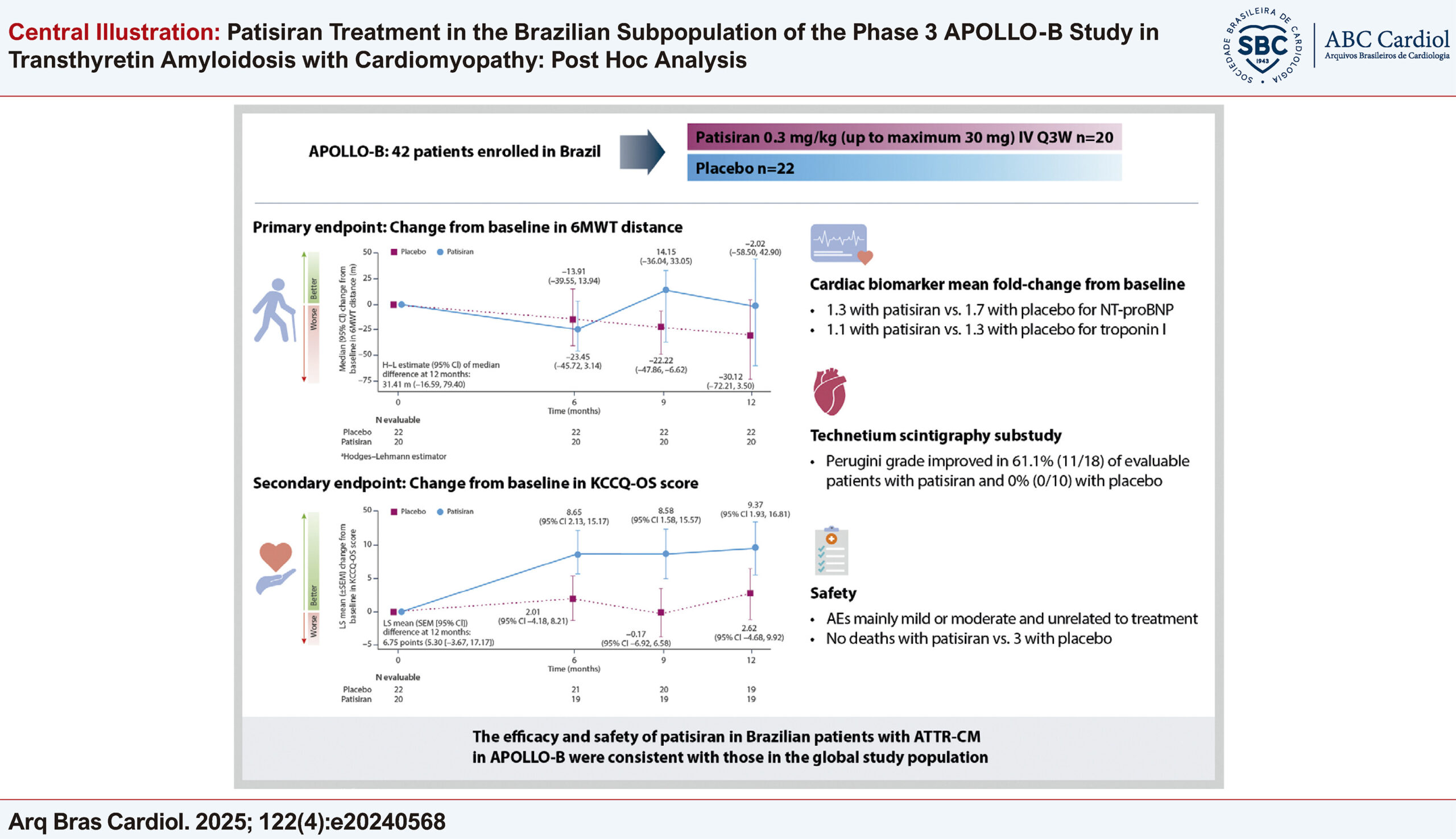
Patients were randomized 1:1 to patisiran 0.3 mg/kg or placebo every 3 weeks for 12 months. The primary endpoint was the change from baseline (CFB) in functional capacity (6-minute walk test [6MWT]) at Month 12. Secondary endpoints included CFB to Month 12 in the Kansas City Cardiomyopathy Questionnaire-Overall Summary (KCCQ-OS) score. Exploratory endpoints included CFB in cardiac biomarkers and Perugini grade of cardiac uptake during technetium-99m scintigraphy.

Results

Forty-two patients enrolled in Brazil (patisiran, n=20; placebo, n=22). Patisiran showed benefit in 6MWT and KCCQ-OS scores vs. placebo; CFB (95% confidence interval [CI]) in 6MWT (median) and KCCQ-OS scores (least squares mean) was –2.0 m (–58.5, 42.9) and 9.37 (1.93, 16.81) points with patisiran vs. –30.1 m (–72.2, 3.5) and 2.62 (–4.68, 9.92) points for placebo. For cardiac biomarkers, the mean fold-change from baseline (95% CI) for N-terminal prohormone B-type natriuretic peptide and troponin I was 1.31 (1.06, 1.61) and 1.12 (0.94, 1.34) for patisiran, and 1.71 (1.39, 2.10) and 1.28 (1.08, 1.53) for placebo, respectively. Perugini grade improved in 11/18 (61.1%) and 0/10 evaluable patients with patisiran and placebo, respectively. There were no deaths in the patisiran group vs. 3 in the placebo group.

Conclusion

The efficacy and safety of patisiran in Brazilian patients with ATTR-CM in APOLLO-B were consistent with those in the global study population. Findings are descriptive due to the small number of patients.

  • Amyloidosis
  • Cardiomyopathies
  • Clinical Trial
  • Small Interfering RNA
  • Transthyretin
Read Full Article
Creative Commons Attribution (CC BY) Creative Commons license
14/04/2025 DOI: 10.36660/abc.20240568i Views 1
Figure 1
ABC
Research Letter

Fabry Disease and Its Different Phenotypes

Murillo Oliveira Antunes et al. Rafael Ruas Nastari Edmundo Arteaga-Fernandez Marcelle G. Henriques Lizandro … William Batah El-Feghaly Guilherme José dos Santos Ferreira Alan Silva Martins Juliana Alzira Gonzales Oliveira Leguizamon Vinicius Machado Correia Vagner Madrini Junior Fábio Fernandes

Abstract

Fabry disease (FD) is an X-linked genetic condition caused by variants in the GLA gene causing enzyme α-galactosidase A deficiency and accumulation of globotriaosylceramide (Gb3) in tissues such as the heart, kidneys, and the nervous system. This study reports a case series of patients with FD, highlighting the phenotypic diversity of the disease, which can be confused with other cardiological conditions. When properly indicated, genetic evaluation, combined with biomarker dosage and α-galactosidase enzymatic activity, is key for an accurate diagnosis. Early diagnosis of FD is fundamental for initiating treatments that can slow disease progression and prevent serious complications, reinforcing the need for greater awareness about this condition among cardiologists.

  • Cardiomyopathies
  • Fabry Disease
  • Genetics
Read Full Article
Creative Commons Attribution (CC BY) Creative Commons license
24/03/2025 DOI: 10.36660/abc.20240535i Views 3

Could not load more articles. Please try again.

How to cite this article

EndNote RIS

Electronic Document Format (Vancouver)

Oliveira GMM, Brant LCC, Polanczyk CA, Malta DC, Biolo A, Nascimento BR, Souza MFM, et al. Cardiovascular Statistics – Brazil 2026. Arquivos Brasileiros de Cardiologia 2026;:e20260832.

Electronic Document Format (ABNT)

Oliveira, Gláucia Maria Moraes de; Brant, Luisa Campos Caldeira; Polanczyk, Carisi Anne; Malta, Deborah Carvalho; Biolo, Andreia; Nascimento, Bruno Ramos; Souza, Maria de Fatima Marinho de; Lorenzo, Andrea Rocha De; Fagundes Júnior, Antonio Aurélio de Paiva; Manfro, Arthur Gus; Schaan, Beatriz D.; Silva, Christina Grüne de Souza e; Castilho, Fábio Morato de; Cesena, Fernando Henpin Yue; Soares, Gabriel Porto; Xavier Junior, Gesner Francisco; Barreto Filho, Jose Augusto Soares; Pellanda, Lucia Campos; Aranha, Luciana Nicolau; Rohde, Luis Eduardo Paim; Passaglia, Luiz Guilherme; Pinto-Filho, Marcelo Martins; Machline-Carrion, M. Julia; Bittencourt, Marcio Sommer; Pontes Neto, Octavio M.; Villela, Paolo Blanco; Godoy, Paulo Henrique; Teixeira, Renato Azeredo; Stein, Ricardo; Sampaio, Roney Orismar; Salim, Thais Rocha; Gaziano, Thomas A.; Perel, Pablo; Roth, Gregory A.; Ribeiro, Antonio Luiz Pinho. Cardiovascular Statistics – Brazil 2026. Arquivos Brasileiros de Cardiologia, e20260832, Oct. 2026.

Electronic Document Format (APA)

Oliveira, G. M. M. , Brant, L. C. C., Polanczyk, C. A., Malta, D. C., Biolo, A., Nascimento, B. R., Souza, M. F. M. , Lorenzo, A. R. D., Fagundes Júnior, A. A. P., Manfro, A. G., Schaan, B. D., Silva, C. G. S. , Castilho, F. M. , Cesena, F. H. Y., Soares, G. P., Xavier Junior, G. F., Barreto Filho, J. A. S., Pellanda, L. C., Aranha, L. N., Rohde, L. E. P., Passaglia, L. G., Pinto-Filho, M. M., Machline-Carrion, M. J., Bittencourt, M. S., Pontes Neto, O. M., Villela, P. B., Godoy, P. H., Teixeira, R. A., Stein, R., Sampaio, R. O., Salim, T. R., Gaziano, T. A., Perel, P., Roth, G. A., & Ribeiro, A. L. P. (2026). Cardiovascular Statistics – Brazil 2026. Arquivos Brasileiros de Cardiologia, , e20260832.

Electronic Document Format (ISO)

Oliveira, Gláucia Maria Moraes de and Brant, Luisa Campos Caldeira and Polanczyk, Carisi Anne and Malta, Deborah Carvalho and Biolo, Andreia and Nascimento, Bruno Ramos and Souza, Maria de Fatima Marinho de and Lorenzo, Andrea Rocha De and Fagundes Júnior, Antonio Aurélio de Paiva and Manfro, Arthur Gus and Schaan, Beatriz D. and Silva, Christina Grüne de Souza e and Castilho, Fábio Morato de and Cesena, Fernando Henpin Yue and Soares, Gabriel Porto and Xavier Junior, Gesner Francisco and Barreto Filho, Jose Augusto Soares and Pellanda, Lucia Campos and Aranha, Luciana Nicolau and Rohde, Luis Eduardo Paim and Passaglia, Luiz Guilherme and Pinto-Filho, Marcelo Martins and Machline-Carrion, M. Julia and Bittencourt, Marcio Sommer and Pontes Neto, Octavio M. and Villela, Paolo Blanco and Godoy, Paulo Henrique and Teixeira, Renato Azeredo and Stein, Ricardo and Sampaio, Roney Orismar and Salim, Thais Rocha and Gaziano, Thomas A. and Perel, Pablo and Roth, Gregory A. and Ribeiro, Antonio Luiz Pinho. Cardiovascular Statistics – Brazil 2026. Arquivos Brasileiros de Cardiologia [online]. 2026, [cited 2026-10-14], e20260832. Available from: <https://journals.cardiol.br/en/article/cardiovascular-statistics-brazil-2026/>. ISSN 0066-782X

EndNote RIS

Electronic Document Format (Vancouver)

Perazzo A, Martins GK, Nobre AP, Oliveira ALL, Araújo Junior JR, Montenegro GL, Montenegro CEL, et al. Shifting Patterns of Out-Of-Hospital Mortality and Premature Life Loss in Cardiomyopathies: A Nationwide Population-Based Study. ABC Heart Fail Cardiomyop 2026;6:e20260024.

Electronic Document Format (ABNT)

Perazzo, Alvaro; Martins, Gabriel Kaleb; Nobre, Arina Peixoto; Oliveira, Arthur Línniker Lopes de; Araújo Junior, Jose Roberto de; Montenegro, Gabriela Lucena; Montenegro, Carlos Eduardo Lucena; Montenegro, Patricia Bezerra Rocha; Torres, João Henrique; Feijó, Flavio; Tenório, Deuzenny; Sepúlveda, Diana Patrícia Lamprea; Steffen, Samuel Padovani; Montenegro, Sérgio Tavares; Gaiotto, Fábio Antonio; Moraes, Fernando. Shifting Patterns of Out-Of-Hospital Mortality and Premature Life Loss in Cardiomyopathies: A Nationwide Population-Based Study. ABC Heart Fail Cardiomyop, v. 6, e20260024, Sep. 2026.

Electronic Document Format (APA)

Perazzo, A., Martins, G. K., Nobre, A. P., Oliveira, A. L. L. , Araújo Junior, J. R. , Montenegro, G. L., Montenegro, C. E. L., Montenegro, P. B. R., Torres, J. H., Feijó, F., Tenório, D., Sepúlveda, D. P. L., Steffen, S. P., Montenegro, S. T., Gaiotto, F. A., & Moraes, F. (2026). Shifting Patterns of Out-Of-Hospital Mortality and Premature Life Loss in Cardiomyopathies: A Nationwide Population-Based Study. ABC Heart Fail Cardiomyop, 6, e20260024.

Electronic Document Format (ISO)

Perazzo, Alvaro and Martins, Gabriel Kaleb and Nobre, Arina Peixoto and Oliveira, Arthur Línniker Lopes de and Araújo Junior, Jose Roberto de and Montenegro, Gabriela Lucena and Montenegro, Carlos Eduardo Lucena and Montenegro, Patricia Bezerra Rocha and Torres, João Henrique and Feijó, Flavio and Tenório, Deuzenny and Sepúlveda, Diana Patrícia Lamprea and Steffen, Samuel Padovani and Montenegro, Sérgio Tavares and Gaiotto, Fábio Antonio and Moraes, Fernando. Shifting Patterns of Out-Of-Hospital Mortality and Premature Life Loss in Cardiomyopathies: A Nationwide Population-Based Study. ABC Heart Fail Cardiomyop [online]. 2026, vol. 6, [cited 2026-10-14], e20260024. Available from: <https://journals.cardiol.br/en/article/shifting-patterns-of-out-of-hospital-mortality-and-premature-life-loss-in-cardiomyopathies-a-nationwide-population-based-study/>

EndNote RIS

Electronic Document Format (Vancouver)

Kumar S, Meena CB, Babbar N, Bhandari A, Shekhawat DS, Meel A. Effects of Pacemakers on Ventricular Functions and Early Variables Associated with Induced Cardiomyopathy. Arquivos Brasileiros de Cardiologia 2026;123(7):e20250566.

Electronic Document Format (ABNT)

Kumar, Sanjeev; Meena, Chandra Bhan; Babbar, Navida; Bhandari, Anil; Shekhawat, Dhananjay Singh; Meel, Ankita. Effects of Pacemakers on Ventricular Functions and Early Variables Associated with Induced Cardiomyopathy. Arquivos Brasileiros de Cardiologia, v. 123, n. 7, e20250566, Sep. 2026.

Electronic Document Format (APA)

Kumar, S., Meena, C. B., Babbar, N., Bhandari, A., Shekhawat, D. S., & Meel, A. (2026). Effects of Pacemakers on Ventricular Functions and Early Variables Associated with Induced Cardiomyopathy. Arquivos Brasileiros de Cardiologia, 123(7), e20250566.

Electronic Document Format (ISO)

Kumar, Sanjeev and Meena, Chandra Bhan and Babbar, Navida and Bhandari, Anil and Shekhawat, Dhananjay Singh and Meel, Ankita. Effects of Pacemakers on Ventricular Functions and Early Variables Associated with Induced Cardiomyopathy. Arquivos Brasileiros de Cardiologia [online]. 2026, vol. 123, n. 7, [cited 2026-10-14], e20250566. Available from: <https://journals.cardiol.br/en/article/effects-of-pacemakers-on-ventricular-functions-and-early-variables-associated-with-induced-cardiomyopathy/>. ISSN 0066-782X

EndNote RIS

Electronic Document Format (Vancouver)

Conceição-Souza GE. ABC Heart Failure & Cardiomyopathy: Management Review and Indexing Perspectives. ABC Heart Fail Cardiomyop 2026;6:e20260033.

Electronic Document Format (ABNT)

Conceição-Souza, Germano Emílio. ABC Heart Failure & Cardiomyopathy: Management Review and Indexing Perspectives. ABC Heart Fail Cardiomyop, v. 6, e20260033, Aug. 2026.

Electronic Document Format (APA)

Conceição-Souza, G. E. (2026). ABC Heart Failure & Cardiomyopathy: Management Review and Indexing Perspectives. ABC Heart Fail Cardiomyop, 6, e20260033.

Electronic Document Format (ISO)

Conceição-Souza, Germano Emílio. ABC Heart Failure & Cardiomyopathy: Management Review and Indexing Perspectives. ABC Heart Fail Cardiomyop [online]. 2026, vol. 6, [cited 2026-10-14], e20260033. Available from: <https://journals.cardiol.br/en/article/abc-heart-failure-cardiomyopathy-management-review-and-indexing-perspectives/>

EndNote RIS

Electronic Document Format (Vancouver)

Durães AR. Mortality from Cardiomyopathies in Brazil. Arquivos Brasileiros de Cardiologia 2026;123(6):e20260438.

Electronic Document Format (ABNT)

Durães, André Rodrigues. Mortality from Cardiomyopathies in Brazil. Arquivos Brasileiros de Cardiologia, v. 123, n. 6, e20260438, Aug. 2026.

Electronic Document Format (APA)

Durães, A. R. (2026). Mortality from Cardiomyopathies in Brazil. Arquivos Brasileiros de Cardiologia, 123(6), e20260438.

Electronic Document Format (ISO)

Durães, André Rodrigues. Mortality from Cardiomyopathies in Brazil. Arquivos Brasileiros de Cardiologia [online]. 2026, vol. 123, n. 6, [cited 2026-10-14], e20260438. Available from: <https://journals.cardiol.br/en/article/mortality-from-cardiomyopathies-in-brazil/>. ISSN 0066-782X

EndNote RIS

Electronic Document Format (Vancouver)

Roston F, Ribeiro AAA, Makiniks NC, Ribeiro LFB, Ziegler LL. A New Frontier in Cardiovascular Prevention: Beyond Prohibition, Clinical Management of Anabolic Steroid Users. ABC Imagem Cardiovascular 2026;39(2):e20260076.

Electronic Document Format (ABNT)

Roston, Fabio; Ribeiro, Alexandre Aby Azar; Makiniks, Naiara Caroline; Ribeiro, Luiz Felipe Branco; Ziegler, Liliana Ludwing. A New Frontier in Cardiovascular Prevention: Beyond Prohibition, Clinical Management of Anabolic Steroid Users. ABC Imagem Cardiovascular, v. 39, n. 2, e20260076, Jul. 2026.

Electronic Document Format (APA)

Roston, F., Ribeiro, A. A. A., Makiniks, N. C., Ribeiro, L. F. B., & Ziegler, L. L. (2026). A New Frontier in Cardiovascular Prevention: Beyond Prohibition, Clinical Management of Anabolic Steroid Users. ABC Imagem Cardiovascular, 39(2), e20260076.

Electronic Document Format (ISO)

Roston, Fabio and Ribeiro, Alexandre Aby Azar and Makiniks, Naiara Caroline and Ribeiro, Luiz Felipe Branco and Ziegler, Liliana Ludwing. A New Frontier in Cardiovascular Prevention: Beyond Prohibition, Clinical Management of Anabolic Steroid Users. ABC Imagem Cardiovascular [online]. 2026, vol. 39, n. 2, [cited 2026-10-14], e20260076. Available from: <https://journals.cardiol.br/en/article/a-new-frontier-in-cardiovascular-prevention-beyond-prohibition-clinical-management-of-anabolic-steroid-users/>. ISSN 2318-8219

EndNote RIS

Electronic Document Format (Vancouver)

Kubrusly LF, Lopes ACA, Souza FR, Dieter GF, Nadolny L, Dias LM, Dias LM, et al. Spatiotemporal Analysis of Mortality from Cardiomyopathies in Brazil between 2001 and 2021. Arquivos Brasileiros de Cardiologia 2026;123(6):e20260064.

Electronic Document Format (ABNT)

Kubrusly, Luiz Fernando; Lopes, Ana Clara Abdo; Souza, Fernanda Ritt de; Dieter, Gustavo Ferrucio; Nadolny, Laura; Dias, Leonardo Moreira; Dias, Letícia Moreira; Farias, Luis Gustavo Machado; Basso, Roberto Oliveira; Okimura, Vitória Naomi. Spatiotemporal Analysis of Mortality from Cardiomyopathies in Brazil between 2001 and 2021. Arquivos Brasileiros de Cardiologia, v. 123, n. 6, e20260064, Jul. 2026.

Electronic Document Format (APA)

Kubrusly, L. F., Lopes, A. C. A., Souza, F. R. , Dieter, G. F., Nadolny, L., Dias, L. M., Dias, L. M., Farias, L. G. M., Basso, R. O., & Okimura, V. N. (2026). Spatiotemporal Analysis of Mortality from Cardiomyopathies in Brazil between 2001 and 2021. Arquivos Brasileiros de Cardiologia, 123(6), e20260064.

Electronic Document Format (ISO)

Kubrusly, Luiz Fernando and Lopes, Ana Clara Abdo and Souza, Fernanda Ritt de and Dieter, Gustavo Ferrucio and Nadolny, Laura and Dias, Leonardo Moreira and Dias, Letícia Moreira and Farias, Luis Gustavo Machado and Basso, Roberto Oliveira and Okimura, Vitória Naomi. Spatiotemporal Analysis of Mortality from Cardiomyopathies in Brazil between 2001 and 2021. Arquivos Brasileiros de Cardiologia [online]. 2026, vol. 123, n. 6, [cited 2026-10-14], e20260064. Available from: <https://journals.cardiol.br/en/article/spatiotemporal-analysis-of-mortality-from-cardiomyopathies-in-brazil-between-2001-and-2021/>. ISSN 0066-782X

EndNote RIS

Electronic Document Format (Vancouver)

Cunha BL, Brasil HN, Matias PA, Rocha EA. Beyond Ventricular Pacing: Is Atrial Cardiomyopathy a Determinant of Clinical Outcome after Pacemaker Implantation?. Arquivos Brasileiros de Cardiologia 2026;123(5):e20260425.

Electronic Document Format (ABNT)

Cunha, Bianca Lopes; Brasil, Helena Nogueira; Matias, Patrícia de Araújo; Rocha, Eduardo Arrais. Beyond Ventricular Pacing: Is Atrial Cardiomyopathy a Determinant of Clinical Outcome after Pacemaker Implantation?. Arquivos Brasileiros de Cardiologia, v. 123, n. 5, e20260425, Jul. 2026.

Electronic Document Format (APA)

Cunha, B. L., Brasil, H. N., Matias, P. A., & Rocha, E. A. (2026). Beyond Ventricular Pacing: Is Atrial Cardiomyopathy a Determinant of Clinical Outcome after Pacemaker Implantation?. Arquivos Brasileiros de Cardiologia, 123(5), e20260425.

Electronic Document Format (ISO)

Cunha, Bianca Lopes and Brasil, Helena Nogueira and Matias, Patrícia de Araújo and Rocha, Eduardo Arrais. Beyond Ventricular Pacing: Is Atrial Cardiomyopathy a Determinant of Clinical Outcome after Pacemaker Implantation?. Arquivos Brasileiros de Cardiologia [online]. 2026, vol. 123, n. 5, [cited 2026-10-14], e20260425. Available from: <https://journals.cardiol.br/en/article/beyond-ventricular-pacing-is-atrial-cardiomyopathy-a-determinant-of-clinical-outcome-after-pacemaker-implantation/>. ISSN 0066-782X

EndNote RIS

Electronic Document Format (Vancouver)

Fernandes ASN, Faria J, Vieira CF. Conflicting Clues in Severe LV Hypertrophy: An Unusual Presentation of ATTR Amyloidosis. Arquivos Brasileiros de Cardiologia 2026;123(5):e20250832.

Electronic Document Format (ABNT)

Fernandes, Ana Sofia Nogueira; Faria, João; Vieira, Catarina Ferreira. Conflicting Clues in Severe LV Hypertrophy: An Unusual Presentation of ATTR Amyloidosis. Arquivos Brasileiros de Cardiologia, v. 123, n. 5, e20250832, Jul. 2026.

Electronic Document Format (APA)

Fernandes, A. S. N., Faria, J., & Vieira, C. F. (2026). Conflicting Clues in Severe LV Hypertrophy: An Unusual Presentation of ATTR Amyloidosis. Arquivos Brasileiros de Cardiologia, 123(5), e20250832.

Electronic Document Format (ISO)

Fernandes, Ana Sofia Nogueira and Faria, João and Vieira, Catarina Ferreira. Conflicting Clues in Severe LV Hypertrophy: An Unusual Presentation of ATTR Amyloidosis. Arquivos Brasileiros de Cardiologia [online]. 2026, vol. 123, n. 5, [cited 2026-10-14], e20250832. Available from: <https://journals.cardiol.br/en/article/conflicting-clues-in-severe-lv-hypertrophy-an-unusual-presentation-of-attr-amyloidosis/>. ISSN 0066-782X

EndNote RIS

Electronic Document Format (Vancouver)

Morte SSB, Magalhães LP, Duarte JOP, Guabiru AT, Santos AS, Magalhães EFS, Aras R, et al. Reversibility of Heart Failure after Catheter Ablation in Patients with Ventricular Pre-Excitation-Induced Cardiomyopathy. Arquivos Brasileiros de Cardiologia 2026;123(5):e20250192.

Electronic Document Format (ABNT)

Morte, Samuel Santos Boa; Magalhães, Luiz Pereira de; Duarte, Jussara de Oliveira Pinheiro; Guabiru, Alex Teixeira; Santos, Adimeia Souza; Magalhães, Eduardo Faria Soares de; Aras, Roque. Reversibility of Heart Failure after Catheter Ablation in Patients with Ventricular Pre-Excitation-Induced Cardiomyopathy. Arquivos Brasileiros de Cardiologia, v. 123, n. 5, e20250192, Jul. 2026.

Electronic Document Format (APA)

Morte, S. S. B., Magalhães, L. P. , Duarte, J. O. P., Guabiru, A. T., Santos, A. S., Magalhães, E. F. S. , & Aras, R. (2026). Reversibility of Heart Failure after Catheter Ablation in Patients with Ventricular Pre-Excitation-Induced Cardiomyopathy. Arquivos Brasileiros de Cardiologia, 123(5), e20250192.

Electronic Document Format (ISO)

Morte, Samuel Santos Boa and Magalhães, Luiz Pereira de and Duarte, Jussara de Oliveira Pinheiro and Guabiru, Alex Teixeira and Santos, Adimeia Souza and Magalhães, Eduardo Faria Soares de and Aras, Roque. Reversibility of Heart Failure after Catheter Ablation in Patients with Ventricular Pre-Excitation-Induced Cardiomyopathy. Arquivos Brasileiros de Cardiologia [online]. 2026, vol. 123, n. 5, [cited 2026-10-14], e20250192. Available from: <https://journals.cardiol.br/en/article/reversibility-of-heart-failure-after-catheter-ablation-in-patients-with-ventricular-pre-excitation-induced-cardiomyopathy/>. ISSN 0066-782X

EndNote RIS

Electronic Document Format (Vancouver)

Antunes MO. The Thickness That Deceives: The Role of Imaging, Biopsy, and Genetics in the Evaluation of Ventricular Hypertrophy. Arquivos Brasileiros de Cardiologia 2026;123(2):e20260119.

Electronic Document Format (ABNT)

Antunes, Murillo de Oliveira. The Thickness That Deceives: The Role of Imaging, Biopsy, and Genetics in the Evaluation of Ventricular Hypertrophy. Arquivos Brasileiros de Cardiologia, v. 123, n. 2, e20260119, May. 2026.

Electronic Document Format (APA)

Antunes, M. O. (2026). The Thickness That Deceives: The Role of Imaging, Biopsy, and Genetics in the Evaluation of Ventricular Hypertrophy. Arquivos Brasileiros de Cardiologia, 123(2), e20260119.

Electronic Document Format (ISO)

Antunes, Murillo de Oliveira. The Thickness That Deceives: The Role of Imaging, Biopsy, and Genetics in the Evaluation of Ventricular Hypertrophy. Arquivos Brasileiros de Cardiologia [online]. 2026, vol. 123, n. 2, [cited 2026-10-14], e20260119. Available from: <https://journals.cardiol.br/en/article/the-thickness-that-deceives-the-role-of-imaging-biopsy-and-genetics-in-the-evaluation-of-ventricular-hypertrophy/>. ISSN 0066-782X

EndNote RIS

Electronic Document Format (Vancouver)

Lêu FA, Paixão GMM, Oliveira AC, Soares CPM, Gomes PR, Macfarlane P, Ribeiro ALP, et al. Atrial Cardiomyopathy Detected by Electrocardiogram: Association with Stroke in a Brazilian Electronic Cohort. Arquivos Brasileiros de Cardiologia 2026;123(3):e20250625.

Electronic Document Format (ABNT)

Lêu, Filipe Antunes de; Paixão, Gabriela Miana de Mattos; Oliveira, Ana Cecilia; Soares, Carla Paula Moreira; Gomes, Paulo R.; Macfarlane, Peter; Ribeiro, Antônio Luiz Pinho. Atrial Cardiomyopathy Detected by Electrocardiogram: Association with Stroke in a Brazilian Electronic Cohort. Arquivos Brasileiros de Cardiologia, v. 123, n. 3, e20250625, Apr. 2026.

Electronic Document Format (APA)

Lêu, F. A. , Paixão, G. M. M., Oliveira, A. C., Soares, C. P. M., Gomes, P. R., Macfarlane, P., & Ribeiro, A. L. P. (2026). Atrial Cardiomyopathy Detected by Electrocardiogram: Association with Stroke in a Brazilian Electronic Cohort. Arquivos Brasileiros de Cardiologia, 123(3), e20250625.

Electronic Document Format (ISO)

Lêu, Filipe Antunes de and Paixão, Gabriela Miana de Mattos and Oliveira, Ana Cecilia and Soares, Carla Paula Moreira and Gomes, Paulo R. and Macfarlane, Peter and Ribeiro, Antônio Luiz Pinho. Atrial Cardiomyopathy Detected by Electrocardiogram: Association with Stroke in a Brazilian Electronic Cohort. Arquivos Brasileiros de Cardiologia [online]. 2026, vol. 123, n. 3, [cited 2026-10-14], e20250625. Available from: <https://journals.cardiol.br/en/article/atrial-cardiomyopathy-detected-by-electrocardiogram-association-with-stroke-in-a-brazilian-electronic-cohort/>. ISSN 0066-782X

EndNote RIS

Electronic Document Format (Vancouver)

Mejía HPG, Madogolele HCN, Barroso MCRD, Nogueira MCA, Morales KRP, Romero CE, Nastari L, et al. Late-Onset Fabry Disease: Diagnostic Challenges and Clinical Evolution. Arquivos Brasileiros de Cardiologia 2026;123(2):e20250554.

Electronic Document Format (ABNT)

Mejía, Hernán Patricio García; Madogolele, Heleuterio da Conceição Nicolau; Barroso, Manuela Cristina Ribeiro Dias; Nogueira, Matheus Carvalho Alves; Morales, Kevin Rafael de Paula; Romero, Cristhian Espinoza; Nastari, Luciano; Fernandes, Fábio. Late-Onset Fabry Disease: Diagnostic Challenges and Clinical Evolution. Arquivos Brasileiros de Cardiologia, v. 123, n. 2, e20250554, Apr. 2026.

Electronic Document Format (APA)

Mejía, H. P. G., Madogolele, H. C. N., Barroso, M. C. R. D., Nogueira, M. C. A., Morales, K. R. P., Romero, C. E., Nastari, L., & Fernandes, F. (2026). Late-Onset Fabry Disease: Diagnostic Challenges and Clinical Evolution. Arquivos Brasileiros de Cardiologia, 123(2), e20250554.

Electronic Document Format (ISO)

Mejía, Hernán Patricio García and Madogolele, Heleuterio da Conceição Nicolau and Barroso, Manuela Cristina Ribeiro Dias and Nogueira, Matheus Carvalho Alves and Morales, Kevin Rafael de Paula and Romero, Cristhian Espinoza and Nastari, Luciano and Fernandes, Fábio. Late-Onset Fabry Disease: Diagnostic Challenges and Clinical Evolution. Arquivos Brasileiros de Cardiologia [online]. 2026, vol. 123, n. 2, [cited 2026-10-14], e20250554. Available from: <https://journals.cardiol.br/en/article/late-onset-fabry-disease-diagnostic-challenges-and-clinical-evolution/>. ISSN 0066-782X

EndNote RIS

Electronic Document Format (Vancouver)

Lenzi B, Tortajada G, Rabaza V, Cairoli E, Parma G. Hypocalcemia and Reversible Cardiomyopathy Assessed by Magnetic Resonance Imaging. ABC Imagem Cardiovascular 2025;38(4):e20250048.

Electronic Document Format (ABNT)

Lenzi, Bruno; Tortajada, Gustavo; Rabaza, Victoria; Cairoli, Ernesto; Parma, Gabriel. Hypocalcemia and Reversible Cardiomyopathy Assessed by Magnetic Resonance Imaging. ABC Imagem Cardiovascular, v. 38, n. 4, e20250048, Dec. 2025.

Electronic Document Format (APA)

Lenzi, B., Tortajada, G., Rabaza, V., Cairoli, E., & Parma, G. (2025). Hypocalcemia and Reversible Cardiomyopathy Assessed by Magnetic Resonance Imaging. ABC Imagem Cardiovascular, 38(4), e20250048.

Electronic Document Format (ISO)

Lenzi, Bruno and Tortajada, Gustavo and Rabaza, Victoria and Cairoli, Ernesto and Parma, Gabriel. Hypocalcemia and Reversible Cardiomyopathy Assessed by Magnetic Resonance Imaging. ABC Imagem Cardiovascular [online]. 2025, vol. 38, n. 4, [cited 2026-10-14], e20250048. Available from: <https://journals.cardiol.br/en/article/hypocalcemia-and-reversible-cardiomyopathy-assessed-by-magnetic-resonance-imaging/>. ISSN 2318-8219

EndNote RIS

Electronic Document Format (Vancouver)

Oliveira ACS, Carvalho VT, Pinto-Filho MM, Brant LC, Barreto SM, Foppa M, Ribeiro ALP, et al. Diagnostic Utility of P-Wave Duration in Identifying Left Atrial Enlargement: Insights from the ELSA-Brasil Cohort. Arquivos Brasileiros de Cardiologia 2025;122(10):e20250151.

Electronic Document Format (ABNT)

Oliveira, Ana Cecília de Sena; Carvalho, Vinicius Tostes; Pinto-Filho, Marcelo Martins; Brant, Luisa Caldeira; Barreto, Sandhi Maria; Foppa, Murilo; Ribeiro, Antonio Luiz Pinho. Diagnostic Utility of P-Wave Duration in Identifying Left Atrial Enlargement: Insights from the ELSA-Brasil Cohort. Arquivos Brasileiros de Cardiologia, v. 122, n. 10, e20250151, Dec. 2025.

Electronic Document Format (APA)

Oliveira, A. C. S., Carvalho, V. T., Pinto-Filho, M. M., Brant, L. C., Barreto, S. M., Foppa, M., & Ribeiro, A. L. P. (2025). Diagnostic Utility of P-Wave Duration in Identifying Left Atrial Enlargement: Insights from the ELSA-Brasil Cohort. Arquivos Brasileiros de Cardiologia, 122(10), e20250151.

Electronic Document Format (ISO)

Oliveira, Ana Cecília de Sena and Carvalho, Vinicius Tostes and Pinto-Filho, Marcelo Martins and Brant, Luisa Caldeira and Barreto, Sandhi Maria and Foppa, Murilo and Ribeiro, Antonio Luiz Pinho. Diagnostic Utility of P-Wave Duration in Identifying Left Atrial Enlargement: Insights from the ELSA-Brasil Cohort. Arquivos Brasileiros de Cardiologia [online]. 2025, vol. 122, n. 10, [cited 2026-10-14], e20250151. Available from: <https://journals.cardiol.br/en/article/diagnostic-utility-of-p-wave-duration-in-identifying-left-atrial-enlargement-insights-from-the-elsa-brasil-cohort/>. ISSN 0066-782X

EndNote RIS

Electronic Document Format (Vancouver)

Costa IBSS, Rangel BSS, Paladino Filho AT, Colombo BN, Morais TC, Hajjar LA. Long-term Follow-Up of a Patient with FLNC Gene Mutation-Related Cardiomyopathy: A Case Report. ABC Imagem Cardiovascular 2025;38(3):e20250071.

Electronic Document Format (ABNT)

Costa, Isabela Bispo Santos da Silva; Rangel, Bruno Soares da Silva; Paladino Filho, Antonio Tito; Colombo, Bruno Normande; Morais, Thamara Carvalho; Hajjar, Ludhmila Abrahão. Long-term Follow-Up of a Patient with FLNC Gene Mutation-Related Cardiomyopathy: A Case Report. ABC Imagem Cardiovascular, v. 38, n. 3, e20250071, Dec. 2025.

Electronic Document Format (APA)

Costa, I. B. S. S., Rangel, B. S. S., Paladino Filho, A. T., Colombo, B. N., Morais, T. C., & Hajjar, L. A. (2025). Long-term Follow-Up of a Patient with FLNC Gene Mutation-Related Cardiomyopathy: A Case Report. ABC Imagem Cardiovascular, 38(3), e20250071.

Electronic Document Format (ISO)

Costa, Isabela Bispo Santos da Silva and Rangel, Bruno Soares da Silva and Paladino Filho, Antonio Tito and Colombo, Bruno Normande and Morais, Thamara Carvalho and Hajjar, Ludhmila Abrahão. Long-term Follow-Up of a Patient with FLNC Gene Mutation-Related Cardiomyopathy: A Case Report. ABC Imagem Cardiovascular [online]. 2025, vol. 38, n. 3, [cited 2026-10-14], e20250071. Available from: <https://journals.cardiol.br/en/article/long-term-follow-up-of-a-patient-with-flnc-gene-mutation-related-cardiomyopathy-a-case-report/>. ISSN 2318-8219

EndNote RIS

Electronic Document Format (Vancouver)

Calvilho Júnior AA, Nisgoski JG, Pires MES, Nunes JNG, Branco BMS. Between the Physiological and the Pathological Spectra: When the Athlete’s Heart Demands More Than Admiration. ABC Imagem Cardiovascular 2025;38(3):e20250059.

Electronic Document Format (ABNT)

Calvilho Júnior, Antonio Amador; Nisgoski, Julia Galetto; Pires, Maria Eduarda da Silva; Nunes, Joao Nádson Granja; Branco, Beatriz Moraes dos Santos. Between the Physiological and the Pathological Spectra: When the Athlete’s Heart Demands More Than Admiration. ABC Imagem Cardiovascular, v. 38, n. 3, e20250059, Nov. 2025.

Electronic Document Format (APA)

Calvilho Júnior, A. A., Nisgoski, J. G., Pires, M. E. S., Nunes, J. N. G., & Branco, B. M. S. (2025). Between the Physiological and the Pathological Spectra: When the Athlete’s Heart Demands More Than Admiration. ABC Imagem Cardiovascular, 38(3), e20250059.

Electronic Document Format (ISO)

Calvilho Júnior, Antonio Amador and Nisgoski, Julia Galetto and Pires, Maria Eduarda da Silva and Nunes, Joao Nádson Granja and Branco, Beatriz Moraes dos Santos. Between the Physiological and the Pathological Spectra: When the Athlete’s Heart Demands More Than Admiration. ABC Imagem Cardiovascular [online]. 2025, vol. 38, n. 3, [cited 2026-10-14], e20250059. Available from: <https://journals.cardiol.br/en/article/between-the-physiological-and-the-pathological-spectra-when-the-athletes-heart-demands-more-than-admiration/>. ISSN 2318-8219

EndNote RIS

Electronic Document Format (Vancouver)

Nunes F, Couto RGT, Avila DX, Torbey AFM, Luciano KS, Figueiredo EL, Mesquita ET, et al. The Multiple Faces of Cardiomyopathy Due to Filamin C Gene Variants (FLNC). ABC Heart Fail Cardiomyop 2025;5(2):20250008.

Electronic Document Format (ABNT)

Nunes, Frank; Couto, Raquel Germer Toja; Avila, Diane Xavier de; Torbey, Ana Flavia Malheiros; Luciano, Kárila Scarduelli; Figueiredo, Estevão Lanna; Mesquita, Evandro Tinoco. The Multiple Faces of Cardiomyopathy Due to Filamin C Gene Variants (FLNC). ABC Heart Fail Cardiomyop, v. 5, n. 2, 20250008, Oct. 2025.

Electronic Document Format (APA)

Nunes, F., Couto, R. G. T., Avila, D. X. , Torbey, A. F. M., Luciano, K. S., Figueiredo, E. L., & Mesquita, E. T. (2025). The Multiple Faces of Cardiomyopathy Due to Filamin C Gene Variants (FLNC). ABC Heart Fail Cardiomyop, 5(2), 20250008.

Electronic Document Format (ISO)

Nunes, Frank and Couto, Raquel Germer Toja and Avila, Diane Xavier de and Torbey, Ana Flavia Malheiros and Luciano, Kárila Scarduelli and Figueiredo, Estevão Lanna and Mesquita, Evandro Tinoco. The Multiple Faces of Cardiomyopathy Due to Filamin C Gene Variants (FLNC). ABC Heart Fail Cardiomyop [online]. 2025, vol. 5, n. 2, [cited 2026-10-14], 20250008. Available from: <https://journals.cardiol.br/en/article/the-multiple-faces-of-cardiomyopathy-due-to-filamin-c-gene-variants-flnc/>

EndNote RIS

Electronic Document Format (Vancouver)

Wang X, Xiong X, Jiang W, Xu S, Li J. Orientin Alleviates Oxidative Stress And Apoptosis In Diabetic Cardiomyopathy Via The Lncrna H19/Mir-103-3p/ALDH2/PI3K/AKT Axis. Arquivos Brasileiros de Cardiologia 2025;122(7):e20240885.

Electronic Document Format (ABNT)

Wang, Xun; Xiong, Xiaofang; Jiang, Wei; Xu, Shanshan; Li, Jun. Orientin Alleviates Oxidative Stress And Apoptosis In Diabetic Cardiomyopathy Via The Lncrna H19/Mir-103-3p/ALDH2/PI3K/AKT Axis. Arquivos Brasileiros de Cardiologia, v. 122, n. 7, e20240885, Aug. 2025.

Electronic Document Format (APA)

Wang, X., Xiong, X., Jiang, W., Xu, S., & Li, J. (2025). Orientin Alleviates Oxidative Stress And Apoptosis In Diabetic Cardiomyopathy Via The Lncrna H19/Mir-103-3p/ALDH2/PI3K/AKT Axis. Arquivos Brasileiros de Cardiologia, 122(7), e20240885.

Electronic Document Format (ISO)

Wang, Xun and Xiong, Xiaofang and Jiang, Wei and Xu, Shanshan and Li, Jun. Orientin Alleviates Oxidative Stress And Apoptosis In Diabetic Cardiomyopathy Via The Lncrna H19/Mir-103-3p/ALDH2/PI3K/AKT Axis. Arquivos Brasileiros de Cardiologia [online]. 2025, vol. 122, n. 7, [cited 2026-10-14], e20240885. Available from: <https://journals.cardiol.br/en/article/orientin-alleviates-oxidative-stress-and-apoptosis-in-diabetic-cardiomyopathy-via-the-lncrna-h19-mir-103-3p-aldh2-pi3k-akt-axis/>. ISSN 0066-782X

EndNote RIS

Electronic Document Format (Vancouver)

Souza AC, Carvalho MVSF. Radiofrequency in Obstructive Hypertrophic Cardiomyopathy: The Role of Imaging in the Assessment of Septal Thickness and Gradient Reduction. ABC Imagem Cardiovascular 2025;38(2):e20250024.

Electronic Document Format (ABNT)

Souza, Alexandre Costa; Carvalho, Marcus Vinicius Silva Freire de. Radiofrequency in Obstructive Hypertrophic Cardiomyopathy: The Role of Imaging in the Assessment of Septal Thickness and Gradient Reduction. ABC Imagem Cardiovascular, v. 38, n. 2, e20250024, Jun. 2025.

Electronic Document Format (APA)

Souza, A. C., & Carvalho, M. V. S. F. (2025). Radiofrequency in Obstructive Hypertrophic Cardiomyopathy: The Role of Imaging in the Assessment of Septal Thickness and Gradient Reduction. ABC Imagem Cardiovascular, 38(2), e20250024.

Electronic Document Format (ISO)

Souza, Alexandre Costa and Carvalho, Marcus Vinicius Silva Freire de. Radiofrequency in Obstructive Hypertrophic Cardiomyopathy: The Role of Imaging in the Assessment of Septal Thickness and Gradient Reduction. ABC Imagem Cardiovascular [online]. 2025, vol. 38, n. 2, [cited 2026-10-14], e20250024. Available from: <https://journals.cardiol.br/en/article/radiofrequency-in-obstructive-hypertrophic-cardiomyopathy-the-role-of-imaging-in-the-assessment-of-septal-thickness-and-gradient-reduction/>. ISSN 2318-8219

EndNote RIS

Electronic Document Format (Vancouver)

Yılmaz F, Şener YZ. Broadening Insights into Implantable Cardioverter Defibrillator Appropriateness: The Role of Economic and Psychosocial Markers, Cardiomyopathy Subtypes, and Advanced Therapies. Arquivos Brasileiros de Cardiologia 2025;122(5):e20250066.

Electronic Document Format (ABNT)

Yılmaz, Ömer Faruk; Şener, Yusuf Ziya. Broadening Insights into Implantable Cardioverter Defibrillator Appropriateness: The Role of Economic and Psychosocial Markers, Cardiomyopathy Subtypes, and Advanced Therapies. Arquivos Brasileiros de Cardiologia, v. 122, n. 5, e20250066, Jun. 2025.

Electronic Document Format (APA)

Yılmaz, F., & Şener, Y. Z. (2025). Broadening Insights into Implantable Cardioverter Defibrillator Appropriateness: The Role of Economic and Psychosocial Markers, Cardiomyopathy Subtypes, and Advanced Therapies. Arquivos Brasileiros de Cardiologia, 122(5), e20250066.

Electronic Document Format (ISO)

Yılmaz, Ömer Faruk and Şener, Yusuf Ziya. Broadening Insights into Implantable Cardioverter Defibrillator Appropriateness: The Role of Economic and Psychosocial Markers, Cardiomyopathy Subtypes, and Advanced Therapies. Arquivos Brasileiros de Cardiologia [online]. 2025, vol. 122, n. 5, [cited 2026-10-14], e20250066. Available from: <https://journals.cardiol.br/en/article/broadening-insights-into-implantable-cardioverter-defibrillator-appropriateness-the-role-of-economic-and-psychosocial-markers-cardiomyopathy-subtypes-and-advanced-therapies/>. ISSN 0066-782X

EndNote RIS

Electronic Document Format (Vancouver)

Hama FM, Rocha EG, Azeka E. Genetic Cardiomyopathies: An Overview of the Main Associated Pathogenic Mutations. ABC Heart Fail Cardiomyop 2025;5(2):e20240052.

Electronic Document Format (ABNT)

Hama, Flavia Misawa; Rocha, Edson Gabriel; Azeka, Estela. Genetic Cardiomyopathies: An Overview of the Main Associated Pathogenic Mutations. ABC Heart Fail Cardiomyop, v. 5, n. 2, e20240052, May. 2025.

Electronic Document Format (APA)

Hama, F. M., Rocha, E. G., & Azeka, E. (2025). Genetic Cardiomyopathies: An Overview of the Main Associated Pathogenic Mutations. ABC Heart Fail Cardiomyop, 5(2), e20240052.

Electronic Document Format (ISO)

Hama, Flavia Misawa and Rocha, Edson Gabriel and Azeka, Estela. Genetic Cardiomyopathies: An Overview of the Main Associated Pathogenic Mutations. ABC Heart Fail Cardiomyop [online]. 2025, vol. 5, n. 2, [cited 2026-10-14], e20240052. Available from: <https://journals.cardiol.br/en/article/genetic-cardiomyopathies-an-overview-of-the-main-associated-pathogenic-mutations/>

EndNote RIS

Electronic Document Format (Vancouver)

Mesquita CT, Schwartzmann P, Correia EB, Simões MV, Biolo A, Duque DR, Jay PY, et al. Patisiran Treatment in the Brazilian Subpopulation of the Phase 3 APOLLO-B Study in Transthyretin Amyloidosis with Cardiomyopathy: Post Hoc Analysis. Arquivos Brasileiros de Cardiologia 2025;122(4):e20240568.

Electronic Document Format (ABNT)

Mesquita, Claudio Tinoco; Schwartzmann, Pedro; Correia, Edileide Barros; Simões, Marcus V.; Biolo, Andreia; Duque, Daniel Rodriguez; Jay, Patrick Y.; Fernandes, Fábio. Patisiran Treatment in the Brazilian Subpopulation of the Phase 3 APOLLO-B Study in Transthyretin Amyloidosis with Cardiomyopathy: Post Hoc Analysis. Arquivos Brasileiros de Cardiologia, v. 122, n. 4, e20240568, Apr. 2025.

Electronic Document Format (APA)

Mesquita, C. T., Schwartzmann, P., Correia, E. B., Simões, M. V., Biolo, A., Duque, D. R., Jay, P. Y., & Fernandes, F. (2025). Patisiran Treatment in the Brazilian Subpopulation of the Phase 3 APOLLO-B Study in Transthyretin Amyloidosis with Cardiomyopathy: Post Hoc Analysis. Arquivos Brasileiros de Cardiologia, 122(4), e20240568.

Electronic Document Format (ISO)

Mesquita, Claudio Tinoco and Schwartzmann, Pedro and Correia, Edileide Barros and Simões, Marcus V. and Biolo, Andreia and Duque, Daniel Rodriguez and Jay, Patrick Y. and Fernandes, Fábio. Patisiran Treatment in the Brazilian Subpopulation of the Phase 3 APOLLO-B Study in Transthyretin Amyloidosis with Cardiomyopathy: Post Hoc Analysis. Arquivos Brasileiros de Cardiologia [online]. 2025, vol. 122, n. 4, [cited 2026-10-14], e20240568. Available from: <https://journals.cardiol.br/en/article/patisiran-treatment-in-the-brazilian-subpopulation-of-the-phase-3-apollo-b-study-in-transthyretin-amyloidosis-with-cardiomyopathy-post-hoc-analysis/>. ISSN 0066-782X

EndNote RIS

Electronic Document Format (Vancouver)

Antunes MO, Nastari RR, Arteaga-Fernandez E, Lizandro MGH, El-Feghaly WB, Ferreira GJS, Martins AS, et al. Fabry Disease and Its Different Phenotypes. Arquivos Brasileiros de Cardiologia 2025;122(2):e20240535.

Electronic Document Format (ABNT)

Antunes, Murillo Oliveira; Nastari, Rafael Ruas; Arteaga-Fernandez, Edmundo; Lizandro, Marcelle G. Henriques; El-Feghaly, William Batah; Ferreira, Guilherme José dos Santos; Martins, Alan Silva; Leguizamon, Juliana Alzira Gonzales Oliveira; Correia, Vinicius Machado; Madrini Junior, Vagner; Fernandes, Fábio. Fabry Disease and Its Different Phenotypes. Arquivos Brasileiros de Cardiologia, v. 122, n. 2, e20240535, Mar. 2025.

Electronic Document Format (APA)

Antunes, M. O., Nastari, R. R., Arteaga-Fernandez, E., Lizandro, M. G. H., El-Feghaly, W. B., Ferreira, G. J. S., Martins, A. S., Leguizamon, J. A. G. O., Correia, V. M., Madrini Junior, V., & Fernandes, F. (2025). Fabry Disease and Its Different Phenotypes. Arquivos Brasileiros de Cardiologia, 122(2), e20240535.

Electronic Document Format (ISO)

Antunes, Murillo Oliveira and Nastari, Rafael Ruas and Arteaga-Fernandez, Edmundo and Lizandro, Marcelle G. Henriques and El-Feghaly, William Batah and Ferreira, Guilherme José dos Santos and Martins, Alan Silva and Leguizamon, Juliana Alzira Gonzales Oliveira and Correia, Vinicius Machado and Madrini Junior, Vagner and Fernandes, Fábio. Fabry Disease and Its Different Phenotypes. Arquivos Brasileiros de Cardiologia [online]. 2025, vol. 122, n. 2, [cited 2026-10-14], e20240535. Available from: <https://journals.cardiol.br/en/article/fabry-disease-and-its-different-phenotypes/>. ISSN 0066-782X

  • About ABC Family
  • Internal Regulation
  • Editorial Board
  • Brazilian Society of Cardiology (SBC)

Issues

SBC Guidelines

  • Videos
  • Podcasts
  • News