ABC Family Arquivos Brasileiros de Cardiologia International Journal of Cardiovascular Sciences ABC Heart Failure & Cardiomyopathy ABC Imagem Cardiovascular
Português English
ABC Family
Português English
  • About
    • About ABC Family
    • Internal Regulation
    • Editorial Board
    • Brazilian Society of Cardiology (SBC)
  • Issues
  • SBC Guidelines
  • Content
    • Videos
    • Podcasts
    • News
  • About
    • About ABC Family
    • Internal Regulation
    • Editorial Board
    • Brazilian Society of Cardiology (SBC)
  • Issues
  • SBC Guidelines
  • Content
    • Videos
    • Podcasts
    • News

ABC Family

  • ABC Family
  • Arquivos Brasileiros de Cardiologia
  • International Journal of Cardiovascular Sciences
  • ABC Heart Failure & Cardiomyopathy
  • ABC Imagem Cardiovascular
Search in

No content found.

Journals
Ordering
Article types
Others

  1. Home
  2. Keyword: Cardiac Magnetic Resonance Imaging
Three-Dimensional Echocardiographic Assessment of the Right Ventricle: Why Should We Use It
ABCIC
Review Article

Three-Dimensional Echocardiographic Assessment of the Right Ventricle: Why Should We Use It

Tiago R. Politi et al. Rodrigo B.M. Barretto João Cesar Nunes Sbano David Costa de Souza Le Bihan Wilson Mathias Jr.

Abstract

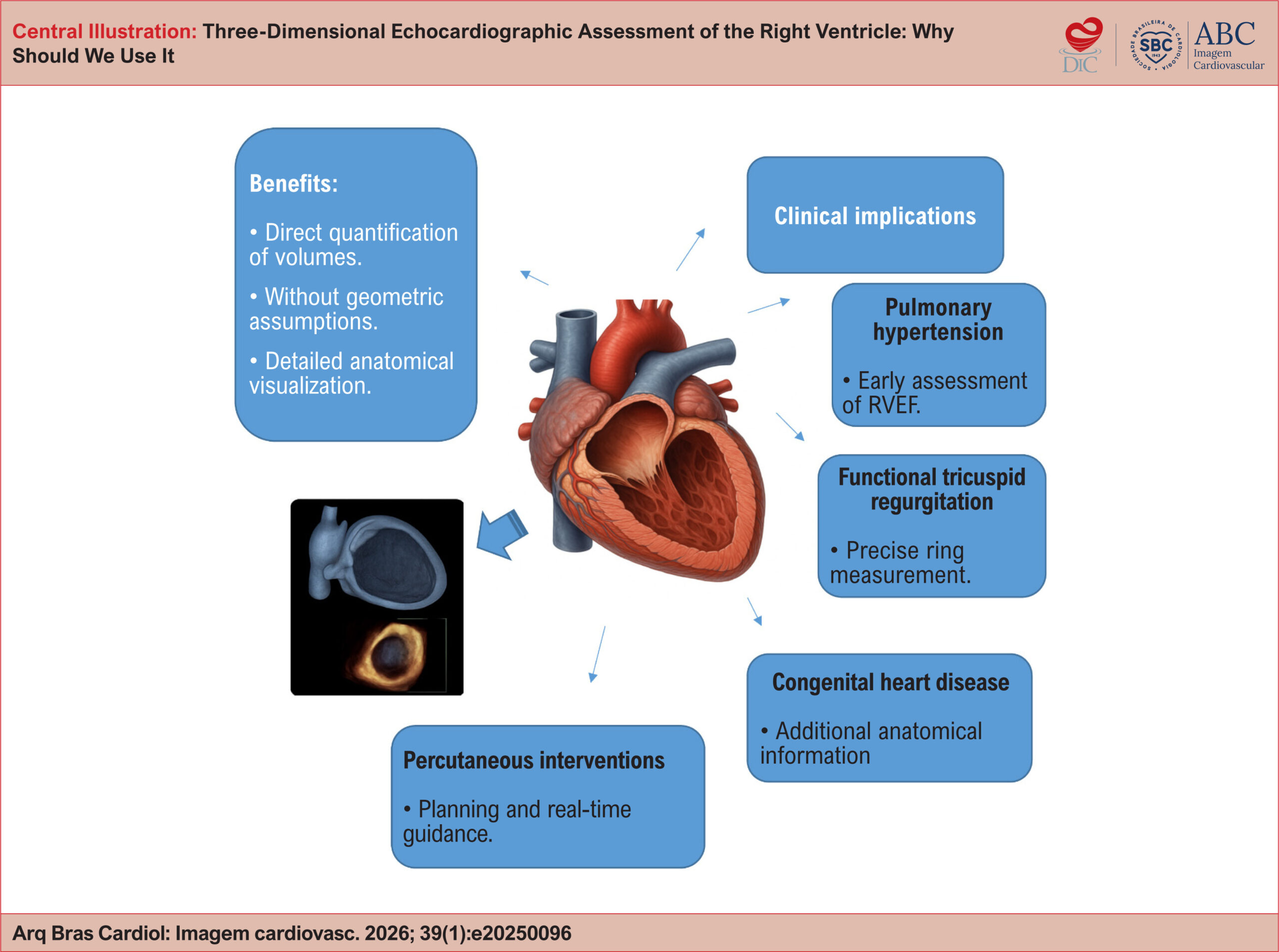
Right ventricular (RV) assessment using two-dimensional (2D) echocardiography has historically faced significant challenges due to the chamber’s complex and unique geometry and its thoracic orientation. In this context, three-dimensional (3D) echocardiography has emerged as a promising tool to overcome and illuminate these limitations, enabling accurate quantification of volumes and ejection fraction without relying on geometric assumptions. As a result, the routine incorporation of 3D echocardiography into RV evaluation may redefine diagnostic and prognostic paradigms, fostering a more precise and personalized approach in modern cardiology. To consolidate and highlight this technique, this review article explores the technical principles of 3D echocardiography for RV assessment, discusses its advantages over conventional 2D imaging, examines its validation against cardiac magnetic resonance (CMR), and reviews key clinical applications, including pulmonary hypertension, functional tricuspid regurgitation, congenital heart disease, and right-sided heart failure. Additionally, the article outlines current limitations of the technique, future perspectives, and practical recommendations based on contemporary literature.
  • Cardiac Magnetic Resonance Imaging
  • Ejection Fraction
  • Right ventricle
  • Three-Dimensional Echocardiography
Read Full Article
Creative Commons Attribution (CC BY) Creative Commons license
10/04/2026 DOI: 10.36660/abcimg.20250096i Views 1
Figure 1
ABCIC
Case Report

Long-term Follow-Up of a Patient with FLNC Gene Mutation-Related Cardiomyopathy: A Case Report

Isabela Bispo Santos da Silva Costa et al. Bruno Soares da Silva Rangel Antonio Tito Paladino Filho Bruno Normande Colombo … Thamara Carvalho Morais Ludhmila Abrahão Hajjar

Introduction

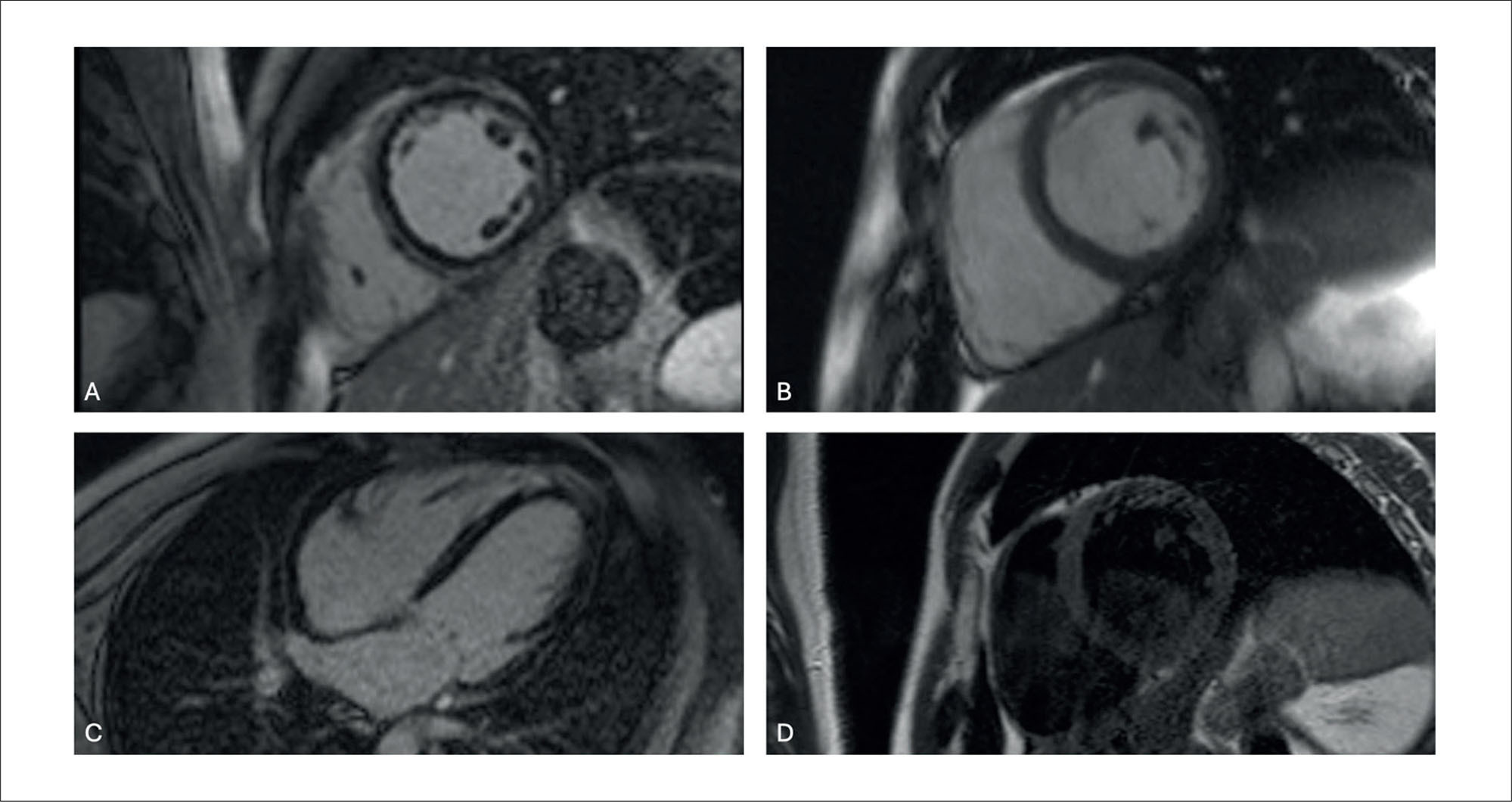
Heart Failure (HF) is estimated to affect approximately 26 million people worldwide., In Brazil, prevalence is high, with about 2 million diagnosed patients and an incidence of roughly 240,000 new cases every year. Between 2011 and 2021, more than 2.5 million HF-related hospitalizations were recorded in the Brazilian Unified Health System (SUS), underscoring the relevance of the disease in the national context. These figures highlight the need for early diagnostic strategies and etiological definition for the appropriate management of these patients. Establishing an etiological diagnosis is often challenging but essential to provide disease-specific treatments and improve prognosis. Diagnosis encompasses multimodality cardiac imaging, with Cardiac Magnetic Resonance imaging (CMR) being a useful tool for evaluating non-ischemic cardiomyopathy phenotypes and establishing an etiological diagnosis.

[…]

  • Arrhythmias Cardiac
  • Cardiac Magnetic Resonance Imaging
  • Cardiomyopathies
  • Genetics
  • Sudden Cardiac Death
Read Full Article
Creative Commons Attribution (CC BY) Creative Commons license
03/12/2025 DOI: 10.36660/abcimg.20250071i
Figure 1
ABCIC
Review Article

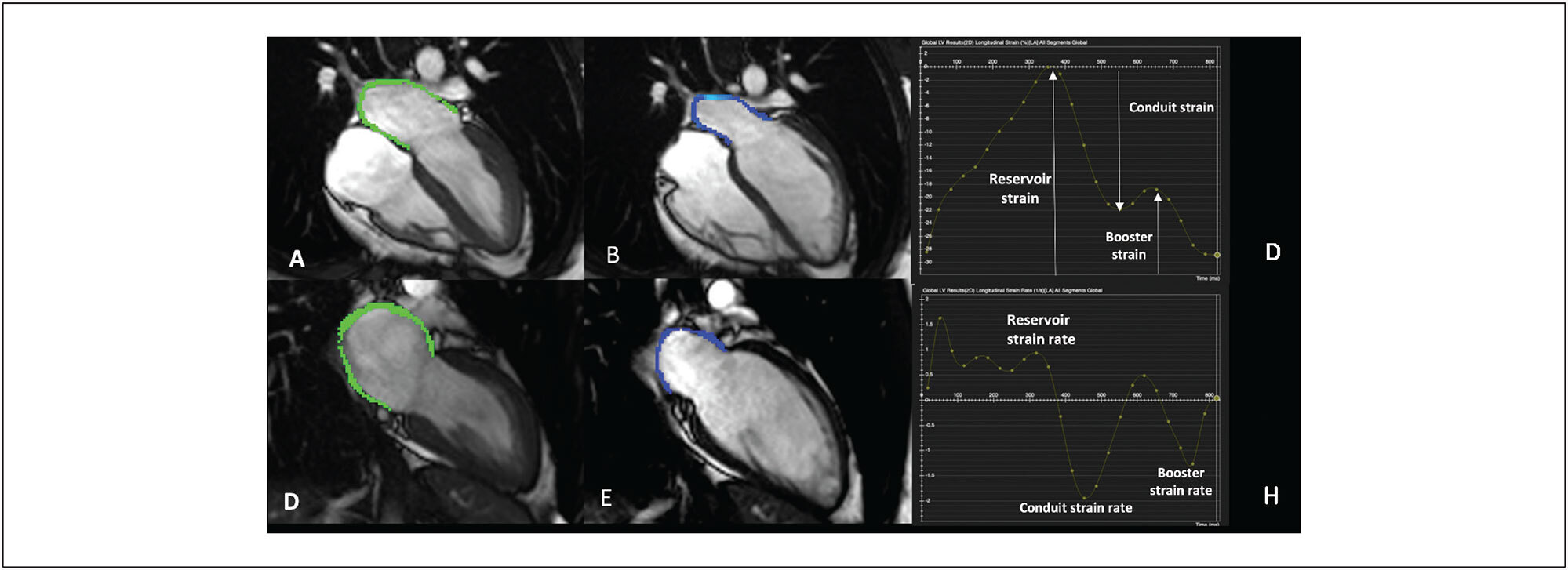
My Approach to Atrial Strain by Cardiac Magnetic Resonanc

Isabela Bispo Santos da Silva Costa et al. Rafael Almeida Fonseca Carlos Eduardo Rochitte

Abstract

Assessment of left atrial strain (LAS) using cardiac magnetic resonance (CMR) is gaining interest in cardiology as a novel parameter, as it quantifies the left atrium’s (LA) deformation throughout the cardiac cycle. Traditionally, LA function was inferred from left ventricular ejection fraction and LA volume. However, recent studies emphasize the prognostic significance of directly analyzing atrial function, particularly in atrial fibrillation (AF), heart failure, and arterial hypertension. CMR provides a thorough evaluation of cardiac anatomy and function, enabling precise and reproducible measurement of atrial tissue deformation.

  • Cardiac Magnetic Resonance Imaging
  • Left atrium
  • Right Atrium
  • Stran Imaging
Read Full Article
Creative Commons Attribution (CC BY) Creative Commons license
26/06/2024 DOI: 10.36660/abcimg.20240020i Views 1
Figure 1
ABC
Original Article

Prognostic Value of Adenosine Stress Perfusion Cardiac Magnetic Resonance Imaging in Older Adults with Known or Suspected Coronary Artery Disease

Yodying Kaolawanich et al. Thananya Boonyasirinant

Abstract

Background:

There is limited data on the prognostic value of stress cardiac magnetic resonance (CMR) in older adults.

Objective:

To determine the prognostic value of adenosine stress CMR in older individuals with known or suspected coronary artery disease (CAD).

Methods:

Between 2010 and 2015, consecutive patients aged 65 years or older referred for adenosine stress CMR were followed for the occurrence of severe cardiac events (cardiac death and nonfatal myocardial infarction) and major adverse cardiovascular events (MACE) that also included hospitalization for heart failure and ischemic stroke. Univariate and multivariate analyses were performed to determine the prognostic value of myocardial ischemia, with p-value <0.05 considered statistically significant.

Results:

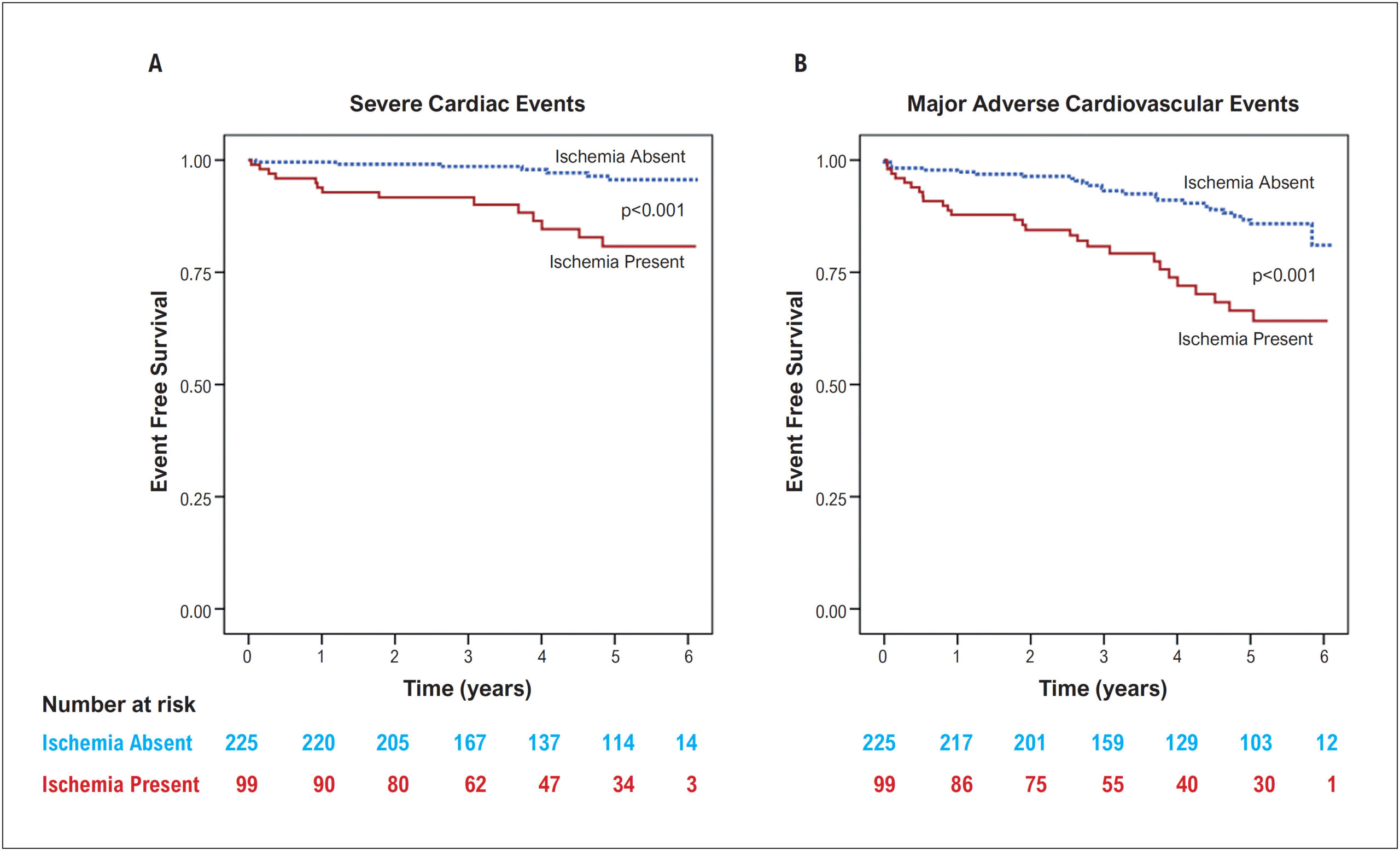
After a mean follow-up period of 50.4 months in 324 patients (48% male, 73±7 years), 21 severe cardiac events and 52 MACE occurred. Patients with myocardial ischemia (n=99) had significantly higher rates of severe cardiac events (HR 5.25 [95% CI 2.11-13.04], p<0.001) and MACE (HR 3.01 [95% CI 1.75-5.20], p<0.001) than those without ischemia. Multivariable analysis determined ischemia as an independent predictor of severe cardiac events (HR 3.14 [95% CI 1.22-8.07], p=0.02) and MACE (HR 1.91 [95%CI 1.02-3.59], p=0.04). Ischemia provided an incremental prognostic value over clinical factors and left ventricular ejection fraction for predicting severe cardiac events and MACE (p<0.01 for both). No severe adverse events occurred during or immediately after CMR examinations.

Conclusion:

Adenosine stress CMR is safe and has prognostic value in older adults with known or suspected CAD.

  • Adenosine
  • Cardiac Magnetic Resonance Imaging
  • Coronary Artery Disease
  • Elderly
  • stress test
Read Full Article
Creative Commons Attribution (CC BY) Creative Commons license
11/07/2022 DOI: 10.36660/abc.20210530
Symptomatic severe chronic aortic valve disease: a comparative study of cardiac magnetic resonance imaging and echocardiography
ABC
Artigo Original

Symptomatic severe chronic aortic valve disease: a comparative study of cardiac magnetic resonance imaging and echocardiography

Marcelo Nigri et al. Carlos Eduardo Rochitte Flávio Tarasoutchi Guilherme S Spina … José Rodrigues Parga Luiz Francisco Ávila Roney Orismar Sampaio José Antonio Franchini Ramires Max Grinberg

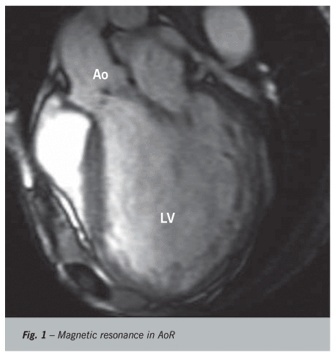
OBJECTIVE: To show the real value of cardiac magnetic resonance imaging (CMRI) in the evaluation of patients with symptomatic chronic aortic valve disease. METHODS: Seventy patients – 35 with aortic stenosis (AoS) and 35 with aortic regurgitation (AoR) with surgical indication, who underwent preoperative echocardiogram (ECHO) and CMRI to assess ventricular function, volumes, and left ventricular mass index using cine magnetic resonance imaging, were studied. RESULTS: No statistically significant difference was observed between the AoS and AoR groups when ECHO and CMRI variables were compared. When compared with the type of symptom, ECHO and CMRI variables showed the same pattern. CONCLUSION: CMRI data were in agreement with ECHO data regarding the assessment of left ventricular volume and ejection fraction, and with the clinical presentation of patients with chronic aortic valve disease.

  • Cardiac Magnetic Resonance Imaging
  • chronic aortic valve disease
  • Echocardiogram
  • Functional Class
Read Full Article
Creative Commons Attribution (CC BY) Creative Commons license
20/02/2006 DOI: 10.1590/S0066-782X2006000200011 Views 1

How to cite this article

EndNote RIS

Electronic Document Format (Vancouver)

Politi TR, Barretto RB, Sbano JCN, Bihan DCSL, Mathias Jr. W. Three-Dimensional Echocardiographic Assessment of the Right Ventricle: Why Should We Use It. ABC Imagem Cardiovascular 2026;39(1):e20250096.

Electronic Document Format (ABNT)

Politi, Tiago R.; Barretto, Rodrigo B.M.; Sbano, João Cesar Nunes; Bihan, David Costa de Souza Le; Mathias Jr., Wilson. Three-Dimensional Echocardiographic Assessment of the Right Ventricle: Why Should We Use It. ABC Imagem Cardiovascular, v. 39, n. 1, e20250096, Apr. 2026.

Electronic Document Format (APA)

Politi, T. R., Barretto, R. B., Sbano, J. C. N., Bihan, D. C. S. L., & Mathias Jr., W. (2026). Three-Dimensional Echocardiographic Assessment of the Right Ventricle: Why Should We Use It. ABC Imagem Cardiovascular, 39(1), e20250096.

Electronic Document Format (ISO)

Politi, Tiago R. and Barretto, Rodrigo B.M. and Sbano, João Cesar Nunes and Bihan, David Costa de Souza Le and Mathias Jr., Wilson. Three-Dimensional Echocardiographic Assessment of the Right Ventricle: Why Should We Use It. ABC Imagem Cardiovascular [online]. 2026, vol. 39, n. 1, [cited 2026-10-14], e20250096. Available from: <https://journals.cardiol.br/en/article/three-dimensional-echocardiographic-assessment-of-the-right-ventricle-why-should-we-use-it/>. ISSN 2318-8219

EndNote RIS

Electronic Document Format (Vancouver)

Costa IBSS, Rangel BSS, Paladino Filho AT, Colombo BN, Morais TC, Hajjar LA. Long-term Follow-Up of a Patient with FLNC Gene Mutation-Related Cardiomyopathy: A Case Report. ABC Imagem Cardiovascular 2025;38(3):e20250071.

Electronic Document Format (ABNT)

Costa, Isabela Bispo Santos da Silva; Rangel, Bruno Soares da Silva; Paladino Filho, Antonio Tito; Colombo, Bruno Normande; Morais, Thamara Carvalho; Hajjar, Ludhmila Abrahão. Long-term Follow-Up of a Patient with FLNC Gene Mutation-Related Cardiomyopathy: A Case Report. ABC Imagem Cardiovascular, v. 38, n. 3, e20250071, Dec. 2025.

Electronic Document Format (APA)

Costa, I. B. S. S., Rangel, B. S. S., Paladino Filho, A. T., Colombo, B. N., Morais, T. C., & Hajjar, L. A. (2025). Long-term Follow-Up of a Patient with FLNC Gene Mutation-Related Cardiomyopathy: A Case Report. ABC Imagem Cardiovascular, 38(3), e20250071.

Electronic Document Format (ISO)

Costa, Isabela Bispo Santos da Silva and Rangel, Bruno Soares da Silva and Paladino Filho, Antonio Tito and Colombo, Bruno Normande and Morais, Thamara Carvalho and Hajjar, Ludhmila Abrahão. Long-term Follow-Up of a Patient with FLNC Gene Mutation-Related Cardiomyopathy: A Case Report. ABC Imagem Cardiovascular [online]. 2025, vol. 38, n. 3, [cited 2026-10-14], e20250071. Available from: <https://journals.cardiol.br/en/article/long-term-follow-up-of-a-patient-with-flnc-gene-mutation-related-cardiomyopathy-a-case-report/>. ISSN 2318-8219

EndNote RIS

Electronic Document Format (Vancouver)

Costa IBSS, Fonseca RA, Rochitte CE. My Approach to Atrial Strain by Cardiac Magnetic Resonanc. ABC Imagem Cardiovascular 2024;37(2):e20240020.

Electronic Document Format (ABNT)

Costa, Isabela Bispo Santos da Silva; Fonseca, Rafael Almeida; Rochitte, Carlos Eduardo. My Approach to Atrial Strain by Cardiac Magnetic Resonanc. ABC Imagem Cardiovascular, v. 37, n. 2, e20240020, Jun. 2024.

Electronic Document Format (APA)

Costa, I. B. S. S., Fonseca, R. A., & Rochitte, C. E. (2024). My Approach to Atrial Strain by Cardiac Magnetic Resonanc. ABC Imagem Cardiovascular, 37(2), e20240020.

Electronic Document Format (ISO)

Costa, Isabela Bispo Santos da Silva and Fonseca, Rafael Almeida and Rochitte, Carlos Eduardo. My Approach to Atrial Strain by Cardiac Magnetic Resonanc. ABC Imagem Cardiovascular [online]. 2024, vol. 37, n. 2, [cited 2026-10-14], e20240020. Available from: <https://journals.cardiol.br/en/article/my-approach-to-atrial-strain-by-cardiac-magnetic-resonanc/>. ISSN 2318-8219

EndNote RIS

Electronic Document Format (Vancouver)

Kaolawanich Y, Boonyasirinant T. Prognostic Value of Adenosine Stress Perfusion Cardiac Magnetic Resonance Imaging in Older Adults with Known or Suspected Coronary Artery Disease. Arquivos Brasileiros de Cardiologia 2022;119(1):97-106.

Electronic Document Format (ABNT)

Kaolawanich, Yodying; Boonyasirinant, Thananya. Prognostic Value of Adenosine Stress Perfusion Cardiac Magnetic Resonance Imaging in Older Adults with Known or Suspected Coronary Artery Disease. Arquivos Brasileiros de Cardiologia, v. 119, n. 1, p. 97-106, Jul. 2022.

Electronic Document Format (APA)

Kaolawanich, Y., & Boonyasirinant, T. (2022). Prognostic Value of Adenosine Stress Perfusion Cardiac Magnetic Resonance Imaging in Older Adults with Known or Suspected Coronary Artery Disease. Arquivos Brasileiros de Cardiologia, 119(1), 97-106.

Electronic Document Format (ISO)

Kaolawanich, Yodying and Boonyasirinant, Thananya. Prognostic Value of Adenosine Stress Perfusion Cardiac Magnetic Resonance Imaging in Older Adults with Known or Suspected Coronary Artery Disease. Arquivos Brasileiros de Cardiologia [online]. 2022, vol. 119, n. 1, [cited 2026-10-14], pp. 97-106. Available from: <https://journals.cardiol.br/en/article/prognostic-value-of-adenosine-stress-perfusion-cardiac-magnetic-resonance-imaging-in-older-adults-with-known-or-suspected-coronary-artery-disease/>. ISSN 0066-782X

EndNote RIS

Electronic Document Format (Vancouver)

Nigri M, Rochitte CE, Tarasoutchi F, Spina GS, Parga JR, Ávila LF, Sampaio RO, et al. Symptomatic severe chronic aortic valve disease: a comparative study of cardiac magnetic resonance imaging and echocardiography. Arquivos Brasileiros de Cardiologia 2006;86(2):145-9.

Electronic Document Format (ABNT)

Nigri, Marcelo; Rochitte, Carlos Eduardo; Tarasoutchi, Flávio; Spina, Guilherme S; Parga, José Rodrigues; Ávila, Luiz Francisco; Sampaio, Roney Orismar; Ramires, José Antonio Franchini; Grinberg, Max. Symptomatic severe chronic aortic valve disease: a comparative study of cardiac magnetic resonance imaging and echocardiography. Arquivos Brasileiros de Cardiologia, v. 86, n. 2, p. 145-149, Feb. 2006.

Electronic Document Format (APA)

Nigri, M., Rochitte, C. E., Tarasoutchi, F., Spina, G. S., Parga, J. R., Ávila, L. F., Sampaio, R. O., Ramires, J. A. F., & Grinberg, M. (2006). Symptomatic severe chronic aortic valve disease: a comparative study of cardiac magnetic resonance imaging and echocardiography. Arquivos Brasileiros de Cardiologia, 86(2), 145-149.

Electronic Document Format (ISO)

Nigri, Marcelo and Rochitte, Carlos Eduardo and Tarasoutchi, Flávio and Spina, Guilherme S and Parga, José Rodrigues and Ávila, Luiz Francisco and Sampaio, Roney Orismar and Ramires, José Antonio Franchini and Grinberg, Max. Symptomatic severe chronic aortic valve disease: a comparative study of cardiac magnetic resonance imaging and echocardiography. Arquivos Brasileiros de Cardiologia [online]. 2006, vol. 86, n. 2, [cited 2026-10-14], pp. 145-149. Available from: <https://journals.cardiol.br/en/article/symptomatic-severe-chronic-aortic-valve-disease-a-comparative-study-of-cardiac-magnetic-resonance-imaging-and-echocardiography/>. ISSN 0066-782X

  • About ABC Family
  • Internal Regulation
  • Editorial Board
  • Brazilian Society of Cardiology (SBC)

Issues

SBC Guidelines

  • Videos
  • Podcasts
  • News