ABC Family Arquivos Brasileiros de Cardiologia International Journal of Cardiovascular Sciences ABC Heart Failure & Cardiomyopathy ABC Imagem Cardiovascular
Português English
ABC Family
Português English
  • About
    • About ABC Family
    • Internal Regulation
    • Editorial Board
    • Brazilian Society of Cardiology (SBC)
  • Issues
  • SBC Guidelines
  • Content
    • Videos
    • Podcasts
    • News
  • About
    • About ABC Family
    • Internal Regulation
    • Editorial Board
    • Brazilian Society of Cardiology (SBC)
  • Issues
  • SBC Guidelines
  • Content
    • Videos
    • Podcasts
    • News

ABC Family

  • ABC Family
  • Arquivos Brasileiros de Cardiologia
  • International Journal of Cardiovascular Sciences
  • ABC Heart Failure & Cardiomyopathy
  • ABC Imagem Cardiovascular
Search in

No content found.

Journals
Ordering
Article types
Others

  1. Home
  2. Keyword: Transthyretin
ABC
Editorial

To Silence or to Stabilize: That is the Question

João Bicho Augusto

Transthyretin amyloid cardiomyopathy (ATTR-CM) was previously considered an inescapable progressive disease leading to devastating outcomes. Clinicians often disregarded ATTR-CM, as the therapeutical arsenal available was very limited. Historically, treatments have offered mostly symptomatic relief without altering disease progression. Fortunately, the last decade brought us disease-modifying treatments with the potential to transform the course of ATTR-CM.

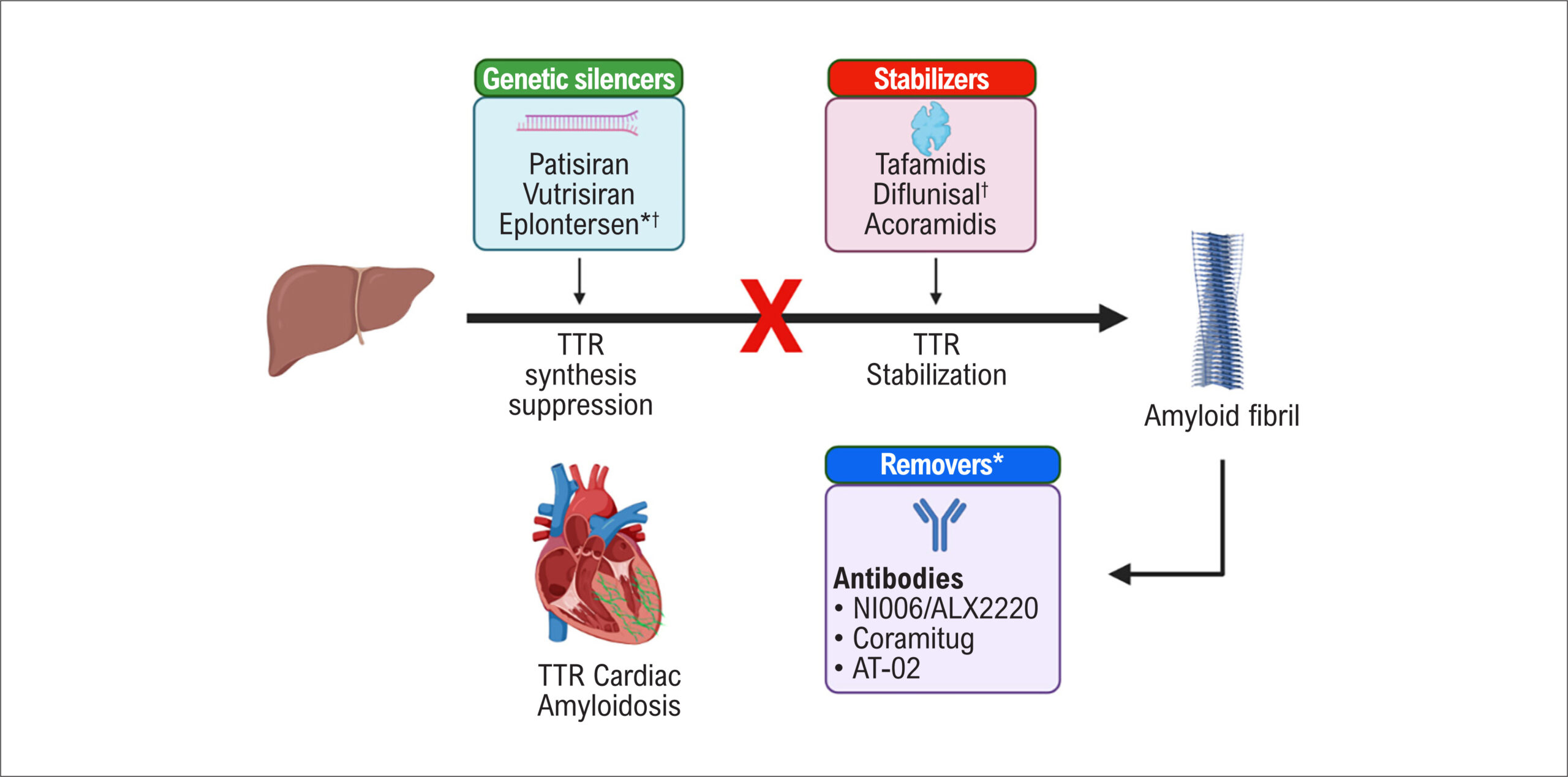
At a molecular level, ATTR-CM develops when transthyretin (TTR), usually a stable transport protein for thyroxine and vitamin A, dissociates from its tetrameric configuration into monomers and amyloid fibrils that accumulate in the myocardium. Two key drug classes have been studied for the treatment of ATTR-CM: stabilizers and silencers. Stabilizers, such as tafamidis and acoramidis, act by stabilizing the TTR tetramer configuration, thus preventing its breakdown and subsequent deposition of amyloid fibrils., In contrast, silencers, such as patisiran and vutrisiran, inhibit the hepatic production of TTR via RNA interference mechanisms, essentially reducing the source of the amyloid precursor., Historically, the ATTR-ACT study was the first Phase III trial to demonstrate that a drug for ATTR-CM, tafamidis, could reduce all-cause mortality, giving stabilizers a competitive edge. However, with newer drug classes, which option is the best for our patients?

[…]

  • Amyloidosis
  • cardiomyopathy
  • Transthyretin
Read Full Article
Creative Commons Attribution (CC BY) Creative Commons license
03/10/2025 DOI: 10.36660/abc.20250426i Views 1
Figure 1
ABC
Editorial

Patisiran in the Treatment of Cardiac Amyloidosis: Good for the World and Good for Brazil

Humberto Villacorta

Patisiran is an RNA interference therapeutic agent used in the treatment of transthyretin-mediated amyloidosis (ATTR amyloidosis), a condition characterized by the accumulation of misfolded transthyretin (TTR) protein amyloid fibrils in tissues.– As shown in , the mechanism of action differs from previous drugs such as tafamidis, which promotes the stabilization of the TTR protein, rather than the synthesis inhibition., Patisiran uses a mechanism involving small interfering RNA to specifically target the messenger RNA (mRNA) responsible for producing the TTR protein in the liver. It activates the RNA-induced silencing complex, which promotes the degradation of the TTR mRNA. By degrading TTR mRNA, patisiran effectively reduces the synthesis of TTR protein within the liver. This leads to decreased levels of both normal and mutant forms of TTR.–

The effects of patisiran in cardiac amyloidosis were assessed in the APOLLO B study, which was a phase 3, multicenter, randomized, double-blind, placebo-controlled trial involving 360 patients diagnosed with hereditary or wild-type ATTR amyloidosis with cardiomyopathy, aimed at assessing treatment effects on cardiac function and quality of life. The primary endpoint was a change from baseline in the functional capacity as assessed by the 6-minute walk test (6MWT) at 12 months. The walk distance in the 6MWT decreased over time in both groups, but it was attenuated in the patisiran group (mean change −8.15 vs −21.35 m, in the patisiran and placebo group, respectively). Quality of life as assessed by the Kansas City Cardiomyopathy Questionnaire-Overall Summary (KCCQ-OS) improved in the patisiran group and declined in the placebo group. In a secondary endpoint analysis, no difference was observed in a combined endpoint of death from any cause, cardiovascular events, or change in the 6MWT. An explanatory analysis found that patisiran attenuated the increase in the cardiac biomarkers NT-proBNP and troponin I.

[…]

  • Cardiac Amyloidosis
  • Genetic Silencers
  • Transthyretin
  • Treatment
Read Full Article
Creative Commons Attribution (CC BY) Creative Commons license
07/07/2025 DOI: 10.36660/abc.20250335i
Patisiran Treatment in the Brazilian Subpopulation of the Phase 3 APOLLO-B Study in Transthyretin Amyloidosis with Cardiomyopathy: Post Hoc Analysis
ABC
Original Article

Patisiran Treatment in the Brazilian Subpopulation of the Phase 3 APOLLO-B Study in Transthyretin Amyloidosis with Cardiomyopathy: Post Hoc Analysis

Claudio Tinoco Mesquita et al. Pedro Schwartzmann Edileide Barros Correia Marcus V. Simões … Andreia Biolo Daniel Rodriguez Duque Patrick Y. Jay Fábio Fernandes

Abstract

Background

Patisiran rapidly knocked down transthyretin and preserved functional capacity in patients with transthyretin amyloidosis with cardiomyopathy (ATTR-CM) in the global Phase 3 APOLLO-B study (NCT03997383).

Objectives

To evaluate patisiran efficacy and safety in post hoc analysis of the Brazilian subpopulation of APOLLO-B.

Methods

Patients were randomized 1:1 to patisiran 0.3 mg/kg or placebo every 3 weeks for 12 months. The primary endpoint was the change from baseline (CFB) in functional capacity (6-minute walk test [6MWT]) at Month 12. Secondary endpoints included CFB to Month 12 in the Kansas City Cardiomyopathy Questionnaire-Overall Summary (KCCQ-OS) score. Exploratory endpoints included CFB in cardiac biomarkers and Perugini grade of cardiac uptake during technetium-99m scintigraphy.

Results

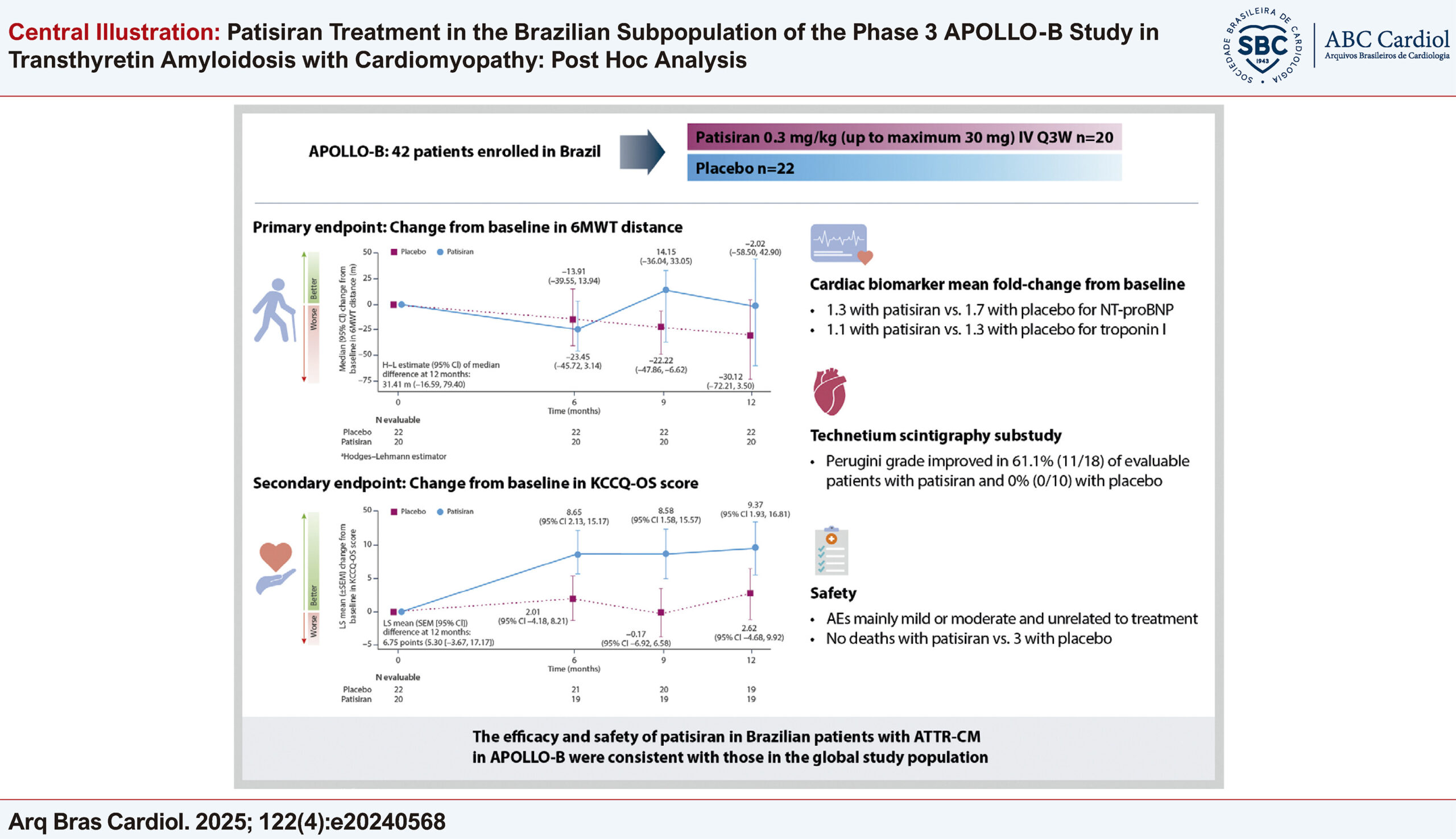
Forty-two patients enrolled in Brazil (patisiran, n=20; placebo, n=22). Patisiran showed benefit in 6MWT and KCCQ-OS scores vs. placebo; CFB (95% confidence interval [CI]) in 6MWT (median) and KCCQ-OS scores (least squares mean) was –2.0 m (–58.5, 42.9) and 9.37 (1.93, 16.81) points with patisiran vs. –30.1 m (–72.2, 3.5) and 2.62 (–4.68, 9.92) points for placebo. For cardiac biomarkers, the mean fold-change from baseline (95% CI) for N-terminal prohormone B-type natriuretic peptide and troponin I was 1.31 (1.06, 1.61) and 1.12 (0.94, 1.34) for patisiran, and 1.71 (1.39, 2.10) and 1.28 (1.08, 1.53) for placebo, respectively. Perugini grade improved in 11/18 (61.1%) and 0/10 evaluable patients with patisiran and placebo, respectively. There were no deaths in the patisiran group vs. 3 in the placebo group.

Conclusion

The efficacy and safety of patisiran in Brazilian patients with ATTR-CM in APOLLO-B were consistent with those in the global study population. Findings are descriptive due to the small number of patients.

  • Amyloidosis
  • Cardiomyopathies
  • Clinical Trial
  • Small Interfering RNA
  • Transthyretin
Read Full Article
Creative Commons Attribution (CC BY) Creative Commons license
14/04/2025 DOI: 10.36660/abc.20240568i Views 1
ABCHF
Editorial

ATTRv: a Multisystemic Disease Requires a Multiprofessional Approach

Carolina Lavigne Moreira et al. Wilson Marques Júnior

Pathogenic variants of the transtiretin gene (TTRv) result in the production of amyloidogenic fibrils that deposit in the extracellular space of many tissues, resulting in amyloidogenic multisystemic disease (ATTRv). Several tissues may be affected in different combinations, including the peripheral nerves and the cardiac system, which are usually the main targets, but also the kidneys, eyes, gastrointestinal system, central nervous system and musculoskeletal structures.

ATTRv is a progressive disease that results in death around 8 to 15 years after the onset of the disease, even more rapidly when the cardiac system is involved early. However, the natural history of the disease has changed with the introduction of treatments that, by different mechanisms, decrease the production of amyloid fibrils.

[…]

  • cardiomyopathy
  • Polyneuropathy
  • Transthyretin
  • TTR
Read Full Article
Creative Commons Attribution (CC BY) Creative Commons license
10/12/2021 DOI: 10.36660/abchf.20210026 Views 2
ABCHF
Viewpoint

Disease Modifying Therapies for Transthyretin Amyloid Cardiomyopathy

Ariane Vieira Scarlatelli Macedo et al. Fábio Fernandes Renato Delascio Lopes

Transthyretin (TTR) is a tetrameric protein synthesized essentially by the liver. TTR molecules may misfold and store as amyloid fibrils in the heart and other organs, leading to TTR-related amyloidosis (ATTR) . ATTR can follow the deposition of either variant ATTR (ATTRv), which was previously known as mutant ATTR, or wild-type ATTR (ATTRwt). ATTR is an underdiagnosed disease, as well as a crucial determinant of morbidity and mortality. Cardiac involvement is common in ATTR, leading to transthyretin cardiomyopathy (ATTR-CA). ATTR-CA is a progressive disorder, and patients ultimately develop heart failure, arrhythmias, and cardiac conduction disturbances, resulting in decreased functional capacity, diminished quality of life, and death. Until recently, treatment of ATTR-CA was limited to treating symptoms and complications; however, the development of new specific therapies that delay or stop the progress of the cardiomyopathy has positively modified the outcomes . These specific treatments work by targeting the inhibition of TTR synthesis (inotersen or patisiran); tetramer stabilization (diflunisal, tafamidis, or acoramidis [AG10]); inhibition of oligomer aggregation and disruption (epigallocatechin-3-gallate); and degradation and reabsorption of amyloid fibers (doxycycline-tauroursodeoxycholic acid [TUDCA] or doxycycline-ursodeoxycholic acid [UDCA]).4

In patients with ATTR-CA, either ATTRv or ATTRwt, tafamidis is considered the agent of choice due to the proven clinical benefit in cardiovascular outcomes. Tafamidis is a kinetic TTR stabilizer that binds to the unoccupied thyroxine binding sites of tetrameric TTR and blocks the amyloidogenic cascade. It was first adopted for treatment of symptomatic ATTRv polyneuropathy, and it is the only therapy approved with effectiveness to treat ATTR-CA. This recommendation is essentially based on the results of a large, well-designed phase III randomized clinical trial (RCT), ATTR-ACT. In this study, tafamidis (20 and 80 mg, pooled) showed a decline in all-cause mortality and cardiovascular-related hospitalization, decreased decline in 6-minute walk test, slower deterioration in quality of life, and a minor increase of NT-proBNP in patients with biopsy-proven ATTRwt or ATTRv CA with heart failure and NYHA class I to III at 30 months. The safety profile was similar to placebo, and individuals with NYHA classes I and II reached the most meaningful benefit. ATTR-ACT was not designed to assess a specific dose; therefore, further analysis from ATTR-ACT and its long-term extension study support tafamidis 80 mg as the optimal dose to be used in clinical practice.

[…]

  • Amyloidosis
  • Cardiac Amyloidosis
  • Transthyretin
  • Treatment
  • TTR
Read Full Article
Creative Commons Attribution (CC BY) Creative Commons license
10/12/2021 DOI: 10.36660/abchf.20210034 Views 2

How to cite this article

EndNote RIS

Electronic Document Format (Vancouver)

Augusto JB. To Silence or to Stabilize: That is the Question. Arquivos Brasileiros de Cardiologia 2025;122(8):e20250426.

Electronic Document Format (ABNT)

Augusto, João Bicho. To Silence or to Stabilize: That is the Question. Arquivos Brasileiros de Cardiologia, v. 122, n. 8, e20250426, Oct. 2025.

Electronic Document Format (APA)

Augusto, J. B. (2025). To Silence or to Stabilize: That is the Question. Arquivos Brasileiros de Cardiologia, 122(8), e20250426.

Electronic Document Format (ISO)

Augusto, João Bicho. To Silence or to Stabilize: That is the Question. Arquivos Brasileiros de Cardiologia [online]. 2025, vol. 122, n. 8, [cited 2026-10-14], e20250426. Available from: <https://journals.cardiol.br/en/article/to-silence-or-to-stabilize-that-is-the-question/>. ISSN 0066-782X

EndNote RIS

Electronic Document Format (Vancouver)

Villacorta H. Patisiran in the Treatment of Cardiac Amyloidosis: Good for the World and Good for Brazil. Arquivos Brasileiros de Cardiologia 2025;122(4):e20250335.

Electronic Document Format (ABNT)

Villacorta, Humberto. Patisiran in the Treatment of Cardiac Amyloidosis: Good for the World and Good for Brazil. Arquivos Brasileiros de Cardiologia, v. 122, n. 4, e20250335, Jul. 2025.

Electronic Document Format (APA)

Villacorta, H. (2025). Patisiran in the Treatment of Cardiac Amyloidosis: Good for the World and Good for Brazil. Arquivos Brasileiros de Cardiologia, 122(4), e20250335.

Electronic Document Format (ISO)

Villacorta, Humberto. Patisiran in the Treatment of Cardiac Amyloidosis: Good for the World and Good for Brazil. Arquivos Brasileiros de Cardiologia [online]. 2025, vol. 122, n. 4, [cited 2026-10-14], e20250335. Available from: <https://journals.cardiol.br/en/article/patisiran-in-the-treatment-of-cardiac-amyloidosis-good-for-the-world-and-good-for-brazil/>. ISSN 0066-782X

EndNote RIS

Electronic Document Format (Vancouver)

Mesquita CT, Schwartzmann P, Correia EB, Simões MV, Biolo A, Duque DR, Jay PY, et al. Patisiran Treatment in the Brazilian Subpopulation of the Phase 3 APOLLO-B Study in Transthyretin Amyloidosis with Cardiomyopathy: Post Hoc Analysis. Arquivos Brasileiros de Cardiologia 2025;122(4):e20240568.

Electronic Document Format (ABNT)

Mesquita, Claudio Tinoco; Schwartzmann, Pedro; Correia, Edileide Barros; Simões, Marcus V.; Biolo, Andreia; Duque, Daniel Rodriguez; Jay, Patrick Y.; Fernandes, Fábio. Patisiran Treatment in the Brazilian Subpopulation of the Phase 3 APOLLO-B Study in Transthyretin Amyloidosis with Cardiomyopathy: Post Hoc Analysis. Arquivos Brasileiros de Cardiologia, v. 122, n. 4, e20240568, Apr. 2025.

Electronic Document Format (APA)

Mesquita, C. T., Schwartzmann, P., Correia, E. B., Simões, M. V., Biolo, A., Duque, D. R., Jay, P. Y., & Fernandes, F. (2025). Patisiran Treatment in the Brazilian Subpopulation of the Phase 3 APOLLO-B Study in Transthyretin Amyloidosis with Cardiomyopathy: Post Hoc Analysis. Arquivos Brasileiros de Cardiologia, 122(4), e20240568.

Electronic Document Format (ISO)

Mesquita, Claudio Tinoco and Schwartzmann, Pedro and Correia, Edileide Barros and Simões, Marcus V. and Biolo, Andreia and Duque, Daniel Rodriguez and Jay, Patrick Y. and Fernandes, Fábio. Patisiran Treatment in the Brazilian Subpopulation of the Phase 3 APOLLO-B Study in Transthyretin Amyloidosis with Cardiomyopathy: Post Hoc Analysis. Arquivos Brasileiros de Cardiologia [online]. 2025, vol. 122, n. 4, [cited 2026-10-14], e20240568. Available from: <https://journals.cardiol.br/en/article/patisiran-treatment-in-the-brazilian-subpopulation-of-the-phase-3-apollo-b-study-in-transthyretin-amyloidosis-with-cardiomyopathy-post-hoc-analysis/>. ISSN 0066-782X

EndNote RIS

Electronic Document Format (Vancouver)

Moreira CL, Marques Júnior W. ATTRv: a Multisystemic Disease Requires a Multiprofessional Approach. Phenomenology, Humanities and Sciences – Fenomenologia, Humanidades e Ciências 2021;1(2):84-5.

Electronic Document Format (ABNT)

Moreira, Carolina Lavigne; Marques Júnior, Wilson. ATTRv: a Multisystemic Disease Requires a Multiprofessional Approach. Phenomenology, Humanities and Sciences – Fenomenologia, Humanidades e Ciências, v. 1, n. 2, p. 84-85, Dec. 2021.

Electronic Document Format (APA)

Moreira, C. L., & Marques Júnior, W. (2021). ATTRv: a Multisystemic Disease Requires a Multiprofessional Approach. Phenomenology, Humanities and Sciences – Fenomenologia, Humanidades e Ciências, 1(2), 84-85.

Electronic Document Format (ISO)

Moreira, Carolina Lavigne and Marques Júnior, Wilson. ATTRv: a Multisystemic Disease Requires a Multiprofessional Approach. Phenomenology, Humanities and Sciences – Fenomenologia, Humanidades e Ciências [online]. 2021, vol. 1, n. 2, [cited 2026-10-14], pp. 84-85. Available from: <https://journals.cardiol.br/en/article/attrv-a-multisystemic-disease-requires-a-multiprofessional-approach/>

EndNote RIS

Electronic Document Format (Vancouver)

Macedo AVS, Fernandes F, Lopes RD. Disease Modifying Therapies for Transthyretin Amyloid Cardiomyopathy. Phenomenology, Humanities and Sciences – Fenomenologia, Humanidades e Ciências 2021;1(2):144-6.

Electronic Document Format (ABNT)

Macedo, Ariane Vieira Scarlatelli; Fernandes, Fábio; Lopes, Renato Delascio. Disease Modifying Therapies for Transthyretin Amyloid Cardiomyopathy. Phenomenology, Humanities and Sciences – Fenomenologia, Humanidades e Ciências, v. 1, n. 2, p. 144-146, Dec. 2021.

Electronic Document Format (APA)

Macedo, A. V. S., Fernandes, F., & Lopes, R. D. (2021). Disease Modifying Therapies for Transthyretin Amyloid Cardiomyopathy. Phenomenology, Humanities and Sciences – Fenomenologia, Humanidades e Ciências, 1(2), 144-146.

Electronic Document Format (ISO)

Macedo, Ariane Vieira Scarlatelli and Fernandes, Fábio and Lopes, Renato Delascio. Disease Modifying Therapies for Transthyretin Amyloid Cardiomyopathy. Phenomenology, Humanities and Sciences – Fenomenologia, Humanidades e Ciências [online]. 2021, vol. 1, n. 2, [cited 2026-10-14], pp. 144-146. Available from: <https://journals.cardiol.br/en/article/disease-modifying-therapies-for-transthyretin-amyloid-cardiomyopathy/>

  • About ABC Family
  • Internal Regulation
  • Editorial Board
  • Brazilian Society of Cardiology (SBC)

Issues

SBC Guidelines

  • Videos
  • Podcasts
  • News