ABC Family Arquivos Brasileiros de Cardiologia International Journal of Cardiovascular Sciences ABC Heart Failure & Cardiomyopathy ABC Imagem Cardiovascular
Português English
ABC Family
Português English
  • About
    • About ABC Family
    • Internal Regulation
    • Editorial Board
    • Brazilian Society of Cardiology (SBC)
  • Issues
  • SBC Guidelines
  • Content
    • Videos
    • Podcasts
    • News
  • About
    • About ABC Family
    • Internal Regulation
    • Editorial Board
    • Brazilian Society of Cardiology (SBC)
  • Issues
  • SBC Guidelines
  • Content
    • Videos
    • Podcasts
    • News

ABC Family

  • ABC Family
  • Arquivos Brasileiros de Cardiologia
  • International Journal of Cardiovascular Sciences
  • ABC Heart Failure & Cardiomyopathy
  • ABC Imagem Cardiovascular
Search in

No content found.

Journals
Ordering
Article types
Others

  1. Home
  2. Keyword: Defibrillators
ABC
Letter to the Editor

Broadening Insights into Implantable Cardioverter Defibrillator Appropriateness: The Role of Economic and Psychosocial Markers, Cardiomyopathy Subtypes, and Advanced Therapies

Ömer Faruk Yılmaz et al. Yusuf Ziya Şener

Dear Editor,

We read with great interest the article by Carvalho et al. titled “Potentially Inappropriate Cardioverter Defibrillator Implants in Secondary Prevention of Death”, which highlights the critical role of socioeconomic and psychosocial markers (EPSM) in predicting early mortality post-implantable cardioverter defibrillator (ICD) implantation. While the study provides valuable insights into multidisciplinary team (MDT) assessments, we would like to address two significant limitations that could refine future research and clinical practice.

[…]

  • Cardiomyopathies
  • Defibrillators
  • Heart Failure
  • Mortality
  • Therapeutics
Read Full Article
Creative Commons Attribution (CC BY) Creative Commons license
16/06/2025 DOI: 10.36660/abc.20250066i Views 1
ABC
Editorial

Defibrillation Threshold in Patients with Chronic Chagas’ Heart Disease: Are There Benefits or not Worth the Risk?

Ricardo Alkmim Teixeira

The implantable cardioverter-defibrillator (ICD) is the best therapeutic option to prevent sudden cardiac death for several high-risk groups of patients. Basically, the ICD can recognize and stop ventricular tachycardia (VT) and ventricular fibrillation (VF) by triggering anti-tachycardia pacing (ATP) or shock therapy. The defibrillation threshold (DT) is the minimum shock energy required to terminate VF.

Historically, testing the ICD function via induction and termination of VF was considered mandatory to ensure that the ICD could properly detect and stop the arrhythmic event.

[…]

  • Chagas Cardiomyopathy
  • Chagas disease
  • Defibrillators
  • Electroshock
  • Ventricular tachycardia
Read Full Article
Creative Commons Attribution (CC BY) Creative Commons license
19/12/2022 DOI: 10.36660/abc.20220790
Figure 1
ABC
Original Article

Non-Sustained Ventricular Tachycardia Episodes Predict Future Hospitalization in ICD Recipients with Heart Failure

Fatih Mehmet Uçar et al. Mustafa Adem Yilmaztepe Gökay Taylan Meryem Aktoz

Abstract

Background:

Implantable cardioverter-defibrillator (ICD) therapy is well known to reduce mortality in selected patients with heart failure (HF).

Objective:

To investigate whether monitored episodes of non-sustained ventricular tachycardia (NSVT) might predict future HF hospitalizations in ICD recipients with HF.

Methods:

We examined 104 ICD recipients (mean age: 60 ± 10.1 years, 80.8 % male) with HF who were referred to our outpatient clinic for device follow-up. After device interrogation, patients were divided into NSVT positive and negative groups. The primary endpoint was the rate of hospitalization within the next 6 months after initial ICD evaluation.

Results:

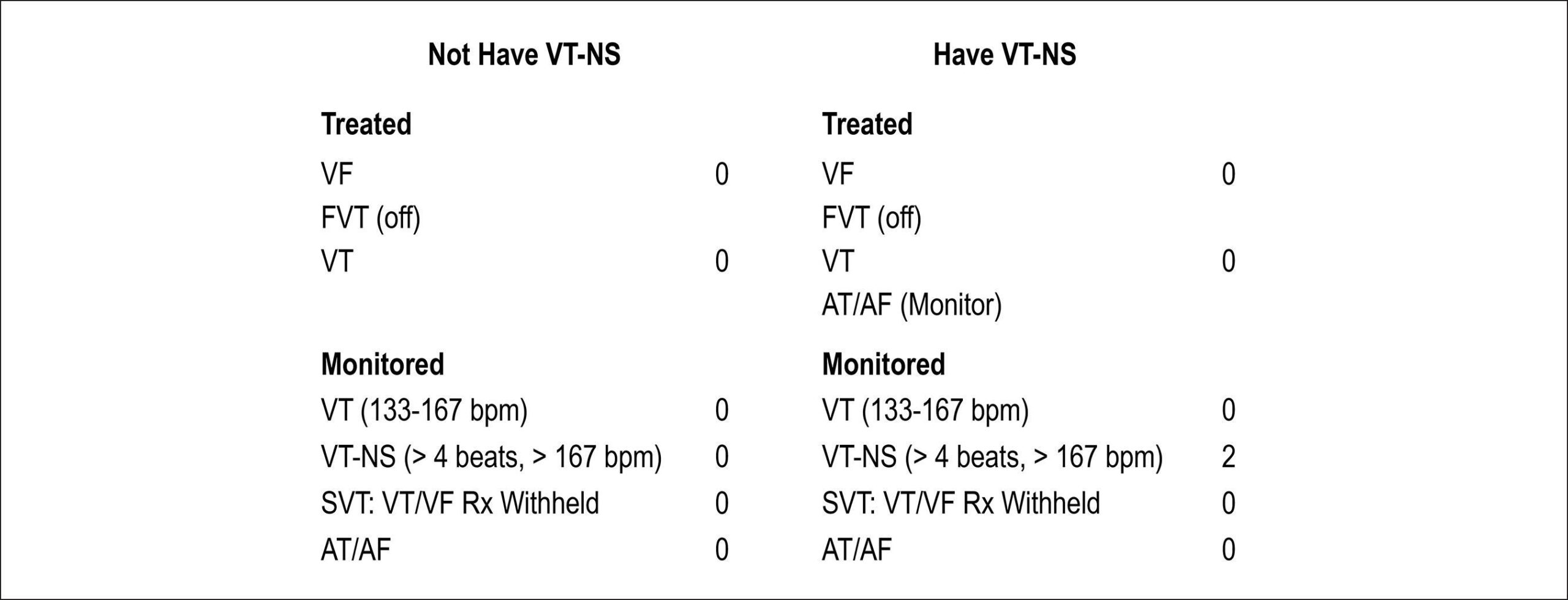
Device evaluation demonstrated at least one episode of monitored NSVT in 50 out of 104 patients. As expected, no device therapy (shock or anti-tachycardia) was needed for such episodes. At 6 months, 24 patients were hospitalized due to acute decompensated HF. Hospitalization rate was significantly lower in the NSVT negative as compared with positive groups (38% versus 62%; adjusted hazard ratio [HR] 0.166 ; 95% CI 0.056 to 0.492; p = 0.01).

Conclusions:

Monitored NSVT bouts in ICD recordings may serve as a predictor of future HF hospitalizations in ICD recipients with HF suggesting optimization of therapeutic modalities in these patients along with a close supervision in the clinical setting.

  • Defibrillators
  • Heart Failure
  • Hospitalization
  • Implantable
  • Tachycardia
  • Ventricular
Read Full Article
Creative Commons Attribution (CC BY) Creative Commons license
01/10/2017 DOI: 10.5935/abc.20170141
Ventricular fibrillation during sport activity successfully treated
ABC
Case Report

Ventricular fibrillation during sport activity successfully treated

Maria Margarita Gonzalez et al. Flávio Rocha Brito Marques Caio Brito Vianna Carlos Alberto Eid … Gilson Soares Feitosa-Filho Sergio Timerman

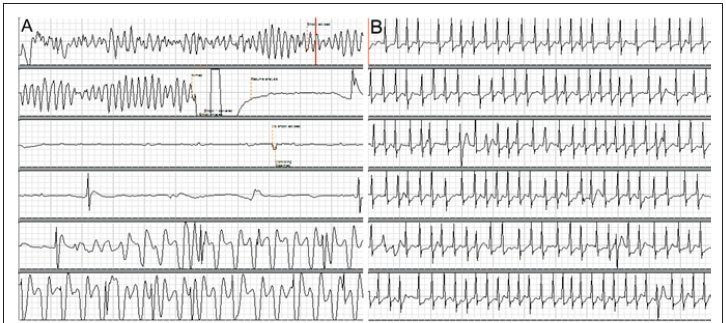
Survival after out-of-hospital cardiopulmonary arrest is estimated at less than 5%. We report a case of ventricular fibrillation during sports activity. Cardiopulmonary resuscitation was initiated early by a layperson, and defibrillation was successfully performed within less than three minutes, with an automated external defibrillator. The public access to defibrillation programs has increased the survival after out-of-hospital ventricular fibrillation. We should encourage the training of laypeople in relation to the use of automated external defibrillators and the Basic Life Support program by stimulating their implementation in places where large numbers of people gather or where people are at a high risk of sudden death, as is the case of sports centers.

  • Cardiopulmonary Resuscitation
  • Defibrillators
  • Exercise
  • Ventricular Fibrillation
Read Full Article
Creative Commons Attribution (CC BY) Creative Commons license
13/10/2009 DOI: 10.1590/S0066-782X2009000800022
Incidence of shock and quality of life in young patients with implantable cardioverter-defibrillator
ABC
Artigo Original

Incidence of shock and quality of life in young patients with implantable cardioverter-defibrillator

Roberto Costa et al. Kátia Regina da Silva Rodrigo Castro Mendonça Silvana Nishioka … Sérgio Siqueira Wagner Tetsuji Tamaki Elizabeth Sartori Crevelari Luiz Felipe Pinho Moreira Martino Martinelli Filho

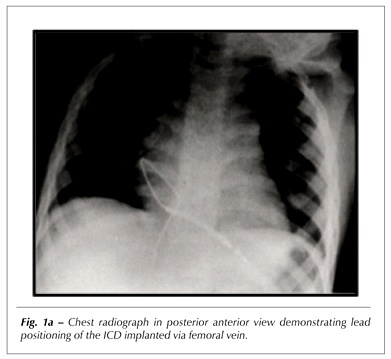
OBJECTIVES: To analyze the incidence and causes of ICD therapies in children and young adults and verify their impact on the quality of life (QoL). METHODS: From March/1977 to February/2006, 29 patients (15.7±5.4 years old) were submitted to ICD implants. Aborted cardiac arrest (41.5%), sustained ventricular tachycardia (27.6%) and primary prophylaxis of sudden cardiac death (30.9%) indicated device therapy. The number of therapies was evaluated by interviewing patients and by ICD diagnostic data. The SF-36 questionnaire was used to measure the QoL and the results were compared to healthy population. The expectative of freedom from ICD therapies were estimated by the Kaplan-Meier method. RESULTS: After 2.6±1.8 years follow-up, 8 (27.6%) patients received 141 appropriate ICD shocks due to ventricular tachycardia (6) or ventricular fibrillation (2), and 11 (37.9%) patients received 152 inappropriate ICD shocks due to supraventricular tachyarrhythmias (8) or oversensing (3). Expectative of freedom from appropriate shocks was 74.2±9.0% and 66.7±10.7% after one and three years, respectively. Compared to healthy population, QoL decreased in physical function (61.7±28.7), vitality (64.7±19.1), mental health (65.9±22.7) and role-emotional domains (66.7±38.5). All patients referred fear and concern related to ICD use. CONCLUSION: Despite the efficacy of ICD therapies, the high incidence of appropriate and inappropriate shocks interfered in patients’ QoL and adaptation to the device.

  • Adolescent
  • Defibrillators
  • Implantable
  • Quality of life
Read Full Article
Creative Commons Attribution (CC BY) Creative Commons license
21/05/2007 DOI: 10.1590/S0066-782X2007000300002

How to cite this article

EndNote RIS

Electronic Document Format (Vancouver)

Yılmaz F, Şener YZ. Broadening Insights into Implantable Cardioverter Defibrillator Appropriateness: The Role of Economic and Psychosocial Markers, Cardiomyopathy Subtypes, and Advanced Therapies. Arquivos Brasileiros de Cardiologia 2025;122(5):e20250066.

Electronic Document Format (ABNT)

Yılmaz, Ömer Faruk; Şener, Yusuf Ziya. Broadening Insights into Implantable Cardioverter Defibrillator Appropriateness: The Role of Economic and Psychosocial Markers, Cardiomyopathy Subtypes, and Advanced Therapies. Arquivos Brasileiros de Cardiologia, v. 122, n. 5, e20250066, Jun. 2025.

Electronic Document Format (APA)

Yılmaz, F., & Şener, Y. Z. (2025). Broadening Insights into Implantable Cardioverter Defibrillator Appropriateness: The Role of Economic and Psychosocial Markers, Cardiomyopathy Subtypes, and Advanced Therapies. Arquivos Brasileiros de Cardiologia, 122(5), e20250066.

Electronic Document Format (ISO)

Yılmaz, Ömer Faruk and Şener, Yusuf Ziya. Broadening Insights into Implantable Cardioverter Defibrillator Appropriateness: The Role of Economic and Psychosocial Markers, Cardiomyopathy Subtypes, and Advanced Therapies. Arquivos Brasileiros de Cardiologia [online]. 2025, vol. 122, n. 5, [cited 2026-10-14], e20250066. Available from: <https://journals.cardiol.br/en/article/broadening-insights-into-implantable-cardioverter-defibrillator-appropriateness-the-role-of-economic-and-psychosocial-markers-cardiomyopathy-subtypes-and-advanced-therapies/>. ISSN 0066-782X

EndNote RIS

Electronic Document Format (Vancouver)

Teixeira RA. Defibrillation Threshold in Patients with Chronic Chagas’ Heart Disease: Are There Benefits or not Worth the Risk?. Arquivos Brasileiros de Cardiologia 2022;119(6):929-30.

Electronic Document Format (ABNT)

Teixeira, Ricardo Alkmim. Defibrillation Threshold in Patients with Chronic Chagas’ Heart Disease: Are There Benefits or not Worth the Risk?. Arquivos Brasileiros de Cardiologia, v. 119, n. 6, p. 929-930, Dec. 2022.

Electronic Document Format (APA)

Teixeira, R. A. (2022). Defibrillation Threshold in Patients with Chronic Chagas’ Heart Disease: Are There Benefits or not Worth the Risk?. Arquivos Brasileiros de Cardiologia, 119(6), 929-930.

Electronic Document Format (ISO)

Teixeira, Ricardo Alkmim. Defibrillation Threshold in Patients with Chronic Chagas’ Heart Disease: Are There Benefits or not Worth the Risk?. Arquivos Brasileiros de Cardiologia [online]. 2022, vol. 119, n. 6, [cited 2026-10-14], pp. 929-930. Available from: <https://journals.cardiol.br/en/article/defibrillation-threshold-in-patients-with-chronic-chagas-heart-disease-are-there-benefits-or-not-worth-the-risk/>. ISSN 0066-782X

EndNote RIS

Electronic Document Format (Vancouver)

Uçar FM, Yilmaztepe MA, Taylan G, Aktoz M. Non-Sustained Ventricular Tachycardia Episodes Predict Future Hospitalization in ICD Recipients with Heart Failure. Arquivos Brasileiros de Cardiologia 2017;109(4):284-9.

Electronic Document Format (ABNT)

Uçar, Fatih Mehmet; Yilmaztepe, Mustafa Adem; Taylan, Gökay; Aktoz, Meryem. Non-Sustained Ventricular Tachycardia Episodes Predict Future Hospitalization in ICD Recipients with Heart Failure. Arquivos Brasileiros de Cardiologia, v. 109, n. 4, p. 284-289, Sep. 2017.

Electronic Document Format (APA)

Uçar, F. M., Yilmaztepe, M. A., Taylan, G., & Aktoz, M. (2017). Non-Sustained Ventricular Tachycardia Episodes Predict Future Hospitalization in ICD Recipients with Heart Failure. Arquivos Brasileiros de Cardiologia, 109(4), 284-289.

Electronic Document Format (ISO)

Uçar, Fatih Mehmet and Yilmaztepe, Mustafa Adem and Taylan, Gökay and Aktoz, Meryem. Non-Sustained Ventricular Tachycardia Episodes Predict Future Hospitalization in ICD Recipients with Heart Failure. Arquivos Brasileiros de Cardiologia [online]. 2017, vol. 109, n. 4, [cited 2026-10-14], pp. 284-289. Available from: <https://journals.cardiol.br/en/article/non-sustained-ventricular-tachycardia-episodes-predict-future-hospitalization-in-icd-recipients-with-heart-failure/>. ISSN 0066-782X

EndNote RIS

Electronic Document Format (Vancouver)

Gonzalez MM, Marques FRB, Vianna CB, Eid CA, Feitosa-Filho GS, Timerman S. Ventricular fibrillation during sport activity successfully treated. Arquivos Brasileiros de Cardiologia 2009;93(2):e26-9.

Electronic Document Format (ABNT)

Gonzalez, Maria Margarita; Marques, Flávio Rocha Brito; Vianna, Caio Brito; Eid, Carlos Alberto; Feitosa-Filho, Gilson Soares; Timerman, Sergio. Ventricular fibrillation during sport activity successfully treated. Arquivos Brasileiros de Cardiologia, v. 93, n. 2, p. e26-e29, Oct. 2009.

Electronic Document Format (APA)

Gonzalez, M. M., Marques, F. R. B., Vianna, C. B., Eid, C. A., Feitosa-Filho, G. S., & Timerman, S. (2009). Ventricular fibrillation during sport activity successfully treated. Arquivos Brasileiros de Cardiologia, 93(2), e26-e29.

Electronic Document Format (ISO)

Gonzalez, Maria Margarita and Marques, Flávio Rocha Brito and Vianna, Caio Brito and Eid, Carlos Alberto and Feitosa-Filho, Gilson Soares and Timerman, Sergio. Ventricular fibrillation during sport activity successfully treated. Arquivos Brasileiros de Cardiologia [online]. 2009, vol. 93, n. 2, [cited 2026-10-14], pp. e26-e29. Available from: <https://journals.cardiol.br/en/article/ventricular-fibrillation-during-sport-activity-successfully-treated/>. ISSN 0066-782X

EndNote RIS

Electronic Document Format (Vancouver)

Costa R, Silva KR, Mendonça RC, Nishioka S, Siqueira S, Tamaki WT, Crevelari ES, et al. Incidence of shock and quality of life in young patients with implantable cardioverter-defibrillator. Arquivos Brasileiros de Cardiologia 2007;88(3):258-64.

Electronic Document Format (ABNT)

Costa, Roberto; Silva, Kátia Regina da; Mendonça, Rodrigo Castro; Nishioka, Silvana; Siqueira, Sérgio; Tamaki, Wagner Tetsuji; Crevelari, Elizabeth Sartori; Moreira, Luiz Felipe Pinho; Martinelli Filho, Martino. Incidence of shock and quality of life in young patients with implantable cardioverter-defibrillator. Arquivos Brasileiros de Cardiologia, v. 88, n. 3, p. 258-264, May. 2007.

Electronic Document Format (APA)

Costa, R., Silva, K. R. , Mendonça, R. C., Nishioka, S., Siqueira, S., Tamaki, W. T., Crevelari, E. S., Moreira, L. F. P., & Martinelli Filho, M. (2007). Incidence of shock and quality of life in young patients with implantable cardioverter-defibrillator. Arquivos Brasileiros de Cardiologia, 88(3), 258-264.

Electronic Document Format (ISO)

Costa, Roberto and Silva, Kátia Regina da and Mendonça, Rodrigo Castro and Nishioka, Silvana and Siqueira, Sérgio and Tamaki, Wagner Tetsuji and Crevelari, Elizabeth Sartori and Moreira, Luiz Felipe Pinho and Martinelli Filho, Martino. Incidence of shock and quality of life in young patients with implantable cardioverter-defibrillator. Arquivos Brasileiros de Cardiologia [online]. 2007, vol. 88, n. 3, [cited 2026-10-14], pp. 258-264. Available from: <https://journals.cardiol.br/en/article/incidence-of-shock-and-quality-of-life-in-young-patients-with-implantable-cardioverter-defibrillator/>. ISSN 0066-782X

  • About ABC Family
  • Internal Regulation
  • Editorial Board
  • Brazilian Society of Cardiology (SBC)

Issues

SBC Guidelines

  • Videos
  • Podcasts
  • News