ABC Family Arquivos Brasileiros de Cardiologia International Journal of Cardiovascular Sciences ABC Heart Failure & Cardiomyopathy ABC Imagem Cardiovascular
Português English
ABC Family
Português English
  • About
    • About ABC Family
    • Internal Regulation
    • Editorial Board
    • Brazilian Society of Cardiology (SBC)
  • Issues
  • SBC Guidelines
  • Content
    • Videos
    • Podcasts
    • News
  • About
    • About ABC Family
    • Internal Regulation
    • Editorial Board
    • Brazilian Society of Cardiology (SBC)
  • Issues
  • SBC Guidelines
  • Content
    • Videos
    • Podcasts
    • News

ABC Family

  • ABC Family
  • Arquivos Brasileiros de Cardiologia
  • International Journal of Cardiovascular Sciences
  • ABC Heart Failure & Cardiomyopathy
  • ABC Imagem Cardiovascular
Search in

No content found.

Journals
Ordering
Article types
Others

  1. Home
  2. Keyword: Life Expectancy
Figure 1
ABCHF
Original Article

Shifting Patterns of Out-Of-Hospital Mortality and Premature Life Loss in Cardiomyopathies: A Nationwide Population-Based Study

Alvaro Perazzo et al. Gabriel Kaleb Martins Arina Peixoto Nobre Arthur Línniker Lopes de Oliveira … Jose Roberto de Araújo Junior Gabriela Lucena Montenegro Carlos Eduardo Lucena Montenegro Patricia Bezerra Rocha Montenegro João Henrique Torres Flavio Feijó Deuzenny Tenório Diana Patrícia Lamprea Sepúlveda Samuel Padovani Steffen Sérgio Tavares Montenegro Fábio Antonio Gaiotto Fernando Moraes

Abstract

Background:

Cardiomyopathies are a major cause of cardiovascular mortality, presenting age-dependent phenotypes ranging from sudden cardiac death (SCD) to progressive heart failure. Despite declining mortality rates, gaps in prevention and access to advanced therapies may manifest as shifts in the place of death and persistent premature mortality.

Objectives:

To evaluate temporal trends in cardiomyopathy-related mortality in Brazil, assess age-related patterns in the place of death, and quantify premature mortality through years of life lost (YLL).

Methods:

This nationwide, population-based ecological study analyzed 369,570 deaths in Brazil (1996–2024) in which cardiomyopathy (ICD-10 I42) was the underlying cause. Temporal trends were assessed using Poisson regression, and associations between age and place of death were evaluated using odds ratios (OR). The YLL were calculated using national life tables.

Results:

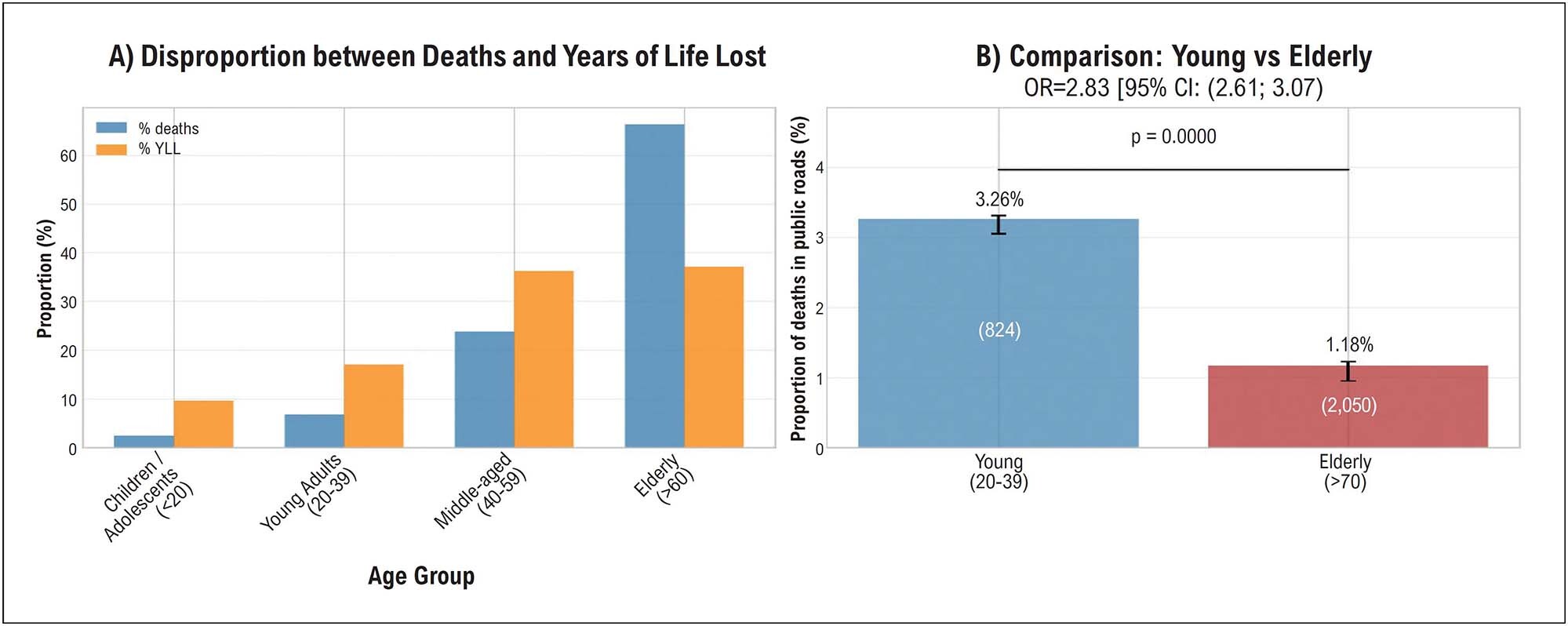
Age-adjusted mortality declined by 1.7% annually (p<0.001). Hospital deaths decreased from 75% to 43%, whereas home deaths increased from 20% to 38%, with a significant inflection point around 2011. Public roadway deaths, used as a proxy for SCD, were more frequent among adults aged 20–39 years (4.8%) than among those aged ≥60 years (0.8%; OR 2.88, 95% CI 2.68–3.10). Total YLL reached 6.83 million years. Individuals aged 20–39 years accounted for only 5.5% of deaths but contributed 12.8% of total YLL, averaging 42.9 years lost per death.

Conclusions:

Despite declining mortality, out-of-hospital deaths have become more frequent. Excess YLL among young adults highlights gaps in SCD prevention. Age-tailored strategies are needed to reduce premature mortality.

  • Cardiomyopathies
  • Epidemiology
  • Life Expectancy
  • Mortality
Read Full Article
Creative Commons Attribution (CC BY) Creative Commons license
29/09/2026 DOI: 10.36660/abchf.20260024i Views 16
Figure 1
ABC
Viewpoint

Treatment of Aortic Stenosis in Elderly Individuals in Brazil: How Long Can We Wait?

Marcelo Antônio Cartaxo Queiroga Lopes et al. Bruno Ramos Nascimento Gláucia Maria Moraes de Oliveira

The growing life expectancy of the population is increasing the occurrence of diseases affecting the elderly age group, notably the non-rheumatic degenerative valvular diseases and, in particular, aortic stenosis, whose prevalence in elderly individuals older than 75 years has been estimated at 3 to 5%. This is the most common valvular heart disease among elderly individuals, and its severe form is associated with high morbidity and mortality. The life expectancy of patients with aortic stenosis presenting with heart failure and rhythm disturbances is estimated to be less than 2 years. The standard treatment for this disease is cardiac surgery with replacement of the aortic valve by a prosthesis. However, due to high surgical risk, especially in very elderly patients with associated comorbidities, cardiac surgery is contraindicated in about 30% of the cases or is performed with high morbidity and mortality rates according to preoperative scores. For these critically ill patients, a new, less invasive technique consisting of transcatheter aortic valve implantation (TAVI) of a bioprosthesis has been considered the therapeutic option of choice, initially tested in patients at very high surgical risk, but currently with evidence of noninferiority compared to open surgery in lower-risk individuals., The first TAVI procedure in the world was performed in France in 2002 by Professor Alain Cribier, and the method was pioneered in Brazil in 2008. Since then, a considerable number of patients has been treated. However, despite robust evidence of safety and efficacy, this therapy has still not been incorporated into the supplemental or public health care systems (Sistema Único de Saúde [SUS]) in the country.

Despite the fact that TAVI has already been evaluated and accepted in the health care systems of several countries with evidence of cost-effectiveness even in individuals at intermediate operative risk, the Ministry of Health, based on a position stand from the National Commission for Incorporation of Technologies in the SUS (Conitec), established in 2013, in response to a request by the Brazilian Society for Hemodynamics and of Interventional Cardiology (SBHCI) acting as the petitioner, considered that there was no convenience in incorporating this therapy in Brazil. Conitec, at the time, based on the opinion of a reviewer and disregarding the opinion of prestigious national universities presented in a public consultation on the subject, recommended against the incorporation of the procedure, justifying this decision on three points: a) TAVI would not be a safe and effective procedure due to an allegedly high incidence of stroke within the first 30 days after the procedure, b) the budgetary impact of incorporating TAVI into the SUS would approach 1 billion reais per year, and c) methodological inaccuracies could have affected the economic model presented by the petitioner and the PARTNER B study, which served as the main background for the incorporation of this procedure by all health technology assessment agencies in the world that have requested the incorporation of this technology.

[…]

  • Aged
  • aging
  • Heart Valve Prosthesis
  • Heart Valve Prosthesis Implantation
  • Life Expectancy
  • Stenosis Valve Aortic/surgery
  • Transcatheter Aortic Valve Replacement/trends
Read Full Article
Creative Commons Attribution (CC BY) Creative Commons license
20/03/2020 DOI: 10.36660/abc.2020003 Views 1
Figure 1
ABC
Editorial

Another Step in Medical Education in Portuguese Speaking Countries

Gláucia Maria Moraes de Oliveira et al. Fausto J. Pinto

In 2016 the Journal of the American Medical Association published a theme issue on medical education, which included an editorial by Golub emphasizing the importance of looking backward on past to advance towards the future. Golub went on to say that the changes in society, such as the shifts in ethnicities, in cultural norms and in health care systems, will lead to new comprehensive, creative and innovative educational models to improve the quality of medical education and patient care.

Therefore, medical training has recently undergone changes, aimed at adapting it to the new population demands, which present great challenges due to regional disparities in the health workforce distribution. Health professionals must be trained to address increasingly complex pathologies and to develop skills to lead interprofessional teams, which must be cost-effective regarding transcultural evidence, to better serve the populations taken care of.

[…]

  • Blobal Burden of Diseases
  • Cardiovascular Diseases
  • Education, Medical/trends
  • Life Expectancy
  • Publishing/trends
  • Risk Factors
  • Schools,Medical
  • Socioeconomics Factors
Read Full Article
Creative Commons Attribution (CC BY) Creative Commons license
02/12/2019 DOI: 10.36660/abc.20190740

How to cite this article

EndNote RIS

Electronic Document Format (Vancouver)

Perazzo A, Martins GK, Nobre AP, Oliveira ALL, Araújo Junior JR, Montenegro GL, Montenegro CEL, et al. Shifting Patterns of Out-Of-Hospital Mortality and Premature Life Loss in Cardiomyopathies: A Nationwide Population-Based Study. ABC Heart Fail Cardiomyop 2026;6:e20260024.

Electronic Document Format (ABNT)

Perazzo, Alvaro; Martins, Gabriel Kaleb; Nobre, Arina Peixoto; Oliveira, Arthur Línniker Lopes de; Araújo Junior, Jose Roberto de; Montenegro, Gabriela Lucena; Montenegro, Carlos Eduardo Lucena; Montenegro, Patricia Bezerra Rocha; Torres, João Henrique; Feijó, Flavio; Tenório, Deuzenny; Sepúlveda, Diana Patrícia Lamprea; Steffen, Samuel Padovani; Montenegro, Sérgio Tavares; Gaiotto, Fábio Antonio; Moraes, Fernando. Shifting Patterns of Out-Of-Hospital Mortality and Premature Life Loss in Cardiomyopathies: A Nationwide Population-Based Study. ABC Heart Fail Cardiomyop, v. 6, e20260024, Sep. 2026.

Electronic Document Format (APA)

Perazzo, A., Martins, G. K., Nobre, A. P., Oliveira, A. L. L. , Araújo Junior, J. R. , Montenegro, G. L., Montenegro, C. E. L., Montenegro, P. B. R., Torres, J. H., Feijó, F., Tenório, D., Sepúlveda, D. P. L., Steffen, S. P., Montenegro, S. T., Gaiotto, F. A., & Moraes, F. (2026). Shifting Patterns of Out-Of-Hospital Mortality and Premature Life Loss in Cardiomyopathies: A Nationwide Population-Based Study. ABC Heart Fail Cardiomyop, 6, e20260024.

Electronic Document Format (ISO)

Perazzo, Alvaro and Martins, Gabriel Kaleb and Nobre, Arina Peixoto and Oliveira, Arthur Línniker Lopes de and Araújo Junior, Jose Roberto de and Montenegro, Gabriela Lucena and Montenegro, Carlos Eduardo Lucena and Montenegro, Patricia Bezerra Rocha and Torres, João Henrique and Feijó, Flavio and Tenório, Deuzenny and Sepúlveda, Diana Patrícia Lamprea and Steffen, Samuel Padovani and Montenegro, Sérgio Tavares and Gaiotto, Fábio Antonio and Moraes, Fernando. Shifting Patterns of Out-Of-Hospital Mortality and Premature Life Loss in Cardiomyopathies: A Nationwide Population-Based Study. ABC Heart Fail Cardiomyop [online]. 2026, vol. 6, [cited 2026-10-15], e20260024. Available from: <https://journals.cardiol.br/en/article/shifting-patterns-of-out-of-hospital-mortality-and-premature-life-loss-in-cardiomyopathies-a-nationwide-population-based-study/>

EndNote RIS

Electronic Document Format (Vancouver)

Lopes MACQ, Nascimento BR, Oliveira GMM. Treatment of Aortic Stenosis in Elderly Individuals in Brazil: How Long Can We Wait?. Arquivos Brasileiros de Cardiologia 2020;114(2):313-8.

Electronic Document Format (ABNT)

Lopes, Marcelo Antônio Cartaxo Queiroga; Nascimento, Bruno Ramos; Oliveira, Gláucia Maria Moraes de. Treatment of Aortic Stenosis in Elderly Individuals in Brazil: How Long Can We Wait?. Arquivos Brasileiros de Cardiologia, v. 114, n. 2, p. 313-318, Mar. 2020.

Electronic Document Format (APA)

Lopes, M. A. C. Q., Nascimento, B. R., & Oliveira, G. M. M. (2020). Treatment of Aortic Stenosis in Elderly Individuals in Brazil: How Long Can We Wait?. Arquivos Brasileiros de Cardiologia, 114(2), 313-318.

Electronic Document Format (ISO)

Lopes, Marcelo Antônio Cartaxo Queiroga and Nascimento, Bruno Ramos and Oliveira, Gláucia Maria Moraes de. Treatment of Aortic Stenosis in Elderly Individuals in Brazil: How Long Can We Wait?. Arquivos Brasileiros de Cardiologia [online]. 2020, vol. 114, n. 2, [cited 2026-10-15], pp. 313-318. Available from: <https://journals.cardiol.br/en/article/treatment-of-aortic-stenosis-in-elderly-individuals-in-brazil-how-long-can-we-wait/>. ISSN 0066-782X

EndNote RIS

Electronic Document Format (Vancouver)

Oliveira GMM, Pinto FJ. Another Step in Medical Education in Portuguese Speaking Countries. Arquivos Brasileiros de Cardiologia 2019;113(5):894-5.

Electronic Document Format (ABNT)

Oliveira, Gláucia Maria Moraes de; Pinto, Fausto J.. Another Step in Medical Education in Portuguese Speaking Countries. Arquivos Brasileiros de Cardiologia, v. 113, n. 5, p. 894-895, Dec. 2019.

Electronic Document Format (APA)

Oliveira, G. M. M. , & Pinto, F. J. (2019). Another Step in Medical Education in Portuguese Speaking Countries. Arquivos Brasileiros de Cardiologia, 113(5), 894-895.

Electronic Document Format (ISO)

Oliveira, Gláucia Maria Moraes de and Pinto, Fausto J.. Another Step in Medical Education in Portuguese Speaking Countries. Arquivos Brasileiros de Cardiologia [online]. 2019, vol. 113, n. 5, [cited 2026-10-15], pp. 894-895. Available from: <https://journals.cardiol.br/en/article/another-step-in-medical-education-in-portuguese-speaking-countries/>. ISSN 0066-782X

  • About ABC Family
  • Internal Regulation
  • Editorial Board
  • Brazilian Society of Cardiology (SBC)

Issues

SBC Guidelines

  • Videos
  • Podcasts
  • News