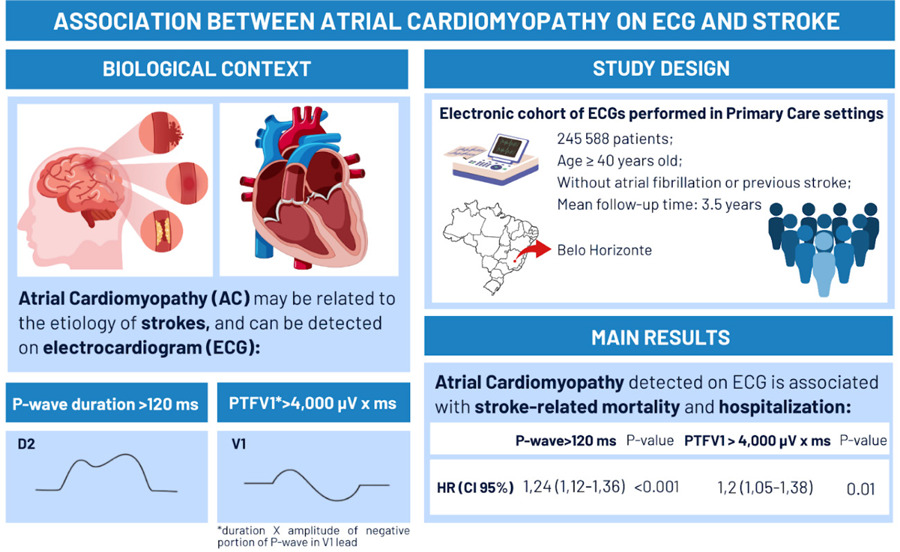
Stroke remains one of the foremost causes of death and disability globally, with ischemic events accounting for approximately 87% of cases. Despite exhaustive etiological investigation, up to 25% of ischemic strokes remain unexplained — the so-called cryptogenic stroke — a designation that carries significant implications for secondary prevention, given an average recurrence rate of 3–6% per year., Atrial fibrillation (AF) has long been the dominant cardioembolic risk factor in this setting; however, mounting evidence suggests that structural and functional atrial abnormalities — collectively encompassed by the concept of atrial cardiomyopathy (AC) — may drive thromboembolic events through an independent pathway, even in the absence of overt arrhythmia. The 2024 updated consensus statement from EHRA, HRS, APHRS, and LAHRS consolidates a staging system for AC integrating biomarkers, atrial geometry, and electrophysiological parameters, firmly establishing AC as a pathological entity distinct from — though intimately associated with — AF. In this context, the 12-lead electrocardiogram (ECG) — simple, inexpensive, and universally available — offers a practical approach to AC detection through two established markers: prolonged P-wave duration (>120 ms) and elevated P-wave terminal force in lead V1 (PTFV1 >4,000 μV·ms). Prior studies from the Cardiovascular Health Study (CHS), the Multi-Ethnic Study of Atherosclerosis (MESA), and the Atherosclerosis Risk in Communities (ARIC) cohort demonstrated that these markers independently predict ischemic stroke;– yet their relevance in Latin American populations, with a distinct cardiovascular and sociodemographic profile, had remained an important evidence gap.
In this issue of Arquivos Brasileiros de Cardiologia, the study by Lêu et al. addresses this gap with notable rigour. Drawing upon the CODE-BH dataset — a subset of the Clinical Outcomes in Digital Electrocardiography (CODE) cohort, one of the world’s largest annotated digital ECG databases — the authors assembled a retrospective cohort of 245,588 patients aged ≥40 years in sinus rhythm, who underwent ECGs in Belo Horizonte between 2006 and 2018. Electrocardiographic data were probabilistically linked to the Brazilian Unified Health System (SUS) databases — the Mortality Information System (SIM) and the Hospital Information System (SIH) — enabling ascertainment of stroke-related deaths and hospitalizations, cardiovascular mortality, incident AF, and acute coronary syndrome over a mean follow-up of 3.5 years. After incremental adjustment for age, sex, cardiovascular risk factors, and left ventricular hypertrophy, both prolonged P-wave duration (HR 1.24; 95% CI 1.12–1.36) and elevated PTFV1 (HR 1.20; 95% CI 1.05–1.38) were independently associated with the composite endpoint of stroke-related death or hospitalization. Prolonged P-wave duration was further associated with cardiovascular mortality and incident AF, whilst elevated PTFV1 was linked to all-cause and cardiovascular mortality.
[…]