Pedro Calomeni et al. Fernando Bernardi Fábio Sandoli de Brito Jr Marcella Sousa Abizaid … Francisco Ribeiro Barbosa Pedro Alves Lemos Fausto Feres Dimytri Alexandre Siqueira Ricardo Costa Rogério Sarmento-Leite Fernanda Mangione José Armando Mangione Luiz Eduardo Koenig São Thiago Valter Correia de Lima Adriano Dias Dourado Oliveira Marcos Antônio Marino Carlos José Francisco Cardoso Paulo Ricardo Avancini Caramori Rogério Tadeu Tumelero Antenor Lages Fortes Portela Maurício Lopes Prudente Leônidas Alvarenga Henriques Fábio Solano de Freitas Souza Cristiano Guedes Bezerra Guy Fernandes de Almeida Prado Junior Leandro Zacarias Figueiredo de Freitas Ederlon Ferreira Nogueira George César Ximenes Meireles Renato Bastos Pope Ênio Eduardo Guérios Pedro Beraldo de Andrade Luciano de Moura Santos Augusto Celso Lopes Vinicius Borges Cardozo Esteves Cleverson Zukowski Alexandre Abizaid Henrique Barbosa Ribeiro
ABSTRACT
Background:
Bicuspid aortic valve (BAV) is a significant risk factor for aortic stenosis (AS). Yet, the outcomes of transcatheter aortic valve implantation (TAVI) remain unclear, as most randomized trials excluded such patients. Furthermore, most published evidence on TAVI in BAV comes from high-income countries, which may not reflect realities of underserved populations.
Objectives:
Evaluate temporal trends, procedural, and in-hospital outcomes between BAV and tricuspid aortic valve (TAV) patients.
Methods:
Retrospective observational study based on a Brazilian multicenter registry of TAVI patients between January 2009 and December 2021. We performed propensity score matching to adjust comparisons. A p-value <0.05 was considered statistically significant for all analyses.
Results:
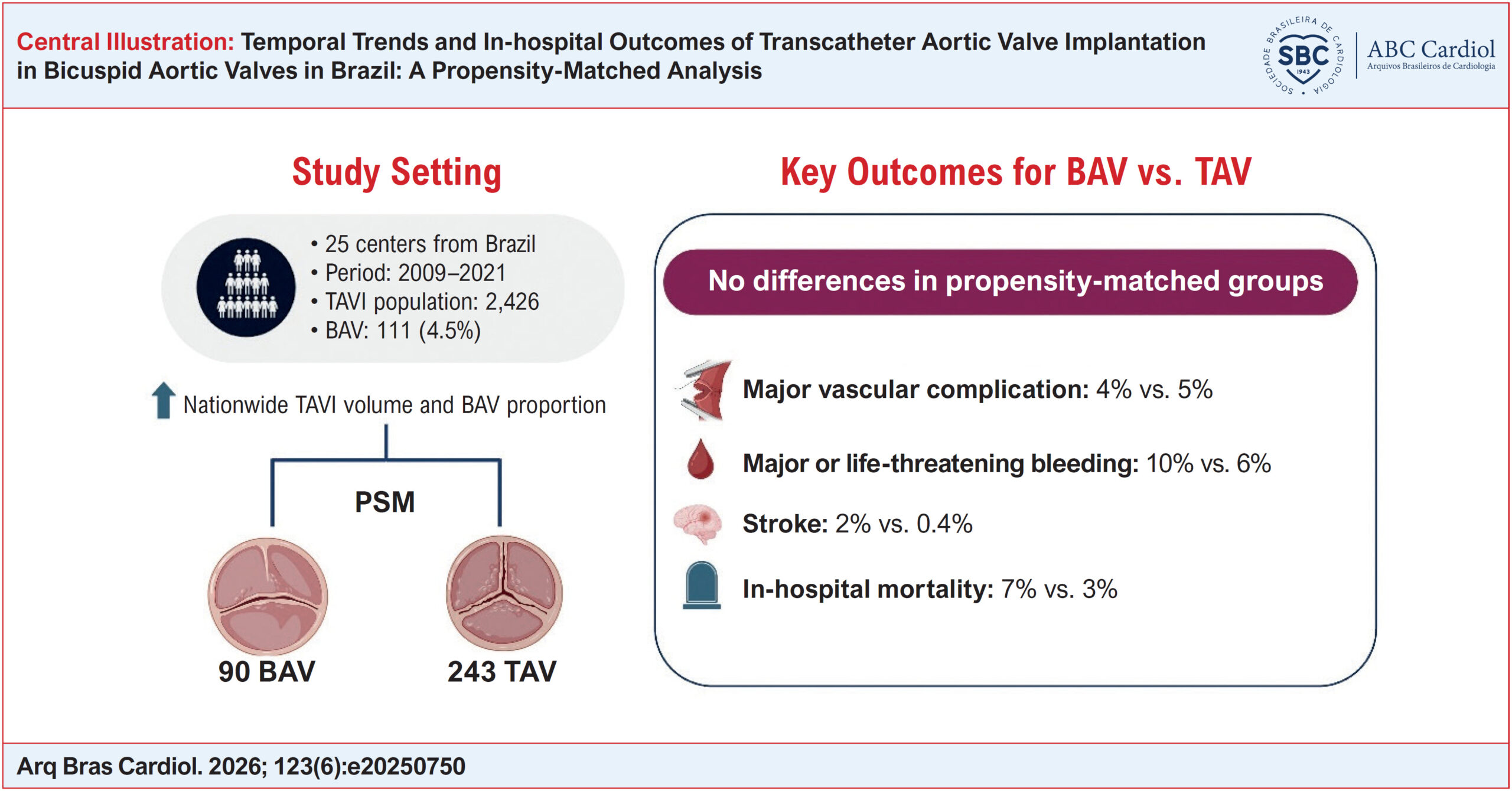
Among 2,426 patients from 25 centers, 111 had BAV. TAVI procedures increased over time in both groups. After one-to-three matching, 90 BAV and 243 TAV patients were included. No significant differences were observed in rates of major vascular complications (4% vs. 5%; p=0.99), major or life-threatening bleeding (10% vs. 6%; p=0.34), stroke (2% vs. 0.4%; p=0.37), or in-hospital mortality (7% vs. 3%; p=0.21). Over time, there was a significant reduction in in-hospital mortality (p<0.01) and major procedural complications (p<0.01 for vascular, bleeding, and stroke events), regardless of valve type.
Conclusion:
During the study period, annual TAVI procedures increased in both BAV and TAV patients, although the prevalence of BAV remained relatively low. No significant differences were observed in procedural or clinical outcomes between the propensity-matched groups. Both valve types showed reductions in procedural complications and in-hospital mortality over time.