ABC Family Arquivos Brasileiros de Cardiologia International Journal of Cardiovascular Sciences ABC Heart Failure & Cardiomyopathy ABC Imagem Cardiovascular
Português English
ABC Family
Português English
  • About
    • About ABC Family
    • Internal Regulation
    • Editorial Board
    • Brazilian Society of Cardiology (SBC)
  • Issues
  • SBC Guidelines
  • Content
    • Videos
    • Podcasts
    • News
  • About
    • About ABC Family
    • Internal Regulation
    • Editorial Board
    • Brazilian Society of Cardiology (SBC)
  • Issues
  • SBC Guidelines
  • Content
    • Videos
    • Podcasts
    • News

ABC Family

  • ABC Family
  • Arquivos Brasileiros de Cardiologia
  • International Journal of Cardiovascular Sciences
  • ABC Heart Failure & Cardiomyopathy
  • ABC Imagem Cardiovascular
Search in

No content found.

Journals
Ordering
Article types
Others

  1. Home
  2. Keyword: Population Health
ABC
Editorial

The Electrocardiogram as a Window into Atrial Pathology: Insights from a Large Brazilian Cohort on Atrial Cardiomyopathy and Stroke

M. Julia Machline-Carrion

Stroke remains one of the foremost causes of death and disability globally, with ischemic events accounting for approximately 87% of cases. Despite exhaustive etiological investigation, up to 25% of ischemic strokes remain unexplained — the so-called cryptogenic stroke — a designation that carries significant implications for secondary prevention, given an average recurrence rate of 3–6% per year., Atrial fibrillation (AF) has long been the dominant cardioembolic risk factor in this setting; however, mounting evidence suggests that structural and functional atrial abnormalities — collectively encompassed by the concept of atrial cardiomyopathy (AC) — may drive thromboembolic events through an independent pathway, even in the absence of overt arrhythmia. The 2024 updated consensus statement from EHRA, HRS, APHRS, and LAHRS consolidates a staging system for AC integrating biomarkers, atrial geometry, and electrophysiological parameters, firmly establishing AC as a pathological entity distinct from — though intimately associated with — AF. In this context, the 12-lead electrocardiogram (ECG) — simple, inexpensive, and universally available — offers a practical approach to AC detection through two established markers: prolonged P-wave duration (>120 ms) and elevated P-wave terminal force in lead V1 (PTFV1 >4,000 μV·ms). Prior studies from the Cardiovascular Health Study (CHS), the Multi-Ethnic Study of Atherosclerosis (MESA), and the Atherosclerosis Risk in Communities (ARIC) cohort demonstrated that these markers independently predict ischemic stroke;– yet their relevance in Latin American populations, with a distinct cardiovascular and sociodemographic profile, had remained an important evidence gap.

In this issue of Arquivos Brasileiros de Cardiologia, the study by Lêu et al. addresses this gap with notable rigour. Drawing upon the CODE-BH dataset — a subset of the Clinical Outcomes in Digital Electrocardiography (CODE) cohort, one of the world’s largest annotated digital ECG databases — the authors assembled a retrospective cohort of 245,588 patients aged ≥40 years in sinus rhythm, who underwent ECGs in Belo Horizonte between 2006 and 2018. Electrocardiographic data were probabilistically linked to the Brazilian Unified Health System (SUS) databases — the Mortality Information System (SIM) and the Hospital Information System (SIH) — enabling ascertainment of stroke-related deaths and hospitalizations, cardiovascular mortality, incident AF, and acute coronary syndrome over a mean follow-up of 3.5 years. After incremental adjustment for age, sex, cardiovascular risk factors, and left ventricular hypertrophy, both prolonged P-wave duration (HR 1.24; 95% CI 1.12–1.36) and elevated PTFV1 (HR 1.20; 95% CI 1.05–1.38) were independently associated with the composite endpoint of stroke-related death or hospitalization. Prolonged P-wave duration was further associated with cardiovascular mortality and incident AF, whilst elevated PTFV1 was linked to all-cause and cardiovascular mortality.

[…]

  • Atrial Fibrillation
  • Data Insights
  • Population Health
  • Stroke Prevention
Read Full Article
Creative Commons Attribution (CC BY) Creative Commons license
20/07/2026 DOI: 10.36660/abc.20260270i Views 3
Figure 1
IJCS
Original Article

Classification System for Cardiorespiratory Fitness Based on a Sample of the Brazilian Population

Antonio Eduardo Monteiro de Almeida et al. Igor Rafael Miranda Ferreira Santander Maria Izabel Macedo Campos Jorge René Garcia Arévalo … João Agnaldo do Nascimento Luiz Eduardo Fonteles Ritt Karlyse Claudino Belli Jorge Pinto Ribeiro Ricardo Stein

Abstract

Background:

Peak oxygen consumption (VO2peak) is an important prognostic marker and its classification helps the cardiologist in the therapeutic decision-making process. The most commonly used cardiorespiratory fitness (CRF) classification has not been validated for the Brazilian population.

Objective:

To elaborate a CRF classification using a Brazilian sample and to compare it with the American Heart Association (AHA), Cooper and UNIFESP classifications.

Methods:

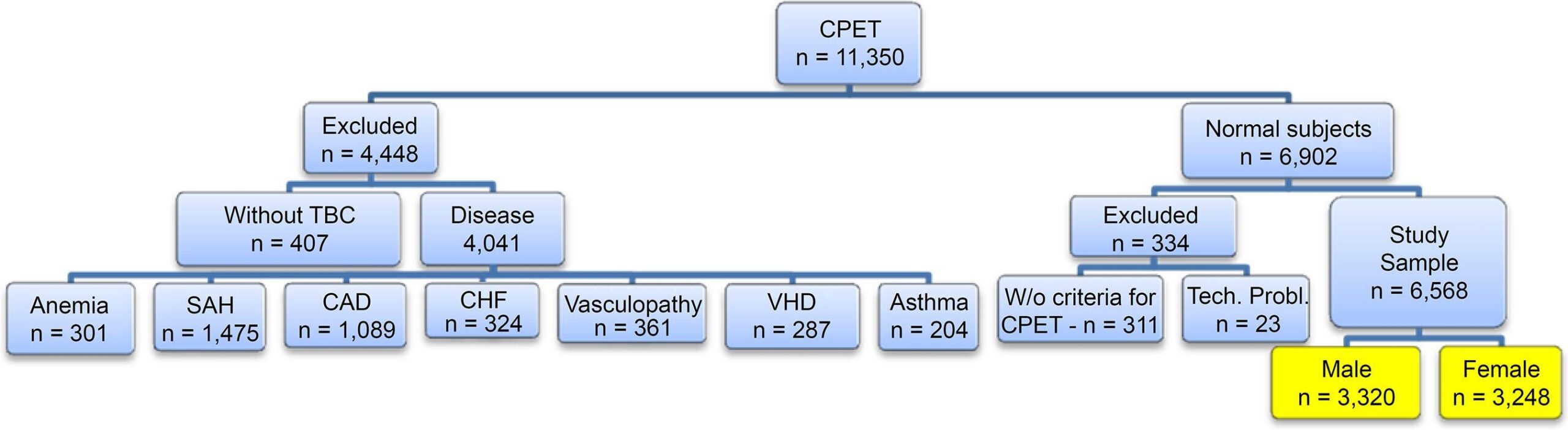
A total of 6,568 healthy subjects were analyzed through cardiopulmonary exercise testing (CPET). They were distributed by sex and the following age groups (years): 7-12, 13-19, 20-79 (per decades) and > 80 years. After measurement of the VO2peak, participants were distributed into quintiles of CRF in very poor, poor, moderate, high and very high (AEMA Table). The CRF classifications by AEMA, AHA, Cooper, and UNIFESP were compared using the Wilcoxon, Kappa and concordance percentages.

Results:

VO2peak presented an inverse and moderate correlation with age considering both sexes (R = -0.488, p < 0.001). All paired comparisons between CRF classification systems showed differences (p < 0.001) and disagreement percentage – AEMA versus AHA (k = 0.291, 56.7%), AEMA versus Cooper (k = 0.220, 62.4%) and AEMA versus UNIFESP (k = 0.201, 63.9 %).

Conclusion:

The AEMA table showed important discrepancies in the classification of CRF when compared to other tables widely used in our setting. Because it was obtained from a large sample of the Brazilian population, the AEMA table should be preferred over other classification systems in our population.

  • Cardiorespiratory Fitness
  • Exercise
  • Exercise Tests
  • Oxygen Consumption
  • Population Health
  • Respiratory Function Tests
Read Full Article
Creative Commons Attribution (CC BY) Creative Commons license
12/08/2019 DOI: 10.5935/2359-4802.20190057 Views 2

How to cite this article

EndNote RIS

Electronic Document Format (Vancouver)

Machline-Carrion MJ. The Electrocardiogram as a Window into Atrial Pathology: Insights from a Large Brazilian Cohort on Atrial Cardiomyopathy and Stroke. Arquivos Brasileiros de Cardiologia 2026;123(3):e20260270.

Electronic Document Format (ABNT)

Machline-Carrion, M. Julia. The Electrocardiogram as a Window into Atrial Pathology: Insights from a Large Brazilian Cohort on Atrial Cardiomyopathy and Stroke. Arquivos Brasileiros de Cardiologia, v. 123, n. 3, e20260270, Jul. 2026.

Electronic Document Format (APA)

Machline-Carrion, M. J. (2026). The Electrocardiogram as a Window into Atrial Pathology: Insights from a Large Brazilian Cohort on Atrial Cardiomyopathy and Stroke. Arquivos Brasileiros de Cardiologia, 123(3), e20260270.

Electronic Document Format (ISO)

Machline-Carrion, M. Julia. The Electrocardiogram as a Window into Atrial Pathology: Insights from a Large Brazilian Cohort on Atrial Cardiomyopathy and Stroke. Arquivos Brasileiros de Cardiologia [online]. 2026, vol. 123, n. 3, [cited 2026-10-14], e20260270. Available from: <https://journals.cardiol.br/en/article/the-electrocardiogram-as-a-window-into-atrial-pathology-insights-from-a-large-brazilian-cohort-on-atrial-cardiomyopathy-and-stroke/>. ISSN 0066-782X

EndNote RIS

Electronic Document Format (Vancouver)

Almeida AEM, Santander IRMF, Campos MIM, Arévalo JRG, Nascimento JA, Ritt LEF, Belli KC, et al. Classification System for Cardiorespiratory Fitness Based on a Sample of the Brazilian Population. International Journal of Cardiovascular Sciences 2019;32(4):343-54.

Electronic Document Format (ABNT)

Almeida, Antonio Eduardo Monteiro de; Santander, Igor Rafael Miranda Ferreira; Campos, Maria Izabel Macedo; Arévalo, Jorge René Garcia; Nascimento, João Agnaldo do; Ritt, Luiz Eduardo Fonteles; Belli, Karlyse Claudino; Ribeiro, Jorge Pinto; Stein, Ricardo. Classification System for Cardiorespiratory Fitness Based on a Sample of the Brazilian Population. International Journal of Cardiovascular Sciences, v. 32, n. 4, p. 343-354, Aug. 2019.

Electronic Document Format (APA)

Almeida, A. E. M. , Santander, I. R. M. F., Campos, M. I. M., Arévalo, J. R. G., Nascimento, J. A. , Ritt, L. E. F., Belli, K. C., Ribeiro, J. P., & Stein, R. (2019). Classification System for Cardiorespiratory Fitness Based on a Sample of the Brazilian Population. International Journal of Cardiovascular Sciences, 32(4), 343-354.

Electronic Document Format (ISO)

Almeida, Antonio Eduardo Monteiro de and Santander, Igor Rafael Miranda Ferreira and Campos, Maria Izabel Macedo and Arévalo, Jorge René Garcia and Nascimento, João Agnaldo do and Ritt, Luiz Eduardo Fonteles and Belli, Karlyse Claudino and Ribeiro, Jorge Pinto and Stein, Ricardo. Classification System for Cardiorespiratory Fitness Based on a Sample of the Brazilian Population. International Journal of Cardiovascular Sciences [online]. 2019, vol. 32, n. 4, [cited 2026-10-14], pp. 343-354. Available from: <https://journals.cardiol.br/en/article/classification-system-for-cardiorespiratory-fitness-based-on-a-sample-of-the-brazilian-population/>. ISSN 2359-4802

  • About ABC Family
  • Internal Regulation
  • Editorial Board
  • Brazilian Society of Cardiology (SBC)

Issues

SBC Guidelines

  • Videos
  • Podcasts
  • News