| ABC
ABC Family Arquivos Brasileiros de Cardiologia International Journal of Cardiovascular Sciences ABC Heart Failure & Cardiomyopathy ABC Imagem Cardiovascular
Português English
ABC Family | ABC
Português English
  • About
    • About the Journal
    • Internal Regulation
    • Editors Section
    • Editorial Board
    • History
    • SBC Award
  • Instructions to Authors
    • Guidelines for Publication
    • Editorial Policy
    • Ethics Policy
    • Policy on the Use of Artificial Intelligence
    • Mandatory Publication Form
    • Publication Fee
  • Issues
  • SBC Guidelines
  • Abstracts
    • How to Publish an Abstract Supplement?
    • Supplements from the Brazilian Congress of Cardiology
  • About
    • About the Journal
    • Internal Regulation
    • Editors Section
    • Editorial Board
    • History
    • SBC Award
  • Instructions to Authors
    • Guidelines for Publication
    • Editorial Policy
    • Ethics Policy
    • Policy on the Use of Artificial Intelligence
    • Mandatory Publication Form
    • Publication Fee
  • Issues
  • SBC Guidelines
  • Abstracts
    • How to Publish an Abstract Supplement?
    • Supplements from the Brazilian Congress of Cardiology

ABC Family

  • ABC Family
  • Arquivos Brasileiros de Cardiologia
  • International Journal of Cardiovascular Sciences
  • ABC Heart Failure & Cardiomyopathy
  • ABC Imagem Cardiovascular
Search in

No content found.

Journals
Ordering
Article types
Others

  1. Home
  2. ABC
  3. Issues
  4. 2025, Volume 122, Number 3
Editorial

Influenza Vaccine Adherence in Older Adults – Reflections and Perspectives

Bruna Moretti Luchesi

Influenza vaccination in Brazil was implemented in 1999 with the goal of vaccinating at least 70% of the population aged 65 or over. In 2000, the age limit was lowered to 60 years; in 2010, new risk groups were included as eligible to receive the vaccine; in 2008, the vaccination target was raised to 80%; and in 2017, to 90%, a target that remains to this day.

Older people are considered a risk group for vaccination because they are more susceptible to serious illnesses and complications from influenza. Within this group, those with cardiovascular comorbidities are even more vulnerable.

[…]

  • Aged
  • Cardiovascular Diseases
  • influenza vaccines
  • Vaccination Coverage
Read Full Article
Creative Commons Attribution (CC BY) Creative Commons license
20/06/2025 DOI: 10.36660/abc.20250210i Views 1
Editorial

Moving from the "Check the Pulse" Era To "Check the ECG" in the Prevention of Thromboembolic Events in Atrial Fibrillation

Tan Chen Wu

Atrial fibrillation (AF) and chronic kidney disease (CKD) share common risk factors and often co-exist: 20% of patients with CKD have symptomatic AF, whereas around 50% of patients with AF will have some degree of renal impairment. Patients with both conditions have a five-fold increased risk of stroke, three-fold increased risk of congestive heart failure, higher cardiovascular morbidity, and all-cause mortality compared with patients who only have either AF or CKD. The incidence rates of AF in a large nationwide database from Taiwan were 5.0, 7.3, and 12.1 events per 1000 patient-years in the general population, the CKD cohort, and the end-stage kidney disease cohort, respectively. The risk of stroke or systemic embolismincreased by 7% for every 10 mL/min decline in eGFR. Early detection of AF may reduce the risk of stroke and other AF-related complications using oral anticoagulant therapy or left atrial appendage closure procedure..

In the first physician-based survey jointly conducted by European Heart Rhythm Association (EHRA) and European Renal Association (ERA)/European Dialysis and Transplantation Association (EDTA) in 2020 to gain insight into the management of AF in patients with CKD, when asked about screening for AF among CKD patient, overall, 132/295 respondents (44.7%) would routinely screen for the presence of AF in all CKD patients at their first presentation, 68/295 (23.1%) would screen for AF only in selected CKD patients, and 95/295 respondents (32.2%) would not screen for AF among CKD patients. Compared with ERA/EDTA respondents, EHRA respondents would more frequently screen for AF only in selected CKD patients (28.5% vs. 16.8%, p = 0.017 at their first presentation and 36.7% vs. 25.0%, p = 0.031 during follow-up). Therefore, there is a low utilization of screening for AF among CKD patients, most likely in patients with symptoms or a history of arrhythmia. More ERA/EDTA respondents would screen for AF among patients on dialysis or those with a functioning kidney transplant compared with EHRA respondents. The most common screening techniques were a single 12-lead electrocardiogram (ECG) recording (240/288 respondents, 83.3%) or ≥24-h Holter monitoring (181/288, 62.8%). The ERA/EDTA respondents still more frequently chose pulse palpation (67.4%), whereas the EHRA respondents more frequently opted for a cardiac rhythm monitoring strategy using a handheld device, telemetry, Holter monitoring, an implantable cardiac monitor, or cardiac implantable electronic device memory readings.

[…]

  • Atrial Fibrillation
  • chronic renal insufficiency
  • Dialysis
  • Equipment and Supplies
  • Triage
Read Full Article
Creative Commons Attribution (CC BY) Creative Commons license
20/06/2025 DOI: 10.36660/abc.20250193i Views 1
Editorial

Atrioesophageal Fistula After Catheter Ablation of Atrial Fibrillation: Can We Really Prevent It?

Luiz Eduardo Montenegro Camanho

Catheter ablation of atrial fibrillation (AF) is a widely used and established procedure in clinical practice. Several randomized studies have demonstrated the superiority of this method in patients with paroxysmal/persistent AF who are symptomatic and refractory to antiarrhythmic therapy, with a strong positive impact on quality of life and in reducing the clinical recurrence of this arrhythmia, regardless of the type of energy used.– The primary objective of the procedure is the electrical isolation of the pulmonary veins, associated or not with more extensive lesions, particularly of the posterior wall.

The main complications related to the procedure, such as death, per-procedure thromboembolic event, atrioesophageal fistula (AEF), cardiac tamponade, severe pulmonary vein stenosis, and permanent phrenic nerve palsy are, in reality, infrequent complications (0.02 to 1.3%). A recent publication demonstrated a decrease in these complications in recent years (2018-2022) when compared to the previous five years (3.8 versus 5.3%).

[…]

  • Atrial Fibrillation
  • Catheter Ablation
  • esophageal fistula
Read Full Article
Creative Commons Attribution (CC BY) Creative Commons license
30/05/2025 DOI: 10.36660/abc.20250148i
Editorial

Detecting Familial Hypercholesterolemia in Adolescents: Universal Screening is Key

Fernando Yue Cesena

Familial hypercholesterolemia (FH) is a genetic disorder characterized by impaired clearance of low-density lipoprotein (LDL) particles from plasma to hepatocytes, resulting in elevated plasma LDL-Cholesterol (LDL-C) levels and a significantly increased risk of premature atherosclerotic cardiovascular disease (ASCVD). Recent meta-analyses indicate an FH prevalence of approximately 1 in 310 individuals in the general population., Importantly, FH remains substantially underdiagnosed, and most affected individuals live with LDL-C levels above recommended targets.

Early identification of FH is critical for preventing ASCVD events. From a pathophysiological perspective, atherosclerosis develops due to cumulative arterial exposure to elevated LDL particles. Both the magnitude of excessive LDL particles in plasma and the duration of exposure are relevant for plaque development and progression. In this regard, FH is of particular concern because affected individuals have very high LDL-C levels since birth/childhood. Early diagnosis and consequent awareness of the problem increase the chance of adopting a healthy lifestyle in the long term. Early LDL-C lowering improves endothelial function, attenuates atherosclerosis progression, and diminishes the risk of coronary events.,,

[…]

  • Adolescent
  • Hypercholesterolemia
  • Mass Screening
Read Full Article
Creative Commons Attribution (CC BY) Creative Commons license
23/05/2025 DOI: 10.36660/abc.20250178i Views 2
Detection and Location of Myocardial Infarction Using Electrocardiogram: Validation by Cardiovascular Magnetic Resonance Imaging
Original Article

Detection and Location of Myocardial Infarction Using Electrocardiogram: Validation by Cardiovascular Magnetic Resonance Imaging

Maria Catarina de Melo Dias Guerra et al. André Gustavo da Silva Rezende Tiago Augusto Magalhães William Azem Chalela … Augusto Hiroshi Uchida Rafael Almeida Fonseca Nevelton Heringer Filho Jürgen Beuther Guilherme Garcia Eduardo Cavalcanti Lapa dos Santos Ulisses Ramos Montarroyos Renata Ávila Cintra José Antônio Franchine Ramires Carlos Eduardo Rochitte

Abstract

Background

In the assessment of ischemic heart disease, cardiac magnetic resonance (CMR) is considered the gold standard for detecting and locating myocardial infarction (MI), but electrocardiogram (ECG) is less expensive and more widely available. Recognition of MI on ECG outside the acute phase is challenging; Q waves are absent in a significant proportion of patients and may reduce or disappear over time. Although ECG is widely used in the initial assessment of previous infarction, studies to validate ECG using CMR as a reference in the context of chronic coronary disease are limited.

Objectives

To evaluate the diagnostic performance of ECG in detecting and locating CMR-defined MI.

Methods

This study included 352 individuals who underwent CMR and ECG, 241 patients with previous MI confirmed by CMR and 111 controls with normal CMR. Their ECG tracings were analyzed by 2 observers, who were blinded to the CMR, for detection and location of MI following to the Fourth Brazilian Society of Cardiology Guidelines on the Analysis and Issuance of Electrocardiographic Reports. The significance level adopted was 5% (p < 0.05).

Results

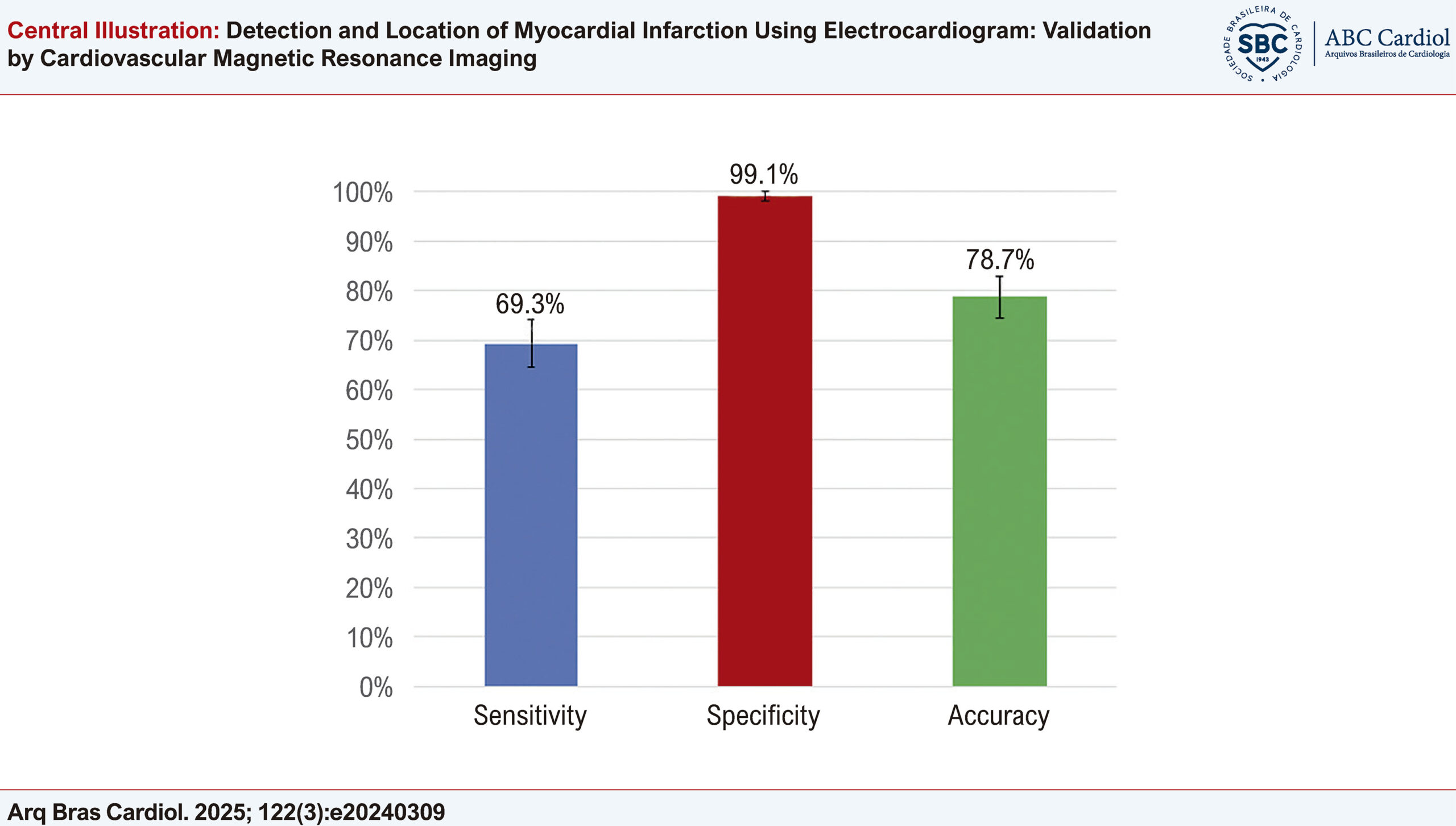
ECG showed good performance for detecting previous MI, with sensitivity of 69.3% (64.5% to 74.1%), specificity of 99.1% (98.1% to 100%), and accuracy of 78.7% (74.4% to 83.0%). However, in locating MI in accordance with CMR, its accuracy was unsatisfactory.

Conclusions

When compared to CMR, ECG was shown to be a method with good accuracy for detecting previous MI, but not for defining its location.

  • Coronary Artery Disease
  • Electrocardiography
  • Magnetic Resonance Imaging
  • Myocardial Infarction
Read Full Article
Creative Commons Attribution (CC BY) Creative Commons license
12/05/2025 DOI: 10.36660/abc.20240309i Views 3
Editorial

From Electrocardiogram to Magnetic Resonance Imaging – The Quest for Unrecognized Myocardial Infarction

Pedro Sousa Mateus

In the article “Detection and localization of myocardial infarction using electrocardiogram: validation by cardiovascular Magnetic Resonance Imaging”, the authors systematically and thoroughly analyze the relationship between the presence of pathological Q waves on the electrocardiogram (ECG) and delayed enhancement with an ischemic pattern on magnetic resonance imaging (MRI). Very relevant data on the diagnostic performance of the ECG in detecting and localizing myocardial infarction (MI) are presented, expanding the evidence accumulated in previous studies.

The authors studied two groups of patients: one consisting of patients with a documented history of MI and the other selected from diabetic patients without significant cardiac abnormalities on MRI.

[…]

  • Electrocardiography
  • Magnetic Resonance Imaging
  • Myocardial Infarction
Read Full Article
Creative Commons Attribution (CC BY) Creative Commons license
12/05/2025 DOI: 10.36660/abc.20250147i Views 1
Editorial

Ideal Blood Pressure Levels: So Long the J-Curve, Lower is Better

Marcio Sommer Bittencourt

While hypertension is one of the most well-recognized risk factors for cardiovascular disease, there are no clear universally accepted ideal blood pressure levels. Original data from the Framingham heart study in the 1970s suggested no normality threshold for high blood pressure, indicating that “the lower, the better”, particularly for systolic blood pressure. However, subsequent reanalysis of the same data suggests a J-curve association between diastolic blood pressure and outcomes. Interestingly, the J-curve pattern was restricted to the diastolic blood pressure as the associations of systolic blood pressure with mortality and cardiovascular outcomes have always been linear with no clear threshold at least to levels as low as 90-110 mmHg. Based on such epidemiological data as well as clinical knowledge that lower blood pressure levels may cause symptoms, hypertension guidelines have recommended a parsimonious definition of blood pressure target tailored to the individual patient risk. In the 1970s, the first version of the Joint National Committee treatment was only consistently indicated with diastolic blood pressures above 105 mmHg, but since then, targets have been progressively lower.

This J-curve has been reassessed in multiple studies since then. An interesting sub-analysis of the SPRINT trial demonstrated that although lower diastolic blood pressure is associated with an increased risk of cardiovascular events, further aggressive reduction of systolic blood pressure to the study target still leads to a reduction in cardiovascular events, even in individuals with lower diastolic blood pressure levels. Another large epidemiologic study demonstrated that while low diastolic blood pressure is associated with increased events, the effect is no longer present once adjusted for age, sex, risk factors, and systolic blood pressure levels. This study also demonstrated that the increased risk associated with low diastolic blood pressure was mostly explained by its association with older age and higher systolic blood pressure. Collectively, the evidence indicates that low diastolic BP does not cause worse outcomes; its association with cardiovascular events only represents reverse causation and confounding effects.

[…]

  • Arterial Pressure
  • Cardiovascular Diseases
  • Hypertension
Read Full Article
Creative Commons Attribution (CC BY) Creative Commons license
09/05/2025 DOI: 10.36660/abc.20250150i
Figure 1
Research Letter

Primary Pericardial Angiosarcoma Complicated by Constrictive Pericarditis

Guilherme Augusto Reissig Pereira et al. Maiane Maria Pauletto Anna Paula Tscheika Fabrício Michalski Velho Luciano Folador

Introduction

Secondary malignant cardiac tumors are metastases from primary tumors and 22 to 132 times more common than primary cardiac tumors (PCTs).– PCTs are rare, with an estimated autopsy prevalence of 0.001-0.03%, and mostly (90%) benign.,

Among PCTs, cardiac angiosarcoma is a rare subtype of soft tissue sarcoma and the most common primary malignant tumor of the heart. Angiosarcomas consist of irregularly shaped vascular channels lined by anaplastic epithelial cells with substantial areas of necrosis and hemorrhage. Cardiac angiosarcoma is an aggressive tumor with a high rate of local recurrence and systemic dissemination. Without surgical resection, it has a mean overall survival of 3.8 (SD 2.5) months. The rapid infiltrating growth of this tumor can lead to emergency clinical presentations including myocardial rupture, pericardial effusions, cardiac tamponade, and constrictive pericarditis (CP).

[…]

  • Angiosarcoma
  • cardiac tumor
  • Constrictive pericarditis
  • Heart Neoplasms
  • Primary Cardiac Angiosarcoma
Read Full Article
Creative Commons Attribution (CC BY) Creative Commons license
09/05/2025 DOI: 10.36660/abc.20240683i Views 2
Seven Deadly Sins in Hypertension Management: In-Depth Analysis of the Errors on a Journey from Riva-Rocci to Myocardial Fibrosis
Review Article

Seven Deadly Sins in Hypertension Management: In-Depth Analysis of the Errors on a Journey from Riva-Rocci to Myocardial Fibrosis

Claudio Pinho et al. Heitor Moreno José Francisco Kerr Saraiva Fernanda Marciano Consolim-Colombo

Abstract

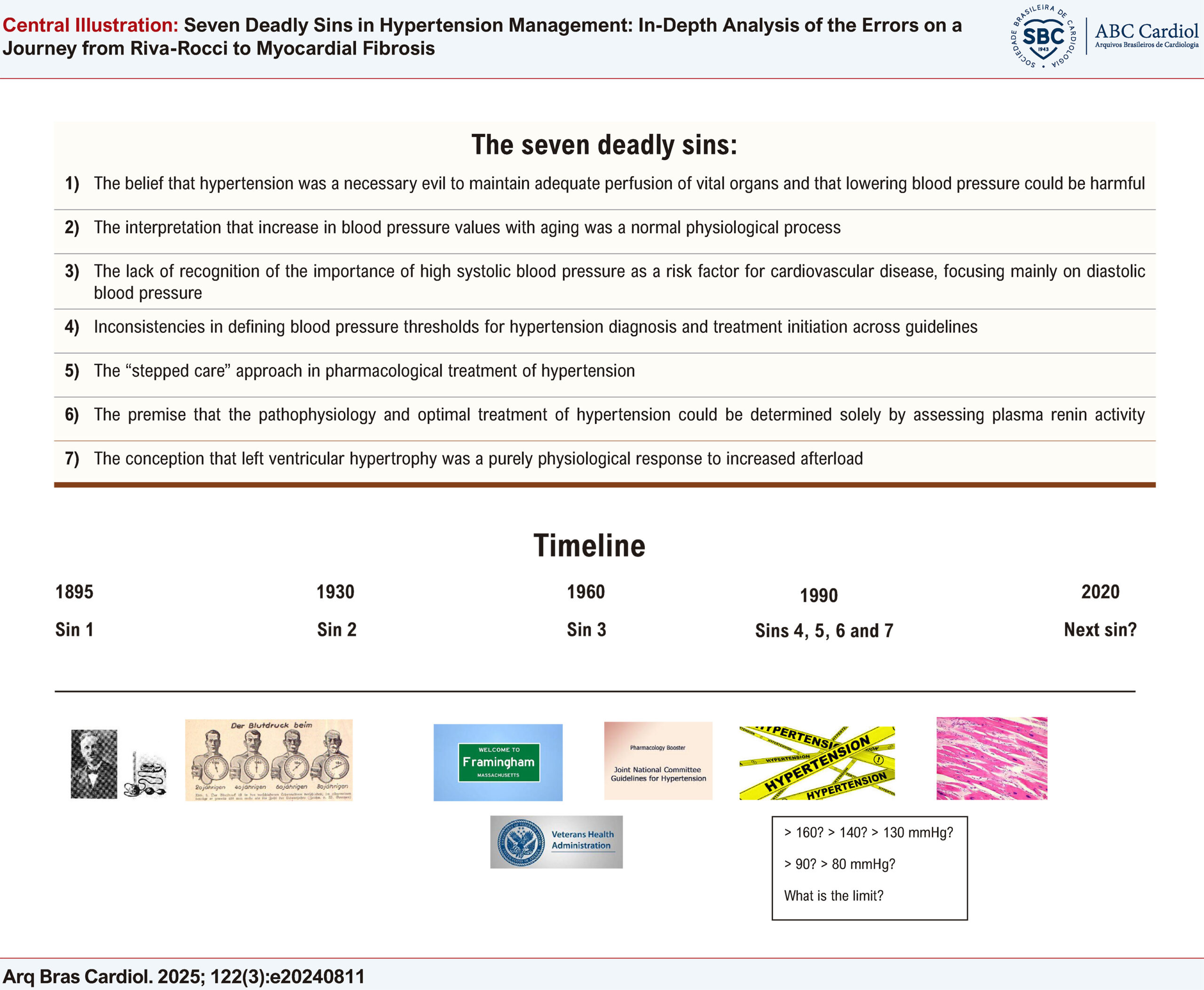
Medicine is perhaps the only science that values knowledge of the most recent scientific publications more than its history over time. Medical epistemology shows that some mistakes and successes are so close that we often do not readily differentiate between them. The production of medical knowledge makes us understand that knowledge is transitory and theories need to be revalidated, rectified, or polished, if not destroyed and built again on other bases; paradigms that are renewed move science. With this critical view, it was necessary to access how much knowledge about arterial hypertension has been built over the last 130 years, since the measurement of blood pressure began to be widespread and become routine in medical practice until the present day. This critical review was focused on errors in the interpretation of acquired knowledge, seven of which have been identified, deeply discussed, and condemned as sins due to the delay in being recognized, thus allowing the lives of people with this cardiovascular pathology to be shortened.

  • Bias
  • Hypertension
  • Science
Read Full Article
Creative Commons Attribution (CC BY) Creative Commons license
02/05/2025 DOI: 10.36660/abc.20240811i Views 1
Association between Cardiovascular Risk Factors and Carotid Plaques in a Population-Based Study - The SHIP-Brazil Study
Original Article

Association between Cardiovascular Risk Factors and Carotid Plaques in a Population-Based Study – The SHIP-Brazil Study

Fernanda Burger Zimmermann et al. Sérgio Luiz Zimmermann Marcelo Burger Zimmermann Enrico Klug Beraldi … Mateus Campanelli Franco da Rocha Bruno Pereira de Oliveira Zabot Siegmar Starke Ernani Tiaraju de Santa Helena Marcello Ricardo Paulista Markus

Abstract

Background

Atherosclerotic disease is a relevant cause of morbidity and mortality in the general population, and it is important to detect factors that can influence its prevention.

Objective

To evaluate the association of cardiovascular risk factors with carotid plaques in participants of the Study of Health in Pomerania (SHIP) – Brazil.

Methods

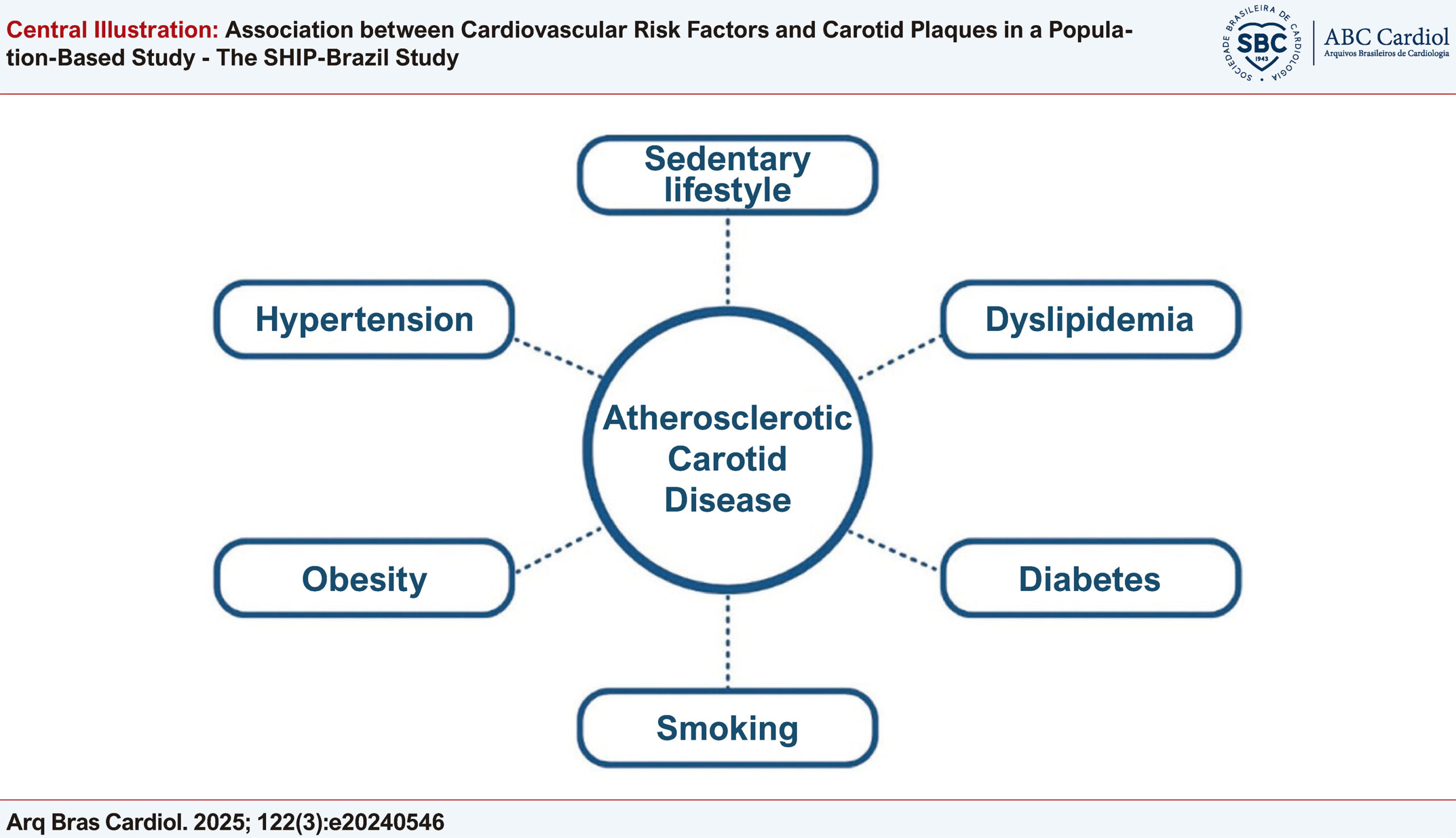
A total of 1,953 participants were assessed for the presence of cardiovascular risk factors (hypertension, dyslipidemia, type 2 diabetes, obesity, smoking and physical inactivity) and sociodemographic variables (gender, age group, Germanic culture, color/race self-declared, and alcohol consumption), waist circumference measurement, waist-to-hip ratio and waist-to-height ratio. The presence of carotid plaques was analyzed by ultrasound. The association between the study variables and carotid plaques was assessed using the Chi-square test. A p-value < 0.05 was considered significant.

Results

Plaques were present in 56.5% of hypertensive patients (p<0.001), 49.8% of dyslipidemic patients (p<0.001), 62% of diabetic patients (p<0.001), 52% of smokers, 29% of those who had never smoked (p<0.001), 39.5% of sedentary people and 33.1% of non-sedentary people (p=0.014), 43.7% of obese people and 26.1% of eutrophic people (p<0.001).

Conclusion

Carotid plaques were prevalent in men, aged between 60 and 79, white, hypertensive, dyslipidemic, diabetic, smokers, sedentary and obese, illiterate, in economic class A1/A2, and of Germanic culture, and low alcohol consumption.

  • Atherosclerosis
  • Carotid Arteries Ultrasonography
  • Carotid Intima-Media Thickness
  • Heart Disease Risk Factors
Read Full Article
Creative Commons Attribution (CC BY) Creative Commons license
02/05/2025 DOI: 10.36660/abc.20240546i Views 1
Figure 1
Research Letter

Unveiling the Genetic Puzzle: Asymmetric Hypertrophy in a Heart Transplant Recipient Linked to Birt-Hogg-Dubé Syndrome

Silas Ramos Furquim et al. Lucas Vieira Lacerda Pires Nara Alves Buriti Mariana Lombardi Peres de Carvalho … Emanuelle Leonilia Marques Bianca Domit Werner Linnenkamp Luciana Sacilotto Fabiana G. Marcondes-Braga Iascara Wozniak de Campos Luis Fernando Bernal da Costa Seguro Sandrigo Mangini Monica S. Avila Fernando Bacal José Eduardo Krieger

Abstract

A case of a 54-year-old man who underwent a heart transplant with early asymmetric hypertrophy unrelated to rejection. Donor’s genetic analysis revealed a variant in folliculin gene, associated with Birt-Hogg-Dubé Syndrome. Screening of the donor’s family uncovered a similar hypertrophy and same genetic variant in the donor’s father. Although genetic evaluation of donors’ tissues is not routine, it can be crucial for understanding changes unrelated to the transplant procedure and identifying carriers of pathogenic variants.

  • Genetics
  • Heart Transplantation
  • Hypertrophic Cardiomyopathy
Read Full Article
Creative Commons Attribution (CC BY) Creative Commons license
02/05/2025 DOI: 10.36660/abc.20240444i Views 4
Clinical Predictors of Heart Failure after STEMI: Data from a Middle-Income Country with Limited Access to Percutaneous Coronary Intervention
Original Article

Clinical Predictors of Heart Failure after STEMI: Data from a Middle-Income Country with Limited Access to Percutaneous Coronary Intervention

Vinícius C. Fiusa et al. Andrea D. Stephanus Victor F. Couto Gustavo A. Alexim … Thaiene M. M. Severino Ana Claudia C. Nogueira Adriana J. B. A. Guimarães Alexandre Anderson S. M. Soares Elizabeth Bilevicius Vivian Batista Alessandra Staffico Andrei C. Sposito Luiz Sérgio F. de Carvalho

Abstract

Background

Heart failure (HF) is a common complication of ST-elevation myocardial infarction (STEMI) in low- and middle-income countries (LMICs), where cardiovascular mortality is disproportionately high. Primary percutaneous coronary intervention (PCI) has reduced post-STEMI HF incidence in high-income countries. However, access to this standard of care is poor in LMICs, and data in these settings remain scarce

Objective

To identify predictors of HF following STEMI in a LMIC with limited access to PCI, aiming at better management and outcomes.

Methods

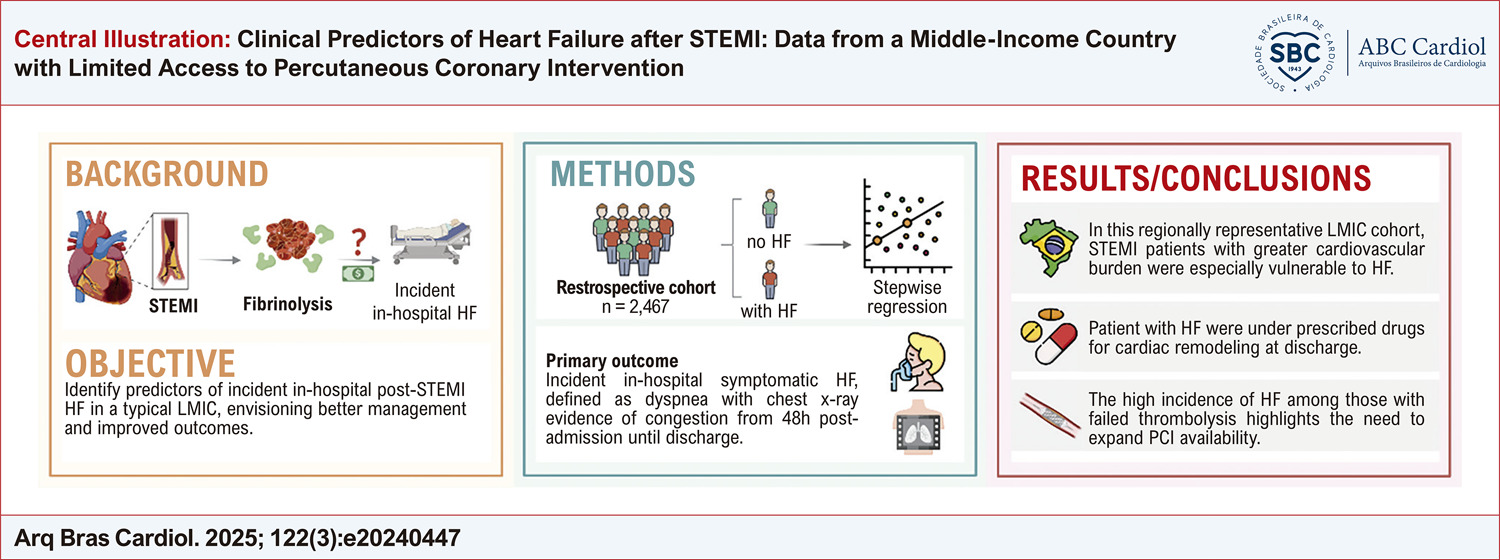
This retrospective cohort study analyzed 2,467 STEMI patients admitted to two Brazilian public hospitals between January/2015 and February/2020. All participants received pharmacological thrombolysis and underwent coronarography within 48h post-admission. The primary outcome was symptomatic HF, defined as dyspnea with chest X-ray evidence of congestion, from 48h post-admission until discharge. Stepwise binary logistic regression was used to identify HF predictors. Significance was defined as p-values<0.05.

Results

The population was 61.9% male, mean age was 58.3±12.6 years, and 39.9% developed post-STEMI HF. HF was more common among older men with cardiovascular-kidney-metabolic (CKM) disease, larger infarcts, and left anterior descending artery involvement. Medications were often underprescribed at discharge, especially aldosterone antagonists (11.0%). HF was notably more frequent among individuals with failed thrombolysis (47.0%).

Conclusions

This regionally representative cohort from a LMIC with limited access to PCI showed that older men with CKM disease are particularly vulnerable to post-STEMI HF, and that HF pharmacotherapy at discharge needs optimization. The high HF incidence among patients with failed thrombolysis highlights the need to expand PCI availability.

  • Heart Failure
  • Pharmacological Thrombolysis
  • Risk Factors
  • ST Elevation Myocardial Infarction
Read Full Article
Creative Commons Attribution (CC BY) Creative Commons license
07/04/2025 DOI: 10.36660/abc.20240447i Views 1
Cardiovascular Telerehabilitation: An Alternative for Greater Availability of Cardiovascular and Metabolic Rehabilitation in Brazil
Viewpoint

Cardiovascular Telerehabilitation: An Alternative for Greater Availability of Cardiovascular and Metabolic Rehabilitation in Brazil

Artur Haddad Herdy et al. Ariella Sebastião Mangia Magnus Benetti

Cardiovascular telerehabilitation – concept

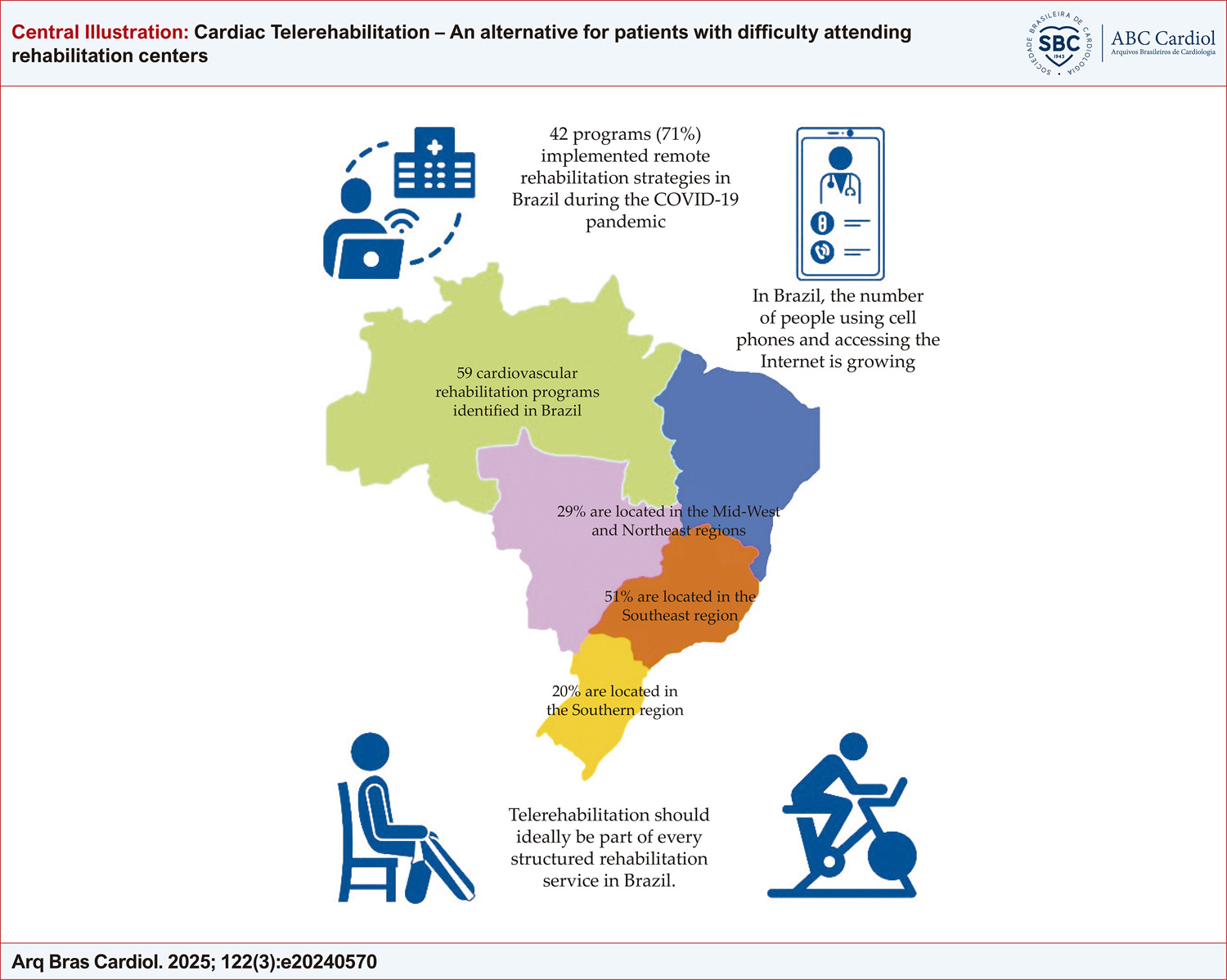
CTR is a program that comprises one or more components of traditional CVR, commonly offered in CVR programs at home or outside a hospital/specialized center environment; it is delivered through digital technology (telemonitoring, e-learning, telecoaching).

Its objective is to manage CVD and improve different physical, emotional, psychological, and social aspects of patients, especially those located in areas with low levels of access, whether due to their place of residence or difficulty in accessing advanced care.,

[…]

  • Cardiac Rehabilitation
  • Cardiovascular Diseases
  • COVID-19
  • Telemonitoring
  • Telerehabilitation
Read Full Article
Creative Commons Attribution (CC BY) Creative Commons license
07/04/2025 DOI: 10.36660/abc.20240570i
Growth Differentiation Factor 15 is Correlated With Urinary Markers in Patients with Chronic Heart Failure
Original Article

Growth Differentiation Factor 15 is Correlated With Urinary Markers in Patients with Chronic Heart Failure

Gustavo Rodolfo Moreira et al. Diane Xavier Ávila Angelo Michele Di Candia Victoria Depes Scaramussa Humberto Villacorta

Abstract

Background

There is a lack in identifying heart failure (HF) patients with an increased risk of hospitalization and death. Growth differentiation factor 15 (GDF-15), a biomarker associated with inflammation and oxidative stress, emerges as a candidate associated with cardiovascular and renal disease. The low estimated glomerular filter rate (eGFR), low urinary sodium (UNa), and the high ratio of albumin to creatinine are renal markers already associated with a high risk of hospitalization and mortality.

Objective

To evaluate the relationship between GDF-15 and renal markers in patients with chronic HF.

Method

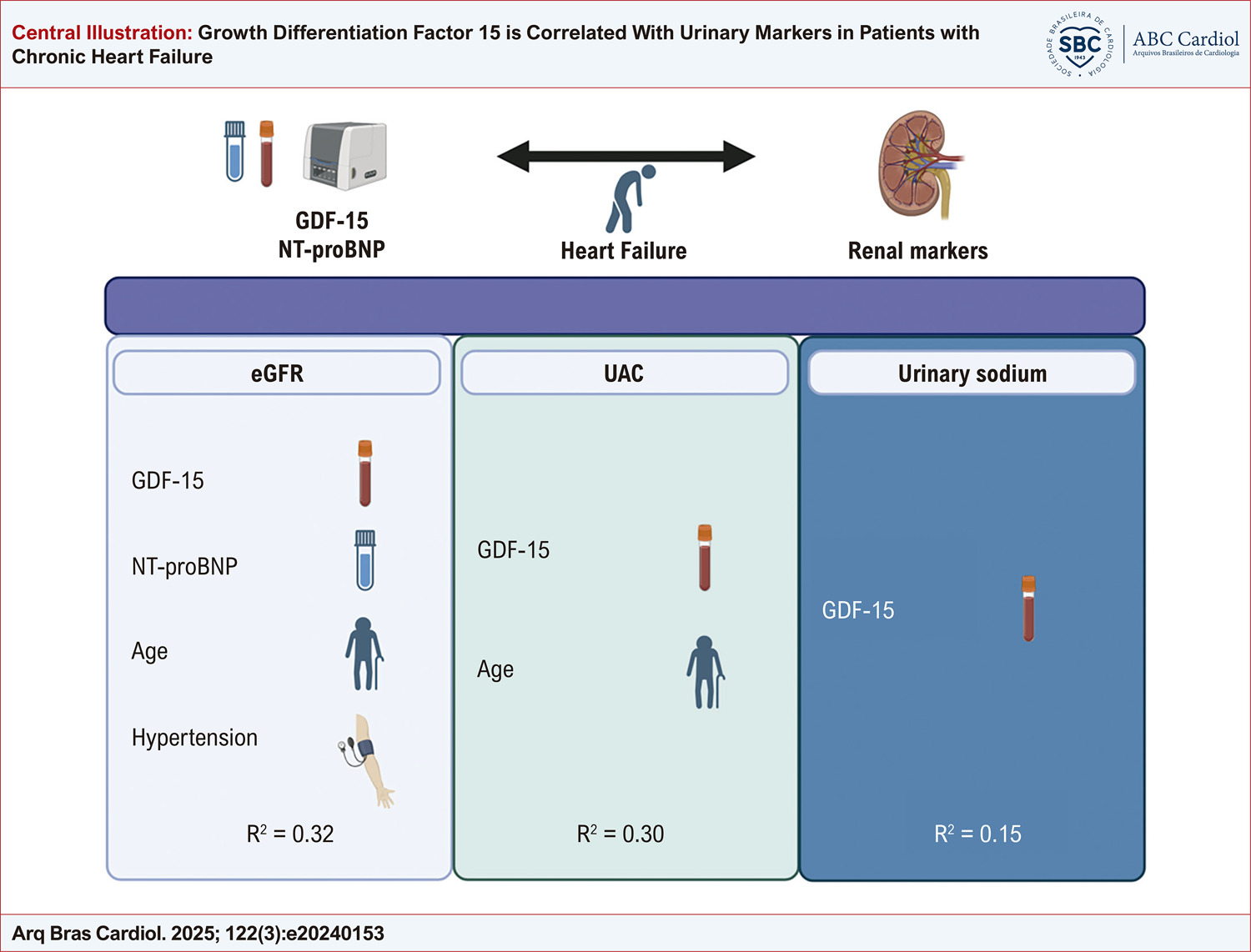
We enrolled 87 consecutive patients with symptomatic HF with reduced left ventricular ejection fraction (LVEF < 40%), mildly reduced LVEF (40–49%) or an improved LVEF (50% but previously < 50%) in a university hospital. We compared the associations of GDF-15 and NT-proBNP with renal markers using correlation tests and multiple regression analysis at the significance level of 5%.

Results

GDF-15 and NT-proBNP had weak to moderate negative correlations with UNa (r=-0.362, p=0.007; r=-0.334, p=0.014, respectively) and eGFR (r=-0.385, p=0.0002; r=-0.346, p=0.001, respectively). GDF-15, age, hypertension and NT-proBNP were independently associated with eGFR in multiple regression analysis (overall R2=0.32). GDF-15 (positive) and age (negative) were independently associated with UAC (overall, R2=0.30). Only GDF-15 was independently associated with UNa (R2=0.45).

Conclusions

In these chronic patients with HF, GDF-15 is better correlated with markers of renal dysfunction than NT-proBNP. Since the prognostic value of renal markers is well established, these findings reinforce the prognostic role of GDF-15 in chronic HF.

  • Biomarkers
  • Cardio-Renal Syndrome
  • GDF-15
  • Heart Failure
  • Kidney Function Tests
Read Full Article
Creative Commons Attribution (CC BY) Creative Commons license
04/04/2025 DOI: 10.36660/abc.20240153i Views 2
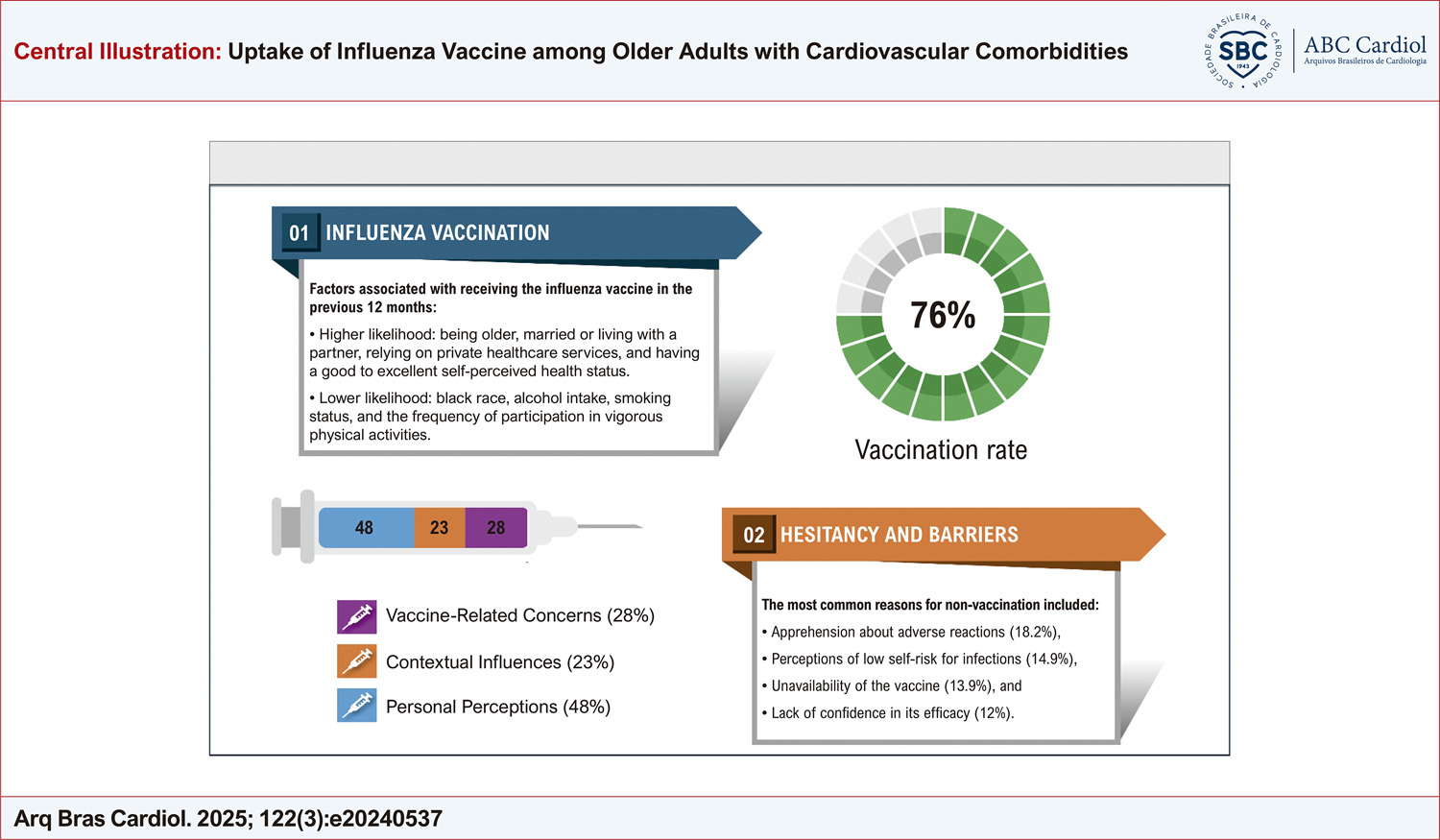
Uptake of Influenza Vaccine among Older Adults with Cardiovascular Comorbidities
Original Article

Uptake of Influenza Vaccine among Older Adults with Cardiovascular Comorbidities

Rodrigo S. Aguilar et al. Ana Paula Rosim Giraldes Maria Paula Barbieri Delia Meliza Goi Roscani Henrique Pott

Abstract

Background

Influenza vaccination reduces illness and fatality in older adults, especially those with cardiovascular comorbidities.

Objective

To investigate influenza vaccination uptake among community-dwelling older Brazilian patients with cardiovascular comorbidities.

Methods

This cross-sectional study analyzed data from the ELSI-Brazil Second wave (2019-2021), involving 9,949 older adults. Participants with cardiovascular conditions provided data on influenza vaccination from the previous year. Vaccination-associated factors were identified, with subgroup analyses for each cardiovascular comorbidity. An exploratory analysis investigated the primary reasons for non-vaccination. Statistical significance was determined with a two-sided P-value < 0.05.

Results

This study included 5,296 individuals. Of these, 76.6% reported receiving the influenza vaccine within the year before data collection. Vaccinated individuals were generally older females, widowed, and non-smokers with healthier habits and private healthcare access, although they had higher frailty and cardiovascular comorbidities. Age significantly influenced the likelihood of vaccination across subgroups. In hypertension, private healthcare and good health status increased the odds, while smoking and alcohol consumption reduced them. The most common reasons for not receiving the influenza vaccine were fear of adverse reactions (18.2%), belief in a low-risk infection (14.9%), vaccine unavailability (13.9%), and lack of confidence in its effectiveness (12%).

Conclusion

About 24% of older Brazilian adults with cardiovascular conditions remain unvaccinated against influenza, posing severe health risks. Strategies addressing personal beliefs, improving access, and enhancing healthcare provider engagement are crucial. Tailored interventions should align with the population’s demographic and health characteristics to overcome these barriers effectively.

  • Aged
  • Cardiovascular Diseases
  • Human Influenza
  • Vaccines
Read Full Article
Creative Commons Attribution (CC BY) Creative Commons license
04/04/2025 DOI: 10.36660/abc.20240537i
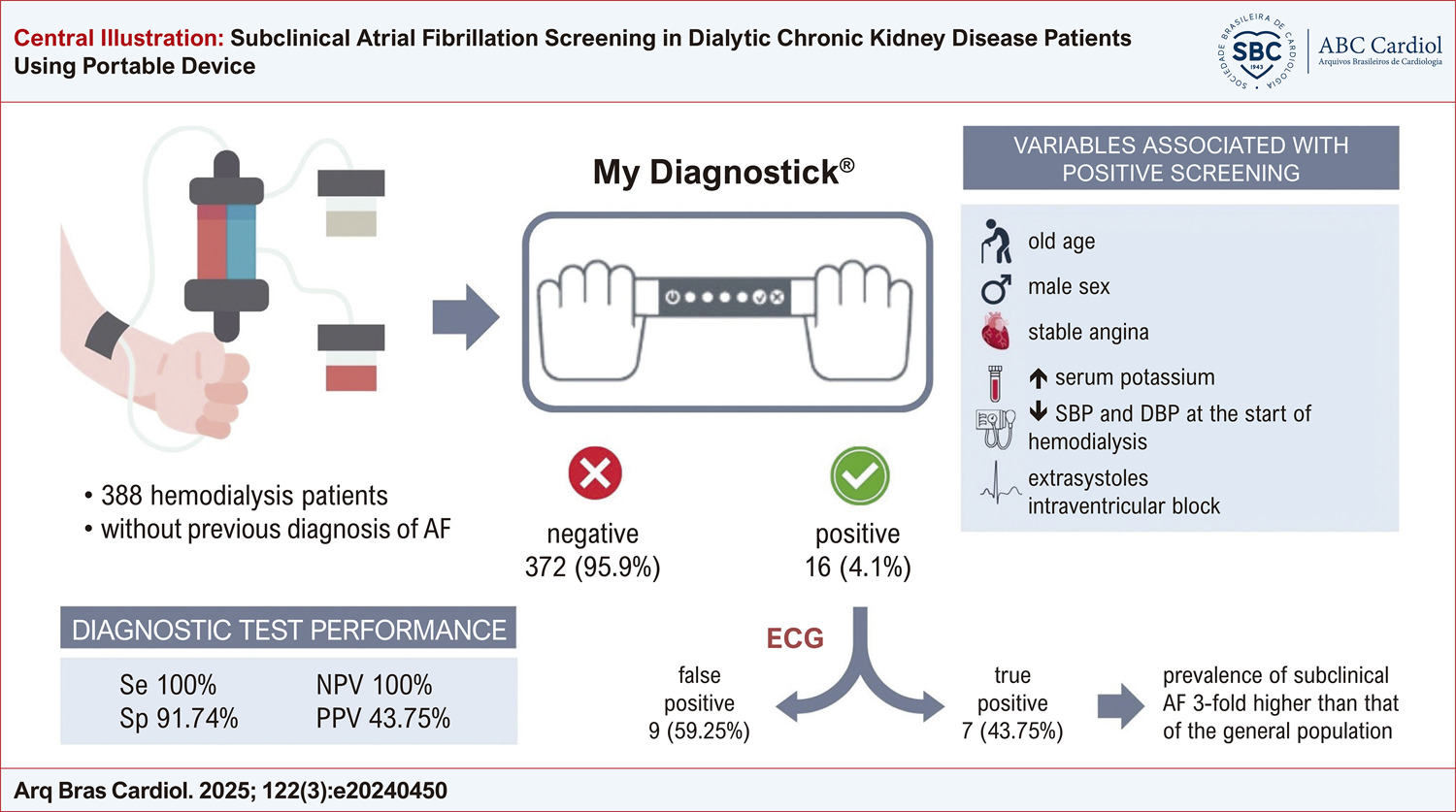
Subclinical Atrial Fibrillation Screening in Dialytic Chronic Kidney Disease Patients Using Portable Device
Original Article

Subclinical Atrial Fibrillation Screening in Dialytic Chronic Kidney Disease Patients Using Portable Device

Adson Patrik Vieira Carvalho et al. Gabriel Assis Lopes do Carmo Cassia Aparecida Silva Ana Cecília Oliveira … Lucas Giandoni Perez Lilian Pires de Freitas do Carmo Antonio L. Ribeiro

Abstract

Background

Cardiovascular morbidity and mortality rates are higher in hemodialysis (HD) patients, with an increased prevalence of arrhythmias. Atrial fibrillation (AF) is an independent risk factor for mortality and thromboembolic events in dialysis patients. For a better understanding and management of AF in these patients, it is important to know its prevalence. The use of a portable device would be pioneering for this group of patients.

Objective

To screen HD patients for AF using a portable gadget and evaluate the device’s diagnostic performance.

Methods

HD patients at a tertiary hospital underwent AF screening during HD sessions using MyDiagnostick® (Applied Biomedical Systems). Multiple data were collected to evaluate potential associations. Statistical significance was defined as p < 0.05.

Results

388 patients were evaluated (female, 40.7%; mean age of 56.8 years old, SD ± 14.7; and HD time of 27 months, 10-57). Screening was positive in 16 (4.1%) patients. AF was confirmed by electrocardiogram in 7 (1.8%) patients. Male sex (p = 0.019), older age (p = 0.007), altered baseline electrocardiogram (p < 0.001), increased serum potassium (p = 0.021), reduced systolic blood pressure at the beginning of dialysis (p = 0.007), and stable angina (0.011) were associated with positive screening for AF. The device presented a 91.74% specificity (95% CI, 86.65% to 96.91%) and 100% sensitivity (95% CI, 100% to 100%), with a negative predictive value of 100% (95% CI, 100% to 100%) for AF screening.

Conclusion

The use of this device proved to be practical, with high sensitivity and excellent negative predictive value. Subclinical AF has a high prevalence and may be underestimated in this population.

  • Atrial Fibrillation
  • Diagnostic Equipment
  • Dialysis
Read Full Article
Creative Commons Attribution (CC BY) Creative Commons license
04/04/2025 DOI: 10.36660/abc.20240450i Views 1
Figure 1
Research Letter

Coronary-Cavitary Fistula, an Unusual Cause of Heart Failure

Hernán Patricio García Mejía et al. Matheus Carvalho Alves Nogueira Bruno Mahler Mioto Nilson Tavares Poppi … Luiz Antonio Machado Cesar Luhanda Leonora Cardoso Monti Sousa Luís Roberto Palma Dallan

Introduction

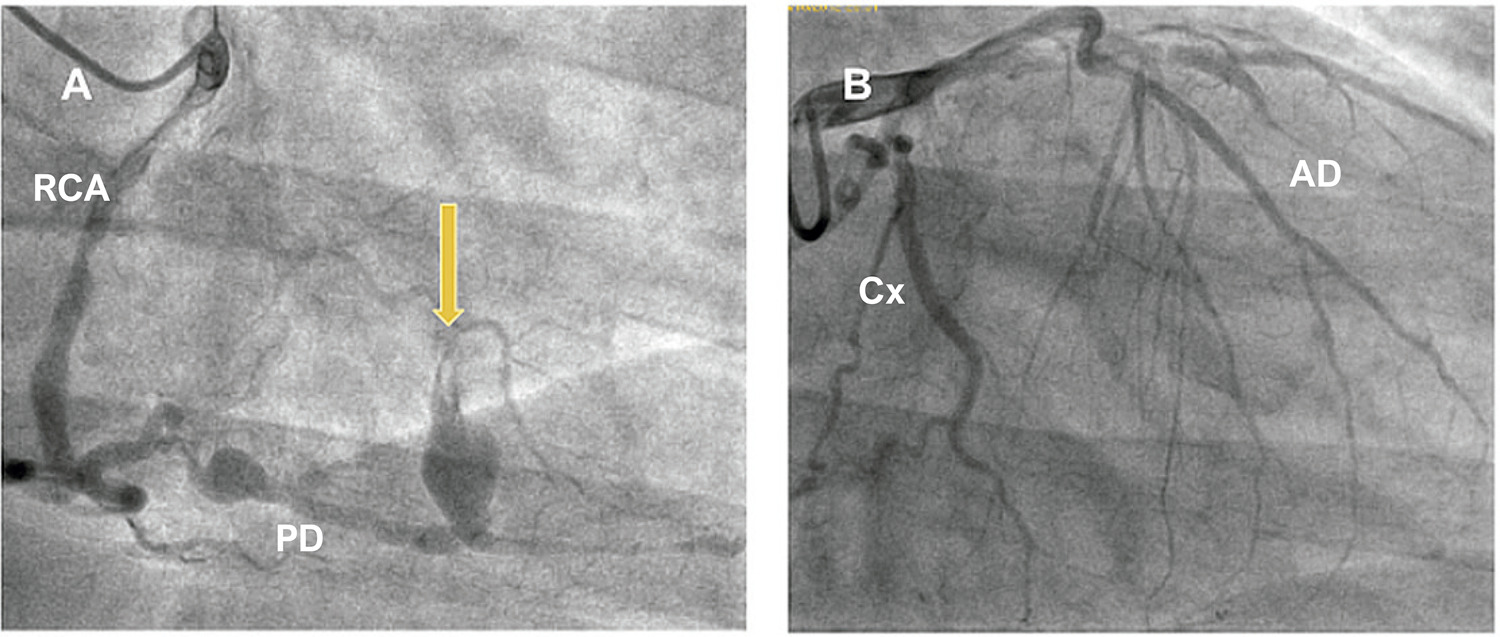
Coronary fistulas (CFs) are defined as a direct anomalous connection between one or more coronary arteries with a large vessel or cardiac chamber. Most CFs drain into a lower pressure system, such as the right ventricle (RV) 40%, right atrium (RA) 26%, pulmonary artery (PA) 17%, coronary sinus 7%, and vena cava 1%. The clinical presentation will depend on the location and volume of the shunt generated by the fistula. Approximately 50% of cases are asymptomatic and, when present, may include dyspnea, palpitations, chest pain, or, in more severe cases, heart failure (HF), acute coronary syndromes, and arrhythmias.,

[…]

  • Coronary Angiography
  • Fistula
  • Heart Failure
  • Myocardial Ischemia
Read Full Article
Creative Commons Attribution (CC BY) Creative Commons license
04/04/2025 DOI: 10.36660/abc.20240809i Views 2
Figure 1
Research Letter

Survival in Patients with Brugada Phenocopy. Case Series

Luis Mariano De la Torre Fonseca et al. Robert Alarcón Cedeño Lileska Andreína Hernandez Bello Juan Díaz-Heredia … Diego Milton Pulla Quezada Rubén Andrés Guamán Castro Pablo Juan-Salvadores

Introduction

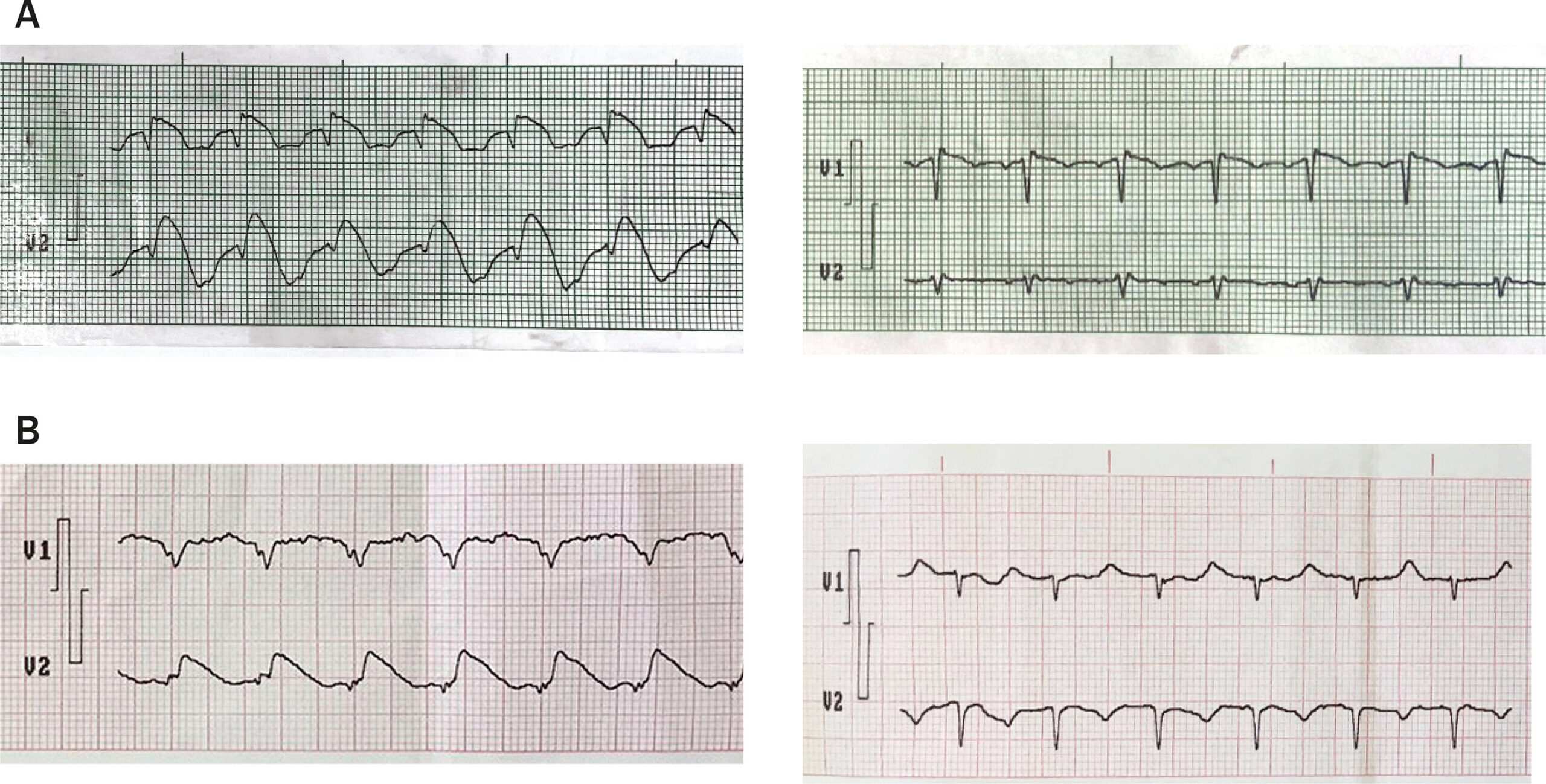
Brugada phenocopy (BP) refers to a situation in which the characteristic electrocardiographic patterns of Brugada syndrome (BS) are temporarily manifested, which are indistinguishable from the type 1 (coved) and 2 (saddleback) patterns of BS. Several additional criteria must be considered for an accurate diagnosis. These include the presence of an identifiable underlying cause, regression of the pattern once this cause is corrected, low pretest probability of BS, a negative result of a pharmacological induction test, and a negative genetic test.

Currently, the true mechanism that causes BP remains unknown. However, ST-segment elevation could be explained by the transmural gradient resulting from the loss of the action potential dome in the epicardium and not in the ventricular endocardium. This phenomenon originates from the transient increase in K outward currents (Ito) or the decrease in L-type Ca inward currents and peak Na currents in phase 1 of the action potential. Various reversible clinical conditions, such as disorders of the internal environment, mechanical compression, ischemia and pulmonary embolism, myocardial and pericardial diseases, among others, constitute its main etiologies.

[…]

  • Brugada Syndrome
  • Case Reports
  • ion channels
Read Full Article
Creative Commons Attribution (CC BY) Creative Commons license
31/03/2025 DOI: 10.36660/abc.20240526i
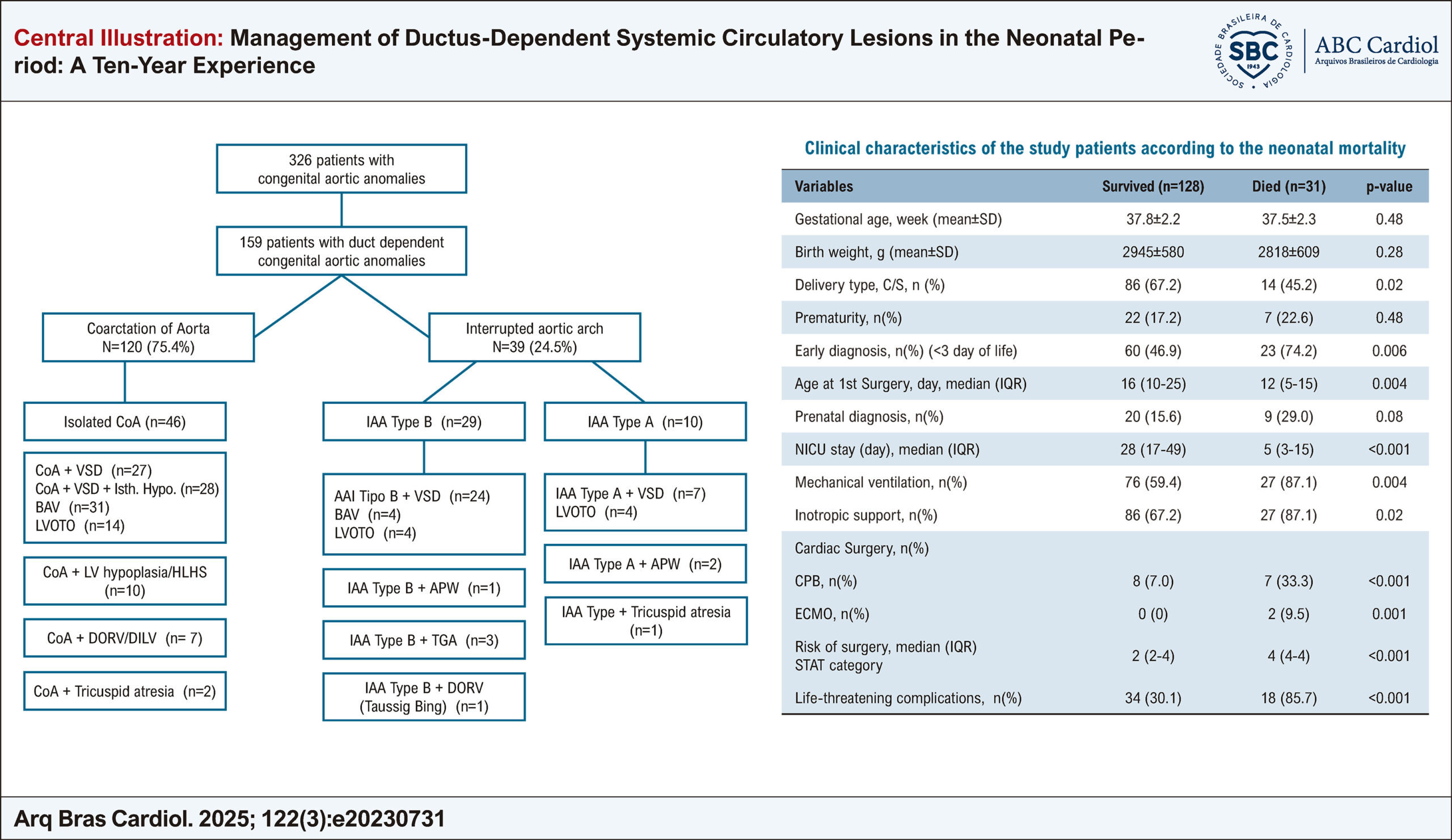
Management of Ductus-Dependent Systemic Circulatory Lesions in the Neonatal Period: A Ten-Year Experience
Original Article

Management of Ductus-Dependent Systemic Circulatory Lesions in the Neonatal Period: A Ten-Year Experience

Dilek Dilli et al. Hasan Akduman Rumeysa Çitli Utku Arman Örun … Vehbi Doğan Mehmet Taşar Tamer Yoldaş Nurdan Dinlen Fettah Ahmet Özyazıcı Ayşegül Zenciroğlu

Abstract

Background

In ductus-dependent left-sided heart lesions, systemic circulation depends on right-to-left flow via the ductus arteriosus. These lesions may occur as an isolated defect or complex disease.

Objective

In this study, we aimed to investigate the neonatal outcomes of duct-dependent systemic circulatory lesions, especially aortic coarctation (CoA) and interrupted aortic arch (IAA).

Methods

A total of 159 patients with duct-dependent systemic lesions were followed up in the Cardiac NICU of our institution from 2012 to 2022. We retrospectively reviewed the medical charts of all patients from the hospital database. They were analyzed for clinical and surgical outcomes. A p-value of <0.05 was considered statistically significant.

Results

Of 159 patients, CoA was detected in 120 (75.4%) and IAA in 39 (24.5%) patients. Cardiac catheterization was performed in 74 (61.6%) patients with CoA in the neonatal period; 49 (40.8%) underwent therapeutic and 25 (20.8%) diagnostic procedures. One hundred one patients with CoA (84.1%) underwent surgery at a median age of 14 days (9-23). Thirty-four of 39 patients with IAA (87.1%) underwent surgery; single-stage repair was performed on 13 patients (38.2%), while two-stage repair was applied to 21 (61.7%) patients. The overall neonatal mortality rate was 19.5% (n=31). In multivariate analysis, the higher STAT categories (OR:2.3, CI:95%, 1.1-5.1, p=0.03) and the presence of major postoperative complications (OR:9.8, CI:95%, 2.1-35.1, p=0.003) have increased the risk of neonatal mortality.

Conclusion

Newborns with congenital duct-dependent aortic anomalies necessitate meticulous perioperative care due to their heightened risk of morbidity and mortality.

  • Cardiovascular Abnormalities
  • Heart
  • Newborn
  • Thoracic aorta
  • Wounds and Injuries
Read Full Article
Creative Commons Attribution (CC BY) Creative Commons license
31/03/2025 DOI: 10.36660/abc.20230731i Views 2
Cascade Screening in Adolescents with Lipid Disorders Suggestive of Familial Hypercholesterolemia: Findings from the ERICA Study in Curitiba
Original Article

Cascade Screening in Adolescents with Lipid Disorders Suggestive of Familial Hypercholesterolemia: Findings from the ERICA Study in Curitiba

Vivian Freitas Rezende Bento et al. Tatiana Lorena da Luz Kaestner Amauri de Vargas Junior Renan Barbosa Lopes … Fernando Pinotti Scariot Leiza Loiane Hollas Marcia Olandoski Cristina Pellegrino Baena Katia Vergetti Bloch José Rocha Faria Neto

Abstract

Background

Familial hypercholesterolemia (FH) is a common genetic cause of premature coronary heart disease due to prolonged exposure to high levels of LDL cholesterol (LDL-C). Its prevalence in the heterozygous form ranges from 1:200 to 1:500, and early diagnosis is fundamental for treatment and risk reduction. Cascade screening is recommended upon the identification of index cases.

Objectives

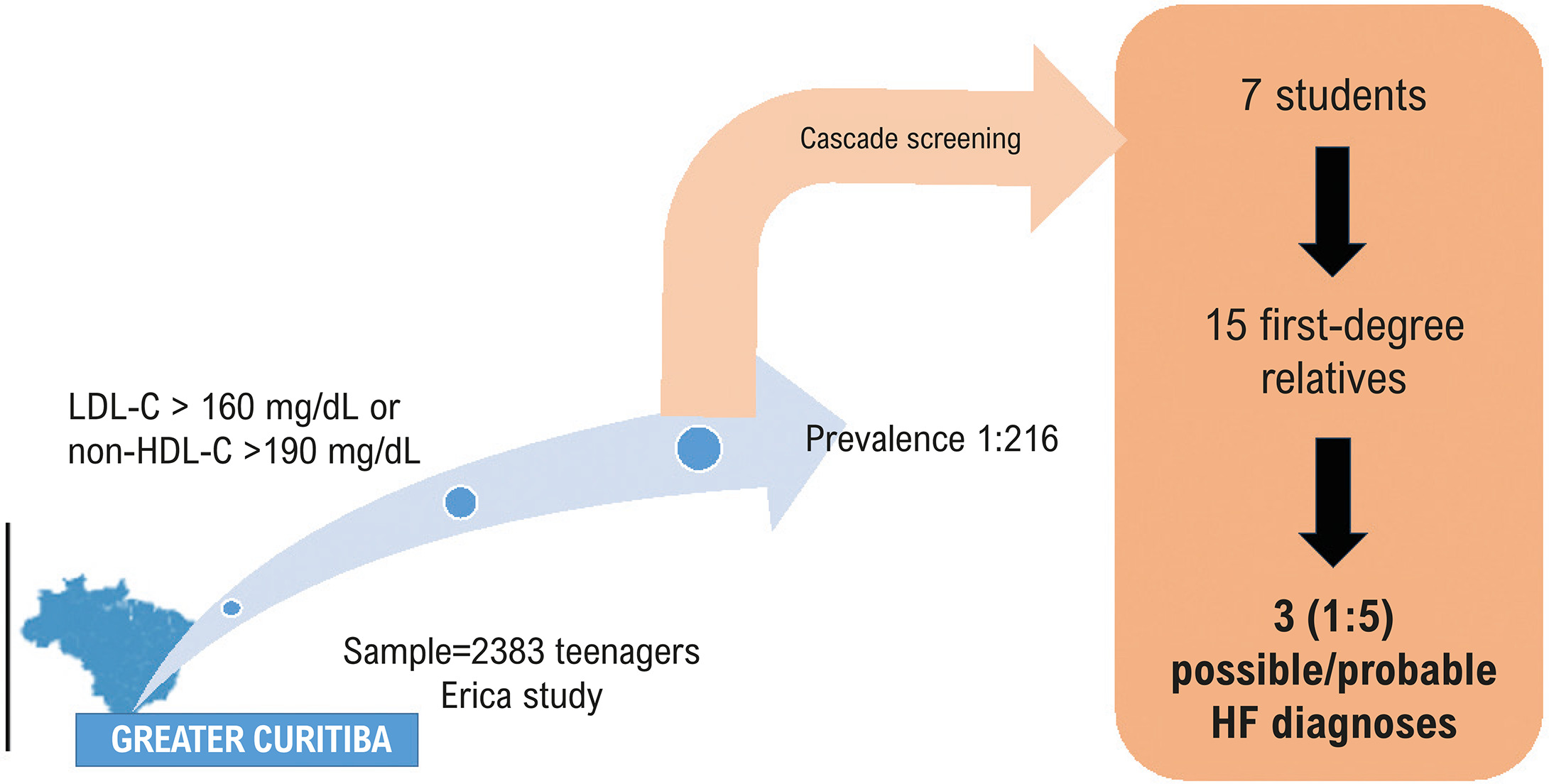
To assess the prevalence of lipid disorders suggestive of FH in students aged 12 to 17 years participating in the ERICA study in Curitiba and to determine the prevalence of FH based on clinical and laboratory criteria in these adolescents and their first-degree relatives undergoing cascade screening.

Methods

Using data from the ERICA study, adolescents with LDL-C levels > 160 mg/dL or non-HDL cholesterol > 190 mg/dL were identified, along with their first-degree relatives. The clinical diagnosis of the study participants was based on the DUTCH MedPed criteria. Statistical significance was defined as P < 0.05.

Results

Eleven adolescents with lipid disorders suggestive of FH were identified among the 2,383 evaluated (1:216). Of these, 7 students and 15 first-degree relatives were assessed. None of the adolescents had a diagnosis of possible FH confirmed by the clinical score. However, 3 family members (20%) were diagnosed with possible/probable FH.

Conclusion

Although the clinical score application did not confirm any cases among adolescents with lipid disorders suggestive of FH, indicating a limitation of the diagnostic method in this population, cascade screening identified potential cases in first-degree relatives.

  • Cholesterol
  • Dyslipidemias
  • Familial hypercholesterolemia
Read Full Article
Creative Commons Attribution (CC BY) Creative Commons license
31/03/2025 DOI: 10.36660/abc.20240468i Views 1
Systematic Review of the Effectiveness of Intensive Antihypertensive Treatment Goals: Brazilian Society of Cardiology (SBC) Recommendation
Original Article

Systematic Review of the Effectiveness of Intensive Antihypertensive Treatment Goals: Brazilian Society of Cardiology (SBC) Recommendation

Andréa Araujo Brandão et al. Cibele Isaac Saad Rodrigues Luiz Aparecido Bortolotto Leonardo Castro Luna … Bruno Monteiro Barros Mario Fritsch Toros Neves Ana Flávia de Souza Moura Frida Liane Plavnik Luciano Ferreira Drager Osni Moreira Filho Weimar Kunz Sebba Barroso de Souza Wilson Nadruz

Abstract

Background

Strict blood pressure control has been investigated as a strategy to reduce severe cardiovascular events in patients with hypertension. However, there are still doubts about the impact of intensive antihypertensive treatment goals (< 130/80 mmHg) compared to conventional goals (≥ 130/80 mmHg) in preventing myocardial infarction, stroke, mortality, and possible treatment-related adverse effects.

Objective

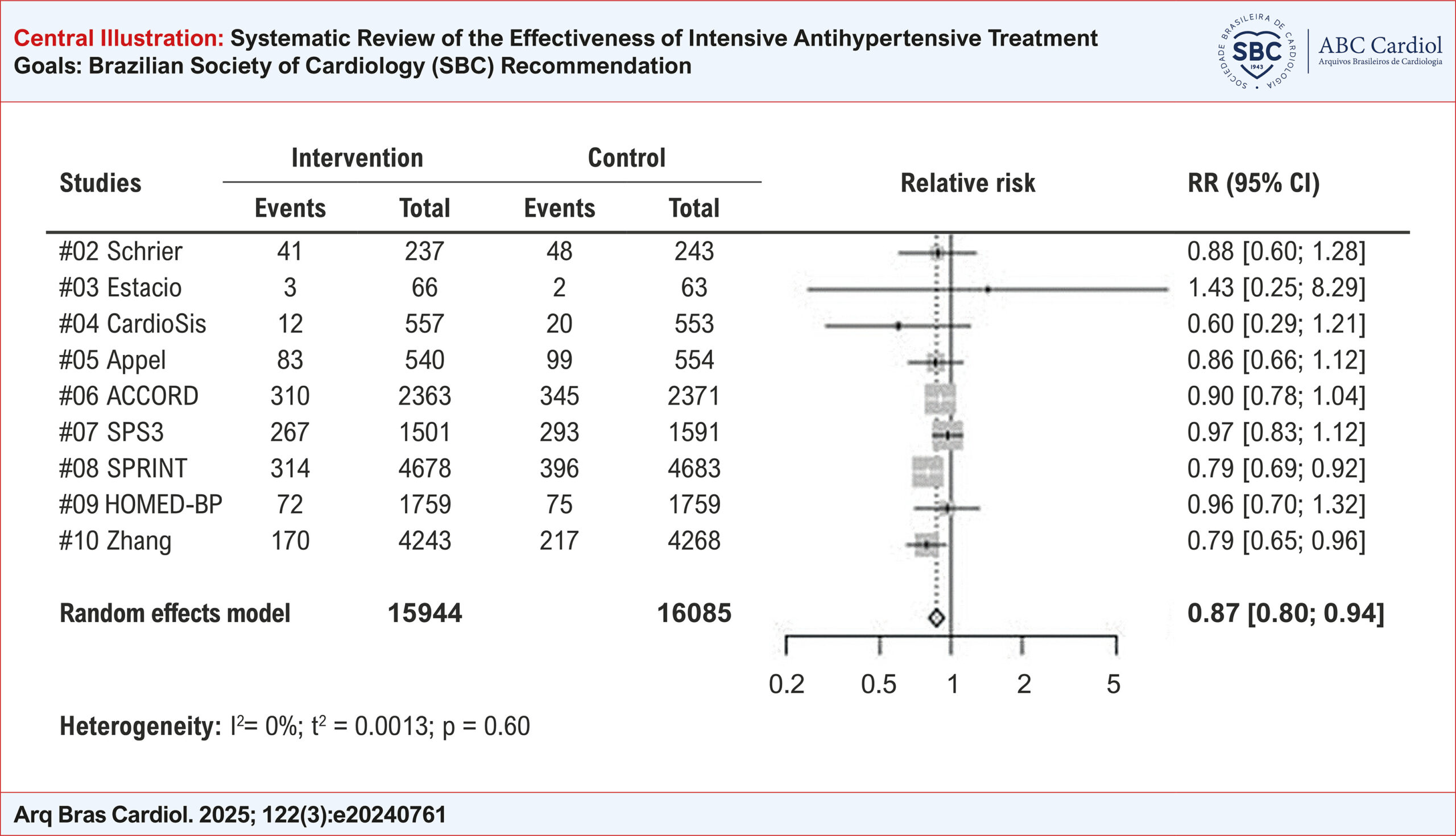
To evaluate the effectiveness of intensive antihypertensive treatment goals in reducing critical cardiovascular events compared to usual goals.

Methods

This systematic review included randomized controlled trials (RCTs) that compared intensive blood pressure control goals with conventional goals in adults aged 18 years or older. Studies with at least one of the following outcomes were included: mortality, myocardial infarction, stroke, progression to stage 4 or 5 chronic kidney disease, need for dialysis, or kidney transplantation. Medline, Embase, and Cochrane Library databases were searched up to May 2024. Risk of bias assessment was performed by two independent reviewers using the Cochrane Collaboration’s Risk of Bias 2 (RoB 2) tool. Synthesis of results was conducted through meta-analysis for the composite outcome of myocardial infarction, stroke, and all-cause mortality. The certainty of scientific evidence and strength of recommendation followed the methods proposed by the Grading of Recommendations Assessment, Development, and Evaluation (GRADE) tool.

Results

Nine RCTs with more than 34,000 participants were included. Intensive treatment was associated with a 13% reduction in cardiovascular events. In the studies with low risk of bias, the reduction was 17%, with high certainty of evidence. Separately, a significant reduction was observed in the outcomes of myocardial infarction and stroke, but not in all-cause mortality. Limited data were found on the progression of kidney disease and the need for dialysis or kidney transplantation.

Conclusion

High-quality evidence suggests that more intensive antihypertensive treatment goals significantly reduce cardiovascular events. However, the choice of treatment goals should be individualized, considering factors such as age, frailty, individual cardiovascular risk, and the possibility of adverse events. Adherence to treatment is essential to therapeutic success.

  • Drug Therapy
  • Hypertension
  • Meta-Analysis
  • systematic review
Read Full Article
Creative Commons Attribution (CC BY) Creative Commons license
31/03/2025 DOI: 10.36660/abc.20240761i
Esophageal Protection Strategies for Ablation of Atrial Fibrillation: Comparative Results of Consecutive Endoscopic Evaluation
Original Article

Esophageal Protection Strategies for Ablation of Atrial Fibrillation: Comparative Results of Consecutive Endoscopic Evaluation

Alberto Pereira Ferraz et al. Cristiano Faria Pisani Esteban Wisnivesky Rocca Rivarola Tan Chen Wu … Francisco Carlos da Costa Darrieux Rafael Alvarenga Scanavacca Muhieddine Omar Chokr Carina Abigail Hardy Sissy Lara de Melo Denise Tessariol Hachul Beatriz Hachul de Campos Mauricio Ibrahim Scanavacca

Abstract

Background

Atrial-esophageal fistula following AF ablation remains a concern. There is no standardized approach to minimize its risk and morbidity.

Objective

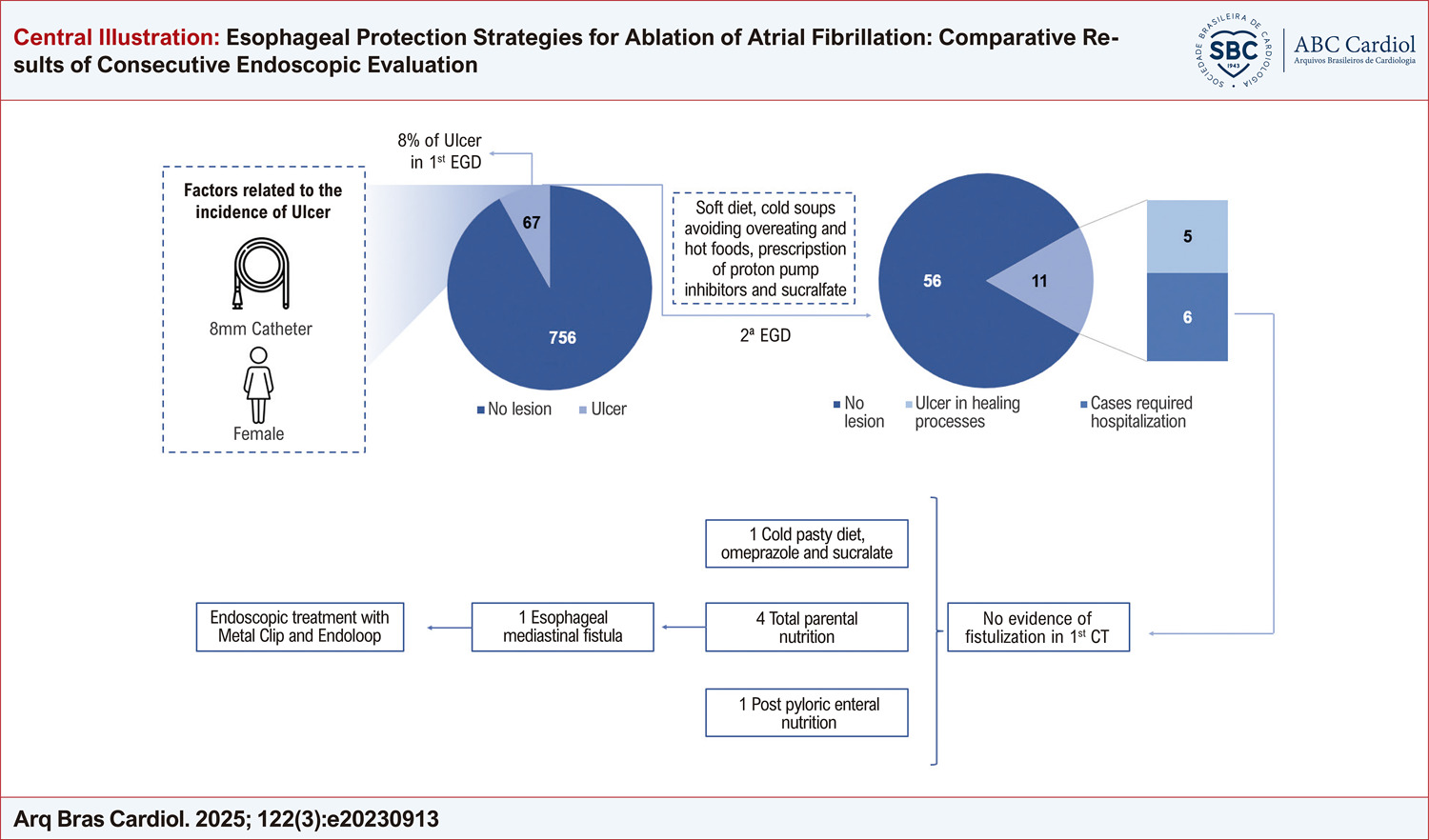
To present the seven-year experience of a systematic endoscopic surveillance of esophageal injury after AF catheter ablation.

Methods

This is a retrospective single center registry of systematic endoscopic evaluation after AF ablation in consecutive procedures performed from 2016 to 2022. A p-value of <0.05 was considered statistically significant.

Results

823 AF ablation with controlled esophagogastroduodenoscopy (EGD) were analyzed. Most patients (n=588, 71.4%) were male, 575 (69.9%) had paroxysmal AF. Esophageal temperature monitoring was performed using a single sensor in 310 patients (40.3%) and a multi–sensor probe in 306 (39.8%). Lesions were presented in 217 EGD (26.5%): hematoma-ecchymosis in 27 (3.3%), erythema in 14 (1.7%), erosion in 78 (9.5%) and ulcer in 67 (8.2%) patients. No esophageal protective strategy was associated with more ulcers, except the use of 8mm tip-catheter (14.7% of ulcers with 8mm tip catheter vs 6.7% with other catheters, p = 0.001). Thermal lesions were early detected and treated. Most lesions were considered healed at endoscopy, but one patient who underwent pulmonary vein isolation with an 8m tip catheter had esophageal fistula, treated successfully with endoscopic metal clip and endoloop technique.

Conclusion

The incidence of esophageal lesions at routine EGD following AF ablation is high, although in most of the cases they heal spontaneously. Patients who underwent ablation with the 8mm tip catheter had more severe thermal lesions. Early esophagus endoscopy may help the diagnosis of early-stage lesions and the prevention of fistula formation after AF ablation.

  • Atrial Fibrillation
  • Catheter Ablation
  • Endoscopy
  • esophageal fistula
Read Full Article
Creative Commons Attribution (CC BY) Creative Commons license
24/03/2025 DOI: 10.36660/abc.20230913i Views 2

How to cite this article

EndNote RIS

Electronic Document Format (Vancouver)

Luchesi BM. Influenza Vaccine Adherence in Older Adults – Reflections and Perspectives. Arquivos Brasileiros de Cardiologia 2025;122(3):e20250210.

Electronic Document Format (ABNT)

Luchesi, Bruna Moretti. Influenza Vaccine Adherence in Older Adults – Reflections and Perspectives. Arquivos Brasileiros de Cardiologia, v. 122, n. 3, e20250210, Jun. 2025.

Electronic Document Format (APA)

Luchesi, B. M. (2025). Influenza Vaccine Adherence in Older Adults – Reflections and Perspectives. Arquivos Brasileiros de Cardiologia, 122(3), e20250210.

Electronic Document Format (ISO)

Luchesi, Bruna Moretti. Influenza Vaccine Adherence in Older Adults – Reflections and Perspectives. Arquivos Brasileiros de Cardiologia [online]. 2025, vol. 122, n. 3, [cited 2026-10-14], e20250210. Available from: <https://journals.cardiol.br/en/article/influenza-vaccine-adherence-in-older-adults-reflections-and-perspectives/>. ISSN 0066-782X

EndNote RIS

Electronic Document Format (Vancouver)

Wu TC. Moving from the “Check the Pulse” Era To “Check the ECG” in the Prevention of Thromboembolic Events in Atrial Fibrillation. Arquivos Brasileiros de Cardiologia 2025;122(3):e20250193.

Electronic Document Format (ABNT)

Wu, Tan Chen. Moving from the “Check the Pulse” Era To “Check the ECG” in the Prevention of Thromboembolic Events in Atrial Fibrillation. Arquivos Brasileiros de Cardiologia, v. 122, n. 3, e20250193, Jun. 2025.

Electronic Document Format (APA)

Wu, T. C. (2025). Moving from the “Check the Pulse” Era To “Check the ECG” in the Prevention of Thromboembolic Events in Atrial Fibrillation. Arquivos Brasileiros de Cardiologia, 122(3), e20250193.

Electronic Document Format (ISO)

Wu, Tan Chen. Moving from the “Check the Pulse” Era To “Check the ECG” in the Prevention of Thromboembolic Events in Atrial Fibrillation. Arquivos Brasileiros de Cardiologia [online]. 2025, vol. 122, n. 3, [cited 2026-10-14], e20250193. Available from: <https://journals.cardiol.br/en/article/moving-from-the-check-the-pulse-era-to-check-the-ecg-in-the-prevention-of-thromboembolic-events-in-atrial-fibrillation/>. ISSN 0066-782X

EndNote RIS

Electronic Document Format (Vancouver)

Camanho LEM. Atrioesophageal Fistula After Catheter Ablation of Atrial Fibrillation: Can We Really Prevent It?. Arquivos Brasileiros de Cardiologia 2025;122(3):e20250148.

Electronic Document Format (ABNT)

Camanho, Luiz Eduardo Montenegro. Atrioesophageal Fistula After Catheter Ablation of Atrial Fibrillation: Can We Really Prevent It?. Arquivos Brasileiros de Cardiologia, v. 122, n. 3, e20250148, May. 2025.

Electronic Document Format (APA)

Camanho, L. E. M. (2025). Atrioesophageal Fistula After Catheter Ablation of Atrial Fibrillation: Can We Really Prevent It?. Arquivos Brasileiros de Cardiologia, 122(3), e20250148.

Electronic Document Format (ISO)

Camanho, Luiz Eduardo Montenegro. Atrioesophageal Fistula After Catheter Ablation of Atrial Fibrillation: Can We Really Prevent It?. Arquivos Brasileiros de Cardiologia [online]. 2025, vol. 122, n. 3, [cited 2026-10-14], e20250148. Available from: <https://journals.cardiol.br/en/article/atrioesophageal-fistula-after-catheter-ablation-of-atrial-fibrillation-can-we-really-prevent-it/>. ISSN 0066-782X

EndNote RIS

Electronic Document Format (Vancouver)

Cesena FY. Detecting Familial Hypercholesterolemia in Adolescents: Universal Screening is Key. Arquivos Brasileiros de Cardiologia 2025;122(3):e20250178.

Electronic Document Format (ABNT)

Cesena, Fernando Yue. Detecting Familial Hypercholesterolemia in Adolescents: Universal Screening is Key. Arquivos Brasileiros de Cardiologia, v. 122, n. 3, e20250178, May. 2025.

Electronic Document Format (APA)

Cesena, F. Y. (2025). Detecting Familial Hypercholesterolemia in Adolescents: Universal Screening is Key. Arquivos Brasileiros de Cardiologia, 122(3), e20250178.

Electronic Document Format (ISO)

Cesena, Fernando Yue. Detecting Familial Hypercholesterolemia in Adolescents: Universal Screening is Key. Arquivos Brasileiros de Cardiologia [online]. 2025, vol. 122, n. 3, [cited 2026-10-14], e20250178. Available from: <https://journals.cardiol.br/en/article/detecting-familial-hypercholesterolemia-in-adolescents-universal-screening-is-key/>. ISSN 0066-782X

EndNote RIS

Electronic Document Format (Vancouver)

Guerra MCMD, Rezende AGS, Magalhães TA, Chalela WA, Uchida AH, Fonseca RA, Heringer Filho N, et al. Detection and Location of Myocardial Infarction Using Electrocardiogram: Validation by Cardiovascular Magnetic Resonance Imaging. Arquivos Brasileiros de Cardiologia 2025;122(3):e20240309.

Electronic Document Format (ABNT)

Guerra, Maria Catarina de Melo Dias; Rezende, André Gustavo da Silva; Magalhães, Tiago Augusto; Chalela, William Azem; Uchida, Augusto Hiroshi; Fonseca, Rafael Almeida; Heringer Filho, Nevelton; Beuther, Jürgen; Garcia, Guilherme; Santos, Eduardo Cavalcanti Lapa dos; Montarroyos, Ulisses Ramos; Cintra, Renata Ávila; Ramires, José Antônio Franchine; Rochitte, Carlos Eduardo. Detection and Location of Myocardial Infarction Using Electrocardiogram: Validation by Cardiovascular Magnetic Resonance Imaging. Arquivos Brasileiros de Cardiologia, v. 122, n. 3, e20240309, May. 2025.

Electronic Document Format (APA)

Guerra, M. C. M. D., Rezende, A. G. S., Magalhães, T. A., Chalela, W. A., Uchida, A. H., Fonseca, R. A., Heringer Filho, N., Beuther, J., Garcia, G., Santos, E. C. L. , Montarroyos, U. R., Cintra, R. , Ramires, J. A. F., & Rochitte, C. E. (2025). Detection and Location of Myocardial Infarction Using Electrocardiogram: Validation by Cardiovascular Magnetic Resonance Imaging. Arquivos Brasileiros de Cardiologia, 122(3), e20240309.

Electronic Document Format (ISO)

Guerra, Maria Catarina de Melo Dias and Rezende, André Gustavo da Silva and Magalhães, Tiago Augusto and Chalela, William Azem and Uchida, Augusto Hiroshi and Fonseca, Rafael Almeida and Heringer Filho, Nevelton and Beuther, Jürgen and Garcia, Guilherme and Santos, Eduardo Cavalcanti Lapa dos and Montarroyos, Ulisses Ramos and Cintra, Renata Ávila and Ramires, José Antônio Franchine and Rochitte, Carlos Eduardo. Detection and Location of Myocardial Infarction Using Electrocardiogram: Validation by Cardiovascular Magnetic Resonance Imaging. Arquivos Brasileiros de Cardiologia [online]. 2025, vol. 122, n. 3, [cited 2026-10-14], e20240309. Available from: <https://journals.cardiol.br/en/article/detection-and-location-of-myocardial-infarction-using-electrocardiogram-validation-by-cardiovascular-magnetic-resonance-imaging/>. ISSN 0066-782X

EndNote RIS

Electronic Document Format (Vancouver)

Mateus PS. From Electrocardiogram to Magnetic Resonance Imaging – The Quest for Unrecognized Myocardial Infarction. Arquivos Brasileiros de Cardiologia 2025;122(3):e20250147.

Electronic Document Format (ABNT)

Mateus, Pedro Sousa. From Electrocardiogram to Magnetic Resonance Imaging – The Quest for Unrecognized Myocardial Infarction. Arquivos Brasileiros de Cardiologia, v. 122, n. 3, e20250147, May. 2025.

Electronic Document Format (APA)

Mateus, P. S. (2025). From Electrocardiogram to Magnetic Resonance Imaging – The Quest for Unrecognized Myocardial Infarction. Arquivos Brasileiros de Cardiologia, 122(3), e20250147.

Electronic Document Format (ISO)

Mateus, Pedro Sousa. From Electrocardiogram to Magnetic Resonance Imaging – The Quest for Unrecognized Myocardial Infarction. Arquivos Brasileiros de Cardiologia [online]. 2025, vol. 122, n. 3, [cited 2026-10-14], e20250147. Available from: <https://journals.cardiol.br/en/article/from-electrocardiogram-to-magnetic-resonance-imaging-the-quest-for-unrecognized-myocardial-infarction/>. ISSN 0066-782X

EndNote RIS

Electronic Document Format (Vancouver)

Bittencourt MS. Ideal Blood Pressure Levels: So Long the J-Curve, Lower is Better. Arquivos Brasileiros de Cardiologia 2025;122(3):e20250150.

Electronic Document Format (ABNT)

Bittencourt, Marcio Sommer. Ideal Blood Pressure Levels: So Long the J-Curve, Lower is Better. Arquivos Brasileiros de Cardiologia, v. 122, n. 3, e20250150, May. 2025.

Electronic Document Format (APA)

Bittencourt, M. S. (2025). Ideal Blood Pressure Levels: So Long the J-Curve, Lower is Better. Arquivos Brasileiros de Cardiologia, 122(3), e20250150.

Electronic Document Format (ISO)

Bittencourt, Marcio Sommer. Ideal Blood Pressure Levels: So Long the J-Curve, Lower is Better. Arquivos Brasileiros de Cardiologia [online]. 2025, vol. 122, n. 3, [cited 2026-10-14], e20250150. Available from: <https://journals.cardiol.br/en/article/ideal-blood-pressure-levels-so-long-the-j-curve-lower-is-better/>. ISSN 0066-782X

EndNote RIS

Electronic Document Format (Vancouver)

Pereira GAR, Pauletto MM, Tscheika AP, Velho FM, Folador L. Primary Pericardial Angiosarcoma Complicated by Constrictive Pericarditis. Arquivos Brasileiros de Cardiologia 2025;122(3):e20240683.

Electronic Document Format (ABNT)

Pereira, Guilherme Augusto Reissig; Pauletto, Maiane Maria; Tscheika, Anna Paula; Velho, Fabrício Michalski; Folador, Luciano. Primary Pericardial Angiosarcoma Complicated by Constrictive Pericarditis. Arquivos Brasileiros de Cardiologia, v. 122, n. 3, e20240683, May. 2025.

Electronic Document Format (APA)

Pereira, G. A. R., Pauletto, M. M., Tscheika, A. P., Velho, F. M., & Folador, L. (2025). Primary Pericardial Angiosarcoma Complicated by Constrictive Pericarditis. Arquivos Brasileiros de Cardiologia, 122(3), e20240683.

Electronic Document Format (ISO)

Pereira, Guilherme Augusto Reissig and Pauletto, Maiane Maria and Tscheika, Anna Paula and Velho, Fabrício Michalski and Folador, Luciano. Primary Pericardial Angiosarcoma Complicated by Constrictive Pericarditis. Arquivos Brasileiros de Cardiologia [online]. 2025, vol. 122, n. 3, [cited 2026-10-14], e20240683. Available from: <https://journals.cardiol.br/en/article/primary-pericardial-angiosarcoma-complicated-by-constrictive-pericarditis/>. ISSN 0066-782X

EndNote RIS

Electronic Document Format (Vancouver)

Pinho C, Moreno H, Saraiva JFK, Consolim-Colombo FM. Seven Deadly Sins in Hypertension Management: In-Depth Analysis of the Errors on a Journey from Riva-Rocci to Myocardial Fibrosis. Arquivos Brasileiros de Cardiologia 2025;122(3):e20240811.

Electronic Document Format (ABNT)

Pinho, Claudio; Moreno, Heitor; Saraiva, José Francisco Kerr; Consolim-Colombo, Fernanda Marciano. Seven Deadly Sins in Hypertension Management: In-Depth Analysis of the Errors on a Journey from Riva-Rocci to Myocardial Fibrosis. Arquivos Brasileiros de Cardiologia, v. 122, n. 3, e20240811, May. 2025.

Electronic Document Format (APA)

Pinho, C., Moreno, H., Saraiva, J. F. K., & Consolim-Colombo, F. M. (2025). Seven Deadly Sins in Hypertension Management: In-Depth Analysis of the Errors on a Journey from Riva-Rocci to Myocardial Fibrosis. Arquivos Brasileiros de Cardiologia, 122(3), e20240811.

Electronic Document Format (ISO)

Pinho, Claudio and Moreno, Heitor and Saraiva, José Francisco Kerr and Consolim-Colombo, Fernanda Marciano. Seven Deadly Sins in Hypertension Management: In-Depth Analysis of the Errors on a Journey from Riva-Rocci to Myocardial Fibrosis. Arquivos Brasileiros de Cardiologia [online]. 2025, vol. 122, n. 3, [cited 2026-10-14], e20240811. Available from: <https://journals.cardiol.br/en/article/seven-deadly-sins-in-hypertension-management-in-depth-analysis-of-the-errors-on-a-journey-from-riva-rocci-to-myocardial-fibrosis/>. ISSN 0066-782X

EndNote RIS

Electronic Document Format (Vancouver)

Zimmermann FB, Zimmermann SL, Zimmermann MB, Beraldi EK, Rocha MCF, Zabot BPO, Starke S, et al. Association between Cardiovascular Risk Factors and Carotid Plaques in a Population-Based Study – The SHIP-Brazil Study. Arquivos Brasileiros de Cardiologia 2025;122(3):e20240546.

Electronic Document Format (ABNT)

Zimmermann, Fernanda Burger; Zimmermann, Sérgio Luiz; Zimmermann, Marcelo Burger; Beraldi, Enrico Klug; Rocha, Mateus Campanelli Franco da; Zabot, Bruno Pereira de Oliveira; Starke, Siegmar; Helena, Ernani Tiaraju de Santa; Markus, Marcello Ricardo Paulista. Association between Cardiovascular Risk Factors and Carotid Plaques in a Population-Based Study – The SHIP-Brazil Study. Arquivos Brasileiros de Cardiologia, v. 122, n. 3, e20240546, May. 2025.

Electronic Document Format (APA)

Zimmermann, F. B., Zimmermann, S. L., Zimmermann, M. B., Beraldi, E. K., Rocha, M. C. F. , Zabot, B. P. O., Starke, S., Helena, E. T. S., & Markus, M. R. P. (2025). Association between Cardiovascular Risk Factors and Carotid Plaques in a Population-Based Study – The SHIP-Brazil Study. Arquivos Brasileiros de Cardiologia, 122(3), e20240546.

Electronic Document Format (ISO)

Zimmermann, Fernanda Burger and Zimmermann, Sérgio Luiz and Zimmermann, Marcelo Burger and Beraldi, Enrico Klug and Rocha, Mateus Campanelli Franco da and Zabot, Bruno Pereira de Oliveira and Starke, Siegmar and Helena, Ernani Tiaraju de Santa and Markus, Marcello Ricardo Paulista. Association between Cardiovascular Risk Factors and Carotid Plaques in a Population-Based Study – The SHIP-Brazil Study. Arquivos Brasileiros de Cardiologia [online]. 2025, vol. 122, n. 3, [cited 2026-10-14], e20240546. Available from: <https://journals.cardiol.br/en/article/association-between-cardiovascular-risk-factors-and-carotid-plaques-in-a-population-based-study-the-ship-brazil-study/>. ISSN 0066-782X

EndNote RIS

Electronic Document Format (Vancouver)

Furquim SR, Pires LVL, Buriti NA, Carvalho MLP, Marques EL, Linnenkamp BDW, Sacilotto L, et al. Unveiling the Genetic Puzzle: Asymmetric Hypertrophy in a Heart Transplant Recipient Linked to Birt-Hogg-Dubé Syndrome. Arquivos Brasileiros de Cardiologia 2025;122(3):e20240444.

Electronic Document Format (ABNT)

Furquim, Silas Ramos; Pires, Lucas Vieira Lacerda; Buriti, Nara Alves; Carvalho, Mariana Lombardi Peres de; Marques, Emanuelle Leonilia; Linnenkamp, Bianca Domit Werner; Sacilotto, Luciana; Marcondes-Braga, Fabiana G.; Campos, Iascara Wozniak de; Seguro, Luis Fernando Bernal da Costa; Mangini, Sandrigo; Avila, Monica S.; Bacal, Fernando; Krieger, José Eduardo. Unveiling the Genetic Puzzle: Asymmetric Hypertrophy in a Heart Transplant Recipient Linked to Birt-Hogg-Dubé Syndrome. Arquivos Brasileiros de Cardiologia, v. 122, n. 3, e20240444, May. 2025.

Electronic Document Format (APA)

Furquim, S. R., Pires, L. V. L., Buriti, N. A., Carvalho, M. L. P. , Marques, E. L., Linnenkamp, B. D. W., Sacilotto, L., Marcondes-Braga, F. G., Campos, I. W. , Seguro, L. F. B. C., Mangini, S., Avila, M. S., Bacal, F., & Krieger, J. E. (2025). Unveiling the Genetic Puzzle: Asymmetric Hypertrophy in a Heart Transplant Recipient Linked to Birt-Hogg-Dubé Syndrome. Arquivos Brasileiros de Cardiologia, 122(3), e20240444.

Electronic Document Format (ISO)

Furquim, Silas Ramos and Pires, Lucas Vieira Lacerda and Buriti, Nara Alves and Carvalho, Mariana Lombardi Peres de and Marques, Emanuelle Leonilia and Linnenkamp, Bianca Domit Werner and Sacilotto, Luciana and Marcondes-Braga, Fabiana G. and Campos, Iascara Wozniak de and Seguro, Luis Fernando Bernal da Costa and Mangini, Sandrigo and Avila, Monica S. and Bacal, Fernando and Krieger, José Eduardo. Unveiling the Genetic Puzzle: Asymmetric Hypertrophy in a Heart Transplant Recipient Linked to Birt-Hogg-Dubé Syndrome. Arquivos Brasileiros de Cardiologia [online]. 2025, vol. 122, n. 3, [cited 2026-10-14], e20240444. Available from: <https://journals.cardiol.br/en/article/unveiling-the-genetic-puzzle-asymmetric-hypertrophy-in-a-heart-transplant-recipient-linked-to-birt-hogg-dube-syndrome/>. ISSN 0066-782X

EndNote RIS

Electronic Document Format (Vancouver)

Fiusa VC, Stephanus AD, Couto VF, Alexim GA, Severino TMM, Nogueira ACC, Guimarães AJBA, et al. Clinical Predictors of Heart Failure after STEMI: Data from a Middle-Income Country with Limited Access to Percutaneous Coronary Intervention. Arquivos Brasileiros de Cardiologia 2025;122(3):e20240447.

Electronic Document Format (ABNT)

Fiusa, Vinícius C.; Stephanus, Andrea D.; Couto, Victor F.; Alexim, Gustavo A.; Severino, Thaiene M. M.; Nogueira, Ana Claudia C.; Guimarães, Adriana J. B. A.; Soares, Alexandre Anderson S. M.; Bilevicius, Elizabeth; Batista, Vivian; Staffico, Alessandra; Sposito, Andrei C.; Carvalho, Luiz Sérgio F. de. Clinical Predictors of Heart Failure after STEMI: Data from a Middle-Income Country with Limited Access to Percutaneous Coronary Intervention. Arquivos Brasileiros de Cardiologia, v. 122, n. 3, e20240447, Apr. 2025.

Electronic Document Format (APA)

Fiusa, V. C., Stephanus, A. D., Couto, V. F., Alexim, G. A., Severino, T. M. M., Nogueira, A. C. C., Guimarães, A. J. B. A., Soares, A. A. S. M., Bilevicius, E., Batista, V., Staffico, A., Sposito, A. C., & Carvalho, L. S. F. (2025). Clinical Predictors of Heart Failure after STEMI: Data from a Middle-Income Country with Limited Access to Percutaneous Coronary Intervention. Arquivos Brasileiros de Cardiologia, 122(3), e20240447.

Electronic Document Format (ISO)

Fiusa, Vinícius C. and Stephanus, Andrea D. and Couto, Victor F. and Alexim, Gustavo A. and Severino, Thaiene M. M. and Nogueira, Ana Claudia C. and Guimarães, Adriana J. B. A. and Soares, Alexandre Anderson S. M. and Bilevicius, Elizabeth and Batista, Vivian and Staffico, Alessandra and Sposito, Andrei C. and Carvalho, Luiz Sérgio F. de. Clinical Predictors of Heart Failure after STEMI: Data from a Middle-Income Country with Limited Access to Percutaneous Coronary Intervention. Arquivos Brasileiros de Cardiologia [online]. 2025, vol. 122, n. 3, [cited 2026-10-14], e20240447. Available from: <https://journals.cardiol.br/en/article/clinical-predictors-of-heart-failure-after-stemi-data-from-a-middle-income-country-with-limited-access-to-percutaneous-coronary-intervention/>. ISSN 0066-782X

EndNote RIS

Electronic Document Format (Vancouver)

Herdy AH, Mangia AS, Benetti M. Cardiovascular Telerehabilitation: An Alternative for Greater Availability of Cardiovascular and Metabolic Rehabilitation in Brazil. Arquivos Brasileiros de Cardiologia 2025;122(3):e20240570.

Electronic Document Format (ABNT)

Herdy, Artur Haddad; Mangia, Ariella Sebastião; Benetti, Magnus. Cardiovascular Telerehabilitation: An Alternative for Greater Availability of Cardiovascular and Metabolic Rehabilitation in Brazil. Arquivos Brasileiros de Cardiologia, v. 122, n. 3, e20240570, Apr. 2025.

Electronic Document Format (APA)

Herdy, A. H., Mangia, A. S., & Benetti, M. (2025). Cardiovascular Telerehabilitation: An Alternative for Greater Availability of Cardiovascular and Metabolic Rehabilitation in Brazil. Arquivos Brasileiros de Cardiologia, 122(3), e20240570.

Electronic Document Format (ISO)

Herdy, Artur Haddad and Mangia, Ariella Sebastião and Benetti, Magnus. Cardiovascular Telerehabilitation: An Alternative for Greater Availability of Cardiovascular and Metabolic Rehabilitation in Brazil. Arquivos Brasileiros de Cardiologia [online]. 2025, vol. 122, n. 3, [cited 2026-10-14], e20240570. Available from: <https://journals.cardiol.br/en/article/cardiovascular-telerehabilitation-an-alternative-for-greater-availability-of-cardiovascular-and-metabolic-rehabilitation-in-brazil/>. ISSN 0066-782X

EndNote RIS

Electronic Document Format (Vancouver)

Moreira GR, Ávila DX, Candia AMD, Scaramussa VD, Villacorta H. Growth Differentiation Factor 15 is Correlated With Urinary Markers in Patients with Chronic Heart Failure. Arquivos Brasileiros de Cardiologia 2025;122(3):e20240153.

Electronic Document Format (ABNT)

Moreira, Gustavo Rodolfo; Ávila, Diane Xavier; Candia, Angelo Michele Di; Scaramussa, Victoria Depes; Villacorta, Humberto. Growth Differentiation Factor 15 is Correlated With Urinary Markers in Patients with Chronic Heart Failure. Arquivos Brasileiros de Cardiologia, v. 122, n. 3, e20240153, Apr. 2025.

Electronic Document Format (APA)

Moreira, G. R., Ávila, D. X., Candia, A. M. D., Scaramussa, V. D., & Villacorta, H. (2025). Growth Differentiation Factor 15 is Correlated With Urinary Markers in Patients with Chronic Heart Failure. Arquivos Brasileiros de Cardiologia, 122(3), e20240153.

Electronic Document Format (ISO)

Moreira, Gustavo Rodolfo and Ávila, Diane Xavier and Candia, Angelo Michele Di and Scaramussa, Victoria Depes and Villacorta, Humberto. Growth Differentiation Factor 15 is Correlated With Urinary Markers in Patients with Chronic Heart Failure. Arquivos Brasileiros de Cardiologia [online]. 2025, vol. 122, n. 3, [cited 2026-10-14], e20240153. Available from: <https://journals.cardiol.br/en/article/growth-differentiation-factor-15-is-correlated-with-urinary-markers-in-patients-with-chronic-heart-failure/>. ISSN 0066-782X

EndNote RIS

Electronic Document Format (Vancouver)

Aguilar RS, Giraldes APR, Delia MPB, Roscani MG, Pott H. Uptake of Influenza Vaccine among Older Adults with Cardiovascular Comorbidities. Arquivos Brasileiros de Cardiologia 2025;122(3):e20240537.

Electronic Document Format (ABNT)

Aguilar, Rodrigo S.; Giraldes, Ana Paula Rosim; Delia, Maria Paula Barbieri; Roscani, Meliza Goi; Pott, Henrique. Uptake of Influenza Vaccine among Older Adults with Cardiovascular Comorbidities. Arquivos Brasileiros de Cardiologia, v. 122, n. 3, e20240537, Apr. 2025.

Electronic Document Format (APA)

Aguilar, R. S., Giraldes, A. P. R., Delia, M. P. B., Roscani, M. G., & Pott, H. (2025). Uptake of Influenza Vaccine among Older Adults with Cardiovascular Comorbidities. Arquivos Brasileiros de Cardiologia, 122(3), e20240537.

Electronic Document Format (ISO)

Aguilar, Rodrigo S. and Giraldes, Ana Paula Rosim and Delia, Maria Paula Barbieri and Roscani, Meliza Goi and Pott, Henrique. Uptake of Influenza Vaccine among Older Adults with Cardiovascular Comorbidities. Arquivos Brasileiros de Cardiologia [online]. 2025, vol. 122, n. 3, [cited 2026-10-14], e20240537. Available from: <https://journals.cardiol.br/en/article/uptake-of-influenza-vaccine-among-older-adults-with-cardiovascular-comorbidities/>. ISSN 0066-782X

EndNote RIS

Electronic Document Format (Vancouver)

Carvalho APV, Carmo GAL, Silva CA, Oliveira AC, Perez LG, Carmo LPF, Ribeiro AL, et al. Subclinical Atrial Fibrillation Screening in Dialytic Chronic Kidney Disease Patients Using Portable Device. Arquivos Brasileiros de Cardiologia 2025;122(3):e20240450.

Electronic Document Format (ABNT)

Carvalho, Adson Patrik Vieira; Carmo, Gabriel Assis Lopes do; Silva, Cassia Aparecida; Oliveira, Ana Cecília; Perez, Lucas Giandoni; Carmo, Lilian Pires de Freitas do; Ribeiro, Antonio L.. Subclinical Atrial Fibrillation Screening in Dialytic Chronic Kidney Disease Patients Using Portable Device. Arquivos Brasileiros de Cardiologia, v. 122, n. 3, e20240450, Apr. 2025.

Electronic Document Format (APA)

Carvalho, A. P. V., Carmo, G. A. L. , Silva, C. A., Oliveira, A. C., Perez, L. G., Carmo, L. P. F. , & Ribeiro, A. L. (2025). Subclinical Atrial Fibrillation Screening in Dialytic Chronic Kidney Disease Patients Using Portable Device. Arquivos Brasileiros de Cardiologia, 122(3), e20240450.

Electronic Document Format (ISO)

Carvalho, Adson Patrik Vieira and Carmo, Gabriel Assis Lopes do and Silva, Cassia Aparecida and Oliveira, Ana Cecília and Perez, Lucas Giandoni and Carmo, Lilian Pires de Freitas do and Ribeiro, Antonio L.. Subclinical Atrial Fibrillation Screening in Dialytic Chronic Kidney Disease Patients Using Portable Device. Arquivos Brasileiros de Cardiologia [online]. 2025, vol. 122, n. 3, [cited 2026-10-14], e20240450. Available from: <https://journals.cardiol.br/en/article/subclinical-atrial-fibrillation-screening-in-dialytic-chronic-kidney-disease-patients-using-portable-device/>. ISSN 0066-782X

EndNote RIS

Electronic Document Format (Vancouver)

Mejía HPG, Nogueira MCA, Mioto BM, Poppi NT, Cesar LAM, Sousa LLCM, Dallan LRP, et al. Coronary-Cavitary Fistula, an Unusual Cause of Heart Failure. Arquivos Brasileiros de Cardiologia 2025;122(3):e20240809.

Electronic Document Format (ABNT)

Mejía, Hernán Patricio García; Nogueira, Matheus Carvalho Alves; Mioto, Bruno Mahler; Poppi, Nilson Tavares; Cesar, Luiz Antonio Machado; Sousa, Luhanda Leonora Cardoso Monti; Dallan, Luís Roberto Palma. Coronary-Cavitary Fistula, an Unusual Cause of Heart Failure. Arquivos Brasileiros de Cardiologia, v. 122, n. 3, e20240809, Apr. 2025.

Electronic Document Format (APA)

Mejía, H. P. G., Nogueira, M. C. A., Mioto, B. M., Poppi, N. T., Cesar, L. A. M., Sousa, L. L. C. M., & Dallan, L. R. P. (2025). Coronary-Cavitary Fistula, an Unusual Cause of Heart Failure. Arquivos Brasileiros de Cardiologia, 122(3), e20240809.

Electronic Document Format (ISO)

Mejía, Hernán Patricio García and Nogueira, Matheus Carvalho Alves and Mioto, Bruno Mahler and Poppi, Nilson Tavares and Cesar, Luiz Antonio Machado and Sousa, Luhanda Leonora Cardoso Monti and Dallan, Luís Roberto Palma. Coronary-Cavitary Fistula, an Unusual Cause of Heart Failure. Arquivos Brasileiros de Cardiologia [online]. 2025, vol. 122, n. 3, [cited 2026-10-14], e20240809. Available from: <https://journals.cardiol.br/en/article/coronary-cavitary-fistula-an-unusual-cause-of-heart-failure/>. ISSN 0066-782X

EndNote RIS

Electronic Document Format (Vancouver)

Fonseca LMDT, Cedeño RA, Bello LAH, Díaz-Heredia J, Quezada DMP, Castro RAG, Juan-Salvadores P, et al. Survival in Patients with Brugada Phenocopy. Case Series. Arquivos Brasileiros de Cardiologia 2025;122(3):e20240526.

Electronic Document Format (ABNT)

Fonseca, Luis Mariano De la Torre; Cedeño, Robert Alarcón; Bello, Lileska Andreína Hernandez; Díaz-Heredia, Juan; Quezada, Diego Milton Pulla; Castro, Rubén Andrés Guamán; Juan-Salvadores, Pablo. Survival in Patients with Brugada Phenocopy. Case Series. Arquivos Brasileiros de Cardiologia, v. 122, n. 3, e20240526, Mar. 2025.

Electronic Document Format (APA)

Fonseca, L. M. D. T., Cedeño, R. A., Bello, L. A. H., Díaz-Heredia, J., Quezada, D. M. P., Castro, R. A. G., & Juan-Salvadores, P. (2025). Survival in Patients with Brugada Phenocopy. Case Series. Arquivos Brasileiros de Cardiologia, 122(3), e20240526.

Electronic Document Format (ISO)

Fonseca, Luis Mariano De la Torre and Cedeño, Robert Alarcón and Bello, Lileska Andreína Hernandez and Díaz-Heredia, Juan and Quezada, Diego Milton Pulla and Castro, Rubén Andrés Guamán and Juan-Salvadores, Pablo. Survival in Patients with Brugada Phenocopy. Case Series. Arquivos Brasileiros de Cardiologia [online]. 2025, vol. 122, n. 3, [cited 2026-10-14], e20240526. Available from: <https://journals.cardiol.br/en/article/survival-in-patients-with-brugada-phenocopy-case-series/>. ISSN 0066-782X

EndNote RIS

Electronic Document Format (Vancouver)

Dilli D, Akduman H, Çitli R, Örun UA, Doğan V, Taşar M, Yoldaş T, et al. Management of Ductus-Dependent Systemic Circulatory Lesions in the Neonatal Period: A Ten-Year Experience. Arquivos Brasileiros de Cardiologia 2025;122(3):e20230731.

Electronic Document Format (ABNT)

Dilli, Dilek; Akduman, Hasan; Çitli, Rumeysa; Örun, Utku Arman; Doğan, Vehbi; Taşar, Mehmet; Yoldaş, Tamer; Fettah, Nurdan Dinlen; Özyazıcı, Ahmet; Zenciroğlu, Ayşegül. Management of Ductus-Dependent Systemic Circulatory Lesions in the Neonatal Period: A Ten-Year Experience. Arquivos Brasileiros de Cardiologia, v. 122, n. 3, e20230731, Mar. 2025.

Electronic Document Format (APA)

Dilli, D., Akduman, H., Çitli, R., Örun, U. A., Doğan, V., Taşar, M., Yoldaş, T., Fettah, N. D., Özyazıcı, A., & Zenciroğlu, A. (2025). Management of Ductus-Dependent Systemic Circulatory Lesions in the Neonatal Period: A Ten-Year Experience. Arquivos Brasileiros de Cardiologia, 122(3), e20230731.

Electronic Document Format (ISO)

Dilli, Dilek and Akduman, Hasan and Çitli, Rumeysa and Örun, Utku Arman and Doğan, Vehbi and Taşar, Mehmet and Yoldaş, Tamer and Fettah, Nurdan Dinlen and Özyazıcı, Ahmet and Zenciroğlu, Ayşegül. Management of Ductus-Dependent Systemic Circulatory Lesions in the Neonatal Period: A Ten-Year Experience. Arquivos Brasileiros de Cardiologia [online]. 2025, vol. 122, n. 3, [cited 2026-10-14], e20230731. Available from: <https://journals.cardiol.br/en/article/management-of-ductus-dependent-systemic-circulatory-lesions-in-the-neonatal-period-a-ten-year-experience/>. ISSN 0066-782X

EndNote RIS

Electronic Document Format (Vancouver)

Bento VFR, Kaestner TLL, Vargas Junior A, Lopes RB, Scariot FP, Hollas LL, Olandoski M, et al. Cascade Screening in Adolescents with Lipid Disorders Suggestive of Familial Hypercholesterolemia: Findings from the ERICA Study in Curitiba. Arquivos Brasileiros de Cardiologia 2025;122(3):e20240468.

Electronic Document Format (ABNT)

Bento, Vivian Freitas Rezende; Kaestner, Tatiana Lorena da Luz; Vargas Junior, Amauri de; Lopes, Renan Barbosa; Scariot, Fernando Pinotti; Hollas, Leiza Loiane; Olandoski, Marcia; Baena, Cristina Pellegrino; Bloch, Katia Vergetti; Faria Neto, José Rocha. Cascade Screening in Adolescents with Lipid Disorders Suggestive of Familial Hypercholesterolemia: Findings from the ERICA Study in Curitiba. Arquivos Brasileiros de Cardiologia, v. 122, n. 3, e20240468, Mar. 2025.

Electronic Document Format (APA)

Bento, V. F. R., Kaestner, T. L. L., Vargas Junior, A. , Lopes, R. B., Scariot, F. P., Hollas, L. L., Olandoski, M., Baena, C. P., Bloch, K. V., & Faria Neto, J. R. (2025). Cascade Screening in Adolescents with Lipid Disorders Suggestive of Familial Hypercholesterolemia: Findings from the ERICA Study in Curitiba. Arquivos Brasileiros de Cardiologia, 122(3), e20240468.

Electronic Document Format (ISO)

Bento, Vivian Freitas Rezende and Kaestner, Tatiana Lorena da Luz and Vargas Junior, Amauri de and Lopes, Renan Barbosa and Scariot, Fernando Pinotti and Hollas, Leiza Loiane and Olandoski, Marcia and Baena, Cristina Pellegrino and Bloch, Katia Vergetti and Faria Neto, José Rocha. Cascade Screening in Adolescents with Lipid Disorders Suggestive of Familial Hypercholesterolemia: Findings from the ERICA Study in Curitiba. Arquivos Brasileiros de Cardiologia [online]. 2025, vol. 122, n. 3, [cited 2026-10-14], e20240468. Available from: <https://journals.cardiol.br/en/article/cascade-screening-in-adolescents-with-lipid-disorders-suggestive-of-familial-hypercholesterolemia-findings-from-the-erica-study-in-curitiba/>. ISSN 0066-782X

EndNote RIS

Electronic Document Format (Vancouver)

Brandão AA, Rodrigues CIS, Bortolotto LA, Luna LC, Barros BM, Neves MFT, Moura AFS, et al. Systematic Review of the Effectiveness of Intensive Antihypertensive Treatment Goals: Brazilian Society of Cardiology (SBC) Recommendation. Arquivos Brasileiros de Cardiologia 2025;122(3):e20240761.

Electronic Document Format (ABNT)

Brandão, Andréa Araujo; Rodrigues, Cibele Isaac Saad; Bortolotto, Luiz Aparecido; Luna, Leonardo Castro; Barros, Bruno Monteiro; Neves, Mario Fritsch Toros; Moura, Ana Flávia de Souza; Plavnik, Frida Liane; Drager, Luciano Ferreira; Moreira Filho, Osni; Souza, Weimar Kunz Sebba Barroso de; Nadruz, Wilson. Systematic Review of the Effectiveness of Intensive Antihypertensive Treatment Goals: Brazilian Society of Cardiology (SBC) Recommendation. Arquivos Brasileiros de Cardiologia, v. 122, n. 3, e20240761, Mar. 2025.

Electronic Document Format (APA)

Brandão, A. A., Rodrigues, C. I. S., Bortolotto, L. A., Luna, L. C., Barros, B. M., Neves, M. F. T., Moura, A. F. S., Plavnik, F. L., Drager, L. F., Moreira Filho, O., Souza, W. K. S. B. , & Nadruz, W. (2025). Systematic Review of the Effectiveness of Intensive Antihypertensive Treatment Goals: Brazilian Society of Cardiology (SBC) Recommendation. Arquivos Brasileiros de Cardiologia, 122(3), e20240761.

Electronic Document Format (ISO)

Brandão, Andréa Araujo and Rodrigues, Cibele Isaac Saad and Bortolotto, Luiz Aparecido and Luna, Leonardo Castro and Barros, Bruno Monteiro and Neves, Mario Fritsch Toros and Moura, Ana Flávia de Souza and Plavnik, Frida Liane and Drager, Luciano Ferreira and Moreira Filho, Osni and Souza, Weimar Kunz Sebba Barroso de and Nadruz, Wilson. Systematic Review of the Effectiveness of Intensive Antihypertensive Treatment Goals: Brazilian Society of Cardiology (SBC) Recommendation. Arquivos Brasileiros de Cardiologia [online]. 2025, vol. 122, n. 3, [cited 2026-10-14], e20240761. Available from: <https://journals.cardiol.br/en/article/systematic-review-of-the-effectiveness-of-intensive-antihypertensive-treatment-goals-brazilian-society-of-cardiology-sbc-recommendation/>. ISSN 0066-782X

EndNote RIS

Electronic Document Format (Vancouver)

Ferraz AP, Pisani CF, Rivarola EWR, Wu TC, Darrieux FCC, Scanavacca RA, Chokr MO, et al. Esophageal Protection Strategies for Ablation of Atrial Fibrillation: Comparative Results of Consecutive Endoscopic Evaluation. Arquivos Brasileiros de Cardiologia 2025;122(3):e20230913.

Electronic Document Format (ABNT)

Ferraz, Alberto Pereira; Pisani, Cristiano Faria; Rivarola, Esteban Wisnivesky Rocca; Wu, Tan Chen; Darrieux, Francisco Carlos da Costa; Scanavacca, Rafael Alvarenga; Chokr, Muhieddine Omar; Hardy, Carina Abigail; Melo, Sissy Lara de; Hachul, Denise Tessariol; Campos, Beatriz Hachul de; Scanavacca, Mauricio Ibrahim. Esophageal Protection Strategies for Ablation of Atrial Fibrillation: Comparative Results of Consecutive Endoscopic Evaluation. Arquivos Brasileiros de Cardiologia, v. 122, n. 3, e20230913, Mar. 2025.

Electronic Document Format (APA)

Ferraz, A. P., Pisani, C. F., Rivarola, E. W. R., Wu, T. C., Darrieux, F. C. C., Scanavacca, R. A., Chokr, M. O., Hardy, C. A., Melo, S. L. , Hachul, D. T., Campos, B. H. , & Scanavacca, M. I. (2025). Esophageal Protection Strategies for Ablation of Atrial Fibrillation: Comparative Results of Consecutive Endoscopic Evaluation. Arquivos Brasileiros de Cardiologia, 122(3), e20230913.

Electronic Document Format (ISO)

Ferraz, Alberto Pereira and Pisani, Cristiano Faria and Rivarola, Esteban Wisnivesky Rocca and Wu, Tan Chen and Darrieux, Francisco Carlos da Costa and Scanavacca, Rafael Alvarenga and Chokr, Muhieddine Omar and Hardy, Carina Abigail and Melo, Sissy Lara de and Hachul, Denise Tessariol and Campos, Beatriz Hachul de and Scanavacca, Mauricio Ibrahim. Esophageal Protection Strategies for Ablation of Atrial Fibrillation: Comparative Results of Consecutive Endoscopic Evaluation. Arquivos Brasileiros de Cardiologia [online]. 2025, vol. 122, n. 3, [cited 2026-10-14], e20230913. Available from: <https://journals.cardiol.br/en/article/esophageal-protection-strategies-for-ablation-of-atrial-fibrillation-comparative-results-of-consecutive-endoscopic-evaluation/>. ISSN 0066-782X

Sede – Rio de Janeiro
Av. Marechal Câmara, 160
3º andar – Sala: 330 – Centro
Rio de Janeiro – CEP: 20020-907
Tel.: (55 +21) 3478-2700
ou (21) 99386-3961
E-mail: revista@cardiol.br

Sede – São Paulo
Alameda Santos, 705 – 11º andar
Cerqueira César | São Paulo
CEP: 01419-001
Tel.: (55 +11) 3411-5500
E-mail: revista@cardiol.br

  • About the Journal
  • Internal Regulation
  • Editors Section
  • Editorial Board
  • History
  • SBC Award

  • Guidelines for Publication
  • Editorial Policy
  • Ethics Policy
  • Policy on the Use of Artificial Intelligence
  • Mandatory Publication Form
  • Publication Fee

Issues

SBC Guidelines

  • How to Publish an Abstract Supplement?
  • Supplements from the Brazilian Congress of Cardiology