ABC Family Arquivos Brasileiros de Cardiologia International Journal of Cardiovascular Sciences ABC Heart Failure & Cardiomyopathy ABC Imagem Cardiovascular
Português English
ABC Family
Português English
  • About
    • About ABC Family
    • Internal Regulation
    • Editorial Board
    • Brazilian Society of Cardiology (SBC)
  • Issues
  • SBC Guidelines
  • Content
    • Videos
    • Podcasts
    • News
  • About
    • About ABC Family
    • Internal Regulation
    • Editorial Board
    • Brazilian Society of Cardiology (SBC)
  • Issues
  • SBC Guidelines
  • Content
    • Videos
    • Podcasts
    • News

ABC Family

  • ABC Family
  • Arquivos Brasileiros de Cardiologia
  • International Journal of Cardiovascular Sciences
  • ABC Heart Failure & Cardiomyopathy
  • ABC Imagem Cardiovascular
Search in

No content found.

Journals
Ordering
Article types
Others

  1. Home
  2. Keyword: esophageal fistula
Severe Esophageal Complications Following Atrial Fibrillation Ablation: Should We Still Be Concerned?
ABC
Review Article

Severe Esophageal Complications Following Atrial Fibrillation Ablation: Should We Still Be Concerned?

Anibal Pires Borges et al. Carlos Kalil Josep Brugada José Plutarco Gutiérrez Yanez … Pablo da Costa Soliz Marco Aurelio Lumertz Saffi Anderson Donelli da Silveira Maurício Pimentel

Abstract

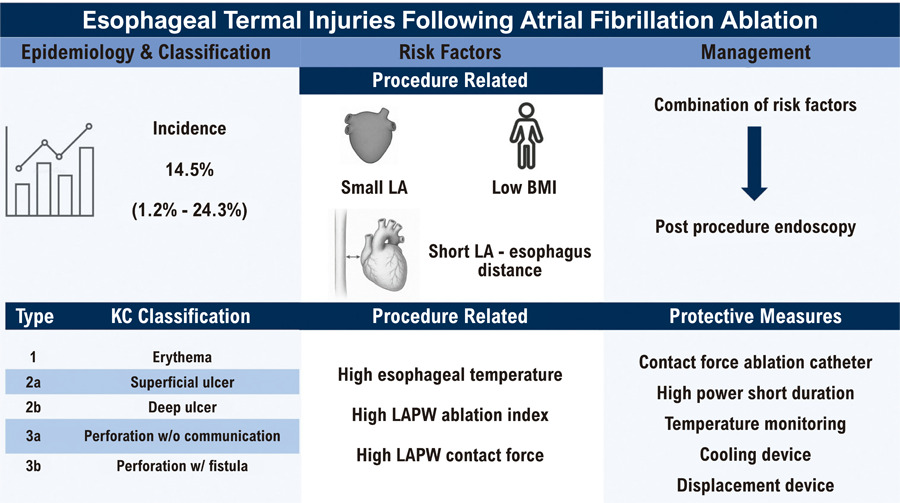
Atrial fibrillation (AF) ablation has been increasingly employed as an effective strategy for rhythm control, leading to a reduction in arrhythmia burden, improved quality of life, and, in selected cases, decreased mortality. However, as an invasive procedure, it carries inherent risks. Severe esophageal complications-such as esophageal perforation or atrioesophageal fistula- though rare (with an incidence ranging from 0.025% to 0.113%), are associated with significant morbidity and mortality. Multiple risk factors for esophageal injury have been identified, including both patient-related and procedure-related characteristics. To mitigate these risks during radiofrequency (RF) ablation, several preventive measures have been adopted, including the use of contact force catheters, high-power short-duration energy applications, and protective strategies such as esophageal temperature monitoring, displacement devices, and cooling techniques. Deep esophageal lesions detected through surveillance endoscopy are considered potential precursors to more serious complications and, therefore, warrant close attention. Enhanced monitoring of patients with such lesions may be crucial for enabling early diagnosis and timely intervention to prevent the progression to more severe complications. While pulsed field ablation therapy, which poses a lower risk to the esophagus and other surrounding structures, is not yet widely available, the implementation of robust monitoring strategies can significantly improve clinical outcomes and enhance patient safety in the context of RF AF ablation.
  • Atrial Fibrillation
  • esophageal fistula
  • postoperative complications
Read Full Article
Creative Commons Attribution (CC BY) Creative Commons license
16/01/2026 DOI: 10.36660/abc.20250290i
Esophageal Temperature Monitoring during Atrial Fibrillation Ablation: A Randomized Study
ABC
Original Article

Esophageal Temperature Monitoring during Atrial Fibrillation Ablation: A Randomized Study

Daniel Moreira Costa Moura et al. Renner Augusto Raposo Pereira Cristiano Faria Pisani Tan Chen Wu … Muhieddine Omar Chokr Carina Abigail Hardy Sissy Lara de Melo Francisco Carlos da Costa Darrieux Denise Tessariol Hachul Mauricio Ibrahim Scanavacca

Abstract

Background

Pulmonary vein isolation (PVI) for atrial fibrillation (AF) ablation carries a risk of esophageal thermal injury (ETI), which can lead to severe complications.

Objective

To evaluate three luminal esophageal temperature (LET) monitoring strategies and assess their effectiveness in reducing the incidence of ETI.

Methods

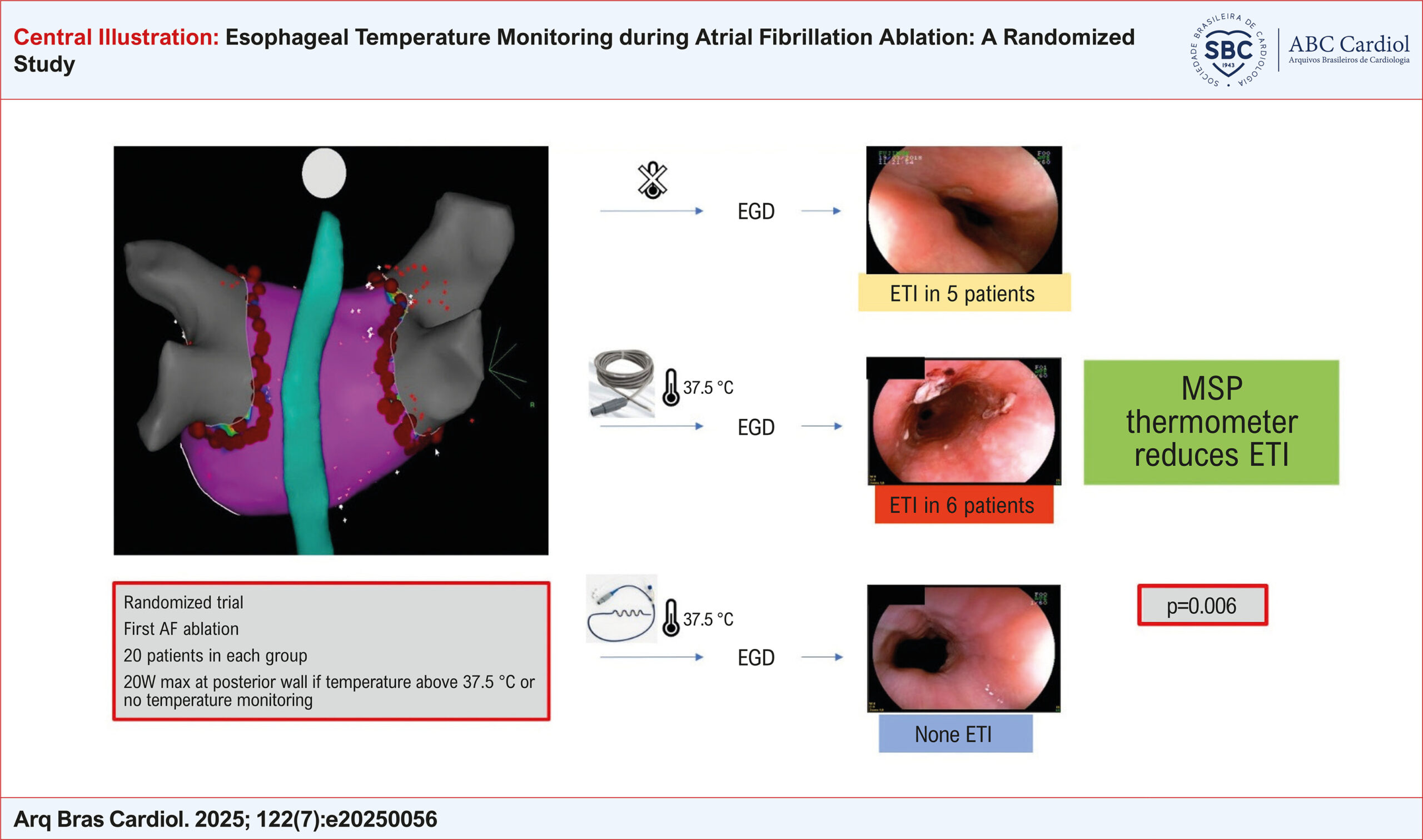
Patients with AF were randomized into three PVI groups according to the temperature monitoring strategy: no LET monitoring (Group 1), LET monitoring with a single-sensor probe (SSP) thermometer (Group 2), and LET monitoring with a multisensor probe (MSP) thermometer (Group 3). In Group 1, AF ablation was performed at a fixed power of 20 W on the left atrial posterior wall. In Groups 2 and 3, AF ablation power was titrated based on LET measurements, with a cutoff temperature of 37.5 °C. Each group included 20 patients. A two-sided p-value <0.05 was considered statistically significant. The trial was registered on ClinicalTrials.gov (#NCT03645070) and International Clinical Trials Registry Platform (#RBR-2yvgyf).

Results

All patients underwent PVI and esophagogastroduodenoscopy. No ETI was observed in patients monitored with an MSP thermometer. In contrast, five patients without LET monitoring and six patients monitored with an SSP thermometer developed ETI (p=0.006). Higher temperatures were recorded with an MSP thermometer (37.9 vs. 38.45 °C, p=0.018). There were no significant differences in PVI duration or total radiofrequency application time (p=0.250 and p=0.253, respectively).

Conclusions

LET monitoring with an MSP thermometer during PVI significantly reduces the incidence of ETI compared to no monitoring or SSP monitoring. Implementing advanced LET monitoring strategies may enhance patient safety without compromising procedural efficiency.

  • Atrial Fibrillation
  • Clinical Trial
  • esophageal fistula
  • Radiofrequency Ablation
Read Full Article
Creative Commons Attribution (CC BY) Creative Commons license
01/08/2025 DOI: 10.36660/abc.20250056i Views 1
ABC
Editorial

Atrioesophageal Fistula After Catheter Ablation of Atrial Fibrillation: Can We Really Prevent It?

Luiz Eduardo Montenegro Camanho

Catheter ablation of atrial fibrillation (AF) is a widely used and established procedure in clinical practice. Several randomized studies have demonstrated the superiority of this method in patients with paroxysmal/persistent AF who are symptomatic and refractory to antiarrhythmic therapy, with a strong positive impact on quality of life and in reducing the clinical recurrence of this arrhythmia, regardless of the type of energy used.– The primary objective of the procedure is the electrical isolation of the pulmonary veins, associated or not with more extensive lesions, particularly of the posterior wall.

The main complications related to the procedure, such as death, per-procedure thromboembolic event, atrioesophageal fistula (AEF), cardiac tamponade, severe pulmonary vein stenosis, and permanent phrenic nerve palsy are, in reality, infrequent complications (0.02 to 1.3%). A recent publication demonstrated a decrease in these complications in recent years (2018-2022) when compared to the previous five years (3.8 versus 5.3%).

[…]

  • Atrial Fibrillation
  • Catheter Ablation
  • esophageal fistula
Read Full Article
Creative Commons Attribution (CC BY) Creative Commons license
30/05/2025 DOI: 10.36660/abc.20250148i Views 1
Esophageal Protection Strategies for Ablation of Atrial Fibrillation: Comparative Results of Consecutive Endoscopic Evaluation
ABC
Original Article

Esophageal Protection Strategies for Ablation of Atrial Fibrillation: Comparative Results of Consecutive Endoscopic Evaluation

Alberto Pereira Ferraz et al. Cristiano Faria Pisani Esteban Wisnivesky Rocca Rivarola Tan Chen Wu … Francisco Carlos da Costa Darrieux Rafael Alvarenga Scanavacca Muhieddine Omar Chokr Carina Abigail Hardy Sissy Lara de Melo Denise Tessariol Hachul Beatriz Hachul de Campos Mauricio Ibrahim Scanavacca

Abstract

Background

Atrial-esophageal fistula following AF ablation remains a concern. There is no standardized approach to minimize its risk and morbidity.

Objective

To present the seven-year experience of a systematic endoscopic surveillance of esophageal injury after AF catheter ablation.

Methods

This is a retrospective single center registry of systematic endoscopic evaluation after AF ablation in consecutive procedures performed from 2016 to 2022. A p-value of <0.05 was considered statistically significant.

Results

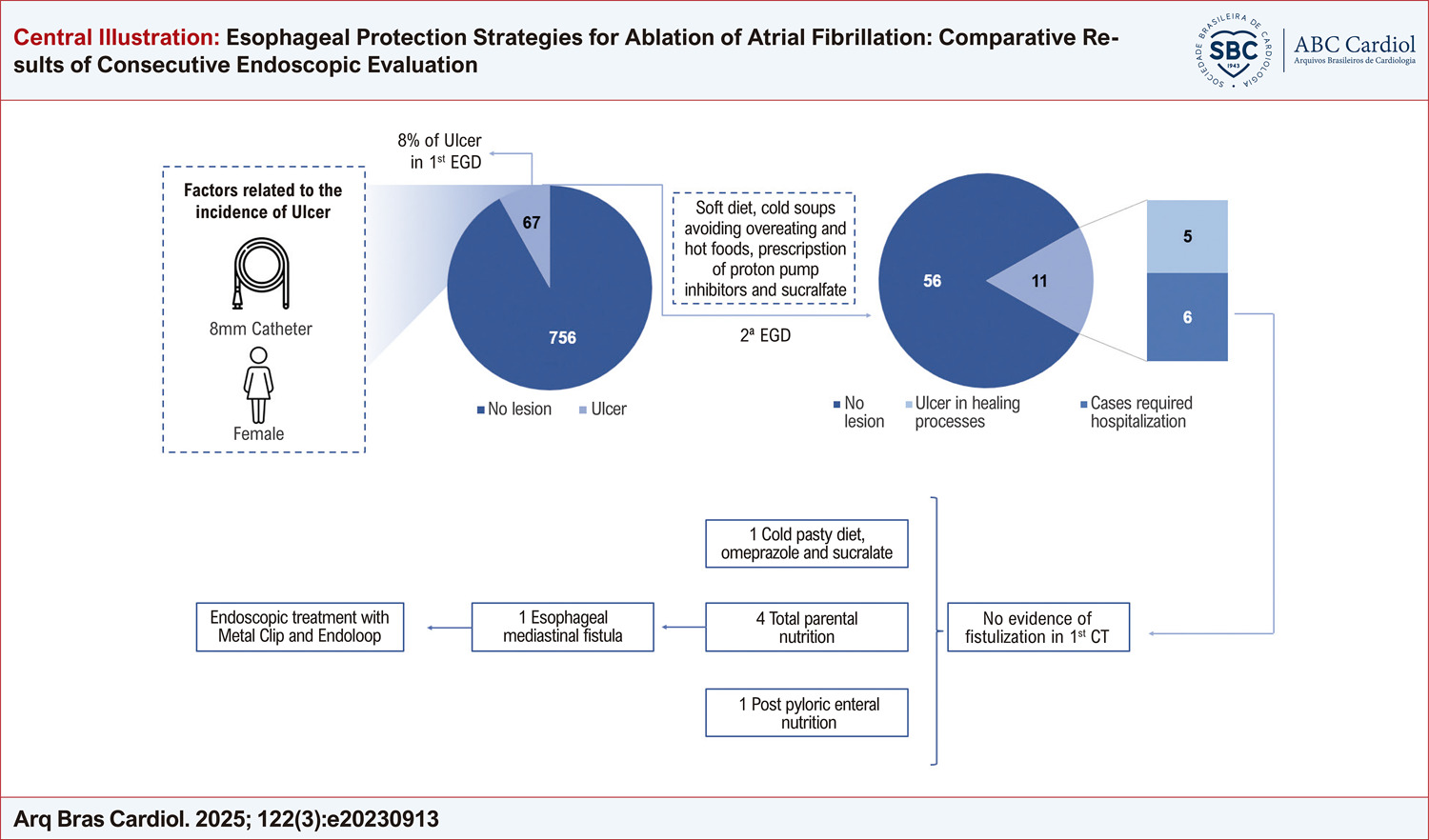
823 AF ablation with controlled esophagogastroduodenoscopy (EGD) were analyzed. Most patients (n=588, 71.4%) were male, 575 (69.9%) had paroxysmal AF. Esophageal temperature monitoring was performed using a single sensor in 310 patients (40.3%) and a multi–sensor probe in 306 (39.8%). Lesions were presented in 217 EGD (26.5%): hematoma-ecchymosis in 27 (3.3%), erythema in 14 (1.7%), erosion in 78 (9.5%) and ulcer in 67 (8.2%) patients. No esophageal protective strategy was associated with more ulcers, except the use of 8mm tip-catheter (14.7% of ulcers with 8mm tip catheter vs 6.7% with other catheters, p = 0.001). Thermal lesions were early detected and treated. Most lesions were considered healed at endoscopy, but one patient who underwent pulmonary vein isolation with an 8m tip catheter had esophageal fistula, treated successfully with endoscopic metal clip and endoloop technique.

Conclusion

The incidence of esophageal lesions at routine EGD following AF ablation is high, although in most of the cases they heal spontaneously. Patients who underwent ablation with the 8mm tip catheter had more severe thermal lesions. Early esophagus endoscopy may help the diagnosis of early-stage lesions and the prevention of fistula formation after AF ablation.

  • Atrial Fibrillation
  • Catheter Ablation
  • Endoscopy
  • esophageal fistula
Read Full Article
Creative Commons Attribution (CC BY) Creative Commons license
24/03/2025 DOI: 10.36660/abc.20230913i Views 2
Aortic aneurysm rupture into the esophagus
ABC
Case Report

Aortic aneurysm rupture into the esophagus

Christiano da Silveira de Barcellos et al. Paulo Ceratti de Azambuja Marcelo Kunh Momolli Clóvis Manfredini Rigoni … Marcelo Lopes Henrique Biavatti Wagnes Franceschi Claudio Borges Fortes

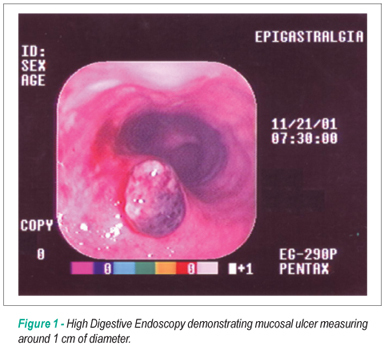
We present the case of a patient with a descending aorta aneurysm rupture into the esophagus, which, after aortoplasty with Dacron tube interposition and suture of esophageal laceration, developed a pleural-esophagus fistula on the 3rd postoperative day. She needed re-intervention and intensive care, followed by adequate recovery. Considering this unusual case and the knowledge acquired through its management, we reviewed the literature in order to discuss the best alternative for the correction of this rare and often fatal form of presentation of aortic diseases.

  • Aortic Aneurysm
  • aortic ruptura
  • esophageal fistula
Read Full Article
Creative Commons Attribution (CC BY) Creative Commons license
05/01/2009 DOI: 10.1590/S0066-782X2008001800012 Views 1

How to cite this article

EndNote RIS

Electronic Document Format (Vancouver)

Borges AP, Kalil C, Brugada J, Yanez JPG, Soliz PC, Saffi MAL, Silveira AD, et al. Severe Esophageal Complications Following Atrial Fibrillation Ablation: Should We Still Be Concerned?. Arquivos Brasileiros de Cardiologia 2026;122(11):e20250290.

Electronic Document Format (ABNT)

Borges, Anibal Pires; Kalil, Carlos; Brugada, Josep; Yanez, José Plutarco Gutiérrez; Soliz, Pablo da Costa; Saffi, Marco Aurelio Lumertz; Silveira, Anderson Donelli da; Pimentel, Maurício. Severe Esophageal Complications Following Atrial Fibrillation Ablation: Should We Still Be Concerned?. Arquivos Brasileiros de Cardiologia, v. 122, n. 11, e20250290, Jan. 2026.

Electronic Document Format (APA)

Borges, A. P., Kalil, C., Brugada, J., Yanez, J. P. G., Soliz, P. C., Saffi, M. A. L., Silveira, A. D. , & Pimentel, M. (2026). Severe Esophageal Complications Following Atrial Fibrillation Ablation: Should We Still Be Concerned?. Arquivos Brasileiros de Cardiologia, 122(11), e20250290.

Electronic Document Format (ISO)

Borges, Anibal Pires and Kalil, Carlos and Brugada, Josep and Yanez, José Plutarco Gutiérrez and Soliz, Pablo da Costa and Saffi, Marco Aurelio Lumertz and Silveira, Anderson Donelli da and Pimentel, Maurício. Severe Esophageal Complications Following Atrial Fibrillation Ablation: Should We Still Be Concerned?. Arquivos Brasileiros de Cardiologia [online]. 2026, vol. 122, n. 11, [cited 2026-10-14], e20250290. Available from: <https://journals.cardiol.br/en/article/severe-esophageal-complications-following-atrial-fibrillation-ablation-should-we-still-be-concerned/>. ISSN 0066-782X

EndNote RIS

Electronic Document Format (Vancouver)

Moura DMC, Pereira RAR, Pisani CF, Wu TC, Chokr MO, Hardy CA, Melo SL, et al. Esophageal Temperature Monitoring during Atrial Fibrillation Ablation: A Randomized Study. Arquivos Brasileiros de Cardiologia 2025;122(7):e20250056.

Electronic Document Format (ABNT)

Moura, Daniel Moreira Costa; Pereira, Renner Augusto Raposo; Pisani, Cristiano Faria; Wu, Tan Chen; Chokr, Muhieddine Omar; Hardy, Carina Abigail; Melo, Sissy Lara de; Darrieux, Francisco Carlos da Costa; Hachul, Denise Tessariol; Scanavacca, Mauricio Ibrahim. Esophageal Temperature Monitoring during Atrial Fibrillation Ablation: A Randomized Study. Arquivos Brasileiros de Cardiologia, v. 122, n. 7, e20250056, Jul. 2025.

Electronic Document Format (APA)

Moura, D. M. C., Pereira, R. A. R., Pisani, C. F., Wu, T. C., Chokr, M. O., Hardy, C. A., Melo, S. L. , Darrieux, F. C. C., Hachul, D. T., & Scanavacca, M. I. (2025). Esophageal Temperature Monitoring during Atrial Fibrillation Ablation: A Randomized Study. Arquivos Brasileiros de Cardiologia, 122(7), e20250056.

Electronic Document Format (ISO)

Moura, Daniel Moreira Costa and Pereira, Renner Augusto Raposo and Pisani, Cristiano Faria and Wu, Tan Chen and Chokr, Muhieddine Omar and Hardy, Carina Abigail and Melo, Sissy Lara de and Darrieux, Francisco Carlos da Costa and Hachul, Denise Tessariol and Scanavacca, Mauricio Ibrahim. Esophageal Temperature Monitoring during Atrial Fibrillation Ablation: A Randomized Study. Arquivos Brasileiros de Cardiologia [online]. 2025, vol. 122, n. 7, [cited 2026-10-14], e20250056. Available from: <https://journals.cardiol.br/en/article/esophageal-temperature-monitoring-during-atrial-fibrillation-ablation-a-randomized-study/>. ISSN 0066-782X

EndNote RIS

Electronic Document Format (Vancouver)

Camanho LEM. Atrioesophageal Fistula After Catheter Ablation of Atrial Fibrillation: Can We Really Prevent It?. Arquivos Brasileiros de Cardiologia 2025;122(3):e20250148.

Electronic Document Format (ABNT)

Camanho, Luiz Eduardo Montenegro. Atrioesophageal Fistula After Catheter Ablation of Atrial Fibrillation: Can We Really Prevent It?. Arquivos Brasileiros de Cardiologia, v. 122, n. 3, e20250148, May. 2025.

Electronic Document Format (APA)

Camanho, L. E. M. (2025). Atrioesophageal Fistula After Catheter Ablation of Atrial Fibrillation: Can We Really Prevent It?. Arquivos Brasileiros de Cardiologia, 122(3), e20250148.

Electronic Document Format (ISO)

Camanho, Luiz Eduardo Montenegro. Atrioesophageal Fistula After Catheter Ablation of Atrial Fibrillation: Can We Really Prevent It?. Arquivos Brasileiros de Cardiologia [online]. 2025, vol. 122, n. 3, [cited 2026-10-14], e20250148. Available from: <https://journals.cardiol.br/en/article/atrioesophageal-fistula-after-catheter-ablation-of-atrial-fibrillation-can-we-really-prevent-it/>. ISSN 0066-782X

EndNote RIS

Electronic Document Format (Vancouver)

Ferraz AP, Pisani CF, Rivarola EWR, Wu TC, Darrieux FCC, Scanavacca RA, Chokr MO, et al. Esophageal Protection Strategies for Ablation of Atrial Fibrillation: Comparative Results of Consecutive Endoscopic Evaluation. Arquivos Brasileiros de Cardiologia 2025;122(3):e20230913.

Electronic Document Format (ABNT)

Ferraz, Alberto Pereira; Pisani, Cristiano Faria; Rivarola, Esteban Wisnivesky Rocca; Wu, Tan Chen; Darrieux, Francisco Carlos da Costa; Scanavacca, Rafael Alvarenga; Chokr, Muhieddine Omar; Hardy, Carina Abigail; Melo, Sissy Lara de; Hachul, Denise Tessariol; Campos, Beatriz Hachul de; Scanavacca, Mauricio Ibrahim. Esophageal Protection Strategies for Ablation of Atrial Fibrillation: Comparative Results of Consecutive Endoscopic Evaluation. Arquivos Brasileiros de Cardiologia, v. 122, n. 3, e20230913, Mar. 2025.

Electronic Document Format (APA)

Ferraz, A. P., Pisani, C. F., Rivarola, E. W. R., Wu, T. C., Darrieux, F. C. C., Scanavacca, R. A., Chokr, M. O., Hardy, C. A., Melo, S. L. , Hachul, D. T., Campos, B. H. , & Scanavacca, M. I. (2025). Esophageal Protection Strategies for Ablation of Atrial Fibrillation: Comparative Results of Consecutive Endoscopic Evaluation. Arquivos Brasileiros de Cardiologia, 122(3), e20230913.

Electronic Document Format (ISO)

Ferraz, Alberto Pereira and Pisani, Cristiano Faria and Rivarola, Esteban Wisnivesky Rocca and Wu, Tan Chen and Darrieux, Francisco Carlos da Costa and Scanavacca, Rafael Alvarenga and Chokr, Muhieddine Omar and Hardy, Carina Abigail and Melo, Sissy Lara de and Hachul, Denise Tessariol and Campos, Beatriz Hachul de and Scanavacca, Mauricio Ibrahim. Esophageal Protection Strategies for Ablation of Atrial Fibrillation: Comparative Results of Consecutive Endoscopic Evaluation. Arquivos Brasileiros de Cardiologia [online]. 2025, vol. 122, n. 3, [cited 2026-10-14], e20230913. Available from: <https://journals.cardiol.br/en/article/esophageal-protection-strategies-for-ablation-of-atrial-fibrillation-comparative-results-of-consecutive-endoscopic-evaluation/>. ISSN 0066-782X

EndNote RIS

Electronic Document Format (Vancouver)

Barcellos CS, Azambuja PC, Momolli MK, Rigoni CM, Lopes M, Biavatti H, Franceschi W, et al. Aortic aneurysm rupture into the esophagus. Arquivos Brasileiros de Cardiologia 2009;91(6):e53-5.

Electronic Document Format (ABNT)

Barcellos, Christiano da Silveira de; Azambuja, Paulo Ceratti de; Momolli, Marcelo Kunh; Rigoni, Clóvis Manfredini; Lopes, Marcelo; Biavatti, Henrique; Franceschi, Wagnes; Fortes, Claudio Borges. Aortic aneurysm rupture into the esophagus. Arquivos Brasileiros de Cardiologia, v. 91, n. 6, p. e53-e55, Jan. 2009.

Electronic Document Format (APA)

Barcellos, C. S. , Azambuja, P. C. , Momolli, M. K., Rigoni, C. M., Lopes, M., Biavatti, H., Franceschi, W., & Fortes, C. B. (2009). Aortic aneurysm rupture into the esophagus. Arquivos Brasileiros de Cardiologia, 91(6), e53-e55.

Electronic Document Format (ISO)

Barcellos, Christiano da Silveira de and Azambuja, Paulo Ceratti de and Momolli, Marcelo Kunh and Rigoni, Clóvis Manfredini and Lopes, Marcelo and Biavatti, Henrique and Franceschi, Wagnes and Fortes, Claudio Borges. Aortic aneurysm rupture into the esophagus. Arquivos Brasileiros de Cardiologia [online]. 2009, vol. 91, n. 6, [cited 2026-10-14], pp. e53-e55. Available from: <https://journals.cardiol.br/en/article/aortic-aneurysm-rupture-into-the-esophagus/>. ISSN 0066-782X

  • About ABC Family
  • Internal Regulation
  • Editorial Board
  • Brazilian Society of Cardiology (SBC)

Issues

SBC Guidelines

  • Videos
  • Podcasts
  • News