Gustavo Paglioli Dannenhauer et al. Simone Nascimento dos Santos Ana Claudia Gomes Pereira Petisco Claudia Maria Vilas Freire … Ana Cristina Lopes Albricker Fanilda Souto Barros
Abstract
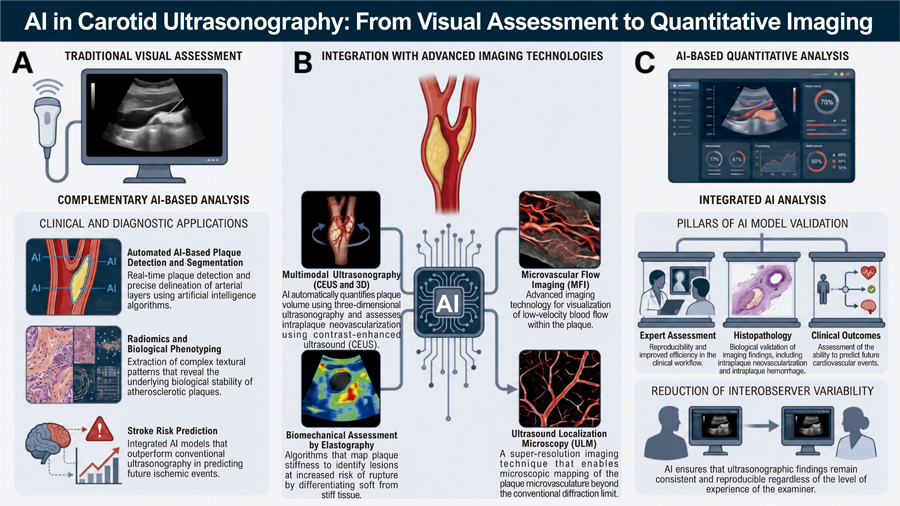
To review the current applications of artificial intelligence (AI) in carotid ultrasonography and its future perspectives. This narrative review was based on recent studies addressing machine learning, deep learning, radiomics, and integration with advanced ultrasound modalities, including contrast-enhanced ultrasound (CEUS), elastography, three-dimensional ultrasound, microvascular flow imaging (MFI), and ultrafast ultrasound. Carotid assessment has evolved from an approach focused primarily on the degree of luminal stenosis to a more comprehensive evaluation encompassing plaque burden, morphology, composition, and vulnerability. AI algorithms have been applied to automated plaque detection, image segmentation, plaque stability classification, radiomic feature extraction, and prediction of ischemic events. When combined with advanced imaging techniques, these models may improve reproducibility, reduce operator dependence, and reveal quantitative patterns that conventional visual assessment may not detect. Despite promising results, important challenges remain regarding image standardization, external validation, model explainability, and prospective clinical impacts. AI has the potential to transform carotid ultrasonography into a multiparametric tool for personalized medicine. Its clinical implementation will depend on robust validation, integration into clinical workflows, and demonstration of incremental value over conventional ultrasonography.