ABC Family Arquivos Brasileiros de Cardiologia International Journal of Cardiovascular Sciences ABC Heart Failure & Cardiomyopathy ABC Imagem Cardiovascular
Português English
ABC Family
Português English
  • About
    • About ABC Family
    • Internal Regulation
    • Editorial Board
    • Brazilian Society of Cardiology (SBC)
  • Issues
  • SBC Guidelines
  • Content
    • Videos
    • Podcasts
    • News
  • About
    • About ABC Family
    • Internal Regulation
    • Editorial Board
    • Brazilian Society of Cardiology (SBC)
  • Issues
  • SBC Guidelines
  • Content
    • Videos
    • Podcasts
    • News

ABC Family

  • ABC Family
  • Arquivos Brasileiros de Cardiologia
  • International Journal of Cardiovascular Sciences
  • ABC Heart Failure & Cardiomyopathy
  • ABC Imagem Cardiovascular
Search in

No content found.

Journals
Ordering
Article types
Others

  1. Home
  2. Keyword: Bias
ABC
Editorial

Will You Tell Them When They Are Wrong? Automation Bias and Artificial Intelligence in Medicine

Marcio Sommer Bittencourt

The use of decision support tools and automation in medical practice is not new. Early tools employed simple regression models to reduce heterogeneity and offer more structured care. In cardiology, initial examples of decision support tools included the Framingham risk scores for primary prevention risk stratification and automated sliding scale dose adjustments for heparin or warfarin. Since then, automation processes have become more sophisticated and are now widespread in many routine aspects of medical practice. In cardiology, these include automated preliminary interpretations of electrocardiography (ECG) tracings as well as automated measurements and image analysis in echocardiography, nuclear medicine, and cardiac magnetic resonance imaging. Other automated clinical decision support systems help reduce prescribing errors by alerting clinicians to drug-drug interactions or incorrect dosages, for example. With recent advances in artificial intelligence (AI), expectations for the future of such tools have grown dramatically. Yet, the potential negative implications of these technologies have received considerably less attention.

Clinical decision support systems can improve medical decision-making and patient outcomes. However, these systems are not flawless and may produce incorrect outputs. Most studies assessing their performance rely on conventional medical metrics such as sensitivity, specificity, accuracy, and area under the receiver operating characteristic curve. Yet, it is far more important to evaluate the real-world impact of these tools, particularly in light of how clinicians interact with them. This is especially relevant given that the European Union Artificial Intelligence Act mandates human oversight for high-risk AI systems. The issue becomes even more critical with the widespread use of generative AI chatbots, as the current generation of complex AI tools has led to a growing trend of overreliance on imperfect automation.

[…]

  • Artificial Intelligence
  • Bias
  • Cardiology
Read Full Article
Creative Commons Attribution (CC BY) Creative Commons license
14/07/2025 DOI: 10.36660/abc.20250300i Views 2
ABCIC
Editorial

Mental Traps That Impact Diagnostic Imaging

Maurício Rodrigues Jordão et al. Marcelo Tavares Fábio Fernandes

Daniel Kahneman reinforced and popularized the idea of two distinct modes of thinking. System 1 relies on pattern recognition, detecting simple relationships, correlating stereotypes, and associating ideas in a search for coherence. It is fast, intuitive, automatic, and requires little or no effort or energy. It cannot be turned off and continuously monitors the environment, driven by a survival need rooted in our ancestral past. System 2, on the other hand, demands attention, compares objects based on various attributes, and makes deliberate choices among options. It evaluates scenarios using logical and statistical reasoning. Because it requires attention, its activity is interrupted when that attention is diverted. Therefore, tasks that require effort interfere with one another (for instance, making a turn while driving and performing a complex calculation simultaneously is impossible). However, System 2 is slow, deliberate, effortful, and orderly. The two systems are interconnected: System 1 effortlessly generates impressions and feelings that serve as the main source for the explicit beliefs and deliberate choices made by System 2. In daily life, we often make decisions based on heuristics—mental shortcuts closely linked to System 1—used to save time and energy. While extremely efficient, this faster way of thinking opens the door to cognitive biases, which are systematic tendencies that distort logical reasoning and lead to flawed decisions.

The causes of error in diagnostic medicine can be categorized into two main groups: perceptual errors and interpretive errors. Perceptual errors occur when an abnormality is present on the image but goes undetected. These may be related to image acquisition, post-processing, or equipment quality. Interpretive errors arise when the abnormality is seen but its significance is misunderstood. In such cases, cognitive biases may be involved and are estimated to account for up to 74% of diagnostic errors.– Approximately 30 types of cognitive biases have been described in literature. In diagnostic imaging, the most relevant include anchoring, confirmation bias, availability bias, attribution bias, framing effect, and satisfaction of search.-,

[…]

  • Bias
  • Diagnostic Errors
  • Healthcare Near Miss
  • Heuristics
Read Full Article
Creative Commons Attribution (CC BY) Creative Commons license
30/06/2025 DOI: 10.36660/abcimg.20250040i Views 1
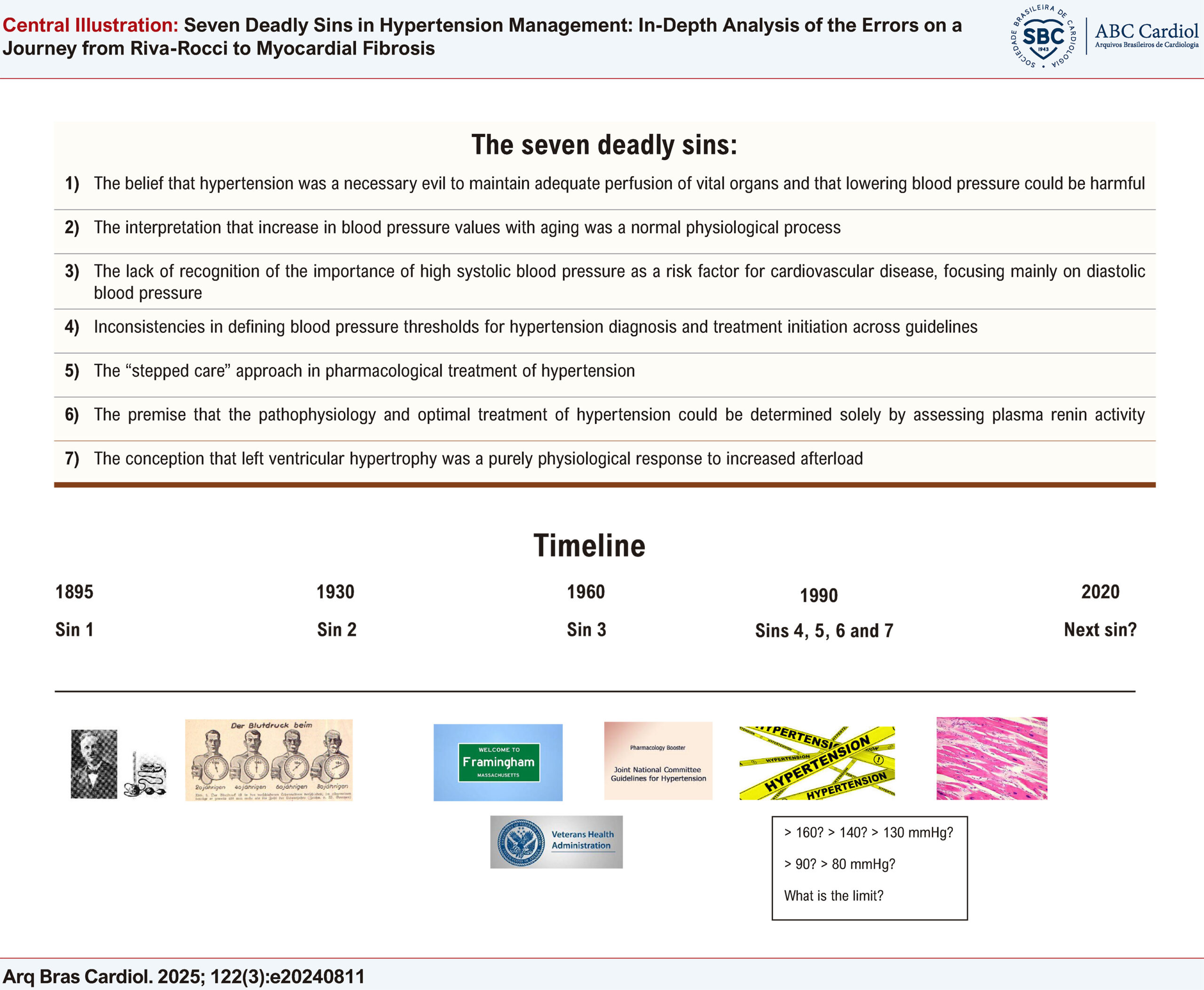
Seven Deadly Sins in Hypertension Management: In-Depth Analysis of the Errors on a Journey from Riva-Rocci to Myocardial Fibrosis
ABC
Review Article

Seven Deadly Sins in Hypertension Management: In-Depth Analysis of the Errors on a Journey from Riva-Rocci to Myocardial Fibrosis

Claudio Pinho et al. Heitor Moreno José Francisco Kerr Saraiva Fernanda Marciano Consolim-Colombo

Abstract

Medicine is perhaps the only science that values knowledge of the most recent scientific publications more than its history over time. Medical epistemology shows that some mistakes and successes are so close that we often do not readily differentiate between them. The production of medical knowledge makes us understand that knowledge is transitory and theories need to be revalidated, rectified, or polished, if not destroyed and built again on other bases; paradigms that are renewed move science. With this critical view, it was necessary to access how much knowledge about arterial hypertension has been built over the last 130 years, since the measurement of blood pressure began to be widespread and become routine in medical practice until the present day. This critical review was focused on errors in the interpretation of acquired knowledge, seven of which have been identified, deeply discussed, and condemned as sins due to the delay in being recognized, thus allowing the lives of people with this cardiovascular pathology to be shortened.

  • Bias
  • Hypertension
  • Science
Read Full Article
Creative Commons Attribution (CC BY) Creative Commons license
02/05/2025 DOI: 10.36660/abc.20240811i Views 1

How to cite this article

EndNote RIS

Electronic Document Format (Vancouver)

Bittencourt MS. Will You Tell Them When They Are Wrong? Automation Bias and Artificial Intelligence in Medicine. Arquivos Brasileiros de Cardiologia 2025;122(5):e20250300.

Electronic Document Format (ABNT)

Bittencourt, Marcio Sommer. Will You Tell Them When They Are Wrong? Automation Bias and Artificial Intelligence in Medicine. Arquivos Brasileiros de Cardiologia, v. 122, n. 5, e20250300, Jul. 2025.

Electronic Document Format (APA)

Bittencourt, M. S. (2025). Will You Tell Them When They Are Wrong? Automation Bias and Artificial Intelligence in Medicine. Arquivos Brasileiros de Cardiologia, 122(5), e20250300.

Electronic Document Format (ISO)

Bittencourt, Marcio Sommer. Will You Tell Them When They Are Wrong? Automation Bias and Artificial Intelligence in Medicine. Arquivos Brasileiros de Cardiologia [online]. 2025, vol. 122, n. 5, [cited 2026-10-14], e20250300. Available from: <https://journals.cardiol.br/en/article/will-you-tell-them-when-they-are-wrong-automation-bias-and-artificial-intelligence-in-medicine/>. ISSN 0066-782X

EndNote RIS

Electronic Document Format (Vancouver)

Jordão MR, Tavares M, Fernandes F. Mental Traps That Impact Diagnostic Imaging. ABC Imagem Cardiovascular 2025;38(2):e20250405.

Electronic Document Format (ABNT)

Jordão, Maurício Rodrigues; Tavares, Marcelo; Fernandes, Fábio. Mental Traps That Impact Diagnostic Imaging. ABC Imagem Cardiovascular, v. 38, n. 2, e20250405, Jun. 2025.

Electronic Document Format (APA)

Jordão, M. R., Tavares, M., & Fernandes, F. (2025). Mental Traps That Impact Diagnostic Imaging. ABC Imagem Cardiovascular, 38(2), e20250405.

Electronic Document Format (ISO)

Jordão, Maurício Rodrigues and Tavares, Marcelo and Fernandes, Fábio. Mental Traps That Impact Diagnostic Imaging. ABC Imagem Cardiovascular [online]. 2025, vol. 38, n. 2, [cited 2026-10-14], e20250405. Available from: <https://journals.cardiol.br/en/article/mental-traps-that-impact-diagnostic-imaging/>. ISSN 2318-8219

EndNote RIS

Electronic Document Format (Vancouver)

Pinho C, Moreno H, Saraiva JFK, Consolim-Colombo FM. Seven Deadly Sins in Hypertension Management: In-Depth Analysis of the Errors on a Journey from Riva-Rocci to Myocardial Fibrosis. Arquivos Brasileiros de Cardiologia 2025;122(3):e20240811.

Electronic Document Format (ABNT)

Pinho, Claudio; Moreno, Heitor; Saraiva, José Francisco Kerr; Consolim-Colombo, Fernanda Marciano. Seven Deadly Sins in Hypertension Management: In-Depth Analysis of the Errors on a Journey from Riva-Rocci to Myocardial Fibrosis. Arquivos Brasileiros de Cardiologia, v. 122, n. 3, e20240811, May. 2025.

Electronic Document Format (APA)

Pinho, C., Moreno, H., Saraiva, J. F. K., & Consolim-Colombo, F. M. (2025). Seven Deadly Sins in Hypertension Management: In-Depth Analysis of the Errors on a Journey from Riva-Rocci to Myocardial Fibrosis. Arquivos Brasileiros de Cardiologia, 122(3), e20240811.

Electronic Document Format (ISO)

Pinho, Claudio and Moreno, Heitor and Saraiva, José Francisco Kerr and Consolim-Colombo, Fernanda Marciano. Seven Deadly Sins in Hypertension Management: In-Depth Analysis of the Errors on a Journey from Riva-Rocci to Myocardial Fibrosis. Arquivos Brasileiros de Cardiologia [online]. 2025, vol. 122, n. 3, [cited 2026-10-14], e20240811. Available from: <https://journals.cardiol.br/en/article/seven-deadly-sins-in-hypertension-management-in-depth-analysis-of-the-errors-on-a-journey-from-riva-rocci-to-myocardial-fibrosis/>. ISSN 0066-782X

  • About ABC Family
  • Internal Regulation
  • Editorial Board
  • Brazilian Society of Cardiology (SBC)

Issues

SBC Guidelines

  • Videos
  • Podcasts
  • News