ABC Family Arquivos Brasileiros de Cardiologia International Journal of Cardiovascular Sciences ABC Heart Failure & Cardiomyopathy ABC Imagem Cardiovascular
Português English
ABC Family
Português English
  • About
    • About ABC Family
    • Internal Regulation
    • Editorial Board
    • Brazilian Society of Cardiology (SBC)
  • Issues
  • SBC Guidelines
  • Content
    • Videos
    • Podcasts
    • News
  • About
    • About ABC Family
    • Internal Regulation
    • Editorial Board
    • Brazilian Society of Cardiology (SBC)
  • Issues
  • SBC Guidelines
  • Content
    • Videos
    • Podcasts
    • News

ABC Family

  • ABC Family
  • Arquivos Brasileiros de Cardiologia
  • International Journal of Cardiovascular Sciences
  • ABC Heart Failure & Cardiomyopathy
  • ABC Imagem Cardiovascular
Search in

No content found.

Journals
Ordering
Article types
Others

  1. Home
  2. Keyword: Cardio-Renal Syndrome
Growth Differentiation Factor 15 is Correlated With Urinary Markers in Patients with Chronic Heart Failure
ABC
Original Article

Growth Differentiation Factor 15 is Correlated With Urinary Markers in Patients with Chronic Heart Failure

Gustavo Rodolfo Moreira et al. Diane Xavier Ávila Angelo Michele Di Candia Victoria Depes Scaramussa Humberto Villacorta

Abstract

Background

There is a lack in identifying heart failure (HF) patients with an increased risk of hospitalization and death. Growth differentiation factor 15 (GDF-15), a biomarker associated with inflammation and oxidative stress, emerges as a candidate associated with cardiovascular and renal disease. The low estimated glomerular filter rate (eGFR), low urinary sodium (UNa), and the high ratio of albumin to creatinine are renal markers already associated with a high risk of hospitalization and mortality.

Objective

To evaluate the relationship between GDF-15 and renal markers in patients with chronic HF.

Method

We enrolled 87 consecutive patients with symptomatic HF with reduced left ventricular ejection fraction (LVEF < 40%), mildly reduced LVEF (40–49%) or an improved LVEF (50% but previously < 50%) in a university hospital. We compared the associations of GDF-15 and NT-proBNP with renal markers using correlation tests and multiple regression analysis at the significance level of 5%.

Results

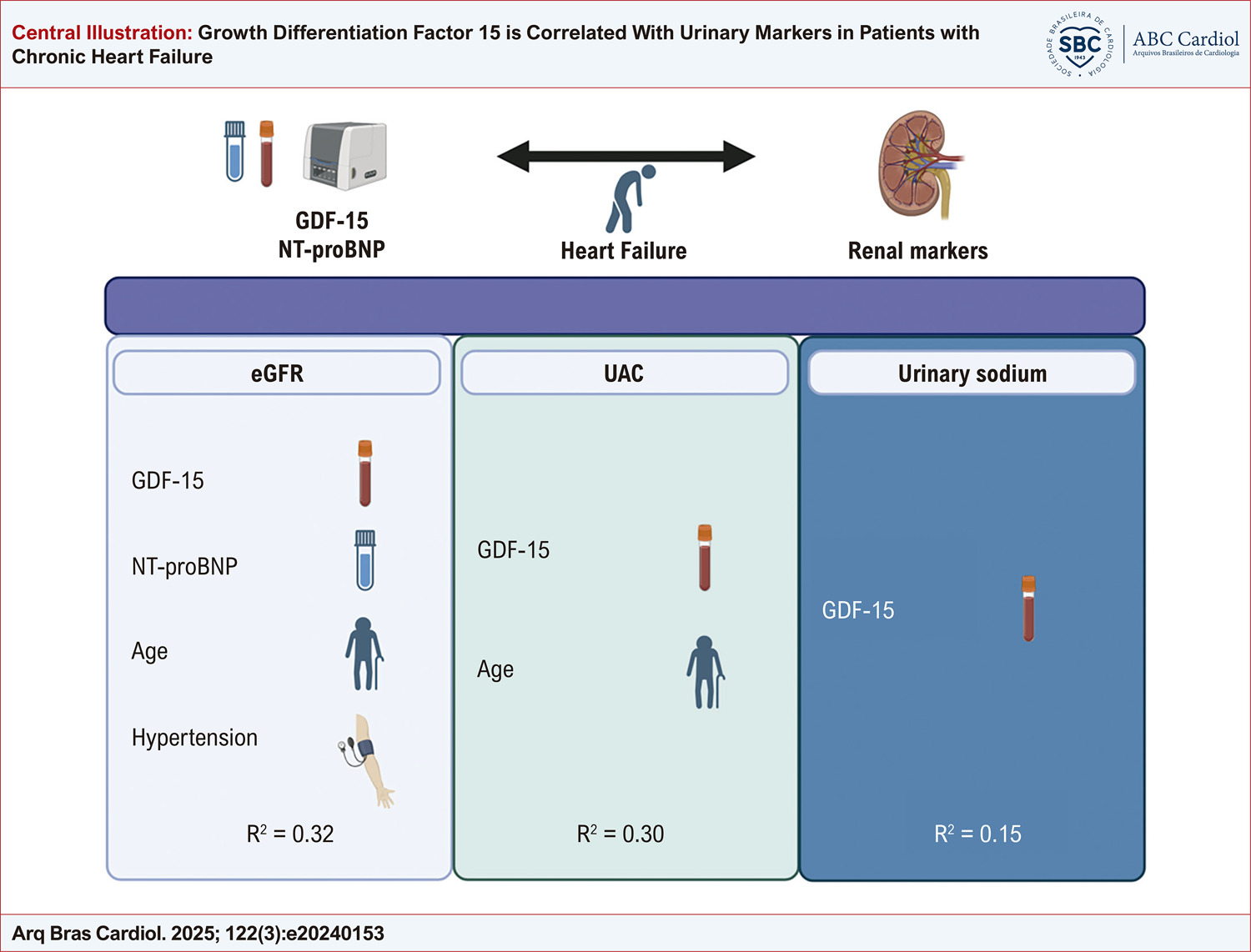
GDF-15 and NT-proBNP had weak to moderate negative correlations with UNa (r=-0.362, p=0.007; r=-0.334, p=0.014, respectively) and eGFR (r=-0.385, p=0.0002; r=-0.346, p=0.001, respectively). GDF-15, age, hypertension and NT-proBNP were independently associated with eGFR in multiple regression analysis (overall R2=0.32). GDF-15 (positive) and age (negative) were independently associated with UAC (overall, R2=0.30). Only GDF-15 was independently associated with UNa (R2=0.45).

Conclusions

In these chronic patients with HF, GDF-15 is better correlated with markers of renal dysfunction than NT-proBNP. Since the prognostic value of renal markers is well established, these findings reinforce the prognostic role of GDF-15 in chronic HF.
  • Biomarkers
  • Cardio-Renal Syndrome
  • GDF-15
  • Heart Failure
  • Kidney Function Tests
Read Full Article
Creative Commons Attribution (CC BY) Creative Commons license
04/04/2025 DOI: 10.36660/abc.20240153i Views 2
Figure 1
IJCS
Original Article

Cardiorenal Syndrome Type 2: A Strong Prognostic Factor of Survival

Arous Salim et al. Mohamed El Ghali Benouna Rachida Habbal Monia El Mourid

Abstract

Background:

Renal failure is common in patients with chronic heart failure, with a prevalence ranging from 20 % to 57% worldwide. It is associated with a poor prognosis and a high risk of readmission.

Objectives:

The purpose of our study is to show the epidemiological, clinical, paraclinical and therapeutic features of Moroccan patients with chronic heart failure who had developed a chronic renal failure. The endpoints were cardiac death and any cause of hospitalization.

Methods:

563 patients followed for chronic heart failure at the heart failure unit in the Department of Cardiology of the University Hospital Ibn Rushd of Casablanca in Morocco, between July 30, 2012 and July 30, 2016 were assessed. Patients were divided into two groups according to the presence or absence of cardiorenal syndrome.

Results:

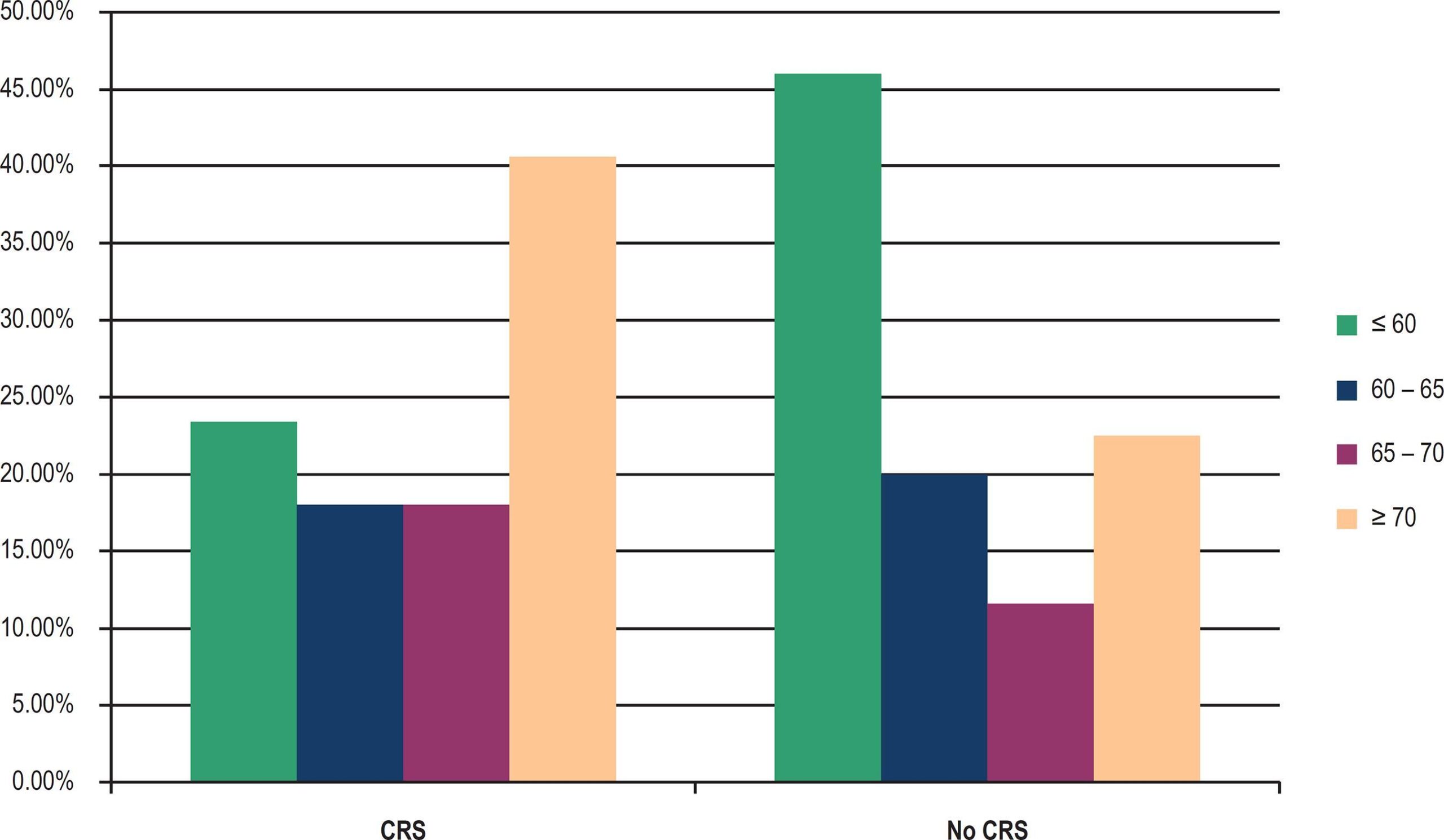
Compared to patients who had no cardiorenal syndrome, patients with cardiorenal syndrome tended to be more aged, hypertensive and diabetic. Clinically more patients were at dyspnea stage III or IV. Biologically their hemoglobin was lower and their blood uric acid level was higher. Regarding echocardiography, their ejection fraction of the left ventricle was lower, with more of systolic dysfunction of the right ventricle and pulmonary hypertension in the CRS group, with a higher risk of readmission (p < 0.0001). The mortality was significantly higher in the group CRS (p < 0.0001).

Conclusion:

The deterioration of renal function in chronic renal failure is associated with poor prognosis, including a high risk of rehospitalization, cardiovascular events and death. Patients who are elderly, diabetic, with a low left ventricular ejection fraction and pulmonary hypertension are the most concerned.

  • Cardio-Renal Syndrome
  • Heart Failure
  • Patient Readmission
  • Renal Insufficiency Chronic / mortality
  • Renal Insufficiency Chronic / prognosis
Read Full Article
Creative Commons Attribution (CC BY) Creative Commons license
01/01/2017 DOI: 10.5935/2359-4802.20170072
ABC
Special Article

Biomarkers in Cardiology – Part 2: In Coronary Heart Disease, Valve Disease and Special Situations

Expert Group on Biomarkers

Cardiovascular diseases are the main causes of mortality and morbidity in Brazil. Their primary and secondary preventions are a priority for the health system and require multiple approaches for increased effectiveness. Biomarkers are tools used to identify with greater accuracy high-risk individuals, establish a faster diagnosis, guide treatment, and determine prognosis. This review aims to highlight the importance of biomarkers in clinical cardiology practice and raise relevant points regarding their application and perspectives for the next few years. This document was divided into two parts. This second part addresses the application of biomarkers in coronary heart disease, valvular diseases, cardio-oncology, pulmonary embolism, and cardiorenal syndrome.

  • Biological Markers, Pharmacological
  • Cardio-Renal Syndrome
  • Coronary Artery Disease
  • Evidence-Based Practice
  • Heart Valve Diseases, Pulmonary Embolism
Read Full Article
Creative Commons Attribution (CC BY) Creative Commons license
01/05/2015 DOI: 10.5935/abc.20150061

How to cite this article

EndNote RIS

Electronic Document Format (Vancouver)

Moreira GR, Ávila DX, Candia AMD, Scaramussa VD, Villacorta H. Growth Differentiation Factor 15 is Correlated With Urinary Markers in Patients with Chronic Heart Failure. Arquivos Brasileiros de Cardiologia 2025;122(3):e20240153.

Electronic Document Format (ABNT)

Moreira, Gustavo Rodolfo; Ávila, Diane Xavier; Candia, Angelo Michele Di; Scaramussa, Victoria Depes; Villacorta, Humberto. Growth Differentiation Factor 15 is Correlated With Urinary Markers in Patients with Chronic Heart Failure. Arquivos Brasileiros de Cardiologia, v. 122, n. 3, e20240153, Apr. 2025.

Electronic Document Format (APA)

Moreira, G. R., Ávila, D. X., Candia, A. M. D., Scaramussa, V. D., & Villacorta, H. (2025). Growth Differentiation Factor 15 is Correlated With Urinary Markers in Patients with Chronic Heart Failure. Arquivos Brasileiros de Cardiologia, 122(3), e20240153.

Electronic Document Format (ISO)

Moreira, Gustavo Rodolfo and Ávila, Diane Xavier and Candia, Angelo Michele Di and Scaramussa, Victoria Depes and Villacorta, Humberto. Growth Differentiation Factor 15 is Correlated With Urinary Markers in Patients with Chronic Heart Failure. Arquivos Brasileiros de Cardiologia [online]. 2025, vol. 122, n. 3, [cited 2026-10-14], e20240153. Available from: <https://journals.cardiol.br/en/article/growth-differentiation-factor-15-is-correlated-with-urinary-markers-in-patients-with-chronic-heart-failure/>. ISSN 0066-782X

EndNote RIS

Electronic Document Format (Vancouver)

Salim A, Benouna MEG, Habbal R, Mourid ME. Cardiorenal Syndrome Type 2: A Strong Prognostic Factor of Survival. International Journal of Cardiovascular Sciences 2017;30(5):425-32.

Electronic Document Format (ABNT)

Salim, Arous; Benouna, Mohamed El Ghali; Habbal, Rachida; Mourid, Monia El. Cardiorenal Syndrome Type 2: A Strong Prognostic Factor of Survival. International Journal of Cardiovascular Sciences, v. 30, n. 5, p. 425-432, Dec. 2016.

Electronic Document Format (APA)

Salim, A., Benouna, M. E. G., Habbal, R., & Mourid, M. E. (2017). Cardiorenal Syndrome Type 2: A Strong Prognostic Factor of Survival. International Journal of Cardiovascular Sciences, 30(5), 425-432.

Electronic Document Format (ISO)

Salim, Arous and Benouna, Mohamed El Ghali and Habbal, Rachida and Mourid, Monia El. Cardiorenal Syndrome Type 2: A Strong Prognostic Factor of Survival. International Journal of Cardiovascular Sciences [online]. 2017, vol. 30, n. 5, [cited 2026-10-14], pp. 425-432. Available from: <https://journals.cardiol.br/en/article/cardiorenal-syndrome-type-2-a-strong-prognostic-factor-of-survival/>. ISSN 2359-4802

EndNote RIS

Electronic Document Format (Vancouver)

Biomarkers EG. Biomarkers in Cardiology – Part 2: In Coronary Heart Disease, Valve Disease and Special Situations. Arquivos Brasileiros de Cardiologia 2015;104(5):337-46.

Electronic Document Format (ABNT)

Biomarkers, Expert Group on. Biomarkers in Cardiology – Part 2: In Coronary Heart Disease, Valve Disease and Special Situations. Arquivos Brasileiros de Cardiologia, v. 104, n. 5, p. 337-346, Apr. 2015.

Electronic Document Format (APA)

Biomarkers, E. G. (2015). Biomarkers in Cardiology – Part 2: In Coronary Heart Disease, Valve Disease and Special Situations. Arquivos Brasileiros de Cardiologia, 104(5), 337-346.

Electronic Document Format (ISO)

Biomarkers, Expert Group on. Biomarkers in Cardiology – Part 2: In Coronary Heart Disease, Valve Disease and Special Situations. Arquivos Brasileiros de Cardiologia [online]. 2015, vol. 104, n. 5, [cited 2026-10-14], pp. 337-346. Available from: <https://journals.cardiol.br/en/article/biomarkers-in-cardiology-part-2-in-coronary-heart-disease-valve-disease-and-special-situations/>. ISSN 0066-782X

  • About ABC Family
  • Internal Regulation
  • Editorial Board
  • Brazilian Society of Cardiology (SBC)

Issues

SBC Guidelines

  • Videos
  • Podcasts
  • News