ABC Family Arquivos Brasileiros de Cardiologia International Journal of Cardiovascular Sciences ABC Heart Failure & Cardiomyopathy ABC Imagem Cardiovascular
Português English
ABC Family
Português English
  • About
    • About ABC Family
    • Internal Regulation
    • Editorial Board
    • Brazilian Society of Cardiology (SBC)
  • Issues
  • SBC Guidelines
  • Content
    • Videos
    • Podcasts
    • News
  • About
    • About ABC Family
    • Internal Regulation
    • Editorial Board
    • Brazilian Society of Cardiology (SBC)
  • Issues
  • SBC Guidelines
  • Content
    • Videos
    • Podcasts
    • News

ABC Family

  • ABC Family
  • Arquivos Brasileiros de Cardiologia
  • International Journal of Cardiovascular Sciences
  • ABC Heart Failure & Cardiomyopathy
  • ABC Imagem Cardiovascular
Search in

No content found.

Journals
Ordering
Article types
Others

  1. Home
  2. Keyword: Angina Pectoris
Five-Year Mortality among Survivors of Coronary Artery Bypass Graft Surgery: A Retrospective Study from a Tertiary Center
ABC
Original Article

Five-Year Mortality among Survivors of Coronary Artery Bypass Graft Surgery: A Retrospective Study from a Tertiary Center

Eduardo Martelli Moreira et al. Bernadette Cunha Waldvogel Eduardo Bello Martins Desiderio Favarato … Eduardo Gomes Lima Fabio Grunspun Pitta Fabiana Hanna Rached Henrique Trombini Pinesi Omar Asdrúbal Vilca Mejia Carlos Vicente Serrano Jr

Background

Long-term outcome data following Coronary Artery Bypass Graft (CABG) surgery in Brazil remain limited, yet are essential for informing public health policies and guiding clinical practice.

Objectives

To estimate five-year all-cause and cause-specific mortality rates in patients undergoing CABG and to identify associated risk factors.

Methods

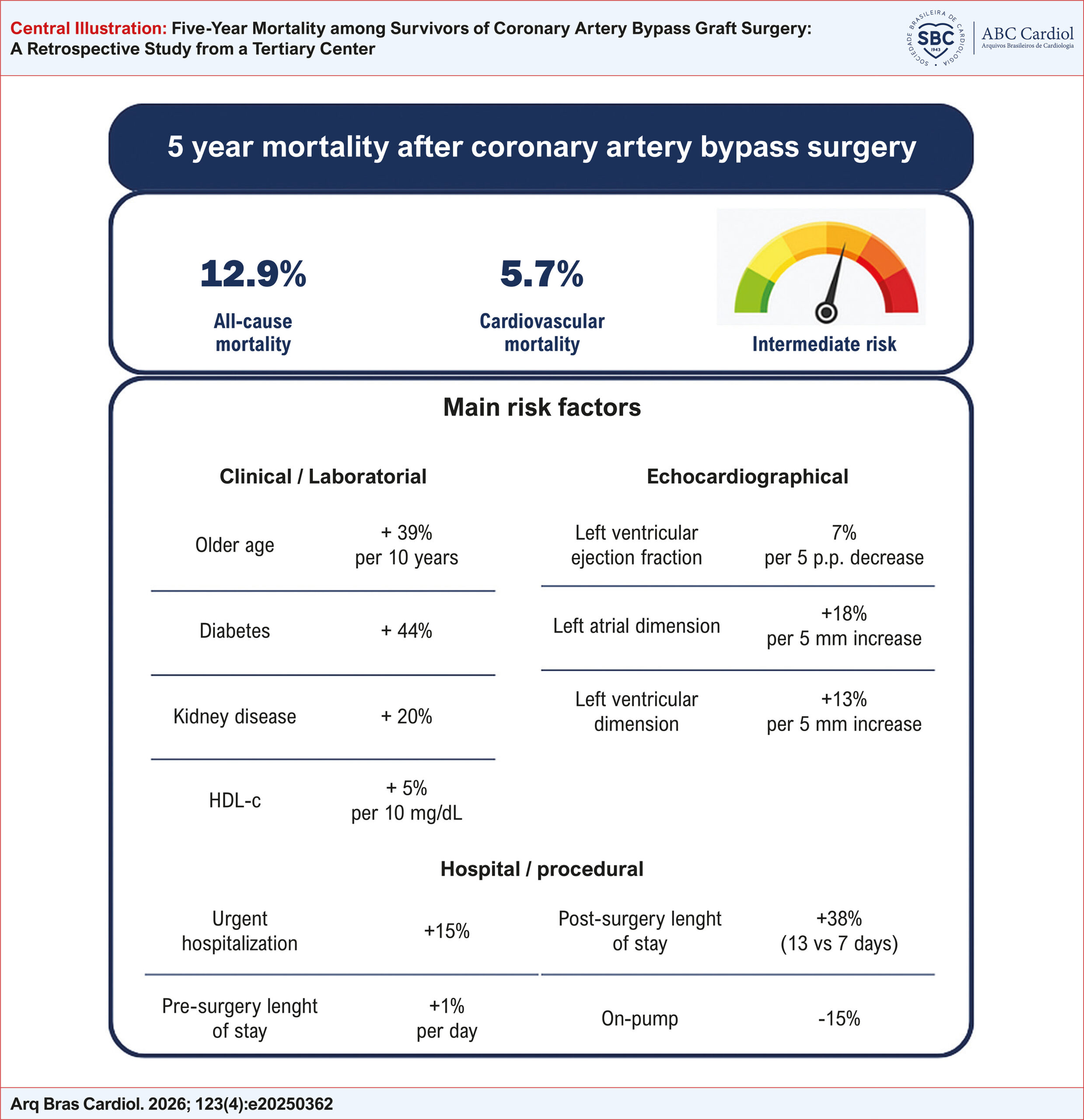
A retrospective analysis of 6,933 patients who underwent CABG at the Heart Institute, Faculty of Medicine, University of São Paulo, between 2007 and 2018. Mortality data up to 2018 were retrieved from government databases. A significance level of 5% was adopted.

Results

The study cohort included 4,854 men (72%) with a median age of 63 years (IQR: 57–70). Diabetes mellitus was present in 2,984 patients (43%), and 1,918 (29%) had chronic kidney disease. During follow-up, 1,075 deaths occurred, of which 506 (47.1%) were attributed to cardiovascular causes. The 5-year all-cause mortality rate was 12.9% (95% CI: 11.9–13.9), and the cardiovascular mortality rate was 5.7% (95% CI: 5.1–6.4). The leading cause of cardiovascular death was ischemic heart disease (290 deaths, 57.3%), followed by cerebrovascular disease (84 deaths, 16.6%). Factors significantly associated with all-cause mortality included older age, diabetes mellitus, glomerular filtration rate, HDL-cholesterol, left ventricular ejection fraction, left atrial and left ventricular diastolic dimensions, urgent hospitalization, on-pump surgery, and length of hospital stay.

Conclusion

Patients undergoing CABG at a tertiary care center exhibited moderate 5-year all-cause and cardiovascular mortality rates. These findings highlight key prognostic factors that may support risk stratification and guide postoperative management strategies.
  • Angina Pectoris
  • Descriptive Epidemiology
  • Myocardial Revascularization
Read Full Article
Creative Commons Attribution (CC BY) Creative Commons license
12/06/2026 DOI: 10.36660/abc.20250362i
Coronary Sinus Reduction for the Treatment of Refractory Angina: What Have We Learned after 70 Years of the Beck Surgery?
ABC
Review Article

Coronary Sinus Reduction for the Treatment of Refractory Angina: What Have We Learned after 70 Years of the Beck Surgery?

Sara Del Vecchio Ziotti et al. Luciana Oliveira Cascaes Dourado Ranil de Silva Rasha Al-Lamee … Timothy D. Henry Luiz Antonio Machado Cesar Carlos Vicente Serrano Jr. Alexandre Antonio Cunha Abizaid Luis Henrique Wolff Gowdak

Abstract

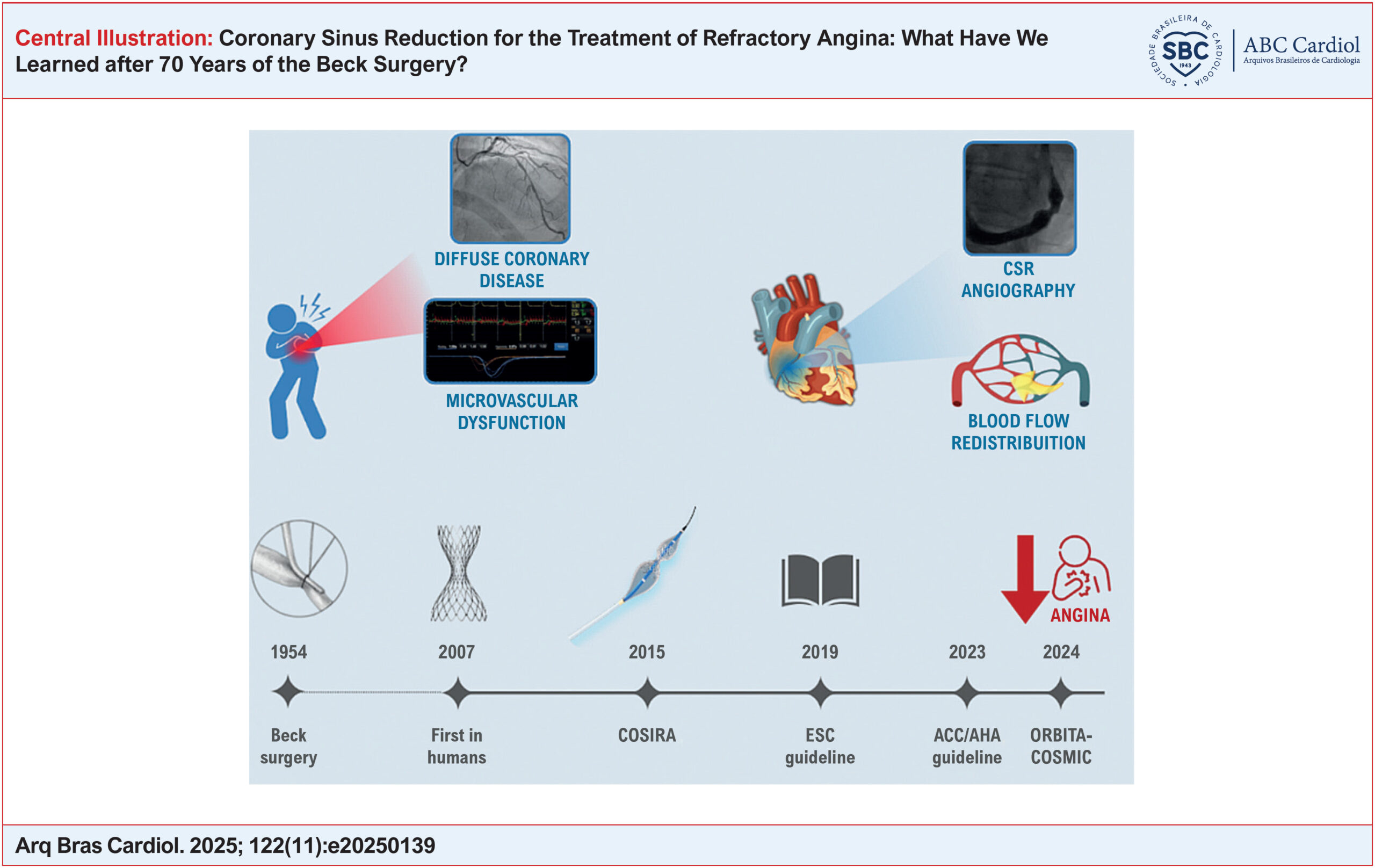
With the increasing prevalence of chronic coronary syndromes, many patients with extensive atherosclerosis experience uncontrolled angina, even while receiving optimal medical therapy. This is especially true for patients who are not suitable candidates for surgical or percutaneous revascularization. Numerous treatments have been investigated for managing angina pectoris, and in this context, the coronary sinus reducer has emerged as a promising therapeutic option. Since the 1950s, beginning with Beck’s surgery, the coronary venous sinus has been a focal point of research in anti-ischemic therapies.

Significant scientific advances have been made in narrowing the venous sinus in the past two decades. Thanks to technological improvements in minimally invasive procedures and better methods for assessing myocardial blood flow, a new therapeutic option has become available for patients suffering from refractory angina and, possibly, for microvascular dysfunction.

In this review, we aim to examine key concepts related to angina pectoris and myocardial ischemia, highlighting the historical background, pathophysiological rationale, and technical aspects of coronary sinus reduction as a therapy for refractory angina. Additionally, we will explore the scientific evidence from recent decades, as well as identify existing gaps and outline future research directions concerning this emerging treatment.

  • Angina Pectoris
  • Blood Circulation
  • Myocardial Ischemia
Read Full Article
Creative Commons Attribution (CC BY) Creative Commons license
19/01/2026 DOI: 10.36660/abc.20250139i Views 1
Central Illustration
ABC
Original Article

Allopurinol versus Trimetazidine for the Treatment of Angina: A Randomized Clinical Trial

Tainá Viana et al. Rodrigo Morel Vieira de Melo Diogo Freitas Cardoso Azevedo Clara Salles Figueiredo … Gustavo Santana Luanna Mota Damasceno Luisa Latado Ludmila Tambuque Raissa Barreto Luiz Carlos Santana Passos

Abstract

Background

Recently, it was demonstrated that allopurinol, a xanthine oxidase inhibitor, has cardiovascular and anti-ischaemic properties and may be a metabolic antianginal agent option.Objective: The objective of this study was to evaluate the antianginal effect of allopurinol as a third drug for patients with stable coronary artery disease (CAD).

Methods

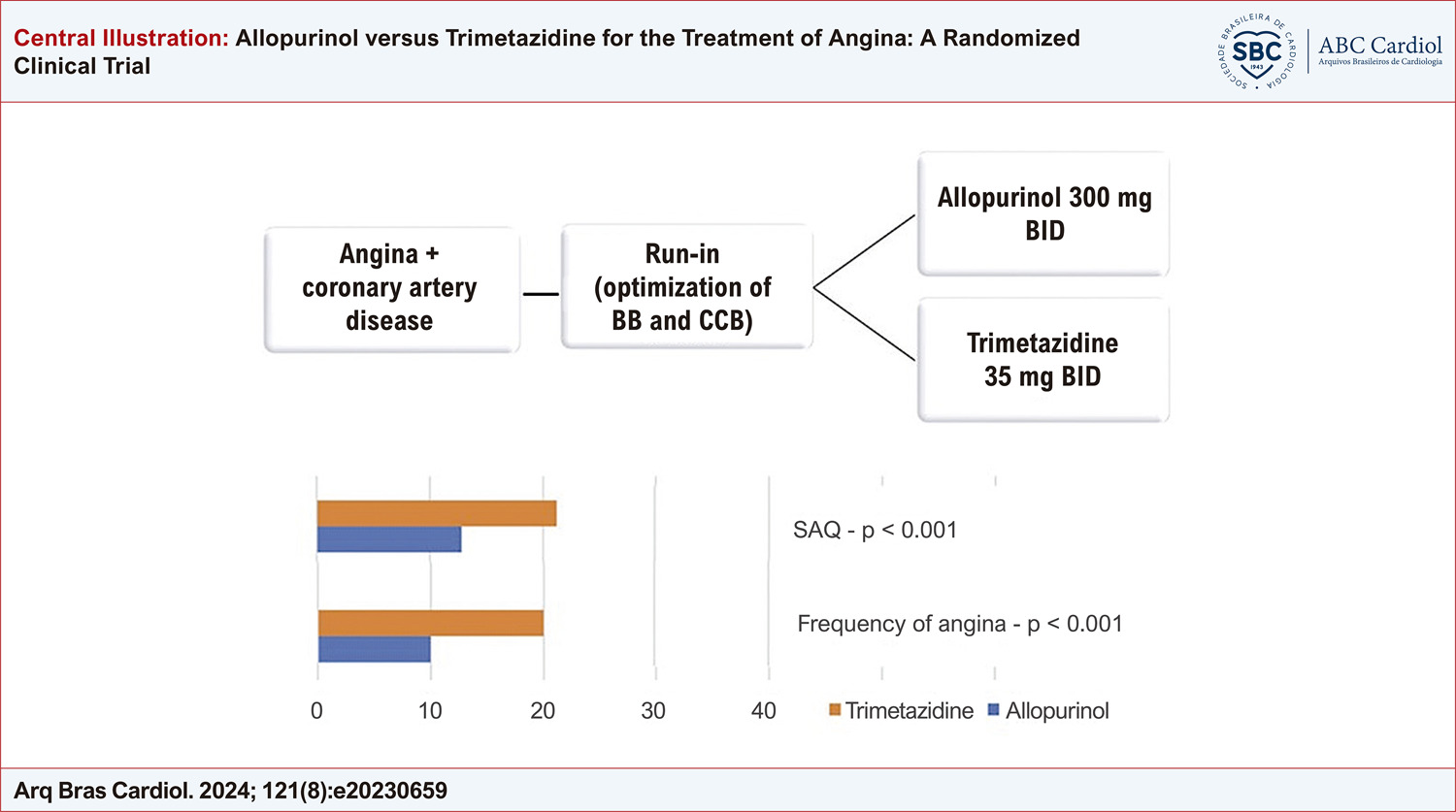
This was a randomized clinical trial between 2018 and 2020 including patients with CAD who maintained angina despite initial optimization with beta-blockers and calcium channel blockers. The individuals were randomized 1:1 to 300 mg of allopurinol twice daily or 35 mg of trimetazidine twice daily. The main outcome was the difference in the angina frequency domain of the Seattle Angina Questionnaire (SAQ-AF). A probability (p) value < 0.05 was considered statistically significant.

Results

A hundred and eight patients were included in the randomization phase, with 54 (50%) in the allopurinol group and 54 (50%) in the trimetazidine group. Six (5.6%) individuals, 3 from each group, were lost to follow-up for the primary outcome. In the allopurinol and trimetazidine groups, the median SAQ-AF scores were 50 (30.0 to 70.0) and 50 (21.3 to 78.3), respectively. In both groups, the SAQ-AF score improved, but the median of the difference compared to baseline was lower in the allopurinol group (10 [0 to 30] versus 20 [10 to 40]; p < 0.001), as was the mean of the difference in the total SAQ score (12.8 ± 17.8 versus 21.2 ± 15.9; p = 0.014).

Conclusion

Both allopurinol and trimetazidine improved the control of angina symptoms; however, trimetazidine presented a greater gain compared to baseline. Brazilian Registry of Clinical Trials – Registration Number RBR-5kh98y

  • Alopurinol
  • Angina Pectoris
  • Doença Myocardial Ischemia
  • Trimetazidine
Read Full Article
Creative Commons Attribution (CC BY) Creative Commons license
26/08/2024 DOI: 10.36660/abc.20230659i Views 1
Figure 1
ABC
Viewpoint

Angina Pectoris and Orbita 2 Trial: Reflections on the Future of Angina Treatment

Eduardo Bello Martins et al. Eduardo Gomes Lima Jaime Paula Pessoa Linhares Filho Henrique Trombini Pinesi … Fabio Grunspun Pitta Carlos Vicente Serrano Júnior

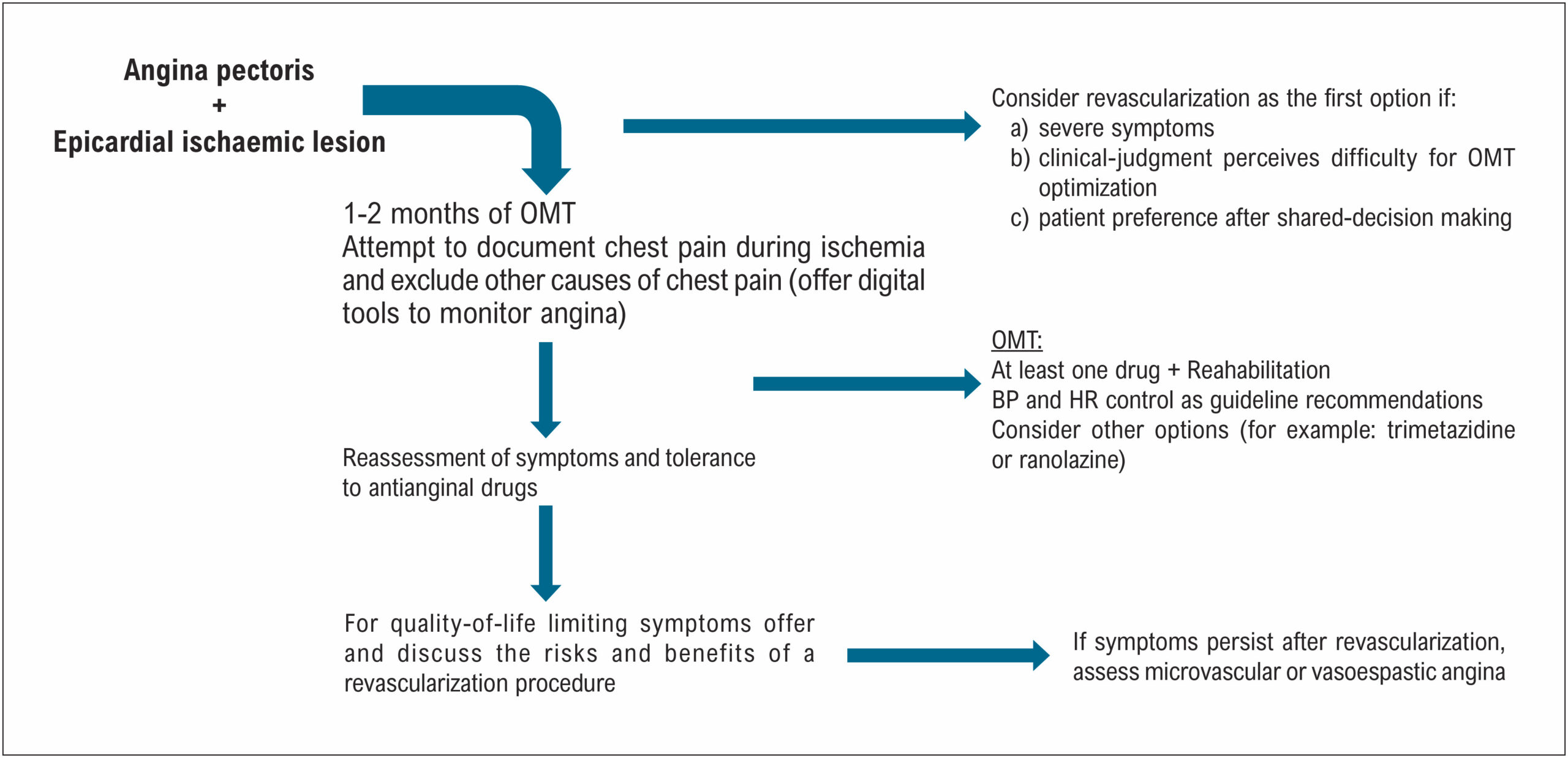
The ORBITA trial

Although the above-mentioned studies have demonstrated some improvement in angina after myocardial revascularization, one of their major limitations is the open nature and a possible placebo effect. In this regard, the ORBITA study showed no benefit of PCI versus a placebo procedure on the primary end-point of an increase in exercise time. ORBITA was a well conducted study that demonstrated the possibility of a placebo component and lack of symptom improvement by PCI. However, several limitations could have influenced these results and have been discussed in the literature, such as the fact that it included patients with non-limiting symptoms, no ischemia in almost a quarter of the participants and short follow-up.

In 2023, the ORBITA 2 trial was finally published in NEJM and addressed for the first time the PCI as a monotherapy for angina relief at a placebo-controlled trial. It provides another piece of the puzzle of angina control and overcomes some of the first ORBITA limitations. ORBITA 2 was an investigator-initiated, multicenter, double-blind, randomized, placebo-controlled trial that was conducted at 14 sites in the United Kingdom and included 301 participants. Patients enrolled had angina or equivalent symptoms, anatomic evidence of severe coronary stenosis and objective evidence of ischemia based on noninvasive imaging or invasive coronary physiology testing. First, antianginal medications were discontinued (median number of antianginal drugs was only 1) and the participants were instructed to use a dedicated smartphone application to report the presence or absence of angina and the number of angina episodes daily. Patients also completed validated questionnaires on symptoms and quality of life. The Canadian Cardiovascular Society (CCS) functional classification was assessed, treadmill exercise test and dobutamine stress echocardiography were also performed. The patients then entered a two-week pre-randomization period during which they reported the number of episodes of angina daily, through the smartphone application. Patients were eligible to proceed to randomization if they reported at least one episode of angina during the symptom assessment phase.

[…]

  • Angina Pectoris
  • Coronary Disease
  • Myocardial Revascularization
Read Full Article
Creative Commons Attribution (CC BY) Creative Commons license
02/08/2024 DOI: 10.36660/abc.20230848i
Figure 1
IJCS
Viewpoint

Coronary Artery Microfistulas: Historical Description and Contemporary Clinical Relevance

Stans Murad Netto et al. Rachel Vianna O'Neill de Souza Victor Murad Evandro Tinoco Mesquita

Introduction

Coronary microfistula was initially described as an anatomical finding in the late 1960s by Murad and colleagues, and it was later recognized as a morphofunctional abnormality of the coronary arteries capable of causing clinical findings (). This often asymptomatic entity is still poorly recognized in clinical practice, although it can be readily identified in the catheterization laboratory, cineangiography studies, and more recently by coronary CT angiography.

Initially, this condition was not taken into consideration, and it was justified as a possible “error” in cineangiography technique. Different studies have demonstrated its existence and its potential as a nosological entity responsible for myocardial ischemia, cardiac chamber overload, arrhythmias, and even heart failure.,

[…]

  • Angina Pectoris
  • CF
  • Coronary Vessels
  • Myocardial Ischemia
Read Full Article
Creative Commons Attribution (CC BY) Creative Commons license
18/12/2023 DOI: 10.36660/ijcs.20230092
Two-Year Follow-Up of Chronic Ischemic Heart Disease Patients in a Specialized Center in Brazil
ABC
Original Article

Two-Year Follow-Up of Chronic Ischemic Heart Disease Patients in a Specialized Center in Brazil

Eduardo Martelli Moreira et al. Henrique Trombini Pinesi Eduardo Bello Martins Fábio Grunspun Pitta … Paula Mathias Paulino Bolta Carlos Alexandre Wainrober Segre Desiderio Favarato Fabiana Hanna Rached Whady Armindo Hueb Eduardo Gomes Lima Roberto Kalil Filho Cibele Larrosa Garzillo Carlos Vicente Serrano Jr

Abstract

Background

The incidence of cardiovascular events in patients with chronic ischemic heart disease (CIHD) may vary significantly among countries. Although populous, Brazil is often underrepresented in international records.

Objectives

This study aimed to describe the quality of care and the two-year incidence of cardiovascular events and associated prognostic factors in CIHD patients in a tertiary public health care center in Brazil.

Methods

Patients with CIHD who reported for clinical evaluation at Instituto do Coração (São Paulo, Brazil) were registered and followed for two years. The primary endpoint was a composite of myocardial infarction (MI), stroke, or death. A significance level of 0.05 was adopted.

Results

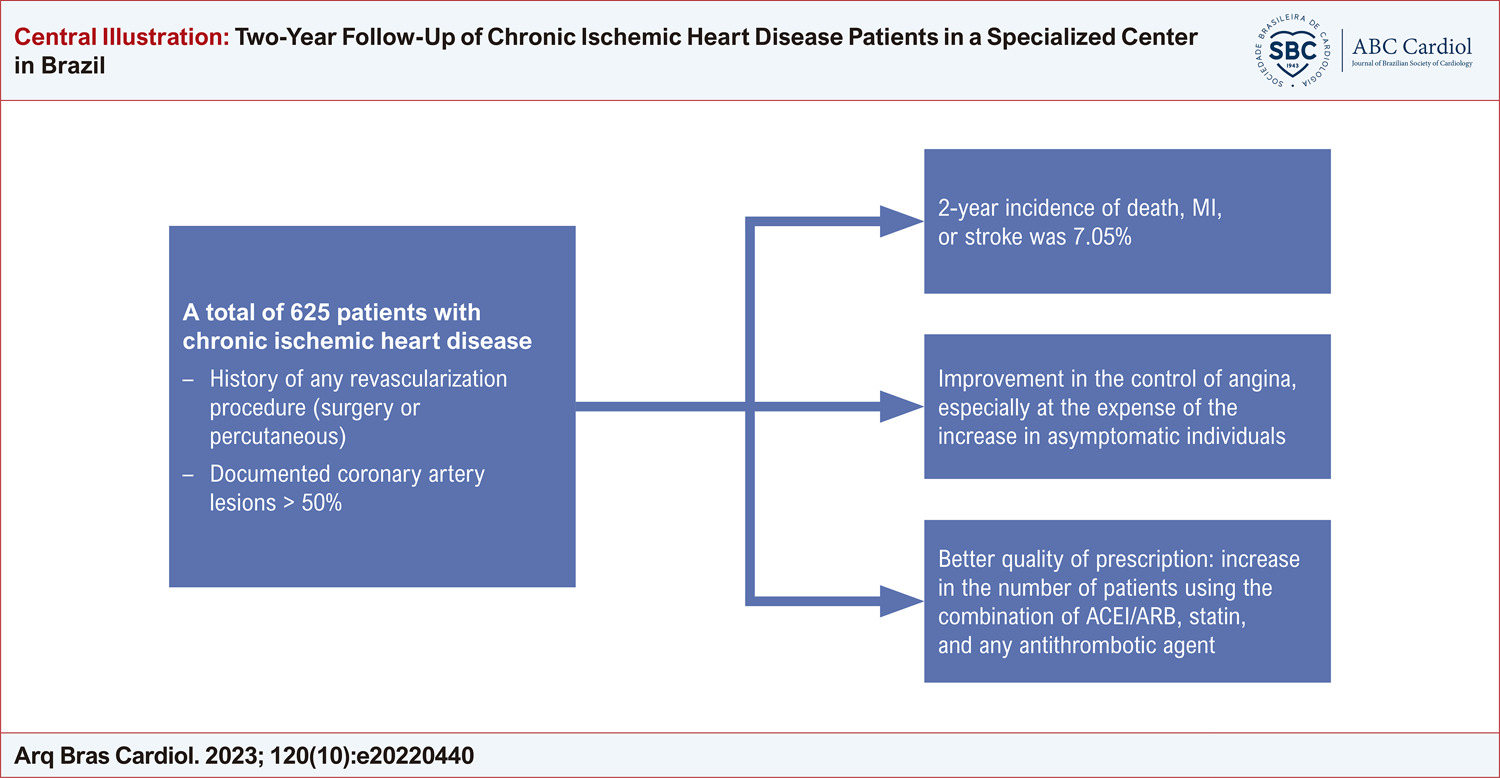
From January 2016 to December 2018, 625 participants were included in the study. Baseline characteristics show that 33.1% were women, median age 66.1 [59.6 – 71.9], 48.6% had diabetes, 83.1% had hypertension, 62.6% had previous MI, and 70.4% went through some revascularization procedure. At a median follow-up (FU) of 881 days, we noted 37 (7.05%) primary endpoints. After adjustments, age, previous stroke, and LDL-cholesterol were independently associated with the primary endpoint. Comparing baseline versus FU, participants experienced relief of angina based on the Canadian Cardiovascular Society (CCS) scale according to the following percentages: 65.7% vs. 81.7% were asymptomatic and 4.2% vs. 2.9% CCS 3 or 4 (p < 0.001). They also experienced better quality of medication prescription: 65.8% vs. 73.6% (p < 0.001). However, there was no improvement in LDL-cholesterol or blood pressure control.

Conclusion

This study shows that CIHD patients had a two-year incidence of the primary composite endpoint of 7.05%, and the reduction of LDL-cholesterol was the only modifiable risk factor associated with prognosis.

  • Angina Pectoris
  • Cholesterol, LDL
  • Myocardial Infarction
  • Myocardial Ischemia
  • Quality of Health Care
Read Full Article
Creative Commons Attribution (CC BY) Creative Commons license
27/10/2023 DOI: 10.36660/abc.20220440 Views 2
Figure 1
ABC
Research Letter

In the Cardiac Rehabilitation Era, is There a “No-Option” Refractory Angina Patient?: A Case Report

Luciana Oliveira Cascaes Dourado et al. Camila Paixão Jordão Camila Regina Alves Assumpção Luciana Diniz Nagem Janot de Matos

Abstract

Exercise-based cardiac rehabilitation, an effective and safe adjuvant treatment recommended to patients with coronary artery disease, is scarcely applied to patients with refractory angina (RA) due to difficulties related to safety, trainning prescription and their clinical management. This case report presents an instance of a “no-option” patient with RA, who was included in a 12-week exercise program, in sessions consisted of 40 minutes of treadmill aerobic exercise, three times a week, and intensity prescribed between ischemic/angina threshold and ventilatory threshold 1, obtained in the cardiopulmonary exercise test; mild to moderate angina was allowed during training. Furthermore, 15 minutes of moderate-intensity resistance training (large group muscle exercises, two sets of 8 to 12 repetitions) was performed. At the end of the protocol, the patient presented an important improvement in functional performance (VO 2 peak 17.0 ml/kg/min to 27.3 ml/kg/min), angina threshold (HR 68 bpm to 95 bpm), and intensity chest pain (levels 7 to 5) with no clinical adverse events during the period. Exercise-based cardiac rehabilitation was safe, even in the occurrence of angina/ischemia during training, according to tolerability to symptoms and other warning clinical signs.

  • Angina Pectoris
  • Cardiac Rehabilitation
  • Exercise
Read Full Article
Creative Commons Attribution (CC BY) Creative Commons license
23/10/2023 DOI: 10.36660/abc.20230007 Views 1
ABC
Editorial

Myocardial Bridge: Friend, Enemy, or Frenemy?

Biljana Parapid et al. Vladimir I. Kanjuh

First mentioned in 1737 by Reyman as an autopsy finding, described in 1922 by Crainicianu, named by Polacek in 1956, and angiographically shown by Portmann and Iwig in 1960, myocardial bridging encompasses the tunneled portion of a coronary artery, while the muscle band enveloping it is termed the myocardial bridge (MB). A myocardial bridge may remain silent lifelong or cause a myriad of clinical symptoms – from angina and ischemia, via syncope with arrhythmia , and heart failure up to sudden death , – however, not even children are spared irrelevant of the setting of the hypertrophic cardiomyopathy (HCMP). ,

From the mainly pathoanatomical standpoint, three main questions remain unanswered: (1) do ethnic differences render some corners of the world more susceptible to being born with this congenital coronary artery anomaly? (2) what are the implications of single or multiple MBs of single or multiple vessels even in the absence of HCMP? Furthermore, (3) what is the real atherosclerotic burden of the tunneled and peri-bridged segment?

[…]

  • Angina Pectoris
  • Arterial Switch Operation
  • Hamartoma
  • Heart Failure
  • Myocardial Bridging
Read Full Article
Creative Commons Attribution (CC BY) Creative Commons license
01/09/2023 DOI: 10.36660/abc.20230426 Views 1
Figure 1
ABC
Original Article

Does Myocardial Injury Occur After an Acute Aerobic Exercise Session in Patients with Refractory Angina?

Carla Giuliano de Sá Pinto Montenegro et al. Luciana Oliveira Cascaes Dourado Camila Paixão Jordão Marcelo Luiz Campos Vieira … Camila Regina Alves Assumpção Luis Henrique Wolff Gowdak Alexandre da Costa Pereira Carlos Eduardo Negrão Luciana Diniz Nagem Janot de Matos

Abstract

Background

It is unclear whether exercise is safe in patients with more advanced forms of coronary artery disease, such as those with refractory angina (RA).

Objective

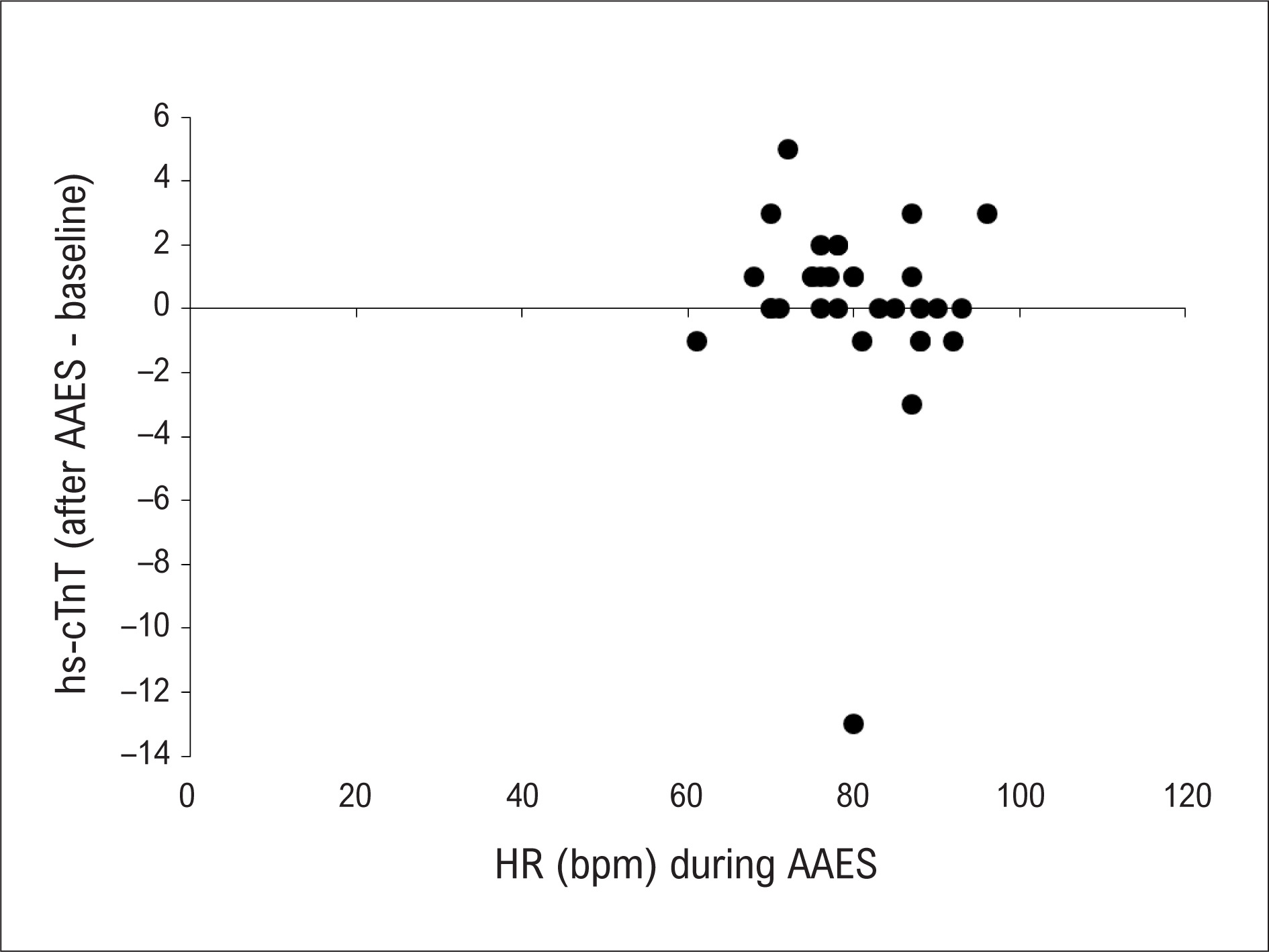
We aimed to determine the effect of an acute aerobic exercise session (AAES) on high-sensitivity cardiac troponin T (hs-cTnT) levels in patients with RA.

Methods

This was a longitudinal, non-randomized, and non-controlled clinical study. Participants were recruited from April 2015 to January 2019. On a visual pain scale from 0 to 10, pain rated up to 3 was considered as the top level allowed to continue exercising. We assessed hs-cTnT at baseline and 3 hours after the AAES. The protocol consisted of 5 minutes of warm-up, 30 minutes of continuous aerobic exercise at heart rate corresponding to the anaerobic threshold or angina threshold obtained in the cardiopulmonary exercise testing, and 5 minutes of cooling down. P values less than 0.05 were considered statistically significant.

Results

Thirty-two patients with RA were included (61 ± 9 years, 59.4% male). The baseline hs-cTnT concentration was 10.9 ng/L (95% confidence interval: 9.1 to 13.0 ng/L). The hs-cTnT collected 3 hours after the AAES was 11.1 ng/L (95% confidence interval: 9.1 to 13.5 ng/L). No difference occurred in hs-cTnT before and after AAES (p = 0.657).

Conclusions

A single AAES performed at the angina threshold with corresponding visual pain scale did not alter hs-cTnT in patients with RA, suggesting that no significant myocardial injury was elicited by exercising and that this exercise protocol can be considered safe.

  • Angina Pectoris
  • Biomarkers
  • Exercise
  • Troponin
Read Full Article
Creative Commons Attribution (CC BY) Creative Commons license
25/11/2022 DOI: 10.36660/abc.20210564
Figure 1
ABC
Original Article

Pharmaco-invasive Strategy in Myocardial Infarction: Descriptive Analysis, Presentation of Ischemic Symptoms and Mortality Predictors

Henrique Tria Bianco et al. Rui Povoa Maria Cristina Izar Claudia Maria Rodrigues Alves … Adriano Henrique Pereira Barbosa Maria Teresa Nogueira Bombig Iran Gonçalves Jr Bráulio Luna Filho Ana Caroline Aguirre Pedro Ivo de Marqui Moraes Dirceu Almeida Flávio Tocci Moreira Fernando Focaccia Povoa Edson Stefanini Adriano Mendes Caixeta Amanda S. Bacchin Valdir Ambrósio Moisés Francisco A.H. Fonseca

Abstract

Background

ST-segment elevation myocardial infarction (STEMI) is defined by symptoms accompanied by typical electrocardiogram changes. However, the characterization of ischemic symptoms is unclear, especially in subgroups such as women and the elderly.

Objectives

To analyze the typification of ischemic symptoms, temporal metrics and observe the occurrence of in-hospital outcomes, in the analysis of predictive scores, in patients with STEMI, in a drug-invasive strategy.

Methods

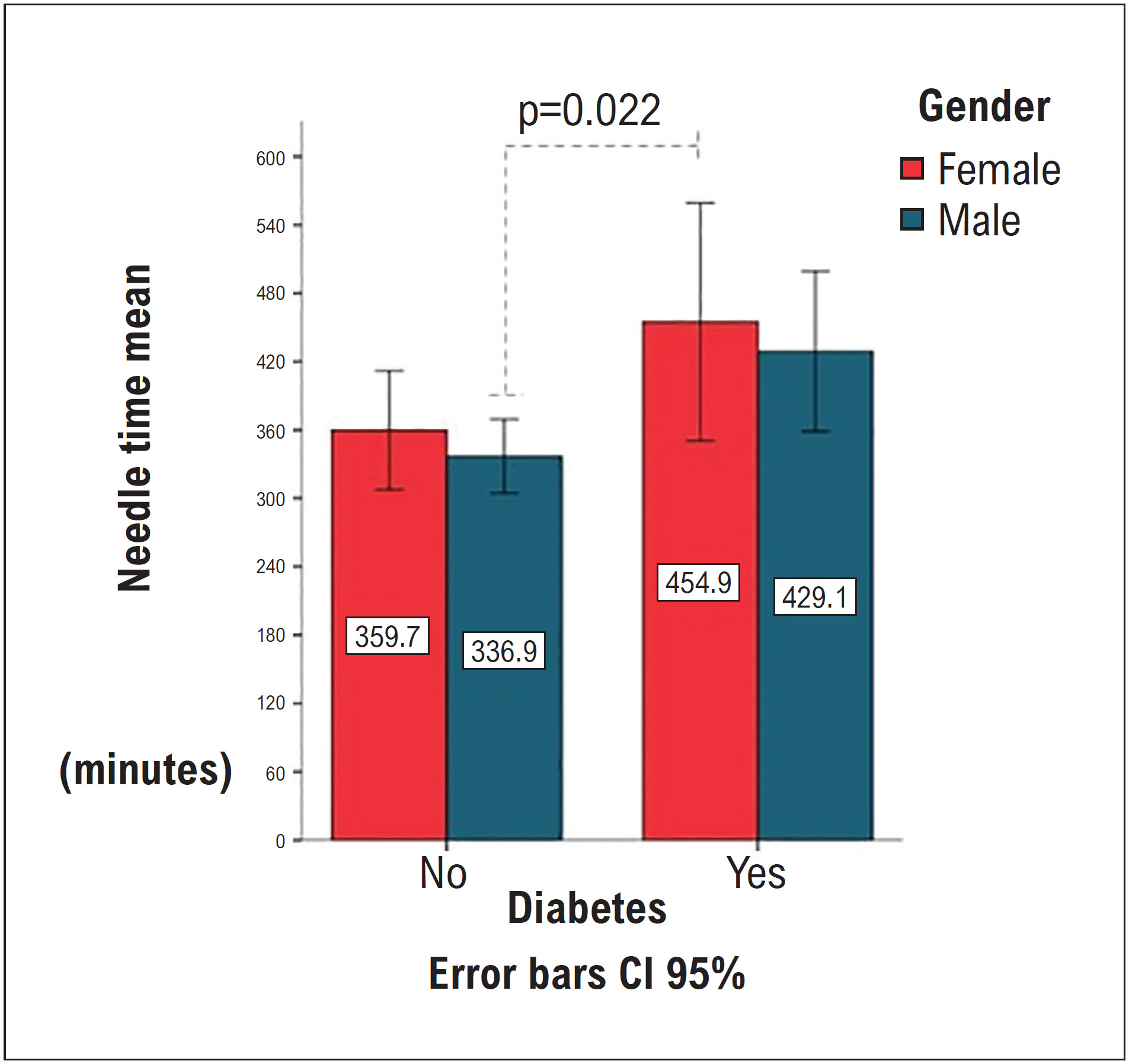
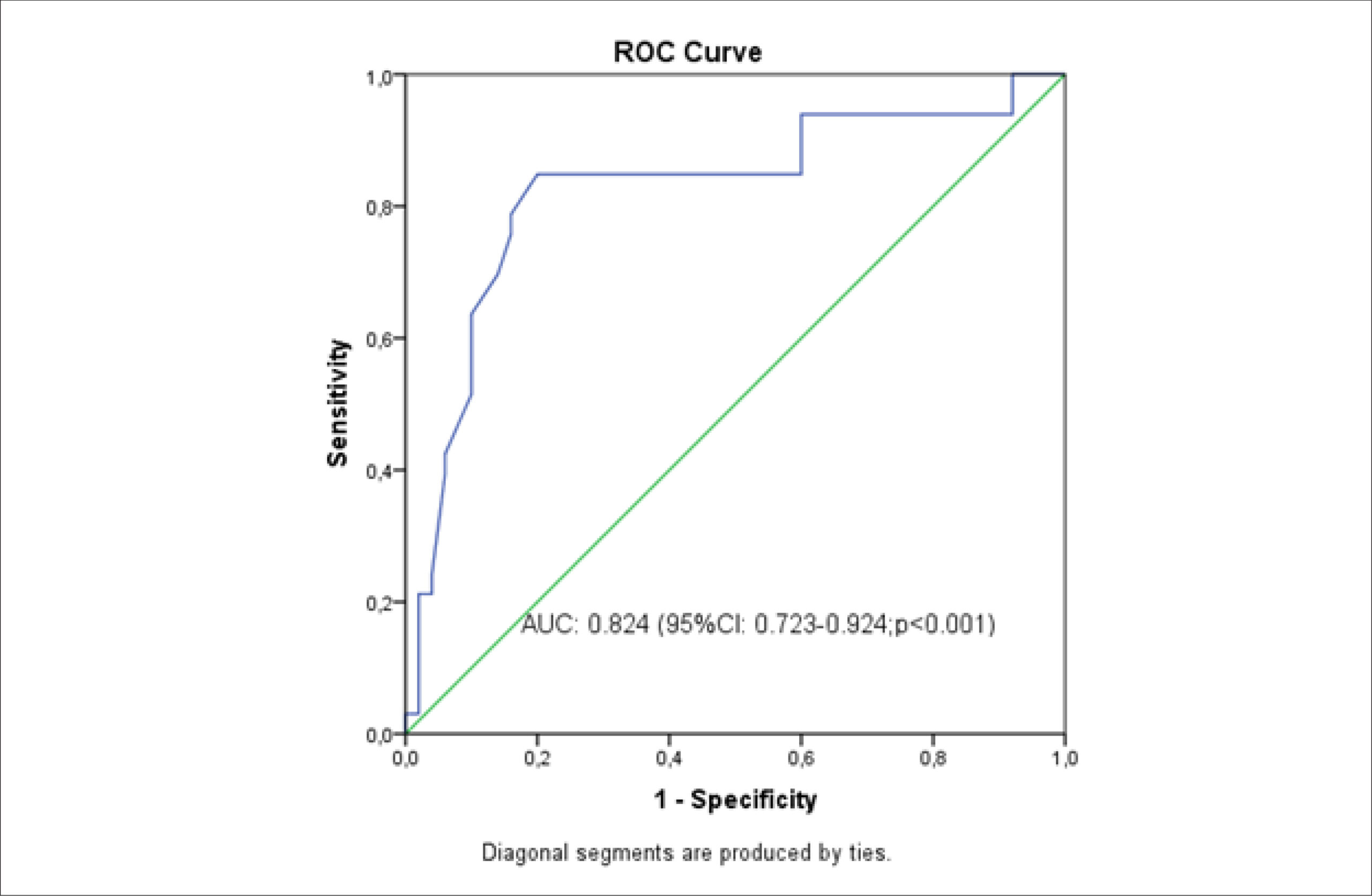
Study involving 2,290 patients. Types of predefined clinical presentations: typical pain, atypical pain, dyspnea, syncope. We measured the time between the onset of symptoms and demand for care and the interval between arrival at the medical unit and thrombolysis. Odds-ratios (OR; CI-95%) were estimated in a regression model. ROC curves were constructed for mortality predictors. The adopted significance level (alpha) was 5%.

Results

Women had a high prevalence of atypical symptoms; longer time between the onset of symptoms and seeking care; delay between arrival at the emergency room and fibrinolysis. Hospital mortality was 5.6%. Risk prediction by Killip-Kimball classification: AUC: [0.77 (0.73-0.81)] in class ≥II. Subgroups studied [OR (CI-95%)]: women [2.06 (1.42-2.99); p=0.01]; chronic renal failure [3.39 (2.13-5.42); p<0.001]; elderly [2.09 (1.37-3.19) p<0.001]; diabetics [1.55 (1.04-2.29); p=0.02]; obese 1.56 [(1.01-2.40); p=0.04]: previous stroke [2.01 (1.02-3.96); p=0.04] correlated with higher mortality rates.

Conclusion

Despite higher mortality rates in some subgroups, significant disparity persists in women, with delays in symptom recognition and prompt thrombolysis. We highlight the applicability of the Killip-Kimball score in prediction, regardless of the clinical presentation.

  • Acute Coronay Syndrome
  • Angina Pectoris
  • Hospitalization
  • Mortality
  • Percutaneous Coronary Intervention/methods
  • ST Elevation Myocardial Infarction
  • Thrombolytic THerapy/methods
Read Full Article
Creative Commons Attribution (CC BY) Creative Commons license
25/11/2022 DOI: 10.36660/abc.20211055 Views 2
Figure 1
IJCS
Case Report

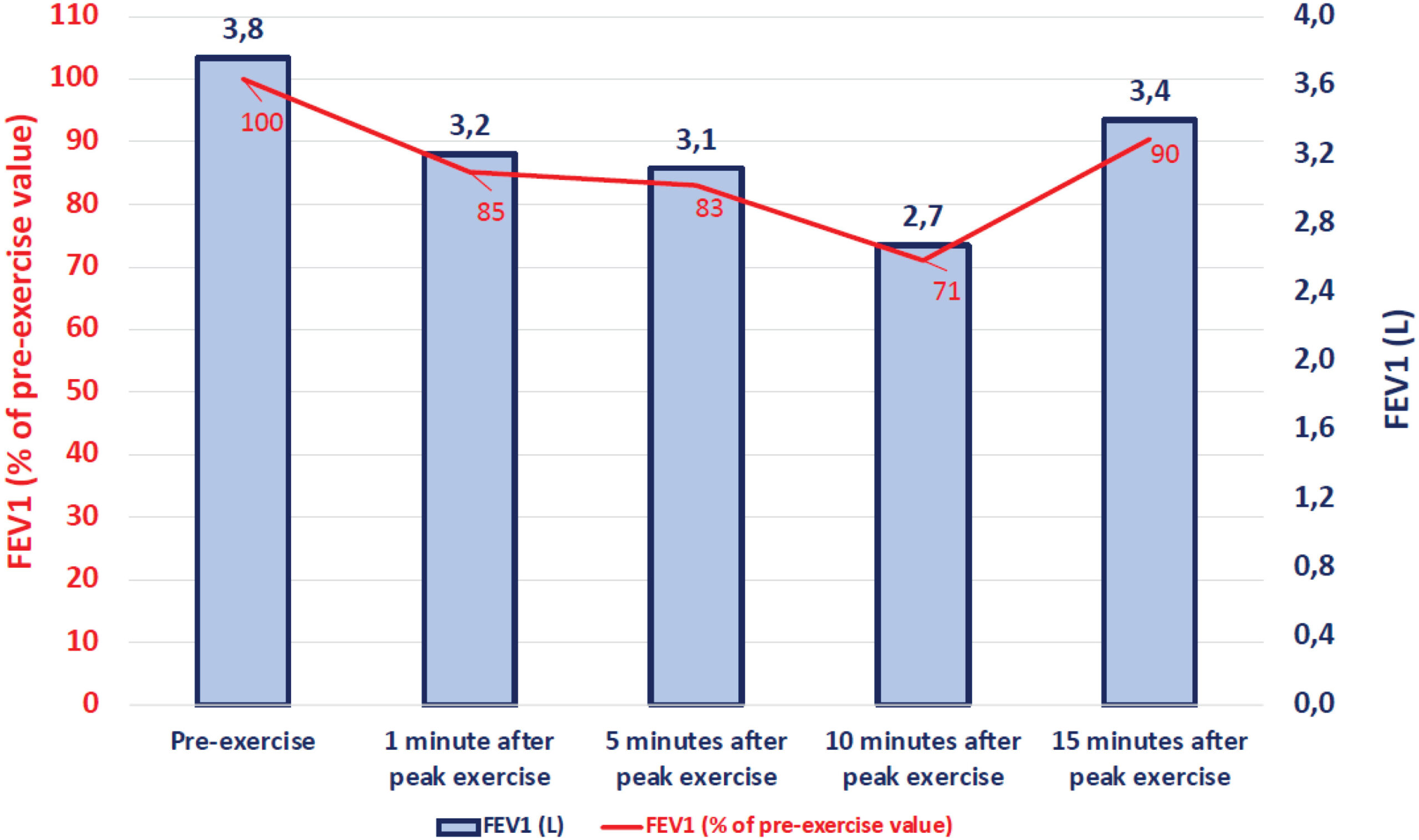
Exercise-Induced Bronchoconstriction: A Frequent, but Neglected Cause of Chest Pain

Renata Rodrigues Teixeira de Castro et al. João Giffoni Silveira Neto Adalgiza Mafra Moreno Marco Orsini

Introduction

Chest pain is one of the most common complaints in emergency departments, and internal medicine and cardiology clinics. Patients’ comorbidities and the clinical characterization of chest pain are cornerstones to guide symptom differentiation. Information about pain intensity, duration, localization, changes with posture/movement, and its reaction to nitroglycerin helps diagnose cardiac chest pain. Typical angina pectoris is the presence of substernal chest pain or discomfort provoked by exertion or emotional stress, and is relieved by rest and nitroglycerin. Angina pectoris is attributed to myocardial ischemia due to the unbalance between myocardial oxygen supply and myocardial oxygen demand elicited during exercise or emotional stress.

The diagnosis and treatment workup in patients with moderate to high cardiovascular risk presenting angina pectoris is quite straight-forward. Nevertheless, exertional chest pain in a young man can be challenging and yield a common but overlooked diagnosis, as in the present case report.

[…]

  • Angina Pectoris
  • Asthma Exercise-Induced
  • Bronchial Spasm
  • Chest Pain
  • Exercise
Read Full Article
Creative Commons Attribution (CC BY) Creative Commons license
22/04/2022 DOI: 10.36660/ijcs.20200376 Views 1
ABCIC
Case Report

Single Coronary Artery in Transplanted Heart: An Unusual Association

Thaís Rossana Cruz de Souza et al. Arthur Luiz Norte Gomes Pereira Araruna Cláudia do Nascimento Silva Fernandes Roberto Moreno Mendonça … Epitácio de Oliveira Belém Neto Robson Macedo

[…]

  • Angina Pectoris
  • Chagas Cardiomyopathy
  • Coronary Artery Disease/physiopathology
  • Echocardiography
  • Heart Transplantation/complications
Read Full Article
Creative Commons Attribution (CC BY) Creative Commons license
20/01/2022 DOI: 10.5935/2318-8219.20180013 Views 2
ABC
Editorial

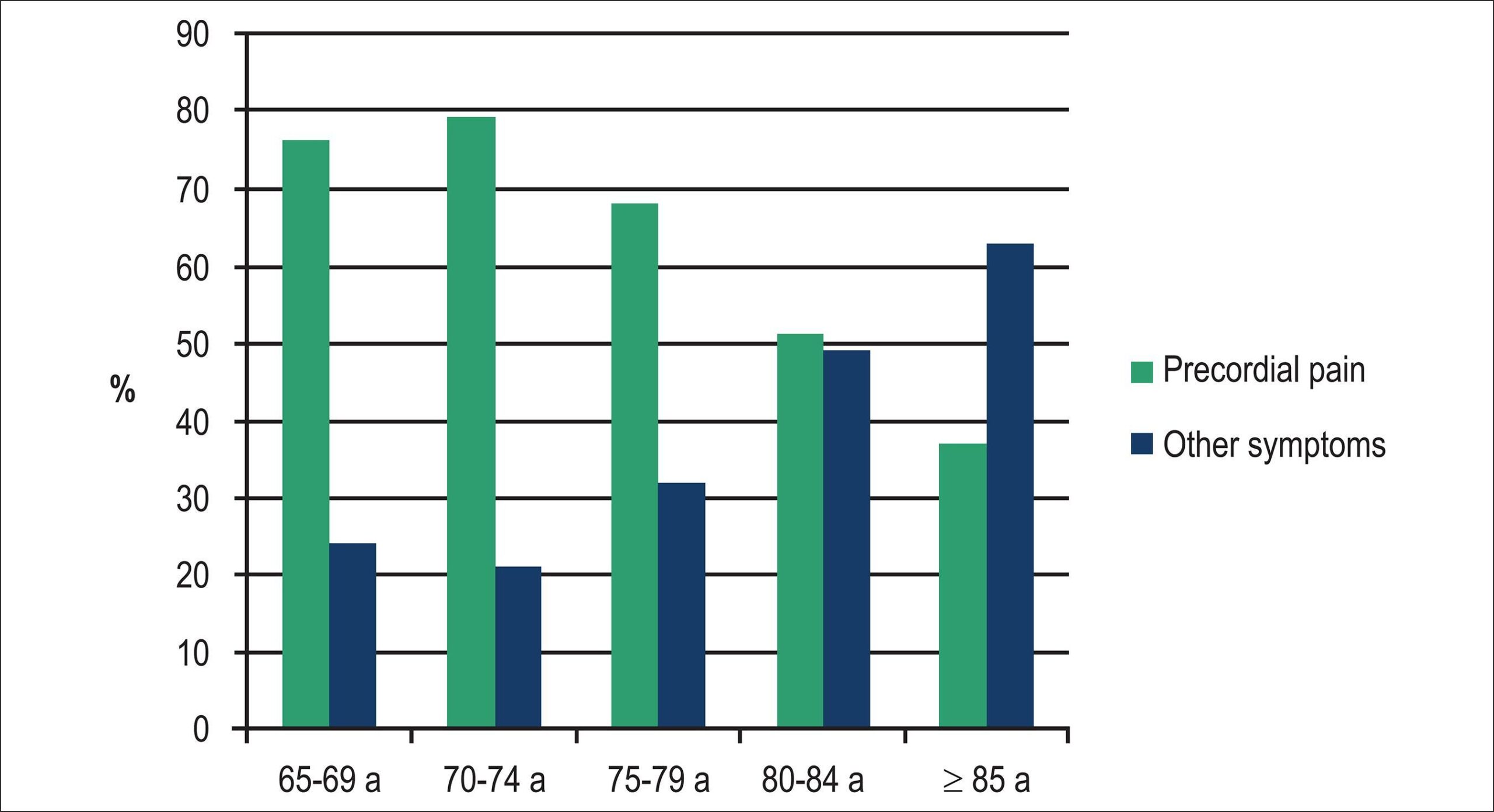
Precordial Pain and Infarction in the Elderly. It´S no so Elementary, My Dear Watson!

Ricardo Wang et al. José Carlos da Costa Zanon Fernando Carvalho Neuschwander

In Medical School, we learn the traditional way to conduct the investigative process in order to reach a diagnosis. This process is traditionally based on the collection of anamnesis and clinical exams, clinical reasoning, the generation of a hypothesis, and tests with complementary exams. In general, we follow the the Occam’s razor principle: “the simplest answer is usually the correct answer,” or as William Osler’s aphorism: “Where you hear hoofs, you don´t think of zebras”. However, in this investigative process, the clinical reasoning is challenged in an elderly population over 80 years of age, and not always is the simplest answer the most correct. In this age group, the presence of comorbidities is quite common and can interfere, changing the perception of cardiovascular symptoms (depression, dementia, medications that interfere in the central nervous system, diabetes, analgesics, etc.), or even modify the symptomatology. The presence of atypical symptoms, such as dyspnea, sudoresis, vomiting, diarrhea, epigastric pain, and mental confusion can all mask the cardiovascular pathology. ,

Many studies have shown the difficulty in diagnosing acute myocardial infarction (AMI) in this population, which clearly entails delays in or the lack of treatment. Even when the diagnosis and early treatment of AMI is established, the mortality rate remains high in this population. The under-treatment or lack of treatment contribute to the increase in mortality in this age group. – Understanding the factors that make the diagnosis difficult is of utmost importance in establishing protocols directed toward the older age elderly patient.

[…]

  • Acute Coronary Syndrome / diagnosis
  • Aged
  • aging
  • Angina Pectoris
  • Chest Pain
  • Myocardial Infarction / Diagnosis
Read Full Article
Creative Commons Attribution (CC BY) Creative Commons license
14/06/2021 DOI: 10.36660/abc.20210331 Views 1
Figure 1
ABC
Original Article

Association Between Serum Elabela Levels and Chronic Totally Occlusion in Patients with Stable Angina Pectoris

Fethi Yavuz et al. Mehmet Kaplan

Abstract

Background:

The beneficial effects of Elabela on the cardiovascular system have been shown in studies.

Objective:

To compare serum Elabela levels of chronic total occlusion (CTO) patients with control patients with normal coronary arteries, and to investigate whether there is a correlation with collateral development.

Methods:

The study was planned cross-sectionally and prospectively. Fifty patients (28.0% female, mean age 61.6±7.3years) with CTO in at least one coronary vessel and 50 patients (38% female, mean age 60,7±6.38 years) with normal coronary arteries were included in the study. Patients in the CTO group were divided into two groups as Rentrop 0-1, those with weak collateral development, and Rentrop 2-3 with good collateral development. In addition to the age, sex, demographic characteristics and routine laboratory tests of the patients, Elabela levels were measured.

Results:

Demographic characteristics and laboratory values were similar in both groups. While the mean NT-proBNP and troponin were higher in the CTO group, the Elabela mean was lower (p <0.05 for all). In the multivariate regression analysis, NT-proBNP and Elabela levels were found to be independent predictors for CTO. Also, Elabela level was found to be statistically higher in Rentrop class 2-3 patients compared to Rentrop class 0-1 patients (p<0.05).

Conclusion:

In our study, we showed that the average Elabela level was low in CTO patients compared to normal patients. In addition, we found the level of Elabela to be lower in patients with weak collateral development compared to patients with good collateral development. (Arq Bras Cardiol. 2021; [online].ahead print, PP.0-0)

  • Angina Pectoris
  • Apelin
  • Chronic Total Occlusion
  • Colateral Circulation
  • Coronary Angiography
  • Coronary Occlusion
  • Elabela
  • Peptides
Read Full Article
Creative Commons Attribution (CC BY) Creative Commons license
31/05/2021 DOI: 10.36660/abc.20200492 Views 1
Figure 1
ABC
Research Letter

The Evolution of Percutaneous Coronary Intervention in Latin America

Costantino Roberto Costantini et al. Rafael Michel de Macedo Marcos Antônio Denk Sergio Gustavo Tarbine … Lazaro Garcia Mario Fernando Camargo Maranhão Costantino Ortiz Costantini

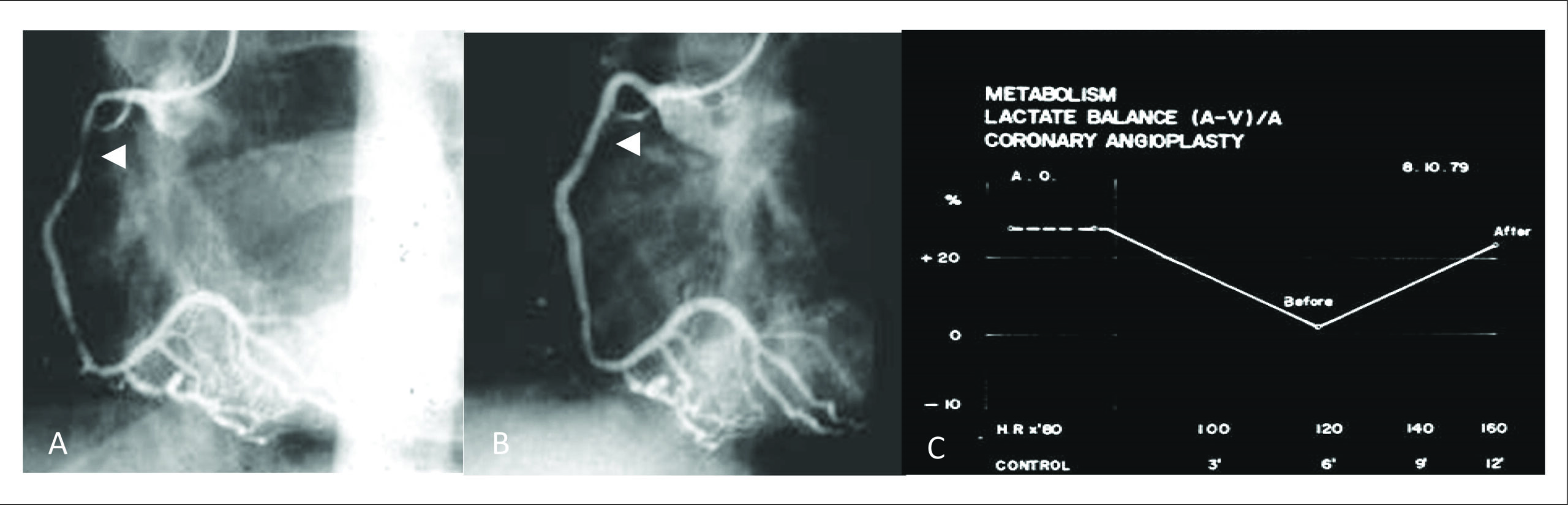
In August 1979, two years and one month after the first percutaneous coronary intervention (PCI) was performed in the world by Andreas Grüntzig, we received at Santa Casa de Misericordia in Curitiba (SCMC) a 55-year-old male patient (A.S.O.) with Canadian Cardiovascular Society (CCS) class 2 stable angina. Coronary angiography showed a severe (75-80 DS%) lesion in the middle segment of the Right Coronary Artery (RCA). The left coronary artery system did not have any significant atherosclerotic lesion and the left ventriculogram showed mild inferior wall hypokinesia with competent mitral and aortic valves.

That was the opportunity to put into practice the technique described by Gruntzig et al. for the first time in Latin America. The clinical presentation and the angiographic characteristics of the lesion met all the criteria described by Gruntzig: Single lesion, short length (<10mm), proximal arterial segment, without vasospasm, concentric, non-calcified and feasible for CABG. Thus, after discussing it with the clinical and cardiovascular surgery staff, it was decided to propose the dilation of the RCA obstruction to the patient as an attempt to treat his coronary disease.

[…]

  • Angina Pectoris
  • Angioplasty Balloon, Coronary/trends
  • Angioplasty, Balloon, Coronary/history
  • Cineangiography/history
  • Clinical Evolution
  • Myocardium/metabolism
  • Stents
Read Full Article
Creative Commons Attribution (CC BY) Creative Commons license
17/05/2021 DOI: 10.36660/abc.20200927
Figure 1
ABC
Original Article

Complete Revascularization Versus Treatment of the Culprit Artery Only in ST Elevation Myocardial Infarction: A Multicenter Registry

Julia Cremona Cadore et al. Mariana Vargas Furtado Rogério Tadeu Tumelero Alexandre Pereira Tognon … Ana Maria Krepsky Denis Cadore Karen Brasil Ruschel Julia Caldas Bedin Thais Conte Carisi Anne Polanczyk

Abstract

Background

Data on the management and prognosis of patients with ST-segment elevation myocardial infarction (STEMI) and multivessel disease are limited in Brazil, showing that the available revascularization strategies should be investigated

Objective

To assess the outcomes of complete revascularization versus treatment of the culprit artery only in patients with STEMI and multivessel disease.

Methods

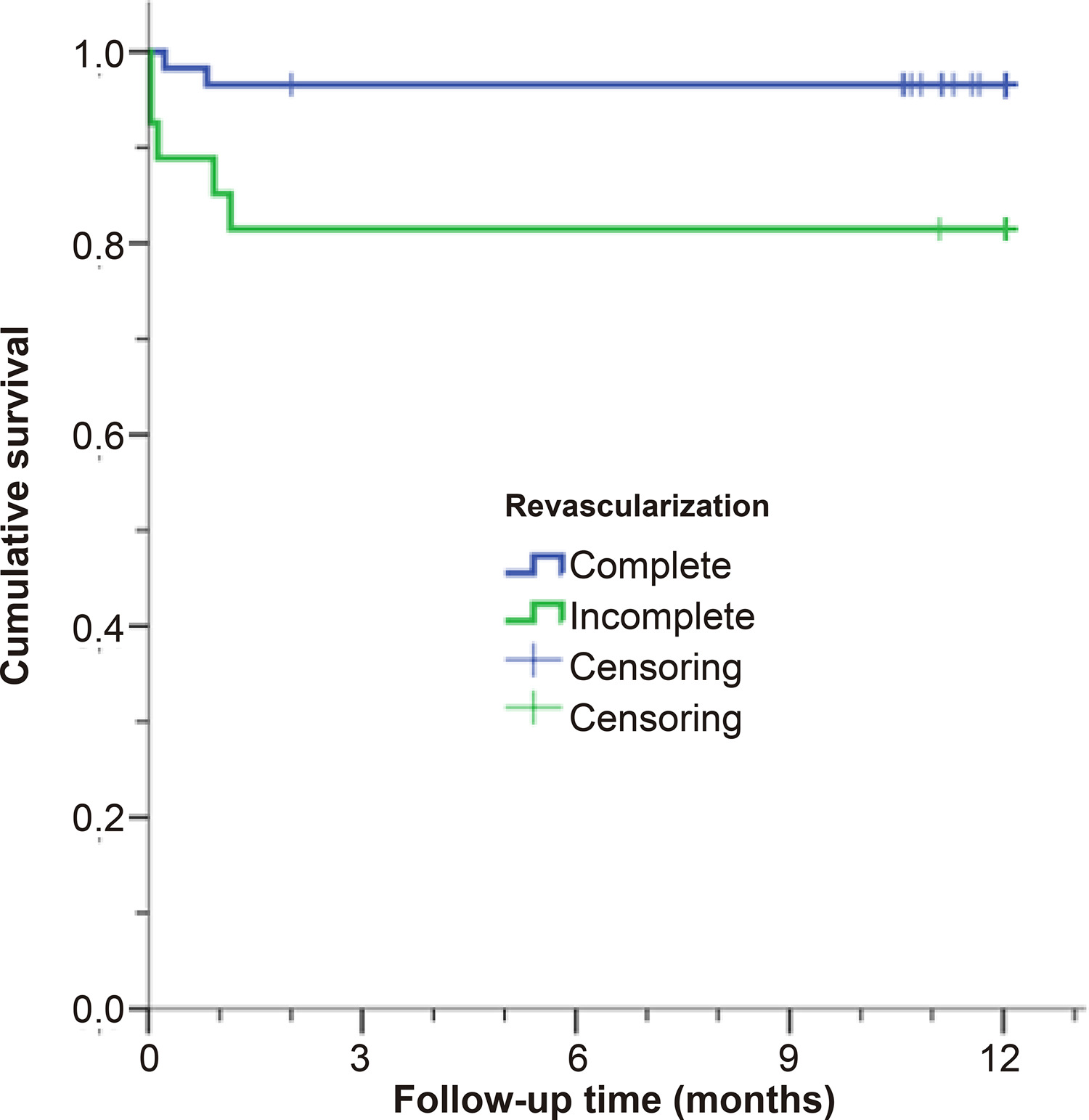
A prospective cohort study was conducted at two medical centers in southern Brazil with a 1-year follow-up after the index procedure. The primary outcome was a composite of cardiac death, reinfarction, or recurrent angina, while the secondary outcome was stroke, nonfatal cardiac arrest, major bleeding, or need for reintervention. The probability of outcomes occurring was compared between the groups using binary logistic regression. A p-value < 0.05 was considered statistically significant.

Results

Eighty-five patients were included. Their mean age was 62±12 years, and 61 (71.8%) were male. Fifty-eight (68.2%) were treated with complete revascularization and 27 (31.8%) with incomplete revascularization. The chance of both the primary and secondary outcomes occurring was significantly greater among patients treated with incomplete revascularization when compared to those treated with complete revascularization (odds ratio [OR] 5.1, 95% confidence interval [CI] 1.6-16.1 vs. OR 5.2, 95% CI 1.2-22.9, respectively), as well as cardiac death (OR 6.4, 95% CI 1.2-35.3).

Conclusion

Registry data from two centers in southern Brazil demonstrate that the complete revascularization strategy is associated with a significant reduction in primary and secondary outcomes in a 1-year follow-up when compared to the incomplete revascularization strategy (Arq Bras Cardiol. 2020; 115(2):229-237)

  • Angina Pectoris
  • Death Certificates
  • Heart Arrest
  • Hemodynamic
  • percutaneous coronary interventions
  • ST Elevation Myocardial Infarction/mortality, Cohort Studies
  • Stroke
Read Full Article
Creative Commons Attribution (CC BY) Creative Commons license
28/08/2020 DOI: 10.36660/abc.20180346
Figure 1
ABC
Case Report

Asymptomatic Coronary Spasm Due to Polytraumatism

Maria Cruz Aguilera et al. Jorge Restrepo Fernando Rivero Teresa Bastante … Rio Aguilar Fernando Alfonso

Introduction

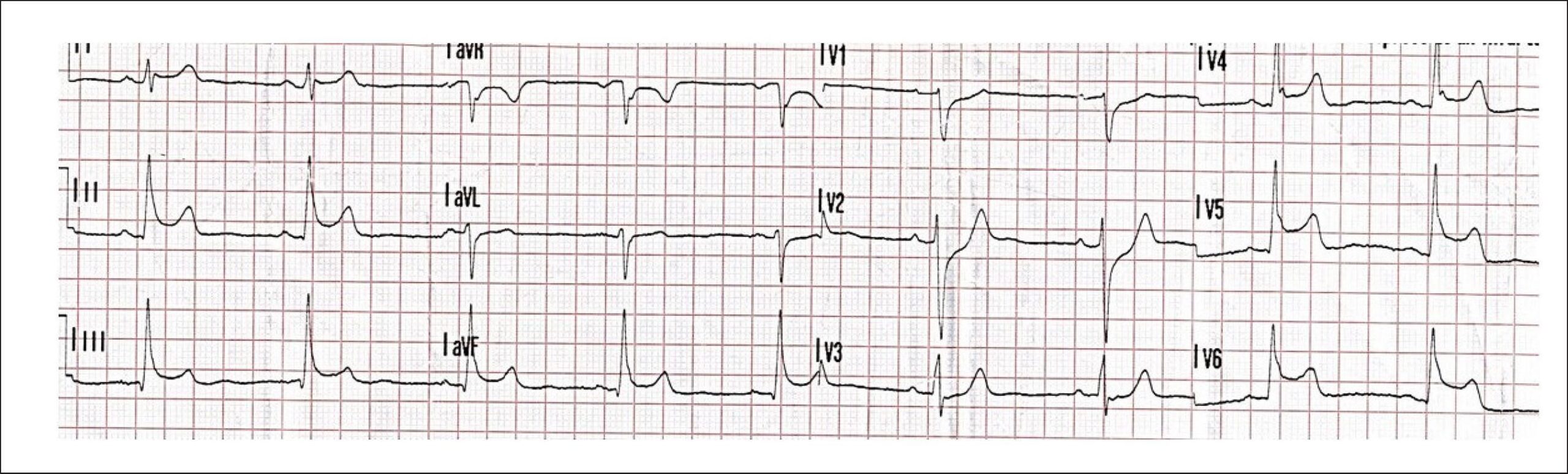
Variant angina is a form of angina pectoris caused by vasospasm of an epicardic coronary artery that results in myocardial ischemia that might be manifested by transient ST segment elevation on the electrocardiogram. Although it usually presents with chest pain, asymptomatic episodes are not rare., We report a case of an incidental diagnosis of asymptomatic coronary vasospam in a patient with polytrauma.

[…]

  • Angina Pectoris
  • Coronary Vasospasm
  • Endothelium/physiopatolhology
  • Wounds and Injuries
Read Full Article
Creative Commons Attribution (CC BY) Creative Commons license
01/08/2017 DOI: 10.5935/abc.20170093 Views 2
Figure 1
ABC
Case Report

Severe Coronary Vasospasm Complicated with Ventricular Tachycardia

Göksel Acar et al. Serdar Fidan Servet İzci Anıl Avcı

Introduction

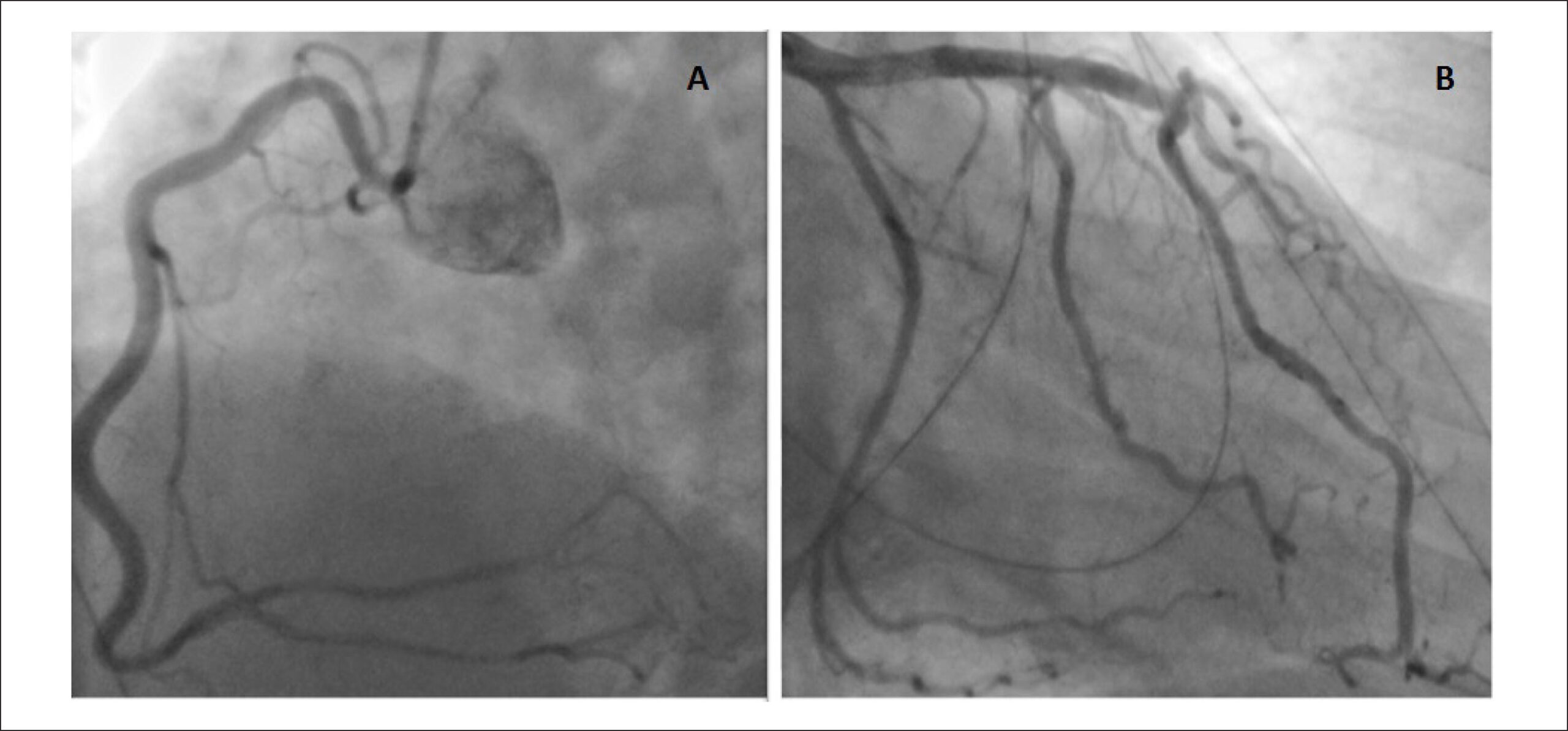
Variant form of angina was first described by Prinzmetal as transient and recurrent coronary spasm leading to recurrent episodes of myocardial ischemia. Although so many factors can trigger or aggravate coronary vasospasm; endothelial dysfunction was considered as an important mechanism underlying this situation. The location and extent of vasospasm determine the seriousness of the clinical picture, which can include myocardial infarction severe arrhythmias, cardiogenic shock and even death.

[…]

  • Angina Pectoris
  • Coronary Angiography
  • Coronary Vasospasm
  • Nitrates / therapeutic use
Read Full Article
Creative Commons Attribution (CC BY) Creative Commons license
01/12/2014 DOI: 10.5935/abc.20140166
Figure 1
ABC
Viewpoint

Atypical Manifestation of Myocardial Ischemia in the Elderly

Marcelo E. Ochiai et al. Neusa Helena Lopes Carolina Giusti Buzo Humberto Pierri

Often, elderly patients have atypical clinical picture for myocardial ischemia, or are asymptomatic. This review intends to re-examine the pathophysiology of atypical manifestation in elderly persons, its prognostic and therapeutic implications.

The coronary atherosclerotic disease is an increasing public health problem, of particular importance in higher age groups. Its prevalence increases significantly at the sixth decade of life, becoming the leading cause of death in older people, as well as the greatest responsible for hospitalization and invasive procedures.

[…]

  • Aged
  • Angina Pectoris
  • Coronary Artery Disease
  • Heart Failure
  • Myocardial Ischemia / physiopathology
Read Full Article
Creative Commons Attribution (CC BY) Creative Commons license
01/03/2014 DOI: 10.5935/abc.20140025
Platelet antiaggregants in primary and secondary prevention of atherothrombotic events
ABC
Atualização

Platelet antiaggregants in primary and secondary prevention of atherothrombotic events

Marcos Vinícius Ferreira Silva et al. Luci Maria SantAna Dusse Lauro Mello Vieira Maria das Graças Carvalho

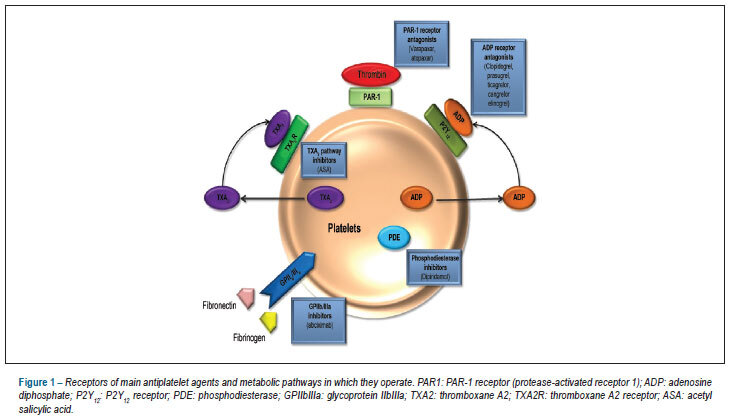
Atherothrombosis and its complications are currently the leading cause of worldwide mortality and its incidence is increasing . Platelets play an essential role in the pathogenesis of atherothrombotic events, justifying the use of antiplatelet agents in their prevention. Thus, it is essential to know the efficacy and safety profile of these drugs in primary and secondary prevention of atherothrombotic events. In this context, this review was performed with the aim of describing and summarizing the outcomes of the main trials involving the use of antiplatelet agents in the two levels of prevention, and evaluating the effectiveness and major adverse events related to therapy.

  • Angina Pectoris
  • Aspirin
  • Coronary Artery Disease
  • Myocardial Infarction
  • Platelet Aggregation Inhibitors
Read Full Article
Creative Commons Attribution (CC BY) Creative Commons license
05/07/2013 DOI: 10.5935/abc.20130122 Views 1
ABC
Brief Communication

Validation of the short-version of Rose angina questionnaire in Brazil

Maria-Socorro Bastos et al. Paulo A. Lotufo Aristarcho L. Whitaker Isabela M. Bensenor

BACKGROUND: Stable angina pectoris is a serious condition with few epidemiological studies in Brazil. OBJECTIVE: To validate the short-version of the Rose angina questionnaire in Brazilian Portuguese for its implementation in surveys and longitudinal studies. METHODS: A total of 116 consecutive patients from an outpatient clinic without prior myocardial infarction and/or coronary revascularization were enrolled for application of three questions of the Rose angina questionnaire addressing chest pain after exertion. We used the treadmill test as the gold standard with the Ellestad protocol. RESULTS: The short-version of the Rose angina questionnaire of the 116 subjects submitted to the exercise treadmill test disclosed 89.7% of accuracy, 25% of sensitivity, 92.0% of specificity, 10.0% of positive predictive value, 97.2% of negative predictive value, and 3.1 of positive likelihood ratio and 0.82 of negative likelihood ratio. CONCLUSION: The Portuguese version with three items of the Rose angina questionnaire is suitable for epidemiological purposes.

  • Angina Pectoris
  • Cardiovascular Diseases
  • Coronary Artery Disease
  • questionnaires
Read Full Article
Creative Commons Attribution (CC BY) Creative Commons license
22/11/2012 DOI: 10.1590/S0066-782X2012001400012 Views 1
NT-Pro-BNP levels and their response to exercise in patients with slow coronary flow
ABC
Artigo Original

NT-Pro-BNP levels and their response to exercise in patients with slow coronary flow

Mustafa Yurtdaş et al. İsmail Türkay Özcan Ahmet Çamsar Dilek Çiçek … Lülüfer Tamer Veli Gökhan Cin Oben Döven Ali Sabri Seyis Mehmet Necdet Akkuş

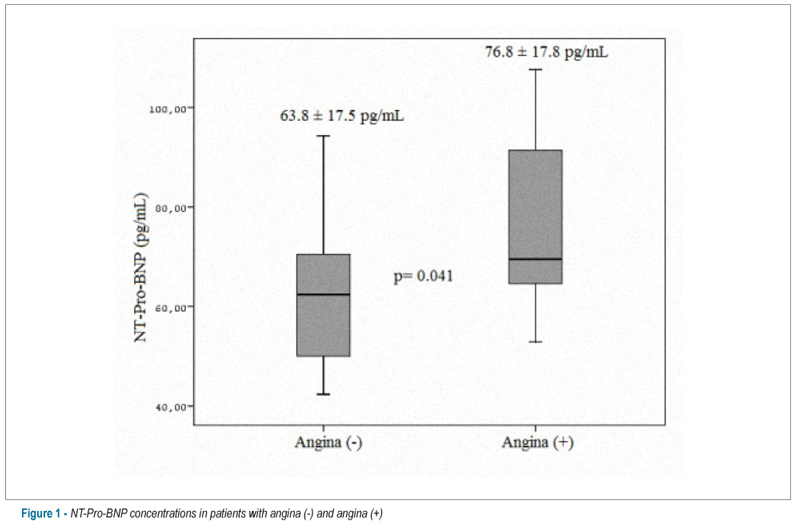
BACKGROUND: Natriuretic peptides are released by the heart in response to wall stress. OBJECTIVE: The NT-Pro-BNP concentrations in slow coronary flow (SCF) patients were assessed before and after the exercise test and compared with the values of healthy controls. METHODS: The study population was 34 patients with SCF [22 males (64.7%), aged 51.0±6.2 years], and 34 normal subjects with normal coronary arteries [21 males (61.8%), aged 53.2±6.6 years]. Coronary flow rates of all patients and control subjects were documented as Thrombolysis in Myocardial Infarction (TIMI) frame count. Blood samples were drawn at rest and after the exercise testing. RESULTS: The baseline NT-Pro-BNP concentrations of the SCF patients were higher than those of the control subjects (NT-Pro-BNP: 49.7±14.2 pg/mL vs. 25.3±4.6 pg/mL p<0.0001, respectively), and this difference increased after exercise test between the groups (NT-Pro-BNP: 69.5±18.6 pg/mL vs. 30.9±6.4 pg/mL p<0.0001). In SCF group after exercise, NT-Pro-BNP concentration in 15 patients with angina was higher than those without angina (76.8 ± 17.8 pg/mL vs. 63.8±17.5 pg/mL p=0.041). NT-Pro-BNP concentration in 11 patients with ST depression was also higher than those without ST depression (82.4 ± 17.3 pg/mL vs. 63.3 ± 16.1 pg/mL p=0.004). Median post-exercise increases in NT-Pro-BNP (Δ NT-Pro-BNP) were higher in the SCF group than in the control group (Δ NT-Pro-BNP: 19.8±7.7 pg/mL vs. 5.7±4.5 pg/mL p<0.0001). CONCLUSION: The results of this study suggest that there may be an important pathophysiologic link between the severity of SCF (microvascular or epicardial coronary artery dysfunction) and the level of circulating NT-Pro-BNP in SCF patients.

  • Angina Pectoris
  • coronary circulation
  • Exercise
  • Natriuretic Agents
Read Full Article
Creative Commons Attribution (CC BY) Creative Commons license
16/11/2012 DOI: 10.1590/S0066-782X2012005000102 Views 1
New prognostic score for stable coronary disease evaluation
ABC
Artigo Original

New prognostic score for stable coronary disease evaluation

Fernanda Coutinho Storti et al. Paulo Jorge Moffa Augusto H. Uchida Whady Armindo Hueb … Luiz Antônio Machado César Beatriz Moreira Ayub Ferreira Paulo Augusto de Camargo Jr William Azem Chalela

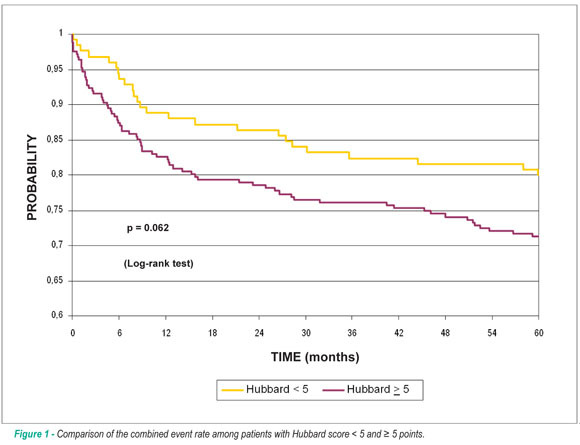
BACKGROUND: The need to improve the exercise testing accuracy, pushed the development of scores, whose applicability was already broadly recognized. OBJECTIVE: Prognostic evaluation of stable coronary disease through a new simplified score. METHODS: A new score was applied in 372 multivessel coronary patients with preserved ventricular function, 71.8% male, age: 59.5 (± 9.07) years old, randomized to medical treatment, surgery (CABG) or angioplasty (PTCA), with 5 years of follow-up. Cardiovascular death was considered the primary endpoint. Non-fatal myocardial infarction, death and re-intervention were considered for a combined secondary endpoint. The score was based on an equation previously validated, resulting from a sum of one point for: male gender, infarction history, angina, diabetes, insulin use and one point for each decade of life after 40 years old. Positive exercise testing summed one additional point. RESULTS: Thirty six deaths was observed (10 in group PTCA, 15 in CABG and 11 in the clinical group), p = 0.61. We observed 93 combined events: 37 in PTCA group, 23 in CABG and 33 in the clinical group (p = 0.058). 247 patients presented clinical score > 5 points and 216 > 6 points. The cutoff point > 5 or > 6 points identified higher risk, p = 0.015 and p = 0.012, respectively. The survival curve showed a different death incidence after the randomization when score reached 06 points or more (p = 0.07), and a distinct incidence of combined events between the patients with score 6 points (p = 0.02). CONCLUSION: The new score was consistent for multiarterial stable coronary disease risk stratification.

  • Angina Pectoris
  • Coronary Disease
  • Exercise Test
  • Prognosis
Read Full Article
Creative Commons Attribution (CC BY) Creative Commons license
15/04/2011 DOI: 10.1590/S0066-782X2011005000046 Views 3
Percutaneous coronary intervention in Brazil: results from the Brazilian Public Health System
ABC
Artigo Original

Percutaneous coronary intervention in Brazil: results from the Brazilian Public Health System

Leopoldo Soares Piegas et al. Nagib Haddad

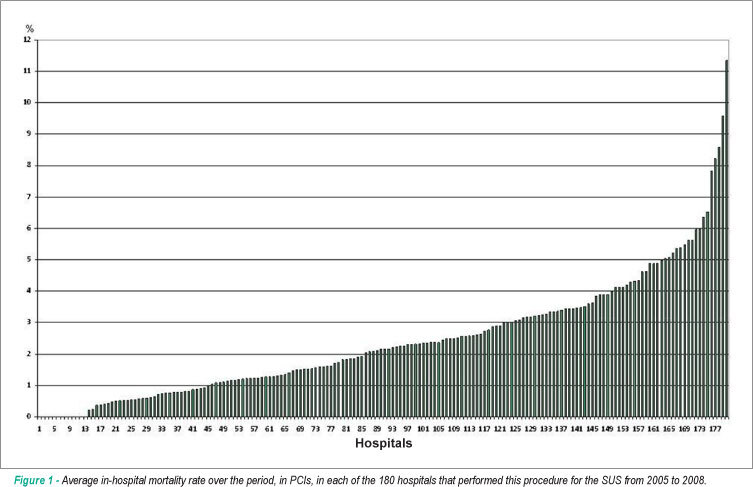
BACKGROUND: The Brazilian Public Health System (SUS) holds approximately 80% of percutaneous coronary interventions (PCI) in Brazil. Being aware of these data will enable to design a proper plan for the treatment of coronary artery disease (CAD). OBJECTIVE: To review and discuss the results of PCIs performed by the SUS. METHODS: We reviewed data from SIH/DATASUS available for public consultation. RESULTS: From 2005 to 2008, 166,514 procedures were performed in 180 hospitals. Average hospital mortality was 2.33%, ranging from 0% to 11.35%, being lower in the Southeast, 2.03% and higher in the northern region, 3.64% (p 0.05). Mortality was higher in females (p 65 to = (p < 0.001). In the diagnosis of angina (79,324, 47.64%) mortality was 1.03%, and AMI (33,286, 32.30%) 6.35% (p < 0.0000001). In the single stent implantation, the most common (102,165, 61.36%), mortality was 1.20%, and primary PCI (27,125, 16.29%), 6.96%. CONCLUSION: Although it is growing, the number of PCIs in Brazil is still low. High-volume hospitals, in smaller numbers, accounted for most procedures. Single stent implantation through hospital admission was reported to be most commonly used procedure. Mortality rates were highly variable among the hospitals. Primary PCI was responsible for the highest mortality rate.

  • Angina Pectoris
  • Angioplasty transluminal percutaneous coronary
  • Single Health System
Read Full Article
Creative Commons Attribution (CC BY) Creative Commons license
01/04/2011 DOI: 10.1590/S0066-782X2011005000035 Views 1

Could not load more articles. Please try again.

How to cite this article

EndNote RIS

Electronic Document Format (Vancouver)

Moreira EM, Waldvogel BC, Martins EB, Favarato D, Lima EG, Pitta FG, Rached FH, et al. Five-Year Mortality among Survivors of Coronary Artery Bypass Graft Surgery: A Retrospective Study from a Tertiary Center. Arquivos Brasileiros de Cardiologia 2026;123(4):e20250362.

Electronic Document Format (ABNT)

Moreira, Eduardo Martelli; Waldvogel, Bernadette Cunha; Martins, Eduardo Bello; Favarato, Desiderio; Lima, Eduardo Gomes; Pitta, Fabio Grunspun; Rached, Fabiana Hanna; Pinesi, Henrique Trombini; Mejia, Omar Asdrúbal Vilca; Serrano Jr, Carlos Vicente. Five-Year Mortality among Survivors of Coronary Artery Bypass Graft Surgery: A Retrospective Study from a Tertiary Center. Arquivos Brasileiros de Cardiologia, v. 123, n. 4, e20250362, Jun. 2026.

Electronic Document Format (APA)

Moreira, E. M., Waldvogel, B. C., Martins, E. B., Favarato, D., Lima, E. G., Pitta, F. G., Rached, F. H., Pinesi, H. T., Mejia, O. A. V., & Serrano Jr, C. V. (2026). Five-Year Mortality among Survivors of Coronary Artery Bypass Graft Surgery: A Retrospective Study from a Tertiary Center. Arquivos Brasileiros de Cardiologia, 123(4), e20250362.

Electronic Document Format (ISO)

Moreira, Eduardo Martelli and Waldvogel, Bernadette Cunha and Martins, Eduardo Bello and Favarato, Desiderio and Lima, Eduardo Gomes and Pitta, Fabio Grunspun and Rached, Fabiana Hanna and Pinesi, Henrique Trombini and Mejia, Omar Asdrúbal Vilca and Serrano Jr, Carlos Vicente. Five-Year Mortality among Survivors of Coronary Artery Bypass Graft Surgery: A Retrospective Study from a Tertiary Center. Arquivos Brasileiros de Cardiologia [online]. 2026, vol. 123, n. 4, [cited 2026-10-14], e20250362. Available from: <https://journals.cardiol.br/en/article/five-year-mortality-among-survivors-of-coronary-artery-bypass-graft-surgery-a-retrospective-study-from-a-tertiary-center/>. ISSN 0066-782X

EndNote RIS

Electronic Document Format (Vancouver)

Ziotti SDV, Dourado LOC, Silva R, Al-Lamee R, Henry TD, Cesar LAM, Serrano Jr. CV, et al. Coronary Sinus Reduction for the Treatment of Refractory Angina: What Have We Learned after 70 Years of the Beck Surgery?. Arquivos Brasileiros de Cardiologia 2026;122(11):e20250139.

Electronic Document Format (ABNT)

Ziotti, Sara Del Vecchio; Dourado, Luciana Oliveira Cascaes; Silva, Ranil de; Al-Lamee, Rasha; Henry, Timothy D.; Cesar, Luiz Antonio Machado; Serrano Jr., Carlos Vicente; Abizaid, Alexandre Antonio Cunha; Gowdak, Luis Henrique Wolff. Coronary Sinus Reduction for the Treatment of Refractory Angina: What Have We Learned after 70 Years of the Beck Surgery?. Arquivos Brasileiros de Cardiologia, v. 122, n. 11, e20250139, Jan. 2026.

Electronic Document Format (APA)

Ziotti, S. D. V., Dourado, L. O. C., Silva, R. , Al-Lamee, R., Henry, T. D., Cesar, L. A. M., Serrano Jr., C. V., Abizaid, A. A. C., & Gowdak, L. H. W. (2026). Coronary Sinus Reduction for the Treatment of Refractory Angina: What Have We Learned after 70 Years of the Beck Surgery?. Arquivos Brasileiros de Cardiologia, 122(11), e20250139.

Electronic Document Format (ISO)

Ziotti, Sara Del Vecchio and Dourado, Luciana Oliveira Cascaes and Silva, Ranil de and Al-Lamee, Rasha and Henry, Timothy D. and Cesar, Luiz Antonio Machado and Serrano Jr., Carlos Vicente and Abizaid, Alexandre Antonio Cunha and Gowdak, Luis Henrique Wolff. Coronary Sinus Reduction for the Treatment of Refractory Angina: What Have We Learned after 70 Years of the Beck Surgery?. Arquivos Brasileiros de Cardiologia [online]. 2026, vol. 122, n. 11, [cited 2026-10-14], e20250139. Available from: <https://journals.cardiol.br/en/article/coronary-sinus-reduction-for-the-treatment-of-refractory-angina-what-have-we-learned-after-70-years-of-the-beck-surgery/>. ISSN 0066-782X

EndNote RIS

Electronic Document Format (Vancouver)

Viana T, Melo RMV, Azevedo DFC, Figueiredo CS, Santana G, Damasceno LM, Latado L, et al. Allopurinol versus Trimetazidine for the Treatment of Angina: A Randomized Clinical Trial. Arquivos Brasileiros de Cardiologia 2024;121(8):e20230659.

Electronic Document Format (ABNT)

Viana, Tainá; Melo, Rodrigo Morel Vieira de; Azevedo, Diogo Freitas Cardoso; Figueiredo, Clara Salles; Santana, Gustavo; Damasceno, Luanna Mota; Latado, Luisa; Tambuque, Ludmila; Barreto, Raissa; Passos, Luiz Carlos Santana. Allopurinol versus Trimetazidine for the Treatment of Angina: A Randomized Clinical Trial. Arquivos Brasileiros de Cardiologia, v. 121, n. 8, e20230659, Aug. 2024.

Electronic Document Format (APA)

Viana, T., Melo, R. M. V. , Azevedo, D. F. C., Figueiredo, C. S., Santana, G., Damasceno, L. M., Latado, L., Tambuque, L., Barreto, R., & Passos, L. C. S. (2024). Allopurinol versus Trimetazidine for the Treatment of Angina: A Randomized Clinical Trial. Arquivos Brasileiros de Cardiologia, 121(8), e20230659.

Electronic Document Format (ISO)

Viana, Tainá and Melo, Rodrigo Morel Vieira de and Azevedo, Diogo Freitas Cardoso and Figueiredo, Clara Salles and Santana, Gustavo and Damasceno, Luanna Mota and Latado, Luisa and Tambuque, Ludmila and Barreto, Raissa and Passos, Luiz Carlos Santana. Allopurinol versus Trimetazidine for the Treatment of Angina: A Randomized Clinical Trial. Arquivos Brasileiros de Cardiologia [online]. 2024, vol. 121, n. 8, [cited 2026-10-14], e20230659. Available from: <https://journals.cardiol.br/en/article/allopurinol-versus-trimetazidine-for-the-treatment-of-angina-a-randomized-clinical-trial/>. ISSN 0066-782X

EndNote RIS

Electronic Document Format (Vancouver)

Martins EB, Lima EG, Linhares Filho JPP, Pinesi HT, Pitta FG, Serrano Júnior CV. Angina Pectoris and Orbita 2 Trial: Reflections on the Future of Angina Treatment. Arquivos Brasileiros de Cardiologia 2024;121(6):e20230848.

Electronic Document Format (ABNT)

Martins, Eduardo Bello; Lima, Eduardo Gomes; Linhares Filho, Jaime Paula Pessoa; Pinesi, Henrique Trombini; Pitta, Fabio Grunspun; Serrano Júnior, Carlos Vicente. Angina Pectoris and Orbita 2 Trial: Reflections on the Future of Angina Treatment. Arquivos Brasileiros de Cardiologia, v. 121, n. 6, e20230848, Aug. 2024.

Electronic Document Format (APA)

Martins, E. B., Lima, E. G., Linhares Filho, J. P. P., Pinesi, H. T., Pitta, F. G., & Serrano Júnior, C. V. (2024). Angina Pectoris and Orbita 2 Trial: Reflections on the Future of Angina Treatment. Arquivos Brasileiros de Cardiologia, 121(6), e20230848.

Electronic Document Format (ISO)

Martins, Eduardo Bello and Lima, Eduardo Gomes and Linhares Filho, Jaime Paula Pessoa and Pinesi, Henrique Trombini and Pitta, Fabio Grunspun and Serrano Júnior, Carlos Vicente. Angina Pectoris and Orbita 2 Trial: Reflections on the Future of Angina Treatment. Arquivos Brasileiros de Cardiologia [online]. 2024, vol. 121, n. 6, [cited 2026-10-14], e20230848. Available from: <https://journals.cardiol.br/en/article/angina-pectoris-and-orbita-2-trial-reflections-on-the-future-of-angina-treatment/>. ISSN 0066-782X

EndNote RIS

Electronic Document Format (Vancouver)

Netto SM, Souza RVO, Murad V, Mesquita ET. Coronary Artery Microfistulas: Historical Description and Contemporary Clinical Relevance. International Journal of Cardiovascular Sciences 2023;36:e20230092.

Electronic Document Format (ABNT)

Netto, Stans Murad; Souza, Rachel Vianna O’Neill de; Murad, Victor; Mesquita, Evandro Tinoco. Coronary Artery Microfistulas: Historical Description and Contemporary Clinical Relevance. International Journal of Cardiovascular Sciences, v. 36, e20230092, Dec. 2023.

Electronic Document Format (APA)

Netto, S. M., Souza, R. V. O. , Murad, V., & Mesquita, E. T. (2023). Coronary Artery Microfistulas: Historical Description and Contemporary Clinical Relevance. International Journal of Cardiovascular Sciences, 36, e20230092.

Electronic Document Format (ISO)

Netto, Stans Murad and Souza, Rachel Vianna O’Neill de and Murad, Victor and Mesquita, Evandro Tinoco. Coronary Artery Microfistulas: Historical Description and Contemporary Clinical Relevance. International Journal of Cardiovascular Sciences [online]. 2023, vol. 36, [cited 2026-10-14], e20230092. Available from: <https://journals.cardiol.br/en/article/coronary-artery-microfistulas-historical-description-and-contemporary-clinical-relevance/>. ISSN 2359-4802

EndNote RIS

Electronic Document Format (Vancouver)

Moreira EM, Pinesi HT, Martins EB, Pitta FG, Bolta PMP, Segre CAW, Favarato D, et al. Two-Year Follow-Up of Chronic Ischemic Heart Disease Patients in a Specialized Center in Brazil. Arquivos Brasileiros de Cardiologia 2023;120(10):e20220440.

Electronic Document Format (ABNT)

Moreira, Eduardo Martelli; Pinesi, Henrique Trombini; Martins, Eduardo Bello; Pitta, Fábio Grunspun; Bolta, Paula Mathias Paulino; Segre, Carlos Alexandre Wainrober; Favarato, Desiderio; Rached, Fabiana Hanna; Hueb, Whady Armindo; Lima, Eduardo Gomes; Kalil Filho, Roberto; Garzillo, Cibele Larrosa; Serrano Jr, Carlos Vicente. Two-Year Follow-Up of Chronic Ischemic Heart Disease Patients in a Specialized Center in Brazil. Arquivos Brasileiros de Cardiologia, v. 120, n. 10, e20220440, Oct. 2023.

Electronic Document Format (APA)

Moreira, E. M., Pinesi, H. T., Martins, E. B., Pitta, F. G., Bolta, P. M. P., Segre, C. A. W., Favarato, D., Rached, F. H., Hueb, W. A., Lima, E. G., Kalil Filho, R., Garzillo, C. L., & Serrano Jr, C. V. (2023). Two-Year Follow-Up of Chronic Ischemic Heart Disease Patients in a Specialized Center in Brazil. Arquivos Brasileiros de Cardiologia, 120(10), e20220440.

Electronic Document Format (ISO)

Moreira, Eduardo Martelli and Pinesi, Henrique Trombini and Martins, Eduardo Bello and Pitta, Fábio Grunspun and Bolta, Paula Mathias Paulino and Segre, Carlos Alexandre Wainrober and Favarato, Desiderio and Rached, Fabiana Hanna and Hueb, Whady Armindo and Lima, Eduardo Gomes and Kalil Filho, Roberto and Garzillo, Cibele Larrosa and Serrano Jr, Carlos Vicente. Two-Year Follow-Up of Chronic Ischemic Heart Disease Patients in a Specialized Center in Brazil. Arquivos Brasileiros de Cardiologia [online]. 2023, vol. 120, n. 10, [cited 2026-10-14], e20220440. Available from: <https://journals.cardiol.br/en/article/two-year-follow-up-of-chronic-ischemic-heart-disease-patients-in-a-specialized-center-in-brazil/>. ISSN 0066-782X

EndNote RIS

Electronic Document Format (Vancouver)

Dourado LOC, Jordão CP, Assumpção CRA, Matos LDNJ. In the Cardiac Rehabilitation Era, is There a “No-Option” Refractory Angina Patient?: A Case Report. Arquivos Brasileiros de Cardiologia 2023;120(9):e20230007.

Electronic Document Format (ABNT)

Dourado, Luciana Oliveira Cascaes; Jordão, Camila Paixão; Assumpção, Camila Regina Alves; Matos, Luciana Diniz Nagem Janot de. In the Cardiac Rehabilitation Era, is There a “No-Option” Refractory Angina Patient?: A Case Report. Arquivos Brasileiros de Cardiologia, v. 120, n. 9, e20230007, Oct. 2023.

Electronic Document Format (APA)

Dourado, L. O. C., Jordão, C. P., Assumpção, C. R. A., & Matos, L. D. N. J. (2023). In the Cardiac Rehabilitation Era, is There a “No-Option” Refractory Angina Patient?: A Case Report. Arquivos Brasileiros de Cardiologia, 120(9), e20230007.

Electronic Document Format (ISO)

Dourado, Luciana Oliveira Cascaes and Jordão, Camila Paixão and Assumpção, Camila Regina Alves and Matos, Luciana Diniz Nagem Janot de. In the Cardiac Rehabilitation Era, is There a “No-Option” Refractory Angina Patient?: A Case Report. Arquivos Brasileiros de Cardiologia [online]. 2023, vol. 120, n. 9, [cited 2026-10-14], e20230007. Available from: <https://journals.cardiol.br/en/article/in-the-cardiac-rehabilitation-era-is-there-a-no-option-refractory-angina-patient-a-case-report/>. ISSN 0066-782X

EndNote RIS

Electronic Document Format (Vancouver)

Parapid B, Kanjuh VI. Myocardial Bridge: Friend, Enemy, or Frenemy?. Arquivos Brasileiros de Cardiologia 2023;120(7):e20230426.

Electronic Document Format (ABNT)

Parapid, Biljana; Kanjuh, Vladimir I.. Myocardial Bridge: Friend, Enemy, or Frenemy?. Arquivos Brasileiros de Cardiologia, v. 120, n. 7, e20230426, Aug. 2023.

Electronic Document Format (APA)

Parapid, B., & Kanjuh, V. I. (2023). Myocardial Bridge: Friend, Enemy, or Frenemy?. Arquivos Brasileiros de Cardiologia, 120(7), e20230426.

Electronic Document Format (ISO)

Parapid, Biljana and Kanjuh, Vladimir I.. Myocardial Bridge: Friend, Enemy, or Frenemy?. Arquivos Brasileiros de Cardiologia [online]. 2023, vol. 120, n. 7, [cited 2026-10-14], e20230426. Available from: <https://journals.cardiol.br/en/article/myocardial-bridge-friend-enemy-or-frenemy/>. ISSN 0066-782X

EndNote RIS

Electronic Document Format (Vancouver)

Montenegro CGSP, Dourado LOC, Jordão CP, Vieira MLC, Assumpção CRA, Gowdak LHW, Pereira AC, et al. Does Myocardial Injury Occur After an Acute Aerobic Exercise Session in Patients with Refractory Angina?. Arquivos Brasileiros de Cardiologia 2022;119(5):747-53.

Electronic Document Format (ABNT)

Montenegro, Carla Giuliano de Sá Pinto; Dourado, Luciana Oliveira Cascaes; Jordão, Camila Paixão; Vieira, Marcelo Luiz Campos; Assumpção, Camila Regina Alves; Gowdak, Luis Henrique Wolff; Pereira, Alexandre da Costa; Negrão, Carlos Eduardo; Matos, Luciana Diniz Nagem Janot de. Does Myocardial Injury Occur After an Acute Aerobic Exercise Session in Patients with Refractory Angina?. Arquivos Brasileiros de Cardiologia, v. 119, n. 5, p. 747-753, Nov. 2022.

Electronic Document Format (APA)

Montenegro, C. G. S. P., Dourado, L. O. C., Jordão, C. P., Vieira, M. L. C., Assumpção, C. R. A., Gowdak, L. H. W., Pereira, A. C., Negrão, C. E., & Matos, L. D. N. J. (2022). Does Myocardial Injury Occur After an Acute Aerobic Exercise Session in Patients with Refractory Angina?. Arquivos Brasileiros de Cardiologia, 119(5), 747-753.

Electronic Document Format (ISO)

Montenegro, Carla Giuliano de Sá Pinto and Dourado, Luciana Oliveira Cascaes and Jordão, Camila Paixão and Vieira, Marcelo Luiz Campos and Assumpção, Camila Regina Alves and Gowdak, Luis Henrique Wolff and Pereira, Alexandre da Costa and Negrão, Carlos Eduardo and Matos, Luciana Diniz Nagem Janot de. Does Myocardial Injury Occur After an Acute Aerobic Exercise Session in Patients with Refractory Angina?. Arquivos Brasileiros de Cardiologia [online]. 2022, vol. 119, n. 5, [cited 2026-10-14], pp. 747-753. Available from: <https://journals.cardiol.br/en/article/does-myocardial-injury-occur-after-an-acute-aerobic-exercise-session-in-patients-with-refractory-angina/>. ISSN 0066-782X

EndNote RIS

Electronic Document Format (Vancouver)

Bianco HT, Povoa R, Izar MC, Alves CMR, Barbosa AHP, Bombig MTN, Gonçalves Jr I, et al. Pharmaco-invasive Strategy in Myocardial Infarction: Descriptive Analysis, Presentation of Ischemic Symptoms and Mortality Predictors. Arquivos Brasileiros de Cardiologia 2022;119(5):691-702.

Electronic Document Format (ABNT)

Bianco, Henrique Tria; Povoa, Rui; Izar, Maria Cristina; Alves, Claudia Maria Rodrigues; Barbosa, Adriano Henrique Pereira; Bombig, Maria Teresa Nogueira; Gonçalves Jr, Iran; Luna Filho, Bráulio; Aguirre, Ana Caroline; Moraes, Pedro Ivo de Marqui; Almeida, Dirceu; Moreira, Flávio Tocci; Povoa, Fernando Focaccia; Stefanini, Edson; Caixeta, Adriano Mendes; Bacchin, Amanda S.; Moisés, Valdir Ambrósio; Fonseca, Francisco A.H.. Pharmaco-invasive Strategy in Myocardial Infarction: Descriptive Analysis, Presentation of Ischemic Symptoms and Mortality Predictors. Arquivos Brasileiros de Cardiologia, v. 119, n. 5, p. 691-702, Nov. 2022.

Electronic Document Format (APA)

Bianco, H. T., Povoa, R., Izar, M. C., Alves, C. M. R., Barbosa, A. H. P., Bombig, M. T. N., Gonçalves Jr, I., Luna Filho, B., Aguirre, A. C., Moraes, P. I. M., Almeida, D., Moreira, F. T., Povoa, F. F., Stefanini, E., Caixeta, A. M., Bacchin, A. S., Moisés, V. A., & Fonseca, F. A. (2022). Pharmaco-invasive Strategy in Myocardial Infarction: Descriptive Analysis, Presentation of Ischemic Symptoms and Mortality Predictors. Arquivos Brasileiros de Cardiologia, 119(5), 691-702.

Electronic Document Format (ISO)

Bianco, Henrique Tria and Povoa, Rui and Izar, Maria Cristina and Alves, Claudia Maria Rodrigues and Barbosa, Adriano Henrique Pereira and Bombig, Maria Teresa Nogueira and Gonçalves Jr, Iran and Luna Filho, Bráulio and Aguirre, Ana Caroline and Moraes, Pedro Ivo de Marqui and Almeida, Dirceu and Moreira, Flávio Tocci and Povoa, Fernando Focaccia and Stefanini, Edson and Caixeta, Adriano Mendes and Bacchin, Amanda S. and Moisés, Valdir Ambrósio and Fonseca, Francisco A.H.. Pharmaco-invasive Strategy in Myocardial Infarction: Descriptive Analysis, Presentation of Ischemic Symptoms and Mortality Predictors. Arquivos Brasileiros de Cardiologia [online]. 2022, vol. 119, n. 5, [cited 2026-10-14], pp. 691-702. Available from: <https://journals.cardiol.br/en/article/pharmaco-invasive-strategy-in-myocardial-infarction-descriptive-analysis-presentation-of-ischemic-symptoms-and-mortality-predictors/>. ISSN 0066-782X

EndNote RIS

Electronic Document Format (Vancouver)

Castro RRT, Silveira Neto JG, Moreno AM, Orsini M. Exercise-Induced Bronchoconstriction: A Frequent, but Neglected Cause of Chest Pain. International Journal of Cardiovascular Sciences 2022;35(6):820-3.

Electronic Document Format (ABNT)

Castro, Renata Rodrigues Teixeira de; Silveira Neto, João Giffoni; Moreno, Adalgiza Mafra; Orsini, Marco. Exercise-Induced Bronchoconstriction: A Frequent, but Neglected Cause of Chest Pain. International Journal of Cardiovascular Sciences, v. 35, n. 6, p. 820-823, Apr. 2022.

Electronic Document Format (APA)

Castro, R. R. T. , Silveira Neto, J. G., Moreno, A. M., & Orsini, M. (2022). Exercise-Induced Bronchoconstriction: A Frequent, but Neglected Cause of Chest Pain. International Journal of Cardiovascular Sciences, 35(6), 820-823.

Electronic Document Format (ISO)

Castro, Renata Rodrigues Teixeira de and Silveira Neto, João Giffoni and Moreno, Adalgiza Mafra and Orsini, Marco. Exercise-Induced Bronchoconstriction: A Frequent, but Neglected Cause of Chest Pain. International Journal of Cardiovascular Sciences [online]. 2022, vol. 35, n. 6, [cited 2026-10-14], pp. 820-823. Available from: <https://journals.cardiol.br/en/article/exercise-induced-bronchoconstriction-a-frequent-but-neglected-cause-of-chest-pain/>. ISSN 2359-4802

EndNote RIS

Electronic Document Format (Vancouver)

Souza TRC, Araruna ALNGP, Fernandes CNS, Mendonça RM, Belém Neto EO, Macedo R. Single Coronary Artery in Transplanted Heart: An Unusual Association. Arquivos Brasileiros de Cardiologia Imagem cardiovascular 2022;31(2):95-8.

Electronic Document Format (ABNT)

Souza, Thaís Rossana Cruz de; Araruna, Arthur Luiz Norte Gomes Pereira; Fernandes, Cláudia do Nascimento Silva; Mendonça, Roberto Moreno; Belém Neto, Epitácio de Oliveira; Macedo, Robson. Single Coronary Artery in Transplanted Heart: An Unusual Association. Arquivos Brasileiros de Cardiologia Imagem cardiovascular, v. 31, n. 2, p. 95-98, Jan. 2022.

Electronic Document Format (APA)

Souza, T. R. C. , Araruna, A. L. N. G. P., Fernandes, C. N. S., Mendonça, R. M., Belém Neto, E. O., & Macedo, R. (2022). Single Coronary Artery in Transplanted Heart: An Unusual Association. Arquivos Brasileiros de Cardiologia Imagem cardiovascular, 31(2), 95-98.

Electronic Document Format (ISO)

Souza, Thaís Rossana Cruz de and Araruna, Arthur Luiz Norte Gomes Pereira and Fernandes, Cláudia do Nascimento Silva and Mendonça, Roberto Moreno and Belém Neto, Epitácio de Oliveira and Macedo, Robson. Single Coronary Artery in Transplanted Heart: An Unusual Association. Arquivos Brasileiros de Cardiologia Imagem cardiovascular [online]. 2022, vol. 31, n. 2, [cited 2026-10-14], pp. 95-98. Available from: <https://journals.cardiol.br/en/article/single-coronary-artery-in-transplanted-heart-an-unusual-association/>. ISSN 2318-8219

EndNote RIS

Electronic Document Format (Vancouver)

Wang R, Zanon JCC, Neuschwander FC. Precordial Pain and Infarction in the Elderly. It´S no so Elementary, My Dear Watson!. Arquivos Brasileiros de Cardiologia 2021;116(6):1046-7.

Electronic Document Format (ABNT)

Wang, Ricardo; Zanon, José Carlos da Costa; Neuschwander, Fernando Carvalho. Precordial Pain and Infarction in the Elderly. It´S no so Elementary, My Dear Watson!. Arquivos Brasileiros de Cardiologia, v. 116, n. 6, p. 1046-1047, Jun. 2021.

Electronic Document Format (APA)

Wang, R., Zanon, J. C. C., & Neuschwander, F. C. (2021). Precordial Pain and Infarction in the Elderly. It´S no so Elementary, My Dear Watson!. Arquivos Brasileiros de Cardiologia, 116(6), 1046-1047.

Electronic Document Format (ISO)

Wang, Ricardo and Zanon, José Carlos da Costa and Neuschwander, Fernando Carvalho. Precordial Pain and Infarction in the Elderly. It´S no so Elementary, My Dear Watson!. Arquivos Brasileiros de Cardiologia [online]. 2021, vol. 116, n. 6, [cited 2026-10-14], pp. 1046-1047. Available from: <https://journals.cardiol.br/en/article/precordial-pain-and-infarction-in-the-elderly-its-no-so-elementary-my-dear-watson/>. ISSN 0066-782X

EndNote RIS

Electronic Document Format (Vancouver)

Yavuz F, Kaplan M. Association Between Serum Elabela Levels and Chronic Totally Occlusion in Patients with Stable Angina Pectoris. Arquivos Brasileiros de Cardiologia 2021;117(3):503-10.

Electronic Document Format (ABNT)

Yavuz, Fethi; Kaplan, Mehmet. Association Between Serum Elabela Levels and Chronic Totally Occlusion in Patients with Stable Angina Pectoris. Arquivos Brasileiros de Cardiologia, v. 117, n. 3, p. 503-510, May. 2021.

Electronic Document Format (APA)

Yavuz, F., & Kaplan, M. (2021). Association Between Serum Elabela Levels and Chronic Totally Occlusion in Patients with Stable Angina Pectoris. Arquivos Brasileiros de Cardiologia, 117(3), 503-510.

Electronic Document Format (ISO)

Yavuz, Fethi and Kaplan, Mehmet. Association Between Serum Elabela Levels and Chronic Totally Occlusion in Patients with Stable Angina Pectoris. Arquivos Brasileiros de Cardiologia [online]. 2021, vol. 117, n. 3, [cited 2026-10-14], pp. 503-510. Available from: <https://journals.cardiol.br/en/article/association-between-serum-elabela-levels-and-chronic-totally-occlusion-in-patients-with-stable-angina-pectoris/>. ISSN 0066-782X

EndNote RIS

Electronic Document Format (Vancouver)

Costantini CR, Macedo RM, Denk MA, Tarbine SG, Garcia L, Maranhão MFC, Costantini CO, et al. The Evolution of Percutaneous Coronary Intervention in Latin America. Arquivos Brasileiros de Cardiologia 2021;116(5):1007-10.

Electronic Document Format (ABNT)

Costantini, Costantino Roberto; Macedo, Rafael Michel de; Denk, Marcos Antônio; Tarbine, Sergio Gustavo; Garcia, Lazaro; Maranhão, Mario Fernando Camargo; Costantini, Costantino Ortiz. The Evolution of Percutaneous Coronary Intervention in Latin America. Arquivos Brasileiros de Cardiologia, v. 116, n. 5, p. 1007-1010, May. 2021.

Electronic Document Format (APA)

Costantini, C. R., Macedo, R. M. , Denk, M. A., Tarbine, S. G., Garcia, L., Maranhão, M. F. C., & Costantini, C. O. (2021). The Evolution of Percutaneous Coronary Intervention in Latin America. Arquivos Brasileiros de Cardiologia, 116(5), 1007-1010.

Electronic Document Format (ISO)

Costantini, Costantino Roberto and Macedo, Rafael Michel de and Denk, Marcos Antônio and Tarbine, Sergio Gustavo and Garcia, Lazaro and Maranhão, Mario Fernando Camargo and Costantini, Costantino Ortiz. The Evolution of Percutaneous Coronary Intervention in Latin America. Arquivos Brasileiros de Cardiologia [online]. 2021, vol. 116, n. 5, [cited 2026-10-14], pp. 1007-1010. Available from: <https://journals.cardiol.br/en/article/the-evolution-of-percutaneous-coronary-intervention-in-latin-america/>. ISSN 0066-782X

EndNote RIS

Electronic Document Format (Vancouver)

Cadore JC, Furtado MV, Tumelero RT, Tognon AP, Krepsky AM, Cadore D, Ruschel KB, et al. Complete Revascularization Versus Treatment of the Culprit Artery Only in ST Elevation Myocardial Infarction: A Multicenter Registry. Arquivos Brasileiros de Cardiologia 2020;115(2):229-37.

Electronic Document Format (ABNT)

Cadore, Julia Cremona; Furtado, Mariana Vargas; Tumelero, Rogério Tadeu; Tognon, Alexandre Pereira; Krepsky, Ana Maria; Cadore, Denis; Ruschel, Karen Brasil; Bedin, Julia Caldas; Conte, Thais; Polanczyk, Carisi Anne. Complete Revascularization Versus Treatment of the Culprit Artery Only in ST Elevation Myocardial Infarction: A Multicenter Registry. Arquivos Brasileiros de Cardiologia, v. 115, n. 2, p. 229-237, Aug. 2020.

Electronic Document Format (APA)

Cadore, J. C., Furtado, M. V., Tumelero, R. T., Tognon, A. P., Krepsky, A. M., Cadore, D., Ruschel, K. B., Bedin, J. C., Conte, T., & Polanczyk, C. A. (2020). Complete Revascularization Versus Treatment of the Culprit Artery Only in ST Elevation Myocardial Infarction: A Multicenter Registry. Arquivos Brasileiros de Cardiologia, 115(2), 229-237.

Electronic Document Format (ISO)

Cadore, Julia Cremona and Furtado, Mariana Vargas and Tumelero, Rogério Tadeu and Tognon, Alexandre Pereira and Krepsky, Ana Maria and Cadore, Denis and Ruschel, Karen Brasil and Bedin, Julia Caldas and Conte, Thais and Polanczyk, Carisi Anne. Complete Revascularization Versus Treatment of the Culprit Artery Only in ST Elevation Myocardial Infarction: A Multicenter Registry. Arquivos Brasileiros de Cardiologia [online]. 2020, vol. 115, n. 2, [cited 2026-10-14], pp. 229-237. Available from: <https://journals.cardiol.br/en/article/complete-revascularization-versus-treatment-of-the-culprit-artery-only-in-st-elevation-myocardial-infarction-a-multicenter-registry/>. ISSN 0066-782X

EndNote RIS

Electronic Document Format (Vancouver)

Aguilera MC, Restrepo J, Rivero F, Bastante T, Aguilar R, Alfonso F. Asymptomatic Coronary Spasm Due to Polytraumatism. Arquivos Brasileiros de Cardiologia 2017;109(2):175-7.

Electronic Document Format (ABNT)

Aguilera, Maria Cruz; Restrepo, Jorge; Rivero, Fernando; Bastante, Teresa; Aguilar, Rio; Alfonso, Fernando. Asymptomatic Coronary Spasm Due to Polytraumatism. Arquivos Brasileiros de Cardiologia, v. 109, n. 2, p. 175-177, Jul. 2017.

Electronic Document Format (APA)

Aguilera, M. C., Restrepo, J., Rivero, F., Bastante, T., Aguilar, R., & Alfonso, F. (2017). Asymptomatic Coronary Spasm Due to Polytraumatism. Arquivos Brasileiros de Cardiologia, 109(2), 175-177.

Electronic Document Format (ISO)

Aguilera, Maria Cruz and Restrepo, Jorge and Rivero, Fernando and Bastante, Teresa and Aguilar, Rio and Alfonso, Fernando. Asymptomatic Coronary Spasm Due to Polytraumatism. Arquivos Brasileiros de Cardiologia [online]. 2017, vol. 109, n. 2, [cited 2026-10-14], pp. 175-177. Available from: <https://journals.cardiol.br/en/article/asymptomatic-coronary-spasm-due-to-polytraumatism/>. ISSN 0066-782X

EndNote RIS

Electronic Document Format (Vancouver)

Acar G, Fidan S, İzci S, Avcı A. Severe Coronary Vasospasm Complicated with Ventricular Tachycardia. Arquivos Brasileiros de Cardiologia 2014;103(6):e81-6.

Electronic Document Format (ABNT)

Acar, Göksel; Fidan, Serdar; İzci, Servet; Avcı, Anıl. Severe Coronary Vasospasm Complicated with Ventricular Tachycardia. Arquivos Brasileiros de Cardiologia, v. 103, n. 6, p. e81-e86, Nov. 2014.

Electronic Document Format (APA)

Acar, G., Fidan, S., İzci, S., & Avcı, A. (2014). Severe Coronary Vasospasm Complicated with Ventricular Tachycardia. Arquivos Brasileiros de Cardiologia, 103(6), e81-e86.

Electronic Document Format (ISO)

Acar, Göksel and Fidan, Serdar and İzci, Servet and Avcı, Anıl. Severe Coronary Vasospasm Complicated with Ventricular Tachycardia. Arquivos Brasileiros de Cardiologia [online]. 2014, vol. 103, n. 6, [cited 2026-10-14], pp. e81-e86. Available from: <https://journals.cardiol.br/en/article/severe-coronary-vasospasm-complicated-with-ventricular-tachycardia/>. ISSN 0066-782X

EndNote RIS

Electronic Document Format (Vancouver)

Ochiai ME, Lopes NH, Buzo CG, Pierri H. Atypical Manifestation of Myocardial Ischemia in the Elderly. Arquivos Brasileiros de Cardiologia 2014;102(3):31.

Electronic Document Format (ABNT)

Ochiai, Marcelo E.; Lopes, Neusa Helena; Buzo, Carolina Giusti; Pierri, Humberto. Atypical Manifestation of Myocardial Ischemia in the Elderly. Arquivos Brasileiros de Cardiologia, v. 102, n. 3, 31, Feb. 2014.

Electronic Document Format (APA)

Ochiai, M. E., Lopes, N. H., Buzo, C. G., & Pierri, H. (2014). Atypical Manifestation of Myocardial Ischemia in the Elderly. Arquivos Brasileiros de Cardiologia, 102(3), 31.

Electronic Document Format (ISO)

Ochiai, Marcelo E. and Lopes, Neusa Helena and Buzo, Carolina Giusti and Pierri, Humberto. Atypical Manifestation of Myocardial Ischemia in the Elderly. Arquivos Brasileiros de Cardiologia [online]. 2014, vol. 102, n. 3, [cited 2026-10-14], 31. Available from: <https://journals.cardiol.br/en/article/atypical-manifestation-of-myocardial-ischemia-in-the-elderly/>. ISSN 0066-782X

EndNote RIS

Electronic Document Format (Vancouver)

Silva MVF, Dusse LMS, Vieira LM, Carvalho MG. Platelet antiaggregants in primary and secondary prevention of atherothrombotic events. Arquivos Brasileiros de Cardiologia 2013;100(6):e78-84.

Electronic Document Format (ABNT)

Silva, Marcos Vinícius Ferreira; Dusse, Luci Maria SantAna; Vieira, Lauro Mello; Carvalho, Maria das Graças. Platelet antiaggregants in primary and secondary prevention of atherothrombotic events. Arquivos Brasileiros de Cardiologia, v. 100, n. 6, p. e78-e84, Jul. 2013.

Electronic Document Format (APA)

Silva, M. V. F., Dusse, L. M. S., Vieira, L. M., & Carvalho, M. G. (2013). Platelet antiaggregants in primary and secondary prevention of atherothrombotic events. Arquivos Brasileiros de Cardiologia, 100(6), e78-e84.

Electronic Document Format (ISO)

Silva, Marcos Vinícius Ferreira and Dusse, Luci Maria SantAna and Vieira, Lauro Mello and Carvalho, Maria das Graças. Platelet antiaggregants in primary and secondary prevention of atherothrombotic events. Arquivos Brasileiros de Cardiologia [online]. 2013, vol. 100, n. 6, [cited 2026-10-14], pp. e78-e84. Available from: <https://journals.cardiol.br/en/article/platelet-antiaggregants-in-primary-and-secondary-prevention-of-atherothrombotic-events/>. ISSN 0066-782X

EndNote RIS

Electronic Document Format (Vancouver)

Bastos M, Lotufo PA, Whitaker AL, Bensenor IM. Validation of the short-version of Rose angina questionnaire in Brazil. Arquivos Brasileiros de Cardiologia 2012;99(5):1056-9.

Electronic Document Format (ABNT)

Bastos, Maria-Socorro; Lotufo, Paulo A.; Whitaker, Aristarcho L.; Bensenor, Isabela M.. Validation of the short-version of Rose angina questionnaire in Brazil. Arquivos Brasileiros de Cardiologia, v. 99, n. 5, p. 1056-1059, Nov. 2012.

Electronic Document Format (APA)

Bastos, M., Lotufo, P. A., Whitaker, A. L., & Bensenor, I. M. (2012). Validation of the short-version of Rose angina questionnaire in Brazil. Arquivos Brasileiros de Cardiologia, 99(5), 1056-1059.

Electronic Document Format (ISO)

Bastos, Maria-Socorro and Lotufo, Paulo A. and Whitaker, Aristarcho L. and Bensenor, Isabela M.. Validation of the short-version of Rose angina questionnaire in Brazil. Arquivos Brasileiros de Cardiologia [online]. 2012, vol. 99, n. 5, [cited 2026-10-14], pp. 1056-1059. Available from: <https://journals.cardiol.br/en/article/validation-of-the-short-version-of-rose-angina-questionnaire-in-brazil/>. ISSN 0066-782X

EndNote RIS

Electronic Document Format (Vancouver)

Yurtdaş M, Özcan T, Çamsar A, Çiçek D, Tamer L, Cin VG, Döven O, et al. NT-Pro-BNP levels and their response to exercise in patients with slow coronary flow. Arquivos Brasileiros de Cardiologia 2012;99(6):1115-22.

Electronic Document Format (ABNT)

Yurtdaş, Mustafa; Özcan, İsmail Türkay; Çamsar, Ahmet; Çiçek, Dilek; Tamer, Lülüfer; Cin, Veli Gökhan; Döven, Oben; Seyis, Ali Sabri; Akkuş, Mehmet Necdet. NT-Pro-BNP levels and their response to exercise in patients with slow coronary flow. Arquivos Brasileiros de Cardiologia, v. 99, n. 6, p. 1115-1122, Nov. 2012.

Electronic Document Format (APA)

Yurtdaş, M., Özcan, T., Çamsar, A., Çiçek, D., Tamer, L., Cin, V. G., Döven, O., Seyis, A. S., & Akkuş, M. N. (2012). NT-Pro-BNP levels and their response to exercise in patients with slow coronary flow. Arquivos Brasileiros de Cardiologia, 99(6), 1115-1122.

Electronic Document Format (ISO)

Yurtdaş, Mustafa and Özcan, İsmail Türkay and Çamsar, Ahmet and Çiçek, Dilek and Tamer, Lülüfer and Cin, Veli Gökhan and Döven, Oben and Seyis, Ali Sabri and Akkuş, Mehmet Necdet. NT-Pro-BNP levels and their response to exercise in patients with slow coronary flow. Arquivos Brasileiros de Cardiologia [online]. 2012, vol. 99, n. 6, [cited 2026-10-14], pp. 1115-1122. Available from: <https://journals.cardiol.br/en/article/nt-pro-bnp-levels-and-their-response-to-exercise-in-patients-with-slow-coronary-flow/>. ISSN 0066-782X

EndNote RIS

Electronic Document Format (Vancouver)

Storti FC, Moffa PJ, Uchida AH, Hueb WA, César LAM, Ferreira BMA, Camargo Jr PA, et al. New prognostic score for stable coronary disease evaluation. Arquivos Brasileiros de Cardiologia 2011;96(5):411-9.

Electronic Document Format (ABNT)

Storti, Fernanda Coutinho; Moffa, Paulo Jorge; Uchida, Augusto H.; Hueb, Whady Armindo; César, Luiz Antônio Machado; Ferreira, Beatriz Moreira Ayub; Camargo Jr, Paulo Augusto de; Chalela, William Azem. New prognostic score for stable coronary disease evaluation. Arquivos Brasileiros de Cardiologia, v. 96, n. 5, p. 411-419, Apr. 2011.

Electronic Document Format (APA)

Storti, F. C., Moffa, P. J., Uchida, A. H., Hueb, W. A., César, L. A. M., Ferreira, B. M. A., Camargo Jr, P. A. , & Chalela, W. A. (2011). New prognostic score for stable coronary disease evaluation. Arquivos Brasileiros de Cardiologia, 96(5), 411-419.

Electronic Document Format (ISO)

Storti, Fernanda Coutinho and Moffa, Paulo Jorge and Uchida, Augusto H. and Hueb, Whady Armindo and César, Luiz Antônio Machado and Ferreira, Beatriz Moreira Ayub and Camargo Jr, Paulo Augusto de and Chalela, William Azem. New prognostic score for stable coronary disease evaluation. Arquivos Brasileiros de Cardiologia [online]. 2011, vol. 96, n. 5, [cited 2026-10-14], pp. 411-419. Available from: <https://journals.cardiol.br/en/article/new-prognostic-score-for-stable-coronary-disease-evaluation/>. ISSN 0066-782X

EndNote RIS

Electronic Document Format (Vancouver)

Piegas LS, Haddad N. Percutaneous coronary intervention in Brazil: results from the Brazilian Public Health System. Arquivos Brasileiros de Cardiologia 2011;96(4):317-24.

Electronic Document Format (ABNT)

Piegas, Leopoldo Soares; Haddad, Nagib. Percutaneous coronary intervention in Brazil: results from the Brazilian Public Health System. Arquivos Brasileiros de Cardiologia, v. 96, n. 4, p. 317-324, Mar. 2011.

Electronic Document Format (APA)

Piegas, L. S., & Haddad, N. (2011). Percutaneous coronary intervention in Brazil: results from the Brazilian Public Health System. Arquivos Brasileiros de Cardiologia, 96(4), 317-324.

Electronic Document Format (ISO)

Piegas, Leopoldo Soares and Haddad, Nagib. Percutaneous coronary intervention in Brazil: results from the Brazilian Public Health System. Arquivos Brasileiros de Cardiologia [online]. 2011, vol. 96, n. 4, [cited 2026-10-14], pp. 317-324. Available from: <https://journals.cardiol.br/en/article/percutaneous-coronary-intervention-in-brazil-results-from-the-brazilian-public-health-system/>. ISSN 0066-782X

  • About ABC Family
  • Internal Regulation
  • Editorial Board
  • Brazilian Society of Cardiology (SBC)

Issues

SBC Guidelines

  • Videos
  • Podcasts
  • News