| ABC
ABC Family Arquivos Brasileiros de Cardiologia International Journal of Cardiovascular Sciences ABC Heart Failure & Cardiomyopathy ABC Imagem Cardiovascular
Português English
ABC Family | ABC
Português English
  • About
    • About the Journal
    • Internal Regulation
    • Editors Section
    • Editorial Board
    • History
    • SBC Award
  • Instructions to Authors
    • Guidelines for Publication
    • Editorial Policy
    • Ethics Policy
    • Policy on the Use of Artificial Intelligence
    • Mandatory Publication Form
    • Publication Fee
  • Issues
  • SBC Guidelines
  • Abstracts
    • How to Publish an Abstract Supplement?
    • Supplements from the Brazilian Congress of Cardiology
  • About
    • About the Journal
    • Internal Regulation
    • Editors Section
    • Editorial Board
    • History
    • SBC Award
  • Instructions to Authors
    • Guidelines for Publication
    • Editorial Policy
    • Ethics Policy
    • Policy on the Use of Artificial Intelligence
    • Mandatory Publication Form
    • Publication Fee
  • Issues
  • SBC Guidelines
  • Abstracts
    • How to Publish an Abstract Supplement?
    • Supplements from the Brazilian Congress of Cardiology

ABC Family

  • ABC Family
  • Arquivos Brasileiros de Cardiologia
  • International Journal of Cardiovascular Sciences
  • ABC Heart Failure & Cardiomyopathy
  • ABC Imagem Cardiovascular
Search in

No content found.

Journals
Ordering
Article types
Others

  1. Home
  2. ABC
  3. Issues
  4. 2024, Volume 121, Number 9
Editorial

Artificial Intelligence Methods for Detecting Asymptomatic Atrial Fibrillation. An Opportunity for New Prevention Approaches and the Role of the Doctor's Eye

Francisco Darrieux et al. Tan Chen Wu

Atrial fibrillation (AF) remains the most common cardiac arrhythmia, associated with a fivefold increased risk of stroke, as well as an increased risk for heart failure. The management of AF encompasses screening and diagnosis, improvement of quality of life through rate or rhythm control, reduction of morbidity and mortality through prevention of stroke and systemic thromboembolism, as well as treatment of associated conditions. Early detection may mitigate complications through prompt intervention. Unfortunately, AF is often unrecognized and untreated because it is frequently asymptomatic or minimally symptomatic and often paroxysmal.

Both the CCS/CHRS and ESC guidelines advocate opportunistic screening for AF in people ≥ 65 years of age at the time of an unrelated medical encounter. The rationale for these recommendations is based on a combination of effectiveness (the AF detection rate for persons ≥ 65 years has been reported as 1.44% (95% confidence interval [CI], 1.13%-1.82%] vs 0.41% [95% CI, 0.31%-0.53%] in persons < 65 years of age), and the actionable outcomes (ie, patients ≥ 65 years of age with AF indicate oral anticoagulation [OAC] therapy for stroke prevention). In addition, the ESC guidelines recommend systematic screening for patients with higher risk of stroke (CHA2DS2-VA scores ≥ 2), largely based on the 4-fold increase in detection of AF in the Systematic ECG Screening for Atrial Fibrillation Among 75- Year-Old Subjects in the Region of Stockholm and Halland, Sweden (STROKESTOP) study, in which new AF was detected in 3.0% (95% CI, 2.7%-3.5%) of patients participating in a 2-week screening program compared with an index electrocardiogram (ECG) alone.

[…]

  • Artificial Intelligence
  • Atrial Fibrillation
  • Screening Program
  • Sroke Risk Analysis
Read Full Article
Creative Commons Attribution (CC BY) Creative Commons license
02/12/2024 DOI: 10.36660/abc.20240662i Views 1
Editorial

Cardiac Implantable Electronic Devices in Chagasic and Non-Chagasic Patients: A Critical Look at the Prognosis

Fernanda Almeida Andrade

Factors that may explain the results

One possible explanation for the lack of significant difference in prognosis between patients with and without Chagas disease may be related to improvements in clinical management and the structuring of health care for this population over the past few years., The study was conducted in a tertiary referral center, with likely access to cutting-edge technology and specialized monitoring. Specialized outpatient follow-up programs and adherence to recommended treatments may have reduced the disparities in outcomes between the two groups.

Furthermore, the study analyzed patient data across three different eras, which allowed for the assessment of possible changes over time. The fact that there were no differences in mortality between chagasic and non-chagasic patients in each of these eras reinforces the idea that progress in treatment, both clinical and surgical, may have diluted the adverse prognostic impact previously attributed to ChC.,

[…]

  • Artificial Pacemaker
  • Cardiac Resynchronization Therapy
  • Chagas disease
  • Dilated Cardiomyopathy
Read Full Article
Creative Commons Attribution (CC BY) Creative Commons license
02/12/2024 DOI: 10.36660/abc.20240629i Views 2
Editorial

Sleep Duration, Genetics, and Atherosclerosis: Challenges and Opportunities

Ana Vitoria Vitoreti Martins et al. Larissa T. Krul Luciano F. Drager

Atherosclerosis, the unifying mechanism for most of the non-fatal and fatal myocardial infarction and stroke events, is a multifactorial process that has been increasing in prevalence worldwide. Traditional risk factors for atherosclerosis have been extensively studied, but recent evidence pointed out that they explained approximately only 40-50% of the variability of markers of arterial damage and atherosclerosis. Therefore, growing interest has been devoted to exploring the relative role of the “nontraditional’ risk factors. One of the promising candidates is sleep disorders. Indeed, the relationship between sleep and cardiovascular health has been increasingly explored in the literature., While most of the evidence relies on the impact of obstructive sleep apnea (OSA) on atherosclerosis, the potential atherogenic effects of extremes of sleep duration has been recently investigated,, considering its positive association with poor cardiovascular outcomes. Interestingly, previous evidence consistently showed that not only short but long sleep duration (usually defined as >8 or >9hs) increased the risk for these events, confirming a U-shaped association between sleep duration and cardiovascular outcomes. This previous evidence paves the way for exploring potential mechanisms by which sleep duration extremes may increase cardiovascular risk.

In this edition of the Arquivos Brasileiros de Cardiologia, Xu et al. evaluated the association between sleep duration and the risk of atherosclerosis using a Mendelian randomization (MR) approach with data from genome-wide association studies (GWAS). Two large cohorts from Europe were included for analysis. The main results indicated that contrary to the initial hypothesis, there is no significant causal association between sleep duration and atherosclerosis. The study concluded that genetically predicted sleep duration does not affect the risk of atherosclerosis and suggested further research to explore this relationship in greater detail. Strengths of the study include the large sample size and the use of a MR study. This strategy allows for avoiding common biases observed in observational studies. However, important limitations deserve appropriate comments precluding definitive conclusions in this important research area: 1) a subjective question defined sleep duration. It is not uncommon to find misperceptions about the real sleep duration; 2) the chosen Single Nucleotide Polymorphism (SNPs) only partially explain the variability of subjective sleep duration in this investigation. This fact may contribute to lower statistical power in identifying situations with poor correlations; 3) ‘atherosclerosis’ was identified by using the International Classification of Diseases (ICD) rather than objective measurements. There is certainly an underreport of the real burden of atherosclerosis in this population; 4) other sleep disorders (highlighting the role of OSA) are consistently associated with prevalent and incident markers of atherosclerosis– but were not studied in the present investigation; 5) the applicability of the results to non-European populations deserve further investigations.

[…]

  • Atherosclerosis
  • Cardiovascular disease
  • Genetics
  • Sleep
Read Full Article
Creative Commons Attribution (CC BY) Creative Commons license
22/11/2024 DOI: 10.36660/abc.20240593i Views 1
Editorial

Women and Atrial Fibrillation: Is the Disparity in Anticoagulation Just a Question of Gender? In Search of the Brazilian Reality

Jorge Elias Neto et al. Fernando Luiz Torres Gomes

The discussion of atrial fibrillation (AF) must begin with the premise that certainly, alongside other conditions such as obesity — and in a particularly harmful partnership with it — this rhythm disturbance has emerged as a global public health problem, warranting an epidemic projection for this century.

Numerous studies have demonstrated differences in AF presentation, comorbidity burden, and admission rates between males and females. Therefore, it is critical to assess whether there are sex differences in adherence to and utilization of oral anticoagulants and outcomes based on hospital discharge status.–

[…]

  • Anticoagulation
  • Atrial Fibrillation
  • Gender
  • Risk Factors
  • Stroke
  • Women
Read Full Article
Creative Commons Attribution (CC BY) Creative Commons license
22/11/2024 DOI: 10.36660/abc.20240583i
Figure 1
Diretrizes

Cardiovascular Computed Tomography and Magnetic Resonance Imaging Guideline of the Brazilian Society of Cardiology and the Brazilian College of Radiology – 2024

Tiago Augusto Magalhães et al. Adriano Camargo de Castro Carneiro Valéria de Melo Moreira Henrique Simão Trad … Marly Maria Uellendahl Lopes Rodrigo Julio Cerci Marcelo Souto Nacif Paulo R. Schvartzman Antônio Carlos Palandrini Chagas Isabela Bispo Santos da Silva Costa André Schmidt Afonso Akio Shiozaki Sérgio Tavares Montenegro Leopoldo Soares Piegas Marcelo Zapparoli José Carlos Nicolau Fabio Fernandes Marcelo Souza Hadlich Nabil Ghorayeb Evandro Tinoco Mesquita Luiz Flávio Galvão Gonçalves Felix José Alvarez Ramires Juliano de Lara Fernandes Pedro Vellosa Schwartzmann Salvador Rassi Jorge Andion Torreão José Carlos Pachón Mateos Luiz Beck-da-Silva Marly Conceição Silva Gabriela Liberato Gláucia Maria Moraes de Oliveira Gilson Soares Feitosa Filho Hilka dos Santos Moraes de Carvalho Brivaldo Markman Filho Ricardo Paulo de Sousa Rocha Clerio Francisco de Azevedo Filho Flávio Taratsoutchi Otavio Rizzi Coelho-Filho Roberto Kalil Filho Ludhmila Abrahão Hajjar Walther Yoshiharu Ishikawa Cíntia Acosta Melo Ieda Biscegli Jatene Andrei Skromov de Albuquerque Carolina de Medeiros Rimkus Paulo Savoia Dias da Silva Thiago Dieb Ristum Vieira Fabio Biscegli Jatene Guilherme Sant Anna Antunes de Azevedo Raul D. Santos Guilherme Urpia Monte José Antonio Franchini Ramires Marcio Sommer Bittencourt Alvaro Avezum Leonardo Sara da Silva Alexandre Abizaid Ilan Gottlieb Dalton Bertolim Precoma Gilberto Szarf Antônio Carlos Sobral Sousa Ibraim Masciarelli Francisco Pinto Fábio de Morais Medeiros Bruno Caramelli José Rodrigues Parga Filho Tiago Senra Garcia dos Santos Carlos Eduardo Elias dos Prazeres Marcelo Antonio Cartaxo Queiroga Lopes Luiz Francisco Rodrigues de Avila Mauricio Ibrahim Scanavacca Luis Henrique Wolff Gowdak Silvio Henrique Barberato Cesar Higa Nomura Carlos Eduardo Rochitte

Preamble

In Brazil, cardiovascular diseases represent an important cause of mortality. From 2010 to 2019, 28% of deaths recorded by the Information Technology Department of the Brazilian Unified Health System resulted from this group of diseases. Within the measures involved in tackling this public health problem, strategies for rational use of resources have been boosted by advances in diagnostic imaging techniques. Notably, computed tomography and magnetic resonance imaging have expanded their potential within the diagnostic and prognostic arsenal in cardiovascular disease, in addition to serving as a basis for planning different types of therapeutic procedures (surgical and/or minimally invasive).

The field of cardiovascular imaging is growing exponentially. In recent years, the emergence and improvement of new techniques for the detection of coronary artery disease, as well as those related to the anatomic and functional study of the myocardium, have allowed the expansion of indication criteria for computed tomography and cardiac magnetic resonance in the management of patients with heart disease. Meanwhile, results from large multicenter studies have allowed for more assertive definitions in the use of these methods in specific scenarios, validating and adjusting previously inconclusive indications.

[…]

Read Full Article
Creative Commons Attribution (CC BY) Creative Commons license
28/10/2024 DOI: 10.36660/abc.20240608i Views 1
Erratum

Erratum

November 2021 Issue, vol. 117(5), pages 988-996

In the Original Article “Cost-Effectiveness Analysis of Evolocumab Therapy in Patients at High Risk of Cardiovascular Events in the Context of the Brazilian Unified Health System”, with DOI: https://doi.org/10.36660/abc.20200690, published in the journal Arquivos Brasileiros de Cardiologia, Arq Bras Cardiol. 2021; 117(5):988-996, on page 1, change the name of the author Luiza Latado to: Luisa Latado.

[…]

Read Full Article
Creative Commons Attribution (CC BY) Creative Commons license
28/10/2024 DOI: 10.36660/abc.20240582i
Restrictive versus Liberal Transfusion Strategies in Acute Myocardial Infarction and Anemia: A Meta-Analysis and Trial Sequential Analysis
Original Article

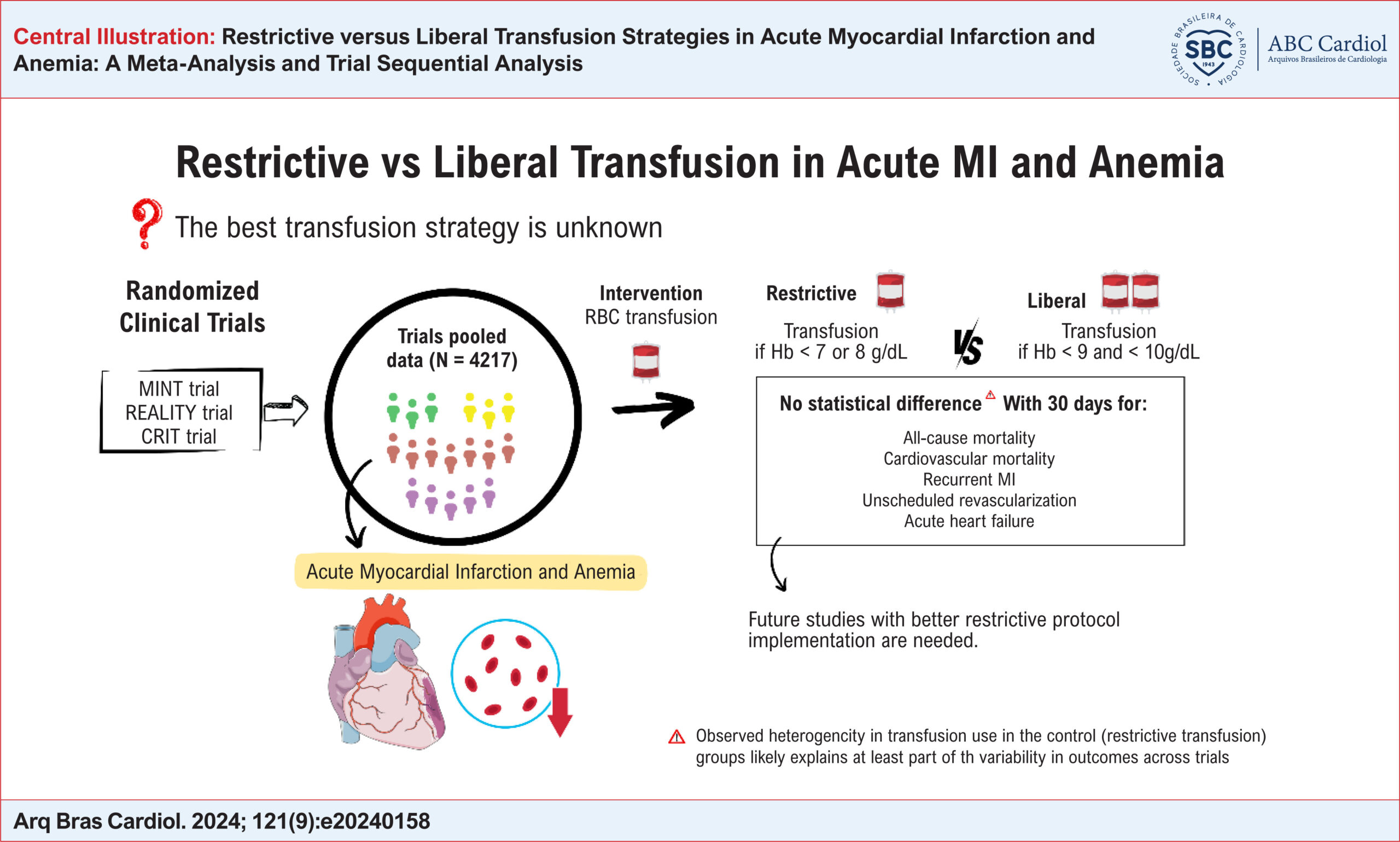
Restrictive versus Liberal Transfusion Strategies in Acute Myocardial Infarction and Anemia: A Meta-Analysis and Trial Sequential Analysis

Ronaldo C. Fabiano et al. Lara Melo Alleh Nogueira Douglas M. Gewehr … Giuliano Generoso Rhanderson Cardoso Marcio S. Bittencourt

Abstract

Background:

The optimal transfusion strategy in acute myocardial infarction (AMI)-associated anemia remains uncertain.

Objectives:

To compare all-cause mortality between liberal versus restrictive transfusion strategies in patients with AMI-associated anemia, using a meta-analytic approach.

Methods:

Pubmed, Embase, and ClinicalTrials.gov were systematically searched for randomized controlled trials (RCTs) comparing liberal and restrictive transfusion strategies in AMI-associated anemia. Random-effects meta-analysis and trial sequential analysis (TSA) were conducted to compare blood use, efficacy, and safety endpoints. The p-values were 2-sided with an α of 0.05.

Results:

In a pooled analysis involving 4,217 participants from three RCTs followed-up for 30 days, no statistically significant differences emerged between restrictive and liberal strategies in all-cause mortality (RR 1.03; 95% CI 0.67–1.57; p=0.90) and other efficacy endpoints (recurrent AMI, unscheduled revascularization, acute heart failure, stroke, and acute kidney injury), as well as in safety endpoints including allergic reactions, infection, and acute lung injury. TSA did not reach futility boundaries. In patients assigned to restrictive strategy, substantial differences in transfusion use were observed across RCTs, correlating with mortality rates, and likely accounting for between-study heterogeneity in treatment effects.

Conclusions:

In patients with AMI-associated anemia, there is no clear superiority between liberal and restrictive transfusion strategies in all-cause mortality or other major outcomes in 30 days. However, the heterogeneity observed in blood use between the restrictive groups likely explains variable findings across RCTs.

  • Anemia
  • blood transfusion
  • Meta-Analysis
  • Myocardial Infarction
Read Full Article
Creative Commons Attribution (CC BY) Creative Commons license
25/10/2024 DOI: 10.36660/abc.20240158i Views 2
Figure 1
Viewpoint

Does Secondary HFpEF Exist? Yes, but it Should not be Called HFpEF

Humberto Villacorta et al. Pedro Schwartzmann

Introduction

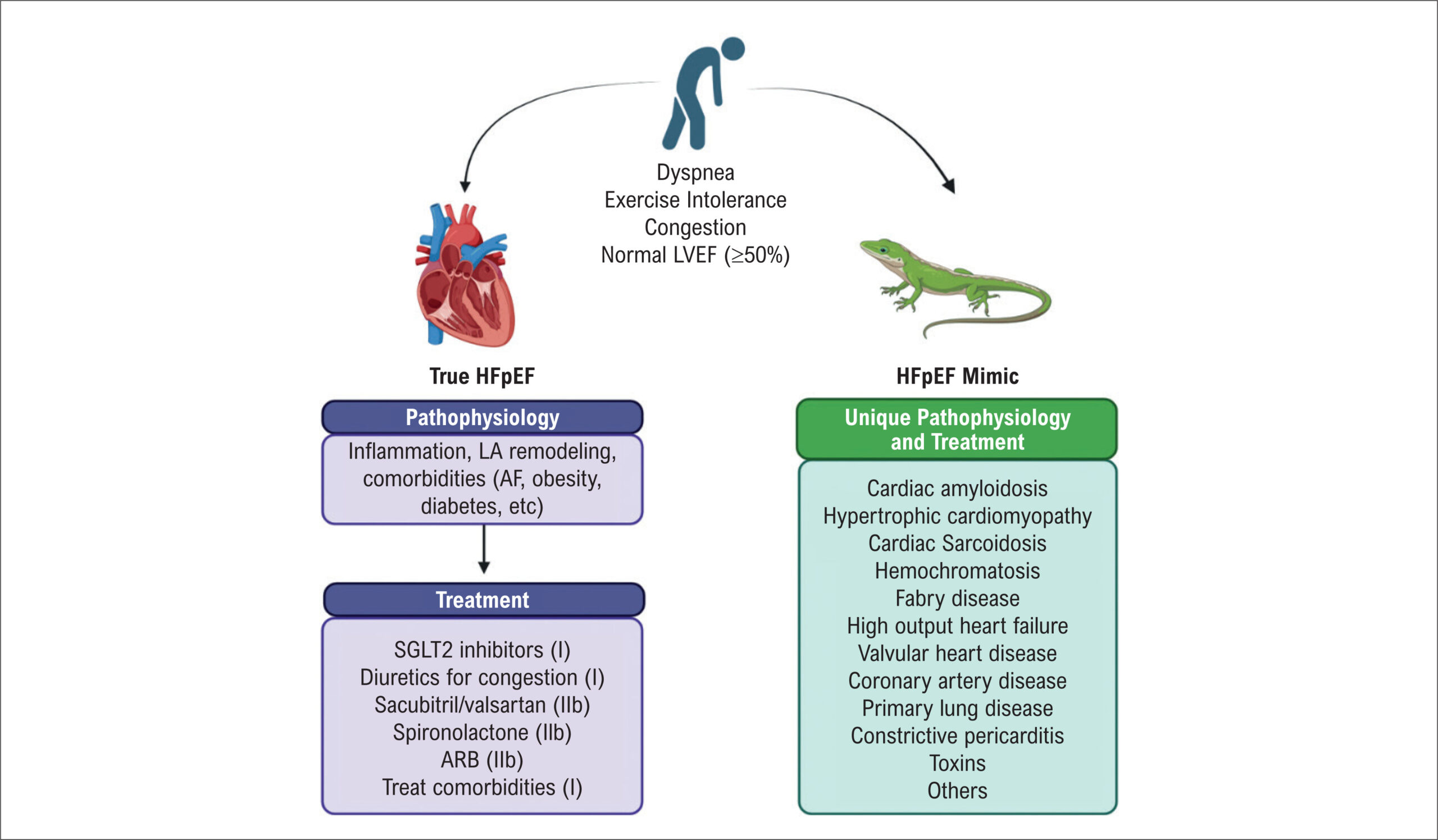
Heart failure with preserved ejection fraction (HFpEF) is defined as a syndrome with symptoms and signs of heart failure (HF) and left ventricular ejection fraction (LVEF) ≥ 50%. This simplistic definition may lead to diagnostic errors by mistaking non-cardiac diseases for HFpEF. The European Society of Cardiology (ESC) offers a more comprehensive definition HFpEF, which requires the presence of symptoms and signs of HF, along with evidence of structural and/or functional cardiac abnormalities, and/or elevated natriuretic peptides, with an LVEF ≥ 50%.

The pathophysiology of HFpEF is not fully understood. Still, it is generally considered a heterogenous and systemic syndrome associated with inflammation, aging, genetic predisposition, and multiple comorbidities, such as hypertension, diabetes mellitus, obesity, and atrial fibrillation. The disease ultimately progresses to loss of left ventricular relaxation, left atrial remodeling, and signs of congestion.

[…]

  • Diastolic Heart Failure
  • Heart Failure
  • Terminology
Read Full Article
Creative Commons Attribution (CC BY) Creative Commons license
25/10/2024 DOI: 10.36660/abc.20240296i Views 1
Guideline for Perioperative Cardiovascular Evaluation of the Brazilian Society of Cardiology – 2024
Diretrizes

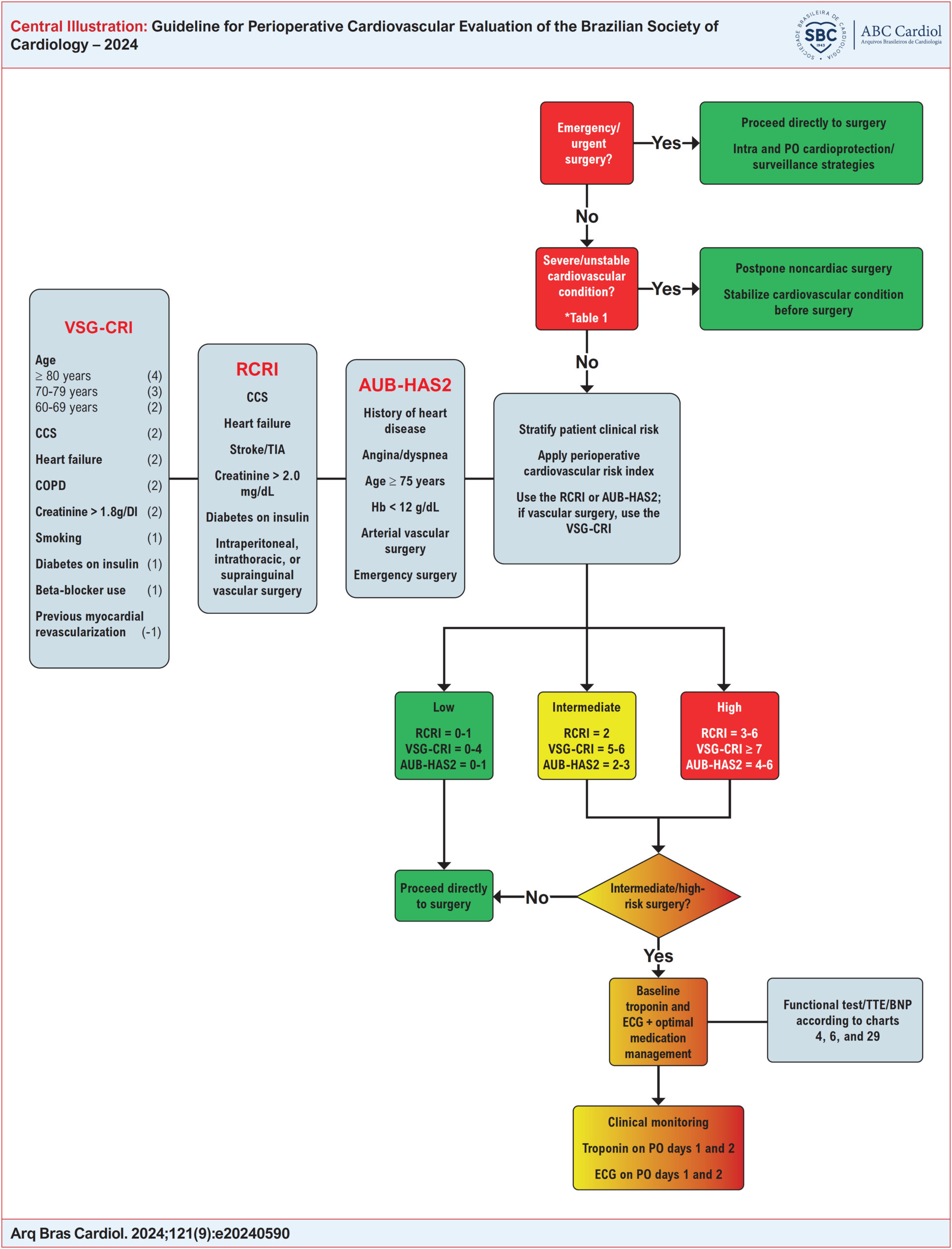
Guideline for Perioperative Cardiovascular Evaluation of the Brazilian Society of Cardiology – 2024

Danielle Menosi Gualandro et al. Luciana Savoy Fornari Bruno Caramelli Alexandre Antonio Cunha Abizaid … Brenno Rizerio Gomes Caio de Assis Moura Tavares Caio Julio Cesar dos Santos Fernandes Carisi Anne Polanczyk Carlos Jardim Carolina Leticia Zilli Vieira Claudio Pinho Daniela Calderaro Dirk Schreen Fabiana Goulart Marcondes-Braga Fábio de Souza Francisco Akira Malta Cardozo Flavio Tarasoutchi Gabriel Assis Lopes Carmo Gabriel Kanhouche José Jayme Galvão de Lima Luciana Dornfeld Bichuette Luciana Sacilotto Luciano Ferreira Drager Luciano Janussi Vacanti Luis Henrique Wolff Gowdak Marcelo Luiz Campos Vieira Marcelo Luiz Floriano Melo Martins Márcio Silva Miguel Lima Marcos Pita Lottenberg Márlon Juliano Romero Aliberti Mauricio Felippi de Sá Marchi Milena Ribeiro Paixão Mucio Tavares de Oliveira Junior Pai Ching Yu Patricia Ramos Cury Pedro Silvio Farsky Ranna Santos Pessoa Rinaldo Focaccia Siciliano Tarso Augusto Duenhas Accorsi Vinícius Machado Correia Wilson Mathias Junior

1. Definition of the Problem

[…]

Read Full Article
Creative Commons Attribution (CC BY) Creative Commons license
21/10/2024 DOI: 10.36660/abc.20240590i Views 2
Central Illustration
Review Article

Cardiomyopathy in Children and Adolescents in the Era of Precision Medicine

Ana Flávia Mallheiros Torbey et al. Raquel Germer Toja Couto Aurea Grippa Eduarda Corrêa Maia … Sara Aimée Miranda Marcos Adriano Cardoso dos Santos Elion Tavares Peres Olimpio Patrick Silva Costa Everton Mattos de Oliveira Evandro Tinoco Mesquita

Abstract

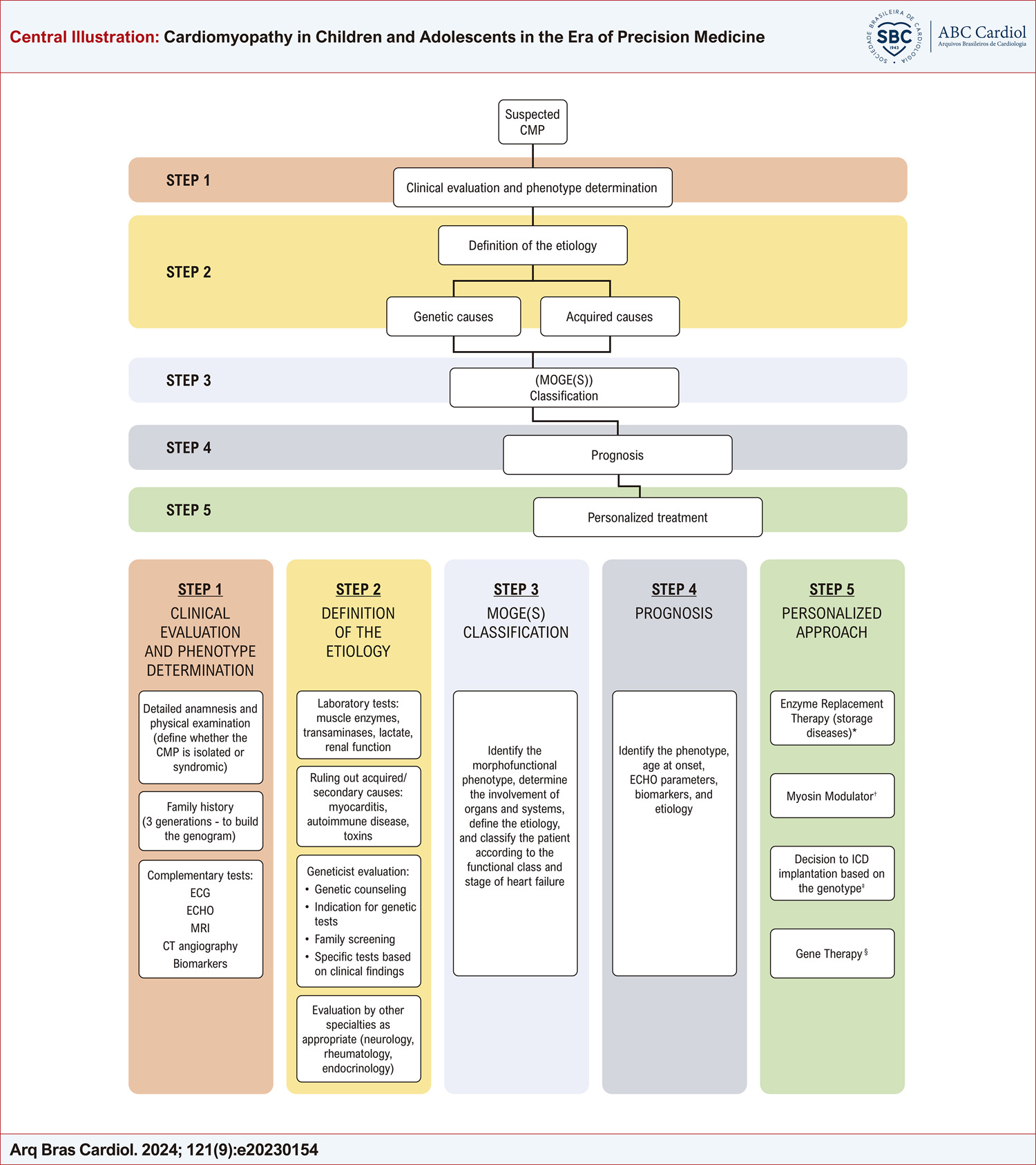
In childhood and adolescence, cardiomyopathies have their own characteristics and are an important cause of heart failure, arrhythmias, sudden death, and indication for heart transplantation. Diagnosis is a challenge in daily practice due to its varied clinical presentation, heterogeneous etiologies, and limited knowledge of tools related to clinical and molecular genetics. However, it is essential to recognize the different phenotypes and prioritize the search for the etiology. Recent advances in precision medicine have made molecular diagnosis accessible, which makes it possible to individualize therapeutic approaches, stratify the prognosis, and identify individuals in the family who are at risk of developing the disease. The objective of this review is to emphasize the particularities of cardiomyopathies in pediatrics and how the individualized approach impacts the therapy and prognosis of the patient. Through a systematized approach, the five-stage protocol used in our service is presented. These stages bring together clinical evaluation for determining the morphofunctional phenotype, identification of etiology, classification, establishment of prognosis, and the search for personalized therapies.

  • Cardiomyopathies
  • Child
  • Genetics
  • Heart Failure
  • Precision Medicine
Read Full Article
Creative Commons Attribution (CC BY) Creative Commons license
21/10/2024 DOI: 10.36660/abc.20230154i Views 1
Figure 1
Case Report

Percutaneous Retrieval of a Vegetation in a Pediatric Patient with Patent Ductus Arteriosus: A New Technique to Avoid Thoracotomy

Miguel Fabian Barrerra-Colín et al. José Luis Colín-Ortiz Carlos Alfonso Corona-Villalobos

Abstract

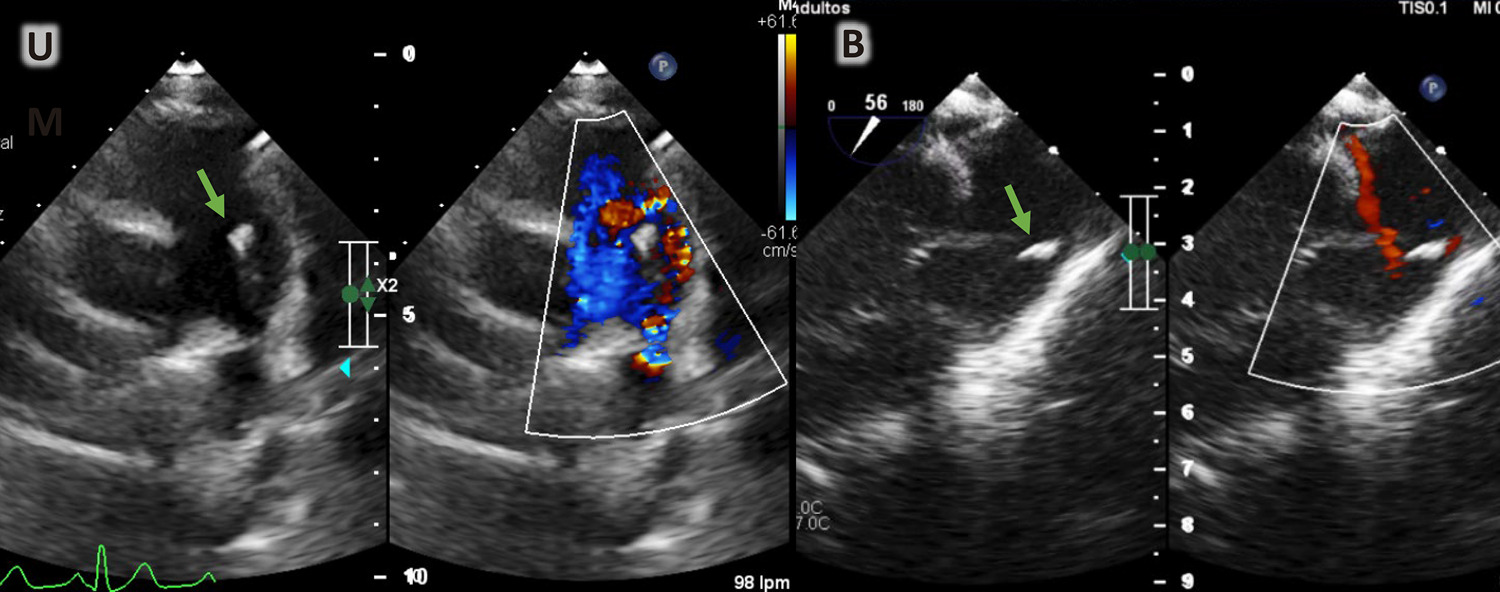
Infective endocarditis in the pediatric population is a rare condition that may or may not be associated with a congenital heart disease. Current treatment modalities are based on long-term antibiotic therapy and surgical resection as the first option for cases of persistent vegetation. We present a case of successful percutaneous retrieval of a vegetation in a patent ductus arteriosus, that extended to the pulmonary artery trunk in a pediatric patient. This is the first report in the literature on this type of extraction of vegetation in the ductus arteriosus without thoracotomy.

  • Child
  • Endocarditis
  • patent ductus arteriosus
  • Percutaneous Coronary Intervention
Read Full Article
Creative Commons Attribution (CC BY) Creative Commons license
21/10/2024 DOI: 10.36660/abc.20240010i Views 3
Editorial

Could Less Be Worth More?

Luiz Maurino Abreu

The use of biologically active products, such as stored blood, in the therapeutic arsenal generates controversy. With the development of hemotherapy, related complications, such as transfusion-transmitted infections, transfusion-related acute lung injury (TRALI), and severe hemolytic reactions, have become rare., However, possible volume overload, with consequent pulmonary edema (transfusion-associated circulatory overload, TACO) and its clinical implications, is associated with a major cause of post-transfusion morbidity and mortality. Predisposing factors for the condition include ischemic cardiomyopathy and chronic kidney disease, often present in the context of acute myocardial infarction (AMI).,

Anemia can worsen myocardial ischemia in AMI, with an impact on mortality. Two main strategies are present in clinical trials in the management of this condition: restrictive transfusion and liberal transfusion. The choice between these approaches remains a controversial topic, with critical implications for clinical practice and patient outcomes.

[…]

  • Anemia
  • blood transfusion
  • Meta-Analysis
  • Myocardial Infarction
Read Full Article
Creative Commons Attribution (CC BY) Creative Commons license
18/10/2024 DOI: 10.36660/abc.20240557i
Prognostic Evaluation of Chagasic and Non-Chagasic Patients Undergoing Pacemaker Implantation and Cardiac Resynchronization in a Tertiary Center
Original Article

Prognostic Evaluation of Chagasic and Non-Chagasic Patients Undergoing Pacemaker Implantation and Cardiac Resynchronization in a Tertiary Center

Laís Toledo de Vasconcelos et al. Larissa Natany Almeida Martins Anna Terra França Fábio Morato de Castilho Antônio Luiz Pinho Ribeiro

Abstract

Background:

Chagas cardiomyopathy (ChCC) is one of the causes of the implantation of pacemakers (PM) in many patients and has been associated with an adverse prognosis.

Objectives:

To compare the prognosis of the chagasic and non-chagasic populations undergoing PM and cardiac resynchronizer implantation.

Methods:

Observational, retrospective study, which analyzed a cohort of patients who underwent implantation of these devices, in a tertiary center, from October 2007 to December 2017, comparing the chagasic group with non-chagasic patients. The non-parametric Kaplan-Meier method was used to calculate patient survival. The significance level adopted in the statistical analysis was 5%. The primary outcome was mortality from any cause, while the secondary outcomes were the occurrence of hospitalization and the combination of hospitalization and death.

Results:

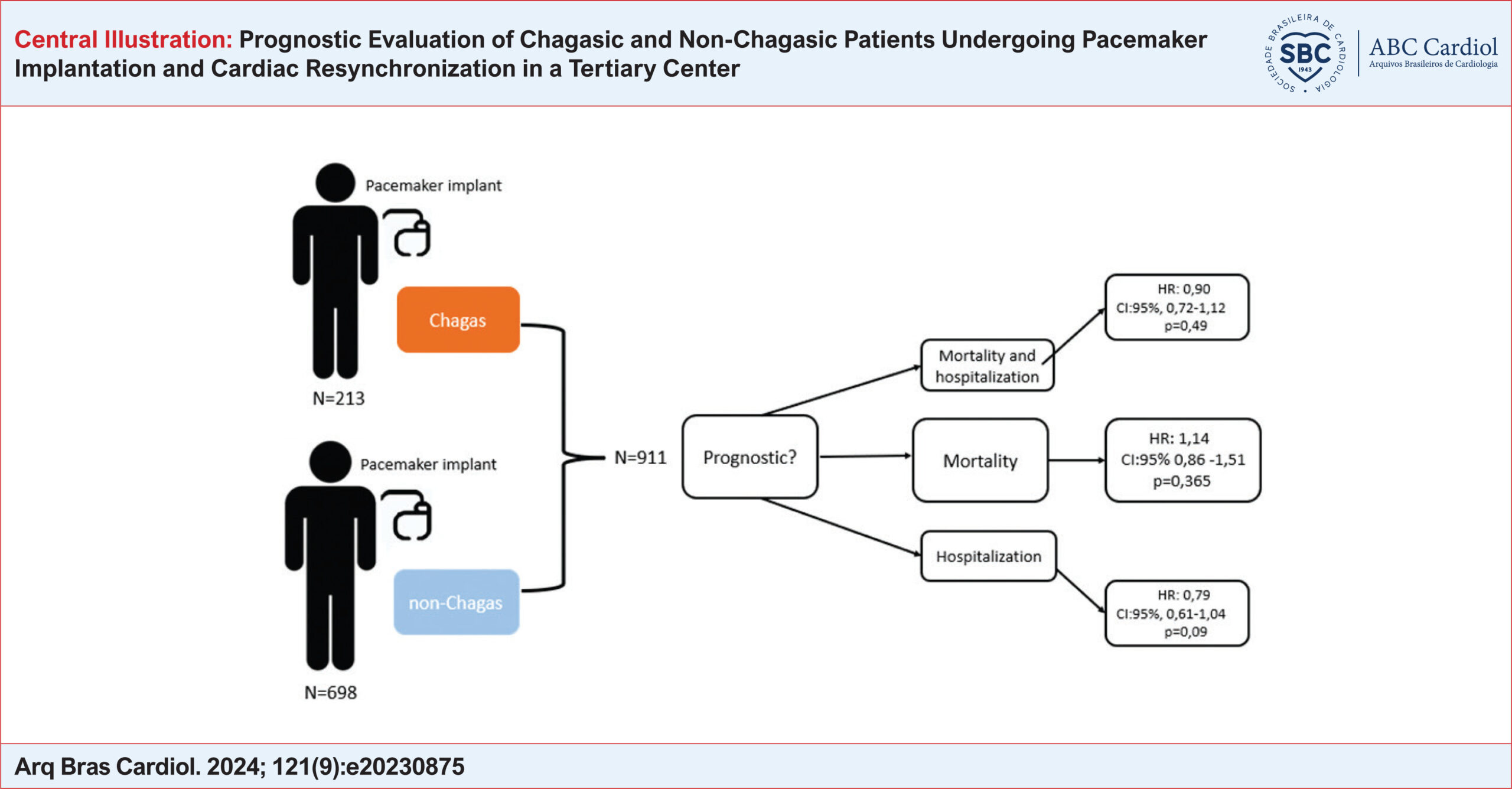
A total of 911 patients were included, of which 23.4% had ChCC. In a Cox analysis adjusted for sex and age, Chagas disease (ChD) was not associated with an increased risk of death (HR: 1.14, CI:95%, 0.86-1.51, p=0.365), hospitalization (HR: 0.79, CI:95%, 0.61-1.04, p=0.09) or combined outcome of death and hospitalization (HR: 0.90, CI:95%, 0.72-1 .12, p=0.49).

Conclusions:

ChD was not associated with an increased risk of death, hospitalization, or combined outcome of death and hospitalization, even after adjustment for sex and age. These results contrast with those of previous studies and suggest changes in the quality of care of patients with cardiomyopathy.

  • Artificial Cardiac Pacing
  • Artificial Pacemaker
  • Chagas Cardiomyopathy
Read Full Article
Creative Commons Attribution (CC BY) Creative Commons license
18/10/2024 DOI: 10.36660/abc.20230875i Views 1
Editorial

Adipose-Derived Mesenchymal Stem Cell Therapy for Ischemic Heart Disease: Safe but Not Effective?

Anurag Jamaiyar et al. Aspasia Tzani

Cardiovascular disease continues to be the leading cause of death in adults globally. Obstructive coronary artery disease involves a gradual narrowing of coronary artery branches due to the build-up of atherosclerotic plaque, leading to reduced blood flow to the myocardium. This myocardial infarction initiates a cascade of pathological processes such as oxidative stress, inflammation, and fibrosis, which eventually lead to heart failure. A heart transplant is sometimes the only viable option for many patients with progressive ischemic heart failure refractory to anti-anginal medication or revascularization. Novel therapeutics such as stem cells, RNAs, CRISPR, growth factors, etc., hold great promise for meeting this clinical need. Stem cells have been tested in pre-clinical studies extensively for many years now. Paracrine factors, instead of differentiation potential, are now widely agreed upon as the most likely cause of their therapeutic effects. Contemporary studies continue to employ either native or genetically reprogrammed stem cells for treating various diseases. Stem cells can be derived from diverse niches in the adult human body, such as blood, bone marrow, fat, skeletal muscle, and more. However, many of these tissues can only be harvested in very small quantities. Also, access to some of them, e.g., bone marrow, requires invasive procedures. Adipose remains one of the most abundant and easily retrievable tissues for this purpose.

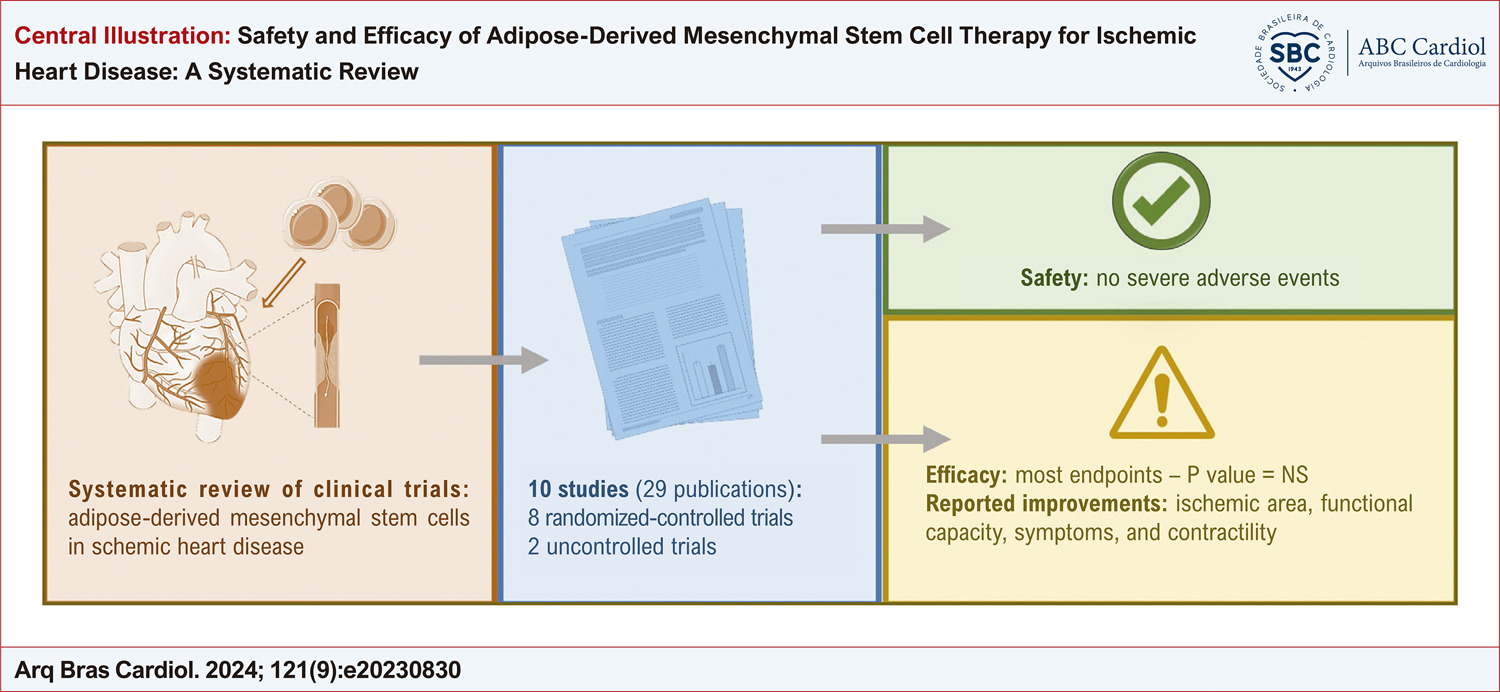
In the current issue, the authors present a systematic review of clinical studies in which adipose-derived stem cells (ADSCs) have been used as a therapeutic for ischemic heart disease (IHD). This review summarizes the safety and efficacy of ADSCs in ten such studies (comprising 29 publications), with 8 randomized controlled clinical trials and 2 uncontrolled trials. The studies reviewed by the authors administered varying numbers of ADSCs (from 400,000 cells in the Athena I trial to 100 million cells in the DANISH and SCIENCE studies. Apart from the AdiFLAP study, which used an adipose patch, these studies administered ADSCs via intramyocardial or intracoronary injections. Follow-up for these trials ranged from 6 months (APOLLO, Kastrup et al.) to 36 months (MyStromalCell and PRECISE). In the early days of stem cell therapy, one of the main safety concerns was teratoma formation. This was largely due to the pluripotent nature of stem cells being tested. As the human body is a complex milieu of growth factors, cytokines, hormones, etc., stem cells could also differentiate into unintended cell types, making stem cell therapy a risky endeavor that could cause more harm than good. In the last decade, these therapies have come of age, with multipotent instead of pluripotent stem cells as candidates.

[…]

  • Cell and Tissue-Based Therapy
  • Mesenchymal Stem Cells
  • Myocardial Infarction
  • systematic review
Read Full Article
Creative Commons Attribution (CC BY) Creative Commons license
18/10/2024 DOI: 10.36660/abc.20240515i
Editorial

Importance of the Correct Definition of Severe Heart Disease in the Prognosis of Individuals Considered with Retirement Due to Disability

Maria Helena Costa de Vasconcelos et al. Andreza Araújo de Oliveira Maria Eduarda da Silva Corrêa João Marcos Bemfica Barbosa Ferreira

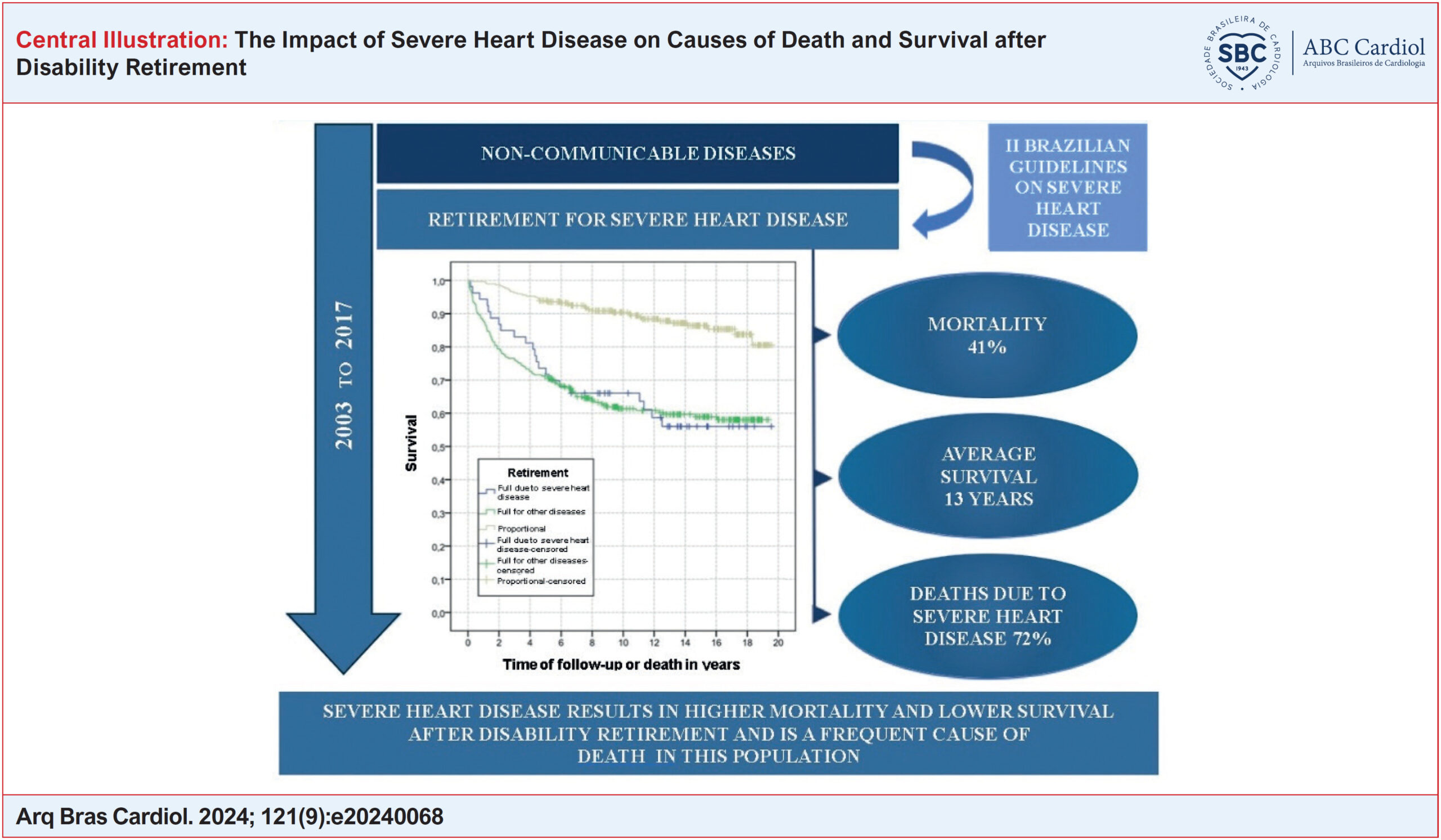
The manuscript “The Impact of Severe Heart Disease on Causes of Death and Survival after Disability Retirement” demonstrates higher mortality in individuals retired due to severe heart disease when compared to those retired for other causes or proportional retirement. Furthermore, it showed coinciding diagnoses between the cause of retirement and death in full retirements due to severe heart disease, demonstrating that serious heart disease plays a fundamental role in the prognosis of retired individuals.

In 2006, the Sociedade Brasileira de Cardiologia published the II Brazilian Guideline on Severe Heart Disease, which standardized the classification of heart diseases as serious or not for expert assessment. The manuscript in question, demonstrating the association of the diagnosis of severe heart disease with a worse long-term prognosis, reinforces the need to define the severity of each patient in their assessment correctly.

[…]

  • Heart Diseases
  • Prognosis
  • Retirement
Read Full Article
Creative Commons Attribution (CC BY) Creative Commons license
18/10/2024 DOI: 10.36660/abc.20240540i Views 1
Editorial

Electrocardiogram as a Predictor of Mortality in Individuals with Pulmonary Hypertension

Frederico José Neves Mancuso

Pulmonary hypertension (PH) is defined as mean pulmonary artery pressure greater than 20 mmHg in invasive assessment by right heart catheterization.,

Guidelines suggest that patients with PH should be stratified according to their prognosis both at the time of diagnosis and throughout follow-up, with emphasis on clinical assessment by functional class, 6-minute walk test, and natriuretic peptide levels.

[…]

  • Electrocardiography
  • Hypertension
  • Pulmonary
Read Full Article
Creative Commons Attribution (CC BY) Creative Commons license
23/09/2024 DOI: 10.36660/abc.20240548i
The Impact of Severe Heart Disease on Causes of Death and Survival after Disability Retirement
Original Article

The Impact of Severe Heart Disease on Causes of Death and Survival after Disability Retirement

Cesar Romaro Pozzobon et al. Gabriel Porto Soares Ronir Raggio Luiz Gláucia Maria Moraes de Oliveira

Abstract

Background:

Noncommunicable diseases contribute to premature deaths and limitations. Disability retirement is linked to chronic conditions, particularly cardiovascular diseases. The II Brazilian Guideline for Severe Heart Disease established criteria for cardiovascular disease classification. However, there is a lack of research in this topic within federal institutions.

Objectives:

Evaluate the survival and causes of death among disabled retirees at UFRJ, focusing on the impact of severe heart disease.

Methods:

A retrospective cohort study based on retirement and death records over 15 years. Retirements were categorized into three groups: full retirement due to severe heart disease, full retirement due to other diseases and proportional. Causes of death were obtained from death certificates. Mortality rates, survival and the presence of matching diagnoses between retirement and death were evaluated. Chi-square, log-rank, Cox models, Kaplan-Meier curves were utilized. Statistical significance with a 95% confidence interval, considering p<0.05.

Results:

There were 630 retirements, 368 (51.4%) in females, with an average age of 52.9 (SD=7.8) years, and 169 (26.8%) deaths. Mortality was higher in professors (37.0%; p=0.113), in the age group between 65 and 70 years (48.4%; p=0.004), in males (34.0%; p=0.001), and in full retirements due to severe heart disease (41.5%; p<0.001). Matching diagnoses between retirement and death were more frequent in professors (74.1%; p=0.026) and in full retirements due to severe heart disease (72.7%; p<0.001).

Conclusions:

Severe heart disease diagnosis is associated with higher mortality and shorter survival in disabled retirees. Its frequent occurrence in retirement and death diagnoses underscores its significance in this context.

  • Heart Diseases
  • Mortality
  • Retirement
  • Survival
Read Full Article
Creative Commons Attribution (CC BY) Creative Commons license
23/09/2024 DOI: 10.36660/abc.20240068i
A Program to Optimize the Detection of Paroxysmal Atrial Fibrillation: The RITMO Study
Original Article

A Program to Optimize the Detection of Paroxysmal Atrial Fibrillation: The RITMO Study

Rodrigo Paashaus de Andrade et al. Priscila Valverde Oliveira Vitorino Ana Luiza Lima Sousa Roberto Dischinger Miranda … Bruno Augusto Alcova Nogueira Elizabeth do Espírito Santo Cestário Marcus Vinícius de Oliveira Luiz Kencis Júnior Fernando Cenci Tormen Pablo de Oliveira Antunes Ivan Di Beo Luiz Eduardo Guiselli Gallina Weimar Kunz Sebba Barroso

Abstract

Background:

Atrial fibrillation (AF) is the most common sustained arrythmia, but still underdiagnosed especially among asymptomatic patients.

Objectives:

To evaluate a simple strategy to optimize the identification of AF.

Methods:

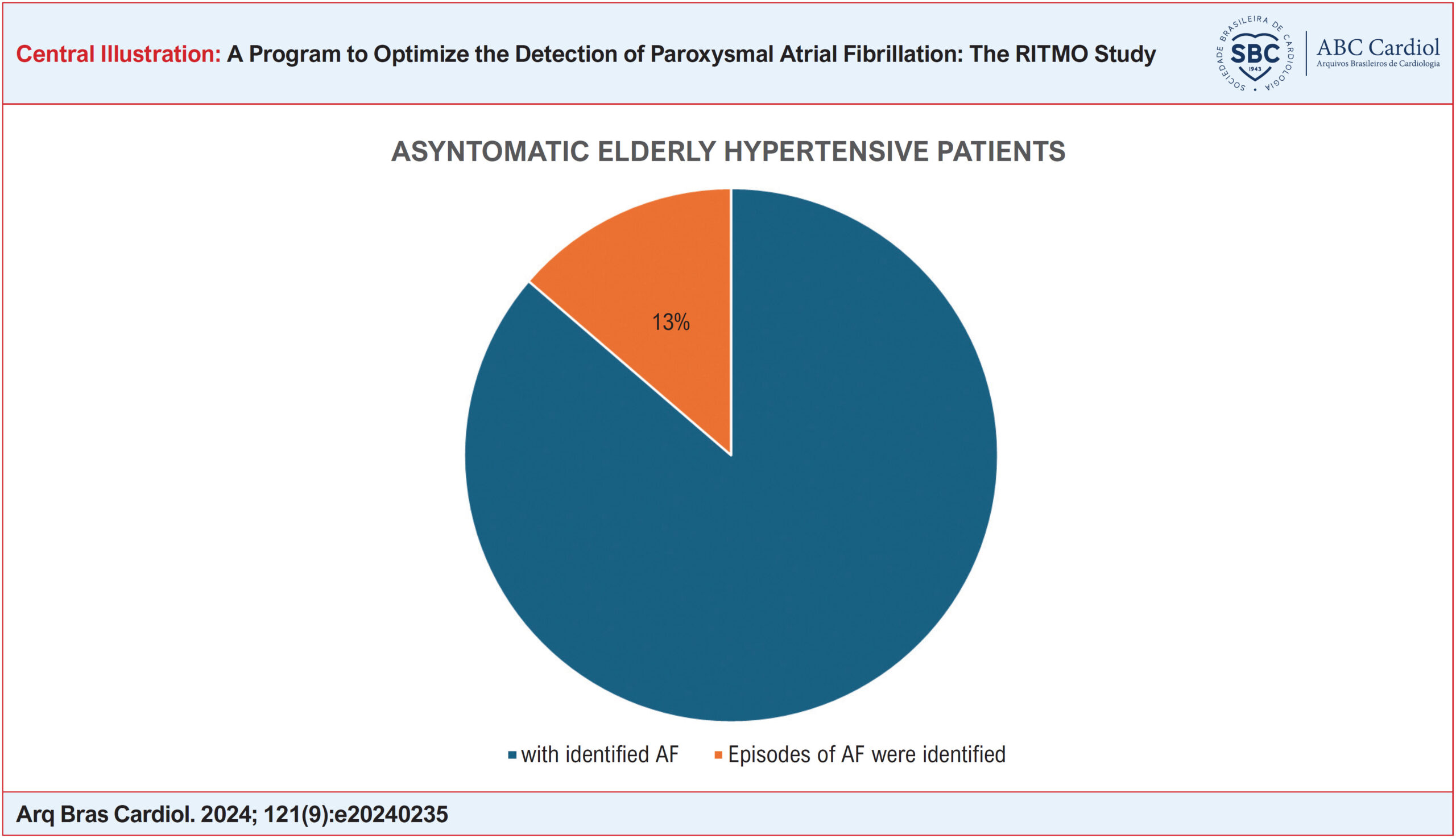
Asymptomatic patients aged 65 years or older, with hypertension or heart failure (HF), were included. Data were inserted into the REDCap software platform. Patients were assessed for the risk for AF using the Stroke Risk Analysis (SRA) mathematical algorithm, which was applied on a one-hour electrocardiogram (ECG). All patients at high risk for AF were instructed to follow a home ECG protocol for seven days using a portable Kardia 6 (OMRON, AliveCor®). The Kolmogorov-test was used to test the normality of quantitative variables; those with normal distribution were expressed as mean and standard deviation. A p<0.05 was set as statistically significant.

Results:

A total of 423 patients were assessed; 15 were excluded due to absence of SRA, yielding a sample of 408 patients. In 13 (3.2%), AF was identified, 120 (29.4%) were considered at high risk and 275 (67.4%) without increased risk for AF. Of the 120 high-risk patients, 111 successfully completed the seven-day protocol with Kardia; at least one episode of AF was identified in 43 patients.

Conclusion:

The strategy adopted in the RITMO study was shown to be effective in identifying AF in asymptomatic elderly patients with hypertension or HF, with an incidence of 13.7% (56/408).

  • Atrial Fibrillation
  • Electrocardiography
  • Heart Failure
  • Hypertension
Read Full Article
Creative Commons Attribution (CC BY) Creative Commons license
23/09/2024 DOI: 10.36660/abc.20240235i Views 2
Ablation of Atrioventricular Nodal Reentrant Tachycardia with Focal Cryoablation, Compared with Radiofrequency Ablation: Single-Center Experience
Original Article

Ablation of Atrioventricular Nodal Reentrant Tachycardia with Focal Cryoablation, Compared with Radiofrequency Ablation: Single-Center Experience

Caner Topaloğlu et al. Francesco Fici Philippe van de Borne Uğur Taşkin … Mustafa Dogdus Serkan Saygi Istemihan Tengiz

Abstract

Background

The ablation of atrioventricular nodal reentrant tachycardia (AVNRT) with cryoablation is an alternative to radiofrequency (RF) ablation in patients due to the low risk of total atrioventricular block. An increase in early-late recurrences after cryoablation is reported as an important disadvantage.

Objectives

In this study, we aimed to compare the acute procedural success and the long-term recurrence rates of patients, with AVNRT who underwent methods.

Methods

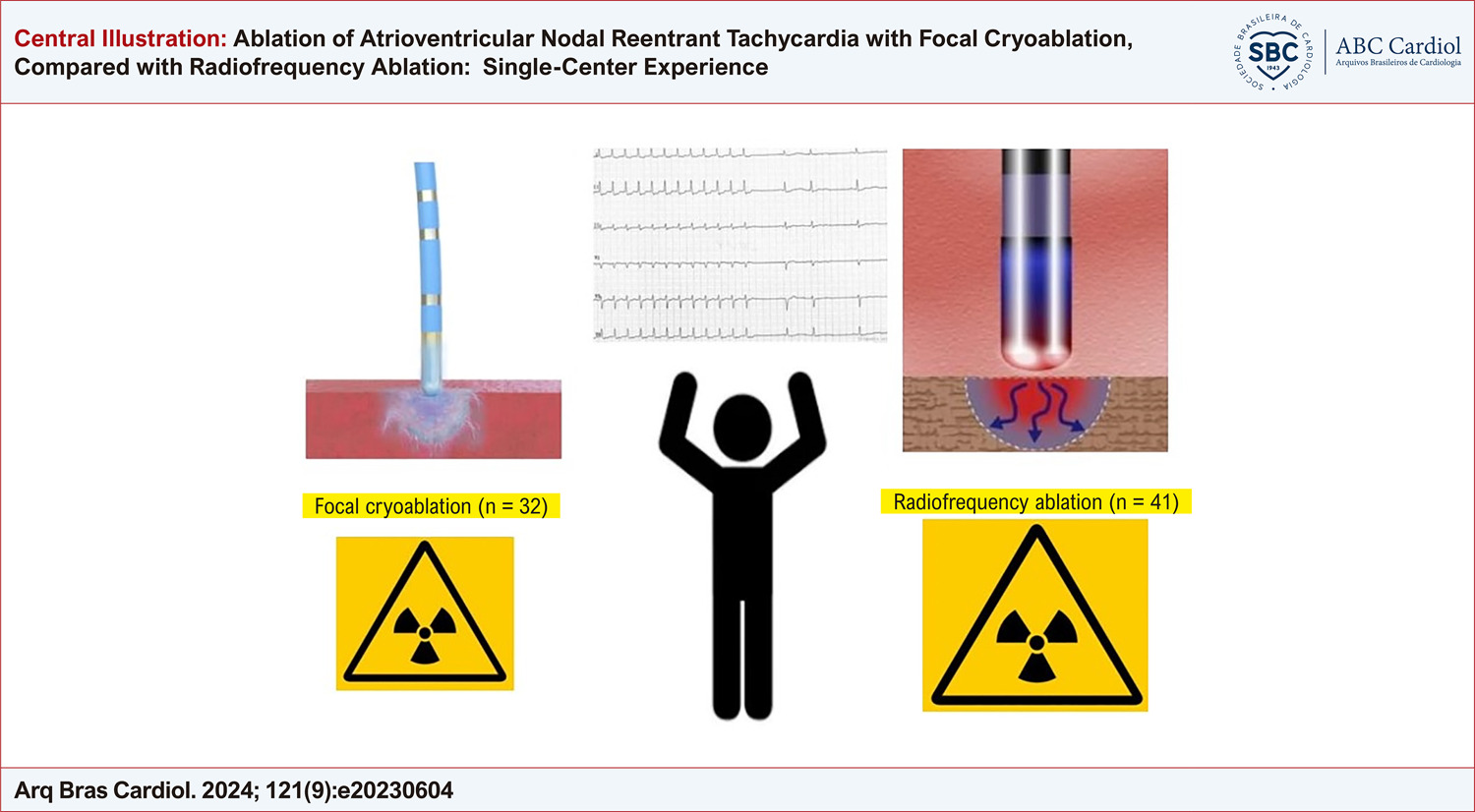
73 patients with AVNRT were included in the study: 32 with cryoablation and 41 with RF ablation. There was no statistically significant difference between acute procedural success in methods. The ablation procedure was performed by an operator experienced in arrhythmology. The choice of RF or cryoablation was made in the electrophysiology laboratory based on the material already available during the procedure. After the procedure, the patients were evaluated every 3 months for 2 years in polyclinic control. The significance level adopted in the statistical analysis was 5%.

Results

The 2 groups of patients were homogeneous. The fluoroscopy time (p<0.001) was shorter, but atrium-his (p=0.004) and his-ventricular (p=0.015) times were longer in the cryoablation group. There was no significant difference, in terms of acute procedural success, post-procedure jump without a single echo, and presence of echo and jump.

Conclusions

Cryoablation requires less fluoroscopy time and is a safe non-inferior alternative to RF ablation in patients with AVNRT. The risk of AV block is a significant problem with the use of RF energy, making it less suitable for use in young and physically active patients.

  • Atrioventricular Nodal Reentry Tachycardia
  • Cryosurgery
  • Radiofrequency Ablation
Read Full Article
Creative Commons Attribution (CC BY) Creative Commons license
23/09/2024 DOI: 10.36660/abc.20230604i Views 1
Polygenic Risk Scores: The Next Step for Improved Risk Stratification in Coronary Artery Disease?
Review Article

Polygenic Risk Scores: The Next Step for Improved Risk Stratification in Coronary Artery Disease?

Ricardo Stein et al. Filipe Ferrari Diego García-Giustiniani

Abstract

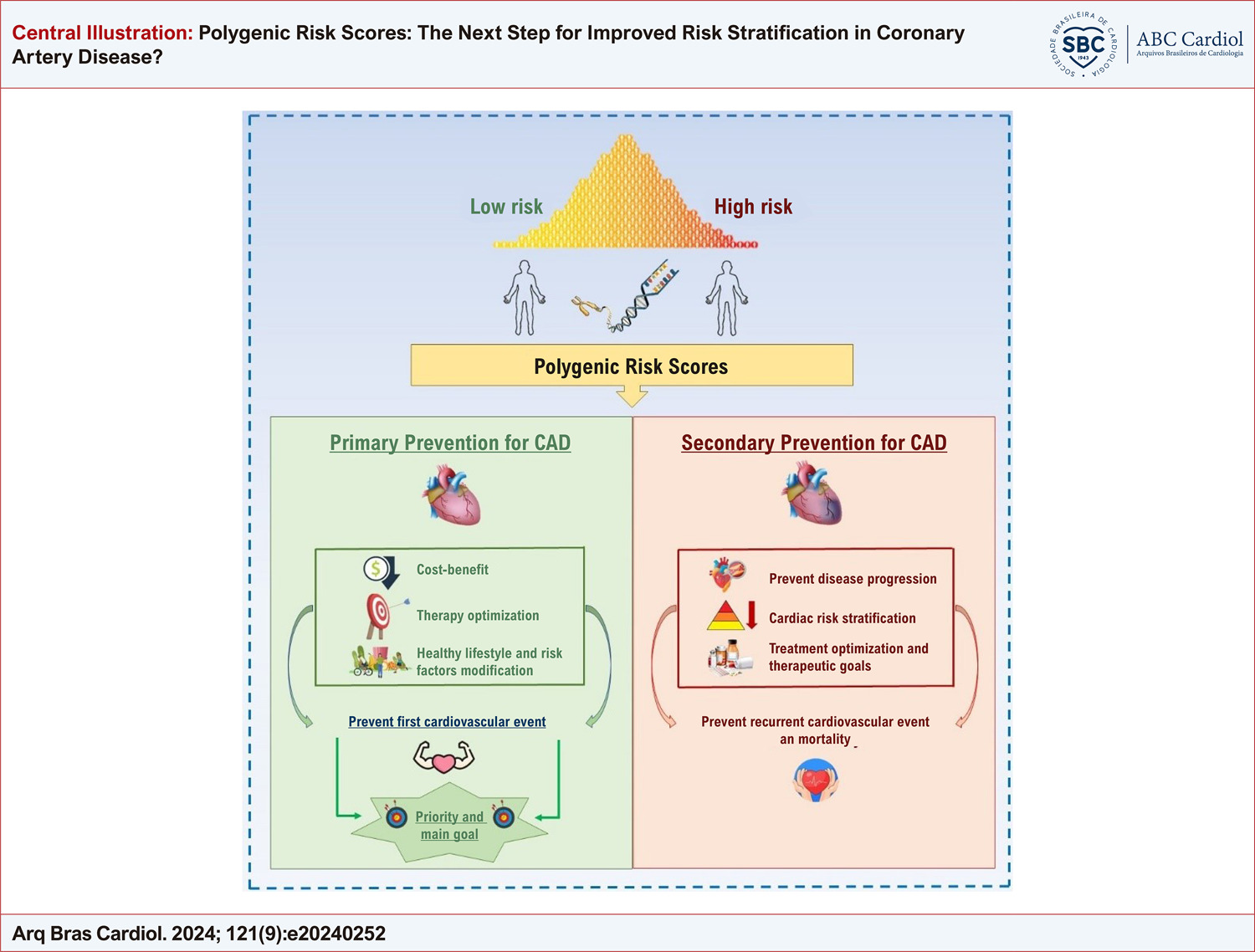
Despite significant advances in the management of coronary artery disease (CAD) and reductions in annual mortality rates in recent decades, this disease remains the leading cause of death worldwide. Consequently, there is an ongoing need for efforts to address this situation. Current clinical algorithms to identify at-risk patients are particularly inaccurate in moderate-risk individuals. For this reason, the need for ancillary tests has been suggested, including predictive genetic screening. As genetic studies rapidly expand and genomic data becomes more accessible, numerous genetic risk scores have been proposed to identify and evaluate an individual’s susceptibility to developing diseases, including CAD. The field of genetics has indeed made substantial contributions to risk prediction, particularly in cases where children have parents with premature CAD, resulting in an increased risk of up to 75%. The polygenic risk scores (PRSs) have emerged as a potentially valuable tool for understanding and stratifying an individual’s genetic risk. The PRS is calculated as a weighted sum of single-nucleotide variants present throughout the human genome, identifiable through genome-wide association studies, and associated with various cardiometabolic diseases. The use of PRSs holds promise, as it enables the development of personalized strategies for preventing or diagnosing specific pathologies early. Furthermore, it can complement existing clinical scores, increasing the accuracy of individual risk prediction. Consequently, the application of PRSs has the potential to impact the costs and adverse outcomes associated with CAD positively. This narrative review provides an overview of the role of PRSs in the context of CAD.

  • Cardiovascular Diseases
  • Coronary Artery Disease
  • Human Genome
  • Risk
Read Full Article
Creative Commons Attribution (CC BY) Creative Commons license
23/09/2024 DOI: 10.36660/abc.20240252i Views 1
Lack of Anticoagulant Use in Patients with Atrial Fibrillation and Increased Risk of Thromboembolic Events According to Sex: Insights from a Multicentric Brazilian Study
Original Article

Lack of Anticoagulant Use in Patients with Atrial Fibrillation and Increased Risk of Thromboembolic Events According to Sex: Insights from a Multicentric Brazilian Study

Emiliano Medei et al. Renata Moll-Bernardes Martha V. T. Pinheiro Andréa S. Sousa … Barbara Abufaiad Andre Feldman Guilherme D’andrea Saba Arruda Thiago Libano Csernik Monteiro Fabio Augusto De Luca Benhur Davi Henz Denilson C. Albuquerque Antonio Aurelio P. Fagundes Junior Marcia M. Noya-Rabelo Angelina Silva Camiletti Rose Mary Frajtag Ronir R. Luiz Olga F. Souza

Abstract

Background

Atrial fibrillation (AF) is the most prevalent cardiac arrhythmia, and its presentation differs according to age and sex. Recent studies have revealed differences in AF among various demographic groups, including the Latin American population.

Objectives

To better understand potential disparities in AF prevalence and treatment strategies in the Brazilian population through data from a large multicentric prospective registry.

Methods

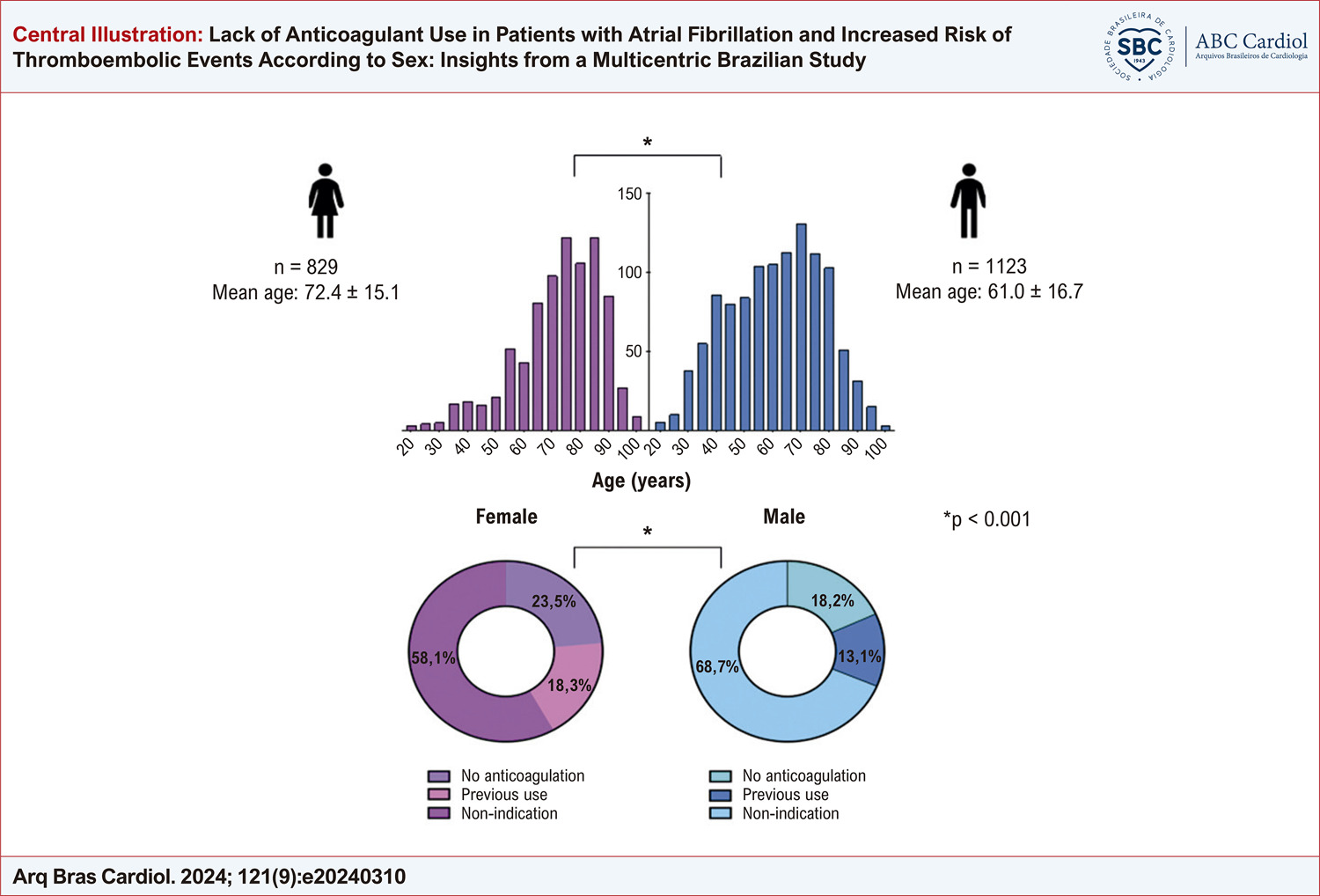
The Rede D’Or AF registry is a multicenter prospective observational study including patients aged ≥ 18 years with AF who were seen in the emergency department of 32 tertiary hospitals in Brazil. Patients were characterized according to sex and other baseline characteristics and were classified according to previous anticoagulant use. The lack of anticoagulant use in patients with previous indications was analyzed. Statistical significance was set at 5%.

Results

The study data were from a total of 1955 patients enrolled. Male sex was more prevalent, and men were younger than the women. Due to an increased prevalence of previous AF episode and a higher CHA2DS2-VASc score, more women had indications for anticoagulant therapy; however, a significant proportion was not receiving this treatment. From 29 in-hospital deaths, 15 patients had previous indication for anticoagulation, but only 3 were using anticoagulants.

Conclusion

This study revealed sex-related differences in the Brazilian population of patients with AF that are consistent with trends in high-income countries. The promotion of better implementation of anticoagulant and antithrombotic therapies to reduce the risk of death and thromboembolic events among women with AF in Brazil is crucial.

  • Anticoagulants
  • Atrial Fibrillation
  • Thromboembolism
Read Full Article
Creative Commons Attribution (CC BY) Creative Commons license
23/09/2024 DOI: 10.36660/abc.20240310i Views 1
Editorial

Look Who is Coming Back? Enhancing Predictive Models for Hospital Readmission Post-CABG: Insights and Perspectives

Stephan Lachtermacher

The field of cardiovascular surgery continually evolves, with coronary artery bypass grafting (CABG) serving as a cornerstone procedure for managing severe coronary artery disease. Despite advancements in surgical techniques and perioperative care, the incidence of hospital readmissions within 30 days post-CABG remains a critical concern. These readmissions not only impact patient outcomes but also strain healthcare resources and increase costs. Understanding predictors of readmission is crucial for improving postoperative care strategies and optimizing patient outcomes.

The study titled ” Predictors of 30-Day Hospital Readmission Following CABG in a Multicenter Database: A Cross-Sectional Study” aims to identify variables associated with early readmission post-CABG in a Brazilian population. While the observed readmission rate was lower than current scientific literature, where rates vary between 8.3% and 21.1%,– it also emphasized non-cardiac-related causes. In this matter, one-third of all readmitted patients had infections as a primary cause. This finding corroborates existing literature highlighting the significant impact of infections, particularly surgical site infections, on readmission rates. Andrade et al. underscore the imperative for stringent infection control measures, including antibiotic prophylaxis and meticulous surgical techniques, to mitigate these complications.,

[…]

  • Myocardial Revascularization
  • Patient Readmission
  • Theoretical Models
Read Full Article
Creative Commons Attribution (CC BY) Creative Commons license
23/09/2024 DOI: 10.36660/abc.20240493i Views 1
Safety and Efficacy of Adipose-Derived Mesenchymal Stem Cell Therapy for Ischemic Heart Disease: A Systematic Review
Original Article

Safety and Efficacy of Adipose-Derived Mesenchymal Stem Cell Therapy for Ischemic Heart Disease: A Systematic Review

Fernando Rabioglio Giugni et al. Melina de Oliveira Valdo Giugni Henrique Trombini Pinesi Fabio Cetinic Habrum … Lígia Nasi Laranjeira Erica Regina Ribeiro Sady Erica Aranha Suzumura Luis Henrique Wolff Gowdak José Eduardo Krieger

Abstract

Background

Cell therapy using adipose-derived mesenchymal stem cells (ADSCs) shows great potential as a treatment for cardiovascular diseases.

Objective

We conducted a systematic review to describe the safety and efficacy of ADSCs in ischemic heart disease.

Methods

We searched PubMed/MEDLINE, EMBASE, Web of Science, CENTRAL, and LILACS (from inception to March 2024) for clinical studies involving ADSCs in patients with ischemic heart disease. We excluded studies involving patients with other types of heart disease, studies using mesenchymal stem cells derived from other tissues, as well as ongoing studies. Two independent reviewers screened the retrieved citations, extracted relevant data, and assessed the risk of bias in the included trials, using the Cochrane Collaboration criteria modified by McMaster University and Methodological Index for Non-Randomized Studies (MINORS). We used a narrative synthesis to present the results.

Results

Ten studies (comprising 29 publications) met our inclusion criteria, including 8 randomized controlled trials and 2 uncontrolled trials. No severe adverse events associated with ADSC therapy were reported. While most efficacy endpoints did not reach statistical significance, there were reports of improved ischemic area, functional capacity, symptoms, and contractility in patients treated with ADSCs.

Conclusions

The findings from our review suggest that ADSC therapy is generally safe for patients with ischemic heart disease. However, further investigation is warranted to confirm its efficacy, particularly with larger clinical trials and in specific conditions where improvements in microcirculation may have a notable impact on clinical outcomes.

  • Cell and Tissue-Based Therapy
  • Mesenchymal Stem Cells
  • Myocardial Ischemia
  • Regenerative Medicine
Read Full Article
Creative Commons Attribution (CC BY) Creative Commons license
16/09/2024 DOI: 10.36660/abc.20230830i Views 2
Electrocardiographic Prognostic Marker in Pulmonary Arterial Hypertension: RS Time
Original Article

Electrocardiographic Prognostic Marker in Pulmonary Arterial Hypertension: RS Time

Emin Koyun et al. Anil Sahin Ahmet Yilmaz Ferhat Dindas … Idris Bugra Cerik Gorkem Berna Koyun

Abstract

Background:

Pulmonary hypertension is a condition that involves the remodeling of the right ventricle. Ongoing remodeling is also associated with disease prognosis. During the restructuring process, complex changes such as hypertrophy and dilatation may also be reflected in electrocardiographic parameters.

Objectives:

Our study aimed to investigate the relationship between prognosis and electrocardiographic parameters in patients with pulmonary arterial hypertension.

Methods:

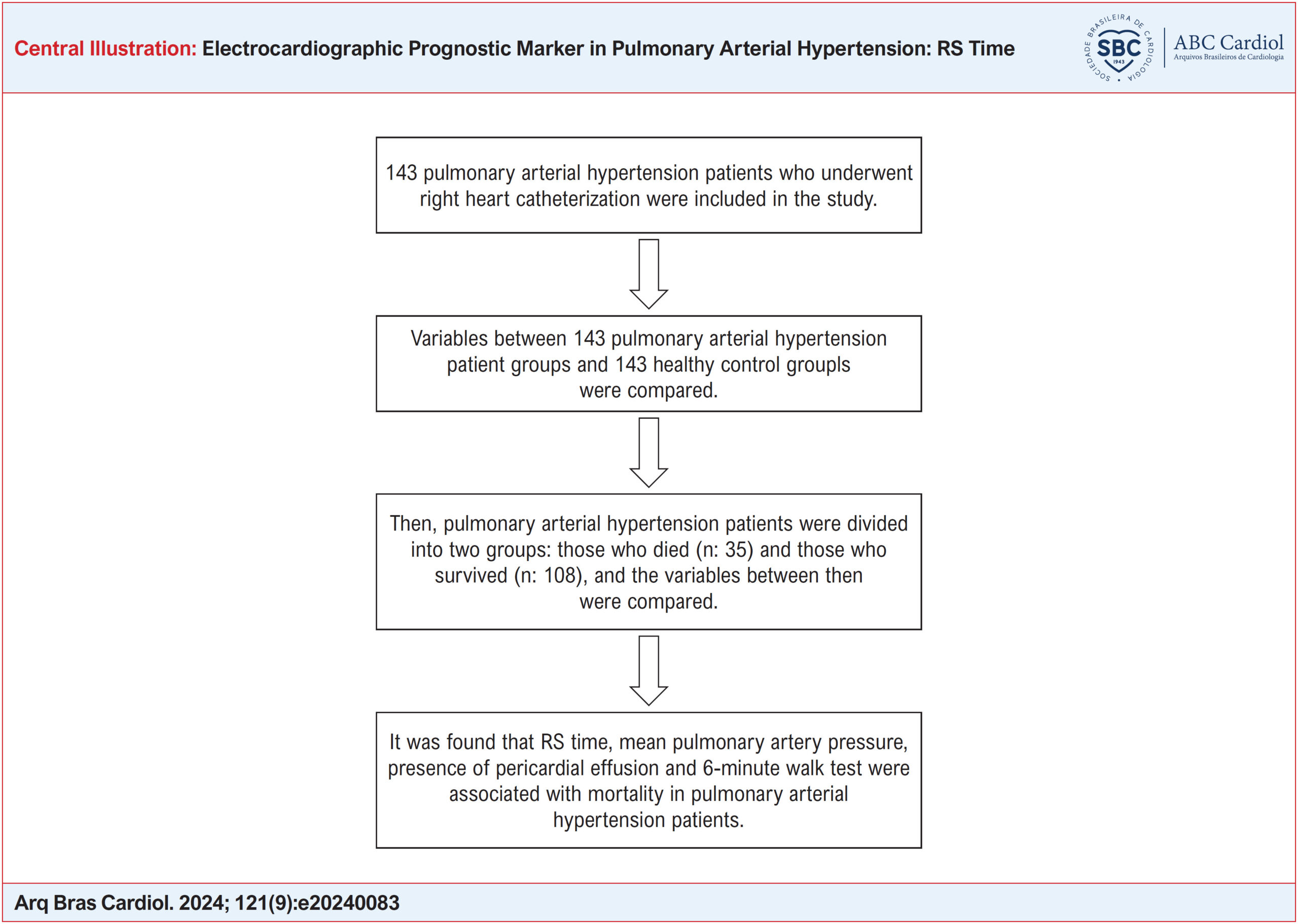
The study was designed retrospectively and included patients diagnosed with pulmonary arterial hypertension between 2010 and 2022. The patients were divided into two groups based on their survival outcome. Various parameters, including electrocardiographic, demographic, echocardiographic, catheter, and blood parameters, were compared between the two groups. A p-value of <0.05 was considered statistically significant.

Results:

In the multivariate Cox analyses, the parameters that were found to be independently associated with survival were the 6-minute walk test, mean pulmonary artery pressure, presence of pericardial effusion, and time between the beginning of the QRS and the peak of the S wave (RS time) (p<0.05 for each). Of all the parameters, RS time demonstrated the best diagnostic performance (AUC:0.832). In the survival analysis, a significant correlation was found between RS time and survival when using a cut-off value of 59.5 ms (HR: 0.06 [0.02-0.17], p < 0.001).

Conclusions:

According to the results of our study, a longer RS time is associated with poor prognosis in patients with pulmonary arterial hypertension. We can obtain information about the course of the disease with a simple, non-invasive parameter.

  • Electrocardiography
  • Prognosis
  • Pulmonary Hypertension
Read Full Article
Creative Commons Attribution (CC BY) Creative Commons license
06/09/2024 DOI: 10.36660/abc.20240083i Views 1

Could not load more articles. Please try again.

How to cite this article

EndNote RIS

Electronic Document Format (Vancouver)

Darrieux F, Wu TC. Artificial Intelligence Methods for Detecting Asymptomatic Atrial Fibrillation. An Opportunity for New Prevention Approaches and the Role of the Doctor’s Eye. Arquivos Brasileiros de Cardiologia 2024;121(9):e20240662.

Electronic Document Format (ABNT)

Darrieux, Francisco; Wu, Tan Chen. Artificial Intelligence Methods for Detecting Asymptomatic Atrial Fibrillation. An Opportunity for New Prevention Approaches and the Role of the Doctor’s Eye. Arquivos Brasileiros de Cardiologia, v. 121, n. 9, e20240662, Dec. 2024.

Electronic Document Format (APA)

Darrieux, F., & Wu, T. C. (2024). Artificial Intelligence Methods for Detecting Asymptomatic Atrial Fibrillation. An Opportunity for New Prevention Approaches and the Role of the Doctor’s Eye. Arquivos Brasileiros de Cardiologia, 121(9), e20240662.

Electronic Document Format (ISO)

Darrieux, Francisco and Wu, Tan Chen. Artificial Intelligence Methods for Detecting Asymptomatic Atrial Fibrillation. An Opportunity for New Prevention Approaches and the Role of the Doctor’s Eye. Arquivos Brasileiros de Cardiologia [online]. 2024, vol. 121, n. 9, [cited 2026-10-14], e20240662. Available from: <https://journals.cardiol.br/en/article/artificial-intelligence-methods-for-detecting-asymptomatic-atrial-fibrillation-an-opportunity-for-new-prevention-approaches-and-the-role-of-the-doctors-eye/>. ISSN 0066-782X

EndNote RIS

Electronic Document Format (Vancouver)

Andrade FA. Cardiac Implantable Electronic Devices in Chagasic and Non-Chagasic Patients: A Critical Look at the Prognosis. Arquivos Brasileiros de Cardiologia 2024;121(9):e20240629.

Electronic Document Format (ABNT)

Andrade, Fernanda Almeida. Cardiac Implantable Electronic Devices in Chagasic and Non-Chagasic Patients: A Critical Look at the Prognosis. Arquivos Brasileiros de Cardiologia, v. 121, n. 9, e20240629, Dec. 2024.

Electronic Document Format (APA)

Andrade, F. A. (2024). Cardiac Implantable Electronic Devices in Chagasic and Non-Chagasic Patients: A Critical Look at the Prognosis. Arquivos Brasileiros de Cardiologia, 121(9), e20240629.

Electronic Document Format (ISO)

Andrade, Fernanda Almeida. Cardiac Implantable Electronic Devices in Chagasic and Non-Chagasic Patients: A Critical Look at the Prognosis. Arquivos Brasileiros de Cardiologia [online]. 2024, vol. 121, n. 9, [cited 2026-10-14], e20240629. Available from: <https://journals.cardiol.br/en/article/cardiac-implantable-electronic-devices-in-chagasic-and-non-chagasic-patients-a-critical-look-at-the-prognosis/>. ISSN 0066-782X

EndNote RIS

Electronic Document Format (Vancouver)

Martins AVV, Krul LT, Drager LF. Sleep Duration, Genetics, and Atherosclerosis: Challenges and Opportunities. Arquivos Brasileiros de Cardiologia 2024;121(9):e20240593.

Electronic Document Format (ABNT)

Martins, Ana Vitoria Vitoreti; Krul, Larissa T.; Drager, Luciano F.. Sleep Duration, Genetics, and Atherosclerosis: Challenges and Opportunities. Arquivos Brasileiros de Cardiologia, v. 121, n. 9, e20240593, Nov. 2024.

Electronic Document Format (APA)

Martins, A. V. V., Krul, L. T., & Drager, L. F. (2024). Sleep Duration, Genetics, and Atherosclerosis: Challenges and Opportunities. Arquivos Brasileiros de Cardiologia, 121(9), e20240593.

Electronic Document Format (ISO)

Martins, Ana Vitoria Vitoreti and Krul, Larissa T. and Drager, Luciano F.. Sleep Duration, Genetics, and Atherosclerosis: Challenges and Opportunities. Arquivos Brasileiros de Cardiologia [online]. 2024, vol. 121, n. 9, [cited 2026-10-14], e20240593. Available from: <https://journals.cardiol.br/en/article/sleep-duration-genetics-and-atherosclerosis-challenges-and-opportunities/>. ISSN 0066-782X

EndNote RIS

Electronic Document Format (Vancouver)

Elias Neto J, Gomes FLT. Women and Atrial Fibrillation: Is the Disparity in Anticoagulation Just a Question of Gender? In Search of the Brazilian Reality. Arquivos Brasileiros de Cardiologia 2024;121(9):e20240583.

Electronic Document Format (ABNT)

Elias Neto, Jorge; Gomes, Fernando Luiz Torres. Women and Atrial Fibrillation: Is the Disparity in Anticoagulation Just a Question of Gender? In Search of the Brazilian Reality. Arquivos Brasileiros de Cardiologia, v. 121, n. 9, e20240583, Nov. 2024.

Electronic Document Format (APA)

Elias Neto, J., & Gomes, F. L. T. (2024). Women and Atrial Fibrillation: Is the Disparity in Anticoagulation Just a Question of Gender? In Search of the Brazilian Reality. Arquivos Brasileiros de Cardiologia, 121(9), e20240583.

Electronic Document Format (ISO)

Elias Neto, Jorge and Gomes, Fernando Luiz Torres. Women and Atrial Fibrillation: Is the Disparity in Anticoagulation Just a Question of Gender? In Search of the Brazilian Reality. Arquivos Brasileiros de Cardiologia [online]. 2024, vol. 121, n. 9, [cited 2026-10-14], e20240583. Available from: <https://journals.cardiol.br/en/article/women-and-atrial-fibrillation-is-the-disparity-in-anticoagulation-just-a-question-of-gender-in-search-of-the-brazilian-reality/>. ISSN 0066-782X

EndNote RIS

Electronic Document Format (Vancouver)

Magalhães TA, Carneiro ACC, Moreira VM, Trad HS, Lopes MMU, Cerci RJ, Nacif MS, et al. Cardiovascular Computed Tomography and Magnetic Resonance Imaging Guideline of the Brazilian Society of Cardiology and the Brazilian College of Radiology – 2024. Arquivos Brasileiros de Cardiologia 2024;121(9):e20240608.

Electronic Document Format (ABNT)

Magalhães, Tiago Augusto; Carneiro, Adriano Camargo de Castro; Moreira, Valéria de Melo; Trad, Henrique Simão; Lopes, Marly Maria Uellendahl; Cerci, Rodrigo Julio; Nacif, Marcelo Souto; Schvartzman, Paulo R.; Chagas, Antônio Carlos Palandrini; Costa, Isabela Bispo Santos da Silva; Schmidt, André; Shiozaki, Afonso Akio; Montenegro, Sérgio Tavares; Piegas, Leopoldo Soares; Zapparoli, Marcelo; Nicolau, José Carlos; Fernandes, Fabio; Hadlich, Marcelo Souza; Ghorayeb, Nabil; Mesquita, Evandro Tinoco; Gonçalves, Luiz Flávio Galvão; Ramires, Felix José Alvarez; Fernandes, Juliano de Lara; Schwartzmann, Pedro Vellosa; Rassi, Salvador; Torreão, Jorge Andion; Mateos, José Carlos Pachón; Beck-da-Silva, Luiz; Silva, Marly Conceição; Liberato, Gabriela; Oliveira, Gláucia Maria Moraes de; Feitosa Filho, Gilson Soares; Carvalho, Hilka dos Santos Moraes de; Markman Filho, Brivaldo; Rocha, Ricardo Paulo de Sousa; Azevedo Filho, Clerio Francisco de; Taratsoutchi, Flávio; Coelho-Filho, Otavio Rizzi; Kalil Filho, Roberto; Hajjar, Ludhmila Abrahão; Ishikawa, Walther Yoshiharu; Melo, Cíntia Acosta; Jatene, Ieda Biscegli; Albuquerque, Andrei Skromov de; Rimkus, Carolina de Medeiros; Silva, Paulo Savoia Dias da; Vieira, Thiago Dieb Ristum; Jatene, Fabio Biscegli; Azevedo, Guilherme Sant Anna Antunes de; Santos, Raul D.; Monte, Guilherme Urpia; Ramires, José Antonio Franchini; Bittencourt, Marcio Sommer; Avezum, Alvaro; Silva, Leonardo Sara da; Abizaid, Alexandre; Gottlieb, Ilan; Precoma, Dalton Bertolim; Szarf, Gilberto; Sousa, Antônio Carlos Sobral; Pinto, Ibraim Masciarelli Francisco; Medeiros, Fábio de Morais; Caramelli, Bruno; Parga Filho, José Rodrigues; Santos, Tiago Senra Garcia dos; Prazeres, Carlos Eduardo Elias dos; Lopes, Marcelo Antonio Cartaxo Queiroga; Avila, Luiz Francisco Rodrigues de; Scanavacca, Mauricio Ibrahim; Gowdak, Luis Henrique Wolff; Barberato, Silvio Henrique; Nomura, Cesar Higa; Rochitte, Carlos Eduardo. Cardiovascular Computed Tomography and Magnetic Resonance Imaging Guideline of the Brazilian Society of Cardiology and the Brazilian College of Radiology – 2024. Arquivos Brasileiros de Cardiologia, v. 121, n. 9, e20240608, Oct. 2024.

Electronic Document Format (APA)

Magalhães, T. A., Carneiro, A. C. C., Moreira, V. M., Trad, H. S., Lopes, M. M. U., Cerci, R. J., Nacif, M. S., Schvartzman, P. R., Chagas, A. C. P., Costa, I. B. S. S., Schmidt, A., Shiozaki, A. A., Montenegro, S. T., Piegas, L. S., Zapparoli, M., Nicolau, J. C., Fernandes, F., Hadlich, M. S., Ghorayeb, N., Mesquita, E. T., Gonçalves, L. F. G., Ramires, F. J. A., Fernandes, J. L., Schwartzmann, P. V., Rassi, S., Torreão, J. A., Mateos, J. C. P., Beck-da-Silva, L., Silva, M. C., Liberato, G., Oliveira, G. M. M. , Feitosa Filho, G. S., Carvalho, H. S. M. , Markman Filho, B., Rocha, R. P. S., Azevedo Filho, C. F. , Taratsoutchi, F., Coelho-Filho, O. R., Kalil Filho, R., Hajjar, L. A., Ishikawa, W. Y., Melo, C. A., Jatene, I. B., Albuquerque, A. S. , Rimkus, C. M., Silva, P. S. D. , Vieira, T. D. R., Jatene, F. B., Azevedo, G. S. A. A. , Santos, R. D., Monte, G. U., Ramires, J. A. F., Bittencourt, M. S., Avezum, A., Silva, L. S. , Abizaid, A., Gottlieb, I., Precoma, D. B., Szarf, G., Sousa, A. C. S., Pinto, I. M. F., Medeiros, F. M., Caramelli, B., Parga Filho, J. R., Santos, T. S. G. , Prazeres, C. E. E. , Lopes, M. A. C. Q., Avila, L. F. R. , Scanavacca, M. I., Gowdak, L. H. W., Barberato, S. H., Nomura, C. H., & Rochitte, C. E. (2024). Cardiovascular Computed Tomography and Magnetic Resonance Imaging Guideline of the Brazilian Society of Cardiology and the Brazilian College of Radiology – 2024. Arquivos Brasileiros de Cardiologia, 121(9), e20240608.

Electronic Document Format (ISO)

Magalhães, Tiago Augusto and Carneiro, Adriano Camargo de Castro and Moreira, Valéria de Melo and Trad, Henrique Simão and Lopes, Marly Maria Uellendahl and Cerci, Rodrigo Julio and Nacif, Marcelo Souto and Schvartzman, Paulo R. and Chagas, Antônio Carlos Palandrini and Costa, Isabela Bispo Santos da Silva and Schmidt, André and Shiozaki, Afonso Akio and Montenegro, Sérgio Tavares and Piegas, Leopoldo Soares and Zapparoli, Marcelo and Nicolau, José Carlos and Fernandes, Fabio and Hadlich, Marcelo Souza and Ghorayeb, Nabil and Mesquita, Evandro Tinoco and Gonçalves, Luiz Flávio Galvão and Ramires, Felix José Alvarez and Fernandes, Juliano de Lara and Schwartzmann, Pedro Vellosa and Rassi, Salvador and Torreão, Jorge Andion and Mateos, José Carlos Pachón and Beck-da-Silva, Luiz and Silva, Marly Conceição and Liberato, Gabriela and Oliveira, Gláucia Maria Moraes de and Feitosa Filho, Gilson Soares and Carvalho, Hilka dos Santos Moraes de and Markman Filho, Brivaldo and Rocha, Ricardo Paulo de Sousa and Azevedo Filho, Clerio Francisco de and Taratsoutchi, Flávio and Coelho-Filho, Otavio Rizzi and Kalil Filho, Roberto and Hajjar, Ludhmila Abrahão and Ishikawa, Walther Yoshiharu and Melo, Cíntia Acosta and Jatene, Ieda Biscegli and Albuquerque, Andrei Skromov de and Rimkus, Carolina de Medeiros and Silva, Paulo Savoia Dias da and Vieira, Thiago Dieb Ristum and Jatene, Fabio Biscegli and Azevedo, Guilherme Sant Anna Antunes de and Santos, Raul D. and Monte, Guilherme Urpia and Ramires, José Antonio Franchini and Bittencourt, Marcio Sommer and Avezum, Alvaro and Silva, Leonardo Sara da and Abizaid, Alexandre and Gottlieb, Ilan and Precoma, Dalton Bertolim and Szarf, Gilberto and Sousa, Antônio Carlos Sobral and Pinto, Ibraim Masciarelli Francisco and Medeiros, Fábio de Morais and Caramelli, Bruno and Parga Filho, José Rodrigues and Santos, Tiago Senra Garcia dos and Prazeres, Carlos Eduardo Elias dos and Lopes, Marcelo Antonio Cartaxo Queiroga and Avila, Luiz Francisco Rodrigues de and Scanavacca, Mauricio Ibrahim and Gowdak, Luis Henrique Wolff and Barberato, Silvio Henrique and Nomura, Cesar Higa and Rochitte, Carlos Eduardo. Cardiovascular Computed Tomography and Magnetic Resonance Imaging Guideline of the Brazilian Society of Cardiology and the Brazilian College of Radiology – 2024. Arquivos Brasileiros de Cardiologia [online]. 2024, vol. 121, n. 9, [cited 2026-10-14], e20240608. Available from: <https://journals.cardiol.br/en/article/cardiovascular-computed-tomography-and-magnetic-resonance-imaging-guideline-of-the-brazilian-society-of-cardiology-and-the-brazilian-college-of-radiology-2024/>. ISSN 0066-782X

EndNote RIS

Electronic Document Format (Vancouver)

. Erratum. Arquivos Brasileiros de Cardiologia 2024;121(9):e20240582.

Electronic Document Format (ABNT)

. Erratum. Arquivos Brasileiros de Cardiologia, v. 121, n. 9, e20240582, Oct. 2024.

Electronic Document Format (APA)

(2024). Erratum. Arquivos Brasileiros de Cardiologia, 121(9), e20240582.

Electronic Document Format (ISO)

. Erratum. Arquivos Brasileiros de Cardiologia [online]. 2024, vol. 121, n. 9, [cited 2026-10-14], e20240582. Available from: <https://journals.cardiol.br/en/article/erratum-46/>. ISSN 0066-782X

EndNote RIS

Electronic Document Format (Vancouver)

Fabiano RC, Melo L, Nogueira A, Gewehr DM, Generoso G, Cardoso R, Bittencourt MS, et al. Restrictive versus Liberal Transfusion Strategies in Acute Myocardial Infarction and Anemia: A Meta-Analysis and Trial Sequential Analysis. Arquivos Brasileiros de Cardiologia 2024;121(9):e20240158.

Electronic Document Format (ABNT)

Fabiano, Ronaldo C.; Melo, Lara; Nogueira, Alleh; Gewehr, Douglas M.; Generoso, Giuliano; Cardoso, Rhanderson; Bittencourt, Marcio S.. Restrictive versus Liberal Transfusion Strategies in Acute Myocardial Infarction and Anemia: A Meta-Analysis and Trial Sequential Analysis. Arquivos Brasileiros de Cardiologia, v. 121, n. 9, e20240158, Oct. 2024.

Electronic Document Format (APA)

Fabiano, R. C., Melo, L., Nogueira, A., Gewehr, D. M., Generoso, G., Cardoso, R., & Bittencourt, M. S. (2024). Restrictive versus Liberal Transfusion Strategies in Acute Myocardial Infarction and Anemia: A Meta-Analysis and Trial Sequential Analysis. Arquivos Brasileiros de Cardiologia, 121(9), e20240158.

Electronic Document Format (ISO)

Fabiano, Ronaldo C. and Melo, Lara and Nogueira, Alleh and Gewehr, Douglas M. and Generoso, Giuliano and Cardoso, Rhanderson and Bittencourt, Marcio S.. Restrictive versus Liberal Transfusion Strategies in Acute Myocardial Infarction and Anemia: A Meta-Analysis and Trial Sequential Analysis. Arquivos Brasileiros de Cardiologia [online]. 2024, vol. 121, n. 9, [cited 2026-10-14], e20240158. Available from: <https://journals.cardiol.br/en/article/restrictive-versus-liberal-transfusion-strategies-in-acute-myocardial-infarction-and-anemia-a-meta-analysis-and-trial-sequential-analysis/>. ISSN 0066-782X

EndNote RIS

Electronic Document Format (Vancouver)

Villacorta H, Schwartzmann P. Does Secondary HFpEF Exist? Yes, but it Should not be Called HFpEF. Arquivos Brasileiros de Cardiologia 2024;121(9):e20240296.

Electronic Document Format (ABNT)

Villacorta, Humberto; Schwartzmann, Pedro. Does Secondary HFpEF Exist? Yes, but it Should not be Called HFpEF. Arquivos Brasileiros de Cardiologia, v. 121, n. 9, e20240296, Oct. 2024.

Electronic Document Format (APA)

Villacorta, H., & Schwartzmann, P. (2024). Does Secondary HFpEF Exist? Yes, but it Should not be Called HFpEF. Arquivos Brasileiros de Cardiologia, 121(9), e20240296.

Electronic Document Format (ISO)

Villacorta, Humberto and Schwartzmann, Pedro. Does Secondary HFpEF Exist? Yes, but it Should not be Called HFpEF. Arquivos Brasileiros de Cardiologia [online]. 2024, vol. 121, n. 9, [cited 2026-10-14], e20240296. Available from: <https://journals.cardiol.br/en/article/does-secondary-hfpef-exist-yes-but-it-should-not-be-called-hfpef/>. ISSN 0066-782X

EndNote RIS

Electronic Document Format (Vancouver)

Gualandro DM, Fornari LS, Caramelli B, Abizaid AAC, Gomes BR, Tavares CAM, Fernandes CJCS, et al. Guideline for Perioperative Cardiovascular Evaluation of the Brazilian Society of Cardiology – 2024. Arquivos Brasileiros de Cardiologia 2024;121(9):e20240590.

Electronic Document Format (ABNT)

Gualandro, Danielle Menosi; Fornari, Luciana Savoy; Caramelli, Bruno; Abizaid, Alexandre Antonio Cunha; Gomes, Brenno Rizerio; Tavares, Caio de Assis Moura; Fernandes, Caio Julio Cesar dos Santos; Polanczyk, Carisi Anne; Jardim, Carlos; Vieira, Carolina Leticia Zilli; Pinho, Claudio; Calderaro, Daniela; Schreen, Dirk; Marcondes-Braga, Fabiana Goulart; Souza, Fábio de; Cardozo, Francisco Akira Malta; Tarasoutchi, Flavio; Carmo, Gabriel Assis Lopes; Kanhouche, Gabriel; Lima, José Jayme Galvão de; Bichuette, Luciana Dornfeld; Sacilotto, Luciana; Drager, Luciano Ferreira; Vacanti, Luciano Janussi; Gowdak, Luis Henrique Wolff; Vieira, Marcelo Luiz Campos; Martins, Marcelo Luiz Floriano Melo; Lima, Márcio Silva Miguel; Lottenberg, Marcos Pita; Aliberti, Márlon Juliano Romero; Marchi, Mauricio Felippi de Sá; Paixão, Milena Ribeiro; Oliveira Junior, Mucio Tavares de; Yu, Pai Ching; Cury, Patricia Ramos; Farsky, Pedro Silvio; Pessoa, Ranna Santos; Siciliano, Rinaldo Focaccia; Accorsi, Tarso Augusto Duenhas; Correia, Vinícius Machado; Mathias Junior, Wilson. Guideline for Perioperative Cardiovascular Evaluation of the Brazilian Society of Cardiology – 2024. Arquivos Brasileiros de Cardiologia, v. 121, n. 9, e20240590, Oct. 2024.

Electronic Document Format (APA)

Gualandro, D. M., Fornari, L. S., Caramelli, B., Abizaid, A. A. C., Gomes, B. R., Tavares, C. A. M., Fernandes, C. J. C. S., Polanczyk, C. A., Jardim, C., Vieira, C. L. Z., Pinho, C., Calderaro, D., Schreen, D., Marcondes-Braga, F. G., Souza, F. , Cardozo, F. A. M., Tarasoutchi, F., Carmo, G. A. L., Kanhouche, G., Lima, J. J. G. , Bichuette, L. D., Sacilotto, L., Drager, L. F., Vacanti, L. J., Gowdak, L. H. W., Vieira, M. L. C., Martins, M. L. F. M., Lima, M. S. M., Lottenberg, M. P., Aliberti, M. J. R., Marchi, M. F. S., Paixão, M. R., Oliveira Junior, M. T. , Yu, P. C., Cury, P. R., Farsky, P. S., Pessoa, R. S., Siciliano, R. F., Accorsi, T. A. D., Correia, V. M., & Mathias Junior, W. (2024). Guideline for Perioperative Cardiovascular Evaluation of the Brazilian Society of Cardiology – 2024. Arquivos Brasileiros de Cardiologia, 121(9), e20240590.

Electronic Document Format (ISO)

Gualandro, Danielle Menosi and Fornari, Luciana Savoy and Caramelli, Bruno and Abizaid, Alexandre Antonio Cunha and Gomes, Brenno Rizerio and Tavares, Caio de Assis Moura and Fernandes, Caio Julio Cesar dos Santos and Polanczyk, Carisi Anne and Jardim, Carlos and Vieira, Carolina Leticia Zilli and Pinho, Claudio and Calderaro, Daniela and Schreen, Dirk and Marcondes-Braga, Fabiana Goulart and Souza, Fábio de and Cardozo, Francisco Akira Malta and Tarasoutchi, Flavio and Carmo, Gabriel Assis Lopes and Kanhouche, Gabriel and Lima, José Jayme Galvão de and Bichuette, Luciana Dornfeld and Sacilotto, Luciana and Drager, Luciano Ferreira and Vacanti, Luciano Janussi and Gowdak, Luis Henrique Wolff and Vieira, Marcelo Luiz Campos and Martins, Marcelo Luiz Floriano Melo and Lima, Márcio Silva Miguel and Lottenberg, Marcos Pita and Aliberti, Márlon Juliano Romero and Marchi, Mauricio Felippi de Sá and Paixão, Milena Ribeiro and Oliveira Junior, Mucio Tavares de and Yu, Pai Ching and Cury, Patricia Ramos and Farsky, Pedro Silvio and Pessoa, Ranna Santos and Siciliano, Rinaldo Focaccia and Accorsi, Tarso Augusto Duenhas and Correia, Vinícius Machado and Mathias Junior, Wilson. Guideline for Perioperative Cardiovascular Evaluation of the Brazilian Society of Cardiology – 2024. Arquivos Brasileiros de Cardiologia [online]. 2024, vol. 121, n. 9, [cited 2026-10-14], e20240590. Available from: <https://journals.cardiol.br/en/article/guideline-for-perioperative-cardiovascular-evaluation-of-the-brazilian-society-of-cardiology-2024/>. ISSN 0066-782X

EndNote RIS

Electronic Document Format (Vancouver)

Torbey AFM, Couto RGT, Grippa A, Maia EC, Miranda SA, Santos MAC, Peres ET, et al. Cardiomyopathy in Children and Adolescents in the Era of Precision Medicine. Arquivos Brasileiros de Cardiologia 2024;121(9):e20230154.

Electronic Document Format (ABNT)

Torbey, Ana Flávia Mallheiros; Couto, Raquel Germer Toja; Grippa, Aurea; Maia, Eduarda Corrêa; Miranda, Sara Aimée; Santos, Marcos Adriano Cardoso dos; Peres, Elion Tavares; Costa, Olimpio Patrick Silva; Oliveira, Everton Mattos de; Mesquita, Evandro Tinoco. Cardiomyopathy in Children and Adolescents in the Era of Precision Medicine. Arquivos Brasileiros de Cardiologia, v. 121, n. 9, e20230154, Oct. 2024.

Electronic Document Format (APA)

Torbey, A. F. M., Couto, R. G. T., Grippa, A., Maia, E. C., Miranda, S. A., Santos, M. A. C. , Peres, E. T., Costa, O. P. S., Oliveira, E. M. , & Mesquita, E. T. (2024). Cardiomyopathy in Children and Adolescents in the Era of Precision Medicine. Arquivos Brasileiros de Cardiologia, 121(9), e20230154.

Electronic Document Format (ISO)

Torbey, Ana Flávia Mallheiros and Couto, Raquel Germer Toja and Grippa, Aurea and Maia, Eduarda Corrêa and Miranda, Sara Aimée and Santos, Marcos Adriano Cardoso dos and Peres, Elion Tavares and Costa, Olimpio Patrick Silva and Oliveira, Everton Mattos de and Mesquita, Evandro Tinoco. Cardiomyopathy in Children and Adolescents in the Era of Precision Medicine. Arquivos Brasileiros de Cardiologia [online]. 2024, vol. 121, n. 9, [cited 2026-10-14], e20230154. Available from: <https://journals.cardiol.br/en/article/cardiomyopathy-in-children-and-adolescents-in-the-era-of-precision-medicine/>. ISSN 0066-782X

EndNote RIS

Electronic Document Format (Vancouver)

Barrerra-Colín MF, Colín-Ortiz JL, Corona-Villalobos CA. Percutaneous Retrieval of a Vegetation in a Pediatric Patient with Patent Ductus Arteriosus: A New Technique to Avoid Thoracotomy. Arquivos Brasileiros de Cardiologia 2024;121(9):e20140010.

Electronic Document Format (ABNT)

Barrerra-Colín, Miguel Fabian; Colín-Ortiz, José Luis; Corona-Villalobos, Carlos Alfonso. Percutaneous Retrieval of a Vegetation in a Pediatric Patient with Patent Ductus Arteriosus: A New Technique to Avoid Thoracotomy. Arquivos Brasileiros de Cardiologia, v. 121, n. 9, e20140010, Oct. 2024.

Electronic Document Format (APA)

Barrerra-Colín, M. F., Colín-Ortiz, J. L., & Corona-Villalobos, C. A. (2024). Percutaneous Retrieval of a Vegetation in a Pediatric Patient with Patent Ductus Arteriosus: A New Technique to Avoid Thoracotomy. Arquivos Brasileiros de Cardiologia, 121(9), e20140010.

Electronic Document Format (ISO)

Barrerra-Colín, Miguel Fabian and Colín-Ortiz, José Luis and Corona-Villalobos, Carlos Alfonso. Percutaneous Retrieval of a Vegetation in a Pediatric Patient with Patent Ductus Arteriosus: A New Technique to Avoid Thoracotomy. Arquivos Brasileiros de Cardiologia [online]. 2024, vol. 121, n. 9, [cited 2026-10-14], e20140010. Available from: <https://journals.cardiol.br/en/article/percutaneous-retrieval-of-a-vegetation-in-a-pediatric-patient-with-patent-ductus-arteriosus-a-new-technique-to-avoid-thoracotomy/>. ISSN 0066-782X

EndNote RIS

Electronic Document Format (Vancouver)

Abreu LM. Could Less Be Worth More?. Arquivos Brasileiros de Cardiologia 2024;121(9):e20240557.

Electronic Document Format (ABNT)

Abreu, Luiz Maurino. Could Less Be Worth More?. Arquivos Brasileiros de Cardiologia, v. 121, n. 9, e20240557, Oct. 2024.

Electronic Document Format (APA)

Abreu, L. M. (2024). Could Less Be Worth More?. Arquivos Brasileiros de Cardiologia, 121(9), e20240557.

Electronic Document Format (ISO)

Abreu, Luiz Maurino. Could Less Be Worth More?. Arquivos Brasileiros de Cardiologia [online]. 2024, vol. 121, n. 9, [cited 2026-10-14], e20240557. Available from: <https://journals.cardiol.br/en/article/could-less-be-worth-more/>. ISSN 0066-782X

EndNote RIS

Electronic Document Format (Vancouver)

Vasconcelos LT, Martins LNA, França AT, Castilho FM, Ribeiro ALP. Prognostic Evaluation of Chagasic and Non-Chagasic Patients Undergoing Pacemaker Implantation and Cardiac Resynchronization in a Tertiary Center. Arquivos Brasileiros de Cardiologia 2024;121(9):e20230875.

Electronic Document Format (ABNT)

Vasconcelos, Laís Toledo de; Martins, Larissa Natany Almeida; França, Anna Terra; Castilho, Fábio Morato de; Ribeiro, Antônio Luiz Pinho. Prognostic Evaluation of Chagasic and Non-Chagasic Patients Undergoing Pacemaker Implantation and Cardiac Resynchronization in a Tertiary Center. Arquivos Brasileiros de Cardiologia, v. 121, n. 9, e20230875, Oct. 2024.

Electronic Document Format (APA)

Vasconcelos, L. T. , Martins, L. N. A., França, A. T., Castilho, F. M. , & Ribeiro, A. L. P. (2024). Prognostic Evaluation of Chagasic and Non-Chagasic Patients Undergoing Pacemaker Implantation and Cardiac Resynchronization in a Tertiary Center. Arquivos Brasileiros de Cardiologia, 121(9), e20230875.

Electronic Document Format (ISO)

Vasconcelos, Laís Toledo de and Martins, Larissa Natany Almeida and França, Anna Terra and Castilho, Fábio Morato de and Ribeiro, Antônio Luiz Pinho. Prognostic Evaluation of Chagasic and Non-Chagasic Patients Undergoing Pacemaker Implantation and Cardiac Resynchronization in a Tertiary Center. Arquivos Brasileiros de Cardiologia [online]. 2024, vol. 121, n. 9, [cited 2026-10-14], e20230875. Available from: <https://journals.cardiol.br/en/article/prognostic-evaluation-of-chagasic-and-non-chagasic-patients-undergoing-pacemaker-implantation-and-cardiac-resynchronization-in-a-tertiary-center/>. ISSN 0066-782X

EndNote RIS

Electronic Document Format (Vancouver)

Jamaiyar A, Tzani A. Adipose-Derived Mesenchymal Stem Cell Therapy for Ischemic Heart Disease: Safe but Not Effective?. Arquivos Brasileiros de Cardiologia 2024;121(9):e20240515.

Electronic Document Format (ABNT)

Jamaiyar, Anurag; Tzani, Aspasia. Adipose-Derived Mesenchymal Stem Cell Therapy for Ischemic Heart Disease: Safe but Not Effective?. Arquivos Brasileiros de Cardiologia, v. 121, n. 9, e20240515, Oct. 2024.

Electronic Document Format (APA)

Jamaiyar, A., & Tzani, A. (2024). Adipose-Derived Mesenchymal Stem Cell Therapy for Ischemic Heart Disease: Safe but Not Effective?. Arquivos Brasileiros de Cardiologia, 121(9), e20240515.

Electronic Document Format (ISO)

Jamaiyar, Anurag and Tzani, Aspasia. Adipose-Derived Mesenchymal Stem Cell Therapy for Ischemic Heart Disease: Safe but Not Effective?. Arquivos Brasileiros de Cardiologia [online]. 2024, vol. 121, n. 9, [cited 2026-10-14], e20240515. Available from: <https://journals.cardiol.br/en/article/adipose-derived-mesenchymal-stem-cell-therapy-for-ischemic-heart-disease-safe-but-not-effective/>. ISSN 0066-782X

EndNote RIS

Electronic Document Format (Vancouver)

Vasconcelos MHC, Oliveira AA, Corrêa MES, Ferreira JMBB. Importance of the Correct Definition of Severe Heart Disease in the Prognosis of Individuals Considered with Retirement Due to Disability. Arquivos Brasileiros de Cardiologia 2024;121(9):e20240540.

Electronic Document Format (ABNT)

Vasconcelos, Maria Helena Costa de; Oliveira, Andreza Araújo de; Corrêa, Maria Eduarda da Silva; Ferreira, João Marcos Bemfica Barbosa. Importance of the Correct Definition of Severe Heart Disease in the Prognosis of Individuals Considered with Retirement Due to Disability. Arquivos Brasileiros de Cardiologia, v. 121, n. 9, e20240540, Oct. 2024.

Electronic Document Format (APA)

Vasconcelos, M. H. C. , Oliveira, A. A. , Corrêa, M. E. S., & Ferreira, J. M. B. B. (2024). Importance of the Correct Definition of Severe Heart Disease in the Prognosis of Individuals Considered with Retirement Due to Disability. Arquivos Brasileiros de Cardiologia, 121(9), e20240540.

Electronic Document Format (ISO)

Vasconcelos, Maria Helena Costa de and Oliveira, Andreza Araújo de and Corrêa, Maria Eduarda da Silva and Ferreira, João Marcos Bemfica Barbosa. Importance of the Correct Definition of Severe Heart Disease in the Prognosis of Individuals Considered with Retirement Due to Disability. Arquivos Brasileiros de Cardiologia [online]. 2024, vol. 121, n. 9, [cited 2026-10-14], e20240540. Available from: <https://journals.cardiol.br/en/article/importance-of-the-correct-definition-of-severe-heart-disease-in-the-prognosis-of-individuals-considered-with-retirement-due-to-disability/>. ISSN 0066-782X

EndNote RIS

Electronic Document Format (Vancouver)

Mancuso FJN. Electrocardiogram as a Predictor of Mortality in Individuals with Pulmonary Hypertension. Arquivos Brasileiros de Cardiologia 2024;121(9):e20240548.

Electronic Document Format (ABNT)

Mancuso, Frederico José Neves. Electrocardiogram as a Predictor of Mortality in Individuals with Pulmonary Hypertension. Arquivos Brasileiros de Cardiologia, v. 121, n. 9, e20240548, Sep. 2024.

Electronic Document Format (APA)

Mancuso, F. J. N. (2024). Electrocardiogram as a Predictor of Mortality in Individuals with Pulmonary Hypertension. Arquivos Brasileiros de Cardiologia, 121(9), e20240548.

Electronic Document Format (ISO)

Mancuso, Frederico José Neves. Electrocardiogram as a Predictor of Mortality in Individuals with Pulmonary Hypertension. Arquivos Brasileiros de Cardiologia [online]. 2024, vol. 121, n. 9, [cited 2026-10-14], e20240548. Available from: <https://journals.cardiol.br/en/article/electrocardiogram-as-a-predictor-of-mortality-in-individuals-with-pulmonary-hypertension/>. ISSN 0066-782X

EndNote RIS

Electronic Document Format (Vancouver)

Pozzobon CR, Soares GP, Luiz RR, Oliveira GMM. The Impact of Severe Heart Disease on Causes of Death and Survival after Disability Retirement. Arquivos Brasileiros de Cardiologia 2024;121(9):e20240068.

Electronic Document Format (ABNT)

Pozzobon, Cesar Romaro; Soares, Gabriel Porto; Luiz, Ronir Raggio; Oliveira, Gláucia Maria Moraes de. The Impact of Severe Heart Disease on Causes of Death and Survival after Disability Retirement. Arquivos Brasileiros de Cardiologia, v. 121, n. 9, e20240068, Sep. 2024.

Electronic Document Format (APA)

Pozzobon, C. R., Soares, G. P., Luiz, R. R., & Oliveira, G. M. M. (2024). The Impact of Severe Heart Disease on Causes of Death and Survival after Disability Retirement. Arquivos Brasileiros de Cardiologia, 121(9), e20240068.

Electronic Document Format (ISO)

Pozzobon, Cesar Romaro and Soares, Gabriel Porto and Luiz, Ronir Raggio and Oliveira, Gláucia Maria Moraes de. The Impact of Severe Heart Disease on Causes of Death and Survival after Disability Retirement. Arquivos Brasileiros de Cardiologia [online]. 2024, vol. 121, n. 9, [cited 2026-10-14], e20240068. Available from: <https://journals.cardiol.br/en/article/the-impact-of-severe-heart-disease-on-causes-of-death-and-survival-after-disability-retirement/>. ISSN 0066-782X

EndNote RIS

Electronic Document Format (Vancouver)

Andrade RP, Vitorino PVO, Sousa ALL, Miranda RD, Nogueira BAA, Cestário EES, Oliveira MV, et al. A Program to Optimize the Detection of Paroxysmal Atrial Fibrillation: The RITMO Study. Arquivos Brasileiros de Cardiologia 2024;121(9):e20240235.

Electronic Document Format (ABNT)

Andrade, Rodrigo Paashaus de; Vitorino, Priscila Valverde Oliveira; Sousa, Ana Luiza Lima; Miranda, Roberto Dischinger; Nogueira, Bruno Augusto Alcova; Cestário, Elizabeth do Espírito Santo; Oliveira, Marcus Vinícius de; Kencis Júnior, Luiz; Tormen, Fernando Cenci; Antunes, Pablo de Oliveira; Beo, Ivan Di; Gallina, Luiz Eduardo Guiselli; Barroso, Weimar Kunz Sebba. A Program to Optimize the Detection of Paroxysmal Atrial Fibrillation: The RITMO Study. Arquivos Brasileiros de Cardiologia, v. 121, n. 9, e20240235, Sep. 2024.

Electronic Document Format (APA)

Andrade, R. P. , Vitorino, P. V. O., Sousa, A. L. L., Miranda, R. D., Nogueira, B. A. A., Cestário, E. E. S., Oliveira, M. V. , Kencis Júnior, L., Tormen, F. C., Antunes, P. O., Beo, I. D., Gallina, L. E. G., & Barroso, W. K. S. (2024). A Program to Optimize the Detection of Paroxysmal Atrial Fibrillation: The RITMO Study. Arquivos Brasileiros de Cardiologia, 121(9), e20240235.

Electronic Document Format (ISO)

Andrade, Rodrigo Paashaus de and Vitorino, Priscila Valverde Oliveira and Sousa, Ana Luiza Lima and Miranda, Roberto Dischinger and Nogueira, Bruno Augusto Alcova and Cestário, Elizabeth do Espírito Santo and Oliveira, Marcus Vinícius de and Kencis Júnior, Luiz and Tormen, Fernando Cenci and Antunes, Pablo de Oliveira and Beo, Ivan Di and Gallina, Luiz Eduardo Guiselli and Barroso, Weimar Kunz Sebba. A Program to Optimize the Detection of Paroxysmal Atrial Fibrillation: The RITMO Study. Arquivos Brasileiros de Cardiologia [online]. 2024, vol. 121, n. 9, [cited 2026-10-14], e20240235. Available from: <https://journals.cardiol.br/en/article/a-program-to-optimize-the-detection-of-paroxysmal-atrial-fibrillation-the-ritmo-study/>. ISSN 0066-782X

EndNote RIS

Electronic Document Format (Vancouver)

Topaloğlu C, Fici F, Borne P, Taşkin U, Dogdus M, Saygi S, Tengiz I, et al. Ablation of Atrioventricular Nodal Reentrant Tachycardia with Focal Cryoablation, Compared with Radiofrequency Ablation: Single-Center Experience. Arquivos Brasileiros de Cardiologia 2024;121(9):e20230604.

Electronic Document Format (ABNT)

Topaloğlu, Caner; Fici, Francesco; Borne, Philippe van de; Taşkin, Uğur; Dogdus, Mustafa; Saygi, Serkan; Tengiz, Istemihan. Ablation of Atrioventricular Nodal Reentrant Tachycardia with Focal Cryoablation, Compared with Radiofrequency Ablation: Single-Center Experience. Arquivos Brasileiros de Cardiologia, v. 121, n. 9, e20230604, Sep. 2024.

Electronic Document Format (APA)

Topaloğlu, C., Fici, F., Borne, P. , Taşkin, U., Dogdus, M., Saygi, S., & Tengiz, I. (2024). Ablation of Atrioventricular Nodal Reentrant Tachycardia with Focal Cryoablation, Compared with Radiofrequency Ablation: Single-Center Experience. Arquivos Brasileiros de Cardiologia, 121(9), e20230604.

Electronic Document Format (ISO)

Topaloğlu, Caner and Fici, Francesco and Borne, Philippe van de and Taşkin, Uğur and Dogdus, Mustafa and Saygi, Serkan and Tengiz, Istemihan. Ablation of Atrioventricular Nodal Reentrant Tachycardia with Focal Cryoablation, Compared with Radiofrequency Ablation: Single-Center Experience. Arquivos Brasileiros de Cardiologia [online]. 2024, vol. 121, n. 9, [cited 2026-10-14], e20230604. Available from: <https://journals.cardiol.br/en/article/ablation-of-atrioventricular-nodal-reentrant-tachycardia-with-focal-cryoablation-compared-with-radiofrequency-ablation-single-center-experience/>. ISSN 0066-782X

EndNote RIS

Electronic Document Format (Vancouver)

Stein R, Ferrari F, García-Giustiniani D. Polygenic Risk Scores: The Next Step for Improved Risk Stratification in Coronary Artery Disease?. Arquivos Brasileiros de Cardiologia 2024;121(9):e20240252.

Electronic Document Format (ABNT)

Stein, Ricardo; Ferrari, Filipe; García-Giustiniani, Diego. Polygenic Risk Scores: The Next Step for Improved Risk Stratification in Coronary Artery Disease?. Arquivos Brasileiros de Cardiologia, v. 121, n. 9, e20240252, Sep. 2024.

Electronic Document Format (APA)

Stein, R., Ferrari, F., & García-Giustiniani, D. (2024). Polygenic Risk Scores: The Next Step for Improved Risk Stratification in Coronary Artery Disease?. Arquivos Brasileiros de Cardiologia, 121(9), e20240252.

Electronic Document Format (ISO)

Stein, Ricardo and Ferrari, Filipe and García-Giustiniani, Diego. Polygenic Risk Scores: The Next Step for Improved Risk Stratification in Coronary Artery Disease?. Arquivos Brasileiros de Cardiologia [online]. 2024, vol. 121, n. 9, [cited 2026-10-14], e20240252. Available from: <https://journals.cardiol.br/en/article/polygenic-risk-scores-the-next-step-for-improved-risk-stratification-in-coronary-artery-disease/>. ISSN 0066-782X

EndNote RIS

Electronic Document Format (Vancouver)

Medei E, Moll-Bernardes R, Pinheiro MVT, Sousa AS, Abufaiad B, Feldman A, Arruda GDS, et al. Lack of Anticoagulant Use in Patients with Atrial Fibrillation and Increased Risk of Thromboembolic Events According to Sex: Insights from a Multicentric Brazilian Study. Arquivos Brasileiros de Cardiologia 2024;121(9):e20240310.

Electronic Document Format (ABNT)

Medei, Emiliano; Moll-Bernardes, Renata; Pinheiro, Martha V. T.; Sousa, Andréa S.; Abufaiad, Barbara; Feldman, Andre; Arruda, Guilherme D’andrea Saba; Monteiro, Thiago Libano Csernik; Luca, Fabio Augusto De; Henz, Benhur Davi; Albuquerque, Denilson C.; Fagundes Junior, Antonio Aurelio P.; Noya-Rabelo, Marcia M.; Camiletti, Angelina Silva; Frajtag, Rose Mary; Luiz, Ronir R.; Souza, Olga F.. Lack of Anticoagulant Use in Patients with Atrial Fibrillation and Increased Risk of Thromboembolic Events According to Sex: Insights from a Multicentric Brazilian Study. Arquivos Brasileiros de Cardiologia, v. 121, n. 9, e20240310, Sep. 2024.

Electronic Document Format (APA)

Medei, E., Moll-Bernardes, R., Pinheiro, M. V. T., Sousa, A. S., Abufaiad, B., Feldman, A., Arruda, G. D. S., Monteiro, T. L. C., Luca, F. A. D., Henz, B. D., Albuquerque, D. C., Fagundes Junior, A. A. P., Noya-Rabelo, M. M., Camiletti, A. S., Frajtag, R. M., Luiz, R. R., & Souza, O. F. (2024). Lack of Anticoagulant Use in Patients with Atrial Fibrillation and Increased Risk of Thromboembolic Events According to Sex: Insights from a Multicentric Brazilian Study. Arquivos Brasileiros de Cardiologia, 121(9), e20240310.

Electronic Document Format (ISO)

Medei, Emiliano and Moll-Bernardes, Renata and Pinheiro, Martha V. T. and Sousa, Andréa S. and Abufaiad, Barbara and Feldman, Andre and Arruda, Guilherme D’andrea Saba and Monteiro, Thiago Libano Csernik and Luca, Fabio Augusto De and Henz, Benhur Davi and Albuquerque, Denilson C. and Fagundes Junior, Antonio Aurelio P. and Noya-Rabelo, Marcia M. and Camiletti, Angelina Silva and Frajtag, Rose Mary and Luiz, Ronir R. and Souza, Olga F.. Lack of Anticoagulant Use in Patients with Atrial Fibrillation and Increased Risk of Thromboembolic Events According to Sex: Insights from a Multicentric Brazilian Study. Arquivos Brasileiros de Cardiologia [online]. 2024, vol. 121, n. 9, [cited 2026-10-14], e20240310. Available from: <https://journals.cardiol.br/en/article/lack-of-anticoagulant-use-in-patients-with-atrial-fibrillation-and-increased-risk-of-thromboembolic-events-according-to-sex-insights-from-a-multicentric-brazilian-study/>. ISSN 0066-782X

EndNote RIS

Electronic Document Format (Vancouver)

Lachtermacher S. Look Who is Coming Back? Enhancing Predictive Models for Hospital Readmission Post-CABG: Insights and Perspectives. Arquivos Brasileiros de Cardiologia 2024;121(9):e20240493.

Electronic Document Format (ABNT)

Lachtermacher, Stephan. Look Who is Coming Back? Enhancing Predictive Models for Hospital Readmission Post-CABG: Insights and Perspectives. Arquivos Brasileiros de Cardiologia, v. 121, n. 9, e20240493, Sep. 2024.

Electronic Document Format (APA)

Lachtermacher, S. (2024). Look Who is Coming Back? Enhancing Predictive Models for Hospital Readmission Post-CABG: Insights and Perspectives. Arquivos Brasileiros de Cardiologia, 121(9), e20240493.

Electronic Document Format (ISO)

Lachtermacher, Stephan. Look Who is Coming Back? Enhancing Predictive Models for Hospital Readmission Post-CABG: Insights and Perspectives. Arquivos Brasileiros de Cardiologia [online]. 2024, vol. 121, n. 9, [cited 2026-10-14], e20240493. Available from: <https://journals.cardiol.br/en/article/look-who-is-coming-back-enhancing-predictive-models-for-hospital-readmission-post-cabg-insights-and-perspectives/>. ISSN 0066-782X

EndNote RIS

Electronic Document Format (Vancouver)

Giugni FR, Giugni MOV, Pinesi HT, Habrum FC, Laranjeira LN, Sady ERR, Suzumura EA, et al. Safety and Efficacy of Adipose-Derived Mesenchymal Stem Cell Therapy for Ischemic Heart Disease: A Systematic Review. Arquivos Brasileiros de Cardiologia 2024;121(9):e20230830.

Electronic Document Format (ABNT)

Giugni, Fernando Rabioglio; Giugni, Melina de Oliveira Valdo; Pinesi, Henrique Trombini; Habrum, Fabio Cetinic; Laranjeira, Lígia Nasi; Sady, Erica Regina Ribeiro; Suzumura, Erica Aranha; Gowdak, Luis Henrique Wolff; Krieger, José Eduardo. Safety and Efficacy of Adipose-Derived Mesenchymal Stem Cell Therapy for Ischemic Heart Disease: A Systematic Review. Arquivos Brasileiros de Cardiologia, v. 121, n. 9, e20230830, Sep. 2024.

Electronic Document Format (APA)

Giugni, F. R., Giugni, M. O. V., Pinesi, H. T., Habrum, F. C., Laranjeira, L. N., Sady, E. R. R., Suzumura, E. A., Gowdak, L. H. W., & Krieger, J. E. (2024). Safety and Efficacy of Adipose-Derived Mesenchymal Stem Cell Therapy for Ischemic Heart Disease: A Systematic Review. Arquivos Brasileiros de Cardiologia, 121(9), e20230830.

Electronic Document Format (ISO)

Giugni, Fernando Rabioglio and Giugni, Melina de Oliveira Valdo and Pinesi, Henrique Trombini and Habrum, Fabio Cetinic and Laranjeira, Lígia Nasi and Sady, Erica Regina Ribeiro and Suzumura, Erica Aranha and Gowdak, Luis Henrique Wolff and Krieger, José Eduardo. Safety and Efficacy of Adipose-Derived Mesenchymal Stem Cell Therapy for Ischemic Heart Disease: A Systematic Review. Arquivos Brasileiros de Cardiologia [online]. 2024, vol. 121, n. 9, [cited 2026-10-14], e20230830. Available from: <https://journals.cardiol.br/en/article/safety-and-efficacy-of-adipose-derived-mesenchymal-stem-cell-therapy-for-ischemic-heart-disease-a-systematic-review/>. ISSN 0066-782X

EndNote RIS

Electronic Document Format (Vancouver)

Koyun E, Sahin A, Yilmaz A, Dindas F, Cerik IB, Koyun GB. Electrocardiographic Prognostic Marker in Pulmonary Arterial Hypertension: RS Time. Arquivos Brasileiros de Cardiologia 2024;121(9):e20240083.

Electronic Document Format (ABNT)

Koyun, Emin; Sahin, Anil; Yilmaz, Ahmet; Dindas, Ferhat; Cerik, Idris Bugra; Koyun, Gorkem Berna. Electrocardiographic Prognostic Marker in Pulmonary Arterial Hypertension: RS Time. Arquivos Brasileiros de Cardiologia, v. 121, n. 9, e20240083, Sep. 2024.

Electronic Document Format (APA)

Koyun, E., Sahin, A., Yilmaz, A., Dindas, F., Cerik, I. B., & Koyun, G. B. (2024). Electrocardiographic Prognostic Marker in Pulmonary Arterial Hypertension: RS Time. Arquivos Brasileiros de Cardiologia, 121(9), e20240083.

Electronic Document Format (ISO)

Koyun, Emin and Sahin, Anil and Yilmaz, Ahmet and Dindas, Ferhat and Cerik, Idris Bugra and Koyun, Gorkem Berna. Electrocardiographic Prognostic Marker in Pulmonary Arterial Hypertension: RS Time. Arquivos Brasileiros de Cardiologia [online]. 2024, vol. 121, n. 9, [cited 2026-10-14], e20240083. Available from: <https://journals.cardiol.br/en/article/electrocardiographic-prognostic-marker-in-pulmonary-arterial-hypertension-rs-time/>. ISSN 0066-782X

Sede – Rio de Janeiro
Av. Marechal Câmara, 160
3º andar – Sala: 330 – Centro
Rio de Janeiro – CEP: 20020-907
Tel.: (55 +21) 3478-2700
ou (21) 99386-3961
E-mail: revista@cardiol.br

Sede – São Paulo
Alameda Santos, 705 – 11º andar
Cerqueira César | São Paulo
CEP: 01419-001
Tel.: (55 +11) 3411-5500
E-mail: revista@cardiol.br

  • About the Journal
  • Internal Regulation
  • Editors Section
  • Editorial Board
  • History
  • SBC Award

  • Guidelines for Publication
  • Editorial Policy
  • Ethics Policy
  • Policy on the Use of Artificial Intelligence
  • Mandatory Publication Form
  • Publication Fee

Issues

SBC Guidelines

  • How to Publish an Abstract Supplement?
  • Supplements from the Brazilian Congress of Cardiology