ABC Family Arquivos Brasileiros de Cardiologia International Journal of Cardiovascular Sciences ABC Heart Failure & Cardiomyopathy ABC Imagem Cardiovascular
Português English
ABC Family
Português English
  • About
    • About ABC Family
    • Internal Regulation
    • Editorial Board
    • Brazilian Society of Cardiology (SBC)
  • Issues
  • SBC Guidelines
  • Content
    • Videos
    • Podcasts
    • News
  • About
    • About ABC Family
    • Internal Regulation
    • Editorial Board
    • Brazilian Society of Cardiology (SBC)
  • Issues
  • SBC Guidelines
  • Content
    • Videos
    • Podcasts
    • News

ABC Family

  • ABC Family
  • Arquivos Brasileiros de Cardiologia
  • International Journal of Cardiovascular Sciences
  • ABC Heart Failure & Cardiomyopathy
  • ABC Imagem Cardiovascular
Search in

No content found.

Journals
Ordering
Article types
Others

  1. Home
  2. Keyword: Cryosurgery
ABC
Letter to the Editor

How to Compare Clinical Outcomes between Cryoablation and Radiofrequency Ablation in Patients with Atrioventricular Nodal Reentrant Tachycardia?

Naoya Kataoka et al. Teruhiko Imamura

To Editor

The ablation of atrioventricular nodal reentrant tachycardia (AVNRT) using cryoablation has emerged as a viable alternative to radiofrequency (RF) ablation due to its reduced risk of inducing permanent atrioventricular block. However, this technique necessitates specific procedural considerations to minimize the recurrence of arrhythmias. The authors conducted a comparative analysis of clinical outcomes between cryoablation and conventional RF ablation, demonstrating that cryoablation was associated with reduced fluoroscopy time and was non-inferior to RF ablation in terms of efficacy and procedural feasibility for AVNRT management. Nonetheless, several critical concerns merit further discussion.

[…]

  • Cryosurgery
  • Radiofrequency Ablation
  • Tachycardia
Read Full Article
Creative Commons Attribution (CC BY) Creative Commons license
16/06/2025 DOI: 10.36660/abc.20250078i Views 3
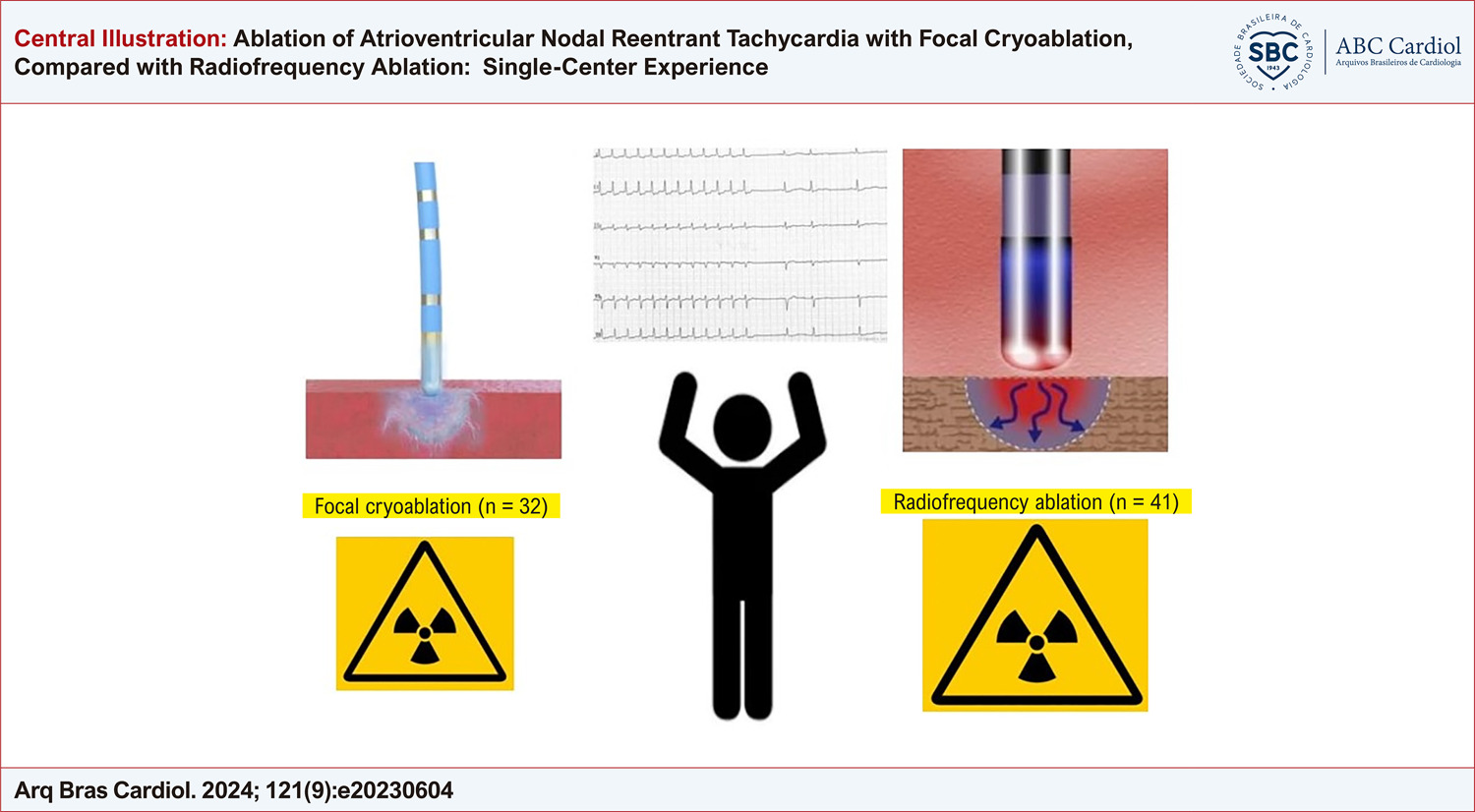
Ablation of Atrioventricular Nodal Reentrant Tachycardia with Focal Cryoablation, Compared with Radiofrequency Ablation: Single-Center Experience
ABC
Original Article

Ablation of Atrioventricular Nodal Reentrant Tachycardia with Focal Cryoablation, Compared with Radiofrequency Ablation: Single-Center Experience

Caner Topaloğlu et al. Francesco Fici Philippe van de Borne Uğur Taşkin … Mustafa Dogdus Serkan Saygi Istemihan Tengiz

Abstract

Background

The ablation of atrioventricular nodal reentrant tachycardia (AVNRT) with cryoablation is an alternative to radiofrequency (RF) ablation in patients due to the low risk of total atrioventricular block. An increase in early-late recurrences after cryoablation is reported as an important disadvantage.

Objectives

In this study, we aimed to compare the acute procedural success and the long-term recurrence rates of patients, with AVNRT who underwent methods.

Methods

73 patients with AVNRT were included in the study: 32 with cryoablation and 41 with RF ablation. There was no statistically significant difference between acute procedural success in methods. The ablation procedure was performed by an operator experienced in arrhythmology. The choice of RF or cryoablation was made in the electrophysiology laboratory based on the material already available during the procedure. After the procedure, the patients were evaluated every 3 months for 2 years in polyclinic control. The significance level adopted in the statistical analysis was 5%.

Results

The 2 groups of patients were homogeneous. The fluoroscopy time (p<0.001) was shorter, but atrium-his (p=0.004) and his-ventricular (p=0.015) times were longer in the cryoablation group. There was no significant difference, in terms of acute procedural success, post-procedure jump without a single echo, and presence of echo and jump.

Conclusions

Cryoablation requires less fluoroscopy time and is a safe non-inferior alternative to RF ablation in patients with AVNRT. The risk of AV block is a significant problem with the use of RF energy, making it less suitable for use in young and physically active patients.

  • Atrioventricular Nodal Reentry Tachycardia
  • Cryosurgery
  • Radiofrequency Ablation
Read Full Article
Creative Commons Attribution (CC BY) Creative Commons license
23/09/2024 DOI: 10.36660/abc.20230604i Views 1
Figure 1
ABC
Original Article

Mid-Term Results of Surgical Treatment of Atrial Fibrillation in Valvular Heart Disease Assesed by Speckle Tracking Echocardiography

Natalia Lorenzo et al. Irene Mendez Mikel Taibo Gianfranco Martinis … Sara Badia Guillermo Reyes Rio Aguilar

Abstract

Background:

Atrial fibrillation frequently affects patients with valvular heart disease. Ablation of atrial fibrillation during valvular surgery is an alternative for restoring sinus rhythm.

Objectives:

This study aimed to evaluate mid-term results of successful atrial fibrillation surgical ablation during valvular heart disease surgery, to explore left atrium post-ablation mechanics and to identify predictors of recurrence.

Methods:

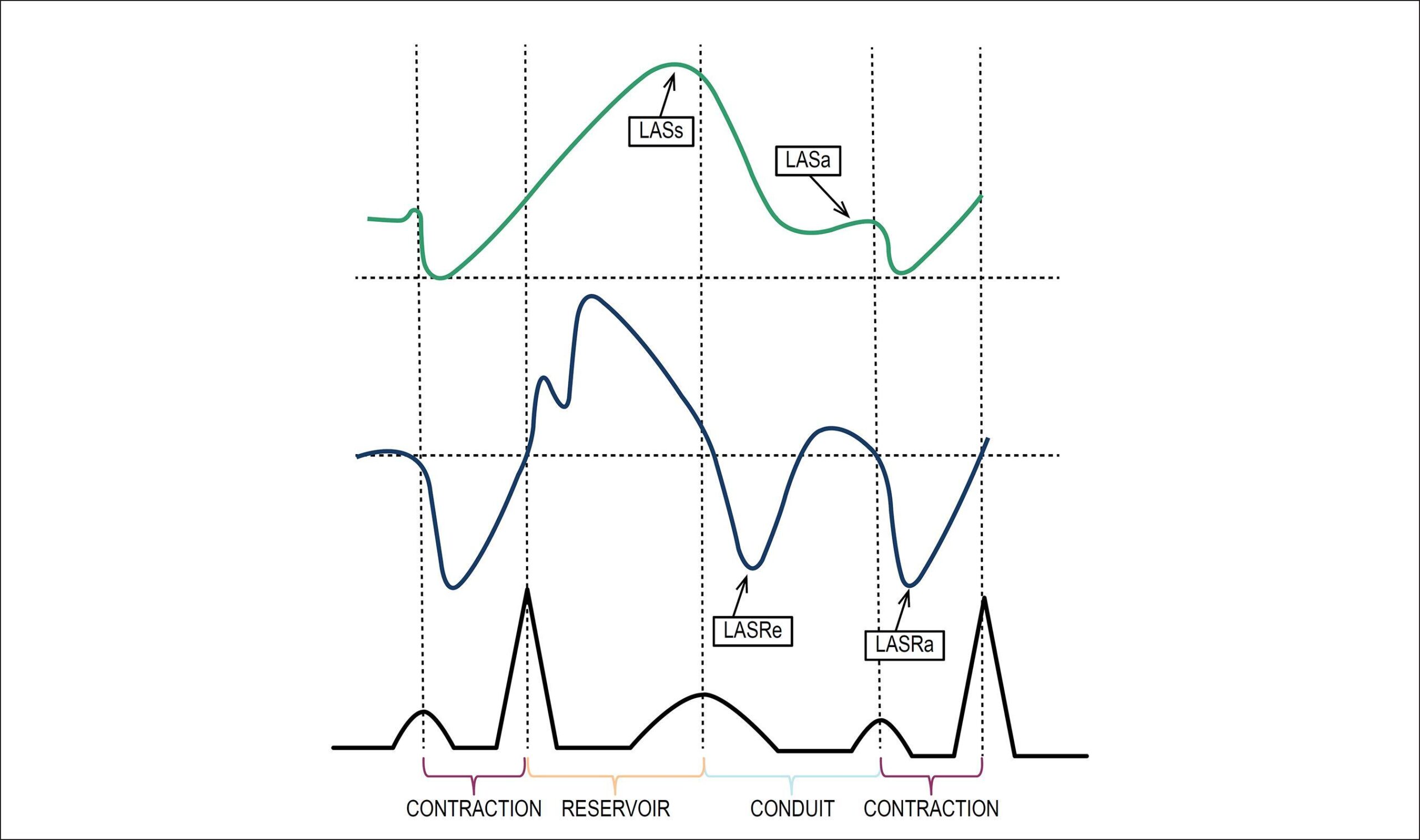
Fifty-three consecutive candidates were included. Eligibility criteria for ablation included persistent atrial fibrillation <10 years and left atrium diameter < 6.0 cm. Three months after surgery, echocardiogram, 24-hour Holter monitoring and electrocardiograms were performed in all candidates who maintained sinus rhythm (44 patients). Echo-study included left atrial deformation parameters (strain and strain rate), using 2-dimensional speckle-tracking echocardiography. Simultaneously, 30 healthy individuals (controls) were analyzed with the same protocol for left atrial performance. Significance was considered with a P value of < 0.05.

Results:

After a mean follow up of 17 ± 2 months, 13 new post-operative cases of recurrent atrial fibrillation were identified. A total of 1,245 left atrial segments were analysed. Left atrium was severely dilated in the post-surgery group and, mechanical properties of left atrium did not recover after surgery when compared with normal values. Left atrial volume (≥ 64 mL/m2) was the only independent predictor of atrial fibrillation recurrence (p = 0.03).

Conclusions:

Left atrial volume was larger in patients with atrial fibrillation recurrence and emerges as the main predictor of recurrences, thereby improving the selection of candidates for this therapy; however, no differences were found regarding myocardial deformation parameters. Despite electrical maintenance of sinus rhythm, left atrium mechanics did not recover after atrial fibrillation ablation performed during valvular heart disease surgery.

  • Ablation Techniques
  • Atrial Fibrillation
  • Cryosurgery
  • Echocardiography
  • Heart Valve Diseases
Read Full Article
Creative Commons Attribution (CC BY) Creative Commons license
19/03/2018 DOI: 10.5935/abc.20180040 Views 2

How to cite this article

EndNote RIS

Electronic Document Format (Vancouver)

Kataoka N, Imamura T. How to Compare Clinical Outcomes between Cryoablation and Radiofrequency Ablation in Patients with Atrioventricular Nodal Reentrant Tachycardia?. Arquivos Brasileiros de Cardiologia 2025;122(5):e20250078.

Electronic Document Format (ABNT)

Kataoka, Naoya; Imamura, Teruhiko. How to Compare Clinical Outcomes between Cryoablation and Radiofrequency Ablation in Patients with Atrioventricular Nodal Reentrant Tachycardia?. Arquivos Brasileiros de Cardiologia, v. 122, n. 5, e20250078, Jun. 2025.

Electronic Document Format (APA)

Kataoka, N., & Imamura, T. (2025). How to Compare Clinical Outcomes between Cryoablation and Radiofrequency Ablation in Patients with Atrioventricular Nodal Reentrant Tachycardia?. Arquivos Brasileiros de Cardiologia, 122(5), e20250078.

Electronic Document Format (ISO)

Kataoka, Naoya and Imamura, Teruhiko. How to Compare Clinical Outcomes between Cryoablation and Radiofrequency Ablation in Patients with Atrioventricular Nodal Reentrant Tachycardia?. Arquivos Brasileiros de Cardiologia [online]. 2025, vol. 122, n. 5, [cited 2026-10-14], e20250078. Available from: <https://journals.cardiol.br/en/article/how-to-compare-clinical-outcomes-between-cryoablation-and-radiofrequency-ablation-in-patients-with-atrioventricular-nodal-reentrant-tachycardia/>. ISSN 0066-782X

EndNote RIS

Electronic Document Format (Vancouver)

Topaloğlu C, Fici F, Borne P, Taşkin U, Dogdus M, Saygi S, Tengiz I, et al. Ablation of Atrioventricular Nodal Reentrant Tachycardia with Focal Cryoablation, Compared with Radiofrequency Ablation: Single-Center Experience. Arquivos Brasileiros de Cardiologia 2024;121(9):e20230604.

Electronic Document Format (ABNT)

Topaloğlu, Caner; Fici, Francesco; Borne, Philippe van de; Taşkin, Uğur; Dogdus, Mustafa; Saygi, Serkan; Tengiz, Istemihan. Ablation of Atrioventricular Nodal Reentrant Tachycardia with Focal Cryoablation, Compared with Radiofrequency Ablation: Single-Center Experience. Arquivos Brasileiros de Cardiologia, v. 121, n. 9, e20230604, Sep. 2024.

Electronic Document Format (APA)

Topaloğlu, C., Fici, F., Borne, P. , Taşkin, U., Dogdus, M., Saygi, S., & Tengiz, I. (2024). Ablation of Atrioventricular Nodal Reentrant Tachycardia with Focal Cryoablation, Compared with Radiofrequency Ablation: Single-Center Experience. Arquivos Brasileiros de Cardiologia, 121(9), e20230604.

Electronic Document Format (ISO)

Topaloğlu, Caner and Fici, Francesco and Borne, Philippe van de and Taşkin, Uğur and Dogdus, Mustafa and Saygi, Serkan and Tengiz, Istemihan. Ablation of Atrioventricular Nodal Reentrant Tachycardia with Focal Cryoablation, Compared with Radiofrequency Ablation: Single-Center Experience. Arquivos Brasileiros de Cardiologia [online]. 2024, vol. 121, n. 9, [cited 2026-10-14], e20230604. Available from: <https://journals.cardiol.br/en/article/ablation-of-atrioventricular-nodal-reentrant-tachycardia-with-focal-cryoablation-compared-with-radiofrequency-ablation-single-center-experience/>. ISSN 0066-782X

EndNote RIS

Electronic Document Format (Vancouver)

Lorenzo N, Mendez I, Taibo M, Martinis G, Badia S, Reyes G, Aguilar R, et al. Mid-Term Results of Surgical Treatment of Atrial Fibrillation in Valvular Heart Disease Assesed by Speckle Tracking Echocardiography. Arquivos Brasileiros de Cardiologia 2018;110(4):312-20.

Electronic Document Format (ABNT)

Lorenzo, Natalia; Mendez, Irene; Taibo, Mikel; Martinis, Gianfranco; Badia, Sara; Reyes, Guillermo; Aguilar, Rio. Mid-Term Results of Surgical Treatment of Atrial Fibrillation in Valvular Heart Disease Assesed by Speckle Tracking Echocardiography. Arquivos Brasileiros de Cardiologia, v. 110, n. 4, p. 312-320, Mar. 2018.

Electronic Document Format (APA)

Lorenzo, N., Mendez, I., Taibo, M., Martinis, G., Badia, S., Reyes, G., & Aguilar, R. (2018). Mid-Term Results of Surgical Treatment of Atrial Fibrillation in Valvular Heart Disease Assesed by Speckle Tracking Echocardiography. Arquivos Brasileiros de Cardiologia, 110(4), 312-320.

Electronic Document Format (ISO)

Lorenzo, Natalia and Mendez, Irene and Taibo, Mikel and Martinis, Gianfranco and Badia, Sara and Reyes, Guillermo and Aguilar, Rio. Mid-Term Results of Surgical Treatment of Atrial Fibrillation in Valvular Heart Disease Assesed by Speckle Tracking Echocardiography. Arquivos Brasileiros de Cardiologia [online]. 2018, vol. 110, n. 4, [cited 2026-10-14], pp. 312-320. Available from: <https://journals.cardiol.br/en/article/mid-term-results-of-surgical-treatment-of-atrial-fibrillation-in-valvular-heart-disease-assesed-by-speckle-tracking-echocardiography/>. ISSN 0066-782X

  • About ABC Family
  • Internal Regulation
  • Editorial Board
  • Brazilian Society of Cardiology (SBC)

Issues

SBC Guidelines

  • Videos
  • Podcasts
  • News