Idelzuita Leandro Liporace et al. Gustavo Bernardes F. Oliveira Lucas Bassolli de Oliveira Alves Nadia Marchiori Galassi … Andreia Dias Jeronimo Fernanda Maria Lopes Gregory Y. H. Lip Álvaro Avezum
Abstract
Background
Vitamin K antagonists (VKA) represent an important therapeutic strategy offered by the Brazilian Unified Public Health System to patients with atrial fibrillation (AF). However, predictors of relevant clinical outcomes are understudied in the real world.
Objective
To determine the incidence and independent predictors of clinical outcomes in patients with valvular and nonvalvular AF treated with VKA.
Methods
This prospective cohort included patients with valvular and nonvalvular AF receiving VKA for ≥ 1 year. The primary outcomes were cardiovascular death, thromboembolic events, and major and clinically relevant non-major bleeding, separately and as a composite outcome. The outcomes were independently adjudicated. P values < 0.05 were considered statistically significant.
Results
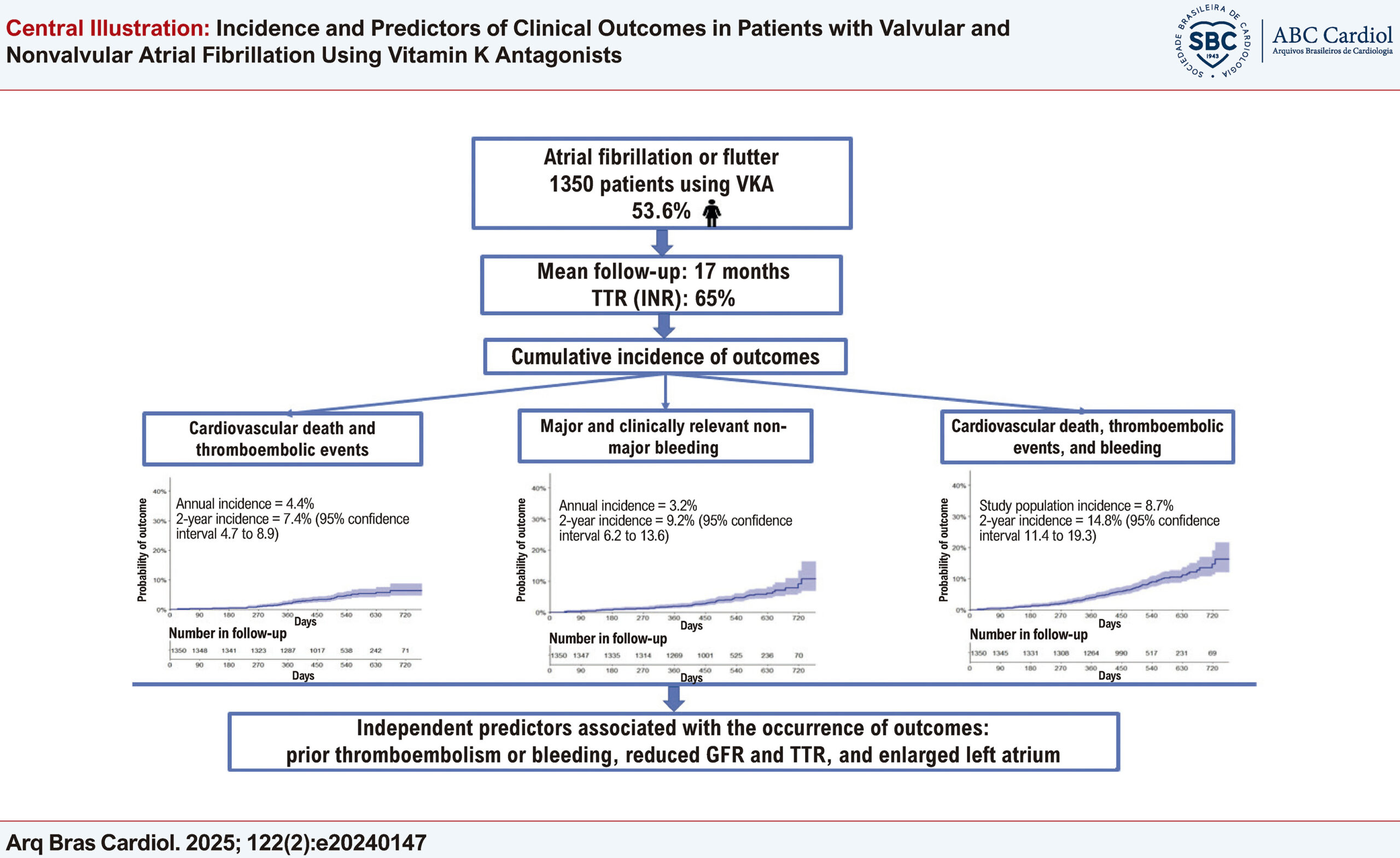
The study included 1,350 patients, with a mean age of 69.2 (± 11.8) years, 53.6% female, followed up for 17 (15 – 19) months. The annual incidence of thromboembolic events and cardiovascular death was 4.4%, and predictors were prior thromboembolism (hazard ratio [HR] 2.12; 95% confidence interval [CI] 1.22 – 3.67), time in therapeutic range (TTR) < 50% (HR 1.98; 95% CI 1.16 – 3.37), and glomerular filtration rate (GFR) < 45 mL/min/1.73 m2 (HR 2.76; 95% CI 4.82 – 1.58). The rate of major and clinically relevant non-major bleeding was 3.24% per year (95% CI 2.47 – 4.14), and predictors were prior bleeding (HR 2.60; 95% CI 1.47 – 4.61) and mechanical prosthesis (HR 1.91; 95% CI 1.15 – 3.15). The composite outcome was 8.7% per year, and predictors were prior bleeding (HR 1.70; 95% CI 1.07 – 2.70), TTR 44 mm (HR 1.97; 95% CI 3.26 – 1.19).
Conclusions
Prior thromboembolism or bleeding, reduced GFR and TTR levels, and enlarged left atrium were predictors of clinical outcomes in patients with AF treated with VKA.