ABC Family Arquivos Brasileiros de Cardiologia International Journal of Cardiovascular Sciences ABC Heart Failure & Cardiomyopathy ABC Imagem Cardiovascular
Português English
ABC Family
Português English
  • About
    • About ABC Family
    • Internal Regulation
    • Editorial Board
    • Brazilian Society of Cardiology (SBC)
  • Issues
  • SBC Guidelines
  • Content
    • Videos
    • Podcasts
    • News
  • About
    • About ABC Family
    • Internal Regulation
    • Editorial Board
    • Brazilian Society of Cardiology (SBC)
  • Issues
  • SBC Guidelines
  • Content
    • Videos
    • Podcasts
    • News

ABC Family

  • ABC Family
  • Arquivos Brasileiros de Cardiologia
  • International Journal of Cardiovascular Sciences
  • ABC Heart Failure & Cardiomyopathy
  • ABC Imagem Cardiovascular
Search in

No content found.

Journals
Ordering
Article types
Others

  1. Home
  2. Keyword: Atrioventricular Nodal Reentry Tachycardia
Assessment of Coronary Sinus Flow and Dimensions by Transthoracic Echocardiography in Patients with Atrioventricular Nodal Reentrant Tachycardia
ABC
Original Article

Assessment of Coronary Sinus Flow and Dimensions by Transthoracic Echocardiography in Patients with Atrioventricular Nodal Reentrant Tachycardia

Ali Duygu et al. Alkame Akgümüş Ahmet Balun Fahri Er

Abstract

Background:

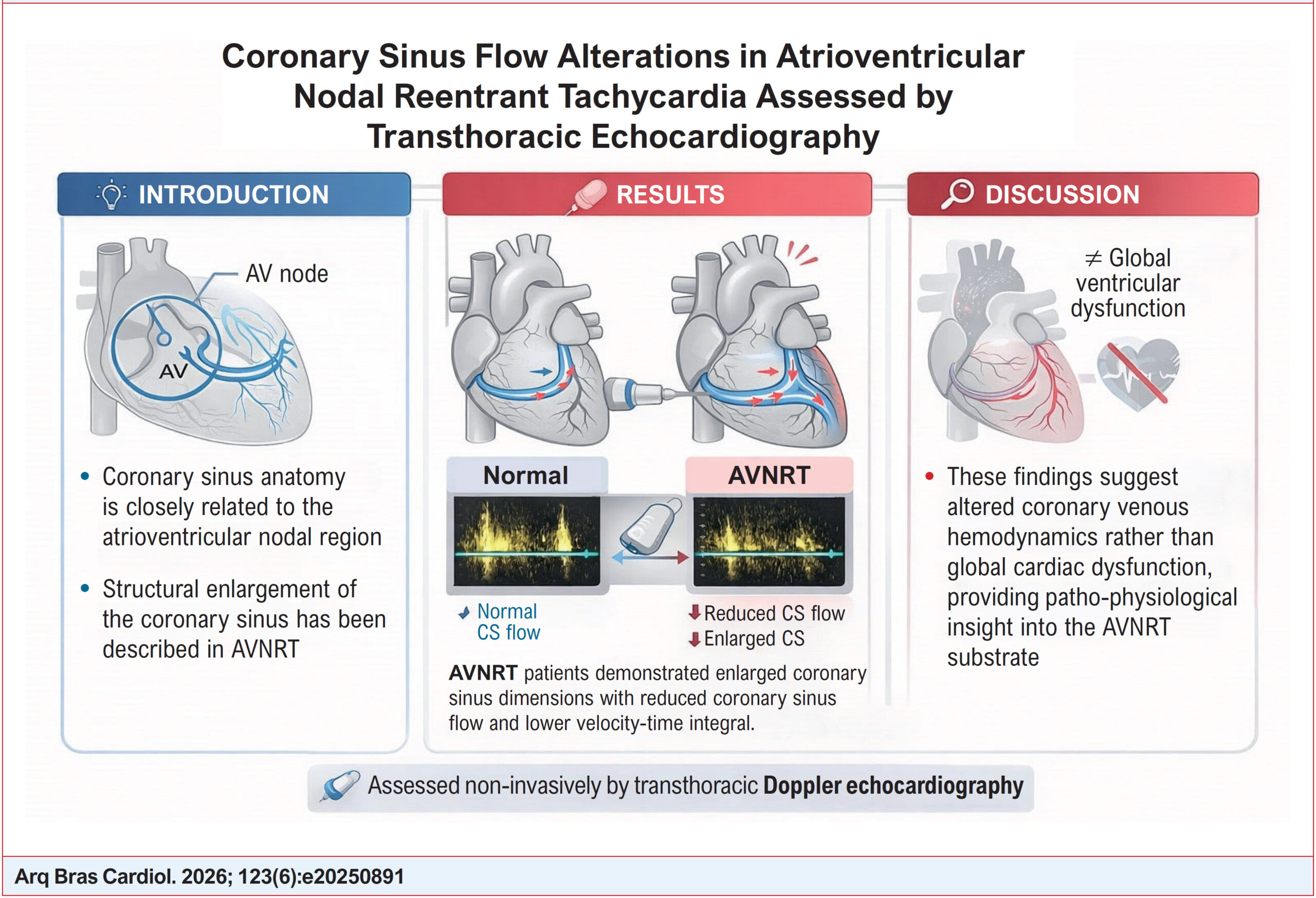
The coronary sinus (CS) plays a pivotal role in cardiac venous drainage and is anatomically adjacent to the atrioventricular nodal region. Although structural enlargement of the CS has been described in patients with atrioventricular nodal reentrant tachycardia (AVNRT), coronary sinus flow (CSF) assessed by transthoracic echocardiography (TTE) has not previously been investigated in this population.

Objective:

To evaluate the relationship between AVNRT and CSF.

Methods:

This retrospective single-center study included 35 patients with AVNRT who underwent successful slow-pathway ablation and 34 age- and sex-matched healthy controls. All participants underwent comprehensive transthoracic echocardiography. CS ostial diameter, CS diameter, and CSF were measured using pulsed-wave Doppler echocardiography. CSF was calculated using standard geometric and Doppler-derived parameters. A p-value <0.05 was considered statistically significant.

Results:

Global left and right ventricular systolic and diastolic function parameters were similar between groups. Patients with AVNRT exhibited significantly larger CS ostial and CS diameters compared with controls (both p<0.001). Despite this enlargement, CSF was significantly reduced in the AVNRT group (460.8 ± 83.3 vs. 523.8 ± 90.1 mL/min, p=0.004), accompanied by a lower CS velocity–time integral. Notably, CSF indexed to left ventricular mass also remained significantly lower in AVNRT patients, indicating that reduced flow was independent of myocardial mass.

Conclusion:

Patients with AVNRT demonstrate a distinct coronary sinus hemodynamic profile characterized by CS enlargement and reduced CSF as assessed by transthoracic echocardiography. These findings suggest altered coronary venous hemodynamics in AVNRT and provide novel pathophysiological insights using a non-invasive imaging modality.
  • Atrioventricular Nodal Reentry Tachycardia
  • Coronary sinus
  • Doppler Echocardiography
Read Full Article
Creative Commons Attribution (CC BY) Creative Commons license
24/07/2026 DOI: 10.36660/abc.20250891i Views 1
Ablation of Atrioventricular Nodal Reentrant Tachycardia with Focal Cryoablation, Compared with Radiofrequency Ablation: Single-Center Experience
ABC
Original Article

Ablation of Atrioventricular Nodal Reentrant Tachycardia with Focal Cryoablation, Compared with Radiofrequency Ablation: Single-Center Experience

Caner Topaloğlu et al. Francesco Fici Philippe van de Borne Uğur Taşkin … Mustafa Dogdus Serkan Saygi Istemihan Tengiz

Abstract

Background

The ablation of atrioventricular nodal reentrant tachycardia (AVNRT) with cryoablation is an alternative to radiofrequency (RF) ablation in patients due to the low risk of total atrioventricular block. An increase in early-late recurrences after cryoablation is reported as an important disadvantage.

Objectives

In this study, we aimed to compare the acute procedural success and the long-term recurrence rates of patients, with AVNRT who underwent methods.

Methods

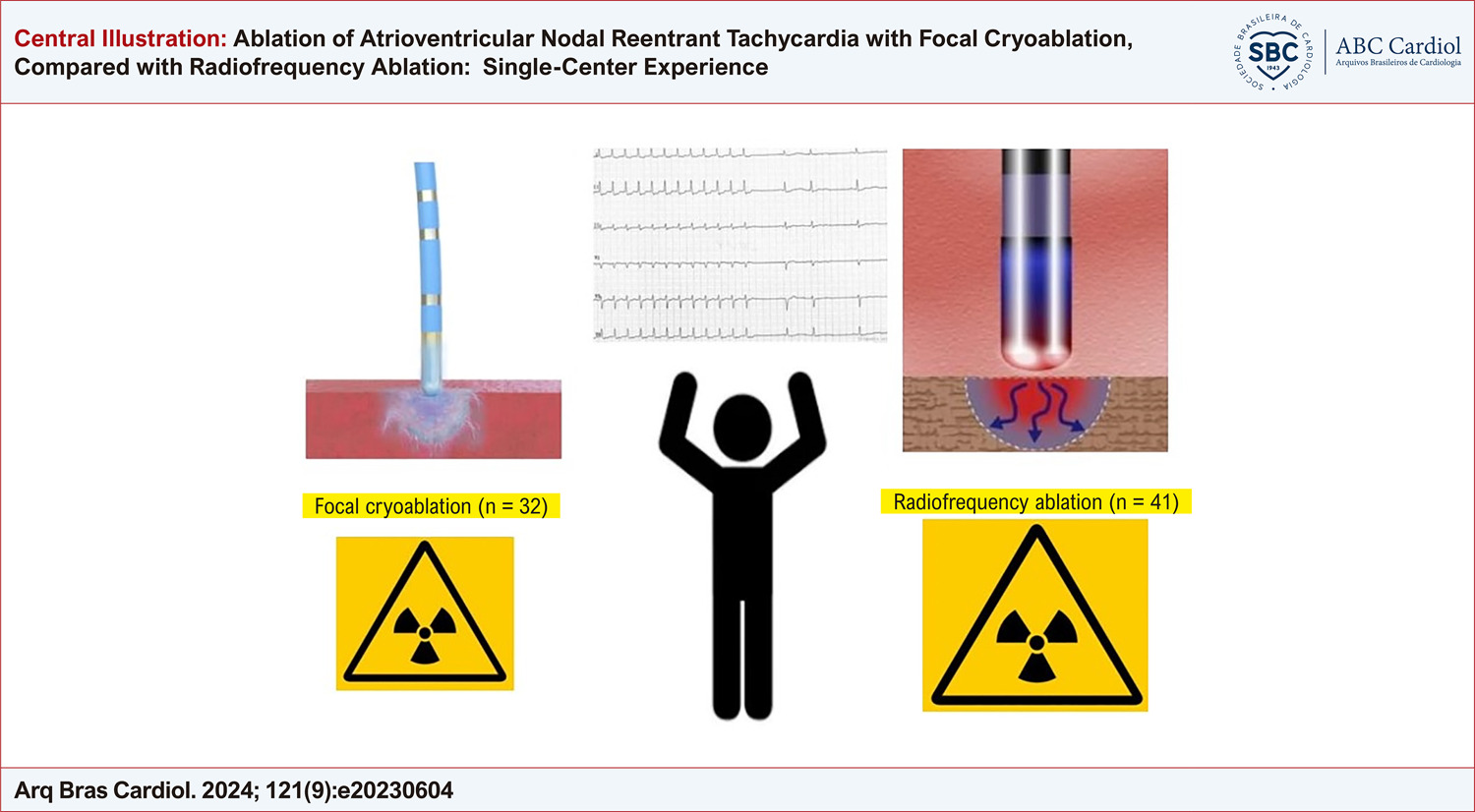
73 patients with AVNRT were included in the study: 32 with cryoablation and 41 with RF ablation. There was no statistically significant difference between acute procedural success in methods. The ablation procedure was performed by an operator experienced in arrhythmology. The choice of RF or cryoablation was made in the electrophysiology laboratory based on the material already available during the procedure. After the procedure, the patients were evaluated every 3 months for 2 years in polyclinic control. The significance level adopted in the statistical analysis was 5%.

Results

The 2 groups of patients were homogeneous. The fluoroscopy time (p<0.001) was shorter, but atrium-his (p=0.004) and his-ventricular (p=0.015) times were longer in the cryoablation group. There was no significant difference, in terms of acute procedural success, post-procedure jump without a single echo, and presence of echo and jump.

Conclusions

Cryoablation requires less fluoroscopy time and is a safe non-inferior alternative to RF ablation in patients with AVNRT. The risk of AV block is a significant problem with the use of RF energy, making it less suitable for use in young and physically active patients.

  • Atrioventricular Nodal Reentry Tachycardia
  • Cryosurgery
  • Radiofrequency Ablation
Read Full Article
Creative Commons Attribution (CC BY) Creative Commons license
23/09/2024 DOI: 10.36660/abc.20230604i Views 1
ABC
Editorial

Para-Hisian Atrial Tachycardia and Atrioventricular Nodal Reentry Tachycardia: After 25 Years The Same History?

Mauro Toniolo

The recent history of the para-hisian atrial tachycardia (PHAT) looks a lot like the older history of the atrioventricular (AV) nodal reentry tachycardia (AVNRT). The debate about precise anatomic boundaries of AV nodal reentry continues today again in the AVNRT, even 75 odd years after the first suspect that some mechanisms of supraventricular tachycardia could involve the region of the AV node. In this type of arrhythmia, the first target for the catheter ablative therapy was the fast pathway of the AV node: this approach showed a high success rate, but induction of AV block was found in more than one every five patients. After a few years, an approach was proposed from the slow pathway, that proved to be more effective and safer than the approach from the fast pathway. For some years, this new approach generated some debate in the electrophysiology (EP) community. Some authors even suggested to cross over from one technique to the other as long as AVNRT persisted. Nowadays, the approach from fast pathway is definitely abandoned and when we think of catheter ablation of AVNRT, we think only about ablation of the slow pathway.

PHAT are a group of atrial tachycardia (ATs) originating near the His-bundle (HB) region. Their prevalence is quite high in some casuistries, therefore it is important learning to recognize and to treat them. Nowadays, in the same manner of AVNRT, also for PHAT a debate is present for both the anatomic site of origin of this type of arrhythmia, both about the mechanism,, both about the best catheter ablation approach.– Some authors hypothesized the presence of a small re-entrant circuit adjacent to the tricuspid annulus; in contrast, other authors described PHAT as focal ATs arising from various location around the tricuspid or mitral annuli. PHAT are amenable to catheter ablation from multiple approaches including right inter-atrial septum, left inter-atrial septum by a transeptal puncture and non coronary sinus (NCS) of Valsalva of the aortic root by a transaortic approach via the femoral artery.

[…]

  • Atrial Tachycardia
  • Atrioventricular Nodal Reentry Tachycardia
  • Non Coronary Sinus of Valsalva
Read Full Article
Creative Commons Attribution (CC BY) Creative Commons license
03/02/2021 DOI: 10.36660/abc.20201149

How to cite this article

EndNote RIS

Electronic Document Format (Vancouver)

Duygu A, Akgümüş A, Balun A, Er F. Assessment of Coronary Sinus Flow and Dimensions by Transthoracic Echocardiography in Patients with Atrioventricular Nodal Reentrant Tachycardia. Arquivos Brasileiros de Cardiologia 2026;123(6):e20250891.

Electronic Document Format (ABNT)

Duygu, Ali; Akgümüş, Alkame; Balun, Ahmet; Er, Fahri. Assessment of Coronary Sinus Flow and Dimensions by Transthoracic Echocardiography in Patients with Atrioventricular Nodal Reentrant Tachycardia. Arquivos Brasileiros de Cardiologia, v. 123, n. 6, e20250891, Jul. 2026.

Electronic Document Format (APA)

Duygu, A., Akgümüş, A., Balun, A., & Er, F. (2026). Assessment of Coronary Sinus Flow and Dimensions by Transthoracic Echocardiography in Patients with Atrioventricular Nodal Reentrant Tachycardia. Arquivos Brasileiros de Cardiologia, 123(6), e20250891.

Electronic Document Format (ISO)

Duygu, Ali and Akgümüş, Alkame and Balun, Ahmet and Er, Fahri. Assessment of Coronary Sinus Flow and Dimensions by Transthoracic Echocardiography in Patients with Atrioventricular Nodal Reentrant Tachycardia. Arquivos Brasileiros de Cardiologia [online]. 2026, vol. 123, n. 6, [cited 2026-10-14], e20250891. Available from: <https://journals.cardiol.br/en/article/assessment-of-coronary-sinus-flow-and-dimensions-by-transthoracic-echocardiography-in-patients-with-atrioventricular-nodal-reentrant-tachycardia/>. ISSN 0066-782X

EndNote RIS

Electronic Document Format (Vancouver)

Topaloğlu C, Fici F, Borne P, Taşkin U, Dogdus M, Saygi S, Tengiz I, et al. Ablation of Atrioventricular Nodal Reentrant Tachycardia with Focal Cryoablation, Compared with Radiofrequency Ablation: Single-Center Experience. Arquivos Brasileiros de Cardiologia 2024;121(9):e20230604.

Electronic Document Format (ABNT)

Topaloğlu, Caner; Fici, Francesco; Borne, Philippe van de; Taşkin, Uğur; Dogdus, Mustafa; Saygi, Serkan; Tengiz, Istemihan. Ablation of Atrioventricular Nodal Reentrant Tachycardia with Focal Cryoablation, Compared with Radiofrequency Ablation: Single-Center Experience. Arquivos Brasileiros de Cardiologia, v. 121, n. 9, e20230604, Sep. 2024.

Electronic Document Format (APA)

Topaloğlu, C., Fici, F., Borne, P. , Taşkin, U., Dogdus, M., Saygi, S., & Tengiz, I. (2024). Ablation of Atrioventricular Nodal Reentrant Tachycardia with Focal Cryoablation, Compared with Radiofrequency Ablation: Single-Center Experience. Arquivos Brasileiros de Cardiologia, 121(9), e20230604.

Electronic Document Format (ISO)

Topaloğlu, Caner and Fici, Francesco and Borne, Philippe van de and Taşkin, Uğur and Dogdus, Mustafa and Saygi, Serkan and Tengiz, Istemihan. Ablation of Atrioventricular Nodal Reentrant Tachycardia with Focal Cryoablation, Compared with Radiofrequency Ablation: Single-Center Experience. Arquivos Brasileiros de Cardiologia [online]. 2024, vol. 121, n. 9, [cited 2026-10-14], e20230604. Available from: <https://journals.cardiol.br/en/article/ablation-of-atrioventricular-nodal-reentrant-tachycardia-with-focal-cryoablation-compared-with-radiofrequency-ablation-single-center-experience/>. ISSN 0066-782X

EndNote RIS

Electronic Document Format (Vancouver)

Toniolo M. Para-Hisian Atrial Tachycardia and Atrioventricular Nodal Reentry Tachycardia: After 25 Years The Same History?. Arquivos Brasileiros de Cardiologia 2021;116(1):127-8.

Electronic Document Format (ABNT)

Toniolo, Mauro. Para-Hisian Atrial Tachycardia and Atrioventricular Nodal Reentry Tachycardia: After 25 Years The Same History?. Arquivos Brasileiros de Cardiologia, v. 116, n. 1, p. 127-128, Feb. 2021.

Electronic Document Format (APA)

Toniolo, M. (2021). Para-Hisian Atrial Tachycardia and Atrioventricular Nodal Reentry Tachycardia: After 25 Years The Same History?. Arquivos Brasileiros de Cardiologia, 116(1), 127-128.

Electronic Document Format (ISO)

Toniolo, Mauro. Para-Hisian Atrial Tachycardia and Atrioventricular Nodal Reentry Tachycardia: After 25 Years The Same History?. Arquivos Brasileiros de Cardiologia [online]. 2021, vol. 116, n. 1, [cited 2026-10-14], pp. 127-128. Available from: <https://journals.cardiol.br/en/article/para-hisian-atrial-tachycardia-and-atrioventricular-nodal-reentry-tachycardia-after-25-years-the-same-history/>. ISSN 0066-782X

  • About ABC Family
  • Internal Regulation
  • Editorial Board
  • Brazilian Society of Cardiology (SBC)

Issues

SBC Guidelines

  • Videos
  • Podcasts
  • News