ABC Family Arquivos Brasileiros de Cardiologia International Journal of Cardiovascular Sciences ABC Heart Failure & Cardiomyopathy ABC Imagem Cardiovascular
Português English
ABC Family
Português English
  • About
    • About ABC Family
    • Internal Regulation
    • Editorial Board
    • Brazilian Society of Cardiology (SBC)
  • Issues
  • SBC Guidelines
  • Content
    • Videos
    • Podcasts
    • News
  • About
    • About ABC Family
    • Internal Regulation
    • Editorial Board
    • Brazilian Society of Cardiology (SBC)
  • Issues
  • SBC Guidelines
  • Content
    • Videos
    • Podcasts
    • News

ABC Family

  • ABC Family
  • Arquivos Brasileiros de Cardiologia
  • International Journal of Cardiovascular Sciences
  • ABC Heart Failure & Cardiomyopathy
  • ABC Imagem Cardiovascular
Search in

No content found.

Journals
Ordering
Article types
Others

  1. Home
  2. Keyword: Cardiac Resynchronization Therapy
ABC
Research Letter

Cardiac Resynchronization Therapy in Cardio-Oncology: Real-World Evidence of Benefit in Cancer Patients with Heart Failure

Catarina Gregório et al. Andreia Magalhães Beatriz Silva Inês Araújo … Marta Vilela Pedro Marques João de Sousa Miguel Nobre Menezes Fausto J. Pinto Manuela Fiuza

Introduction

Heart failure (HF) is a major cause of morbidity and mortality among patients with cancer. The incidence of HF in this high-risk population is increasing, partly due to the cardiotoxic effects associated with contemporary cancer therapies. Despite substantial advances in oncological treatments and the growing number of cancer survivors, HF remains a major determinant of adverse clinical outcomes.

Cardiac resynchronization therapy (CRT) is an established treatment that improves symptoms and reduces mortality in patients with chronic HF. However, patients with a history of cancer have been frequently excluded or underrepresented in pivotal CRT trials, resulting in a significant evidence gap regarding the efficacy and safety of CRT in this population. Concerns related to comorbidities, cancer prognosis, and procedural risk may further contribute to the underutilization of CRT in clinical practice.

[…]

  • Cardiac Resynchronization Therapy
  • Cardio-Oncology
  • Heart Failure
Read Full Article
Creative Commons Attribution (CC BY) Creative Commons license
18/09/2026 DOI: 10.36660/abc.20250888i Views 1
Conduction System Pacing vs Biventricular Pacing in Chronic Heart Failure: Protocol for the Economic Analysis of the PhysioSync-HF Trial
ABC
Original Article

Conduction System Pacing vs Biventricular Pacing in Chronic Heart Failure: Protocol for the Economic Analysis of the PhysioSync-HF Trial

Sérgio R. R. Decker et al. Ana Paula Beck da S Etges André Zimerman Fernanda D. Alves … Caique M. Ternes Juliana S. Santos Leandro Zimerman Luis Eduardo Rohde Alexander Dal Forno André d’Avila Dhruv S. Kazi Eduardo G. Bertoldi Carisi A. Polanczyk

Abstract

Background

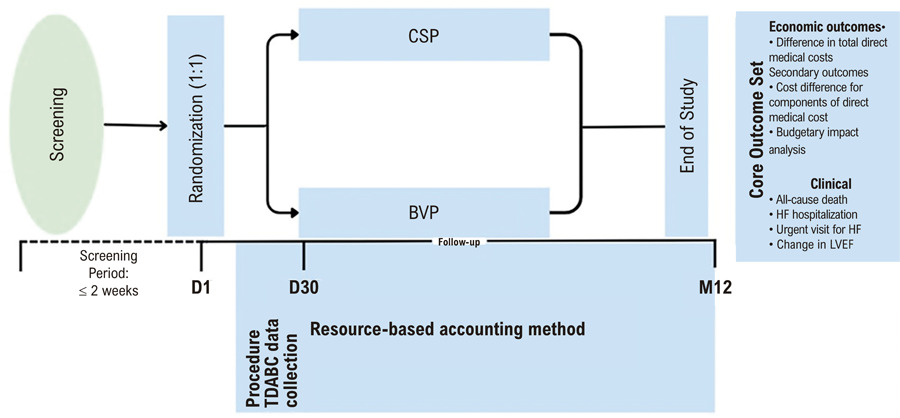
Conduction system pacing (CSP) has emerged as an alternative to biventricular pacing (BVP) for cardiac resynchronization therapy (CRT), with potential clinical benefits and lower costs. PhysioSync-HF is a multicenter, randomized trial comparing these strategies from both clinical and economic perspectives in patients with heart failure with reduced ejection fraction (HFrEF).

Objective

To describe the rationale and design of the trial-based economic evaluation embedded within the PhysioSync-HF trial.

Methods

The PhysioSync-HF trial enrolled 179 patients with 1-year follow-up. Procedural cost data will be collected using a time-driven activity-based costing approach. Costs associated with the device, adverse clinical events, and ambulatory care during follow-up will be estimated using resource-based accounting methods. Appropriate methods will address missing data, and statistical analyses will account for the skewed distribution of cost variables.

Results

The primary economic outcome is the between-group difference in total direct medical costs per patient over the 1-year follow-up (CSP vs BVP). Secondary outcomes include component-level cost breakdowns of direct medical expenses and a budget impact analysis estimating the annual effect on Brazil’s health care system if all eligible patients received CSP instead of BVP.

Conclusion

By leveraging a multicenter cardiovascular trial to measure costs of CSP versus BVP, this economic evaluation aims to identify cost-saving opportunities that could expand equitable access to CRT for individuals with HFrEF in Brazil, while providing insights relevant to other health care settings worldwide.

Trial Registration

NCT05572736.

  • Cardiac Resynchronization Therapy
  • Health Care Costs
  • Systolic Heart Failure
Read Full Article
Creative Commons Attribution (CC BY) Creative Commons license
27/02/2026 DOI: 10.36660/abc.20250254i Views 4
Figure 1
ABCIC
Editorial

What Does Myocardial Work Offer Beyond Strain?

Luiz Otávio de Arruda Santos et al. Edgar Daminello Lucas Arraes de França

Introduction

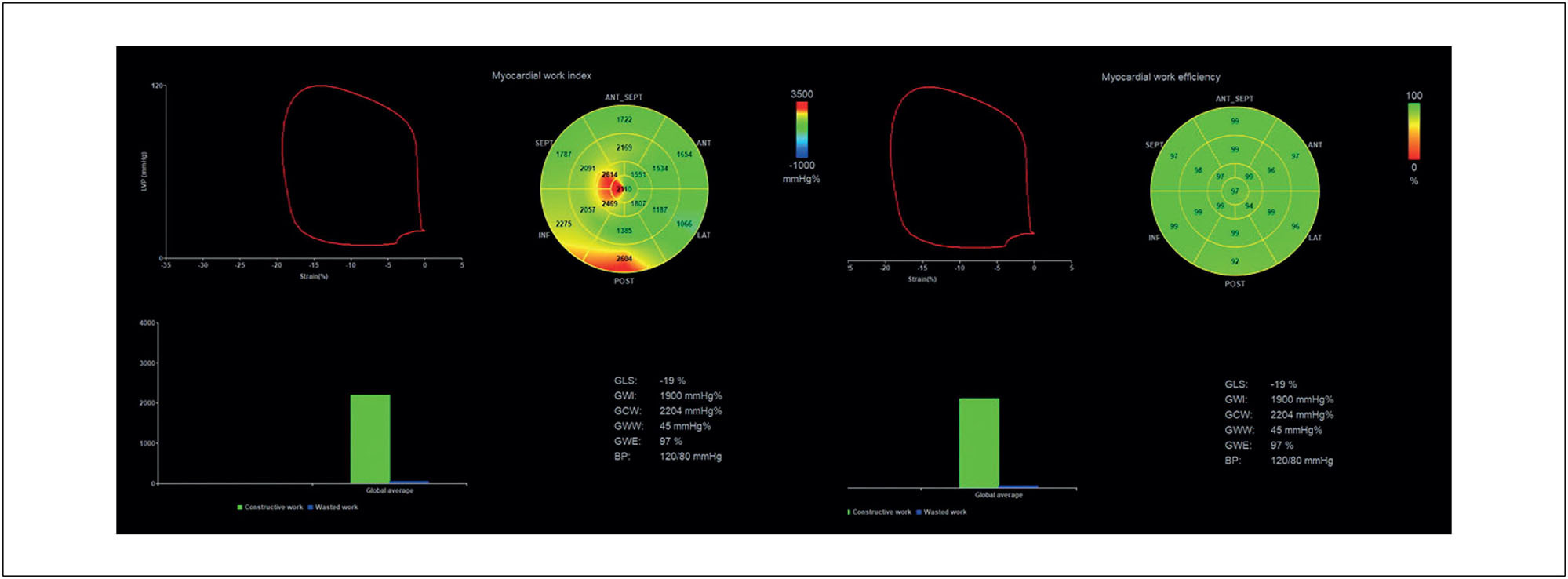
In contemporary cardiovascular imaging, one of the methods that has gained significant relevance by adding diagnostic and prognostic information is speckle-tracking–derived Longitudinal Strain, particularly the assessment of left ventricular Global Longitudinal Strain (GLS). However, although GLS evaluates global myocardial deformation of the left ventricle, it is highly dependent on loading conditions, which may interfere with the accurate interpretation of its results. In this context, an emerging technique has been introduced, also derived from speckle tracking: Myocardial Work (MW). Compared with strain, MW offers the advantage of mitigating afterload bias by incorporating systemic arterial pressure into longitudinal strain analysis, generating Pressure–Strain Loops (PSL) throughout the cardiac cycle. Thus, MW quantifies not only the extent of longitudinal myocardial deformation but also the load under which this deformation occurs, providing refined diagnostic insight into ventricular function. The methodology is based on the work of Russell et al., who validated the PSL area as a noninvasive index of myocardial work and also introduced the concept of wasted work resulting from contractile discoordination. In clinical practice, four global indices are derived: Global Work Index (GWI), Global Constructive Work (GCW), Global Wasted Work (GWW), and Global Work Efficiency (GWE = GCW / [GCW + GWW]) (). shows normal reference values for myocardial work and its indices derived from the Normal Reference Ranges for Echocardiography (NORRE) study of the European Association of Cardiovascular Imaging (EACVI).

[…]

  • Aortic Valve Stenosis
  • Cardiac Resynchronization Therapy
  • Coronary Artery Disease
  • Echocardiography
Read Full Article
Creative Commons Attribution (CC BY) Creative Commons license
03/02/2026 DOI: 10.36660/abcimg.20250103i Views 1
Central Illustration
ABCHF
Original Article

Effect of Sacubitril/Valsartan on All-Cause Mortality Reduction in Patients Undergoing Cardiac Resynchronization Therapy: SALVA-CRT

Luiz Carlos Santana Passos et al. William Carvalho Jackson Pedro Barros-Pereira Clara Salles Figueiredo … Gabriela Pio Dourado Fernanda Pinheiro Martin Tapioca Caio Rebouças Fonseca Cafezeiro

Abstract

Background

Cardiac resynchronization therapy (CRT) is indicated for patients with heart failure with reduced ejection fraction (HFrEF) receiving conventional triple therapy (CTT). Although sacubitril/valsartan (S/V) is a cornerstone of modern triple therapy (MTT) for HFrEF, its effectiveness in patients undergoing CRT implantation has not been adequately evaluated.

Objective

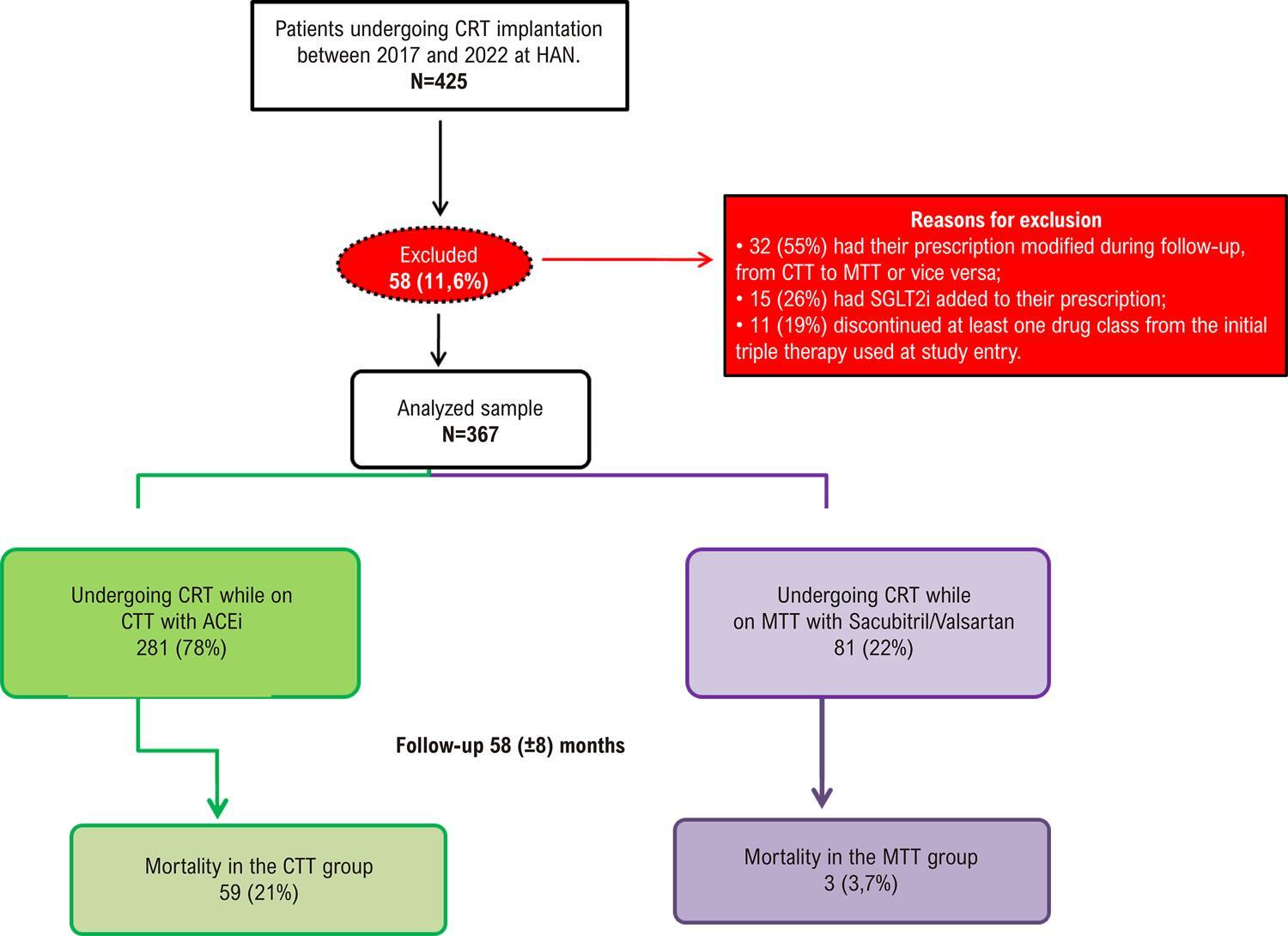
To compare all-cause mortality between CRT recipients on CTT and those on MTT, with a minimum follow-up of 1 year.

Methods

Prospective, observational cohort including patients undergoing a first CRT implantation. Inclusion criteria were left ventricular ejection fraction (LVEF) ≤35% and bundle branch block with QRS ≥150 ms, with prior use of either CTT or MTT. Patients who discontinued any medication, initiated a sodium-glucose cotransporter-2 inhibitor (SGLT2i), or crossed over between CTT and MTT during follow-up were excluded. Statistical analyses used the unpaired Student’s t test (p < 0.05 for significance). Cox regression was applied to variables potentially associated with the outcome (p < 0.1).

Results

From 2017 to 2022, 425 CRT implantations were performed; 58 (13.6%) patients were excluded. Of the 367 analyzed, 286 (78%) were on CTT and 81 (22%) on MTT. Mean age was 61 (±12) years; mean LVEF was 26% (±6); Chagas disease was the most prevalent etiology (34.3%). Mean follow-up was 58 (±8) months, with 62 deaths (16.9%): 59 (21%) in the CTT group and 3 (3.7%) in the MTT group. The HR was 1.27 (95% CI 1.17–1.39) for CTT and 0.18 (95% CI 0.06–0.58) for MTT. In multivariable analysis, CTT use was the only independent predictor of mortality (HR 5.83; 95% CI 1.81–18.70; p = 0.003).

Conclusion

MTT including S/V significantly reduced all-cause mortality in patients undergoing CRT implantation.

  • Cardiac Resynchronization Therapy
  • Mortality
  • Systolic Heart Failure
Read Full Article
Creative Commons Attribution (CC BY) Creative Commons license
15/12/2025 DOI: 10.36660/abchf.20250003i Views 3
Impact of Intraventricular Blocks on Cardiac Cycle Dynamics: An Echocardiographic and Vectorcardiographic Analysis
ABC
Original Article

Impact of Intraventricular Blocks on Cardiac Cycle Dynamics: An Echocardiographic and Vectorcardiographic Analysis

Carlos Eduardo Duarte et al. Katia Regina Silva Luciene Dias de Jesus Henry Abensur Roberto Costa

Abstract

Background

Left bundle branch block (LBBB) causes delays that alter the mechanics of the ventricular cycle. The effect of other intraventricular blocks (IVB) remains little explored.

Objectives

To study the phases of the cardiac cycle (CC) and ventricular synchrony in different ventricular activation patterns.

Methods

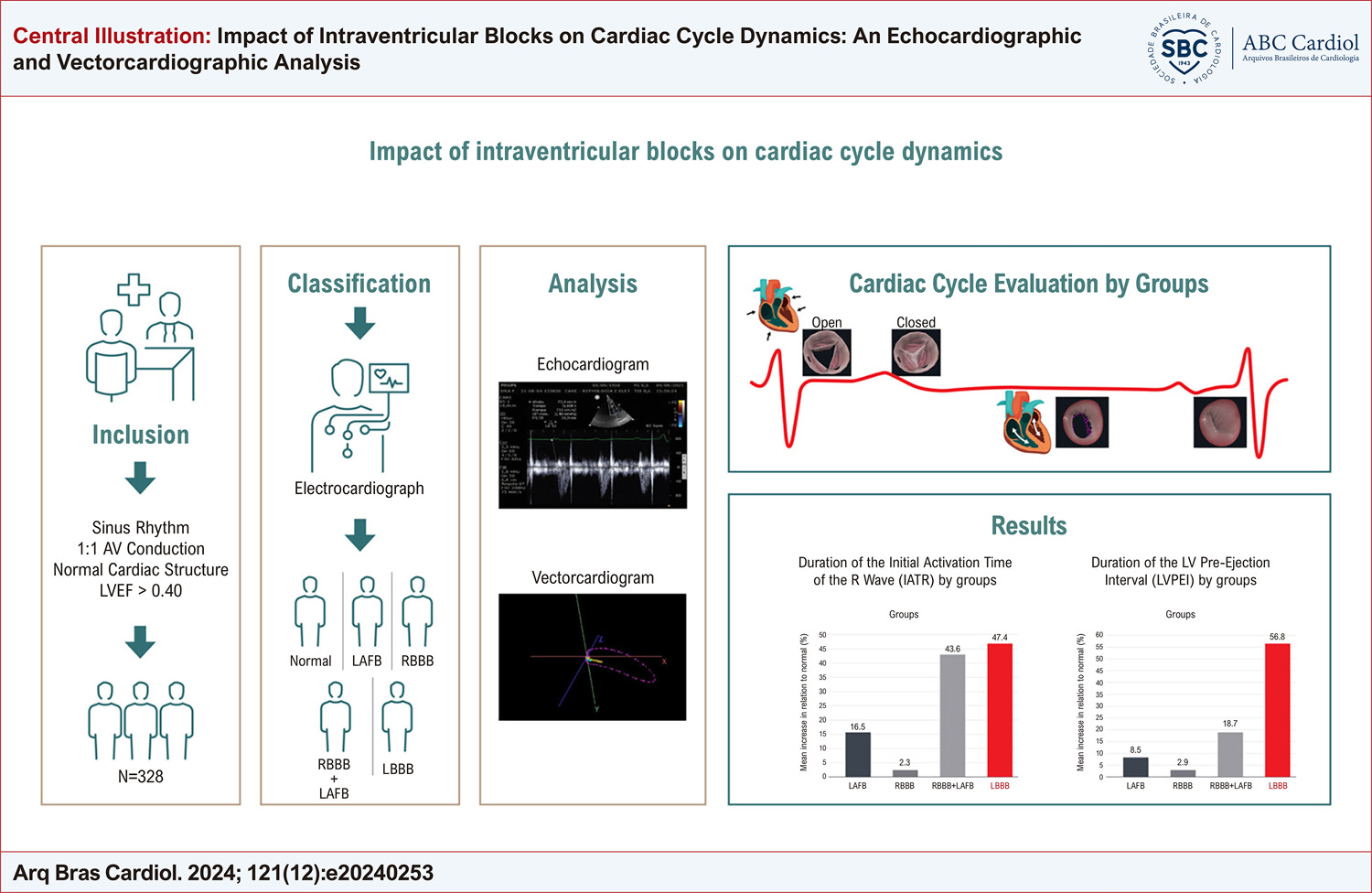
Cross-sectional study with 328 consecutive individuals without structural heart disease, normal electrocardiogram or IVB, conducted in the period between August/2020 and January/2022. Echocardiogram and Vectorcardiogram were performed simultaneously to analyze the electromechanics of the CC. A one-way Analysis of Variance (ANOVA) with Bonferroni’s multiple comparison test was used, with a significance level of 5%.

Results

The age of the participants was 64.8±15.3 years, with 57.9% male and an ejection fraction of 67.0±6.8%. The electrocardiogram was normal for 32.3%, 18.6% had right bundle branch block (RBBB), 17.7% had left anterior fascicular block (LAFB), 15.6% had RBBB+LAFB, and 15.9% had LBBB. The echocardiogram showed an increased left ventricular pre-ejection by 18.7% (p<0.001) and 56.8% (p<0.001) in RBBB+LAFB and LBBB, respectively. There was a post-systolic myocardial contraction in all types of IVB and ventricular dyssynchrony in LBBB. Using the vectorcardiogram, initial activation of the R wave was increased by 17.4% in LAFB (p<0.001), 43.5% in RBBB+LAFB (p<0.001) and 47.4% in LBBB (p<0.001) and delayed final activation by 69.4% in LBBB (p<0.001), 73.6% in RBBB+LAFB (p<0.001) and 95.3% in RBBB (p<0.001).

Conclusion

All IVBs modified the CC; however, only LBBB and RBBB+LAFB significantly changed the left ventricular cycle, thereby evidencing the greater complexity of these disorders.

  • Bundle Branch Block
  • Cardiac Resynchronization Therapy
  • Electrocardiography
  • Vectorcardiography
Read Full Article
Creative Commons Attribution (CC BY) Creative Commons license
14/02/2025 DOI: 10.36660/abc.20240253i Views 2
ABC
Editorial

Cardiac Implantable Electronic Devices in Chagasic and Non-Chagasic Patients: A Critical Look at the Prognosis

Fernanda Almeida Andrade

Factors that may explain the results

One possible explanation for the lack of significant difference in prognosis between patients with and without Chagas disease may be related to improvements in clinical management and the structuring of health care for this population over the past few years., The study was conducted in a tertiary referral center, with likely access to cutting-edge technology and specialized monitoring. Specialized outpatient follow-up programs and adherence to recommended treatments may have reduced the disparities in outcomes between the two groups.

Furthermore, the study analyzed patient data across three different eras, which allowed for the assessment of possible changes over time. The fact that there were no differences in mortality between chagasic and non-chagasic patients in each of these eras reinforces the idea that progress in treatment, both clinical and surgical, may have diluted the adverse prognostic impact previously attributed to ChC.,

[…]

  • Artificial Pacemaker
  • Cardiac Resynchronization Therapy
  • Chagas disease
  • Dilated Cardiomyopathy
Read Full Article
Creative Commons Attribution (CC BY) Creative Commons license
02/12/2024 DOI: 10.36660/abc.20240629i Views 2
Conduction System Pacing: Redefining Resynchronization Therapy in Heart Failure
ABCHF
Review Article

Conduction System Pacing: Redefining Resynchronization Therapy in Heart Failure

Caique M. P. Ternes et al. André Zimerman

Abstract

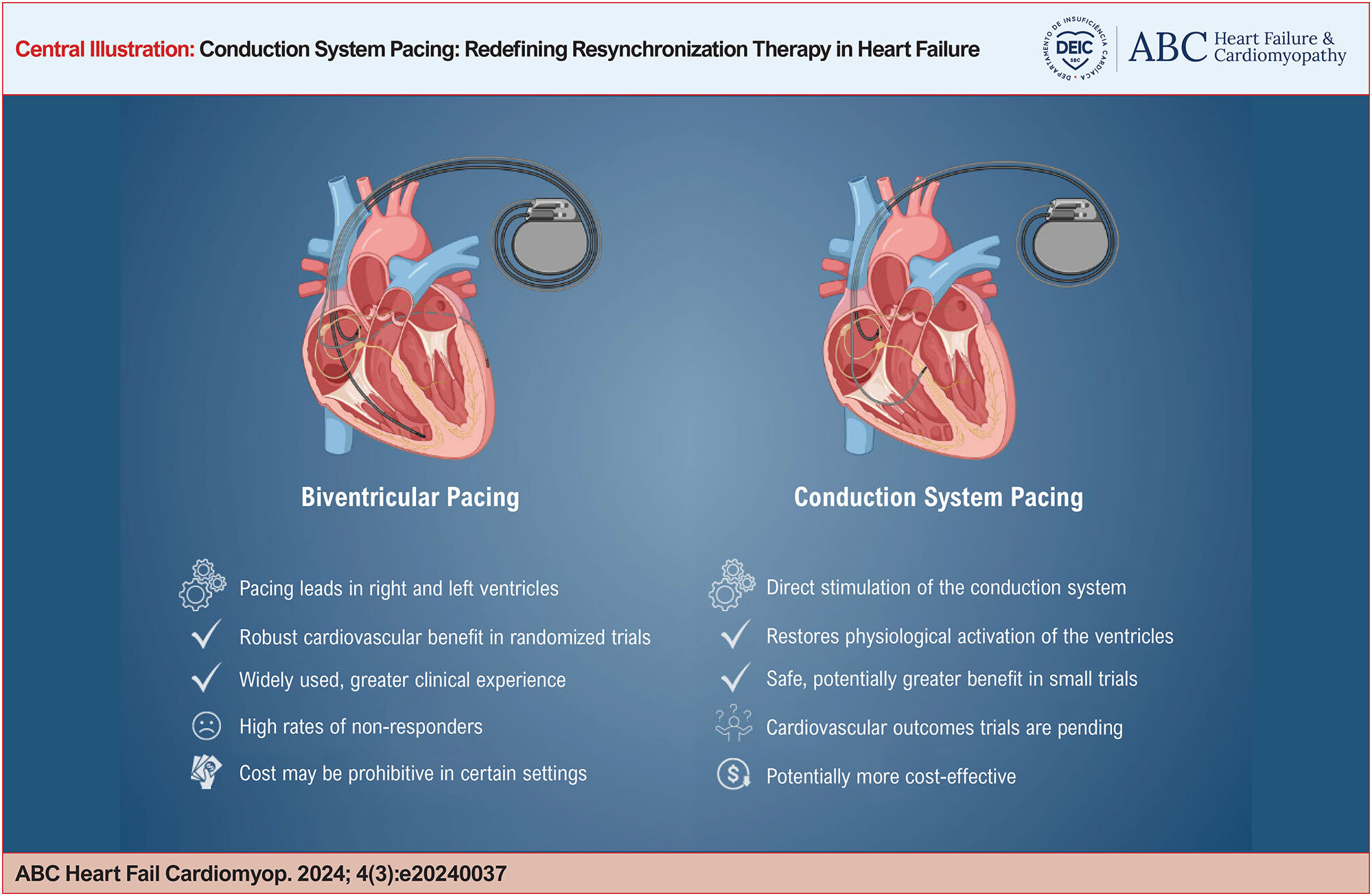
Cardiac resynchronization therapy is a foundational treatment in patients with heart failure with reduced ejection fraction (HFrEF) and left bundle branch block (LBBB). Although resynchronization has traditionally been performed via biventricular pacing, this approach may be limited by a high rate of non-responders and elevated cost. Conduction system pacing, sometimes referred to as “physiologic” pacing, involves direct stimulation of the heart’s intrinsic conduction pathways and has emerged as a promising alternative. Large intercontinental registries have supported the safety of conduction system pacing in different settings, with high procedural success and low complication rates that are comparable to biventricular pacing. Moreover, in small, randomized trials, conduction system pacing has led to similar or greater improvements in left ventricular ejection fraction and QRS duration versus biventricular pacing, potentially at a lower cost. Ongoing cardiovascular outcomes trials are expected to conclusively determine the role of conduction system pacing in the management of patients with HFrEF and LBBB.

  • Bundle of His
  • Cardiac Resynchronization Therapy
  • Heart Failure
  • Left Bundle Branch Block
Read Full Article
Creative Commons Attribution (CC BY) Creative Commons license
08/11/2024 DOI: 10.36660/abchf.20240037i Views 2
Figure 1
ABC
Case Report

Left Bundle Branch Area Pacing for Resynchronization in Chagasic Patient and Dependent on Artificial Cardiac Pacing. Case Report

Raoni de Castro Galvão et al. João Paulo Velasco Pucci Ofir Gomes Vieira Edvagner Leite Sérgio de Carvalho … Winder Marconsini Soares Guilherme Cunha dos S. Teles

Introduction

Persistent monosytic pacing of the right ventricle can cause deleterious effects on ventricular function. Patients with Chagas cardiomyopathy (CCM) with ventricular dysfunction, requiring artificial heart stimulation (AHS) may accelerate the progression to heart failure (HF) due to the underlying disease and the consequent ventricular dyssynchrony.

For over 20 years, cardiac resynchronization therapy (CRT) has been an established alternative in cardiology for the treatment of heart failure with reduced ejection fraction (LVEF) with intraventricular conduction disorder (especially LBBB)., However, the effect of CRT on Chagas patients may not be as clear in relation to other heart diseases. The high degree of myocardial fibrosis, especially in the left ventricle (LV) lateral wall or other target regions for electrode placement, may be one of the factors that would explain this poor response to CRT.

[…]

  • Cardiac Pacing, Artificial
  • Cardiac Resynchronization Therapy
  • Chagas Cardiomyopathy
Read Full Article
Creative Commons Attribution (CC BY) Creative Commons license
24/07/2023 DOI: 10.36660/abc.20220464 Views 2
ABC
Editorial

Nuclear Cardiology in the Optimization of Resynchronization Therapy: Quo Vadis?

Gabriel Blacher Grossman

Myocardial Viability and Resynchronization Therapy

Several studies in the literature have shown that the absence of myocardial viability at the site where the electrode was positioned reduces the efficacy of CRT. Ypenburg et al. evaluated the presence of fibrosis using GATED-SPECT with Tc-99m-tetrofosmin before CRT. Patients without fibrosis at the electrode implantation site showed improvement in NYHA class, quality of life, 6-minute walk test, ventricular volumes, and ejection fraction at a 6-month follow-up compared to patients with fibrosis at the electrode implantation site for CRT RT. The extent of the viable myocardial area was related to the reduction of ventricular volumes and ejection fraction. Bose et al. also demonstrated in a retrospective study involving 160 patients with ischemic cardiomyopathy that those patients in which electrode placement was in a site with fibrosis or fibrosis and ischemia more often had the primary outcome (hospitalization for HF and death) at 3 years compared to those patients with normal myocardium. Therefore, the fibrosis and myocardial viability evaluation at the electrode implementation site should be considered before CRT.

[…]

  • Cardiac Resynchronization Therapy
  • Diagnostic Imaging/methods
  • Heart Failure
  • Myocardial Ischemia Myocardial Perfusion Imaging
  • Nuclear Medicine, Cardiology
  • Radioisotopes
Read Full Article
Creative Commons Attribution (CC BY) Creative Commons license
07/04/2023 DOI: 10.36660/abc.20230136 Views 1
Figure 1
ABC
Original Article

Feasibility of Left Ventricle Lead Implantation in Cardiac Resynchronization Therapy Guided by Gated SPECT and Ventricular Remodeling

Erivelton Alessandro do Nascimento et al. Fernando de Amorim Fernandes Pedro Augusto Carvalho Mira Zhuo He … Weihua Zhou Claudio Tinoco Mesquita

Abstract

Background

Cardiac resynchronization therapy (CRT) may benefit patients with advanced heart failure (HF). Abnormal eccentricity index by gated SPECT is related to structural and functional alterations of the left ventricle (LV).

Objective

The aim of this study is to evaluate the feasibility of LV lead implantation guided by phase analysis and its relationship to ventricular remodeling.

Methods

Eighteen patients with indication for CRT underwent myocardial scintigraphy for implant orientation, and eccentricity and ventricular shape parameters were evaluated. P < 0.05 was adopted as statistical significance.

Results

At baseline, most patients were classified as NYHA 3 (n = 12). After CRT, 11 out of 18 patients were reclassified to a lower degree of functional limitation. In addition, patients’ quality of life was improved post-CRT. Significant reductions were observed in QRS duration, PR interval, end-diastolic shape index, end-systolic shape index, stroke volume, and myocardial mass post-CRT. The CRT LV lead was positioned concordant, adjacent, and discordant in 11 (61.1%), 5 (27.8%), and 2 (11.1%) patients, respectively. End-systolic and end-diastolic eccentricity demonstrated reverse remodeling post-CRT.

Conclusions

LV lead implantation in CRT guided by gated SPECT scintigraphy is feasible. The placement of the electrode concordant or adjacent to the last segment to contract was a determinant of reverse remodeling.

  • Cardiac Resynchronization Therapy
  • Heart Failure
  • Left Ventricular Dyssynchrony
  • SPECT
Read Full Article
Creative Commons Attribution (CC BY) Creative Commons license
03/04/2023 DOI: 10.36660/abc.20220077 Views 1
Chart 1
IJCS
Brief Communication

Effects of Cardiac Resynchronization Therapy on a Six-minute Walk Test, Maximal Inspiratory Pressure and Peak Expiratory Flow in Patients with Heart Failure: A Longitudinal Study

Christiane Rodrigues Alves et al. Sergio S. M. C. Chermont Christiane Wiefels Reis Erivelton A. Nascimento … Mario Luiz Ribeiro Fernanda Ribeiro Evandro Tinoco Mesquita Claudio Tinoco Mesquita

Abstract

Background:

Cardiac resynchronization therapy (CRT) is an effective treatment for patients with heart failure.

Objective:

To evaluate the response of CRT in maximal inspiratory pressure (MIP), peak expiratory flow (PEF), and exercise tolerance as determined by the six-minute walk test (6MWT) in patients with HF.

Methods:

This study used the 6MWT and Manovacuometer to assess functional capacity in relation to activities of daily living, in which fatigue and dyspnea are common.

Results:

After six months of CRT, this study identified improvements in the 6MWT, p<0.05; MIP, p=0.01; and PEF, p=0.03.

Conclusion:

After CRT, this study showed a significant improvement in MIP, PEF, and exercise tolerance. However, further studies are warranted to demonstrate the relevance of these findings.

  • Cardiac Resynchronization Therapy
  • Heart Failure
  • Maximal Inspiratory Pressures
  • Walk Test
Read Full Article
Creative Commons Attribution (CC BY) Creative Commons license
22/04/2022 DOI: 10.36660/ijcs.20190158 Views 1
ABCIC
Review Article

Applicability of Myocardial Perfusion Scintigraphy in the Evaluation of Cardiac Synchronization

Christiane Cigagna Wiefels Reis et al. Erivelton Alessandro do Nascimento Fernanda Baptista Ribeiro Dias Mario Luiz Ribeiro … Annelise Passos Bispo Wanderley Layanara Albino Batista Thais Helena Peixoto Nunes Claudio Tinoco Mesquita

Abstract

To systematically assess the literature on the applicability of myocardial perfusion scintigraphy with phase analysis in the investigation of cardiac dyssynchrony and in the selection of patients for cardiac resynchronization therapy (CRT), manuscripts published on the PubMed database over the past five years have been reviewed. The following MeSH terms were used: heart failure, left ventricular, dyssynchrony, gated-spect, phase analysis and resynchronization therapy. Altogether, 99 manuscripts were included for discussion. Speckle-tracking echocardiography is still widely used in the evaluation of dyssynchrony, but the advent of myocardial perfusion scintigraphy with the phase analysis technique has been gaining ground, as besides being operator-independent, it can evaluate myocardial viability in the same test. Its use became more widespread in patients with left bundle branch block, with recommendation of CRT. Phase analysis also allows evaluating, in a highly reproducible way, the last ventricular segment to contract, hence allowing the best positioning of the CRT electrode. Knowing that the presence, location and extent of fibrosis in the left ventricle, associated with dyssynchrony are determinants of response to resynchronization therapy, gated-SPECT can provide this information in a single test and in a reproducible and accurate way. Phase histogram offers several parameters that provide greater sensitivity and specificity to the method. It seems that the technique is able to add value both in the selection and in the evaluation of response of patients eligible to CRT. Further studies are being conducted to demonstrate its clinical applicability.

  • Cardiac Resynchronization Therapy
  • Echocardiography, Doppler
  • Heart Failure
  • Myocardial Perfusion Imaging
  • Myocardial/radionuclide imaging
Read Full Article
Creative Commons Attribution (CC BY) Creative Commons license
20/01/2022 DOI: 10.5935/2318-8219.20170013 Views 1
ABCIC
Review Article

Use of Echocardiography in Infectious Endocarditis Associated with Implantable Cardiac Devices

Mauricio Vitor Machado Oliveira et al. Pedro Henrique Oliveira Murta Pinto Gustavo Brandão de Oliveira Luan Salvador Machado Barbalho … André de Oliveira Parreiras Fernanda Alves Gelape Teresa Cristina Abreu Ferrari Maria Carmo Pereira Nunes

Abstract

In recent decades, the increase in indications for cardiac implantable electronic devices (CIEDs) has been accompanied by an increased number of complications related to their use, including infectious endocarditis (IE). IE has high morbidity and mortality rates despite advances in diagnostic and therapeutic strategies. The case studies on this topic have significant limitations in terms of diagnostic criteria and methods, which affect decision-making on CIED removal and increase the risk of complications and death. Notwithstanding, echocardiography is critical for diagnosing CIED-associated IE and related potential complications. The limitations and challenges in its diagnosis demand the need for further studies on the topic. The objective of this study was to elucidate the epidemiology, microbiology, risk factors, pathogenesis, diagnosis, and treatment of IE associated with CIEDs to demonstrate the importance of imaging techniques in diagnosis of IE, especially echocardiography.

  • Cardiac Resynchronization Therapy
  • Echocardiography
  • Endocarditis
  • Pacemaker, Artificial
Read Full Article
Creative Commons Attribution (CC BY) Creative Commons license
14/01/2022 DOI: 10.5935/2318-8219.20200030 Views 1
Figure 1
ABC
Original Article

Percutaneous Removal of Cardiac Leads in a Single Center in South America

Bruna Costa Lemos Silva Di Nubila et al. Gustavo de Castro Lacerda Helena Cramer Veiga Rey Rodrigo Minati Barbosa

Abstract

Background:

In the last decade, the number of cardiac electronic devices has risen considerably and consequently the occasional need for their removal. Concurrently, the transvenous lead removal became a safe procedure that could prevent open-heart surgery.

Objective:

The primary objective of this study was to describe the successful performance and the complication rates of pacemaker removals in a Brazilian public hospital. Our secondary aim was to describe the variables associated to successes and complications.

Methods:

A retrospective case series was conducted in patients submitted to pacemaker removal in a Brazilian public hospital from January 2013 to June 2018. Removal, explant, extraction, success and complication rates were defined by the 2017 Heart Rhythm Society Guideline. Categorical variables were compared using x2 or Fisher’s tests, while continuous variables were compared by unpaired tests. A p-value of 0.05 was considered statistically significant.

Results:

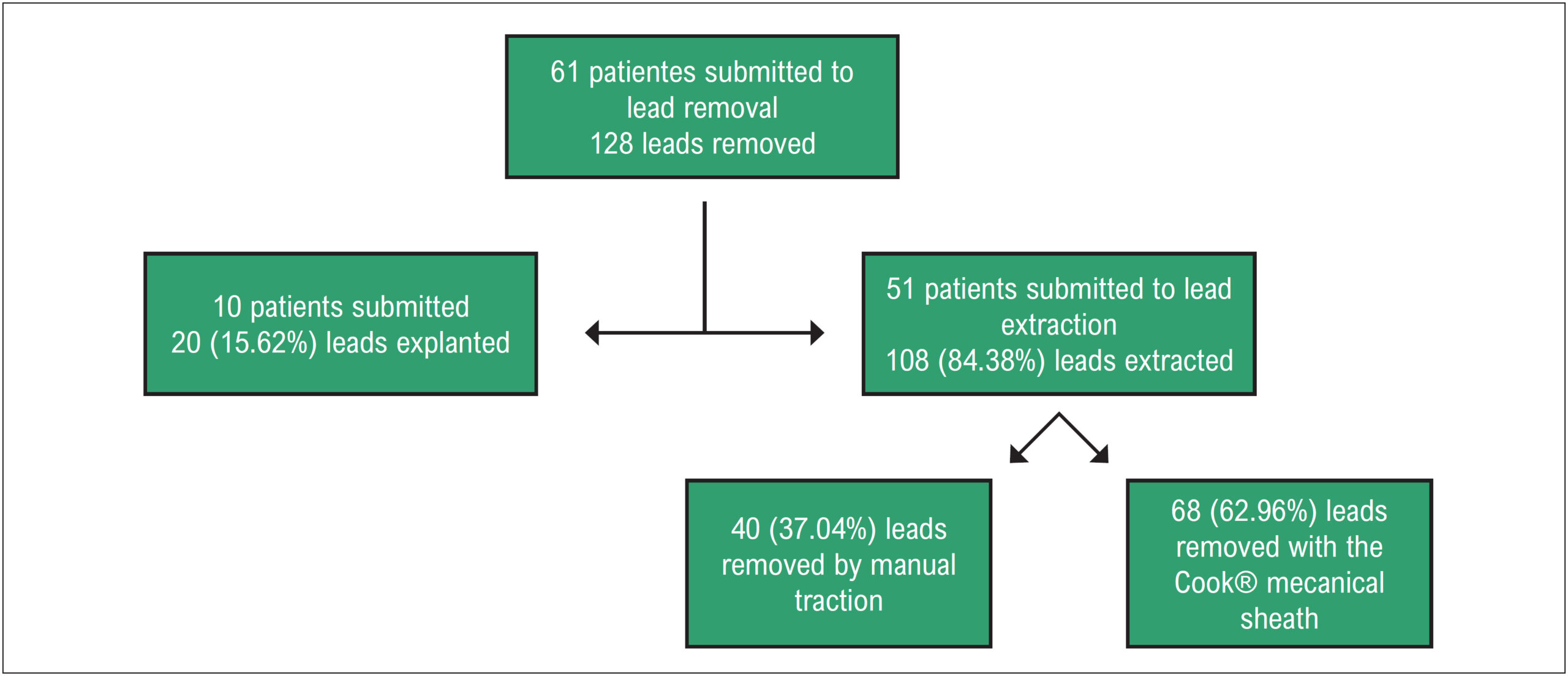
Cardiac device removals were performed in 61 patients, of which 51 were submitted to lead extractions and 10 to lead explants. In total, 128 leads were removed. Our clinical success rate was 100% in the explant group and 90.2% in the extraction one (p=0.58). Major complications were observed in 6.6% patients. Procedure failure was associated to older right ventricle (p=0.05) and atrial leads (p=0,04). Procedure duration (p=0.003) and need for blood transfusion (p<0,001) were associated to more complications.

Conclusion:

Complications and clinical success were observed in 11.5% and 91.8% of the population, respectively. Removal of older atrial and ventricular leads were associated with lower success rates. Longer procedures and blood transfusions were associated with complications.

  • Artificial Pacemaker
  • Cardiac Resynchronization Therapy
  • Implantable Electrodes
Read Full Article
Creative Commons Attribution (CC BY) Creative Commons license
17/05/2021 DOI: 10.36660/abc.20190726 Views 2
Figure 1
IJCS
Case Report

Acute Heart Failure Exacerbation in the Setting of Electrical Storm: Total Artificial Heart vs. Ventricle Assist Device

Juan Simon Rico et al. Daniela Arango-Isaza Megha Prasad Clara Saldarriaga

Introduction

Total artificial heart (TAH) is a novel device with over a thousand implantations worldwide, being a suitable option for patients as a bridge to transplantation (BTT). The following case was the second implantation of a TAH at our institution.

[…]

  • Arrhythmias Cardiac
  • Cardiac Resynchronization Therapy
  • Defibrillators, Implantable
  • Dilated Cardiomyopathy
  • Heart Failure
Read Full Article
Creative Commons Attribution (CC BY) Creative Commons license
01/01/2019 DOI: 10.5935/2359-4802.20180078
ABC
Editorial

Can We Consider PR Interval to Screen Patients for Cardiac Resynchronization Therapy?

Martino Martinelli Filho

The search for response markers to Cardiac Resynchronization Therapy (CRT) remains intensive. Currently, the main criteria for CRT indication are the QRS morphology and the absence of myocardial fibrosis.

The electrocardiogram remains an important tool for selecting CRT candidates, and new parameters, such as the PR interval, are interesting to discriminate the prognosis in this population. On this issue, we have a meta-analysis study concluding that the presence of prolonged PR interval is a marker of poor prognosis at baseline.

[…]

  • Cardiac Resynchronization Therapy
  • Electrocardiology/methods
  • Heart Failure/complications
  • Review
Read Full Article
Creative Commons Attribution (CC BY) Creative Commons license
01/11/2018 DOI: 10.5935/abc.20180224 Views 1
ABC
Editorial

Analysis of Cardiac Dyssynchrony – An Unsolved Issue! How to improve selection and response to Cardiac Resynchronization Therapy?

Eduardo Arrais Rocha

The authors Nascimento et al., published an important work demonstrating the value of myocardial perfusion scintigraphy (SPECT-Gated) to identify cardiac dyssynchrony (CD) and with posterior implantation of left ventricle (LV) electrode in the area with higher dyssynchrony, with favorable correlation with clinical results and cardiac function. The study rises important issues in the attempt to reduce non-respondent rate (30-40%). These high rates are due to implants in very advanced or irreversible phases of the disease or to positioning of the LV electrode in areas with fibrosis or due to absence of dyssynchrony.

All the current directives take the indication of cardiac resynchronization therapy (CRT) in consideration, based on electrical dyssynchrony criteria, in detriment of mechanical dyssynchrony criteria. The Echo CRT study confirmed the unfavorable results in patients submitted to CRT in absence of CD, minding it may be a deleterious therapy.

[…]

  • Cardiac Resynchronization Therapy
  • Cardiac resynchronization-therapy devices
  • Eletrodes
  • Myocardial Perfusion Imaging, Diagnostic Imaging
Read Full Article
Creative Commons Attribution (CC BY) Creative Commons license
01/10/2018 DOI: 10.5935/abc.20180200 Views 1
Figure 1
ABC
Original Article

Relationship of Electromechanical Dyssynchrony in Patients Submitted to CRT With LV Lead Implantation Guided by Gated Myocardial Perfusion Spect

Erivelton Alessandro do Nascimento et al. Christiane Cigagna Wiefels Reis Fernanda Baptista Ribeiro Christiane Rodrigues Alves … Eduardo Nani Silva Mario Luiz Ribeiro Claudio Tinoco Mesquita

Abstract

Background:

Heart failure (HF) affects more than 5 million individuals in the United States, with more than 1 million hospital admissions per year. Cardiac resynchronization therapy (CRT) can benefit patients with advanced HF and prolonged QRS. A significant percentage of patients, however, does not respond to CRT. Electrical dyssynchrony isolated might not be a good predictor of response, and the last left ventricular (LV) segment to contract can influence the response.

Objectives:

To assess electromechanical dyssynchrony in CRT with LV lead implantation guided by GATED SPECT.

Methods:

This study included 15 patients with functional class II-IV HF and clinically optimized, ejection fraction of 35%, sinus rhythm, left bundle-branch block, and QRS ≥ 120 ms. The patients underwent electrocardiography, answered the Minnesota Living with Heart Failure Questionnaire (MLHFQ), and underwent gated myocardial perfusion SPECT up to 4 weeks before CRT, being reassessed 6 months later. The primary analysis aimed at determining the proportion of patients with a reduction in QRS duration and favorable response to CRT, depending on concordance of the LV lead position, using chi-square test. The pre- and post-CRT variables were analyzed by use of Student t test, adopting the significance level of 5%.

Results:

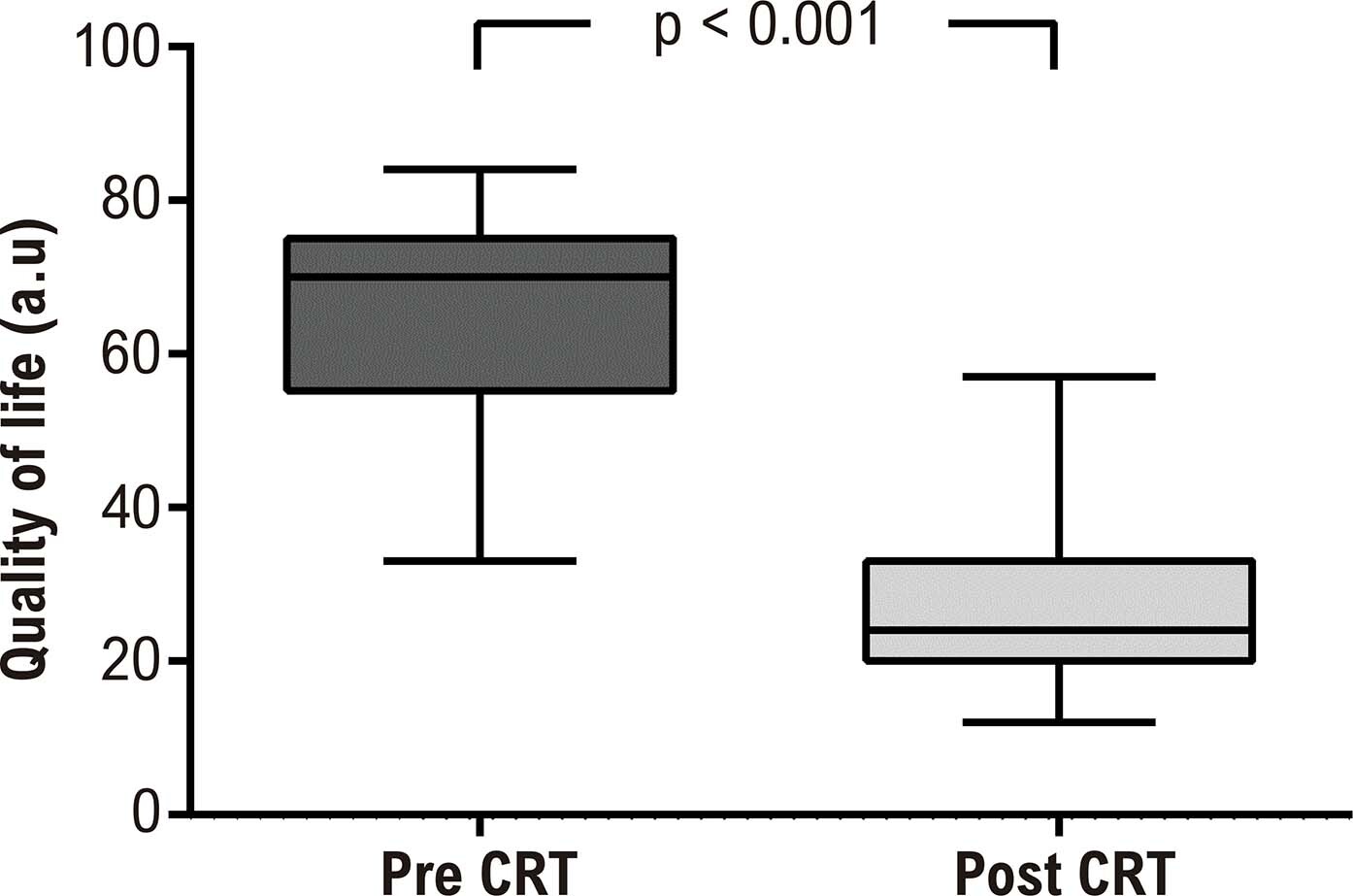
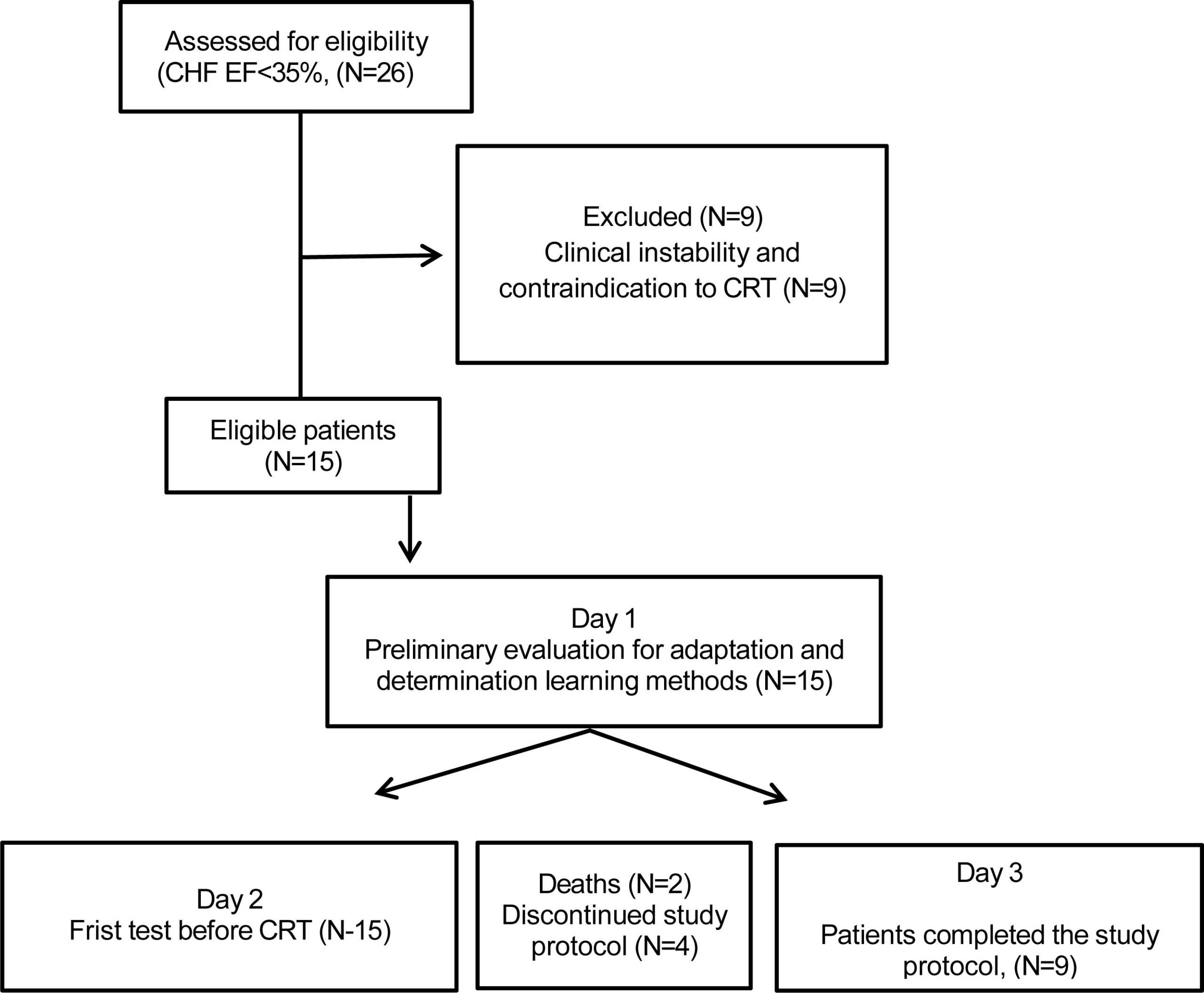
We implanted 15 CRT devices, and 2 patients died during follow-up. The durations of the QRS (212 ms vs 136 ms) and the PR interval (179 ms vs 126 ms) were significantly reduced (p < 0.001). In 54% of the patients, the lead position was concordant with the maximal delay site. In the responder group, the lateral position was prevalent. The MLHFQ showed a significant improvement in quality of life (p < 0.0002).

Conclusion:

CRT determines improvement in the quality of life and in electrical synchronism. Electromechanical synchronism relates to response to CRT. Positioning the LV lead in the maximal delay site has limitations.

  • Cardiac Resynchronization Therapy
  • Eletrodes,Implanted
  • Heart Failure
  • Radionuclide Imaging
  • Stroke Volume
Read Full Article
Creative Commons Attribution (CC BY) Creative Commons license
23/08/2018 DOI: 10.5935/abc.20180159 Views 2
Figure 1
IJCS
Case Report

Improvement of Pacing-Induced Dyssynchrony by Right Ventricular Septal Stimulation in a Child with Tetralogy of Fallot

Alexander González Guillen et al. Michel Cabrera Ortega Francisco Díaz Ramírez Dunia Bárbara Benítez Ramos

Introduction

Complete atrioventricular block (CAVB) is not an uncommon complication after surgical correction of tetralogy of Fallot (TOF). The choice of the ventricular pacing site in patients requiring pacemaker therapy depends on factors such as age, weight, presence of a venous anomaly, and intracardiac short -circuit. The harmful effects of ventricular pacing are most pronounced during right ventricular (RV) stimulation. Even then, RV pacing sites have been determined to be optimal in some patients with and without congenital heart disease.

[…]

  • Atrioventricular block
  • Cardiac Resynchronization Therapy
  • Heart Defects, Congenital
  • Tetralogy of Fallot/surgery
  • Ventricular Dysfunction Right
Read Full Article
Creative Commons Attribution (CC BY) Creative Commons license
01/01/2018 DOI: 10.5935/2359-4802.20170100 Views 1
Figure 1
IJCS
Original Article

Use of GATED-SPECT for Ventricular Desynchronization Evaluation in Patients with Heart Failure Submitted to Cardiac Resynchronization Therapy

Christiane Cigagna Wiefels et al. Erivelton Alessandro do Nascimento Christiane Rodrigues Alves Fernanda Baptista Ribeiro … Fernando de Amorim Fernandes Mario Luiz Ribeiro Claudio Tinoco Mesquita

Abstract

Background:

Approximately 20 to 40% of patients with heart failure do not respond to cardiac resynchronization therapy (CRT). To improve patient selection, phase analysis by myocardial perfusion scintigraphy (GSPECT) was developed.

Objectives:

To evaluate the clinical and scintigraphic response of patients with heart failure (HF) submitted to CRT using GSPECT.

Method:

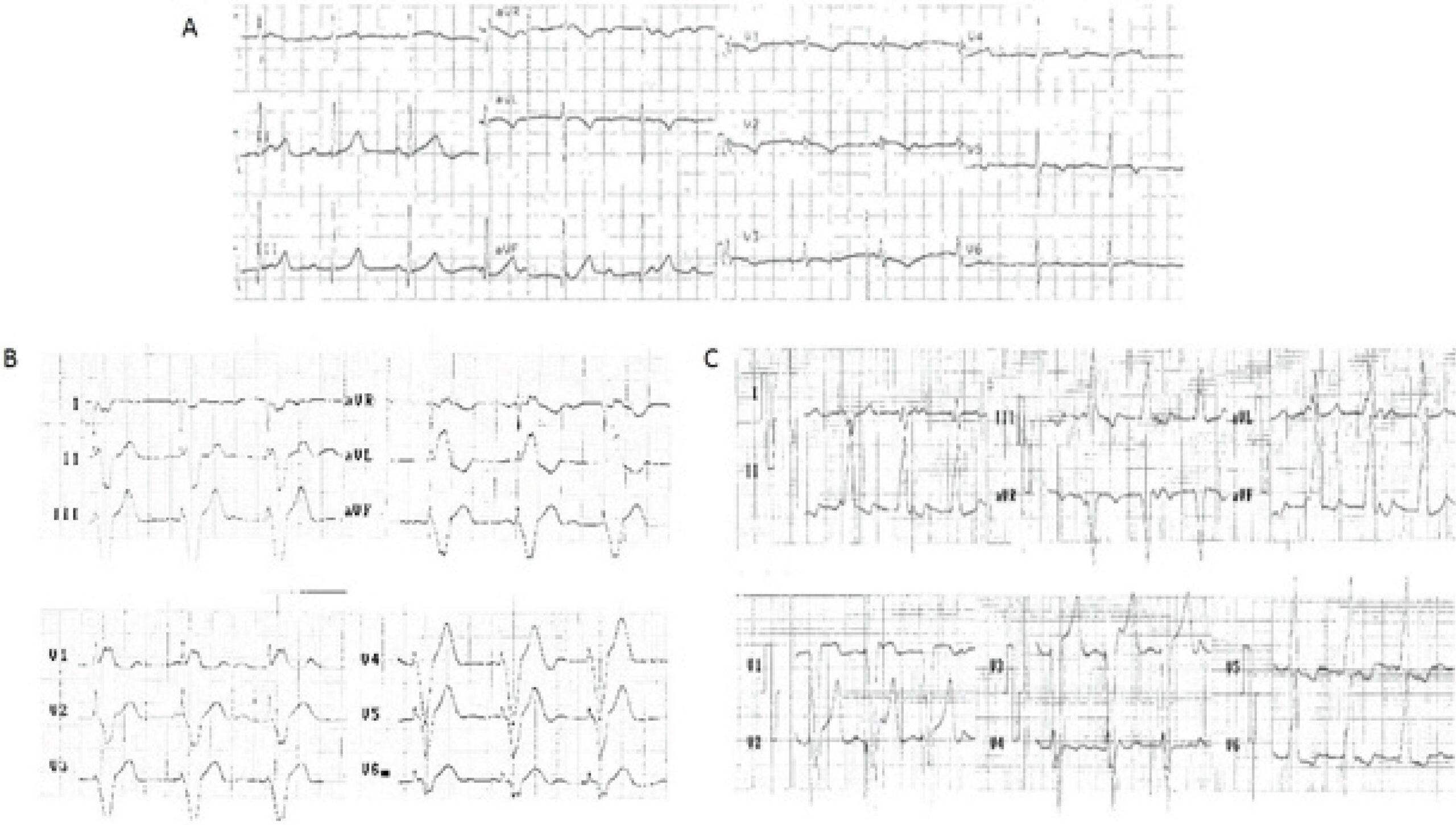
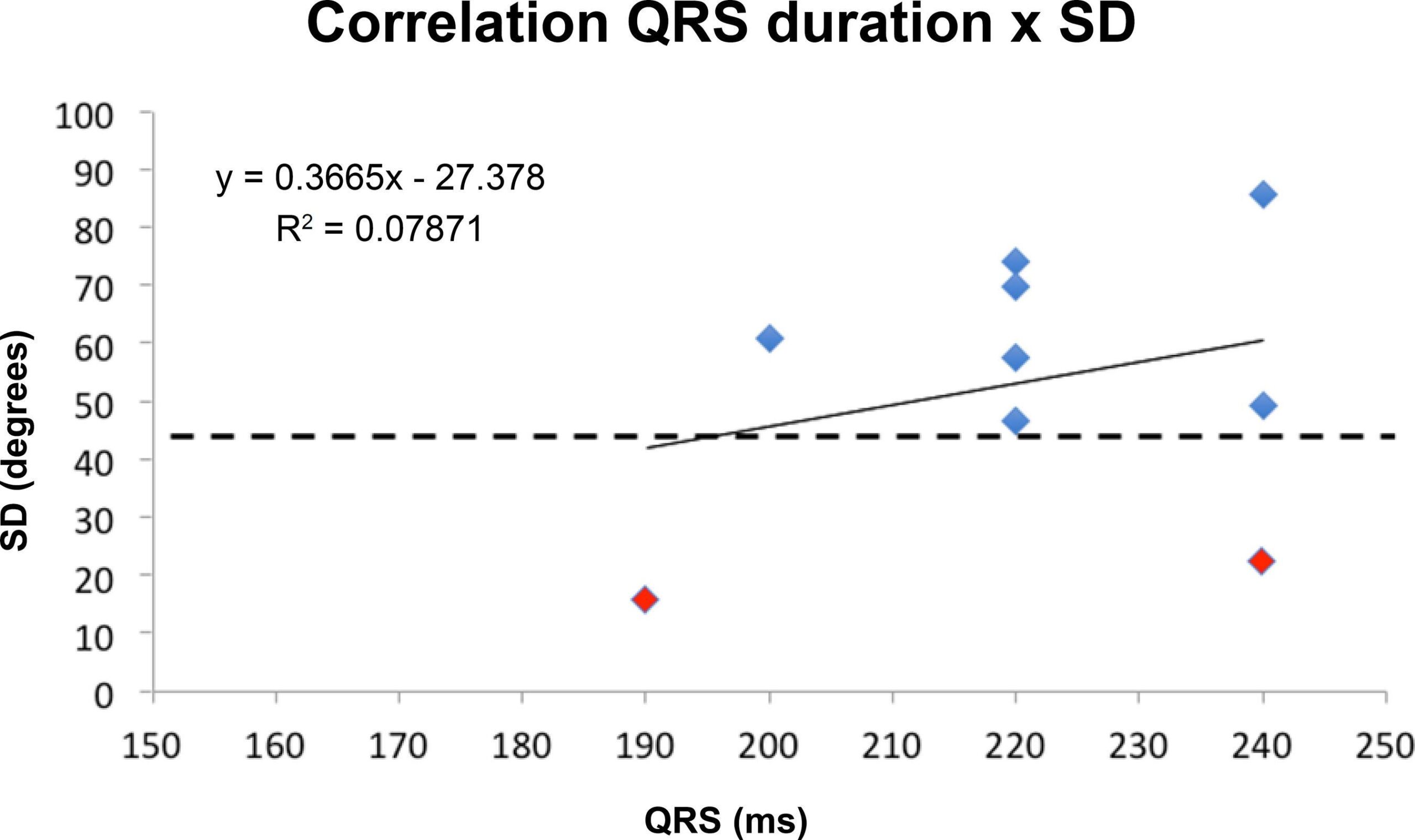
This was an interventional study that included consecutive patients assessed by GSPECT four weeks prior to CRT implantation and six months after it for comparison. These patients also answered the Minnesota Living with Heart Failure Questionnaire (MLHFQ). The categorical variables were compared using Fisher’s exact test and chi-square test, whereas Student’s t-test was used for numerical variables. The level of statistical significance was set at 5%. The scintigraphic variables analyzed were left ventricular ejection fraction, end-systolic volume, end-diastolic volume, left ventricular mass, standard deviation and bandwidth, as well as QRS duration and the Minnesota Quality of Life Questionnaire score. The presence of mechanical dyssynchrony was defined as standard deviation > 43º.

Results:

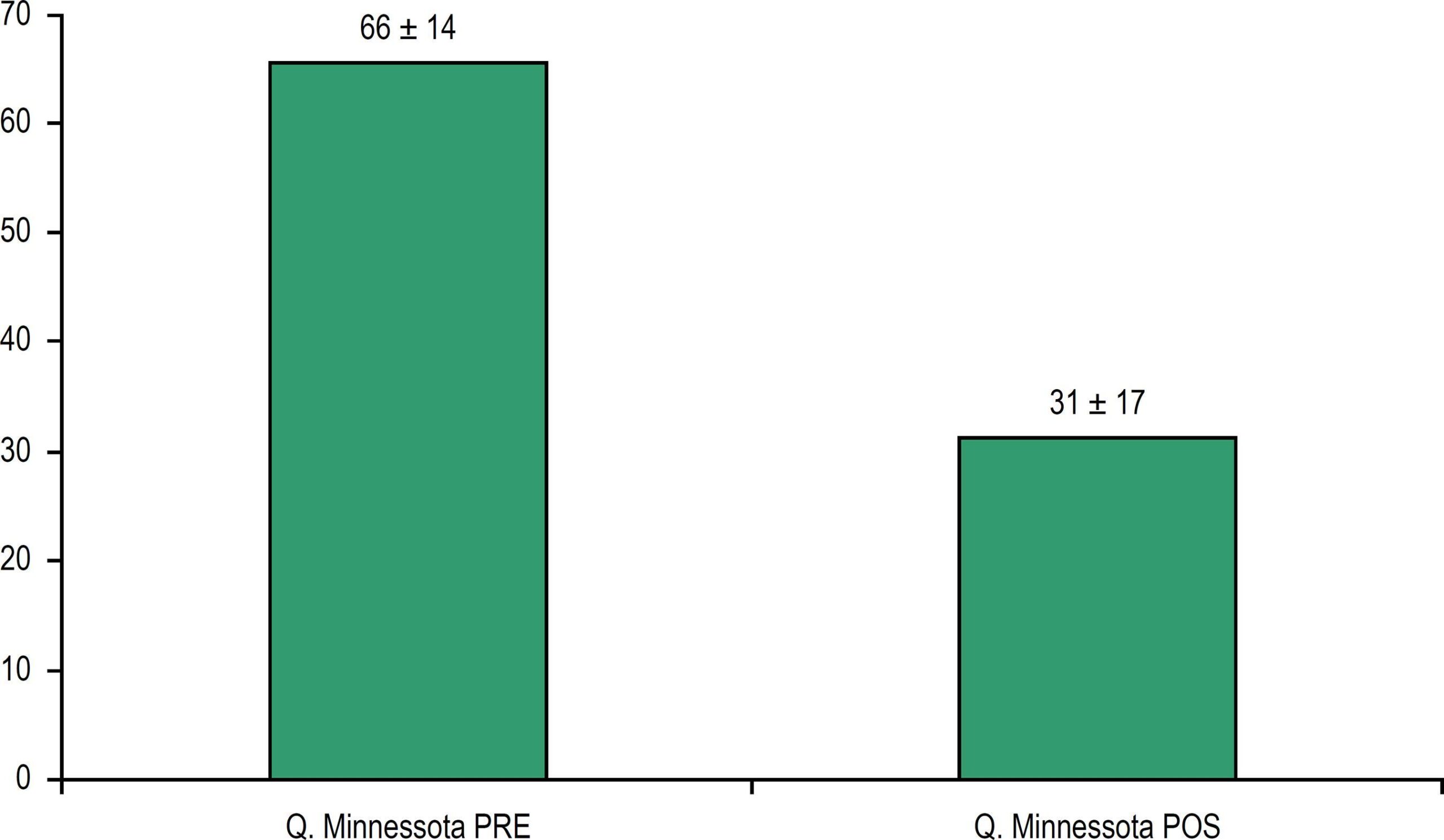
Nine patients were included in the study. After the cardiac resynchronization therapy, there was a significant improvement (p < 0.05) in the end-systolic volume (206 ± 80 mL vs. 158 ± 108 mL), QRS (180 ± 18 ms vs. 120 ± 9 ms), left ventricular mass (248 ± 65 g vs. 193 ± 52 g) and Minnesota Quality of Life Questionnaire score (63 ± 16 vs. 34 ± 20). All patients with scintigraphic criteria of mechanical dyssynchrony showed clinical improvement. Two patients had only electrical dyssynchrony and did not achieve significant clinical improvement, although they showed QRS duration reduction.

Conclusion:

GSPECT was able to differentiate patients with isolated electrical dyssynchrony from those with associated mechanical dyssynchrony, through the intraventricular dyssynchrony parameters. The cardiac resynchronization therapy is associated with the improvement of both mechanical and electrical dyssynchrony. Pre-implantation GSPECT showed that patients with associated electrical and mechanical dyssynchrony had a better response to cardiac resynchronization therapy than those with isolated electrical dyssynchrony.

  • Artery Coronary Disease / physiopathology
  • Cardiac Resynchronization Therapy
  • Heart Failure
  • Myocardial Infarction
  • Myocardial Perfusion Imaging / scintigraphy
  • Stroke Volume
Read Full Article
Creative Commons Attribution (CC BY) Creative Commons license
01/01/2018 DOI: 10.5935/2359-4802.20180022 Views 2
Figure 1
ABC
Original Article

Predictors of Total Mortality and Echocardiographic Response for Cardiac Resynchronization Therapy: A Cohort Study

Guilherme Ferreira Gazzoni et al. Matheus Bom Fraga Andres Di Leoni Ferrari Pablo da Costa Soliz … Anibal Pires Borges Eduardo Bartholomay Carlos Antonio Abunader Kalil Vanessa Giaretta Luis Eduardo Paim Rohde

Abstract

Background:

Clinical studies demonstrate that up to 40% of patients do not respond to cardiac resynchronization therapy (CRT), thus, appropriate patient selection is critical to the success of CRT in heart failure.

Objective:

Evaluation of mortality predictors and response to CRT in the Brazilian scenario.

Methods:

Retrospective cohort study including patients submitted to CRT in a tertiary hospital in southern Brazil from 2008 to 2014. Survival was assessed through a database of the State Department of Health (RS). Predictors of echocardiographic response were evaluated using Poisson regression. Survival analysis was performed by Cox regression and Kaplan Meyer curves. A two-tailed p value less than 0.05 was considered statistically significant.

Results:

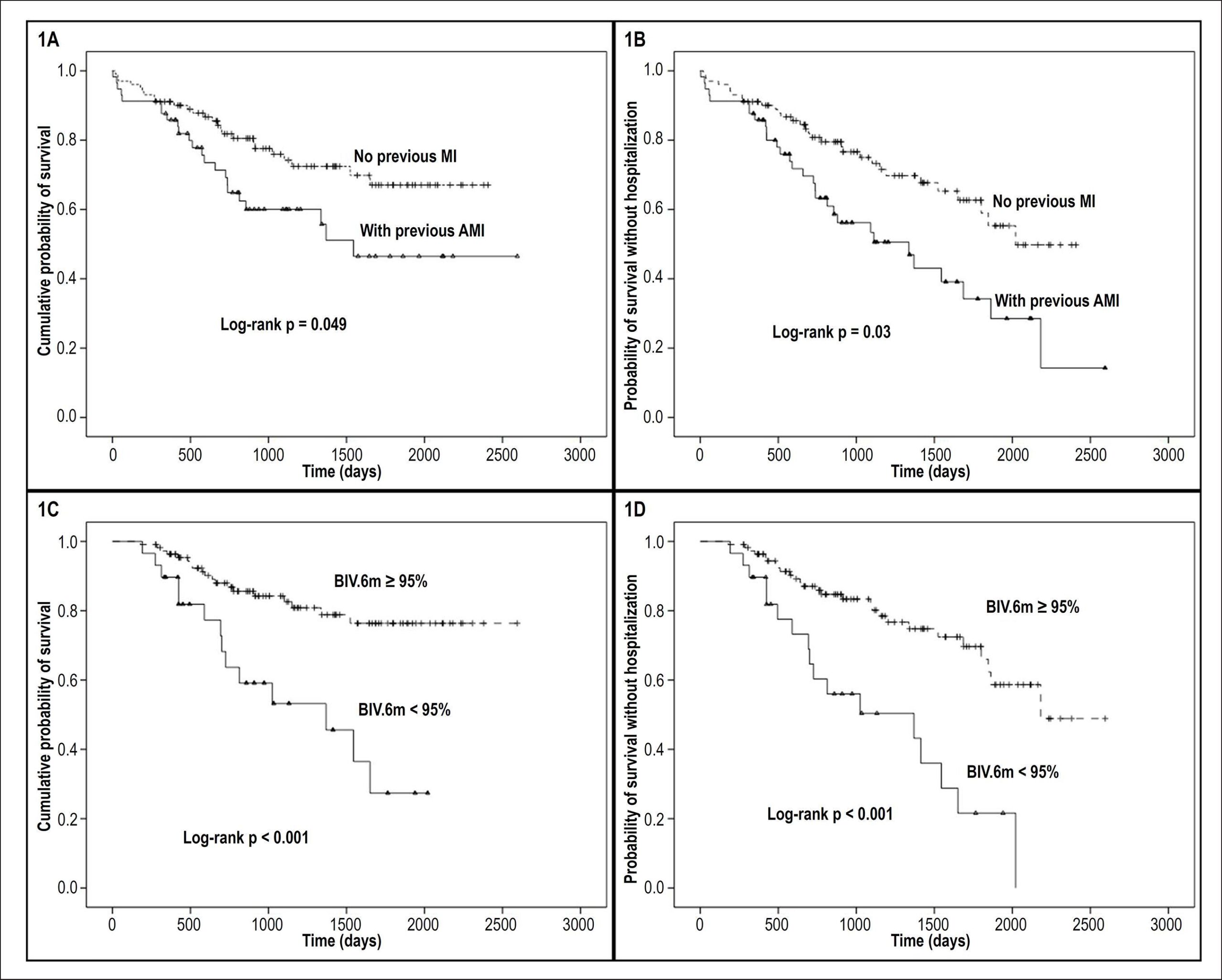
A total of 170 patients with an average follow-up of 1011 ± 632 days were included. The total mortality was 30%. The independent predictors of mortality were age (hazard ratio [HR] of 1.05, p = 0.027), previous acute myocardial infarction (AMI) (HR of 2.17, p = 0.049) and chronic obstructive pulmonary disease (COPD) (HR of 3.13, p = 0.015). The percentage of biventricular stimulation at 6 months was identified as protective factor of mortality ([HR] 0.97, p = 0.048). The independent predictors associated with the echocardiographic response were absence of mitral insufficiency, presence of left bundle branch block and percentage of biventricular stimulation.

Conclusion:

Mortality in patients submitted to CRT in a tertiary hospital was independently associated with age, presence of COPD and previous AMI. The percentage of biventricular pacing evaluated 6 months after resynchronizer implantation was independently associated with improved survival and echocardiographic response.

  • Bundle Branch Block
  • Cardiac Resynchronization Therapy
  • Cohort Studies
  • Heart Failure / mortality
  • Stroke Volume
Read Full Article
Creative Commons Attribution (CC BY) Creative Commons license
27/11/2017 DOI: 10.5935/abc.20170171 Views 2
IJCS
Original Article

Who Are the Super-Responders to Cardiac Resynchronization Therapy?

Eduardo Arrais Rocha et al. Francisca Tatiana Moreira Pereira Ana Rosa Pinto Quidute José Sebastião Abreu … José Wellington Oliveira Lima Carlos Roberto M Rodrigues Sobrinho Maurício Ibrahim Scanavacca

Abstract

Background:

Patients submitted to cardiac resynchronization may develop response patterns that are higher than expected, with normalization of clinical and echocardiographic parameters.

Objective:

To analyze the clinical and echocardiographic characteristics of this population of super-responders, comparing them with the other patients submitted to cardiac resynchronization therapy.

Methods:

A prospective, observational cohort study involving 146 patients consecutively submitted to cardiac resynchronization implants. Fisher’s exact test and Mann-Whitney test were performed to compare the variables. Patients with ejection fraction > 50% and functional class I/II (New York Heart Association) were considered super-responders after 6 months of cardiac resynchronization therapy.

Results:

Mean age was 64.8 ± 11.1 years, with 69.8% of males, with a median ejection fraction of 29%, 71.5% with left bundle-branch block, 12% with right bundle-branch block associated with hemiblocks; 16.3% wearing a definitive cardiac pacemaker, 29.3% with ischemic cardiomyopathy, 59.4% with dilated cardiomyopathy, and 11.2% with Chagasic cardiomyopathy. Twenty-four (16.4%) super-responders were observed, and 13 (8.9%) showed normalization of the ejection fraction, left ventricular diastolic diameters and functional class. When compared to the non-super-responder patients, in relation to the pre-implantation characteristics, the super-responders were more often females (58.3% vs. 22.8%, p = 0.002), had higher body mass index (26.8 vs. 25.5, p = 0.013), higher baseline ejection fraction (31.0 vs. 26.9, p = 0.0003), and lower left ventricular diastolic diameters (65.9 mm vs. 72.6 mm, p = 0.0032). Ten patients (41.6% of super-responders) with right bundle-branch block and hemiblock progressed to super-responders, although there was only one patient with Chagas’ disease among them, and only at the first assessment.

Conclusions:

Super-responders had less advanced heart disease at baseline and no differences regarding the type of conduction disorder at baseline. Patients with right bundle-branch block and hemiblock, but without Chagasic heart disease may also progress as super-responders.
  • Cardiac Resynchronization Therapy
  • Defibrillators, Implantable
  • Echocardiography
  • Heart Failure
Read Full Article
Creative Commons Attribution (CC BY) Creative Commons license
01/01/2017 DOI: 10.5935/2359-4802.20170020 Views 2
Figure 1
ABC
Original Article

Echocardiographic Predictors of Worse Outcome After Cardiac Resynchronization Therapy

Eduardo Arrais Rocha et al. Francisca Tatiana Moreira Pereira José Sebastião Abreu José Wellington O. Lima … Marcelo de Paula M. Monteiro Almino Cavalcante Rocha Neto Ana Rosa Pinto Quidute Camilla Viana A. Goés Carlos Roberto Martins Rodrigues Sobrinho Maurício Ibrahim Scanavacca

Abstract

Background:

Cardiac resynchronization therapy (CRT) is the recommended treatment by leading global guidelines. However, 30%-40% of selected patients are non-responders.

Objective:

To develop an echocardiographic model to predict cardiac death or transplantation (Tx) 1 year after CRT.

Method:

Observational, prospective study, with the inclusion of 116 patients, aged 64.89 ± 11.18 years, 69.8% male, 68,1% in NYHA FC III and 31,9% in FC IV, 71.55% with left bundle-branch block, and median ejection fraction (EF) of 29%. Evaluations were made in the pre‑implantation period and 6-12 months after that, and correlated with cardiac mortality/Tx at the end of follow-up. Cox and logistic regression analyses were performed with ROC and Kaplan-Meier curves. The model was internally validated by bootstrapping.

Results:

There were 29 (25%) deaths/Tx during follow-up of 34.09 ± 17.9 months. Cardiac mortality/Tx was 16.3%. In the multivariate Cox model, EF < 30%, grade III/IV diastolic dysfunction and grade III mitral regurgitation at 6‑12 months were independently related to increased cardiac mortality or Tx, with hazard ratios of 3.1, 4.63 and 7.11, respectively. The area under the ROC curve was 0.78.

Conclusion:

EF lower than 30%, severe diastolic dysfunction and severe mitral regurgitation indicate poor prognosis 1 year after CRT. The combination of two of those variables indicate the need for other treatment options.

  • Cardiac Resynchronization Therapy
  • Echocardiography
  • Heart Failure / mortality
  • Pacemaker, Artificial
  • Risk Factors
Read Full Article
Creative Commons Attribution (CC BY) Creative Commons license
04/09/2015 DOI: 10.5935/abc.20150108 Views 1
Figure 1
ABC
Original Article

Development and Validation of Predictive Models of Cardiac Mortality and Transplantation in Resynchronization Therapy

Eduardo Arrais Rocha et al. Francisca Tatiana Moreira Pereira José Sebastião Abreu José Wellington O. Lima … Marcelo de Paula Martins Monteiro Almino Cavalcante Rocha Neto Camilla Viana Arrais Goés Ana Gardênia P. Farias Carlos Roberto Martins Rodrigues Sobrinho Ana Rosa Pinto Quidute Maurício Ibrahim Scanavacca

Abstract

Background:

30-40% of cardiac resynchronization therapy cases do not achieve favorable outcomes.

Objective:

This study aimed to develop predictive models for the combined endpoint of cardiac death and transplantation (Tx) at different stages of cardiac resynchronization therapy (CRT).

Methods:

Prospective observational study of 116 patients aged 64.8 ± 11.1 years, 68.1% of whom had functional class (FC) III and 31.9% had ambulatory class IV. Clinical, electrocardiographic and echocardiographic variables were assessed by using Cox regression and Kaplan-Meier curves.

Results:

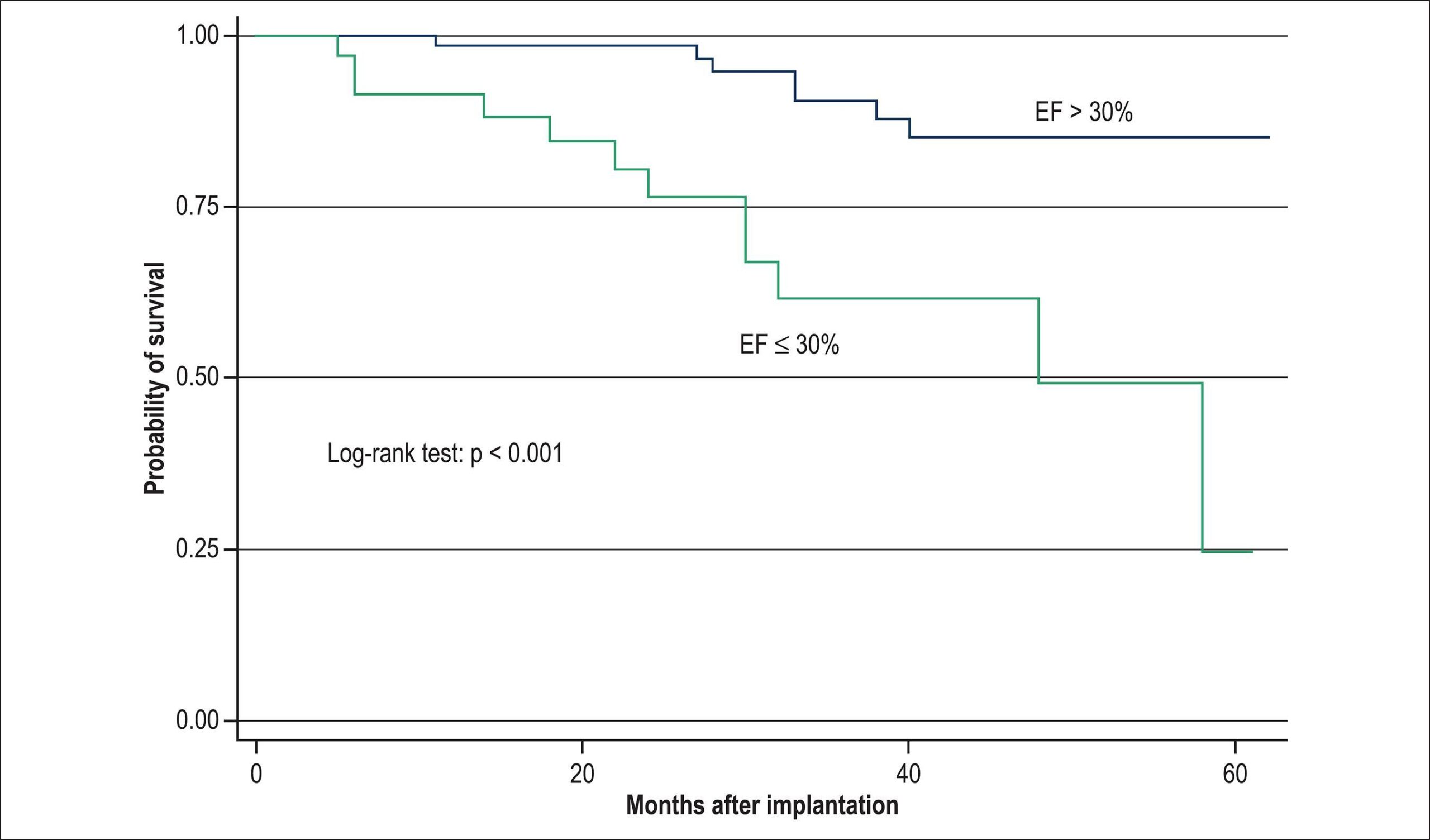
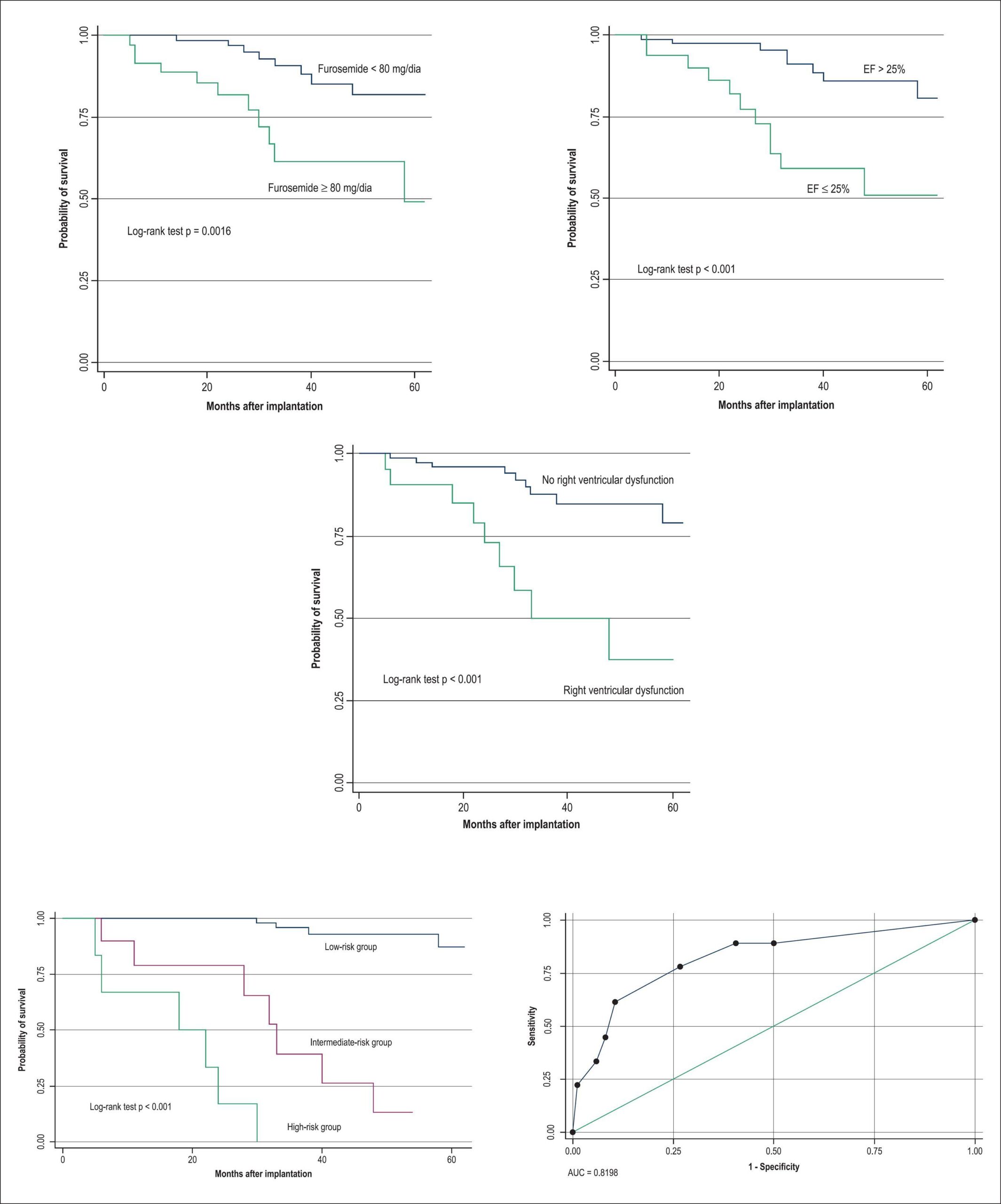
The cardiac mortality/Tx rate was 16.3% during the follow-up period of 34.0 ± 17.9 months. Prior to implantation, right ventricular dysfunction (RVD), ejection fraction < 25% and use of high doses of diuretics (HDD) increased the risk of cardiac death and Tx by 3.9-, 4.8-, and 5.9-fold, respectively. In the first year after CRT, RVD, HDD and hospitalization due to congestive heart failure increased the risk of death at hazard ratios of 3.5, 5.3, and 12.5, respectively. In the second year after CRT, RVD and FC III/IV were significant risk factors of mortality in the multivariate Cox model. The accuracy rates of the models were 84.6% at preimplantation, 93% in the first year after CRT, and 90.5% in the second year after CRT. The models were validated by bootstrapping.

Conclusion:

We developed predictive models of cardiac death and Tx at different stages of CRT based on the analysis of simple and easily obtainable clinical and echocardiographic variables. The models showed good accuracy and adjustment, were validated internally, and are useful in the selection, monitoring and counseling of patients indicated for CRT.

  • Cardiac Resynchronization Therapy
  • Follow-Up Studies
  • Heart Failure/physiopathology
  • Heart Transplantation / mortality
  • Pacemaker, Artificial
Read Full Article
Creative Commons Attribution (CC BY) Creative Commons license
07/08/2015 DOI: 10.5935/abc.20150093 Views 1

Could not load more articles. Please try again.

How to cite this article

EndNote RIS

Electronic Document Format (Vancouver)

Gregório C, Magalhães A, Silva B, Araújo I, Vilela M, Marques P, Sousa J, et al. Cardiac Resynchronization Therapy in Cardio-Oncology: Real-World Evidence of Benefit in Cancer Patients with Heart Failure. Arquivos Brasileiros de Cardiologia 2026;123(7):e20250888.

Electronic Document Format (ABNT)

Gregório, Catarina; Magalhães, Andreia; Silva, Beatriz; Araújo, Inês; Vilela, Marta; Marques, Pedro; Sousa, João de; Menezes, Miguel Nobre; Pinto, Fausto J.; Fiuza, Manuela. Cardiac Resynchronization Therapy in Cardio-Oncology: Real-World Evidence of Benefit in Cancer Patients with Heart Failure. Arquivos Brasileiros de Cardiologia, v. 123, n. 7, e20250888, Sep. 2026.

Electronic Document Format (APA)

Gregório, C., Magalhães, A., Silva, B., Araújo, I., Vilela, M., Marques, P., Sousa, J. , Menezes, M. N., Pinto, F. J., & Fiuza, M. (2026). Cardiac Resynchronization Therapy in Cardio-Oncology: Real-World Evidence of Benefit in Cancer Patients with Heart Failure. Arquivos Brasileiros de Cardiologia, 123(7), e20250888.

Electronic Document Format (ISO)

Gregório, Catarina and Magalhães, Andreia and Silva, Beatriz and Araújo, Inês and Vilela, Marta and Marques, Pedro and Sousa, João de and Menezes, Miguel Nobre and Pinto, Fausto J. and Fiuza, Manuela. Cardiac Resynchronization Therapy in Cardio-Oncology: Real-World Evidence of Benefit in Cancer Patients with Heart Failure. Arquivos Brasileiros de Cardiologia [online]. 2026, vol. 123, n. 7, [cited 2026-10-14], e20250888. Available from: <https://journals.cardiol.br/en/article/cardiac-resynchronization-therapy-in-cardio-oncology-real-world-evidence-of-benefit-in-cancer-patients-with-heart-failure/>. ISSN 0066-782X

EndNote RIS

Electronic Document Format (Vancouver)

Decker SRR, Etges APBS, Zimerman A, Alves FD, Ternes CM, Santos JS, Zimerman L, et al. Conduction System Pacing vs Biventricular Pacing in Chronic Heart Failure: Protocol for the Economic Analysis of the PhysioSync-HF Trial. Arquivos Brasileiros de Cardiologia 2026;122(12):e20250254.

Electronic Document Format (ABNT)

Decker, Sérgio R. R.; Etges, Ana Paula Beck da S; Zimerman, André; Alves, Fernanda D.; Ternes, Caique M.; Santos, Juliana S.; Zimerman, Leandro; Rohde, Luis Eduardo; Forno, Alexander Dal; d’Avila, André; Kazi, Dhruv S.; Bertoldi, Eduardo G.; Polanczyk, Carisi A.. Conduction System Pacing vs Biventricular Pacing in Chronic Heart Failure: Protocol for the Economic Analysis of the PhysioSync-HF Trial. Arquivos Brasileiros de Cardiologia, v. 122, n. 12, e20250254, Feb. 2026.

Electronic Document Format (APA)

Decker, S. R. R., Etges, A. P. B. S., Zimerman, A., Alves, F. D., Ternes, C. M., Santos, J. S., Zimerman, L., Rohde, L. E., Forno, A. D., d’Avila, A., Kazi, D. S., Bertoldi, E. G., & Polanczyk, C. A. (2026). Conduction System Pacing vs Biventricular Pacing in Chronic Heart Failure: Protocol for the Economic Analysis of the PhysioSync-HF Trial. Arquivos Brasileiros de Cardiologia, 122(12), e20250254.

Electronic Document Format (ISO)

Decker, Sérgio R. R. and Etges, Ana Paula Beck da S and Zimerman, André and Alves, Fernanda D. and Ternes, Caique M. and Santos, Juliana S. and Zimerman, Leandro and Rohde, Luis Eduardo and Forno, Alexander Dal and d’Avila, André and Kazi, Dhruv S. and Bertoldi, Eduardo G. and Polanczyk, Carisi A.. Conduction System Pacing vs Biventricular Pacing in Chronic Heart Failure: Protocol for the Economic Analysis of the PhysioSync-HF Trial. Arquivos Brasileiros de Cardiologia [online]. 2026, vol. 122, n. 12, [cited 2026-10-14], e20250254. Available from: <https://journals.cardiol.br/en/article/conduction-system-pacing-vs-biventricular-pacing-in-chronic-heart-failure-protocol-for-the-economic-analysis-of-the-physiosync-hf-trial/>. ISSN 0066-782X

EndNote RIS

Electronic Document Format (Vancouver)

Santos LOA, Daminello E, França LA. What Does Myocardial Work Offer Beyond Strain?. ABC Imagem Cardiovascular 2026;38(4):e20250103.

Electronic Document Format (ABNT)

Santos, Luiz Otávio de Arruda; Daminello, Edgar; França, Lucas Arraes de. What Does Myocardial Work Offer Beyond Strain?. ABC Imagem Cardiovascular, v. 38, n. 4, e20250103, Feb. 2026.

Electronic Document Format (APA)

Santos, L. O. A., Daminello, E., & França, L. A. (2026). What Does Myocardial Work Offer Beyond Strain?. ABC Imagem Cardiovascular, 38(4), e20250103.

Electronic Document Format (ISO)

Santos, Luiz Otávio de Arruda and Daminello, Edgar and França, Lucas Arraes de. What Does Myocardial Work Offer Beyond Strain?. ABC Imagem Cardiovascular [online]. 2026, vol. 38, n. 4, [cited 2026-10-14], e20250103. Available from: <https://journals.cardiol.br/en/article/what-does-myocardial-work-offer-beyond-strain/>. ISSN 2318-8219

EndNote RIS

Electronic Document Format (Vancouver)

Passos LCS, Carvalho W, Barros-Pereira JP, Figueiredo CS, Dourado GP, Tapioca FPM, Cafezeiro CRF, et al. Effect of Sacubitril/Valsartan on All-Cause Mortality Reduction in Patients Undergoing Cardiac Resynchronization Therapy: SALVA-CRT. ABC Heart Fail Cardiomyop 2025;5(2):e20250003.

Electronic Document Format (ABNT)

Passos, Luiz Carlos Santana; Carvalho, William; Barros-Pereira, Jackson Pedro; Figueiredo, Clara Salles; Dourado, Gabriela Pio; Tapioca, Fernanda Pinheiro Martin; Cafezeiro, Caio Rebouças Fonseca. Effect of Sacubitril/Valsartan on All-Cause Mortality Reduction in Patients Undergoing Cardiac Resynchronization Therapy: SALVA-CRT. ABC Heart Fail Cardiomyop, v. 5, n. 2, e20250003, Dec. 2025.

Electronic Document Format (APA)

Passos, L. C. S., Carvalho, W., Barros-Pereira, J. P., Figueiredo, C. S., Dourado, G. P., Tapioca, F. P. M., & Cafezeiro, C. R. F. (2025). Effect of Sacubitril/Valsartan on All-Cause Mortality Reduction in Patients Undergoing Cardiac Resynchronization Therapy: SALVA-CRT. ABC Heart Fail Cardiomyop, 5(2), e20250003.

Electronic Document Format (ISO)

Passos, Luiz Carlos Santana and Carvalho, William and Barros-Pereira, Jackson Pedro and Figueiredo, Clara Salles and Dourado, Gabriela Pio and Tapioca, Fernanda Pinheiro Martin and Cafezeiro, Caio Rebouças Fonseca. Effect of Sacubitril/Valsartan on All-Cause Mortality Reduction in Patients Undergoing Cardiac Resynchronization Therapy: SALVA-CRT. ABC Heart Fail Cardiomyop [online]. 2025, vol. 5, n. 2, [cited 2026-10-14], e20250003. Available from: <https://journals.cardiol.br/en/article/effect-of-sacubitril-valsartan-on-all-cause-mortality-reduction-in-patients-undergoing-cardiac-resynchronization-therapy-salva-crt/>

EndNote RIS

Electronic Document Format (Vancouver)

Duarte CE, Silva KR, Jesus LD, Abensur H, Costa R. Impact of Intraventricular Blocks on Cardiac Cycle Dynamics: An Echocardiographic and Vectorcardiographic Analysis. Arquivos Brasileiros de Cardiologia 2025;121(12):e20240253.

Electronic Document Format (ABNT)

Duarte, Carlos Eduardo; Silva, Katia Regina; Jesus, Luciene Dias de; Abensur, Henry; Costa, Roberto. Impact of Intraventricular Blocks on Cardiac Cycle Dynamics: An Echocardiographic and Vectorcardiographic Analysis. Arquivos Brasileiros de Cardiologia, v. 121, n. 12, e20240253, Feb. 2025.

Electronic Document Format (APA)

Duarte, C. E., Silva, K. R., Jesus, L. D. , Abensur, H., & Costa, R. (2025). Impact of Intraventricular Blocks on Cardiac Cycle Dynamics: An Echocardiographic and Vectorcardiographic Analysis. Arquivos Brasileiros de Cardiologia, 121(12), e20240253.

Electronic Document Format (ISO)

Duarte, Carlos Eduardo and Silva, Katia Regina and Jesus, Luciene Dias de and Abensur, Henry and Costa, Roberto. Impact of Intraventricular Blocks on Cardiac Cycle Dynamics: An Echocardiographic and Vectorcardiographic Analysis. Arquivos Brasileiros de Cardiologia [online]. 2025, vol. 121, n. 12, [cited 2026-10-14], e20240253. Available from: <https://journals.cardiol.br/en/article/impact-of-intraventricular-blocks-on-cardiac-cycle-dynamics-an-echocardiographic-and-vectorcardiographic-analysis/>. ISSN 0066-782X

EndNote RIS

Electronic Document Format (Vancouver)

Andrade FA. Cardiac Implantable Electronic Devices in Chagasic and Non-Chagasic Patients: A Critical Look at the Prognosis. Arquivos Brasileiros de Cardiologia 2024;121(9):e20240629.

Electronic Document Format (ABNT)

Andrade, Fernanda Almeida. Cardiac Implantable Electronic Devices in Chagasic and Non-Chagasic Patients: A Critical Look at the Prognosis. Arquivos Brasileiros de Cardiologia, v. 121, n. 9, e20240629, Dec. 2024.

Electronic Document Format (APA)

Andrade, F. A. (2024). Cardiac Implantable Electronic Devices in Chagasic and Non-Chagasic Patients: A Critical Look at the Prognosis. Arquivos Brasileiros de Cardiologia, 121(9), e20240629.

Electronic Document Format (ISO)

Andrade, Fernanda Almeida. Cardiac Implantable Electronic Devices in Chagasic and Non-Chagasic Patients: A Critical Look at the Prognosis. Arquivos Brasileiros de Cardiologia [online]. 2024, vol. 121, n. 9, [cited 2026-10-14], e20240629. Available from: <https://journals.cardiol.br/en/article/cardiac-implantable-electronic-devices-in-chagasic-and-non-chagasic-patients-a-critical-look-at-the-prognosis/>. ISSN 0066-782X

EndNote RIS

Electronic Document Format (Vancouver)

Ternes CMP, Zimerman A. Conduction System Pacing: Redefining Resynchronization Therapy in Heart Failure. ABC Heart Fail Cardiomyop 2024;4(3):e20240037.

Electronic Document Format (ABNT)

Ternes, Caique M. P.; Zimerman, André. Conduction System Pacing: Redefining Resynchronization Therapy in Heart Failure. ABC Heart Fail Cardiomyop, v. 4, n. 3, e20240037, Nov. 2024.

Electronic Document Format (APA)

Ternes, C. M. P., & Zimerman, A. (2024). Conduction System Pacing: Redefining Resynchronization Therapy in Heart Failure. ABC Heart Fail Cardiomyop, 4(3), e20240037.

Electronic Document Format (ISO)

Ternes, Caique M. P. and Zimerman, André. Conduction System Pacing: Redefining Resynchronization Therapy in Heart Failure. ABC Heart Fail Cardiomyop [online]. 2024, vol. 4, n. 3, [cited 2026-10-14], e20240037. Available from: <https://journals.cardiol.br/en/article/conduction-system-pacing-redefining-resynchronization-therapy-in-heart-failure/>

EndNote RIS

Electronic Document Format (Vancouver)

Galvão RC, Pucci JPV, Vieira OG, Carvalho ELS, Soares WM, Teles GCS. Left Bundle Branch Area Pacing for Resynchronization in Chagasic Patient and Dependent on Artificial Cardiac Pacing. Case Report. Arquivos Brasileiros de Cardiologia 2023;120(7):e20220464.

Electronic Document Format (ABNT)

Galvão, Raoni de Castro; Pucci, João Paulo Velasco; Vieira, Ofir Gomes; Carvalho, Edvagner Leite Sérgio de; Soares, Winder Marconsini; Teles, Guilherme Cunha dos S.. Left Bundle Branch Area Pacing for Resynchronization in Chagasic Patient and Dependent on Artificial Cardiac Pacing. Case Report. Arquivos Brasileiros de Cardiologia, v. 120, n. 7, e20220464, Jul. 2023.

Electronic Document Format (APA)

Galvão, R. C., Pucci, J. P. V., Vieira, O. G., Carvalho, E. L. S. , Soares, W. M., & Teles, G. C. S. (2023). Left Bundle Branch Area Pacing for Resynchronization in Chagasic Patient and Dependent on Artificial Cardiac Pacing. Case Report. Arquivos Brasileiros de Cardiologia, 120(7), e20220464.

Electronic Document Format (ISO)

Galvão, Raoni de Castro and Pucci, João Paulo Velasco and Vieira, Ofir Gomes and Carvalho, Edvagner Leite Sérgio de and Soares, Winder Marconsini and Teles, Guilherme Cunha dos S.. Left Bundle Branch Area Pacing for Resynchronization in Chagasic Patient and Dependent on Artificial Cardiac Pacing. Case Report. Arquivos Brasileiros de Cardiologia [online]. 2023, vol. 120, n. 7, [cited 2026-10-14], e20220464. Available from: <https://journals.cardiol.br/en/article/left-bundle-branch-area-pacing-for-resynchronization-in-chagasic-patient-and-dependent-on-artificial-cardiac-pacing-case-report/>. ISSN 0066-782X

EndNote RIS

Electronic Document Format (Vancouver)

Grossman GB. Nuclear Cardiology in the Optimization of Resynchronization Therapy: Quo Vadis?. Arquivos Brasileiros de Cardiologia 2023;120(3):e20230136.

Electronic Document Format (ABNT)

Grossman, Gabriel Blacher. Nuclear Cardiology in the Optimization of Resynchronization Therapy: Quo Vadis?. Arquivos Brasileiros de Cardiologia, v. 120, n. 3, e20230136, Apr. 2023.

Electronic Document Format (APA)

Grossman, G. B. (2023). Nuclear Cardiology in the Optimization of Resynchronization Therapy: Quo Vadis?. Arquivos Brasileiros de Cardiologia, 120(3), e20230136.

Electronic Document Format (ISO)

Grossman, Gabriel Blacher. Nuclear Cardiology in the Optimization of Resynchronization Therapy: Quo Vadis?. Arquivos Brasileiros de Cardiologia [online]. 2023, vol. 120, n. 3, [cited 2026-10-14], e20230136. Available from: <https://journals.cardiol.br/en/article/nuclear-cardiology-in-the-optimization-of-resynchronization-therapy-quo-vadis/>. ISSN 0066-782X

EndNote RIS

Electronic Document Format (Vancouver)

Nascimento EA, Fernandes FA, Mira PAC, He Z, Zhou W, Mesquita CT. Feasibility of Left Ventricle Lead Implantation in Cardiac Resynchronization Therapy Guided by Gated SPECT and Ventricular Remodeling. Arquivos Brasileiros de Cardiologia 2023;120(3):e20220077.

Electronic Document Format (ABNT)

Nascimento, Erivelton Alessandro do; Fernandes, Fernando de Amorim; Mira, Pedro Augusto Carvalho; He, Zhuo; Zhou, Weihua; Mesquita, Claudio Tinoco. Feasibility of Left Ventricle Lead Implantation in Cardiac Resynchronization Therapy Guided by Gated SPECT and Ventricular Remodeling. Arquivos Brasileiros de Cardiologia, v. 120, n. 3, e20220077, Apr. 2023.

Electronic Document Format (APA)

Nascimento, E. A. , Fernandes, F. A., Mira, P. A. C., He, Z., Zhou, W., & Mesquita, C. T. (2023). Feasibility of Left Ventricle Lead Implantation in Cardiac Resynchronization Therapy Guided by Gated SPECT and Ventricular Remodeling. Arquivos Brasileiros de Cardiologia, 120(3), e20220077.

Electronic Document Format (ISO)

Nascimento, Erivelton Alessandro do and Fernandes, Fernando de Amorim and Mira, Pedro Augusto Carvalho and He, Zhuo and Zhou, Weihua and Mesquita, Claudio Tinoco. Feasibility of Left Ventricle Lead Implantation in Cardiac Resynchronization Therapy Guided by Gated SPECT and Ventricular Remodeling. Arquivos Brasileiros de Cardiologia [online]. 2023, vol. 120, n. 3, [cited 2026-10-14], e20220077. Available from: <https://journals.cardiol.br/en/article/feasibility-of-left-ventricle-lead-implantation-in-cardiac-resynchronization-therapy-guided-by-gated-spect-and-ventricular-remodeling/>. ISSN 0066-782X

EndNote RIS

Electronic Document Format (Vancouver)

Alves CR, Chermont SSMC, Reis CW, Nascimento EA, Ribeiro ML, Ribeiro F, Mesquita ET, et al. Effects of Cardiac Resynchronization Therapy on a Six-minute Walk Test, Maximal Inspiratory Pressure and Peak Expiratory Flow in Patients with Heart Failure: A Longitudinal Study. International Journal of Cardiovascular Sciences 2022;35(5):690-5.

Electronic Document Format (ABNT)

Alves, Christiane Rodrigues; Chermont, Sergio S. M. C.; Reis, Christiane Wiefels; Nascimento, Erivelton A.; Ribeiro, Mario Luiz; Ribeiro, Fernanda; Mesquita, Evandro Tinoco; Mesquita, Claudio Tinoco. Effects of Cardiac Resynchronization Therapy on a Six-minute Walk Test, Maximal Inspiratory Pressure and Peak Expiratory Flow in Patients with Heart Failure: A Longitudinal Study. International Journal of Cardiovascular Sciences, v. 35, n. 5, p. 690-695, Apr. 2022.

Electronic Document Format (APA)

Alves, C. R., Chermont, S. S. M. C., Reis, C. W., Nascimento, E. A., Ribeiro, M. L., Ribeiro, F., Mesquita, E. T., & Mesquita, C. T. (2022). Effects of Cardiac Resynchronization Therapy on a Six-minute Walk Test, Maximal Inspiratory Pressure and Peak Expiratory Flow in Patients with Heart Failure: A Longitudinal Study. International Journal of Cardiovascular Sciences, 35(5), 690-695.

Electronic Document Format (ISO)

Alves, Christiane Rodrigues and Chermont, Sergio S. M. C. and Reis, Christiane Wiefels and Nascimento, Erivelton A. and Ribeiro, Mario Luiz and Ribeiro, Fernanda and Mesquita, Evandro Tinoco and Mesquita, Claudio Tinoco. Effects of Cardiac Resynchronization Therapy on a Six-minute Walk Test, Maximal Inspiratory Pressure and Peak Expiratory Flow in Patients with Heart Failure: A Longitudinal Study. International Journal of Cardiovascular Sciences [online]. 2022, vol. 35, n. 5, [cited 2026-10-14], pp. 690-695. Available from: <https://journals.cardiol.br/en/article/effects-of-cardiac-resynchronization-therapy-on-a-six-minute-walk-test-maximal-inspiratory-pressure-and-peak-expiratory-flow-in-patients-with-heart-failure-a-longitudinal-study/>. ISSN 2359-4802

EndNote RIS

Electronic Document Format (Vancouver)

Reis CCW, Nascimento EA, Dias FBR, Ribeiro ML, Wanderley APB, Batista LA, Nunes THP, et al. Applicability of Myocardial Perfusion Scintigraphy in the Evaluation of Cardiac Synchronization. Arquivos Brasileiros de Cardiologia Imagem cardiovascular 2022;30(2):54-63.

Electronic Document Format (ABNT)

Reis, Christiane Cigagna Wiefels; Nascimento, Erivelton Alessandro do; Dias, Fernanda Baptista Ribeiro; Ribeiro, Mario Luiz; Wanderley, Annelise Passos Bispo; Batista, Layanara Albino; Nunes, Thais Helena Peixoto; Mesquita, Claudio Tinoco. Applicability of Myocardial Perfusion Scintigraphy in the Evaluation of Cardiac Synchronization. Arquivos Brasileiros de Cardiologia Imagem cardiovascular, v. 30, n. 2, p. 54-63, Jan. 2022.

Electronic Document Format (APA)

Reis, C. C. W., Nascimento, E. A. , Dias, F. B. R., Ribeiro, M. L., Wanderley, A. P. B., Batista, L. A., Nunes, T. H. P., & Mesquita, C. T. (2022). Applicability of Myocardial Perfusion Scintigraphy in the Evaluation of Cardiac Synchronization. Arquivos Brasileiros de Cardiologia Imagem cardiovascular, 30(2), 54-63.

Electronic Document Format (ISO)

Reis, Christiane Cigagna Wiefels and Nascimento, Erivelton Alessandro do and Dias, Fernanda Baptista Ribeiro and Ribeiro, Mario Luiz and Wanderley, Annelise Passos Bispo and Batista, Layanara Albino and Nunes, Thais Helena Peixoto and Mesquita, Claudio Tinoco. Applicability of Myocardial Perfusion Scintigraphy in the Evaluation of Cardiac Synchronization. Arquivos Brasileiros de Cardiologia Imagem cardiovascular [online]. 2022, vol. 30, n. 2, [cited 2026-10-14], pp. 54-63. Available from: <https://journals.cardiol.br/en/article/applicability-of-myocardial-perfusion-scintigraphy-in-the-evaluation-of-cardiac-synchronization/>. ISSN 2318-8219

EndNote RIS

Electronic Document Format (Vancouver)

Oliveira MVM, Pinto PHOM, Oliveira GB, Barbalho LSM, Parreiras AO, Gelape FA, Ferrari TCA, et al. Use of Echocardiography in Infectious Endocarditis Associated with Implantable Cardiac Devices. Arquivos Brasileiros de Cardiologia Imagem cardiovascular 2022;33(3):1-8.

Electronic Document Format (ABNT)

Oliveira, Mauricio Vitor Machado; Pinto, Pedro Henrique Oliveira Murta; Oliveira, Gustavo Brandão de; Barbalho, Luan Salvador Machado; Parreiras, André de Oliveira; Gelape, Fernanda Alves; Ferrari, Teresa Cristina Abreu; Nunes, Maria Carmo Pereira. Use of Echocardiography in Infectious Endocarditis Associated with Implantable Cardiac Devices. Arquivos Brasileiros de Cardiologia Imagem cardiovascular, v. 33, n. 3, p. 1-8, Jan. 2022.

Electronic Document Format (APA)

Oliveira, M. V. M., Pinto, P. H. O. M., Oliveira, G. B. , Barbalho, L. S. M., Parreiras, A. O., Gelape, F. A., Ferrari, T. C. A., & Nunes, M. C. P. (2022). Use of Echocardiography in Infectious Endocarditis Associated with Implantable Cardiac Devices. Arquivos Brasileiros de Cardiologia Imagem cardiovascular, 33(3), 1-8.

Electronic Document Format (ISO)

Oliveira, Mauricio Vitor Machado and Pinto, Pedro Henrique Oliveira Murta and Oliveira, Gustavo Brandão de and Barbalho, Luan Salvador Machado and Parreiras, André de Oliveira and Gelape, Fernanda Alves and Ferrari, Teresa Cristina Abreu and Nunes, Maria Carmo Pereira. Use of Echocardiography in Infectious Endocarditis Associated with Implantable Cardiac Devices. Arquivos Brasileiros de Cardiologia Imagem cardiovascular [online]. 2022, vol. 33, n. 3, [cited 2026-10-14], pp. 1-8. Available from: <https://journals.cardiol.br/en/article/use-of-echocardiography-in-infectious-endocarditis-associated-with-implantable-cardiac-devices/>. ISSN 2318-8219

EndNote RIS

Electronic Document Format (Vancouver)

Nubila BCLSD, Lacerda GC, Rey HCV, Barbosa RM. Percutaneous Removal of Cardiac Leads in a Single Center in South America. Arquivos Brasileiros de Cardiologia 2021;116(5):908-16.

Electronic Document Format (ABNT)

Nubila, Bruna Costa Lemos Silva Di; Lacerda, Gustavo de Castro; Rey, Helena Cramer Veiga; Barbosa, Rodrigo Minati. Percutaneous Removal of Cardiac Leads in a Single Center in South America. Arquivos Brasileiros de Cardiologia, v. 116, n. 5, p. 908-916, May. 2021.

Electronic Document Format (APA)

Nubila, B. C. L. S. D., Lacerda, G. C., Rey, H. C. V., & Barbosa, R. M. (2021). Percutaneous Removal of Cardiac Leads in a Single Center in South America. Arquivos Brasileiros de Cardiologia, 116(5), 908-916.

Electronic Document Format (ISO)

Nubila, Bruna Costa Lemos Silva Di and Lacerda, Gustavo de Castro and Rey, Helena Cramer Veiga and Barbosa, Rodrigo Minati. Percutaneous Removal of Cardiac Leads in a Single Center in South America. Arquivos Brasileiros de Cardiologia [online]. 2021, vol. 116, n. 5, [cited 2026-10-14], pp. 908-916. Available from: <https://journals.cardiol.br/en/article/percutaneous-removal-of-cardiac-leads-in-a-single-center-in-south-america/>. ISSN 0066-782X

EndNote RIS

Electronic Document Format (Vancouver)

Rico JS, Arango-Isaza D, Prasad M, Saldarriaga C. Acute Heart Failure Exacerbation in the Setting of Electrical Storm: Total Artificial Heart vs. Ventricle Assist Device. International Journal of Cardiovascular Sciences 2019;32(1):87-90.

Electronic Document Format (ABNT)

Rico, Juan Simon; Arango-Isaza, Daniela; Prasad, Megha; Saldarriaga, Clara. Acute Heart Failure Exacerbation in the Setting of Electrical Storm: Total Artificial Heart vs. Ventricle Assist Device. International Journal of Cardiovascular Sciences, v. 32, n. 1, p. 87-90, Dec. 2018.

Electronic Document Format (APA)

Rico, J. S., Arango-Isaza, D., Prasad, M., & Saldarriaga, C. (2019). Acute Heart Failure Exacerbation in the Setting of Electrical Storm: Total Artificial Heart vs. Ventricle Assist Device. International Journal of Cardiovascular Sciences, 32(1), 87-90.

Electronic Document Format (ISO)

Rico, Juan Simon and Arango-Isaza, Daniela and Prasad, Megha and Saldarriaga, Clara. Acute Heart Failure Exacerbation in the Setting of Electrical Storm: Total Artificial Heart vs. Ventricle Assist Device. International Journal of Cardiovascular Sciences [online]. 2019, vol. 32, n. 1, [cited 2026-10-14], pp. 87-90. Available from: <https://journals.cardiol.br/en/article/acute-heart-failure-exacerbation-in-the-setting-of-electrical-storm-total-artificial-heart-vs-ventricle-assist-device/>. ISSN 2359-4802

EndNote RIS

Electronic Document Format (Vancouver)

Martinelli Filho M. Can We Consider PR Interval to Screen Patients for Cardiac Resynchronization Therapy?. Arquivos Brasileiros de Cardiologia 2018;111(5):720.

Electronic Document Format (ABNT)

Martinelli Filho, Martino. Can We Consider PR Interval to Screen Patients for Cardiac Resynchronization Therapy?. Arquivos Brasileiros de Cardiologia, v. 111, n. 5, p. 720-720, Oct. 2018.

Electronic Document Format (APA)

Martinelli Filho, M. (2018). Can We Consider PR Interval to Screen Patients for Cardiac Resynchronization Therapy?. Arquivos Brasileiros de Cardiologia, 111(5), 720-720.

Electronic Document Format (ISO)

Martinelli Filho, Martino. Can We Consider PR Interval to Screen Patients for Cardiac Resynchronization Therapy?. Arquivos Brasileiros de Cardiologia [online]. 2018, vol. 111, n. 5, [cited 2026-10-14], pp. 720-720. Available from: <https://journals.cardiol.br/en/article/can-we-consider-pr-interval-to-screen-patients-for-cardiac-resynchronization-therapy/>. ISSN 0066-782X

EndNote RIS

Electronic Document Format (Vancouver)

Rocha EA. Analysis of Cardiac Dyssynchrony – An Unsolved Issue! How to improve selection and response to Cardiac Resynchronization Therapy?. Arquivos Brasileiros de Cardiologia 2018;111(4):616-7.

Electronic Document Format (ABNT)

Rocha, Eduardo Arrais. Analysis of Cardiac Dyssynchrony – An Unsolved Issue! How to improve selection and response to Cardiac Resynchronization Therapy?. Arquivos Brasileiros de Cardiologia, v. 111, n. 4, p. 616-617, Sep. 2018.

Electronic Document Format (APA)

Rocha, E. A. (2018). Analysis of Cardiac Dyssynchrony – An Unsolved Issue! How to improve selection and response to Cardiac Resynchronization Therapy?. Arquivos Brasileiros de Cardiologia, 111(4), 616-617.

Electronic Document Format (ISO)

Rocha, Eduardo Arrais. Analysis of Cardiac Dyssynchrony – An Unsolved Issue! How to improve selection and response to Cardiac Resynchronization Therapy?. Arquivos Brasileiros de Cardiologia [online]. 2018, vol. 111, n. 4, [cited 2026-10-14], pp. 616-617. Available from: <https://journals.cardiol.br/en/article/analysis-of-cardiac-dyssynchrony-an-unsolved-issue-how-to-improve-selection-and-response-to-cardiac-resynchronization-therapy/>. ISSN 0066-782X

EndNote RIS

Electronic Document Format (Vancouver)

Nascimento EA, Reis CCW, Ribeiro FB, Alves CR, Silva EN, Ribeiro ML, Mesquita CT, et al. Relationship of Electromechanical Dyssynchrony in Patients Submitted to CRT With LV Lead Implantation Guided by Gated Myocardial Perfusion Spect. Arquivos Brasileiros de Cardiologia 2018;111(4):607-15.

Electronic Document Format (ABNT)

Nascimento, Erivelton Alessandro do; Reis, Christiane Cigagna Wiefels; Ribeiro, Fernanda Baptista; Alves, Christiane Rodrigues; Silva, Eduardo Nani; Ribeiro, Mario Luiz; Mesquita, Claudio Tinoco. Relationship of Electromechanical Dyssynchrony in Patients Submitted to CRT With LV Lead Implantation Guided by Gated Myocardial Perfusion Spect. Arquivos Brasileiros de Cardiologia, v. 111, n. 4, p. 607-615, Aug. 2018.

Electronic Document Format (APA)

Nascimento, E. A. , Reis, C. C. W., Ribeiro, F. B., Alves, C. R., Silva, E. N., Ribeiro, M. L., & Mesquita, C. T. (2018). Relationship of Electromechanical Dyssynchrony in Patients Submitted to CRT With LV Lead Implantation Guided by Gated Myocardial Perfusion Spect. Arquivos Brasileiros de Cardiologia, 111(4), 607-615.

Electronic Document Format (ISO)

Nascimento, Erivelton Alessandro do and Reis, Christiane Cigagna Wiefels and Ribeiro, Fernanda Baptista and Alves, Christiane Rodrigues and Silva, Eduardo Nani and Ribeiro, Mario Luiz and Mesquita, Claudio Tinoco. Relationship of Electromechanical Dyssynchrony in Patients Submitted to CRT With LV Lead Implantation Guided by Gated Myocardial Perfusion Spect. Arquivos Brasileiros de Cardiologia [online]. 2018, vol. 111, n. 4, [cited 2026-10-14], pp. 607-615. Available from: <https://journals.cardiol.br/en/article/relationship-of-electromechanical-dyssynchrony-in-patients-submitted-to-crt-with-lv-lead-implantation-guided-by-gated-myocardial-perfusion-spect/>. ISSN 0066-782X

EndNote RIS

Electronic Document Format (Vancouver)

Guillen AG, Ortega MC, Ramírez FD, Ramos DBB. Improvement of Pacing-Induced Dyssynchrony by Right Ventricular Septal Stimulation in a Child with Tetralogy of Fallot. International Journal of Cardiovascular Sciences 2018;31(2):193-5.

Electronic Document Format (ABNT)

Guillen, Alexander González; Ortega, Michel Cabrera; Ramírez, Francisco Díaz; Ramos, Dunia Bárbara Benítez. Improvement of Pacing-Induced Dyssynchrony by Right Ventricular Septal Stimulation in a Child with Tetralogy of Fallot. International Journal of Cardiovascular Sciences, v. 31, n. 2, p. 193-195, Dec. 2017.

Electronic Document Format (APA)

Guillen, A. G., Ortega, M. C., Ramírez, F. D., & Ramos, D. B. B. (2018). Improvement of Pacing-Induced Dyssynchrony by Right Ventricular Septal Stimulation in a Child with Tetralogy of Fallot. International Journal of Cardiovascular Sciences, 31(2), 193-195.

Electronic Document Format (ISO)

Guillen, Alexander González and Ortega, Michel Cabrera and Ramírez, Francisco Díaz and Ramos, Dunia Bárbara Benítez. Improvement of Pacing-Induced Dyssynchrony by Right Ventricular Septal Stimulation in a Child with Tetralogy of Fallot. International Journal of Cardiovascular Sciences [online]. 2018, vol. 31, n. 2, [cited 2026-10-14], pp. 193-195. Available from: <https://journals.cardiol.br/en/article/improvement-of-pacing-induced-dyssynchrony-by-right-ventricular-septal-stimulation-in-a-child-with-tetralogy-of-fallot/>. ISSN 2359-4802

EndNote RIS

Electronic Document Format (Vancouver)

Wiefels CC, Nascimento EA, Alves CR, Ribeiro FB, Fernandes FA, Ribeiro ML, Mesquita CT, et al. Use of GATED-SPECT for Ventricular Desynchronization Evaluation in Patients with Heart Failure Submitted to Cardiac Resynchronization Therapy. International Journal of Cardiovascular Sciences 2018;31(3):264-73.

Electronic Document Format (ABNT)

Wiefels, Christiane Cigagna; Nascimento, Erivelton Alessandro do; Alves, Christiane Rodrigues; Ribeiro, Fernanda Baptista; Fernandes, Fernando de Amorim; Ribeiro, Mario Luiz; Mesquita, Claudio Tinoco. Use of GATED-SPECT for Ventricular Desynchronization Evaluation in Patients with Heart Failure Submitted to Cardiac Resynchronization Therapy. International Journal of Cardiovascular Sciences, v. 31, n. 3, p. 264-273, Dec. 2017.

Electronic Document Format (APA)

Wiefels, C. C., Nascimento, E. A. , Alves, C. R., Ribeiro, F. B., Fernandes, F. A., Ribeiro, M. L., & Mesquita, C. T. (2018). Use of GATED-SPECT for Ventricular Desynchronization Evaluation in Patients with Heart Failure Submitted to Cardiac Resynchronization Therapy. International Journal of Cardiovascular Sciences, 31(3), 264-273.

Electronic Document Format (ISO)

Wiefels, Christiane Cigagna and Nascimento, Erivelton Alessandro do and Alves, Christiane Rodrigues and Ribeiro, Fernanda Baptista and Fernandes, Fernando de Amorim and Ribeiro, Mario Luiz and Mesquita, Claudio Tinoco. Use of GATED-SPECT for Ventricular Desynchronization Evaluation in Patients with Heart Failure Submitted to Cardiac Resynchronization Therapy. International Journal of Cardiovascular Sciences [online]. 2018, vol. 31, n. 3, [cited 2026-10-14], pp. 264-273. Available from: <https://journals.cardiol.br/en/article/use-of-gated-spect-for-ventricular-desynchronization-evaluation-in-patients-with-heart-failure-submitted-to-cardiac-resynchronization-therapy/>. ISSN 2359-4802

EndNote RIS

Electronic Document Format (Vancouver)

Gazzoni GF, Fraga MB, Ferrari ADL, Soliz PC, Borges AP, Bartholomay E, Kalil CAA, et al. Predictors of Total Mortality and Echocardiographic Response for Cardiac Resynchronization Therapy: A Cohort Study. Arquivos Brasileiros de Cardiologia 2017;109(6):569-78.

Electronic Document Format (ABNT)

Gazzoni, Guilherme Ferreira; Fraga, Matheus Bom; Ferrari, Andres Di Leoni; Soliz, Pablo da Costa; Borges, Anibal Pires; Bartholomay, Eduardo; Kalil, Carlos Antonio Abunader; Giaretta, Vanessa; Rohde, Luis Eduardo Paim. Predictors of Total Mortality and Echocardiographic Response for Cardiac Resynchronization Therapy: A Cohort Study. Arquivos Brasileiros de Cardiologia, v. 109, n. 6, p. 569-578, Nov. 2017.

Electronic Document Format (APA)

Gazzoni, G. F., Fraga, M. B., Ferrari, A. D. L., Soliz, P. C., Borges, A. P., Bartholomay, E., Kalil, C. A. A., Giaretta, V., & Rohde, L. E. P. (2017). Predictors of Total Mortality and Echocardiographic Response for Cardiac Resynchronization Therapy: A Cohort Study. Arquivos Brasileiros de Cardiologia, 109(6), 569-578.

Electronic Document Format (ISO)

Gazzoni, Guilherme Ferreira and Fraga, Matheus Bom and Ferrari, Andres Di Leoni and Soliz, Pablo da Costa and Borges, Anibal Pires and Bartholomay, Eduardo and Kalil, Carlos Antonio Abunader and Giaretta, Vanessa and Rohde, Luis Eduardo Paim. Predictors of Total Mortality and Echocardiographic Response for Cardiac Resynchronization Therapy: A Cohort Study. Arquivos Brasileiros de Cardiologia [online]. 2017, vol. 109, n. 6, [cited 2026-10-14], pp. 569-578. Available from: <https://journals.cardiol.br/en/article/predictors-of-total-mortality-and-echocardiographic-response-for-cardiac-resynchronization-therapy-a-cohort-study/>. ISSN 0066-782X

EndNote RIS

Electronic Document Format (Vancouver)

Rocha EA, Pereira FTM, Quidute ARP, Abreu JS, Lima JWO, Sobrinho CRMR, Scanavacca MI, et al. Who Are the Super-Responders to Cardiac Resynchronization Therapy?. International Journal of Cardiovascular Sciences 2017;30(1):61-9.

Electronic Document Format (ABNT)

Rocha, Eduardo Arrais; Pereira, Francisca Tatiana Moreira; Quidute, Ana Rosa Pinto; Abreu, José Sebastião; Lima, José Wellington Oliveira; Sobrinho, Carlos Roberto M Rodrigues; Scanavacca, Maurício Ibrahim. Who Are the Super-Responders to Cardiac Resynchronization Therapy?. International Journal of Cardiovascular Sciences, v. 30, n. 1, p. 61-69, Dec. 2016.

Electronic Document Format (APA)

Rocha, E. A., Pereira, F. T. M., Quidute, A. R. P., Abreu, J. S., Lima, J. W. O., Sobrinho, C. R. M. R., & Scanavacca, M. I. (2017). Who Are the Super-Responders to Cardiac Resynchronization Therapy?. International Journal of Cardiovascular Sciences, 30(1), 61-69.

Electronic Document Format (ISO)

Rocha, Eduardo Arrais and Pereira, Francisca Tatiana Moreira and Quidute, Ana Rosa Pinto and Abreu, José Sebastião and Lima, José Wellington Oliveira and Sobrinho, Carlos Roberto M Rodrigues and Scanavacca, Maurício Ibrahim. Who Are the Super-Responders to Cardiac Resynchronization Therapy?. International Journal of Cardiovascular Sciences [online]. 2017, vol. 30, n. 1, [cited 2026-10-14], pp. 61-69. Available from: <https://journals.cardiol.br/en/article/who-are-the-super-responders-to-cardiac-resynchronization-therapy/>. ISSN 2359-4802

EndNote RIS

Electronic Document Format (Vancouver)

Rocha EA, Pereira FTM, Abreu JS, Lima JWO, Monteiro MPM, Rocha Neto AC, Quidute ARP, et al. Echocardiographic Predictors of Worse Outcome After Cardiac Resynchronization Therapy. Arquivos Brasileiros de Cardiologia 2015;105(6):552-9.

Electronic Document Format (ABNT)

Rocha, Eduardo Arrais; Pereira, Francisca Tatiana Moreira; Abreu, José Sebastião; Lima, José Wellington O.; Monteiro, Marcelo de Paula M.; Rocha Neto, Almino Cavalcante; Quidute, Ana Rosa Pinto; Goés, Camilla Viana A.; Sobrinho, Carlos Roberto Martins Rodrigues; Scanavacca, Maurício Ibrahim. Echocardiographic Predictors of Worse Outcome After Cardiac Resynchronization Therapy. Arquivos Brasileiros de Cardiologia, v. 105, n. 6, p. 552-559, Sep. 2015.

Electronic Document Format (APA)

Rocha, E. A., Pereira, F. T. M., Abreu, J. S., Lima, J. W. O., Monteiro, M. P. M., Rocha Neto, A. C., Quidute, A. R. P., Goés, C. V. A., Sobrinho, C. R. M. R., & Scanavacca, M. I. (2015). Echocardiographic Predictors of Worse Outcome After Cardiac Resynchronization Therapy. Arquivos Brasileiros de Cardiologia, 105(6), 552-559.

Electronic Document Format (ISO)

Rocha, Eduardo Arrais and Pereira, Francisca Tatiana Moreira and Abreu, José Sebastião and Lima, José Wellington O. and Monteiro, Marcelo de Paula M. and Rocha Neto, Almino Cavalcante and Quidute, Ana Rosa Pinto and Goés, Camilla Viana A. and Sobrinho, Carlos Roberto Martins Rodrigues and Scanavacca, Maurício Ibrahim. Echocardiographic Predictors of Worse Outcome After Cardiac Resynchronization Therapy. Arquivos Brasileiros de Cardiologia [online]. 2015, vol. 105, n. 6, [cited 2026-10-14], pp. 552-559. Available from: <https://journals.cardiol.br/en/article/echocardiographic-predictors-of-worse-outcome-after-cardiac-resynchronization-therapy/>. ISSN 0066-782X

EndNote RIS

Electronic Document Format (Vancouver)

Rocha EA, Pereira FTM, Abreu JS, Lima JWO, Monteiro MPM, Rocha Neto AC, Goés CVA, et al. Development and Validation of Predictive Models of Cardiac Mortality and Transplantation in Resynchronization Therapy. Arquivos Brasileiros de Cardiologia 2015;105(4):399-40.

Electronic Document Format (ABNT)

Rocha, Eduardo Arrais; Pereira, Francisca Tatiana Moreira; Abreu, José Sebastião; Lima, José Wellington O.; Monteiro, Marcelo de Paula Martins; Rocha Neto, Almino Cavalcante; Goés, Camilla Viana Arrais; Farias, Ana Gardênia P.; Sobrinho, Carlos Roberto Martins Rodrigues; Quidute, Ana Rosa Pinto; Scanavacca, Maurício Ibrahim. Development and Validation of Predictive Models of Cardiac Mortality and Transplantation in Resynchronization Therapy. Arquivos Brasileiros de Cardiologia, v. 105, n. 4, p. 399-409, Aug. 2015.

Electronic Document Format (APA)

Rocha, E. A., Pereira, F. T. M., Abreu, J. S., Lima, J. W. O., Monteiro, M. P. M., Rocha Neto, A. C., Goés, C. V. A., Farias, A. G. P., Sobrinho, C. R. M. R., Quidute, A. R. P., & Scanavacca, M. I. (2015). Development and Validation of Predictive Models of Cardiac Mortality and Transplantation in Resynchronization Therapy. Arquivos Brasileiros de Cardiologia, 105(4), 399-409.

Electronic Document Format (ISO)

Rocha, Eduardo Arrais and Pereira, Francisca Tatiana Moreira and Abreu, José Sebastião and Lima, José Wellington O. and Monteiro, Marcelo de Paula Martins and Rocha Neto, Almino Cavalcante and Goés, Camilla Viana Arrais and Farias, Ana Gardênia P. and Sobrinho, Carlos Roberto Martins Rodrigues and Quidute, Ana Rosa Pinto and Scanavacca, Maurício Ibrahim. Development and Validation of Predictive Models of Cardiac Mortality and Transplantation in Resynchronization Therapy. Arquivos Brasileiros de Cardiologia [online]. 2015, vol. 105, n. 4, [cited 2026-10-14], pp. 399-409. Available from: <https://journals.cardiol.br/en/article/development-and-validation-of-predictive-models-of-cardiac-mortality-and-transplantation-in-resynchronization-therapy/>. ISSN 0066-782X

  • About ABC Family
  • Internal Regulation
  • Editorial Board
  • Brazilian Society of Cardiology (SBC)

Issues

SBC Guidelines

  • Videos
  • Podcasts
  • News