ABC Family Arquivos Brasileiros de Cardiologia International Journal of Cardiovascular Sciences ABC Heart Failure & Cardiomyopathy ABC Imagem Cardiovascular
Português English
ABC Family
Português English
  • About
    • About ABC Family
    • Internal Regulation
    • Editorial Board
    • Brazilian Society of Cardiology (SBC)
  • Issues
  • SBC Guidelines
  • Content
    • Videos
    • Podcasts
    • News
  • About
    • About ABC Family
    • Internal Regulation
    • Editorial Board
    • Brazilian Society of Cardiology (SBC)
  • Issues
  • SBC Guidelines
  • Content
    • Videos
    • Podcasts
    • News

ABC Family

  • ABC Family
  • Arquivos Brasileiros de Cardiologia
  • International Journal of Cardiovascular Sciences
  • ABC Heart Failure & Cardiomyopathy
  • ABC Imagem Cardiovascular
Search in

No content found.

Journals
Ordering
Article types
Others

  1. Home
  2. Keyword: Regenerative Medicine
Safety and Efficacy of Adipose-Derived Mesenchymal Stem Cell Therapy for Ischemic Heart Disease: A Systematic Review
ABC
Original Article

Safety and Efficacy of Adipose-Derived Mesenchymal Stem Cell Therapy for Ischemic Heart Disease: A Systematic Review

Fernando Rabioglio Giugni et al. Melina de Oliveira Valdo Giugni Henrique Trombini Pinesi Fabio Cetinic Habrum … Lígia Nasi Laranjeira Erica Regina Ribeiro Sady Erica Aranha Suzumura Luis Henrique Wolff Gowdak José Eduardo Krieger

Abstract

Background

Cell therapy using adipose-derived mesenchymal stem cells (ADSCs) shows great potential as a treatment for cardiovascular diseases.

Objective

We conducted a systematic review to describe the safety and efficacy of ADSCs in ischemic heart disease.

Methods

We searched PubMed/MEDLINE, EMBASE, Web of Science, CENTRAL, and LILACS (from inception to March 2024) for clinical studies involving ADSCs in patients with ischemic heart disease. We excluded studies involving patients with other types of heart disease, studies using mesenchymal stem cells derived from other tissues, as well as ongoing studies. Two independent reviewers screened the retrieved citations, extracted relevant data, and assessed the risk of bias in the included trials, using the Cochrane Collaboration criteria modified by McMaster University and Methodological Index for Non-Randomized Studies (MINORS). We used a narrative synthesis to present the results.

Results

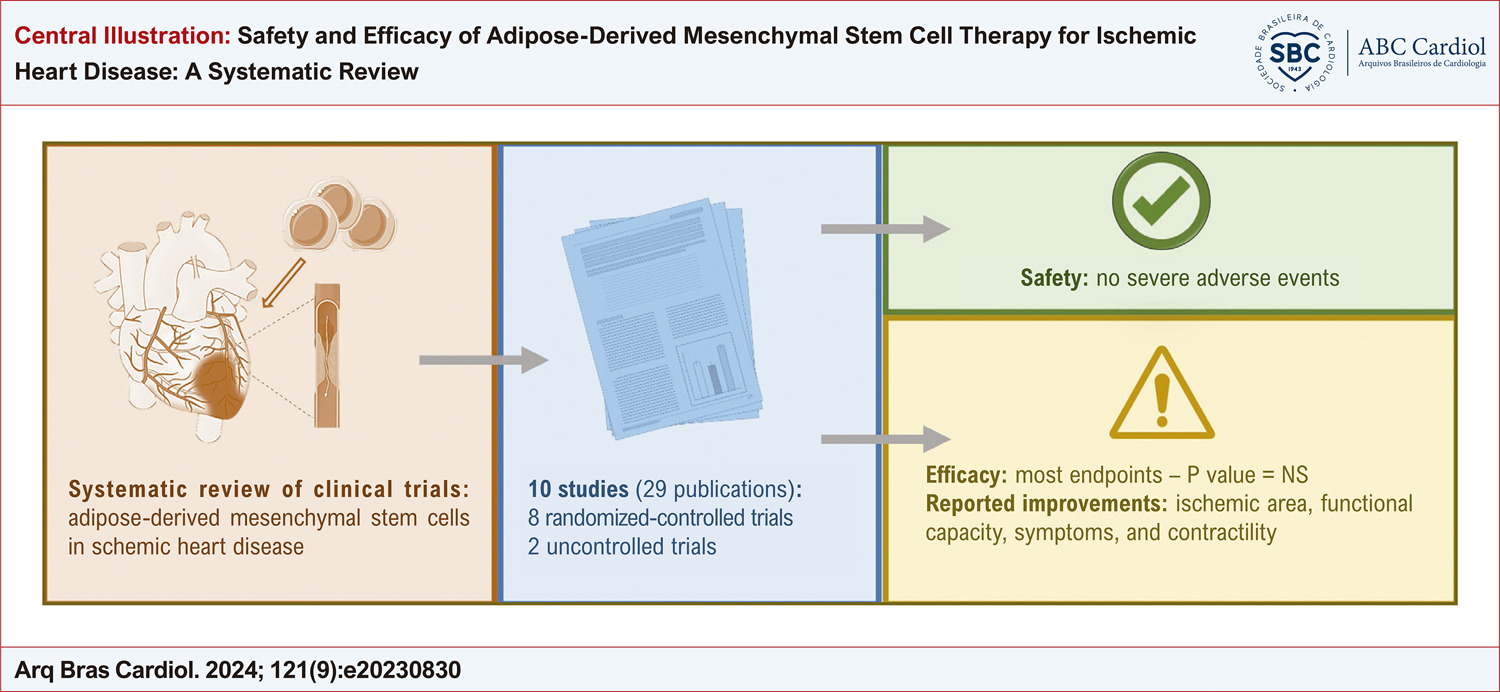
Ten studies (comprising 29 publications) met our inclusion criteria, including 8 randomized controlled trials and 2 uncontrolled trials. No severe adverse events associated with ADSC therapy were reported. While most efficacy endpoints did not reach statistical significance, there were reports of improved ischemic area, functional capacity, symptoms, and contractility in patients treated with ADSCs.

Conclusions

The findings from our review suggest that ADSC therapy is generally safe for patients with ischemic heart disease. However, further investigation is warranted to confirm its efficacy, particularly with larger clinical trials and in specific conditions where improvements in microcirculation may have a notable impact on clinical outcomes.

  • Cell and Tissue-Based Therapy
  • Mesenchymal Stem Cells
  • Myocardial Ischemia
  • Regenerative Medicine
Read Full Article
Creative Commons Attribution (CC BY) Creative Commons license
16/09/2024 DOI: 10.36660/abc.20230830i Views 2
ABC
Editorial

Decellularization of Human Pericardium with Potential Application in Regenerative Medicine

Estela de Oliveira Lima et al. Adriana Camargo Ferrasi Andreas Kaasi

Regenerative medicine is an interdisciplinary branch of the biomedical sciences that is showing, through the transposition of basic research into the clinic, great potential for therapeutic application, and the field is consequently becoming an important frontman for Translational Medicine. The essence of regenerative medicine consists of the repair or replacement of tissues and organs in which there is structural and functional deficiency. With a view of achieving this objective, several approaches have been proposed, including therapies that include genes, cells, biologic and synthetic scaffolds, which may or may not take part of a tissue engineering strategy. When dealing with synthetic scaffolds, it is possible to manipulate and control structural and mechanical properties, nonetheless, it is not possible to guarantee the same functional capacity as natural tissue. In addition, one of the great challenges is minimizing the risk of immunogenic reactions triggered by the repair scaffold’s composition. Owing to the challenges associated with the reestablishment on a functional and structural level of the cell microenvironment, the interest in scaffolds based on natural extracellular matrix (ECM) has increased considerably.

With a view of obtaining a biomaterial closely approximating tissues or organs having suffered damage, be it structural or functional, yet at the same time presenting safety from an immunological point of view, a new technology for clinical applications of ECM has been proposed – the decellularization of tissues and organs from human or animal donors. This technology makes use of physical, chemical and/or biochemical methods to eliminate cells from the target tissue/organ, be it xenogeneic or allogeneic, whose antigens represent an elevated risk of immunogenic reaction. The process seeks to ensure immunologic safety and the preservation of basic structural and functional components of the ECM, such as proteins, collagen and glycosaminoglycans (GAGs). The end product is a three-dimensional ECM scaffold with analogous shape to the original tissue, with preserved ultrastructural architecture and with greater biocompatibility and potential of tissue regeneration when compared to synthetic scaffolds.

[…]

  • Biocompatible Materials
  • Cells
  • Heart Valves/surgery
  • Pericardium
  • Regenerative Medicine
  • Tissue Scaffolds
  • Translational Medical Research
Read Full Article
Creative Commons Attribution (CC BY) Creative Commons license
08/08/2019 DOI: 10.5935/abc.20190130

How to cite this article

EndNote RIS

Electronic Document Format (Vancouver)

Giugni FR, Giugni MOV, Pinesi HT, Habrum FC, Laranjeira LN, Sady ERR, Suzumura EA, et al. Safety and Efficacy of Adipose-Derived Mesenchymal Stem Cell Therapy for Ischemic Heart Disease: A Systematic Review. Arquivos Brasileiros de Cardiologia 2024;121(9):e20230830.

Electronic Document Format (ABNT)

Giugni, Fernando Rabioglio; Giugni, Melina de Oliveira Valdo; Pinesi, Henrique Trombini; Habrum, Fabio Cetinic; Laranjeira, Lígia Nasi; Sady, Erica Regina Ribeiro; Suzumura, Erica Aranha; Gowdak, Luis Henrique Wolff; Krieger, José Eduardo. Safety and Efficacy of Adipose-Derived Mesenchymal Stem Cell Therapy for Ischemic Heart Disease: A Systematic Review. Arquivos Brasileiros de Cardiologia, v. 121, n. 9, e20230830, Sep. 2024.

Electronic Document Format (APA)

Giugni, F. R., Giugni, M. O. V., Pinesi, H. T., Habrum, F. C., Laranjeira, L. N., Sady, E. R. R., Suzumura, E. A., Gowdak, L. H. W., & Krieger, J. E. (2024). Safety and Efficacy of Adipose-Derived Mesenchymal Stem Cell Therapy for Ischemic Heart Disease: A Systematic Review. Arquivos Brasileiros de Cardiologia, 121(9), e20230830.

Electronic Document Format (ISO)

Giugni, Fernando Rabioglio and Giugni, Melina de Oliveira Valdo and Pinesi, Henrique Trombini and Habrum, Fabio Cetinic and Laranjeira, Lígia Nasi and Sady, Erica Regina Ribeiro and Suzumura, Erica Aranha and Gowdak, Luis Henrique Wolff and Krieger, José Eduardo. Safety and Efficacy of Adipose-Derived Mesenchymal Stem Cell Therapy for Ischemic Heart Disease: A Systematic Review. Arquivos Brasileiros de Cardiologia [online]. 2024, vol. 121, n. 9, [cited 2026-10-14], e20230830. Available from: <https://journals.cardiol.br/en/article/safety-and-efficacy-of-adipose-derived-mesenchymal-stem-cell-therapy-for-ischemic-heart-disease-a-systematic-review/>. ISSN 0066-782X

EndNote RIS

Electronic Document Format (Vancouver)

Lima EO, Ferrasi AC, Kaasi A. Decellularization of Human Pericardium with Potential Application in Regenerative Medicine. Arquivos Brasileiros de Cardiologia 2019;113(1):18-9.

Electronic Document Format (ABNT)

Lima, Estela de Oliveira; Ferrasi, Adriana Camargo; Kaasi, Andreas. Decellularization of Human Pericardium with Potential Application in Regenerative Medicine. Arquivos Brasileiros de Cardiologia, v. 113, n. 1, p. 18-19, Aug. 2019.

Electronic Document Format (APA)

Lima, E. O., Ferrasi, A. C., & Kaasi, A. (2019). Decellularization of Human Pericardium with Potential Application in Regenerative Medicine. Arquivos Brasileiros de Cardiologia, 113(1), 18-19.

Electronic Document Format (ISO)

Lima, Estela de Oliveira and Ferrasi, Adriana Camargo and Kaasi, Andreas. Decellularization of Human Pericardium with Potential Application in Regenerative Medicine. Arquivos Brasileiros de Cardiologia [online]. 2019, vol. 113, n. 1, [cited 2026-10-14], pp. 18-19. Available from: <https://journals.cardiol.br/en/article/decellularization-of-human-pericardium-with-potential-application-in-regenerative-medicine/>. ISSN 0066-782X

  • About ABC Family
  • Internal Regulation
  • Editorial Board
  • Brazilian Society of Cardiology (SBC)

Issues

SBC Guidelines

  • Videos
  • Podcasts
  • News