ABC Family Arquivos Brasileiros de Cardiologia International Journal of Cardiovascular Sciences ABC Heart Failure & Cardiomyopathy ABC Imagem Cardiovascular
Português English
ABC Family
Português English
  • About
    • About ABC Family
    • Internal Regulation
    • Editorial Board
    • Brazilian Society of Cardiology (SBC)
  • Issues
  • SBC Guidelines
  • Content
    • Videos
    • Podcasts
    • News
  • About
    • About ABC Family
    • Internal Regulation
    • Editorial Board
    • Brazilian Society of Cardiology (SBC)
  • Issues
  • SBC Guidelines
  • Content
    • Videos
    • Podcasts
    • News

ABC Family

  • ABC Family
  • Arquivos Brasileiros de Cardiologia
  • International Journal of Cardiovascular Sciences
  • ABC Heart Failure & Cardiomyopathy
  • ABC Imagem Cardiovascular
Search in

No content found.

Journals
Ordering
Article types
Others

  1. Home
  2. Keyword: Chronic Kidney Disease
Comparison of Different Glomerular Filtration Rate Formulas in the Prediction of Coronary Artery Disease Severity and Extent
ABC
Original Article

Comparison of Different Glomerular Filtration Rate Formulas in the Prediction of Coronary Artery Disease Severity and Extent

Monica Verdoia et al. Alyssa Clemente Aurelio Malabaila Chantal Montini Andrea Rognoni

Abstract

Background

Chronic kidney disease (CKD) is an established risk factor for coronary artery disease (CAD), displaying a linear relationship with glomerular filtration rate (GFR). The prognostic role of the different formulas for the estimation of GFR is still debated.

Objective

To evaluate the impact of GFR calculation in the prediction of angiographically assessed CAD.

Methods

In consecutive patients undergoing coronary angiography, GFR was assessed at admission with the formulas Cockroft-Gault, Chronic Kidney Disease Epidemiology Collaboration (CKD-EPI), and Modification of Diet in Renal Disease Study (MDRD). A 2-sided p-value < 0.05 was considered statistically significant.

Results

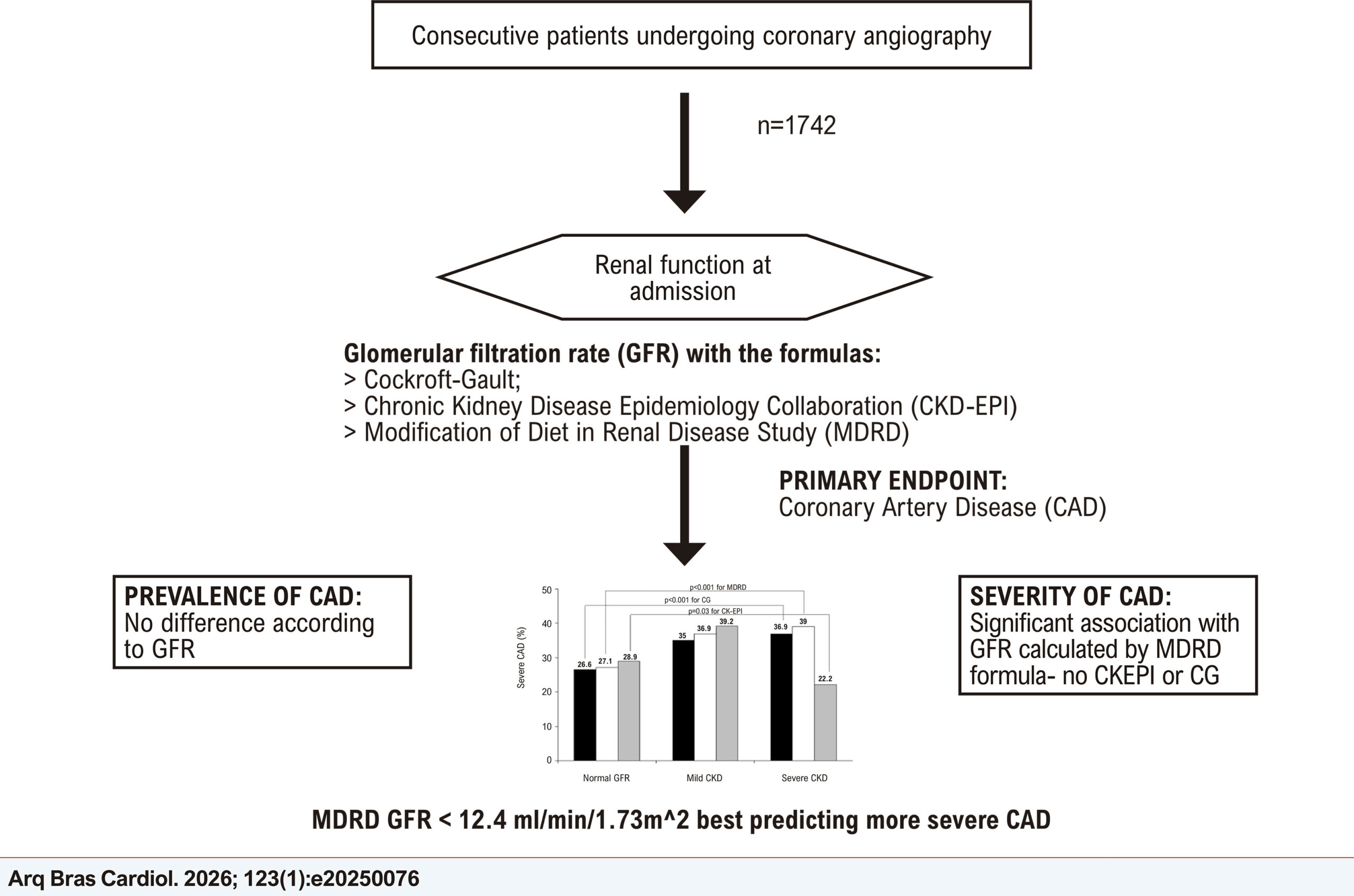
Among 1742 patients, 79.8% displayed CAD. No difference in the mean values of GFR was observed in patients with and without CAD with the three different GFR formulas. We observed a significant association between severe CAD and GFR, by Cockcroft Gault (26.6% vs 35% vs 36.9%, p<0.001), MDRD (27.1% vs 36.9% vs 39%, p<0.001), and CKD-EPI (28.9% vs 39.2% vs 22.2%, p=0.03). In multivariate analysis, only MDRD remained statistically significant (adjusted OR[95%CI]= 1.27[1.01-1.59], p=0.04). In ROC curve analysis, we identified the value of 12.4 ml/min/1.73m^2 as the best predicting value for severe CAD with the MDRD formula. Higher rates of calcifications, restenosis, and chronic occlusion were observed for the Cockroft-Gault and MDRD formulas.

Conclusion

The present study showed a significant association between the extent of angiographically-defined CAD and GFR, estimated by the MDRD, but not for the Cockroft-Gault and CKD-EPI formulas. MDRD values below 12.4 ml/min/1.73m^2 best predicted more severe CAD.
  • Chronic Kidney Disease
  • Coronary Artery Disease
  • Glomerular Filtration Rate
Read Full Article
Creative Commons Attribution (CC BY) Creative Commons license
27/02/2026 DOI: 10.36660/abc.20250076i Views 6
ABC
Editorial

Beyond Atherosclerosis: Mind the Valves in Chronic Kidney Disease

Sofia Cabral

Cardiovascular disease (CVD) remains the leading cause of morbidity and mortality among patients with chronic kidney disease (CKD), far surpassing the risk of progression to end-stage renal disease, and accounting for approximately 40% to 50% of all deaths in the advanced stages.– Growing attention has been directed toward the intersection of renal dysfunction and valvular heart disease (VHD), which plays a major role in the cardiovascular complications and adverse outcomes observed in this population., Valvular calcification, particularly affecting the aortic and mitral valves, is the hallmark manifestation of VHD in this setting, representing a highly prevalent, progressive, and prognostically significant process driven by disordered mineral metabolism, its crosstalk with persistent inflammation, and the toxic uremic milieu., Despite growing acknowledgment of its clinical impact, the biological underpinnings remain incompletely understood, even as emerging evidence begins to clarify the processes driving valvular calcification in CKD.

While several mechanistic pathways have been identified, robust clinical and laboratory markers that predict its development remain elusive. In this regard, the study by Conceição et al. offers valuable insight into the factors associated with valvular calcification, helping to address a relevant blind spot in current knowledge and underscoring the need for continued research into its clinical implications and underlying mechanisms in this high-risk population. Their systematic review was based on twenty observational studies involving 13,314 patients from varied geographic contexts, including individuals both on and off dialysis. Most were cross-sectional in design, with fewer cohort studies and a single case-control study, reflecting the predominantly descriptive and observational nature of the available evidence. The breadth of the population analyzed, combined with the methodological rigor adopted, offers a comprehensive overview of the existing body of evidence in this still underexplored domain. Among the thirty-eight risk factors identified, advanced age (tipically above 55 years),was the most consistently associated with valvular calcification, reported in half of the studies reviewed. These findings lend further support to the concept that ageing represents a major determinant in valvular degeneration in CKD, as it does in the broader context of age-related valve disease in the general population.

[…]

  • calcification
  • Cardiovascular risk
  • Chronic Kidney Disease
  • Valvular heart disease
Read Full Article
Creative Commons Attribution (CC BY) Creative Commons license
08/09/2025 DOI: 10.36660/abc.20250376i Views 1
ABC
Editorial

Osteoprotegerin: A Biomarker in Chronic Kidney Disease

Rui Póvoa

Biomarkers are biological indicators that can be quantified to assess normal or pathological biological processes and responses to various therapeutic interventions. They are found in various body fluids, such as blood, urine, or tissues, and help in the early diagnosis of some diseases, in addition to monitoring progression or evaluating the effectiveness of treatment. In addition to their importance in clinical diagnosis, they can estimate risk and prognosis. This is very well structured in processes whose inflammatory basis stands out in a multifactorial scenario, such as arterial hypertension, diabetes mellitus, dyslipidemia, and chronic kidney disease (CKD).,

CKD, which is a growing public health problem, is increasingly present in the cardiovascular (CV) disease scenario due to its high morbidity and mortality. It is at the evolutionary end of the CV continuum where the main risk factors (hypertension, diabetes, dyslipidemia) have not been adequately treated. In addition, patients with CKD are still at a higher CV risk due to the presence of these factors that often remain without adequate treatment.

[…]

  • Biomarkers
  • Chronic Kidney Disease
  • Osteoprotegerin
  • Vascular Calcification
Read Full Article
Creative Commons Attribution (CC BY) Creative Commons license
02/12/2024 DOI: 10.36660/abc.20240679i
Higher Arterial Stiffness Predicts Chronic Kidney Disease in Adults: The ELSA-Brasil Cohort Study
ABC
Original Article

Higher Arterial Stiffness Predicts Chronic Kidney Disease in Adults: The ELSA-Brasil Cohort Study

Júlia Cândido et al. Lidyane do Valle Camelo Luisa Brant Roberto Sá Cunha … José Geraldo Mill Sandhi Maria Barreto

Abstract

Background

Arterial stiffening can directly affect the kidneys, which are passively perfused by a high flow. However, whether the relation between arterial stiffness and renal function depends on diabetes and hypertension conditions, is a matter of debate.

Objective

To investigate the relationship between arterial stiffening by carotid-to-femoral pulse wave velocity (cfPWV) and chronic kidney disease (CKD) incidence in individuals and verify whether this association is present in individuals without hypertension and diabetes.

Methods

A longitudinal study of 11,647 participants of the ELSA-Brasil followed up for four years (2008/10-2012/14). Baseline cfPWV was grouped per quartile, according to sex-specific cut-offs. Presence of CKD was ascertained by glomerular filtration rate (eGFR-CKD-EPI) < 60 ml/min/1.73 m2 and/or albumin-to-creatinine ratio ≥ 30 mg/g. Logistic regression models were run for the whole cohort and a subsample free from hypertension and diabetes at baseline, after adjustment for age, sex, race, schooling, smoking, cholesterol/HDL ratio, body mass index, diabetes, use of antihypertensive, systolic blood pressure, heart rate, and cardiovascular disease. Statistical significance was set at 5%.

Results

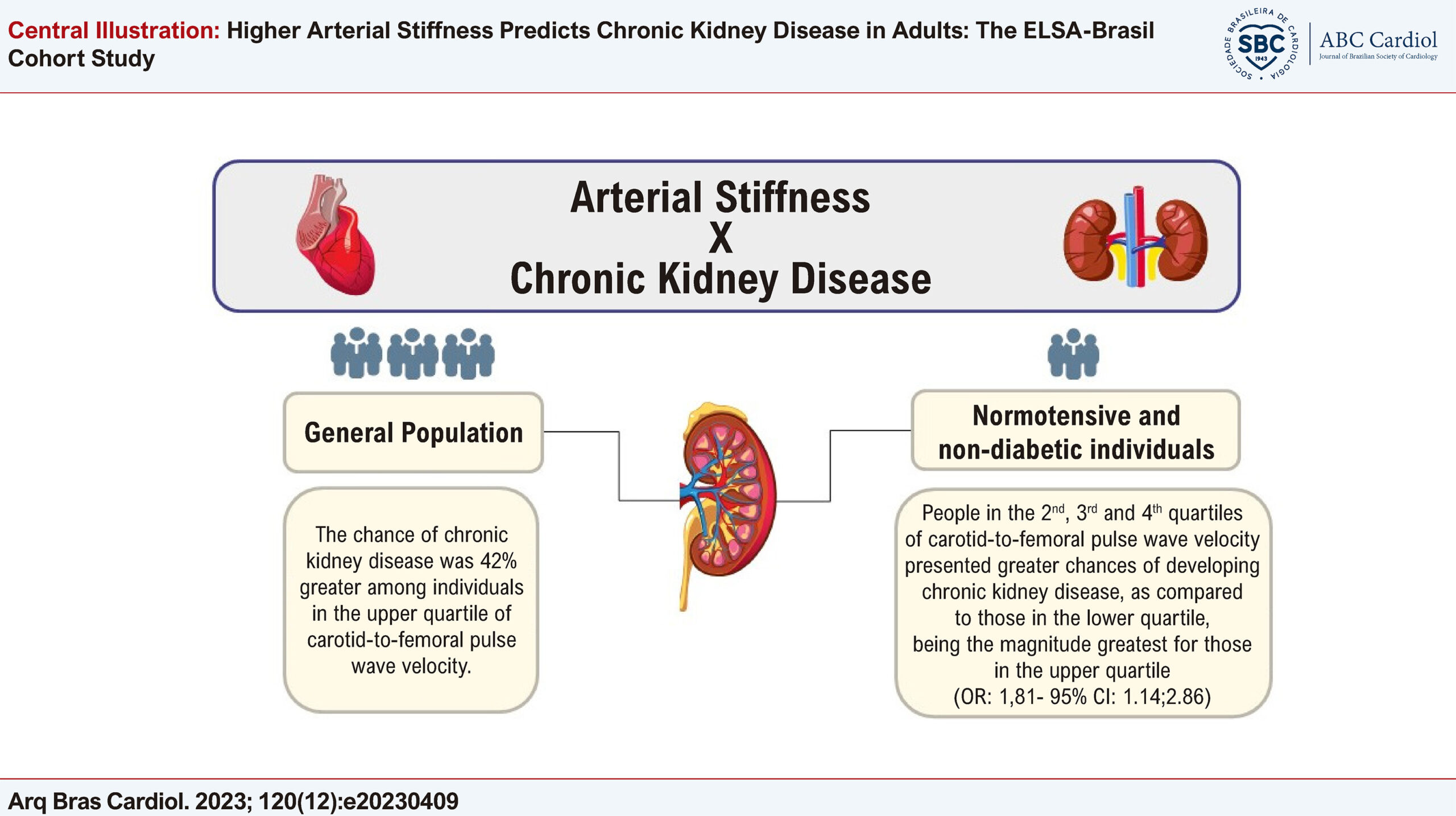
The chance of CKD was 42% (CI 95%: 1.05;1.92) greater among individuals in the upper quartile of cfPWV. Among normotensive, non-diabetic participants, individuals in the 2nd, 3rd, and 4th quartiles of cfPWV presented greater chances of developing CKD, as compared to those in the lower quartile, and the magnitude of this association was the greatest for those in the upper quartile (OR: 1.81 CI 95%: 1.14;2.86).

Conclusion

Higher cfPWV increased the chances of CKD and suggests that this effect is even greater in individuals without diabetes and hypertension.

  • Arterial Stiffness
  • Chronic Kidney Disease
  • Glomerular Filtration Rate
Read Full Article
Creative Commons Attribution (CC BY) Creative Commons license
04/03/2024 DOI: 10.36660/abc.20230409 Views 1

How to cite this article

EndNote RIS

Electronic Document Format (Vancouver)

Verdoia M, Clemente A, Malabaila A, Montini C, Rognoni A. Comparison of Different Glomerular Filtration Rate Formulas in the Prediction of Coronary Artery Disease Severity and Extent. Arquivos Brasileiros de Cardiologia 2026;123(1):e20250076.

Electronic Document Format (ABNT)

Verdoia, Monica; Clemente, Alyssa; Malabaila, Aurelio; Montini, Chantal; Rognoni, Andrea. Comparison of Different Glomerular Filtration Rate Formulas in the Prediction of Coronary Artery Disease Severity and Extent. Arquivos Brasileiros de Cardiologia, v. 123, n. 1, e20250076, Feb. 2026.

Electronic Document Format (APA)

Verdoia, M., Clemente, A., Malabaila, A., Montini, C., & Rognoni, A. (2026). Comparison of Different Glomerular Filtration Rate Formulas in the Prediction of Coronary Artery Disease Severity and Extent. Arquivos Brasileiros de Cardiologia, 123(1), e20250076.

Electronic Document Format (ISO)

Verdoia, Monica and Clemente, Alyssa and Malabaila, Aurelio and Montini, Chantal and Rognoni, Andrea. Comparison of Different Glomerular Filtration Rate Formulas in the Prediction of Coronary Artery Disease Severity and Extent. Arquivos Brasileiros de Cardiologia [online]. 2026, vol. 123, n. 1, [cited 2026-10-14], e20250076. Available from: <https://journals.cardiol.br/en/article/comparison-of-different-glomerular-filtration-rate-formulas-in-the-prediction-of-coronary-artery-disease-severity-and-extent/>. ISSN 0066-782X

EndNote RIS

Electronic Document Format (Vancouver)

Cabral S. Beyond Atherosclerosis: Mind the Valves in Chronic Kidney Disease. Arquivos Brasileiros de Cardiologia 2025;122(8):e20250376.

Electronic Document Format (ABNT)

Cabral, Sofia. Beyond Atherosclerosis: Mind the Valves in Chronic Kidney Disease. Arquivos Brasileiros de Cardiologia, v. 122, n. 8, e20250376, Sep. 2025.

Electronic Document Format (APA)

Cabral, S. (2025). Beyond Atherosclerosis: Mind the Valves in Chronic Kidney Disease. Arquivos Brasileiros de Cardiologia, 122(8), e20250376.

Electronic Document Format (ISO)

Cabral, Sofia. Beyond Atherosclerosis: Mind the Valves in Chronic Kidney Disease. Arquivos Brasileiros de Cardiologia [online]. 2025, vol. 122, n. 8, [cited 2026-10-14], e20250376. Available from: <https://journals.cardiol.br/en/article/beyond-atherosclerosis-mind-the-valves-in-chronic-kidney-disease/>. ISSN 0066-782X

EndNote RIS

Electronic Document Format (Vancouver)

Póvoa R. Osteoprotegerin: A Biomarker in Chronic Kidney Disease. Arquivos Brasileiros de Cardiologia 2024;121(11):e20240679.

Electronic Document Format (ABNT)

Póvoa, Rui. Osteoprotegerin: A Biomarker in Chronic Kidney Disease. Arquivos Brasileiros de Cardiologia, v. 121, n. 11, e20240679, Dec. 2024.

Electronic Document Format (APA)

Póvoa, R. (2024). Osteoprotegerin: A Biomarker in Chronic Kidney Disease. Arquivos Brasileiros de Cardiologia, 121(11), e20240679.

Electronic Document Format (ISO)

Póvoa, Rui. Osteoprotegerin: A Biomarker in Chronic Kidney Disease. Arquivos Brasileiros de Cardiologia [online]. 2024, vol. 121, n. 11, [cited 2026-10-14], e20240679. Available from: <https://journals.cardiol.br/en/article/osteoprotegerin-a-biomarker-in-chronic-kidney-disease/>. ISSN 0066-782X

EndNote RIS

Electronic Document Format (Vancouver)

Cândido J, Camelo LV, Brant L, Cunha RS, Mill JG, Barreto SM. Higher Arterial Stiffness Predicts Chronic Kidney Disease in Adults: The ELSA-Brasil Cohort Study. Arquivos Brasileiros de Cardiologia 2024;120(12):e20230409.

Electronic Document Format (ABNT)

Cândido, Júlia; Camelo, Lidyane do Valle; Brant, Luisa; Cunha, Roberto Sá; Mill, José Geraldo; Barreto, Sandhi Maria. Higher Arterial Stiffness Predicts Chronic Kidney Disease in Adults: The ELSA-Brasil Cohort Study. Arquivos Brasileiros de Cardiologia, v. 120, n. 12, e20230409, Mar. 2024.

Electronic Document Format (APA)

Cândido, J., Camelo, L. V., Brant, L., Cunha, R. S., Mill, J. G., & Barreto, S. M. (2024). Higher Arterial Stiffness Predicts Chronic Kidney Disease in Adults: The ELSA-Brasil Cohort Study. Arquivos Brasileiros de Cardiologia, 120(12), e20230409.

Electronic Document Format (ISO)

Cândido, Júlia and Camelo, Lidyane do Valle and Brant, Luisa and Cunha, Roberto Sá and Mill, José Geraldo and Barreto, Sandhi Maria. Higher Arterial Stiffness Predicts Chronic Kidney Disease in Adults: The ELSA-Brasil Cohort Study. Arquivos Brasileiros de Cardiologia [online]. 2024, vol. 120, n. 12, [cited 2026-10-14], e20230409. Available from: <https://journals.cardiol.br/en/article/higher-arterial-stiffness-predicts-chronic-kidney-disease-in-adults-the-elsa-brasil-cohort-study/>. ISSN 0066-782X

  • About ABC Family
  • Internal Regulation
  • Editorial Board
  • Brazilian Society of Cardiology (SBC)

Issues

SBC Guidelines

  • Videos
  • Podcasts
  • News