ABC Family Arquivos Brasileiros de Cardiologia International Journal of Cardiovascular Sciences ABC Heart Failure & Cardiomyopathy ABC Imagem Cardiovascular
Português English
ABC Family
Português English
  • About
    • About ABC Family
    • Internal Regulation
    • Editorial Board
    • Brazilian Society of Cardiology (SBC)
  • Issues
  • SBC Guidelines
  • Content
    • Videos
    • Podcasts
    • News
  • About
    • About ABC Family
    • Internal Regulation
    • Editorial Board
    • Brazilian Society of Cardiology (SBC)
  • Issues
  • SBC Guidelines
  • Content
    • Videos
    • Podcasts
    • News

ABC Family

  • ABC Family
  • Arquivos Brasileiros de Cardiologia
  • International Journal of Cardiovascular Sciences
  • ABC Heart Failure & Cardiomyopathy
  • ABC Imagem Cardiovascular
Search in

No content found.

Journals
Ordering
Article types
Others

  1. Home
  2. Keyword: Interventional Ultrasonography
Incorporating Intracoronary Lithotripsy into Daily Practice: A Temporal Comparative Analysis of Safety, Efficacy, and Learning Curve
ABC
Original Article

Incorporating Intracoronary Lithotripsy into Daily Practice: A Temporal Comparative Analysis of Safety, Efficacy, and Learning Curve

Guy F. A. Prado et al. Stefano Garzon José Mariani Junior Willterson Bandeira … Felipe Mateus Teixeira Bezerra Breno Oliveira Almeida Gustavo Neves de Araujo Ana Claudia Conrado João Silveira Emanuele Barbato Flavio Ribichini Pedro Alves Lemos

Abstract

Background

Intravascular lithotripsy (IVL) has emerged as a groundbreaking technology for treating calcified coronary lesions.

Objective

To assess whether case selection and interventional performance with IVL have evolved over time after its incorporation into daily practice.

Methods

We prospectively included 104 consecutive patients with 127 calcified coronary lesions treated with IVL. The cohort was divided into two temporal groups (52 patients each) based on the order of patient inclusion. Clinical data and procedural performance were compared between the groups. All statistical tests were two-sided, with a significance level of 0.05.

Results

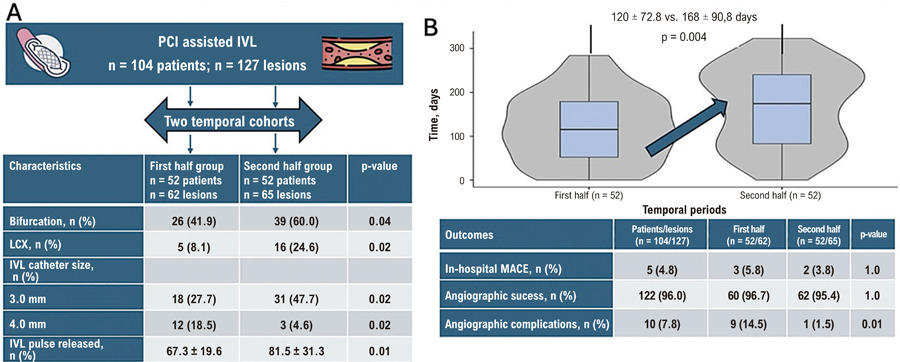
The mean age was 73.2 ± 10.2 years, and 62.5% of patients presented with acute coronary syndromes. Severe calcification and type B2/C lesions were identified in 73.2% and 98.4%, respectively. Upfront IVL was performed in 92.9% of lesions, intravascular imaging was used in 78%, rotational atherectomy in 6.3%, and angiographic success was achieved in 96.0%. Compared with the first cohort, the latter cohort had more bifurcation lesions (60.0% vs. 41.9%; p = 0.04), more interventions in the circumflex artery (24.6% vs. 8.1%; p = 0.02), and a lower use of 4.0-mm diameter balloons (4.6% vs. 18.5%; p = 0.02). The latter cohort spanned a longer inclusion period (168 ± 90.8 vs. 120 ± 72.8 days; p = 0.004) and had fewer angiographic complications (1.5% vs. 14.5%; p = 0.01), whereas in-hospital major adverse cardiac events did not differ (3.8% vs. 5.8%; p = 1.0).

Conclusion

IVL is an effective modality for coronary calcium modification. Temporal changes in case selection and interventional performance may reflect a learning-adaptation curve.
  • Interventional Ultrasonography
  • Learning Curve
  • Lithotripsy
  • Percutaneous Coronary Intervention
Read Full Article
Creative Commons Attribution (CC BY) Creative Commons license
21/09/2026 DOI: 10.36660/abc.20250783i Views 3
Figure 1
ABCIC
Case Report

Coronary Artery Disease In A Rare Anatomical Scenario: Type IV Duplicated Left Anterior Descending Artery

Matheus Sacco Gomes et al. Amanda Raquel Costa Cruz Bruno Leal Martins Mario Henrique Caliano … Patricia de Souza Magalhães Daniel Bandeira Ricardo Costa Marinella Patrizia Centemero

Introduction

Congenital coronary anomalies comprise a heterogeneous group of anatomical variations, most often identified incidentally during non-invasive imaging studies or invasive diagnostic and therapeutic procedures. Studies show that approximately 1.3% of individuals undergoing coronary angiography present some form of coronary anomaly. Although most are considered benign, certain anomalies may be associated with myocardial ischemia, ventricular arrhythmias, and, in rare cases, sudden cardiac death. It is important to emphasize that coexistence with obstructive coronary artery disease (CAD) may amplify their clinical impact.

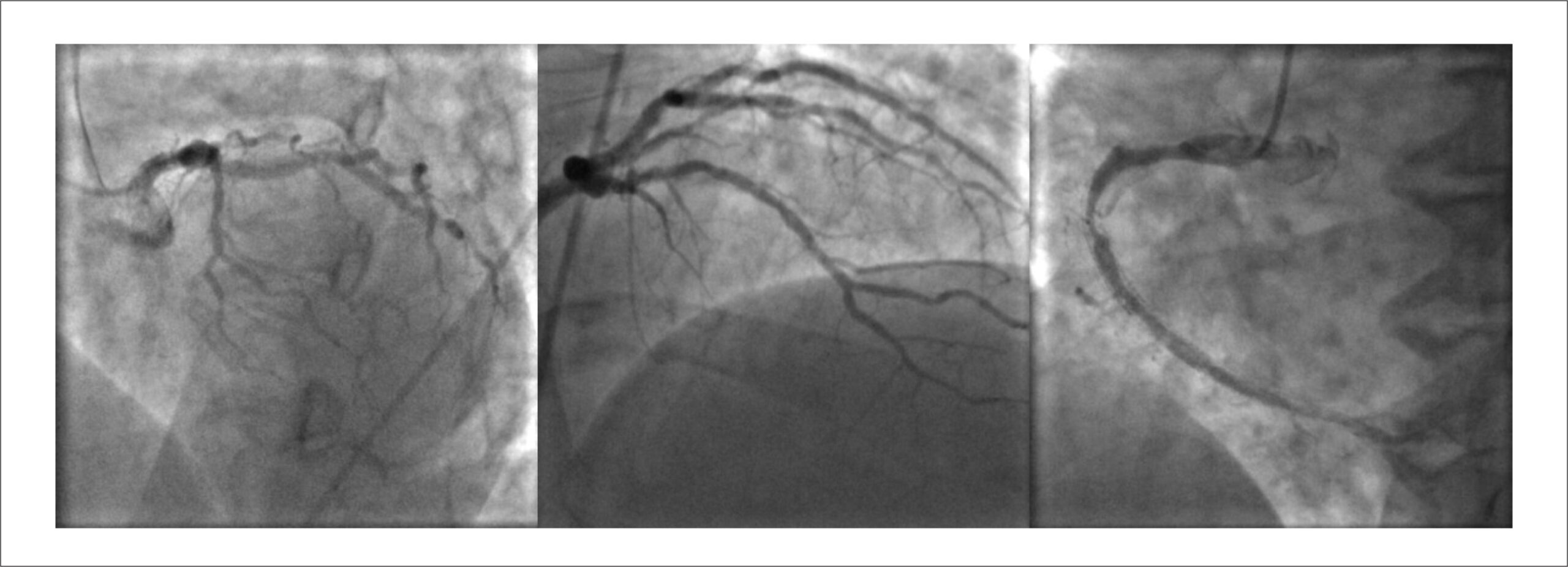
Among these variations, duplication of the left anterior descending (LAD) artery stands out due to its rarity and diagnostic relevance. According to the classification proposed by Spindola-Franco et al. (), this anomaly is divided into four types based on the origin and course of the branches. In Type I, the most frequent form, the short and long LAD originate from the bifurcation of the main LAD artery; the short LAD artery follows the anterior interventricular groove and terminates early, whereas the long LAD artery runs parallel along the left ventricular surface before rejoining the distal groove. In Type II, the short and long LAD also arise from the bifurcation of the main LAD artery; however, the long LAD artery courses to the right of the anterior interventricular groove before reaching the apex. In Type III, the long LAD artery has an initial intramyocardial trajectory before emerging distally on the epicardial surface. Finally, in Type IV, the rarest type, a short LAD artery originates from the left coronary artery, while a long LAD artery arises anomalously from the right coronary artery (RCA) or its sinus of Valsalva.² This long branch follows an intraseptal course before emerging in the anterior interventricular groove and reaching the apex, occurring in approximately 0.2% of patients undergoing coronary angiography.

[…]

  • Coronary Artery Disease
  • Drug-Eluting Stents
  • Interventional Ultrasonography
  • Percutaneous Coronary Intervention
Read Full Article
Creative Commons Attribution (CC BY) Creative Commons license
03/09/2026 DOI: 10.36660/abcimg.20260032i Views 1
ABC
Letter to the Editor

Geometric Models in Left Main Coronary Bifurcation: Mathematical Accuracy and Clinical Limits in the Era of Intravascular Imaging

Guilherme O. Araújo et al. Henrique Barbosa Ribeiro

The geometry of coronary bifurcations plays a fundamental role in the pathophysiology of atherosclerosis and in the planning of percutaneous coronary intervention. Among these structures, the bifurcation of the left main coronary artery (LMCA) assumes singular relevance, not only due to the large myocardial territory it irrigates, but also due to the complex interaction between hemodynamic forces, vascular remodeling, and the progression of atherosclerotic disease. In this context, geometric models that estimate the diameter of the main vessel from the dimensions of the distal branches have been proposed as auxiliary tools for vessel sizing and for optimizing interventional strategies. However, studies systematically comparing these models with intravascular imaging tools, which are more precise in measuring coronary arteries, are lacking.–

Garzon et al. evaluated the reliability of the Murray, Finet, and Huo-Kassab models in estimating the dimensions of the LMCA bifurcation in arteries with moderate atherosclerosis, using quantitative coronary angiography (QCA) and Intravascular ultrasound (IVUS) as reference methods.The authors demonstrated that the Murray and Huo-Kassab models exhibit greater accuracy and precision compared to the Finet model, with the Murray model performing particularly better when IVUS is used as the reference standard. These findings are consistent with the theoretical robustness of models based on fluid dynamics principles and energy optimization, in contrast to the Finet model, which is empirically derived from angiographic fractal geometry.–

[…]

  • Angioplasty, Balloon, Coronary
  • Coronary Angiography
  • Interventional Ultrasonography
Read Full Article
Creative Commons Attribution (CC BY) Creative Commons license
03/08/2026 DOI: 10.36660/abc.20260239i Views 1

How to cite this article

EndNote RIS

Electronic Document Format (Vancouver)

Prado GFA, Garzon S, Mariani Junior J, Bandeira W, Bezerra FMT, Almeida BO, Araujo GN, et al. Incorporating Intracoronary Lithotripsy into Daily Practice: A Temporal Comparative Analysis of Safety, Efficacy, and Learning Curve. Arquivos Brasileiros de Cardiologia 2026;123(8):e20250783.

Electronic Document Format (ABNT)

Prado, Guy F. A.; Garzon, Stefano; Mariani Junior, José; Bandeira, Willterson; Bezerra, Felipe Mateus Teixeira; Almeida, Breno Oliveira; Araujo, Gustavo Neves de; Conrado, Ana Claudia; Silveira, João; Barbato, Emanuele; Ribichini, Flavio; Lemos, Pedro Alves. Incorporating Intracoronary Lithotripsy into Daily Practice: A Temporal Comparative Analysis of Safety, Efficacy, and Learning Curve. Arquivos Brasileiros de Cardiologia, v. 123, n. 8, e20250783, Sep. 2026.

Electronic Document Format (APA)

Prado, G. F. A., Garzon, S., Mariani Junior, J., Bandeira, W., Bezerra, F. M. T., Almeida, B. O., Araujo, G. N. , Conrado, A. C., Silveira, J., Barbato, E., Ribichini, F., & Lemos, P. A. (2026). Incorporating Intracoronary Lithotripsy into Daily Practice: A Temporal Comparative Analysis of Safety, Efficacy, and Learning Curve. Arquivos Brasileiros de Cardiologia, 123(8), e20250783.

Electronic Document Format (ISO)

Prado, Guy F. A. and Garzon, Stefano and Mariani Junior, José and Bandeira, Willterson and Bezerra, Felipe Mateus Teixeira and Almeida, Breno Oliveira and Araujo, Gustavo Neves de and Conrado, Ana Claudia and Silveira, João and Barbato, Emanuele and Ribichini, Flavio and Lemos, Pedro Alves. Incorporating Intracoronary Lithotripsy into Daily Practice: A Temporal Comparative Analysis of Safety, Efficacy, and Learning Curve. Arquivos Brasileiros de Cardiologia [online]. 2026, vol. 123, n. 8, [cited 2026-10-14], e20250783. Available from: <https://journals.cardiol.br/en/article/incorporating-intracoronary-lithotripsy-into-daily-practice-a-temporal-comparative-analysis-of-safety-efficacy-and-learning-curve/>. ISSN 0066-782X

EndNote RIS

Electronic Document Format (Vancouver)

Gomes MS, Cruz ARC, Martins BL, Caliano MH, Magalhães PS, Bandeira D, Costa R, et al. Coronary Artery Disease In A Rare Anatomical Scenario: Type IV Duplicated Left Anterior Descending Artery. ABC Imagem Cardiovascular 2026;39(3):e20260032.

Electronic Document Format (ABNT)

Gomes, Matheus Sacco; Cruz, Amanda Raquel Costa; Martins, Bruno Leal; Caliano, Mario Henrique; Magalhães, Patricia de Souza; Bandeira, Daniel; Costa, Ricardo; Centemero, Marinella Patrizia. Coronary Artery Disease In A Rare Anatomical Scenario: Type IV Duplicated Left Anterior Descending Artery. ABC Imagem Cardiovascular, v. 39, n. 3, e20260032, Sep. 2026.

Electronic Document Format (APA)

Gomes, M. S., Cruz, A. R. C., Martins, B. L., Caliano, M. H., Magalhães, P. S., Bandeira, D., Costa, R., & Centemero, M. P. (2026). Coronary Artery Disease In A Rare Anatomical Scenario: Type IV Duplicated Left Anterior Descending Artery. ABC Imagem Cardiovascular, 39(3), e20260032.

Electronic Document Format (ISO)

Gomes, Matheus Sacco and Cruz, Amanda Raquel Costa and Martins, Bruno Leal and Caliano, Mario Henrique and Magalhães, Patricia de Souza and Bandeira, Daniel and Costa, Ricardo and Centemero, Marinella Patrizia. Coronary Artery Disease In A Rare Anatomical Scenario: Type IV Duplicated Left Anterior Descending Artery. ABC Imagem Cardiovascular [online]. 2026, vol. 39, n. 3, [cited 2026-10-14], e20260032. Available from: <https://journals.cardiol.br/en/article/coronary-artery-disease-in-a-rare-anatomical-scenario-type-iv-duplicated-left-anterior-descending-artery/>. ISSN 2318-8219

EndNote RIS

Electronic Document Format (Vancouver)

Araújo GO, Ribeiro HB. Geometric Models in Left Main Coronary Bifurcation: Mathematical Accuracy and Clinical Limits in the Era of Intravascular Imaging. Arquivos Brasileiros de Cardiologia 2026;123(7):e20260239.

Electronic Document Format (ABNT)

Araújo, Guilherme O.; Ribeiro, Henrique Barbosa. Geometric Models in Left Main Coronary Bifurcation: Mathematical Accuracy and Clinical Limits in the Era of Intravascular Imaging. Arquivos Brasileiros de Cardiologia, v. 123, n. 7, e20260239, Aug. 2026.

Electronic Document Format (APA)

Araújo, G. O., & Ribeiro, H. B. (2026). Geometric Models in Left Main Coronary Bifurcation: Mathematical Accuracy and Clinical Limits in the Era of Intravascular Imaging. Arquivos Brasileiros de Cardiologia, 123(7), e20260239.

Electronic Document Format (ISO)

Araújo, Guilherme O. and Ribeiro, Henrique Barbosa. Geometric Models in Left Main Coronary Bifurcation: Mathematical Accuracy and Clinical Limits in the Era of Intravascular Imaging. Arquivos Brasileiros de Cardiologia [online]. 2026, vol. 123, n. 7, [cited 2026-10-14], e20260239. Available from: <https://journals.cardiol.br/en/article/geometric-models-in-left-main-coronary-bifurcation-mathematical-accuracy-and-clinical-limits-in-the-era-of-intravascular-imaging/>. ISSN 0066-782X

  • About ABC Family
  • Internal Regulation
  • Editorial Board
  • Brazilian Society of Cardiology (SBC)

Issues

SBC Guidelines

  • Videos
  • Podcasts
  • News