Erivelton Alessandro do Nascimento et al. Christiane Cigagna Wiefels Reis Fernanda Baptista Ribeiro Christiane Rodrigues Alves … Eduardo Nani Silva Mario Luiz Ribeiro Claudio Tinoco Mesquita
Abstract
Background:
Heart failure (HF) affects more than 5 million individuals in the United States, with more than 1 million hospital admissions per year. Cardiac resynchronization therapy (CRT) can benefit patients with advanced HF and prolonged QRS. A significant percentage of patients, however, does not respond to CRT. Electrical dyssynchrony isolated might not be a good predictor of response, and the last left ventricular (LV) segment to contract can influence the response.
Objectives:
To assess electromechanical dyssynchrony in CRT with LV lead implantation guided by GATED SPECT.
Methods:
This study included 15 patients with functional class II-IV HF and clinically optimized, ejection fraction of 35%, sinus rhythm, left bundle-branch block, and QRS ≥ 120 ms. The patients underwent electrocardiography, answered the Minnesota Living with Heart Failure Questionnaire (MLHFQ), and underwent gated myocardial perfusion SPECT up to 4 weeks before CRT, being reassessed 6 months later. The primary analysis aimed at determining the proportion of patients with a reduction in QRS duration and favorable response to CRT, depending on concordance of the LV lead position, using chi-square test. The pre- and post-CRT variables were analyzed by use of Student t test, adopting the significance level of 5%.
Results:
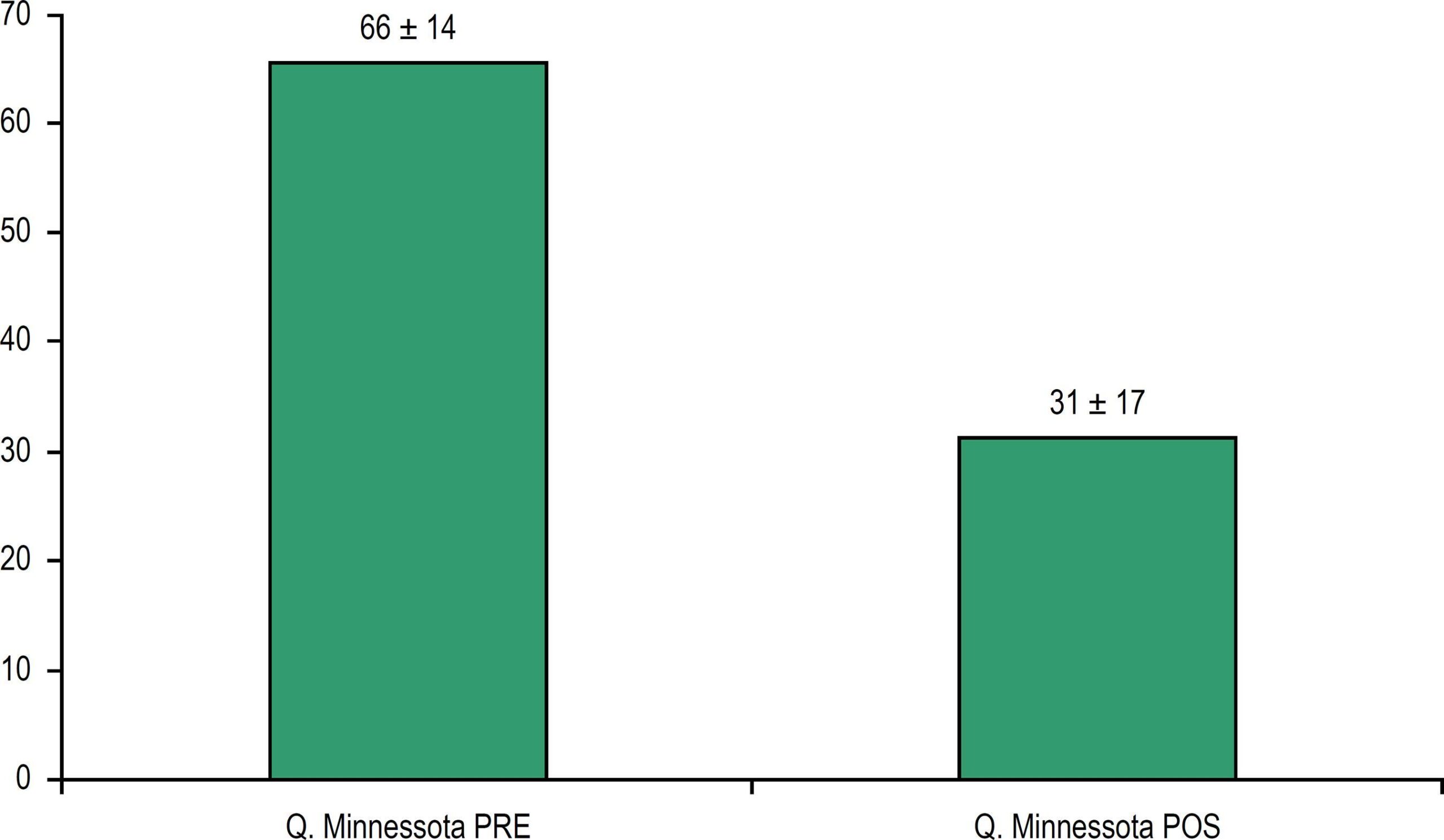
We implanted 15 CRT devices, and 2 patients died during follow-up. The durations of the QRS (212 ms vs 136 ms) and the PR interval (179 ms vs 126 ms) were significantly reduced (p < 0.001). In 54% of the patients, the lead position was concordant with the maximal delay site. In the responder group, the lateral position was prevalent. The MLHFQ showed a significant improvement in quality of life (p < 0.0002).
Conclusion:
CRT determines improvement in the quality of life and in electrical synchronism. Electromechanical synchronism relates to response to CRT. Positioning the LV lead in the maximal delay site has limitations.