Effect of Sacubitril/Valsartan on All-Cause Mortality Reduction in Patients Undergoing Cardiac Resynchronization Therapy: SALVA-CRT
Abstract
Background
Cardiac resynchronization therapy (CRT) is indicated for patients with heart failure with reduced ejection fraction (HFrEF) receiving conventional triple therapy (CTT). Although sacubitril/valsartan (S/V) is a cornerstone of modern triple therapy (MTT) for HFrEF, its effectiveness in patients undergoing CRT implantation has not been adequately evaluated.
Objective
To compare all-cause mortality between CRT recipients on CTT and those on MTT, with a minimum follow-up of 1 year.
Methods
Prospective, observational cohort including patients undergoing a first CRT implantation. Inclusion criteria were left ventricular ejection fraction (LVEF) ≤35% and bundle branch block with QRS ≥150 ms, with prior use of either CTT or MTT. Patients who discontinued any medication, initiated a sodium-glucose cotransporter-2 inhibitor (SGLT2i), or crossed over between CTT and MTT during follow-up were excluded. Statistical analyses used the unpaired Student’s t test (p < 0.05 for significance). Cox regression was applied to variables potentially associated with the outcome (p < 0.1).
Results
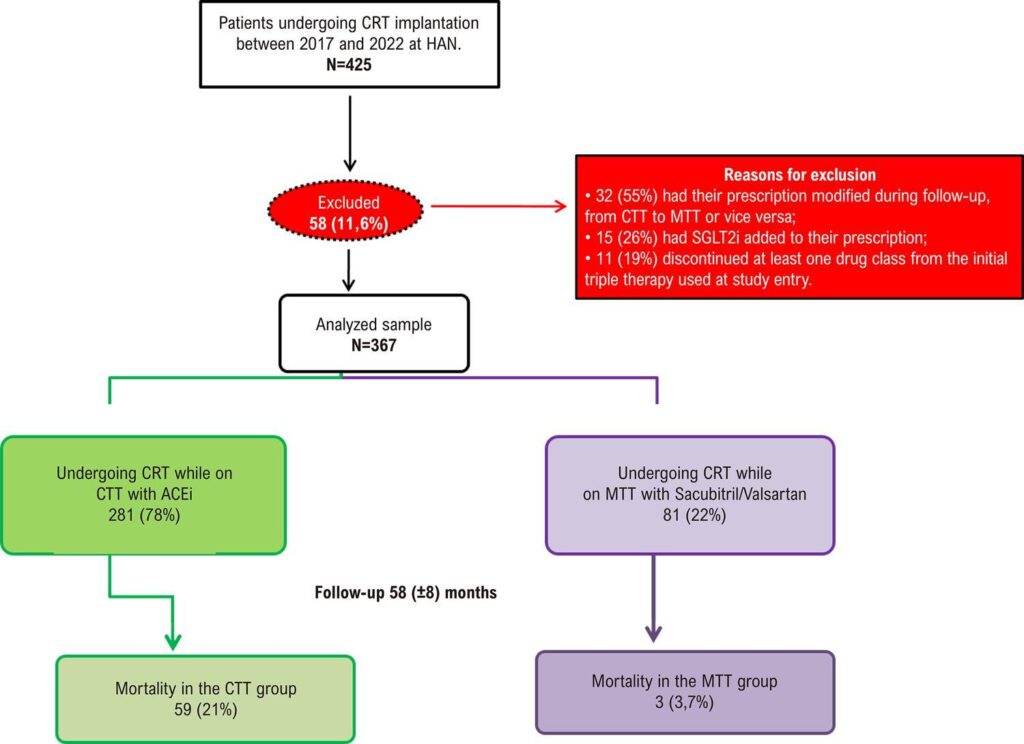
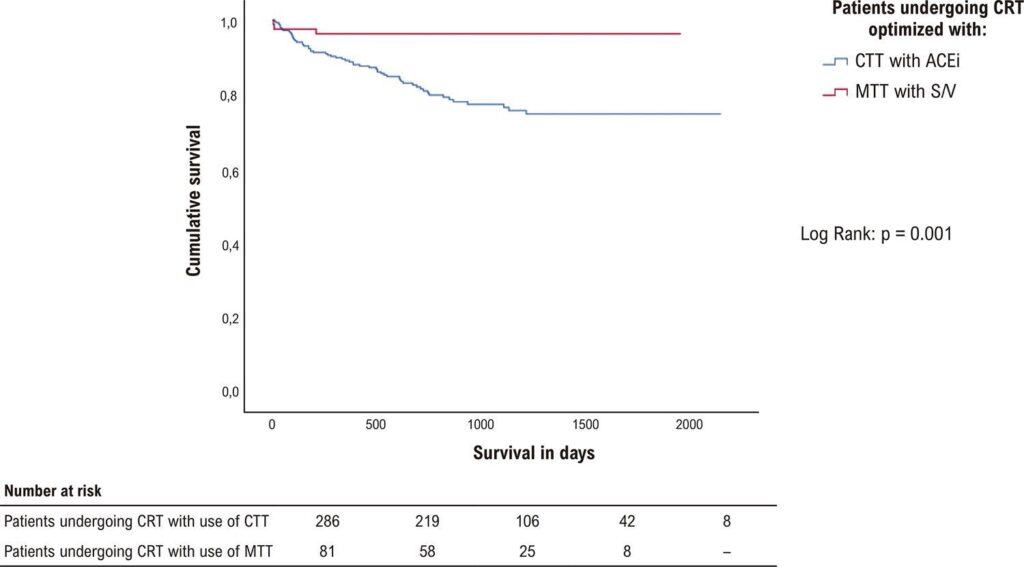
From 2017 to 2022, 425 CRT implantations were performed; 58 (13.6%) patients were excluded. Of the 367 analyzed, 286 (78%) were on CTT and 81 (22%) on MTT. Mean age was 61 (±12) years; mean LVEF was 26% (±6); Chagas disease was the most prevalent etiology (34.3%). Mean follow-up was 58 (±8) months, with 62 deaths (16.9%): 59 (21%) in the CTT group and 3 (3.7%) in the MTT group. The HR was 1.27 (95% CI 1.17–1.39) for CTT and 0.18 (95% CI 0.06–0.58) for MTT. In multivariable analysis, CTT use was the only independent predictor of mortality (HR 5.83; 95% CI 1.81–18.70; p = 0.003).
Conclusion
MTT including S/V significantly reduced all-cause mortality in patients undergoing CRT implantation.
Images
Image gallery fullscreen viewer
Comments are moderated by the editorial team before publication. Discussions should be evidence-based and use scientific language. Conflicts of interest should be declared.