Impact of Intraventricular Blocks on Cardiac Cycle Dynamics: An Echocardiographic and Vectorcardiographic Analysis
Abstract
Background
Left bundle branch block (LBBB) causes delays that alter the mechanics of the ventricular cycle. The effect of other intraventricular blocks (IVB) remains little explored.
Objectives
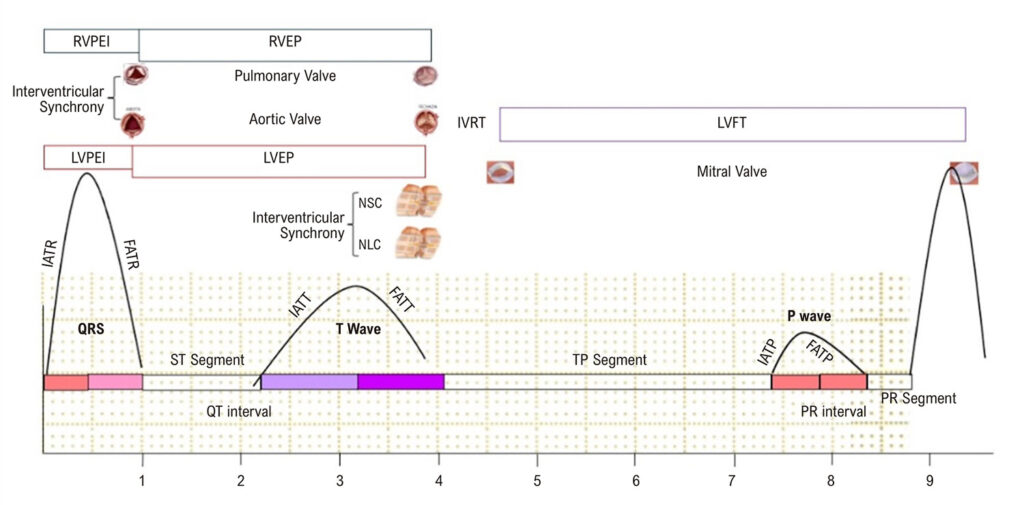
To study the phases of the cardiac cycle (CC) and ventricular synchrony in different ventricular activation patterns.
Methods
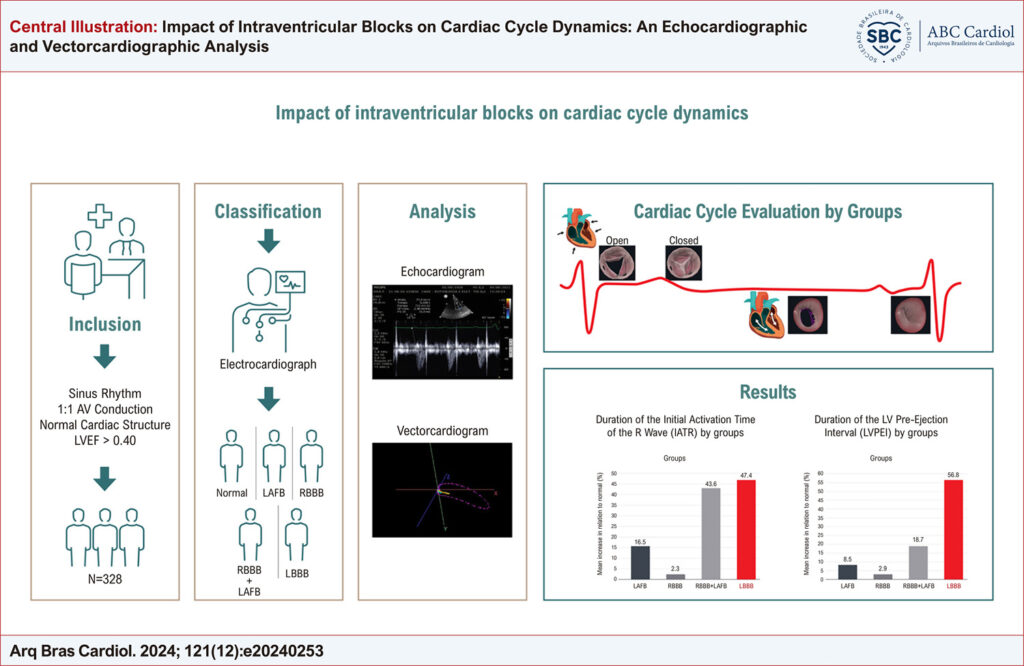
Cross-sectional study with 328 consecutive individuals without structural heart disease, normal electrocardiogram or IVB, conducted in the period between August/2020 and January/2022. Echocardiogram and Vectorcardiogram were performed simultaneously to analyze the electromechanics of the CC. A one-way Analysis of Variance (ANOVA) with Bonferroni’s multiple comparison test was used, with a significance level of 5%.
Results
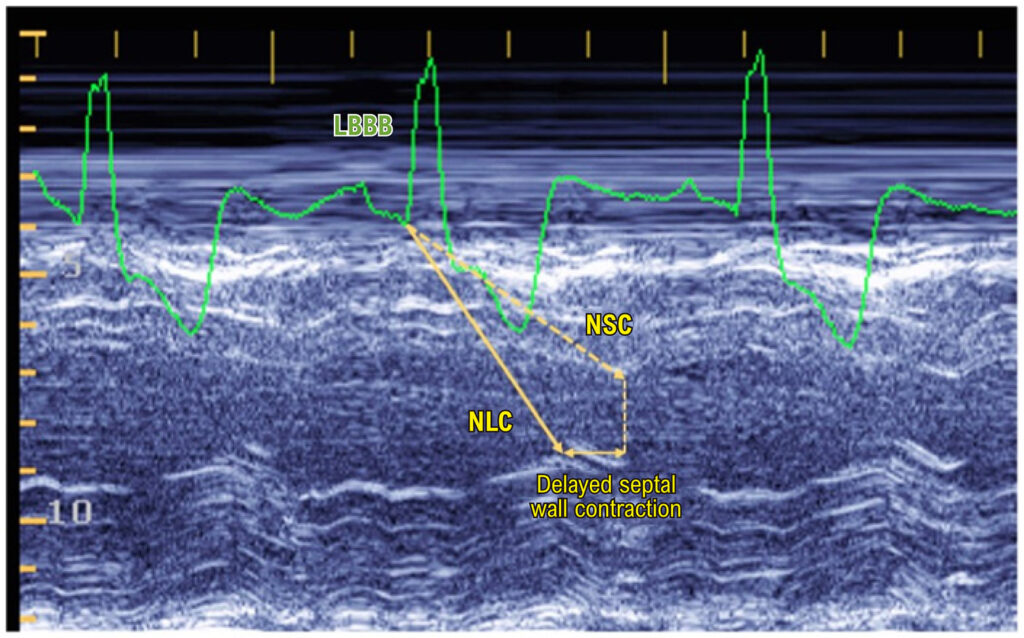
The age of the participants was 64.8±15.3 years, with 57.9% male and an ejection fraction of 67.0±6.8%. The electrocardiogram was normal for 32.3%, 18.6% had right bundle branch block (RBBB), 17.7% had left anterior fascicular block (LAFB), 15.6% had RBBB+LAFB, and 15.9% had LBBB. The echocardiogram showed an increased left ventricular pre-ejection by 18.7% (p<0.001) and 56.8% (p<0.001) in RBBB+LAFB and LBBB, respectively. There was a post-systolic myocardial contraction in all types of IVB and ventricular dyssynchrony in LBBB. Using the vectorcardiogram, initial activation of the R wave was increased by 17.4% in LAFB (p<0.001), 43.5% in RBBB+LAFB (p<0.001) and 47.4% in LBBB (p<0.001) and delayed final activation by 69.4% in LBBB (p<0.001), 73.6% in RBBB+LAFB (p<0.001) and 95.3% in RBBB (p<0.001).
Conclusion
All IVBs modified the CC; however, only LBBB and RBBB+LAFB significantly changed the left ventricular cycle, thereby evidencing the greater complexity of these disorders.
Images
Image gallery fullscreen viewer
Comments are moderated by the editorial team before publication. Discussions should be evidence-based and use scientific language. Conflicts of interest should be declared.