ABC Family Arquivos Brasileiros de Cardiologia International Journal of Cardiovascular Sciences ABC Heart Failure & Cardiomyopathy ABC Imagem Cardiovascular
Português English
ABC Family
Português English
  • About
    • About ABC Family
    • Internal Regulation
    • Editorial Board
    • Brazilian Society of Cardiology (SBC)
  • Issues
  • SBC Guidelines
  • Content
    • Videos
    • Podcasts
    • News
  • About
    • About ABC Family
    • Internal Regulation
    • Editorial Board
    • Brazilian Society of Cardiology (SBC)
  • Issues
  • SBC Guidelines
  • Content
    • Videos
    • Podcasts
    • News

ABC Family

  • ABC Family
  • Arquivos Brasileiros de Cardiologia
  • International Journal of Cardiovascular Sciences
  • ABC Heart Failure & Cardiomyopathy
  • ABC Imagem Cardiovascular
Search in

No content found.

Journals
Ordering
Article types
Others

  1. Home
  2. Keyword: SPECT
Clinical Impact of Assessment of Myocardial Flow Reserve in Identifying the Cause of Chest Discomfort
ABC
Original Article

Clinical Impact of Assessment of Myocardial Flow Reserve in Identifying the Cause of Chest Discomfort

Ronaldo Lima et al. André Luiz Ferreira Bezerra Marianna Daibes Claudio Domenico Andrea De Lorenzo

Abstract

Background:

Gamma cameras with cadmium-zinc telluride (CZT) detectors allowed the quantification of myocardial flow reserve (MBF), which can increase the accuracy of myocardial perfusion scintigraphy (MPS) to detect the cause of chest discomfort.

Objective:

To assess the clinical impact of MBF to detect the cause of chest discomfort.

Methods:

171 patients with chest discomfort who underwent coronary angiography or coronary CT angiography also underwent MPS and MBF in a time interval of <30 days. The acquisitions of dynamic imaging of rest and stress were initiated simultaneously with the 99mTc injection sestamibi (10 and 30mCi, respectively), both lasting eleven minutes, followed by immediately acquiring perfusion images for 5 minutes. The stress was performed with dipyridamole. A global or per coronary territory MBF <2.0 was classified as abnormal.

Results:

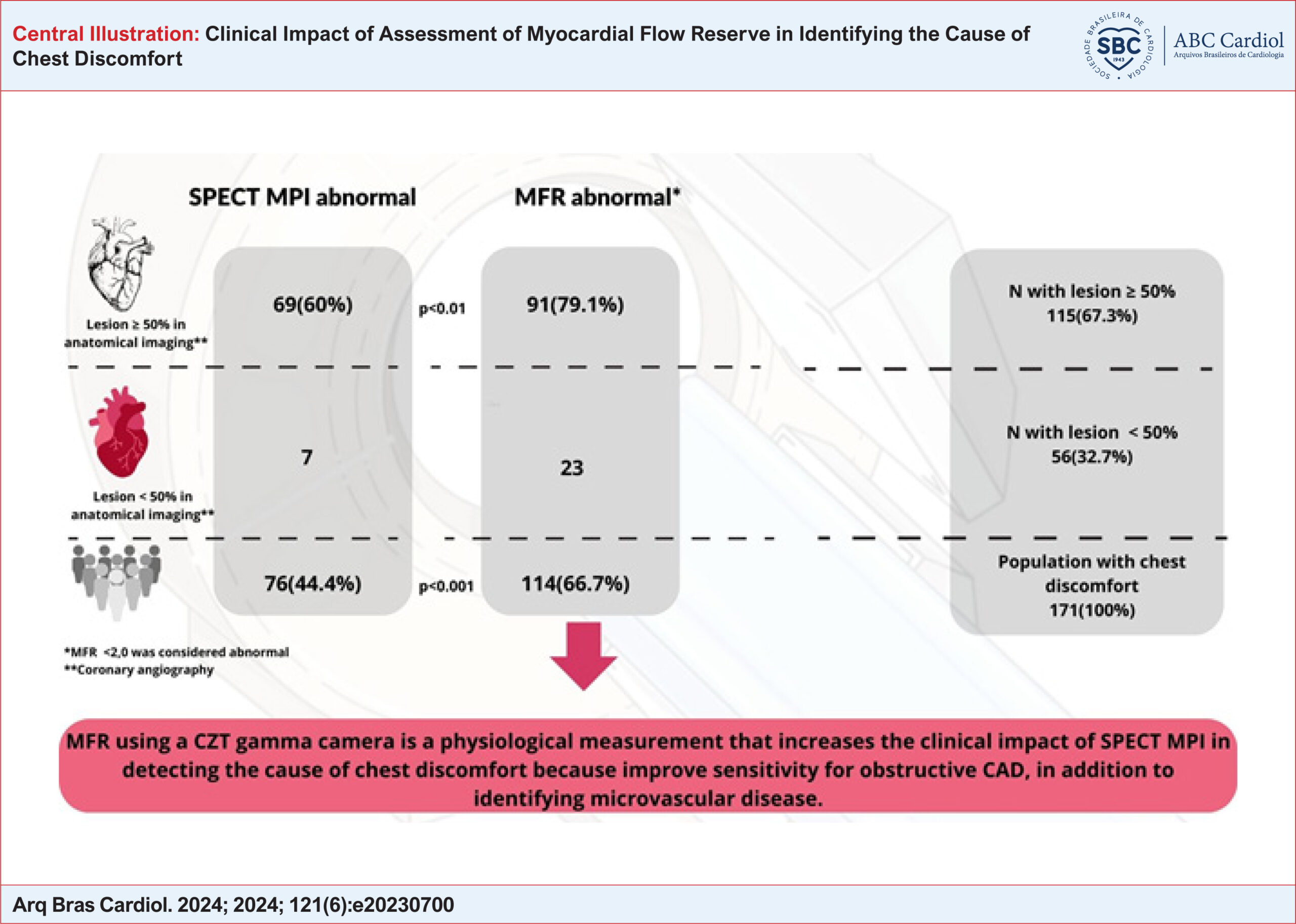
The average age was 65.9±10 years (60% female). The anatomical evaluation showed that 115 (67.3%) patients had coronary obstruction significant, with 69 having abnormal MPs and 91 having abnormal MBF (60.0% vs 79.1%, p<0.01). Among patients without obstruction (56 – 32.7%), 7 had abnormal MPS, and 23 had reduced global MBF. Performing MBF identified the etiology of the chest discomfort in 114 patients while MPS identified it in 76 (66.7% vs 44.4%, p<0.001).

Conclusion:

MBF is a quantifiable physiological measure that increases the clinical impact of MPS in detecting the cause of chest discomfort through greater accuracy for detecting obstructive CAD, and it also makes it possible to identify the presence of the microvascular disease.
  • Myocardium Flow Reserve
  • Myocardium Ischemia
  • SPECT
Read Full Article
Creative Commons Attribution (CC BY) Creative Commons license
08/07/2024 DOI: 10.36660/abc.20230700i Views 1
Figure 1
ABC
Original Article

Feasibility of Left Ventricle Lead Implantation in Cardiac Resynchronization Therapy Guided by Gated SPECT and Ventricular Remodeling

Erivelton Alessandro do Nascimento et al. Fernando de Amorim Fernandes Pedro Augusto Carvalho Mira Zhuo He … Weihua Zhou Claudio Tinoco Mesquita

Abstract

Background

Cardiac resynchronization therapy (CRT) may benefit patients with advanced heart failure (HF). Abnormal eccentricity index by gated SPECT is related to structural and functional alterations of the left ventricle (LV).

Objective

The aim of this study is to evaluate the feasibility of LV lead implantation guided by phase analysis and its relationship to ventricular remodeling.

Methods

Eighteen patients with indication for CRT underwent myocardial scintigraphy for implant orientation, and eccentricity and ventricular shape parameters were evaluated. P < 0.05 was adopted as statistical significance.

Results

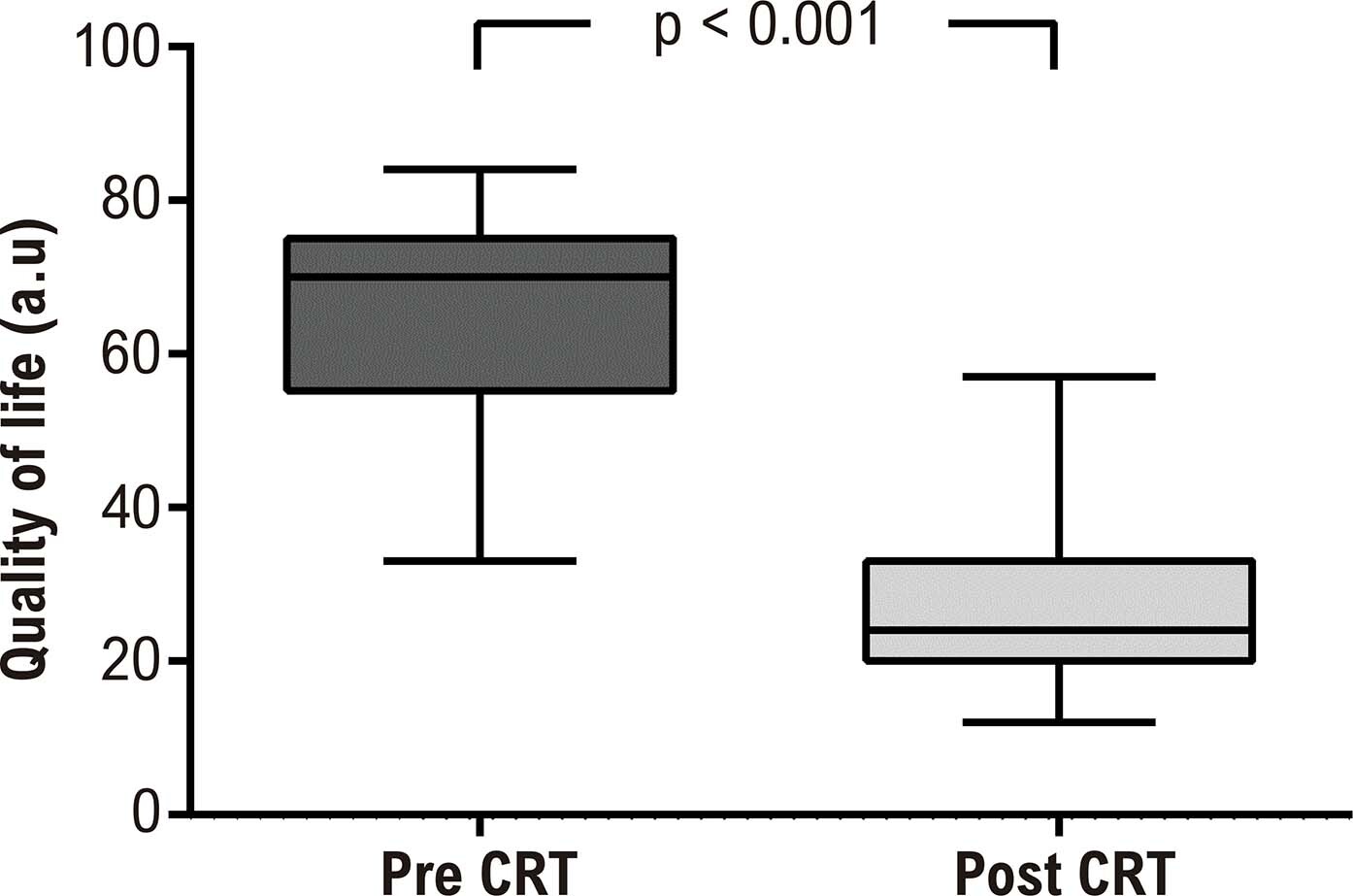
At baseline, most patients were classified as NYHA 3 (n = 12). After CRT, 11 out of 18 patients were reclassified to a lower degree of functional limitation. In addition, patients’ quality of life was improved post-CRT. Significant reductions were observed in QRS duration, PR interval, end-diastolic shape index, end-systolic shape index, stroke volume, and myocardial mass post-CRT. The CRT LV lead was positioned concordant, adjacent, and discordant in 11 (61.1%), 5 (27.8%), and 2 (11.1%) patients, respectively. End-systolic and end-diastolic eccentricity demonstrated reverse remodeling post-CRT.

Conclusions

LV lead implantation in CRT guided by gated SPECT scintigraphy is feasible. The placement of the electrode concordant or adjacent to the last segment to contract was a determinant of reverse remodeling.

  • Cardiac Resynchronization Therapy
  • Heart Failure
  • Left Ventricular Dyssynchrony
  • SPECT
Read Full Article
Creative Commons Attribution (CC BY) Creative Commons license
03/04/2023 DOI: 10.36660/abc.20220077 Views 1

How to cite this article

EndNote RIS

Electronic Document Format (Vancouver)

Lima R, Bezerra ALF, Daibes M, Domenico C, Lorenzo AD. Clinical Impact of Assessment of Myocardial Flow Reserve in Identifying the Cause of Chest Discomfort. Arquivos Brasileiros de Cardiologia 2024;121(6):e20230700.

Electronic Document Format (ABNT)

Lima, Ronaldo; Bezerra, André Luiz Ferreira; Daibes, Marianna; Domenico, Claudio; Lorenzo, Andrea De. Clinical Impact of Assessment of Myocardial Flow Reserve in Identifying the Cause of Chest Discomfort. Arquivos Brasileiros de Cardiologia, v. 121, n. 6, e20230700, Jul. 2024.

Electronic Document Format (APA)

Lima, R., Bezerra, A. L. F., Daibes, M., Domenico, C., & Lorenzo, A. D. (2024). Clinical Impact of Assessment of Myocardial Flow Reserve in Identifying the Cause of Chest Discomfort. Arquivos Brasileiros de Cardiologia, 121(6), e20230700.

Electronic Document Format (ISO)

Lima, Ronaldo and Bezerra, André Luiz Ferreira and Daibes, Marianna and Domenico, Claudio and Lorenzo, Andrea De. Clinical Impact of Assessment of Myocardial Flow Reserve in Identifying the Cause of Chest Discomfort. Arquivos Brasileiros de Cardiologia [online]. 2024, vol. 121, n. 6, [cited 2026-10-14], e20230700. Available from: <https://journals.cardiol.br/en/article/clinical-impact-of-assessment-of-myocardial-flow-reserve-in-identifying-the-cause-of-chest-discomfort/>. ISSN 0066-782X

EndNote RIS

Electronic Document Format (Vancouver)

Nascimento EA, Fernandes FA, Mira PAC, He Z, Zhou W, Mesquita CT. Feasibility of Left Ventricle Lead Implantation in Cardiac Resynchronization Therapy Guided by Gated SPECT and Ventricular Remodeling. Arquivos Brasileiros de Cardiologia 2023;120(3):e20220077.

Electronic Document Format (ABNT)

Nascimento, Erivelton Alessandro do; Fernandes, Fernando de Amorim; Mira, Pedro Augusto Carvalho; He, Zhuo; Zhou, Weihua; Mesquita, Claudio Tinoco. Feasibility of Left Ventricle Lead Implantation in Cardiac Resynchronization Therapy Guided by Gated SPECT and Ventricular Remodeling. Arquivos Brasileiros de Cardiologia, v. 120, n. 3, e20220077, Apr. 2023.

Electronic Document Format (APA)

Nascimento, E. A. , Fernandes, F. A., Mira, P. A. C., He, Z., Zhou, W., & Mesquita, C. T. (2023). Feasibility of Left Ventricle Lead Implantation in Cardiac Resynchronization Therapy Guided by Gated SPECT and Ventricular Remodeling. Arquivos Brasileiros de Cardiologia, 120(3), e20220077.

Electronic Document Format (ISO)

Nascimento, Erivelton Alessandro do and Fernandes, Fernando de Amorim and Mira, Pedro Augusto Carvalho and He, Zhuo and Zhou, Weihua and Mesquita, Claudio Tinoco. Feasibility of Left Ventricle Lead Implantation in Cardiac Resynchronization Therapy Guided by Gated SPECT and Ventricular Remodeling. Arquivos Brasileiros de Cardiologia [online]. 2023, vol. 120, n. 3, [cited 2026-10-14], e20220077. Available from: <https://journals.cardiol.br/en/article/feasibility-of-left-ventricle-lead-implantation-in-cardiac-resynchronization-therapy-guided-by-gated-spect-and-ventricular-remodeling/>. ISSN 0066-782X

  • About ABC Family
  • Internal Regulation
  • Editorial Board
  • Brazilian Society of Cardiology (SBC)

Issues

SBC Guidelines

  • Videos
  • Podcasts
  • News